• Skip to primary navigation
  • Skip to main content
  • Skip to primary sidebar
  • Home
  • About Us
    • Privacy Policy
    • Comment Policy
    • Disclosures & Disclaimers
  • Resources
    • Links, Essays & Articles
    • Fandomology!
    • CLAMP Directory
    • BlogRoll
  • Features & Columns
    • 3 Things Thursday
    • Adventures in the Key of Shoujo
    • Bit & Blips (game reviews)
    • BL BOOKRACK
    • Bookshelf Briefs
    • Bringing the Drama
    • Comic Conversion
    • Fanservice Friday
    • Going Digital
    • It Came From the Sinosphere
    • License This!
    • Magazine no Mori
    • My Week in Manga
    • OFF THE SHELF
    • Not By Manga Alone
    • PICK OF THE WEEK
    • Subtitles & Sensibility
    • Weekly Shonen Jump Recaps
  • Manga Moveable Feast
    • MMF Full Archive
    • Yun Kouga
    • CLAMP
    • Shojo Beat
    • Osamu Tezuka
    • Sailor Moon
    • Fruits Basket
    • Takehiko Inoue
    • Wild Adapter
    • One Piece
    • After School Nightmare
    • Karakuri Odette
    • Paradise Kiss
    • The Color Trilogy
    • To Terra…
    • Sexy Voice & Robo
  • Browse by Author
    • Sean Gaffney
    • Anna Neatrour
    • Michelle Smith
    • Katherine Dacey
    • MJ
    • Brigid Alverson
    • Travis Anderson
    • Phillip Anthony
    • Derek Bown
    • Jaci Dahlvang
    • Angela Eastman
    • Erica Friedman
    • Sara K.
    • Megan Purdy
    • Emily Snodgrass
    • Nancy Thistlethwaite
    • Eva Volin
    • David Welsh
  • MB Blogs
    • A Case Suitable For Treatment
    • Experiments in Manga
    • MangaBlog
    • The Manga Critic
    • Manga Report
    • Soliloquy in Blue
    • Manga Curmudgeon (archive)

Manga Bookshelf

Discussion, Resources, Roundtables, & Reviews

Features & Reviews

Manga the Week of 6/10/20

June 4, 2020 by Sean Gaffney, Michelle Smith, Ash Brown, MJ and Anna N 1 Comment

SEAN: Still June-ing, still dreaming.

J-Novel Club has digital manga and light novels. On the manga end, we get Animeta! 4 and Demon Lord, Retry! 2.

MICHELLE: I enjoy Animeta!, though I can’t really claim that it’s great.

ASH: I’ve been liking it, too.

SEAN: For light novels, there is the 6th The Combat Baker and Automaton Waitress, Outbreak Company 14, the 2nd in the Tales of Marielle Clarac series, The Beloved of Marielle Clarac, and The World’s Least Interesting Master Swordsman 3.

We’ll divide Kodansha into digital with print coming later, and just digital. For the former, we see the debut of Chobits: the 20th Anniversary Edition. One of CLAMP’s more problematic series… and that’s a pretty high bar… it’s still worth a read.

MICHELLE: I haven’t read Chobits in 17 years (I’m so old), so I think I might give it another look.

ASH: Chobits was the first CLAMP work that I read, so it holds a special place for me, problems and all.

MJ: Definitely not my favorite of CLAMP’s work, but I’m interested in what a 20th Anniversary Edition has to offer.

SEAN: There’s also Eden’s Zero 8 and Wotakoi: Love Is Hard for Otaku 4. Definitely looking forward to more Wotakoi.

MICHELLE: Me, too!

ASH: Yes! It seems like forever since the last omnibus. I’ve been enjoying the series a great deal.

ANNA: I’m OK with skipping it!

SEAN: The digital-only debut is Hop Step Sing!. A VR Idol story that lists ‘Kodansha’ as the creator of the original concept, its artist is best known for yuri works from Galette magazine. This runs in Comic Days, though, and is about a girl who becomes a VR Idol, unsurprisingly.

For ongoing digital-only, we see All-Out!! 14, Ex-Enthusiasts: Motokare Mania 4, Fairy Tail: Happy’s Heroic Adventure 4, The Hero Life of a (Self-Proclaimed) “Mediocre” Demon! 3, My Roomie Is a Dino 3, and Orient 3.

MICHELLE: Ex-Enthusiasts is enjoyable josei, so I’m looking forward to more of that.

SEAN: Seven Seas has a digital-first debut, The Legend of Dororo and Hyakkimaru. A retelling of the classic Tezuka story, the artist is known in the West for Attack on Titan: Before the Fall. A young man whose body is split into 48 pieces joins up with a thief to recover them. This runs in Akita Shoten’s Champion Red, but I will try not to hold that against it.

ASH: The original Dororo is a favorite of mine, so I’m very curious to see this version.

MJ: I’m also a big fan of Dororo, so this is interesting to me.

SEAN: Also debuting digitally first is Sarazanmai, the light novel based on the anime series that also spawned a manga prequel, which we’ve already talked about. It is, and I quote, an “action-filled LGBT comedy”.

ASH: Adding it to list of Sarazanmai media I need to catch up on!

MJ: I read very few light novels, but the description sounds great.

SEAN: Digitally first but not debuts are Blank Canvas 5 (the final volume) and Reincarnated As a Sword novel 6.

MICHELLE: Oh, I totally forgot about Blank Canvas! I need to read this.

ASH: It’s such a great series.

SEAN: SuBLime has a debut with Therapy Game. It’s a sequel to Secret XXX, and also runs in Shinshokan’s Dear+. It seems to involve casual sex, heartbreak, and revenge?

Also out from SuBLime is Caste Heaven 2.

Vertical has, digitally, the 4th Bakemonogatari manga, which starts the Suruga Monkey arc.

Viz’s debut is How Do We Relationship? (Tsukiatte Agete Mo Ii Ka Na), a yuri manga from Shogakukan’s Ura Sunday. Based on a doujinshi series, it apparently really gets into the messiness of dating between two young women. I have been looking forward to this one.

MICHELLE: Same.

ASH: Likewise!

MJ: This sounds great!

SEAN: There’s also Komi Can’t Communicate 7, the 2nd Pokemon Adventures Collector’s Edition, Requiem of the Rose King 12, and Sleepy Princess in the Demon Castle 12. Komi and Sleepy Princess have had a crossover between each other. I would not expect Richard from Rose King to appear in either of those series, however.

MICHELLE: *snerk*

ASH: Ha! Likely not. Though it has been known to have dream sequences…

MJ: Always here for the Rose King!

ANNA: Me too!

SEAN: Lastly, some Yen Press hangovers. The 2nd Collector’s Edition of Nightschool, and the third Toilet-Bound Hakano-kun in print.

ASH: I’m really liking Toilet-Bound Hakano-kun, so far!

SEAN: What manga are you burning the midnight lamp over?

Filed Under: FEATURES, manga the week of

Spy x Family, Vol. 1

June 4, 2020 by Sean Gaffney

By Tatsuya Endo. Released in Japan by Shueisha, serialization ongoing in the magazine Shonen Jump+. Released in North America by Viz Media. Translated by Casey Loe.

I have technically reviewed this before. Back when Spy x Family was a brand new manga on the Mangaplus app, I was so taken with it that I did a review of the first four chapters even though it hadn’t even been collected into volumes in Japan. Since then it’s gotten up to four volumes there, been picked up by the Shonen Jump app, gotten ludicrously popular (though rumors of an anime coming soon are likely merely rumors), and now we have the first volume from Viz. Is it worth a reread if you’ve already seen it on the app? Of course. This is a manga that rewards rereads. It’s also the perfect combination of funny and heartwarming, and the Spy and the Family in its title are in almost perfect balance. It also features three leads who can each play the clueless one when the plot allows (yes, even Loid). And of course it’s a found family manga, showing off that when you have people you care about, it can be hard to see them as just pawns for your mission.

Spy x Family takes place in not-Cold War Germany, with tensions brewing between thinly renamed versions of East and West Berlin. Agent Twilight is a master spy, good at almost everything, who is now forced to have a wife and child so that he can infiltrate an exclusive private academy. Going by the name Loid Forger (why not Lloyd? I dunno. Why not Gerald instead of Jellal/Geord?), he goes to an orphanage to adopt Anya, a girl who seems brilliant to him, but it turns out she’s a telepath who just reads his mind to get the right answers. She really wants out of the orphanage, and things Loid is cool. As for a wife, he meets Yor, an office lady who is over 25 yet has no husband, suspicious in this cold war environment. She and Loid both agree to have a sham marriage to prop each other up. Oh yes, she’s also an assassin for the other side. Neither Loid nor Yor know each other’s secrets. Anya knows both, but she thinks it’s really cool, so it’s fine.

This manga is funny. It’s filled with great lines from everyone. Loid’s over-seriousness is mined for comedy. Anya’s childishness and ability to read minds is mined for comedy. Yor is perhaps the best at it, as despite being a lethal assassin, she’s also an airhead of the finest kind. I’d happily read this if it were just broad comedy. But the other reason everyone loves it is the gradual love and affection the family develops for each other, particularly on Loid’s end. The entire reason for him doing this was to infiltrate the school (which they do, in a ludicrous chapter that involves a child stuck in mud, a stampede of wild animals through the campus, and THREE different outfits for everyone “just in case”), and yet when they get there and one of the interviewers starts to humiliate Anya and Yor, Loid snaps and almost hits him, then walks out. His family became (even briefly) more important than the mission. It’s fantastic.

There’s a joke that says that the author came up with the idea of this manga by reading the most popular AO3 tags and mushing them together. It does feel like that at times. But like the best found family/enemies to lovers fanfics, it also has a strong plot, and it’s a lot of fun. I can’t wait for the next volume, even if I have read it before on the Shonen Jump app. It’s just that good.

Filed Under: REVIEWS, spy x family

Der Werwolf: The Annals of Veight, Vol. 7

June 3, 2020 by Sean Gaffney

By Hyougetsu and Nishi(E)da. Released in Japan by Earth Star Novels. Released in North America by J-Novel Club. Translated by Ningen.

For the most part, Der Werwolf has been one of those reincarnation isekai series that tends to ignore the reincarnation most of the time. Veight’s old life in Japan is still mostly a blank to us, and aside from bringing in a few modern ideas to medieval fantasy land, it hasn’t really impacted this story either. That may be changing soon, however, as the cliffhanger at the end of this book seems to show us another Japanese reincarnation, someone who’s looking for Veight specifically. Before that, though, Veight has to finally wrap up this long story arc, helping Eleora to ascend to the throne, fighting off even more plots to try to usurp it from various lords and family members, march through sewers and jump out of windows like a boss, deal with a rival group of werewolves and also a few vampires, and, most importantly, get back home in time like he promised before Airia kicks his ass. He accomplishes… most of these things.

After a number of books that have slowly been killing off the royal family one by one, the theme of this book is trying to solve problems with the least amount of bloodshed. Veight is called “soft” a few times for this, and it’s not inaccurate, but it’s also very politically savvy. The book starts with Ashley on the throne, but he’s a bad emperor for these warlike times. There’s a lord who is clearly plotting… something, and the great joke about him is that every single thing he says is so suspicious that it’s impossible to know how many plans he’s got in his pocket. (Answer: a lot of plans.) There’s also the eldest princess, Dillier, who has grown tired of waiting for a perfect political marriage to be arranged for her and has allied herself with Lord Shallier, thus making one of the most awkward pairing names in some time. (ShallDill?) She’s not evil so much as fed up, so is a lot less difficult to stop.

This book is rather light on its usual tropes. Veight only mentions being a humble vie-commander once or twice, and may even be getting used to people thinking well of him. It helps that he runs into a bishop who is essentially his religious equivalent. Speaking of religion, these books have not been kind to the devout, and that doesn’t really change here, even though the church are not the bad guys this time around. Editing scripture to guide people into doing what you want is a total villain move, but here it’s being used for good. the book is light on Veight being oblivious to everyone being in love with him, too. Eleora clearly is but duty comes before love, so she lets him go. Airia clearly is and I suspect is wondering if she can ask for a kiss or something given Veight promised he’d do a favor for her (as punishment for being late in returning).

And there’s also the shrine maiden we meet in the cliffhanger. Is she going to fall for Veight’s charms? And we we finally get more details about why Japanese folks keep popping up in this world? Not sure, but Der Werwolf remains very well-written and confident. It’s one of the best under-the-radar J-Novel Club series.

Filed Under: der werwolf, REVIEWS

Adachi and Shimamura, Vol. 2

June 1, 2020 by Sean Gaffney

By Hitoma Iruma and Non. Released in Japan by Dengeki Bunko. Released in North America by Seven Seas. Translated by Molly Lee.

When I started this book, I had a very low bar I wanted it to clear, and to its credit, it did. I said on Twitter I was looking for Shimamura to be slightly more interesting and for Adachi to be slightly more gay. On one of those points, the book sails over the bar easily – Adachi’s freaking out about her love for Shimamura, what that says about her, what that says about Shimamura, trying to confess while also desperately hoping she is never found out, and (towards the end) realizing that yes, there is a physical desire in this love as well is probably the highlight of the book. As for Shimamura, sadly, she still narrates a large chunk of the book. She works best when around people more interesting than herself (i.e. the rest of the cast) and especially when she is dragged in an odd direction, which she just goes along with because she’s that sort of person. We saw this last time with the alien girl, and we see it here with her friend Nagafuji.

The book revolves around Christmas in Japan, meaning it’s a lover’s holiday, and also you eat fried chicken. Adachi, trying to convey her feelings without actually doing so, wants to invite Shimamura out to spend the day with her. The first third of the book or so has her working up the courage to do this. The second third splits our heroines into odd pairings – as I noted above, Shimamura and Nagafuji go to get a nice present for… well, for Adachi, but Shimamura, who is not completely clueless about what’s going on here, says it’s for her little sister. Meanwhile, Hino, the other half of “those two girls”, goes to the same mall with Adachi to help her get a present for Shimamura. In the final third, the two go on their not-date, have a relatively nice time, exchange presents, and Adachi tries to confess but doesn’t quite make it.

As with the last book, I think the strengths here lie in the unexpected making an appearance. In this book it’s the boomerang, a ridiculous present to give but also one that appeals highly to Shimamura, who falls in love with the image of Adachi throwing it. (Adachi isn’t wild about it, but it’s a present from the girl she likes, so it’s fantastic. She frames it on her wall. No, really.) I was also somewhat surprised that the book may be trying to pair the spares already, which given its tiny cast makes sense, I suppose. There are a few tiny scenes where you get the sense Hino and Nagafuji are also edging closer to each other, but again, they aren’t quite there. The entire book contrasts comfort (the same old thing every day) with danger (a risk of losing it all, but a big reward if successful. In the end, Adachi chooses to try to fall between the two poles, asking if Shimamura is not just her friend, but her BEST friend. Which, well, she is. For now, I guess Adachi will make do with that.

The flaws of this book are obvious: it still tends towards the dull and ordinary, and even the space alien girl is proving to be just another one of the cast now, hanging out with Shimamura’s younger sister. Oh yes, and there’s a jarring scene at the start when Shimamura, swimming at a fitness center, spots a creeper watching the little kids getting swimming lessons and saying “ew”. It’s meant to be slice of life, and I’m sure this does happen in Japan, but it felt out of place, and I wanted Shimamura to do something about him. Overall, though, if you liked the first book you should like the second. I do wonder how long it can string this out till Adachi finally confesses, though.

Filed Under: adachi and shimamura, REVIEWS

Blue Flag, Vol 1

May 31, 2020 by Anna N

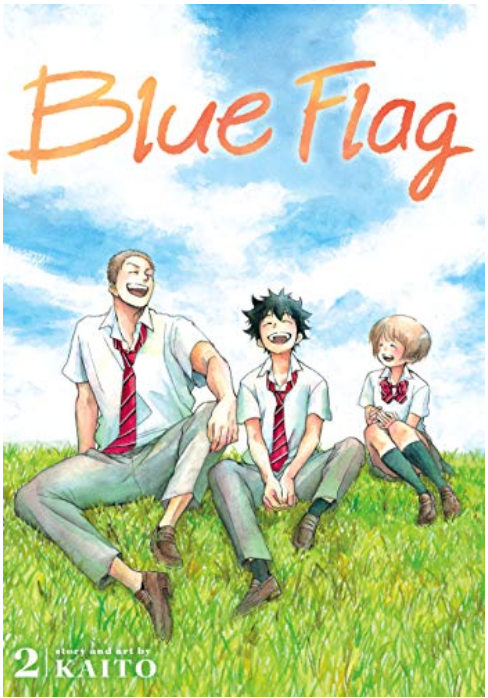
Blue Flag Volume 1 by KAITO

It is fair to say that I read plenty of manga, but now and then I read a series that is just so well executed that it feels incredibly refreshing. I knew Blue Flag had plenty of fans, and I was excited to read it when I heard that it was licensed, but my high expectations were surpassed by the first volume.

The volume opens with some character introductions that remind most readers of standard characters, but the insightful look into Taichi’s inner thoughts as he starts a new school year plays against readers expecting something more stereotypical. Taichi has a small friend group, who all look like they came out of a shonen playbook of nerd 101. He’s fairly content with remaining under the radar at school, but something quickly breaks him out of his usual routine. Taichi’s elementary school friend Toma is going to be in Taichi’s class for the first time in several years. Taichi and Toma are opposites in many ways. Taichi is short and has hair that seems to defy any grooming attempt. Toma is tall, athletic, and extremely popular, but his effortless way of making friends is the result of him being genuinely nice rather than anything overly calculated. Taichi’s friends consider Toma to be a different species than them, and are mystified that Toma keeps popping up to keep randomly talk to Taichi even though Taichi claims that they aren’t close anymore.

Taichi seems to have a special kind of antipathy to Futuba Kuze, a girl in his class who is painfully shy and clumsy. He starts to realize that he’s reminded of his own failings when he looks at her, because she’s similar to him. After an incredibly awkward chance encounter in the library, Futuba asks Taichi for advice because she has a crush on Toma. He thinks that any help he would provide would be useless, but she’s incredibly determined, following up with any random reference that Taichi tosses out. Eventually Taichi agrees to serve as Futuba’s spectacularly uninformed tutor in the ways of teen romance. Taichi is brutally realistic with Futuba about her chances of attracting Toma, but she’s not fazed by the idea that she isn’t his type. Eventually Taichi and Futuba strike up an odd friendship as he keeps trying to draw her in to his usual interactions with Toma. Blue Flag is invested with a ton of emotional resonance as the characters investigate childhood games, deal with homework, and share memories. Futuba explains to Taichi that one of the reasons she’s been nursing a crush towards Toma is that when he accidentally knocked down her plant in the school garden with a stray baseball, he returned every day until it was healthy again.

Towards the end of the volume, the reader gets a sense of what is actually happening in Toma’s head and the realization that the love story that’s unfolding is going to be much more complex and surprising than one would think. Blue Flag rewards the re-reader, who will be able to go back and detect hints in the body language and attitudes of the characters. This is by far one of the most promising shonen series I’ve read in a long time, and the focus on the emotional complexity of teenage live reminded me a bit of Cross Game. I highly recommend Blue Flag, and I’m impatiently waiting for the next volume.

Filed Under: Manga Reviews, REVIEWS Tagged With: Blue Flag, Shonen, viz media

There’s No Way a Side Character Like Me Could Be Popular, Right?, Vol. 1

May 31, 2020 by Sean Gaffney

By Sekaiichi and Tomari. Released in Japan as “Yujinchara no Ore ga Motemakuru Wakenaidaro?” by Overlap. Released in North America by Tentai Books. Translated by Alejandro de Vicente Suárez.

One thing that needs to be made clear about this book’s basic premise is that it only works if our protagonist is using anime/manga terms to talk about real life. Tomoki goes on about the fact that he is a ‘side character’, the best friend to the real protagonist Ike (two syllables, I believe). Ike is handsome, popular, does well in school, etc. Tomoki, on the other hand, has the classic “resting bitch face” that makes everyone terrified of him, rumors of a violent past, and has trouble making friends. Um… Tomoki, I hate to break it to you, but Ike’s type is never, EVER the main character. You are. I therefore assume that he means the ‘main character’ of real life, sort of what the Japanese term ‘reajuu’ – someone who has it together. I will admit that between this, the artist ignoring all Tomoki’s descriptions in the text and drawing him as darkly handsome, and Tomoki’s obliviousness, this didn’t start well for me. That said, it was intriguing, so I read on, and it ended up being pretty decent.

The plot starts when Ike’s younger sister, Touka, a first-year, comes up to Tomoki and asks him to be her boyfriend. She has similar issues to her brother – popular, pretty, good in school – and has a desire to get rid of potential suitors, so needs Tomoki to fake date her. Or at least, so she says. In reality, she’s a lot brattier (and more interesting) than she lets on, and is doing this to try to divide Ike and Tomoki’s friendship. She runs into the brick wall that is Tomoki’s ability to read the room, however, so it doesn’t work, and his essential decency and ability to see her as a real person rather than as “Ike’s sister” lead her to gradually develop real feelings for him. This is upsetting to others, notably Kana, a girl who Tomoki sees as “constantly terrified of him” who, to the reader, clearly has a massive crush on him instead; Kai, Touka’s classmate who has a crush on HER and sees Tomoki as a thug; and Chiaki, their teacher, who… well, we dunno.

As I said, there are some things wrong with this book. It doesn’t start strongly, so bored readers might drop it. More importantly, it can’t decide if it’s a stand-alone or an ongoing series. We get little hints of backstory in regards to Tomoki, particularly from his teacher, who seems sad about something, and Kai, who at some point saw Tomoki beating up a bunch of folks (we see that as well on one of his dates with Touka – the guys are assholes trying to pick her up who go after him first). In other words, Tomoki clearly has a backstory desperately trying to be told. What is it? We don’t really find out here, sadly. On the bright side, Touka is great, striking just the right amount of “I am a brat but also cute” and showing greater depth than I anticipated. And, while initially aggravated at Tomoki’s cluelessness, I really liked that it’s explicitly supposed to be a function of his lack of social skills from ostracization, rather than a comedy “the girls are in love with me and I don’t get it because I am a protagonist” bullet – though it’s partly that as well, of course.

This is a debut from Tentai Books, and the translation seemed decent enough – if a bit over-colloquial at times. (That could simply be me disliking the phrase “smell you later”. On the other hand, “we live in a society, bro”? *chef’s kiss*) I’ll be interested in their other title as well, now. As for the book itself, good and bad, but in the end I did enjoy it, and want to read more, if only to find out what’s been going on before this story began. (That said, the 2nd volume has Kana on the cover, making me worry this will be a “save one heroine per book” series.)

Filed Under: REVIEWS, there's no way a side character like me could be popular right?

Bottom-Tier Character Tomozaki, Vol. 3

May 30, 2020 by Sean Gaffney

By Yuki Yaku and Fly. Released in Japan as “Jaku Chara Tomozaki-kun” by Shogakukan. Released in North America by Yen On. Translated by Winifred Bird.

I’m not sure this series has ‘arcs’ like some other light novels, but there’s no denying that this third volume feels like the end of part one and the start of part two, and it would not surprise me if the upcoming anime decides this is a good place to wrap things up. Here we see Tomozaki finally go on the movie date with Kikuchi that he didn’t do in the last volume, and also invite her out to fireworks, This is part of Hinami’s life plan of getting him dating a girl by the end of summer break. Along the same sort of lines, he goes on a group barbecue/camping trip with the main group, tries to help the others get two of their friends together, and even gets a part-time job. He’s come a long way. The question is, how much of this is him being genuine and how much of this is him doing what Hinami says? And is Hinami really all that successful at life anyway?

The first 3/4 of this volume is merely very good, showing off the characters and situations we like. Tomozaki’s date with Kikuchi is indeed as adorable as expected, as is the fireworks viewing, and it’s her pure and basic honesty that helps him decide how to move forward (and, also, that dating her because of a gaming strategy is not a thing he wants to do). Crucially, she finds it easier to talk to him when he’s not trying to be a “normie”… but doesn’t reject the fact that he’s trying harder. The bulk of the middle of the book is the campout, and it’s fun, and also reminds you that these are, at heart, immature teenagers: a discussion of which girl in the group is hottest revolves around breast size, and Tomozaki may be the first character I’ve seen to canonically get a large penis (it comes up in guy talk), as opposed to in fanfics written about a character.

The last quarter of the book is where things really take off. Misuzawa has seen what Tomozaki has been doing, and finds his odd combination of “trying to be normal” and brutal honesty refreshing. So he tries to open up to Hinami… which goes disastrously. The afterward with her and Tomozaki also goes disastrously, leading to a break in their “teacher/student” relationship and for Tomozaki to backslide into old habits. The best part of this is that it doesn’t reject either premise: Tomozaki’s honest niceness and desire to not do something if he doesn’t want to is a good and sensible thing… and at the same time he dislikes the old, don’t care about appearances or posture self that he gained by learning with Hinami. He likes the fact that he grew as a person… he just wants to do it without moving into uncomfortable directions, like “date the library girl because I told you to.” Best of all, he manages to get Hinami to acknowledge this and start coaching him again, which is a big get given she was ready to completely shut him out of her life.

So another excellent volume, and it also shows that moving forward it will likely be Hinami who has the much harder road ahead. That said, Izumi is the cover girl for the next volume. This has rapidly become a must-read series.

Filed Under: bottom-tier character tomozaki, REVIEWS

Bookshelf Briefs 5/28/20

May 28, 2020 by Ash Brown, Sean Gaffney and Michelle Smith Leave a Comment

Dr. STONE, Vol. 11 | By Riichiro Inagaki and Boichi | Viz Media – Balloons! Yes, Dr. STONE is taking it upon itself to do something it does best, which is show off the gorgeous vistas of this not-really-that-explored future Japan it takes place in. And that means hot air balloons. It also means speedboats! But alas, just because Senku is a scientist does not mean he can cook. So they use some of the last remaining fluid to un-stone a butler-cum-chef-cum-everything, Francois, who is flamboyant and also a lot of fun. There’s actually some really good humor in this volume as well, be it the reporter getting her camera and its undercutting right afterwards, or Senku’s Einstein impersonation. This remains one of the essential Jump titles. – Sean Gaffney

Dungeon Builder: The Demon King’s Labyrinth Is a Modern City!, Vol. 2 | By Rui Tsukiyo and Hideaki Yoshikawa | Seven Seas – After wrapping up the cliffhanger from the first volume (he names his first monster girl, which gives her the power-up (and bust expansion) she needs to win), the cast gets down to the nitty-gritty of what he wants to do: build a city, not a dungeon, which feeds on positive emotions. Of course, there are a few problems. Location, labor costs, the neighboring demon lords, and of course Marcho’s impending death, which she seems to have accepted more than Procel has. This remains sort of mid-tier manga—not interesting enough to stand out, but the pages turn easily, and you could do worse. Also, brilliant pun for the back-cover blurb. – Sean Gaffney

Éclair Blanche: A Girls’ Love Anthology That Resonates in Your Heart | By Various Artists | Yen Press – The second of the Éclair anthologies to come out over here, this one seems to focus more attention on love that is already in bloom when the story begins than love that we see the start of. There’s a nice mix of funny, heartwarming, sad, and generally melancholic. Some highlights are “Azalea Corner,” about a minion’s crush on the arrogant ojou she follows; “The Unemployed Woman and the High School Girl,” which should be awful but is by Canno so is cute instead; and “That Summer Won’t Come Again,” about a girl trapped in her sister’s past who bonds with a senpai and learns to swim again. There’s good and not-so-good here, but overall well worth buying. – Sean Gaffney

Éclair Blanche: A Girls’ Love Anthology That Resonates in Your Heart | By Various Artists | Yen Press – This is the second Éclair anthology, but aside from two continuations, all the stories here are new. The quality varies, and it seems the better stories are in the front. The first story, Fly’s “Flowers in a Storm,” sets the tone for bittersweet, ambiguous endings with the tale of a first kiss that comes too late. There are also several stories about unrequited love for a friend who loves someone else, be it another girl, an idol, or a guy. Kabocha’s “Though Summer Won’t Come Again” is a standout, about a girl who assumes the senpai she’s developed feelings for prefers her older sister, as everyone else seems to. Unfortunately, I found the stories toward the end of the volume to be less enjoyable, particularly the final one, which includes the most awkward teacher-student embrace I have ever seen. Still, I will read the next installment when it comes out! – Michelle Smith

I Didn’t Mean to Fall in Love | By Minta Suzumaru | Futekiya (digital only) – Yoshino Kiritani is a beautiful 30-year-old salaryman who happens to be both gay and a virgin. With no relationship prospects on the horizon and wanting to finally have sex, he goes to a gay bar, meets a charismatic college student named Rou, and sleeps with him. The back-and-forth that follows between these two guys is so well done. Rou is a notorious playboy with a hot-and-cold routine he has employed many times to manipulate his conquests into falling for him and confessing their feelings. He tries this on Yoshino, even though he’s actually serious about him, but it doesn’t work. Self-effacing Yoshino genuinely thinks Rou wants nothing more to do with him, forcing Rou to face the seriously scary prospect of rejection by declaring his feelings first. There are a few explicit scenes, but they serve the characters and story well. Highly recommended! – Michelle Smith

Love Me, Love Me Not, Vol. 2 | By Io Sakisaka | Viz Media – First of all, a word of advice to the author: don’t sink people’s ships in your author’s notes, OK? Secondly, this continues to have the strengths of Io Sakisaka titles—it gets teenage love in a good way, has characters who are likeable but clearly flawed, shows gradual character growth, and has clean, easy-to-follow art. She’s still trying to balance out the idealistic girl with the realistic girl, though it may be leaning towards the former. Sadly, it also contains what’s always been one of this author’s big weaknesses to me—I like her series but never love them. Each volume is fun to read and I’d call it good, but it’s never going to be tops in my favorite shoujo manga lists. It’s not life-changing the way a Yona of the Dawn is. – Sean Gaffney

Ping Pong, Vol. 1 | By Taiyo Matsumoto | Viz Media – Ever since Matsumoto was a guest at TCAF in 2013 and spoke in depth about the series, its development, and how it fit into his overall career, I’ve been desperately wanting to read Ping Pong in English. When the excellent anime adaptation came and went soon after and the original manga still hadn’t been licensed, I didn’t expect that we’d ever see it translated. But it is actually here! The first of two beautifully designed omnibus volumes. And I am absolutely in love with Matsumoto’s Ping Pong. Ostensibly a high school sports manga, Ping Pong spends very little time explaining the ins and outs of the game even though table tennis is essentially omnipresent; instead, the series devotes its attention almost entirely to the characters themselves. With strong psychological elements, in part the work’s themes explore talent, motivation, and self-determination, all supported by Matsumoto’s distinctive and spectacularly dynamic and expressive artwork. – Ash Brown

Prince Freya, Vol. 1 | By Keiko Ishihara | VIZ Media – The land of Tyr is threatened by Sigurd, the empire to the north. Our “wimpy and weak” heroine, Freya, happens to be the spitting image of Prince Edvard, who’s just been poisoned by Sigurd, and so takes on the role of impersonating him to protect her country. Alas, Freya’s performance as Edvard (and characterization in general) is inconsistent and in a way that doesn’t seem intentional on the mangaka’s part. Sometimes she boldly and capably takes action, sometimes she just cries. In my notes I wrote, “This ain’t no Basara,” prompted by a panel in which Freya is making an extremely insipid face because of something sappy her love interest has just said, but then something super dramatic and unexpected occurs and… well, now I’m cautiously on board. It may turn out to be fluffier than I would like, but I will at least give it a couple more volumes. – Michelle Smith

The Quintessential Quintuplets, Vol. 9 | By Negi Haruba | Kodansha Comics (digital only) – There’s less swapping in this one, but the one time there is a swap it blows the reader out of the water. I suspect Ichika’s popularity took a nosedive after this volume, as her ideal of “all’s fair in love and war” is taken to a somewhat cruel conclusion. She’s not even the thirstiest of the quints, as both Nino and Miku are trying to make their feelings for Futaro as clear to him as possible. Meanwhile, Yotsuba is trying the opposite tactic, saying that she’ll support whichever sister that isn’t her he picks, showing off a core of self-deprecation that we’ve seen before, but never to this level. And then there’s Itsuki, who seems to have forgotten she was supposed to be first girl. Great harem antics. – Sean Gaffney

Sacrificial Princess and the King of Beasts, Vol. 9 | By Yu Tomofuji | Yen Press – I missed reviewing the eighth volume of this, for some reason; I’m not sure why. It continues to be quietly sweet, with a heroine who perhaps leans a little too much towards “can save everyone by the sheer power of being really nice.” That said, nice can only go so far, and when she discovers a country that’s being blackmailed into slavery, nice becomes determined and fierce. There’s also some tortured romance at the start—the king’s chief bodyguard and the princess’s attendant clearly are headed towards each other, but there are a few steps back here before we can move forward once more. I admit that I’d likely enjoy this more without its central conceit of animal people, but oh well. – Sean Gaffney

Snow White with the Red Hair, Vol. 7 | By Sorata Akiduki | Viz Media – I admit I was a bit more surprised than Shirayuki was at the identity of the leader of the Lions of the Mountain. That said, it does remind us that Shirayuki is another one of those great “shoujo heroines who underreacts to everything,” which can be quite amusing when done right. That said, this volume is when the series transitioned from the quarterly DX to the main LaLa magazine, and as such much of the middle part is taken up with introducing new readers to the main cast and the situation. This includes an amusing “personality reversal” chapter where Mitsuhide starts acting like a chivalrous knight. the book ends with the implication that their love is going public. How will that go? Great shoujo. – Sean Gaffney

Wandering Witch: The Journey of Elaina, Vol. 1 | By Jougi Shiraishi, Itsuki Nanao, and Azure | Square Enix – This is a manga adaptation of the first fourth or so of the light novel, and it’s a very good adaptation. I will admit that Elaina is a lot more expressive than I was expecting… her delivery in the novels is somewhat cool… but it makes sense given the manga’s visual medium, and she’s cute. This volume shows off what we’re going to get from now on: some cute fluffy stories, some melancholic stories with deaths, some stories of Elaina having to extricate herself from a situation, and some backstory showing how she came to be wandering. The final story was one of my favorites in the book, and it’s the best one here too. A nice adaptation. – Sean Gaffney

Filed Under: Bookshelf Briefs

Manga the Week of 6/3/20

May 28, 2020 by Sean Gaffney, Michelle Smith, Anna N, Ash Brown and MJ 1 Comment

SEAN: June is busting out all over, and while the schedule is not back to normal yet, it’s better than May was.

ASH: Huzzah!

SEAN: First, an apology to a new publisher, Tentai Books, who have their first release out this week and I missed it. They’re publishing in both Spanish and English, and their debut is a light novel, There’s No Way a Side Character Like Me Could Be Popular, Right?. Seems to be targeting the Oregairu/Tomozaki crowd.

As for next week, Ghost Ship has a 9th Yuuna and the Haunted Hot Springs.

J-Novel Club has a lot. In print, we get the debut volume of Sexiled: My Sexist Party Leader Kicked Me Out, So I Teamed Up With a Mythical Sorceress!, which I recommend to absolutely everyone.

ASH: Now that it’s finally in print, I’ll definitely be picking this one up. I’ve heard great things about it from all sorts of people.

ANNA: I’m curious about it too!

SEAN: Also in print: Ascendance of a Bookworm 5, How NOT to Summon a Demon Lord 10, and In Another World with My Smartphone 10.

Digitally, there’s also Altina the Sword Princess 4, a 3rd By the Grace of the Gods, Can Someone Please Explain What’s Going On? 2, Kokoro Connect 9, the 3rd Marginal Operation manga, The Master of Ragnarok & Blesser of Einherjar 11, and a 6th Record of Wortenia War.

Kodansha has a lot, most of which I’ve mentioned before because the schedule shifted. The print and digital debut is Rent-A-Girlfriend (Kanojo, Okarishimasu), a Weekly Shonen Magazine manga by an artist best known for the long-running and unlicensed AKB49: The Rules Against Love. A desperate guy, as the title suggests, rents a girlfriend, who seems perfect… at first. This is getting an anime this summer, and Kodansha describes it as “sweet, naive boy meets cute, ruthless girl”.

Debuting digitally is Stellar Witch LIP☆S (MajoKaitou LIP☆S), a shoujo series from Nakayoshi. A girl who desperately wants to see an idol group turns to a witch to help her. Hijinks ensue.

MICHELLE: I can’t confidently claim Stellar Witch is going to be any better than Rent-A-Girlfriend, but it’s certainly more my speed.

ANNA: This sounds fun, but I am utterly incapable of keeping up with these digital releases.

MJ: Yes, with so many, I find I need to REALLY want to read something for it to stand out from the crowd.

SEAN: No other print stuff, but in digital-first print books we have (be prepared for titles you’ve heard here before…) Cells At Work: Code BLACK 5, Fairy Tail 100 Years Quest 4, Granblue Fantasy 5, Knight of the Ice 2, L♥DK 15, Maga-Tsuki 11-13 (a final volume 3-in-one omnibus two years after a 2-in-one omnibus, YIKES), The Seven Deadly Sins 38, Something’s Wrong with Us 2, and Yuzu the Pet Vet 2.

In digital-only we get A Condition Called Love 4, Chihayafuru 20, Smile Down the Runway 10, and To Be Next to You 6.

MICHELLE: I’ve been catching up on A Condition Called Love and enjoying it. And, of course, I always rejoice for more Chihayafuru.

ANNA: Chihayafuru is the one digital release that I am confident I will get caught up on…one day.

SEAN: Seven Seas has, in early digital release, Love Me for Who I Am (Fukakai na Boku no Subete o), aka Fukaboku. This LGBT manga from GOT Corporation’s Comic MeDu is about a nonbinary protagonist and the nontraditional maid cafe they’re introduced to.

MICHELLE: I’ll definitely be checking this one out.

ASH: Same!

ANNA: Sounds good!

MJ: To illustrate my above point, I’m SO here for this. I will seek it out.

SEAN: Also out early digitally: A Centaur’s Life 18 and Skeleton Knight in Another World light novel 6.

In print, Seven Seas has quite a bit. Debuting is The Invincible Shovel, a light novel that I found hilarious when I reviewed the early digital copy. And we also see Sarazanmai: Reo and Mabu, the manga prequel to the upcoming light novels based on the anime.

ASH: I really need to catch up on Sarazanmai in general.

SEAN: Also out in print: Dungeon Builder: The Demon King’s Labyrinth is a Modern City! 2, How Heavy Are the Dumbbells You Lift? 3, Magical Girl Site 12, Miss Kobayashi’s Dragon Maid 9, and Saint Seiya: Saintia Sho 10.

Viz has two debuts. The first is SPY x FAMILY, a series that should need no introduction but I’m going to anyway. In an unnamed vaguely Eastern European country, a spy needs to have a wife and child to complete his next assignment. A woman who moonlights as an assassin needs a husband so that she isn’t suspicious. And a young girl with esper powers just wants to get away from being experimented on. Together, they are the best found family ever. Oh yes, and except for the girl (who can read minds), they don’t know each other’s profession. A magical series, I want the world to read it. Hilarious and heartwarming.

MICHELLE: So excite.

ASH: Really looking forward to this release!

ANNA: Me too!!!

MJ: This sounds great!

SEAN: The other debut is, of course, My Villain Academia, which replaces the seemingly popular My Hero Academia. Not sure why, maybe its sales were slipping? In any case, this volume focuses on our villain heroes, Shigaraki, Twice, and Himiko Toga. It promises to be DARK as hell. (Also, it is possibly it’s really My Hero Academia 24.)

MICHELLE: Heh. This arc solidified Twice as my favorite amongst the villains.

SEAN: In Shonen Jump news, we get Black Clover 21, Demon Slayer: Kimetsu no Yaiba 13, Dragon Ball Super 9, Food Wars 36 (mercifully the final volume… anyone noticed an annoying trend for popular long-running Jump series to leap off of cliffs into piles of crap lately?), Jujutsu Kaisen 4, My Hero Academia Vigilantes 7, The Promised Neverland 15, We Never Learn 10, and Yu-Gi-Oh Arc-V 7.

MICHELLE: Oh, I had no idea that was the final volume of Food Wars! I reckon since I have read through volume 30 I might as well finish it, pile of crap or no. Also, I’m looking forward to the next Vigilantes volume, as I believe it has more of Aizawa’s past in it.

SEAN: As for Shojo Beat, no debuts, but we get Ao Haru Ride 11, Natsume’s Book of Friends 24, Queen’s Quality 9, and Yona of the Dawn 24. Natsume’s Book of Friends is always near the top of my pile when it comes out, though it may have to wait for me to read Yona.

MICHELLE: I love both dearly, but because Natsume comes out less regularly, I think it’s got the edge for me.

ASH: Natsume and Yona both have my heart, too. Though, I’ve also been enjoying Queen’s Quality.

MICHELLE: I really need to read it. I did enjoy QQ Sweeper.

ANNA: Nice week of many great series coming out!

MJ: Queen’s Quality! Hurray!

SEAN: What are you getting next week? (Please get SPY x FAMILY.)

Filed Under: FEATURES, manga the week of

A Mysterious Job Called Oda Nobunaga, Vol. 1

May 28, 2020 by Sean Gaffney

By Kisetsu Morita and Kaito Shibano. Released in Japan as “Oda Nobunaga to Iu Nazo no Shokugyou ga Mahou Kenshi Yori Cheat Datta Node, Oukoku o Tsukuru Koto ni Shimashita” by GA Novels. Released in North America by Yen On. Translated by Alex Wetnight.

Another in the many examples we’ve seen lately of “how can I get my webnovel to rise to the top of the rankings when it’s just a basic power fantasy?”, A Mysterious Job Called Oda Nobunaga is by the author of I’ve Been Killing Slimes for 300 Years but is almost its polar opposite. It oozes cocky masculinity from every page. Honestly, also like many light novels I’ve read lately, its gimmick is somewhat irrelevant. Oda Nobunaga is in our hero’s head, talking to him about this and that, but I think only gives him specific advice once or twice. The rest of the time, Alsrod is simply being a brilliant warlord, and Nobunaga is in his head going “ah, yes, this reminds me of the time in Japan when I did this! Well done!”. That feeling when one of the greatest Japanese warlords is a backseat driver.

Alsrod, at the age of 18, is ready to get his job that will help to guide his career path. Some get fighter, some get thief. He gets… Oda Nobunaga, and no one has any idea what it means. Not good news. Less good news is that his brother the viscount is ordering him to go defend a castle that is on the verge of certain death… and he can’t refuse because he has to care for their younger sister, who is sickly. All he has is his new job and his childhood friend Laviala. Then he discovers that he has an aptitude for battle and warfare. He occasionally hears Game Stats in his head (very occasionally, thank God), and they help to make him and his allies more powerful. As the book goes on he removes his brother from power, attacks various neighboring provinces, and plans on how to move even further up in the kingdom.

I did mention this book was the opposite of Killing Slimes for 300 Years, and that applies to the pacing as well. This book zooms. By the halfway point Alsrod has killed his brother, become Viscount, is on his way to becoming Count, and taken his childhood friend as a lover and also a buxom and politically savvy wife. (Content warning, he also takes a third lover, who is said to be fifteen years old. This feels like one of those “it’s okay because it’s ancient times” author decisions that is not actually okay.) He carves through the neighboring areas with ease, never facing a single setback in the entire book. There is one brief hint that the second book might have actual conflict – another character has a job that is also a Sengoku Period job, and it’s the retainer who killed Nobunaga, so you sense there will be betrayal. But that’s not in this book. This book is “watch Alsrod be awesome and manly.”

If you like a plain old male power fantasy in every possible way, this is actually an excellent book for you to pick up. It has all of that. If you want conflict, or depth, or even Oda Nobunaga actually doing something, you might want to find another series.

Filed Under: a mysterious job called oda nobunaga, REVIEWS

The Melancholy of Suzumiya Haruhi-chan, Vol. 12

May 27, 2020 by Sean Gaffney

By Nagaru Tanigawa and Puyo. Released in Japan as “Suzumiya Haruhi-chan no Yuutsu” by Kadokawa Shoten, serialized in the magazine Shonen Ace. Released in North America by Yen Press. Translated by Paul Starr.

And now, the end is near. And so we face the final curtain. Since the Haruhi Suzumiya novels began in Japan in 2003, we’ve seen two manga, two anime series, a movie, two manga spinoffs, and two anime of said manga spinoffs. In 2006, Haruhi was the hottest franchise around. But in 2020, quietly, the last Haruhi spinoff has come to an end, and as far as I can tell there’s nothing out there to replace it. The novels are effectively finished, as the author apparently has massive writer’s block. The main manga ended, and Nagato Yuki-chan’s manga ended. And now we have the final volume of Haruhi-chan, though… wait a minute, didn’t we see this before? In 2017? Remember, the volume with the word ‘FINAL’ on it? In fact, didn’t I write these same words back then? And yet here we are with one more Haruhi-chan… and one more short-story from the original author, a sort of “thank you for the gag comic” story.

At least this cover looks a bit more final than the last one. Indeed, the author is far more prepared than last time for the end of the series. In perhaps the funniest chapter in the book, we see Haruhi at college, reminiscing about the old times and telling us what everyone’s up to now… except she can’t, as she’s constrained by the fact that the original source material didn’t tell us anything beyond her and Kyon being in college. (That said, we do get some amusing panels showing Kyon’s sister as a young (and grumpy) teenager, showing that Puyo is at least not constrained when it comes to her.) There are also three final chapters in a row, each concerned with one of the main heroines. Nagato’s is about stasis… She’s in the apartment and Ryoko is there basically being her housewife (Ryoko’s in big mode more than little mode in this book.) Mikuru tries to hint to Tsuruya that she’s going away and won’t be able to be contacted, till Tsuruya insists she’ll just magically invent something that will keep them in touch. And Haruhi seems to be bringing back the very first novel, as once again she’s recreating “Adam and Eve” and Kyon will have to kiss her out of it. (We don’t see that, of course.)

The rest of the volume is more plotless gag-oriented. There’s one last New Year’s dream story, mocking the fact that the cast has grown so large. One last beach episode, featuring Kyon and Sasaki’s gang (don’t worry, the Haruhi gang is out buying swimsuits and tormenting Mikuru). We do not see that picture of Haruhi as a sexy hot 30-year-old that had been floating around the Internet, but we do see college Haruhi looking pretty sexy. And then there’s that short story by the original author at the end, which in effect “fictionalizes” this gag comic, as Haruhi decides to make a gag manga of their lives, and finds someone to draw it… who Kyon and the others can’t actually track down. As a story it’s not much, but it is a sort of sweet thank you, and it’s nice to see that Tanigawa can still write SOMETHING.

Gag comics are not for everyone, and honestly at 12 volumes this one probably went on longer than it should have. But I usually found a great deal to enjoy as I read it – Puyo knows the series inside and out, and allows the characters to be exaggerated while never feeling out of character, even if they’re the butt of the joke. If you enjoyed the Haruhi franchise and want to delve into it one more time, the book makes a pretty decent wake… didn’t I write this before too?

Filed Under: melancholy of haruhi suzumiya, REVIEWS

Bibliophile Princess, Vol. 2

May 26, 2020 by Sean Gaffney

By Yui and Satsuki Sheena. Released in Japan as “Mushikaburi-hime” by Ichijinsha Bunko Iris NEO. Released in North America by J-Novel Club. Translated by Alyssa Niioka.

The second volume of Bibliophile Princess also consists of three stories, but the biggest (and best) takes up the first 2/3 of the book. Prince Chris has to go away on kingdom business for several days, and so Elianna will be representing him at a noble’s hunting-dancing-and-being-rich party. Naturally the party turns out to be a web of intrigue, from the expected (Elianna, despite being officially engaged to the Prince, is still not very popular with many young women, leading to a lot of catty remarks) to the dangerous (Elianna is almost killed by a runaway boar, knocked from her horse, threatened with violence by an assholish noble trying to mack on one of her new friends, and locked in a room with another noble in an attempt to besmirch her reputation). Fortunately, Elianna is able to get through it with a nice combination of book-learning, air-headedness, and a surprising amount of muscle. Takes strength to climb those library ladders searching for books, after all.

The author knows that Elianna’s personality is the main reason we’re reading the book, and shows it off nicely. That said, she grows in this book, not quite floating through every situation like a dandelion puff. Indeed, a lot of what goes on in this book could be a life lesson in “don’t be so naive and oblivious”, as is pointed out several times, especially by her cousin Lilia, who stomps through this book in a perpetual state of aggravation, which is great. When several young ladies snipe at her, she actually does get that they’re being insulting now, even if she chooses not to bother to respond. And she remains dedicated to her ideals – there is a subplot here involving the warlike nation they decided to give aide to in the last volume, and how a lot of people on both ides would feel more comfortable if the aid were military rather than otherwise. Elianna defends herself wonderfully, the only time she gets emotional in this book when it doesn’t involve books.

The other two stories are shorter and also less successful. Glen has fit into his role as the series whipping boy very easily, but it doesn’t mean I want to read a whole chapter about it. His company whine about why they have bad luck with women – just listening to them should tell you. That said, I will also admit (and this applies to the main story as well) that Prince Chris can be… a bit exhausting. Dial it back a bit, guy. There’s also a “is Elianna pregnant?” scene here that wouldn’t work if anyone took two seconds not to be mad and simply think about Elianna’s personality. The second story is another one that shows two people who are deeply in love with each other but don’t think that the other one is, leading to misadventures in a locked warehouse and Elianna getting to show off how she can still be terrifying in the right lighting and when covered in red dye.

Still, the first story is what sticks with you, and it’s excellent. I’m not sure if the next volume will have Elianna and Chris’ wedding – it’s in the spring, we’re told, but that’s still months away here – but I am hoping that the series will continue to have Elianna doing what she does best. And perhaps kicking a few more guys in the balls, too. That was fantastic.

Filed Under: bibliophile princess, REVIEWS

Shortcake Cake, Vol 8

May 25, 2020 by Anna N

Shortcake Cake, Volume 8 By suu Morishita

Some shoujo series have fast-paced drama, and others have stories that unfold much more slowly like Shortcake Cake, which finally gets around to hinting at more details between the oddly hostile relationship between Riku and Rei. Morishita’s is so great at presenting her story with a slow, slice of life feel that I don’t feel annoyed at all that I was waiting until volume 8 to get a few more clues about Riku’s past.

Shortcake Cake 8

This volume is set during Christmas and New Year’s and Ten decides to take Riku on a date to her hometown, where she gives him a tour of all the places that were meaningful to her during her childhood, and they drop in on her parents and her older brother. It might be way too early for Riku to meet her parents, but he carries off the surprise visit with his characteristic aplomb. Ten and Riku enjoy actually being able to spend time together since they have to keep apart and pretend to not be dating at the boarding house. Ten wants to continue to support Riku and get to know him better, but she senses some inner pain that she’s not able to interpret or help with. Ten and Chiaki decided to team up to learn more about Riku because they both want to support him. Ten ends up reaching out to Shiraoka, who has a bit of a messy approach for telling them what he knows about Riku’s past, setting up a situation where they end up witnessing a painful family confrontation.

I always enjoy the way the story in Shortcake Cake is tied so closely with the seasons, as Ten and Riku share some cozy winter bonding time, the image of red lights on the snow suggests both festivities and danger, and the rain during a memorial services highlights the emotional state of the characters. Even when the characters are dealing with some heavy emotional burdens, the pacing and execution of Shortcake Cake makes it feel like a brief escape from the real world while reading it.

Filed Under: Manga Reviews, REVIEWS

Accel World: The Snow Sprite

May 25, 2020 by Sean Gaffney

By Reki Kawahara and Hima. Released in Japan by Dengeki Bunko. Released in North America by Yen On. Translated by Jocelyne Allen.

Everyone has things they’re good and bad at, and realizing that is one of the best ways to stop being frustrated. To Reki Kawahara’s credit, I think he’s aware of his strengths. He writes good battle scenes. Especially these days, when he’s got years of experience that Sword Art Online (which, let’s remember, is mostly ported from his almost 20-year-old webnovel) does not. And this, the 21st volume of Accel World, finally gets to the big fight against White Cosmos that we’ve been waiting for for about a year now. As such, it should not be too surprising that this is one of the stronger volumes we’ve had in Accel World for some time. It also helps that, in among the action, which is exceedingly well-timed, there are also several plot beats that we’ve had hanging around for a while now that we actually get answers to. Not everything, of course – the reason White Cosmos are doing all this is left vague – but enough that the emotional payoff of the book is very satisfying.

We’ve spent a lot of time taking all sorts of precautions to make sure that Nega Nebulus are as prepared as possible to attack White Cosmos. It should therefore be no surprise to find that everything goes spectacularly wrong almost immediately. The group is forcibly taken to the Unlimited Neutral Field, then it’s transformed into a Hell Stage. 90% of the cast are caught in a “kill you over and over till you permanently die” trap, though fortunately no one permanently dies. Indeed, the biggest twist of the book is someone NOT dying. Sort of. In amongst this, Silver Crow and Lime bell are able to escape, but there are endless numbers of traps still waiting for them… heck, even the upper strata where Haruyuki can confab with Metatron proves to be attackable by our villains. How can they possibly win?

This isn’t all just fights, of course. The reason the fights work well in these books is the emotional beats we get along with them. Chocolat Puppeter helping to given everyone a leg to stand on, and also providing the best cliffhanger ever. Magenta Scissor, still in the throes of her heel face turn. Trilead Tetraoxide, outside the palace for the first time in the series, kicking a lot of ass. The villains are no less impressive. Kuroyukihime’s sister does not put in an appearance, of course, but we do get the snow sprite of the title, as well as a Rose Red to go with her, who proves a bit more noble than their counterparts. And there’s also the reveal on who the major power behind all these surprise moves is, why they’ve been coerced into doing it and who their parent is. It’s a great emotional climax.

So, well done, excellent book in the series. Next volume promises to be the equivalent of a Phoenix Wright trial, which could be very awesome.

Filed Under: accel world, REVIEWS

The Weakest Manga Villainess Wants Her Freedom!

May 24, 2020 by Sean Gaffney

By Kazuki Karasawa and Masami. Released in Japan as “Maou-gun Shitennou no Saijaku Reijou wa Jiyuu ni Ikitai!” by the author on the Shosetsuka ni Naro website. Released in North America digitally by Cross Infinite World. Translated by Charis Messier.

This book does not want to be messing around with the heroine’s past life – Truck-kun is on Page 1. In fact, because Elle doesn’t remember anything about her past life except the manga she was obsessed with, it’s mostly irrelevant. This leads to what I think is the strongest reason that I enjoyed Weakest Manga Villainess so much: Elle, our heroine, is a selfish, overdramatic tsundere twintail brat before she gains memories of how she’s killed, and afterwards… she’s exactly the same, only her selfishness (which the narrative hints was never as big as all that) is shown to be slightly better. She’s mostly been busy researching her magic (good at huge spells, bad at fine tuning), loving the Demon Lord, and kidnapping people to be her servants. Now, though, she wants to avoid her death, which starts with confronting the Demon Lord himself. And this… opens up a whole new can of worms.

As I said before, Elle is a treat. The author’s afterword tells us to love her because she’s cute, but honestly I love her because she’s fun. Her brief guilt over kidnapping a bunch of foreigners and making them wait on her is assuaged by, seemingly by accident (but actually by instinct) the fact that all of those people had miserable lives when they were taken and consider Elle their savior. As such, any guilt about her past actions leaves town, and the rest of the book is made up of her planning how to escape the Demon Lord, set up her own town with her as the grand sorceress mayor of Elle Village, a fact the reader will soon learn because she repeats it over and over while posing. Unfortunately for her, it turns out that she is far more valuable to the Demon Lord than “killed off first as she was the weakest” would imply, so escaping may be hard.

The supporting cast is also fun. Because this story is done in one volume, the love interests are limited to two: Julius, the guy on the cover, one of her fellow villains who finds himself fascinated by Elle, and Laurent, a young teen she rescued from a barren village who now devotes himself to learning magic so he can help her. I was amused by the running gag (well, not ha ha funny) of Julius always being ready to use lethal force and attack at a moment’s notice simply as he has no experience with trusting anyone. Bakarina fans may find one thing familiar: Elle is still assuming that the pairings will go the way that they did in the manga, so is oblivious to the fact that Julius is over the moon for her.

The stakes end up being relatively low here, mostly due to Elle’s magic abilities and the shoujo manga heroine’s healing powers. Indeed, a few people I was sure would be bumped off end up fulfilling an entirely different manga cliche. I suspect Elle is voiced by Rie Kugimiya. Or possibly, given how much the heroine feels like a younger, red-headed Rin Tohsaka, by Kana Ueda. The series will not win any originality awards, which is not surprising give it’s part of the “villainess tries to change her fate” genre. But it’s fun, reads impressively fast given its length, and has a heroine that I really loved experiencing.

Filed Under: REVIEWS, weakest manga villainess wants her freedom!

  • « Go to Previous Page
  • Page 1
  • Interim pages omitted …
  • Page 151
  • Page 152
  • Page 153
  • Page 154
  • Page 155
  • Interim pages omitted …
  • Page 538
  • Go to Next Page »
 | Log in
Copyright © 2010 Manga Bookshelf | Powered by WordPress & the Genesis Framework