• Skip to primary navigation
  • Skip to main content
  • Skip to primary sidebar
  • Home
  • About Us
    • Privacy Policy
    • Comment Policy
    • Disclosures & Disclaimers
  • Resources
    • Links, Essays & Articles
    • Fandomology!
    • CLAMP Directory
    • BlogRoll
  • Features & Columns
    • 3 Things Thursday
    • Adventures in the Key of Shoujo
    • Bit & Blips (game reviews)
    • BL BOOKRACK
    • Bookshelf Briefs
    • Bringing the Drama
    • Comic Conversion
    • Fanservice Friday
    • Going Digital
    • It Came From the Sinosphere
    • License This!
    • Magazine no Mori
    • My Week in Manga
    • OFF THE SHELF
    • Not By Manga Alone
    • PICK OF THE WEEK
    • Subtitles & Sensibility
    • Weekly Shonen Jump Recaps
  • Manga Moveable Feast
    • MMF Full Archive
    • Yun Kouga
    • CLAMP
    • Shojo Beat
    • Osamu Tezuka
    • Sailor Moon
    • Fruits Basket
    • Takehiko Inoue
    • Wild Adapter
    • One Piece
    • After School Nightmare
    • Karakuri Odette
    • Paradise Kiss
    • The Color Trilogy
    • To Terra…
    • Sexy Voice & Robo
  • Browse by Author
    • Sean Gaffney
    • Anna Neatrour
    • Michelle Smith
    • Katherine Dacey
    • MJ
    • Brigid Alverson
    • Travis Anderson
    • Phillip Anthony
    • Derek Bown
    • Jaci Dahlvang
    • Angela Eastman
    • Erica Friedman
    • Sara K.
    • Megan Purdy
    • Emily Snodgrass
    • Nancy Thistlethwaite
    • Eva Volin
    • David Welsh
  • MB Blogs
    • A Case Suitable For Treatment
    • Experiments in Manga
    • MangaBlog
    • The Manga Critic
    • Manga Report
    • Soliloquy in Blue
    • Manga Curmudgeon (archive)

Manga Bookshelf

Discussion, Resources, Roundtables, & Reviews

Blog

Boruto: Naruto Next Generations, Vol. 1

March 28, 2017 by Katherine Dacey

Since its 1999 debut, Masashi Kishimoto’s Naruto has sold more than 220 million volumes in 35 countries and spawned a cottage industry of anime adaptations, costumes, trading cards, video games, figurines, and stage plays. VIZ published the final English-language volume in 2015, but the series’ popularity endures; walk through any American comic-con, and you’ll find small gangs of Narutos and Sasukes roaming the floor alongside Superman, Batman, and Sailor Moon.

In the post-Naruto era, VIZ has supplied hardcore fans with a steady stream of spin-off products, from light novels to coffee-table books. The company’s latest offering is Boruto: Naruto Next Generations, a manga written and illustrated by Ukyo Kodachi and Mikio Ikemoto under Kishimoto’s supervision. The story focuses on three new characters: Boruto (Naruto and Hinata’s son), Sarada (Sasuke and Sakura’s daughter), and Mitsuki (a young ninja of uncertain origins), all of whom enter the Chunin Exam, a tournament for aspiring ninjas. Running in tandem with the trio’s quest for victory are two subplots, the first centering on the return of the Otsutsuki clan and the second on a cloning scheme orchestrated by one of Naruto’s old nemeses.

While it’s obvious that Next Generations is aimed at ride-or-die fans, Kodachi deserves a medal for his efforts to make the story accessible to the uninitiated as well. Some of these expository passages are a little clumsy, but the pacing is brisk enough to smooth over the less graceful exchanges. The artwork, too, is competently executed; Ikemoto’s character designs create a strong visual continuity with the original series, making it easier for readers to grasp who’s related to whom.

On the minus side, Next Generations straddles the fence between remake and sequel, never fully settling on one approach. In an effort to show us that Boruto is just like his dad, for example, Kodachi portrays Boruto as impatient, brash, and… well, that’s about it. Reduced to a third-generation photocopy of his father, Boruto lacks a real identity or purpose of his own, despite Kodachi’s efforts to manufacture father-son drama. The decision to enter Boruto in the Chunin Exam is further evidence of the creators’ unwillingness to take risks. Boruto’s experiences may be a little different than his dad’s, but the tasks and outcomes tack so closely to the original that they, too, register as bad facsimiles, rather than an organic continuation of the Uzumakis’ saga.

The other problem with Next Generations is that the bad guys are cooler than the good guys. To be sure, this is a frequent issue in shonen manga; villains often get the snappiest lines and deadliest weapons while heroes are reduced to blustering about courage, teamwork, and loyalty. This problem nearly sinks the first volume of Next Generations, however, as Orochimaru — one of the most memorable villains in the original series — oozes sinister purpose in his cameo appearance, making a more immediate impression than any of Konoha’s do-gooder teens; he’s compulsively “watchable,” whether he’s browbeating one of his minions or playing at fatherhood.

Whether Orochimaru will be Next Generations’ principal baddie is unclear, as volume one introduces yet another flamboyant villain: Kawaki. If I had to hazard a guess about who Kawaki is, I’d say he was a refugee from JoJo’s Bizarre Adventure, as his two-tone hairdo and dramatic tattoos are just a little too fabulous for the Naruto universe. I’m not sure if he’s a portent of what’s to come in volume two or a hint of what Kodachi and Ikemoto might have created if they’d been given more latitude by Kishimoto; either way, finding out who Kawaki is the only reason I’d continue reading Next Generations.

The bottom line: If you’re a self-professed Naruto fan, Next Generations will offer just enough fresh material to affirm your love of all things Kishimoto; if not, you may find Next Generations a tedious slog.

Review copy provided by VIZ Media.

BORUTO: NARUTO NEXT GENERATIONS, VOL. 1 • CREATED BY MASASHI KISHIMOTO, ILLUSTRATED BY MIKIO IKEMOTO, AND WRITTEN BY UKYO KODACHI • VIZ MEDIA • RATED T (FOR TEENS)

Filed Under: Manga, Manga Critic, REVIEWS Tagged With: Boruto, Masashi Kishimoto, naruto, Ninja, Shonen, Shonen Jump, VIZ

Log Horizon: The Gold of the Kunie

March 28, 2017 by Sean Gaffney

By Mamare Touno and Kazuhiro Hara. Released in Japan by Enterbrain. Released in North America by Yen On. Translated by Taylor Engel.

Confession to make: I’m an extrovert. It’s actually been difficult for me to accept this, as most of my close friends are introverts, as are most of the people I interact with on Tumblr and the like. But much as I whine “but sometimes I don’t like interacting with others either”, there’s no getting around my extroverted nature. As such, I find Shiroe very frustrating and hard to take at times, and I empathized very much with Naotsugu in this book, who knows there’s not much he can do but be there for Shiroe and let him work things out at his own pace. Of course, Shirou is trying to pull off an even bigger scheme than usual – this is essentially the Log Horizon equivalent of a heist movie, only with the true objective not being piles and piles of money – well, not DIRECTLY. The true goal is freedom and security.

The majority of this book is a raid, and once again I am painfully reminded that I don’t game. More than any other light novel that details game-like aspects of a world, Log Horizon depends on its readers being gamers. This means there’s lots of discussions of balanced parties and of HP and MP and the like, to the point where we need extended appendixes just to discuss MORE of it. Thankfully, it’s not completely incomprehensible, and enough of it is written in standard action movie terms that I was never lost. But we’re not allowed to forget that the people trapped in this world are all hardcore gamers. This goes double for William Massachusetts (I will never get used to that name) and his guild Silver Sword, whose close bonds are a reflection of a group of people who found real-life interaction difficult but were able to find true bonds online – and also learn more about how to interact offline. His speech of anguished frustration is a highlight of the book.

There’s a new regular introduced here, and I’m not sure how I feel about them. Tetora is a self-proclaimed “idol” who also happens to be a Level 93 cleric, and for a while you suspect has been added to the book in order to replace Akatsuki as someone to bounce off Naotsugu properly. The gender reveal – that Tetora is actually a boy, though it’s not clear if they just dress as a girl or have a female game body – seems rather odd and last-minute, and I assume that we will get a bit more of this later beyond “I just like acting overly cutesy and annoying”. Interestingly, Taylor Engel uses female pronouns the entire book till the reveal, then has Shiroe switch to male ones. How does Tetora see her/his gender? To be honest, I found Tetora a bit grating, but that’s possibly as I’m a massive Naotsugu/Marielle shipper, and don’t want someone horning in on their slowly developing couplehood. Luckily, we see a bit of that relationship here as well.

There’s a bit more going on here that will impact future books – Krusty has vanished, and his lieutenant seems to have permanently lost her right arm. This likely ties into the “flavor text” from the previous volumes. But the majority of this volume had the same goal as the 6th did for Akatsuki – get Shiroe to open up, explain things, and stop trying to take the entire world on his shoulders. Whether that will stick is something we’ll have to see about in future books. In the meantime, next book we’ll focus on the younger members of Log Horizon again. This is a good, solid light novel series that may appeal to the reader who finds Sword Art Online a bit too outgoing.

Filed Under: log horizon, REVIEWS

Pick of the Week: Sweet Witches

March 27, 2017 by Sean Gaffney, Ash Brown, Anna N, Katherine Dacey, Michelle Smith and MJ Leave a Comment

MICHELLE: No matter which way I go this week, my pick will be from Kodansha. Ultimately, while I really look forward to more Cells at Work! and House of the Sun, it’s Sweetness & Lightning that beckons most strongly.

SEAN: The most tempting thing for me this week is Flying Witch Vertical’s new series about a witch adjusting to life in a rural town. It’s been called a Japanese Sabrina the Teenage Witch.

KATE: I second Michelle’s recommendation for the fifth volume of Sweetness & Lightning. I just binged on the first four volumes this weekend, and was genuinely impressed by the storytelling: it’s sweet and funny and sometimes very sad, but I never felt manipulated into sniffling or laughing. I also agree with Michelle’s observation that Sweetness & Lightning is one of the few food manga that focuses on stuff that an ordinary reader could make — another plus!

ASH: I’ll definitely be reading the next volume of Sweetness & Lightning, but since this is the only time I’ll be able to pick the Otomo tribute artbook, that’s the release I’m going to go with this week. Based on a volume that was presented when Otomo won the Grand Prize at the Angoulême International Comics Festival in 2015, and presented in a full-color hardcover, I expect it to be great.

ANNA: I’m not seeing a ton that is inspiring me this week, although it sounds like I should give Sweetness & Lightning a try for sure. I’m going to join in with Sean in picking Flying Witch, because often one can’t go wrong with new Vertical releases.

MJ: Count me in with the Flying Witch crowd! A cat on the cover will get me every time.

Filed Under: PICK OF THE WEEK

Bookshelf Briefs 3/27/17

March 27, 2017 by Michelle Smith and Sean Gaffney Leave a Comment

It’s the Affordable Briefs Act!

The Boy and the Beast, Vol. 3 | By Mamoru Hosada and Renji Asai | Yen Press – This novel, and in turn this manga, is at heart about an adopted dad and son who have issues that cause them to lash out, but get along well anyway. Kyuta has the excuse of being a teenager who has met a nice girl and also runs into his birth father again but can’t pick up where he left off. Kumatetsu is simply a bear man with massive anger and abandonment issues. But they both manage to man up and evolve to another level in this book, which is immensely satisfying until the cliffhanger, where everything goes horribly wrong. This should wrap up next time, and it’s an excellent adaptation, with nicely expressive art and some cool fight scenes at the end. – Sean Gaffney

A Centaur’s Life, Vol. 11 | By Kei Murayama | Seven Seas – I’m still reading this series, mostly because I want to see how many times it makes me stare at the page in disbelief. Half of its is still slice-of-life monster girls, with chapters like “little girls’ first day at school” and “are the main cast good enough to try being idols?.” And then you get chapters with frog terrorists breaking into a brothel and slaughtering nearly everyone in order to rescue one of their own, or the human soldier who’s involved in a war with the same frogs and runs into phenomenal prejudice from the other soldiers, which is clearly meant to be a commentary on World War II. Either of these genres might be interesting by itself. Together they’re a hopeless mishmash, and I mostly just end up frustrated. – Sean Gaffney

Complex Age, Vol. 4 | By Yui Sakuma | Kodansha Comics – If there was an award for introducing a character to a series and immediately making you hate her so much that every time you see her on the cover you’re filled with the urge to kick her face in, then Yui Sakuma would surely win it. Rui is the girl whose shabby cosplay Nagisa shamed back in volume one, and now she’s back, having become a perfectionist herself. Clearly unhinged, she’s outraged by newbie Aya receiving Nagisa’s attention and sics internet trolls on her. I might hate her, but I love that Nagisa must compare herself to Rui and articulate how she’s different. Because of this interaction, and the way Nagisa breaks things off with her boyfriend after he’s critical of a chubby friend enjoying cosplay, I’ve got a stronger sense of her character than ever before. I can’t believe there are only two more volumes of this series! – Michelle Smith

Everyone’s Getting Married, Vol. 4 | By Izumi Miyazono | VIZ Media – Guess what? Asuka still wants to get married and Ryu still doesn’t. Shocker, I know. A sizable portion of this volume focuses on the insecurities each has regarding someone else in the other’s life—for Ryu it’s Kamiya, a banking-industry comrade of Asuka who sees her as his perfect woman and has proposed to her, while for Asuka it’s married actress Yuko Sakura, Ryu’s former lover and co-host of a new music program. The resolutions to these situations are sweet, and there’s one comment by Ryu that suggests a bit of thawing on the marriage question, but I admit it’s all beginning to feel a bit repetitive to me. That said, I did like the oneshot at the end, and will definitely continue reading the series. – Michelle Smith

He’s My Only Vampire, Vol. 10 | By Aya Shouoto | Yen Press – We’ve reached the end of this series, and I will definitely give it credit for not ending the way that I was expecting to. The school life is not making a comeback, as the final battle between Aki and Eriya proves to be life-changing and not something that you can walk back. As for the battle itself, it’s filled with last-minute plot twists and turns that unfortunately did not have as much impact on me as they should have. This series has an unfortunate habit of being interesting while I read it but immediately forgettable otherwise. But it looks quite pretty, and certainly those who love vampire romance got their money’s worth. Probably my favorite Shouoto series, though it still had a lot of issues. – Sean Gaffney

Kiniro Mosaic, Vol. 2 | By Yui Hara | Yen Press – Slice-of-life fluff is always difficult to review, even in brief format. “The cute girls do cute things” doesn’t really tell you anything. We do see more of their teacher, who appears to be well-meaning but a bit ditzy, and Youo seems to settle into her role as the closest this series has to a normal girl. For the most part, if you liked volume one you’ll like the second—there’s still yuri tease that doesn’t really go beyond “I really like you in a blushy way,” there’s still “these girls are all airheads in various ways” humor, and Karen continues to be the only one who suffers from not being a strong enough stereotype. If you enjoy this sort of series, it’s good fun, but it’s quite inessential, even for yuri fans. – Sean Gaffney

Love at Fourteen, Vol. 6 | By Fuka Mizutani | Yen Press – It’s been a year since we last saw this series, but not much has changed. Kanata and Kazuki still awkwardly pursue a secret relationship, even as Kanata realizes that “I love you” has never actually been said. A lot of Japanese romances involve the idea that deeds are always more important than words, and this proves to be the case here as well. We also discover that there is more than one lesbian character in the series, which is surprising, and nice to see. As for Nagai and Hinohara, that’s there as well, and we see she’s not above abusing his obvious crush on her to get him to do something for the school, though it backfires on her somewhat. Ignoring the power issues with that ship, this remains a great manga for romance fans. – Sean Gaffney

Of the Red, the Light, and the Ayakashi, Vol. 6 | By nanao and HaccaWorks* | Yen Press – Oh dear, and now we’re running in place again. There’s a lot that goes on here, but there’s less forward progression than I like. We do get some nice backstory between the fox-tailed miko of the shrine and the ayakashi killer, and we also learn, and I shouldn’t have been as surprised as I was, that there is more to Tsubaki’s sister than it appears. (If nothing else, I guess that means I can rely on her to not get killed for the sake of drama in the next book.) But I have similar issues with this series and He’s My Only Vampire, in that I find it very hard to keep track of everything that’s happening, even with the release being relatively fast in North America. For fantasy fans. – Sean Gaffney

Of the Red, the Light, and the Ayakashi, Vol. 6 | By HaccaWorks* and nanao | Yen Press – Akitoshi and Akashi have partnered together to infiltrate the shrine of Utsuwa, but once Akitoshi realizes Akashi doesn’t care if other people get hurt, he joins up with Yue instead to look for their missing friend, Tsubaki. Once everyone gathers inside, Akashi and Mikoto have a standoff, and some of their past is revealed. Honestly, although I found this volume to be fast-paced and interesting, it’s also still fairly confusing at times. Some of what puzzles me are mysteries yet to be explained, but I’m also not sure why Yue, a vessel of someone important like Shin, was also destined to be someone else’s meal. I strongly suspect this series will benefit from a straight-through reading rather than in installments. Still recommended, though! – Michelle Smith

That Wolf-boy Is Mine, Vol. 4 | By Yoko Nogiri | Kodansha Comics – And so, a heartwarming tale comes to a close. Komugi’s memories of Yu and friends have been buried by Yata-sensei, but thankfully it doesn’t take too long for her to recover them. I very much liked seeing the other ayakashi boys arguing in favor of their relationship, and we finally learn what happened twelve years ago. It’s a pleasant and non-surprising ending, and it is satisfying, though I confess I still kind of hoped Komugi would end up with Rin. What pleasantly surprised me, though, was the absolutely lovely bonus story about Senri, the two-tailed cat who has been most distant from the main narrative, and the time he loved and was loved by a human. I enjoyed this series very much and hope we see more of Nogiri’s work here in the future. – Michelle Smith

Filed Under: Bookshelf Briefs

My Week in Manga: March 20-March 26, 2017

March 27, 2017 by Ash Brown

My News and Reviews

I actually managed to post another review at Experiments in Manga last week! That makes two weeks in a row, which hasn’t happened in a very long time. My goal of writing one review every month still remains, but when a month with five Wednesdays (like March this year) comes along, I’m going to try to do a second in-depth review or feature. That way, every week will have at least two posts, the usual My Week in Manga along with another feature of some sort. Anyway, as for the review that was posted last week, I took a look at Akira Himekawa’s The Legend of Zelda: Twilight Princess, Volume 1 which I enjoyed a great deal. The manga stands well on its own so someone doesn’t have to be familiar with the original video game it’s based on to enjoy it. The manga series is also notably darker than Himekawa’s previous all-ages adaptations of The Legend of Zelda video games.

Elsewhere online, I came across a few interesting interviews to read. Over at Viz Media’s blog, speculative fiction author Taiyo Fujii talks a little about Orbital Cloud, his most recent novel to be translated into English. (I previously read and reviewed Gene Mapper, Fujii’s debut work of fiction which I rather enjoyed, so I’m looking forward to reading the award-winning Orbital Cloud.) Through the Painting is in the process of translating a 2013 Tokyo Manga Lab interview with Haruko Kumota, creator of the manga series Descending Stories: Showa Genroku Rakugo Shinju. (Kodansha Comics is releasing the series in English; it’s one of my most anticipated debuts of the year.) Finally, on the occasion of Yen Press’ recent release of Canno’s Kiss and White Lily for My Dearest Girl, Brigid Alverson interviewed Erica Friedman about yuri manga for Barnes & Noble. And speaking of Yen Press, the publisher announced a few manga licenses last week: Re:ZERO -Starting Life in Another World, Chapter 3: Truth of Zero by Tappei Nagatsuki, Shinichirou Otsuka, Daichi Matsuse; Is It Wrong to Try to Pick Up Girls in a Dungeon?: Sword Oratoria by Fujino Omori, Takashi Yagi; Hybrid x Heart by Masamune Kuji, Riku Ayakawa; and Gabriel Dropout by Ukami.

Quick Takes

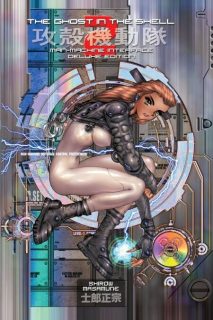
The Ghost in the Shell, Volume 2: Man-Machine InterfaceThe Ghost in the Shell, Volume 2: Man-Machine Interface by Masamune Shirow. It’s been well over a decade since I first read Masamune’s The Ghost in the Shell manga. While I had vague memories of the first volume, I remembered virtually nothing about the second. Kodansha Comics’ recent re-release of the series in a deluxe, hardcover edition provided an ideal opportunity for me to revisit the manga. (The deluxe edition presents the manga in right-to-left format with the original Japanese sound effects for the first time; it’s also supposed to have bonus content, but I’m not exactly sure what that additional material is supposed to be in second volume.) Upon rereading the second volume of The Ghost in the Shell, I think I know why I had trouble recalling anything about it–the manga seems to be more show than substance. At times I would find that I had stopped reading the seemingly nonsensical text entirely and was just turning pages and looking the artwork, much of which is in color. There is a story in there somewhere, as well as some interesting worldbuilding and philosophizing, but most of that seems to be happening in the copious footnotes rather than in the manga proper.

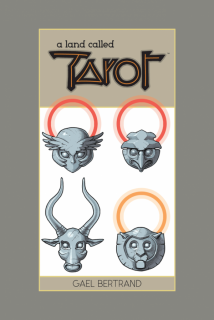
A Land Called TarotA Land Called Tarot by Gael Bertrand. Originally serialized in the Island comics anthology, A Land Called Tarot was recently released in a standalone hardcover collection with additional content. Except for a few sound effects, A Land Called Tarot is actually a wordless comic. There is no dialogue or narration, so readers must rely entirely on Bertrand’s artwork to interpret the characters, story, and setting. Fortunately, Bertrand is more than up to the task. The artwork in A Land Called Tarot is absolutely gorgeous. The cover design is actually somewhat misleading–the interior illustrations are marvelously detailed and beautifully colorful. The lack of words in the comic invites readers to pay even more attention to the artwork and to explore the nuances of the fantastic world that Bertrand has created. The comic follows an adventurous hero, the Knight of Swords, as he travels across the land and meeting its people, his journey taking him through both time and space. There are moments of action and battle, but there are also moments that are peaceful and serene and sometimes even little lonely. A Land Called Tarot is a wondrous delight. I unequivocally loved the comic hope to see more work by Bertrand in the future.

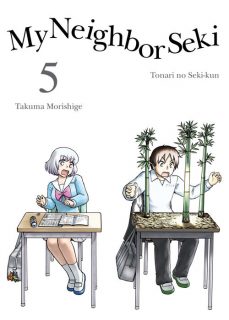
My Neighbor Seki, Volume 5My Neighbor Seki, Volumes 5-7 by Takuma Morishige. I’m not really sure why I’ve fallen behind reading of My Neighbor Seki because I enjoy the series a great deal. The manga remains consistently delightful and is wonderfully charming. My introduction to the series was through its anime adaptation; the chapters in these three volumes happen to be released or serialized around the same time that the anime was being produced. The author’s notes seem to imply that the manga wasn’t initially anticipated to become as long as it now has (the series is actually still ongoing, as far as I can tell) but the anime understandably revitalized interest in My Neighbor Seki. I like both versions of My Neighbor Seki, but there’s more in the manga that was never adapted. I continue to be impressed by Morishige’s inventiveness and imagination in creating new and clever scenarios for the series’ characters. Not much has changed from the beginning of My Neighbor Seki, although occasionally Seki isn’t the only one actively participating in the games he plays instead of paying attention in class. His mother has been introduced, too. I hope to see her again as one of the recurring characters.

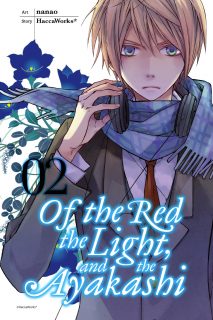
Of the Red, the Light, and the Ayakashi, Volume 2Of the Red, the Light, and the Ayakashi, Volumes 2-3 by Nanao. While I enjoyed the first volume of Of the Red, the Light, and the Ayakashi, especially its ominous atmosphere and the sense of foreboding it inspired, it’s taken me quite a while to finally get around to reading more of the series. Now I’m regretting my delay, because the next two volumes are just as enticing as the first, if not more so, and if anything the series is getting stronger as a whole. Granted, there’s still some annoying awkwardness surrounding some of the characters’ conversations in which they seem to talk around important topics and information simply because the reader isn’t supposed to know the details about them yet. But even with this fault, Of the Red, the Light, and the Ayakashi manages to remain engaging. Part of this is due to the series’ air of mystery and the way in which Nanao is able to stretch out the story without being manipulative. For example, an important reveal in the second volume which in many other stories would have been the major plot twist is simply one in a longer string of steady developments. Several more questions are raised for every one that is answered in the series; I am incredibly curious to learn more.

Filed Under: FEATURES, My Week in Manga Tagged With: comics, Gael Bertrand, Ghost in the Shell, manga, Masamune Shirow, My Neighbor Seki, Nanao, Of the Red the Light and the Ayakashi, Takuma Morishige

Fruits Basket Collector’s Edition, Vol. 11

March 27, 2017 by Sean Gaffney

By Natsuki Takaya. Released in Japan by Hakusensha, serialized in the magazine Hana to Yume. Released in North America by Yen Press. Translated by Sheldon Drzka.

This is the penultimate omnibus of Fruits Basket, and has most of the things you’d expect to see. Kyo finishes telling Tohru about his past with her mother, and because he hates himself, is really upset that Tohru doesn’t get mad about it. Akito is also dealing with self-hatred, and it’s to Takaya’s credit that the resolution to Akito and Tohru’s talk is not being stabbed with a knife (though admittedly, the crumbling cliff feels VERY deus ex machina, and I could do without the ‘kissing the concussed girl’ too). And of course the curse breaks for everyone, which allows those in couples to hug their loved ones, or those who aren’t in couples to wander the streets alone in tears because I dunno, Takaya is just mean. In any case, it’s Fruits Basket. All the feels are contained within.

Ren has the cover but doesn’t feature in the book personally. Her presence is felt throughout Akito and Tohru’s confrontation, though. Tohru realizes what the reader has, which is that Akito is in many ways similar to the other Sohmas, i.e. she’s dealing with emotional trauma from parental abuse. This doesn’t excuse what she put everyone through, but it does help Tohru to understand why her declaration of “I’m going to break the curse” meant, to Akito, “I’m going to destroy your life”. Tohru is still reeling from Kyo’s “disillusionment”, but more power to her for talking Akito down, and helping her to understand that the paralyzing fear of being rejected is what love is all about. And then there’s that cliff fall, which is *so* ridiculous that Shigure has to ask Akito if Tohru was pushed.

The remainder of the volume has Tohru in the hospital, and Kyo undergoing a huge torrent of abuse because, thanks to Yuki, everyone knows what he said to Tohru right before the accident. This does allow Kyo to attempt to move on from his past, which means confronting his birth father, who is an amazingly awful monster, but who Kyo also now sees as sad and small. It’s one of the better scenes in the book, and shows off that, despite what the rest of the cast has been screaming at him, Kyo has matured. Of course, the best scenes in the book are those where the curse breaks, and we see the aftermath from everyone’s eyes. Kyo and Tohru reuniting and declaring their love for each other is wonderful, but it’s easily topped by realizing that Kyo, despite being hugged, isn’t transforming, and his ripping off his bracelet. Tohru’s face as he does this may be the best panel in all of Fruits Basket.

Things aren’t perfect. Aside from the deus cliff machina, Takaya’s side pairings aren’t always developed as they should be, and she relies on the audience connecting dots that she hasn’t actually put into the manga itself. Thus while I like the basic idea of Kureno and Uotani, there’s no real feeling or emotion behind their getting together. (I do agree with his thoughts that he needs to be far away from Akito). Yuki and Machi fares a little better, and certainly she tried to develop it in the later books, but it still feels rushed. I did like the idea of Yuki calling her out to explain the curse, only to have to break right as she arrives. And now we have only one volume left to go, and given there’s only one regular book left to put in it, I expect there should be some extra content included as well. What will it be? Find out next month. In the meantime, still one of the top shoujo manga, despite its faults.

Filed Under: fruits basket, REVIEWS

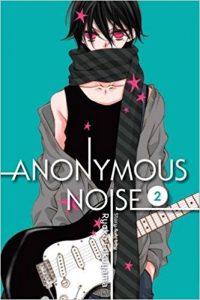
Anonymous Noise Vol. 2

March 26, 2017 by Anna N

I feel like Anonymous Noise is hobbled by its covers, because they are so consistently great the manga inside has a hard time living up to them. That being said, I found the contrived plot elements a little less annoying in the second volume, probably because the cliched character introductions are now out of the way.

The volume opens with Nino being challenged about her vocal ability. Miou, Yuzu’s former singer points out that while Nino’s voice has a compelling quality, her technique is a mess. Nino and Miou sing together and Miou is able to sustain her note much longer than Nino. Nino is determined to get better, and she starts reading tons of books on vocal technique. Nino spots Momo’s name on a flyer advertising music autions for a famous writer/producer, and she decides to try out in order to find out if the mysterious producer is her long-lost Momo. Of course the auditions are on the same day as the next TV appearance of In No Hurry to Shout, and Nino has to somehow pull off being at both at the same time.

The aspect of this manga that I found most interesting in the first volume was Nino as a destructive muse. She’s so single-minded, she is still utterly unaware that she’s hurting Yuzu’s feelings with her never-ending Momo obsession. Yuzu is inspired to compose by the idea of Nino as his Alice, but Momo is determined to avoid her because he’s turned away from his original childhood inspiration to compose pop hits. Yuzu even damaged his voice to sing with Nino when they were children, with the result that he’s no longer able to sing himself and Nino is now serving as his proxy. All this obsession in the service of creativity might not be a good thing, yet the joyful scenes of people lost in song carry the manga along.

I wish some of the plot elements were a little less contrived, because the coincidences piling on top of each other take me out of enjoying the story a little bit. I am still enjoying the stylish art, particularly a great panel where Yuzu hands Nino the wig of the lead singer for his band. I think this series might be one where I become a little better at engaging my suspension of disbelief with each volume. Anonymous Noise certainly delivers dramatic angst, so I’m still finding it interesting to read.

Filed Under: Manga Reviews, REVIEWS Tagged With: anonomous noise, shojo beat, shoujo, viz media

In Another World with My Smartphone, Vol. 1

March 25, 2017 by Sean Gaffney

By Patora Fuyuhara and Eiji Usatsuka. Released in Japan as “Isekai wa Smartphone to Tomo ni” by Hobby Japan. Released in North America digitally by J-Novel Club. Translated by Andrew Hodgson.

It’s a bit difficult to know where to begin. I guess I’ll start by saying that by the end of this book, I was enjoying it immensely and had a big smile on my face. The second thing I should say is that this does not actually make the book “good” in any sense of the word. For a few years I’ve had to review the occasional awful manga, and people have sometimes asked me “do you mean that it’s bad in an MST3K way or bad in a bad way”. Sadly, I’ve always had to say that it’s actually the latter. Most terrible things are not remotely entertaining. In Another World with My Smartphone is an exception. Every ridiculous power the hero has, each new cliched heroine that appears, every time the plot rearranges itself so that everything is as “awesome” as possible, and most importantly the complete lack of any sense that things are about to get difficult for anyone makes this book bad in an absolutely wonderful, hilarious way. Everyone who says Kirito or Tatsuya are overpowered self-insert wannabes need to read this immediately.

I should lay out the plot here, though if you have read any isekai you’ll get the gist. Touya (no, not the Touya from Mixed Bathing in Another Dimension, though I now wonder if the name has significance for isekai works) is accidentally killed by a lightning bolt. He’s granted an audience with God, who offers to reincarnate him in a fantasy world where he can have adventures. Touya, a modern thinking sort, asks if he can keep his smartphone, and God obligingly allows it to remain working and gives it unlimited battery. He then arrives in a new world, where he quickly meets up with Kyou and Ryou Fujibayashi… (cough) sorry, with Elze and Linze, two beginning adventurers who he joins forces with. Joining an adventurer’s guild, he gradually adds incredible powers, more cute girls, and heroic feats that make everyone’s jaws drop. In fact, the author literally apologizes for not using the smartphone enough in the first volume – why would Touya need it, when he can fight like a champ, use every single kind of magic, and summon Heavenly Beasts that then become adorable tiger cub mascots?

This is taken from a webnovel, and it’s really, really obvious. Usually with most conversions to published works they at least try to get rid of the excited sense of “I’m going to put absolutely everything into this book!”, but not here. Touya has impossible magic powers. Touya can read the moves of other fighters so he’s able to dodge or counter them. Touya can heal the blind. Touya can solve crimes, provided the suspect is an obvious cliche of an evil Duke. Touya is so pure of heart that the Princess of the land immediately falls in love and declares that he will be her husband. (Touya’s complete panic at this idea is possibly the best he’s written the whole book, and I hope (probably in vain) that future volumes throw him off his game like this.) Touya can read ancient scripts (just like Bob Hope and Steve Allen!), and can make magical reading glasses to allow other to do so. Touya can even accidentally look as if he’s been to a brothel and get lectured by all his girls, because this is still a harem comedy. Is there anything Touya cannot do? Sadly, yes. Touya cannot stop his friends’ menstrual pain. Some things are simply beyond any power.

I mentioned Touya’s purity of heart, and I think the same thing applies to the book as a whole. The reason that this is fun bad and not bad bad is that it’s so innocent of the normal cynicism you tend to see in these works. I joked on Twitter that this was “Baby’s First Isekai”, and that’s not far off. I think authors are allowed to write this sort of thing to get it out of their system. Being mean to it would be like kicking a puppy. There’s apparently an anime of this coming in the summer, and I cannot WAIT to see how the typical male anime fan who hates Kirito is going to react to this. I think I’ll bring popcorn. I’ll also be reading more, because this proved to be insanely fun. Which makes it a big success after all.

Filed Under: in another world with my smartphone, REVIEWS

Kiss & White Lily for My Dearest Girl, Vol. 1

March 24, 2017 by Sean Gaffney

By Canno. Released in Japan as “Ano Ko ni Kiss to Shirayuri wo” by Media Factory, serialization ongoing in the magazine Comic Alive. Released in North America by Yen Press. Translated by Jocelyn Allen.

Those who follow my reviews know that I have a certain penchant for mocking the monthly manga magazine Comic Alive, which has always seemed to cater to the audience who wants fanservice, tie-ins, and the latest trends, and they want them now. Sometimes that can be a disaster, but on occasion Comic Alive will throw me a curveball and give me a series I can truly enjoy. Kiss & White Lily for My Dearest Girl is one of those series. I came to it at the end of a glut of yuri manga volumes (and who’d ever imagine I’d be typing that phrase even two years ago?), and was worried that a lot of this review would be finding ways to say the exact same thing again. But this title is different enough from its predecessors that there’s some interesting things to discuss.

The cover is somewhat deceptive, leading me to believe that we’d be seeing one of the common default yuri pairings (or CDYP for short), the shy easily embarrassed girl and the overly genki enthusiastic girl. Luckily, that’s not the case. The premise is actually similar to the old shoujo manga Special A – Ayaka is a hard-working diligent student who always gets the best grades, but now in high school she’s up against Yurine, a lazy and apathetic girl who nonetheless always manages to get first place in everything. Ayaka’s competitive nature (instilled by her parents, it’s hinted) won’t allow her to accept this, and so she grows more and more frustrated with Yurine. As for Yurine herself, nothing challenges her anymore, and therefore nothing is interesting… except maybe Ayaka.

By itself this would probably be enough to sustain a series, likely about 2-3 volumes. But halfway through we shift to Ayaka’s roommate and cousin Mizuki, who’s athletic, handsome, and the male half of the Takarazuka pair she has with her friend Moe, who manages the track team and is angling to get Yurine on it. Yes, you guessed right, this is a School Full Of Gay (TM), and so the second half of the story focuses on another couple and their own travails. This one is more easily solved, while it appears that Ayaka and Yukine will be the developing pairing we keep coming back to after wandering away for a bit. There’s also a few one-page shorts detailing that yes, everyone in this school is indeed gay, and while it’s unrealistic, it’s also quite cute.

As I said above, the thing I enjoyed best about this series is the way that Canno’s characters don’t quite go the way I expect them to. They’re still types to a degree, but this first volume gave them a bit more depth than I’d expect for a series like this, particularly Yurine, who also gets a chapter near the end where she hangs out all day with the exceedingly hyperactive Ai, partly in an effort to try to be more open and sociable. (She’s lucky she tried it first with Ai, who plows through social cues like a train.) I have a sneaking suspicion I’ll see more of ai and her own romantic travails in a future volume. In the meantime, Kiss & White Lily for My Dearest Girl may walk on some well-worn paths, but there’s surprising depth here. A must have for fans of yuri.

Filed Under: kiss & white lily for my dearest girl, REVIEWS

Manga the Week of 3/29/17

March 23, 2017 by Sean Gaffney, Ash Brown, Anna N, Michelle Smith and MJ Leave a Comment

SEAN: The 5th week of the month used to be a very quiet week, but this is manga boom time, so don’t expect quietness.

Dark Horse has the 2nd RG Veda omnibus, filled with early CLAMP pretty boys.

MJ: This never gets old for me.

Kodansha has a number of new titles. Cells at Work! has a 3rd volume.

ASH: The first volumes were a lot of fun, and surprisingly informative, too!

MICHELLE: Indeed!

ANNA: We got the first couple volumes in my library, but I have not yet read them due to them being perpetually checked out.

SEAN: And House of the Sun continues to be a very fast digital release with Vol. 3.

MICHELLE: Huzzah! Not that I have read the first two volumes or anything.

ANNA: Should I be happy about this? I haven’t read it either but I feel I should be excited if Michelle likes it!

MICHELLE: It’s shoujo from Dessert magazine, which also brought us Say I Love You. and My Little Monster. So, I’m basically just assuming it will be good because of that connection.

SEAN: There’s also a 9th volume of L♥DK, in case you’re reading the new digital Gakuen Prince volumes and want even more like that.

Otomo: A Global Tribute to the Mind Behind Akira is a new artbook from Kodansha dedicated to said mind, with lots of famous artists coming together to pay tribute.

ASH: I haven’t read much of Otomo’s work beyond Akira, but I’m really looking forward to this volume.

SEAN: Real Account gives us a 6th volume.

And there’s a 5th Sweetness and Lightning. Sorry for the lack of witty comments, I just don’t have much to say about these.

ASH: Awww, but Sweetness and Lightning is delightful!

MICHELLE: It is! As much as I love food manga, only Sweetness & Lightning regularly features things that I feel like I could conceivably make myself.

SEAN: Seven Seas also has a pile of titles, starting with the 4th volume of Monster Musume spinoff I Heart Monster Girls.

And the 4th and final volume of The Other Side of Secret, which is so very, very Comic Alive.

Servamp has a 9th volume, and rumor has it vampires still figure in it.

I know very little about the new debut, Species Domain, except that it runs in Bessatsu Shonen Champion and is another “Monster Girls” type series.

ASH: Personally, I’ve lost most of my interest in the various monster girl manga, but I know it’s a popular niche and so am glad for those who enjoy it.

SEAN: And the 5th Testament of Sister New Devil shows that Shonen Ace can be even worse than Comic Alive if it really wants to be.

MJ: Wow.

SEAN: Vertical debuts Flying Witch, which runs in Bessatsu Shonen Magazine and has both an anime and good word of mouth.

MJ: i’m probably interested in this.

ANNA: I’m maybe interested in this.

And there’s the now standard “Yen delayed these till one week later” releases. A 9th volume of Sekirei is out digitally.

And out in print, we have a 5th How to Raise a Boring Girlfriend. (Spoiler: girlfriend still boring.)

Lastly, there’s a 6th Prison School omnibus.

ASH: Assuming someone isn’t simply outright offended by Prison School (which would certainly be more than understandable), the series can actually be legitimately funny.

SEAN: Something for everyone next week. What are you getting?

Filed Under: FEATURES, manga the week of

  • « Go to Previous Page
  • Page 1
  • Interim pages omitted …
  • Page 439
  • Page 440
  • Page 441
  • Page 442
  • Page 443
  • Interim pages omitted …
  • Page 1048
  • Go to Next Page »
 | Log in
Copyright © 2010 Manga Bookshelf | Powered by WordPress & the Genesis Framework