• Skip to primary navigation
  • Skip to main content
  • Skip to primary sidebar
  • Home
  • About Us
    • Privacy Policy
    • Comment Policy
    • Disclosures & Disclaimers
  • Resources
    • Links, Essays & Articles
    • Fandomology!
    • CLAMP Directory
    • BlogRoll
  • Features & Columns
    • 3 Things Thursday
    • Adventures in the Key of Shoujo
    • Bit & Blips (game reviews)
    • BL BOOKRACK
    • Bookshelf Briefs
    • Bringing the Drama
    • Comic Conversion
    • Fanservice Friday
    • Going Digital
    • It Came From the Sinosphere
    • License This!
    • Magazine no Mori
    • My Week in Manga
    • OFF THE SHELF
    • Not By Manga Alone
    • PICK OF THE WEEK
    • Subtitles & Sensibility
    • Weekly Shonen Jump Recaps
  • Manga Moveable Feast
    • MMF Full Archive
    • Yun Kouga
    • CLAMP
    • Shojo Beat
    • Osamu Tezuka
    • Sailor Moon
    • Fruits Basket
    • Takehiko Inoue
    • Wild Adapter
    • One Piece
    • After School Nightmare
    • Karakuri Odette
    • Paradise Kiss
    • The Color Trilogy
    • To Terra…
    • Sexy Voice & Robo
  • Browse by Author
    • Sean Gaffney
    • Anna Neatrour
    • Michelle Smith
    • Katherine Dacey
    • MJ
    • Brigid Alverson
    • Travis Anderson
    • Phillip Anthony
    • Derek Bown
    • Jaci Dahlvang
    • Angela Eastman
    • Erica Friedman
    • Sara K.
    • Megan Purdy
    • Emily Snodgrass
    • Nancy Thistlethwaite
    • Eva Volin
    • David Welsh
  • MB Blogs
    • A Case Suitable For Treatment
    • Experiments in Manga
    • MangaBlog
    • The Manga Critic
    • Manga Report
    • Soliloquy in Blue
    • Manga Curmudgeon (archive)

Manga Bookshelf

Discussion, Resources, Roundtables, & Reviews

Katherine Dacey

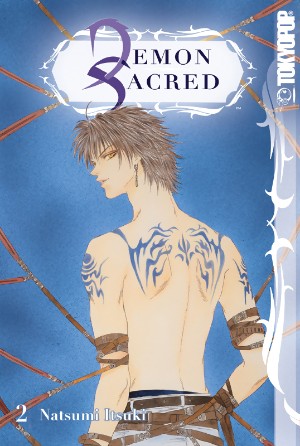
Demon Sacred, Vols. 1-2

September 28, 2010 by Katherine Dacey

Demon Sacred is shojo manga’s answer to the everything bagel, substituting hot scientists, dragons, pop idols, twins, secret government research facilities, and time-traveling aliens for garlic chips and sesame seeds. That such an unlikely combination of ingredients proves complimentary is nothing sort of miraculous — it’s hard to imagine how rock stars and rifts in the space-time continuum could co-exist in the same manga without the whole enterprise descending into complete silliness, but Natsumi Itsuki walks the fine line between stupid and clever with the grace of a high-wire acrobat.

Consider the first three chapters of the series: in them, we’re introduced to Rena, the sole survivor of an incident involving unicorns; her fourteen-year-old daughters Rina and Mona, one of whom has developed a disease that causes her to age backwards; and the girls’ guardian Shinobu, a handsome, pony-tailed researcher who is toiling away on a cure for Return Syndrome and — natch — earned a PhD from Harvard before his eighteenth birthday. Those three storylines alone provide ample material for a good shojo fantasy, but Itsuki cranks up the narrative nuttiness to eleven in subsequent chapters, tossing in a handsome “demon” — in fact, a shape-shifting alien from another dimension — who knew the twins’ mother, and a second, more powerful demon who assumes the form of the girls’ favorite pop singer.

…

Read More

Filed Under: Manga Critic Tagged With: shojo, Tokyopop

Demon Sacred, Vols. 1-2

September 28, 2010 by Katherine Dacey

Demon Sacred is shojo manga’s answer to the everything bagel, substituting hot scientists, dragons, pop idols, twins, secret government research facilities, and time-traveling aliens for garlic chips and sesame seeds. That such an unlikely combination of ingredients proves complimentary is nothing sort of miraculous — it’s hard to imagine how rock stars and rifts in the space-time continuum could co-exist in the same manga without the whole enterprise descending into complete silliness, but Natsumi Itsuki walks the fine line between stupid and clever with the grace of a high-wire acrobat.

Consider the first three chapters of the series: in them, we’re introduced to Rena, the sole survivor of an incident involving unicorns; her fourteen-year-old daughters Rina and Mona, one of whom has developed a disease that causes her to age backwards; and the girls’ guardian Shinobu, a handsome, pony-tailed researcher who is toiling away on a cure for Return Syndrome and — natch — earned a PhD from Harvard before his eighteenth birthday. Those three storylines alone provide ample material for a good shojo fantasy, but Itsuki cranks up the narrative nuttiness to eleven in subsequent chapters, tossing in a handsome “demon” — in fact, a shape-shifting alien from another dimension — who knew the twins’ mother, and a second, more powerful demon who assumes the form of the girls’ favorite pop singer.

A cynic might dismiss these additional characters as pandering to teen girl taste, but Mika and K2 serve an important role in advancing the plot, shedding light on Rina and Mona’s past (Mom disappeared when they were four) and offering a potential cure for Rina’s condition. Ditto for some of the comic-relief episodes, in which K2 impersonates a real-life idol; if Itsuki always played it straight, the story would seem positively ludicrous instead of charmingly overstuffed. Remember, the opening pages of the series involve a stampede of unicorns emerging from the aurora borealis and trampling a group of tourists in the Finnish countryside. Even Madeline L’Engle didn’t have the guts to try that.

I’d be the first to admit that Demon Sacred isn’t as well constructed as Itsuki’s Jyu-Oh-Sei, a tight, logical exercise in hard science fiction; if anything, Demon Sacred feels freer and messier than her earlier work. That impression of spontaneity stems from the casual way in which Itsuki assembles plot elements, like a chef rummaging through the refrigerator and grabbing whatever looks appetizing. There’s no obvious rationale for inter-dimensional, time-traveling aliens to assume the form of mythical Earth-beasts, other than the fact it tickled Itsuki’s authorial fancy. Yet that kitchen-sink quality is a big part of Demon Sacred‘s appeal; I’d be lying if I denied my pleasure in seeing a character quote from the Book of Revelations, or imagining a universe in which griffins, unicorns, and fire-breathing dragons could assume the form of popular singers.

It’s hard to guess how Itsuki will resolve the myriad subplots introduced in the first two volumes, but the story unfolds in such a feverish, urgent fashion that it’s easy to forgive the occasional narrative shortcuts or capitulations to shojo convention. (See “hot young scientist” and “pop idols,” above.) Demon Sacred may not be the best new manga of 2010, but it’s a strong contender for most addictive.

Review copies provided by Tokyopop.

DEMON SACRED, VOLS. 1-2 • BY NATSUMI ITSUKI • TOKYOPOP • RATING: TEEN (13+)

Filed Under: Manga, Manga Critic, REVIEWS Tagged With: Natsumi Itsuki, Sci-Fi, Tokyopop

Manga Artifacts: Magical Mates

September 23, 2010 by Katherine Dacey

It’s hard to remember a time when the only translated manga featured explosions, monsters, and naked women, but for most of the 1980s and 1990s, manly-man manga was the norm; American publishers barely acknowledged that female comic fans existed in or outside Japan. There were licensed manga with female protagonists, to be sure, but The Legend of Mother Sarah and Mai The Psychic Girl were clearly written for male audiences, as the reductive tagline on Mai‘s front cover attests: “She is pretty. She is psychic. She is Japanese.” (Read: “She might go out with you.”) That began to change in the mid-1990s, when a few publishers made the then-radical decision to introduce manga for girls. VIZ released Moto Hagio’s They Were Eleven (1995) and A, A’ (1997); Mixx made a hit out of Naoko Takeuchi’s Sailor Moon (1997); and Antarctic Press, home of Ninja High School and Hurricane Girls, dabbled in shojo with Mio Odagi’s Magical Mates (1996).

If VIZ took the high road, introducing readers to one of Japan’s most influential and beloved creators, and Mixx took the middle road, courting female fans of Mighty Morphin’ Power Rangers and the Sailor Moon anime, Antarctic took the cheap road, licensing a self-published work by an obscure artist. The fact that Magical Mates reached American shores at all had more to do with who Odagi knew than the quality of her work. As Jason Thompson explains in a recent House of 1000 Manga column, Odagi was a member of Studio Do-Do, a small group of artists that had an inside connection at Antarctic Press: Ippongi Bang, whose friendship with Antarctic staffers helped open the door for her fellow Studio Do-Do artists.

Flipping through the six issues that comprise Magical Mates, Mio Odagi’s lack of skill is painfully obvious. The stories — which focus on a trio of tarot-reading, spell-casting teens — abound in the kind of poorly drawn panels and non-sequitors that would make a Hana to Yume editor pull out her hair. Odagi lavishes considerable attention on her characters’ eyes, rendering their irises and lashes with a meticulous precision that’s fundamentally at odds with the slapdash way she draws the rest of their bodies. She also struggles with backgrounds; her characters often appear to be floating above the picture plane, unencumbered by gravity.

Each story revolves around a romantic entanglement of one sort or another: in “Love on a Friendship Bracelet,” for example, Rinko, Kana, and Noemi help the manager of the boys’ soccer team express her feelings to the arrogant star player, while in “The Priestesses’ Love Letter,” the girls play matchmaker for the class brain and the rock guitarist she secretly adores. Not much connects the episodes, save for running gags about Rinko’s vanity — she vies with Kana and Noemi to be the “star” of the series — and about Rinko’s long-suffering suitor Eiji, a short, bespectacled nerd with an alter ego: The Student President of Darkness, a malicious teen who carries out Eiji’s darker wishes.

The Student President of Darkness gag embodies what’s good and bad about Magical Mates. Eiji’s frequent transformations are the kind of problem that could easily be fixed by logic or a lanyard; the fact that he’s always absent when the President is sabotaging a soccer match or flooding a water park doesn’t seem to register with Rinko or her friends. Yet for all the suspension of disbelief that Eiji’s Jekyll-and-Hyde persona demands, these transformations serve an important function, adding a badly needed element of emotional authenticity to Magical Mates; Eiji’s jealousy feels more real than anything else in the series, providing a reliable source of comic relief and dramatic conflict.

More striking than the stories themselves is Antarctic Press’ attempt to position Magical Mates as a comedy that older male readers would enjoy. Each issue featured advertisements for comics such as Warrior Nun Areala, Codename: Scorpio, and the NC-17 vampire comic Tabou, which had a tie-in with an adult film. Though the covers seem less deliberately calculated to appeal to male readers than the advertising, issue four is a notable exception: all three girls have been given a sexy makeover with super-long legs, savage tans, and skimpy bathing suits that are completely out of character. The one fan letter that Antarctic published — which appears on the back page of issue four — comes from a male reader who complains that he doesn’t like Magical Mates‘ cover art or title. “It’s got that Sailor Moon stigma,” he notes. “I hope readership picks up, and that people don’t get the wrong idea and think this is some sort of bland children’s comic.”

With the benefit of hindsight, it’s easy to fault Antarctic for treating Magical Mates as something other than a “children’s comic,” as its tone and episodic structure seem best suited for young readers. Yet at the time Mates debuted, there was no obvious market for girls’ manga. The Sailor Moon anime was just beginning to reach female audiences here in the US — it was still two years away from becoming a big hit — and American publishers had been neglecting the female comics market for decades. Antarctic made a logical gamble, presenting Mates as a wacky comedy starring three cute girls rather than a wacky comedy written for girls, never acknowledging that Odagi’s artwork, plotlines, and sensibility owed a significant debt to the magical girl genre.

Had it been marketed differently, Magical Mates still might not have found an audience — Moto Hagio, after all, bombed with readers, despite her impeccable pedigree and formidable talent. Yet Mates is significant because it anticipated the kind of shojo that caught on with American girls in the following decade, with its focus on romance, wacky hijinks, and unabashedly teen pursuits, from telling fortunes and swapping love charms to visiting amusement parks.

Readers curious about Magical Mates can find inexpensive copies of all six issues on eBay; note that Antarctic initially planned a nine-issue series, but canceled the last three.

Manga Artifacts is a monthly feature exploring older, out-of-print manga published in the 1980s and 1990s. For a fuller description of the series’ purpose, see the inaugural column.

Filed Under: Manga Critic

Manga Artifacts: Magical Mates

September 23, 2010 by Katherine Dacey

It’s hard to remember a time when the only translated manga featured explosions, monsters, and naked women, but for most of the 1980s and 1990s, manly-man manga was the norm; American publishers barely acknowledged that female comic fans existed in or outside Japan. There were licensed manga with female protagonists, to be sure, but The Legend of Mother Sarah and Mai The Psychic Girl were clearly written for male audiences, as the reductive tagline on Mai‘s front cover attests: “She is pretty. She is psychic. She is Japanese.” (Read: “She might go out with you.”) That began to change in the mid-1990s, when a few publishers made the then-radical decision to introduce manga for girls. VIZ released Moto Hagio’s They Were Eleven (1995) and A, A’ (1997); Mixx made a hit out of Naoko Takeuchi’s Sailor Moon (1997); and Antarctic Press, home of Ninja High School and Hurricane Girls, dabbled in shojo with Mio Odagi’s Magical Mates (1996).

If VIZ took the high road, introducing readers to one of Japan’s most influential and beloved creators, and Mixx took the middle road, courting female fans of Mighty Morphin’ Power Rangers and the Sailor Moon anime, Antarctic took the cheap road, licensing a self-published work by an obscure artist. The fact that Magical Mates reached American shores at all had more to do with who Odagi knew than the quality of her work. As Jason Thompson explains in a recent House of 1000 Manga column, Odagi was a member of Studio Do-Do, a small group of artists that had an inside connection at Antarctic Press: Ippongi Bang, whose friendship with Antarctic staffers helped open the door for her fellow Studio Do-Do artists.

Flipping through the six issues that comprise Magical Mates, Mio Odagi’s lack of skill is painfully obvious. The stories — which focus on a trio of tarot-reading, spell-casting teens — abound in the kind of poorly drawn panels and non-sequitors that would make a Hana to Yume editor pull out her hair. Odagi lavishes considerable attention on her characters’ eyes, rendering their irises and lashes with a meticulous precision that’s fundamentally at odds with the slapdash way she draws the rest of their bodies. She also struggles with backgrounds; her characters often appear to be floating above the picture plane, unencumbered by gravity.

Each story revolves around a romantic entanglement of one sort or another: in “Love on a Friendship Bracelet,” for example, Rinko, Kana, and Noemi help the manager of the boys’ soccer team express her feelings to the arrogant star player, while in “The Priestesses’ Love Letter,” the girls play matchmaker for the class brain and the rock guitarist she secretly adores. Not much connects the episodes, save for running gags about Rinko’s vanity — she vies with Kana and Noemi to be the “star” of the series — and about Rinko’s long-suffering suitor Eiji, a short, bespectacled nerd with an alter ego: The Student President of Darkness, a malicious teen who carries out Eiji’s darker wishes.

The Student President of Darkness gag embodies what’s good and bad about Magical Mates. Eiji’s frequent transformations are the kind of problem that could easily be fixed by logic or a lanyard; the fact that he’s always absent when the President is sabotaging a soccer match or flooding a water park doesn’t seem to register with Rinko or her friends. Yet for all the suspension of disbelief that Eiji’s Jekyll-and-Hyde persona demands, these transformations serve an important function, adding a badly needed element of emotional authenticity to Magical Mates; Eiji’s jealousy feels more real than anything else in the series, providing a reliable source of comic relief and dramatic conflict.

More striking than the stories themselves is Antarctic Press’ attempt to position Magical Mates as a comedy that older male readers would enjoy. Each issue featured advertisements for comics such as Warrior Nun Areala, Codename: Scorpio, and the NC-17 vampire comic Tabou, which had a tie-in with an adult film. Though the covers seem less deliberately calculated to appeal to male readers than the advertising, issue four is a notable exception: all three girls have been given a sexy makeover with super-long legs, savage tans, and skimpy bathing suits that are completely out of character. The one fan letter that Antarctic published — which appears on the back page of issue four — comes from a male reader who complains that he doesn’t like Magical Mates‘ cover art or title. “It’s got that Sailor Moon stigma,” he notes. “I hope readership picks up, and that people don’t get the wrong idea and think this is some sort of bland children’s comic.”

With the benefit of hindsight, it’s easy to fault Antarctic for treating Magical Mates as something other than a “children’s comic,” as its tone and episodic structure seem best suited for young readers. Yet at the time Mates debuted, there was no obvious market for girls’ manga. The Sailor Moon anime was just beginning to reach female audiences here in the US — it was still two years away from becoming a big hit — and American publishers had been neglecting the female comics market for decades. Antarctic made a logical gamble, presenting Mates as a wacky comedy starring three cute girls rather than a wacky comedy written for girls, never acknowledging that Odagi’s artwork, plotlines, and sensibility owed a significant debt to the magical girl genre.

Had it been marketed differently, Magical Mates still might not have found an audience — Moto Hagio, after all, bombed with readers, despite her impeccable pedigree and formidable talent. Yet Mates is significant because it anticipated the kind of shojo that caught on with American girls in the following decade, with its focus on romance, wacky hijinks, and unabashedly teen pursuits, from telling fortunes and swapping love charms to visiting amusement parks.

Readers curious about Magical Mates can find inexpensive copies of all six issues on eBay; note that Antarctic initially planned a nine-issue series, but canceled the last three.

Manga Artifacts is a monthly feature exploring older, out-of-print manga published in the 1980s and 1990s. For a fuller description of the series’ purpose, see the inaugural column.

Filed Under: Manga, Manga Critic, REVIEWS Tagged With: Antarctic Press, Mio Odagi, Studio Do-Do

Hetalia: Axis Powers, Vol. 1

September 19, 2010 by Katherine Dacey

To say that Hetalia: Axis Powers has a devoted fanbase is like saying that Cookie Monster is partial to Oreos; it’s the kind of series that inspires fans to write their own Hetalia stories by the truckload (there are over 14,000 posted at FanFiction.net), dress up as their favorite countries, and debate the virtues of various characters with quasi-religious intensity.

Part of Hetalia‘s appeal lies with the artwork: manga-ka Hidekaz Himeyura populates his stories with cute, attractive young men in lavishly detailed military costumes that are tailor-made for cosplay. The other part of Hetalia‘s appeal lies with its cheerfully subversive premise: all the major participants in World War II are represented as petulant bishies whose behavior mimics the way these countries interacted in the 1930s, and whose personalities conform to well-rehearsed national stereotypes. Whether or not you cotton to Hetalia will depend largely on whether you find the underlying concept a stellar example of the Japanese ability to kawaii-ify anything or proof that Japan’s younger generation doesn’t grasp just how terrible World War II really was.

…

Read More

Filed Under: Manga Critic Tagged With: 4-koma, Tokyopop

Hetalia: Axis Powers, Vol. 1

September 19, 2010 by Katherine Dacey

To say that Hetalia: Axis Powers has a devoted fanbase is like saying that Cookie Monster is partial to Oreos; it’s the kind of series that inspires fans to write their own Hetalia stories by the truckload (there are over 14,000 posted at FanFiction.net), dress up as their favorite countries, and debate the virtues of various characters with quasi-religious intensity.

Part of Hetalia‘s appeal lies with the artwork: manga-ka Hidekaz Himeyura populates his stories with cute, attractive young men in lavishly detailed military costumes that are tailor-made for cosplay. The other part of Hetalia‘s appeal lies with its cheerfully subversive premise: all the major participants in World War II are represented as petulant bishies whose behavior mimics the way these countries interacted in the 1930s, and whose personalities conform to well-rehearsed national stereotypes. Whether or not you cotton to Hetalia will depend largely on whether you find the underlying concept a stellar example of the Japanese ability to kawaii-ify anything or proof that Japan’s younger generation doesn’t grasp just how terrible World War II really was.

I fall somewhere in the middle of the continuum: I’m not offended by Hetalia, but I’m not amused, either. Himaruya has certainly done his homework, seeding the dialogue with salacious historical tidbits and inserting flashbacks to major European wars of the eighteenth and nineteenth centuries, yet he never challenges the basic stereotypes that guide all the characterizations: Japan is prissy and horrified by European cuisine, England views America as his ill-behaved offspring, America loves hamburgers and talks with his mouth full, Germany is efficient and belligerent, and Northern Italy adores pasta and shirks responsibility. The endless stream of nationality-as-destiny jokes grows tiresome quickly; imagine spending an afternoon with someone who insists on referring to the French as “cheese-eating surrender monkeys” every time you mention a recent trip to Paris, and you have some idea of how stale the better gags become on their third or tenth repetition.

From time to time, Himaruya inserts the kind of pointed, tasteless joke that suggests at true subversion. In one scene, for example, Germany finds himself at a supermarket check-out, fuming because Korea is holding up the line, demanding reparations and an apology for how he’s been treated. A more skilled writer could have done something with this moment, perhaps using it as a jumping off point for exploring the complicated relationship between Japan and Korea. Instead, Himaruya treats this moment as just another wacky example of a country behaving according to national character, as if Korea’s legitimate protests over Japanese occupation were akin to Italians loving red wine or Russians placing ineffectual curses on their enemies. I’m mildly horrified to contemplate how Himaruya will treat German anti-Semitism — a personal quirk?

Which brings me to my biggest criticism of Hetalia: Axis Powers: there’s a strong whiff of pointlessness about the whole enterprise. Himaruya goes to great pains to get the history right, but it’s never clear what the series’ underlying message really is; why depict one of the ugliest, most brutal periods in human history as a cute, interpersonal drama if you’re not trying to make some greater point about the folly of international alliances, or the dangers of aggressive nationalism? I have no doubt that Trey Parker and Matt Stone could run with the Hetalia premise and turn it into something genuinely funny, rude, and intelligent, but Himaruya just doesn’t have the historical insight or the courage to do much with the material except make all the participants look very pretty.

Review copy provided by Tokyopop. Volume one of Hetalia: Axis Powers will be released on September 21, 2010.

HETALIA: AXIS POWERS, VOL. 1 • BY HIDEKAZ HIMARUYA • TOKYOPOP • 152 pp. • RATING: OLDER TEEN (16+)

Filed Under: Manga, Manga Critic, REVIEWS Tagged With: 4-koma, Comedy, Tokyopop

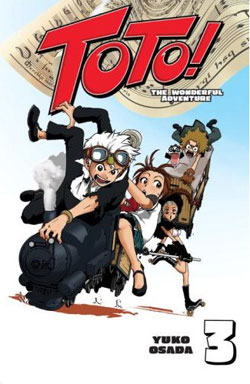
Toto! The Wonderful Adventure, Vols. 1-5

September 16, 2010 by Katherine Dacey

If you’ve ever been to Canal Street in New York City — the Counterfeit Capital of North America — you know that there are two types of goods for sale there. The first are inept knock-offs: the “Cooch” purse with plastic handles, the “Rollex” with cubic zirconia insets and a flimsy metal band. The second are just as fake as the first, but are executed with enough panache that style-conscious women get a secret thrill in owning them: the plastic “Birkin” bag that looks like the real thing but costs $30, the canvas “Louis Vuitton” wallet that comes in prettier colors than the original.

The same principles apply to manga as well: there are series which shamelessly imitate a best-selling title like Dragonball or InuYasha, rehearsing the same plot without capturing the original’s charm, and there are copycats which bear a strong resemblance to the original but nonetheless work well on their own terms. Toto! The Wonderful Adventure falls into the latter category, a good-natured rip-off of One Piece and Rave Master that accomplishes in five volumes what many shonen series need twenty or thirty to pull off.

…

Read More

Filed Under: Manga Critic Tagged With: del rey, Shonen

Toto! The Wonderful Adventure, Vols. 1-5

September 16, 2010 by Katherine Dacey

If you’ve ever been to Canal Street in New York City — the Counterfeit Capital of North America — you know that there are two types of goods for sale there. The first are inept knock-offs: the “Cooch” purse with plastic handles, the “Rollex” with cubic zirconia insets and a flimsy metal band. The second are just as fake as the first, but are executed with enough panache that style-conscious women get a secret thrill in owning them: the plastic “Birkin” bag that looks like the real thing but costs $30, the canvas “Louis Vuitton” wallet that comes in prettier colors than the original.

The same principles apply to manga as well: there are series which shamelessly imitate a best-selling title like Dragonball or InuYasha, rehearsing the same plot without capturing the original’s charm, and there are copycats which bear a strong resemblance to the original but nonetheless work well on their own terms. Toto! The Wonderful Adventure falls into the latter category, a good-natured rip-off of One Piece and Rave Master that accomplishes in five volumes what many shonen series need twenty or thirty to pull off.

As one might guess from the title, Yuko Osada dresses up his swashbuckling treasure hunt with frequent allusions to Frank L. Baum’s The Wonderful Wizard of Oz. The hero, Kakashi (literally, “scarecrow”), is an orphan who dreams of leaving his small island home for grand adventures, but lacks the brains to realize his ambition. When a zeppelin makes an unscheduled stop on the island, he stows away, thus beginning an odyssey that loosely mirrors the plot of Baum’s novel. Kakashi finds a puppy in the ship’s cargo hold, then meets a feisty teen named Dorothy who attends St. Kansas Academy, practices “tornado” senjutsu (a martial art involving spinning kicks), and plans to visit Emerald City. As Kakashi and Dorothy follow the Yellow Brick Road — here played by an old railway line — they acquire traveling companions, each modeled on one of Baum’s iconic characters: Noil, a kind but cowardly soldier who aspires to be a comedian; Dam, a big, blustering army officer with a metal arm; and Paisley, the Northern Investigator for the W.I.T.C.H. organization.

Central to the story is the relationship between Kakashi and Toto, the puppy he rescues in volume one. Though Toto initially appears benign, he has a big secret: his collar grants him the kind of amazing, destructive powers that make him of special interest to the military. It doesn’t take long before Kakashi and Dorothy find the Western army bearing down on them, anxious to reclaim their lost weapon.

Though the story’s Oz jokes add novelty value, Toto! barks like a typical wacky shonen adventure, with lengthy set-pieces that follow the same basic formula: Kakashi et al. arrive in a town, befriend one of the locals, and narrowly evade capture by the army. Some of these story arcs are genuinely delightful; in volumes two and three, for example, Kakashi and Dorothy stumble into the once-glorious Dego City, a former railroad hub that’s been stripped bare by the Imperial Army in its never-ending quest for scrap metal. The heroes’ getaway is executed with a perfect mixture of suspense and humor, culminating in a scene that Miyazaki would be proud to include in one of his films. Other storylines feel more labored. In volumes four and five, for example, Kakashi and friends get swept up in a feud between rival gangs: Alice and the Wonder Family in one camp, the Uchiyaka (literally, “rabbit gun”) in the other. Osada piles on the Lewis Carroll references, double- and triple-crosses, and crazy shoot-outs, but the frenzied pace and frequent jump cuts render these chapters almost incoherent.

At times, Osada’s dogged capitulation to shonen formula invites not-so-flattering comparisons between Toto! and more popular series. He populates his story with a dim but determined hero (with a dead explorer father, no less), a feisty female sidekick, a comic-relief character with an outsized Afro, and a posse of villains-turned-allies — in this case, a group of sky pirates called the Man Chicken Family. Osada even provides a complex mythology to explain Toto’s power — something involving twelve directions and twelve “accessories” — that feels like a complete afterthought, an editor’s attempt to make Toto! behave more like One Piece or Rave Master.

Yet for all Kakashi’s earnest declarations about “family” and “adventure,” and all the wacky villains, epic battles, and amazing artifacts pilfered from One Piece and Rave Master, Toto! has undeniable charm. The characters have great rapport, for one thing; though their interactions follow the standard shonen model of friendly antagonism, their obvious loyalty to and affection for one another is contagious. The girls are on equal footing with the boys, for another; Dorothy and Paisley prove stalwart and resourceful, getting significant butt-kicking turns in the spotlight. The art is terrific, too; Osada’s crisp linework and vivid caricatures evoke Eiichiro Oda and Hiro Mashima’s styles without feeling slavishly derivative of either.

Best of all, Toto! is brief. By the time the series concludes, Kakashi has realized his life’s greatest goal: to see the world with friends. It’s not clear whether volume five was intended to be the final installment, or if the editors at Weekly Shonen Magazine canceled it prematurely; either way, Toto! The Wonderful Adventure is proof that a hero’s journey from ignorance to enlightenment needn’t take fifty volumes to convincingly achieve.

TOTO! THE WONDERFUL ADVENTURE, VOLS. 1-5 • BY YUKO OSADA • DEL REY • RATING: TEEN (13+)

Filed Under: Manga, Manga Critic, REVIEWS Tagged With: Action/Adventure, del rey

The 9/11 Report: A Graphic Adaptation

September 10, 2010 by Katherine Dacey

Modern governments from the Bolshevik regime to the Bush presidency have sought simple, appealing ways to present complex information to their citizens, from “Red Pinkerton” novels (think politically correct Communist detective stories) to televised public service announcements. Ernie Colon and Sid Jacobson’s The 9/11 Report: A Graphic Adaptation is one such effort, produced with the full cooperation of the National Commission on Terrorist Attacks Upon the United States. The goal: to summarize the Commission’s findings in a concise, visually arresting format that would appeal to readers reluctant to tackle the full 500-page document. Unfortunately, the final product falls well short of the mark, offering a dense, confusing gloss on the Commission’s work that I found harder to read than the actual prose report.

One can’t fault Colon and Jacobson for their fidelity to the original material. Their book follows the report closely, down to the chapters and subheadings, and uses the Commission’s own words to explain the events that precipitated the 9/11 attacks. In their efforts to mimic the structure of the original document, however, Colon and Jacobson seldom find the right balance between text and image; most of the artwork feels more like an afterthought than a clarification of the prose. More frustrating is the book’s choppy visual flow; Colon and Jacobson’s panel placement often seems poorly chosen, making it difficult to read the images and text boxes in the correct sequence.

The artwork, too, is a disappointment, an eclectic assortment of traced elements, computer-generated graphics, maps, photo-realistic drawings, and Silver Age character designs that never mesh into a seamless whole. (It’s particularly odd to see some real-life figures get the cartoon treatment, while others are rendered in a naturalistic fashion; as depicted in The 9/11 Report, Condolezza Rice bears a striking resemblance to Lucy van Pelt.) Though Colon and Jacobson generally avoid visual stereotyping, there are a few unfortunate images sprinkled throughout the book. On page 115, for example, there’s a chart outlining strategies for combating Muslim extremism in the Middle East and Southeast Asia. The chart is embellished with several images of hook-nosed, squinty-eyed, turban-wearing terrorists, one of whom grins menacingly at the reader, rocket launcher perched on his shoulder; surely the problem of global terrorism deserves a more sophisticated treatment than cartoonish, racist typecasting.

The most effective section of The 9/11 Report is the very beginning, in which Colon and Jacobson meticulously recreate the morning of September 11, 2001. They present the sequence of events twice, first depicting what happened aboard the four hijacked airplanes, then reconstructing the official response to these same events, documenting the jurisdictional confusion and poor communication that prevented the government from taking more decisive action. Both passages consist of four horizontal timelines that allow the reader to see, at a glance, what was happening aboard all four planes on a minute-to-minute basis. (In the hardbound edition, these timelines are printed on a single piece of paper which readers can unfold to view the entire sequence of events.) Here, the comics medium seems uniquely suited to showing these events simultaneously, giving the reader a much better appreciation of just how quickly the day’s events unfolded, and how difficult it was for anyone — military commanders, aviation authorities, police and fire officials — to know how to proceed.

It’s a shame that the rest of The 9/11 Report doesn’t utilize the format as effectively as these early pages, where image and text function as co-equal partners. Whatever the flaws of the original report — and, depending on your political inclinations, those flaws are either minor factual errors or egregious omissions of evidence implicating the CIA in bringing down the World Trade Center — it is a more effective, compelling narrative than the one Colon and Jacobson fashioned from it.

THE 9/11 REPORT: A GRAPHIC ADAPTATION • BY SID JACOBSON AND ERNIE COLON, BASED UPON THE FINAL REPORT OF THE NATIONAL COMMISSION ON TERRORIST ATTACKS UPON THE UNITED STATES • HILL & WANG • 134 pp.

Filed Under: Manga Critic

The 9/11 Report: A Graphic Adaptation

September 10, 2010 by Katherine Dacey

Modern governments from the Bolshevik regime to the Bush presidency have sought simple, appealing ways to present complex information to their citizens, from “Red Pinkerton” novels (think politically correct Communist detective stories) to televised public service announcements. Ernie Colon and Sid Jacobson’s The 9/11 Report: A Graphic Adaptation is one such effort, produced with the full cooperation of the National Commission on Terrorist Attacks Upon the United States. The goal: to summarize the Commission’s findings in a concise, visually arresting format that would appeal to readers reluctant to tackle the full 500-page document. Unfortunately, the final product falls well short of the mark, offering a dense, confusing gloss on the Commission’s work that I found harder to read than the actual prose report.

One can’t fault Colon and Jacobson for their fidelity to the original material. Their book follows the report closely, down to the chapters and subheadings, and uses the Commission’s own words to explain the events that precipitated the 9/11 attacks. In their efforts to mimic the structure of the original document, however, Colon and Jacobson seldom find the right balance between text and image; most of the artwork feels more like an afterthought than a clarification of the prose. More frustrating is the book’s choppy visual flow; Colon and Jacobson’s panel placement often seems poorly chosen, making it difficult to read the images and text boxes in the correct sequence.

The artwork, too, is a disappointment, an eclectic assortment of traced elements, computer-generated graphics, maps, photo-realistic drawings, and Silver Age character designs that never mesh into a seamless whole. (It’s particularly odd to see some real-life figures get the cartoon treatment, while others are rendered in a naturalistic fashion; as depicted in The 9/11 Report, Condolezza Rice bears a striking resemblance to Lucy van Pelt.) Though Colon and Jacobson generally avoid visual stereotyping, there are a few unfortunate images sprinkled throughout the book. On page 115, for example, there’s a chart outlining strategies for combating Muslim extremism in the Middle East and Southeast Asia. The chart is embellished with several images of hook-nosed, squinty-eyed, turban-wearing terrorists, one of whom grins menacingly at the reader, rocket launcher perched on his shoulder; surely the problem of global terrorism deserves a more sophisticated treatment than cartoonish, racist typecasting.

The most effective section of The 9/11 Report is the very beginning, in which Colon and Jacobson meticulously recreate the morning of September 11, 2001. They present the sequence of events twice, first depicting what happened aboard the four hijacked airplanes, then reconstructing the official response to these same events, documenting the jurisdictional confusion and poor communication that prevented the government from taking more decisive action. Both passages consist of four horizontal timelines that allow the reader to see, at a glance, what was happening aboard all four planes on a minute-to-minute basis. (In the hardbound edition, these timelines are printed on a single piece of paper which readers can unfold to view the entire sequence of events.) Here, the comics medium seems uniquely suited to showing these events simultaneously, giving the reader a much better appreciation of just how quickly the day’s events unfolded, and how difficult it was for anyone — military commanders, aviation authorities, police and fire officials — to know how to proceed.

It’s a shame that the rest of The 9/11 Report doesn’t utilize the format as effectively as these early pages, where image and text function as co-equal partners. Whatever the flaws of the original report — and, depending on your political inclinations, those flaws are either minor factual errors or egregious omissions of evidence implicating the CIA in bringing down the World Trade Center — it is a more effective, compelling narrative than the one Colon and Jacobson fashioned from it.

THE 9/11 REPORT: A GRAPHIC ADAPTATION • BY SID JACOBSON AND ERNIE COLON, BASED UPON THE FINAL REPORT OF THE NATIONAL COMMISSION ON TERRORIST ATTACKS UPON THE UNITED STATES • HILL & WANG • 134 pp.

Filed Under: Comics, Manga Critic, REVIEWS Tagged With: Hill & Wang, Non-Fiction

Black Blizzard

September 9, 2010 by Katherine Dacey

First published in 1956, Black Blizzard is a juicy pulp thriller that will irresistibly remind Western readers of The 39 Steps, The Defiant Ones, and The Fugitive. The hero is twenty-five-year-old Susumu Yamaji, a down-on-his-luck pianist who stands accused of murdering the ringmaster of a traveling circus. The circumstantial evidence against him is so compelling that even Susumu — who was in a drunken stupor at the time — believes he did it. After surrendering to authorities, Susumu is handcuffed to hardened criminal Shinpei Konta, a middle-aged man who’s spent most of his adult life drifting in and out of jail. (When Susumu admits to his crime, Shinpei sniffs, “Just one? Tch! That’s nothing! I’ve been convicted five times. Twice for murder.”) An avalanche provides the shackled pair an opportunity to escape into a raging snowstorm, police hot on their trail.

Written in just twenty days, Black Blizzard unfolds at a furious clip, pausing only to allow Susumu a chance to tell Shinpei about his involvement with the circus. The two principals are more archetypes than characters, drawn in bold strokes, but the interaction between them crackles with antagonistic energy — they’re as much enemies as partners, roles that they constantly renegotiate during their time on the lam. Only in the final, rushed pages does manga-ka Yoshihiro Tatsumi falter, tidily resolving the story through an all-too-convenient plot twist that hinges on coincidence.

The plot may be pilfered from Manhunt — Tatsumi claims Mickey Spillane as an influence — but the art leaves a fresh impression. Tatsumi already had a substantial amount of work under his belt at the time he wrote Blizzard — seventeen novel-length stories, as well as several volumes’ worth of short ones — but was moving in the direction of what he called “manga that isn’t manga,” stories that exploited the medium’s capacity for representing action in a more dynamic, cinematic fashion. Black Blizzard is filled with slashing diagonal lines, dramatic camera angles, and images of speeding trains; it’s as if Giacomo Balla decided to try his hand at sequential art, filling the pages with as many signifiers of motion as he could muster without lapsing into abstraction:

This kineticism extends to even the smallest gestures; in the very first panels, for example, we see a pair of hands banging out notes on a keyboard:

The composition couldn’t be simpler — just a few speedlines and sound effects convey the action — but these details, when coupled with the claw-like position of the hands, suggest the pianist’s extreme agitation, an impression confirmed just a few panels later when we first see Susumu’s sweat-drenched face.

Tatsumi’s regard for anatomy is, at times, careless; Susumu has Rachmaninoff-sized mitts, to judge from the awkward way in which his hands are drawn, while other cast members look stumpy, with grossly foreshortened legs. Yet for all the obvious flaws in his draftmanship, Tatsumi’s gestural approach to characterization proves well-suited to the material’s relentless pace, efficiently communicating each cast member’s personality, age, and plot function with a few artfully rendered lines and shapes. Shinpei, in particular, is a terrific creation, with a broad, sagging jaw and two thick, diagonal lines for eyebrows, making him a dead ringer for a jack-o-lantern.

Drawn & Quarterly has done a fine job of adapting Black Blizzard for Western readers, thanks, in large part, to a crisp translation by Akemi Wegmuller that captures the unique cadences of mid-century noir; one can almost imagine Shinpei referring to an attractive woman as a “tomato.” The volume also includes an interview with Tatsumi; read in tandem with “The Joy of Creation,” one of the later chapters in A Drifting Life, the interview sheds light on Tatsumi’s creative process as well as the work’s initial reception. Editor and designer Adrian Tomine has given Black Blizzard a retro-chic makeover, dying the trim yellow and boldly announcing the book’s price in the manner of a dime-store novel. It’s an attractive design (see above), but I can’t help wishing that Drawn and Quarterly had used Masami Kuroda’s original painting:

It’s a minor complaint, to be sure, but the original cover — to my mind, at least — is a closer expression of the story’s pulpy roots and futurism-tinged artwork.

That said, Black Blizzard is a welcome addition to the growing body of mid-century manga now available in English, providing an all-too-rare glimpse into the early stages of the gekiga movement. And while it lacks the visual and narrative polish of Tatsumi’s mature work, I’ll take the sweaty hyperbole of Black Blizzard over the dour verismo of The Push Man any day; Black Blizzard has a vital, improvisatory energy missing from Tatsumi’s later period, even though his command of the medium was clearly more assured in the 1960s and 1970s.

BLACK BLIZZARD • BY YOSHIHIRO TATSUMI • DRAWN & QUARTERLY • 132 pp. • NO RATING

Filed Under: Manga Critic Tagged With: Classic, Drawn & Quarterly, Yoshihiro Tatsumi

Black Blizzard

September 9, 2010 by Katherine Dacey

First published in 1956, Black Blizzard is a juicy pulp thriller that will irresistibly remind Western readers of The 39 Steps, The Defiant Ones, and The Fugitive. The hero is twenty-five-year-old Susumu Yamaji, a down-on-his-luck pianist who stands accused of murdering the ringmaster of a traveling circus. The circumstantial evidence against him is so compelling that even Susumu — who was in a drunken stupor at the time — believes he did it. After surrendering to authorities, Susumu is handcuffed to hardened criminal Shinpei Konta, a middle-aged man who’s spent most of his adult life drifting in and out of jail. (When Susumu admits to his crime, Shinpei sniffs, “Just one? Tch! That’s nothing! I’ve been convicted five times. Twice for murder.”) An avalanche provides the shackled pair an opportunity to escape into a raging snowstorm, police hot on their trail.

Written in just twenty days, Black Blizzard unfolds at a furious clip, pausing only to allow Susumu a chance to tell Shinpei about his involvement with the circus. The two principals are more archetypes than characters, drawn in bold strokes, but the interaction between them crackles with antagonistic energy — they’re as much enemies as partners, roles that they constantly renegotiate during their time on the lam. Only in the final, rushed pages does manga-ka Yoshihiro Tatsumi falter, tidily resolving the story through an all-too-convenient plot twist that hinges on coincidence.

The plot may be pilfered from Manhunt — Tatsumi claims Mickey Spillane as an influence — but the art leaves a fresh impression. Tatsumi already had a substantial amount of work under his belt at the time he wrote Blizzard — seventeen novel-length stories, as well as several volumes’ worth of short ones — but was moving in the direction of what he called “manga that isn’t manga,” stories that exploited the medium’s capacity for representing action in a more dynamic, cinematic fashion. Black Blizzard is filled with slashing diagonal lines, dramatic camera angles, and images of speeding trains; it’s as if Giacomo Balla decided to try his hand at sequential art, filling the pages with as many signifiers of motion as he could muster without lapsing into abstraction:

This kineticism extends to even the smallest gestures; in the very first panels, for example, we see a pair of hands banging out notes on a keyboard:

The composition couldn’t be simpler — just a few speedlines and sound effects convey the action — but these details, when coupled with the claw-like position of the hands, suggest the pianist’s extreme agitation, an impression confirmed just a few panels later when we first see Susumu’s sweat-drenched face.

Tatsumi’s regard for anatomy is, at times, careless; Susumu has Rachmaninoff-sized mitts, to judge from the awkward way in which his hands are drawn, while other cast members look stumpy, with grossly foreshortened legs. Yet for all the obvious flaws in his draftmanship, Tatsumi’s gestural approach to characterization proves well-suited to the material’s relentless pace, efficiently communicating each cast member’s personality, age, and plot function with a few artfully rendered lines and shapes. Shinpei, in particular, is a terrific creation, with a broad, sagging jaw and two thick, diagonal lines for eyebrows, making him a dead ringer for a jack-o-lantern.

Drawn & Quarterly has done a fine job of adapting Black Blizzard for Western readers, thanks, in large part, to a crisp translation by Akemi Wegmuller that captures the unique cadences of mid-century noir; one can almost imagine Shinpei referring to an attractive woman as a “tomato.” The volume also includes an interview with Tatsumi; read in tandem with “The Joy of Creation,” one of the later chapters in A Drifting Life, the interview sheds light on Tatsumi’s creative process as well as the work’s initial reception. Editor and designer Adrian Tomine has given Black Blizzard a retro-chic makeover, dying the trim yellow and boldly announcing the book’s price in the manner of a dime-store novel. It’s an attractive design (see above), but I can’t help wishing that Drawn and Quarterly had used Masami Kuroda’s original painting:

It’s a minor complaint, to be sure, but the original cover — to my mind, at least — is a closer expression of the story’s pulpy roots and futurism-tinged artwork.

That said, Black Blizzard is a welcome addition to the growing body of mid-century manga now available in English, providing an all-too-rare glimpse into the early stages of the gekiga movement. And while it lacks the visual and narrative polish of Tatsumi’s mature work, I’ll take the sweaty hyperbole of Black Blizzard over the dour verismo of The Push Man any day; Black Blizzard has a vital, improvisatory energy missing from Tatsumi’s later period, even though his command of the medium was clearly more assured in the 1960s and 1970s.

BLACK BLIZZARD • BY YOSHIHIRO TATSUMI • DRAWN & QUARTERLY • 132 pp. • NO RATING

Filed Under: Manga, Manga Critic, REVIEWS Tagged With: Classic, Drawn & Quarterly, Thriller, Yoshihiro Tatsumi

Short Takes: The Art of Osamu Tezuka and Korea As Viewed by 12 Creators

September 6, 2010 by Katherine Dacey

I’m taking a break from shojo romances and seinen shoot-em-ups in favor of two books aimed squarely at older comics connoisseurs. The first is Helen McCarthy’s The Art of Osamu Tezuka: God of Manga (Abrams Comics), an award-winning biography of Japan’s best-known manga-ka. (Her book just nabbed a Harvey in the Best American Edition of Foreign Material category, a category normally reserved for translated comics such as Yoshihiro Tatsumi’s Abandon the Old in Tokyo.) The second is Korea As Viewed by 12 Creators (Fanfare/Ponent Mon), a much-anticipated follow-up to the critically acclaimed anthology Japan As Viewed By 17 Creators. Which ones deserve a place on your bookshelf? Read on for details.

THE ART OF OSAMU TEZUKA: GOD OF MANGA

BY HELEN MCCARTHY • ABRAMS COMIC ART • 272 pp.

In the introduction to The Art of Osamu Tezuka: God of Manga, author Helen McCarthy argues that Tezuka’s work merits scholarly attention, but also deserves a more accessible treatment as well, one that acknowledges that Tezuka “was first and foremost a maker of popular entertainment.” Her desire to bring Tezuka’s work to a wider audience of anime and manga fans is reflected in every aspect of the book’s execution, from its organization — she divides her chapters into short, one-to-three page subsections, each generously illustrated with full-color plates — to its coffee-table book packaging.

As one might expect from such an ambitious undertaking, the results are a little uneven. The strongest chapters focus on the unique aspects of Tezuka’s work, exploring a variety of creative issues in straightforward, jargon-free language. McCarthy provides a helpful overview of Tezuka’s “star system” (a.k.a. recurring figures such as Acetylene Lamp and Zephyrus) and traces the evolution of his storytelling technique through dozens of series, debunking the notion that he “invented” cinematic comics while carefully spelling out what was innovative about his manga. McCarthy also makes a persuasive case for Astro Boy as one of the most important works in the Tezuka canon, the series that most clearly anticipated his mature style.

As a biography, however, The Art of Osamu Tezuka offers little insight into Tezuka’s personality beyond his relentless perfectionism and strong work ethic. McCarthy’s attempts to situate Tezuka’s work within the context of his life and times feel glib — a pity, as she makes some thought-provoking observations about Tezuka’s recurring use of certain motifs — especially androgyny, childhood, and disguise — that beg further elucidation.

That said, The Art of Osamu Tezuka largely succeeds in its mission to educate fans about Tezuka’s work process and artistic legacy, clarifying his place in Japanese popular culture, exploring his animated oeuvre, and introducing readers to dozens of untranslated — and sometimes obscure — series. A worthwhile addition to any serious manga reader’s library.

KOREA AS VIEWED BY 12 CREATORS

VARIOUS ARTISTS, EDITED BY NICOLAS FINET • FANFARE/PONENT MON • 222 pp. • NO RATING

This anthology of twelve short stories, six by Korean artists and six by French, follows the same basic template as Japan As Viewed by 17 Creators, offering brief, impressionistic scenes of contemporary Korean life. Though 17 Creators is a uniformly excellent work, its companion volume is not; the stories run the gamut from pedestrian to brilliant, with the Korean artists making the strongest contributions.

The unevenness of the collection is attributable, in part, to a home field advantage. Artists such as Choi Kyu-sok and Byun Ki-hyun tackle deeper, more penetrating topics than their French counterparts, exploring homelessness (“The Fake Dove”), sexual discrimination and violence (“The Rabbit”), and the decay of traditional social networks (“The Rain That Goes Away Comes Back”). Though the artists’ ambition sometimes outstrips their allocated space, all three stories boast beautiful, detailed artwork that suggests the rhythm and feeling of modern urban life. The French contributions, by contrast, are travelogues of one sort or another: in “Beondegi,” for example, Mathieu Sapin imagines what it would be like for a French-Korean woman to return to her parents’ home country, while in “Letters From Korea,” Igort offers brief descriptions of places he visited in Seoul. The weakest of the collection is Catel’s “Dul Lucie,” an uneventful travel diary filled with observations about “doll-like” and “sensual” Koreans that — in English, at least — leave a bad aftertaste of exoticism. Though the other French artists are not as patronizing, the stories feel shallow; imagine an essay about New York City written by someone who only visited Times Square, and you have some idea of how superficial these artists’ appreciation of Korea seems to be.

Two stories make this collection a worthwhile investment. The first is “Solgeo’s Tree,” by Lee Doo-hoo, in which a monk paints a mural so life-like that birds attempt to perch in its branches. Told with almost no dialogue, the story relies heavily on Lee’s exquisite pen-and-ink drawings to impart its Buddhist moral. The second is “A Rat in the Country of Yong,” Herve Tanquerelle’s playful, wordless story about a mouse visiting Seoul. The surrealistic imagery — skies full of dragon transports, streets filled with animal-eared people, pools inhabited by monstrous carp — and Chaplin-esque physical comedy evoke the strangeness and excitement of visiting a new city without falling into the trap of essentializing its people. Both comics attest to the vitality and richness of the “as viewed by” concept, and suggest what might have emerged from this sometimes insightful, sometimes banal French-Korean collaboration.

Filed Under: Manga Critic Tagged With: Fanfare/Ponent Mon, Osamu Tezuka

The Art of Osamu Tezuka

September 6, 2010 by Katherine Dacey

In the introduction to The Art of Osamu Tezuka: God of Manga, author Helen McCarthy argues that Tezuka’s work merits scholarly attention, but also deserves a more accessible treatment as well, one that acknowledges that Tezuka “was first and foremost a maker of popular entertainment.” Her desire to bring Tezuka’s work to a wider audience of anime and manga fans is reflected in every aspect of the book’s execution, from its organization — she divides her chapters into short, one-to-three page subsections, each generously illustrated with full-color plates — to its coffee-table book packaging.

As one might expect from such an ambitious undertaking, the results are a little uneven. The strongest chapters focus on the unique aspects of Tezuka’s work, exploring a variety of creative issues in straightforward, jargon-free language. McCarthy provides a helpful overview of Tezuka’s “star system” (a.k.a. recurring figures such as Acetylene Lamp and Zephyrus) and traces the evolution of his storytelling technique through dozens of series, debunking the notion that he “invented” cinematic comics while carefully spelling out what was innovative about his manga. McCarthy also makes a persuasive case for Astro Boy as one of the most important works in the Tezuka canon, the series that most clearly anticipated his mature style.

As a biography, however, The Art of Osamu Tezuka offers little insight into Tezuka’s personality beyond his relentless perfectionism and strong work ethic. McCarthy’s attempts to situate Tezuka’s work within the context of his life and times feel glib — a pity, as she makes some thought-provoking observations about Tezuka’s recurring use of certain motifs — especially androgyny, childhood, and disguise — that beg further elucidation.

That said, The Art of Osamu Tezuka largely succeeds in its mission to educate fans about Tezuka’s work process and artistic legacy, clarifying his place in Japanese popular culture, exploring his animated oeuvre, and introducing readers to dozens of untranslated — and sometimes obscure — series. A worthwhile addition to any serious manga reader’s library.

The Art of Osamu Tezuka: God of Manga
By Helen McCarthy
Abrams Comic Art, 272 pp.

Filed Under: Books, Manga, Manga Critic, REVIEWS Tagged With: Biography, Helen McCarthy, Osamu Tezuka

Harmony

September 4, 2010 by Katherine Dacey

In 2009, VIZ launched its Haikasoru imprint with the goal of bringing Japan’s best speculative fiction to the US. Haikasoru’s debut titles — All You Need Is Kill and The Lord of the Sands of Time — introduced Americans to two award-winning sci-fi authors whose work had previously been unavailable in English. As the line as grown, so, too, has the diversity of its offerings, which run the gamut from horror to teen-friendly fantasy and science fiction. Harmony, the newest Haikasoru title, falls on the softer end of the sci-fi continuum, depicting a world in which “admedistrative” societies are the new empire-builders.

Harmony takes place in the late twenty-first century, fifty years after a nuclear holocaust destroys North America. Countries which successfully developed a cure for radiation sickness have supplanted the old superpowers, while less scientifically advanced societies have descended into a perpetual state of guerilla warfare. Keeping the peace is the World Health Organization (WHO), which is tasked with monitoring world’s well-being. Their mission sounds benign, but WHO’s “peacekeeping” efforts smack of Big Brother: they use WatchMe, an elaborate system that keeps tabs on what people eat, do, and say while providing the government a steady stream of data about a person’s medical condition.

Harmony is told through the point of view of Tuan Kirie, a twenty-eight-year-old WHO agent tasked with solving the mystery behind an “outbreak” of suicide — an action that, in theory, should be impossible under the WatchMe system. Tuan is an appealing narrator, at once tough and funny, a natural contrarian who smokes and drinks and defies authority yet nonetheless treats her mission with the utmost seriousness. The story moves fluidly between past and present, using Tuan’s childhood memories to shed light on her conflicted, often subversive, behavior.

Until the third act, the pacing is brisk and the dialogue crisp. As Tuan draws closer to finding out what prompted the wave of suicides, however, the story begins to sag under the weight of turgid conversations about free will and psychology, a flaw that the frequent changes of setting can’t conceal. It’s a shame these discussions are so pedestrian, as author Keikaku “Project” Itoh has devised a nifty set-up for examining the boundaries between public and private life, imagining a world in which the government’s desire to collect data and enforce civility goes well beyond speech, belief, and association — all manifestations of conscious thought — to the level of neural transmissions and body chemistry. Though Tuan yearns for the physical and social freedom less technologically advanced societies enjoy, the persistence of armed conflict in the developing world is a potent reminder of why so many people willingly submit to the benevolent totalitarianism of the WatchMe system.

VIZ has done an excellent job of adapting Harmony for English-speaking audiences. Translator Alexander O. Smith, in particular, deserves praise for the smooth, idiomatic voicing of Tuan’s thoughts in language that captures the heroine’s fierce personality. Smith also navigates passages of scientific shoptalk and historical description with ease, producing a highly readable text that lacks any of the tell-tale signs of translation: awkward turns of phrase, confusing use of pronouns.

Aside from a few third-act hiccups, Harmony is a solidly entertaining book, offering a judicious mixture of globe-trotting action, social commentary, and suspense to engage all but the hardest science fiction fans, and a surprise ending that neatly resolves the main plot while raising new, thought-provoking questions. Recommended.

Review copy provided by VIZ Media, LLC.

HARMONY • BY PROJECT ITOH, TRANSLATED BY ALEXANDER O. SMITH • VIZ • 252 pp.

Filed Under: Manga Critic Tagged With: Haikasoru, VIZ

  • « Go to Previous Page
  • Page 1
  • Interim pages omitted …
  • Page 74
  • Page 75
  • Page 76
  • Page 77
  • Page 78
  • Interim pages omitted …
  • Page 89
  • Go to Next Page »
 | Log in
Copyright © 2010 Manga Bookshelf | Powered by WordPress & the Genesis Framework