• Skip to primary navigation
  • Skip to main content
  • Skip to primary sidebar
  • Home
  • About Us
    • Privacy Policy
    • Comment Policy
    • Disclosures & Disclaimers
  • Resources
    • Links, Essays & Articles
    • Fandomology!
    • CLAMP Directory
    • BlogRoll
  • Features & Columns
    • 3 Things Thursday
    • Adventures in the Key of Shoujo
    • Bit & Blips (game reviews)
    • BL BOOKRACK
    • Bookshelf Briefs
    • Bringing the Drama
    • Comic Conversion
    • Fanservice Friday
    • Going Digital
    • It Came From the Sinosphere
    • License This!
    • Magazine no Mori
    • My Week in Manga
    • OFF THE SHELF
    • Not By Manga Alone
    • PICK OF THE WEEK
    • Subtitles & Sensibility
    • Weekly Shonen Jump Recaps
  • Manga Moveable Feast
    • MMF Full Archive
    • Yun Kouga
    • CLAMP
    • Shojo Beat
    • Osamu Tezuka
    • Sailor Moon
    • Fruits Basket
    • Takehiko Inoue
    • Wild Adapter
    • One Piece
    • After School Nightmare
    • Karakuri Odette
    • Paradise Kiss
    • The Color Trilogy
    • To Terra…
    • Sexy Voice & Robo
  • Browse by Author
    • Sean Gaffney
    • Anna Neatrour
    • Michelle Smith
    • Katherine Dacey
    • MJ
    • Brigid Alverson
    • Travis Anderson
    • Phillip Anthony
    • Derek Bown
    • Jaci Dahlvang
    • Angela Eastman
    • Erica Friedman
    • Sara K.
    • Megan Purdy
    • Emily Snodgrass
    • Nancy Thistlethwaite
    • Eva Volin
    • David Welsh
  • MB Blogs
    • A Case Suitable For Treatment
    • Experiments in Manga
    • MangaBlog
    • The Manga Critic
    • Manga Report
    • Soliloquy in Blue
    • Manga Curmudgeon (archive)

Manga Bookshelf

Discussion, Resources, Roundtables, & Reviews

Katherine Dacey

An Open Letter to Movie Critics

May 25, 2012 by Katherine Dacey

By now, if you’re a movie critic, you’ve filed your Avengers — sorry, Marvel’s The Avengers — review and are girding your loins for The Amazing Spider-Man and The Dark Knight Rises. Before you hold forth on the evils of comic book movies, or write an essay about superhero decadence, let me offer a few suggestions for reviewing Spider-Man and The Dark Knight. These tips won’t guarantee that every DC or Marvel man will be wowed by your references to Rio Bravo and Yojimbo, or swayed by your measured criticisms, but they will ensure that movie-goers like me — smart folk who like Lawrence of Arabia and The Walking Dead — won’t roll our eyes in disgust at yet another review that begins, “Hollywood must be out of ideas, because they sure do like to make comic book movies.”

1. Don’t trot out the “superheroes are for kids” line.

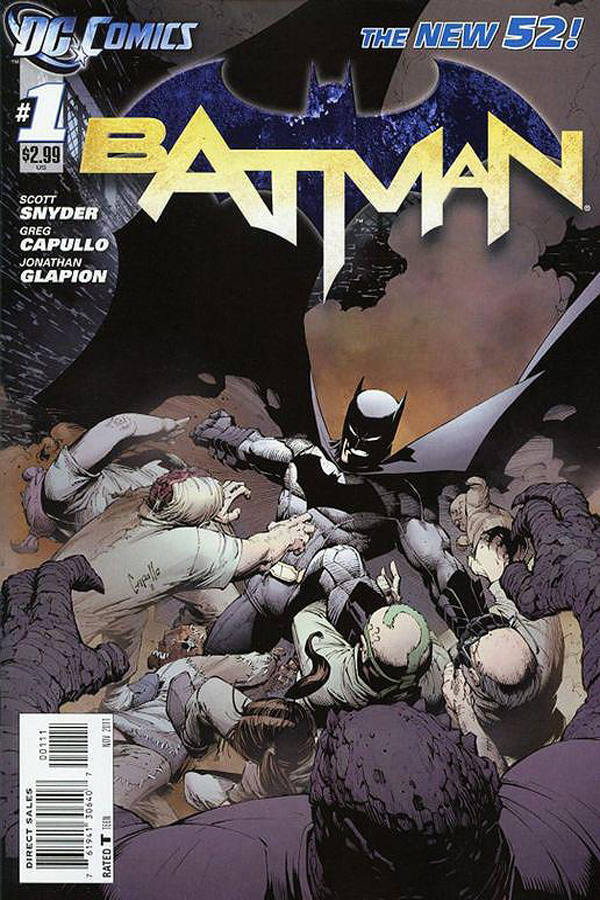
Neither DC Comics nor Marvel have been publishing superhero comics for kids since the mid-1980s. OK — that’s not entirely true. In the interest of reaching out to younger readers, both companies have created all-ages versions of Batman, Spider-Man, and other popular stories. That both companies felt the need to create kid-friendly versions of these properties ought to tell you something about the content of most DC and Marvel products. Just compare an issue of any New 52 title with Tiny Titans if you don’t believe me; the difference in tone, presentation, and content will astonish you:

This DC Comic is for kids.

This DC Comic is not.

It’s fair to criticize the plot of a comic book movie as being too obvious or simplistic to sustain an adult’s interest, of course, but that’s not the same thing as dismissing the entire enterprise as “kids’ stuff” because ten-year-old boys used to be Stan Lee’s target audience. Comics have evolved. So should your critique of movies based on comics.

2. Get your facts straight.

Take it from a comic book reviewer: if you whiff a detail — no matter how insignificant — fans will stop following your argument and start building a case against you. Amy Nicholson — who wrote a smart, informed review of The Avengers — was eviscerated by fans who fumed that she’d referred to Samuel L. Jackson’s character as “Nick Frost” instead of “Nick Fury.” (The error has since been corrected.)

As someone who reviews Japanese comics in translation, I have deep sympathy for this reviewer. I’ve made similar mistakes, and have endured withering comments from readers who think it a cardinal sin to credit the wrong publisher for a book, or misspell a secondary character’s name. What I’ve learned from that experience is that you might demonstrate your erudition in ten other ways — through the quality of your insights, the depth of your cinematic knowledge, or the creativity of your language — but comics fans won’t give a damn about your opinion if you call Captain America “Stephen Rodgers.”

3. Do your homework.

The best comic-book films work equally well for devoted fans and newcomers alike: think Ghost World (2001), Spider-Man (2002), or Superman (1978), all of which had something to offer both groups of viewers. And while it’s beneficial to share your impression of a comic book movie as a member of the general public — as someone who knows Batman from the campy Adam West show, for example, or from watching Saturday morning cartoons — your review will be more authoritative if you take the time to learn a little more about the characters’ histories. Think about it this way: you wouldn’t review a big-screen adaptation of Sense and Sensibility without reading the novel or watching other versions, so why would you walk into a movie version of a long-running comic book franchise without at least familiarizing yourself with the characters? Read Wikipedia. Visit your local comic book store and talk to the sales clerks. Buy a few trades. It won’t kill you, I promise.

4. Remember that there are many comic book fans who will appreciate a thoughtful review.

We aren’t all rampaging monsters with a taste for critics’ flesh; many of us like an elegant turn of phrase or appreciate a Truffaut reference as much as you do. Don’t insult us for liking comic books, and we won’t sneer at you for suggesting The Avengers was overly long. Scout’s honor.

Filed Under: Comics, Manga Critic Tagged With: Comic Book Movies, DC Comics, Marvel Comics, Marvel's The Avengers, The Amazing Spider-Man, The Dark Knight Rises

7 Mouth-Watering Food Manga

May 24, 2012 by Katherine Dacey 18 Comments

When Khursten Santos announced that this month’s Manga Movable Feast would be… well, a feast, that provided me with a swell excuse to highlight my favorite food manga. I attribute my interest in the genre to my brief but intense infatuation with Iron Chef in the mid-2000s. I had always found cooking shows uninteresting: why watch someone make a cake or a roast when I already knew how to do that? Iron Chef, however, reimagined the cooking show as a tournament manga with an identifiable cast of characters who faced new and increasingly difficult challenges each week. Presiding over the competition was a flamboyant “villain” — the one and only Chairman Kaga — who was capricious and extravagant, demanding his contestants turn asparagus and ayu into ice cream and amuse-bouche. I can’t say I learned how to prepare any dishes from watching Iron Chef, but I came to appreciate the Iron Chefs’ creativity and combat-readiness.

When I discovered that there were manga that looked and sounded like an episode of Iron Chef, I was ecstatic. I read Iron Wok Jan and Yakitate!! Japan before discovering more sedate forms of food manga: Antique Bakery, Kitchen Princess, Mixed Vegetables. I gradually lost interest in the melodramatic pageantry of Iron Chef, but not in Japanese cuisine. I’ve been expanding my culinary horizons through manga instead, tackling anything with a food theme. Which ones reign supreme in Manga Critic Stadium? Read on for the list!

7. EKIBEN HITORITABI

KAN SAKURAI AND JUN HAYASE • JMANGA • 2 VOLUMES (ONGOING)

If you need definitive proof that there’s a manga for every conceivable niche audience, look no further than Ekiben Hitoritabi, a charming series about a train bento enthusiast. Yes, you read that right: Ekiben Hitoritabi follows the exploits of Daisuke Nakahara, a thirty-five-year-old man whose greatest ambition is to sample the boxed lunches served at train stations around Japan. The story is as relaxed and meandering as Daisuke’s journey, as he transfers from one line to the next in search of the country’s best — and most exotic — ekiben. Slight as the story may be, the authors’ meticulous attention to detail and obvious fondness for train travel carry the day, making this manga both fun and educational. Now if only Amtrak would investigate ekiben… I’d take a fish cake over microwave pizza any day.

6. NEKO RAMEN

KENJI SONISHI • TOKYOPOP • 4 VOLUMES (INCOMPLETE)

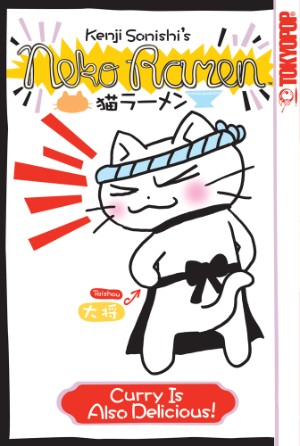
If you’ve ever lived with a cat or dog, you know that no meal is complete without a pet hair garnish. Now imagine that your beloved companion actually prepared your meals instead of watching you eat them: what sort of unimaginable horrors might you encounter beyond the stray hair? That’s the starting point for Neko Ramen, a 4-koma manga about a cat whose big dream is to run a noodle shop, but author Kenji Sonishi quickly moves past hair balls and litter box jokes to mine a richer vein of humor, poking fun at his cat cook’s delusions of entrepreneurial grandeur. Taisho is the Don Quixote of ramen vendors, dreaming up ludicrous giveaways and unappetizing dishes in an effort to promote his business, never realizing that he is the store’s real selling point. The loose, sketchy artwork gives the series an improvisational feel, while the script has the pleasant, absurdist zing of an Abbott and Costello routine. (Reviewed at The Manga Critic on 6/2/10.)

5. YAKITATE!! JAPAN

TAKAHASHI HASHIGUCHI • VIZ MEDIA • 26 VOLUMES (COMPLETE)

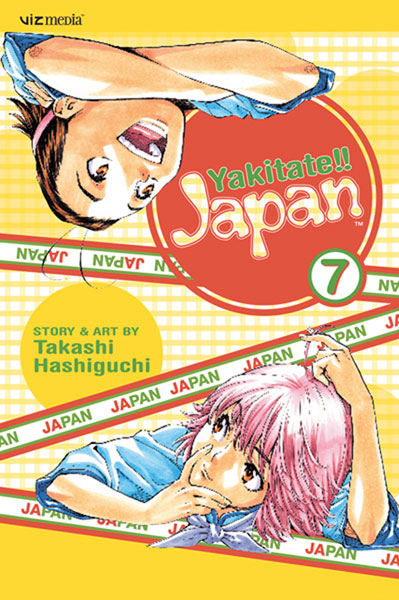
Kazuma Azuma is a boy with a dream: to create a bread so beloved by the Japanese people that it becomes synonymous with the country itself. Though he lacks formal training, he’s a prodigy in the kitchen, blessed with “hands of the sun” (a.k.a. hands warm enough to jump-start the dough’s rising) and a jazz musician’s knack for improvisation. These skills land him at the modest South Tokyo branch of Pantasia, a popular chain of bakeries. There, alongside the loud-mouthed apprentice Kyosuke Kawachi, the cute but steely manager Tsukino Asuzagawa, and the bread master Ken Matsushiro, he hones his craft, develops new Ja-pan prototypes, and enters countless bake-offs. (In other words, Yakitate!! Japan is One Piece with pastry.) The series does, at times, sag under the weight of repetition — how many death-defying baking competitions can one boy win? — but its mouth-watering concoctions, colorful cast, and impromptu science lessons ensure that every volume has a least one or two outstanding chapters. (Reviewed at PopCultureShock on 3/7/07)

4. KODOKO NO GOURMET

MASAYUKI QUSUMI AND JIRO TANIGUCHI • JMANGA • 1 VOLUME (COMPLETE)

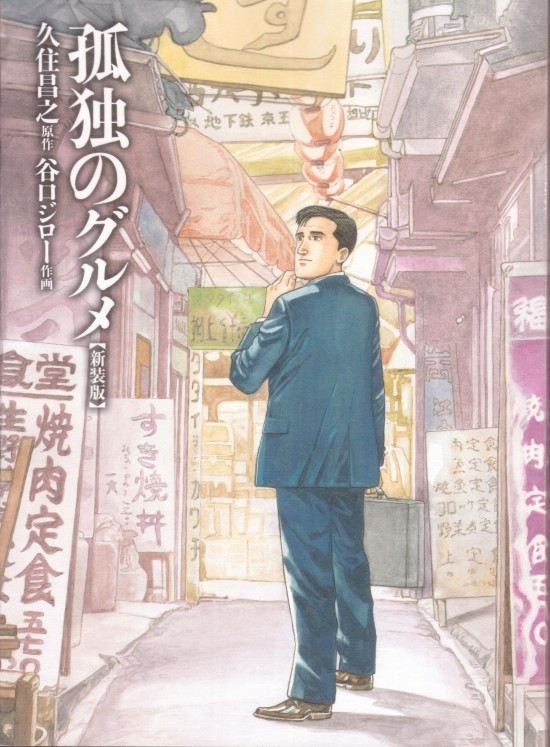
If you’re a fan of Kingyo Used Books, you may remember the chapter in which Japanese backpackers shared a dog-eared copy of Kodoku no Gourmet (a.k.a. The Lonely Gourmet) in order to feel more connected to home. Small wonder they adored Gourmet: its hero, Goro Inoshigara, is a traveler who devotes considerable time and energy to seeking out his favorite foods wherever he goes. While the manga is episodic  — Goro visits a new restaurant in every chapter — Jiro Taniguchi does a wonderful job of conveying the social aspect of eating, creating brief but vivid portraits of each establishment: its clientele, its proprietors, and, of course, its signature dishes. Best of all, Taniguchi and writer Masayuki Qusumi have the good sense to limit the story to a single volume, allowing the reader to savor Goro’s culinary adventures, rather than ponder its very slight premise.

3. GOKUDOU MESHI

SHIGERU TSUCHIYAMA • JMANGA • 2 VOLUMES (ONGOING)

Gokudou Meshi revolves around a contest: once a year, the residents of Naniwa South Prison describe the best food they’ve ever eaten. The prisoner with the most mouth-watering story wins an item from each of his fellow inmates’ osechi, a special New Year’s Eve box filled with fish, rice cakes, omelettes, and other holiday treats. As one might expect from such a conversation-driven series, Gokudou Meshi is told primarily through flashbacks, with each prisoner recounting a memorable meal or favorite noodle shop. Such an improbable premise lends itself to sitcom exaggeration, but author Shigeru Tsuchiyama plays it straight, respecting the sincerity of his thugs’ culinary convictions. The results read like cross between a Damon Runyon story and a Food Network Show; one could almost imagine Nicely-Nicely Johnson waxing poetic with the Naniwa gang about the hot dogs at Saratoga.

2. NOT LOVE BUT DELICIOUS FOODS MAKE ME SO HAPPY!

FUMI YOSHINAGA • YEN PRESS • 1 VOLUME (COMPLETE)

My Dinner With Fumi: that’s what I would have called the English-language edition of Not Love But Delicious Foods Make Me So Happy! The fifteen stories contained within this slim volume celebrate good food and good conversation, documenting Yoshinaga’s interactions with friends, assistants, and fellow artists at real restaurants around Tokyo. No culinary stone goes unturned, as Yoshinaga — or, as her fictional alter ego is called, Y-naga — visits a Korean restaurant, a French bistro, an Italian trattoria, a sushi joint, an all-you-can-eat dim sum buffet, and a bakery famous for its bagels. As the characters chatter enthusiastically about what they’re eating, we realize that Yoshinaga’s real objective is showing us the important role that food plays in fostering friendships. One contentious conversation even prompts the omniscient narrator to praise good food for its diplomatic value: “But through the power of skirt steak, their hearts resumed beating as one,” the narrator observes. In Yoshinaga’s world, detente is just a dish away.  (Reviewed at The Manga Critic on 12/12/10.)

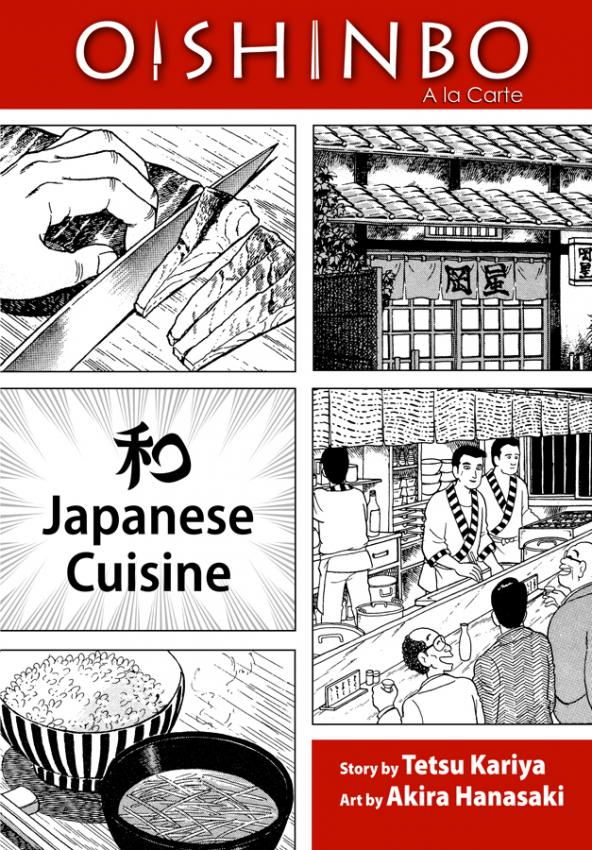
1. OISHINBO A LA CARTE

TETSU KARIYA AND AKIRA HANASAKI • VIZ MEDIA • 8 VOLUMES (COMPLETE)

Equal parts Iron Wok Jan, Mostly Martha, and The Manga Cookbook, this educational, entertaining series explores Japanese cuisine at its most refined — sake, seabream sashimi — and its most basic — rice, pub food. The stories fall into two categories: stories celebrating the important role of food in creating community, and stories celebrating the culinary expertise of its principal characters, newspaperman Yamaoka Shiro and his curmudgeonly father Kaibara Yuzan. (Fun fact: Yuzan is such a food snob that he drove Yamaoka’s mother to an early grave, causing an irreparable break between father and son.) Though the competition between Yamaoka and Yuzan yields some elegant, mouth-watering dishes, Oishinbo is at its best when it focuses on everyday food in everyday settings, shedding light on how the Japanese prepare everything from bean sprouts to ramen. Warning: never read on an empty stomach!

* * * * *

So, hungry readers, which food manga are your favorites? Are there food manga you’d like to see translated into English (e.g. Cooking Papa)? Dish away!

Filed Under: Manga Critic Tagged With: Cooking and Food, Manga Movable Feast

7 Mouth-Watering Food Manga

May 24, 2012 by Katherine Dacey

When Khursten Santos announced that this month’s Manga Movable Feast would be… well, a feast, that provided me with a swell excuse to highlight my favorite food manga. I attribute my interest in the genre to my brief but intense infatuation with Iron Chef in the mid-2000s. I had always found cooking shows uninteresting: why watch someone make a cake or a roast when I already knew how to do that? Iron Chef, however, reimagined the cooking show as a tournament manga with an identifiable cast of characters who faced new and increasingly difficult challenges each week. Presiding over the competition was a flamboyant “villain” — the one and only Chairman Kaga — who was capricious and extravagant, demanding his contestants turn asparagus and ayu into ice cream and amuse-bouche. I can’t say I learned how to prepare any dishes from watching Iron Chef, but I came to appreciate the Iron Chefs’ creativity and combat-readiness.

When I discovered that there were manga that looked and sounded like an episode of Iron Chef, I was ecstatic. I read Iron Wok Jan and Yakitate!! Japan before discovering more sedate forms of food manga: Antique Bakery, Kitchen Princess, Mixed Vegetables. I gradually lost interest in the melodramatic pageantry of Iron Chef, but not in Japanese cuisine. I’ve been expanding my culinary horizons through manga instead, tackling anything with a food theme. Which ones reign supreme in Manga Critic Stadium? Read on for the list!

7. Ekiben Hitoriabi
By Kan Sakurai and Jun Hayase • JManga • 2 volumes+ (incomplete in English)
If you need definitive proof that there’s a manga for every conceivable niche audience, look no further than Ekiben Hitoritabi, a charming series about a train bento enthusiast. Yes, you read that right: Ekiben Hitoritabi follows the exploits of Daisuke Nakahara, a thirty-five-year-old man whose greatest ambition is to sample the boxed lunches served at train stations around Japan. The story is as relaxed and meandering as Daisuke’s journey, as he transfers from one line to the next in search of the country’s best — and most exotic — ekiben. Slight as the story may be, the authors’ meticulous attention to detail and obvious fondness for train travel carry the day, making this manga both fun and educational. Now if only Amtrak would investigate ekiben… I’d take a fish cake over microwave pizza any day.

6. Neko Ramen
By Kenji Sonishi • Tokyopop • 4 volumes (complete)
If you’ve ever lived with a cat or dog, you know that no meal is complete without a pet hair garnish. Now imagine that your beloved companion actually prepared your meals instead of watching you eat them: what sort of unimaginable horrors might you encounter beyond the stray hair? That’s the starting point for Neko Ramen, a 4-koma manga about a cat whose big dream is to run a noodle shop, but author Kenji Sonishi quickly moves past hair balls and litter box jokes to mine a richer vein of humor, poking fun at his cat cook’s delusions of entrepreneurial grandeur. Taisho is the Don Quixote of ramen vendors, dreaming up ludicrous giveaways and unappetizing dishes in an effort to promote his business, never realizing that he is the store’s real selling point. The loose, sketchy artwork gives the series an improvisational feel, while the script has the pleasant, absurdist zing of an Abbott and Costello routine. (Reviewed at The Manga Critic on 6/2/10.)

5. Yakitate!! Japan
By Takhashi Hashiguchi • VIZ Media • 26 volumes (complete)
Kazuma Azuma is a boy with a dream: to create a bread so beloved by the Japanese people that it becomes synonymous with the country itself. Though he lacks formal training, he’s a prodigy in the kitchen, blessed with “hands of the sun” (a.k.a. hands warm enough to jump-start the dough’s rising) and a jazz musician’s knack for improvisation. These skills land him at the modest South Tokyo branch of Pantasia, a popular chain of bakeries. There, alongside the loud-mouthed apprentice Kyosuke Kawachi, the cute but steely manager Tsukino Asuzagawa, and the bread master Ken Matsushiro, he hones his craft, develops new Ja-pan prototypes, and enters countless bake-offs. (In other words, Yakitate!! Japan is One Piece with pastry.) The series does, at times, sag under the weight of repetition — how many death-defying baking competitions can one boy win? — but its mouth-watering concoctions, colorful cast, and impromptu science lessons ensure that every volume has a least one or two outstanding chapters. (Reviewed at PopCultureShock on 3/7/07)

4. Kodoko no Gourmet
By Masayuki Qusumi and Jiro Taniguchi • JManga • 1 volume (complete)
If you’re a fan of Kingyo Used Books, you may remember the chapter in which Japanese backpackers shared a dog-eared copy of Kodoku no Gourmet (a.k.a. The Lonely Gourmet) in order to feel more connected to home. Small wonder they adored Gourmet: its hero, Goro Inoshigara, is a traveler who devotes considerable time and energy to seeking out his favorite foods wherever he goes. While the manga is episodic  — Goro visits a new restaurant in every chapter — Jiro Taniguchi does a wonderful job of conveying the social aspect of eating, creating brief but vivid portraits of each establishment: its clientele, its proprietors, and, of course, its signature dishes. Best of all, Taniguchi and writer Masayuki Qusumi have the good sense to limit the story to a single volume, allowing the reader to savor Goro’s culinary adventures, rather than ponder its very slight premise.

3. Gokodou Meshi
By Shigeru Tsuchiyama • JManga • 2 volumes+ (incomplete in English)
Gokudou Meshi revolves around a contest: once a year, the residents of Naniwa South Prison describe the best food they’ve ever eaten. The prisoner with the most mouth-watering story wins an item from each of his fellow inmates’ osechi, a special New Year’s Eve box filled with fish, rice cakes, omelettes, and other holiday treats. As one might expect from such a conversation-driven series, Gokudou Meshi is told primarily through flashbacks, with each prisoner recounting a memorable meal or favorite noodle shop. Such an improbable premise lends itself to sitcom exaggeration, but author Shigeru Tsuchiyama plays it straight, respecting the sincerity of his thugs’ culinary convictions. The results read like cross between a Damon Runyon story and a Food Network Show; one could almost imagine Nicely-Nicely Johnson waxing poetic with the Naniwa gang about the hot dogs at Saratoga.

2. Not Love But Delicious Foods Make Me So Happy!
By Fumi Yoshinaga • Yen Press • 1 volumes (complete)
My Dinner With Fumi: that’s what I would have called the English-language edition of Not Love But Delicious Foods Make Me So Happy! The fifteen stories contained within this slim volume celebrate good food and good conversation, documenting Yoshinaga’s interactions with friends, assistants, and fellow artists at real restaurants around Tokyo. No culinary stone goes unturned, as Yoshinaga — or, as her fictional alter ego is called, Y-naga — visits a Korean restaurant, a French bistro, an Italian trattoria, a sushi joint, an all-you-can-eat dim sum buffet, and a bakery famous for its bagels. As the characters chatter enthusiastically about what they’re eating, we realize that Yoshinaga’s real objective is showing us the important role that food plays in fostering friendships. One contentious conversation even prompts the omniscient narrator to praise good food for its diplomatic value: “But through the power of skirt steak, their hearts resumed beating as one,” the narrator observes. In Yoshinaga’s world, detente is just a dish away.  (Reviewed at The Manga Critic on 12/12/10.)

1. Oishinbo a la Carte
By Tetsu Kariya and Akira Hanasaki • VIZ Media • 8 volumes (complete English edition)*
Equal parts Iron Wok Jan, Mostly Martha, and The Manga Cookbook, this educational, entertaining series explores Japanese cuisine at its most refined — sake, seabream sashimi — and its most basic — rice, pub food. The stories fall into two categories: stories celebrating the important role of food in creating community, and stories celebrating the culinary expertise of its principal characters, newspaperman Yamaoka Shiro and his curmudgeonly father Kaibara Yuzan. (Fun fact: Yuzan is such a food snob that he drove Yamaoka’s mother to an early grave, causing an irreparable break between father and son.) Though the competition between Yamaoka and Yuzan yields some elegant, mouth-watering dishes, Oishinbo is at its best when it focuses on everyday food in everyday settings, shedding light on how the Japanese prepare everything from bean sprouts to ramen. Warning: never read on an empty stomach!

* The English edition is an adaptation of the original series, which spans 111 volumes.

* * * * *

So, hungry readers, which food manga are your favorites? Are there food manga you’d like to see translated into English (e.g. Cooking Papa)? Dish away!

Filed Under: Manga, Manga Critic, Recommended Reading Tagged With: Cooking and Food, Manga Movable Feast

Pick of the Week: Flowers of Evil & other stories

May 21, 2012 by Katherine Dacey, Sean Gaffney, Michelle Smith and MJ 6 Comments

KATE: If you buy only one manga this week, make it The Flowers of Evil. I was fully prepared to hate this series with every fiber of my feminist being, as the plot summary made it sound like Sundome: The Revenge. What I discovered, however, is that Shuzo Oshimi is a far more accomplished storyteller than Kazuto Okada. Oshimi paints a sympathetic portrait of his hero, oddball bookworm Takao Kusuga; Kusuga is the kind of earnest kid who feels uncomfortable with normal boy stuff, but isn’t confident enough to ignore his peers’ snickering. Kusuga unwittingly becomes the toy of Sawa Nakamura, an angry, confused girl who threatens to expose Kusuga as a “pervert” unless he acquiesces to her demands. The dynamic between Kusuga and Nakamura is expertly rendered; though Nakamura’s motives for blackmailing Kusuga aren’t directly explained, we can see how important it is for her to find someone—anyone—her shares her predilections. A queasy yet fascinating exploration of teenage sexuality.

SEAN: When Yen press announced Until Death Do Us Part at NYCC, I was quite excited. For one thing, it was 15 volumes and still going, and I wasn’t expecting any more licenses of long series that weren’t Naruto-esque. For another, it simply feels like it will do well here. It has swordfighting, it has future prediction, and it has lots and lots of excitement and action. It may not win any prizes for depth, but that’s never stopped me before. And it’s an omnibus, so you get two volumes in one.

MICHELLE: Having not yet read The Flowers of Evil, and having probably touted Pandora Hearts a time or two in the past, I’ll cast my vote for the fifth volume of Saturn Apartments, from VIZ’s SigIkki lineup. I’ve described the series as a low-key dystopia, as it somehow manages to charm whilst depicting a pretty bleak future for humanity. It doesn’t come out very frequently, but when it does, it’s something to be happy about.

MJ: This week, I’m with Kate. While I’m certainly enthusiastic about new volumes of Nabari no Ou and Pandora Hearts, and I’m looking forward to checking out Puella Magi Madoka Magica, this week’s must-buy is The Flowers of Evil. As I mentioned in last week’s Off the Shelf, I went into volume one of The Flowers of Evil with the expectation that it was most likely Not For Me, but it rather emphatically was for me. As Kate indicates, it succeeds on the strength of its characterization, and the fact that both of its leads are immediately sympathetic, or at least relatable. This kind of honest storytelling is absolutely the key to my heart. This series is not to be missed.


Readers, what looks good to you this week?

Filed Under: PICK OF THE WEEK

Bookshelf Briefs 5/21/12

May 21, 2012 by Sean Gaffney, Katherine Dacey, MJ and Michelle Smith 4 Comments

This week, Sean, Kate, MJ, and Michelle look at recent releases from Yen Press, VIZ Media, Digital Manga Publishing, and Kodansha Comics.


Ai Ore!, Vol. 5 | By Mayu Shinjo | VIZ Media – I have completely given up on these characters – especially Mizuki – growing or learning from any of their experiences. And honestly, doing that makes it much easier to get into the groove of this melodramatic, silly manga. From Akira’s desperately trying to be taken seriously as a guy while wearing a kitty hoodie, to Mizuki’s over-the-top “MY WORLD IS ENDING!” reaction to her first fight with Akira, the situations here are made for amusement. Sure, there’s some soap opera dramatics – the fight I mentioned earlier – but even the serious backstory for Akira, where he reveals that his tutor once brought in an older woman to “make a man of him” – is played with its tongue in cheek. The ending seems to hint we may be seeing the return of “Dark Akira”, though – let’s hope he’s merely firm and seductive, and not the callous ass he was at the start. Fun stuff. –Sean Gaffney

Arata: The Legend, Vol. 10 | By Yuu Watase | VIZ Media – The latest installment of Arata: The Legend features body-swapping hijinks. Usually these kind of comic interludes are a sign that the artist is marking time between big fight scenes, but Yuu Watase uses this time-honored trick to advance the plot in a meaningful fashion, allowing Hinohara to infiltrate Yataka’s stronghold. The body-swapping gimmick also provides the characters an opportunity to reflect on their feelings for one another, giving us greater insight into Hinohara and Mikusa’s personalities. The only drawback to the out-of-character behavior is that it grants Watase license for fan service — something that the series doesn’t need to be funny or sexy. That minor gripe aside, Arata remains engrossing, finding the perfect middle ground between shojo angst and shonen action. Recommended. -Katherine Dacey

Hana-Kimi, Vols. 4-6 Omnibus | By Hisaya Nakajo | VIZ Media – A lot of this second omnibus deals with the class culture festival, where most of Mizuki’s class is dressing up in drag. This gives her an excuse to wear a dress most of the time, even if it’s as Alice in Wonderland. After a strong start, the author seems to have realized that the series will be a long one, so the actual romance between Mizuki and Sano isn’t moved forward as much. Instead, Nakatsu gets the focus, as he struggles with his repressed feelings for a “guy”. He’s mostly comedic, but I liked how he handled telling the girl who likes him that he was breaking it off – he’s a sweetie pie that sadly is doomed in a series like this. The addition of a female friend – as well as a new rival – for Mizuki is also welcome, and I look forward to the third and presumably last teaser omnibus. –Sean Gaffney

Itazura Na Kiss, Vol. 8 | By Kaoru Tada | Published by Digital Manga Publishing – There are times when Itazura Na Kiss is so frustrating, one wants to hurl it against the wall. Usually this is because the protagonist, Kotoko, is almost aggressively incompetent. In this latest volume, she has decided that what she wants to do is become a nurse and help Naoki with his medical practice, so she enrolls in nursing school with practically no idea what this will entail. Naoki is cutting in his criticism, as usual, but what’s interesting is that one of Kotoko’s classmates objects to how Naoki treats his wife and eventually presents himself as an alternative. Naoki, faced with jealous feelings for the first time, is thrown for a loop and it’s what he does to win Kotoko back that makes up for every bit of irritation caused by other elements of the series. Still recommended, despite its flaws! – Michelle Smith

Pandora Hearts, Vol. 10 | By Jun Mochizuki | Yen Press – While the series’ last few volumes have posed many more questions than they have answered, things finally come to a head here in volume ten. This volume is chock full of revelations, particularly regarding Gil and Vincent Nightray, and the atmosphere is tense in exactly the way that shows off Jun Mochizuki’s fast-paced storytelling style to its best advantage. Though crystal-clear plotting has never been Mochizuki’s strong point, clarity in the moment is, which is what makes a volume like this work so well. Panel-to-panel, she maps out these characters’ emotional truths so clearly that the text becomes nearly irrelevant to our understanding of their plights. That said, some of Mochizuki’s dialogue is so delightful (Xerxes Break owns my soul), it would be a tragedy to do without it. Still recommended. – MJ

Psyren, Vol. 4 | By Toshiaki Iwashiro | VIZ Media – I’m starting to enjoy this the more I get into it. The lead is likeable and talented while retaining that ‘everyman’ spirit, the cast isn’t too overpowered yet, and of course hard work is emphasized, as in the best Jump works. The introduction of the Elmore Wood kids is well-handled – they act like typical kids, ranging from bratty to shy to stoic. They help Ageha to figure out how to control his powers (well, we presume – we haven’t seen it in action just yet) by virtue of a simpler mindset and learning at a younger age. And, as a cliffhanger shows, they may be mankind’s last, best hope. Of course, they may all be killed at the start of the next volume, too. The only downside here is Kabuto, who lacks enough likeable traits to make a good comic relief character – you want him to fail. Otherwise, very good stuff. –Sean Gaffney

Sayonara, Zetsubou-Sensei, Vol. 12 | By Koji Kumeta | Kodansha Comics – “We’ll have to start a new campaign with easier content so that even first-timers can understand Zetsubou-Sensei,” declares suicidal teacher Itoshiki Nozumu in the first pages of volume 12. What follows is a sharp, funny deconstruction of a common manga practice: the catch-up chapter. I wish the rest of the jokes in volume 12 were as accessible to a Western reader as “The First-Timer Condition,” but the intricate wordplay and cultural allusions often sailed over my head. (Word to the translator: I know what Comiket is! More explanation of the yakuza jokes and economic references, please!) Zetsubou-Sensei ought to be in my wheelhouse — there was a Stendahl joke in chapter 112, for Pete’s sake! — but requires too much explanation to elicit more than an appreciative, “Oh, I get it. Very clever.” -Katherine Dacey

Filed Under: Bookshelf Briefs Tagged With: Ai Ore!, arata: the legend, hana-kimi, itazura na kiss, pandora hearts, psyren, sayonara zetsubou-sensei

Until Death Do Us Part, Vol. 1

May 19, 2012 by Katherine Dacey 1 Comment

Until Death Do Us Part is a slickly packaged compendium of action movie tropes that reads like a story. That’s not to say it’s bad — it isn’t — but to warn you that you may experience a powerful sense of deja-vu as you thumb through its numerous shoot-outs, explosions, and speeches about terrorism.

The opening pages plunge us directly into the action: a solemn pre-teen girl leaps from a speeding car, accosts a blind man, and begs him to help her, promising him jewels and money in return for his assistance. That man, Mamorou, proves surprisingly adept at dispatching bad guys; he’s a modern-day Zaitoichi, using a pair of special goggles and a fine-edged sword to disarm Haruka’s captors, a group of thugs in the employ of the Ex Solid Corporation. (Which begs the question: how does such an ill-named company stay in business? But I digress.) Haruka’s ability to pick Mamorou from a crowd of thousands is no accident; like the pre-cogs in Minority Report, she has an uncanny ability to predict the future. For several years, she used that power to enrich her family — mostly by playing scratch tickets — but now she finds herself running from several powerful organizations, each of whom sees her precognition as a tool for advancing their own interests.

Whether Until Death‘s similarities to The Professional, Mission: Impossible, Minority Report, and the entire oeuvre of Jason Statham are intentional is difficult to say; some of the plots skirt the line between theft and homage. Mamorou’s fellow crime fighters, in particular, seem like IMF recruits, as they’re armed to the teeth with the latest spy technology and weaponry — an incredible feat for an off-the-the-grid vigilante organization with no ties to the government or the mob. (Just in case we don’t fully appreciate how awesome this weaponry is, there are several scientists on hand to explain in excruciating detail how they work.) The sheer abundance of borrowed characters and story lines, however, work in Death‘s favor, with no single borrowing overpowering the resulting fusion of sensibilities.

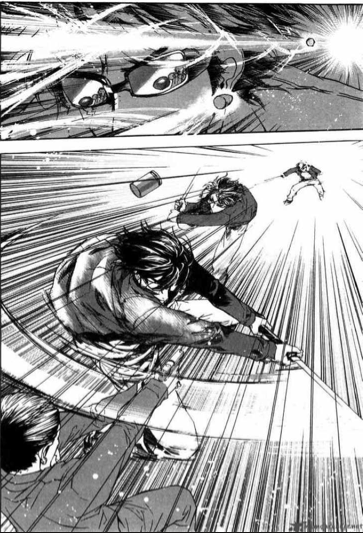
Like many action manga, the artwork tacks between static scenes of talking heads — usually imparting some key points of information about a bad guy’s history, or describing a hypothetical technology — and kinetic scenes of bone-crunching violence. Though the fights aren’t as inventively staged as a John Woo shoot-out, DOUBLE-S wins points for carefully delineating the space in which the gun battles unfold; the reader is conscious of how walls, objects, and sight lines influence the outcome of those battles. DOUBLE-S is overly enamored of slo-mo bullets — a visual gimmick so overused in the last fifteen years it’s become a parodic gesture — but he uses it to good effect, demonstrating how swiftly Mamorou moves, and how precisely his blade slices through solid objects:

Mamorou slices bullets with his scientifically modified katana.

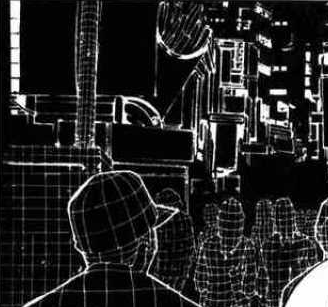
DOUBLE-S has several other nifty tricks up his sleeve as well. In one of the manga’s recurring visual gambits, DOUBLE-S shows us how Mamorou perceives his environment through his special goggles:

A Tokyo street as viewed through Mamorou's goggles.

Though the characters are recognizable in their computer-enhanced form, they have a spectral quality to them; if anything, they resemble echoes or after-images, rather than corporeal entities. The artist’s quick cuts between Mamorou’s perspective and ours neatly underscores how much Mamorou must rely on his other senses to give these incomplete forms flesh and blood: how else could he be so devastating, given the limitations of his goggles?

Perhaps the best compliment I could give Death‘s creators is to note the skill with which it recycles familiar action-movie conventions. We’ve seen Death‘s characters and plots and scientifically implausible weapons in other stories, but Hiroshi Takashige and DOUBLE-S stitch them together in such a fashion that the seamwork is almost invisible. The resulting manga isn’t original, exactly, but it has enough style and integrity to engage the reader’s interest, making it an agreeable beach or airplane companion.

Review copy provided by Yen Press.

UNTIL DEATH DO US PART, VOL. 1 • STORY BY HIROSHI TAKASHIGE, ART BY DOUBLE-S • YEN PRESS • 448 pp. • RATING: OLDER TEEN (16+)

Filed Under: Manga Critic Tagged With: yen press

Until Death Do Us Part, Vol. 1

May 19, 2012 by Katherine Dacey

Until Death Do Us Part is a slickly packaged compendium of action movie tropes that reads like a story. That’s not to say it’s bad — it isn’t — but to warn you that you may experience a powerful sense of deja-vu as you thumb through its numerous shoot-outs, explosions, and speeches about terrorism.

The opening pages plunge us directly into the action: a solemn pre-teen girl leaps from a speeding car, accosts a blind man, and begs him to help her, promising him jewels and money in return for his assistance. That man, Mamorou, proves surprisingly adept at dispatching bad guys; he’s a modern-day Zaitoichi, using a pair of special goggles and a fine-edged sword to disarm Haruka’s captors, a group of thugs in the employ of the Ex Solid Corporation. (Which begs the question: how does such an ill-named company stay in business? But I digress.) Haruka’s ability to pick Mamorou from a crowd of thousands is no accident; like the pre-cogs in Minority Report, she has an uncanny ability to predict the future. For several years, she used that power to enrich her family — mostly by playing scratch tickets — but now she finds herself running from several powerful organizations, each of whom sees her precognition as a tool for advancing their own interests.

Whether Until Death‘s similarities to The Professional, Mission: Impossible, Minority Report, and the entire oeuvre of Jason Statham are intentional is difficult to say; some of the plots skirt the line between theft and homage. Mamorou’s fellow crime fighters, in particular, seem like IMF recruits, as they’re armed to the teeth with the latest spy technology and weaponry — an incredible feat for an off-the-the-grid vigilante organization with no ties to the government or the mob. (Just in case we don’t fully appreciate how awesome this weaponry is, there are several scientists on hand to explain in excruciating detail how they work.) The sheer abundance of borrowed characters and story lines, however, work in Death‘s favor, with no single borrowing overpowering the resulting fusion of sensibilities.

Like many action manga, the artwork tacks between static scenes of talking heads — usually imparting some key points of information about a bad guy’s history, or describing a hypothetical technology — and kinetic scenes of bone-crunching violence. Though the fights aren’t as inventively staged as a John Woo shoot-out, DOUBLE-S wins points for carefully delineating the space in which the gun battles unfold; the reader is conscious of how walls, objects, and sight lines influence the outcome of those battles. DOUBLE-S is overly enamored of slo-mo bullets — a visual gimmick so overused in the last fifteen years it’s become a parodic gesture — but he uses it to good effect, demonstrating how swiftly Mamorou moves, and how precisely his blade slices through solid objects:

Mamorou slices bullets with his scientifically modified katana.

DOUBLE-S has several other nifty tricks up his sleeve as well. In one of the manga’s recurring visual gambits, DOUBLE-S shows us how Mamorou perceives his environment through his special goggles:

A Tokyo street as viewed through Mamorou’s goggles.

Though the characters are recognizable in their computer-enhanced form, they have a spectral quality to them; if anything, they resemble echoes or after-images, rather than corporeal entities. The artist’s quick cuts between Mamorou’s perspective and ours neatly underscores how much Mamorou must rely on his other senses to give these incomplete forms flesh and blood: how else could he be so devastating, given the limitations of his goggles?

Perhaps the best compliment I could give Death‘s creators is to note the skill with which it recycles familiar action-movie conventions. We’ve seen Death‘s characters and plots and scientifically implausible weapons in other stories, but Hiroshi Takashige and DOUBLE-S stitch them together in such a fashion that the seamwork is almost invisible. The resulting manga isn’t original, exactly, but it has enough style and integrity to engage the reader’s interest, making it an agreeable beach or airplane companion.

Review copy provided by Yen Press.

UNTIL DEATH DO US PART, VOL. 1 • STORY BY HIROSHI TAKASHIGE, ART BY DOUBLE-S • YEN PRESS • 448 pp. • RATING: OLDER TEEN (16+)

Filed Under: Manga, Manga Critic, REVIEWS Tagged With: yen press

Pick of the Week: Sailor Moon & more!

May 14, 2012 by Sean Gaffney, Katherine Dacey, Michelle Smith, Brigid Alverson and MJ 1 Comment

SEAN: Many interesting releases this week, but I have to go with an old favorite. Sailor Moon has hit its 5th volume, which in this 12-volume re-release means we get to the end of the ‘R’ arc here. The manga may lack some of the characterization highs of the anime – the other four senshi in particular suffer in this volume as the focus is on other characters – but its action, coherence and occasional emotional brutality – Chibi-Usa’s transformation into Sailor Chibi Moon ends up being heartbreaking – are top-notch. And Pluto actually gets a lot more characterization here than in the anime, being far more than just a stoic ‘guardian’ of time. Any fan of manga should be getting this.

KATE: Since I’ve plugged InuYasha more times than I can count, I’m going off-list to highlight an awesome graphic novel that’s arriving in stores on Wednesday: Princeless. This Eisner-nominated kids’ comic is funny, edgy, and utterly feminist in its outlook — even though it stars a princess who’s imprisoned in a tower. That princess, sixteen-year-old Adrienne, is a blast of fresh air: she dismisses fairy tales as “full of plot holes,” and dispatches would-be suitors with withering assessments of their intelligence. When she finds a sword stashed under her bed, she enlists the help of a dragon to escape. (And that’s just in the first few pages!) Like the best kids’ comics, the script works equally well for kids and adults, offering a good mixture of teachable moments and laugh-out-loud scenes.

MICHELLE: I’m with Sean on this one. Somehow, I never did get around to watching the ‘R’ arc of the anime, so I’ve been enjoying getting a better handle on that storyline, since I’m actually able to read it in English now! I’ve definitely been enjoying Pluto, too, but I’ve got to say… what really makes me happy is that the conclusion of the ‘R’ arc means the start of the ‘S’ arc is just around the corner, and ‘S’ introduces some of the most beloved characters in the series. MJ, I hope you find a way to keep up with this series, because I dearly want to know what you think of what’s coming next!

BRIGID: OK, I’ll be different and go with Starry Sky. I know, I know, it’s based on a game, but the idea of an astronomy student reminiscing about her old school friends—who are somehow tied into a four-seasons theme—seems like a good choice for a lazy day. I’m not expecting to be blown away by this, but I think I’ll enjoy reading it more than a late volume of a series I haven’t been following. (Actually, Sailor Moon was my first choice too but I didn’t want to just go with the crowd.)

MJ: Like Brigid, while Sailor Moon is probably my first choice this week, I’ll seize the opportunity to talk about something different, though I may sorely regret it. Back September of 2010, I read the first volume of Hinako Takanaga’s The Tyrant Falls in Love and kinda hated it. Several months later, I read the second volume and kinda loved it. Though I haven’t yet gone any further in, I’m seriously considering picking up the rest of the series, including volume six, which was released this week. Which will be it? Love or hate? Your guess is as good as mine, but I think I may risk it.


Readers, what looks good to you this week?

Disclosure: MJ is currently under contract with Digital Manga Publishing’s Digital Manga Guild, as necessitated for her ongoing report Inside the DMG. Any compensation earned by MJin her role as an editor with the DMG will be donated to the Comic Book Legal Defense Fund.

Filed Under: PICK OF THE WEEK

Rohan at the Louvre

May 11, 2012 by Katherine Dacey 7 Comments

In 2007, NBM Comics-Lit published Nicolas de Crecy’s Glacial Period, the first in a series of graphic novels commissioned by the Louvre Museum. The goal of Glacial Period — and the four books that followed it — was to introduce readers to the richness and complexity of the Louvre’s vast collections through a familiar medium: comics.

The artists’ strategies for bridging the divide between fine and sequential art have varied. In Glacial Period, for example, a team of anthropologists unearth the Louvre’s collections, which have been buried under ice for a millennium. The scientists try to make sense of the objects they discover, not unlike a group of aliens speculating about the purpose of a Coke bottle or an Etch-A-Sketch. Other novels are more fanciful: Eric Liberge’s On the Odd Hours reads like a classy version of Night at the Museum, in which the museum’s iconic pieces come to life, roaming the empty galleries until the night watchman can subdue them. Still others are explicitly historical: Bernar Yslaire and Jean-Claude Carriere’s Sky Over the Louvre, for example, stars two of the French Revolution’s best-known bad boys: Maximilien Robiespierre and David.

Hirohiko Araki’s Rohan at the Louvre, by contrast, takes its cues from the world of J-horror, using the Louvre as the setting for a nifty ghost story. In the book’s opening pages, we’re introduced to Rohan, an aspiring manga artist who lives with his grandmother in a nearly deserted rooming house. (N.B. Fans of JoJo’s Bizarre Adventure may recognize Rohan as a minor character from one of the later volumes of the series, though prior knowledge of JoJo is not necessary for appreciating Louvre.) The unexpected arrival of a beautiful divorcee turns the normally placid household upside down with tearful drama. Within a week of her arrival, however, Nanase disappears into the night, never to be seen again.

We then jump forward ten years: Rohan, now 27, is a successful manga artist who decides to visit the Louvre to view what Nanase once described to him as “the darkest painting in the world.” The painting, he learns, has never been publicly displayed; it sits in a long-forgotten basement vault. What transpires in the bowels of the Louvre is a mixture of old-fashioned Japanese ghost story and contemporary slasher flick; if one were to update Masaki Kobayashi’s Kwaidan for today’s audiences, the denouement of “The Black-Haired Woman” or “Hoichi the Earless” might look like the climatic scene of Rohan.

For all the gory zest with which that scene is staged, Rohan‘s artwork is uneven. Araki’s command of color is impeccable: the prelude is bathed in a golden light, while the scenes at the Louvre are rendered in a cooler palette of grey, blue, and pure black, a contrast that nicely underscores Rohan’s journey from youthful inexperience to maturity. Araki’s sexy character designs are another plus; even the most muscle-bound figures have a sensual quality to them, with full lips and eyes that that moistly beckon to the reader.

When those figures are in motion, however, Araki’s artwork is less persuasive. Rohan and Nanase’s bodies, for example, rotate along several heretofore undiscovered axes; only Power Girl and Wonder Woman twist their bodies into more anatomy-defying poses. Araki’s fondness for extreme camera angles similarly distorts his characters’ bodies, as he draws them from below, behind, or a forty-five degree angle, eschewing simple frontal views whenever possible. Such bodily distortions are meant to give depth to the picture plane, I think, but the result is curiously flat; the characters often look like paper dolls that have been bent into unnatural shapes, rather than convincing representations of walking, talking people.

What Araki’s artwork does best is convey a sense of place. The opening pages are lovely, offering us a peek into a world that is largely — though not completely — untouched by modernity. Araki takes great pains to render the boarding house’s environs — its rock garden and gnarled pine trees — as well as its interior of spartan rooms and sliding doors. We feel the stillness and seclusion of the inn, and bristle when Nanase’s cell phone pierces that tranquility.

Likewise, Araki captures the Louvre in vivid detail. He guides the reader through its galleries, marching us past the Nike of Samothrace and several rooms of seventeenth- and eighteenth-century paintings. We follow Rohan’s gaze upwards towards vaulted ceilings encrusted in sculptural detail and elaborate frescoes, pausing to meet the gaze of the Dutch burghers and Roman gods whose images are mounted on the gallery walls. We then descend into the museum’s extensive network of tunnels and storage vaults, a veritable catacombs of neglected and obscure objects spread out over hundreds of acres. Although these dark, claustrophobic spaces make an ideal setting for a horror story, they’re also a powerful reminder of the Louvre’s history; the tunnels are remnants of a twelfth-century fortress that once occupied the site of the present-day museum.

If the artwork is, at times, overly stylized, Rohan at the Louvre is still an imaginative celebration of the Louvre Museum, conveying its scale, age, and majesty. Araki’s book is not as sophisticated or ambitious as some of the other titles in this series, but is one of the most dramatically satisfying, achieving a near-perfect balance between telling a ghost story and telling the Louvre’s own story. Recommended.

ROHAN AT THE LOUVRE • BY HIROHIKO ARAKI • NBM/COMICS-LIT • 128 pp. • NO RATING

Filed Under: Manga Critic Tagged With: Hirohiko Araki, Louvre Museum, NBM/Comics Lit, Rohan at the Louvre

Rohan at the Louvre

May 11, 2012 by Katherine Dacey

In 2007, NBM Comics-Lit published Nicolas de Crecy’s Glacial Period, the first in a series of graphic novels commissioned by the Louvre Museum. The goal of Glacial Period — and the four books that followed it — was to introduce readers to the richness and complexity of the Louvre’s vast collections through a familiar medium: comics.

The artists’ strategies for bridging the divide between fine and sequential art have varied. In Glacial Period, for example, a team of anthropologists unearth the Louvre’s collections, which have been buried under ice for a millennium. The scientists try to make sense of the objects they discover, not unlike a group of aliens speculating about the purpose of a Coke bottle or an Etch-A-Sketch. Other novels are more fanciful: Eric Liberge’s On the Odd Hours reads like a classy version of Night at the Museum, in which the museum’s iconic pieces come to life, roaming the empty galleries until the night watchman can subdue them. Still others are explicitly historical: Bernar Yslaire and Jean-Claude Carriere’s Sky Over the Louvre, for example, stars two of the French Revolution’s best-known bad boys: Maximilien Robiespierre and David.

Hirohiko Araki’s Rohan at the Louvre, by contrast, takes its cues from the world of J-horror, using the Louvre as the setting for a nifty ghost story. In the book’s opening pages, we’re introduced to Rohan, an aspiring manga artist who lives with his grandmother in a nearly deserted rooming house. (N.B. Fans of JoJo’s Bizarre Adventure may recognize Rohan as a minor character from one of the later volumes of the series, though prior knowledge of JoJo is not necessary for appreciating Louvre.) The unexpected arrival of a beautiful divorcee turns the normally placid household upside down with tearful drama. Within a week of her arrival, however, Nanase disappears into the night, never to be seen again.

We then jump forward ten years: Rohan, now 27, is a successful manga artist who decides to visit the Louvre to view what Nanase once described to him as “the darkest painting in the world.” The painting, he learns, has never been publicly displayed; it sits in a long-forgotten basement vault. What transpires in the bowels of the Louvre is a mixture of old-fashioned Japanese ghost story and contemporary slasher flick; if one were to update Masaki Kobayashi’s Kwaidan for today’s audiences, the denouement of “The Black-Haired Woman” or “Hoichi the Earless” might look like the climatic scene of Rohan.

For all the gory zest with which that scene is staged, Rohan‘s artwork is uneven. Araki’s command of color is impeccable: the prelude is bathed in a golden light, while the scenes at the Louvre are rendered in a cooler palette of grey, blue, and pure black, a contrast that nicely underscores Rohan’s journey from youthful inexperience to maturity. Araki’s sexy character designs are another plus; even the most muscle-bound figures have a sensual quality to them, with full lips and eyes that that moistly beckon to the reader.

When those figures are in motion, however, Araki’s artwork is less persuasive. Rohan and Nanase’s bodies, for example, rotate along several heretofore undiscovered axes; only Power Girl and Wonder Woman twist their bodies into more anatomy-defying poses. Araki’s fondness for extreme camera angles similarly distorts his characters’ bodies, as he draws them from below, behind, or a forty-five degree angle, eschewing simple frontal views whenever possible. Such bodily distortions are meant to give depth to the picture plane, I think, but the result is curiously flat; the characters often look like paper dolls that have been bent into unnatural shapes, rather than convincing representations of walking, talking people.

What Araki’s artwork does best is convey a sense of place. The opening pages are lovely, offering us a peek into a world that is largely — though not completely — untouched by modernity. Araki takes great pains to render the boarding house’s environs — its rock garden and gnarled pine trees — as well as its interior of spartan rooms and sliding doors. We feel the stillness and seclusion of the inn, and bristle when Nanase’s cell phone pierces that tranquility.

Likewise, Araki captures the Louvre in vivid detail. He guides the reader through its galleries, marching us past the Nike of Samothrace and several rooms of seventeenth- and eighteenth-century paintings. We follow Rohan’s gaze upwards towards vaulted ceilings encrusted in sculptural detail and elaborate frescoes, pausing to meet the gaze of the Dutch burghers and Roman gods whose images are mounted on the gallery walls. We then descend into the museum’s extensive network of tunnels and storage vaults, a veritable catacombs of neglected and obscure objects spread out over hundreds of acres. Although these dark, claustrophobic spaces make an ideal setting for a horror story, they’re also a powerful reminder of the Louvre’s history; the tunnels are remnants of a twelfth-century fortress that once occupied the site of the present-day museum.

If the artwork is, at times, overly stylized, Rohan at the Louvre is still an imaginative celebration of the Louvre Museum, conveying its scale, age, and majesty. Araki’s book is not as sophisticated or ambitious as some of the other titles in this series, but is one of the most dramatically satisfying, achieving a near-perfect balance between telling a ghost story and telling the Louvre’s own story. Recommended.

ROHAN AT THE LOUVRE • BY HIROHIKO ARAKI • NBM/COMICS-LIT • 128 pp. • NO RATING

Filed Under: Manga Critic, REVIEWS Tagged With: Hirohiko Araki, Louvre Museum, NBM/Comics Lit, Rohan at the Louvre

The Flowers of Evil, Vol. 1

May 9, 2012 by Katherine Dacey 11 Comments

If you grew up in a small town, you probably knew someone like Takao Kasuga, the nebbish-hero of The Flowers of Evil. Kasuga is a precocious middle-schooler who copes with provincial life by burying his nose in a book. His peers tolerate him, but find him a little too smug and strange to be one of the guys. Kasuga, for his part, takes pride in his sophisticated reading habits, stashing poems in his desk and telling his classmates that they’re too stupid to appreciate his favorite writer, Charles Baudelaire.

In a moment of impulse, Kasuga steals the gym outfit of beautiful classmate Nanako Saeki — an act witnessed by Sawa Nakamura, the class outcast. Nakamura confronts Kasuga after school, threatening to expose him as the thief unless he complies with her requests. Her motives for blackmailing Kasuga are complex, a mixture of prurient interest in Kasuga’s sexual fantasies and sadistic delight in wielding power over a boy. At times Nakamura  physically dominates him — she punches and tackles him — and at times she manipulates him with humiliating tasks and questions.

I’d be the first to admit that the similarities between Flowers of Evil and Sundome — however superficial — predisposed me to dislike the book. I didn’t think I had the stomach for another story in which a ball-busting girl sexually and psychologically tortured a sad-sack boy. Yet Flowers of Evil proved a far more compelling and honest look at adolescent sexuality than Sundome, thanks, in large part, to Shuzo Oshimi’s sympathetic portrayal of Kasuga.

Throughout the book, author Shuzo Oshimi hints that Kasuga’s character was inspired by his own experiences as a book-toting misfit. “I read Baudelaire’s Flowers of Evil for the first time in middle school,” he explains at the end of chapter one. “I didn’t understand much of it, but the book’s feel — suspicious, indecent, yet nastily noble — made me think, I’m so cool for reading it.” Kasuga, too, clearly feels a sense of superiority for having discovered Baudelaire at a young age; in a fit of self-pity, he muses, “How many people in this town understand Baudelaire?” At the same time, however, he’s keenly aware that his peers think he’s weird. Kasuga may be mature enough to appreciate Baudelaire — or perhaps, more accurately, to think he understands Baudelaire — but he isn’t quite old enough to shake off his classmates’ teasing.

Oshimi also does an exceptional job of dramatizing Kasuga’s inner sexual turmoil. Early in the book, for example, Kasuga catches sight of Saeki. In a flash, he pictures her clad in gym clothes, blushing and telling him, “I love you.” His acute embarrassment at being discovered mid-reverie is all the more palpable for the way in which he’s drawn: Kasuga sinks into his chair, his shoulders slumped, brows furrowed, and body foreshortened, making him look like a moist ragdoll. In later chapters, Oshimi uses surreal imagery — a wall of eyes, a fun-house mirror, a giant sink hole — to suggest that Kasuga’s normal teenage discomfort with sexual feelings has become something more powerful and destructive: shame.

If Kasuga is a sympathetic character, Nakamura poses greater difficulties for the reader. She claims her true agenda is to expose him as a pervert, but nothing about Kasuga’s behavior indicates that he is; if anything, Kasuga is naive, torn between romantic and sexual ideas about love. (That he calls Saeki “my muse, my femme fatale, my Venus” suggests the extent of his confusion.) Nakamura, too, appears to wrestling with complicated sexual feelings; in several scenes, she hints at her own predilections, only to accuse Kasuga of harboring even nastier ones. In short, Nakamura seems intent on finding someone more self-loathing and sexually confused than she is, yet her behavior is so violent and manipulative it sometimes feels as if Oshimi is trying too hard to suggest her disaffection; Nakamura’s character veers dangerously close to being a symbol of castration anxiety, rather than an emotionally damaged teenage girl.

That said, The Flowers of Evil is a shockingly readable story that vividly — one might even say queasily — evokes the fear and confusion of discovering one’s own sexuality. Recommended.

THE FLOWERS OF EVIL, VOL. 1 • BY SHUZO OSHIMI • VERTICAL, INC. • 202 pp. • NO RATING (BEST FOR OLDER TEENS)

Filed Under: Manga Critic Tagged With: Flowers of Evil, Shonen, vertical

The Flowers of Evil, Vol. 1

May 9, 2012 by Katherine Dacey

If you grew up in a small town, you probably knew someone like Takao Kasuga, the nebbish-hero of The Flowers of Evil. Kasuga is a precocious middle-schooler who copes with provincial life by burying his nose in a book. His peers tolerate him, but find him a little too smug and strange to be one of the guys. Kasuga, for his part, takes pride in his sophisticated reading habits, stashing poems in his desk and telling his classmates that they’re too stupid to appreciate his favorite writer, Charles Baudelaire.

In a moment of impulse, Kasuga steals the gym outfit of beautiful classmate Nanako Saeki — an act witnessed by Sawa Nakamura, the class outcast. Nakamura confronts Kasuga after school, threatening to expose him as the thief unless he complies with her requests. Her motives for blackmailing Kasuga are complex, a mixture of prurient interest in Kasuga’s sexual fantasies and sadistic delight in wielding power over a boy. At times Nakamura  physically dominates him — she punches and tackles him — and at times she manipulates him with humiliating tasks and questions.

I’d be the first to admit that the similarities between Flowers of Evil and Sundome — however superficial — predisposed me to dislike the book. I didn’t think I had the stomach for another story in which a ball-busting girl sexually and psychologically tortured a sad-sack boy. Yet Flowers of Evil proved a far more compelling and honest look at adolescent sexuality than Sundome, thanks, in large part, to Shuzo Oshimi’s sympathetic portrayal of Kasuga.

Throughout the book, author Shuzo Oshimi hints that Kasuga’s character was inspired by his own experiences as a book-toting misfit. “I read Baudelaire’s Flowers of Evil for the first time in middle school,” he explains at the end of chapter one. “I didn’t understand much of it, but the book’s feel — suspicious, indecent, yet nastily noble — made me think, I’m so cool for reading it.” Kasuga, too, clearly feels a sense of superiority for having discovered Baudelaire at a young age; in a fit of self-pity, he muses, “How many people in this town understand Baudelaire?” At the same time, however, he’s keenly aware that his peers think he’s weird. Kasuga may be mature enough to appreciate Baudelaire — or perhaps, more accurately, to think he understands Baudelaire — but he isn’t quite old enough to shake off his classmates’ teasing.

Oshimi also does an exceptional job of dramatizing Kasuga’s inner sexual turmoil. Early in the book, for example, Kasuga catches sight of Saeki. In a flash, he pictures her clad in gym clothes, blushing and telling him, “I love you.” His acute embarrassment at being discovered mid-reverie is all the more palpable for the way in which he’s drawn: Kasuga sinks into his chair, his shoulders slumped, brows furrowed, and body foreshortened, making him look like a moist ragdoll. In later chapters, Oshimi uses surreal imagery — a wall of eyes, a fun-house mirror, a giant sink hole — to suggest that Kasuga’s normal teenage discomfort with sexual feelings has become something more powerful and destructive: shame.

If Kasuga is a sympathetic character, Nakamura poses greater difficulties for the reader. She claims her true agenda is to expose him as a pervert, but nothing about Kasuga’s behavior indicates that he is; if anything, Kasuga is naive, torn between romantic and sexual ideas about love. (That he calls Saeki “my muse, my femme fatale, my Venus” suggests the extent of his confusion.) Nakamura, too, appears to wrestling with complicated sexual feelings; in several scenes, she hints at her own predilections, only to accuse Kasuga of harboring even nastier ones. In short, Nakamura seems intent on finding someone more self-loathing and sexually confused than she is, yet her behavior is so violent and manipulative it sometimes feels as if Oshimi is trying too hard to suggest her disaffection; Nakamura’s character veers dangerously close to being a symbol of castration anxiety, rather than an emotionally damaged teenage girl.

That said, The Flowers of Evil is a shockingly readable story that vividly — one might even say queasily — evokes the fear and confusion of discovering one’s own sexuality. Recommended.

THE FLOWERS OF EVIL, VOL. 1 • BY SHUZO OSHIMI • VERTICAL, INC. • 202 pp. • NO RATING (BEST FOR OLDER TEENS)

Filed Under: Manga, Manga Critic, REVIEWS Tagged With: Flowers of Evil, Shonen, Shuzo Oshimi, vertical

Bookshelf Briefs 5/7/12

May 7, 2012 by Katherine Dacey, Sean Gaffney and Michelle Smith 3 Comments

This week, Kate, Sean, and Michelle look at recent releases from Yen Press, Dark Horse, VIZ Media, and Digital Manga Publishing.


Highschool of the Dead, Vol. 6 | Story by Daisuke Sato, Art by Shouji Sato | Yen Press – After reading the first six volumes of this Dawn of the Dead rip-off, I’m still mystified by its appeal. The layouts are busy and poorly composed, a riot of screentones, traced elements, and grossly distended breasts, while the script consists mostly of characters ordering one another around. Yes, there are plenty of scenes of zombie carnage, but even those aren’t executed with much imagination. In volume six, for example, our heroes try to fight their way out a shopping mall, eventually taking refuge on the roof. Sound familiar? That’s because volume one follows the same basic trajectory — just swap “school” for “mall,” and the two storylines are virtually interchangeable. That kind of lazy storytelling might be excusable if Highschool of the Dead were funny or exceptionally gory, but when the laughs and scares are in such short supply, it’s hard to fathom why horror fans are making do with such weak sauce. -Katherine Dacey

Itazura Na Kiss, Vol. 7 | By Kaoru Tada | Digital Manga Publishing – We’re now over halfway through this series, and so we begin to get some new plotlines and characters debut in order to give us more to chew on than “When will Naoki be nice/when will Kotoko be smart?” So we get a new girl who is clearly introduced to be the ‘consolation prize’ to nice yet loser-ish Kinnosuke. It works here, though, as Chris is so much fun – kudos to DMP for translating her fractured Japanese in a way that shows how she sounds to everyone else – and you’re also rooting for her. As for Kotoko, reality slaps her in the face again here, despite minor triumphs like winning over Naoki’s family. Naoki is correct in that Kotoko works best when she isn’t coddled or sympathized with. What’s impressive here is that she realizes it as well. She really may be finally growing up. –Sean Gaffney

Itazura Na Kiss, Vol. 8 | By Kaoru Tada | Digital Manga Publishing – And if the last book showed us Kotoko, if not getting smarter, then at least learning her strengths and limitations, this volume is for Naoki. No, he’s not really all that nicer, but he is at last realizing that he can’t simply expect declarations of love to be entirely one-sided on his wife’s part. Naoki simply doesn’t do emotions – except around Kotoko, who has taught him the joys of frustration, anger, exasperation… and love, reluctant as he still is to admit it. He admits this publicly for one reason – a serious threat to his marriage arrives, and starts pointing out all of his worst flaws. Keita is not particularly in danger of stealing Kotoko – she’s not all that interested. But Naoki here not only admits that he needs Kotoko to be more human – and to be more loving. Which is why the final part of the book is the two of them skipping their anniversary party and sharing a drink and a kiss on a quiet bench. –Sean Gaffney

Kamisama Kiss, Vol. 8 | By Julietta Suzuki | VIZ Media – The annual kami conference is underway, and Nanami has been assigned the special task of sealing the entrance to the land of the dead, which is always besieged by yokai when its guardian kami is away. Unfortunately, she and a mysterious human named Kirihito end up trapped on the other side. So basically, this is yet another “Tomoe to the rescue” scenario. True, Nanami exhibits some bona fide powers as she works to free herself and Kirihito, but ultimately it’s Tomoe who must save her. One nice side effect is that Tomoe seems to realize his feelings for Nanami at long last and some secrets concerning his past—that even he is unaware of—are touched upon. I continue to enjoy Kamisama Kiss, but it must be said that this particular volume was not particularly riveting. – Michelle Smith

Magic Knight Rayearth 2 | By CLAMP | Dark Horse Comics – Needless to say, although it had a great ending, it cannot be denied that the way the last Rayearth manga ended was a bit… well, depressing. So let’s have a sequel where we bring our heroines back and have them save the world again! This omnibus has more flaws than the first – too many characters and a messy and confusing plotline. That said, it explores the idea of what would happen to a world which is collapsing after the woman keeping it idyllic is killed quite well. And it is nice seeing the cute couples that barely had time to be suggested in the first series having a bit more time to develop now – aged-up Ascot is adorable, and I love Caldina and Lafarga too… (Sorry, Rafaga. Damn romanizations.) And of course there’s Hikaru, Lantis and Eagle, which is about as close as one can get to a canonical threesome without a wedding. Not as essential as the first, but still fun. –Sean Gaffney

Psyren, Vol. 4 | By Toshiaki Iwashiro | VIZ Media – The plot of Psyren is moving right along. Oh, sure, there’s the obligatory shounen stuff wherein the heroes are determined to get stronger and the main character must gain control of his tremendous yet potentially destructive power, but we also get more information about how the world of Psyren came to be and how far ahead it is from the present for our characters. Each volume of Psyren is a lot of fun, though I’m beginning to suspect that I would enjoy it even more if I had a lovely stack to consume at once—each time I finish a volume, I wonder when the next will be coming out, which is a pretty big compliment. If you’re weary or wary of certain shounen clichés, Psyren might be different enough to satisfy. As an added bonus, at sixteen volumes, it’s considerably shorter than many titles in this demographic. – Michelle Smith

Voltron Force: Shelter from the Storm, Vol. 1 | Story by Brian Smith, Art by Jacob Chabot | VIZ Media – Back in the 1980s — the golden age of cruddy cartoons with merchandising tie-ins — Voltron: Defender of the Universe introduced a generation of American kids to mecha. Nickelodeon revived the series last year, giving it a fresh look and new cast of cadets. In keeping with the spirit of the original, the new Voltron has inspired its fair share of spin-off products, including a series of original graphic novels published by VIZ. When contrasted with similar comics — especially the original Ben 10 “manga” — Voltron Force: Shelter from the Storm is a superior product, with crisp artwork, sophisticated storytelling, and teenage characters who sound and act enough like teenagers to pass muster with the comic’s target audience of seven-to-ten-year-old boys. The language is sufficiently challenging for advanced readers but not too overwhelming for kids who have just graduated to chapter books, while the diverse cast of characters ensures that boys and girls alike will find a cast member to identify with. A solid addition to the elementary school classroom library. -Katherine Dacey

Filed Under: Bookshelf Briefs

Pick of the Week: Saiunkoku, NonNonBa, FLCL

May 7, 2012 by Katherine Dacey, MJ and Sean Gaffney 2 Comments

KATE: Looking over Midtown Comics‘ brief shipping list, I’m not particularly interested in Blood Blockade Battlefront—though I admit it’s fun to say—and I haven’t read FLCL yet, so my pick is volume seven of The Story of Saiunkoku. I realize that “spunky” is one of the most abused adjectives in the manga critic’s lexicon, but Shurei, Saiunkoku‘s heroine, is spunky in the best sense of the word: she’s smart, determined, and upbeat without being Pollyannish. That she’s surrounded by an agreeable cast of bishonen makes Saiunkoku a special treat; no matter what your preference, there’s a cast member who will make your heart sing. (I’m a Minister Ko partisan, FWIW.) I’ve fallen a little behind with this series, but the release of a new volume offers me a fine incentive for diving back in.

SEAN: Yeah, I think I’m going to have to give Midtown’s list a pass this week. Half of what I’m getting is last week’s order late, anyway. I am excited for the appearance of Shigeru Mizuki’s NonNonBa from Drawn & Quarterly, though, which Diamond says it is shipping to me this week. We’re in a bit of a yokai renaissance right now, what with Natsume’s Book of Friends, Nura: Rise of the Yokai Clan, and Kamisama Kiss. But no one can possibly top the creator of Gegege no Kitaro for yokai, both in scares, laughs, and pure strangeness. This book is half-autobiographical, and also touches on what life was like growing up in pre-World War II Japan. It’s a must buy.

MJ: Technically, I’m with Kate. The one book I know I’ll enjoy from this week’s tiny list is The Story of Saiunkoku. It’s one of my favorite currently-running shoujo series—probably one of my top three or four, in fact. But since Kate has already recommended it so thoroughly (my heart is singing already), I’ll throw my vote to FLCL. This is a bit of a risky pick for me. I enjoyed the anime series when I first saw it several years ago, despite the fact that it contains a number of elements that generally lose with me (mecha, maids, and a sort of fetishization of teen depression are just a few). And though I don’t tend to have a lot of confidence in manga adapted from anime (as opposed to the other way around), I’ll give this one a shot.


Readers, what looks good to you this week?

Filed Under: PICK OF THE WEEK

7 Essential VIZ Signature Manga

April 26, 2012 by Katherine Dacey 10 Comments

Are you an adult reader new to manga? Or a librarian who’s looking to add more graphic novels to your adult collection? Then this list is for you! The VIZ Signature imprint is one of the best resources for adults who read — or are curious about — manga. All of the Signature titles originally appeared in Japanese magazines that cater to grown-up tastes. As a result, the Signature line has broader appeal than many of VIZ’s other imprints, offering something for manga lovers who have “aged out” of Naruto as well as general interest readers who are more likely to discover a graphic novel through The New York Times than The Comics Journal.

Below, I’ve compiled a list of seven titles that best represent the VIZ Signature catalog. In choosing manga for this list, I was less concerned about identifying the “best” titles and more concerned with steering readers towards stories that resonate with their taste in movies, television, and comics. I’ve also focused on more recent series, as some of the line’s older titles — Monster, Sexy Voice and Robo, Phoenix — are out of print. Manga fans are strongly encouraged to add their recommendations in the comments section!

ALL MY DARLING DAUGHTERS

FUMI YOSHINAGA • 1 VOLUME

The five vignettes in All My Darling Daughters depict women negotiating difficult personal relationships: a daughter confronts her mother about mom’s new, much younger husband; a college student seduces her professor, only to dump him when he tries to court her properly; a beautiful young woman contemplates an arranged marriage. Like all of Yoshinaga’s work, the characters in All My Darling Daughters love to talk. That chattiness isn’t always an asset to Yoshinaga’s storytelling, but here the dialogue is perfectly calibrated to reveal just how complex and ambivalent these relationships really are. Yoshinaga’s artwork is understated but effective, as she uses small details — how a character stands or carries her shoulders — to offer a more complete and nuanced portrait of each woman. (One of my picks for Best New Manga of 2010.)

Recommended for: Readers who liked Drinking at the Movies, Dykes to Watch Out For, Make Me a Woman, and other graphic novels exploring the everyday lives of women; readers who are reluctant to commit to a multi-volume series.

BIOMEGA

TSUTOMU NIHEI • 6 VOLUMES

In this sci-fi/horror hybrid, an outbreak of a mysterious virus turns all but one resident of an island colony into zombies. Zoichi Kanoe, a corporate bounty hunter, is sent to retrieve that survivor, only to discover that she’s being guarded by a talking, gun-toting bear. Tsutomu Nihei has the artistic chops to pull off some outlandish stuff, including a rooftop chase scene that borrows a few pages from Bullitt and a spooky Martian prologue that would do John Carpenter proud. Nihei also has the good sense to exercise restraint — if one can describe an apocalyptic zombie scenario with pistol-packing grizzlies as “restrained” — revealing key bits of information only as the characters learn them. The result is a lean, fast-paced shoot-em-up that has just enough thought behind it to make it plausible but not so much that it seems ham-fistedly allegorical. (Reviewed at The Manga Critic on 2/14/10.)

Recommended for: Readers who like science fiction with elements of horror (e.g. Alien, John Carpenter’s The Thing); readers who like zombie fiction, comics, and movies.

DETROIT METAL CITY

KIMINORI WAKASUHI • 10 VOLUMES

Satirizing death metal is a bit like shooting fish in a barrel: how hard can it be to parody a style associated with bands named Cannibal Corpse or Necrophagia? Poking fun at death metal while respecting the sincerity of its followers, however, is a much more difficult trick to pull off, yet Kiminori Wakasugi does just that in Detroit Metal City, ridiculing the music — the violent lyrics, the crudely sexual theatrics — while recognizing the depth of DMC fans’ commitment to the metal lifestyle. Though the musical parodies are hilarious, the series’ funniest moments arise from classic fish-out-of-water situations: Negishi driving a tractor on his parent’s farm while dressed as alter ego Lord Krauser (complete with makeup, fright wig, and platform boots), Negishi bringing a fruit basket to a hospitalized DMC fan while dressed as Krauser… you get the idea. The series begins to run out of gas around volume six, but has the decency not to overstay its welcome. (Reviewed at The Manga Critic on 5/28/09.)

Recommended for: Readers who love musical parodies (e.g. This Is Spinal Tap, South Park, Flight of the Conchords); readers who have fond memories of attending KISS or GWAR concerts back in the day.

HOUSE OF FIVE LEAVES

NATSUME ONO • 7 VOLUMES, ONGOING (8 TOTAL)

Timid ronin Akitsu Masanosuke can’t hold a steady job, despite his formidable swordsmanship. When a businessman approaches him with work, Masanosuke readily accepts, not realizing that his new employer, Yaichi, runs a crime syndicate that specializes in kidnapping. Masanosuke’s unwitting participation in a blackmailing scheme prevents him from severing his ties to Yaichi; Masanosuke must then decide if he will join the House of Five Leaves or bide his time until he can escape. Though Toshiro Mifune and Hiroyuki Sanada have made entire careers out of playing characters like Masanosuke, Natsume Ono makes a persuasive case that you don’t need a flesh-and-blood actor to tell this kind of story with heartbreaking intensity; she can do the slow-burn on the printed page with the same skill as Masaki Kobayashi (Hara Kiri, Samurai Rebellion) and Yoji Yamada (The Twilight Samurai) did on the big screen. (Reviewed at The Manga Critic on 8/20/10.)

Recommended for: Kurosawa junkies; readers who like costume dramas; readers with an interest in Japanese history.

OISHINBO A LA CARTE

STORY BY TETSY KARIYA, ART BY HANASAKI AKIRA • 7 VOLUMES

Equal parts Iron Wok Jan, Mostly Martha, and The Manga Cookbook, this educational, entertaining series explores Japanese cuisine at its most refined — sake, seabream sashimi — and its most basic — rice, pub food. The stories fall into two categories: stories celebrating the important role of food in creating community, and stories celebrating the culinary expertise of its principal characters, newspaperman Yamaoka Shiro and his curmudgeonly father Kaibara Yuzan. (Fun fact: Yuzan is such a food snob that he drove Yamaoka’s mother to an early grave, causing an irreparable break between father and son.) Though the competition between Yamaoka and Yuzan yields some elegant, mouth-watering dishes, Oishinbo is at its best when it focuses on everyday food in everyday settings, shedding light on how the Japanese prepare everything from bean sprouts to ramen. Warning: never read on an empty stomach! (Reviewed at The Manga Critic on 6/24/09.)

Recommended for: Foodies, gourmets, and other people who like to watch the Food Network (or have daydreamed about becoming a restaurant critic); readers who enjoy The Drops of God.

REAL

TAKEHIKO INOUE • 10 VOLUMES, ONGOING

In lesser hands, REAL might have been an Afterschool Special in manga form, an earnest, uplifting story about disabled teens who find a new sense of purpose on the basketball court. Takehiko Inoue, however, steers clear of easy sentiment; his characters are tough, competitive, and profane, occasionally self-pitying, and fiercely determined to create a space for themselves that’s theirs—and theirs alone. Though the court scenes are brief (at least by shonen sports manga standards, where matches can take several volumes to unfold), Inoue captures the speed and energy of his athletes with consummate skill. A funny, honest, and sometimes rueful series that works equally well for teens and adults. (My choice for Best New Manga of 2008 at PopCultureShock; reviewed at The Manga Critic on 5/3/09.)

Recommended for: Basketball enthusiasts; readers who enjoy sports stories with a human interest angle.

20TH CENTURY BOYS

NAOKI URASAWA • 20 VOLUMES, ONGOING (24 TOTAL)

Naoki Urasawa’s 20th Century Boys tells a twisty, layered story about ordinary people saving the world from annihilation. Other auteurs have explore similar turf — Tim Kring’s Heroes comes to mind — but Urasawa manages to sustain the reader’s interest without succumbing to cliche or unduly testing our patience. The key to Urasawa’s success is strong script with vivid characters and a clear sense of purpose, reassuring the reader that all the plot strands are just that: strands, not loose threads. Crisp, detailed artwork helps sell the more ludicrous aspects of the story, and distinguish the sprawling cast from one another. (Reviewed at The Manga Critic on 1/9/10.)

Recommended for: Conspiracy theory buffs; readers who enjoy television programs that blend elements of science fiction, suspense, and paranoia (e.g. Alcatraz, Heroes, Lost).

Filed Under: Manga Critic Tagged With: Cooking and Food, Drama, fumi yoshinaga, Horror/Supernatural, Naoki Urasawa, Natsume Ono, Sci-Fi, Seinen, Sports Manga, Tsutomu Nihei, VIZ, VIZ Signature

  • « Go to Previous Page
  • Page 1
  • Interim pages omitted …
  • Page 52
  • Page 53
  • Page 54
  • Page 55
  • Page 56
  • Interim pages omitted …
  • Page 89
  • Go to Next Page »
 | Log in
Copyright © 2010 Manga Bookshelf | Powered by WordPress & the Genesis Framework