• Skip to primary navigation
  • Skip to main content
  • Skip to primary sidebar
  • Home
  • About Us
    • Privacy Policy
    • Comment Policy
    • Disclosures & Disclaimers
  • Resources
    • Links, Essays & Articles
    • Fandomology!
    • CLAMP Directory
    • BlogRoll
  • Features & Columns
    • 3 Things Thursday
    • Adventures in the Key of Shoujo
    • Bit & Blips (game reviews)
    • BL BOOKRACK
    • Bookshelf Briefs
    • Bringing the Drama
    • Comic Conversion
    • Fanservice Friday
    • Going Digital
    • It Came From the Sinosphere
    • License This!
    • Magazine no Mori
    • My Week in Manga
    • OFF THE SHELF
    • Not By Manga Alone
    • PICK OF THE WEEK
    • Subtitles & Sensibility
    • Weekly Shonen Jump Recaps
  • Manga Moveable Feast
    • MMF Full Archive
    • Yun Kouga
    • CLAMP
    • Shojo Beat
    • Osamu Tezuka
    • Sailor Moon
    • Fruits Basket
    • Takehiko Inoue
    • Wild Adapter
    • One Piece
    • After School Nightmare
    • Karakuri Odette
    • Paradise Kiss
    • The Color Trilogy
    • To Terra…
    • Sexy Voice & Robo
  • Browse by Author
    • Sean Gaffney
    • Anna Neatrour
    • Michelle Smith
    • Katherine Dacey
    • MJ
    • Brigid Alverson
    • Travis Anderson
    • Phillip Anthony
    • Derek Bown
    • Jaci Dahlvang
    • Angela Eastman
    • Erica Friedman
    • Sara K.
    • Megan Purdy
    • Emily Snodgrass
    • Nancy Thistlethwaite
    • Eva Volin
    • David Welsh
  • MB Blogs
    • A Case Suitable For Treatment
    • Experiments in Manga
    • MangaBlog
    • The Manga Critic
    • Manga Report
    • Soliloquy in Blue
    • Manga Curmudgeon (archive)

Manga Bookshelf

Discussion, Resources, Roundtables, & Reviews

Katherine Dacey

Drifting Net Cafe, Vol. 1

June 19, 2012 by Katherine Dacey

It takes nerve — nay, stones — to update Kazuo Umezu’s bat-shit classic The Drifting Classroom. That’s exactly what Shuzo Oshimi (The Flowers of Evil) has done in Drifting Net Cafe, however, substituting a nebbishy salaryman for Sho, the original series’ twelve-year-old protagonist, and an Internet cafe for Sho’s school. The results are a decidedly mixed bag, suggesting that some texts lend themselves to revision, while others are too much the product of particular author’s imagination to warrant re-telling.

As in the original series, the story begins with a snapshot of the hero’s daily life: 29-year-old Toki has an argument with his pregnant wife, Yukie, then goes to an office job he dislikes. On impulse, he stops in an Internet cafe on his way home from work, where he bumps into Tohno, a girl he loved in middle school. The two begin comparing notes on their current lives when an earthquake plunges the building into darkness. When no one arrives to lead Toki, Tohno, and their fellow customers to safety, the group makes a terrifying discovery: the cafe has been transported from Tokyo to a wasteland from which all evidence of human civilization — roads, buildings, people — has been expunged.

To his credit, Oshimi takes enough time to establish Toki’s routine and personality for the reader to appreciate what’s at stake if Toki doesn’t find a way to return to his old life. None of the other characters, however, are fleshed out to the same degree. Yukie is portrayed as a howling grotesque, at the mercy of her hormones; Tohno is saintly and brave; and the other cafe customers are assigned one or two defining traits, depending on their gender and age. Thin characterizations are a common problem in disaster stories; authors are often reluctant to bestow too much humanity on characters who are destined to become monster food or cannon fodder, lest the audience find the story too dispiriting. Oshimi, however, takes that indifference to an extreme, creating a supporting cast of repellant, one-note characters whose comeuppance elicit cheers, not tears.

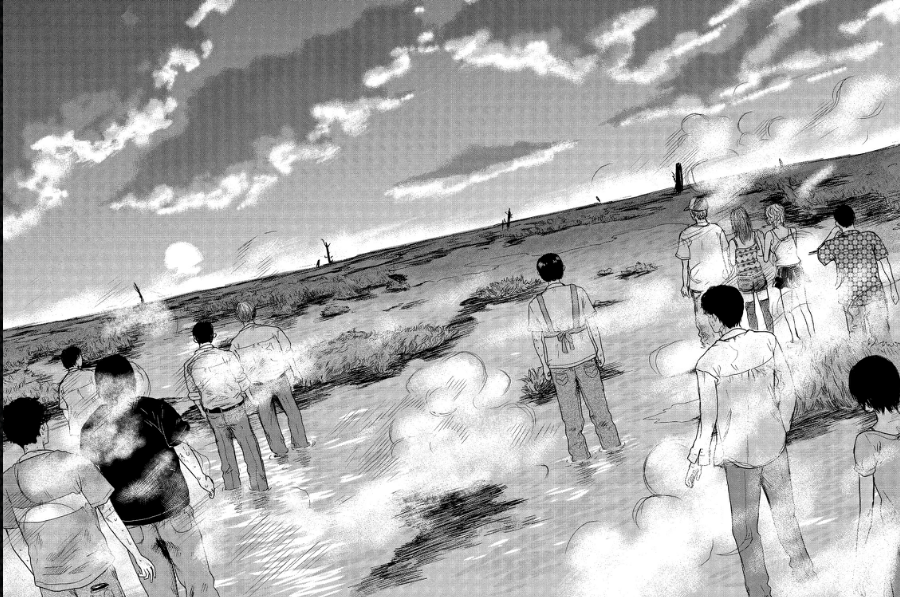
The other great drawback to Drifting Net Cafe is Oshimi’s lack of imagination. Though Oshimi is a competent draftsman, he shows little of Umezu’s flair for nightmarish imagery. Consider the way Oshimi renders the cafe’s final destination:

The wasteland, as imagined by Shuzo Oshimi in Drifting Net Cafe.

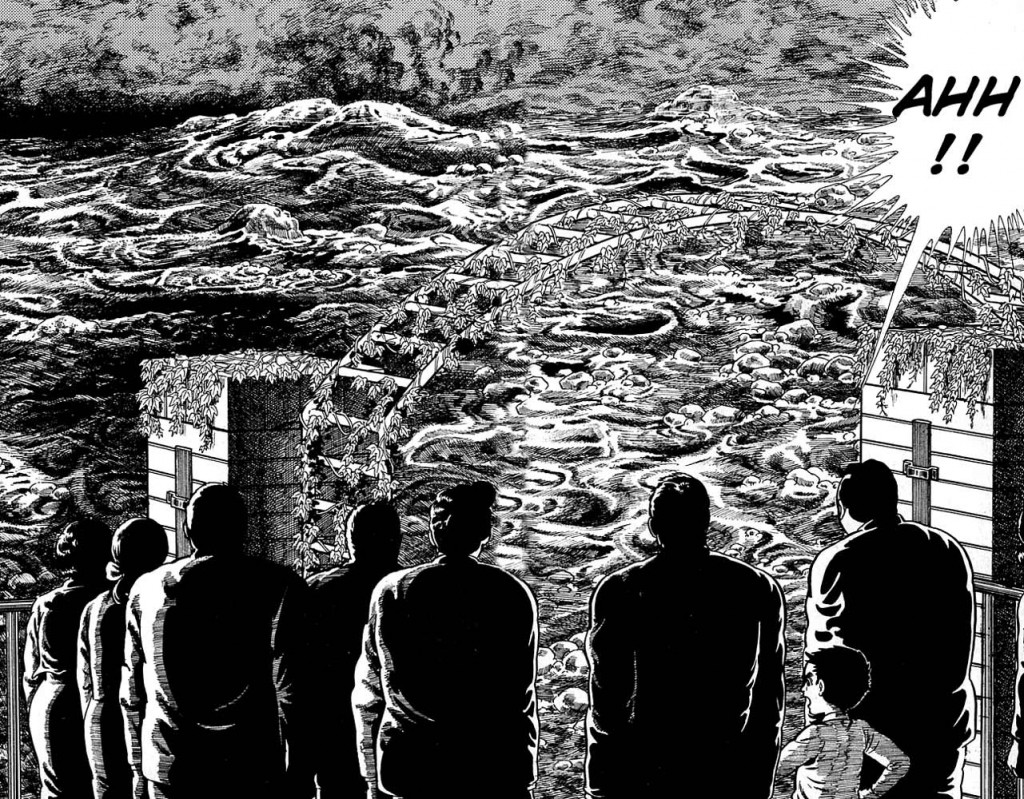
It’s not a badly composed image; Oshimi makes effective use of the tilted camera angle to convey the characters’ disorientation, and uses a few charred trees to suggest that something powerful scoured the landscape clean. When contrasted with the original version, however, it’s clear that Oshimi’s image elicits a much tidier, less emotional response than the repulsive, molten moonscape that Sho and his teachers discover just beyond the school gates:

Umezu’s vision of the wasteland, from The Drifting Classroom.

Oshimi’s monsters, too, betray his tendency to favor blandly polished imagery over inspired, if crudely rendered, boogeymen. Late in volume one of Drifting Net Cafe, for example, a creature resembling a typical Star Trek parasite attacks a female character, latching onto her thigh. It’s a memorable scene, tapping a similar vein of body-violation horror as Alien and Prometheus, but the monster’s quick defeat makes it seem more like a pretext for fanservice than a genuine menace. Umezu’s monsters, by contrast, take a variety of forms — giant insects and lizards, creepy aliens with bulbous foreheads, giant metallic serpents with grasping hands — all of which seem like the products of a feverish child’s imagination, rather than something copied from a TV show or straight-to-DVD movie.

The characters’ conflicts, too, seem smaller and less compelling than they did in Umezu’s original, which pitted Sho and his classmates against their teachers. The Drifting Classroom‘s adults quickly become deranged with grief and fear, leaving the children to fend for themselves in a hostile environment. Sho and his classmates spend several agonizing chapters struggling to accept the fact that none of the adults are in charge anymore; the students’ first attempts to defend themselves against crazed teachers and giant bugs end in catastrophe, a gruesome reminder of their misplaced trust in the adults.

In Oshimi’s version, however, all the characters are adults. They challenge one another’s leadership, squabble over resources, and indulge their worst impulses, sexual and otherwise. Though some of these scenes pack a visceral punch, most simply reinforce the idea that Toki and Tohno are the only decent folk among a group of unpleasant, self-interested urbanites — not exactly the stuff of high-stakes drama, even if one character finds himself on the business end of a pocket knife.

Where Drifting Net Cafe improves on the source material is pacing. The Drifting Classroom unfolds at a furious clip; characters are maimed or menaced in every chapter, and speak at decibel levels better suited for the Bonnaroo Music Festival than everyday conversation. Oshimi, on the other hand, varies the narrative tempo of Drifting Net Cafe: some chapters are packed with important revelations and dramatic confrontations, while others are more leisurely. These quieter chapters are among the most unnerving, however, as we watch the characters size up each others’ weaknesses, like sharks circling a wounded seal.

Though conceived as a tribute to The Drifting Classroom, Oshimi’s work is more likely to appeal to readers who haven’t read the original, or who find Umezu’s distinctive artwork dated and ugly. Long-time fans of Classroom are likely to find Oshimi’s update slick but soulless, as it relies more heavily on low-budget disaster movies than the original source material for its characters and conflicts.

DRIFTING NET CAFE, VOL. 1 • BY SHUZO OSHIMI • JMANGA • 251 pp. • RATING: MATURE (18+)

Filed Under: Manga, Manga Critic, REVIEWS Tagged With: Drifting Classroom, JManga, Kazuo Umezu, Seinen, Shuzo Oshimi

Pick of the Week: Abundance

June 18, 2012 by MJ, Katherine Dacey, Michelle Smith, Sean Gaffney and Brigid Alverson 3 Comments

MJ: There’s quite a bit manga on its way to Midtown Comics this week, but despite the wide range of tasty-looking titles, making my pick is astonishingly easy. Natsume Ono’s House of Five Leaves is one of my very favorite titles currently running, and a new volume of that trumps nearly anything else the industry could put before me. I love this series’ idiosyncratic artwork, its passive protagonist, its ambiguous morality, and its meandering style. For me, this series is always a must-buy.

KATE: I second MJ’s recommendation; House of Five Leaves is my favorite Natsume Ono manga (it beats out Ristorante Paradiso by a whisker), and I never miss an opportunity to sing its praises. The other series on my mind this week is Alice in the Country of Hearts, which Yen Press rescued from licensing purgatory. I missed out on Alice when Tokyopop was publishing it, so I’m grateful for the opportunity to read it without bankrupting myself or resorting to scans. I’ve heard nothing but good things about this title’s shojolicious riff on Alice in Wonderland, so I go into the new two-in-one editions with high hopes.


MICHELLE: I’ll cast my vote for Yen Press’s license rescue of Alice in the Country of Hearts, which is hitting stores complete in three omnibus editions. Yes, I’ve read it already, but I had to rely on a somewhat dodgy translation for the final volume, so I’m looking forward to checking it out and seeing whether it makes any more sense (hopefully!) when handled by professionals!

SEAN: I know very little about Olympos other than that it’s a josei manga from Ichijinsha, and is apparently about Apollo and Ganymede. It’s always fascinating to see how Japan handles Western mythology, and the art for this series looks absolutely gorgeous. (The author also did Utahime, which DMP has.) It’s also nice to get a manga that’s complete in one, which this is, by virtue of it being an omnibus collecting both Japanese volumes. But I have to say, in a week which already features a lot of high-minded and worthy manga, Olympos simply looks *classy*. Looking forward to it.

BRIGID: Well, you guys grabbed the obvious choices, so let me chime in with a recommendation for a manga that is near the end of its run: Vol. 32 of Kekkaishi. I have only started reading this series, but what I have read I have liked a lot—it’s a shonen battle manga with a lot of personality. It has the usual ingredients—teenage boy with special powers, girl who is a childhood friend—but it also has some nice quirks (the main character longs to be a pastry chef) and the art is clear and easy to follow—even the fight scenes, which often lose me in shonen manga. It’s hard to jump in over 30 volumes into a series, but Viz has started issuing the earlier volumes as 3-in-1 omnibus editions, and the first 27 volumes are also available digitally. It’s a nice alternative if you’re just in the mood for some straight-up shonen manga.


Readers, what looks good to you this week?

Filed Under: PICK OF THE WEEK

Pick of the Week: Of Mice and Men

June 11, 2012 by Katherine Dacey, MJ, Michelle Smith and Sean Gaffney 1 Comment

KATE: I’d be the first to admit that Honey Darling is silly. The plot hinges on the kind of illogical behavior and improbable coincidences that a first-semester film student would know better than to include in his script. (The nadir is a scene in which one character runs into the street asking strangers where the nearest animal clinic is. Hasn’t he heard of directory assistance? Or Google, for that matter?) If you can look past the contrivances, however, what you’ll discover is a sweet story with a good heart and a good sense of humor, in which two impossibly handsome guys fall in love with each other. Fans of smutty manga may be disappointed, as all the heavy breathing takes place in the final chapter, but readers who like a more straightforward romance will find Honey Darling agreeable.

MJ: I must say, I’m with Kate this week. I’ll admit there haven’t been a lot of titles for me to love in SuBLime’s lineup so far, which is to say that they’ve simply been Not to My Taste. I have been won over by a couple of books, however, and they’ve been the ones I least expected to enjoy—first Oku-San’s Daily Fantasies and now Honey Darling. It is silly, just as Kate says, and there’s nothing truly remarkable in its fairly conventional BL premise, but it’s a lovely example of sweet, sincere romance that doesn’t take itself too seriously. Simply put, Honey Darling is a pleasure to read.

MICHELLE: I’m also aboard the BL bandwagon, but I’m once again recommending Kazuma Kadoka’s Kizuna, which is seeing the release of its sixth and I think final volume. Kizuna was actually released in English before, by long-defunct CPM, but that publisher never got around to publishing the last volume. Though DMP repackaged the first ten, already-released volumes in two-in-one omnibus editions, they’ve left this final one as a standalone, meaning that all the folks who didn’t rebuy the series can just snap this one up! Pretty considerate, actually! Anyway, this BL story (with plenty of yakuza) has been a pleasure to read and I look forward to seeing how it all ends.

SEAN: Honestly, there’s nothing this week that screams Pick of the Week for me. So I will move away from manga and go with the 3rd collection of Floyd Gottfredson’s comic strips, Walt Disney’s Mickey Mouse Vol. 3: High Noon at Inferno Gulch. These volumes have been a revelation, showing a generation who had only seen the dull, squeaky clean corporate Mickey exactly why he was the darling of the 1930s. Pure rollicking high-adventure, they’re also filled with background material and essays by cartoon scholars such as editor David Gerstein. A must for any cartoon fan collection.


Readers, what looks good to you this week?

Filed Under: PICK OF THE WEEK

Bookshelf Briefs 6/10/12

June 11, 2012 by MJ, Sean Gaffney, Katherine Dacey and Michelle Smith Leave a Comment

This week, MJ, Sean, Kate, and Michelle look at recent releases from VIZ Media and JManga.


Bakuman, Vol. 11 | By Tsugumi Ohba & Takeshi Obata | VIZ Media – I’ve always considered Bakuman to be a manga made up of pretty much equal parts “awesome” and “maddening,” and if that’s a decent description of the series as a whole, it’s especially applicable to volume eleven. In the category of “maddening,” we have the usual tiresome offenses against feminism—specifically the further domestication of Kaya, Takagi’s spunky but unambitious young wife, and the over-the-top vilification of Aiko Akina, the talented young writer who was first introduced as a girl too smart to be attractive to men. In the “awesome” column, on the other hand, is basically everything else, especially ongoing rivalry between our heroes and Eiji Nizuma and the artistry it elicits from both sides. By the end of the volume, even Akina is finally beginning to be portrayed as a worthwhile rival instead of the jealous harpy she’s been painted as all along. Overall, I’d probably call it a win. YMMV. – MJ

A Devil And Her Love Song, Vol. 3 | By Miyoshi Tomori | VIZ Media – It’s becoming pretty clear that we’re in for the long haul as regards Maria being bullied, and this volume seems to continue the pattern of her winning over the class one by one. That said, ‘winning over’ is not the same thing as it was with Tomoyo or our two male love interests. Maria has genuine problems interacting with others, and even if you admire her ability to tell folks the truth straight up, you have to acknowledge it. The maskless Maria in this volume goes up against another girl who is putting up a facade, and is just as intolerant of it. I enjoyed the author’s depiction of the crush Hana has on Yusuke – it’s all about the awkward and childish, with very little ‘we were meant to be from the start. Plus, of course, it helps keep the romantic triangle involving Maria alive. – Sean Gaffney

Fluffy, Fluffy Cinnamoroll, Vol. 4 | Story & Art by Yumi Tsukirino, Original Concept by Chisato Seki | VIZ Media – I feel like a grinch for not succumbing to the charms of this Sanrio series, but Fluffy, Fluffy Cinnamoroll has all the warmth of a Transformers comic: it’s a slick, synthetic story in which the real aim is selling products, not creating memorable characters or representing real emotions. The second half of volume four is particularly egregious, as it focuses on the “girl” puppies’ efforts to become pop idols and date celebrities. There’s no doubt that tween girls fantasize about being famous, but the the stories are so neatly resolved that only the least discerning ten-year-old will find them convincing. About the best I can say for volume four is that the first batch of stories — in which the entire gang gets into the crepe-making business — are moderately amusing, as Cinnamoroll’s forest-dwelling neighbors ask for unusual fillings; the raccoons and chickens are a good foil for the prissy, sweets-eating pups. The rest of volume four suffers from their absence. – Katherine Dacey

Gokudou Meshi, Vol. 2 | Shigeru Tsuchiyama | JManga – I was really looking forward to the second volume of Gokudou Meshi and it didn’t disappoint, but that’s because I knew what to expect: tales of simple fare told by a nearly indistinguishable cast of inmates sitting around their cell in a Japanese prison. The food featured in this volume includes instant ramen, katsudon, spaghetti, and even canned pineapple juice. We also see the storytelling tradition spread from the original room 204 to room 307, at which point it becomes apparent that there’s absolutely nothing to be gained in trying to keep track of the characters, because they are utterly unimportant. Gokudou Meshi has stripped away the things that are not essential (plot, characters…) and instead focuses solely on the food. It’s a formula that works for me, though, and one that’s not unaffecting—now I need to find a place in town with good katsudon! – Michelle Smith

Nura: Rise of the Yokai Clan, Vol. 9 | By Hiroshi Hiibashi | VIZ Media – If you like shonen battles and you like yokai, there’s plenty to enjoy here. Rikuo trains in order to be able to face his newest enemies in Kyoto, and for those playing along ‘fear’ is apparently Nura’s version of ‘bankai’ or ‘haki’ or whatever you call a power-up in Jump. There’s new characters introduced, most of whom mistake Rikuo as a weakling before they learn better, and the villain marches through Kyoto curbstomping everyone and being arrogant. That said, I do sort of miss the initial plot of Nura trying to balance his human and yokai sides, which has gotten a bit lost amidst the battles. Now that his classmates are in danger (again) in Kyoto, perhaps we can get a bit more of a return to form. I’m not hopeful, though – the artist seems to love the yokai world far more than they do the human one.. – Sean Gaffney

The Story of Saiunkoku, Vol. 7 | Art by Kairi Yura, Story by Sai Yukino | VIZ Media – I’ve always really liked The Story of Saiunkoku, but this volume made me love it. While Shurei continues to persevere at court in the face of tremendous hardship (winning some admiration in the process), there is a lot of other really interesting stuff going on, including Koyu’s doubts about whether his guardian truly cares for him, Seiran’s promise to watch over Shurei until she can stand on her own, and the arrival of Shurei’s uncle with plans to recall her to the Hong clan’s “main house” someday. As if that weren’t enough, there’s an accusation of favoritism regarding Shurei’s test results, an arrest, a confinement, and a liberal sprinkling of Ryuki being awesome. Really, this volume has it all. I can’t imagine anyone waffling on the quality of this series, but if you did have doubts, volume seven will put them to rest! – Michelle Smith

Filed Under: Bookshelf Briefs

Pick of the Week: Ouran, Devil, GTO

June 4, 2012 by Michelle Smith, Sean Gaffney, MJ and Katherine Dacey 3 Comments

MICHELLE: Ordinarily next week would be one of those impossible-to-choose weeks for me, featuring as it does series like Bakuman, Slam Dunk, Kimi ni Todoke, and Dawn of the Arcana, all of which are terrific. However, they’re all also still being released in English, which means I have plenty of time to recommend them in future. The same cannot be said for Ouran High School Host Club, which reaches its eighteenth and final volume at long last. I’ve followed this series for six years, throughout various ups and downs—I loved some of it, I liked some of it, and I grew frustrated by some of it—but I am really looking forward to its conclusion. I hope it’s as satisfying as it has the potential to be!

SEAN: What Michelle said. Ouran 18 for me as well. (Hey, sometimes even I have little to say.)

KATE: I’ve never been an Ouran gal, so my pick goes to another Shojo Beat title: volume three of A Devil and Her Love Song. I thought the first two volumes showed promise, but felt that the author sometimes didn’t quite know what to do with her prickly, truth-telling heroine. In the third volume, however, the story really clicks: the characters are fully realized, and the storyline begins moving more briskly. Though there are some melodramatic flourishes, A Devil and Her Love Song remains squarely focused on real teenage concerns: fitting in, staying true to one’s beliefs, and rejecting phoniness in all guises. Surely Holden Caulfield would approve.

MJ: While there are quite a few favorites of mine on the list this week, I’ll give my vote to volume three of GTO: 14 Days in Shonan. From my write-up at Off the Shelf: “What I found pretty spectacular about 14 Days in Shonan, is that it features a main character who spends a lot of time telling other people just how much of a badass he is, while actually being a badass … I enjoyed these volumes so much more than I expected, I find myself wishing I had some kind of award to give out for it, or something. It’s been a while since my expectations were so neatly trounced.” I realize that simply repeating myself is a lazy way to make my pick, but really, that gets to the crux of it. I (very unexpectedly) loved the first two volumes of this manga, and I can’t wait to read more!


Readers, what looks good to you this week?

Filed Under: PICK OF THE WEEK

Bookshelf Briefs 6/4/12

June 4, 2012 by Michelle Smith, Sean Gaffney and Katherine Dacey 1 Comment

This week, Michelle, Kate, and Sean look at recent releases from Viz Media, Yen Press, and Sweatdrop Studios.


Ai Ore!, Vol. 5 | By Mayu Shinjo | Viz Media – Ai Ore! in its fifth volume is pretty different than its first. Almost entirely gone is Akira’s manipulative/disturbing behavior (though he’s still fixated on making Mizuki “his”), which is definitely a good thing, and the series has settled into a fairly generic romantic comedy groove. Unfortunately, it seems like Mayu Shinjo may already be out of ideas, since we’re treated to yet another “Mizuki thinks Akira has secretly been gay all this time” bout of melodrama. I continued to be disappointed that Mizuki, who occasionally looks ravishingly boyish, is not a cooler and stronger character, but it’s pretty much a lost cause at this point. Still, even though I stop short of calling Ai Ore! good, it is compulsively readable, and I see myself finishing out the series, though I’m not looking forward to the beachy hijinks advertised for the next volume. – Michelle Smith

Bamboo Blade, Vol. 13 | By Masahiro Totsuka and Aguri Igarashi | Yen Press – There’s some big surprises here, though many of them were signposted earlier. TV Savant Erina is not who she appears to be, and it’s her backstory and growth that is the focus of this volume. The reason that it’s her, by the way, is that Tama loses – genuinely and honestly. This is exactly what her coach has wanted all along, and now we get to see what she will gain from it. Tama has always sort of done kendo as it’s expected of her. Now she sees true kendo passion – both from Erina and from Ura Sakaki, whose delusions of sentai are finally thrashed out of her in one of the most awesome sports battles I’ve seen in a long time. So we’ve one volume to go, and I’ve no doubt that volume will have Tamaki finally seeking the real reason she fights kendo matches. Highly recommended. –Sean Gaffney

Oresama Teacher, Vol. 8 | By Izumi Tsubaki | Viz Media – I sense that Tsubaki-san was told be her editors at Hana to Yume around this point in the manga that the series was a success, and in no danger of ending soon, so it was time to break out the new characters and plot complications. There’s a sense of gearing up for the next big battle here. Unfortunately, as always, Tsubaki’s plotting always seems flaky and scattered. So we get a chapter giving a bit of depth to the main villain, then some background for Takaomi, then a whole passel of new minor villains (some even female – gasp!) are introduced, and then Mafuyu’s two suitors find out about her relationship with Takaomi. There’s some fun stuff here – I was, as always, laughing a lot throughout – but Tsubaki needs a stronger editor than the ones Hakusensha provides. –Sean Gaffney

Soul Eater, Vol. 9 | By Atsushi Ohkubo | Yen Press – Soul Eater is another title, like Oresama Teacher, that is finishing one plot and getting ready to gear up for another. It, however, handles this much better, with plot threads from Vol. 6 onwards just now starting to pay off. The focus here is on our three meisters, rather than their weapons, and I was impressed with how the manga handled Black*Star, everyone’s favorite insufferable talented jerk. We get a lesson seemingly set up for teaching him humility and learning to hold back for the sake of the others – then it turns out this is a fakeout, and that it’s Maka who has to learn not to hold her fellow student back. Finally, our team goes off on its next big battle, where they’re acting as backup for an increasingly unstable Doctor Stein – and they promptly disobey his orders and charge in to the rescue. Kids, sheesh. Good shonen fun. –Sean Gaffney

The Story of Saiunkoku, Vol. 7 | By Kaira Yura and Sai Yukino | Viz Media – The ongoing hazing and abuse of Shurei and Eigetsu sort of percolates along through this entire volume, driving many plots but not quite coming to a head – no doubt that will happen in the next volume. Instead, we get to see that ‘slow and steady wins the race’ seems to be the moral lesson for the entire cast – the villains always seem to overplay their hands by overdoing things and making fast, impetuous choices. Our heroes, meanwhile, are the picture of calm and serenity, even when they’re being arrested for favoritism or held captive so as not to testify at a trial. Of course, one can be *too* serene and unreadable – there’s a great story here about Koyu’s frustration with his lord, and being unable to tell the difference between not caring and not wanting to hold back. It’s all about the small, quiet moments here. –Sean Gaffney

Sun Fish Moon Fish | By Morag Lewis | Sweatdrop Studios – Set in the fictional kingdom of The Thousand Island Archipelago, Sun Fish Moon Fish tells the story of Anciarin, a court mage who’s falsely accused of murdering Archipelago’s royal family. The premise is certainly ripe with potential, but the execution is wanting; Morag Lewis’ character designs have a faintly unnatural quality to them, with enormous, wide-set eyes and perpetually surprised expressions. The dialogue, too, tacks between medieval formality and modern-day casualness, with one character demanding, “What’s your beef?” and another making reference to “teams,” as if he were a S.W.A.T. captain. If the art and dialogue are sometimes amateurish, Lewis shows considerable promise as a writer; Sun Fish Moon Fish is briskly paced and skillfully plotted, giving equal time to Anciarin and Iashar, the soldier tasked with bringing the mage to justice. An ambitious, though uneven, work. – Katherine Dacey

Filed Under: Bookshelf Briefs

Pick of the Week: Genshiken, Wallflower, & more

May 29, 2012 by MJ, Sean Gaffney, Katherine Dacey and Michelle Smith 3 Comments

MJ: There’s not much to choose from at Midtown Comics this week, but making my pick is astonishingly easy, perhaps only because I came so late into the world of manga. The truth is, I’ve always wanted to read Genshiken, and this new omnibus release from Kodansha Comics has finally made it easy for me to actually conceive of doing so. I look forward to finally picking this series up!

SEAN: It’s a very slim week this week, so instead of highlighting something revolutionary or cutting-edge, I will go for one of my comfort manga again. The Wallflower will not win any points for originality—or indeed for resolving its plot—but it’s always so much fun, and I always enjoy seeing what wacky situations the cast will find themselves in this time. Everyone needs a manga that you just turn your brain off and read, and this is a good one. Plus Sunako kicks ass when she wants to.

KATE: Looking over the final shipping list of the month is like opening a half-empty refrigerator: there’s bound to be something worth trying, but it takes a little imagination to find it. This week, however, the manga offerings are just too meager, so I’m going to recommend the first Wonder Woman trade instead. For me, the big draw is the artwork: Cliff Chiang depicts WW not as a voluptuous pin-up, but as a tall, lean warrior who just happens to look a lot better in a strapless unitard than the rest of us mortals. I don’t have any difficulty imagining this WW kicking ass and taking names.

MICHELLE: It’s not on the Midtown list, but according to Amazon, volume three of GTO: 14 Days in Shonan is due out this Tuesday. I wasn’t sure what to expect from this tale of a former delinquent with a talent for getting through to troubled teens, but it turns out it’s a lot of fun. I enjoyed volume two more than the first, as a matter of fact, which certainly bodes well for this next installment!


Readers, what looks good to you this week?

Filed Under: PICK OF THE WEEK

Bookshelf Briefs 5/29/12

May 29, 2012 by MJ, Katherine Dacey and Michelle Smith 4 Comments

This week, Kate, MJ, and Michelle look at recent releases from Yen Press, VIZ Media, JManga, and eManga.


Amorous Women of the Floating World: Sex in Old Tokyo, Vol. 1 | By Kaoru Hazuki & Chinatsu Takamura | Leed Publishing Co., LTD – The cover copy for this manga begins, “Did you know that Japan in the 18th century was even more sexually permissive than it is today?” After reading this manga, however, it must be clarified that “sexually permissive” should be appended with”…for men.” This book is for men, of course, but it’s difficult to accept it as harmless sexual fantasy, when it works so hard to try to sell the subjugation of women as female empowerment. The book opens with lessons in “marital harmony.” “It is incredibly pleasurable for your lord to enter your mouth,” a young woman is told on the eve of her wedding night. “Do not deny him!” Later, we learn about the rural practice in which groups of local men set upon households of women in the middle of the night to ask for sex, which we’re told was empowering for the women because they were allowed to say no. While as a history of sexual behavior in Japan, this book offers some interesting information, as sexual fantasy it’s just kind of… icky. – MJ

Black Butler, Vol. 9 | By Yana Toboso | Published by Yen Press – You know the previous arc must’ve been a dark one when a murder mystery set in Phantomhive Manor seems positively lighthearted by comparison! Ciel is compelled by Her Majesty to play host to a distinguished German visitor, but when the man turns up dead (on the requisite dark and stormy night, of course), Ciel is the only one without an alibi. One guest believes in his innocence, however—a medically trained mystery writer named Arthur, whom one can only assume is meant to be Conan Doyle. Arthur narrates the tale, which is kind of neat, and though I don’t believe for one moment that Sebastian has truly become the killer’s latest victim, I must say that I was really bummed out that I didn’t have volume ten immediately to hand.– Michelle Smith

Cross Game, Vol. 7 | By Mitsuru Adachi | Published by VIZ Media – I’ve you’ve been keeping up with Cross Game, you pretty much know what to expect with this volume. The Seishu team has one last chance to make it to Koshien, and this omnibus (comprising volumes 14 and 15 of the original Japanese edition) offers lots and lots of baseball goodness as they make their way through the Tokyo tournament. Meanwhile, there’s a sort of romantic pentagram going on that provides some distractions. I really admire the elegant way that Adachi and co. depict the games—they are effortlessly easy to follow—as well as Aoba’s growing realization of Ko’s various good qualities, and am always left wanting more even after 300+ pages. Speaking of wanting more, I shall avail myself once more of the opportunity to express my wish for another Adachi series after Cross Game wraps in July. Please, VIZ? – Michelle Smith

A Devil and Her Love Song, Vol. 3 | By Miyoshi Tomori | VIZ Media – Miyoshi Tomori captures adolescence in all its messy confusion, addressing pack behavior, frenemies, and faculty bullies. To be sure, other manga explore the same terrain, but Tomori’s work is one the few that can transport an adult reader back to his or her high school days in a vivid, compelling fashion. What makes this series work is its cast: the characters are flawed, inconsistent, and sometimes unlikable — just like real people — but they’re also funny, smart, and occasionally brave in small ways — just like real people. Best of all, Tomori’s heroine is prickly and brash without being cartoonish; chances are, you knew someone just like Maria when you were 15, and secretly admired her candor, too. Recommended. -Katherine Dacey

Don’t Cry, Girl | By Tomoko Yamashita | JManga – Are wacky nudists the latest trend in manga? I ask because Don’t Cry, Girl was the second manga I’ve read that featured a naked character — in this case, Masuda, a bachelor who agrees to provide a home for Taeko, his friends’ chaste but sensible 17-year-old daughter. The story reads like an extended riff on Austin Powers, with Masuda strategically using bowls of fruit, house plants, and vacuum cleaners to block Taeko’s line of sight. It’s a giddy and stupid conceit, sustained by the chemistry between the unsparingly blunt Taeko and the irrepressibly childish Masuda. The volume is rounded out by a second story, “3322,” which explores the relationships among a trio of women who spend a summer living together. The second story is lush and atmospheric but a little disjointed, making it difficult to follow all the plot strands. Taken as a whole, however, Don’t Cry, Girl is a welcome addition to the small but growing body of josei in English. – Katherine Dacey

Rin-ne, Vol. 9 | By Rumiko Takahashi | VIZ Media – The latest volume of Rin-ne features several ghost-of-the-week stories. Some have a loopy charm: in “Ramen Kaedama,” for example, Rokudo’s feckless father teams up with another damashigami to open a noodle shop, while “The Wig’s Regret” features a possessed prop from a long-forgotten school play. Other chapters, however, feel like something that Rumiko Takahashi could produce on autopilot: the stories are pat and predictable, with magical elements that feel overdetermined. The artwork, too, lacks the detail and personality of Takahashi’s earlier efforts; the backgrounds are uncharacteristically sparse and bland, while the figure drawings look like pallid imitations of characters from Ranma and InuYasha. It’s not bad, just tired; we’ve seen Takahashi tell these kind of stories before with more spark and wit. -Katherine Dacey

Filed Under: Bookshelf Briefs

Puella Magi Madoka Magica, Vol. 1

May 29, 2012 by Katherine Dacey 10 Comments

The opening pages of Puella Magi Madoka Magica suggest a dreary retread of Sailor Moon: Kyubey, a talking cat, appears before Madoka Kaname, a perky yet otherwise unremarkable school girl, and asks her, “Would you like to change destiny?” Our first clue that Puella has something nastier up its be-ribboned sleeve occurs midway through the first chapter, when transfer student Homura Akemi confronts Madoka with a dire, if cryptic, warning: “You should never consider ‘changing yourself’ in any way,” she tells Madoka. “If you choose not to heed my words, those things that you hold dear will all be lost.” Homura then attacks Kyubey, accusing him of using “dirty tactics” to persuade Madoka to make a contract with him.

Though all the trappings of a traditional magical girl manga are in place — the costume changes, the cute familiars, the teamwork — Puella charts a darker, more violent course than other translated examples of the genre. Homura and Madoka operate in a world where magical girls routinely die; though their powers are formidable, magical girls are worked to the point of emotional and physical exhaustion. Moreover, their contracts are signed under duress; Kyubey frequently appeals to girls in desperate circumstances, using their vulnerability as leverage. (In exchange for battling witches, he explains to Madoka, “I fulfill one wish. Any wish you want!”)

In short, Puella manages to have its cake and eat it, too, faithfully adhering to the genre’s conventions while offering an explicit critique of its underlying message of courage and selflessness. The story is the antithesis of a wish-fulfillment fantasy: the powers that Kyubey bestows come with responsibilities that are too difficult for a young, inexperienced person to bear. Throughout the manga, we see examples of magical girls who have become competitive or embittered by their experiences, at risk of becoming witches themselves. We also meet girls who regret the haste with which they made their contracts, as their wishes were fulfilled at the expense of friends and family members.

As sharp as Puella‘s genre critique may be, the artwork is a disappointment. The character designs are faithful to the original anime, but the magical elements look smudgy on the page, the product of too much dark grey screentone. The anime’s surreal fight sequences have lost their visual punch as well. Creatures that looked strange and menacing in color have been defanged, reduced to cute video game monsters floating above the picture plane.

Most of the fight scenes have been compressed into a few pages, further curtailing their impact; we barely have time to register who the opponents are before one of the magical girls has eliminated the threat. As a result, the volume’s climatic scene lacks emotional resonance. Though the characters have repeatedly discussed how dangerous their vocation is, the fight is so fleeting and impressionistic that the stakes seem too low to yield such a devastating outcome.

If the artwork lacks the personality of a Magic Knight Rayearth or Cardcaptor Sakura, however, the actual story is on par with the best translated examples of the magical girl manga. Like the aforementioned CLAMP titles, Puella Magi Madoka Magica treats the magical girl as a character worthy of complexity and genuine interiority; the Puella girls may engage in magical combat, but they’re painfully aware that saving the world can be an ugly business — even if they’re wearing smart costumes.

Review copy provided by Yen Press.

PUELLA MAGI MADOKA MAGICA, VOL. 1 • STORY BY MAGICA QUARTET, ART BY HANOKAGE • YEN PRESS • 144 pp. • RATING: OLDER TEEN (16+)

Filed Under: Manga Critic Tagged With: Magical Girl, Magical Girl Manga, Puella Magi Madoka Magica, shojo, yen press

Puella Magi Madoka Magica, Vol. 1

May 29, 2012 by Katherine Dacey

The opening pages of Puella Magi Madoka Magica suggest a dreary retread of Sailor Moon: Kyubey, a talking cat, appears before Madoka Kaname, a perky yet otherwise unremarkable school girl, and asks her, “Would you like to change destiny?” Our first clue that Puella has something nastier up its be-ribboned sleeve occurs midway through the first chapter, when transfer student Homura Akemi confronts Madoka with a dire, if cryptic, warning: “You should never consider ‘changing yourself’ in any way,” she tells Madoka. “If you choose not to heed my words, those things that you hold dear will all be lost.” Homura then attacks Kyubey, accusing him of using “dirty tactics” to persuade Madoka to make a contract with him.

Though all the trappings of a traditional magical girl manga are in place — the costume changes, the cute familiars, the teamwork — Puella charts a darker, more violent course than other translated examples of the genre. Homura and Madoka operate in a world where magical girls routinely die; though their powers are formidable, magical girls are worked to the point of emotional and physical exhaustion. Moreover, their contracts are signed under duress; Kyubey frequently appeals to girls in desperate circumstances, using their vulnerability as leverage. (In exchange for battling witches, he explains to Madoka, “I fulfill one wish. Any wish you want!”)

In short, Puella manages to have its cake and eat it, too, faithfully adhering to the genre’s conventions while offering an explicit critique of its underlying message of courage and selflessness. The story is the antithesis of a wish-fulfillment fantasy: the powers that Kyubey bestows come with responsibilities that are too difficult for a young, inexperienced person to bear. Throughout the manga, we see examples of magical girls who have become competitive or embittered by their experiences, at risk of becoming witches themselves. We also meet girls who regret the haste with which they made their contracts, as their wishes were fulfilled at the expense of friends and family members.

As sharp as Puella‘s genre critique may be, the artwork is a disappointment. The character designs are faithful to the original anime, but the magical elements look smudgy on the page, the product of too much dark grey screentone. The anime’s surreal fight sequences have lost their visual punch as well. Creatures that looked strange and menacing in color have been defanged, reduced to cute video game monsters floating above the picture plane.

Most of the fight scenes have been compressed into a few pages, further curtailing their impact; we barely have time to register who the opponents are before one of the magical girls has eliminated the threat. As a result, the volume’s climatic scene lacks emotional resonance. Though the characters have repeatedly discussed how dangerous their vocation is, the fight is so fleeting and impressionistic that the stakes seem too low to yield such a devastating outcome.

If the artwork lacks the personality of a Magic Knight Rayearth or Cardcaptor Sakura, however, the actual story is on par with the best translated examples of the magical girl manga. Like the aforementioned CLAMP titles, Puella Magi Madoka Magica treats the magical girl as a character worthy of complexity and genuine interiority; the Puella girls may engage in magical combat, but they’re painfully aware that saving the world can be an ugly business — even if they’re wearing smart costumes.

Review copy provided by Yen Press.

PUELLA MAGI MADOKA MAGICA, VOL. 1 • STORY BY MAGICA QUARTET, ART BY HANOKAGE • YEN PRESS • 144 pp. • RATING: OLDER TEEN (16+)

Filed Under: Manga, Manga Critic, REVIEWS Tagged With: Magical Girl, Magical Girl Manga, Puella Magi Madoka Magica, shojo, yen press

An Open Letter to Movie Critics

May 25, 2012 by Katherine Dacey 19 Comments

By now, if you’re a movie critic, you’ve filed your Avengers — sorry, Marvel’s The Avengers — review and are girding your loins for The Amazing Spider-Man and The Dark Knight Rises. Before you hold forth on the evils of comic book movies, or write an essay about superhero decadence, let me offer a few suggestions for reviewing Spider-Man and The Dark Knight. These tips won’t guarantee that every DC or Marvel man will be wowed by your references to Rio Bravo and Yojimbo, or swayed by your measured criticisms, but they will ensure that movie-goers like me — smart folk who like Lawrence of Arabia and The Walking Dead — won’t roll our eyes in disgust at yet another review that begins, “Hollywood must be out of ideas, because they sure do like to make comic book movies.”

1. Don’t trot out the “superheroes are for kids” line.

Neither DC Comics nor Marvel have been publishing superhero comics for kids since the mid-1980s. OK — that’s not entirely true. In the interest of reaching out to younger readers, both companies have created all-ages versions of Batman, Spider-Man, and other popular stories. That both companies felt the need to create kid-friendly versions of these properties ought to tell you something about the content of most DC and Marvel products. Just compare an issue of any New 52 title with Tiny Titans if you don’t believe me; the difference in tone, presentation, and content will astonish you:

This DC Comic is for kids.

This DC Comic is not.

It’s fair to criticize the plot of a comic book movie as being too obvious or simplistic to sustain an adult’s interest, of course, but that’s not the same thing as dismissing the entire enterprise as “kids’ stuff” because ten-year-old boys used to be Stan Lee’s target audience. Comics have evolved. So should your critique of movies based on comics.

2. Get your facts straight.

Take it from a comic book reviewer: if you whiff a detail — no matter how insignificant — fans will stop following your argument and start building a case against you. Amy Nicholson — who wrote a smart, informed review of The Avengers — was eviscerated by fans who fumed that she’d referred to Samuel L. Jackson’s character as “Nick Frost” instead of “Nick Fury.” (The error has since been corrected.)

As someone who reviews Japanese comics in translation, I have deep sympathy for this reviewer. I’ve made similar mistakes, and have endured withering comments from readers who think it a cardinal sin to credit the wrong publisher for a book, or misspell a secondary character’s name. What I’ve learned from that experience is that you might demonstrate your erudition in ten other ways — through the quality of your insights, the depth of your cinematic knowledge, or the creativity of your language — but comics fans won’t give a damn about your opinion if you call Captain America “Stephen Rodgers.”

3. Do your homework.

The best comic-book films work equally well for devoted fans and newcomers alike: think Ghost World (2001), Spider-Man (2002), or Superman (1978), all of which had something to offer both groups of viewers. And while it’s beneficial to share your impression of a comic book movie as a member of the general public — as someone who knows Batman from the campy Adam West show, for example, or from watching Saturday morning cartoons — your review will be more authoritative if you take the time to learn a little more about the characters’ histories. Think about it this way: you wouldn’t review a big-screen adaptation of Sense and Sensibility without reading the novel or watching other versions, so why would you walk into a movie version of a long-running comic book franchise without at least familiarizing yourself with the characters? Read Wikipedia. Visit your local comic book store and talk to the sales clerks. Buy a few trades. It won’t kill you, I promise.

4. Remember that there are many comic book fans who will appreciate a thoughtful review.

We aren’t all rampaging monsters with a taste for critics’ flesh; many of us like an elegant turn of phrase or appreciate a Truffaut reference as much as you do. Don’t insult us for liking comic books, and we won’t sneer at you for suggesting The Avengers was overly long. Scout’s honor.

Filed Under: Manga Critic Tagged With: Comic Book Movies, DC Comics, Marvel Comics, Marvel's The Avengers, The Amazing Spider-Man, The Dark Knight Rises

An Open Letter to Movie Critics

May 25, 2012 by Katherine Dacey

By now, if you’re a movie critic, you’ve filed your Avengers — sorry, Marvel’s The Avengers — review and are girding your loins for The Amazing Spider-Man and The Dark Knight Rises. Before you hold forth on the evils of comic book movies, or write an essay about superhero decadence, let me offer a few suggestions for reviewing Spider-Man and The Dark Knight. These tips won’t guarantee that every DC or Marvel man will be wowed by your references to Rio Bravo and Yojimbo, or swayed by your measured criticisms, but they will ensure that movie-goers like me — smart folk who like Lawrence of Arabia and The Walking Dead — won’t roll our eyes in disgust at yet another review that begins, “Hollywood must be out of ideas, because they sure do like to make comic book movies.”

1. Don’t trot out the “superheroes are for kids” line.

Neither DC Comics nor Marvel have been publishing superhero comics for kids since the mid-1980s. OK — that’s not entirely true. In the interest of reaching out to younger readers, both companies have created all-ages versions of Batman, Spider-Man, and other popular stories. That both companies felt the need to create kid-friendly versions of these properties ought to tell you something about the content of most DC and Marvel products. Just compare an issue of any New 52 title with Tiny Titans if you don’t believe me; the difference in tone, presentation, and content will astonish you:

This DC Comic is for kids.

This DC Comic is not.

It’s fair to criticize the plot of a comic book movie as being too obvious or simplistic to sustain an adult’s interest, of course, but that’s not the same thing as dismissing the entire enterprise as “kids’ stuff” because ten-year-old boys used to be Stan Lee’s target audience. Comics have evolved. So should your critique of movies based on comics.

2. Get your facts straight.

Take it from a comic book reviewer: if you whiff a detail — no matter how insignificant — fans will stop following your argument and start building a case against you. Amy Nicholson — who wrote a smart, informed review of The Avengers — was eviscerated by fans who fumed that she’d referred to Samuel L. Jackson’s character as “Nick Frost” instead of “Nick Fury.” (The error has since been corrected.)

As someone who reviews Japanese comics in translation, I have deep sympathy for this reviewer. I’ve made similar mistakes, and have endured withering comments from readers who think it a cardinal sin to credit the wrong publisher for a book, or misspell a secondary character’s name. What I’ve learned from that experience is that you might demonstrate your erudition in ten other ways — through the quality of your insights, the depth of your cinematic knowledge, or the creativity of your language — but comics fans won’t give a damn about your opinion if you call Captain America “Stephen Rodgers.”

3. Do your homework.

The best comic-book films work equally well for devoted fans and newcomers alike: think Ghost World (2001), Spider-Man (2002), or Superman (1978), all of which had something to offer both groups of viewers. And while it’s beneficial to share your impression of a comic book movie as a member of the general public — as someone who knows Batman from the campy Adam West show, for example, or from watching Saturday morning cartoons — your review will be more authoritative if you take the time to learn a little more about the characters’ histories. Think about it this way: you wouldn’t review a big-screen adaptation of Sense and Sensibility without reading the novel or watching other versions, so why would you walk into a movie version of a long-running comic book franchise without at least familiarizing yourself with the characters? Read Wikipedia. Visit your local comic book store and talk to the sales clerks. Buy a few trades. It won’t kill you, I promise.

4. Remember that there are many comic book fans who will appreciate a thoughtful review.

We aren’t all rampaging monsters with a taste for critics’ flesh; many of us like an elegant turn of phrase or appreciate a Truffaut reference as much as you do. Don’t insult us for liking comic books, and we won’t sneer at you for suggesting The Avengers was overly long. Scout’s honor.

Filed Under: Comics, Manga Critic Tagged With: Comic Book Movies, DC Comics, Marvel Comics, Marvel's The Avengers, The Amazing Spider-Man, The Dark Knight Rises

7 Mouth-Watering Food Manga

May 24, 2012 by Katherine Dacey 18 Comments

When Khursten Santos announced that this month’s Manga Movable Feast would be… well, a feast, that provided me with a swell excuse to highlight my favorite food manga. I attribute my interest in the genre to my brief but intense infatuation with Iron Chef in the mid-2000s. I had always found cooking shows uninteresting: why watch someone make a cake or a roast when I already knew how to do that? Iron Chef, however, reimagined the cooking show as a tournament manga with an identifiable cast of characters who faced new and increasingly difficult challenges each week. Presiding over the competition was a flamboyant “villain” — the one and only Chairman Kaga — who was capricious and extravagant, demanding his contestants turn asparagus and ayu into ice cream and amuse-bouche. I can’t say I learned how to prepare any dishes from watching Iron Chef, but I came to appreciate the Iron Chefs’ creativity and combat-readiness.

When I discovered that there were manga that looked and sounded like an episode of Iron Chef, I was ecstatic. I read Iron Wok Jan and Yakitate!! Japan before discovering more sedate forms of food manga: Antique Bakery, Kitchen Princess, Mixed Vegetables. I gradually lost interest in the melodramatic pageantry of Iron Chef, but not in Japanese cuisine. I’ve been expanding my culinary horizons through manga instead, tackling anything with a food theme. Which ones reign supreme in Manga Critic Stadium? Read on for the list!

7. EKIBEN HITORITABI

KAN SAKURAI AND JUN HAYASE • JMANGA • 2 VOLUMES (ONGOING)

If you need definitive proof that there’s a manga for every conceivable niche audience, look no further than Ekiben Hitoritabi, a charming series about a train bento enthusiast. Yes, you read that right: Ekiben Hitoritabi follows the exploits of Daisuke Nakahara, a thirty-five-year-old man whose greatest ambition is to sample the boxed lunches served at train stations around Japan. The story is as relaxed and meandering as Daisuke’s journey, as he transfers from one line to the next in search of the country’s best — and most exotic — ekiben. Slight as the story may be, the authors’ meticulous attention to detail and obvious fondness for train travel carry the day, making this manga both fun and educational. Now if only Amtrak would investigate ekiben… I’d take a fish cake over microwave pizza any day.

6. NEKO RAMEN

KENJI SONISHI • TOKYOPOP • 4 VOLUMES (INCOMPLETE)

If you’ve ever lived with a cat or dog, you know that no meal is complete without a pet hair garnish. Now imagine that your beloved companion actually prepared your meals instead of watching you eat them: what sort of unimaginable horrors might you encounter beyond the stray hair? That’s the starting point for Neko Ramen, a 4-koma manga about a cat whose big dream is to run a noodle shop, but author Kenji Sonishi quickly moves past hair balls and litter box jokes to mine a richer vein of humor, poking fun at his cat cook’s delusions of entrepreneurial grandeur. Taisho is the Don Quixote of ramen vendors, dreaming up ludicrous giveaways and unappetizing dishes in an effort to promote his business, never realizing that he is the store’s real selling point. The loose, sketchy artwork gives the series an improvisational feel, while the script has the pleasant, absurdist zing of an Abbott and Costello routine. (Reviewed at The Manga Critic on 6/2/10.)

5. YAKITATE!! JAPAN

TAKAHASHI HASHIGUCHI • VIZ MEDIA • 26 VOLUMES (COMPLETE)

Kazuma Azuma is a boy with a dream: to create a bread so beloved by the Japanese people that it becomes synonymous with the country itself. Though he lacks formal training, he’s a prodigy in the kitchen, blessed with “hands of the sun” (a.k.a. hands warm enough to jump-start the dough’s rising) and a jazz musician’s knack for improvisation. These skills land him at the modest South Tokyo branch of Pantasia, a popular chain of bakeries. There, alongside the loud-mouthed apprentice Kyosuke Kawachi, the cute but steely manager Tsukino Asuzagawa, and the bread master Ken Matsushiro, he hones his craft, develops new Ja-pan prototypes, and enters countless bake-offs. (In other words, Yakitate!! Japan is One Piece with pastry.) The series does, at times, sag under the weight of repetition — how many death-defying baking competitions can one boy win? — but its mouth-watering concoctions, colorful cast, and impromptu science lessons ensure that every volume has a least one or two outstanding chapters. (Reviewed at PopCultureShock on 3/7/07)

4. KODOKO NO GOURMET

MASAYUKI QUSUMI AND JIRO TANIGUCHI • JMANGA • 1 VOLUME (COMPLETE)

If you’re a fan of Kingyo Used Books, you may remember the chapter in which Japanese backpackers shared a dog-eared copy of Kodoku no Gourmet (a.k.a. The Lonely Gourmet) in order to feel more connected to home. Small wonder they adored Gourmet: its hero, Goro Inoshigara, is a traveler who devotes considerable time and energy to seeking out his favorite foods wherever he goes. While the manga is episodic  — Goro visits a new restaurant in every chapter — Jiro Taniguchi does a wonderful job of conveying the social aspect of eating, creating brief but vivid portraits of each establishment: its clientele, its proprietors, and, of course, its signature dishes. Best of all, Taniguchi and writer Masayuki Qusumi have the good sense to limit the story to a single volume, allowing the reader to savor Goro’s culinary adventures, rather than ponder its very slight premise.

3. GOKUDOU MESHI

SHIGERU TSUCHIYAMA • JMANGA • 2 VOLUMES (ONGOING)

Gokudou Meshi revolves around a contest: once a year, the residents of Naniwa South Prison describe the best food they’ve ever eaten. The prisoner with the most mouth-watering story wins an item from each of his fellow inmates’ osechi, a special New Year’s Eve box filled with fish, rice cakes, omelettes, and other holiday treats. As one might expect from such a conversation-driven series, Gokudou Meshi is told primarily through flashbacks, with each prisoner recounting a memorable meal or favorite noodle shop. Such an improbable premise lends itself to sitcom exaggeration, but author Shigeru Tsuchiyama plays it straight, respecting the sincerity of his thugs’ culinary convictions. The results read like cross between a Damon Runyon story and a Food Network Show; one could almost imagine Nicely-Nicely Johnson waxing poetic with the Naniwa gang about the hot dogs at Saratoga.

2. NOT LOVE BUT DELICIOUS FOODS MAKE ME SO HAPPY!

FUMI YOSHINAGA • YEN PRESS • 1 VOLUME (COMPLETE)

My Dinner With Fumi: that’s what I would have called the English-language edition of Not Love But Delicious Foods Make Me So Happy! The fifteen stories contained within this slim volume celebrate good food and good conversation, documenting Yoshinaga’s interactions with friends, assistants, and fellow artists at real restaurants around Tokyo. No culinary stone goes unturned, as Yoshinaga — or, as her fictional alter ego is called, Y-naga — visits a Korean restaurant, a French bistro, an Italian trattoria, a sushi joint, an all-you-can-eat dim sum buffet, and a bakery famous for its bagels. As the characters chatter enthusiastically about what they’re eating, we realize that Yoshinaga’s real objective is showing us the important role that food plays in fostering friendships. One contentious conversation even prompts the omniscient narrator to praise good food for its diplomatic value: “But through the power of skirt steak, their hearts resumed beating as one,” the narrator observes. In Yoshinaga’s world, detente is just a dish away.  (Reviewed at The Manga Critic on 12/12/10.)

1. OISHINBO A LA CARTE

TETSU KARIYA AND AKIRA HANASAKI • VIZ MEDIA • 8 VOLUMES (COMPLETE)

Equal parts Iron Wok Jan, Mostly Martha, and The Manga Cookbook, this educational, entertaining series explores Japanese cuisine at its most refined — sake, seabream sashimi — and its most basic — rice, pub food. The stories fall into two categories: stories celebrating the important role of food in creating community, and stories celebrating the culinary expertise of its principal characters, newspaperman Yamaoka Shiro and his curmudgeonly father Kaibara Yuzan. (Fun fact: Yuzan is such a food snob that he drove Yamaoka’s mother to an early grave, causing an irreparable break between father and son.) Though the competition between Yamaoka and Yuzan yields some elegant, mouth-watering dishes, Oishinbo is at its best when it focuses on everyday food in everyday settings, shedding light on how the Japanese prepare everything from bean sprouts to ramen. Warning: never read on an empty stomach!

* * * * *

So, hungry readers, which food manga are your favorites? Are there food manga you’d like to see translated into English (e.g. Cooking Papa)? Dish away!

Filed Under: Manga Critic Tagged With: Cooking and Food, Manga Movable Feast

7 Mouth-Watering Food Manga

May 24, 2012 by Katherine Dacey

When Khursten Santos announced that this month’s Manga Movable Feast would be… well, a feast, that provided me with a swell excuse to highlight my favorite food manga. I attribute my interest in the genre to my brief but intense infatuation with Iron Chef in the mid-2000s. I had always found cooking shows uninteresting: why watch someone make a cake or a roast when I already knew how to do that? Iron Chef, however, reimagined the cooking show as a tournament manga with an identifiable cast of characters who faced new and increasingly difficult challenges each week. Presiding over the competition was a flamboyant “villain” — the one and only Chairman Kaga — who was capricious and extravagant, demanding his contestants turn asparagus and ayu into ice cream and amuse-bouche. I can’t say I learned how to prepare any dishes from watching Iron Chef, but I came to appreciate the Iron Chefs’ creativity and combat-readiness.

When I discovered that there were manga that looked and sounded like an episode of Iron Chef, I was ecstatic. I read Iron Wok Jan and Yakitate!! Japan before discovering more sedate forms of food manga: Antique Bakery, Kitchen Princess, Mixed Vegetables. I gradually lost interest in the melodramatic pageantry of Iron Chef, but not in Japanese cuisine. I’ve been expanding my culinary horizons through manga instead, tackling anything with a food theme. Which ones reign supreme in Manga Critic Stadium? Read on for the list!

7. Ekiben Hitoriabi
By Kan Sakurai and Jun Hayase • JManga • 2 volumes+ (incomplete in English)
If you need definitive proof that there’s a manga for every conceivable niche audience, look no further than Ekiben Hitoritabi, a charming series about a train bento enthusiast. Yes, you read that right: Ekiben Hitoritabi follows the exploits of Daisuke Nakahara, a thirty-five-year-old man whose greatest ambition is to sample the boxed lunches served at train stations around Japan. The story is as relaxed and meandering as Daisuke’s journey, as he transfers from one line to the next in search of the country’s best — and most exotic — ekiben. Slight as the story may be, the authors’ meticulous attention to detail and obvious fondness for train travel carry the day, making this manga both fun and educational. Now if only Amtrak would investigate ekiben… I’d take a fish cake over microwave pizza any day.

6. Neko Ramen
By Kenji Sonishi • Tokyopop • 4 volumes (complete)
If you’ve ever lived with a cat or dog, you know that no meal is complete without a pet hair garnish. Now imagine that your beloved companion actually prepared your meals instead of watching you eat them: what sort of unimaginable horrors might you encounter beyond the stray hair? That’s the starting point for Neko Ramen, a 4-koma manga about a cat whose big dream is to run a noodle shop, but author Kenji Sonishi quickly moves past hair balls and litter box jokes to mine a richer vein of humor, poking fun at his cat cook’s delusions of entrepreneurial grandeur. Taisho is the Don Quixote of ramen vendors, dreaming up ludicrous giveaways and unappetizing dishes in an effort to promote his business, never realizing that he is the store’s real selling point. The loose, sketchy artwork gives the series an improvisational feel, while the script has the pleasant, absurdist zing of an Abbott and Costello routine. (Reviewed at The Manga Critic on 6/2/10.)

5. Yakitate!! Japan
By Takhashi Hashiguchi • VIZ Media • 26 volumes (complete)
Kazuma Azuma is a boy with a dream: to create a bread so beloved by the Japanese people that it becomes synonymous with the country itself. Though he lacks formal training, he’s a prodigy in the kitchen, blessed with “hands of the sun” (a.k.a. hands warm enough to jump-start the dough’s rising) and a jazz musician’s knack for improvisation. These skills land him at the modest South Tokyo branch of Pantasia, a popular chain of bakeries. There, alongside the loud-mouthed apprentice Kyosuke Kawachi, the cute but steely manager Tsukino Asuzagawa, and the bread master Ken Matsushiro, he hones his craft, develops new Ja-pan prototypes, and enters countless bake-offs. (In other words, Yakitate!! Japan is One Piece with pastry.) The series does, at times, sag under the weight of repetition — how many death-defying baking competitions can one boy win? — but its mouth-watering concoctions, colorful cast, and impromptu science lessons ensure that every volume has a least one or two outstanding chapters. (Reviewed at PopCultureShock on 3/7/07)

4. Kodoko no Gourmet
By Masayuki Qusumi and Jiro Taniguchi • JManga • 1 volume (complete)
If you’re a fan of Kingyo Used Books, you may remember the chapter in which Japanese backpackers shared a dog-eared copy of Kodoku no Gourmet (a.k.a. The Lonely Gourmet) in order to feel more connected to home. Small wonder they adored Gourmet: its hero, Goro Inoshigara, is a traveler who devotes considerable time and energy to seeking out his favorite foods wherever he goes. While the manga is episodic  — Goro visits a new restaurant in every chapter — Jiro Taniguchi does a wonderful job of conveying the social aspect of eating, creating brief but vivid portraits of each establishment: its clientele, its proprietors, and, of course, its signature dishes. Best of all, Taniguchi and writer Masayuki Qusumi have the good sense to limit the story to a single volume, allowing the reader to savor Goro’s culinary adventures, rather than ponder its very slight premise.

3. Gokodou Meshi
By Shigeru Tsuchiyama • JManga • 2 volumes+ (incomplete in English)
Gokudou Meshi revolves around a contest: once a year, the residents of Naniwa South Prison describe the best food they’ve ever eaten. The prisoner with the most mouth-watering story wins an item from each of his fellow inmates’ osechi, a special New Year’s Eve box filled with fish, rice cakes, omelettes, and other holiday treats. As one might expect from such a conversation-driven series, Gokudou Meshi is told primarily through flashbacks, with each prisoner recounting a memorable meal or favorite noodle shop. Such an improbable premise lends itself to sitcom exaggeration, but author Shigeru Tsuchiyama plays it straight, respecting the sincerity of his thugs’ culinary convictions. The results read like cross between a Damon Runyon story and a Food Network Show; one could almost imagine Nicely-Nicely Johnson waxing poetic with the Naniwa gang about the hot dogs at Saratoga.

2. Not Love But Delicious Foods Make Me So Happy!
By Fumi Yoshinaga • Yen Press • 1 volumes (complete)
My Dinner With Fumi: that’s what I would have called the English-language edition of Not Love But Delicious Foods Make Me So Happy! The fifteen stories contained within this slim volume celebrate good food and good conversation, documenting Yoshinaga’s interactions with friends, assistants, and fellow artists at real restaurants around Tokyo. No culinary stone goes unturned, as Yoshinaga — or, as her fictional alter ego is called, Y-naga — visits a Korean restaurant, a French bistro, an Italian trattoria, a sushi joint, an all-you-can-eat dim sum buffet, and a bakery famous for its bagels. As the characters chatter enthusiastically about what they’re eating, we realize that Yoshinaga’s real objective is showing us the important role that food plays in fostering friendships. One contentious conversation even prompts the omniscient narrator to praise good food for its diplomatic value: “But through the power of skirt steak, their hearts resumed beating as one,” the narrator observes. In Yoshinaga’s world, detente is just a dish away.  (Reviewed at The Manga Critic on 12/12/10.)

1. Oishinbo a la Carte
By Tetsu Kariya and Akira Hanasaki • VIZ Media • 8 volumes (complete English edition)*
Equal parts Iron Wok Jan, Mostly Martha, and The Manga Cookbook, this educational, entertaining series explores Japanese cuisine at its most refined — sake, seabream sashimi — and its most basic — rice, pub food. The stories fall into two categories: stories celebrating the important role of food in creating community, and stories celebrating the culinary expertise of its principal characters, newspaperman Yamaoka Shiro and his curmudgeonly father Kaibara Yuzan. (Fun fact: Yuzan is such a food snob that he drove Yamaoka’s mother to an early grave, causing an irreparable break between father and son.) Though the competition between Yamaoka and Yuzan yields some elegant, mouth-watering dishes, Oishinbo is at its best when it focuses on everyday food in everyday settings, shedding light on how the Japanese prepare everything from bean sprouts to ramen. Warning: never read on an empty stomach!

* The English edition is an adaptation of the original series, which spans 111 volumes.

* * * * *

So, hungry readers, which food manga are your favorites? Are there food manga you’d like to see translated into English (e.g. Cooking Papa)? Dish away!

Filed Under: Manga, Manga Critic, Recommended Reading Tagged With: Cooking and Food, Manga Movable Feast

Pick of the Week: Flowers of Evil & other stories

May 21, 2012 by Katherine Dacey, Sean Gaffney, Michelle Smith and MJ 6 Comments

KATE: If you buy only one manga this week, make it The Flowers of Evil. I was fully prepared to hate this series with every fiber of my feminist being, as the plot summary made it sound like Sundome: The Revenge. What I discovered, however, is that Shuzo Oshimi is a far more accomplished storyteller than Kazuto Okada. Oshimi paints a sympathetic portrait of his hero, oddball bookworm Takao Kusuga; Kusuga is the kind of earnest kid who feels uncomfortable with normal boy stuff, but isn’t confident enough to ignore his peers’ snickering. Kusuga unwittingly becomes the toy of Sawa Nakamura, an angry, confused girl who threatens to expose Kusuga as a “pervert” unless he acquiesces to her demands. The dynamic between Kusuga and Nakamura is expertly rendered; though Nakamura’s motives for blackmailing Kusuga aren’t directly explained, we can see how important it is for her to find someone—anyone—her shares her predilections. A queasy yet fascinating exploration of teenage sexuality.

SEAN: When Yen press announced Until Death Do Us Part at NYCC, I was quite excited. For one thing, it was 15 volumes and still going, and I wasn’t expecting any more licenses of long series that weren’t Naruto-esque. For another, it simply feels like it will do well here. It has swordfighting, it has future prediction, and it has lots and lots of excitement and action. It may not win any prizes for depth, but that’s never stopped me before. And it’s an omnibus, so you get two volumes in one.

MICHELLE: Having not yet read The Flowers of Evil, and having probably touted Pandora Hearts a time or two in the past, I’ll cast my vote for the fifth volume of Saturn Apartments, from VIZ’s SigIkki lineup. I’ve described the series as a low-key dystopia, as it somehow manages to charm whilst depicting a pretty bleak future for humanity. It doesn’t come out very frequently, but when it does, it’s something to be happy about.

MJ: This week, I’m with Kate. While I’m certainly enthusiastic about new volumes of Nabari no Ou and Pandora Hearts, and I’m looking forward to checking out Puella Magi Madoka Magica, this week’s must-buy is The Flowers of Evil. As I mentioned in last week’s Off the Shelf, I went into volume one of The Flowers of Evil with the expectation that it was most likely Not For Me, but it rather emphatically was for me. As Kate indicates, it succeeds on the strength of its characterization, and the fact that both of its leads are immediately sympathetic, or at least relatable. This kind of honest storytelling is absolutely the key to my heart. This series is not to be missed.


Readers, what looks good to you this week?

Filed Under: PICK OF THE WEEK

  • « Go to Previous Page
  • Page 1
  • Interim pages omitted …
  • Page 52
  • Page 53
  • Page 54
  • Page 55
  • Page 56
  • Interim pages omitted …
  • Page 89
  • Go to Next Page »
 | Log in
Copyright © 2010 Manga Bookshelf | Powered by WordPress & the Genesis Framework