• Skip to primary navigation
  • Skip to main content
  • Skip to primary sidebar
  • Home
  • About Us
    • Privacy Policy
    • Comment Policy
    • Disclosures & Disclaimers
  • Resources
    • Links, Essays & Articles
    • Fandomology!
    • CLAMP Directory
    • BlogRoll
  • Features & Columns
    • 3 Things Thursday
    • Adventures in the Key of Shoujo
    • Bit & Blips (game reviews)
    • BL BOOKRACK
    • Bookshelf Briefs
    • Bringing the Drama
    • Comic Conversion
    • Fanservice Friday
    • Going Digital
    • It Came From the Sinosphere
    • License This!
    • Magazine no Mori
    • My Week in Manga
    • OFF THE SHELF
    • Not By Manga Alone
    • PICK OF THE WEEK
    • Subtitles & Sensibility
    • Weekly Shonen Jump Recaps
  • Manga Moveable Feast
    • MMF Full Archive
    • Yun Kouga
    • CLAMP
    • Shojo Beat
    • Osamu Tezuka
    • Sailor Moon
    • Fruits Basket
    • Takehiko Inoue
    • Wild Adapter
    • One Piece
    • After School Nightmare
    • Karakuri Odette
    • Paradise Kiss
    • The Color Trilogy
    • To Terra…
    • Sexy Voice & Robo
  • Browse by Author
    • Sean Gaffney
    • Anna Neatrour
    • Michelle Smith
    • Katherine Dacey
    • MJ
    • Brigid Alverson
    • Travis Anderson
    • Phillip Anthony
    • Derek Bown
    • Jaci Dahlvang
    • Angela Eastman
    • Erica Friedman
    • Sara K.
    • Megan Purdy
    • Emily Snodgrass
    • Nancy Thistlethwaite
    • Eva Volin
    • David Welsh
  • MB Blogs
    • A Case Suitable For Treatment
    • Experiments in Manga
    • MangaBlog
    • The Manga Critic
    • Manga Report
    • Soliloquy in Blue
    • Manga Curmudgeon (archive)

Manga Bookshelf

Discussion, Resources, Roundtables, & Reviews

Katherine Dacey

Bookshelf Briefs 10/22/12

October 22, 2012 by Sean Gaffney, Katherine Dacey, Michelle Smith and MJ Leave a Comment

This week, Sean, Kate, MJ, and Michelle look at recent releases from Kodansha Comics, VIZ Media, Yen Press, and Vertical, Inc.


Cage of Eden, Vol. 7 | By Yoshinobu Yamada | Kodansha Comics – Yes, the fanservice is still as gratuitous as ever. That said, there’s a lot to like here. For one, we get more casualties, reminding us that the longer everyone stays on the island, the more the cast is going to be culled. The fact that the group is taken out by what turns out to be ticks is quite chilling. Akira’s open show of determination and leadership, meanwhile, gives everyone inspiration and makes them want to keep up with him. This then takes a much darker turn, as we see the consequences of everyone not wanting to be dragging the group down – the cast getting altitude sickness that nearly kills them because no one will rest. And finally the cast start to hallucinate (a genuine symptom of altitude sickness) – which allows for a cliffhanger involving more horrific extinct animals. Shonen madness! – Sean Gaffney

A Devil And Her Love Song, Vol. 5 | By Miyoshi Tomori | VIZ Media – Maria’s first instinct when confronted with conflict is still brutal honesty, and I admire the fact that the manga shows this remains ultimately a good thing. Indeed, it’s not just Maria in this volume, as Shin shows off his own tendency to say exactly what he thinks. He thus ends up meeting Maria’s friend from her old school, Anna. I knew from the moment we started Volume 1 that Anna would be appearing at some point, and would be an antagonist. Thus I am once again pleased at how believable Tomori-san makes her. Maria, meanwhile, is still having trouble dealing with her feelings for Shin. This fails to surprise anyone, given how she has trouble with friendships, much less love. But I can’t wait to see what happens next. – Sean Gaffney

Fairy Tail, Vol. 21 | By Hiro Mashima | Kodansha Comics – There is a WHOLE lot going on in this volume. We meet most of the Fairy Tail cast doppelgangers – including Lisanna, who’s dead in Natsu’s universe – and find Erza’s working for the bad guys. Speaking of the bad guys, they’re the usual eccentric lot, ranging from obviously sympathetic to completely insane. There’s a healthy dollop of humor here, as we see Lucy’s double showing off how alike the two are and Loki ignoring Lucy’s call to battle as he’s on a date (presumably with Aries). And there are sad and heartwarming moments, such as Carla’s realization of what she’s been involved in, as well as the identity of the cats who briefly harbor them. Most of all, I’ve finally stopped thinking about how much Fairy Tail rips off One Piece when I read it. Which is quite the accomplishment. – Sean Gaffney

The Flowers of Evil, Vol. 3 | By Shuzo Oshimi | Vertical, Inc. – Though I had high praise for the first two volumes of The Flowers of Evil, volume three is a weaker and less psychologically plausible installment than what preceded it. Saeki’s increasingly desperate attachment to Takao seems more like a plot contrivance than a natural progression for her character, while Nakamura’s bullying sails over the line from nasty manipulation to outright sadism. The two girls’ tug-of-war isn’t beyond the realm of possibility; nor is Saeki’s unfounded belief that Takao represents something more interesting or profound than what other boys her ages could offer. What feels wrong is the way in which that conflict manifests itself, culminating in a scene that only a teenage boy would feel was an accurate representation of how girls think and behave. I’m not ready to throw in the towel just yet, but I’m no longer convinced that Oshimi has as a firm a grasp of his characters as he did in the first chapters of the series. – Katherine Dacey

The Flowers of Evil, Vol. 3 | By Shuzo Oshimi | Vertical, Inc. – I wrote in my brief review of volume two that I “pretty much hated” The Flowers of Evil and couldn’t see myself continuing with it, and yet here I am. I suppose curiosity got the best of me. Volume three deals with the aftermath of Kasuga and Nakamura’s classroom vandalism, during which it becomes clear to Saeki and Kasuga’s mother that he is the one responsible. I actually did like certain things about what follows—especially Kasuga’s admittance that he was only reading Baudelaire in an effort to convince himself he’s special and that he’s scared of facing the real Saeki as opposed to his idealized vision of her—but spent a lot of time baffled by the characters’ actions and reactions. What is clear is that nobody is the person that others thought they were, which seems like a decent note upon which to end the series, but it actually continues from this point. I’m still not sure if I’ll be reading it. – Michelle Smith

Jiu Jiu, Vol. 2 | By Touya Tobina | VIZ Media – First of all, that cover is far saucier than a typical Hakusensha shojo title – something the author lampshades in one of her notes! Despite that, this title is becoming for females what Cage of Eden is for males. There’s lots of rampant fanservice of Snow and Night looking half-naked and sweaty. The plot is still a bit ‘make it up as you go along’, but I’m used to that with Hakusensha. The author hasn’t made it clear whether we – and Takamichi – are supposed to think of the two male leads as pets, or as children/family, or as love interests. It’s somewhat uncomfortable, and I think that’s at least partly deliberate. The addition of a few new cast members is nice to see, but for the most part this is still a three-hander about young people who are very bad at social interaction and the laughs and awkwardness that comes with that. Hope it continues to improve. -Sean Gaffney

Library Wars: Love & War, Vol. 8 | By Hiro Arikawa and Kiiro Yumi | VIZ Media- Okay, seriously, how did Library Wars end up being so shoujoliciously good? I mean, the premise is rather silly and the characters are far from convincing as soldiers, but the past couple of volumes have been genuinely enjoyable. In volume eight, the truth of why Iku’s being interrogated regarding a book-burning incident comes to light, which ultimately leads to her finally realizing that her commanding officer, Dojo, is her prince, whereupon she freaks out in a pretty awesome way. Combined with her composure under questioning and her reaction to this news, I am finally beginning to like Iku at long last. This volume also prominently features Iku’s awesome roommate, Shibazaki, who is one of those “I am jaded and unable to fall in love but will protect my idealistic friend with all I’ve got” characters whom I always adore. I’m looking forward to volume nine! – Michelle Smith

Pandora Hearts, Vol. 12 | By Jun Mochizuki | Yen Press – As tension ramps up over Oz’s questionable origins and the return of a mysterious villain with a penchant for beheading, I’ll admit that what really makes this whole volume for me is a (presumably) throwaway section in which Oz’s younger sister Ada reveals her secret obsession with the occult. That may not sound funny on the face of it, but trust me… it’s honestly hilarious, surprisingly charming, and makes it even harder to continue to hate the supposedly evil Vincent Nightray, to whom she bares her magically-consumed soul. Too, this section highlights one of the strengths of Mochizuki’s writing. No matter how dark and complicated her story becomes, she never loses her sense of whimsy or her deep love for her odd little cast of characters. Humorous interludes aside, volume twelve is full of terrific little nuggets of characterization—just part of the series’ considerable payoff for fans who have stuck with it so far. Still recommended. – MJ

Skip Beat!, Vol. 29 | By Yoshiki Nakamura | VIZ Media – I am probably somewhat of a broken record where Skip Beat! is concerned, because not only do I genuinely enjoy every new volume, I also always wish that I had twenty more of them waiting in the wings, that’s how much I adore it. In this volume, Kyoko has realized that she’s on the verge of sprouting feelings for Ren, which scares her very much, since he is able to slip past her defenses so easily. She’s so distracted she allows a male costar to make her over for a wrap party, which yields two developments: Kyoko becomes convinced Ren sees her as too childish to pursue and she gains confidence in her ability to transform herself for a role. That’s Skip Beat! in a nutshell—even when there’s a smidgen of romantic progress, there’s a healthy dollop of career progress for the awesome heroine to go along with it. Perennially recommended. – Michelle Smith

Filed Under: Bookshelf Briefs Tagged With: a devil and her love song, Cage of Eden, Fairy Tail, Flowers of Evil, Jiu Jiu, pandora hearts, Skip Beat!

Pick of the Week: Limit

October 22, 2012 by Katherine Dacey, MJ, Michelle Smith and Sean Gaffney 1 Comment

KATE: Though I’m glad to see that Dark Horse is still releasing new volumes of Bride of the Water God—surely one of the most beautiful and confusing manhwa available in English—my vote goes to volume one of Keiko Suenobu’s Limit. The story focuses on a group of girls who survive a terrible bus accident. As they wait for help, the class pariah discovers she has the upper hand over her tormentors, and exploits that turn of events to its fullest. Suenobu sometimes tries too hard to make her story a parable about bullying and social dynamics, but on the whole, Limit manages to be thoughtful *and* entertaining — think Mean Girls with weapons.

MJ: I have to say, I’m with Kate this week. Though there are a number of my favorites on the list this week (I must continue to mention the ever-charming Pandora Hearts), Limit is really a must-buy.

MICHELLE: I’m going to have to chime in with a “ditto,” as well. It’s not too often that we get shoujo like this, and it’s definitely something worth checking out and supporting.

SEAN: Much as I do like the Nagato and DRRR!! spinoffs, I must chime in for Limit as well, which is simply a change of pace from ‘sweet young girl goes to high school and meets cool guy who likes her’ shoujo manga. Limit has its pacing issues, but is a gripping read with lots of high-tension emotion.


Readers, what looks good to you this week?

Filed Under: PICK OF THE WEEK

The Best Manga You’re Not Reading: Mail

October 20, 2012 by Katherine Dacey 1 Comment

Have spirit gun, will travel — that’s the basic plot of Mail, a three-volume collection of ghost stories penned by Kurosagi Corpse Delivery Service illustrator Housui Yamazaki.

Like Kurosagi, Mail follows a spook-of-the-week formula, pausing occasionally to fill us in on the personal life of its chief exorcist, Detective Reiji Akiba. Akiba initially presents as a Columbo-esque figure, disarming clients with his rumpled coat and penchant for napping on the job, but his true nature is soon revealed in the first story: he’s handy with Kagutsuchi, his trusty pistol, and unflappable in the presence of the undead.

As we learn over the course of the series, Akiba was blind as a child. Medicine restored his sight, but with a side effect: he saw dead people. After years of living in fear of ghosts, Akiba learned to perform exorcisms with Kagutsuchi, a skill he parlayed into a career as a modern-day onmyoji.

If Akiba’s strategies for assisting his clients are decidedly hi-tech — websites, cellphones, GPS devices, bullets — the stories have a pleasantly old-fashioned quality to them. Some are morality plays; in “The Doll,” for example, a toy becomes the vessel for a hit-and-run victim to bring her killer to justice. Others read more like good campfire tales; in “Suppressed,” for example, a young woman begins receiving mysterious calls from a “friend” who’s en route to her home, the last of which appear to be originating from inside her apartment. Still others draw on urban legend for inspiration; “Ka-tsu-mi,” the fifth chapter in the series, focuses on a girl who dies after accidentally photographing a ghost.

I’d be the first to admit that Yamazaki is not a master of suspense. Though Mail is filled with suitably gruesome imagery and creative variations on oft-told ghost stories, the reader is never in doubt about Akiba’s ability to save his clients. The endings have a sameness that becomes more apparent when reading them back-to-back, as Akiba’s only method for banishing the undead is to fire Kagutsuchi. And while Akiba demonstrates remarkable sangfroid when confronting murdered babies, vengeful lovers, and drowning victims, his undeniable coolness doesn’t quite compensate for the predictability of the denounements.

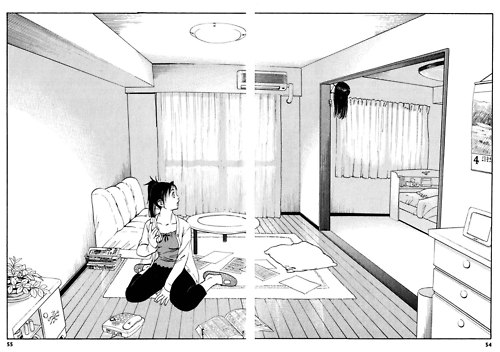
What Mail lacks in suspense it makes up in atmosphere. Yamazaki shows considerable flair for turning ordinary urban environments into unbearably scary places, whether he’s depicting an empty public bathroom or a high-rise building. In one of Mail‘s best stories, for example, a woman receives a letter urging her to move out of her apartment right away. Shortly after reading the letter, she catches glimpse of something moving along the ceiling of the adjacent room:

Though we’re outside the picture plane, viewing the action from a different angle than the hapless apartment dweller, we don’t have any more information about what’s lurking in the other room than she does; Yamazaki is relying on the reader to guess what might be crawling along the ceiling by planting one suggestive detail.

The other thing that makes this image so unsettling is the very mundaneness of the setting. With its square rooms and bland furnishings, this scene could be unfolding in almost any Tokyo neighborhood, in almost any modern apartment complex. (Add a parquet floor, and it could just as easily be taking place in any postwar building in Manhattan.) More unsettling still is that this scene is taking place in broad daylight, not at night; whatever is haunting the apartment isn’t relying on the camouflage of darkness, but is sallying forth at a time of day when spirits are supposed to be hidden and, more importantly, impotent.

Not all of the stories take place in Tokyo; several unfold in the countryside. Mail is at its best in urban settings, however, as the very nature of city living gives Yamazaki ample material to work with, whether he’s spinning a cautionary tale about the anonymity of modern life or simply reflecting on the myriad layers of history buried underneath new roadways and buildings. As a life-long city-dweller, I found stories such as “The Drive” — which takes place on an urban freeway — “The Elevator” — which takes place in a stalled elevator car — and “Hide-and-Seek” — which takes place in a haunted apartment — among the spookiest in the collection, as they tapped into a deep well of fear that all urban folk share: that cities harbor something even bigger and scarier than crime, high property taxes, or gridlock.

MAIL, VOLS. 1-3 • BY HOUSUI YAMAZAKI • DARK HORSE • RATING: OLDER TEEN/MATURE

Filed Under: Manga Critic Tagged With: Dark Horse, Horror/Supernatural, Housui Yamazaki

The Best Manga You’re Not Reading: Mail

October 20, 2012 by Katherine Dacey

Have spirit gun, will travel — that’s the basic plot of Mail, a three-volume collection of ghost stories penned by Kurosagi Corpse Delivery Service illustrator Housui Yamazaki. Like Kurosagi, Mail follows a spook-of-the-week formula, pausing occasionally to fill us in on the personal life of its chief exorcist, Detective Reiji Akiba. Akiba initially presents as a Columbo-esque figure, disarming clients with his rumpled coat and penchant for napping on the job, but his true nature is soon revealed in the first story: he’s handy with Kagutsuchi, his trusty pistol, and unflappable in the presence of the undead.

As we learn over the course of the series, Akiba was born blind. Medicine restored his sight, but with a side effect: he began seeing dead people. After years of living in fear of ghosts, Akiba learned to perform exorcisms with Kagutsuchi, a skill he parlayed into a career as a modern-day onmyoji.

If Akiba’s strategies for assisting his clients are decidedly hi-tech — websites, cellphones, GPS devices, bullets — the stories have a pleasantly old-fashioned quality to them. Some are morality plays; in “The Doll,” for example, a toy becomes the vessel for a hit-and-run victim to bring her killer to justice. Others read more like good campfire tales; in “Suppressed,” for example, a young woman begins receiving mysterious calls from a “friend” who’s en route to her home, the last of which appear to be originating from inside her apartment. Still others draw on urban legend for inspiration; “Ka-tsu-mi,” the fifth chapter in the series, focuses on a girl who dies after accidentally photographing a ghost.

I’d be the first to admit that Yamazaki is not a master of suspense. Though Mail is filled with suitably gruesome imagery and creative variations on oft-told ghost stories, the reader is never in doubt about Akiba’s ability to save his clients. The endings have a sameness that becomes more apparent when reading them back-to-back, as Akiba’s only method for banishing the undead is to fire Kagutsuchi. And while Akiba demonstrates remarkable sangfroid when confronting murdered babies, vengeful lovers, and drowning victims, his undeniable coolness doesn’t quite compensate for the predictability of the denounements.

What Mail lacks in suspense it makes up in atmosphere. Yamazaki shows considerable flair for turning ordinary urban environments into unbearably scary places, whether he’s depicting an empty public bathroom or a high-rise building. In one of Mail‘s best stories, for example, a woman receives a letter urging her to move out of her apartment right away. Shortly after reading the letter, she catches glimpse of something moving along the ceiling of the adjacent room:

Though we’re outside the picture plane, viewing the action from a different angle than the hapless apartment dweller, we don’t have any more information about what’s lurking in the other room than she does; Yamazaki is relying on the reader to guess what might be crawling along the ceiling by planting one suggestive detail.

The other thing that makes this image so unsettling is the very mundaneness of the setting. With its square rooms and bland furnishings, this scene could be unfolding in almost any Tokyo neighborhood, in almost any modern apartment complex. (Add a parquet floor, and it could just as easily be taking place in any postwar building in Manhattan.) More unsettling still is that this scene is taking place in broad daylight, not at night; whatever is haunting the apartment isn’t relying on the camouflage of darkness, but is sallying forth at a time of day when spirits are supposed to be hidden and, more importantly, impotent.

Not all of the stories take place in Tokyo; several unfold in the countryside. Mail is at its best in urban settings, however, as the very nature of city living gives Yamazaki ample material to work with, whether he’s spinning a cautionary tale about the anonymity of modern life or simply reflecting on the myriad layers of history buried underneath new roadways and buildings. As a life-long city-dweller, I found stories such as “The Drive” — which takes place on an urban freeway — “The Elevator” — which takes place in a stalled elevator car — and “Hide-and-Seek” — which takes place in a haunted apartment — among the spookiest in the collection, as they tapped into a deep well of fear that all urban folk share: that cities harbor something even bigger and scarier than crime, high property taxes, or gridlock.

MAIL, VOLS. 1-3 • BY HOUSUI YAMAZAKI • DARK HORSE • RATING: OLDER TEEN/MATURE

Filed Under: Manga, Manga Critic, Recommended Reading, REVIEWS Tagged With: Dark Horse, Horror/Supernatural, Housui Yamazaki

A First Look at Cross Manage

October 13, 2012 by Katherine Dacey 3 Comments

For a series whose plot hinges on a mammary collision, Cross Manage is better than it has any right to be: it’s interesting, funny, and populated with appealing characters who rise above type.

The collider and the collidee are, respectively, Sakurai, an aimless second-year student, and Misora, captain of the girls’ lacrosse team. Though Sakurai has joined and quit twelve clubs, he has yet to discover an activity at which he excels; he scoffs at the idea that anyone would play a sport or pursue a hobby simply for enjoyment. Misora is his diametric opposite, an enthusiast who can describe the history of lacrosse in voluminous detail, but can’t make a shot to save her life. When Sakurai accidentally grabs Misora’s chest during an impromptu coaching session, she offers him a choice: become the manager of the girls’ lacrosse team, or risk public humiliation.

Yikes! The “whoops-I-touched-your-boob!” gag is one of the most overused and least amusing “comic” bits in shonen manga, not least because it portrays boys as the victims of mammary collisions, rather than the other way around. I admit that my heart sank a little when I read that scene: surely Kaito could have found a more creative way to set the plot in motion, perhaps one that didn’t scream Love Hina: The Lacrosse Years. But I soldiered on for another chapter, and was pleasantly surprised to discover that Cross Manage wasn’t evolving into a panty-fest or a string of lecherous, Benny Hill-style gags, but an amusing character study of two charmingly screwed-up teens.

Anyone who’s read more than two shonen rom-coms will recognize Sakurai and Misora as familiar types, but artist/author Kaito has invested them with more personality than is called for by the genre. Misora, for example, is a classic Shonen Spaz Dream Girl, but she’s an interesting variation on the type; though she’s utterly incompetent at everything, she’s clearly knowledgeable about lacrosse. She freely admits that she’s terrible, but she doesn’t care because playing the game gives her a sense of accomplishment and purpose.

Sakurai embodies another classic type, the Cool Reader Surrogate. As portrayed in the first two chapters of Cross Manage, Sakurai is a natural at everything — photography, shogi, sports — even though he never practices. Sakurai is a sympathetic character nonetheless, one who’s both moved and puzzled by Misora’s dedication to a sport at which she… well, sucks. And while Misora has a lot to learn from Sakurai about how to handle the stick and pass the ball, Sakurai clearly has a lot to learn from Misora as well — not the least of which is how to enjoy doing things at which he’s not an expert. (Also how to comport himself around girls, of whom he has a deep, unnatural phobia that’s sure to be explained in a future chapter.)

As with many Shonen Jump titles, the artwork is crisp if not terribly distinctive; I’d have a hard time picking Sakurai and Misora out of a line-up of recent Jump characters, though both are memorable enough within the context of the story. Kaito has the artistic chops to populate Cross Manage with a diverse supporting cast — a key skill in a series that promises to have a bumper crop of comic relief characters. Though he hasn’t had many opportunities to showcase this skill just yet, a throwaway scene involving the “prince” of the shogi club hints at Kaito’s ability to establish personality through a few well-chosen details.

If Kaito can steer clear of excessive fanservice, and provide both Sakurai and Misora room for personal growth, I could see myself following Cross Manage; if not, it will join the large pile of shonen romantic comedies that I’ve abandoned after the fifth — or fifteenth — “misunderstanding” involving groping, nudity, or panties. Stay tuned.

CROSS MANAGE, CHAPTERS 1-2 • BY KAITO • VIZ MEDIA • CURRENTLY RUNNING IN WEEKLY SHONEN JUMP ALPHA

Filed Under: Manga Critic Tagged With: Lacrosse, Shonen, Shonen Jump, Sports Manga, VIZ

A First Look at Cross Manage

October 13, 2012 by Katherine Dacey

For a series whose plot hinges on a mammary collision, Cross Manage is better than it has any right to be: it’s interesting, funny, and populated with appealing characters who rise above type. The collider and the collidee are, respectively, Sakurai, an aimless second-year student, and Misora, captain of the girls’ lacrosse team. Though Sakurai has joined and quit twelve clubs, he has yet to discover an activity at which he excels; he scoffs at the idea that anyone would play a sport or pursue a hobby simply for enjoyment. Misora is his diametric opposite, an enthusiast who can describe the history of lacrosse in voluminous detail, but can’t make a shot to save her life. When Sakurai accidentally grabs Misora’s chest during an impromptu coaching session, she offers him a choice: become the manager of the girls’ lacrosse team, or risk public humiliation.

Yikes! The “whoops-I-touched-your-boob!” gag is one of the most overused and least amusing “comic” bits in shonen manga, not least because it portrays boys as the victims of mammary collisions, rather than the other way around. I admit that my heart sank a little when I read that scene: surely Kaito could have found a more creative way to set the plot in motion, perhaps one that didn’t scream Love Hina: The Lacrosse Years. But I soldiered on for another chapter, and was pleasantly surprised to discover that Cross Manage wasn’t evolving into a panty-fest or a string of lecherous, Benny Hill-style gags, but an amusing character study of two charmingly screwed-up teens.

Anyone who’s read more than two shonen rom-coms will recognize Sakurai and Misora as familiar types, but artist/author Kaito has invested them with more personality than is called for by the genre. Misora, for example, is a classic Shonen Spaz Dream Girl, but she’s an interesting variation on the type; though she’s utterly incompetent at everything, she’s clearly knowledgeable about lacrosse. She freely admits that she’s terrible, but she doesn’t care because playing the game gives her a sense of accomplishment and purpose.

Sakurai embodies another classic type, the Cool Reader Surrogate. As portrayed in the first two chapters of Cross Manage, Sakurai is a natural at everything — photography, shogi, sports — even though he never practices. Sakurai is a sympathetic character nonetheless, one who’s both moved and puzzled by Misora’s dedication to a sport at which she… well, sucks. And while Misora has a lot to learn from Sakurai about how to handle the stick and pass the ball, Sakurai clearly has a lot to learn from Misora as well — not the least of which is how to enjoy doing things at which he’s not an expert. (Also how to comport himself around girls, of whom he has a deep, unnatural phobia that’s sure to be explained in a future chapter.)

As with many Shonen Jump titles, the artwork is crisp if not terribly distinctive; I’d have a hard time picking Sakurai and Misora out of a line-up of recent Jump characters, though both are memorable enough within the context of the story. Kaito has the artistic chops to populate Cross Manage with a diverse supporting cast — a key skill in a series that promises to have a bumper crop of comic relief characters. Though he hasn’t had many opportunities to showcase this skill just yet, a throwaway scene involving the “prince” of the shogi club hints at Kaito’s ability to establish personality through a few well-chosen details.

If Kaito can steer clear of excessive fanservice, and provide both Sakurai and Misora room for personal growth, I could see myself following Cross Manage; if not, it will join the large pile of shonen romantic comedies that I’ve abandoned after the fifth — or fifteenth — “misunderstanding” involving groping, nudity, or panties. Stay tuned.

CROSS MANAGE, CHAPTERS 1-2 • BY KAITO • VIZ MEDIA • CURRENTLY RUNNING IN WEEKLY SHONEN JUMP ALPHA

Filed Under: Manga, Manga Critic, REVIEWS Tagged With: Lacrosse, Shonen, Shonen Jump, Sports Manga, VIZ

Give My Regards to Black Jack, Vols. 1-2

October 5, 2012 by Katherine Dacey 1 Comment

Give My Regards to Black Jack tells a familiar story: a newly-minted professional enters his field, convinced that he has chosen the True Path. He soon discovers, however, that many of his colleagues have chosen profit over passion, forcing him to decide whether to follow their example or fight the system.

Eijiro Saito, the hero, is a graduate of a top medical school, brimming with energy and enthusiasm. Though Saito lands a plum internship at Eiroku University’s teaching hospital, his pay is meager; he supplements his income by moonlighting at a woefully understaffed emergency room. At both institutions, Saito encounters crooked doctors who demand bribes from patients; arrogant doctors who belittle poor patients; and money-minded doctors who care only about the hospital’s bottom line. For all the challenges to Saito’s idealism, however, he clings tenaciously to the belief that candor and sincerity are a doctor’s greatest assets.

As agit-prop, Give My Regards to Black Jack succeeds. Author Shuho Sato makes a convincing case that billing practices encourage Japanese hospitals to treat patients as cash cows, rather than people in need of medical care. Sato also offers a blistering critique of doctor training, showing us the toll that long hours, poor pay, and workplace bullying exact on residents.

As drama, however, Give My Regards to Black Jack is too tidy to be moving. True, Saito’s despair at his own futility seems genuine. Early in volume one, for example, Saito finds himself alone in the operating room with a motorcycle accident victim. Fearful of killing the patient, Saito does nothing; only the last-minute intervention of a more experienced surgeon prevents the victim from dying on the table. In a moment of self-hatred, Saito dissolves into tears, castigating himself for his paralysis — a scene that intuitively and emotionally feels right, given where he is in his residency.

Where the story falters is in its portrayal of the senior doctors at Eiroku Hospital: they’re haughty and deceitful, primarily concerned with asserting their authority over patients and junior staff members. Even when their words ring with truth, their advice is framed as a cynical and self-serving pose. Not all of the doctors fit this mold: the repulsively drawn Ushida, who toils in the Seido emergency room, is a wiser and more compassionate soul than his wolfish face or feral demeanor might suggest. So is Saburo Kita, a maverick heart surgeon who loves karaoke and paisley shirts; Kita cuts a flamboyant figure, but is humble when discussing his work. These characters are few and far between, however, with many more doctors acting like graduates of the Snidely Whiplash School of Medical Malpractice.

The series’ other shortcoming is the artwork. Though Sato shows a Tezukian flair for close-ups of mangled flesh and pulsating organs, his character designs lack Tezuka’s finesse. Tezuka’s Black Jack might be a cartoonish figure with his cloak and Frankensutures, but those design elements are fundamental to establishing Black Jack’s personality; a reader could dive into any Black Jack story and immediately understand who he is. Moreover, all of the characters in Black Jack are crafted with similar care, each assigned a few simple but telling details that communicate their role in the drama.

By contrast, Ushida looks like he stepped out of Toriko, with his bug eyes, lantern-jaw, and perma-sneer. Since none of the other characters are rendered in such a grotesque fashion, one could make the argument that Ushida’s ugliness must serve a dramatic purpose, symbolizing the corrosive effect of his working conditions. We never spend enough time with Ushida, however, to know how much he sacrificed his ideals for a steady career, nor do we see enough of his behavior with patients to rationalize his appearance. It seems perverse to draw only one character in such a distorted fashion; say what you will about Tezuka’s caricatures, but there was always a unifying aesthetic in Black Jack that made it possible for the reader to view Dr. Kiriko, Pinoko, and Biwamaru as inhabitants of the same universe.

What Sato’s work has in common with Tezuka’s is a fierce conviction that the Japanese medical establishment is bloated, ineffective, and indifferent to real human suffering. Sato addresses these shortcomings in a more explicit fashion than Tezuka did in Black Jack — or Ode to Kirihito, for that matter — using real medical procedures and real administrative dilemmas as plot fodder. Yet Sato’s stories are often unmoving, as his hero’s idealism compels him to take simplistic stands on complex issues. Tezuka, on the other hand, focused more on entertaining audiences than on educating them about Japanese health care, building his stories around a character whose subversive, self-interested behavior never prevented him from treating the genuinely deserving. Tezuka’s stories might be more formulaic and absurd than Sato’s, but they’re never so earnestly dull that they read like anti-JMA propaganda. Call me crazy, but I’ll take killer whale surgery and teratoid cystomas over a hectoring medical procedural any day.

GIVE MY REGARDS TO BLACK JACK, VOLS. 1-2 • BY SHUHO SATO • SELF-PUBLISHED (AVAILABLE THROUGH AMAZON’S KINDLE STORE)

Filed Under: Manga Critic Tagged With: black jack, Medical, Say Hello to Black Jack, Shuho Sato

Give My Regards to Black Jack, Vols. 1-2

October 5, 2012 by Katherine Dacey

Give My Regards to Black Jack tells a familiar story: a newly-minted professional enters his field, convinced that he has chosen the True Path. He soon discovers, however, that many of his colleagues have chosen profit over passion, forcing him to decide whether to follow their example or fight the system.

Eijiro Saito, the hero, is a graduate of a top medical school, brimming with energy and enthusiasm. Though Saito lands a plum internship at Eiroku University’s teaching hospital, his pay is meager; he supplements his income by moonlighting at a woefully understaffed emergency room. At both institutions, Saito encounters crooked doctors who demand bribes from patients; arrogant doctors who belittle poor patients; and money-minded doctors who care only about the hospital’s bottom line. For all the challenges to Saito’s idealism, however, he clings tenaciously to the belief that candor and sincerity are a doctor’s greatest assets.

As agit-prop, Give My Regards to Black Jack succeeds. Author Shuho Sato makes a convincing case that billing practices encourage Japanese hospitals to treat patients as cash cows, rather than people in need of medical care. Sato also offers a blistering critique of doctor training, showing us the toll that long hours, poor pay, and workplace bullying exact on residents.

As drama, however, Give My Regards to Black Jack is too tidy to be moving. True, Saito’s despair at his own futility seems genuine. Early in volume one, for example, Saito finds himself alone in the operating room with a motorcycle accident victim. Fearful of killing the patient, Saito does nothing; only the last-minute intervention of a more experienced surgeon prevents the victim from dying on the table. In a moment of self-hatred, Saito dissolves into tears, castigating himself for his paralysis — a scene that intuitively and emotionally feels right, given where he is in his residency.

Where the story falters is in its portrayal of the senior doctors at Eiroku Hospital: they’re haughty and deceitful, primarily concerned with asserting their authority over patients and junior staff members. Even when their words ring with truth, their advice is framed as a cynical and self-serving pose. Not all of the doctors fit this mold: the repulsively drawn Ushida, who toils in the Seido emergency room, is a wiser and more compassionate soul than his wolfish face or feral demeanor might suggest. So is Saburo Kita, a maverick heart surgeon who loves karaoke and paisley shirts; Kita cuts a flamboyant figure, but is humble when discussing his work. These characters are few and far between, however, with many more doctors acting like graduates of the Snidely Whiplash School of Medical Malpractice.

The series’ other shortcoming is the artwork. Though Sato shows a Tezukian flair for close-ups of mangled flesh and pulsating organs, his character designs lack Tezuka’s finesse. Tezuka’s Black Jack might be a cartoonish figure with his cloak and Frankensutures, but those design elements are fundamental to establishing Black Jack’s personality; a reader could dive into any Black Jack story and immediately understand who he is. Moreover, all of the characters in Black Jack are crafted with similar care, each assigned a few simple but telling details that communicate their role in the drama.

By contrast, Ushida looks like he stepped out of Toriko, with his bug eyes, lantern-jaw, and perma-sneer. Since none of the other characters are rendered in such a grotesque fashion, one could make the argument that Ushida’s ugliness must serve a dramatic purpose, symbolizing the corrosive effect of his working conditions. We never spend enough time with Ushida, however, to know how much he sacrificed his ideals for a steady career, nor do we see enough of his behavior with patients to rationalize his appearance. It seems perverse to draw only one character in such a distorted fashion; say what you will about Tezuka’s caricatures, but there was always a unifying aesthetic in Black Jack that made it possible for the reader to view Dr. Kiriko, Pinoko, and Biwamaru as inhabitants of the same universe.

What Sato’s work has in common with Tezuka’s is a fierce conviction that the Japanese medical establishment is bloated, ineffective, and indifferent to real human suffering. Sato addresses these shortcomings in a more explicit fashion than Tezuka did in Black Jack — or Ode to Kirihito, for that matter — using real medical procedures and real administrative dilemmas as plot fodder. Yet Sato’s stories are often unmoving, as his hero’s idealism compels him to take simplistic stands on complex issues. Tezuka, on the other hand, focused more on entertaining audiences than on educating them about Japanese health care, building his stories around a character whose subversive, self-interested behavior never prevented him from treating the genuinely deserving. Tezuka’s stories might be more formulaic and absurd than Sato’s, but they’re never so earnestly dull that they read like anti-JMA propaganda. Call me crazy, but I’ll take killer whale surgery and teratoid cystomas over a hectoring medical procedural any day.

GIVE MY REGARDS TO BLACK JACK, VOLS. 1-2 • BY SHUHO SATO • SELF-PUBLISHED (AVAILABLE THROUGH AMAZON’S KINDLE STORE)

Filed Under: Manga, Manga Critic, REVIEWS Tagged With: black jack, Medical, Say Hello to Black Jack, Shuho Sato

Pick of the Week: Saiunkoku, GTO, Skip Beat!

October 1, 2012 by Katherine Dacey, MJ, Sean Gaffney and Michelle Smith 1 Comment

KATE: It’s VIZ dump week, in which a large and random assortment of VIZ titles arrive at Midtown Comics. Although there are several great titles to choose from—Skip Beat!, Slam Dunk, A Devil and Her Love Song—my vote goes to volume eight of The Story of Saiunkoku. The volume is worth it just for the scene of Minister Ko’s unmasking, but there’s plenty more going on as well: sexual discrimination, clan intrigue, and romance. (Remember the emperor? He factors into the story in a more prominent way in this volume.) Frustratingly tidy as Saiunkoku can be, it’s still fun to read; I’m irresistibly reminded of Yentl and Mulan every time I sit down with a new volume.

MJ: While the VIZ dump certainly has a lot to offer, I admit I’m leaning in Vertical’s direction. Arrivals this week at Midtown include my pick from last week, Paradise Kiss, but also the fifth volume of GTO: 14 Days in Shonan, one of my least expected current favorites. Though nothing about the premise suggests that this series would be something I’d fall in love with, the fact is, I have, and I can’t help looking forward to each new volume. It’s definitely a GTO week for me!

SEAN: I also went with ParaKiss last week, so I’ll dip into the Viz Blitz this week and pick Vol. 29 of Skip Beat!. First of all, that cover is pure Barbara Cartland, even if no actual hot hot seduction will be happening within the actual pages. What we’ll get instead, I suspect, is more acting angst, more of Ren brooding, Kyoko freaking out about something at least once, and hopefully a shot or two of humor. At 29 volumes and counting, this is one of the longest shoujo series to be published over here, and I’ glad that it still seems to sell well. Mostly as Kyoko is simply fun to read about.

MICHELLE: I think I am going to have to go with Skip Beat!, too. It’s a special series that still makes me go, “Oh, yay! New Skip Beat!” even when we’re talking about volume 29. I could probably love this series at volume 79, actually. It’s that good, and the characters that endearing.


Readers, what looks good to you this week?

Filed Under: PICK OF THE WEEK

Bookshelf Briefs 10/1/12

October 1, 2012 by Sean Gaffney, Katherine Dacey, MJ and Michelle Smith 1 Comment

This week, Sean, Kate, MJ, and Michelle look at recent releases from VIZ Media, Yen Press, and Vertical, Inc.


Arata: The Legend, Vol. 11 | By Yuu Watase | VIZ Media – The last time I wrote about Arata, I described it as consistently entertaining. Alas, I haven’t really been feeling these two most recent volumes. So much seems to be repeating the same pattern—Arata encounters a hostile bishounen shinsho and employs his shoujo-heroine-in-a-shounen-manga mojo to discover the fellow’s true feelings, which he soothes before the two become allies—that when important things do happen, like the revelation that a pair of characters changed places (between modern Japan and Amawakuni) in their infancy, it fails to register any sort of impact. Things begin to look up slightly towards the end of the volume, though, as the group heads into the territory of the most hostile bishounen of them all: Akachi. Somehow I doubt he’s going to want to talk about his feelings for, oh, at least two volumes. – Michelle Smith

The Drops of God: New World | By Tadashi Agi and Shu Okimoto | Vertical, Inc. – If Drops of God had sold better, this would be half of Vol. 11 and half of 12, and we’d be reading it a couple years from now. As it is, this is the last planned volume, and I understand the publisher in Japan asked that it jump ahead to focus on American (and Australian) wines. Honestly, there isn’t that much missed – the biggest change is that Loulan, Issei’s hookup from Vol. 4, is now in Japan and acting as his Miyabi. (It’s unclear if they’re married, still lovers, or what have you.) And Issei is the one who clearly has gotten the most character development – he almost seems like a 2nd protagonist than a rival by now, and has mellowed out considerably. Shizuku, on the other hand, still feels as if he’s lagging behind and unable to progress. Which, to be honest, is true – he’s much the same as he was in V. 1-4. I do hope we eventually see more of this. -Sean Gaffney

Fushigi Yugi Genbu Kaiden, Vol. 10 | By Yuu Watase | VIZ Media – In my experience, a long wait between volumes of a manga series can be either a blessing or a curse—maybe even both. On one hand, anticipation is undoubtedly sweet, and a wait of nearly three years certainly provides plenty of that. On the other hand, anticipation can shift quickly to expectation, and after nearly three years… well, you get the idea. Fortunately, Fushigi Yugi Genbu Kaiden delivers, at least where it most counts. Despite the long wait, Watase’s well-paced storytelling and energetic artwork pull us right back into the story (and its awesomely giddy primary romance), as though no time has passed at all. On the downside (or is it?), the volume’s final pages are likely to throw readers right back into the clutches of sweet (and painful!) anticipation once again. – MJ

GTO: 14 Days in Shonan, Vol. 5 | By Toru Fujisawa | Vertical, Inc. – One of the main reasons we enjoy reading GTO is to see Onizuka kick the crap out of people as he tells them how they’re screwing things up. That said, he is meant to be a teacher, and pass on his example to others. This volume doesn’t have quite as much Onizuka in person, but it has him leading by inspiration – including a long mid-volume sequence starring Uchiyamada, the antagonistic vice-principal from the GTO series proper. It’s easy to see Onizuka dealing with young, impressionable teens. But just because folks are adults doesn’t mean they’re wise and all-knowing, or that their problems go away. So seeing Uchiyamada preparing to confront 50 gang members, or Ayame beating the crap out of a yakuza in order to confront the twins behind all this, is just as awesome as Onizuka himself. -Sean Gaffney

Spice & Wolf, Vol. 6 | Story by Isuna Kasekua, Art by Keito Koume, Character Design by Jyuu Ayakura | Yen Press – Here are eight words I never thought I’d type: I liked volume six of Spice & Wolf. Yes, there was some gratuitous nudity, and yes, there was some limp flirtation between Holo and Lawrence, but on balance, volume six delivered enough action to erase the memory of all those Economics for Dummies speeches in previous volumes. Better still, Holo spent most of the volume as a wisewolf, inflicting bodily harm on soldiers, extracting confessions from enemies, and menacing her (perceived) romantic rival Norah. I’ll take Holo in her feral form any day; she’s funny and fierce, using her physical strength, rather than her feminine wiles, to get the job done. I’m not sure that a handful of decent chapters are enough to make me revisit earlier volumes, but they did, at last, help me understand why this series has been such a phenomenon among American otaku. – Katherine Dacey

The Story of Saiunkoku, Vol. 8 | Art by Kairi Yura, Story by Sai Yukino | VIZ Media – Never underestimate the power of Cover Girl — that’s my takeaway from volume eight, in which Shurei decides her only chance of claiming her rightful position as a civil servant is to show her male peers she’s 100% woman… by donning makeup. The resolution of that conflict is a little too tidy, relying on narration rather than dramatization to show us how Shurei establishes her civil servant credentials. On the whole, however, volume eight is a solid installment in this period soap opera, serving up an appealing mixture of comedy, drama, intrigue, and romance, and ending with the kind of cliffhanger that promises to advance the story in a new and meaningful direction. Still recommended. – Katherine Dacey

Yotsuba&!, Vol. 11 | By Kiyohiko Azuma | Yen Press – It’s been nearly a year since I last read any Yotsuba&!. I didn’t realize how much I’d missed it until I started to read and the first chapter, in which Yotsuba invites herself into the kitchen of an udon shop to watch how it’s made, completely reminded me of everything that is great about this series. Seriously, this is the kind of manga where you suddenly realize you’re smiling and wonder how long you’ve been sitting there, doing that. Pizza, bubbles, cameras… these are a few of the things that fill Yotsuba with wonder in these pages, but the last page of the volume is the one that really made me laugh out loud and get verklempt all at the same time. Is this praise copious enough? If you haven’t read Yotsuba&!, what are you waiting for? Jeez, man. Get with it! – Michelle Smith

Filed Under: Bookshelf Briefs

Limit, Vol. 1

September 28, 2012 by Katherine Dacey 2 Comments

“The world doesn’t suffer fools or fugly people” — so says Sakura, the most popular student in class 2-4. Sakura is a classic Alpha Girl: pretty, manipulative, and confident that at fifteen, she’s discovered the secret to being successful. (“Both studies and make-up. They’re real important for enjoying life, you know?” she informs her pal Konno.) Though Sakura’s friends may not like her, they recognize her power and follow her example; when Sakura declares that the awkward, quiet Arisa Morishige should “die,” Sakura’s friends are all too quick to agree.

The dynamic between Sakura’s clique and Morishige is dramatically reversed, however, on an annual school trip to “exchange camp,” where second-year students spend a week roughing it in a rural setting. En route to camp, a bus accident kills most of the class, leaving a handful of survivors stranded in the wilderness. The remaining members of Sakura’s clique soon discover that their nasty antics have demoted them from the A-list to the D — a demotion that, in their new, desperate circumstances, has potentially deadly consequences.

In a more cynical frame of mind, I might describe Limit as “Lord of the Flies with chicks,” but that cheeky brush-off doesn’t quite do justice to Keiko Suenobo’s story. Her principal characters are just as concerned with survival as William Golding’s private-school boys were, but the girls’ internal power struggles are less a exploration of Hobbesian philosophy than an extreme dramatization of the cliquish behavior found in Japanese high schools. In other words, it’s Mean Girls… with weapons.

Entertaining as that sounds, Limit suffers from a crucial flaw: Konno, the narrator, isn’t very interesting, as her primary role is to be an inoffensive reader surrogate. Konno is pretty and smart enough to be a member of Sakura’s clique, but passive enough that her behavior won’t elicit criticism from most readers; Konno is never portrayed as a ringleader or enthusiastic participant in Morishige’s degradation, though she clearly joined Sakura in harassing Morishige. That’s a mistake, I think, because it permits the reader to side too readily with Konno when the tables are turned, ignoring the fact that Morishige’s rage stems from being bullied on a daily basis by Sakura and Konno.

The other survivors are a more compelling lot, even if each neatly slots into a well-established role: The Principled Outsider, The Timid Girl, The Frenemy. That Suenobo endows each of these girls with more humanity than those roles require is testament to her skill as a writer. Volume one’s most moving scene, for example, belongs to Ichinose, Sakura’s best friend. Though she and Konno have moved in the same social circles, the bus accident reveals that Ichinose views Konno as a rival for Sakura’s friendship. Ichinose’s desperation at being “traded in” for the smarter, prettier Konno is palpable, and the rawness of her angry confession is one of the few moments in the script that doesn’t feel like a rote portrayal of mean-girl politics.

Perhaps the strongest element of Limit is the artwork. Suenobo’s meticulous efforts to dramatize her characters’ inner turmoil reminds the reader that Limit ran in Bessatsu Friend, not Weekly Shonen Magazine. Konno and Ichinose scream and cry as lustily as any character in Cage of Eden, but Limit‘s characters register a much fuller range of emotions than just fear of being lost or eaten; Konno and her fellow survivors are by turns angry, jealous, gleeful, miserable, spiteful, bitter, remorseful, and fearful — of one another. By far the most dramatic example is Morishige, who morphs from cringing, sweaty scapegoat to demonic avenger; her once dull, shark-like eyes are suddenly animated with a fierce, nasty sense of purpose, and she moves with a speed and deliberation that surprise her classmates.

Suenobo also demonstrates a flair for staging action scenes. The bus accident is depicted in a brief but effective sequence that makes creative use of camera angles to suggest the severity of the crash. Likewise, Suenobo firmly establishes how desperate the girls’ situation really is; in a few carefully drawn panels, the reader readily grasps the geographic obstacles to rescue, from sheer cliff walls to impenetrable woods. That no one’s cell phone works feels like an unnecessary touch, given the care with which Suenobo sketches out the crash site and its environs.

If the story is, at times, a little uneven, or ungenerous to Morishige, Limit still shows considerable promise. Suenobo makes good use of her teen-survivor premise to explore the politics of bullying without being too mawkish. At the same time, however, Suenobo manages to write a scary thriller that’s sophisticated and suspenseful enough to sustain an adult’s interest; the story’s occasional Grand Guignol touches add a welcome dash of camp, preventing the story from sinking under the weight of its Very Important Message. I can’t imagine what will happen in volume two, but I’m looking forward to reading it… with the lights on. Recommended.

Review copy provided by Vertical, Inc. Volume one will be released on October 9, 2012.

LIMIT, VOL. 1 • BY KEIKO SUENOBO • VERTICAL, INC. • 176 pp.

Filed Under: Manga Critic Tagged With: Keiko Suenobo, Limit, shojo, vertical

Limit, Vol. 1

September 28, 2012 by Katherine Dacey

“The world doesn’t suffer fools or fugly people” — so says Sakura, the most popular student in class 2-4. Sakura is a classic Alpha Girl: pretty, manipulative, and confident that at fifteen, she’s discovered the secret to being successful. (“Both studies and make-up. They’re real important for enjoying life, you know?” she informs her pal Konno.) Though Sakura’s friends may not like her, they recognize her power and follow her example; when Sakura declares that the awkward, quiet Arisa Morishige should “die,” Sakura’s friends are all too quick to agree.

The dynamic between Sakura’s clique and Morishige is dramatically reversed, however, on an annual school trip to “exchange camp,” where second-year students spend a week roughing it in a rural setting. En route to camp, a bus accident kills most of the class, leaving a handful of survivors stranded in the wilderness. The remaining members of Sakura’s clique soon discover that their nasty antics have demoted them from the A-list to the D — a demotion that, in their new, desperate circumstances, has potentially deadly consequences.

In a more cynical frame of mind, I might describe Limit as “Lord of the Flies with chicks,” but that cheeky brush-off doesn’t quite do justice to Keiko Suenobo’s story. Her principal characters are just as concerned with survival as William Golding’s private-school boys were, but the girls’ internal power struggles are less a exploration of Hobbesian philosophy than an extreme dramatization of the cliquish behavior found in Japanese high schools. In other words, it’s Mean Girls… with weapons.

Entertaining as that sounds, Limit suffers from a crucial flaw: Konno, the narrator, isn’t very interesting, as her primary role is to be an inoffensive reader surrogate. Konno is pretty and smart enough to be a member of Sakura’s clique, but passive enough that her behavior won’t elicit criticism from most readers; Konno is never portrayed as a ringleader or enthusiastic participant in Morishige’s degradation, though she clearly joined Sakura in harassing Morishige. That’s a mistake, I think, because it permits the reader to side too readily with Konno when the tables are turned, ignoring the fact that Morishige’s rage stems from being bullied on a daily basis by Sakura and Konno.

The other survivors are a more compelling lot, even if each neatly slots into a well-established role: The Principled Outsider, The Timid Girl, The Frenemy. That Suenobo endows each of these girls with more humanity than those roles require is testament to her skill as a writer. Volume one’s most moving scene, for example, belongs to Ichinose, Sakura’s best friend. Though she and Konno have moved in the same social circles, the bus accident reveals that Ichinose views Konno as a rival for Sakura’s friendship. Ichinose’s desperation at being “traded in” for the smarter, prettier Konno is palpable, and the rawness of her angry confession is one of the few moments in the script that doesn’t feel like a rote portrayal of mean-girl politics.

Perhaps the strongest element of Limit is the artwork. Suenobo’s meticulous efforts to dramatize her characters’ inner turmoil reminds the reader that Limit ran in Bessatsu Friend, not Weekly Shonen Magazine. Konno and Ichinose scream and cry as lustily as any character in Cage of Eden, but Limit‘s characters register a much fuller range of emotions than just fear of being lost or eaten; Konno and her fellow survivors are by turns angry, jealous, gleeful, miserable, spiteful, bitter, remorseful, and fearful — of one another. By far the most dramatic example is Morishige, who morphs from cringing, sweaty scapegoat to demonic avenger; her once dull, shark-like eyes are suddenly animated with a fierce, nasty sense of purpose, and she moves with a speed and deliberation that surprise her classmates.

Suenobo also demonstrates a flair for staging action scenes. The bus accident is depicted in a brief but effective sequence that makes creative use of camera angles to suggest the severity of the crash. Likewise, Suenobo firmly establishes how desperate the girls’ situation really is; in a few carefully drawn panels, the reader readily grasps the geographic obstacles to rescue, from sheer cliff walls to impenetrable woods. That no one’s cell phone works feels like an unnecessary touch, given the care with which Suenobo sketches out the crash site and its environs.

If the story is, at times, a little uneven, or ungenerous to Morishige, Limit still shows considerable promise. Suenobo makes good use of her teen-survivor premise to explore the politics of bullying without being too mawkish. At the same time, however, Suenobo manages to write a scary thriller that’s sophisticated and suspenseful enough to sustain an adult’s interest; the story’s occasional Grand Guignol touches add a welcome dash of camp, preventing the story from sinking under the weight of its Very Important Message. I can’t imagine what will happen in volume two, but I’m looking forward to reading it… with the lights on. Recommended.

Review copy provided by Vertical, Inc. Volume one will be released on October 9, 2012.

LIMIT, VOL. 1 • BY KEIKO SUENOBO • VERTICAL, INC. • 176 pp.

Filed Under: Manga, Manga Critic, REVIEWS Tagged With: Keiko Suenobo, Limit, shojo, vertical

Pick of the Week: Barbara & More!

September 24, 2012 by Katherine Dacey, Michelle Smith, Sean Gaffney, MJ and Brigid Alverson 4 Comments

KATE: Once again, you could count this week’s new arrivals on one hand. But, oh, those arrivals! DMP’s long-awaited edition of Barbara is now available through traditional retail outlets. Like most of Osamu Tezuka’s mature fiction of the 1970s, it’s equally fascinating and infuriating, with passages of sublime beauty and passages of sheer, WTF?! ridiculousness. I’m not sure I “liked” it exactly; a simple “good/bad” rating really doesn’t capture Barbara‘s weirdness, or its ambition, or its compulsive readability. Perhaps the best compliment I can pay Barbara is to say that it elicited a very strong response from me every time I’ve read it—and that’s not something I can say about 98% of the manga I review.

MICHELLE: It’s not on Midtown’s list, but Amazon shows that the latest volume of Vertical’s wine-tasting/sports manga, Drops of God, is due out this Tuesday. Subtitled “New World,” this installment jumps ahead in the storyline to a segment focusing on Napa Valley wines, which should be pretty interesting and which will hopefully garner enough interest to fill in the missing volumes in the near future!

SEAN: If we’ve decided to go rogue and pick stuff in bookstores but not comic shops this week, I think I will go with the first omnibus edition of Ai Yazawa’s Paradise Kiss. A semi-sequel to a shoujo manga from Ribon (as yet unlicensed), this features a young high school girl running into a group of eccentric young fashion designers and finding that she has talent as a model… but is the world of modeling really the safest choice? Pure soap opera, with riveting characters, this was most people’s introduction to Yazawa in North America back in the Tokyopop days, and paved the way for Nana to be an even bigger hit. Glad to see Vertical putting it back in print so it can get the attention it deserves.

MJ: I’ll just chime in here to say that I’m with Sean! I’m all about Paradise Kiss this week!

BRIGID: I never finished the first run of Genshiken, so I think I’d spring for the second volume of the Genshiken omnibus from Kodansha. It is an otaku’s otaku story, filled with all sorts of in-jokes, but the basic premise is universal, and I’ll learn a lot from the translator’s notes.


Readers, what looks good to you this week?

Filed Under: PICK OF THE WEEK

Bookshelf Briefs 9/24/12

September 24, 2012 by Sean Gaffney and Katherine Dacey 1 Comment

This week, Sean and Kate look at recent releases from Kodansha Comics, VIZ Media, and Yen Press.


Attack on Titan, Vol. 2 | By Hajime Isayama | Kodansha Comics – This grim and downbeat story continues to intrigue almost despite itself, as we see humanity battle against the seemingly unstoppable titans. Luckily, they are helped out this time by a mysterious titan who turns against its own, tearing them apart in messy ways. The revelation of the titan’s identity is not as much of a surprise as the author wants, I think, but still well done – particularly Mikasa’s reaction. The main problem with this series, though, continues to be the artwork – I simply can’t tell many of the characters apart, and their being soldiers in the same uniform isn’t helping. At one point I thought I saw one of the soldiers we knew shoot himself in the head, only for it to turn out to be another, similar crew-cut soldier. A character guide at the front of the volume is no help – it only has the three leads. -Sean Gaffney

Blue Exorcist, Vol. 7 | By Kazue Kato | VIZ Media – One of the things that never ceases to amaze me about Blue Exorcist is Kazue Kato’s ability to tell an intricate story while still providing enough points of entry that a newcomer can follow what’s happening. In volume seven, for example, we learn more about Mamushi and Todo’s true purpose in stealing the Impure King’s eyes. Though these scenes are more emotionally engaging for a well-informed reader, a newbie can readily grasp the basics: Kyoto will be toast if the Impure King’s seal is broken. You don’t need to know much else to appreciate Kato’s smart pacing, crisp artwork, and flair for the grotesque; the Impure King looks like the unholy love child of InuYasha‘s Naraku and AKIRA‘s Tetsuo, and haunted me for several days after I’d finished the volume. Still highly recommended. -Katherine Dacey

Durarara!!, Vol. 3 | Created by Ryohgo Narita, Character Design by Suzuhito Yasuda, and Art by Akiyo Satorigi | Yen Press – Durarara!! is 50% great, and 50% irritating. The good parts involve Celty, a headless Irish spirit who rides through Tokyo on a sleek motorcycle; Celty is tough, funny, and more human than the high school students, thugs, and evil scientists who also inhabit her world. Her quest to be reunited with her head provides the story’s best comic and dramatic moments, including an agonizing scene in which she must decide whether to reclaim it from its new owner. The not-so-good parts involve the rest of the cast, none of whom behave like real human beings. The worst offender is Namie Yagiri, whose obsessive interest in her younger brother crosses the line between eccentric and just plain icky. More frustrating still is how labored these scenes feel; a judicious trimming of secondary characters and subplots would make Durarara!! a more consistently entertaining series. -Katherine Dacey

Miles Edgeworth: Ace Attorney Investigations, Vol. 2 | By Kenji Kuroda & Kazuo Maekawa | Kodansha Comics – As with Volume One of this series, the only regulars from the games are Miles and Detective Gumshoe, which makes me sad. Things are simply less silly here, as Miles doesn’t have everything go wrong as much as Phoenix does. The first case is fairly straightforward and obvious, though I loved Miles casually pointing his finger and saying ‘Objection” to an officer, as if he uses it in conversation all the time. The second case is stronger, with a better gimmick – the so-called Gentlemen Thieves. It also has a Maya/Kay surrogate in Monet Kreskin, and a very clever solution – I had figured out half the mystery, but not the other half, and the revelation was quite well done. Mystery fans will enjoy this as a quick, non-filling read.-Sean Gaffney

Yotsuba&!, Vol. 11 | By Kiyohiko Azuma | Yen Press – One thing I’ve always loved about the Yotsuba series is that the title character is not presented as a weirdo in a world of normal people. Yotsuba can do strange things, yes, but less so as the series has gone by – she’s no longer prone to climbing telephone poles, and is content to buzz around the neighborhood with a camera. Likewise, the adults and teens all have quirks of their own, from Fuuka’s strange sense of humor (which also seems to drive her relationship with Shimau – sorry, Miss Stake) to Yotsuba’s father’s tendency towards overacting. I’ve even grown to tolerate Yanda, their annoying friend, who is growing more tolerant of everyone messing with him – and in fact seems bothered by Yotsuba’s inability to do so because of depression. Lastly, Asagi is the best big sister ever. That is all.-Sean Gaffney

Filed Under: Bookshelf Briefs

A Devil and Her Love Song, Vol. 4

September 19, 2012 by Katherine Dacey 7 Comments

A Devil and Her Love Song has been one of 2012’s best surprises. Though the series uneven — and sometimes a little silly — its heroine is one of the most memorable in the Shojo Beat canon. Maria Kawai looks like a mean girl on the surface: she’s pretty and unsparingly blunt, pointing out her classmates’ insecurities with all the delicacy of Dr. Phil. Yet Maria’s bull-in-a-china-shop demeanor reflects her own uncertainty about how to be the kind of person who’s liked for who she is, not the kind of person who’s admired for telling unpleasant truths. And that makes her interesting.

Early in volume four, for example, Maria confronts queen bee Ayu in the bathroom, where she finds Ayu primping for the television cameras. When Maria questions Ayu’s behavior — “But you look the same,” she tells Ayu — Ayu is furious. Maria, however, persists — not because she wants the embarrass a rival, but because she wants to share a hard-won piece of advice. “If someone likes you, or wants to get to know you, it’s not because of how you look,” she tells Ayu. “It’s because you show them how you feel.”

Ayu’s subsequent behavior, however, points to one of the series’ weaknesses: characters have epiphanies with whiplash-inducing frequency. (Saul would never have made it to Damascus if he fell off his donkey as many times as Maria’s classmates do.) Though some of these epiphanies feel genuine, many are contrived: would an alpha girl suddenly confess her feelings to a cute boy in front of all her friends, risking public rejection? Or the class darling admit that she’s actually a nasty manipulator, risking her popularity? Those are nice fantasies, but not very plausible ones; Tomori is working too hard to convince us that Maria’s classmates secretly wish they could be more like her, and not giving group-think and fear enough due.

The series also relies heavily on shopworn gimmicks to advance the plot. The arrival of a television crew in volume three, for example, serves no useful purpose; they disappear for long stretches at a home, only to materialize when the plot demands that someone bear witness to the class’ antics. Maria’s long-running feud with her teacher, too, feels more like an editor’s suggestion than an original idea. To be sure, a student as outspoken as Maria might infuriate a certain kind of adult, but her teacher’s cartoonish behavior renders him ineffective; his actions seem too obvious, too ripe for exposure, for him to pose a real threat to Maria.

Where A Devil and Her Love Song shines is in Maria’s one-on-one interactions with other students. These scenes remind us that everyone is wearing a mask in high school — even Maria, whose sharp comments are as much a pose as Hana’s forced cheerfulness. Though Tomori nails the mean-girl dynamic in all its exquisite awfulness, the best of these exchanges belong to Maria and Shin. Their will-they-won’t-they tension is certainly an effective narrative hook, but what makes these scenes compelling is their honesty. Tomori captures her characters’ body language and fitful conversations, which unfold in fragments, silences, and sudden bursts of feeling, rather than eloquent declarations.

I don’t know about you, but that’s how I remember high school, as a time when I had flashes of insight and bravery, but a lot more moments of cringe-inducing stupidity, cowardice, or tongue-tied helplessness. That Tomori captures adolescence in all its discomfort while still writing a romance that’s fun, readable, and sometimes endearingly silly, is proof of her skill. Now if she could just ditch the television crew and the evil teacher…

Review copy provided by VIZ Media.

A DEVIL AND HER LONG SONG • BY MIYOSHI TOMORI • VIZ MEDIA • 200 pp. • RATING: TEEN (13+)

Filed Under: Manga Critic Tagged With: Miyoshi Tomori, shojo, shojo beat, VIZ

  • « Go to Previous Page
  • Page 1
  • Interim pages omitted …
  • Page 48
  • Page 49
  • Page 50
  • Page 51
  • Page 52
  • Interim pages omitted …
  • Page 89
  • Go to Next Page »
 | Log in
Copyright © 2010 Manga Bookshelf | Powered by WordPress & the Genesis Framework