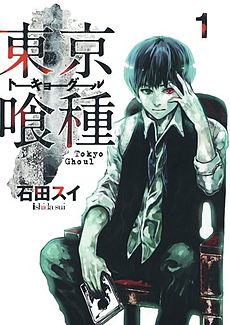
Tokyo Ghoul will debut in June 2015.
Breaking news from New York Comic-Con: VIZ Media has licensed two new series, both of which will debut in June 2015. The first, Tokyo Ghoul, focuses on a college student who unwittingly receives an organ transplant from a demon. The second, So Cute It Hurts!!, is pure shojo fodder: fraternal twins Mitsuru and Megumu swap identities to attend each others’ school. The twist? Mitsuru enrolls in an all-girls academy, while his sister enrolls in a high school for delinquent boys.
Pack your beret: ReedPOP, the company that organizes New York Comic-Con, just announced the first-ever Paris Comic-Con, which will be held from October 23-25, 2015.
The New York Times files a report on the business of comic conventions, noting that over 150,000 people will be attending this year’s NYCC. Not everyone is enthusiastic about conventions’ increasing emphasis on movies, television, and video games, however. Blogger Denise Dorman argues that comics — and their creators — are being marginalized at the very events they helped popularize.
Paging Julie Taymor! Shueisha and Masashi Kishimoto have approved a stage adaption of Naruto. No word if Bono and the Edge will be contributing musical numbers…
The final volume of Vampire Knight arrives in stores on Tuesday, October 14th.
Reviews: Ash Brown kicks the tires on manga adaptations of Pride and Prejudice and Les Miserables, while Jason Thompson dedicates his latest House of 1,000 Manga column to Attack on Titan.
Rebecca Silverman on Helter Skelter: Fashion Unfriendly (Anime News Network)
Kate O’Neil on vol. 3 of The Infernal Devices: Clockwork Princess (The Fandom Post)
Kate O’Neil on vol. 7 of Midnight Secretary (The Fandom Post)
L.B. Bryant on Time Killers (ICv2)
Marissa Lieberman on Wolf Children: Ame & Yuki (No Flying No Tights)
Kristin on vols. 1-2 of World Trigger (Comic Attack)



 SEAN: Generally speaking, I’m not a big horror fan, unless it has a healthy dose of comedy. With that in mind, I’m going with my perennial favorite Higurashi: When They Cry. In between its harem antics, its mystery plotting, and its tragic futility, there’s no end to terrifying images, ranging from Rena’s scratching at imaginary maggots to Keiichi eating a needle hidden in his riceball to… well, the entire epilogue of the Cotton-Drifting Arc. Some truly nightmare-inducing imagery, especially given the cute moe-type heroines.
 KATE: My favorite Halloween title? That’s a tough call, but if I had to choose just one—and death was not an option!—my pick would be Rumiko Takahashi’s Mermaid Saga. This four-volume series follows the adventures of Yuta, a fisherman who accidentally ingests mermaid flesh, gaining immortality in the process. Though Yuta is keen to regain his humanity, he crosses paths with people who seek mermaid flesh as a remedy for illness, old age, or the death of a loved one. Say what you will about InuYasha or Rin-ne, when Takahashi is working in short-story form, she’s an undisputed master of horror; her spooky morality plays are a skillful mixture of suspense, humor, and horror, with a generous dose of pathos. Hands-down my favorite Takahashi series.
 MJ: This particular pick is really difficult for me—not because I’m a big fan of horror comics in particular (I’m not) but because for whatever reason, the spooky comics I do like, I tend to really love. Tempting choices include Setona Mizushiro’s emotionally complex epic
  MICHELLE: Having


 KATE: Though I’m glad to see that Dark Horse is still releasing new volumes of Bride of the Water God—surely one of the most beautiful and confusing manhwa available in English—my vote goes to volume one of Keiko Suenobu’s