• Skip to primary navigation
  • Skip to main content
  • Skip to primary sidebar
  • Home
  • About Us
    • Privacy Policy
    • Comment Policy
    • Disclosures & Disclaimers
  • Resources
    • Links, Essays & Articles
    • Fandomology!
    • CLAMP Directory
    • BlogRoll
  • Features & Columns
    • 3 Things Thursday
    • Adventures in the Key of Shoujo
    • Bit & Blips (game reviews)
    • BL BOOKRACK
    • Bookshelf Briefs
    • Bringing the Drama
    • Comic Conversion
    • Fanservice Friday
    • Going Digital
    • It Came From the Sinosphere
    • License This!
    • Magazine no Mori
    • My Week in Manga
    • OFF THE SHELF
    • Not By Manga Alone
    • PICK OF THE WEEK
    • Subtitles & Sensibility
    • Weekly Shonen Jump Recaps
  • Manga Moveable Feast
    • MMF Full Archive
    • Yun Kouga
    • CLAMP
    • Shojo Beat
    • Osamu Tezuka
    • Sailor Moon
    • Fruits Basket
    • Takehiko Inoue
    • Wild Adapter
    • One Piece
    • After School Nightmare
    • Karakuri Odette
    • Paradise Kiss
    • The Color Trilogy
    • To Terra…
    • Sexy Voice & Robo
  • Browse by Author
    • Sean Gaffney
    • Anna Neatrour
    • Michelle Smith
    • Katherine Dacey
    • MJ
    • Brigid Alverson
    • Travis Anderson
    • Phillip Anthony
    • Derek Bown
    • Jaci Dahlvang
    • Angela Eastman
    • Erica Friedman
    • Sara K.
    • Megan Purdy
    • Emily Snodgrass
    • Nancy Thistlethwaite
    • Eva Volin
    • David Welsh
  • MB Blogs
    • A Case Suitable For Treatment
    • Experiments in Manga
    • MangaBlog
    • The Manga Critic
    • Manga Report
    • Soliloquy in Blue
    • Manga Curmudgeon (archive)

Manga Bookshelf

Discussion, Resources, Roundtables, & Reviews

Katherine Dacey

A First Look at Tokyo Tarareba Girls

February 13, 2017 by Katherine Dacey

Are you breathlessly awaiting the next installment of Princess Jellyfish? Still fuming over Tokyopop’s cancellation of Suppli? Eagerly searching for a manga romance whose heroine is old enough to drink? Then I have the cure for what ails you: Akiko Higashimura’s Tokyo Tarareba Girls, which makes its digital debut tomorrow (2/14) courtesy of Kodansha Comics. This fizzy, fast-paced comedy is every bit as good as Higashimura’s Princess Jellyfish, deftly mixing wacky misunderstandings and witty banter with moments of genuine rue and self-reflection.

The first chapter begins with the narrator declaring, “I spent all my time wondering ‘What if,’ and then one day I woke up and was 33.” As Rinko fills us in on her career, female readers will feel an immediate sense of identification with her — she’s smart, capable, and constantly imagining her future instead of being fully invested in the present, something many of us are guilty of doing in our twenties and early thirties. Though Rinko has forged her own career path, she frets over being single. Rinko isn’t alone in her frustration, since Kaori and Kayuki — her gal pals and drinking buddies — are in the same boat.

The plot is set in motion by a cryptic message from Rinko’s co-worker Hayasaka. In a brief flashback to 2004, we see Rinko and Hayasaka on an uncomfortable date: she focuses on his shyness, his clothing, and his fumbling efforts to be suave, while he ignores her squirming and tries to give her an unwanted gift. Ten years later, both still work for the same company, although there’s a lingering note of tension — or is that romantic frisson? — between them. When Hayasaka sends Rinko a text asking, “I would like to discuss something with you. Could I trouble you for some time later this week?” Rinko immediately declares a “four-alarm” emergency and reaches out to her girls for counsel: after all this time, is Mr. Hayasaka planning to propose? And if so, should she say yes?

If you’re thinking been there, seen that, I get it. Tokyo Tarareba Girls sounds like a hundred other comedies about single women navigating a paired-off world, from Bridget Jones’ Diary to How to Be Single. What prevents Tarareba Girls from reading like a Sex in the City clone is Higashimura’s storytelling chops.

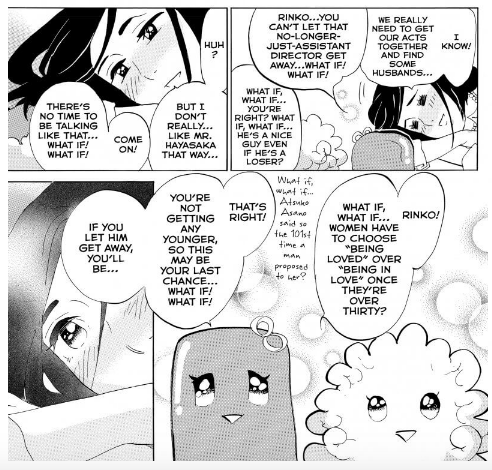
Consider Higashimura’s strategy for making us privy to Rinko’s thoughts. Though Rinko often functions as the series’ narrator, Higashimura looks for more imaginative ways to dramatize Rinko’s emotional life than simple disclosure. In one scene, for example, Rinko’s food — yes, you read that right — cheerfully engages her in a conversation about her romantic dilemma:

Coming from one of her gal pals, this exchange would sound too on-the-nose, a bald statement of the manga’s main thesis. But coming from an izakaya dish? That’s genius! It allows us a window into Rinko’s state of mind (and her state of intoxication) without falling back on such shop-worn devices as the “Dear Diary” entry or the “Little did I know then…” voice-over.

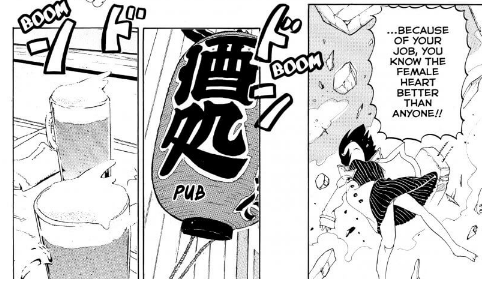
Elsewhere in chapter one, Higashimura uses a similar technique of transposing Rinko’s inner thoughts onto the outer world, using the visual language of action movies — explosions, falling debris — to evoke the intensity of Rinko’s embarrassment over misunderstanding a friendly overture:

This sequence, too, is genius: anyone who’s ever read too much into an email, a voice mail, a text, or a friendly conversation knows exactly how Rinko feels in that moment and can laugh — or cringe — in self-recognition. At the same time, however, the reader can also see that Rinko’s romantic delusions are blinding her to the real lesson of turning 33: that she should learn what — or who — she really wants instead of settling for Mr. Not Quite Right.

The first chapter ends with the introduction of a prickly, truth-telling character whose appearance adds a welcome jolt of energy to the story; his barroom sermon about self-defeating female behavior is a show-stopper, both for its blunt honesty and for the impact it has on Rinko and her pals. Whether he becomes Rinko’s enemy or love interest, his memorable exit leaves the reader wanting to know what happens next — further proof of Higashimura’s storytelling mojo.

TOKYO TARAREBA GIRLS, VOL. 1 • BY AKIKO HIGASHIMURA • KODANSHA COMICS • RATED OT, FOR OLDER TEENS (16+) 

Filed Under: Manga, Manga Critic, REVIEWS Tagged With: Akiko Higashimura, Josei, Kodansha Comics, Romance/Romantic Comedy

Pick of the Week: Chihayafuror

February 13, 2017 by Anna N, Ash Brown, Katherine Dacey, MJ, Michelle Smith and Sean Gaffney Leave a Comment

MICHELLE: I have wished for an English release of Chihayafuru for nearly a decade now. It’s josei, it’s long, it’s about an obscure game… all of the things that made me sure I’d love it made it an unlikely licensing prospect. And yet Kodansha came through! I must say, I am already deeply loving their ramped-up digital initiative. I will surely be checking out Tokyo Tarareba Girls and Springtime with Ninjas (and Germany o/~), but Chihayafuru simply must be my pick this week.

SEAN: Absolutely Chihayafuru, if only so I can cross another title off my “this will never be licensed” bucket list.

ANNA: Michelle has said everything I would about Chihayafuru. As someone who loves josei manga, I wish more of it would be translated, and I’m delighted about Chihayafuru.

KATE: Since Michelle and Sean have already mentioned my top picks for the week, I’m going off-list to honor the late, great Jiro Taniguchi, who passed away on Saturday. A quick glance at online retailers like Amazon reveals that many of his manga are out of print. Two great titles that are still readily available are A Distant Neighborhood, a lovely coming-of-age story that’s funny, wise, and unsentimental, and Guardians of the Louvre, a handsome, full-color manga exploring the Louvre’s history.

ASH: Kodansha’s digital offerings of late really have been fantastic! I’ll throw in with everyone else and declare my top pick to be Chihayafuru. I’d also like to join Kate in highlighting some of Taniguchi’s work: A Distant Neighborhood is a personal favorite of mine as is his collaboration with Baku Yumemakura The Summit of the Gods.

MJ: From deep beneath a pile of snow, I raise my fist and shout, “Chihayafuru!” Yes, Chihayafuru.

Filed Under: PICK OF THE WEEK

The Manga Critic’s Guide to Jiro Taniguchi

February 11, 2017 by Katherine Dacey


Word of Jiro Taniguchi’s death spread quickly this afternoon via Twitter and Facebook. It was a sobering moment for American fans; most of us imagined that he was only one great series away from mainstream recognition in the U.S., and eagerly hoped that his next release — whatever it might be — would wow new readers and make bank. Alas, the only appreciation we may see is in the value of his older, rarer titles like Icaro (a collaboration with French artist Moebius) and Samurai Legend (a collaboration with Kan Furuyama).

Manga lovers who haven’t yet discovered Taniguchi’s skill may be surprised to learn just how versatile and prolific he was. He leaves behind a rich assortment of historical dramas, hard-boiled crime thrillers, samurai swashbucklers, alpine adventures, food manga, and coming-of-age stories. As an introduction to Taniguchi’s sizeable oeuvre, I’ve compiled a list of my favorite titles, as well as a complete list of Taniguchi’s work in English.

Benkei in New York
With Jinpachi Mori • VIZ Media • 1 volume
Originally serialized in Big Comic Original, Benkei in New York focuses on a Japanese ex-pat living in New York. Like many New Yorkers, Benkei’s career is best characterized by slashes and hyphens: he’s a bartender-art forger-hitman who can paint a Millet from memory or make a killer martini. Benkei’s primary job, however, is seeking justice for murder victims’ families. Part of the series’ fun is watching him set elaborate traps for his prey, whether he’s borrowing a page from the Titus Andronicus playbook or using a grappling hook to take down a crooked longshoreman. Though we never doubt Benkei will prevail, the crackling script, imaginatively staged fight scenes, and tight plotting make Benkei in New York Taniguchi’s most satisfying crime thriller. – Reviewed at The Manga Critic on 3/20/12

A Distant Neighborhood
Fanfare/Ponent Mon • 2 volumes

A Distant Neighborhood is a wry, wistful take on a tried-and-true premise: a salaryman is transported back in time to his high school days, and must decide whether to act on his knowledge of the past or let events unfold as they did before. We’ve seen this story many times at the multiplex — Back to the Future, Peggy Sue Got Married — but Taniguchi doesn’t play the set-up for laughs; rather, he uses Hiroshi’s predicament to underscore the challenges of family life and the awkwardness of adolescence. (Hiroshi is the same chronological age as his parents, giving him special insight into the vicissitudes of marriage, as well as the confidence to cope with teenage tribulations.) Easily one of the most emotional, most intimate stories Taniguchi’s ever told. – Reviewed at The Manga Critic on 2/23/11

Furari
Fanfare/Ponent Mon • 1 volume

One part Walking Man, one part Times of Botchan, this elegant collection of stories focuses on Ino Tadataka (1745-1818), the cartographer responsible for the first complete map of Japan’s coastline. We meet Tadataka shortly before he embarks on the arduous task of surveying the main island. As we follow him through the parks and streets of Edo, we realize that Tadataka is consumed with measuring; he makes mental note of every step he takes, calculating and re-calculating his routes. That’s a slender premise on which to hang a manga, but Taniguchi’s fine eye for detail transforms Tadataka’s daily walks into an immersive experience, capturing the energy, light, and sounds of the eighteenth century cityscape in all its vitality. These walks are so vividly drawn, in fact, that you could read Furari in blissful ignorance of Tadataka’s identity and still find it utterly engrossing.

Guardians of the Louvre
NBM/Comics Lit • 1 VOLUME

Guardians of the Louvre has a simple premise: a Japanese artist dreams about the world’s most famous museum. In each chapter, our unnamed protagonist is temporarily transported to a particular place and time in the Louvre’s history, rubbing shoulders with famous artists, witnessing famous events, and chatting with the Nike of Samothrace, who chaperones him from exhibit to exhibit. The set-up provides Taniguchi with a nifty excuse to draw rural landscapes, gracious country manors, war-ravaged cities, and busy galleries, as well as convincing recreations of Van Gogh and Corot canvasses. If the story lacks the full emotional impact of A Zoo in Winter or A Distant Neighborhood, the gorgeous, full-color illustrations and deluxe presentation make Guardians a natural gateway for exploring Taniguchi’s work. – Reviewed at The Manga Critic on 1/6/17

Hotel Harbour View
With Natsui Sekikawa • VIZ Media • 1 volume

The two stories that comprise Hotel Harbour View are among the pulpiest in the Taniguchi canon. In the first, a man waits in a seedy Hong Kong bar for the person who’s supposed to kill him, while in the second, an assassin returns to Paris for a showdown with his former associates. Both stories can be enjoyed as simple exercises in hard-boiled crime, but attentive readers will appreciate Taniguchi and Sekikawa’s sly nods to film noir, yakuza flicks, and the French New Wave. The characters in both stories self-consciously behave like gangsters and molls, trading quips and telling well-rehearsed stories about their pasts; they even wear fedoras, a sure sign that they’re reliving their favorite moments from the silver screen. A mirrored shoot-out is the highlight of the volume, demonstrating Taniguchi’s crisp draftsmanship and mastery of perspective. – Reviewed at The Manga Critic on 1/14/11

Kodoku Gourmet
With Masayuki Qusumi • JManga • 1 volume*

If you’re a fan of Kingyo Used Books, you may remember the chapter in which Japanese backpackers shared a dog-eared copy of Kodoku no Gourmet (a.k.a. The Lonely Gourmet) in order to feel more connected to home. Small wonder they adored Gourmet: its hero, Goro Inoshigara, is a traveler who devotes considerable time and energy to seeking out his favorite foods wherever he goes. While the manga is episodic  — Goro visits a new restaurant in every chapter — Jiro Taniguchi does a wonderful job of conveying the social aspect of eating, creating brief but vivid portraits of each establishment: its clientele, its proprietors, and, of course, its signature dishes. Best of all, Taniguchi and writer Masayuki Qusumi have the good sense to limit the story to a single volume, allowing the reader to savor Goro’s culinary adventures, rather than ponder its very slight premise. – Reviewed at The Manga Critic on 5/24/12

The Summit of the Gods
With Yumemakura Baku • Fanfare/Ponent Mon • 5 volumes

On June 8, 1924, British explorer George Mallory started up the summit of Mt. Everest, never to be seen again. His disappearance drives the plot of The Summit of the Gods, a pulse-pounding adventure in which two modern-day climbers retrace Mallory’s steps up the Northeast Ridge, searching for clues to his fate. Although the drama ostensibly focuses on Fukumachi, a hard-charging photographer, and Habu, a tough-as-nails mountaineer, the real star of Summit is Everest. Taniguchi captures the mountain’s danger with his meticulous renderings of rock formations, glaciers, and quick-changing weather patterns, reminding us that Everest is one of the remotest places on Earth; at the top of the world, no one can hear you scream. – Reviewed at The Manga Critic on 10/12/2009

The Times of Botchan
With Natsuo Sekikawa • Fanfare/Ponent Mon •  5 volumes**

In The Times of Botchan, Natsuo Sekikawa and Jiro Taniguchi immerse readers in the tumult of the Meiji Restoration. Novelist Soseki Natsume (Botchan, I Am a Cat) functions as our de facto guide, introducing us to the suffragettes, anarchists, novelists, poets, and politicians whose struggle helped create modern Japan. Taniguchi invests small details with great meaning, using them to reveal the characters’ ambivalent relationship with the West; some embrace European dress, others flatly reject it, and most, like Natsume, strike a compromise, combining a yukata with a button-down shirt and bowler hat. Though Sekikawa’s script is not as nimble as Taniguchi’s artwork, the series leaves a vivid impression nonetheless, offering modern readers a window into Natsume’s world. – Reviewed at The Manga Critic on 5/19/2010

Venice
Fanfare/Ponent Mon • 1 volume

Venice — one of the last projects Jiro Taniguchi completed before his death in 2017 — is perhaps the most beautiful work he ever produced, a paean not only to the great Italian city, but to his own superb command of light, color, and line. Rendered in watercolor and ink, Venice‘s subtle palette and expansive treatment of the page are reminiscent of Taniguchi’s Guardians of the Louvre, while its premise recalls The Walking Man, Furari, and The Solitary Gourmet, three manga in which an unnamed male character strolls through the thoroughfares and byways of a major city, stopping to admire a blossoming tree or duck into an unassuming noodle shop. Taniguchi does more than recreate the Venetian landscape, however; he conveys the rhythms and emotions of a journey as the hero retraces his grandparents’ steps through 1930s Venice. – Reviewed at The Manga Critic on 3/2/18.

The Walking Man
Fanfare/Ponent Mon • 1 volume

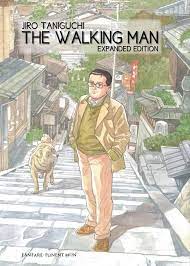
This nearly wordless manga follows an ordinary man through his daily routines. He walks his dog; he swims laps at the pool; he retrieves a model airplane from a tree. In less capable hands, the sheer lack of conflict would result in a dull comic, but Taniguchi invests these activities with meaning by interrupting them with moments of simple beauty: a rare bird alighting on a branch, a rooftop view of a neighborhood in spring bloom. Though we learn very little about the protagonist — he remains nameless throughout the story — his capacity for noticing and savoring these details becomes a small act of heroism, a conscious effort to resist the indifference, complacency, and impatience that blinds us to our surroundings and dulls our imaginations.

A Zoo in Winter
Fanfare/Ponent Mon • 1 volume

Drawing on his own experiences, Jiro Taniguchi spins an engaging tale about a young man who abandons a promising career in textile design for the opportunity to become a manga artist. Though the basic plot invites comparison with Bakuman, Taniguchi does more than just document important milestones in Hamaguchi’s career: he shows us how Hamaguchi’s emotional maturation informs every aspect of his artistry — something that’s missing from many other portrait-of-an-artist-as-a-young-man sagas, which place much greater emphasis on the pleasure of professional recognition than on the satisfaction of mastering one’s craft. Lovely, moody artwork and an appealing cast of supporting characters complete this very satisfying package.  —Reviewed at The Manga Critic on 5/28/11

* * * * * *

Below is a complete list of Jiro Taniguchi’s manga in English. Please note that I’ve provided the publication information for the English translations, not the original Japanese editions. This list was last updated on August 28, 2023 to include several books that have been released since 2017.

As Artist and Author

  • Taniguchi, Jiro. A Distant Neighborhood. Fanfare/Ponent Mon, 2009. 2 vols.
  • Taniguchi, Jiro. Furari. Fanfare/Ponent Mon, 2017. 1 vol.
  • Taniguchi, Jiro. Guardians of the Louvre. NBM/Comics Lit, 2016. 1 vol.
  • Taniguchi, Jiro. The Ice Wanderer and Other Stories. Fanfare/Ponent Mon, 2010. 1 vol.
  • Taniguchi, Jiro. A Journal of My Father, Fanfare/Ponent Mon, 2021. 1 vol.
  • Taniguchi, Jiro. The Quest for the Missing Girl. Fanfare/Ponent Mon, 2010. 1 vol.
  • Taniguchi, Jiro. Sky Hawk. Fanfare/Ponent Mon, 2019. 1 vol.
  • Taniguchi, Jiro. Venice. Fanfare/Ponent Mon, 2017. 1 vol.
  • Taniguchi, Jiro. The Walking Man. Fanfare/Ponent Mon, 2007. 1 vol.
  • Taniguchi, Jiro. A Zoo in Winter. Fanfare/Ponent Mon, 2011. 1 vol.

As Artist

  • Boilet, Frederic and Jiro Taniguchi. Tokyo Is My Garden. Fanfare/Ponent Mon, 2010. 1 vol.
  • Furuyama, Kan and Jiro Taniguchi. Samurai Legend. Central Park Media, 2003. 1 vol.
  • Moebius and Jiro Taniguchi. Icaro. IBooks, 2003-2004. 2 vols.
  • Mori, Jinpachi and Jiro Taniguchi. Benkei in New York. VIZ Media. 2001. 1 vol.
  • Qusumi, Masayuki and Jiro Taniguchi. Kodoku Gourmet.  JManga, 2012. 1 vol.*
  • Sekikawa, Natsuo and Jiro Taniguchi. Hotel Harbour View. VIZ Media, 2001. 1 vol.
  • Sekikawa, Natsuo and Jiro Taniguchi. The Times of Botchan. Fanfare/Ponent Mon, 2007-2010. 5 vols.**
  • Yumemakura, Baku and Jiro Yaniguchi. The Summit of the Gods. Fanfare/Ponent Mon, 2009-2015. 5 vols.

*This title was only released digitally through the JManga platform.

**This series is incomplete in English; the complete Japanese edition spans 10 volumes.

Filed Under: Manga, Manga Critic, Recommended Reading Tagged With: Fanfare/Ponent Mon, Jiro Taniguchi, JManga, NBM/Comics Lit, VIZ

Pick of the Week: So Many Choices

February 6, 2017 by Sean Gaffney, Ash Brown, Anna N, Katherine Dacey, MJ and Michelle Smith Leave a Comment

SEAN: There’s a ton to choose from, most of it from Viz. So many of my favorites are getting new volumes it’s hard to narrow it down, but I’ll make it the new volume of My Love Story!!, which never fails to warm the cockles of my little heart.

KATE: My pick goes to Fuku Fuku Kitten Tales. Although it’s not quite in the same league as Chi’s Sweet Home, Fuku Fuku will appeal to cat fanciers. I particularly like the way Kanata Konami draws cats when they’re irritated; no one draws feline side-eye with quite such authority. Those feline reaction shots add a tart little zing to the Fuku Fuku stories that prevents them from becoming too cloying.

MICHELLE: Oh, man. Such a tough choice. Both Sean’s and Kate’s picks are on the top of my stack, but ultimately the title I’m most eager for is Haikyu!! because I’m addicted to its sports manga goodness.

ASH: It really is a tough pick this week, especially since there are so many Viz series that I’m following with new volumes being released. Sean has already mentioned My Love Story!! and Michelle has already mentioned Haikyu!!, so I’ll take this opportunity to mention Yona of the Dawn. It may not be as typographically emphatic, but it’s still a great series and I’m looking forward to reading more of the shoujo fantasy epic.

ANNA: If there’s a shoujo fantasy series out, you can be sure that I’m going to pick it. I’m going to join with Ash in picking Yona of the Dawn. It is firmly in the “get the team together” phase of the story, but I’m thoroughly enjoying it. I would love it if there were 2 or 3 series like it licensed at once!

MJ: I feel a little out of sync this week, with such a big haul and so little of it for me. But I will join Kate in appreciation of Fuku-Fuku Kitten Tales. More kitties is always something I can get behind, especially when they are drawn by this artist.

Filed Under: PICK OF THE WEEK

Kuma Miko: Girl Meets Bear, Vol. 1

February 5, 2017 by Katherine Dacey

By all rights, Kuma Miko: Girl Meets Bear should be interesting: it takes place in a rural village where talking bears and humans have peacefully coexisted for centuries. The story focuses on Machi, a priestess-in-training who’s learning the ropes from Natsu, her ursine mentor. Though Machi is determined to serve the village in her capacity as miko, she’s also determined to attend high school in a nearby city — something none of her predecessors have done.

While the set-up is ripe with potential, the execution is oddly flat. Part of the problem is that the leads feel more like ideas than characters. Machi, in particular, is a collection of quirks in search of a personality. In an effort to endear her to the reader, author Masume Yoshimoto makes her naive, ditsy, shy, and spazzy — a veritable catalog of manic pixie dream girl traits — but never reveals why she behaves so irrationally. Natsu is a little more fleshed out: he has wisdom to impart, and frets about Machi’s welfare. Worrying about another person, however, isn’t the same thing as having a personality, and here, too, Yoshimoto falls short. Natsu’s concern doesn’t suggest any deeper knowledge of Machi’s past or her reasons for wanting to leave the village; any reasonable person would worry about someone who seems as impetuous and dim-witted as Machi.

The only character with any presence is Yoshio, Machi’s pervy 25-year-old cousin. In one memorable scene, Yoshio gets so carried away describing the village’s history that he forgets his audience, accidentally regaling third graders with salacious details of a human-bear union. This scene might be funny, but the author wants to have it both ways, aiming for a mixture of titillation and tee-hees that’s just plain uncomfortable; I’m with the little girl who declares, “Sexual harassment!” before covering her ears.

If any of the other five stories had left as vivid an impression as “Village Legends,” I might cautiously recommend Kuma Miko to fans of off-beat slice-of-life comedies, but the rest of volume one was vanilla in comparison. Competent but undistinguished artwork and sluggish pacing pushed the title further into the “No” column for me; if I’m going to read about talking bears, dammit, I’d like to see a little more imagination on display.

KUMA MIKO, VOL. 1: GIRL MEETS BEAR • BY MASUME YOSHIMOTO • ONE PEACE BOOKS • NO RATING (SOME SUGGESTIVE MATERIAL; THIS TITLE IS BETTER SUITED FOR READERS 13+)

Filed Under: Manga, Manga Critic, REVIEWS Tagged With: Kuma Miko, Masume Yoshimoto, One Peace Books

Deathtopia, Vol. 1

February 1, 2017 by Katherine Dacey

It’s never a good sign when you enjoyed the Baka-Updates thread about a manga more than the actual manga, but that’s the case for Deathtopia, a title that scores a hat trick for being gory, exploitative, and boring. Part of the problem is the story: it’s the umpteenth example of an ordinary teen discovering that he’s been chosen to save the world. Koh Fujimura, the hero of Deathtopia, is the only person who can detect the presence of “Them,” a group of super-human predators that commit sadistic, stagey murders. Aiding him in the quest to ferret out these menaces are Maya Hoshimiya, Yui Kisagari, and Saki Yagami, a trio of buxom special agents who favor bustiers and short skirts over traditional uniforms. (Call me crazy, but where do you holster a gun if you’re not wearing any pants?)

All of this would be easier to swallow if manga-ka Yoshinobu Yamada had bestowed any personality on his characters, or supplied them with motives for the work they do. None of the cast, however, show any traces of wit or curiosity; all of them behave like well-programmed robots, dutifully marching from one grotesque crime scene to the next. Yamada allows Koh a few moments of fear and confusion, but these beats land with the emotional force of a Linux manual since we know almost nothing about him. Even the character designs are generic: there’s a pretty girl with short hair and hot pants, a pretty girl with a pony tail and a school uniform, and a pretty girl with long hair and a suit. (Actually, she’s the only one who looks like a law-enforcement agent, since she’s wearing comfortable shoes.) The bad guys, by contrast, are so uniformly and cartoonishly ugly it’s a wonder that Koh, Maya, Yui, and Saki can’t identify them at 50 paces.

Perhaps the most telling sign that Yamada is more interested in cheesecake than plot is that he draws the female characters’ breasts with more individuality than their faces. Yamada further diminishes his female characters by reducing them to types — the psychopathic bitch, the aloof older woman — and making his teenage male hero miraculously “better” at monster-hunting, despite his young age and lack of training. The only evidence of Maya, Yui, and Saki’s superior skill is supplied by Koh himself in the form of a voice-over; he muses that “These women are amazing! Even I can tell that their every move is calculated,” although that statement is undermined by the way Yamada stages a subsequent shoot-out.

The manga’s best gambit is shamelessly pilfered from John Carpenter’s They Live! (1988). In this Reagan-era cult classic, sunglasses enabled the hero to see that aliens were living amongst us, using subliminal messaging to subdue and control humanity:

In Deathtopia, Koh gains a similar ability after eye surgery: he sees the monsters as humans with scribbly, mouthless faces, drifting unnoticed through Tokyo streets. Only when Koh dons glasses does he lose sight of “Them”; in an original touch, glass blocks his monster vision. For all the promise this idea holds, however, Yamada makes no attempt to explore its allegorical potential, instead lavishing most of his attention on dismembered corpses and topless girls. Carpenter, by contrast, used They Live! to explore the evils of consumerism and conformity and deliver one of the longest, goofiest, and most admired fight sequences in B-movie history.

In sum, Deathtopia is the sort of manga you might think was cool if you hadn’t read any manga, or were just hoping to steal a glimpse of naked girls. Anyone who’s read Alive: The Final Evolution, Bloody Monday, Death Note, Platinum End, or even Yamada’s Cage of Eden, however, won’t find much to distinguish Deathtopia from these other teenage male fantasies, as it lacks the verve, polish, and imagination of the best examples in this genre.

DEATHTOPIA, VOL. 1 • BY YOSHINOBU YAMADA • KODANSHA COMICS • RATED M, for MATURE

Filed Under: Manga, Manga Critic, REVIEWS Tagged With: Action/Adventure, Kodansha Comics, Yoshinobu Yamada

Pick of the Week: Lesbians or Melting Faces?

January 31, 2017 by Sean Gaffney, Anna N, Ash Brown, Katherine Dacey and Michelle Smith Leave a Comment

MICHELLE: Hm, probably I shouldn’t pick Wave, Listen to Me! for two weeks in a row, so this time I’ll go for Kindred Spirits on the Roof, which has been on my to-get list for quite a while.

SEAN: There’s lots I’m interested in, including lots of light novels and some amusing/disgusting horror. But yes, my pick is definitely Kindred Spirits on the Roof. This makes three Seven Seas picks this month. Kudos to them.

ASH: While I’m certainly interested in Kindred Spirits on the Roof there can be no other pick for me this week than Dissolving Classroom. Josei horror by Junji Ito? Count me in!

KATE: My vote goes to Junji Ito’s The Dissolving Classroom. It looks gross — in the best possible way — and funny — as all of Ito’s manga are. I don’t know if it’s studded with references to Umezu’s Drifting Classroom, but it seems as if there’s drinking game potential here!

ANNA: I’m with the folks who are choosing The Dissolving Classroom, it isn’t every week a quality horror release comes out!

Filed Under: PICK OF THE WEEK

Bookshelf Briefs 1/30/17

January 30, 2017 by Anna N, Katherine Dacey, Michelle Smith and Sean Gaffney Leave a Comment

Alice in Matchaland | By Mosoko Miyatsuki | Manga University – This slim volume is both picture and cook book, offering readers a playful riff on Lewis Carroll’s most famous work as well as recipes for matcha-infused snacks. For tween manga lovers, the button-cute character designs, Technicolor palette, and gentle pokes at manga cliche may be enough to justify purchasing Alice in Matchaland. Anyone intent on making Matcha Energy Bites, however, will need a conversion table handy, as the recipes freely mix teaspoons with grams and milliliters. The book doesn’t offer any tips for procuring matcha powder, either—a curious omission, since many Americans won’t find it on the shelves of their local grocery stores. A little more attention to the recipes would have made this book less of a stocking stuffer and more of a must-buy for tea-drinking manga enthusiasts. (The publisher provided a review copy.) -Kate Dacey

Behind the Scenes!!, Vol. 3 | By Bisco Hatori | VIZ Media – It’s not that Behind the Scenes!! is awful, but that every chapter is essentially filler. In this volume, there’s the one about the bratty child actor whom the team helps emote, the one about protecting a group filming in a park, the one about fundraising through shrinky dinks (yes, really), and the one about creating a haunted house. At times, attempts are made to flesh out the other members of the art squad, but it’s never building on character traits previously established and then paying off in a satisfying way. It’s always Ranmaru noticing on one page that Ruka gives in too easily and then on the next page encouraging her not to give in because shrinky dinks (yes, really). Probably it’s time to accept that this series is just not for me and move on. – Michelle Smith

Behind the Scenes!!, Vol. 3 | By Bisco Hatori | Viz Media – There isn’t a ton of plot or character development in Behind the Scenes!!, but it does reliably deliver a pleasant escape in the adventures of a college art club that supports various film projects. The first story line in this volume deals with the redemption of a child actor who at first seems spoiled, then there is detour into the value of crafts as the gentle rich girl Ruka stands up for herself. The gang also has to fine tune a haunted house, when they make it dangerously realistic. Even if this series isn’t the most memorable thing Hatori has created, it still is diverting in the moment. I enjoy the interactions between all the characters, and this volume also featured several bonus one page manga at end. – Anna N

Horimiya, Vol. 6 | By Hero and Daisuke Hagiwara | Yen Press – I said last time that Hori and Miyamura hadn’t quite taken the next step in their relationship yet. They do that here, but blink sand you’ll miss it—unlike most manga of this type, their first time—while sweet—is not earth-shattering and does not really change either of them. Indeed, Miyamura is far more concerned about the required swimming event, mostly as it could get him expelled. We also see Hori being jealous again, but she’s at least cognizant of how annoying it is, and it’s funnier when she uses her anger against other people, like Miyamura’s old teasing classmates from junior high. This is not particularly going anywhere, even with the sex, but it’s still a well-written leisurely ride. – Sean Gaffney

Interviews with Monster Girls, Vol. 2 | By Petos | Kodansha Comics – This is sort of a harem series—there’s certainly enough students and one teacher in love with Takahashi-sensei. But it feels so laid-back and leisurely, and he’s so non-sexual in general, that I can’t really define it as a classic harem comedy. At heart, it’s about the girls and their monster issues—though the best chapter in the volume has the teacher pointing out that you can’t just think of them as monsters OR girls, but you have to balance both sides. Much of the volume deals with a yuki-onna who worries she may live up to her stereotype, and she’s just as sweet and cute (and somewhat boring) as the other girls. This is a nice series, and monster girl fans will like it. It is, however, not a book that will get your pulse racing. Leisurely. – Sean Gaffney

Liselotte & Witch’s Forest, Vol. 3 | By Natsuki Takaya | Yen Press – At last, a volume of Liselotte I can honestly say was excellent throughout. The bargain that she has to strike to save Engetsu’s life essentially resets things to square one, but that’s really for the best, as I think the baggage was crushing them both a bit. We also get more flashes to what Lise was like before the rebellion, and it’s rather sad and also a bit eerie. There’s also still some comedy, mostly coming from Alto and Anna, though the return of a witch from the previous volume also helps. I suspect things may not stay comedic for long, though, as it appears that Lise is not going to be allowed to be merely exiled for much longer. The less fluffy this gets the more I like it, though the fluff is still fun. – Sean Gaffney

Liselotte & Witch’s Forest, Vol. 3 | By Natsuki Takaya | VIZ Media – Man, I can already tell that it’s going to be pretty painful when Liselotte goes on hiatus after two more volumes. Although some of what happens in this installment feels like things I’ve seen before—the heroine who unhesitatingly hacks off her own long hair, the love interest who loses his memories of the heroine, the determined optimism and welcoming spirit—there are some unique things about this story, chief among them the reveal in the final pages that someone has been watching Liselotte and reporting back to her brother, who is being pressured to do something about her. It’d be an interesting development if her world were to get a bit darker; the Akito vibes I got from the tree spirit in this volume were pretty fantastic. – Michelle Smith

Scum’s Wish, Vol. 2 | By Mengo Yokoyari | Yen Press – I have to say, so far this is currently at the top of my “most surprising new series” list, as the second volume is just as strong as the first was. Even as it appears that Mugi and Hanabi may have deeper feelings for each other than they expected, it is shown over and over again how bad this relationship really is, and how much they’re hurting from it. Of course, not having the relationship would not ease the source of the hurt. Meanwhile, we also meet Ebato, Hanabi’s friend who turns out to be in love with her, something that gets revealed a lot more than she’d like at a sleepover, and ends just as ambiguously as you’d expect. This is a fantastic car crash of a romance manga, where even the omake extra is tragic and sad. Well-written and brutal. – Sean Gaffney

Scum’s Wish, Vol. 2 | By Mengo Yokoyari | Yen Press – After making a brief appearance in volume one, a lot of this volume focuses on Hanabi’s only female friend, Ecchan, who has been in love with her ever since the day they took the entrance exam. When she’s invited to a sleepover, she’s unable to contain her feelings anymore and confesses, but more importantly gets Hanabi to confirm that she doesn’t love Mugi. Ecchan offers to be the surrogate herself, but by volume’s end, Hanabi’s in bed with Mugi, seemingly ready to have sex with him. One thing I particularly liked about this volume is though her relationship with Mugi might seem twisted and strange, in a way she’s more pure than other classmates, because she’s acting out of love and not merely juggling two guys, trying to decide who has more to offer her. Looking forward to volume three! – Michelle Smith

Filed Under: Bookshelf Briefs

Happiness, Vols. 1-2

January 27, 2017 by Katherine Dacey

The first chapter of Happiness reads like a teenage boy’s answer to Are You There, God? It’s Me, Margaret. Makoto, the principle character, is doing his best to cope with the indignities of being fourteen: he’s bullied by the popular kids, pestered by his well-meaning but clueless mother, and embarrassed by his lustful reactions to pretty girls. Though he has one friend — the equally uncool Nunota — Makoto spends most of his time alone.

A nighttime trip to the convenience store, however, jolts Makoto out of his routine. In a dark alley, a female vampire tackles and pins him to the ground, offering the following ultimatum: “Do you want to die like this, or do you want to be like me?” With tears and snot streaming down his face, Makoto whimpers, “I don’t want to die,” thus beginning his transformation from ordinary teen to bloodsucker.

If Makoto thought that wet dreams and wedgies were awful, he soon discovers that they pale in comparison with the first stages of vampirism. He suffers from an unquenchable, almost violent thirst and finds direct sunlight blisteringly painful. Worse still, his sense of smell is now so acute that he swoons and sweats in the presence of bloody noses, cuts, and girls, a symptom that sends him into an even deeper spiral of shame. The only potential upside to his condition is his supernatural strength: though he still looks like a 100-pound weakling, he can leap from great heights and deliver a lethal karate chop when the scent of blood is in the air.

Given Makoto’s age, it’s not surprising that author Shizuno Oshimi treats his hero’s transformation as a metaphor for puberty itself. In the manga’s earliest scenes, Oshimi frankly documents Makoto’s efforts to cope with hormonal surges and maternal helicoptering, capturing Makoto’s discomfort in his own skin. As Makoto begins turning into a vampire, however, his increasingly urgent thirst for blood amplifies the very aspects of puberty that most embarrass him — his keen interest in sex, his inability to conceal his arousal from others — making him feel even more powerless.

To capture Makoto’s turbulent emotions, Oshimi employs a variety of artistic styles. Some panels are rendered in smudgy pastels, suggestive of a foggy evening, while other panels are rendered in swirling, pulsating lines reminiscent of The Scream. These visual interludes last only a page or two, but vividly capture the nausea, pain, and confusion Makoto experiences in the grips of bloodlust.

Perhaps no scene is as evocative as that first encounter between Makoto and the female vampire. Oshimi uses rapid shifts in perspective and a few fleeting images — a shadowy figure plunging through space, a dark smear of blood — to indicate what’s happening. The extreme close-ups and feverish pacing neatly mimic Makoto’s growing sense of panic as he considers the possibility of dying in an alleyway — and not just any death, but a potentially humiliating one. (And really, what could be worse than that from a fourteen-year-old’s perspective?)

The pacing, like the artwork, is expertly handled. Oshimi has a knack for lulling readers into a false sense of security that Makoto will transcend (or master) his vampirism and silence his tormentors. Then — bam! Oshimi inserts a twist or introduces a new character who contradicts our sense of how socially maladroit or invulnerable Makoto really is. The appearance in volume two of a new bloodsucker, for example, reveals the extent to which vampires pose an active threat to one another — something that Makoto in his solipsistic misery never considered when he agreed to become a vampire himself.

And speaking of volume two, Oshimi does an excellent job of expanding and developing the cast of characters. By volume’s end, there’s more at stake than Makoto’s desire to escape humiliation; Makoto must decide whether to become a full-fledged vampire or fight for his humanity, a decision complicated by his budding friendship with a female classmate. How Makoto resolves this dilemma remains to be seen, though his struggle should provide plenty of dramatic grist for volume 3 (available February 14th).

The bottom line: Happiness is a rare vampire manga with bite: it’s smart, stylish, and unsettling, drawing readers into Makoto’s world with an honest look at the horrors of being fourteen. And what could be scarier than that?

HAPPINESS, VOLS. 1-2 • BY SHIZUNO OSHIMI • KODANSHA COMICS • RATING: OT, for OLDER TEENS (16+)

Filed Under: Manga, Manga Critic, REVIEWS Tagged With: Happiness, Horror/Supernatural, Kodansha Comics, Shizuno Oshimi, Shonen, Vampires

Pick of the Week: Catch the Wave

January 23, 2017 by Sean Gaffney, Anna N, Ash Brown, Katherine Dacey, MJ and Michelle Smith Leave a Comment

SEAN: As always, there’s a ton of stuff I’d like to pick this week. The new digital volumes from Kodansha, the Nisioisin novel, new Horimiya and Furuba… that said, I will have my pick be the final volume of Umineko When They Cry: Dawn of the Golden Witch, if only as I’m not sure when the next arc will be coming out and I’d like to recommend it one last time. Even if it can be aggravating.

MICHELLE: I’ll definitely be picking up a few things from Yen Press this week, but I am officially picking Wave, Listen to Me! this week. Not only am I interested in radio stations, I also admire Samura-sensei’s artwork, so it’s the obvious choice for me.

ASH: I’m not usually one for digital manga but like Michelle the release I’m most interested in this week is Wave, Listen to Me! Samura’s Blade of the Immortal was actually one of the first manga that I ever read, so I’m always happy for the chance to read more of his work. I definitely hope there will be a print edition in the future, though!

MJ: I, too, will be jumping on the Wave, Listen to Me! bandwagon this week! Though I was never a big fan of Blade of the Immortal, I’m very interested in the premise of Wave. It’s the kind of story that, on the face of it, you’d expect to be written by someone like Moyoco Anno. I gotta check it out.

KATE: At the risk of sounding like a skipping record, I’m also going to surf the Wave. (Sorry–not sorry.) I liked Samura’s Ohikkoshi and Emerald — more than Blade of the Immortal, if I’m being honest — so I’m pretty sure Wave will be in my wheelhouse.

ANNA: No surprise, I’m also most interested in Wave, Listen to Me!. I have very fond memories of Samura’s non-Blade of the Immortal Work so I’m also very intrigued by this new title from him.

Filed Under: PICK OF THE WEEK

Manga the Week of 1/25/17

January 19, 2017 by Sean Gaffney, Ash Brown, Anna N, Katherine Dacey, MJ and Michelle Smith Leave a Comment

SEAN: For a Yen week, this is actually pretty reasonable. Mostly as Yen moved a bunch of titles to the week after next, but hey.

Kodansha first, though. They’ve recently announced several new titles as digital releases. Deathtopia debuts next week, from the creator of Cage of Eden. This is a seinen title from Evening Magazine, and we’ll see if it’s as fanservice-laden as its shonen predecessor. It’s a thriller.

Wave, Listen to Me! gets the award for best title of the week. It’s an Afternoon manga from the creator of Blade of the Immortal. Fans of that series will be happy to hear this new one takes place… at a radio station?

ASH: I just found out about this series and I am incredibly curious about it.

MICHELLE: Oooooh! I especially like that the Kodansha site mentions “the beginning of an aggressive ramp-up in new digital manga series!”

KATE: Count me in for Wave, Listen to Me!, too. I’m a little biased — I teach a class on radio and television history — but I’m delighted to see a few grown-up options in the mix.

MJ: Oh, interesting.

ANNA: I am officially intrigued.

SEAN: And this isn’t out in volume form yet, but a new series from the creator of A Silent Voice debuts next week with 10 individual chapters, which catches us up with Weekly Shonen Magazine. Called To Your Eternity (Fumetsu no Anata e), it’s more supernaturally tinged than A Silent Voice but apparently just as depressing.

Kodansha also has an 8th print volume of Forget Me Not.

Seven Seas surprisingly only has one title out this week, given how much they’ve been piling on the books lately. It’s the 5th volume of Nurse Hitomi’s Monster Infirmary.

Vertical Inc. has the first volume of Nisioisin’s popular Zaregoto series, Decapitation: Kubikiri Cycle, though they emphasize they’ve only licensed this one volume, to tie in with the current Japanese OAV adaptation. It was actually released by Del Rey years ago; this is a re-edited version, and hopefully now that Bakemonogatari is popular it should see more readers.

Vertical Comics also gives us a third Immortal Hounds.

And the rest is Yen Press. First off, a 9th volume of capital letter and punctuation loving Akame Ga KILL!.

The 8th manga volume of A Certain Magical Index wraps up the adaptation of the 6th novel.

Death March to the Parallel World Rhapsody is the runner-up for best title of the week. As for the content, it’s a story where a guy finds himself transported to another world, gaining impressive powers, and surrounded by beautiful… wait, why are you running away? “Transported to another world” is this year’s vampires! This is the manga, the novel is out one week later.

First Love Monster has a 6th volume.

Fruits’ Basket Collector’s Edition reached Vol. 9, and get ready, because this is the one with THAT spoiler which shattered Furuba fandom forever.

MICHELLE: I continue to boggle that we’re up to this point already. But I also love that we’re still maintaining the secrecy of that spoiler.

SEAN: Horimiya has a 6th volume, and we’ll see if things advance on the romance front.

ASH: I’ve been enjoying Horimiya a great deal.

MICHELLE: Woot!

SEAN: I’ve enjoyed the light novel The Isolator, dark as it’s been, and so am pleased to see the manga adaptation is now coming out over here.

And there’s a 3rd volume of fantasy Liselotte & Witch’s Forest.

MICHELLE: I’ll be picking up this one, too.

SEAN: Murciélago also debuts this month from Yen Press. It’s a Young Gangan title that is apparently SUPER violent, and has humor so black it causes you to redefine “funny”. And it also has a lesbian lead, though this isn’t your cute high school girls sort of lesbian. I’ve heard good things about it (it has the Erica Friedman seal of approval), but with lots of “it’s pretty sick” warnings.

ASH: I’ve heard good things, too, but it definitely won’t be a series for everybody.

MJ: I would describe myself as interested, but skeptical.

SEAN: Rokka: Brave of the Six Flowers also has its manga adaptation debut (the novel arrives in April). It’s a fantasy series with strong word of mouth – real fantasy, rather than light novel fantasy. This adaptation ran in Shueisha’s now defunct Super Dash & Go!.

ANNA: Huh, I am always up for more fantasy manga.

SEAN: I was pleasantly surprised at how good I found the first volume of Scum’s Wish, though ‘pleasant’ is perhaps the wrong word for what’s going on with these kids. I look forward to the second volume.

MICHELLE: Same. Dark and complex, but not ecchi like the cover of volume one might suggest.

SEAN: Taboo Tattoo has a 5th volume, and is very Monthly Comic Alive.

Today’s Cerberus sees a 2nd print volume, and is still cute and silly.

You can’t have a long list of manga without at least one survival game title, and there is is: the 2nd volume of Tohyo Game.

Lastly, we wrap up the 6th Umineko arc with the 3rd and final omnibus of Dawn of the Golden Witch. I’m not sure when the 7th arc will begin – Yen hasn’t scheduled it – but this volume at least resolves Erika Furudo’s role in the series… at least for the time being.

A lot of new stuff this week. What appeals to you most?

Filed Under: FEATURES, manga the week of

The Girl From the Other Side: Siúil, a Rún, Vol. 1

January 17, 2017 by Katherine Dacey

On the surface, The Girl From the Other Side: Siúil, a Rún looks like a fairy tale. It unfolds in a long-ago, far-away place governed by one simple rule: humans and Outsiders must never cross paths. The principal characters are Shiva, a young girl, and Teacher, an Outsider who adopted Shiva after finding her alone in the woods. At first glimpse, their situation seems idyllic, two opposites living harmoniously in a charming little cottage — that is, until the human and demon worlds take interest in Shiva, testing Teacher’s commitment to protecting her.

Probe a little deeper, however, and it becomes clear that the manga’s nuanced characterizations elevate Shiva and Teacher from fairy tale archetypes to fully realized characters. Shiva, for example, talks and acts like a real six-year-old, toggling between moments of impetuousness and thoughtfulness. Though she is obviously fond of Teacher, she fantasizes about a reunion with her aunt, fervent in her desire to rejoin the human world. Shiva has an inkling that Teacher might be “sad” if she left, but she cannot fully appreciate his anguish over their possible separation. (Translator Adrienne Beck and adaptor Ysabet Reinhardt MacFarlane deserve special mention for voicing Shiva’s dialogue with naturalism; Shiva never sounds older or wiser than her years.)

The sophisticated artwork, too, plays an important role in transporting the reader to a specific place and time, rather than simply “long ago.” Nagabe’s elegant pen and ink drawings demonstrate a superb command of light; using washes and cross-hatching, she evokes a world lit by fire, where the glow of a candle casts a small spell against the darkness, and monsters lurk in the shadows. Her figure drawings are likewise strong, neatly conveying the characters’ personalities in a few well-chosen details. Teacher, for example, is a clever amalgamation of animal and demon parts. His most menacing features — his mouthless face and piercing eyes — are tempered by the way he carries himself; he’s fastidious in his movements and dress, gliding through the woods with the graceful, upright posture of a dancer.

Lest The Girl From the Other Side sound mawkish or precious, the brisk pacing and crisp dialogue prevent the story from sagging under the poignancy of the characters’ dilemma. It’s perhaps a little early to nominate it for a “Best of 2017” award, but this promising first volume demonstrates a level of craft, imagination, and restraint that’s sorely lacking in many fantasy manga. Highly recommended.

THE GIRL FROM THE OTHER SIDE: SIUIL, A RUN, VOL. 1 • BY NAGABE • SEVEN SEAS • RATING: ALL AGES

Filed Under: Manga, Manga Critic, REVIEWS Tagged With: Fantasy, Girl from the Other Side, Nagabe, Seven Seas

Pick of the Week: Outside the Box

January 16, 2017 by Sean Gaffney, Ash Brown, Anna N, Katherine Dacey, MJ and Michelle Smith Leave a Comment

ASH: It’s a relatively small week for new manga releases but, unsurprisingly, there are still a few things that I’m interested in. Apparently I’m in the mood for quirky horror since both Franken Fran and Dorohedoro are high on that list. My official pick goes to Dorohedoro though as I can’t seem to resist it’s bizarrely charming characters and humor.

KATE: I didn’t find much in this week’s new manga arrivals, so I’m going off-list for my recommendation: Snow Blind, a TPB that collects all four issues of a limited-run series by Ollie Masters and Tyler Jenkins. The artwork is moody and gorgeous — who knew Alaska was such a good setting for noir? — and the plotting is skillful. Heck, even Warren Ellis seems to like it, so there’s that, too.

SEAN: Like Ash, it’s pretty much a choice between Franken Fran and Dorohedoro this week, and, like Ash, I will be picking the latter. Still one of the more surprising Viz licenses, especially without an anime, I am so pleased that this has gotten to Volume 20. Even if I will no doubt find it confusing again.

MICHELLE: I’m sure I would enjoy Dorohedoro if I actually got around to reading it, but since I haven’t, I’d feel weird recommending it. So, instead, I will recommend two series that I actually have finally gotten around to reading, after seeing both recommended multiple times on Manga Bookshelf: One-Punch Man and A Silent Voice. I am enjoying both quite a lot and can now add my voice to the chorus of praise.

ANNA: There isn’t really anything that appeals to me this week, but I’ve recently been trying to get caught up on The Demon Prince of Momochi House, which incorporates lovely art into a story exploring the relationship between human guardians living in a nexus between the human and spiritual world. That’s my pick!

MJ: I’m not particularly excited about anything on this week’s list, but I have a considerable backlog to get through, so that’s not necessarily a bad thing. First on my docket, I think, is the SuBLime series, Ten Count by Rihito Takarai. I have the first two volumes sitting here, with volume three on its way next month. I’m a little nervous about what looks to be a problematic relationship (therapist and patient), but considering how common that is in BL, I can at least take heart that the characters are adults, and that there isn’t a terrified uke on the cover. So I’m feeling optimistic.

Filed Under: PICK OF THE WEEK

Manga the Week of 1/18

January 12, 2017 by Sean Gaffney, Ash Brown, Michelle Smith, Katherine Dacey, MJ and Anna N 2 Comments

SEAN: Mid-month, and it’s a mostly quiet time in manga land. Some series end, but others carry on regardless. What’ve we got this time around?

ASH: Wow! It’s been a while since we’ve had a week this quiet.

SEAN: Kodansha has a 2nd volume of Interviews with Monster Girls, whose first volume I found pretty good. It’s more on the ‘cute’ than ‘sexy’ end of the spectrum.

ASH: Hopefully the recent anime adaptation will encourage people to try the manga, too.

SEAN: And there’s an 18th volume of The Seven Deadly Sins.

One Peace gives us an 8th volume of yuri trap manga Maria Holic.

.

Seven Seas has one of my favorite horrible guilty pleasure series come to an end with the 4th and final omnibus of Franken Fran. I understand it wasn’t a big seller, which is a shame, but its over-the-top horrible horror and humor always tickled my funny bone. Or made my jaw drop.

ASH: I’ve been thoroughly enjoying Franken Fran. It’s sad to hear it hasn’t done especially well, but I’m glad to have it on my shelves.

SEAN: How to Build a Dungeon also made my jaw drop, but not in a good way. Vol. 2 is out. Buyer beware.

My Girlfriend Is a T-Rex also has a 2nd volume, and I found the first, like Interviews with Monster Girls, cute and ‘pretty good’. This is a mild recommendation.

And Non Non Biyori’s 6th volume, a series that takes slice of life to such extremes you may fall asleep just reading the synopsis.

Vertical gives us a 7th volume of Ninja Slayer, which has ninjas, who possibly slay.

Viz has the 20th volume of Dorohedoro, and I could not be more delighted. I look forward to this series every time a new volume comes out.

ASH: Yes! I love Dorohedoro.

SEAN: And there is a 16th Terra Formars as well.

Lastly, Tokyo Ghoul has a 2nd novel based on the popular series, this one called Void.

MANGA? It’s what’s happening. What are you getting?

MICHELLE: Uhhh… nothing, apparently.

KATE: That makes two of us, Michelle! There’s a whole lotta “Whoa!” and “No!” in this week’s shipments as far as I’m concerned.

MJ: Same! Is it sad that I’m somewhat relieved to finally have disembarked the Seven Seas train? Sorry, Seven Seas.

ANNA: There is nothing that appeals to me this week, which is good because I can hopefully get caught up reading other things!

Filed Under: FEATURES, manga the week of

Welcome (Back) to The Manga Critic!

January 12, 2017 by Katherine Dacey


Welcome! My name is Kate Dacey, and I’ve been writing about comics since 2006 for sites like PopCultureShock, The School Library Journal, and MangaBlog. Though I’m passionate about comics in general, my first love is manga. I count Rumiko Takahashi, Katsuhiro Otomo, Kaoru Mori, Fumi Yoshinaga, Naoki Urasawa, and Osamu Tezuka among my favorite artists, as their work showed me the full potential of the comics medium.

I first created the Manga Critic in 2009. Back then, TOKYOPOP, CMX, and Del Rey were actively publishing material, Yen Press was the new kid on the block, and the New York Times was just beginning to acknowledge manga sales in its weekly bestseller lists. It was an exciting time: some weeks yielded as many as 50-60 new volumes of manga, and important artists — Hayao Miyazaki, Moto Hagio — were making the rounds at San Diego and New York Comic-Cons.

Though there were an astonishing number of manga-themed websites, blogs, and LiveJournals, many of these sites catered to self-professed otakus. For someone who primarily identified as a reader, I found the conversations at these sites unwelcoming, as I was more invested in the quality of the stories I read than in the fine details. I hankered for an online community where the hardcore fan and the occasional reader would feel equally welcome — and equally entitled to their opinions. When I didn’t find such a space, I set out to make one, and the Manga Critic was born.

For three years, I had a blast. I got shout-outs at the New Yorker and New York Times’ websites, a re-tweet from Roger Ebert that nearly crashed Manga Bookshelf, and enough passionate reader comments to fill a football stadium. (There are *still* a few people who are sore about my review of Blood Alone.) Then I hit the wall: I’d reviewed one too many books about teenage ninjas, wacky afterschool clubs, ruthless assassins, sexy robots, and vampire Romeos, and it showed. I put the Manga Critic in mothballs, and stopped blogging for almost two years.

In the immediate aftermath of shutting down my site, I felt relief: no more volumes of Highschool of the Dead to review! No more comments from infuriated teenaged boys! At the same time, however, I missed discussing and discovering new manga with thoughtful readers, an experience that I couldn’t fully replicate through Twitter or Tumblr feeds. So after several years of deliberation — and a few sporadic posts at MangaBlog — I decided that 2017 was the right time to bring back the Manga Critic.

HOW TO NAVIGATE THE SITE

If you’re new to manga, you’ll find several ways to discover new series and artists at the Manga Critic, from the Year in Review, an archive of my annual best-and-worst lists, to Recommended Reading, a series of articles highlighting different types of manga (e.g. horror, shojo). If you’re already a serious manga reader, you’ll find features that cater to your interests as well, including Manga Artifacts, an occasional column exploring Japanese comics published before 2000, and The Best Manga You’re Not Reading, a column highlighting great series that aren’t getting the attention they deserve. I also post occasional capsule reviews on Mondays — Bookshelf Briefs, a joint effort among the six Manga Bookshelf bloggers — and round-ups of manga industry news.

If you’re new to this site, I’ve compiled a short list of articles from the original Manga Critic (2009-2012). These essays provide a good introduction to my writing and reviewing style:

  • Ayako
  • The Best Manga You’re Not Reading: Benkei in New York
  • Manga Artifacts: Love Song
  • The Manga Hall of Shame: Wounded Man
  • My Favorite Shojo Manga: Kaze Hikaru
  • On Criticism: The 7 Deadly Sins of Reviewing
  • Rumiko Takashi’s Rumic Theater
  • Sexy Voice and Robo and Harriet the Spy
  • Summer, Fireworks and My Corpse

You’ll also find a wealth of sources on manga, manhwa, and comics for kids, all of which can be accessed through the Resources menu.

Going forward, I anticipate posting one major article each month, and one short review or news story each week. To stay abreast of what’s happening here at the Manga Critic, you can subscribe to my Twitter feed or the Manga Bookshelf Facebook page.

A WORD OF THANKS

Last but not least, I wanted to acknowledge three people for their encouragement and support: Brigid Alverson, who graciously gave me a place to hang out while The Manga Critic was on hiatus; Claire Dacey, who created the site’s funky new banner; and MJ, who played a major role in making the site functional and attractive. Thank you, ladies!

Filed Under: Manga Critic

  • « Go to Previous Page
  • Page 1
  • Interim pages omitted …
  • Page 40
  • Page 41
  • Page 42
  • Page 43
  • Page 44
  • Interim pages omitted …
  • Page 89
  • Go to Next Page »
 | Log in
Copyright © 2010 Manga Bookshelf | Powered by WordPress & the Genesis Framework