• Skip to primary navigation
  • Skip to main content
  • Skip to primary sidebar
  • Home
  • About Us
    • Privacy Policy
    • Comment Policy
    • Disclosures & Disclaimers
  • Resources
    • Links, Essays & Articles
    • Fandomology!
    • CLAMP Directory
    • BlogRoll
  • Features & Columns
    • 3 Things Thursday
    • Adventures in the Key of Shoujo
    • Bit & Blips (game reviews)
    • BL BOOKRACK
    • Bookshelf Briefs
    • Bringing the Drama
    • Comic Conversion
    • Fanservice Friday
    • Going Digital
    • It Came From the Sinosphere
    • License This!
    • Magazine no Mori
    • My Week in Manga
    • OFF THE SHELF
    • Not By Manga Alone
    • PICK OF THE WEEK
    • Subtitles & Sensibility
    • Weekly Shonen Jump Recaps
  • Manga Moveable Feast
    • MMF Full Archive
    • Yun Kouga
    • CLAMP
    • Shojo Beat
    • Osamu Tezuka
    • Sailor Moon
    • Fruits Basket
    • Takehiko Inoue
    • Wild Adapter
    • One Piece
    • After School Nightmare
    • Karakuri Odette
    • Paradise Kiss
    • The Color Trilogy
    • To Terra…
    • Sexy Voice & Robo
  • Browse by Author
    • Sean Gaffney
    • Anna Neatrour
    • Michelle Smith
    • Katherine Dacey
    • MJ
    • Brigid Alverson
    • Travis Anderson
    • Phillip Anthony
    • Derek Bown
    • Jaci Dahlvang
    • Angela Eastman
    • Erica Friedman
    • Sara K.
    • Megan Purdy
    • Emily Snodgrass
    • Nancy Thistlethwaite
    • Eva Volin
    • David Welsh
  • MB Blogs
    • A Case Suitable For Treatment
    • Experiments in Manga
    • MangaBlog
    • The Manga Critic
    • Manga Report
    • Soliloquy in Blue
    • Manga Curmudgeon (archive)

Manga Bookshelf

Discussion, Resources, Roundtables, & Reviews

Katherine Dacey

Pick of the Week: Heroes and Villains

August 14, 2017 by Sean Gaffney, Katherine Dacey, Michelle Smith, Ash Brown and Anna N Leave a Comment

KATE:: For most readers, this week’s pick is a no-brainer: it’s the final volume of Tokyo Ghoul, which reaches its gory climax with volume fourteen. I never got on the Tokyo Ghoul train myself, so I’m more inclined to pick the latest installment of I Am a Hero, an even gorier series that manages to breathe fresh life into an undead concept by putting an unreliable narrator in the center of the action. (For the curious, I reviewed volume one.)

SEAN: Well, I mean, Tokyo Ghoul: re starts in October, so… in any case, I’m going to pick the 5th and final volume of Akuma no Riddle, a yuri manga that takes place at a school but is not like the 80 other yuri manga being released that take place at schools. I enjoyed this more than I expected, and I think it will benefit from a mass reread.

MICHELLE: There isn’t a whole lot that appeals to me this week, I’m afraid. So, even though I haven’t started the series yet, I’ll pick the fifth volume of All-Rounder Meguro to show support for Kodansha’s digital sports manga offerings.

ASH: Although I haven’t actually played very much of any of the games in the franchise, the release that I’m probably most curious about this week is the Assassin’s Creed manga adaptation, largely because I’ve greatly enjoyed Oiwa’s past adaptations.

ANNA: There isn’t a whole lot out there that is appealing to me this week either, but I’m probably going to check out Cosplay Animal in the hopes that it is fun and trashy, so that’s my pick.

Filed Under: PICK OF THE WEEK

Melody of Iron

August 11, 2017 by Katherine Dacey

Osamu Teuka hit rock bottom in 1973. Mushi Production, the animation studio he’d launched to great fanfare in 1961, had just declared bankruptcy. Although Tezuka had parted ways with Mushi in 1968, he was still linked to his old company in the public imagination — Mushi was, after all, the studio that had introduced Tetsuwan Atom to television viewers around the globe, and made Kimba the White Lion a household figure in Japan. Tezuka also faced a creative crisis: his work was out of step with emerging trends in what he called “young adult manga,” a point he plaintively addressed in the afterword to the 1974 short story collection Melody of Iron:

The media was whispering that I’d hit my wall… With a broken heart, but also rebellious determination, I blindly tackled magazine jobs …These are examples of my Young Adult Manga write during times when I was mentally hungry. There were many more. Ranging from pieces that were too dark and hopeless, to really harsh pieces that, in today’s day and age, would immediately receive protest from all sorts of organizations. All of my pieces then had really emotionless themes and I don’t remember enjoying writing most of them.

Manga publishers agreed with Tezuka’s glum self-assessment. In 1973, Weekly Shonen Champion offered Tezuka an opportunity to write a limited five-week series with the implicit assumption that Tezuka was publishing his final work. That series turned out to be the opening salvo in a new stage of Tezuka’s career, however, as Black Jack became one of Tezuka’s best-known, best-loved titles, a mixture of bold, expressive cartooning, crazy plot lines, and gut-punch endings all held together by one of the most memorable characters Tezuka ever created.

Not all of Tezuka’s work from the 1970s walks this melodramatic tightrope as effectively as Black Jack, a point underscored by Melody of Iron. The title story, for example, is a three-act mish-mash of gangster movie cliches and seventies pseudo-science. In the first act, a young man runs afoul of the mafia, ratting out one their assassins in court; as punishment, the Albanis cut off his arms and leave him to die. In the second act, Dan holes up in a mad scientist’s laboratory where he learns to use a set of psychokinetic prosthetic arms. And in the final act, Dan’s ability to harness PK proves a mixed blessing when the arms exact revenge against the Albanis… without him.

The finale exemplifies what’s good and bad about Tezuka’s crank-it-to-eleven approach. On the one hand, Tezuka has the cartooning chops to make the arms look sufficiently animated, a necessary condition for selling us on his Stephen King-meets-Mario Puzo concept. On the other hand, Tezuka’s own distinctive style works against the potential horror of the killer limbs; the arms aren’t menacing enough to be a convincing embodiment of Dan’s fierce anger, looking more like the Tin Man’s costume than instruments of death. The arms’ efficacy is further neutered by the staging of their grand murder spree, a string of over-the-top deaths that re-enact Dan’s initial humiliation in the most baldly literal fashion: look, Ma, no arms!

The story also stumbles in its efforts to depict American racial dynamics. Shortly after Dan’s bloody encounter with the Albani’s goons, for example, a mob of African American teenagers harasses Dan, pelting him with stones and mocking him for his missing arms. The way these characters are rendered — with thick lips and maliciously gleeful expressions — creates a profoundly uncomfortable moment for the modern Western reader, resurrecting the visual iconography of minstrel shows to dehumanize these unnamed teens. Dan is rescued by Birdie, a black Vietnam vet who counsels Dan to abandon his murderous plans. Birdie looks more recognizably human than the rock-throwing teens, but he’s more a construct than a character, a noble voice of reason whose primary purpose is to advance the plot by introducing Dan to the mad Dr. Macintosh.

The third strike against “Melody” — and, by extension, the entire anthology — is that the edgier content feels like a self-conscious effort to dress up the material in adult themes, rather than a vehicle for exploring the darker corners of the human psyche. This problem is most pronounced in “Revolution,” a short story about Yasue, a housewife who wakes up from a coma convinced that she’s a young radical named Minako Hotta. In an effort to prove to her husband that she is, in fact, Minako, Yasue describes Minako’s sexual encounters with a wounded revolutionary, explaining how Minako’s tender ministrations brought him back from death’s door. We’re clearly supposed to sympathize with Yasue’s husband — he’s disgusted by Yasue’s “memory” — but his boorish, violent behavior in previous scenes makes it hard for the reader to sympathize with his predicament. Worse still, Minako’s sacrifices are presented as a sign of her dedication to the cause, a notion so risible it seems more like a lame joke from Woody Allen’s Bananas than a credible character motivation.

As with Tezuka’s other work from the period, the principal characters in Melody of Iron are generically attractive types whose personalities emerge primarily through what they say, while the supporting cast members are vividly drawn caricatures whose personalities are established through how they look. Such visual shortcuts are a standard manga technique, of course, but in Tezuka’s hands these aesthetic decisions are effective since they’re rendered with flair and specificity; you know exactly what kind of person Dr. Macintosh is from the shape of his nose, the tousle of his hair, and the hunch of his shoulders. Tezuka also scatters a few Easter eggs through the collection, including a sequence modeled on The Godfather‘s iconic wedding scene, and a panel depicting Broadway’s signature jumble of lights and signs; look closely and you’ll see the names of several Tezuka titles gracing the marquees.

For all the flashes of imagination in Melody of Iron, however, Tezuka was onto something when he characterized his “young adult” stories as “less approachable” than his other work from the early 1970s. Even the most over-the-top scenes feel a little labored and dour, lacking the visual exuberance or emotional oomph that makes “Dingoes” and “Teratoid Cystoma” such memorable entries in the Black Jack canon. Readers looking for an introduction to Tezuka’s late work may find Melody of Iron a good point of entry, but anyone with dog-eared copies of Black Jack or Ode to Kirihito may be underwhelmed by this more workmanlike collection.

THE MELODY OF IRON • BY OSAMU TEZUKA • TRANSLATED BY ADAM SECORD • DIGITAL MANGA, INC. • RATED YOUNG ADULT (16+) FOR VIOLENCE AND SEXUAL CONTENT • 214 pp.

Filed Under: Manga, Manga Critic, REVIEWS Tagged With: Classic Manga, DMP, Horror/Supernatural, Osamu Tezuka, Seinen

Pick of the Week: Across the Spectrum

August 7, 2017 by Sean Gaffney, Katherine Dacey, Michelle Smith, Ash Brown and Anna N Leave a Comment

SEAN: The title I find most intriguing this week is Nirvana, which is a reincarnated in another world title with a female lead (a rarity), and apparently borrows from both Hindu and Buddhist mythology. I’m in!

KATE: Hmmmm… If I were picking a manga on the strength of the title alone, Am I in Love Or Just Hungry would get my vote — we’ve all been there — but Sean makes Nirvana sound interesting, so I think I’ll follow his lead this week and choose Adventures in Reincarnation, too.

MICHELLE: There are a few titles that I’m somewhat interested in, but what I’m looking forward to the most is seeing whether the lead couple of The Full-Time Wife Escapist actually makes any progress. So, that’s my pick this week!

ASH: I’m a bit more curious about Nirvana now that I know a little more about it, but I must say that after three years since the last volume, it’s Drifters that really has my attention. It’s not a series that necessarily makes much sense, but it’s certainly bombastic with energetic action sequences and outrageous characters. (At least if I recall correctly; it’s been a while… )

ANNA: I’m intrigued by Nirvana after seeing everyone talk about it more, but the manga I’m probably most likely to get and read this week is Altair: A Record of Battles Volume 2, once I read volume 1 that is!

Filed Under: PICK OF THE WEEK

Pick of the Week: Shining Wind And Twinkling Stars

July 31, 2017 by Sean Gaffney, Michelle Smith, Katherine Dacey, Anna N and Ash Brown 1 Comment

MICHELLE: It’s that time of year again! I’m very interested in the conclusion of Otherworld Barbara as well as I Hear the Sunspot and She and Her Cat, but I am simply unable to pass up my annual chance to squee about Kaze Hikaru. I agree with AshLynx, who expressed a wish that VIZ would start making the annual release a 2-in-1 volume. Otherwise we won’t catch up to where Japan is now until I’m retired!

SEAN: I can’t break with the yearly tradition. It’s definitely Kaze Hikaru as my pick. My goal is for it to sell well enough that we might see it… dare I hope… TWICE a year!

ANNA: Kaze Hikaru all the way for me as well. I love that series!

KATE: Add my name to the chorus of folks recommending Kaze Hikaru. I’m glad VIZ continues to publish new installments, but second Michelle’s request for a slightly faster release schedule. The East Coast will be underwater before we get the final volume here in the US!

ASH: Despite its slow release schedule, I’ve still somehow managed to fall behind with Kaze Hikaru. And so while I do plan on reading it because I do like the series, my pick this week (perhaps surprisingly) actually goes to Twinkle Stars. Although the series is a little trope-worn in places, I found the first two omnibuses to be both compelling and emotionally resonant.

Filed Under: PICK OF THE WEEK

Kakegurui: Compulsive Gambler, Vol. 1

July 27, 2017 by Katherine Dacey

Kakegurui: Compulsive Gambler resists easy labels, combining elements of a tournament manga, high school drama, and instructional comic. The plot focuses on Yumeko Jabami, a wealthy girl who transfers to Hyakkaou Private Academy, one of those only-in-manga institutions where the curriculum emphasizes poker and roulette instead of reading and writing. Although Jabami seems demure, her pleasant demeanor turns to maniacal resolve at the first mention of gambling. Within hours of arriving at Hyakkaou, she’s engaged in a high-stakes game of rock, paper, scissors with another student, betting ¥10,000,000 on the outcome. (When in Rome, I guess?)

To make the contest more exciting, author Homura Kawamoto adds a few novel rules, transforming a simple set of challenges into a complex game of chance involving cards, ballot boxes, and voting. He also raises the dramatic stakes by initially portraying Jabami as impulsive — even foolish — in her decision to stake ¥500,000 on a single face-off. By the end of the game, however, we realize just how cunning and observant Jabami really is, as she not only triumphs over her snotty opponent Saotome, but does so by figuring out how Saotome was cheating and using that information against her.

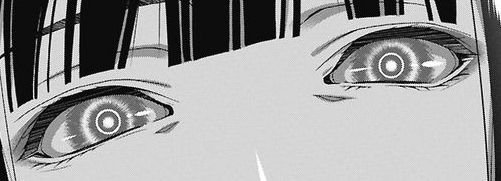
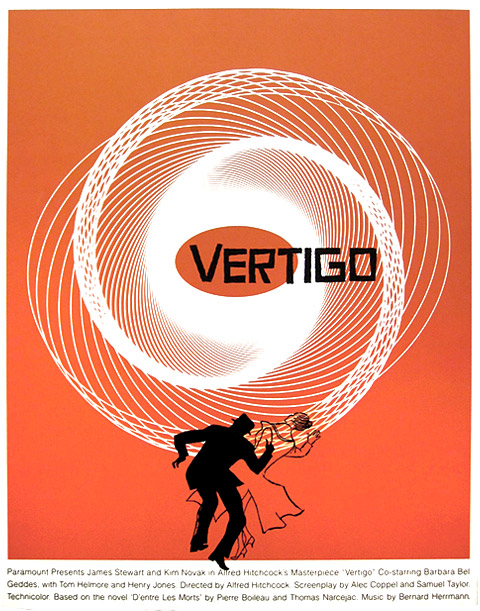
What really puts this chapter over the top is the artwork. Toru Naomura stages the contest like an extreme sporting event, using her entire bag of tricks to convey the contestants’ intense effort — sweatdrops, speedlines, split screens, sound effects — and mimicking the kind of camera work that ESPN trots out for the X Games. The fluid, inventive layouts are also key to making these betting matches come to life, artfully illustrating the rules of play without too much speechifying; even the most inexperienced Go Fish player could follow the game and calculate Jabami’s odds of winning. Naomura’s most effective gambit, however, is the way she draws Jabami’s face. When Jabami is playing her cards close to the vest, her eyes resemble dark, placid pools, but when she’s trouncing the competition, her eyes go supernova, turning into a set of concentric, fiery rings that mimic the line work in Saul Bass’ iconic Vertigo poster:

For all the swagger with which Jabami’s first match is staged, it’s clear that Kawamoto is more interested in the mechanics of gameplay than in the development of three-dimensional characters or the introduction of new plot twists. Each of the subsequent chapters follows the same basic pattern as the first, with Jabami besting her opponent after blowing the whistle on her for cheating. Then there’s the fanservice: Naomura never misses an opportunity to draw an extreme mammary close-up or a glimpse of underwear. And ugly underwear, I might add; Naomura’s artwork is solid, but her application of plaid screentone is so clumsy that it screams MacPaint.

Despite these shortcomings, volume one of Kakegurui is a fun, trashy read that has the good graces not to take itself too seriously. I’m not sure if the premise is strong enough to sustain my interest for more than a few volumes, as the series’ cast of schemers, cheaters, and sadists seem doomed to repeat the same patterns of behavior from chapter to chapter. I put my odds of continuing with Kakegurui at 3 to 1, but other readers may find the psychological combat between Jabami and her opponents enough to persevere through seven or ten installments.

KAKEGURUI: COMPULSIVE GAMBLER, VOL. 1 • STORY BY HOMURA KAWAMOTO, ART BY TORU NAOMURA • TRANSLATED BY MATTHEW ALBERTS • YEN PRESS • 240 pp. • RATING: OT, FOR OLDER TEENS (16+)

Filed Under: Manga, Manga Critic, REVIEWS Tagged With: Homura Kawamoto, Kakegurui, Toru Naomura, yen press

Pick of the Week: Killer Queen

July 24, 2017 by Sean Gaffney, Michelle Smith, Katherine Dacey, Anna N and Ash Brown Leave a Comment

SEAN: No real dilemma for me this time – my pick this week is the 2nd and final Queen Emeraldas omnibus. It’s Wagnery delicious!

MICHELLE: In the Wagnerian spirit, I should warble about my decision for at least ten minutes or so, but… Yep. Same.

KATE: I’m fresh out of Wagner jokes, so I’ll keep it simple: Queen Emeraldas is my pick of the week, too. If you like Star Wars or Blade Runner, you owe it to yourself to check out Leiji Matsumoto’s work; his sci-fi stories are as richly imagined as anything in the George Lucas or Ridley Scott canon.

ANNA: I read the first volume of Queen Emeraldas and it was a bit too bleak for my mood at the time. But even though I didn’t connect with this space opera as much as I expected to, it is undoubtedly the most important manga coming out this week, so it is my pick as well!

ASH: There are actually a few releases that I’m very interested in this week, such as the next volume of Descending Stories, but like everyone else here it’s the finale of Queen Emeraldas that gets my official pick. I simply can’t resist a dramatic, classic space opera!

Filed Under: PICK OF THE WEEK

Ravina the Witch?

July 13, 2017 by Katherine Dacey

Cute characters behaving badly — that’s been Junko Mizuno’s MO since her professional debut twenty years ago. Her latest work, Ravina the Witch?, is more picture book than manga, eschewing panels and word balloons for glossy, full-color illustrations, but the story it tells is pure Mizuno: a young woman meets a witch, inherits her wand, and then wanders the countryside meeting depraved men whose hobbies run the gamut from S&M to binge-drinking.

There’s a little more to the story, of course, since Mizuno loves to embroider a simple narrative with odd details. Ravina, we learn, was raised by crows in a junkyard, impervious to human custom and language. Once exiled from her home — by eminent domain, no less! — Ravina uses her new-found powers to cure disease, embarrass a cruel tyrant, and make mushrooms dance. She also finds time to work as a dominatrix and do crossword puzzles with an enormous owl. Oh, and she’s almost burned at the stake for being a witch.

As the plot suggests, Ravina sits somewhere between fractured fairytale and feminist rumination. Mizuno clearly recognizes the way in which female healers are viewed as both powerful and subversive; why else flirt with the idea that Ravina might be a witch, the quintessential symbol of dangerous femininity? Yet Mizuno’s obsession with food complicates any understanding of Ravina as a feminist text. In almost all of her works, from Pure Trance to Ravina the Witch?, Mizuno’s female characters binge, purge, and pop diet pills with ferocious abandon. Mizuno plays these scenes for uncomfortable laughs, blurring the line between criticism of the characters’ self-destructive behavior and critique of the cultural attitudes that fuel it. Ravina, for example, doesn’t just eat a meal; she gorges herself on animals, pies, and bottles of wine, with Cabernet-stained drool seeping down her chin. It’s not clear if Mizuno is showing us how the other characters see Ravina — as a repulsive, unstoppable force of nature — or if Mizuno is celebrating Ravina’s obvious pleasure in eating, defying social expectations that she be restrained, demure, or self-abnegating — in short, refusing to be lady-like in the presence of food.

The ambiguity of these binge-eating scenes stems, in part, from Mizuno’s trademark Gothic kawaii style, which subverts the true horror of what’s she depicting; even the most ruthless characters have soft, round faces that belie their rotten natures. (Heck, her maggots are cute.) Her illustrations are framed by a pleasing assortment of pastel doodles, with flowers, ravens, curlicues, and smiley-faced cabbages filling the nooks and crannies of every page. Although Mizuno is no stranger to full-color comics — all three of her VIZ titles are printed in color — Ravina is printed on glossy paper stock that enables Mizuno to exploit the natural shine and texture of metallic paints to striking effect, mitigating the flatness of her character designs and backgrounds with tactile accents.

Though Ravina the Witch? feels like a step forward for Mizuno’s artistry, story-wise it reads more like a remix of Cinderalla and Princess Mermaid. There’s nothing wrong with mining the same vein of inspiration to produce new works, but when your storytelling approach is this mannered, there are only so many times you can rehearse the same schtick before it feels tired. I’m not sure where Mizuno goes from here, but a gonzo sci-fi adventure, a crime procedural, or even a high-school comedy might give her fresh opportunities to stretch herself without rehashing the same Grimm plotline.

RAVINA THE WITCH? • BY JUNKO MIZUNO • TITAN COMICS • NO RATING (MATURE THEMES) • 48 pp.

Filed Under: Manga, Manga Critic, REVIEWS Tagged With: Alt-Manga, Fantasy, Junko Mizuno, Titan Comics

Pick of the Week: Write To Me And Escape

July 10, 2017 by Sean Gaffney, Michelle Smith, Katherine Dacey, Anna N and Ash Brown Leave a Comment

SEAN: So the Kodansha digital debuts I mentioned are actually moved to the 18th. This means my pick shall me an “older” digital-only title, The Full-Time Wife Escapist. The escapes are the best part.

MICHELLE: In the Kodansha digital realm, I’m definitely looking forward to the fourth volume of The Full-Time Wife Escapist. My real pick, though, is the second volume of Dreamin’ Sun, as I enjoyed volume one quite a bit.

KATE: Oof — this is some slim pickings. My suggestion: skip the manga aisle this week and watch GLOW instead. It’s a valentine to 80s pop culture that recognizes what a weird and sometimes awful decade it was. Great performances, snappy dialogue, and a big, appealing cast of characters made GLOW five of the best hours of TV I’ve seen this year.

ANNA: I find The Full-Time Wife Escapist such a fun series. I enjoy the unconventional not romance combined with slice of life activities and occasional discussions about the economy. That’s my pick!

ASH: While I’m curious to see where Dreamin’ Sun is heading, my pick this week is the final Legendary Edition of Akira Himekawa’s all-ages The Legend of Zelda manga. Up until this point I had resisted collecting the series, but the new edition’s larger trim sizes, additional content, and great design makes for an immensely appealing package.

Filed Under: PICK OF THE WEEK

Land of the Lustrous, Vol. 1

July 7, 2017 by Katherine Dacey

Land of the Lustrous is a gorgeous trainwreck, the kind of manga that doesn’t make sense on a panel-by-panel basis, but ravishes you with artwork so beautiful and strange it’s hard to look away.

I’ll be honest: I read the first volume three times, and found it almost impenetrable. As best I could tell, Land of the Lustrous depicts an interplanetary war between two races: the Gems, whose androgynous, humanoid appearance belies their true, rock-like nature, and the Lunarians, who frequently raid Earth, hoping to capture Gems for decorative purposes. (What kind of decorations remains a mystery; my vote is for bedazzled jeans and hoodies.) Since there are only 28 Gems, they’ve organized themselves into “fighter-medic” pairs to defend Earth from the Lunarians. One Gem — Phosphophyllite, who registers only 3.5 on the Mohs scale — is too weak to perform either task, so the group’s leader pronounces Phos their official naturalist, and tasks Phos with writing a history of Earth.

You’d be forgiven for thinking that Land of the Lustrous was a satire on the dissertation-writing process, given how much time Phos spends procrastinating and grumbling about the book, but these scenes are interspersed with awkward flirtations, violent combat, and a brief episode in which Phos turns into a cute, sentient space slug. These abrupt shifts in tone frustrate the reader’s ability to get a handle on what, if anything, Land of the Lustrous is trying to say — a problem compounded by the dialogue, which is sometimes so windy that it’s a drag on the story, and sometimes so burdened with exposition that it barely passes for conversation.

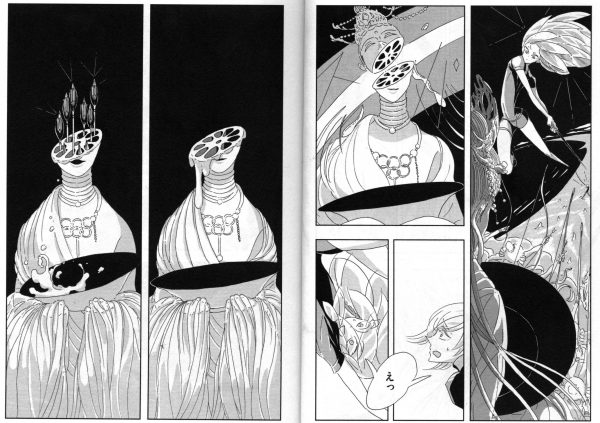
When the characters stop talking and start doing things, however, Land of the Lustrous is a show-stopper, a testament to the richness of Haruko Ichikawa’s imagination. The Lunarians’ first appearance, for example, establishes them as an inscrutable menace. Their soldiers glide silently above the ground, led by an enormous, stone-faced Bodhissattva who’s flanked by undulating lines of archers with bows drawn, their arms and arrows criss-crossing the horizon to form a graceful lattice. (Busby Berkeley would have approved of the Lunarians’ formation.)

What happens next is even more astonishing:

In this sequence, a Gem slices through the general’s head, only to reveal a lotus pod filled with lethal “seeds” — a beautiful but unsettling moment reminiscent of Aubrey Beardsley’s work in its commingling of the sensual and the grotesque; we’re not certain if the Lunarians are animal, vegetable, or mineral. Making this sequence even more disorienting is the dramatic shift in perspective: we see the impending attack from the general’s point of view, then shift to the attackers’ for the moment of contact and its aftermath. The eerie stillness of the final two panels reveals the extent to which the Lunarian general’s transformation has confounded the Gems, who are transfixed by the viscous flow of blood — or is that sap? — from his head.

Looking at these images, I wonder what a more assertive editor might have done to reign in Ichikawa’s worst storytelling tendencies: would the tone and pacing have been more even? The world-building more coherent? The dialogue more revelatory? In the absence of such editorial interventions, however, the most original aspects of Ichikawa’s work sink beneath a torrent of banal conversation and stale comic bits that pass for character development. A few moments of unnerving imagery interrupt the tedium long enough to make an impression on the reader, but are too brief and scattered to yield a truly satisfying experience.

LAND OF THE LUSTROUS, VOL. 1 • BY HARUKO ICHIKAWA • TRANSLATED BY ALETHEA AND ATHENA NIBLEY • KODANSHA COMICS • RATED: TEEN (13+) • 192 pp.

Filed Under: Manga, Manga Critic, REVIEWS Tagged With: Haruko Ichikawa, Kodansha Comics, Sci-Fi

Pick of the Week: KITTY!

July 3, 2017 by Sean Gaffney, Michelle Smith, Katherine Dacey, Ash Brown and Anna N Leave a Comment

MICHELLE: I’m happy about Days and Haikyu!! and Honey So Sweet, but the debut of Plum Crazy! easily snags my pick for this week. It hadn’t even been on my radar before Sean’s column, but now I’m desperate to read it. And the best part is that the series is sixteen volumes long and still ongoing!

SEAN: I am definitely looking forward to cat manga, and there’s a pile of Viz I want to read as well. My pick this week, though, is Appleseed Alpha, a manga interpretation of the recent movie. Deunan and Briareos were some of the first manga characters I really grew attached to, and I want to read this new hardcover omnibus even if Shirow isn’t writing it.

KATE: Call me a crazy cat lady if you must, but my vote also goes to Plum Crazy!. Cats doing cute things = manga gold.

ASH: There’s definitely a variety of things that I’m interested in and will be making a point to read this week, but since a new volume is released so rarely, my official pick will be going to Berserk. I don’t find the most recent story arc as viscerally compelling as some of the earlier ones but, if nothing else, Miura’s artwork can still astonish.

ANNA: Honey So Sweet has been so consistently adorable, that is my pick this week.

Filed Under: PICK OF THE WEEK

The Life-Changing Manga of Tidying Up: A Magical Story

June 28, 2017 by Katherine Dacey

First published in 2011, Marie Kondo’s The Life-Changing Magic of Tidying Up: The Japanese Art of Decluttering and Organizing became an international phenomenon, selling over seven million copies in 40 languages. The book inspired a two-part television drama, a follow-up called Spark Joy: An Illustrated Master Class on the Art of Tidying Up, and a veritable tsunami of related products and experiences including apps, seminars, and journals for documenting “what brings you joy every day.” In an effort to bring her message to even more readers, Kondo recently collaborated with artist Yuko Uramoto (Kanojo no Curve, Hanayome Miman) to create the most quintessentially Japanese tie-in product of all: a manga version of The Life-Changing Magic of Tidying Up.

Uramoto’s strategy for transforming a how-to book into a manga is simple: she turns the decluttering process into a narrative, using a fictional character, Chiaki, to lead us through the process step-by-step. When we first meet Chiaki, she’s a single, 29-year-old career woman living in a filthy apartment strewn with clothing, papers, sports equipment, dirty dishes, and bric-a-brac of every description. After her handsome next-door neighbor chastises her for leaving garbage on the balcony, Chiaki vows to change her life by calling — who else? — Marie Kondo herself.

Over the next nine chapters, Kondo gently but firmly helps Chiaki get control of her apartment. Before they tackle the clutter, however, Kondo asks Chiaki, “What kind of life would you like to live here?” Chiaki is taken aback by the question, but this visualization exercise is a cornerstone of the KonMari system, encouraging the client to think about decluttering not as a one-time effort but a first step towards living a more joyful, less harried life. Kondo then shepherds Chiaki through the discard process, helping Chiaki systematically assess all of her belongings, starting with the three biggest sources of clutter — clothing, books, and paper — before moving on to komono (odds and ends) and sentimental objects. Guiding all of Chiaki’s decision-making are two questions: “Does this item give me joy?” and “Am I using this item right now?”

As an adaptation, The Life-Changing Manga largely succeeds in teaching the KonMari method without recourse to talking-head panels. The graphic format allows Uramoto to show the reader how to store things, arrange a closet, and fold items into small rectangles that can stand upright in a drawer — one of Kondo’s signature organizational techniques. As befits a manga about decluttering, the artwork is both simple and cute. Though the character designs lack strong personality, they’re winsome enough to carry to the story and convey the emotional impact of using the KonMari method; by the story’s end, we appreciate just how elated Chiaki feels after liberating herself from the Tyranny of Stuff.

The manga’s most glaring fault lies not with the adaptation but the source material. Kondo frames de-cluttering as a one-size-fits-all remedy for life’s biggest problems, a point reinforced by the fictional Kondo’s conversations with Chiaki. As we learn in chapter two, Chiaki has a bad habit of falling for guys with hobbies, buying snowboards and tea sets so that she can get to know them better. Every time she breaks up with someone, however, she can’t bear to get rid of her newly acquired gear, developing elaborate rationales for keeping it. Kondo counsels Chiaki to get rid of these items, telling her, “If you hang onto things because you can’t forget an old love, you’ll never find a new love.”

There’s unquestionable value in Kondo’s insight that clutter accumulates when we’re not fully invested in the present, yet her philosophy is too reductive. A messy apartment might be a sign that you need to reconsider your approach to dating, but it could also be symptomatic of working such long hours that cleaning and organizing feel like a second, unpaid job. There’s also a whiff of sexism in the way Chiaki is depicted as a failure for being disorganized, messy, and single; it’s hard to imagine a salaryman character attributing his romantic shortcomings to a sinkful of dirty coffee cups or a jumbled closet, or viewing the KonMari method as the key to living a better, more fulfilling life.

That lingering note of sexism makes it hard for me to unequivocally endorse The Life-Changing Manga of Tidying Up. I think Kondo’s basic advice is sound, but I can’t quite shake the feeling that perfectly folded undies are being held up as a badge of true womanhood, rather than an artful way to organize your drawers.

THE LIFE-CHANGING MANGA OF TIDYING UP: A MAGICAL STORY • BY MARIE KONDO, ILLUSTRATED BY YUKO URAMOTO • TRANSLATED BY CATHY HIRANO • TEN SPEED PRESS • NO RATING • 192 pp.

Filed Under: Manga, Manga Critic, REVIEWS Tagged With: KonMari Method, Marie Kondo, Ten Speed Press, Yuko Uramoto

Pick of the Week: Gems, Witches, Emperors and Vikings

June 26, 2017 by Sean Gaffney, Michelle Smith, Katherine Dacey, Ash Brown and Anna N Leave a Comment

SEAN: I’ll be honest, most of my attention this week is focused on novels, what with Combat Baker and Nisemonogatari. But I picked a novel last week, so this week my pick is Land of the Lustrous, a new Kodansha series with gem wars but sadly not Steven.

MICHELLE: I’m looking forward to the second volumes of series whose debut volumes I liked a lot. Ordinarily, I’d pick Giant Killing, what with it being sports manga and all, but Flying Witch has an amusing kitty, and that gives it the edge this time.

KATE: I share Michelle’s enthusiasm for manga featuring cute animal sidekicks., but my vote goes to the digital-only release The Emperor and I, a comedy about a family living with an Emperor penguin. The story unfolds in short chapters of three to nine pages, so the formula isn’t as rigid as a 4-koma title; it feels a little bit like reading a collection of Sunday comic strips. Not sold? Here’s what I had to say about it back in May.

ASH: For me, my pick could be nothing other than Vinland Saga this week. The series has been consistently compelling from the very beginning. It’s also had great female characters from the start, but the most recent story arc allows the women in the series to shine like they haven’t before.

ANNA: I agree with Ash, I am very happy that new volumes of Vinland Saga are coming out after the series was paused for some time. It is rare for a series to combine great historical background with a truly compelling story and evocative art. Vinland Saga is my pick!

Filed Under: PICK OF THE WEEK

Master Keaton, Vol. 11

June 22, 2017 by Katherine Dacey

If you’re a connoisseur of British crime procedurals, you’ve undoubtedly watched Midsomer Murders, England’s answer to Murder, She Wrote. It isn’t the edgiest or smartest mystery series on television, but it is among the most consistently enjoyable, delivering a satisfying answer to the question, “Whodunnit?” at the end of every episode. Much of the series’ appeal lies with its formula: someone commits a ghastly murder, prompting DCI Barnaby to scrutinize the crime scene, interrogate reluctant witnesses, and suss out hidden clues before assembling the suspects to reveal the killer’s identity and motives. This formula is flexible enough to offer a new murder scenario every week, yet predictable enough to reassure viewers that there’s a payoff for keeping track of the subplots and false leads that frustrate Barnaby’s efforts to solve the mystery.

Master Keaton — a joint effort by Hokusai Katsushika and Naoki Urasawa — offers the same kind of experience in manga form. Every volume features an assortment of mysteries, all solved by the brilliant investigator Taichi Hiraga Keaton. (In an original touch, Keaton works for an insurance agency, though he frequently moonlights as a private eye.) Though the stories’ denouements occasionally veer into Scooby Doo territory — more on that later — Katsushika and Urasawa have a knack for spinning a good yarn, whether the story involves lost Nazi gold or a conscience-stricken assassin.

One key to Katsushika and Urasawa’s success is that they carefully adhere to the same basic rules as Midsomer Murders, setting each mystery in a community where resentments fester, secrets abound, and strong personalities clash. Katsushika and Urasawa put a fresh spin on this storytelling technique by choosing a new locale for each story, rather than limiting the action to a fictional English county, a la Midsomer. In volume eleven, for example, Keaton flits from East Germany to the Scottish highlands to a haunted London mansion. As disparate as these settings may be, each is as much “a cauldron” or “microcosm” as a country village — to borrow a phrase from Midsomer creator Anthony Horowitz — thus creating the right setting “for something unpleasant — a murder, for example — to take place.”

Consider “The Lost Genius Director,” one of the shortest, most tightly plotted stories in volume 11. In just two pages, Katsushika and Urasawa create a virtual “village” populated with vivid characters: a perfectionist director, his devoted wife, a vain leading man, and a nervous producer who’s caught between the director’s vision and the bottom line. All of these characters are living and working in close proximity on the set, clashing over the director’s insistence that the cast re-shoot several key scenes. When the director is found dangling from a noose, Keaton discovers a video of the victim’s final moments, a video that first implicates, then exonerates, the most obvious suspect. This narrative feint makes the actual “reveal” more satisfying, as we come away from the story feeling as if we were just a step or two behind Keaton in solving the crime.

The few stories that falter do so because Katsushika and Urasawa violate this second unspoken rule of whodunnits. In “Love from the Otherworld” and “Lost Beyond the Wall,” the endings feel arbitrary; there simply aren’t enough clues to justify the outcome of the story. The problem is especially acute in “Otherworld,” a supernatural mystery that plays out like a classic Scooby Doo episode: a book publisher hires Keaton to investigate a ghost who’s been roaming the halls of his mansion. Though it doesn’t take a great leap of imagination to realize that one of the household members is, in fact, “the ghost,” the story is so compressed that we don’t learn enough about the characters to independently arrive at the same conclusion as Keaton. More frustrating still, the denouement is handled in such a bald, clumsy fashion that the culprit all but declares, “And I would have gotten away with it, too, if it hadn’t been for you meddling kids and that darn dog!”

It’s easy to overlook the few clunkers, however, as Katsushika and Urasawa clearly have a deep love for the mystery genre. Nowhere is that more evident in “Return of the Super Sleuth?!” and “Pact on Ben-Tan Mountain,” two stories that knowingly borrow elements from Rear Window and Strangers on a Train. Both stories honor the spirit of the source material, preserving the most important details while finding new and surprising ways to resolve these famous plotlines. Equally important, Katsushika and Urasawa don’t take any narrative shortcuts on the way to revealing whodunnit, granting the reader the same delicious sense of closure characteristic of Midsomer Murders — or, I might add, Alfred Hitchcock Presents. Recommended.

A review copy was provided by VIZ Media.

MASTER KEATON, VOL. 11 • STORY BY HOKUSAI KATSUSHIKA AND NAOKI URASAWA, ART BY NAOKI URASAWA • TRANSLATED BY JOHN WERRY • VIZ MEDIA • RATING: TEEN+ (OLDER TEENS) • 318 pp.

Filed Under: Manga, Manga Critic, REVIEWS Tagged With: Hokusai Katsushika, Master Keaton, Mystery/Suspense, Naoki Urasawa, VIZ

Golden Kamuy, Vol. 1

June 15, 2017 by Katherine Dacey

If you have a strong constitution and a healthy appetite for adventure, you’ll cotton to Golden Kamuy, a solid, if sometimes workmanlike, manga that reads like a mash-up of The Revenant and The Treasure of the Sierra Madre. Set on the Hokkaido frontier in 1905, Golden Kamuy tells the story of Saichi “Immortal” Sugimoto, a battle-scarred veteran of the Russo-Japanese War who’s desperately trying to raise money for a fallen comrade’s widow. After a chance encounter with a chatty ex-con, Sugimoto learns about a hidden treasure worth millions. Sugimoto then sets off to find the gold — no mean feat, as the map pinpointing its location has been tattooed onto the backs of a dozen prisoners, each with his own design on the loot.

Sugimoto faces another major obstacle to success: the harsh Hokkaido winter. A second fortuitous meeting — this time with an Ainu teenager — furnishes Sugimoto with a expert guide to wilderness survival. Like Sugimoto, Asirpa is searching for the treasure, albeit for a different reason: the men in her village died to prevent it from falling into Japanese hands. Though Asirpa slots into the common and often stereotyped role of “native sidekick,” she’s not just a repository of useful skills and earthy wisdom; she’s an individual with the courage to challenge Sugimoto when his determination shades into ruthlessness, and the tenacity to fight her way out of difficult situations by improvising traps, creating smokescreens, and throwing punches. Oh, and she brings down a hungry bear with a single well-placed arrow. She’s a baller, and one of the best reasons to read Golden Kamuy.

As skillful as Noda may be in establishing his setting and characters, the script suffers from frequent — if brief — patches of clumsy dialogue and narration. One of the most egregious examples occurs in chapter four, when Sugimoto goes mano-a-mano with another soldier. The artwork makes it plain that Sugimoto’s opponent gets the best of him by grabbing and disabling his rifle, but Noda interrupts the scene to inform us, “The moment they moved away from each other, the man depressed the bolt stop and pulled out the bolt, rendering Sugimoto’s rifle useless.” Such intrusions are all the more puzzling because Noda’s draftsmanship is crisp, stylish, and easy to parse; even when Noda indulges in an extreme close-up or odd camera angle, we’re never in doubt about what’s happening.

Speaking of Noda’s artwork, he draws guts, wounds, and scars with a surgeon’s precision, offering a nightmarish vision of bodies torn apart by bullets — and bears. Though a few sequences skirt the line between dramatic necessity and cinematic flourish, these horrific images play an essential role in conveying the brutality of frontier experience and the horrors of trench warfare. Anything tamer would rob the story of its urgency, and reduce Sugimoto to a simple opportunist, rather than a fierce survivor who’s cheated death dozens of times.

So if you can soldier past the tin-eared dialogue and frequent arterial spray, you’ll be rewarded with a briskly paced thriller that transports you to another time and place, capturing the Hokkaido wilderness in all its squalor, beauty, and promise. Recommended.

A copy of volume one was provided by the publisher. Golden Kamuy will be available on June 20, 2017.

GOLDEN KAMUY, VOL. 1 • ART AND STORY BY SATORU NODA • TRANSLATION BY EIJI YASUDA • VIZ MEDIA • RATING: M FOR MATURE (FOR READERS 18+) • 192 pp.

Filed Under: Manga, Manga Critic, REVIEWS Tagged With: Action/Adventure, Satoru Noda, Seinen, VIZ Signature

Pick of the Week: Manwha-Karuta

June 12, 2017 by Sean Gaffney, Michelle Smith, Katherine Dacey, Ash Brown, Anna N and MJ Leave a Comment

SEAN: There have been a lot of yuri picks of the week this year, mostly as there have been a lot of yuri debuts this year. The latest is After Hours, a Viz title about a young woman who gets dragged to a club and finds her life turned upside-down! It’s my pick this week, despite putting the voice of Mo Tucker in my head.

MICHELLE: o/~ And someday I know someone will look into my eyes and say hellooooo… you’re my very special one…. o/~ I used to always close mix tapes with that one back in the day. Anyway, I am very excited about After Hours, but as usual my heart pines most strongly for sports manga and in this case it’s the third volume of Chihayafuru, due out digitally from Kodansha. I’m happy to see it coming out so soon after volume two and hope that becomes a trend.

KATE: My pick of the week isn’t a manga but a manhwa: Uncomfortably Happily, due out from Drawn & Quarterly on June 13th. It’s a semi-autobiographical story by Yeon-Sik Hong about a pair of artists who trade life in the big city for a rural retreat, only to discover that life in the countryside isn’t as simple as they imagined it would be. After reading Rebecca Silverman’s glowing review, I ordered myself a copy.

ASH: I’m definitely interested in After Hours, but I’m with Kate this week in picking Uncomfortably Happily. I actually ended up with an advanced copy of the work, so I already know it’s great! My own review of the manhwa should be posted in just a few days.

ANNA: How am I behind in my Chihayafuru reading!? Having two volumes to read to get caught up is exciting though. Volume three of Chihayafuru is my pick for the week.

MJ: Did someone say “manhwa from Drawn & Quarterly”? I’m pretty sure that’s my pick, even if I read nothing more about it. Combine that with the recommendations so far, and it sounds like it’ll completely make my week. Uncomfortably Happily is the comic for me this week!

Filed Under: PICK OF THE WEEK

  • « Go to Previous Page
  • Page 1
  • Interim pages omitted …
  • Page 37
  • Page 38
  • Page 39
  • Page 40
  • Page 41
  • Interim pages omitted …
  • Page 89
  • Go to Next Page »
 | Log in
Copyright © 2010 Manga Bookshelf | Powered by WordPress & the Genesis Framework