• Skip to primary navigation
  • Skip to main content
  • Skip to primary sidebar
  • Home
  • About Us
    • Privacy Policy
    • Comment Policy
    • Disclosures & Disclaimers
  • Resources
    • Links, Essays & Articles
    • Fandomology!
    • CLAMP Directory
    • BlogRoll
  • Features & Columns
    • 3 Things Thursday
    • Adventures in the Key of Shoujo
    • Bit & Blips (game reviews)
    • BL BOOKRACK
    • Bookshelf Briefs
    • Bringing the Drama
    • Comic Conversion
    • Fanservice Friday
    • Going Digital
    • It Came From the Sinosphere
    • License This!
    • Magazine no Mori
    • My Week in Manga
    • OFF THE SHELF
    • Not By Manga Alone
    • PICK OF THE WEEK
    • Subtitles & Sensibility
    • Weekly Shonen Jump Recaps
  • Manga Moveable Feast
    • MMF Full Archive
    • Yun Kouga
    • CLAMP
    • Shojo Beat
    • Osamu Tezuka
    • Sailor Moon
    • Fruits Basket
    • Takehiko Inoue
    • Wild Adapter
    • One Piece
    • After School Nightmare
    • Karakuri Odette
    • Paradise Kiss
    • The Color Trilogy
    • To Terra…
    • Sexy Voice & Robo
  • Browse by Author
    • Sean Gaffney
    • Anna Neatrour
    • Michelle Smith
    • Katherine Dacey
    • MJ
    • Brigid Alverson
    • Travis Anderson
    • Phillip Anthony
    • Derek Bown
    • Jaci Dahlvang
    • Angela Eastman
    • Erica Friedman
    • Sara K.
    • Megan Purdy
    • Emily Snodgrass
    • Nancy Thistlethwaite
    • Eva Volin
    • David Welsh
  • MB Blogs
    • A Case Suitable For Treatment
    • Experiments in Manga
    • MangaBlog
    • The Manga Critic
    • Manga Report
    • Soliloquy in Blue
    • Manga Curmudgeon (archive)

Manga Bookshelf

Discussion, Resources, Roundtables, & Reviews

Archives for January 2017

Vinland Saga, Vol. 8

January 21, 2017 by Ash Brown

Vinland Saga, Omnibus 8Creator: Makoto Yukimura
Translator: Stephen Paul
U.S. publisher: Kodansha
ISBN: 9781682335406
Released: December 2016
Original release: 2014-2015
Awards: Japan Media Arts Award, Kodansha Manga Award

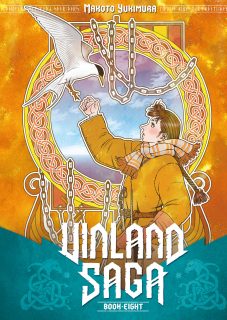
For a time it seemed as though the fate of the English-language edition of Makoto Yukimura’s epic award-winning manga series Vinland Saga was in question. Happily though, Kodansha Comics has been able to continue releasing the series. While the seventh omnibus reached a satisfying conclusion to one of the series’ major story arcs, it was still obvious that Yukimura had more to tell. I honestly believe that Vinland Saga is one of the strongest manga currently being released in English. It is also a personal favorite of mine, so I was thrilled when the eighth hardcover omnibus was finally released in 2016, collecting the fifteenth and sixteenth volumes of the original Japanese edition published between 2014 and 2015. Unlike the past few omnibuses of Vinland Saga, there is no additional content directly relating to the series (I was sad not to see the continuation of the “Ask Yukimura” section), but it does include an extensive preview of Kazuhiro Fujita’s The Ghost and the Lady, another historically-inspired manga available from Kodansha.

Finally free from his life of slavery but still bound by the violence of his past, Thorfinn travels back to Iceland in order to briefly reunite with his family before setting into motion his plans for the future. Accompanied by Einar, Leif, and “Bug-Eyes,” Thorfinn intends to colonize Vinland in an attempt to create a peaceful settlement far removed from the wars and violence seemingly inherent to the Norse way of life. But before that they must first secure the resources and supplies needed for the venture and support from others will be hard to come by–Thorfinn has very little to offer a potential investor except for ideals and his own life. Initially it seemed that they could secure the aid of Halfdan, a wealthy landowner who was already planning to become a relative of Leif’s by marrying his son to the widow of Lief’s brother, but then the wedding doesn’t go quite as planned. Thorfinn and the others may very well have gained themselves a few new enemies when they flee Iceland with Gudrid, the runaway bride.
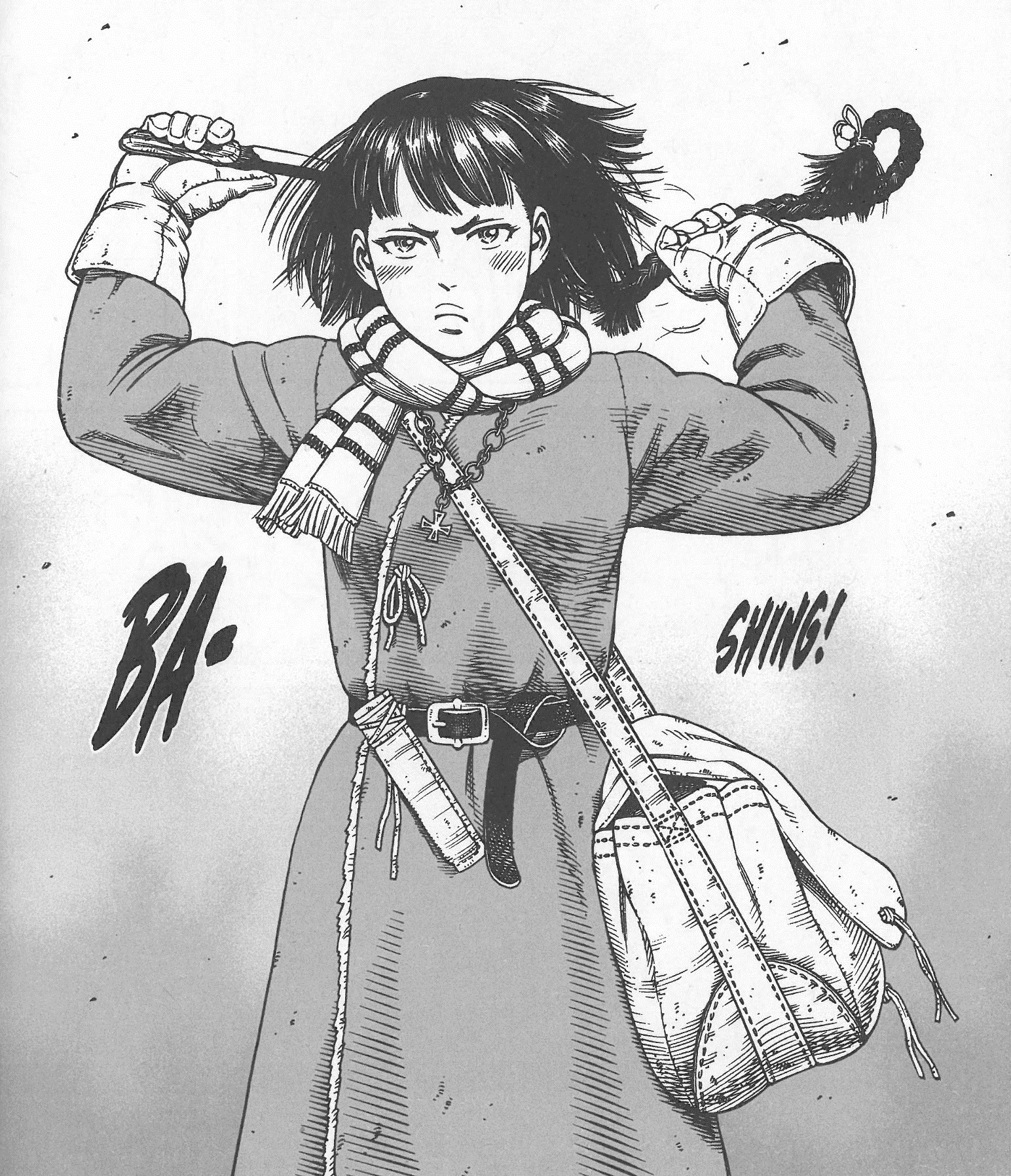
Vinland Saga, Omnibus 8, page 50From the beginning, many of the women in Vinland Saga have been strong, memorable characters (Thorfinn’s sister and mother in particular are marvelous), but for the most part the focus of the series has been on the stories of the men. However, with the eighth omnibus there is a notable change in the manga with he introduction of Gudrid who becomes one of the main characters of Vinland Saga. In fact, a great deal of the plot currently directly revolves around her. I absolutely adore Gudrid. Like Thorfinn, she is struggling against the constraints of what is considered acceptable by the culture and traditions of their society. She has absolutely no interest in marriage or in behaving like a “proper” woman; her heart has always been set on exploring the world around her and expanding her horizons. Gudrid repeatedly proves that her worth is equal to or even greater than that of a man. Eventually, her persistence and brashness pays off although the circumstances surrounding her becoming a sailor are admittedly less than ideal.

Gudrid isn’t the only great female character to be introduced in the eighth Vinland Saga omnibus. Among others, there is also Astrid, Halfdan’s wife, and Hild, a young woman who proves once more that Thorfinn can never truly escape his past misdeeds. While many of the previous omnibuses have been battle-oriented, the eight omnibus tends to pay more attention to the characters themselves and their relationships. However, there are still a few excellent action sequences and Yukimura’s artwork continues to be dynamic and dramatic even when physical violence is not as prominent. For example, Halfdan exudes an aura of intensity and power–the way he is drawn and visually framed is frequently reminiscent of the way King Canute was portrayed, emphasizing his status and influence. This, of course, makes it even more satisfying when Astrid calmly, quietly, and fearlessly puts her husband in his place. (I really hope to see more of Astrid in the future.) Vinland Saga remains an incredibly well-done manga. With a growing cast of fantastic, complex characters, an engrossing story exploring themes of freedom and violence, and excellent artwork, I can’t wait to read more.

Filed Under: REVIEWS Tagged With: Japan Media Arts Award, kodansha, Kodansha Comics, Kodansha Manga Award, Makoto Yukimura, manga, Vinland Saga

Manga the Week of 1/25/17

January 19, 2017 by Sean Gaffney, Ash Brown, Anna N, Katherine Dacey, MJ and Michelle Smith Leave a Comment

SEAN: For a Yen week, this is actually pretty reasonable. Mostly as Yen moved a bunch of titles to the week after next, but hey.

Kodansha first, though. They’ve recently announced several new titles as digital releases. Deathtopia debuts next week, from the creator of Cage of Eden. This is a seinen title from Evening Magazine, and we’ll see if it’s as fanservice-laden as its shonen predecessor. It’s a thriller.

Wave, Listen to Me! gets the award for best title of the week. It’s an Afternoon manga from the creator of Blade of the Immortal. Fans of that series will be happy to hear this new one takes place… at a radio station?

ASH: I just found out about this series and I am incredibly curious about it.

MICHELLE: Oooooh! I especially like that the Kodansha site mentions “the beginning of an aggressive ramp-up in new digital manga series!”

KATE: Count me in for Wave, Listen to Me!, too. I’m a little biased — I teach a class on radio and television history — but I’m delighted to see a few grown-up options in the mix.

MJ: Oh, interesting.

ANNA: I am officially intrigued.

SEAN: And this isn’t out in volume form yet, but a new series from the creator of A Silent Voice debuts next week with 10 individual chapters, which catches us up with Weekly Shonen Magazine. Called To Your Eternity (Fumetsu no Anata e), it’s more supernaturally tinged than A Silent Voice but apparently just as depressing.

Kodansha also has an 8th print volume of Forget Me Not.

Seven Seas surprisingly only has one title out this week, given how much they’ve been piling on the books lately. It’s the 5th volume of Nurse Hitomi’s Monster Infirmary.

Vertical Inc. has the first volume of Nisioisin’s popular Zaregoto series, Decapitation: Kubikiri Cycle, though they emphasize they’ve only licensed this one volume, to tie in with the current Japanese OAV adaptation. It was actually released by Del Rey years ago; this is a re-edited version, and hopefully now that Bakemonogatari is popular it should see more readers.

Vertical Comics also gives us a third Immortal Hounds.

And the rest is Yen Press. First off, a 9th volume of capital letter and punctuation loving Akame Ga KILL!.

The 8th manga volume of A Certain Magical Index wraps up the adaptation of the 6th novel.

Death March to the Parallel World Rhapsody is the runner-up for best title of the week. As for the content, it’s a story where a guy finds himself transported to another world, gaining impressive powers, and surrounded by beautiful… wait, why are you running away? “Transported to another world” is this year’s vampires! This is the manga, the novel is out one week later.

First Love Monster has a 6th volume.

Fruits’ Basket Collector’s Edition reached Vol. 9, and get ready, because this is the one with THAT spoiler which shattered Furuba fandom forever.

MICHELLE: I continue to boggle that we’re up to this point already. But I also love that we’re still maintaining the secrecy of that spoiler.

SEAN: Horimiya has a 6th volume, and we’ll see if things advance on the romance front.

ASH: I’ve been enjoying Horimiya a great deal.

MICHELLE: Woot!

SEAN: I’ve enjoyed the light novel The Isolator, dark as it’s been, and so am pleased to see the manga adaptation is now coming out over here.

And there’s a 3rd volume of fantasy Liselotte & Witch’s Forest.

MICHELLE: I’ll be picking up this one, too.

SEAN: Murciélago also debuts this month from Yen Press. It’s a Young Gangan title that is apparently SUPER violent, and has humor so black it causes you to redefine “funny”. And it also has a lesbian lead, though this isn’t your cute high school girls sort of lesbian. I’ve heard good things about it (it has the Erica Friedman seal of approval), but with lots of “it’s pretty sick” warnings.

ASH: I’ve heard good things, too, but it definitely won’t be a series for everybody.

MJ: I would describe myself as interested, but skeptical.

SEAN: Rokka: Brave of the Six Flowers also has its manga adaptation debut (the novel arrives in April). It’s a fantasy series with strong word of mouth – real fantasy, rather than light novel fantasy. This adaptation ran in Shueisha’s now defunct Super Dash & Go!.

ANNA: Huh, I am always up for more fantasy manga.

SEAN: I was pleasantly surprised at how good I found the first volume of Scum’s Wish, though ‘pleasant’ is perhaps the wrong word for what’s going on with these kids. I look forward to the second volume.

MICHELLE: Same. Dark and complex, but not ecchi like the cover of volume one might suggest.

SEAN: Taboo Tattoo has a 5th volume, and is very Monthly Comic Alive.

Today’s Cerberus sees a 2nd print volume, and is still cute and silly.

You can’t have a long list of manga without at least one survival game title, and there is is: the 2nd volume of Tohyo Game.

Lastly, we wrap up the 6th Umineko arc with the 3rd and final omnibus of Dawn of the Golden Witch. I’m not sure when the 7th arc will begin – Yen hasn’t scheduled it – but this volume at least resolves Erika Furudo’s role in the series… at least for the time being.

A lot of new stuff this week. What appeals to you most?

Filed Under: FEATURES, manga the week of

BL Bookrack: Ten Count, Vols. 1-2

January 19, 2017 by MJ and Michelle Smith 5 Comments

MJ: Wow, it’s been… a long time hasn’t it, my friend?

MICHELLE: I am scared to even verify how long it has been. A couple of years, at least!

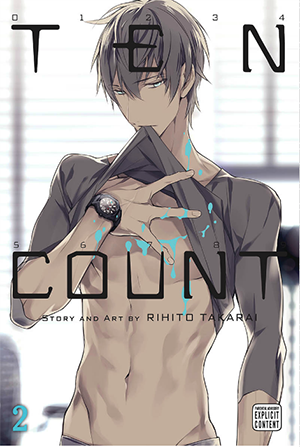
MJ: So what’s brought us here today is the boys’ love series Ten Count (volumes one and two ) by Rihito Takarai, published here by SuBLime. From what I understand, the series has reached five volumes (ongoing) in Japan. The third volume is due out from SuBLime next month.

MICHELLE: Would you like to start?

MJ: Sure!

Shirotani is a lifelong germaphobe, resigned to his condition, though it keeps him isolated from others. Fortunately, with the help of his understanding employer, he is able to tolerate his job as secretary to a corporate CEO. It is in the corporate line of duty, then, that he first meets Kurose, a therapist at a local mental health clinic. Kurose notices Shirotani’s condition immediately, and suggests he seek help, but though Shirotani is able to make his way to the clinic, he can’t bring himself to go inside. Acknowledging this difficulty, Kurose offers to help him in a non-clinical capacity, as a friend, an arrangement to which Shirotani eventually agrees. As Kurose slowly helps him accomplish progressively difficult tasks (touching a doorknob with his bare hand, buying a book from a bookstore), the two become close in ways that complicates their relationship and threatens the fragile boundaries between them.
Fans of BL manga don’t need me to explain what that means, or probably why my greatest fear with this series would be that the therapist/patient dynamic (even in the context of them being “friends”) would create a problematic imbalance of power. And it does, though not right away. Had I read only the first volume, this paragraph would be a very different one, gratefully dismissing my fears and filled with satisfied discussion of their slowly-evolving relationship and lots of talk about how that kind of careful development is so rare and wonderful in this genre. Had I read only the first volume, I would have declared a lot of love for this series. Unfortunately, Kurose’s careful handling of Shirotani is abandoned less than two chapters into the second volume, when after declaring his love for Shirotani, he mercilessly forces him into accepting sexual contact (against Shirotani’s clear protestations), which only escalates as the volume continues. In fact, Shirotani’s germaphobia makes the situation even more brutal, as Kurose is not only performing non-consensual sexual acts with Shirotani, but also blatantly ignoring Shirotani’s boundaries regarding skin-to-skin contact without any of the thoughtful consideration he promised as part of their initial arrangement. It’s obvious that the author intended the germaphobia as a metaphorical stand-in for the typical uke resistance so popular in BL, but instead it just feels like piling on.

MICHELLE: What I found most interesting to contemplate is that Kurose does, in fact, give Shirotani opportunity to object. He warns him that he’s going to attempt these kinds of things if they continue to see each other, and asks questions like, “Did you really not like what we did a moment ago?” Sometimes, Shirotani is able to give voice to his objections, but he also holds back his disgust, and I have to think that’s because he doesn’t want to drive Kurose, the only person to whom he has any kind of close relationship, away. How much, then, does Shirotani actually reciprocate and how much is he just desperate to keep Kurose in his life?

If I had faith that Takarai was wanting us to consider this question in a thoughtful way, I’d be fairly happy. But there are a few comments, mostly in bonus stories or author asides, that make me think she is setting up a dominant/submissive paradigm in which Kurose simply enjoys seeing Shirotani squirm, and that is very troubling indeed.

MJ: Yeah, you’re right—he often does ask Shirotani for permission to do something, or for confirmation that he’s enjoying himself, but those check-ins feel pretty empty, considering the fact that he generally moves on with what he’s doing without anything resembling actual enthusiastic consent. And if she’s trying to set up a dominant/submissive relationship, she’s doing it 50 Shades style, which only furthers my discomfort. Kurose’s behavior becomes increasingly controlling over the course of the second volume, by the end of which he has not only violated most of Shirotani’s personal and sexual boundaries, but also has begun infantilizing him to a truly creepy degree. Between declaring a preference for a “childlike” hairstyle and outright asking Shirotani to agree to be “dependent” on him, Kurose has basically given up any pretense of respect or even basic acknowledgement of Shirotani’s agency as an (older!!) adult man. It is a testament to the strength of the series’ first volume that I’m even still reading this thing. But I would be lying if I said that it hadn’t broken my heart.

I understand that rape fantasy is a thing, and that it’s in poor taste to judge other people (especially femme-identified people, who are this genre’s target audience) for such fantasies. And on some level, I even understand a bit why someone’s fantasy might include giving up control, though I’d probably understand that better if we lived in a world where acknowledgement of a woman’s control over her own body was not considered a radical political act. I also understand that it’s, at the very least, pointless to wish for a story to be a different one than what its author wants to tell. I know that I should simply accept that something is not for me and move on. But after a full volume of something that *seems* to be for me, that truth can be difficult to swallow.

MICHELLE: Another thing that strikes me about the questions Kurose poses is how detached and clinical they can seem, even after a sexual act. One example is, “Were you more concerned with the possibility that I found you unpleasant than whether or not you found the situation itself unpleasant?” Leaving aside the tacit admission that he knows Shirotani could’ve been finding the situation unpleasant, attempting to reassert the therapist/patient dynamic at such a moment is, well, kind of creepy.

I’m not ready to give up on the series yet. Like I said, I want to believe Takarai is trying to make a more subtle point here, but I just don’t know. If volume three is more of the same, it might be too much for me, too.

MJ: Upsides of this series that extend beyond its fairly awesome first volume include Shirotani’s sweet, understanding boss, whose constant mindfulness regarding Shirotani’s discomfort and physical boundaries paint a picture of a pretty awesome guy. Similarly, Shirotani’s acquaintance from his company’s sales department, Mikami, proves himself over and over to be a good friend and a stand-up guy. It’s a shame that these characters, who operate without personal motive and truly seem to have Shirotani’s best interests at heart aren’t the people he trusts most. I can’t help but think that if either of them knew what was going on, they’d be the first to jump to Shirotani’s defense and help him get the hell out of the abusive relationship he’s been lured into by Kurose.

MICHELLE: I liked them, too! I really wanted to believe that Shirotani was indeed able to make progress in his therapy with Mikami, as he initially claimed to do, though we later learn he was lying in hopes that he could resume seeing Kurose. Perhaps it was some kind of self-fulfilling prophecy, in a way. Like, he tried with Mikami, and had no success, and now he believes that Kurose is the key to moving forward, thus increasing his dependence. He is able to achieve some things for these people in his life, though, like when his desire to find a book to entertain his hospitalized boss results in a successful purchase at a bookstore.

Regarding Kurose and his motivations, do you think there’s still some reveal to come? When he has Shirotani write out the list of ten activities he feels aversion for, with ten being something he thinks he could never do, Shirotani leaves that one blank. Kurose refuses to divulge his reasons for helping Shirotani on his own time until Shirotani fills in that tenth item. Do we already know that it’s because he was falling in love? Or is it something like, “I’m secretly a major sadist”?

MJ: That’s a really good question! I feel like I have no idea. I mean, on one hand, things have gone so far at this point I’m sort of just expecting the usual “tortured uke” trope to continue from this point, with more and more uncomfortable sex scenes and less and less real storytelling. So I’m not as optimistic as I’d like. On one hand, the series obviously continues beyond this, but I wonder if it will continue to really explore and examine this relationship or whether it will just turn to side characters like so many deceivingly-long BL series do.

Your whole first paragraph, though, just reminds me how much I loved the first volume! Gah! I want to be optimistic!

MICHELLE: So do I, and part of me thinks there’s still room for something great to evolve from this. I’m thinking of Tomoko Yamashita’s marvelous The Night Beyond the Tricornered Window, actually, in which no sexual contact has occurred, but in which one lead (Hiyakawa) casually appropriates the body of the other (Mikado) in a way that alarms others but which the affected party chooses not to think too deeply about because with Hiyakawa around, he no longer feels alone or potentially crazy for his ability to see spirits. There are some definite parallels to Ten Count there, but Yamashita is more clearly going into a psychological direction with her story, whereas Takarai seems to be taking a more traditional, explicit route.

I will still read volume three, though. How about you?

MJ: I will probably give this series one more volume, yes, even though I don’t feel as optimistic as I wish I did. Also, I’ll second your shout-out to The Night Beyond the Tricornered Window, which manages to talk about consent more thoughtfully, despite its supernatural premise. In that series, there is at least another character screaming out, “THIS IS NOT OKAY” all the time, so that we’re aware that the author knows there is a problem. It makes all the difference in the world.

MICHELLE: Indeed it does.

MJ: Bottom line, though this series starts off as a thoughtful look at the slow development of a tricky but potentially important relationship between a lonely professional who becomes friendly with a younger mental health specialist, its second volume takes a dark turn, devolving into a tale of emotional abuse, sexual assault, and deeply broken trust. We’ll probably keep reading it, but buyer beware.

Filed Under: BL BOOKRACK, FEATURES & REVIEWS, MANGA REVIEWS, REVIEWS Tagged With: BL, boys' love, Rihito Takarai, SuBLime, Ten Count, Yaoi

Ranma 1/2, Vols. 35-36

January 19, 2017 by Sean Gaffney

By Rumiko Takahashi. Released in Japan by Shogakukan, serialized in the magazine Shonen Sunday. Released in North America by Viz. Translated by Kaori Inoue, Adapted by Gerard Jones.

I was quite excited by this omnibus of Ranma 1/2 when I got it. Not only does it feature not one but TWO appearances by Akari, my favorite minor character, but is also resolves a plot point. That may not seem like much to those of you who are used to plot and characterization in your manga, but this is Ranma 1/2, the title where everything is done for the humor, and everything will always snap back with few if any lessons learned. Taking this manga and these characters seriously is, as we’ve learned, a mug’s game. But yes, we actually get forward progression here (you can see that she had decided to end Ranma soon). No, Ranma and Akane don’t confess. No, no curses are broken. But Ranma’s mother now knows the truth about her son. And he doesn’t have to kill himself.

The whole sequence leading up to Nodoka discovering the truth is without a doubt the highlight of the book. It also, out of necessity, shows Genma at his absolute worst, a desperate, petty ass who would happily destroy his marriage in exchange for a good meal. As for Ranma, he’s trying really hard to shrug off what his father has taught him to believe, and finally decides to give in and face whatever consequences come from his mother discovering he can turn into a girl. (In fact, his happy expression when he resolves to do this may be one of the best panels in Ranma, period.) There’s also a lot of action, as Ranma and Genma constantly fight back and forth to attempt to stop the other, and it all ends in a fall off a giant cliff into the sea. (I also liked Soun, Kasumi and Nabiki’s understated presence throughout – they’re on Ranma’s side, even if awkwardly.) It’s a really good arc.

The rest of the book is not quite as good. Leaving aside yet another arc devoted to Ranma and Akane mistaking “I am embarrassed by my feelings” for “I hate you”, we have the introduction of Konatsu, a ninja with a poor family situation who somehow ends up at Ucchan’s. Given that fandom has paired Akari and Konatsu together by the function they fill (late-period characters introduced to ‘resolve’ parts of the love septangle), you’d think I’d be more accepting of him, but I’m not really. First of all, unlike Ryouga and Akari, any love seen here is clearly one-sided – Ukyou is literally paying Kanatsu the equivalent of 5 cents to work for her, and barely seems to acknowledge him as a human being. More to the point, though, Konatsu is just a rehash of Tsubasa Kurenai from earlier volumes, and reminds the reader that Rumiko Takahashi is simply not very good at writing trans characters, even giving her a pass of “this is the 1990s”.

And so, despite one piece of forward progression, this volume ends as it begins. In fact, thanks to the destruction of the Saotome home, we now have Nodoka living at the Tendos in addition to Ranma and Genma. Is there anything that can possibly resolve this manga and give it a happy ending>? Well. yes there is, though it depends on how broadly you define “resolve” and “ending”. Stay tuned next time for the final gripping installment of Ranma 1/2!

Filed Under: ranma 1/2, REVIEWS

The Girl From the Other Side: Siúil, a Rún, Vol. 1

January 17, 2017 by Katherine Dacey

On the surface, The Girl From the Other Side: Siúil, a Rún looks like a fairy tale. It unfolds in a long-ago, far-away place governed by one simple rule: humans and Outsiders must never cross paths. The principal characters are Shiva, a young girl, and Teacher, an Outsider who adopted Shiva after finding her alone in the woods. At first glimpse, their situation seems idyllic, two opposites living harmoniously in a charming little cottage — that is, until the human and demon worlds take interest in Shiva, testing Teacher’s commitment to protecting her.

Probe a little deeper, however, and it becomes clear that the manga’s nuanced characterizations elevate Shiva and Teacher from fairy tale archetypes to fully realized characters. Shiva, for example, talks and acts like a real six-year-old, toggling between moments of impetuousness and thoughtfulness. Though she is obviously fond of Teacher, she fantasizes about a reunion with her aunt, fervent in her desire to rejoin the human world. Shiva has an inkling that Teacher might be “sad” if she left, but she cannot fully appreciate his anguish over their possible separation. (Translator Adrienne Beck and adaptor Ysabet Reinhardt MacFarlane deserve special mention for voicing Shiva’s dialogue with naturalism; Shiva never sounds older or wiser than her years.)

The sophisticated artwork, too, plays an important role in transporting the reader to a specific place and time, rather than simply “long ago.” Nagabe’s elegant pen and ink drawings demonstrate a superb command of light; using washes and cross-hatching, she evokes a world lit by fire, where the glow of a candle casts a small spell against the darkness, and monsters lurk in the shadows. Her figure drawings are likewise strong, neatly conveying the characters’ personalities in a few well-chosen details. Teacher, for example, is a clever amalgamation of animal and demon parts. His most menacing features — his mouthless face and piercing eyes — are tempered by the way he carries himself; he’s fastidious in his movements and dress, gliding through the woods with the graceful, upright posture of a dancer.

Lest The Girl From the Other Side sound mawkish or precious, the brisk pacing and crisp dialogue prevent the story from sagging under the poignancy of the characters’ dilemma. It’s perhaps a little early to nominate it for a “Best of 2017” award, but this promising first volume demonstrates a level of craft, imagination, and restraint that’s sorely lacking in many fantasy manga. Highly recommended.

THE GIRL FROM THE OTHER SIDE: SIUIL, A RUN, VOL. 1 • BY NAGABE • SEVEN SEAS • RATING: ALL AGES

Filed Under: Manga, Manga Critic, REVIEWS Tagged With: Fantasy, Girl from the Other Side, Nagabe, Seven Seas

Nisekoi, Vol. 19

January 17, 2017 by Sean Gaffney

By Naoshi Komi. Released in Japan by Shueisha, serialized in the magazine Weekly Shonen Jump. Released in North America by Viz Media. Translated by Camellia Nieh

I was recently called out for spoiling a plot point in a recent review, and had to go back and put in a disclaimer. Regular readers of my reviews will note that I spoil everything shamelessly, often without thinking. It’s rare when I actually try to keep something a secret for the sake of those who haven’t read it yet (which one could argue defeats the point of reviews, but hey). But it got me to thinking about this most recent volume of Nisekoi, which I haven’t actually done a full review of since it began. It’s now over in Japan, and indeed has also ended in North America, being one of the series that ran in Viz’s Weekly Jump magazine. Any big fan of the series knows how it ended. But of course the volumes are about a year behind the chapters, as with most Jump titles. So, when I talk about this new volume, and note how well the author succeeds at keeping the harem balanced so that the reader isn’t quite sure who Raku will end up with… who am I supposed to be fooling?

I will try, however, for the sake of the one or two casual readers of Nisekoi who read my reviews and also don’t wish to be spoiled (there must be one or two, right?) not to give away the ending. I will note that fans of romantic fluff will love this volume, be they Chitoge fans, Kosaki fans, or Marika fans. (Tsumugi does not get much of a look-in, but she’s had big moments before and will again). We open with the resolution of the “Chitoge is moving away’ arc, in which Chitoge’s father, who’s always been pretty cook, gives in at last to his daughter’s demands. Raku defensing her is awesome, even if it is (of course) undercut by his realization of who she is to him… his BEST friend! Yes, Raku is still dense, as otherwise the title would be over. Most of the volume then covers Kosaki and Raku on a date… sort of. Tricked into it by Haru, but not really against the idea, this shows off the shy, blushing, embarrassing aspect of romance, which many Western harem readers prefer to Chitoge or Marika’s more forward brusqueness.

Lastly, speaking of Marika and brusqueness, Raku is literally kidnapped by her and brought to a South Seas island (which he takes far better than you’d expect, as Marika herself notes… Raku is a nice guy almost to a fault). At first this just seems like the usual Marika that we’ve seen before, going too far as always. But Marika’s health has always been in the background of her character as well, and it may finally be failing her. There have been ominous hints that she is, if not dying, at least far more ill than she lets on. In which case, vanishing to a South Sea island, and then getting shipwrecked on a different, more deserted one, may not be the wisest choice. But then, of all the heroines, Marika’s love has always been the most desperate.

So there’s something for everyone here. Fans who know how Japanese harem mangas tend to resolve may have a sneaking suspicion who will eventually win, but Nisekoi does a much better job than most in making the journey fun and heartwarming, mostly as Raku is the type where you understand why they love him. This is still quite highly recommended.

Filed Under: REVIEWS

Pick of the Week: Outside the Box

January 16, 2017 by Sean Gaffney, Ash Brown, Anna N, Katherine Dacey, MJ and Michelle Smith Leave a Comment

ASH: It’s a relatively small week for new manga releases but, unsurprisingly, there are still a few things that I’m interested in. Apparently I’m in the mood for quirky horror since both Franken Fran and Dorohedoro are high on that list. My official pick goes to Dorohedoro though as I can’t seem to resist it’s bizarrely charming characters and humor.

KATE: I didn’t find much in this week’s new manga arrivals, so I’m going off-list for my recommendation: Snow Blind, a TPB that collects all four issues of a limited-run series by Ollie Masters and Tyler Jenkins. The artwork is moody and gorgeous — who knew Alaska was such a good setting for noir? — and the plotting is skillful. Heck, even Warren Ellis seems to like it, so there’s that, too.

SEAN: Like Ash, it’s pretty much a choice between Franken Fran and Dorohedoro this week, and, like Ash, I will be picking the latter. Still one of the more surprising Viz licenses, especially without an anime, I am so pleased that this has gotten to Volume 20. Even if I will no doubt find it confusing again.

MICHELLE: I’m sure I would enjoy Dorohedoro if I actually got around to reading it, but since I haven’t, I’d feel weird recommending it. So, instead, I will recommend two series that I actually have finally gotten around to reading, after seeing both recommended multiple times on Manga Bookshelf: One-Punch Man and A Silent Voice. I am enjoying both quite a lot and can now add my voice to the chorus of praise.

ANNA: There isn’t really anything that appeals to me this week, but I’ve recently been trying to get caught up on The Demon Prince of Momochi House, which incorporates lovely art into a story exploring the relationship between human guardians living in a nexus between the human and spiritual world. That’s my pick!

MJ: I’m not particularly excited about anything on this week’s list, but I have a considerable backlog to get through, so that’s not necessarily a bad thing. First on my docket, I think, is the SuBLime series, Ten Count by Rihito Takarai. I have the first two volumes sitting here, with volume three on its way next month. I’m a little nervous about what looks to be a problematic relationship (therapist and patient), but considering how common that is in BL, I can at least take heart that the characters are adults, and that there isn’t a terrified uke on the cover. So I’m feeling optimistic.

Filed Under: PICK OF THE WEEK

My Week in Manga: January 9-January 15, 2017

January 16, 2017 by Ash Brown

My News and Reviews

Last week at Experiments in Manga I posted the Bookshelf Overload for December. It includes a pretty big list of things, in part due to massive holiday sales, so hopefully future months won’t be quite as ridiculous. Another thing that happened last week that was kind of cool was related to a post that I wrote back in 2014. My Spotlight on Masaichi Mukaide is probably one of the most noteworthy things that I’ve ever written and it actually got quite a bit of attention when I posted it. Well, Masaichi Mukaide himself apparently came across it recently and even left a comment.

Probably the biggest manga news from last week was the slew of licenses and other announcements made by Seven Seas. Here’s the list of manga:

Absolute Duo by Takumi Hiiragiboshi and Shinichirou Nariie
Alice & Zouroku by Tetsuya Imai
Captain Harlock: Dimensional Voyage by Leiji Matsumoto and Kouichi Shimahoshi
The Count of Monte Cristo by Moriyama Ena
Cutie Honey a Go Go! by Hideaki Anno and Shinpei Itou
Devilman G by Go Nagai and Rui Takatou
Dragon Half by Ryusuke Mita
Hatsune Miku: Bad End Night by Hitoshizuku-P x Yama and Tsubata Nozaki
Hatsune Miku Presents: Hachune Miku’s Everyday Vocaloid Paradise by Ontama
Magical Girl Special Ops Asuka by Makoto Fukami and Seigo Tokiya
Sleeping Beauty by Yumi Unita
Spirit Circle by Satoshi Mizukami
The Testament of Sister New Devil Storm by Tetsuto Uesu and Fumihiro Kiso
Unmagical Girl by Ryuichi Yokoyama and Manmaru Kamitsuki
Wadanohara and the Great Blue Sea by Mogeko

Seven Seas is getting back into translating novels and has a deluxe edition of Ryo Mizuno’s Record of the Lodoss War: The Grey Witch with illustrations by illustrations by Yutaka Izubuchi in the works, too. Also announced was a full-color edition of Madeleine Rosca’s Hollow Fields and five more illustrated literary classics. (I found Seven Seas release of Lewis Carroll’s Alice’s Adventures in Wonderland and Through the Looking-Glass to be quite enjoyable.)

It’s a pretty interesting group of announcements with a fairly wide range of titles to choose from. There’s even a manga from the late ’80s (Dragon Half), and not many of those are licensed any more. I’m particularly curious about Moriyama Ena’s adaptation of The Count of Monte Cristo (the cover art is gorgeous), the josei manga Sleeping Beauty by Yumi Unita (whose Bunny Drop left me with extremely conflicted feelings), as well as the number of titles which are part of classic franchises.

Quick Takes

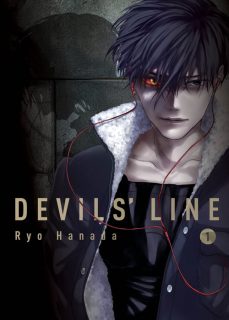
Devils' Line, Volume 1Devils’ Line, Volumes 1-2 by Ryo Hanada. I actually didn’t realize it at first, but Devils’ Line is the second work by Hanada to be released in English. The first was the doujinshi Good-bye Geist which overall I enjoyed. However, Devils’ Line is Hanada’s first professional series. In general, I’m liking it, too, except that the artwork is terribly inconsistent. At times it’s absolutely spectacular (the cover illustrations are especially great) but within a few panels it may have lost all sense of scale an anatomy. I can’t quite tell if this is mean to be deliberate or not; if so, the execution is unconvincing. The story isn’t as tight as it could be, but it does have a nice blend of genres, including romance, horror, action, crime, and thriller. And, like Good-bye Geist, the series has a marvelously ominous atmosphere. The plot centers around Tsukasa, who unfortunately seems to be a magnet for both vampires (or “devils”) and sexual assault, and Anzai, a half-vampire working for the police in a unit specializing in devil-related incidents. Vampirism in Devils’ Line has an intensely sexual component to it; the eroticism often associated with vampires in other stories is in this case incredibly dark and violent.

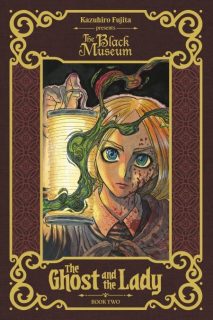
The Ghost and the Lady, Volume 2The Ghost and the Lady, Volume 2 by Kazuhiro Fujita. Admittedly, The Ghost and the Lady is kind of a strange manga series. In part historical fiction and in part supernatural drama, the manga’s disparate elements don’t always perfectly mesh, but I still enjoyed the series a great deal. In The Ghost and the Lady, Fujita mixes together historical facts and legends, reimagining the life of Florence Nightingale and her accomplishments during the Crimean War with a distinctly supernatural flair. It’s clear that Fujita has done a tremendous amount of research for the series; and as the afterword by the series’ translator Zack Davisson points out, more or less every named character in the manga has a historical counterpart. There’s Nightingale herself as well as the people she knew, Grey is based on a famous ghost of the Drury Lane theater, and even historical figures like the Chevalier d’Éon have prominent roles to play. (Speaking of whom, I really need to find a good biography of d’Éon to read.) Despite the presence of the ghosts, the supernatural aspects of The Ghost and the Lady seem to come and go; I do wish that the eidolons had been utilized a little more in the series’ second half because it’s great when they are.

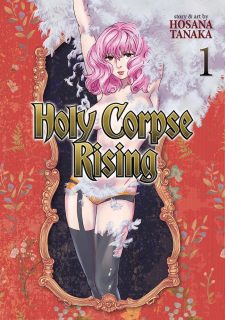
Holy Corpse Rising, Volume 1Holy Corpse Rising, Volume 1 by Hosana Tanaka. As can be safely assumed by provocative cover art, Holy Corpse Rising is a manga series that includes a fair amount of nudity and scantily clad women. However, despite the occasional ridiculousness, the fanservice is largely keeping with the style and tone of the series as a whole, so it doesn’t feel out-of-place; a significant portion of Holy Corpse Rising is intended to be titillating. In general, Tanaka’s artwork is quite attractive, though the women in the series are the most beautiful. They’re also by far the most powerful characters, both in ability and status. The first volume of Holy Corpse Rising serves as an introduction to the war between the Credic Church and the witches. Nikola, a monk who is a specialist in witch lore, is charged with securing the aid of the coven of first witches in the Church’s fight against their descendants. But first Nikola must resurrect them and in the process manages to put himself in some rather compromising situations. So far the first witches each seem to gain their power from a different bodily fluid (tears, blood). And since there are twelve of them, Holy Corpse Rising has the potential to enter some pretty kinky territory.

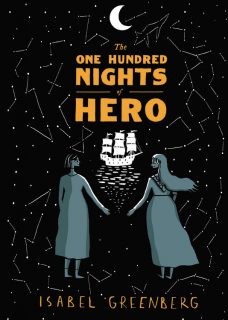
The One Hundred Nights of HeroThe One Hundred Nights of Hero by Isabel Greenberg. I don’t recall exactly what it was that brought The One Hundred Nights of Hero to my attention, but I’m so glad that I read it because it is marvelous; I loved the comic. Greenberg takes inspiration from existing stories and even provides retelling of folktales over the course of the graphic novel. The framework is deliberately similar to that of One Thousand and One Nights and there are stories within stories within stories. In fact, The One Hundred Nights of Hero is about the power of stories and storytellers. It’s also about love and “brave women who don’t take shit from anyone.” At the center of the comic is Cherry and her maid Hero, two women who love each other dearly. Night after night, Hero spins tale after tale in an effort to save their lives. The world of The One Hundred Nights of Hero is an incredibly misogynistic one. While different from our own, in some ways it is also tragically reminiscent. The One Hundred Nights of Hero isn’t always particularly subtle and can at times feel somewhat heavy-handed, but it’s a wonderfully powerful and unabashedly feminist work. I definitely plan on seeking out more of Greenberg’s comics.

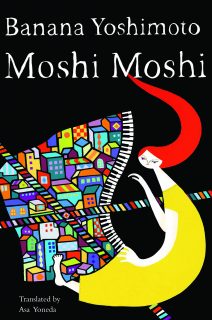
Moshi MoshiMoshi Moshi by Banana Yoshimoto. Despite being an extremely prolific author and one of the most well-known Japanese novelists translated in English, I haven’t actually read any of Yoshimoto’s works until now. The story of Moshi Moshi is told from the first-person perspective of Yoshie, a young woman whose father has recently died. A successful musician, the circumstances surrounding his death are somewhat unclear, but it’s believed that he committed double suicide with a woman who neither she or her mother knows. The novel follows Yoshie as she tries to come to terms with the unexpected loss of her father by reinventing her life in the chic neighborhood of Shimokitazawa. Her mother joins her there, feeling that the ghost of her husband is haunting the family home, and Yoshie herself is plagued with recurring dreams in which her father appears, searching for his phone. Though Moshi Moshi does tend to drag a little in places, I really liked how Yoshimoto handles the themes of love, loss, and the inevitability of change in the novel. I suspect that Moshi Moshi likely isn’t the best introduction to Yoshimoto’s work, but for the most part I did appreciate it.

Filed Under: FEATURES, My Week in Manga Tagged With: Banana Yoshimoto, comics, Devils' Line, Ghost and the Lady, Holy Corpse Rising, Hosana Tanaka, Isabel Greenberg, Kazuhiro Fujita, manga, Novels, Ryo Hanada

Bookshelf Briefs 1/16/17

January 16, 2017 by Michelle Smith and Sean Gaffney Leave a Comment

Arpeggio of Blue Steel, Vol. 9 | By Ark Performance | Seven Seas – As this series has gone on, we’ve been introduced to more and more mental models, to the point where it can be hard to keep track of everyone. I have some bad news for you, but we get even more showing up here. My favorite was Ashigara, who is very much of the “I love combat and BEING LOUD!” sort of Japanese manga stereotype, and her battle goes about as well as you’d expect, which is to say not at all. Meanwhile, we find that not only can Iona do a good verbal impersonation of Gunzou, but she does a fair job of impersonating his captain skills as well. As we gain more cast and more subplots, it’s going to be important to be able to remember who they all are, and thankfully Arpeggio does its best. Solid. – Sean Gaffney

The Black Museum: The Ghost and the Lady, Vol. 2 | By Kazuhiro Fujita | Kodansha Comics – This story wraps up with this volume, though there is more Black Museum out in Japan (and not yet licensed). It’s actually rather interesting to see how well Florence Nightingale’s life works as an action manga and/or medical drama. There’s no shortage of villains, and I’m not even talking about D’Eon. We even get endnotes reminding us that these are based on real people. Still, the fun in this series is to see Florence’s never-say-die pluck, watch Gray be cool, and see the occasional swordfight or spirit battle. Oh yes, and the museum curator, who remains hilarious. Also watch for the cameo by characters from a manga by the creator of Rurouni Kenshin. Well worth the hardcover price. – Sean Gaffney

The Demon Prince of Momochi House, Vol. 7 | By Aya Shouoto | VIZ Media – I never thought I’d say this about an Aya Shouoto title, but this was a great volume of manga. It was always fairly obvious that Himari’s school project researching a local ghost story with a group of classmates would tie in to what happened to Aoi when he was a kid, but the reveal of exactly why and how he ended up at Momochi House was handled with a creepy atmosphere and suspenseful, engrossing pacing that made for a highly enjoyable read. Plus, although some major, game-changing things happen, the essential threat to Aoi’s humanity remains. If you’re curious about Shouoto and wondering which of her series to try, let there be no doubt: it’s this one. – Michelle Smith

Haikyu!!, Vol. 7 | By Haruichi Furudate | Viz Media – As with the last volume, this is entirely about all volleyball, all the time. Unlike the last volume, there’s lots to talk about, as the series goes from good to great. The way that Sugawara works to bring out the best in his team, the way that Kageyama is showing he can learn and evolve, and the communication that develops between everyone—even cranky Tsukishima—are a joy to see, and really drive the series. We must also be getting near the end of the game, as we get tragic backstory for one of the opposing players. And of course there IS lots of volleyball lecturing and discussion, as well as cool action poses. This is one of the most Jump manga ever, and if you don’t read it you’re missing a treat. – Sean Gaffney

Haikyu!!, Vol. 7 | By Haruichi Furudate | VIZ Media – I always love when characters who had previously been in the background get their turn to shine, and there is quite a lot of that in this volume of Haikyu!!. After Kageyama loses his cool and gets benched, Sugawara finally gets to play for the first time in the tournament. Although his skills are average, the way he communicates with his teammates brings them together and calms their nerves, showing Kageyama some ways in which he’s clearly lacking. When he returns to the game, he takes Sugawara’s advice, and finally starts interacting with prickly Tsukishima and figuring out how best to utilize him as a hitter. It means a lot to see that he’s actually willing to listen for the benefit of his team, and his later, awkward attempts at congratulatory high-fiving are fairly amusing. As ever, I eagerly await the next volume! – Michelle Smith

My Monster Secret, Vol. 5 | By Eiji Masuda | Seven Seas – Still hilarious, still has touches of harem romance, but this volume also shows that My Monster Secret can be quite touching when it wants to be. Mikan is on the cover, and much of the latter half of the volume focuses on her, as she gradually realizes that she’s in a school of monsters. Luckily, not only does she have her own monster issue with her possessed glasses, but an accidental trip to the future allows her to confess to Asahi. Now, he loves Youko, so that’s not going anywhere, but it’s good to get off her chest, and maybe it helped him to finally confess to Youko? That’s the cliffhanger. There’s also plenty of hilarious gags—this is a funny manga. But it’s also got great characters. Best ‘monster girl’ manga right now. – Sean Gaffney

Nichijou: My Ordinary Life, Vol. 6 | By Keiichi Arawi | Vertical Comics – This is a more hit-and-miss volume of Nichijou than before, but the hits are hilarious. Nakamura-sensei trying to find out what makes Nano tick, and ending up at her house and meeting The Professor is just one great visual gag after another. Speaking of The Professor, she’s horrified to find Mai coming over “to play,” as she knows her as the girl with the vicious biting dogs. Luckily, Mai’s art skills are more valuable than Mai’s sense of what’s interesting or amusing, so she manages to mollify her. As for Mio, she gets a lot of dream sequences here, be they her own or Yukko’s, and they’re all hysterical, as is her “running away from reality” rampage across town, which the anime animated flawlessly. Good stuff. – Sean Gaffney

That Wolf-boy Is Mine!, Vol. 3 | By Yoko Nogiri | Kodansha Comics – I’m usually dubious when a series gets compared to Fruits Basket, but here it’s more justified than most. Not only are there hot boys who transform into animals and a girl who knows their secret, but now we’ve got a figure filling the Akito role. Yata-sensei was the one who taught the boys to transform in the first place, and makes sure they are able to pass as humans, and when Komugi’s presence (and the tension it causes between Yu and Rin, who both have feelings for her) creates an unnecessary disturbance, he tries to get rid of her. First, he warns her off, suggesting she return to Tokyo to live with her mother, but by the end of the volume, he’s opted for more drastic measures. Exactly what those are, we’ll have to wait for the fourth and final volume to find out. I’m really enjoying this series! – Michelle Smith

Filed Under: Bookshelf Briefs

Attack on Titan, Vol. 20

January 14, 2017 by Sean Gaffney

By Hajime Isayama. Released in Japan by Kodansha, serialization ongoing in the magazine Bessatsu Shonen Magazine. Released in North America by Kodansha Comics. Translated by Ko Ransom.

(Note: this review contains large spoilers for the whole volume)

In the last volume we finally got back to a lot of Titan fighting after several volumes of political intrigue. That doesn’t let up here, as this book is about humanity’s desperate fight to stop the titans. It’s also about death – at the start of the series, a lot of characters we briefly knew well died, and Levi’s squad was killed off several volumes later. Now the reaper has come calling again, and it’s uncertain who’s actually going to survive by the end of it. Is Armin really dead? Well, we thought Hange was dead last time, but here she is, looking battered but alive. This series has always had an underlying question of “how depressing is the ending going to be?”. Will the author and editors really kill off most of the likable main cast for good? Will the Titans win?

Speaking of Armin, a lot of this volume focuses on him, particularly on his loss of courage in the face of disaster. This is actually done quite well, showing that the horrible slaughter of war does not automatically make anyone a badass, particularly if your soldier skills are mostly confined to tactics, as with Armin. Seeing him falter gives us extra frustration and sadness, and helps to make the end of the volume, where he snaps out of it, comes up with a plan, and seemingly sacrifices his life for the others’ sake, even more impressive. Speaking of impressive, I must admit I’ve never really warmed to Jean before now, a character who has always been very confrontational and obnoxious. But he’s fantastic here, taking over when Armin falters and thinking of good short-term plans that will help them escape, while admitting that long-term tactics is not something he is designed for. Great job.

Armin is, of course, not the only casualty here, as Erwin takes all the rookies who are watching the Beast Titan and company destroy everything on a suicidal charge in order to give Levi time to make a sneak attack. As one recruit points out (and oh what irony that he seems to be literally the only recruit to survive after this debacle), Erwin is asking them to go out and die, and Erwin responds bluntly that yes, he is. And they do just that. Naturally the reader focuses on Marlowe, whose shift from reluctant MP soldier to raw recruit has gotten quite a bit of focus, and he even got some rare Titan ship tease with fellow MP Hitch. Now he thinks of Hitch, who did not join the Survey Corps and is thus likely asleep, right before his head is blown apart. War is hell. And in war, the good die. A lot.

And that may also include Erwin, whose frustration that they’re almost but not quite able to get to Eren’s father’s house is palpable. He’s leaving everything to Levi and Hange, but like Armin, his fate is not quite confirmed at the end of this book. Will they both end up like Marlowe, Petra and Marco? Or will this be like Sasha or Hange, where we’re sure they’re about to die but they somehow escape? In any case, a good solid volume, and I can’t even complain about the mediocre art too much this time.

Filed Under: REVIEWS

Manga the Week of 1/18

January 12, 2017 by Sean Gaffney, Ash Brown, Michelle Smith, Katherine Dacey, MJ and Anna N 2 Comments

SEAN: Mid-month, and it’s a mostly quiet time in manga land. Some series end, but others carry on regardless. What’ve we got this time around?

ASH: Wow! It’s been a while since we’ve had a week this quiet.

SEAN: Kodansha has a 2nd volume of Interviews with Monster Girls, whose first volume I found pretty good. It’s more on the ‘cute’ than ‘sexy’ end of the spectrum.

ASH: Hopefully the recent anime adaptation will encourage people to try the manga, too.

SEAN: And there’s an 18th volume of The Seven Deadly Sins.

One Peace gives us an 8th volume of yuri trap manga Maria Holic.

.

Seven Seas has one of my favorite horrible guilty pleasure series come to an end with the 4th and final omnibus of Franken Fran. I understand it wasn’t a big seller, which is a shame, but its over-the-top horrible horror and humor always tickled my funny bone. Or made my jaw drop.

ASH: I’ve been thoroughly enjoying Franken Fran. It’s sad to hear it hasn’t done especially well, but I’m glad to have it on my shelves.

SEAN: How to Build a Dungeon also made my jaw drop, but not in a good way. Vol. 2 is out. Buyer beware.

My Girlfriend Is a T-Rex also has a 2nd volume, and I found the first, like Interviews with Monster Girls, cute and ‘pretty good’. This is a mild recommendation.

And Non Non Biyori’s 6th volume, a series that takes slice of life to such extremes you may fall asleep just reading the synopsis.

Vertical gives us a 7th volume of Ninja Slayer, which has ninjas, who possibly slay.

Viz has the 20th volume of Dorohedoro, and I could not be more delighted. I look forward to this series every time a new volume comes out.

ASH: Yes! I love Dorohedoro.

SEAN: And there is a 16th Terra Formars as well.

Lastly, Tokyo Ghoul has a 2nd novel based on the popular series, this one called Void.

MANGA? It’s what’s happening. What are you getting?

MICHELLE: Uhhh… nothing, apparently.

KATE: That makes two of us, Michelle! There’s a whole lotta “Whoa!” and “No!” in this week’s shipments as far as I’m concerned.

MJ: Same! Is it sad that I’m somewhat relieved to finally have disembarked the Seven Seas train? Sorry, Seven Seas.

ANNA: There is nothing that appeals to me this week, which is good because I can hopefully get caught up reading other things!

Filed Under: FEATURES, manga the week of

Bookshelf Overload: December 2016

January 12, 2017 by Ash Brown

Well, December happened, as I knew it would. I took advantage of a large number of holiday and end of year sales and made good use of coupons and gift cards, so my wallet is happier than it would have been otherwise, but I still managed to pick up an absurd number of things. This includes an unusual amount of anime for me, such as the Amazon-exclusive limited edition of Cowboy Bebop which was on super sale at one point. (This will replace the bootleg copy I unintentionally bought when I was much younger and didn’t know any better or how to tell the difference.) Probably the manga release I was most excited for in December was the return of Makoto Yukimura’s Vinland Saga. (I’ll hopefully have a review of the eighth and most recent omnibus to share in the near future.) I’m also especially happy to have the deluxe edition of Junji Ito’s Tomie and the conclusion of The Ghost and the Lady by Kazuhiro Fujita on my shelves. And, of course, more of Inio Asano’s Goodnight Punpun, Haruichi Furudate’s Haikyu!!, and Izumi Tsubaki’s Monthly Girls’ Nozaki-kun are always welcome. Fans of Mentaiko Itto will also want to be aware of the poster collection recently released by Bruno Gmünder. It’s labeled as “1,” so there may very well be more to come. (Ahem.) As for comics, Reindeer Boy by Cassandra Jean is a lot of fun and I recently read and highly recommend The One Hundred Nights of Hero by Isabel Greenberg.

Manga!
Aoharu X Machinegun, Volume 1 by Naoe
Blood Blockade Battlefront, Volumes 1-7 by Yasuhiro Nightow
Bungo Stray Dogs, Volume 1 written by Kafka Asagiri, illustrated by Sango Harukawa
Dragon Voice, Volumes 1-10 by Yuriko Nishiyama
Fruits Basket, Omnibus 1 by Natsuki Takaya
Gangsta: Cursed, Volume 1 written by Kohske, illustrated by Syuhei Kamo
The Ghost and the Lady, Volume 2 by Kazuhiro Fujita
Giganto Maxia by Kentaro Miura
Goodnight Punpun, Omnibus 4 by Inio Asano
Haikyu!!, Volume 7 by Haruichi Furudate
Happiness, Volume 2 by Shuzo Oshimi
He’s My Only Vampire, Volumes 1-3 by Aya Shouoto
Holy Corpse Rising, Volume 1 by Hosana Tanaka
Hunter x Hunter, Volumes 1-8 by Yoshihiro Togashi
Kiss of the Rose Princess, Volumes 1-2 by Aya Shouoto
Magi: The Labyrinth of Magic, Volumes 1-2 by Shinobu Ohtaka
Monthly Girls’ Nozaki-kun, Volume 5 by Izumi Tsubaki
New Lone Wolf and Cub, Volume 6 written by Kazuo Koike, illustrated by Hideki Mori
One-Punch Man, Volume 10 written by One, illustrated by Yusuke Murata
Ōoku: The Inner Chambers, Volumes 11-12 by Fumi Yoshinaga
Pandora Hearts, Volumes 20-22 by Jun Mochizuki
Persona 4, Volumes 4-5 by Shuji Sogabe
The Prince and His Dark Days, Volume 2 by Hico Yamanaka
Seven Princes of the Thousand Year Labyrinth, Volume 1 by Yu Aikawa
Sweetness and Lightning, Volume 3 by Gido Amagakure
Tomie by Junji Ito
Vinland Saga, Omnibus 8 by Makoto Yukimura
Welcome to the Ballroom, Volume 2 by Tomo Takeuchi

Comics!
Babybel Wax Bodysuit by Eric Kostiuk Williams
Battles by Jenn Woodall
Canopy by Karine Bernadou
Centralia 2050, Chapters 1-2 by Michelle Stanford
A City Inside by Tillie Walden
Diesel Ignition by Tyson Hesse
Dirty Diamonds, Issue 7: Imagination edited by Claire Folkman and Kelly Phillips
The End of Summer by Tillie Walden
Forest Dew by Heldrad
Hot Dog Taste Test by Lisa Hanawalt
I Love This Part by Tillie Walden
Little Kinano by Yeehun
Mondo by Ted McKeever
Oath: An Anthology of New (Queer) Heroes edited by Audre Redpath
The One Hundred Nights of Hero by Isabel Greenberg
Panther by Brecht Evens
RAV, Volume 2 by Mickey Zacchilli
Reindeer Boy by Cassandra Jean
Rosalie Lightning by Tom Hart
Small Town Witch written by Alex Singer, illustrated by Jayd Aït-Kaci
Somthing Terrible by Dean Trippe
Spidersilk, Volume 1 by Pamela Kotila
SuperCakes by Kate Leyh
That Which Wills: Virgo Rising, Book 1 written by Alex Singer, illustrated by Jayd Aït-Kaci

Artbooks!
BLKBT by C Lijewski
Burl & Furl edited by Irene Koh, Ricardo Bessa, Paul Reinwand, and Kevin Jay Stanton
Poster Book 1 by Mentaiko Itto

Novels!
The Borrowed by Chan Ho-Kei
Memoirs of a Polar Bear by Yoko Tawada
Moshi Moshi by Banana Yoshimoto
Orochi no Yaiba written by Itoshi, illustrated by Aldaria
Outlet by Randy Taguchi

Anime!
Cowboy Bebop directed by Shinichirō Watanabe
Detroit Metal City directed by Hiroshi Nagahama
My Love Story directed by Morio Asaka
Natsume’s Book of Friends, Seasons 3-4 directed by Takahiro Omori
The Perfect Insider directed by Mamoru Kanbe
Persona 4: The Animation directed by Seiji Kishi
Terror in Resonance directed by Shinichirō Watanabe
Yurikuma Arashi directed by Kunihiko Ikuhara
Young Black Jack directed by Mitsuko Kase

Filed Under: Bookshelf Overload, UNSHELVED

Welcome (Back) to The Manga Critic!

January 12, 2017 by Katherine Dacey


Welcome! My name is Kate Dacey, and I’ve been writing about comics since 2006 for sites like PopCultureShock, The School Library Journal, and MangaBlog. Though I’m passionate about comics in general, my first love is manga. I count Rumiko Takahashi, Katsuhiro Otomo, Kaoru Mori, Fumi Yoshinaga, Naoki Urasawa, and Osamu Tezuka among my favorite artists, as their work showed me the full potential of the comics medium.

I first created the Manga Critic in 2009. Back then, TOKYOPOP, CMX, and Del Rey were actively publishing material, Yen Press was the new kid on the block, and the New York Times was just beginning to acknowledge manga sales in its weekly bestseller lists. It was an exciting time: some weeks yielded as many as 50-60 new volumes of manga, and important artists — Hayao Miyazaki, Moto Hagio — were making the rounds at San Diego and New York Comic-Cons.

Though there were an astonishing number of manga-themed websites, blogs, and LiveJournals, many of these sites catered to self-professed otakus. For someone who primarily identified as a reader, I found the conversations at these sites unwelcoming, as I was more invested in the quality of the stories I read than in the fine details. I hankered for an online community where the hardcore fan and the occasional reader would feel equally welcome — and equally entitled to their opinions. When I didn’t find such a space, I set out to make one, and the Manga Critic was born.

For three years, I had a blast. I got shout-outs at the New Yorker and New York Times’ websites, a re-tweet from Roger Ebert that nearly crashed Manga Bookshelf, and enough passionate reader comments to fill a football stadium. (There are *still* a few people who are sore about my review of Blood Alone.) Then I hit the wall: I’d reviewed one too many books about teenage ninjas, wacky afterschool clubs, ruthless assassins, sexy robots, and vampire Romeos, and it showed. I put the Manga Critic in mothballs, and stopped blogging for almost two years.

In the immediate aftermath of shutting down my site, I felt relief: no more volumes of Highschool of the Dead to review! No more comments from infuriated teenaged boys! At the same time, however, I missed discussing and discovering new manga with thoughtful readers, an experience that I couldn’t fully replicate through Twitter or Tumblr feeds. So after several years of deliberation — and a few sporadic posts at MangaBlog — I decided that 2017 was the right time to bring back the Manga Critic.

HOW TO NAVIGATE THE SITE

If you’re new to manga, you’ll find several ways to discover new series and artists at the Manga Critic, from the Year in Review, an archive of my annual best-and-worst lists, to Recommended Reading, a series of articles highlighting different types of manga (e.g. horror, shojo). If you’re already a serious manga reader, you’ll find features that cater to your interests as well, including Manga Artifacts, an occasional column exploring Japanese comics published before 2000, and The Best Manga You’re Not Reading, a column highlighting great series that aren’t getting the attention they deserve. I also post occasional capsule reviews on Mondays — Bookshelf Briefs, a joint effort among the six Manga Bookshelf bloggers — and round-ups of manga industry news.

If you’re new to this site, I’ve compiled a short list of articles from the original Manga Critic (2009-2012). These essays provide a good introduction to my writing and reviewing style:

  • Ayako
  • The Best Manga You’re Not Reading: Benkei in New York
  • Manga Artifacts: Love Song
  • The Manga Hall of Shame: Wounded Man
  • My Favorite Shojo Manga: Kaze Hikaru
  • On Criticism: The 7 Deadly Sins of Reviewing
  • Rumiko Takashi’s Rumic Theater
  • Sexy Voice and Robo and Harriet the Spy
  • Summer, Fireworks and My Corpse

You’ll also find a wealth of sources on manga, manhwa, and comics for kids, all of which can be accessed through the Resources menu.

Going forward, I anticipate posting one major article each month, and one short review or news story each week. To stay abreast of what’s happening here at the Manga Critic, you can subscribe to my Twitter feed or the Manga Bookshelf Facebook page.

A WORD OF THANKS

Last but not least, I wanted to acknowledge three people for their encouragement and support: Brigid Alverson, who graciously gave me a place to hang out while The Manga Critic was on hiatus; Claire Dacey, who created the site’s funky new banner; and MJ, who played a major role in making the site functional and attractive. Thank you, ladies!

Filed Under: Manga Critic

I Saved Too Many Girls And Caused The Apocalypse, Vol. 1

January 11, 2017 by Sean Gaffney

By Namekojirushi and Nao Watanuki. Released in Japan as “Ore ga Heroine o Tasukesugite Sekai ga Little Mokushiroku!?” by Hobby Japan. Released in North America digitally by J-Novel Club. Translated by Adam Lensenmayer.

To a certain extent, a lot of light novels in Japan have a certain level of knowing irony built into their very frame. You don’t have a genre with that many long-winded over-dramatic series titles and not know that your tongue is planted firmly in your cheek, though by now, a few years out, I suspect many of the imitators may have bypassed the irony in favor of “long titles sell”. But if you do understand, and your audience does as well, there’s a lot you can make fun of. Especially in the so-called “harem” genre, something which has been around in North America since the dawn of manga here (see Ranma 1/2 for only one example) and is even more rife in Japan. Jealous childhood friends, wishy-washy male leads, cripplingly shy yet adorable girls who always enthrall the male audience yet never actually win… we all know the type. It’s ripe for being made fun of.

Our hero is a young man who only wishes to live a normal life. Sadly, Rekka is told by his father on his 16th birthday that he’s inheriting the birthright of being the “final hero” – i.e., when a crisis is happening somewhere and a hero is needed but has not actually materialized, died, or failed, Rekka will be called to action to get the girl, kill the baddies, and save the entire planet. The keywords here being “get the girl”. Shortly after this, a young girl from the future, R, pops up to tell Rekka that he made too many girls fall in love with him doing this, and his inability to settle down and pick one has led to a future apocalypse. R is here to help prevent this. And right after this, the hero stuff keeps pouring in. His childhood friend is secretly a mage, an alien princess wants to marry him, and a shy sorcerer needs hims help to defeat the Demon Overlord. The conceit is that this all happens at the same time.

I must admit, my expectations were somewhat low for this release. The dire but similar “My Little Sister Can Read Kanji” release by J-Novel was so bad I wasn’t even able to finish (or review) it. But it looked lighthearted at least, and I was in the mood for something that wasn’t just dour overpowered male leads staring at the charred remains of all they once loved. And luckily, this ended up being a quite readable treat. It’s not great art, and overstays its welcome (something that is worrying given how long the series is in Japan). But it knows what it’s mocking and does it very well. Some of the jokes actually made me laugh out loud, a rarity for light novels. Its one big drawback is that it peaks too soon. Rekka and Harissa battling the Demon Overlord, complete with “you fools! This isn’t even my final form!” is the absolute highlight of the entire book, and the rest couldn’t dream of topping it.

The basic premise is actually quite clever: Rakka would normally be taking care of these things one by one, and likely not doing a great job. But with them all happening at once, he’s able to use resources from one heroine route to fix another. And they aren’t necessarily easy fixes, either – I knew the moment that he left Harissa right after defeating the Demon Overlord handily that it wouldn’t be that simple, and sure enough she’s soon on the chopping block to be executed. As for Rekka himself, he’s amusingly dense, but he’s not an incompetent clumsy idiot like a lot of harem heroes – you actually get why these girls fall for him. The heroines themselves are all obvious types, designed to win over whichever pleases the reader best, and none are too annoying. Best of all is R, who is invisible to all but Rekka and is thus able to float around him at all times making dry, sarcastic remarks about his incompetence. “I now understand the difficulty of my mission in my heart and not just in my head” was wonderful. (I also hope that she does not become part of the harem in future books.)

Overall, I’m pleasantly surprised at what a light, breezy read this was. Don’t read it if you can’t tolerate harems, of course. And like many light novels, I suspect it’s something I’d find far more aggravating as an anime or manga with more visual fanservice. But if you want something funny and cheeky, this is a good series to get.

Filed Under: REVIEWS

Bookshelf Briefs 1/9/17

January 9, 2017 by Michelle Smith and Sean Gaffney Leave a Comment

Cells at Work!, Vol. 2 | By Akane Shimizu | Kodansha Comics – Given that this is about anthropomorphic blood cells, it can sometimes be a surprise when the series packs an emotional and weighty punch. But that is, after all, the purpose of the anthropomorphism—Red Blood Cell and White Blood Cell are memorable because of their eccentricities and human foibles. Here we learn they’re apparently also forgotten childhood friends… sort of. There’s also discussion of Eosinophil, which is more specialized and therefore less powerful against things a normal White Blood Cell can do, and a surprisingly poignant treatment of a cancer cell, which is after all only trying to survive. A good second volume, and I like these cells. Are there ship wars yet? – Sean Gaffney

He’s My Only Vampire, Vol. 9 | By Aya Shouoto | Yen Press – The pieces begin to fall into place in this, the penultimate volume of He’s My Only Vampire. Unfortunately, Kana is thrust almost entirely into the background, despite a couple of revelations about her past (well, one is not entirely confirmed, but the hinting is so heavy-handed, it might as well be), as the looming confrontation between Aki and Eriya means the hunt for stigma is ramping up. Aki currently has three with a fourth at his disposal, once Jin deems the time is right, but Eriya soon claims his second. The cliffhanger ending involves the manifestation of the final stigma as well as a diary of significance. So far, this is hanging together better than Kiss of the Rose Princess, even if it isn’t 100% coherent. I’ll definitely be reading the conclusion! – Michelle Smith

Honey So Sweet, Vol. 5 | By Amu Meguro | VIZ Media – There are no fewer than five great big beaming smiles in this volume. Nao and Taiga plan to have a solo date on Christmas, but their friends quickly co-opt the evening for a party. This, in turn, leads to Nao meeting Taiga’s mom, who doesn’t seem to like her much, and then sleeping over and forgetting to notify Sou, who is very upset. Even though there is much going on here that is sweet and sunny—my favorite moment is actually Yashiro giving Valentine’s Day chocolates to Misaki—I actually really liked seeing Nao get angry for once and vow to be rebellious, and then seeing Tai lose his patience with the whole situation and intervene to get Nao and Sou reconciled. Like they themselves conclude in the story, it makes you closer with someone when you can be honest how you feel. And I honestly adore this series. – Michelle Smith

The Honor Student at Magic High School, Vol. 5 | By Tsutomu Sato and Yu Mori | Yen Press – My relief at the novels having caught up to the spinoff didn’t last long, as this volume of Miyuki’s adventures breezed through the third book in only 70 pages or so, leaving the rest of the plot as part of book four, not out here until April. So I’m spoiled by the spinoff again. There’s some good stuff here, in amongst the setup for the next volume or two. Shizuku in particular benefits in this book, becoming more than Honoka’s fiend and deadpan support and gaining character and awesome moments in her own right. As for Miyuki herself, I suspect she’s damaged by the aforementioned setup, as she doesn’t do quite as much here. Still good stuff. – Sean Gaffney

Of the Red, the Light, and the Ayakashi, Vol. 5 | By HaccaWorks* and nanao | Yen Press – Well, the story is certainly moving swiftly along! So swiftly, in fact, that the final four volumes of this series are certain to be action-packed. In this particular installment, we learn a little more about the meal, as well as the fact that Yue’s small and cute fox companion, Kurogitsune, is due a meal of his own and potentially thinks that Yue seems pretty tasty. Yue, for his part, is feeling disinclined to partake of a meal if it means one of his friends will disappear and is seeking a way out of the obligation, but the head honcho of the shrine aims to take the decision out of his hands and kidnaps Tsubaki when he has the opportunity. All sorts of forces are at play now, and I can definitely see the potential for a straight-through reread once the ninth and final volume finally arrives. – Michelle Smith

One-Punch Man, Vol. 10 | By ONE and Yusuke Marata | Viz Media – Tornado of Terror is on the cover, and she gets a significant chunk of the book as well. And you can see why—more than any of the other female characters we’ve seen in the series, she’s a match for Saitama, possibly as she’s also a lot like Saitama—she gets a lot of simplified faces, emotionless stares, and superdeformed art just as he does. Her sister also gets a nice chapter showing how difficult it can be to not worry about others when you’re constantly striving to get stronger than your betters. Among all that, the further adventures of Garo don’t pack quite as much of a punch—indeed, Saitama takes him out handily as always. This continues to be top-tier shonen and top-tier shonen parody. – Sean Gaffney

Yowamushi Pedal, Vol. 4 | By Wataru Watanabe | Yen Press – I was right that the second years were unable to beat out the first years, who are of course the protagonists so have the writer on their side. That said, I wasn’t expecting so nasty a finish, as they end up giving themselves significant injuries that will take them out of the action for some time. As for Onoda, he’s near his limits, and close to failing, but he gets another reward to give him even more speed—cleats—and that proves to be all the difference. So now we’re ready for the tournament itself, which promises to be grueling, and which features a flashback to the last one, which ended badly for all parties concerned. Is revenge in the offing? Excellent sports manga. – Sean Gaffney

Filed Under: Bookshelf Briefs

  • « Go to Previous Page
  • Page 1
  • Page 2
  • Page 3
  • Page 4
  • Page 5
  • Go to Next Page »
 | Log in
Copyright © 2010 Manga Bookshelf | Powered by WordPress & the Genesis Framework