• Skip to primary navigation
  • Skip to main content
  • Skip to primary sidebar
  • Home
  • About Us
    • Privacy Policy
    • Comment Policy
    • Disclosures & Disclaimers
  • Resources
    • Links, Essays & Articles
    • Fandomology!
    • CLAMP Directory
    • BlogRoll
  • Features & Columns
    • 3 Things Thursday
    • Adventures in the Key of Shoujo
    • Bit & Blips (game reviews)
    • BL BOOKRACK
    • Bookshelf Briefs
    • Bringing the Drama
    • Comic Conversion
    • Fanservice Friday
    • Going Digital
    • It Came From the Sinosphere
    • License This!
    • Magazine no Mori
    • My Week in Manga
    • OFF THE SHELF
    • Not By Manga Alone
    • PICK OF THE WEEK
    • Subtitles & Sensibility
    • Weekly Shonen Jump Recaps
  • Manga Moveable Feast
    • MMF Full Archive
    • Yun Kouga
    • CLAMP
    • Shojo Beat
    • Osamu Tezuka
    • Sailor Moon
    • Fruits Basket
    • Takehiko Inoue
    • Wild Adapter
    • One Piece
    • After School Nightmare
    • Karakuri Odette
    • Paradise Kiss
    • The Color Trilogy
    • To Terra…
    • Sexy Voice & Robo
  • Browse by Author
    • Sean Gaffney
    • Anna Neatrour
    • Michelle Smith
    • Katherine Dacey
    • MJ
    • Brigid Alverson
    • Travis Anderson
    • Phillip Anthony
    • Derek Bown
    • Jaci Dahlvang
    • Angela Eastman
    • Erica Friedman
    • Sara K.
    • Megan Purdy
    • Emily Snodgrass
    • Nancy Thistlethwaite
    • Eva Volin
    • David Welsh
  • MB Blogs
    • A Case Suitable For Treatment
    • Experiments in Manga
    • MangaBlog
    • The Manga Critic
    • Manga Report
    • Soliloquy in Blue
    • Manga Curmudgeon (archive)

Manga Bookshelf

Discussion, Resources, Roundtables, & Reviews

Archives for June 2010

Manhwa Monday: June Preview

June 7, 2010 by MJ 5 Comments

Welcome to another Manhwa Monday! With June now upon us, it’s time to take a look at what’s coming out in print this month. It’s a fairly lean month for manhwa, but there are some real goodies in the bunch.

First of all, from NETCOMICS, comes the debut print volume of There’s Something About Sunyool, the latest from Youngran Lee, author of Click and a host of other NETCOMICS titles. Like 100% Perfect Girl, Sunyool is being released simultaneously in the US and Korea. This kind of arrangement is something Japanese manga fans have been begging for, yet NETCOMICS seems to have received very little attention for their trouble.

And speaking of 100% Perfect Girl, its final volume (11) comes out in print this month as well. Though this title is not a favorite of mine, it (like Sunyool) is yet another manhwa series for grownup women …

Read More

Filed Under: Manhwa Bookshelf Tagged With: manhwa, manhwa monday

Introducing Shonen Sundays

June 7, 2010 by MJ 4 Comments

Yesterday saw the first posts in a new month-long series, Shonen Sundays, a joint project with Michelle Smith of Soliloquy in Blue. To quote her introductory post:

“MJ (of Manga Bookshelf) and I have often talked about our ardent love for shounen manga … Unfortunately, our conversations have been somewhat limited because neither of us has read the other’s favorite series. With that in mind, the idea for Shounen Sundays was born.

Here’s how it works: each Sunday in June, MJand I will post a review of a shounen manga that is new to us, two that are among the other’s favorites and two of our own choosing.”

Check out Michelle’s post for more.

This past weekend, I reviewed the first two volumes of Arata: The Legend …

Read More

Filed Under: NEWS Tagged With: shonen sunday

Yokan 1: Premonition by Makoto Tateno: B-

June 7, 2010 by Michelle Smith

Akira is the lead singer of a visual kei band and has somewhat of an attitude. He doesn’t care about the fans’ enjoyment, only his own, and refuses to sing anything he didn’t write himself. That is, until he overhears mainstream entertainer Hiroya Sunaga singing one of his own compositions. For the first time, Akira’s obsessed by someone else’s music and makes it his mission to get Hiroya to abandon his “adequate” career and really sing seriously.

Once again, Makoto Tateno has crafted a BL story with a fair amount of plot and a minimum of romance. Yes, Akira and Hiroya eventually become lovers, but there’s always an atmosphere of challenge to their encounters. In dragging Hiroya back into a world he left behind, Akira is creating a rival for himself, setting up a standard to be surpassed.

While this concept is promising, Yokan is far from perfect. When Akira first expresses interest in singing his song, Hiroya demands payment. Readers expect this to be sex, but in fact, he only claims a kiss. This led me to hope the story would be free from a nonconsensual scene, but this is unfortunately not the case. The bonus story, “Sinsemilla,” is also pretty horrible, featuring one character dosing another with an aphrodisiac and said victim later suggesting that the drug made him gay. “I was completely hetero before!”

I liked Yokan well enough to continue to the second volume, but it probably won’t be everyone’s cup of tea.

Review copy provided by the publisher. Review originally published at Manga Recon.

Filed Under: Uncategorized Tagged With: digital manga publishing, Juné, Makoto Tateno

Fullmetal Alchemist 1-2 by Hiromu Arakawa: B+

June 6, 2010 by Michelle Smith

I’ve been hoarding volumes of Fullmetal Alchemist for several years. Having heard it praised for its impressive storytelling, I decided to wait until it was nearer to being finished in Japan before starting it, with the idea that I might be spared some of the long waits between volumes that other fans have endured. But now, word is that the end is nigh, and with MJrecommending it to me so ardently, the time has finally come. Cracking open that first volume felt like quite the momentous occasion.

Edward and Alphonse Elric are unlike normal teenage boys. Both studied alchemy as children and when Edward found a way to bring their beloved mother back to life, the boys performed the ritual without a second thought, not realizing—in the “equivalent exchange” demanded by alchemy—that it would cost Edward his left leg and Alphonse his entire body. After exchanging his right arm for Alphonse’s soul, Edward grafted the soul into the one human-shaped thing that was handy at the time: a suit of armor. Edward is haunted by this mistake, not to mention the memory of what they actually managed to resurrect for their sacrifice, and his primary concern is regaining their original bodies. To that end, they travel the world looking for the Philosopher’s Stone, an alchemical power booster that might make this possible.

The brothers’ travels bring them into contact with trouble in various forms. Their first deed is to expose an alchemist posing as a religious figure, followed by freeing occupants of a mining town from the corruption of a military official and foiling a train hijacking. While this is going on, Edward is also trying to learn as much as he can about biological transmutation. In the second volume, his research leads him to a state alchemist who’s had some success in this area, which in turn takes the story down a very dark avenue involving human experimentation and a vigilante named Scar who takes it upon himself to execute alchemists who have violated the laws of nature.

I knew exceedingly little about Fullmetal Alchemist going into this, which is great. I knew about the brothers’ injuries, though not how they obtained them, and I knew they’d meet a mechanically inclined girl at some point. That’s it. As a result, I was surprised by a number of things as I read, including the presence of comedy. I’m not sure why I thought there wouldn’t be any, but having lighthearted moments sprinkled throughout is definitely welcome, especially once the story delves into more disturbing territory. I particularly love anything that shows that Alphonse, trapped inside a hulking steel shell, is really just a kid.

I was also surprised (and impressed) that the series tackles the religion vs. science question right away with the story of the fraudulent holy man. This also provides an opportunity to introduce Edward’s feelings about alchemy: because alchemists strive to understand the laws of nature, they are perhaps the closest to God that a human can achieve, but overstepping certain bounds—he likens this to the hubris of Icarus—leads only to sorrow and pain. His conflicted feelings resurface several times in these two volumes; one gets the idea that he would like to avoid the very kind of alchemy he’s been researching, but because it’s his best chance at bodily restoration, he’s got no choice.

Lastly, I was downright shocked by some things in the second volume. Somehow, I had expected the Elric brothers to save Nina, the child of a desperate alchemist about to lose state funding, from her father’s experimentation, but this was not to be. Similarly, I expected them to escape grievous bodily harm when fighting Scar so imagine my surprise when both are gravely injured in volume two. That’s just not normal! Shounen heroes are supposed to sustain wounds that would kill an average guy three times over and then get up for more!

I had originally planned to read three volumes for this review, but so much had happened by the end of volume two that I required time to digest it all. I’m used to a shounen manga’s second volume being the stage of the story where some wacky episodic hijinks introduce our hero to the rivals who’ll eventually become part of his entourage. It’s usually not until half a dozen volumes later that you glimpse the real meat of the story. Not so with Fullmetal Alchemist, which lulls you into expecting that episodic setup but makes with the buildup and continuity right away. I can already tell, and believe me that I mean this as a most sincere compliment, that this is going to be one challenging series.

Fullmetal Alchemist is published in English by VIZ. There are 22 volumes currently available, with volume 23 due out next month. We’re pretty close to being caught up to Japan, where volume 25 just came out in late April.

Filed Under: Fantasy, Manga, Shounen Tagged With: Hiromu Arakawa, VIZ

Arata: The Legend, Vols. 1-2

June 6, 2010 by MJ 12 Comments

Arata: The Legend, Vols. 1-2
By Yuu Watase
Published by Viz Media
Rated T (Teen)

In a world full of magic and gods, young Arata of the Hime Clan has been framed for the murder of his people’s beloved princess and is now on the run from her twelve godlike “protectors” who actually committed the crime. Arata Hinohara is a modern-day schoolboy just entering high school, where a bully from his past threatens to ruin the new friendships he’s just begun to form. When otherworld Arata flees into an enchanted forest in order to evade his pursuers, the two Aratas suddenly change places, each finding himself in a truly foreign world.

Though much of the story’s setup and look will be very familiar to fans of Watase’s well-known shojo epic Fushigi Yugi (and its currently-running prequel, Fushigi Yugi Genbu Kaiden), Arata: The Legend has considerable charm of its own. By exchanging her “schoolgirl in a strange land” for a schoolboy in a strange land, Watase plays right into her greatest strengths–period-inspired fantasy, action sequences, and pretty young men.

In otherworld Arata, Watase has inserted all the characteristics of the standard shonen hero. Brash, boyish, goodhearted, and strong, this Arata would be at home in nearly any shonen manga universe, protecting his loved ones with all his might. With modern-day Arata, however, she’s gone off the beaten path, at least to start.

Arata Hinohara is deeply scarred by the intense bullying that haunted him through junior high. Anxious not to stand out at his new high school, he hides his athletic abilities and avoids joining any clubs. He tentatively accepts the new friendships offered to him, but is wary of pushing them too far.

When, just a month into the new school year, the ringleader of his junior high misery suddenly joins his class, it’s a nightmare come true. And as his new friends abandon him, one by one, bitterness and cynicism take over his mind. Still, Arata’s raw hurt keeps him vulnerable, turning him not into a typical hard-as-nails loner (as much as he might wish it), but just a deflated, lonely boy who desperately needs someone to believe in him.

Though this may not be exactly profound, it’s a nice change of pace for a shonen adventure/fantasy and it goes a long way towards helping old material feel new again. With the first two volumes focusing heavily on Arata Hinohara, it will be interesting to see what Watase does with otherworld Arata in the next volume as he heads off for his first day at high school.

While Watase’s shojo fantasies have always featured a lot of action, this series allows her to really shine, with fights, chases, and weapons galore. There’s a natural, easy feel to the artwork in this series, even when compared to her other current work like Fushigi Yugi Genbu Kaiden, as though by choosing to draw shonen action heroes, she’s finally really hit her stride. Her gift for pretty, poignant faces is used to great advantage as well–something that surely can’t be hurting Weekly Shonen Sunday‘s crossover numbers.

Though Arata: The Legend may offer nothing truly new, its vulnerable hero and attractive, expressive artwork help to create a thoroughly enjoyable fantasy with a surprisingly fresh feel.

Review copy of volume two provided by the publisher.

Filed Under: MANGA REVIEWS Tagged With: arata: the legend, shonen sunday

Ristorante Paradiso by Natsume Ono: B+

June 5, 2010 by Michelle Smith

Twenty-one-year-old Nicoletta arrives in Rome with the intention of confronting her absentee mother, Olga, and revealing the fact of her existence to Olga’s husband, Lorenzo, who had believed his wife to be childless. Instead, she becomes entranced by her mother’s world and ultimately finds a place in it.

Olga and Lorenzo run a restaurant, and though the food is excellent, many of the patrons come just to see the waiters, a staff of mostly older men who all wear glasses (whether necessary or not) to indulge Olga’s whim. At first Nicoletta is perplexed by the multitude of women swooning over these men until she begins to notice the particular charms of Claudio, the head waiter. Claudio is graceful, sexy, and very kind, though he’s still hung up on his ex-wife and continues to wear his wedding ring. Although Nicoletta originally wrangles a job as a kitchen apprentice in order to be near him, she proves to be genuinely good at cooking. She becomes part of the restaurant’s family, and her relationship with Olga improves as a result.

Ristorante Paradiso is a completely different kind of story than not simple, the other Natsume Ono title currently available in English. It’s happy, for one thing, with a cozy, slice-of-life storytelling style and the kind of predictable yet comforting conclusion that would be perfectly at home in an Italian holiday kind of chick flick. Things between Nicoletta and Olga work out too easily, but most of the focus is on the guys anyway, so I’m not as annoyed as I otherwise would be.

Let’s talk about those guys for a minute. Sexy Claudio is definitely the star among them, but grumpy yet kind Luciano is another standout, as is Gigi, Lorenzo’s eccentric half-brother who seems to have a completely unspoken thing for the boss’s wife. Nicoletta is continually upstaged by these men—and by Olga, whose zeal for life makes her a sympathetic character despite the mistakes she made in the past—and it’s no wonder that Gente, the prequel/sequel series due from VIZ in July, focuses on them and not her. Nicoletta starts out as a directionless twenty-something in search of her place in the world, but we just don’t get to know her well enough to find her journey truly compelling. That said, I did appreciate her confidence in certain situations and she has a terrific final line.

It might just be an illusion, but Natsume Ono’s art looks a little more traditional here than in not simple. There’s no way you’d mistake her work for anyone else’s, but the characters seem more normally proportioned and she really does a great job in conveying Claudio’s gentle demeanor and appeal whenever he appears. While the “show don’t tell” rule gets broken on several occasions, there are still a few examples of good nonverbal communication, too. My one artistic complaint is that I wish we could have seen more of the food! Then we might have had something like the Antique Bakery of Italian cuisine. The subtle inclusion of a hilariously oversized ravioli made by Olga is some compensation, however.

In the end, Ristorante Paradiso is definitely worth reading. The plot won’t knock your socks off, but the experience will likely put a smile on your face nonetheless.

Review copy provided by the publisher. Review originally published at Manga Recon.

Filed Under: REVIEWS Tagged With: Natsume Ono, VIZ, VIZ Signature

I’ll Give It My All… Tomorrow, Vol. 1

June 3, 2010 by MJ Leave a Comment

I’ll Give it My All… Tomorrow
By Shunju Aono
Published by Viz Media.
Rated T+ (older teen).

Shizuo Ogura is a single dad and low-level salaryman who, at the age of forty, drops out of the workforce to find himself. In actuality, where he “finds” himself is lost, unmotivated, and paralyzed by guilt and an increasing sense of panic. When inspiration finally hits and he announces to his family–his elderly father and teenaged daughter–that he’s decided to become a mangaka, the news is not terribly well-received.

Determined to prove himself, Shizuo digs in enthusiastically, despite a lack of any previous ambition or experience in the field. Unfortunately, his resolve fades quickly under the pressures of everyday life, eventually becoming part of an endless pattern of grand declarations, chronic procrastination, and unfulfilled promises, both to himself and to his family.

This series is technically a comedy, but it has a firm grasp on several unpleasant truths that are just too real to laugh at for anyone who has experienced this kind of profound loss of confidence at an age many would consider to be too late for a fresh start. Furthermore, Shizuo’s life lends itself to a series of humiliations, beginning just pages in when he runs into his teenaged daughter at a massage parlor (she’s working, he’s just finished being, uh, serviced) and going downhill from there. Though he’s moderately likable, Shizuo’s persistent inability to improve his circumstances is painful to watch, and it’s difficult to imagine how the series will remain readable if something doesn’t change pretty shortly into its next volume.

That said, volume one is genuinely funny and often insightful, especially when portraying Shizuo’s strained relationship with his daughter, who finally lets out some of her frustration with him near the end. “What would you do if I got published?” Shizuo asks her, after a volume’s worth of progressively pathetic starts and stops. “I really don’t know,” she responds. “So get published and we’ll find out.”

Aono draws Shizuo in a style that should feel cartoonish and exaggerated, but doesn’t. Shizuo’s hunched shoulders, awkward posture, and oversized head ably represent the epic torpidity of his character in both sickening and sympathetic terms, stopping just short of caricature. As a result, Shizuo exists in a sort of amplified reality that is both uncomfortable to accept and too real to ignore.

Whether providing a cynical chuckle or hitting just a bit too close to home, I’ll Give It My All… Tomorrow is a surprisingly compelling read.

Review copy provided by the publisher. Review originally published at Examiner.com.

Filed Under: MANGA REVIEWS Tagged With: examiner.com, I'll give it my all... tomorrow

Off the Shelf with MJ & Michelle

June 2, 2010 by MJ and Michelle Smith 16 Comments

Welcome to the first edition of a new weekly feature here at Manga Bookshelf, Off the Shelf!

Joining me in this venture is Soliloquy in Blue‘s Michelle Smith. Each week, Michelle and I will chat about manga we’re reading and see where the conversation goes! This week, we discuss titles from Bandai Entertainment, Viz Media, and the recently deceased Go!Comi … Michelle?

MICHELLE: So…. what’s a nice reviewer like you doing in a feature like this? Blog here often? Read any good books lately?

MJ: I have, actually! This week I’ve spent some time with three different manga, all written for women or girls. And I think this ties in a bit with recent discussion of what female readers look for in comics, because despite the fact that these are all written for female readers (and two of them are romances), they couldn’t be more different….

Read More

Filed Under: OFF THE SHELF Tagged With: butterflies flowers, kimi ni todoke, off the shelf

Neko Ramen, Vol. 1: Hey! Order Up!

June 2, 2010 by Katherine Dacey

If you’ve ever lived with a cat or dog, you know that no meal is complete without a pet hair garnish. Now imagine that your beloved companion actually prepared your meals instead of watching you eat them: what sort of unimaginable horrors might you encounter beyond the stray hair? That’s the starting point for Neko Ramen, a 4-koma manga about a cat whose big dream is to run a noodle shop, but author Kenji Sonishi quickly moves past hair balls and litter box jokes to mine a richer vein of humor, poking fun at his cat cook’s delusions of entrepreneurial grandeur.

Taisho is forever dreaming up ways to expand his business, ideas that seem sound in the abstract, but prove disastrous in the execution: a dessert ramen consisting of noodles and milk, a delivery service that’s thwarted by feline territoriality, a playing card promotion featuring unappetizing pictures of soup. In fact, Taisho is so completely misguided that he doesn’t grasp what’s novel about Neko Ramen; when a competitor in a cat costume opens a shop, hoping to capitalize on Taisho’s appearance on “The World’s Most Amazing Animals,” Taisho thinks he, too, needs an animal costume in order to drum up business. His sole customer, the long-suffering Tanaka-san, tries hard to offer sensible advice, but Tanaka’s counsel falls on deaf ears. (Why Tanaka sticks around for ramen that he freely admits is “awful” is one the series’ great mysteries.)

Sonishi’s artwork is crude and sketchy; each character is rendered with just enough lines to give a general impression of who or what he’s supposed to be. The primitive quality of the art actually works in the series’ favor, conveying the low-rent nature of Taisho’s business. More effective still is Sonishi’s strategy for differentiating Taisho from the other cats who regularly appear in the series: Taisho resembles a maneki neko (beckoning cat statue) in an apron, while other felines are depicted as simple, rounded shapes with ears and tails.

None of this would work if the translation were stiff or colorless, but TOKYOPOP wisely employed the husband-and-wife team of Emily Gordon and Kumail Nanjiani to adapt the script for English-speaking audiences. Both are experienced writers and performers (she wrote for Bust and Jane, he does stand-up comedy), and their ear for language is evident throughout volume one; the dialogue is idiomatic and the punchlines are snappy. The other secret to the script’s success is the care with which the adaptors distinguish Taisho’s voice from Tanaka’s, infusing the characters’ owner-customer banter the feeling of a good manzai routine, with Taisho as the boke and Tanaka as the tsukkomi.

The biggest surprise about Neko Ramen is that Sonishi manages to wring so many laughs out of what could be a one-joke premise. Sonishi’s gags remain fresh throughout the first volume, thanks, in part, to several interludes in which he abandons the 4-koma format to relate stories of Taisho’s past: his ill-fated stint as a cat model, his rivalry with a noodle shop staffed by a dog, a monkey, and a bird. These interludes nicely set the table for volume two, providing Sonishi more avenues for his absurd humor without straying too far from the series’ basic idea. Highly recommended, whether or not you fancy cats.

NEKO RAMEN, VOL. 1: HEY! ORDER UP! • BY KENJI SONISHI • TOKYOPOP • 156 pp. • RATING: TEEN (13+)

Filed Under: Manga, Manga Critic, REVIEWS Tagged With: 4-koma, Cats, Comedy, Cooking and Food, Tokyopop

Neko Ramen, Vol. 1: Hey! Order Up!

June 2, 2010 by Katherine Dacey

If you’ve ever lived with a cat or dog, you know that no meal is complete without a pet hair garnish. Now imagine that your beloved companion actually prepared your meals instead of watching you eat them: what sort of unimaginable horrors might you encounter beyond the stray hair? That’s the starting point for Neko Ramen, a 4-koma manga about a cat whose big dream is to run a noodle shop, but author Kenji Sonishi quickly moves past hair balls and litter box jokes to mine a richer vein of humor, poking fun at his cat cook’s delusions of entrepreneurial grandeur.

Taisho is forever dreaming up ways to expand his business, ideas that seem sound in the abstract, but prove disastrous in the execution: a dessert ramen consisting of noodles and milk, a delivery service that’s thwarted by feline territoriality, a playing card promotion featuring unappetizing pictures of soup. In fact, Taisho is so completely misguided that he doesn’t grasp what’s novel about Neko Ramen; when a competitor in a cat costume opens a shop, hoping to capitalize on Taisho’s appearance on “The World’s Most Amazing Animals,” Taisho thinks he, too, needs an animal costume in order to drum up business. His sole customer, the long-suffering Tanaka-san, tries hard to offer sensible advice, but Tanaka’s counsel falls on deaf ears. (Why Tanaka sticks around for ramen that he freely admits is “awful” is one the series’ great mysteries.)

Sonishi’s artwork is crude and sketchy; each character is rendered with just enough lines to give a general impression of who or what he’s supposed to be. The primitive quality of the art actually works in the series’ favor, conveying the low-rent nature of Taisho’s business. More effective still is Sonishi’s strategy for differentiating Taisho from the other cats who regularly appear in the series: Taisho resembles a maneki neko (beckoning cat statue) in an apron, while other felines are depicted as simple, rounded shapes with ears and tails.

None of this would work if the translation were stiff or colorless, but TOKYOPOP wisely employed the husband-and-wife team of Emily Gordon and Kumail Nanjiani to adapt the script for English-speaking audiences. Both are experienced writers and performers (she wrote for Bust and Jane, he does stand-up comedy), and their ear for language is evident throughout volume one; the dialogue is idiomatic and the punchlines are snappy. The other secret to the script’s success is the care with which the adaptors distinguish Taisho’s voice from Tanaka’s, infusing the characters’ owner-customer banter the feeling of a good manzai routine, with Taisho as the boke and Tanaka as the tsukkomi.

The biggest surprise about Neko Ramen is that Sonishi manages to wring so many laughs out of what could be a one-joke premise. Sonishi’s gags remain fresh throughout the first volume, thanks, in part, to several interludes in which he abandons the 4-koma format to relate stories of Taisho’s past: his ill-fated stint as a cat model, his rivalry with a noodle shop staffed by a dog, a monkey, and a bird. These interludes nicely set the table for volume two, providing Sonishi more avenues for his absurd humor without straying too far from the series’ basic idea. Highly recommended, whether or not you fancy cats.

NEKO RAMEN, VOL. 1: HEY! ORDER UP! • BY KENJI SONISHI • TOKYOPOP • 156 pp. • RATING: TEEN (13+)

Filed Under: Manga Critic Tagged With: 4-koma, Tokyopop

Why Hope Larson is Cooler Than You

June 1, 2010 by MJ 29 Comments

Yes, I’m talking to you, paranoid fanboy. You, who are so terrified of having to share shelf space with girls that you’ll call them names just to keep them at bay.

For a little context, Kelly Thompson at CBR’s Comics Should Be Good posted a great interview yesterday with comics creator Hope Larson. The interview was inspired by Hope’s recent survey of female comics fans, in which the two discuss topics such as how to create more female-friendly comics and how to introduce girls to comics, especially in their heavy-reading YA years. The interview is a great read, filled with plenty of timely insight for any western comics publishers looking to sell books to the half of the population they’re currently ignoring.

Unfortunately, things move swiftly downhill in comments to the post, with smug, condescending fanboys calling female readers “cute,” …

Read More

Filed Under: NEWS Tagged With: women in manga

Library Wars: Love & War, Vol. 1

June 1, 2010 by Katherine Dacey

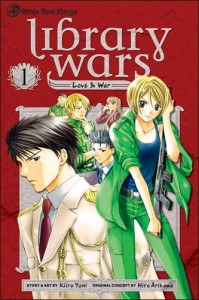
If I were thirteen years old, Library Wars would be at the top of my Best Manga Ever list, as it reads like a catalog of the things I dug in my early teens: books about the future, books about women breaking into male professions, books with bickering leads who harbor secret feelings for each other. I can’t say that Library Wars works as well for me as an adult, but I can recommend it to younger female manga fans who are tired of stories about wallflowers, doormats, or fifteen-year-old girls whose primary objective is to nab a husband.

The story focuses on Iku Hasahara, a former track star and future librarian who enlists in the Library Defense Force (LDF), a paramilitary organization dedicated to combating censorship. Formed in response to the Media Betterment Act, the LDF actively challenges the national government’s efforts to remove books from stores and libraries, using weapons and strong-arm tactics when necessary. Iku is the only female recruit who can keep pace with the guys, push-up for push-up, and is the frequent target of abuse from Atsushi Dojo, a handsome drill sergeant who takes grim delight in pointing out her weaknesses. (Her mastery of the Japanese Decimal System leaves a lot to be desired.) As Iku advances through basic training, however, she begins to realize that Dojo isn’t so bad; his sometimes brusque demeanor masks genuine concern for his pupil, and a sincere desire to help her become a top-notch officer.

Library Wars‘ premise certainly invites comparisons with Fahrenheit 451. The future society depicted in Library Wars isn’t nearly as bleak or disorderly as the one Ray Bradbury imagined back in 1951, but creators Hiro Arakawa and Kiiro Yumi are just as insistent on the importance of standing up for free speech; Iku joined the Defense Forces after the Media Betterment Committee’s jack-booted thugs attempted to confiscate a book from her. (A hot guy also factored into her decision to enlist.) The MBC is as arbitrary and ruthless as the Firemen of Fahrenheit 451, working hard to restrict citizens’ access to potentially “harmful” materials, even going so far as to infiltrate libraries to weed out undesirable material.

In adapting Library Wars from novel to manga, however, Kiiro Yuki places less emphasis on the book-banning crisis and more on her characters’ relationships, preserving just enough background about the LDF’s history to justify the action sequences. That’s not necessarily a bad choice; Iku and Dojo’s banter has a pleasant, antagonistic zing to it that infuses the boot camp scenes with some playful energy. The LDF’s rationale for existing, however, often seems underdeveloped, as we don’t know what prompted the national government to pass the Betterment Act. In leaving these details vague, one could argue that Yuki is simply being true to historical fact; oppressive regimes from tsarist Russia to Maoist China have arbitrarily banned books and condemned authors in the interest of “the national welfare,” yet in the context of the Library Wars manga, that lack of specificity comes off as sloppiness. We don’t know whether censorship is having a real impact on citizens’ ability to say and think what they please; the few scenes in which we glimpse the MBC in action suggest that they’re more of a nuisance than a genuine threat to the social order.

The artwork is serviceable but not great. The character designs are about as basic as they get, with haircuts playing a pivotal role in establishing each cast member’s personality; we know Iku is a tomboy from her sensible and slightly androgynous bob, for example, while Dojo’s neat ‘do paints him as a hardcore military man. (By contrast, Sgt. Komaki, the series’ designated McDreamy character, has the kind of tousled locks that wouldn’t pass muster in the Marines.) The action scenes are hasty affairs, rendered with little respect for continuity or background detail, while the layouts often feel busy, with too many small panels and design elements hampering the visual flow.

If the censorship theme and artwork aren’t as well executed as I might have hoped, Library Wars earns high marks for having a smart, capable heroine and a smart, topical premise. Iku may not be a wonder woman, but she’s a plausible mixture of strength and uncertainty; teen girls will relate to her shifting moods, fierce temper, and high principles, even if they can’t agree whether she should end up with Dojo. And really, what’s not to like about a series that features hot guys who hate censorship but like books, libraries, and butt-kicking women? Now there’s a fantasy female readers of all ages can endorse.

LIBRARY WARS: LOVE & WAR, VOL. 1 • STORY & ART KIIRO YUMI, ORIGINAL CONCEPT BY HIRO ARAKAWA • VIZ • 200 pp. • RATING: OLDER TEEN (16+)

Filed Under: Manga, Manga Critic, REVIEWS Tagged With: Sci-Fi, shojo beat, VIZ

Library Wars: Love & War, Vol. 1

June 1, 2010 by Katherine Dacey

LibraryWars1If I were thirteen years old, Library Wars would be at the top of my Best Manga Ever list, as it reads like a catalog of the things I dug in my early teens: books about the future, books about women breaking into male professions, books with bickering leads who harbor secret feelings for each other. I can’t say that Library Wars works as well for me as an adult, but I can recommend it to younger female manga fans who are tired of stories about wallflowers, doormats, or fifteen-year-old girls whose primary objective is to nab a husband.

The story focuses on Iku Hasahara, a former track star and future librarian who enlists in the Library Defense Force (LDF), a paramilitary organization dedicated to combating censorship. Formed in response to the Media Betterment Act, the LDF actively challenges the national government’s efforts to remove books from stores and libraries, using weapons and strong-arm tactics when necessary. Iku is the only female recruit who can keep pace with the guys, push-up for push-up, and is the frequent target of abuse from Atsushi Dojo, a handsome drill sergeant who takes grim delight in pointing out her weaknesses. (Her mastery of the Japanese Decimal System leaves a lot to be desired.) As Iku advances through basic training, however, she begins to realize that Dojo isn’t so bad; his sometimes brusque demeanor masks genuine concern for his pupil, and a sincere desire to help her become a top-notch officer.

…

Read More

Filed Under: Manga Critic Tagged With: shojo, VIZ

You’re So Cool, Vols. 1-6

June 1, 2010 by MJ 1 Comment

You’re So Cool | By YoungHee Lee | Published by Yen Press | Rated T (Teens) – My big news for the afternoon is the event of my guest review of YoungHee Lee’s You’re So Cool (full series) over at Brigid Alverson’s MangaBlog. This is a series that began on weak footing with me, setting itself up to be another Hot Gimmick or Black Bird or any number of other girls’ comic series dedicated to romanticizing smug, controlling men.

Fortunately, by the time I got around to this series, there was enough of it released for me to avoid being turned off by just the first couple of volumes. It’s not a perfect series by any means, but the romantic content is surprisingly satisfying (thanks mainly to the series’ secondary romance) and its heroine is the most endearing little tomboy you’ll ever meet. The artist doesn’t go crazy prettying her up in the later volumes, either, which is a refreshing choice indeed.

This is also my very first guest review at MangaBlog, so if you like it, be sure to say so! Click here for more!

Filed Under: Manhwa Bookshelf, MANHWA REVIEWS Tagged With: yen press

13th Boy, Vol. 2

June 1, 2010 by MJ 1 Comment

13th Boy, Vol. 2 | By SangEun Lee | Published by Yen Press – Still determined that Won-Jun is her destined true love, Hee-Soo campaigns to join the Girl Scouts so that she can attend the joint scouts camping trip along with him. The scouts are reluctant to accept Hee-Soo into their ranks since she is applying well after the deadline (and they suspect her motives are far from pure) but when Hee-Soo miraculously passes their impossible test for membership they are unable to refuse. Meanwhile, more is revealed about Whie-Young’s supernatural powers and the long-standing romantic triangle between him, Won-Jun, and Sae-Bom which Hee-Soo has complicated further. Most importantly, however, talking cactus Beatrice has a mysterious secret which provides this volume’s greatest shock!

What was charming but incoherent in the first volume of this unusual supernatural romance has become simply charming in its second volume now that the story has apparently hit its stride. Without losing any of the elements that made the first volume so perfectly whimsical (strange teenagers, hints of magic, talking plant life), the relationships between the characters are finally taking shape, though much mystery still remains. What is the true nature of Whie-Young’s magic? Why doesn’t Hee-Soo remember her childhood friendship with him? What on earth is the deal with Beatrice? These questions linger on, but there is enough solid ground to stand on to make this story’s foundation comfortably secure.

Though Hee-Soo’s unwavering pursuit of Won-Jun could easily become too strident to bear (the heroine of Sarasah comes to mind) her sincerity and determination to remain smiling as he repeatedly (but not unkindly) rejects her make her too sympathetic to dislike. It is quite painful to watch the four-way tangle of unrequited love between Hee-Soo, Won-Jun, Sae-Bom, and Whie-Young, but there is enough real affection between them all–even Hee-Soo who is the outsider of the group–to render each of them likable in his/her own way. It is especially refreshing to see them take steps to save each other from pain and public humiliation, including those who are rivals. There is real kindness in each of these characters, no matter how hard they work to hide it.

With its nuanced relationships, idiosyncratic characters, supernatural themes, quirky art, and sense of true whimsy, 13th Boy is a real winner with me. Let’s hope it continues to build on this new strength!

Review copy provided by the publisher.

Filed Under: Manhwa Bookshelf, MANHWA REVIEWS Tagged With: 13th boy, yen press

  • « Go to Previous Page
  • Page 1
  • Page 2
  • Page 3
  • Page 4
  • Page 5
  • Go to Next Page »
 | Log in
Copyright © 2010 Manga Bookshelf | Powered by WordPress & the Genesis Framework