• Skip to primary navigation
  • Skip to main content
  • Skip to primary sidebar
  • Home
  • About Us
    • Privacy Policy
    • Comment Policy
    • Disclosures & Disclaimers
  • Resources
    • Links, Essays & Articles
    • Fandomology!
    • CLAMP Directory
    • BlogRoll
  • Features & Columns
    • 3 Things Thursday
    • Adventures in the Key of Shoujo
    • Bit & Blips (game reviews)
    • BL BOOKRACK
    • Bookshelf Briefs
    • Bringing the Drama
    • Comic Conversion
    • Fanservice Friday
    • Going Digital
    • It Came From the Sinosphere
    • License This!
    • Magazine no Mori
    • My Week in Manga
    • OFF THE SHELF
    • Not By Manga Alone
    • PICK OF THE WEEK
    • Subtitles & Sensibility
    • Weekly Shonen Jump Recaps
  • Manga Moveable Feast
    • MMF Full Archive
    • Yun Kouga
    • CLAMP
    • Shojo Beat
    • Osamu Tezuka
    • Sailor Moon
    • Fruits Basket
    • Takehiko Inoue
    • Wild Adapter
    • One Piece
    • After School Nightmare
    • Karakuri Odette
    • Paradise Kiss
    • The Color Trilogy
    • To Terra…
    • Sexy Voice & Robo
  • Browse by Author
    • Sean Gaffney
    • Anna Neatrour
    • Michelle Smith
    • Katherine Dacey
    • MJ
    • Brigid Alverson
    • Travis Anderson
    • Phillip Anthony
    • Derek Bown
    • Jaci Dahlvang
    • Angela Eastman
    • Erica Friedman
    • Sara K.
    • Megan Purdy
    • Emily Snodgrass
    • Nancy Thistlethwaite
    • Eva Volin
    • David Welsh
  • MB Blogs
    • A Case Suitable For Treatment
    • Experiments in Manga
    • MangaBlog
    • The Manga Critic
    • Manga Report
    • Soliloquy in Blue
    • Manga Curmudgeon (archive)

Manga Bookshelf

Discussion, Resources, Roundtables, & Reviews

vertical

Black Jack, Vols. 1-2

December 15, 2010 by Katherine Dacey 9 Comments

Black Jack practices a different kind of medicine than the earnest physicians on Grey’s Anatomy or ER, taking cases that push the boundary between science and science fiction. In the first two volumes of Black Jack alone, the good doctor tests his surgical mettle by:

  • Performing a brain transplant
  • Separating conjoined twins
  • Operating on a killer whale
  • Operating blind
  • Operating on a man who’s been hit by a bullet train
  • Operating on twelve patients at once… without being sued for medical malpractice.

Osamu Tezuka’s own medical training is evident in the detailed drawings of muscle tissue, livers, hearts, and brains. Yet these images are beautifully integrated into his broad, cartoonish vocabulary, making the surgical scenes pulse with life. These procedures get an additional jolt of energy from the way Tezuka stages them; he brings the same theatricality to the operating room that John Woo does to shoot-outs and hostage crises, with crazy camera angles and unexpected complications that demand split-second decision-making from the hero.

At the same time, however, a more adult sensibility tempers the bravado displays of surgical acumen. Black Jack’s medical interventions cure his patients but seldom yield happy endings. In “The Face Sore,” for example, a man seeks treatment for a condition that contorts his face into a grotesque mask of boils. Jack eventually restores the man’s appearance, only to realize that the organism causing the deformation had a symbiotic relationship with its host; once removed, the host proves even more hideous than his initial appearance suggested. “The Painting Is Dead!” offers a similarly bitter twist, as Jack prolongs a dying artist’s life by transplanting his brain into a healthy man’s body. The artist longs to paint one final work — hence the request for a transplant — but finds himself incapable of realizing his vision until radiation sickness begins corrupting his new body just as it did his old one. Jack may profess to be indifferent to both patients’ suffering, insisting he’s only in it for the money, but that bluster conceals a painful truth: Jack knows all too well that he can’t heal the heart or mind.

The only thing that dampened my enthusiasm for Black Jack was the outdated sexual politics. In “Confluence,” for example, a beautiful young medical student is diagnosed with uterine cancer. Tezuka diagrams her reproductive tract, explaining each organ’s function and describing what will happen to this luckless gal if they’re removed:

As you know, the uterus and ovaries secrete crucial hormones that define a woman’s sex. To have them removed is to quit being a woman. You won’t be able to bear children, of course, and you’ll become unfeminine.

Too bad Tezuka never practiced gynecology; he might have gotten an earful (and a black eye or two) from some of his “unfeminine” patients.

I also found the dynamic between Jack and his sidekick Pinoko, a short, slightly deformed child-woman, similarly troubling. Though Pinoko has the will and libido of an adult, she behaves like a toddler, pouting, wetting herself, running away, and lisping in a babyish voice. She’s mean-spirited and possessive, behaving like a jealous lover whenever Jack mentions other women, even those who are clearly seeking his medical services. These scenes are played for laughs, but have a creepy undercurrent; it’s hard to know if Pinoko is supposed to be a caricature of a housewife or just a vaguely incestuous flourish in an already over-the-top story. Thankfully, these Pygmalion-and-Galatea moments are few and far between, making it easy to bypass them altogether. Don’t skip the story in which Jack first creates Pinoko from a teratoid cystoma, however; it’s actually quite moving, and at odds with the grotesque domestic comedy that follows.

If you’ve never read anything by Tezuka, Black Jack is a great place to begin exploring his work. Tezuka is at his most efficient in this series, distilling novel-length dramas into gripping twenty-page stories. Though Tezuka is often criticized for being too “cartoonish,” his flare for caricature is essential to Black Jack; Tezuka conveys volumes about a character’s past or temperament in a few broad strokes: a low-slung jaw, a furrowed brow, a big belly. That visual economy helps him achieve the right balance between medical shop-talk and kitchen-sink drama without getting bogged down in expository dialogue. The result is a taut, entertaining collection of stories that offer the same mixture of pathos and medical mystery as a typical episode of House, minus the snark and commercials. Highly recommended.

This is a synthesis of two reviews that originally appeared at PopCultureShock on 10/26/2008 and 11/4/08. I’ve also reviewed volumes five and eleven here at The Manga Critic.

BLACK JACK, VOLS. 1-2 • BY OSAMU TEZUKA • VERTICAL, INC.

Filed Under: Manga Critic Tagged With: Classic, Medical, Osamu Tezuka, vertical

The Best Manga of 2010: The Manga Critic’s Picks

December 6, 2010 by Katherine Dacey 16 Comments

For all the upheaval within the manga industry — the demise of CMX, Del Rey, and Go! Comi, the layoffs at VIZ — 2010 proved an exceptionally good year for storytelling. True, titles like Black Butler, Naruto, and Nabari no Ou dominated sales charts, but publishers made a concerted effort to woo grown-ups with vintage manga — Black Blizzard, A Drunken Dream and Other Stories — edgy sci-fi — Biomega, 7 Billion Needles — underground comix — AX: A Collection of Alternative Manga, The Box Man — and good old-fashioned drama — All My Darling Daughters, Bunny Drop. I had a hard time limiting myself to just ten titles this year, so I’ve borrowed a few categories from my former PCS cohort Erin Finnegan, from Best New Guilty Pleasure to Best Manga You Thought You’d Hate. Please feel free to add your own thoughts: what titles did I unjustly omit? What titles did I like but you didn’t? Inquiring minds want to know!

10. CROSS GAME (Mitsuri Adachi; VIZ)

In this sometimes funny, sometimes melancholy coming-of-age story, a family tragedy brings teenager Ko Kitamura closer to neighbor Aoba Tsukishima, with whom he has a fraught relationship. Though the two bicker with the antagonistic gusto of Beatrice and Benedict, their shared love of baseball helps smooth the course of their budding romance. To be sure, Cross Game can’t escape a certain amount of sports-manga cliche, but Mitsuri Adachi is more interested in showing us how the characters relate to each other than in celebrating their amazing baseball skills. (Not that he skimps on the game play; Adachi clearly knows his way around the diamond.) The result is an agreeable dramedy that has the rhythm of a good situation comedy and the emotional depth of a well-crafted YA novel, with just enough shop-talk to win over baseball enthusiasts, too.

9. AX: A COLLECTION OF ALTERNATIVE MANGA (Various Artists; Top Shelf)

The next time someone dismisses manga as a “style” characterized by youthful-looking, big-eyed characters with button noses, I’m going to hand them a copy of AX, a rude, gleeful, and sometimes disturbing rebuke to the homogenized artwork and storylines found in mainstream manga publications. No one will confuse AX for Young Jump or even Big Comic Spirits; the stories in AX run the gamut from the grotesquely detailed to the playfully abstract, often flaunting their ugliness with the cheerful insistence of a ten-year-old boy waving a dead animal at squeamish classmates. Nor will anyone confuse Yoshihiro Tatsumi or Einosuke’s outlook with the humanism of Osamu Tezuka or Keiji Nakazawa; the stories in AX revel in the darker side of human nature, the part of us that’s fascinated with pain, death, sex, and bodily functions. Like all anthologies, the collection is somewhat uneven, with a few too many scatological tales for its own good, but the very best stories — “The Hare and the Tortoise,” “Push Pin Woman,” “Six Paths of Wealth,” “Puppy Love,” “Inside the Gourd” — attest to the diversity of talent contributing to this seminal manga magazine. –Reviewed at The Manga Critic on 5/21/10

8. NEKO RAMEN (Kenji Sonishi; Tokyopop)

If you’ve ever lived with a cat or dog, you know that no meal is complete without a pet hair garnish. Now imagine that your beloved companion actually prepared your meals instead of watching you eat them: what sort of unimaginable horrors might you encounter beyond the stray hair? That’s the starting point for Neko Ramen, a 4-koma manga about a cat whose big dream is to run a noodle shop, but author Kenji Sonishi quickly moves past hair balls and litter box jokes to mine a richer vein of humor, poking fun at his cat cook’s delusions of entrepreneurial grandeur. Taisho is the Don Quixote of ramen vendors, dreaming up ludicrous giveaways and unappetizing dishes in an effort to promote his business, never realizing that he is the store’s real selling point. The loose, sketchy artwork gives the series an improvisational feel, while the script has the pleasant, absurdist zing of an Abbott and Costello routine. –Reviewed at The Manga Critic on 6/2/10

7. AYAKO (Osamu Tezuka; Vertical, Inc.)

Combining the psychological realism of Dostoevsky with the social consciousness of Tolstoy and Zola, Osamu Tezuka uses conflicts within the once-powerful Tenge clan to dramatize the social, political, and economic upheaval caused by the American occupation of post-war Japan. No subject is off-limits for Tezuka: the Tenge commit murders, spy for the Americans, join the Communist Party, imprison a family member in an underground cell, and engage in incest. It’s one of Tezuka’s most sober and damning stories, at once tremendously powerful and seriously disturbing, with none of the cartoonish excess of Ode to Kirihito or MW. The ending is perhaps too pat and loaded with symbolism for its own good, but like Tezuka’s best work, Ayako forces the reader to confront the darkest, most corruptible corners of the human soul. As with Apollo’s Song, Black Jack, and Buddha, Vertical has done a superb job of making Tezuka accessible to Western readers with flipped artwork and a fluid translation.

6. BUNNY DROP (Yumi Unita; Yen Press)

Stop me if you’ve heard this one before: a thirty-something bachelor unexpectedly becomes a parent to a cute little girl, leading to hijinks, misunderstandings, and heart-tugging moments. That’s a fair summary of what happens in Bunny Drop, but Yumi Unita wisely avoids the pitfalls of the single-dad genre — the cheap sentiment, the unfunny scenes of dad recoiling in horror at diapers, runny noses, and tears — instead focusing on the unique bond between Daikichi and Rin, the six-year-old whom he impetuously adopts after the rest of the family disavows her. (Rin is the product of a liaison between Daikichi’s grandfather and a much younger woman.) Though Daikichi struggles to find day care, buy clothes for Rin, and make sense of her standoffish behavior, he isn’t a buffoon or a straight man for Rin’s antics; Unita portrays him as a smart, sensitive person blessed with good instincts and common sense. Clean, expressive artwork and true-to-life dialogue further inoculate Bunny Drop against a terminal case of sitcom cuteness, making it one of the most thoughtful, moving, and adult manga of the year.

5. BLACK BLIZZARD (Yoshihiro Tatsumi; Drawn & Quarterly)

Written in just twenty days, this feverish pulp thriller plays like a mash-up of The Fugitive, The 39 Steps, and The Defiant Ones as two convicts — one a hardened criminal, the other a down-on-his luck musician — go on the lam during a blinding snowstorm. The heroes are more archetypes than characters, drawn in bold strokes, but the interaction between them crackles with antagonistic energy; they’re as much enemies as partners, roles that they constantly renegotiate during their escape. Evocative artwork — slashing lines, dramatic camera angles, images of speeding trains — infuses Black Blizzard with a raw, nervous energy that nicely mirrors the characters’ internal state. Only in the final, rushed pages does manga-ka Yoshihiro Tatsumi falter, tidily resolving the story through an all-too-convenient plot twist that hinges on coincidence. Still, that’s a minor criticism of a thoroughly entertaining story written during a crucial stage of Tatsumi’s artistic development. –Reviewed at The Manga Critic on 9/9/10

4. HOUSE OF FIVE LEAVES (Natsume Ono; VIZ)

Timid ronin Akitsu Masanosuke can’t hold a steady job, despite his formidable swordsmanship. When a businessman approaches him with work, Masanosuke readily accepts, not realizing that his new employer, Yaichi, runs a crime syndicate that specializes in kidnapping. Masanosuke’s unwitting participation in a blackmailing scheme prevents him from severing his ties to Yaichi; Masanosuke must then decide if he will join the House of Five Leaves or bide his time until he can escape. Though Toshiro Mifune and Hiroyuki Sanada have made entire careers out of playing characters like Masanosuke, Natsume Ono makes a persuasive case that you don’t need a flesh-and-blood actor to tell this kind of story with heartbreaking intensity; she can do the slow-burn on the printed page with the same skill as Masaki Kobayashi (Hara Kiri, Samurai Rebellion) and Yoji Yamada (The Twilight Samurai) did on the big screen. –Reviewed at The Manga Critic on 8/20/10

3. TWIN SPICA (Kou Yaginuma; Vertical, Inc.)

Asumi Kamogawa is a small girl with a big dream: to be an astronaut on Japan’s first manned space flight. Though she passes the entrance exam for Tokyo Space School, she faces several additional hurdles to realizing her goal, from her child-like stature — she’s thirteen going on eight — to a faculty member who blames her father for causing a fiery rocket crash that claimed hundreds of civilian lives. Yet for all the setbacks she’s experienced, Asumi proves resilient, a gentle girl who perseveres in difficult situations, offers friendship in lieu of judgment, and demonstrates a preternatural awareness of life’s fragility. Twin Spica follows Asumi through every stage of training, from physics lectures to zero-G simulations, showing us how she befriends her fellow cadets and gradually learns to rely on herself, rather than her imaginary friend, Mr. Lion. Though Twin Spica was serialized in a seinen magazine, it works surprisingly well for young adults, too, an all-too-rare example of a direct, heartfelt story that’s neither saccharine nor mawkish.  –Reviewed at The Manga Critic on 5/3/10

2. ALL MY DARLING DAUGHTERS (Fumi Yoshinaga; VIZ)

The five vignettes in All My Darling Daughters depict women negotiating difficult personal relationships: a daughter confronts her mother about mom’s new, much younger husband; a college student seduces her professor, only to dump him when he tries to court her properly; a beautiful young woman contemplates an arranged marriage. Like all of Yoshinaga’s work, the characters in All My Darling Daughters love to talk. That chattiness isn’t always an asset to Yoshinaga’s storytelling (see Gerard and Jacques), but here the dialogue is perfectly calibrated to reveal just how complex and ambivalent these relationships really are. Yoshinaga’s artwork is understated but effective, as she uses small details — how a character stands or carries her shoulders — to offer a more complete and nuanced portrait of each woman. Quite possibly my favorite work by Yoshinaga.

1. A DRUNKEN DREAM AND OTHER STORIES (Moto Hagio; Fantagraphics)

Not coincidentally, A Drunken Dream and Other Stories was my nomination for Best New Graphic Novel of 2010 as well. Here’s what I had to say about the title over at Flashlight Worthy Books:

Moto Hagio is to shojo manga what Will Eisner is to American comics, a seminal creator whose distinctive style and sensibility profoundly changed the medium. Though Hagio has been actively publishing stories since the late 1960s, very little of her work has been translated into English. A Drunken Dream, published by Fantagraphics, is an excellent corrective — a handsomely produced, meticulously edited collection of Hagio’s short stories that span her career from 1970 to 2007. Readers new to Hagio’s work will appreciate the inclusion of two contextual essays by manga scholar Matt Thorn, one an introduction to Hagio and her peers, the other an interview with Hagio. What emerges is a portrait of a gifted artist who draws inspiration from many sources: Osamu Tezuka and Shotaro Ishimonori, Ray Bradbury and Isaac Asimov, Frances Hodgson Burnett and L.M. Montgomery.

For the complete list — including nominations from David “Manga Curmudgeon” Welsh, Brigid “MangaBlog” Alverson, Lorena “i heart manga” Ruggero, and Matthew “Warren Peace Sings the Blues” Brady — click here. To read my full review of A Drunken Dream, click here.

HONORABLE MENTIONS

Done because there are too menny… great manga, that is, to confine myself to a traditional top ten list. With apologies to Thomas Hardy, here are some of the other titles that tickled my fancy in 2010:

  • OTHER AWESOME DEBUTS: Not Love But Delicious Foods Make Me Happy (Yen Press), Saturn Apartments (VIZ), 7 Billion Needles (Vertical, Inc.)
  • BEST CONTINUING SERIES: Itazura na Kiss (DMP), Ooku: The Inner Chambers (VIZ), Suppli (Tokyopop), 20th Century Boys (VIZ)
  • BEST NEW ALL-AGES MANGA: Chi’s Sweet Home (Vertical, Inc.)
  • BEST NEW SERIES THAT’S ALREADY ON HIATUS: Diamond Girl (CMX), Stolen Hearts (CMX)
  • BEST NEW GUILTY PLEASURE: Demon Sacred (Tokyopop), Dragon Girl (Yen Press)
  • BEST REPRINT EDITION: Cardcaptor Sakura (Dark Horse), Little Butterfly Omnibus (DMP)
  • BEST MANGA I THOUGHT I’D HATE: Higurashi When They Cry: Beyond Midnight Arc (Yen Press)
  • BEST FINALE: Pluto: Tezuka x Urasawa (VIZ)

Filed Under: Manga Critic Tagged With: cmx, Dark Horse, DMP, Drawn & Quarterly, fantagraphics, fumi yoshinaga, moto hagio, Naoki Urasawa, Osamu Tezuka, SigIKKI, Tokyopop, Top Shelf, vertical, VIZ, yen press, Yoshihiro Tatsumi

7 Billion Needles, Vols. 1-2

November 21, 2010 by Katherine Dacey

First published in 1950, Hal Clement’s Needle was a unique mixture of hard science fiction and police procedural. The story focused on an alien detective who crash-lands on Earth while chasing an intergalactic criminal. With his ship destroyed and his symbiant companion dead, The Hunter takes up residence inside a teenager’s body, eventually persuading his host to help him find the fugitive — no mean feat, as the fugitive can also hide, undetected, inside a human host.

The story was notable, in part, for Clement’s meticulous, detailed study of the alien’s physiology. Drawing on mid-century research on microorganisms, Clement imagined a highly intelligent, adaptable creature capable of manipulating its body to squeeze through tiny spaces and make use of its host’s sensory organs to learn more about its surroundings. Needle was also notable for the way in which Clement folded these speculative passages into an old-fashioned detective story; once The Hunter begins communicating directly with Bob, his host, the two retrace the fugitive’s steps, investigating everyone who might have come into contact with it and systematically ruling out suspects through careful observation of their behavior.

Nobuaki Tadano’s 7 Billion Needles (2008-10) draws inspiration from Clement’s novel, preserving the basic concept while tweaking the storyline to work in a graphic format. Gone are the long passages explaining how Horizon (as the alien detective is called in 7 Billion Needles) insinuates himself into his human host; in their place are more direct, dramatic scenes showing us how Horizon’s host, a sullen teenage girl named Hikaru, wrestles with the emotional and physical burden of helping him pursue Maelstrom, a shape-shifting creature so powerful he’s left a trail of dead planets in his wake.

As a result, 7 Billion Needles reads more like horror than hard science fiction, placing more emphasis on monster-hunting and raw adolescent emotion than the mechanics of Horizon and Hikaru’s symbiotic relationship. Tadano’s choices make good sense from the standpoint of pacing and visual drama; so much of the original novel took place inside Bob, it’s hard to imagine how an artist would have brought those passages to life in comic-book form. (That summary makes Needle sound impossibly dirty, but rest assured, it isn’t.) Tadano’s monster, too, is much better defined than Clement’s; Clement’s fugitive only appears in the final chapters of the book, the nature of his crime never fully explained, whereas Maelstrom, Tadano’s creation, is something out of a good B-movie, causing his host du jour to undergo grotesque transformations before going all-out alien.

The real genius of 7 Billion Needles, however, is the way Tadano uses teen angst as a key plot element. In the very first pages of volume one, we learn that Hikaru is an orphan, living with an aunt and uncle not much older than she is. As the story unfolds, Tadano seeds the conversation with nuggets of information about Hikaru’s past; in volume two, for example, we learn that Hikaru and her father had lived on a small island, where they became social pariahs, enduring threats, taunts, and vandalism from their neighbors. Not surprisingly, Hikaru is withdrawn at the beginning of 7 Billion Needles, openly defying teachers by wearing headphones in class and avoiding even the most basic interaction with her peers. Once she agrees to help Horizon, however, she must begin talking to other people — the only way Horizon can detect Malestrom’s presence is for Hikaru to interact with Maelstrom’s host. Her awkward attempts to connect with other students, and her fumbling efforts at friendship, add a raw emotional energy to 7 Billion Needles that is largely absent from Clement’s original story.

The series’ artwork is its only shortcoming. As Deb Aoki noted in her review of volume one, all the female characters have the same bland, plastic face, making them difficult to distinguish from one another. (Tadano’s rather weak efforts at creating a memorable supporting cast also contribute to the impression of sameness.) Some of the monster designs, too, lack inspiration — a key shortcoming in a genre known for its nightmarish, otherworldly imagery. When we first see Maelstrom in his true form, he looks like a tyrannosaurus rex; not until the second volume are we treated to a more terrifying and unsettling image of Malestrom as a grotesque composite of all the human beings he’s ingested. Perhaps most disappointing is Tadano’s over-reliance on the flash-boom, using big bursts of light and sound effects to indicate Horizon’s powers without really showing us what’s happening.

On the whole, however, 7 Billion Needles is an intelligent update on Needle, substituting the heat of adolescent angst and monster-slaying for the cool detachment of hard science and old-fashioned gumshoeing. Recommended.

Review copies provided by Vertical, Inc. Volume two will be released on November 23, 2010.

7 BILLION NEEDLES, VOLS. 1-2 • BY NOBUAKI TADANO • VERTICAL, INC. • RATING: 16+

Filed Under: Manga Critic Tagged With: Hal Clement, Seinen, vertical

My 10 Favorite Spooky Manga

October 24, 2010 by Katherine Dacey 38 Comments

Whether by accident or design, the very first manga I read and liked were horror titles: “The Laughing Target,” Mermaid Saga, Uzumaki. I’m not sure why I find spooky stories so compelling in manga form; I don’t generally read horror novels, and I don’t have the constitution for gory movies. But manga about zombies? Or vampires? Or angry spirits seeking to avenge their own deaths? Well, there’s always room on my bookshelf for another one, even if the stories sometimes feel overly familiar or — in the case of artists like Kanako Inuki and Kazuo Umezu — make no sense at all. Below is a list of my ten favorite scary manga, which run the gamut from psychological horror to straight-up ick.

10. LAMENT OF THE LAMB

KEI TOUME • TOKYOPOP • 7 VOLUMES

Kei Toume puts a novel spin on vampirism, presenting it not as a supernatural phenomenon, but as a symptom of a rare genetic disorder. His brother-and-sister protagonists, Kazuna and Chizuna, begin exhibiting the same tendencies as their deceased mother, losing control at the sight or suggestion of blood, and enduring cravings so intense they induce temporary insanity. Long on atmosphere and short on plot, Lament of the Lamb won’t be every vampire lover’s idea of a rip-snortin’ read; the manga focuses primarily on the intense, unhealthy relationship between Kazuna and Chizuna, and very little on blood-sucking. What makes Lament of the Lamb so deeply unsettling, however, is the strong current of violence and fear that flows just beneath its surface; Kazuna and Chizuna may not be predators, but we see just how much self-control it takes for them to contain their bloodlust.

9. SCHOOL ZONE

KANAKO INUKI • DARK HORSE • 3 VOLUMES

In this odd, hallucinatory, and sometimes very funny series, a group of students summon the ghosts of people who died on school grounds, unleashing the spirits’ wrath on their unsuspecting classmates. School Zone is as much a meditation on childhood fears of being ridiculed or ostracized as it is a traditional ghost story; time and again, the students’ own response to the ghosts is often more horrific than the ghosts’ behavior. Inuki’s artwork isn’t as gory or imaginative as some of her peers’, though she demonstrates a genuine flair for comically gruesome thrills: one girl is dragged into a toilet, for example, while another is attacked by a scaly, long-armed creature that lives in the infirmary. Where Inuki really shines, however, is in her ability to capture the primal terror that a dark, empty building can inspire in the most rational person. Even when the story takes one its many silly detours — and yes, there are many WTF?! moments in School Zone — Inuki makes us feel her characters’ vulnerability as they explore the school grounds after hours. —Reviewed at The Manga Critic on 10/29/09

8. MAIL

HOUSUI YAMAKAZI • DARK HORSE • 3 VOLUMES

If you like you horror neat with a twist, Mail might be your kind of manga: a meticulously crafted selection of short, spooky tales in which a handsome exorcist goes toe-to-toe with all sort of ghosts. The stories are a mixture of urban legend and folklore: a GPS system which directs a woman to the scene of a crime, an accident victim who haunts the elevator shaft where he died, a possessed doll. Through precise linework and superb command of light, Hosui Yamakazi transforms everyday situations — returning home from work, logging onto a computer — into extraordinary ones in which shadows and corners harbor very nasty surprises. Best of all, Mail never overstays its welcome; it’s the manga equivalent of the Goldberg Variations, offering a number of short, trenchant variations on a single theme and then wrapping things up neatly.

7. AFTER SCHOOL NIGHTMARE

SETONA MITZUSHIRO • GO! COMI • 10 VOLUMES

Masahiro, a charming, popular high school student, harbors a terrible secret: though he appears to be male, the lower half of his body is female. At a nurse’s urging, he agrees to visit the school infirmary for a series of dream workshops in which he interacts with classmates who are also grappling with serious problems, from child abuse to pathological insecurity. The students’ collective dreams are vivid and strange, unfolding with the peculiar, fervid logic of a nightmare; buildings flood, stairwells lead to dead ends, and characters undergo sudden, dramatic transformations. Making the dream sequences extra creepy is the way Setona Mizushiro renders the students, choosing an avatar for each that represents their true selves: a black knight, a faceless body, a long, disembodied arm that grasps and slithers. Attentive readers will be rewarded for their patient observation with an unexpected but brilliant twist in the very final pages.

6. THE DRIFTING CLASSROOM

KAZUO UMEZU • VIZ • 11 VOLUMES

It’s sorely tempting to compare The Drifting Classroom to The Lord of the Flies, as both stories depict school children creating their own societies in the absence of adult authority. But Kazuo Umezu’s series is more sinister than Golding’s novel, as Classroom‘s youthful survivors have been forced to band together to defend themselves from their former teachers, many of whom have become unhinged at the realization that they may never return to their own time. (Their entire elementary school has slipped through a rift in the space-time continuum, depositing everyone in the distant future.) The story is as relentless as an episode of 24: characters are maimed or killed in every chapter, and almost every line of dialogue is shouted. (Sho’s petty arguments with his mother are delivered as emphatically as his later attempts to alert classmates to the dangers of their new surroundings.) Yet for all its obvious shortcomings, Umezu creates an atmosphere of almost unbearable tension that conveys both the hopelessness of the children’s situation and their terror at being abandoned by the grown-ups. If that isn’t the ultimate ten-year-old’s nightmare, I don’t know what is. —Reviewed at PopCultureShock on 10/15/06

5. MERMAID SAGA

RUMIKO TAKAHASHI • VIZ • 4 VOLUMES

This four-volume series ran on and off in Shonen Sunday for nearly ten years, chronicling the adventures of Yuta, a fisherman who gained immortality by eating mermaid flesh. Desperate to live an ordinary existence, Yuta spends five hundred years wandering Japan in search of a mermaid who can restore his mortality, crossing paths with criminals, immortals, and “lost souls,” people reduced to a monstrous condition by the poison in mermaid flesh. Though the stories follow a somewhat predictable pattern, Takahashi’s writing is brisk and assured, propelled by snappy dialogue and genuinely creepy scenarios. The imagery is tame by horror standards, but Takahashi doesn’t shy away from the occasional grotesque or gory image, using them to underscore the ugly consequences of seeking immortality. –Reviewed at The Manga Critic on 10/29/09.

4. DORORO

OSAMU TEZUKA • VERTICAL, INC. • 3 VOLUMES

The next time you feel inclined to criticize your parents, remember Hyakkimaru’s plight: his father pledged Hyakkimaru’s body parts to forty-eight demons in exchange for political power, leaving his son blind, deaf, and limbless at birth. After being rescued and raised by a kindly doctor, Hyakkimaru embarks on a quest to reclaim his eyes and ears, wandering across a war-torn landscape where demons take advantage of the chaos to prey on humans. Some of these demons have obvious antecedents in Japanese folklore (e.g. a nine-tailed fox), while others seem to have sprung full-blown from Tezuka’s imagination (e.g. a shark who paralyzes his victims with sake breath). Though the story ostensibly unfolds during the Warring States period, Dororo wears its allegory lightly, focusing primarily on swordfights, monster lairs, and damsels in distress while using its historical setting to make a few modest points about the corrosive influence of greed, power, and fear. For my money, one of Tezuka’s best series, peroid. —Reviewed at The Manga Critic on 7/27/09

3. PARASYTE

HITOSHI IWAAKI • DEL REY • 8 VOLUMES

Part The Defiant Ones, part Invasion of the Body Snatchers, Parasyte focuses on the symbiotic relationship between Shin, a high school student, and Migi, the alien parasite that takes up residence in his right hand after failing to take control of Shin’s brain. The two go on the lam after another parasite kills Shin’s mother — and makes Shin and Migi look like the culprits. If the human character designs are a little blank and clumsy, the parasites are not; Hitoshi Iwaaki twists the human body into some of the most sinister-looking shapes since Pablo Picasso painted Dora Maar. The violence is graphic but not sadistic, as most of the action takes place between panels, with only the grisly aftermath represented in pictorial form. The best part of Parasyte, however, is the script; Shin and Migi trade barbs with the antagonistic affection of Oscar Madison and Felix Unger, revealing Migi to be smarter and more objective than his human host. Shin and Migi’s banter adds an element of levity to the story, to be sure, but their heated debates about survival are also a sly poke at the idea that human beings’ intellect and emotional attachments place them squarely atop the food chain. –Reviewed at The Manga Critic on 7/2/10

2. THE KUROSAGI CORPSE DELIVERY SERVICE

EIJI OTSUKI AND HOUSUI YAMAKAZI • DARK HORSE • 13+ VOLUMES

The Kurosagi Corpse Delivery Service is comprised of five members: Karatsu, a monk-in-training; Numata, a hipster with an encyclopedic knowledge of pop culture; Yata, an odd duck who communicates primarily through a puppet that he wears on his left hand; Makino, a chatty embalmer; and Sasaki, a hacker with an entrepreneurial streak. Working as a team, the quintet helps the dead cross over, using their myriad talents to locate bodies, speak with ghosts, and resolve the spirits’ unfinished business. The set-up is pure gold, giving the episodic series some structure, while allowing Eiji Otsuka and Housui Yamakazi the flexibility to stage grisly murders and discover corpses in a variety of unexpected places. Think Scooby Doo with less wholesome protagonists and scarier spooks and you have a good idea of what makes this offbeat series tick. And yes, the gang even has their own van. —Reviewed at The Manga Critic on 6/24/09

1. GYO

JUNJI ITO • VIZ • 2 VOLUMES

From the standpoint of craft, Uzumaki is a better manga, but it’s hard to top the sheer creepiness factor of Gyo, which taps into one of the most primordial of fears: being eaten! Here’s how I explained its appeal to David Welsh at The Comics Reporter:

Like many other children of the 1970s, Jaws left an indelible impression on me. I wasn’t just terrified of swimming in the ocean, I was reluctant to immerse myself in any standing body of water — swimming pools, bathtubs, ponds — that might conceivably harbor a shark. That irrational fear of encountering a great white somewhere it’s not supposed to be even led me to wonder what it might be like to bump into one on land — could I outrun it?

I’m guessing Junji Ito also suffers from icthyophobia, because Gyo looks like my worst nightmare, a world in which hideously deformed fish crawl out of the sea on mechanical legs and terrorize humans, spreading a disease that quickly jumps species. As horror stories go, many of Gyo‘s details aren’t terribly well explained — how, exactly, the fish acquired legs remains unclear despite talk of military experiments gone awry — but the imaginative artwork appeals on a visceral level. Gyo‘s highpoint comes midway through volume one, when a great white shark chases the hero and his girlfriend through a house, even scaling the stairs (no pun intended) in pursuit of its next meal. The scene is utterly ridiculous, but it works — for a few terrible, thrilling pages I learned the answer to my long-standing question, What would it be like to be chased by a shark on land? In a word: scary.

In other words, this is my worst nightmare:

So those are ten of my favorite spooky manga! What horror manga are on your top-ten list? Inquiring minds want to know!

Filed Under: Manga Critic Tagged With: Dark Horse, del rey, Eiji Otsuka, Go! Comi, Hitoshi Iwaaki, Horror/Supernatural, Housui Yamakazi, Junji Ito, Kanako Inuki, Kazuo Umezu, Kei Toume, Osamu Tezuka, Rumiko Takahashi, Setona Mizushiro, Tokyopop, vertical, VIZ

Vertical Licenses Velveteen & Mandara

September 19, 2010 by MJ 4 Comments

Thanks to live-tweeting from @safetygirl0, we’ve got news from Vertical’s recent panel at Anime Weekend Atlanta. Karen reports that Vertical has licensed Jiro Matsumoto’s Velveteen & Mandara (Becchin to Mandara), complete in one volume, originally serialized in Manga Erotics F. “Zombies and high school girls” was the description supplied by Marketing Manager Ed Chavez at the panel, according to Karen’s tweets.

A few other tidbits from the panel, Black Jack volume 13 has been delayed until November due to some scheduling difficulties. Also, more license announcements will be made in a few weeks at the New York Anime Festival, including an upcoming Tezuka license.

Most excitingly, there may be a classic shojo license upcoming from one of the 49ers, though perhaps not until 2012. No details on when we might know more.

Check out Karen’s Twitter Account for more!

Filed Under: NEWS Tagged With: vertical

Apollo’s Song, Vols. 1-2

September 1, 2010 by Katherine Dacey

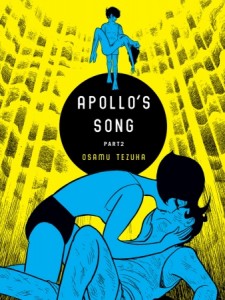
Apollo’s Song may be one of the strangest sex ed manuals ever written.

It begins with a textbook Tezuka scene, at once lyrical and goofy: millions of anthropomorphic sperm race towards a comely egg. After one lucky soul pants and claws his way to the front of the scrum, the sperm and egg dissolve into a passionate embrace. In the following panel, we see the result of their union, an embryo, presiding over a veritable sperm graveyard. This juxtaposition of life and death — or, perhaps more accurately, sex and death — foreshadows the dialectic that will play out in the following chapters.

We are then introduced to Shogo, a young man who has just arrived at a psychiatric hospital. Shogo is a sociopath: unemotional, cruel to animals, scornful of society, and deeply misogynist. While undergoing electroshock therapy, Shogo has a vivid hallucination in which a stern goddess chastises him for renouncing all forms of love. As punishment for his cruelty, she condemns him to a fate straight out of Dante’s Inferno: Shogo will love and lose the same woman over and over again for eternity. Thus begins a series of romantic and sexual encounters between Shogo and various incarnations of his ill-fated partner.

…

Read More

Filed Under: Manga Critic Tagged With: Classic, Osamu Tezuka, Shonen, vertical

Apollo’s Song, Vols. 1-2

September 1, 2010 by Katherine Dacey

Apollo’s Song may be one of the strangest sex ed manuals ever written. It begins with a textbook Tezuka scene, at once lyrical and goofy: millions of anthropomorphic sperm race towards a comely egg. After one lucky soul pants and claws his way to the front of the scrum, the sperm and egg dissolve into a passionate embrace. In the following panel, we see the result of their union, an embryo, presiding over a veritable sperm graveyard. This juxtaposition of life and death — or, perhaps more accurately, sex and death — foreshadows the dialectic that will play out in the following chapters.

We are then introduced to Shogo, a young man who has just arrived at a psychiatric hospital. Shogo is a sociopath: unemotional, cruel to animals, scornful of society, and deeply misogynist. While undergoing electroshock therapy, Shogo has a vivid hallucination in which a stern goddess chastises him for renouncing all forms of love. As punishment for his cruelty, she condemns him to a fate straight out of Dante’s Inferno: Shogo will love and lose the same woman over and over again for eternity. Thus begins a series of romantic and sexual encounters between Shogo and various incarnations of his ill-fated partner.

Though the story begins and ends in the present day, the individual episodes unfold in both the past and future, reminding the reader that Shogo cannot escape his fate. Certain recurring motifs suggest that these scenarios are, in fact, manifestations of Shogo’s subconscious as he struggles to reconcile his hatred of women with his need to be loved. In each scenario, for example, Shogo adopts a hyper-masculine guise — Nazi foot soldier, fugitive, hunter, terrorist — that he must ultimately renounce in his quest for spiritual and sexual fulfillment. We’re never entirely certain which of these episodes are unfolding in Shogo’s mind and which, if any, are unfolding in the real world.

Though Apollo’s Song aspires to universality, Tezuka’s characters remain firmly rooted in the time and place of their creation. Tezuka blames Shogo’s mother — whose crimes include an inability to lactate, promiscuity, and emotional detachment — for her son’s pathology, even treating us to a scene of the youthful Shogo walking in on his mother and a lover. While no one would deny the deleterious effects of parental neglect, Shogo’s mother seems less like a character than a casebook study out of the 1952 DSM. Other characters, such as an “artsy-fartsy,” “self-centered” career woman who defends her chastity with hysterical fury, seem like the morbidly sexual figments of a Freudian imagination.

Tezuka’s moralizing, too, has a curiously alienating effect. In the first episode, for example, Shogo imagines that he is a German soldier aboard a train bound for an unnamed concentration camp. Through the slats of a cattle car, he spots Elise, whose beauty and modesty awakens his sense of moral outrage. He rescues her first from the wreckage of the train (which is bombed by Allied forces), then from German rapists, earning her love through his selflessness. This scenario is clearly meant to teach readers that love can transcend ethnic, racial, and religious divisions, yet this epiphany is of a shallow nature, as Shogo fails to grasp the true horror of the situation or appreciate Elise’s grief at losing her entire family – in essence, the Holocaust has been reduced to a colorful backdrop for yet another of Shogo’s doomed romances.

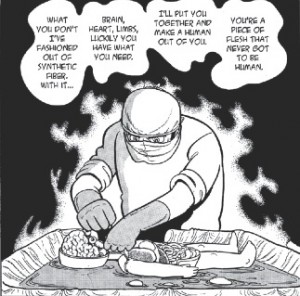
However problematic the story may be, the artwork in Apollo’s Song ranks among Tezuka’s best, filled with arresting landscapes and surprisingly carnal imagery. In chapter two, for example, Shogo finds himself stranded on a lush tropical island. Peering through a dense frame of vegetation, he spies a secluded glen where deer, panthers, and leopards embrace their mates in sexual congress. The sensuality of the moment is accentuated by their bodies’ curved lines and beatific expressions, infusing a potentially silly scene with a graceful spirituality. Later chapters also abound in vivid images; as Tezuka imagines the Tokyo of the future, the city has been transformed from a glass-and-concrete forest into an Art Deco monstrosity reminiscent of Fritz Lang’s Metropolis or a Soviet Bloc city. Its inhabitants, a race of sexless, synthetic beings that store their faces in jars, preside over a haunted landscape of tombs, forgotten infrastructure, and empty plazas; the very barrenness of the place brings the intensity of Shogo’s yearning and anger into sharp relief.

Revisiting Apollo’s Song three years after its initial release, I find myself torn. On the one hand, Tezuka’s artwork is a feast for the eyes, featuring some of the most erotic images he committed to paper. On the other hand, it’s a deeply flawed work that, in its attitudes towards women and finger-wagging tone, shows its age. Vertical has done an admirable job of fashioning a silk purse from a sow’s ear with the handsomely produced new edition, but even the knockout cover designs can’t conceal the fact that Apollo’s Song is a sour, heavy-handed tale that lacks the essential humanism – and humor – of Buddha and Phoenix.

This is a revised version of a review that appeared at PopCultureShock on 6/22/2007.

APOLLO’S SONG, VOLS. 1-2 • BY OSAMU TEZUKA • VERTICAL, INC. • RATING: OLDER TEEN (16+)

Filed Under: Manga, Manga Critic, REVIEWS Tagged With: Classic, Osamu Tezuka, Shonen, vertical

Peepo Choo, Vol. 1

July 19, 2010 by Katherine Dacey

peepochooWhen I was fifteen and in the throes of my mope-rock obsession, I fantasized a lot about England, home to my favorite bands. I imagined London, in particular, to be a place where everyone appreciated the sartorial genius of Mary Quant, fashionable ladies accessorized every outfit with a pair of shit kickers, regular moviegoers recognized Eat the Rich as brilliant satire, and — most important of all — teenage boys appreciated girls with dry, sarcastic wits and gloomy taste in music. You can guess my disappointment when I finally visited England for the first time; not only was London dirty, expensive, and filled with tweedy-looking people who found my taste in clothing odd, many of the teenagers I met were fascinated by American pop culture, pumping me and my companions for information about — quelle horror! — LL Cool J. I could have died. Though I’ve gone through similar phases since then — Russophilia, Woody Allenomania — I’ve never been able to abandon myself to those passions in quite the same way, knowing somewhere in the back of my mind that all Muscovites weren’t soulful admirers of Shostakovich and that most book editors didn’t live in pre-war sixes on the Upper East Side.

…

Read More

Filed Under: Manga Critic Tagged With: Felipe Smith, peepo choo, Seinen, vertical

Chi’s Sweet Home, Vol. 1

June 24, 2010 by Katherine Dacey

chi_coverCome for the cat, stay for the cartooning — that’s how I’d summarize the appeal of Chi’s Sweet Home, a deceptively simple story about a family that adopts a wayward kitten. Chi certainly works as an all-ages comic, as the clean, simple layouts do a good job of telling the story, even without the addition of dialogue or voice-overs. But Chi is more than just cute kitty antics; it’s a thoughtful reflection on the joys and difficulties of pet ownership, one that invites readers of all ages to see the world through their cat or dog’s eyes and imagine how an animal adapts to life among humans.

Though Kanata Konami accomplishes some of this by revealing Chi’s thoughts in the form of a simple monologue, delivered — or should that be “dewivered”? — in a child-like voice, it’s the artwork that really drives home the point that Chi is bewildered and intrigued by her new environment. Early in the volume, for example, the newly-rescued Chi awakes in a panicked state: she doesn’t know where she is, and she’s desperate to find her mother. Konami first gives us an overhead view of the living room, tracing Chi’s frantic attempt to find the door, then cuts to a panel of Chi trapped against a wall, two pieces of furniture looming over her. Konami employs a similar tactic when Mr. Yamada takes Chi to the veterinarian for her first check-up, again using an overhead shot of the waiting room to establish the human scale of the space before offering a cat’s eye perspective; as Chi sees things, the vet’s office is filled with enormous, Godzilla-sized dogs who seemed poised to eat her. In both sequences, the quick shift in perspective gives the reader a clear sense of Chi’s disorientation by reminding us how small she is, and how alien the environment seems to her.

…

Read More

Filed Under: Manga Critic Tagged With: Animals, vertical

Andromeda Stories, Vols. 1-3

May 26, 2010 by Katherine Dacey

andromeda_stories1Ah, Keiko Takemiya, how I love your sci-fi extravaganzas! The psychic twins. The giant spiderbots. The evil, omniscient computers. The sand dragons. The fantastic hairdos. Just think how much more entertaining The Matrix might have been if you’d been at the helm instead of the dour, self-indulgent Wachowski Brothers! But wait… you did create your very own version of The Matrix: Andromeda Stories. Your version may not be as slickly presented as the Wachowski Brothers’, but you and collaborator Ryu Mitsuse engage the mind and heart with your tragic tale of doomed love, lost siblings, and machines so insidious that they’ll remake anything in their image—including the fish.

But I’m getting ahead of myself.

Mitsuse and Takemiya invert the normal order of events in a classical drama and begin Andromeda Stories with a wedding. A royal wedding, to be exact, forging an alliance between Cosmoralia and Ayoyoda, two kingdoms on the planet Astria. On the eve of the ceremony, newlyweds Prince Ithaca and Princess Lilia spot a mysterious blue star pulsating in the night sky. Shortly after the star’s appearance, a meteorite crashes through Astria’s atmosphere with a deadly cargo: an army of nanobots seeking human hosts. Only Il, a fierce female warrior, and Prince Milan, Lilia’s devoted brother, realize that these cyber-critters are rapidly transforming Cosmoralia’s population into a Borg-like race of automatons. Il and Milan set out to liberate Cosmoralia from the grips of this cyber-invasion force before the contagion of violence and fear spreads to Ayoyoda.

…

Read More

Filed Under: Manga Critic Tagged With: Classic, Keiko Takemiya, Shonen, vertical

An Introduction to Keiko Takemiya’s To Terra

May 23, 2010 by Katherine Dacey


Welcome to the May Manga Movable Feast! On the menu: Keiko Takemiya’s award-winning sci-fi epic To Terra. If you’ve never dined with us before, here’s how the MMF works: every month, the manga blogging community holds a week-long virtual book club in which we discuss a particular series or one-shot. Each day, the host shares links to new blog entries focusing on that work, while building an archive for the entire week’s discussion. At the end of the week, the group then selects a new host and a new “menu” for the following month.

Our “feast” has two goals. The first is to promote intelligent, in-depth analysis of manga we love (or, in some cases, hate). Previous contributions have run the gamut from straightforward reviews to an interview with Sexy Voice and Robo editor Eric Searleman, a guided tour through Kaoru Mori’s “Emmaverse,” and an essay contrasting Urushibara’s Mushishi with Lovecraft’s Cthulhu Mythos. The second goal is to foster a sense of community among avid manga readers. Everyone is invited to take part in the MMF, regardless of whether you’ve participated before. If you have your own blog, simply send me the link to your To Terra-themed post, whether it’s a brand new essay written expressly for the MMF or an older review that you’d like the share with the community, and I’ll include it in my daily round-up. If you don’t have a blog, send me your text and I’ll post your ideas here. (Click here for my email.) Discussion begins today and will run through the week until Sunday, May 30th.

Below, I’ve provided an overview of the series’ publication history, plot, and place in the manga canon. You can follow the discussion by checking the daily blog posts, clicking on the Manga Movable Feast tag, or visiting the MMF archive: http://mangacritic.com/?page_id=4766.

TO TERRA: THE PUBLICATION HISTORY

To Terra debuted in 1977 in Gekkan Manga Shonen. During its three-year run, To Terra nabbed two honors: the Shogakukan Manga Award and the Seiun Award, an annual prize for the best new science fiction published in Japan. (To Terra was the first manga to receive a Seiun Award; later winners would include Appleseed, Domu: A Child’s Dream, Urusei Yatsura, Cardcaptor Sakura, Planetes, and 20th Century Boys.)  The series was originally issued in tankubon format in 1980 by Asahi Sonorama, and reissued again in 2007 by Square Enix, around the same time Vertical, Inc. released the first English-language edition.

To Terra has enjoyed considerable popularity in Japan, thanks, in part, to several adaptations: a 1979 NHK radio drama; a 1980 movie, produced by Toei Animation; and a 2007 animated television series, produced by Aniplex.

TO TERRA: THE STORY

toterra2To Terra unfolds in a distant future characterized by environmental devastation. To salvage their dying planet, humans have evacuated Terra (Earth) and, with the aid of a supercomputer named Mother, formed a new government to restore Terra and its people to health. The most striking feature of this era of Superior Domination (S.D.) is the segregation of children from adults. Born in laboratories, raised by foster parents on Ataraxia, a planet far from Terra, children are groomed from infancy to become model citizens. At the age of 14, Mother subjects each child to a grueling battery of psychological tests euphemistically called Maturity Checks. Those who pass are sorted by intelligence, then dispatched to various corners of the galaxy for further training; those who fail are removed from society.
The real purpose of these checks is to weed out an unwanted by-product of S.D.-era genetic engineering: the Mu, a race of telepathic mutants. After decades of persecution, the Mu fled Terra, seeking refuge beneath the surface of Ataraxia. Under the leadership of Soldier Blue, they escaped detection by humans. But Soldier Blue is frail and dying (though he has chosen to project a youthful, sparkly-eyed appearance), and seeks a successor in Jomy Marcus Shin, a 14-year-old who possesses both the telepathic ability of a Mu and the hardier constitution of a human. As the series unfolds, we watch Jomy develop into a formidable leader, capable of inspiring passion, loyalty, and sacrifice among the Mu as they struggle to return to their homeworld. Running in counterpoint to Jomy’s story is that of Keith Anyan, an elite solider-in-training and future Terran leader. Keith enjoys a privileged position in human society. Yet he is plagued by doubt: why doesn’t he remember his childhood? Or his foster parents? And why does Mother refuse to eradicate the Mu when the state has deemed them a threat to mankind?

What makes this unabashedly Romantic mash-up of Star Trek, Star Wars, and 2001 both entertaining and moving is the richness of Keiko Takemiya’s universe. On the surface, To Terra is a beautifully illustrated soap opera, the kind of manga in which the heroes have terrific hair, wear smart jumpsuits, and keep psychic squirrels as pets. But To Terra can also be read a cautionary tale about mankind’s poor custodianship of the Earth; a scathing critique of eugenics and social engineering; a meditation on the relationship between memory and identity; and, most significantly, a critique of adult hypocrisy. It’s this multivalent quality that elevates To Terra from a mere allegory to an epic space opera as engaging, beautiful, and thought-provoking as Tezuka’s best work. (This review originally appeared at PopCultureShock on July 16, 2007.)

TO TERRA: ITS PLACE IN THE CANON

As anyone with a passing familiarity with the Magnificent 49ers knows, the 1970s were a watershed in the development of shojo manga. Not that shojo manga was an invention of the 1970s, of course; shojo manga traces its roots back to the 1910s, when girls’ magazines began running short, one-page gag strips, and underwent several major stages of development before evolving into the medium we know today. Until the mid-1960s, however, shojo manga was written by men for pre-teen girls; the stories were sweet, sentimental, and chaste, often revolving around family, class, and identity in the manner of a Frances Hodgson Burnett story. In an interview with manga scholar Matt Thorn, Keiko Takemiya’s former roommate Moto Hagio remembers the manga from this period:

In the girls’ comics, you would have stories in which the woman you thought was the mother turns not to be the mother, and the real mother is actually somewhere else. There was a variety of settings. For example, the poor child in the story turns out to actually come from a rich family, or the child of a rich family turns to have been adopted from a poor family. And one of the standard device was amnesia… It appeared so often, it makes me think that what with the war and the harsh social conditions, people had an unconscious desire to forget everything. So the heroine goes off in search of her real mother, but along the way she develops amnesia, and ends up being taken care of by a string of kind strangers.

Another popular motif was ballet. There was quite a boom in girls’ comics about ballet for a while. For example, the heroine would be a girl from a poor family who’s really good at ballet, but she loses the lead to an untalented girl from a rich family. In the standard story, there would be a mean girl and a kind-hearted heroine, and there would be a very clear-cut struggle between good and evil.

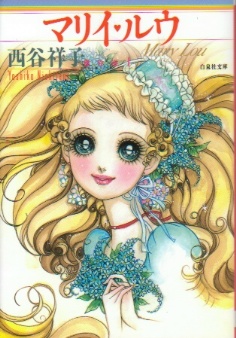
maryloubunkoIn the mid-1960s, pioneering female artist Yoshiko Nishitani began writing stories aimed at a slightly older audience. Nishitani’s Mary Lou, which made its debut in Weekly Margaret in 1965, was one of the very first shojo manga to document the romantic longings of a teenage girl. (As Thorn notes in “The Multi-Faceted World of Shoujo Manga,” the heroines of early shojo stories were too young for crushes and dates, so romance was the provenance of older, secondary characters.) Though tame by contemporary standards, Mary Lou’s emphasis on the heroine’s emotional life and relationships proved highly influential, paving the way for other artists to write stories that focused on the everyday concerns of teenagers, rather than the melodramatic travails of poor little rich girls.

Nishitani was a pioneer in another sense as well: she inspired dozens of women to enter what had been an overwhelmingly male profession. Those artists who followed Nishitani into the field in the 1970s — women like Takemiya, Hagio, and Ryoko “Rose of Versailles” Ikeda — built on her legacy, helping complete the transformation of shojo manga from staid stories about good girls to a multi-faceted storytelling medium capable of dramatizing the characters’ inner thoughts as forcefully as their physical actions. The 49ers embraced genres such as science fiction and fantasy, and developed new ones as well: the entire boys’ love industry owes a debt to Hagio and Takemiya for ground-breaking stories such as “The Heart of Thomas” and The Song of the Wind in the Trees. Whatever the subject matter, however, the 49ers used the comics medium to explore fundamental questions about identity — what constitutes family? what does it mean to be female? what distinguishes the child from the adult? — and love in all its manifestations, from maternal to carnal.

To Terra, which addresses many of the themes found in Takemiya’s other works, is significant precisely because it isn’t shojo; Takemiya was one of the first female artists to write for a boys’ magazine, bringing a distinctly shojo sensibility to her portrayal of Keith and Jomy’s emotional lives. The popular success of To Terra created opportunities for other manga-ka to cross over as well, a trend important enough for Frederick Schodt to make note of it in Manga! Manga! The World of Japanese Comics (1983). Contemporary artists such Rumiko Takahashi, CLAMP, Yellow Tanabe, and Hiromu Arakawa owe a debt to Takemiya, as she helped demonstrate what seems patently obvious to us now: that women are just as capable of writing for male audiences as men are. Oh, and we can draw a pretty bitchin’ space ship if the story calls for one.

FOR FURTHER READING

Aoki, Deb. “Interview: Keiko Takemiya, Creator of To Terra and Andromeda Stories.” About.com: Manga. January 22, 2008. (Accessed 5/23/10.)

Thorn, Matt. “The Moto Hagio Interview.” The Comics Journal 269 (July/August 2005). (Accessed 5/23/10.)

Thorn, Matt. “The Multi-Facted Universe of Shoujo Manga.” Conference paper. 2008. (Accessed 5/23/10.)

Filed Under: Classic Manga Critic, Manga, Manga Critic, REVIEWS Tagged With: Classic, Keiko Takemiya, Magnificent 49ers, Sci-Fi, Shonen, vertical

MMF: An Introduction to Keiko Takemiya’s To Terra

May 23, 2010 by Katherine Dacey

Welcome to the May Manga Movable Feast! On the menu: Keiko Takemiya’s award-winning sci-fi epic To Terra. If you’ve never dined with us before, here’s how the MMF works: every month, the manga blogging community holds a week-long virtual book club in which we discuss a particular series or one-shot. Each day, the host shares links to new blog entries focusing on that work, while building an archive for the entire week’s discussion. At the end of the week, the group then selects a new host and a new “menu” for the following month.

…

Read More

Filed Under: Manga Critic Tagged With: Classic, Keiko Takemiya, Magnificent 49ers, Sci-Fi, Shonen, vertical

Twin Spica, Vol. 1

May 3, 2010 by Katherine Dacey

twinspica1Asumi Kamogawa is a small girl with a big dream: to be an astronaut on Japan’s first manned space flight. Though she passes the entrance exam for Tokyo Space School, she faces several additional hurdles to realizing her goal, from her child-like stature — she’s thirteen going on eight — to her family’s precarious financial position. Then, too, Asumi is haunted by memories of a terrible fire that consumed her hometown and killed her mother, a fire caused by a failed rocket launch. Yet for all the pain in her young life, Asumi proves resilient, a gentle girl who perseveres in difficult situations, offers friendship in lieu of judgment, and demonstrates a preternatural awareness of life’s fragility.

If Asumi sounds like a stereotypically optimistic manga character, a can-do kid who maintains a positive attitude through every set-back, the first volume of Twin Spica reveals her to be more complex and damaged than her firm resolve might suggest. Mr. Lion, her imaginary friend, is proof of the wounds she carries: she “met” him when she was six, never quite outgrowing the need for his counsel or company. When Asumi suffers a traumatic flashback to the Yuigahama disaster, for example, she calls out Mr. Lion’s name; when her father responds angrily to the news that she passed the space academy’s placement test, she asks Mr. Lion if she should enroll or abandon her dream of becoming “a driver on a rocket.”

…

Read More

Filed Under: Manga Critic Tagged With: Seinen, vertical

Ode to Kirihito, Vols. 1-2

April 7, 2010 by Katherine Dacey

kirihito1“When he heard his cry for help, it wasn’t human” — so went the tagline for Ken Russell’s Altered States (1980), a bizarre fever-dream of Nietzchean philosophy, horror, and mystical hoo-ha in which a scientist’s experiments result in his spontaneous devolution. That same tagline would work equally well for Osamu Tezuka’s Ode to Kirihito (1970-71), a globe-trotting medical mystery about a doctor who takes a similar step down the evolutionary ladder from man to beast. In less capable hands, Kirihito would be pure, B-movie camp with delusions of grandeur — as Altered States is — but Tezuka synthesizes these disparate elements into a gripping story that explores meaty themes: the porous boundaries between man and animal, sanity and insanity, godliness and godlessness; the arrogance of scientists; and the corruption of the Japanese medical establishment.

At its most basic level, Ode to Kirihito is a beat-the-clock thriller in which a charismatic young doctor named Kirihito Osanai tries to discover the cause of Monmow, a mysterious condition that reduces its victims to hairy, misshapen creatures with dog-like snouts. Kirihito’s superior, the ambitious Dr. Tatsugaura, dispatches Kirihito to Doggodale, a remote mountain village where hundreds of residents have developed suggestive symptoms. Once in Doggodale, Kirihito contracts Monmow himself, thus beginning a hellish odyssey to escape the village, arrest the disease’s progress, and share his findings with the medical community.

…

Read More

Filed Under: Manga Critic Tagged With: Classic, Medical Thriller, Osamu Tezuka, vertical

Osamu Tezuka’s MW

March 1, 2010 by Katherine Dacey

mw_coverInvoke Tezuka’s name, and most readers immediately think of Astro Boy, Buddha, and Princess Knight. But there’s a darker side to Tezuka’s oeuvre that dates back to 1953, the year in which he brought Dostoevsky’s tormented Raskolnikov to life in a manga-fied version of Crime and Punishment. It’s this side of Tezuka — the side that acknowledges the human capacity for violence, greed, and deception — that’s on display in MW, a twisty thriller about a sociopath and the priest who loves him.

The central event of MW is a military cover-up. “Nation X,” which maintains a base on Okinawa Mafune, has been stockpiling a top-secret chemical weapon known as MW.1 An explosion releases a poisonous cloud, killing everyone on the island except for two visitors, Iwao Garai and Michio Yuki. Though Garai and Yuki are equally traumatized by this holocaust, their lives diverge wildly over the next fifteen years. Garai embraces the light, becoming a Roman Catholic priest, while Yuki embraces the darkness, embarking on a spree of kidnappings, murders, and extortion schemes meant to punish the politicians, businessmen, and military officials who profited from the subsequent cover-up.

…

Read More

Filed Under: Manga Critic Tagged With: Osamu Tezuka, Seinen, vertical

  • « Go to Previous Page
  • Page 1
  • Interim pages omitted …
  • Page 4
  • Page 5
  • Page 6
  • Page 7
  • Go to Next Page »
 | Log in
Copyright © 2010 Manga Bookshelf | Powered by WordPress & the Genesis Framework