• Skip to primary navigation
  • Skip to main content
  • Skip to primary sidebar
  • Home
  • About Us
    • Privacy Policy
    • Comment Policy
    • Disclosures & Disclaimers
  • Resources
    • Links, Essays & Articles
    • Fandomology!
    • CLAMP Directory
    • BlogRoll
  • Features & Columns
    • 3 Things Thursday
    • Adventures in the Key of Shoujo
    • Bit & Blips (game reviews)
    • BL BOOKRACK
    • Bookshelf Briefs
    • Bringing the Drama
    • Comic Conversion
    • Fanservice Friday
    • Going Digital
    • It Came From the Sinosphere
    • License This!
    • Magazine no Mori
    • My Week in Manga
    • OFF THE SHELF
    • Not By Manga Alone
    • PICK OF THE WEEK
    • Subtitles & Sensibility
    • Weekly Shonen Jump Recaps
  • Manga Moveable Feast
    • MMF Full Archive
    • Yun Kouga
    • CLAMP
    • Shojo Beat
    • Osamu Tezuka
    • Sailor Moon
    • Fruits Basket
    • Takehiko Inoue
    • Wild Adapter
    • One Piece
    • After School Nightmare
    • Karakuri Odette
    • Paradise Kiss
    • The Color Trilogy
    • To Terra…
    • Sexy Voice & Robo
  • Browse by Author
    • Sean Gaffney
    • Anna Neatrour
    • Michelle Smith
    • Katherine Dacey
    • MJ
    • Brigid Alverson
    • Travis Anderson
    • Phillip Anthony
    • Derek Bown
    • Jaci Dahlvang
    • Angela Eastman
    • Erica Friedman
    • Sara K.
    • Megan Purdy
    • Emily Snodgrass
    • Nancy Thistlethwaite
    • Eva Volin
    • David Welsh
  • MB Blogs
    • A Case Suitable For Treatment
    • Experiments in Manga
    • MangaBlog
    • The Manga Critic
    • Manga Report
    • Soliloquy in Blue
    • Manga Curmudgeon (archive)

Manga Bookshelf

Discussion, Resources, Roundtables, & Reviews

Tokyopop

Sweat & Honey

June 13, 2014 by Ash Brown

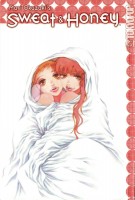
Sweat & HoneyCreator: Mari Okazaki
U.S. publisher: Tokyopop
ISBN: 9781591827979
Released: February 2005
Original release: 2002

Back in 2005 Tokyopop launched a short-lived line of josei manga called Passion Fruit, describing it as a collection of innovative and edgy works. Only two volumes were ever released before Passion Fruit faded out of existence: Mari Okazaki’s Sweat & Honey and Junko Kawakami’s Galaxy Girl, Panda Boy. I learned about all of this long after the fact and only discovered the Passion Fruit line while searching for more translated manga by Okazaki after rereading her series Suppli (which was sadly left incomplete in English after Tokyopop’s decline.) Currently, Sweat & Honey is her only other work available, which is a shame. Sweat & Honey was originally published in Japan in 2002 before being released in English in 2005. I didn’t realize it when I first picked up a copy–initially I was interested in the fact that it was by Okazaki more than anything else–but Sweat & Honey incorporates sapphic elements and yuri undertones which made me even more curious to read it.

Sweat & Honey collects five short, unrelated manga, most of which focus on the close, personal, and intimate relationships between women, ranging from friendship to love and even more complicated bonds. The volume opens with “After Sex, A Boy’s Sweat Smells Like Honey,” from which the collection draws its name. In it, a young woman is staying with her cousin; her attitudes toward and dislike of men has her cousin reevaluating her own romantic relationships as the two women grow closer. In “About Kusako,” Moeko stumbles upon a girl literally growing out of the ground. It’s a curious story and the most fantastical one included in Sweat & Honey. “Sister” follows Chinami, a highschool girl, and Kayo, her 35-year-old neighbor who leads a much more fulfilling life than most realize. The longest story, “The Land Where Rain Falls,” is told in three parts. It delves into the intense and twisted connections between Kumi, her classmate Kaya, and Kaya’s older brother. The volume closes with “Iced Tea,” in which a young man looks back on one of his first crushes, his seventh-grade teacher.

Sweat & Honey, though occasionally lighthearted, is a manga that deals with very mature themes–death, coming of age, self-discovery, nostalgia–and can frankly be disturbing from time to time. Okazaki’s artwork aids tremendously in creating this atmosphere in the volume. Her illustrations are sensuous and provocative, with a languid heaviness to them. They are beautiful, but also somewhat disconcerting and ominous, too. The page layouts in Sweat & Honey are also interesting, often featuring a large background panel which sets the scene with smaller, overlapping panels that focus a reader’s attention on a particular detail of the people who inhabit it. The elegant line of a neck, hesitant glances or a sly smile, an exposed breast, shifting legs and feet, entwined fingers or tightly clasped hands, all are accentuated. Because of this, the young women in Sweat & Honey seem to exist both in their world and apart from it. Okazaki reveals their personal and private thoughts and feelings while at the same time exposing their physical selves.

Although the short manga collected in Sweat & Honey aren’t related by characters or by plot, they all share an emphasis on the inner and outer lives of women and their relationships with each other. Even “Iced Tea,” which is told from the perspective of a young man, is focused on his female teacher. Although the ties between the women in Sweat & Honey are the most crucial, their associations with men and how those associations impact their other relationships are also very important. The older cousin in “After Sex, A Boy’s Sweat Smell s Like Honey” has a boyfriend, but she isn’t able to connect with him in the same way that she does with her younger relative. Moeko drifts away from Kusako when a boy enters the picture. Kayo’s seeming lack of romantic involvement is one of the things that bothers Chinami the most. And in “The Land Where Rain Falls,” the nearly incestuous relationship instigated by Kaya is one of the key elements of the story. But in the end, while the men have their place in the manga, the true focus of Sweat & Honey is on its young women and their experiences.
Filed Under: REVIEWS Tagged With: manga, Mari Okazaki, Passion Fruit, Tokyopop, Year of Yuri

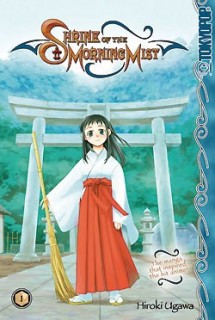
Shrine of the Morning Mist, Vol. 1

January 19, 2014 by Jocilyn Wagner

I am very pleased to introduce Jocilyn Wagner to readers of Experiments in Manga. Jocilyn doesn’t currently have a platform of her own, but she was still interested in occasionally writing about manga. And so, I’m happy to offer up some space here and welcome her to Experiments in Manga as a guest.

Greetings and Salutations! Some of you might know me from my love of yuri and occasional manga and light novel translations, but that’s not what I’m doing this time. Instead… I thought I’d introduce you to some of the most forgotten and/or unappreciated (usually for good reason) manga I own, which have, in all likelihood, never before been reviewed on a Manga Bookshelf blog!

* * *

I’d like to begin with a title that was so under-sold and under-appreciated it literally debuted at number 92 in graphic novel sales. The year was 2006; it was the end of an era. I’d just wrapped up my undergrad and year-long stint as president of the Western Michigan Anime Addicts and my heart was still full of some of the incredible anime we’d enjoyed: Paradise Kiss, Madlax, Last Exile, Read or Die, the list goes on. In my youthful vigor and utter boredom I was working on one of the many anime subtitling teams (in the days before Crunchyroll a great many of these existed if you can believe it!) editing scripts for #Ishin, when I was asked to finish up work on a silly series no one was watching. It was bizarre, ugly and ridiculously cute, and the episodes were so short it would be a breeze. I’m speaking of course of Asagiri no Miko (朝霧の巫女). You may now groan and pinch your noses in despair and hopefully save yourself the trouble of reading the following review of TokyoPop’s 2006 edition of the series they called “Shrine of the Morning Mist.”

Shrine of the Morning Mist, Volume 1

The name has always been something of a sticking point with me since a literal translation would be closer to “shrine maiden of the morning mist” but then, I suppose TokyoPop didn’t want to confuse people with the bull in a china shop, Kannazuki no Miko, for which they’d already used the term (never mind the fact that the miko in Asagiri no Miko actually resemble real miko and Himeko and Chikane are rather infamous, but not for their pious purity), but I digress.

Ugawa Hiroki’s story is usually seen as a seinen action comedy, but I always thought of it as a supernatural slice-of-life romance. In the fine tradition of early 2000s dating sims, the story revolves around a loner teenage dude (Amatsu Tadahiro, usually referred to as Hiro) who returns to the home of his childhood and some of the girls he left heartbroken in his wake. In this case, the brokenhearted is his cousin Yuzu who is painted to be a fiery but loveable tsundere, as well as his closest childhood friend. Yuzu is the middle child of three girls: Kurako, the eldest, is quiet, thoughtful and spiritually driven and has made it her goal to bring the two star-crossed lovers back together. She reminds me of a cross between Belldandy and Toudou Shimako. Yuzu’s younger sister Tama-chan is the fun rascal who dotes on “Hiro Onii-chan” but often speaks with a maturity beyond her years. Actually she very closely resembles Yukino’s sister Kana from Kare Kano, except she isn’t a manga geek. Their father, in his insane knee-jerk reactions to everything, sketchy behavior and extreme unpopularity could easily be mistaken for Shimura-sensei of Azamanga Daioh! fame. A chapter or two into the series, we’re introduced to the girls’ mother Miyuki. I’m not at all sure how to describe Miyuki since she isn’t given a lot of dialogue in this volume. She’s really rather unlike other manga moms: she arrives on the scene with a samurai-like speed, agility and appearance, wielding a bouken and saves Hiro from becoming breakfast to a giant cyclops. The reader’s told she’d been sent to Izumo, so one might infer she’s a gifted Shinto priestess, but it’s not at all clear at this point. Finally, we’re introduced to Koma-san, a mysterious short-tempered but otherwise solemn woman who claims to have known Hiro’s father, though he had died before Hiro was born and this woman looks to be in her mid-to-late 20s. The way Koma is drawn, I can’t help but be reminded of Yumura Kirika, except Koma is endowed with some rather annoying feline qualities. No doubt inspired by a little known game at the time, Tsukihime.

The plot is tragically somewhat thin. Hiro has been traveling, searching out his way in life and has finally come home to the quiet town of his childhood (Miyoshi, in Hiroshima Prefecture). His cousins, the Hieda sisters put him up for the night but are hesitant to let him go since it’s obvious Yuzu still has feelings for him. From the moment he arrives, Hiro is hellhounded by a mysterious sorcerer who wears a tengu mask and summons a host of cruel-intentioned spirits to eliminate Hiro and his spiritual potential before it upsets the balance of something or other. Tengu-san and Hiro have many annoying random encounters in which Tengu-san is always easily defeated by the sisters, and a thoroughly incompetent yet nevertheless unappreciative Hiro is saved from certain doom in the nick of time. One might compare Hiro to Morisato Keiichi, except Hiro’s not all that nice or mature. He’s also unmoved by Yuzu’s total red-faced embarrassment (which comes into play whenever he’s around), though he obviously remembers what transpired between them five years ago. Yuzu’s mom and sisters are constantly trying to push Hiro and Yuzu together. That’s basically the entire plot.

Tune in next time for another segment of The Manga That Time Forgot/Was Hoping To Forget. ~jocilyn

Filed Under: FEATURES Tagged With: Hiroki Ugawa, manga, Shrine of the Morning Mist, Tokyopop

12 Days

December 13, 2013 by Ash Brown

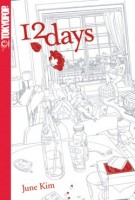
12 DaysCreator: June Kim
Publisher: Tokyopop
ISBN: 9781598166910
Released: November 2006

June Kim is a Korean-born comics artist and illustrator who currently lives and works in the United States. Although some of her short comics had previously been collected in various anthologies, 12 Days was her first and, as far as I know, only graphic novel to have been published. What I can say for certain is that 12 Days was my introduction to Kim and her work. 12 Days was released by Tokyopop in 2006. The book’s cover design is really quite lovely with silver foil line work and striking red accents. Tokyopop didn’t always take such care with the presentation of its releases, so this was nice to see. 12 Days is at least partially based on a true story–a sad tale that a stranger told to Kim about her ex-girlfriend. Kim herself originally developed the story of 12 Days while getting over a breakup in her sophomore year of college. However, it wasn’t until 12 Days was picked up by Tokyopop that she completed the graphic novel.

On the way back from her honeymoon, Noah was in a lethal car accident. That was a month ago. Noah’s death hits her ex-girlfriend Jackie hard. Already a wreck from their breakup, Jackie is faced with the reality that she has now completely lost the love of her life. And so she devises a way to forget and finally let go. Over the course of twelve days she will drink Noah’s ashes as part of a personal ritual. Somehow Jackie convinces Nick, Noah’s half-brother, to steal some of his sister’s ashes for her from the urn on his parents’ mantle. It’s under these strange circumstances that the two most important people in Noah’s life meet. Nick and Jackie are each struggling to accept and cope with Noah’s death in their own ways. Their shared experience becomes a source of comfort as much as it is a source of pain. They both loved Noah dearly and it will take far more than twelve days to ever change that.

Kim’s style in 12 Days is influenced by both manga and manhwa as well as by independent comics. A prominent theme in both the artwork and narrative of 12 Days is reflection. This can be seen in Kim’s use of mirrors in the graphic novel, but also in the page layouts and panel composition. Jackie and Nick’s actions and how they are captured in the artwork often parallel or echo each other, providing yet another tenuous connection between the two of them. The narrative itself isn’t linear. Much of the story is told through the flashbacks, dreams, and memories that intrude upon Nick and Jackie’s lives. It’s as if a mirror containing all of their thoughts of Noah has been shattered and they are left picking up the pieces–a fitting metaphor for the grieving process. Some of the transitions can be a little difficult to follow at first, but overall it as a remarkably effective approach.

As a whole 12 Days is a very reflective and introspective work. There is intensity and drama but it’s not overblown; the graphic novel tends to be rather intimate and quiet. Despite the realistic portrayal of the complexities of grief, family, love, and loss, 12 Days is not overwhelmingly bleak or depressing. The graphic novel can certainly be heartbreaking considering Noah’s death, the circumstances surrounding her and Jackie’s breakups, and some of society’s prevailing attitudes towards same-sex love, but there is also a fair amount of humor in 12 Days that keeps things from getting too heavy or dark. Even while dealing with the tragedies in their lives, Jackie and Nick, who are both endearingly eccentric, are still able to joke around and tease each other. Sometimes that humor can be a bittersweet reminder of what they have lost, though. 12 Days is a work that holds extraordinarily up well to multiple readings. In fact, I think I enjoyed and appreciated its subtleties even more after reading it several times.

Filed Under: REVIEWS Tagged With: comics, June Kim, Tokyopop, Year of Yuri

The Best Manga You’re Not Reading: Suki

July 26, 2012 by Katherine Dacey 8 Comments

The brilliant sociopath, the hooker with the heart of gold, and the naïf are my three least favorite character types, the first two for their tiresome ubiquity in popular culture, and the third for being tiresome: when was the last time you read a story about a sweet, innocent person that didn’t make you feel horribly manipulated or horribly jaded? Imagine my surprise, then, at discovering CLAMP’s delightfully odd series Suki: A Like Story, which revolves around a brilliant but impossibly naive teenager who trusts everyone, reads picture books, and talks to teddy bears. I thought I’d be tearing my breast in agony by the end of the first chapter; instead, I quickly succumbed to Suki‘s charms and even suppressed a sniffle or two in the final pages.

Suki succeeds, in large part, because the supporting cast has the same reaction to sixteen-year-old Hinata Asashi as the reader. Hina’s boundless enthusiasm endears her to best friends, Touko and Emi, though both roll their eyes at her inability to read social cues or grasp ulterior motives. Touko, in particular, is keen to protect her pal; as we learn in the second volume of the series, Hina has been kidnapped nine — count ’em — times over the course of her short life. (Hina’s dad is rich and willing to pay ransom for the safe return of his daughter.) Though an ordinary person might be deeply scarred by such experiences — or least more suspicious of strangers — Hina remains cheerful and oblivious to signs that a tenth abduction might be in the works.

Those signs include a string of odd coincidences: the long-vacant house next to Hina’s is suddenly occupied by a handsome young man who just happens to be Hina’s new homeroom teacher, Shiro Asou. Shiro just happens to be around whenever Hina is in need of an escort, or rescuing. And Shiro just happens to conduct clandestine meetings when the class goes on field trips. The ever-vigilant Touko quickly suspects the worst, but Hina interprets Shiro’s gruff yet solicitous behavior as concern, and develops a chaste crush on her sensei.

Watching Hina come to terms with her feelings is a painful but believable process. At first, she revels in any opportunity to spend time with Shiro, whether they’re raking leaves or walking home from school. Later, she begins to see parallels between their relationship and the relationship between two characters in a favorite picture-book series. (More on the series-within-a-series gambit in a minute.) In the final chapters of the book, Hina develops a more realistic idea of who Shiro is, eventually telling him how her feelings have evolved from youthful naivete to adult maturity. “At first, I fell in love with you because you did so many things I loved,” she confesses. “But from now on, Asou-san… whatever you do for yourself… I’ll love you for that.”

That Hina’s epiphany is facilitated, in part, by reading a children’s book may strike some readers as hopelessly twee. Suki — the name of the story-within-a-story — isn’t subtle; using bears as surrogates for Hina and Shiro, Suki charts the budding friendship between a small, chatty bear and her large, bespectacled neighbor. The parallels between the main plot and the story-within-the-story are obvious, but they serve an important purpose, reminding us that Hina is struggling to reconcile new, adult feelings with her decidedly child-like worldview.

Art-wise, Suki: A Like Story is one of CLAMP’s simplest — one might even say plainest — series. Tsubaki Nekoi’s style is much less Baroque than her cohorts’; she favors ordinary street clothes over epaulets and garter belts, and more realistic physiques over exaggerated shoulders and sharp chins. By shedding the fanciful trappings, Nekoi focuses the reader’s attention on faces, allowing us to fully register how each character is feeling. Nowhere is that more evident in the way Nekoi draws Touko. Touko is by far the most mature girl at Hina’s school, and the one most attuned to signs of adult malfeasance. Though Touko voices her concerns, the sadness in her face reveals a level of understanding that might be rooted in her own experiences, not just Hina’s:

Though Hina has a much more innocent personality than Touko, Nekoi resists the temptation to draw Hina as a child; Hina is clearly meant to be a teenager, given her size and athleticism. Hina’s transparent facial expressions, wide-eyed enthusiasm, and sudden, darting movements, however, hint at the discrepancy between her chronological and emotional ages; she bounces and skips and claps her way through the story, reacting with intense glee at even the briefest exchange with Shiro:

The art isn’t perfect by any means. Shiro’s proportions, for example, often look wrong: he has a tiny head and an enormous frame, and is so much taller than the other characters that he’d be NBA draft material in real life. Suki, the book-within-a-book, is also problematic. It’s quite possibly the dullest picture book I’ve read, a series of simple drawings accompanied by large, undifferentiated blocks of text. I certainly wasn’t expecting Sylvester and the Magic Pebble (or A Kiss for Little Bear), but the flat, unimaginative illustrations make it harder for the reader to imagine why someone Hina’s age would find the story so compelling:

Perhaps the most interesting thing about Suki is that Hina’s realistic coming-of-age story is embedded within a thriller. The suspenseful elements of Suki are handled with skill and restraint, even if they are a wee bit ridiculous. (OK, a lot ridiculous: who allows their frequently kidnapped sixteen-year-old daughter to live alone with her teddy bears?!) The few action scenes are brief but crisply executed, adding some much-needed variety in tone and pacing to the story. If the ending is a little too tidy, CLAMP avoids the trap of pandering to the reader’s expectations of what should happen; there’s a note of melancholy in that final scene, joyous though Hina may be.

Readers curious about Suki: A Like Story won’t have too much difficulty tracking down used copies on eBay or Amazon; the complete series will set you back about $20-30.

SUKI: A LIKE STORY, VOLS. 1-3 • BY CLAMP • TOKYOPOP • RATING: TEEN (13+)

Filed Under: Manga Critic Tagged With: clamp, Suki, Tokyopop

The Best Manga You’re Not Reading: Suki

July 26, 2012 by Katherine Dacey

The brilliant sociopath, the hooker with the heart of gold, and the naïf are my three least favorite character types, the first two for their tiresome ubiquity in popular culture, and the third for being tiresome: when was the last time you read a story about a sweet, innocent person that didn’t make you feel horribly manipulated or horribly jaded? Imagine my surprise, then, at discovering CLAMP’s delightfully odd series Suki: A Like Story, which revolves around a brilliant but impossibly naive teenager who trusts everyone, reads picture books, and talks to teddy bears. I thought I’d be tearing my breast in agony by the end of the first chapter; instead, I quickly succumbed to Suki‘s charms and even suppressed a sniffle or two in the final pages.

Suki succeeds, in large part, because the supporting cast has the same reaction to sixteen-year-old Hinata Asashi as the reader. Hina’s boundless enthusiasm endears her to best friends, Touko and Emi, though both roll their eyes at her inability to read social cues or grasp ulterior motives. Touko, in particular, is keen to protect her pal; as we learn in the second volume of the series, Hina has been kidnapped nine — count ’em — times over the course of her short life. (Hina’s dad is rich and willing to pay ransom for the safe return of his daughter.) Though an ordinary person might be deeply scarred by such experiences — or least more suspicious of strangers — Hina remains cheerful and oblivious to signs that a tenth abduction might be in the works.

Those signs include a string of odd coincidences: the long-vacant house next to Hina’s is suddenly occupied by a handsome young man who just happens to be Hina’s new homeroom teacher, Shiro Asou. Shiro just happens to be around whenever Hina is in need of an escort, or rescuing. And Shiro just happens to conduct clandestine meetings when the class goes on field trips. The ever-vigilant Touko quickly suspects the worst, but Hina interprets Shiro’s gruff yet solicitous behavior as concern, and develops a chaste crush on her sensei.

Watching Hina come to terms with her feelings is a painful but believable process. At first, she revels in any opportunity to spend time with Shiro, whether they’re raking leaves or walking home from school. Later, she begins to see parallels between their relationship and the relationship between two characters in a favorite picture-book series. (More on the series-within-a-series gambit in a minute.) In the final chapters of the book, Hina develops a more realistic idea of who Shiro is, eventually telling him how her feelings have evolved from youthful naivete to adult maturity. “At first, I fell in love with you because you did so many things I loved,” she confesses. “But from now on, Asou-san… whatever you do for yourself… I’ll love you for that.”

That Hina’s epiphany is facilitated, in part, by reading a children’s book may strike some readers as hopelessly twee. Suki — the name of the story-within-a-story — isn’t subtle; using bears as surrogates for Hina and Shiro, Suki charts the budding friendship between a small, chatty bear and her large, bespectacled neighbor. The parallels between the main plot and the story-within-the-story are obvious, but they serve an important purpose, reminding us that Hina is struggling to reconcile new, adult feelings with her decidedly child-like worldview.

Art-wise, Suki: A Like Story is one of CLAMP’s simplest — one might even say plainest — series. Tsubaki Nekoi’s style is much less Baroque than her cohorts’; she favors ordinary street clothes over epaulets and garter belts, and more realistic physiques over exaggerated shoulders and sharp chins. By shedding the fanciful trappings, Nekoi focuses the reader’s attention on faces, allowing us to fully register how each character is feeling. Nowhere is that more evident in the way Nekoi draws Touko. Touko is by far the most mature girl at Hina’s school, and the one most attuned to signs of adult malfeasance. Though Touko voices her concerns, the sadness in her face reveals a level of understanding that might be rooted in her own experiences, not just Hina’s:

Though Hina has a much more innocent personality than Touko, Nekoi resists the temptation to draw Hina as a child; Hina is clearly meant to be a teenager, given her size and athleticism. Hina’s transparent facial expressions, wide-eyed enthusiasm, and sudden, darting movements, however, hint at the discrepancy between her chronological and emotional ages; she bounces and skips and claps her way through the story, reacting with intense glee at even the briefest exchange with Shiro:

The art isn’t perfect by any means. Shiro’s proportions, for example, often look wrong: he has a tiny head and an enormous frame, and is so much taller than the other characters that he’d be NBA draft material in real life. Suki, the book-within-a-book, is also problematic. It’s quite possibly the dullest picture book I’ve read, a series of simple drawings accompanied by large, undifferentiated blocks of text. I certainly wasn’t expecting Sylvester and the Magic Pebble (or A Kiss for Little Bear), but the flat, unimaginative illustrations make it harder for the reader to imagine why someone Hina’s age would find the story so compelling:

Perhaps the most interesting thing about Suki is that Hina’s realistic coming-of-age story is embedded within a thriller. The suspenseful elements of Suki are handled with skill and restraint, even if they are a wee bit ridiculous. (OK, a lot ridiculous: who allows their frequently kidnapped sixteen-year-old daughter to live alone with her teddy bears?!) The few action scenes are brief but crisply executed, adding some much-needed variety in tone and pacing to the story. If the ending is a little too tidy, CLAMP avoids the trap of pandering to the reader’s expectations of what should happen; there’s a note of melancholy in that final scene, joyous though Hina may be.

Readers curious about Suki: A Like Story won’t have too much difficulty tracking down used copies on eBay or Amazon; the complete series will set you back about $20-30.

SUKI: A LIKE STORY, VOLS. 1-3 • BY CLAMP • TOKYOPOP • RATING: TEEN (13+)

Filed Under: Manga, Manga Critic, Recommended Reading, REVIEWS Tagged With: clamp, Suki, Tokyopop

My 5 Favorite CLAMP Manga

July 24, 2012 by Katherine Dacey 19 Comments

I’ve read almost every CLAMP title available in English, from X (or X/1999, as we called it in back in the day) to Gate 7, and while I can’t claim to love them all, there is a core group of manga that I’ve read, re-read, and recommended to other fans. I make no special claims of excellence for these series, though I will say that these manga impressed me with their technical brilliance, genre-bending narratives, and beautiful artwork, if not their stellar endings.

MAGIC KNIGHT RAYEARTH (Dark Horse; 2 volumes)

It’s easy to forget that Magic Knight Rayearth ran in the pages of Nakayoshi, as it adheres so closely to the friendship-effort-victory template that it almost passes for a Shonen Jump title. A careful reading of MKR, however, reveals it to be a unique fusion of shojo and shonen storytelling practices. On a moment to moment basis, MKR reads like shojo: the heroines denigrate their academic prowess, swoon over the only cute boy to cross their path, and extol the value of “heart” in defeating their enemies. The intense and protracted battle scenes, however, scream Naruto — or maybe Gundam — as the girls are pushed to their physical and emotional limits while casting spells, swinging swords, and piloting giant robots. That CLAMP reconciles such tonally different genres into a coherent whole is an impressive narrative feat; no matter how many times the heroines utter dippy or painfully sincere sentiments, their tenacity in combat makes them every bit as bad-ass as Naruto, InuYasha, or Ichigo Kurasaki. -Reviewed at The Manga Critic on July 22, 2011.
LEGAL DRUG (Tokyopop; 3 volumes)

I hesitate to use the word “intertextual” to describe Legal Drug, as that term is so heavily freighted with academic associations. But intertextual it is, as Legal Drug takes place in a universe that’s been carefully mapped out in prior works such as Angelic Layer, Cardcaptor Sakura, and Suki. Major and minor characters from Chobits and Suki wander in and out of the story, providing comic relief and commentary on the budding relationship between Rikuo and Kazahaya, two handsome young errand boys for the Green Drugstore. As in xxxHolic — a series in which Rikuo and Kazahaya make guest appearances — the supernatural frequently intrudes on mundane existence, giving rise to scenes of sublime comedy and surreal grace. An odd mixture of melancholy and whimsy, with a soupçon of shonen-ai.

CLOVER (Dark Horse; 1 volume)

Clover is a gorgeous train wreck, an unholy marriage of shojo, steampunk, and science fiction that almost — almost — gels into a coherent story. The plot revolves around a class of psychically gifted individuals known as Clovers, who have been rounded up, tested, and sorted into categories based on their abilities. The most powerful — Three- and Four-Leaf Clovers — have been imprisoned, as they pose a threat to humanity.

In the small fragment of story that CLAMP completed, the Clovers’ abilities are hastily sketched; the few demonstrations of their powers are less-than-awe-inspiring, and the government’s reasons for fearing them poorly explained. But oh, the atmosphere! Anyone who remembers what it felt like to be fourteen will recognize the Clovers’ magnificent isolation, as they struggle with feelings of loneliness, rejection, and desire; that they’ve been singled out for being different (and special!) only heightens the emotional intensity of their dilemma. The artwork, too, is a feast for the eyes, with inventive layouts and sensual character designs that rank among CLAMP’s finest. Even CLAMP’s use of soggy, overwrought song lyrics as a narrative device contributes to the story’s moody beauty, if not the pantheon of great love songs.

SHIRAHIME-SYO: SNOW GODDESS TALES (Tokyopop; 1 volume)

Shirahime-Syo: Snow Goddess Tales is testament to CLAMP’s Borg-like ability assimilate any genre or artistic style and make it into their own. The three stories that comprise this slim volume are folkloric in tone and subject-matter, but expressed in a visual language that’s a beautiful synthesis of shojo manga and ukiyo print-making; the characters — with their pointy chins and artfully tousled hair — inhabit stark landscapes reminiscent of the Kishi and Shijo schools. If the overall mood is more subdued than xxxHolic or Tokyo Babylon, the stories are nonetheless moving in their directness and simplicity. The first, “On Wolf Mountain,” is the strongest of the three, exploring how one girl’s quest for revenge is transformed by the discovery that her enemy is, in fact, more courageous and generous than she ever imagined. The other stories — “The Ice Flower” and “Hiyoku no Tori” — read more like entries in Lafcadio Hearn’s Kwaidan and Other Strange Stories, but are nonetheless effective parables about sacrifice. An out-of-print gem.

X (VIZ; 6 volumes)

On many levels, X is a bad manga: the characters are underwritten, the storytelling is lazy, and the dialogue is comically awful. (Don’t believe me? Check out Party Like It’s 1999, a Tumblr blog dedicated to exploring X on a page-by-page basis.) If you can look past the 90s hair and the tin-eared dialogue, however, what you’ll discover is a fierce apocalyptic drama that boasts some of the best end-of-the-world imagery in any manga not written by Katsuhiro Otomo. Oh, and blood. Buckets of blood.

The battle scenes are kinetic and violent, executed with a gory zest that’s difficult to resist. The dream sequences, too, are suitably shocking: characters are dismembered, crucified, impaled, and engulfed in flames, often right before their loved ones’ eyes. I hesitate to suggest that X‘s body count is a victory for women, but it is a sharp and welcome rebuke to the idea that female readers strongly prefer conversation and character development to butt-kicking and carnage. – Reviewed at The Manga Critic on 10/16/11.

So, readers, I turn the floor over to you: what are your favorite CLAMP titles? Which manga do you recommend to friends and new fans? Inquiring minds want to know!

Filed Under: Manga Critic Tagged With: clamp, Clover, Dark Horse, legal drug, Magic Knight Rayearth, Shirahime-Syo, shojo, Tokyopop, VIZ, X/1999

Do you know the way to San Diego?

July 11, 2012 by Brigid Alverson

If you’re headed to San Diego Comic-Con this week, make MTV Geek your first stop. I’ve compiled a list of all the major manga events, as well as a list of the manga publishers that will be exhibiting on the show floor. Planning to attend on Saturday? Be sure to check out The Best and Worst Manga of 2012 session, in which an all-star panel of manga pundits will discuss the year’s most memorable titles.

Tokyopop has been asking fans, via Twitter, if they would like to see more OEL manga. Sean Kleefeld has some thoughts on that, and on what might have been.

David Brothers looks at a particularly good example of Kiyohiko Azuma’s use of body language in Yotsuba&!.

At 2Chan, Shii translates a discussion of changes to an end-note from Osamu Tezuka’s early manga Magic House.

Reviews: Ash Brown takes us through a week of manga at Experiments in Manga.

Dave Ferraro on 5 Centimeters Per Second (Comics-and-More)
Kristin on 5 Centimeters Per Second (Comic Attack)
Leroy Douresseaux on vol. 5 of Bleach (The Comic Book Bin)
Kate Dacey on vol. 2 of The Flowers of Evil (The Manga Critic)
Rob McMonigal on issue 5 of GEN (Panel Patter)
Johanna Draper Carlson on The Manga Guide to Linear Algebra (Comics Worth Reading)
Michael Buntag on vol. 2 of Sailor Moon (NonSensical Words)
Erica Friedman on vol. 18 of Tsubomi (Okazu)

Filed Under: MANGABLOG Tagged With: OEL, Osamu Tezuka, SDCC, Tokyopop, yotsuba!

How to Draw Shojo Manga

February 14, 2012 by Katherine Dacey 1 Comment

This slim how-to manual caters to the manga fan who wants to become an artist, but finds the technical aspects of comic creation daunting. “If you’ve ever flipped through a How to Draw Manga book in a bookstore, looked at the pages that explain character design and perspective and thought, ‘I have to learn all this hard stuff to be a manga artist?’ then you are exactly the person who we want to read this book,” the authors cheerfully assert.

The introduction is a little disingenuous, however, as the book assumes a level of artistic fluency on the part of the reader that isn’t reflected in that warmly inviting statement. No novice could use the passages on anatomy or perspective to learn either of these essential drafting skills; the authors don’t break down the process of sketching a body or a three-dimensional space into enough discrete steps for a newcomer to recreate the examples in the book. The same is true for their advice on tools; though the authors provide a detailed catalog of pens, nibs, erasers, templates, blades, and brushes favored by professional artists, the information about how to use these tools presumes that the reader has worked with similar implements.

What How to Draw Shojo Manga does well, however, is introduce novices to the concepts associated with creating sequential art. The authors review the basics, explaining the various types of camera angles and shots, and when they’re most effective; discussing the underlying philosophy behind character designs; and showing how an artist takes a script from words to storyboards to finished product. The book also includes an appendix with practical information about submitting work to contests — obviously less applicable to American readers — as well as strategies for handling criticism; in a thoughtful touch, the authors critique a short story (included in full in the book) so that readers can better appreciate the substance of the editorial comments. Whenever possible, the authors use examples from actual manga to underscore points about character design and layouts; sharp-eyed fans will recognize works from such Hakusensha magazines as Lala, Melody, and Hana to Yume.

The bottom line: How to Draw Shojo Manga won’t turn a greenhorn into Arina Tanemura, but it will help her identify areas of weakness (e.g. poor drafting skills) and provide her with the vocabulary to discuss — and learn more about — the creative process.

Editor’s note: This review was originally included in a Short Takes column from November 2010. When I reorganized my site in January 2012, I created a category for instruction manuals (How to Draw Manga) and decided that this review would be better suited as a stand-alone piece. Look for more how-to reviews in the coming months!

HOW TO DRAW SHOJO MANGA • WRITTEN BY THE EDITORIAL STAFF OF HANA TO YUME, BESSATSU HANE TO YUME, LALA, AND MELODY MAGAZINES • TOKYOPOP • 176 pp. • RATING: TEEN (13+)

Filed Under: Manga Critic Tagged With: How-To, shojo, Tokyopop

How to Draw Shojo Manga

February 14, 2012 by Katherine Dacey

This slim how-to manual caters to the manga fan who wants to become an artist, but finds the technical aspects of comic creation daunting. “If you’ve ever flipped through a How to Draw Manga book in a bookstore, looked at the pages that explain character design and perspective and thought, ‘I have to learn all this hard stuff to be a manga artist?’ then you are exactly the person who we want to read this book,” the authors cheerfully assert.

The introduction is a little disingenuous, however, as the book assumes a level of artistic fluency on the part of the reader that isn’t reflected in that warmly inviting statement. No novice could use the passages on anatomy or perspective to learn either of these essential drafting skills; the authors don’t break down the process of sketching a body or a three-dimensional space into enough discrete steps for a newcomer to recreate the examples in the book. The same is true for their advice on tools; though the authors provide a detailed catalog of pens, nibs, erasers, templates, blades, and brushes favored by professional artists, the information about how to use these tools presumes that the reader has worked with similar implements.

What How to Draw Shojo Manga does well, however, is introduce novices to the concepts associated with creating sequential art. The authors review the basics, explaining the various types of camera angles and shots, and when they’re most effective; discussing the underlying philosophy behind character designs; and showing how an artist takes a script from words to storyboards to finished product. The book also includes an appendix with practical information about submitting work to contests — obviously less applicable to American readers — as well as strategies for handling criticism; in a thoughtful touch, the authors critique a short story (included in full in the book) so that readers can better appreciate the substance of the editorial comments. Whenever possible, the authors use examples from actual manga to underscore points about character design and layouts; sharp-eyed fans will recognize works from such Hakusensha magazines as Lala, Melody, and Hana to Yume.

The bottom line: How to Draw Shojo Manga won’t turn a greenhorn into Arina Tanemura, but it will help her identify areas of weakness (e.g. poor drafting skills) and provide her with the vocabulary to discuss — and learn more about — the creative process.

Editor’s note: This review was originally included in a Short Takes column from November 2010. When I reorganized my site in January 2012, I created a category for instruction manuals (How to Draw Manga) and decided that this review would be better suited as a stand-alone piece. Look for more how-to reviews in the coming months!

HOW TO DRAW SHOJO MANGA • WRITTEN BY THE EDITORIAL STAFF OF HANA TO YUME, BESSATSU HANE TO YUME, LALA, AND MELODY MAGAZINES • TOKYOPOP • 176 pp. • RATING: TEEN (13+)

Filed Under: Books, Classic Manga Critic, Manga Critic, REVIEWS Tagged With: How-To, shojo, Tokyopop

The Best Manga of 2011: The Manga Critic’s Picks

December 31, 2011 by Katherine Dacey 27 Comments

The usual gambit for introducing a year-end list is to remark on the abundance of good titles, acknowledge the difficulty in choosing just ten (or five, or three), and comment on the overall state of the industry. And while I certainly debated what to include on my list, I’ll be honest: 2011 yielded fewer contenders for Best Manga than any other year I’ve covered. The dearth of new titles was attributable to publishers’ financial prudence; companies released fewer books, licensed fewer series, and focused on repackaging older content for budget-conscious consumers. And though I selfishly wish that more new material had been released this year, I think manga publishers have done an excellent job of responding to their biggest challenges: a sluggish economy, digital piracy, and Borders’ bankruptcy.

So what titles made my 2011 list? My top ten are below, along with my list of favorite continuing series, favorite finales, and favorite guilty pleasures.

10. BREATHE DEEPLY (Yamaaki Doton; One Peace Books)

Part sci-fi thriller, part coming-of-age story, this engrossing drama examines the relationship between two young men: Sei, who grew up in a world of privilege, and Oishi, a boy from the wrong side of the tracks. Both Sei and Oishi fall in love with Yuko, a sickly girl whose incurable illness inspires her suitors to become medical researchers. In less capable hands, Breathe Deeply might have been a mawkish paean to the purity of young love, but the husband-and-wife team of Yamaaki Doton have a keen ear for dialogue; the interactions between Yuko and her two suitors are tinged with an authentic mixture of adolescent anxiety, sexual longing, and braggadocio. Clean, expressive artwork and well-rounded characters help sell the story, especially in its final pages. One of 2011’s best surprises.

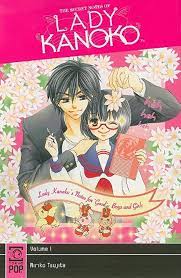
9. THE SECRET NOTES OF LADY KANOKO (Ririko Tsujita; Tokyopop)

Kanoko, the sardonic heroine of The Secret Notes of Lady Kanoko, is a student of human behavior, gleefully filling her notebooks with detailed observations about her classmates. Though Kanoko would like nothing more than to remain on the sidelines, she frequently becomes embroiled in her peers’ problems; they value her independent perspective, as Kanoko isn’t the least bit interested in dating, running for student council, or currying favor with the alpha clique. Kanoko’s sharp tongue and cool demeanor might make her the mean-girl villain in another shojo manga, but Ririko Tsujita embraces her heroine’s prickly, opinionated nature and makes it fundamental to Kanoko’s appeal. It’s a pity TOKYOPOP didn’t survive long enough to finish this three-volume series, as it’s one of the best shojo titles in recent memory.

8. WANDERING SON (Takako Shimura; Fantagraphics)

In her thoughtful review of volume one, Michelle Smith praised Takako Shimura’s deft use of perspective: “The main thing I kept thinking about while reading Wandering Son… is how things that seem insignificant to one person can be secretly, intensely significant to someone else.” Shimura’s ability to dramatize each character’s unique point of view is one of the reasons Wandering Son never feels preachy, even though the topic suggests an Afterschool Special; we are always exquisitely aware of the subtle but important changes in the way each character views herself, as well as her fears and hopes.

7. PRINCESS KNIGHT (Osamu Tezuka; Vertical, Inc.)

What Osamu Tezuka’s New Treasure Island (1946) was to shonen, his Princess Knight (1953-56) was to shojo: both were long-form adventure stories with cinematic flair. Neither could be said to be the “first” shonen or shojo manga, but both had a profound influence on the artists who came of age in the 1940s and 1950s, offering a new storytelling model for them to emulate. Viewed through a contemporary lens, Princess Knight hasn’t aged quite as well as New Treasure Island, as it’s saddled with some woefully antiquated notions of gender. At the same time, however, it’s easy to see why this story appealed to several generations of Japanese girls: Sapphire gets to eat her cake and have it too, having swashbuckling adventures *and* winning the hand of Prince Charming. –Reviewed at Manga Bookshelf on 11/21/11 and The Manga Critic on 12/19/10

6. TANK TANKURO: GAJO SAKAMOTO, MANGA’S PRE-WAR MASTER, 1934-35 (Gajo Sakamoto; Press Pop)

Almost twenty years before Osamu Tezuka’s Astro Boy took flight in the pages of Shonen Kobunsha magazine, Gajo Sakamoto’s Tank Tankuro enchanted Japanese youngsters with his monster-fighting exploits and cool gadgets. Though the series’ propaganda intent is impossible for contemporary readers to ignore — Tank fights the Chinese, who are portrayed in less-than-flattering terms — Presspop’s new anthology demonstrates that Sakamoto’s artistry has aged more gracefully than his storylines. Sakamoto’s work is packaged in a handsome, hardcover edition that includes thoughtful extras: a contextual essay by translator Sunsuke Nakazawa, an interview with Sakamoto’s son, and an article by Sakamoto himself, discussing the character’s origin.

5. STARGAZING DOG (Takashi Murakami; NBM/Comics Lit)

Consider yourself warned: Stargazing Dog is a five-hanky affair. The two interconnecting vignettes that comprise this slim volume explore the bond between Happie, a shiba inu, and Daddy, his owner. When Daddy loses his job, his home, and his family, he and Happie hit the road in search of a new life. Though the outcome of Happie and Daddy’s journey is never in doubt — we learn their fate in the opening pages of the book — Murakami draws the reader into their story with an honest and unsparing look at the human-dog compact that may remind cinephiles of Vittorio de Sica’s Umberto D. —Reviewed at The Manga Critic on 12/23/11

4. ONWARDS TOWARD OUR NOBLE DEATHS (Shigeru Mizuki; Drawn & Quarterly)

In this blistering indictment of Japanese militarism, Shigeru Mizuki draws on his own experiences during World War II to tell the story of a platoon stationed in Papua New Guinea. The soldiers face a terrible choice: fight a hopeless battle, or face execution for treason. Like many war stories, Onwards Toward Our Noble Deaths documents the tremendous human sacrifice of modern armed conflict: gruesome injuries, senseless deaths, devastated landscapes. What lends Mizuki’s narrative its special potency is his depiction of the senior officers; their perverse dedication to their mission turns them into tyrants, more concerned with saving face than saving their own soldiers’ skins. Essential reading for anyone interested in World War II.

3. THE DROPS OF GOD (Tadashi Agi and Shu Okimoto; Vertical, Inc.)

As Oishinbo handily demonstrated, a skilled writer can fold a considerable amount of educational detail into a story without reducing it to a textbook. The Drops of God follows a similar template, imparting highly specialized information about wine with the same natural ease that Law & Order illustrates the inner workings of a crime investigation. At the same time, however, Drops is a delicious soap opera, filled with domineering fathers, mustache-twirling villains, evil beauties, eccentric oenophiles, and down-on-their-luck restauranteurs. Even if the reader isn’t the least bit interested in wine, he’ll find the drama as irresistible as an episode of Dynasty. –Reviewed at The Manga Critic on 12/16/11

2. A ZOO IN WINTER (Jiro Taniguchi; Fanfare/Ponent Mon)

Drawing on his own experiences, Jiro Taniguchi spins an engaging tale about a young man who abandons a promising career in textile design for the opportunity to become a manga artist. Though the basic plot invites comparison with Bakuman, Taniguchi does more than just document important milestones in Hamaguchi’s career: he shows us how Hamaguchi’s emotional maturation informs every aspect of his artistry — something that’s missing from many other portrait-of-an-artist-as-a-young-man sagas, which place much greater emphasis on the pleasure of professional recognition than on the satisfaction of mastering one’s craft. Lovely, moody artwork and an appealing cast of supporting characters complete this very satisfying package.  —Reviewed at The Manga Critic on 5/28/11

1. A BRIDE’S STORY (Kaoru Mori; Yen Press)

A Bride’s Story, which takes place on the banks of the Caspian Sea, explores the relationship between Amir Halgal, a nineteen-year-old nomad, and Karluk Eihon, the eldest son of sheep herders. Though their marriage is one of political expedience, Amir is determined to be a good wife, doing her utmost to learn her new family’s customs, befriend the members of their extended clan, and earn her new husband’s respect. Kaoru Mori is as interested in observing Amir’s everyday life as she is in documenting the growing conflict between the Halgal and Eihon clans, yet A Bride’s Story is never dull, thanks to Mori’s smart, engaging dialogue; as she demonstrated in Emma and Shirley, Mori can make even the simplest moments revealing, whether her characters are preparing a manor house for the master’s return or skinning a freshly killed deer. By allowing her story to unfold in such a naturalistic fashion, A Bride’s Story manages to be both intimate and expansive, offering readers a window into life along the Silk Road. –Reviewed at The Manga Critic on 5/24/11

HONORABLE MENTIONS

As in previous years, I had difficulty limiting myself to just ten titles, so I compiled a list of manga that didn’t quite make my best-of list, but were thoroughly enjoyable:

  • OTHER AWESOME DEBUTS: The Book of Human Insects (Vertical, Inc.), Tesoro (VIZ)
  • BEST CONTINUING SERIES: 20th Century Boys (VIZ), Bunny Drop (Yen Press), Chi’s Sweet Home (Vertical, Inc.), Cross Game (VIZ), Ooku: The Inner Chambers (VIZ), Twin Spica (Vertical, Inc.)
  • BEST NEW GUILTY PLEASURE: Blue Exorcist (VIZ), Oresama Teacher (VIZ)
  • BEST REPRINT EDITION: Magic Knight Rayearth (Dark Horse), Pretty Guardian Sailor Moon (Kodansha Comics)
  • BEST MANGA I THOUGHT I’D HATE: Cage of Eden (Kodansha Comics)
  • BEST FINALE: Black Jack, Vol. 17 (Vertical, Inc.)

So now I turn the floor over to you, readers: what were your favorite new manga of 2011?

Filed Under: Manga Critic Tagged With: Drawn & Quarterly, Fanfare/Ponent Mon, fantagraphics, Gajo Sakamoto, Jiro Taniguchi, Kaoru Mori, NBM/Comics Lit, One Peace Books, Osamu Tezuka, PressPop, Shigeru, Tokyopop, vertical, yen press

The Best Manga of 2011: The Manga Critic’s Picks

December 31, 2011 by Katherine Dacey

The usual gambit for introducing a year-end list is to remark on the abundance of good titles, acknowledge the difficulty in choosing just ten (or five, or three), and comment on the overall state of the industry. And while I certainly debated what to include on my list, I’ll be honest: 2011 yielded fewer contenders for Best Manga than any other year I’ve covered. The dearth of new titles was attributable to publishers’ financial prudence; companies released fewer books, licensed fewer series, and focused on repackaging older content for budget-conscious consumers. And though I selfishly wish that more new material had been released this year, I think manga publishers have done an excellent job of responding to their biggest challenges: a sluggish economy, digital piracy, and Borders’ bankruptcy.

So what titles made my 2011 list? My top ten are below, along with my list of favorite continuing series, favorite finales, and favorite guilty pleasures.

10. Breathe Deeply
By Yamaaki Doton • One Peace Books
Part sci-fi thriller, part coming-of-age story, this engrossing drama examines the relationship between two young men: Sei, who grew up in a world of privilege, and Oishi, a boy from the wrong side of the tracks. Both Sei and Oishi fall in love with Yuko, a sickly girl whose incurable illness inspires her suitors to become medical researchers. In less capable hands, Breathe Deeply might have been a mawkish paean to the purity of young love, but the husband-and-wife team of Yamaaki Doton have a keen ear for dialogue; the interactions between Yuko and her two suitors are tinged with an authentic mixture of adolescent anxiety, sexual longing, and braggadocio. Clean, expressive artwork and well-rounded characters help sell the story, especially in its final pages. One of 2011’s best surprises.

9. The Secret Notes of Lady Kanako
By Ririko Tsujita • Tokyopop
Kanoko, the sardonic heroine of The Secret Notes of Lady Kanoko, is a student of human behavior, gleefully filling her notebooks with detailed observations about her classmates. Though Kanoko would like nothing more than to remain on the sidelines, she frequently becomes embroiled in her peers’ problems; they value her independent perspective, as Kanoko isn’t the least bit interested in dating, running for student council, or currying favor with the alpha clique. Kanoko’s sharp tongue and cool demeanor might make her the mean-girl villain in another shojo manga, but Ririko Tsujita embraces her heroine’s prickly, opinionated nature and makes it fundamental to Kanoko’s appeal. It’s a pity TOKYOPOP didn’t survive long enough to finish this three-volume series, as it’s one of the best shojo titles in recent memory.

8. Wandering Son
By Takako Shimura • Fantagraphics
In her thoughtful review of volume one, Michelle Smith praised Takako Shimura’s deft use of perspective: “The main thing I kept thinking about while reading Wandering Son… is how things that seem insignificant to one person can be secretly, intensely significant to someone else.” Shimura’s ability to dramatize each character’s unique point of view is one of the reasons Wandering Son never feels preachy, even though the topic suggests an Afterschool Special; we are always exquisitely aware of the subtle but important changes in the way each character views herself, as well as her fears and hopes.

7. Princess Knight
By Osamu Tezuka • Vertical, Inc.
What Osamu Tezuka’s New Treasure Island (1946) was to shonen, his Princess Knight (1953-56) was to shojo: both were long-form adventure stories with cinematic flair. Neither could be said to be the “first” shonen or shojo manga, but both had a profound influence on the artists who came of age in the 1940s and 1950s, offering a new storytelling model for them to emulate. Viewed through a contemporary lens, Princess Knight hasn’t aged quite as well as New Treasure Island, as it’s saddled with some woefully antiquated notions of gender. At the same time, however, it’s easy to see why this story appealed to several generations of Japanese girls: Sapphire gets to eat her cake and have it too, having swashbuckling adventures *and* winning the hand of Prince Charming. —Reviewed at Manga Bookshelf on 11/21/11 and The Manga Critic on 12/19/10

6. Tank Tankuro: Gajo Sakamoto, Manga’s Pre-War Master, 1934-35
By Gajo Sakamoto • Press Pop
Almost twenty years before Osamu Tezuka’s Astro Boy took flight in the pages of Shonen Kobunsha magazine, Gajo Sakamoto’s Tank Tankuro enchanted Japanese youngsters with his monster-fighting exploits and cool gadgets. Though the series’ propaganda intent is impossible for contemporary readers to ignore — Tank fights the Chinese, who are portrayed in less-than-flattering terms — Presspop’s new anthology demonstrates that Sakamoto’s artistry has aged more gracefully than his storylines. Sakamoto’s work is packaged in a handsome, hardcover edition that includes thoughtful extras: a contextual essay by translator Sunsuke Nakazawa, an interview with Sakamoto’s son, and an article by Sakamoto himself, discussing the character’s origin.

5. Stargazing Dog
By Takashi Murakami • NBM/Comics Lit
Consider yourself warned: Stargazing Dog is a five-hanky affair. The two interconnecting vignettes that comprise this slim volume explore the bond between Happie, a shiba inu, and Daddy, his owner. When Daddy loses his job, his home, and his family, he and Happie hit the road in search of a new life. Though the outcome of Happie and Daddy’s journey is never in doubt — we learn their fate in the opening pages of the book — Murakami draws the reader into their story with an honest and unsparing look at the human-dog compact that may remind cinephiles of Vittorio de Sica’s Umberto D. —Reviewed at The Manga Critic on 12/23/11

4. Onwards Towards Our Noble Deaths
By Shigeru Mizuki • Drawn & Quarterly
In this blistering indictment of Japanese militarism, Shigeru Mizuki draws on his own experiences during World War II to tell the story of a platoon stationed in Papua New Guinea. The soldiers face a terrible choice: fight a hopeless battle, or face execution for treason. Like many war stories, Onwards Toward Our Noble Deaths documents the tremendous human sacrifice of modern armed conflict: gruesome injuries, senseless deaths, devastated landscapes. What lends Mizuki’s narrative its special potency is his depiction of the senior officers; their perverse dedication to their mission turns them into tyrants, more concerned with saving face than saving their own soldiers’ skins. Essential reading for anyone interested in World War II.

3. The Drops of God
By Tadashi Agi and Shu Okimoto • Vertical, Inc
As Oishinbo handily demonstrated, a skilled writer can fold a considerable amount of educational detail into a story without reducing it to a textbook. The Drops of God follows a similar template, imparting highly specialized information about wine with the same natural ease that Law & Order illustrates the inner workings of a crime investigation. At the same time, however, Drops is a delicious soap opera, filled with domineering fathers, mustache-twirling villains, evil beauties, eccentric oenophiles, and down-on-their-luck restauranteurs. Even if the reader isn’t the least bit interested in wine, he’ll find the drama as irresistible as an episode of Dynasty. —Reviewed at The Manga Critic on 12/16/11

2. A Zoo in Winter
By Jiro Taniguchi • Fanfare/Ponent Mon
Drawing on his own experiences, Jiro Taniguchi spins an engaging tale about a young man who abandons a promising career in textile design for the opportunity to become a manga artist. Though the basic plot invites comparison with Bakuman, Taniguchi does more than just document important milestones in Hamaguchi’s career: he shows us how Hamaguchi’s emotional maturation informs every aspect of his artistry — something that’s missing from many other portrait-of-an-artist-as-a-young-man sagas, which place much greater emphasis on the pleasure of professional recognition than on the satisfaction of mastering one’s craft. Lovely, moody artwork and an appealing cast of supporting characters complete this very satisfying package.  —Reviewed at The Manga Critic on 5/28/11

1. A Bride’s Story
By Kaoru Mori • Yen Press
A Bride’s Story, which takes place on the banks of the Caspian Sea, explores the relationship between Amir Halgal, a nineteen-year-old nomad, and Karluk Eihon, the eldest son of sheep herders. Though their marriage is one of political expedience, Amir is determined to be a good wife, doing her utmost to learn her new family’s customs, befriend the members of their extended clan, and earn her new husband’s respect. Kaoru Mori is as interested in observing Amir’s everyday life as she is in documenting the growing conflict between the Halgal and Eihon clans, yet A Bride’s Story is never dull, thanks to Mori’s smart, engaging dialogue; as she demonstrated in Emma and Shirley, Mori can make even the simplest moments revealing, whether her characters are preparing a manor house for the master’s return or skinning a freshly killed deer. By allowing her story to unfold in such a naturalistic fashion, A Bride’s Story manages to be both intimate and expansive, offering readers a window into life along the Silk Road. —Reviewed at The Manga Critic on 5/24/11

HONORABLE MENTIONS
As in previous years, I had difficulty limiting myself to just ten titles, so I compiled a list of manga that didn’t quite make my best-of list, but were thoroughly enjoyable:

  • Other Awesome Debuts: The Book of Human Insects (Vertical, Inc.), Tesoro (VIZ)
  • Best Continuing Series: 20th Century Boys (VIZ), Bunny Drop (Yen Press), Chi’s Sweet Home (Vertical, Inc.), Cross Game (VIZ), Ooku: The Inner Chambers (VIZ), Twin Spica (Vertical, Inc.)
  • Best New Guilty Pleasure: Blue Exorcist (VIZ), Oresama Teacher (VIZ)
  • Best Reprint Edition: Magic Knight Rayearth (Dark Horse), Pretty Guardian Sailor Moon (Kodansha Comics)
  • Best Manga I Thought I’d Hate: Cage of Eden (Kodansha Comics)
  • Best Finale: Black Jack, Vol. 17 (Vertical, Inc.)

So now I turn the floor over to you, readers: what were your favorite new manga of 2011?

Filed Under: Manga Critic, Recommended Reading Tagged With: Drawn & Quarterly, Fanfare/Ponent Mon, fantagraphics, Gajo Sakamoto, Jiro Taniguchi, Kaoru Mori, NBM/Comics Lit, One Peace Books, Osamu Tezuka, PressPop, Tokyopop, Vertical Comics, yen press

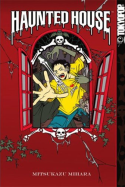
Haunted House

October 27, 2011 by Michelle Smith

By Mitsukazu Mihara | Published by TOKYOPOP

I blame my “meh” reaction to Mitsukazu Miharu’s Haunted House—which I honestly wanted to like!—on the back cover, which promises that readers will be “kept guessing—and giggling” by the behavior of Sabato Obiga’s flamboyantly goth parents. I might’ve smiled a time or two, but that’s about it.

The basic premise here is simple and reiterated several times throughout the volume: Sabato would like a steady girlfriend, but they inevitably ask to see his house, which means they will have to meet his bizarre, “death-flavored” family and be scared off by their creepy antics. Sabato’s mother strongly resembles Morticia Addams, his father (despite being a banker) often sports a sort of Victorian dandy look, and his twin sisters have a gothic lolita vibe and spend their free time making voodoo dolls. The Obiga family also likes to decorate their home with skeletons and shrines and threatens to serve the family cat for dinner. Sabato always obtains their promise to behave before inviting a girl over, but this is invariably broken.

Haunted House is pretty repetitive, but I think I wouldn’t have been dissastified with it if the powers that be at TOKYOPOP hadn’t strongly hinted that Sabato’s family has some reason for treating him like they do. Okay, yes, they abruptly promise to support him when it seems that he, after fancying a long string of random ladies, seems to have fallen in love at last, but it’s not like they actually follow through with this in any meaningful way.

Looking kooky is one thing, but they’re frequently just down-right mean. At one point, Sabato is hospitalized with a broken leg and his family comes to visit. Most of what they do is innocuous—bringing him only hospital-themed horror novels to read, for example—but his mother actually feeds him dog food. I just don’t get it. Is that supposed to be funny? Is that supposed to be someone who is merely tormenting their kid, as the back cover implies, in an effort to encourage him to grow up, become an independent person, and stop pursuing meaningless relationships with random girls?

I don’t know, but I am certain that I am thinking too hard about this. And I partly blame the back cover that encouraged me to expect more from a story that is really just a diverting bit of goofiness.

Filed Under: REVIEWS Tagged With: Tokyopop

Let’s Get Visual: Fruits Basket

July 30, 2011 by Michelle Smith

MICHELLE: So, we’ve been talking about Fruits Basket all week, but I’m certainly not yet weary of the topic. How about you, MJ?

MJ: I suspect I could discuss Fruits Basket for weeks on end!

MICHELLE: Me too. We’ve already discussed the general awesomeness of the story and characters this week, but one thing we haven’t talked much about yet is the art. Takaya’s style evolves a good bit over the course of the series, and while I used to think I preferred her earlier style, I’ve lately realized that that is not the case at all. Do you have a preference yourself?

MJ: Hm, well, I definitely appreciate the prettiness of the series’ early volumes, and I do think there is some detail lost later on, but one thing the series never lacks is expressiveness, and that goes for the artwork as much as anything else.

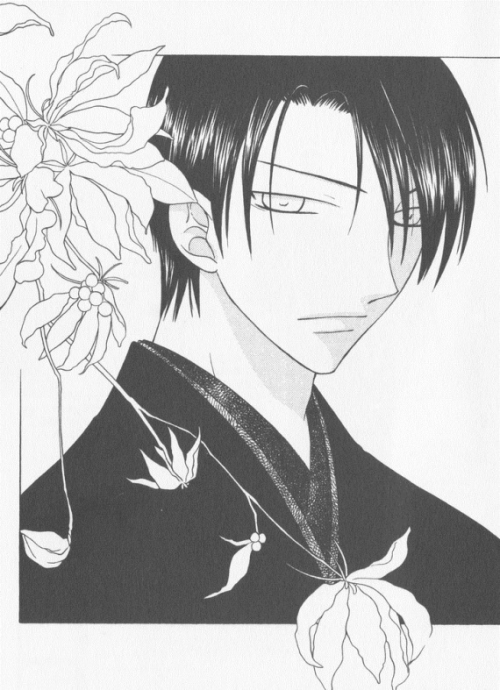
MICHELLE: I think the expressiveness actually improves later on, at least insofar as Tohru is concerned, since she loses those really, really, really big eyes of hers. I will forever mourn the changes to my beloved Hatori, though, who goes from looking like this to looking like this.

It’s not that he’s become unattractive; he’s just lost a certain bishounen quality that I had certainly appreciated.

MJ: I do think Takaya does a wonderful job of aging the characters subtly over the course of the story, and I’m not necessarily just referring to their physical ages. I think she matures them overall, letting their outsides reflect their insides.

MICHELLE: That is definitely true, especially with Kyo, Yuki, and Momiji. Probably Momiji most stunningly of all.

MJ: Yes, there is quite a bit made of Momiji’s growing up, isn’t there? And though it’s more difficult to see that transformation as “subtle,” it’s certainly striking and oddly poignant.

MICHELLE: Takaya really does well with “striking” and “poignant,” doesn’t she? Which leads us to our specific picks for this month’s column!

Many of the most powerful and affecting moments in Fruits Basket occur between just two characters. To exemplify this trend, MJand I have both chosen scenes starring only Kyo and Tohru.

MJ, why don’t we start with you?

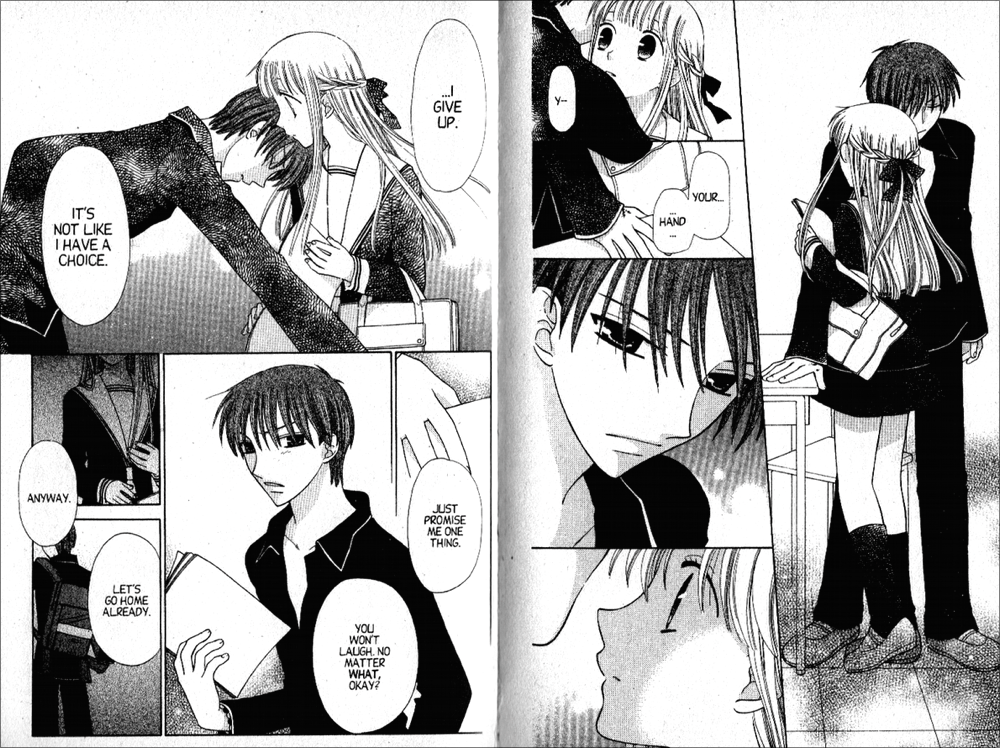
Volume 15, Chapter 87, Pages 129-134 (TOKYOPOP)

MJ: Okay, well, I’ve chosen a scene from late in volume fifteen. After losing his temper in a confrontation with Yuki, Kyo returns to his classroom to find Tohru waiting for him, alone. In terms of script alone, the scene is not especially remarkable. There are some dramatic moments in Kyo’s inner monologue, but they’re both being careful not to *say* anything out of the ordinary. What makes the scene really work, though, is their body language.

At this point in the series, both Kyo and Tohru are just barely beginning to realize how they feel about each other, and Takaya plays this beautifully. The way Tohru lights up the moment she realizes Kyo is in the room, Kyo’s impulse to lean against her, their excited nervousness about being close, and especially Tohru’s last page alone—you can actually feel the tension between them in every panel. It’s so well done.

I especially like the last panel, with a flushed Tohru hurrying out of the frame. Somehow, leaving us with the empty space behind her keeps us lingering in the moment, much as she would herself, if she hadn’t been called away. There’s a sense there that the moment still looms large for her, too, even as she’s hastily left it behind, emphasized by the flowers still present in the frame. Like her absence in the frame is saying, “Really intense and possibly scary feelings happened here… run away, run away!” Does that make any sense?

MICHELLE: It absolutely makes sense! I’m always interested in how mangaka use open space, and I think you’re quite right that in that final panel it’s being used to keep us in place while Tohru dashes off. On the first page, the oddly tall panel of Tohru alone in the classroom employs empty space to emphasize how she really is the only one there.

This example reminds me of your pick for our “Duds” column, Baseball Heaven, and how the artist in that case utterly failed to establish convincing body language between two characters who were meant to be attracted to each other. Perhaps Ellie Mamahara needs to read more Fruits Basket!

MJ: Oh, good call, Michelle! Yes, that’s the perfect choice for contrast here. Everything that’s missing in that scene from Baseball Heaven is demonstrated spectacularly here, and as a result, this actually plays as a love scene much more convincingly, despite not actually being one. Even the use of small frames to emphasize the hand or face—something that just felt distracting and fragmented in Mamahara’s scene—adds to the tension here. It’s wonderfully done.

So what about you, Michelle? What scene did you choose?

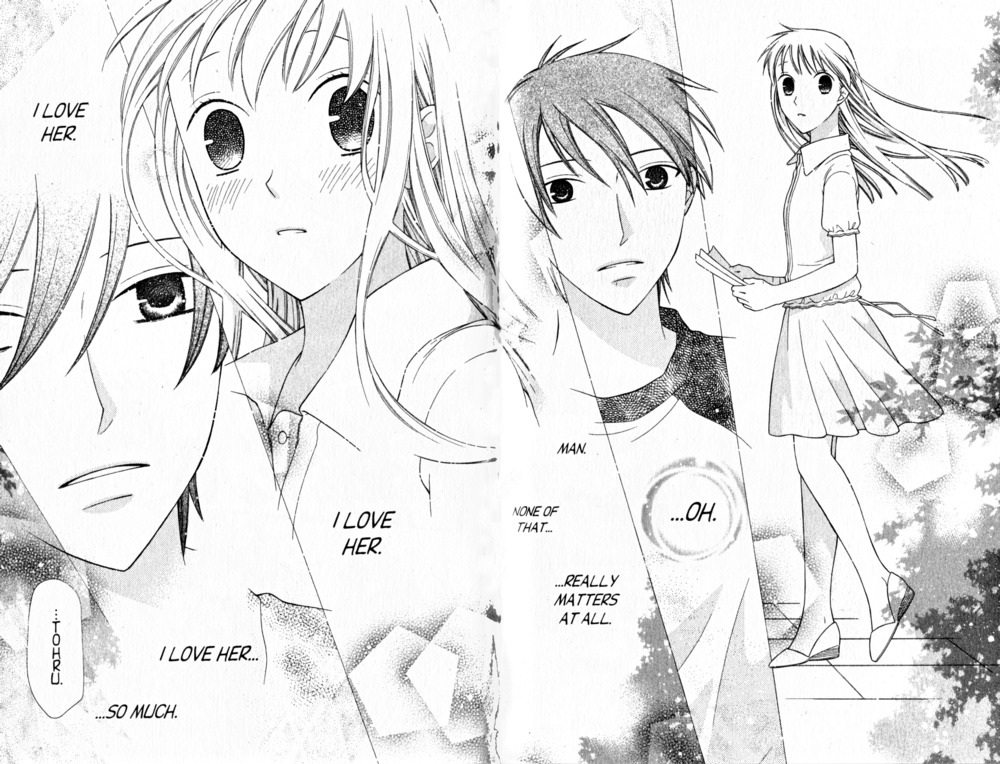
Volume 22, Chapter 128, Pages 96-99 (TOKYOPOP)

MICHELLE: The scene I’ve chosen is from volume 22, quite near the end of the series. Tohru has been hospitalized and her friends have barred Kyo from seeing her while she recovers, since she gets stressed at the mention of his name.

As Kyo makes his nervous way to the hospital, the size and shape of the panels reflect his mental state. They’re cramped, dark, and dominated by his inner monologue. “Do I really still like her? What do I like about her?” We catch incomplete glimpses of the things Kyo passes on his journey, because he is so wrapped up in his thoughts that he too is hardly noticing them. Finally he arrives at the hospital, and the tension as he catches Uotani’s eye is palpable.

And then… Tohru appears and the world falls away. Suddenly, everything is so clear. The doubts are wiped away as if they have never been, because the minute he sees her, it is so very simple. “I love her.” Even as Kyo’s focus narrows to include only Tohru, the pages still have a wide-open and airy feeling that suggests gentleness and infinite possibility. This is the first time Kyo has really allowed himself to acknowledge these feelings, and it’s so beautifully done that it gives me goosebumps.

MJ: Oh, absolutely, I have the same reaction here! Everything you’ve said about the size and tone of the panels is exactly spot-on. Also, watching Kyo’s face the few times we see it is striking, panel-to-panel. His first expression, as he’s approaching the hospital, is one of extreme trepidation, and it feels to me that he’s sort of hiding behind his bangs. He doesn’t want to be seen by anyone, especially someone like Uotani, whose gaze he reacts so intensely to. He’s terrified of his own feelings and of screwing things up, and he knows that he’s historically bad at dealing with emotional situations. He’s simply terrified on all fronts.

Then, when he sees Tohru, all of that just drops away, leaving him with an expression of pure longing and vulnerability we’ve really not seen on him before. Just as the air opens up, so does Kyo, completely unguarded for one long moment. It’s really stunning. I think both of these scenes we’ve chosen would play just the same with all the text removed—they’re so much driven by the emotion in the artwork.

MICHELLE: Longing, vulnerability and sheer wonder, I think. :)

And yes, I think we have a knack for picking scenes where text is not really necessary. Even here, body language is certainly telling a lot of the story for us, even in small ways like Kyo’s tensed, half-flexed arm and clenched fist as he finally reaches his destination. You can almost see him willing himself to get through this without messing up.

MJ: There’s just so much emotional nuance here, in every panel. When I’m reading scenes like this in context, these are details I don’t consciously notice as I let the emotions just sweep me along, but when we actually take the time to break it down like this, I can’t help but be amazed by how much thought has gone into each line on the page.

MICHELLE: Me too. It sounds like we’ve convinced ourselves that, yet again, Fruits Basket is awesome.

MJ: Indeed we have!

MICHELLE: Thank you, MJ, for joining me once again! And to those reading this column. Do you have a favorite artistic moment in Fruits Basket? Tell us about it in the comments!

Filed Under: FEATURES, Let's Get Visual Tagged With: natsuki takaya, Tokyopop

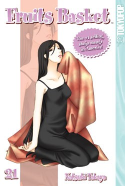
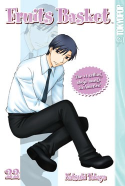
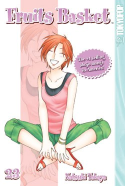
Fruits Basket, Vols. 21-23

July 28, 2011 by Michelle Smith

As I recounted in this week’s Off the Shelf column, I have been a fan of Fruits Basket for nearly a decade now. I followed the end of the series in Japanese, and because I knew how it ended, I was able to postpone reading the final English volumes and delay the sad moment when the series really would be over. This week’s Manga Moveable Feast, however, prompted me to finally take the plunge.

Volume 21 is extremely tense, with Kyo continuing the story of how he redirected his feelings of guilt regarding the death of Tohru’s mother into a hatred of Yuki (just like his father redirected his own guilt in the death of his wife onto Kyo). Meanwhile, an ominous, knife-wielding Akito creeps up on their location. After Kyo seems to reject her feelings, Tohru runs off and crosses paths with Akito. A vitally important scene occurs between them in which Akito, weakened by lies and uncritical kindness perpetuated by various Sohma family members, is finally receptive to the kind of acceptance and sympathy Tohru offers. I’m a little disappointed that Tohru immediately falls off a cliff at this point, because that’s rather meloramatic, but I adore how urgently Akito attempts to summon help.

All of the Sohmas are worried, but none more so than Yuki (in cold fury mode) and Kyo (deeply grieving), who eventually have it out and end up finally confessing that they each aspired to be like the other. I love how this plays out, and I love that Yuki continues to nudge Kyo when necessary to ensure that Tohru ends up happy. Are they super pals by the end of the series? Not exactly, but they’ve definitely made their peace and come to an understanding. I’d say they’re closer than mere friends, actually, because they’ve gone through so much together, treasure the same person so much, and have finally realized that, despite appearances and insults, the person they are is valued by the other.

While Tohru recovers in the hospital, Kyo realizes that she’s given him something worth fighting his “fate” for. A visit to his father leads to paternal hysterics, but Kyo’s resolve is unshaken: he is going to live “outside,” no matter what. Meanwhile, Akito has made plans to demolish the isolation room. In the aforementioned Off the Shelf column, I wondered whether Akito’s actions might partly be due to some unconscious influence by the God who originally created the bond, as we later learn that he laments that something forged in love has now become a source of pain. He’s grateful to those who “shouldered that exhausted promise” for so long, and willingly lets them go. So, did he convince Akito in some way? Did Akito convince him? The latter would be more in line with the themes of the series, actually.

Uotani and Hanajima keep Kyo away from the hospital while Tohru is recuperating, since the mere mention of her name prompts her to start crying (she still believes he is disillusioned by her confession of love), but he’s finally tipped off regarding her release date and goes to see her. It’s an amazing scene: as Kyo heads there, he’s full of doubts and uncertainty regarding his own feelings, but the moment he sees her, everything is clear as day. “I love her.” I can’t help getting a bit choked up even discussing it, because it seems like I’m watching cherished friends finally find each other. They talk and work things out, and it is as lovely as can be. “I really do love you,” quoth Tohru, when Kyo warns he’ll probably cause her pain because the curse is still between them. “And that feeling is invincible.” They embrace and are profoundly shocked when Kyo does not transform. His curse is broken.

A wonderful chain-reaction montage ensues as the members of the Zodiac are freed in turn, with Yuki the last of all. “You’re the last,” says God. “Thank you. For keeping the very distant promise.” This happens just in time for Yuki, who had been on the verge of telling Machi about the curse, to embrace her in tears.

Loose ends are wrapped up in the final volume, more loose ends than I actually realized needed wrapping up, making for a very thorough and satisfying conclusion. It’s a little convenient that nearly everyone ends up romantically paired off by the end, with the exceptions of Momiji and Kagura, who are still not over their respective unrequited loves. Other things, however, aren’t wrapped up so neatly, with Rin unable to forgive Akito just yet, long-time family servants unable to adjust to the dissolution of the curse, and many painful feelings still remaining.

But, as a certain image reminded me, Takaya-sensei maintains the idea that “there is no such thing as a memory that’s okay to forget” to the end. The formerly cursed Sohma don’t need to forget what happened to them in the past in order to be happy in the future. Tohru believes this fully, collecting each of the beads from Kyo’s broken bracelet and displaying them as precious items alongside family portraits even until the day she and Kyo are lovey-dovey grandparents.

I cannot express enough how wonderful this series is. I feel so fortunate that I was able to witness the growth and transformation of such a memorable cast of characters, many of whom I dearly love.

Filed Under: REVIEWS Tagged With: natsuki takaya, Tokyopop

Ghostface, Vol. 1

July 12, 2011 by Katherine Dacey

“What doesn’t kill you will try again later” — so goes the tag line for Min-Woo Hyung’s Ghostface, a sci-fi thriller in which a female assassin is sent to recover a top-secret drug from a gang of thieves. If only the story was as snappy as the jacket copy! Alas, Ghostface is the kind of talky, self-serious comic that interrupts a perfectly good action scene so that one of the characters can intone nonsense about destiny, or explain a key plot detail for the reader’s benefit, or remind his arch-enemy about the source of their mutual animosity.

It’s a pity that Hyung saddled Ghostface with such a ponderous script, as he’s a terrific artist, capable of drawing sexy, strong characters, evocative landscapes, and scary-looking monsters. Sodo, the island on which Ghostface takes place, offers ample evidence of his skill; though the island’s abandoned buildings and shattered roadways are something of a sci-fi cliche, Hyung’s expert use of color imbues these wasted cities with a sepulchral beauty. His characters, too, are stylish: his women are tall and curvy butt-kickers — the better to fill out their skin-tight costumes — while the men have leonine faces and impossibly chiseled torsos. (In a nod to equal-opportunity fanservice, many of Hyung’s male characters like to accessorize a chic outfit with a bare pec or two.)

Storytelling, on the other hand, is not Hyung’s forte. The basic plot is clearly delineated, but the script’s slack pacing and macho posturing grow tiresome quickly. If I had to point to the moment at which I officially lost interest in Ghostface, it would be a scene in which a drug-addled supervillain hovers over an unconscious woman and hisses, “Your flesh will sustain me and bear my fruit… You were born to be my chalice.” Not since Baudelaire declared, “Your memory in me glitters like a monstrance!” have I read such an uninviting pick-up line involving a sacred object.

And if the relic pillow-talk wasn’t goofy enough, Hyung then introduces a sexy ninja, complete with butt-floss outfit, mystical powers, and a taste for other beautiful women. She’s the kind of character who might have worked in the context of a Koike-Ikegami raunchfest, but Hyung’s story is so self-important that he won’t allow her be to crazy or evil or interesting; her primary role is to strike provocative poses, whether she’s torturing the heroine or lying comatose in a hallway. Hyung doesn’t even have the good graces to let us savor how tough she is, treating her big moment of bad-assery so casually that I didn’t realize that she had stabbed herself in the heart with an acupuncture needle until I re-read the scene.

The bottom line: Ghostface looks like a million bucks, but takes itself so seriously that it forgets to be fun.

GHOSTFACE, VOL. 1 • BY MIN-WOO HYUNG • TOKYOPOP • 140 pp. • RATING: MATURE (18+)

Filed Under: Manga Critic Tagged With: Ghostface, Min-Woo Hyung, Tokyopop

  • « Go to Previous Page
  • Page 1
  • Page 2
  • Page 3
  • Page 4
  • Interim pages omitted …
  • Page 7
  • Go to Next Page »
 | Log in
Copyright © 2010 Manga Bookshelf | Powered by WordPress & the Genesis Framework