• Skip to primary navigation
  • Skip to main content
  • Skip to primary sidebar
  • Home
  • About Us
    • Privacy Policy
    • Comment Policy
    • Disclosures & Disclaimers
  • Resources
    • Links, Essays & Articles
    • Fandomology!
    • CLAMP Directory
    • BlogRoll
  • Features & Columns
    • 3 Things Thursday
    • Adventures in the Key of Shoujo
    • Bit & Blips (game reviews)
    • BL BOOKRACK
    • Bookshelf Briefs
    • Bringing the Drama
    • Comic Conversion
    • Fanservice Friday
    • Going Digital
    • It Came From the Sinosphere
    • License This!
    • Magazine no Mori
    • My Week in Manga
    • OFF THE SHELF
    • Not By Manga Alone
    • PICK OF THE WEEK
    • Subtitles & Sensibility
    • Weekly Shonen Jump Recaps
  • Manga Moveable Feast
    • MMF Full Archive
    • Yun Kouga
    • CLAMP
    • Shojo Beat
    • Osamu Tezuka
    • Sailor Moon
    • Fruits Basket
    • Takehiko Inoue
    • Wild Adapter
    • One Piece
    • After School Nightmare
    • Karakuri Odette
    • Paradise Kiss
    • The Color Trilogy
    • To Terra…
    • Sexy Voice & Robo
  • Browse by Author
    • Sean Gaffney
    • Anna Neatrour
    • Michelle Smith
    • Katherine Dacey
    • MJ
    • Brigid Alverson
    • Travis Anderson
    • Phillip Anthony
    • Derek Bown
    • Jaci Dahlvang
    • Angela Eastman
    • Erica Friedman
    • Sara K.
    • Megan Purdy
    • Emily Snodgrass
    • Nancy Thistlethwaite
    • Eva Volin
    • David Welsh
  • MB Blogs
    • A Case Suitable For Treatment
    • Experiments in Manga
    • MangaBlog
    • The Manga Critic
    • Manga Report
    • Soliloquy in Blue
    • Manga Curmudgeon (archive)

Manga Bookshelf

Discussion, Resources, Roundtables, & Reviews

Shonen

Ginga Legend Weed, Vol. 1

May 19, 2011 by Katherine Dacey 9 Comments

As a critic, I tend to focus on how stories are told, rather than how they make me feel. Much as I’d like to chalk up that tendency to rigorous academic training or a Vulcan-like disposition, I’m afraid the underlying reason is much simpler and less flattering: I’m a snob.

I should qualify that statement by saying that I’m not really a snob, but I’ve spent enough time in the Ivory Tower to know that I’m supposed to appreciate the difference between Great Art and commercial crap, between penetrating explorations of the human condition and cheap sentiment. Crying while watching Sansho the Bailiff? Perfectly OK — it’s a Criterion film based on a critically regarded novel! Crying while watching Marley & Me? Intellectually suspect — it’s a mawkish paean to dog ownership, and an obvious play for the audience’s sympathy!

Except I’m more likely to weep buckets while watching Marley & Me.

OK, that’s only partially true. I cried harder during the final reel of Marley & Me than I did during the final reel of Sansho the Bailiff, though both left me devastated. But you grasp the point: Sansho the Bailiff may be a deep, moving statement about cruelty, sacrifice, and loyalty, but on an autonomic level, Zushio and Anju’s plight can’t hold a candle to a pooch in peril.

Which leads me to Ginga Legend Weed. The story is, in fact, a sequel to Ginga: Nagareboshi Gin, an eighteen-volume manga about an Akita who abandons his human master, joins a pack of feral dogs, and wrests control of the Ōu Mountains from a powerful, demonic bear nicknamed “Red Helmet.” Ginga Legend Weed picks up the thread several years after Akakabuto’s defeat: Gin’s mate, Sakura, has given birth to a pup, but is unable to raise him. On her deathbed, she implores an English Setter named GB to bring Weed to his father, thus initiating the first of many battle arcs that will pit Weed against a genetically altered dog, a vicious baboon troupe, a dog army led by an evil German Shepherd named Victor, and a “large hybrid bear.” (Actually, I have no idea what a “large hybrid bear” is, though it certainly sounds dangerous and impressive. Thanks, Wikipedia!)

As a well-trained product of a fancy-pants university, I can say with confidence that Ginga Legend Weed suffers from a host of structural problems. The pacing is uneven; the action sequences are repetitive, recycling the same attacks again and again; and the script is both tin-eared and thoroughly sentimental, ascribing a full complement of human emotions and motivations to its canine characters. Were I to judge Ginga purely on the quality of its execution, I’d have to proclaim it a mediocre specialty product calculated to appeal to a particular audience, the kind of readers who aren’t likely to roll their eyes dismissively when a puppy cries out for his mommy. Readers like… well, me.

Trading my critic’s cap for a dog lover’s,  I can see the obvious skill behind Yoshihiro Takahashi’s drawings; he’s spent many hours observing canine body language and facial expressions, and uses flattened ears, tucked tails, and raised hackles to show the full extent of his characters’ emotional states. Takahashi is also a student of canine social behavior. His dog societies may use human terms to describe each member’s rank — general, captain, and so forth — but Takahashi clearly grasps pack dynamics; canine power struggles frequently drive the plot, as dogs vie for alpha status and bully weaker members of the group.

What Ginga Legend Weed does most powerfully, however, is take the core values of a Shonen Jump manga — “friendship, effort, victory” — and apply them to a story about a young dog trying to find his place in the world. Weed’s unswerving commitment to his friends, his willingness to risk his life for others, and his ability to rally dogs to his cause are, perhaps, a bit absurd — he’s Naruto in quadriped form — but his efforts remind us that dogs are emotionally complex, intelligent creatures capable of forming deep attachments. For an animal lover like me, Ginga affirms the warm, affectionate bond I have with my own dog while stoking my indignation that many human-canine relationships are fraught with violence and neglect. (Many of the characters have been abandoned or abused by their human masters.) That may not have been Takahashi’s intended message, but that’s how Ginga Legend Weed made me *feel.*

And speaking of my emotional response to Ginga Legend Weed, yes, I did sniffle a bit while I read, especially during a story line involving a pup who’d been cruelly separated from his mother. And yes, I felt compelled to write a check to the Humane Society when I finished. I don’t know if either of those actions are testament to Ginga‘s quality, exactly, but they speak to its ability to push my emotional buttons. And sometimes knowing that I’m still attuned to my inner sap is reward enough for a highbrow gal like me.

Filed Under: Manga Critic Tagged With: Animals, Comics One, Dog Manga, Ginga Legend Weed, Shonen

From the stack: Maoh: Juvenile Remix vols. 4 and 5

May 12, 2011 by David Welsh

The good news: there’s nothing wrong with Maoh: Juvenile Remix (Viz) that Kazuya Minekura couldn’t fix. The bad news: Maoh: Juvenile Remix was created by Megumi Osuga.

Maoh, based on a story by Kotaro Isaka, has an interesting plot. A corporation is undertaking a neighborhood revitalization plan that basically involves razing the place and displacing the residents to make room for luxury high-rises. The corporation is opposed by a group of vigilantes led by an enigmatic and ostensibly charismatic figure named Inukai. Caught in the middle of these two forces is a high-school student named Ando who has the minor psychic power of being able to put his words into the mouths of others.

The story is packed with corrupt officials, hired killers, angry mobs, and generally seedy types. There are attempts at moral complexity and the angst of personal choice in a crumbling world. There’s a reasonable sprinkling of homoeroticism.

In other words, it reminds me of Minekura’s Wild Adapter (Tokyopop). Unfortunately, it also makes me wish I was reading Wild Adapter instead.

The main problem with Maoh is its leaden sincerity. Ando makes Hamlet look like a type-A personality, and his use of his “ventriloquism” is generally awkward and hard to follow. (How does forcing people to quote Kamen Rider protect you from mob violence?) The dialogue is almost always overblown, and Ando’s droning internal monologues may make you wish someone else was putting words in his mouth.

The promising plot is generally sacrificed to spectacle. The people of Nekota City seem even more prone to mob mentality than the denizens of Springfield, and it’s supposed to be chilling here instead of goofy and ironic. Inukai and his vigilantes seem to have no credible moral position, and their opponents in the Anderson Group are just greedy, which equates to “bad.” There are interesting arguments to be made in a story like this, but it’s just a frame for bombast in this case.

The quality of the art varies quite a bit. Some chapters have a sleek competence that resembles a combination of Takeshi Obata and Naoki Urasawa. A lot of the time, the pages seem like they’ve been finished in a hurry. I would describe the character design as patchy; I’ve seen many a manga assassin look ridiculous and still be terrifying, but Osuga doesn’t strike that balance. Some of the crowd scenes display too-strenuous attempts to achieve visual variety and end up looking like a community theatre musical chorus that was asked to provide its own costumes. Even the homoeroticism doesn’t help, as it frequently seems inadvertent, unless Osuga is trying to suggest what a cute couple Ando and his younger brother might be.

Maoh badly needs some of Minekura’s polish and slyness, but it has neither. It’s just lumpy and overly serious, with a waffling protagonist who lacks urgency. Hard as it tries to simulate it, Maoh lacks the sex appeal it needs to really be something.

(Based on review copies provided by the publisher.)


Filed Under: REVIEWS Tagged With: Shogakukan, Shonen, shonen sunday

My Viz 25

May 5, 2011 by David Welsh

Viz is celebrating will celebrate its 25th anniversary this summer, which is quite an accomplishment. Given how many English-language manga publishers have fallen away over time, you have to give Viz credit for sticking around, no matter how well resourced they may be. They’ve always struck me as grown-ups and professionals, which certainly helps. Beyond that, I appreciate the range of material they’ve published over time and that they continue to try and publish.

So, in preparation for the milestone, I thought I’d list 25 of my favorite Viz manga. It’s impressive that it was actually difficult to limit this list to 25, and I ended up having to institute a one-title-per-creator rule to make it possible. Here they are in alphabetical order:

  1. 20th Century Boys, written and illustrated by Naoki Urasawa: my favorite of Urasawa’s paranoid thriller, because it’s as frisky and funny as it is suspenseful.
  2. A, A1, written and illustrated by Moto Hagio: dreamy science fiction about people with too many feelings for the universe to contain.
  3. Benkei in New York, written by Jinpachi Mori, illustrated by Jiro Taniguchi: beautifully drawn (because it’s Taniguchi) and slyly written noir tales of a mysterious Japanese man in the Big Apple.
  4. Children of the Sea, written and illustrated by Daisuke Igarashi: some of the most viscerally absorbing art I’ve ever seen in a comic used to tell a solid environmental fable.
  5. Cross Game, written and illustrated by Mitsuru Adachi: simply the bet, funniest, most heartfelt sport manga I’ve ever read.
  6. The Drifting Classroom, written and illustrated by Kazuo Umezu: an elementary school gets blown into a dangerous wasteland, and everything falls apart in the most gruesome, hilarious ways.
  7. Even a Monkey Can Draw Manga, written and illustrated by Koji Aihara and Kentaro Takekuma: much more than a parody of instruction manuals, it’s a hilarious take-down of the form itself and the sausage-factory elements that can produce it.
  8. Fullmetal Alchemist, written and illustrated by Hiromu Arakawa: a great shônen adventure series with some of the crispest, most focused storytelling you’re likely to find in this category.
  9. GoGo Monster, written and illustrated by Taiyo Matsumoto: gorgeous art used in service of an imaginative, emotionally complex story, beautifully packaged for bonus points.
  10. Hikaru no Go, written by Yumi Hotta, illustrated by Takeshi Obata: the series that will make you ask how a comic about a board game can be so exciting.
  11. Honey and Clover, written and illustrated by Chica Umino: art-school students give a master class in mono no aware.
  12. House of Five Leaves, written and illustrated by Natsume Ono: elegant, character-driven examination of a group of kidnappers in Edo era Japan.
  13. I’ll Give it My All… Tomorrow, written and illustrated by Shunju Aono: one of the few comics about losers trying to make comics that I can truly love, because Aono knows he’s writing about a loser and spares his protagonist virtually nothing.
  14. Maison Ikkoku, written and illustrated by Rumiko Takahashi: further evidence, as if it was needed, that Takahashi is queen of the well-told situation comedy.
  15. Nana, written and illustrated by Ai Yazawa: the lives and love of two very different young women who share the same name and an enduring friendship through life’s ups and downs in rock-and-roll Tokyo.
  16. Oishinbo, written by Tetu Karia, illustrated by Akira Hanasaki: gone too soon, but much appreciated for its food-obsessed tour through Japan’s culinary culture.
  17. One Piece, written and illustrated by Eiichiro Oda: an absolutely magical blend of high adventure, low comedy, heartbreaking drama, and whatever the hell else Oda feels like throwing into the mix.
  18. Ôoku: The Inner Chambers, written and illustrated by Fumi Yoshinaga: an engrossing alternate universe where most of the men have died, leaving the survivor to sly, courtly intrigue and surprising emotional brutality.
  19. Phoenix, written and illustrated by Osamu Tezuka: a sprawling example of Tezuka at his peak.
  20. Real, written and illustrated by Takehiko Inoue: as smart and sensitive as it is gorgeous and visceral, telling the stories of wheelchair basketball players.
  21. Sand Chronicles, written and illustrated by Hinako Ashihara: heartfelt melodrama about a girl’s troubled journey from early adolescence to womanhood.
  22. Saturn Apartments, written and illustrated by Hisae Iwaoka: another example of why I love slice-of-life science fiction with down-to-earth people in out-of-this-world circumstances.
  23. Secret Comics Japan, written and illustrated by various artists: long before Ax came this wooly and marvelous collection of alternative manga shorts.
  24. Sexy Voice and Robo, written and illustrated by Iou Kuroda: a nosy girl drags a hapless guy into her sometimes-perilous odd jobs snooping for a retired mobster, offering great variety of tones but consistently sharp observations about human nature.
  25. Uzumaki, written and illustrated by Junji Ito: because you always love your first Ito manga best, and this one is an excellent representation of his horrifying work. Of course, if Viz had published Tomie first…

What are your favorite Viz series? If you’d rather post a similar list at your own blog, I’d love to read it (and link to it). Otherwise, let loose in the comments.


Filed Under: DAILY CHATTER Tagged With: Ai Yazawa, Chica Umino, Daisuke Igarashi, fumi yoshinaga, Iou Kuroda, Josei, Junji Ito, Kazuo Umezu, Mitsuru Adachi, moto hagio, Naoki Urasawa, Osamu Tezuka, Rumiko Takahashi, Shogakukan, shojo, Shonen, Taiyo Matsumoto, Takehiko Inoue

5 Reasons to Read InuYasha

April 29, 2011 by Katherine Dacey 26 Comments

InuYasha was the first comic that I actively collected, the manga that introduced me to the Wednesday comic-buying ritual and the very notion of self-identifying as a fan. Though I followed it religiously for years, trading in my older editions for new ones, watching the anime, and speculating about the finale, my interest in the series gradually waned as I was exposed to new artists and new genres. Still, InuYasha held a special place in my heart; reading it was one of my seminal experiences as a comic fan, making me reluctant to re-visit InuYasha for fear of sullying those precious first-manga memories. VIZ’s recent decision to re-issue InuYasha in an omnibus edition, however, inspired me to pick it up again. I made a shocking discovery in the process of re-reading the first chapters: InuYasha is good. Really good, in fact, and deserving of more respect than it gets from many critics.

What makes InuYasha work? I can think of five reasons:

1. The story arcs are long enough to be complex and engaging, but not so long as to test the patience.

There’s a Zen quality to Rumiko Takahashi’s storytelling that might not be obvious at first glance; after all, she loves a pratfall or a sword fight as much as the next shonen manga-ka. Don’t let that surface activity fool you, however: Takahashi has a terrific sense of balance, staging a romantic interlude between a demon-of-the-week episode and a longer storyline involving Naraku’s minions, thus preventing the series from devolving into a punishing string of battle arcs. The other great advantage of this approach is that Takashi carves out more space for her characters to interact as people, not just combatants; as a result, InuYasha is one of the few shonen manga in which the characters’ relationships evolve over time.

2. Takahashi knows how to stage a fight scene that’s dramatic, tense, and mercifully short.

‘Nuff said.

3. InuYasha‘s villains are powerful and strange, not strawmen.

Though we know our heroes will prevail — it’s shonen, for Pete’s sake — Takahashi throws creative obstacles in their way that makes their eventual triumph more satisfying. Consider Naraku. In many respects, he’s a standard-issue bad guy: he’s omnipotent, charismatic, and manipulative, capable of finding the darkness and vulnerability in the purest soul. (He also has fabulous hair, another reliable indication of his villainy.) Yet the way in which Naraku wields power is genuinely unsettling, as he fashions warriors from pieces of himself, then reabsorbs them into his body when they outlive their usefulness. Naraku’s manifestations are peculiar, too. Some are female, some are children, some have monstrous bodies, and some have the power to create their own demonic offspring, but few look like the sort of golem I’d create if I wanted to wreak havoc. And therein lies Naraku’s true power: his opponents never know what form he’ll take next, or whether he’s already among them.

Sesshomaru, too, is another villain who proves more interesting than he first appears. In the very earliest chapters of the manga, he’s a bored sociopath who has no qualms about using InuYasha’s mama trauma to trick his younger brother into revealing the Tetsusaiga’s location. As the story progresses, however, Sesshomaru begins tolerating the company of a cheerful eight-year-old girl who, in a neat inversion of the usual human-canine relationship, is dependent on her dog-demon master for protection, food, and companionship. Takahashi resists the urge to fully “humanize” Sesshomaru, however; he remains InuYasha’s scornful adversary for most of the series, largely unchanged by his peculiar fixation with Rin.

And did I mention that Sesshomaru has awesome hair? Oh, to be a villain in a Takahashi manga!

4. InuYasha‘s female characters kick ass.

Back in 2008, Shaenon Garrity wrote a devastatingly funny article about the seven types of female characters in shonen manga, from The Tomboy to The Little Girl to The Experienced Older Woman. I’m pleased to report that none of these types appear in InuYasha; in fact, InuYasha boasts one of the smartest, toughest, and most appealing set of female characters in shonen manga. And by “tough,” I don’t mean that Kagome, Kikyo, and Sango brandish weapons while wearing provocative outfits; I mean they persist in the face of adversity, even if their own lives are at stake. They’re strong enough to hold their own against demons, ghosts, and heavily armed bandits, and wise enough to know when words are more effective than weapons. They’re not adverse to the idea of romance, but recovering the Shikon Jewel takes precedence over dating. And they’re woman enough to cry if something awful happens, though they’d rather shed their tears in private than show their pain to others.

5. The horror! The horror!

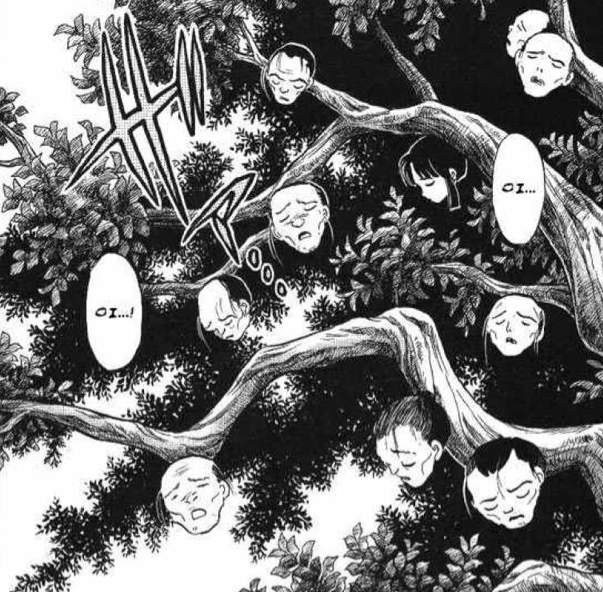
Takahashi may have the coolest resume of anyone working in manga today; not only did she study script writing with Kazuo Koike, she also worked as an assistant to Kazuo Umezu — an apprenticeship that’s evident in the early chapters of InuYasha. In between Kagome and InuYasha’s first encounters with Naraku are a handful of short but spooky stories in which seemingly benign objects — a noh mask, a peach tree — are transformed by Shikon Jewel shards into instruments of torture and killing. Takahashi’s horror stories are less florid than Umezu’s, with fewer detours into WTF? territory, but like Umezu, Takahashi has a vivid imagination that yields some decidedly scary images. Here, for example, is the demonic peach tree from chapter 79, “The Fruits of Evil”:

Takahashi doesn’t just use these images to shock; she uses them to illustrate the consequences of ugly emotions, impulsive actions, and violent behavior, to show us how these choices slowly corrode the soul and transform us into the most monstrous version of ourselves. (Also to show us the consequences of substituting human bones and blood for Miracle Gro. Kids, don’t try this at home.)

What Takahashi does better than almost anyone is walk the fine line between terror and horror. Gothic novelist Ann Radcliffe, author of The Mysteries of Udolpho (1794) and The Italian (1797), was one of the first writers to argue that terror and horror were different states of arousal. “Terror and Horror are so far opposite, that the first expands the soul and awakens the faculties to a high degree of life; the other contracts, freezes and nearly annihilates them,” she wrote in an 1826 essay, “On the Supernatural in Poetry.” Critiquing Radcliffe’s work in 1966, Devendra P. Varma explained that difference more concretely: “The difference between Terror and Horror is the difference between awful apprehension and sickening realization: between the smell of death and stumbling against a corpse.” And that’s exactly where Takahashi operates: she gives us tantalizing, suggestive glimpses of scary things, then keeps them obscured until the denouement of the story, allowing our imaginations to supply most of the grisly details. We read her work in a heightened state of awareness, which only intensifies our pleasure — and revulsion — when the true nature of Kagome and InuYasha’s foes are revealed.

* * * * *

If you haven’t looked at InuYasha in a while, or missed it during the height of its popularity, now is a great time to give it a try. Each volume of the VIZBIG edition collects three issues, allowing readers to more fully immerse themselves in the story. And if you’re a purist about packaging, you’ll be happy to know that VIZ is finally issuing InuYasha in an unflipped format — a first in the series’ US history.

Filed Under: Manga Critic Tagged With: Horror/Supernatural, inuyasha, Rumiko Takahashi, Shonen, shonen sunday, VIZ, Yokai

5 Reasons to Read InuYasha

April 29, 2011 by Katherine Dacey

InuYasha was the first comic that I actively collected, the manga that introduced me to the Wednesday comic-buying ritual and the very notion of self-identifying as a fan. Though I followed it religiously for years, trading in my older editions for new ones, watching the anime, and speculating about the finale, my interest in the series gradually waned as I was exposed to new artists and new genres. Still, InuYasha held a special place in my heart; reading it was one of my seminal experiences as a comic fan, making me reluctant to re-visit InuYasha for fear of sullying those precious first-manga memories. VIZ’s recent decision to re-issue InuYasha in an omnibus edition, however, inspired me to pick it up again. I made a shocking discovery in the process of re-reading the first chapters: InuYasha is good. Really good, in fact, and deserving of more respect than it gets from many critics.

What makes InuYasha work? I can think of five reasons:

1. The story arcs are long enough to be complex and engaging, but not so long as to test the patience.

There’s a Zen quality to Rumiko Takahashi’s storytelling that might not be obvious at first glance; after all, she loves a pratfall or a sword fight as much as the next shonen manga-ka. Don’t let that surface activity fool you, however: Takahashi has a terrific sense of balance, staging a romantic interlude between a demon-of-the-week episode and a longer storyline involving Naraku’s minions, thus preventing the series from devolving into a punishing string of battle arcs. The other great advantage of this approach is that Takashi carves out more space for her characters to interact as people, not just combatants; as a result, InuYasha is one of the few shonen manga in which the characters’ relationships evolve over time.

2. Takahashi knows how to stage a fight scene that’s dramatic, tense, and mercifully short.

‘Nuff said.

3. InuYasha‘s villains are powerful and strange, not strawmen.

Though we know our heroes will prevail — it’s shonen, for Pete’s sake — Takahashi throws creative obstacles in their way that makes their eventual triumph more satisfying. Consider Naraku. In many respects, he’s a standard-issue bad guy: he’s omnipotent, charismatic, and manipulative, capable of finding the darkness and vulnerability in the purest soul. (He also has fabulous hair, another reliable indication of his villainy.) Yet the way in which Naraku wields power is genuinely unsettling, as he fashions warriors from pieces of himself, then reabsorbs them into his body when they outlive their usefulness. Naraku’s manifestations are peculiar, too. Some are female, some are children, some have monstrous bodies, and some have the power to create their own demonic offspring, but few look like the sort of golem I’d create if I wanted to wreak havoc. And therein lies Naraku’s true power: his opponents never know what form he’ll take next, or whether he’s already among them.

Sesshomaru, too, is another villain who proves more interesting than he first appears. In the very earliest chapters of the manga, he’s a bored sociopath who has no qualms about using InuYasha’s mama trauma to trick his younger brother into revealing the Tetsusaiga’s location. As the story progresses, however, Sesshomaru begins tolerating the company of a cheerful eight-year-old girl who, in a neat inversion of the usual human-canine relationship, is dependent on her dog-demon master for protection, food, and companionship. Takahashi resists the urge to fully “humanize” Sesshomaru, however; he remains InuYasha’s scornful adversary for most of the series, largely unchanged by his peculiar fixation with Rin.

And did I mention that Sesshomaru has awesome hair? Oh, to be a villain in a Takahashi manga!

4. InuYasha‘s female characters kick ass.

Back in 2008, Shaenon Garrity wrote a devastatingly funny article about the seven types of female characters in shonen manga, from The Tomboy to The Little Girl to The Experienced Older Woman. I’m pleased to report that none of these types appear in InuYasha; in fact, InuYasha boasts one of the smartest, toughest, and most appealing set of female characters in shonen manga. And by “tough,” I don’t mean that Kagome, Kikyo, and Sango brandish weapons while wearing provocative outfits; I mean they persist in the face of adversity, even if their own lives are at stake. They’re strong enough to hold their own against demons, ghosts, and heavily armed bandits, and wise enough to know when words are more effective than weapons. They’re not adverse to the idea of romance, but recovering the Shikon Jewel takes precedence over dating. And they’re woman enough to cry if something awful happens, though they’d rather shed their tears in private than show their pain to others.

5. The horror! The horror!

Takahashi may have the coolest resume of anyone working in manga today; not only did she study script writing with Kazuo Koike, she also worked as an assistant to Kazuo Umezu — an apprenticeship that’s evident in the early chapters of InuYasha. In between Kagome and InuYasha’s first encounters with Naraku are a handful of short but spooky stories in which seemingly benign objects — a noh mask, a peach tree — are transformed by Shikon Jewel shards into instruments of torture and killing. Takahashi’s horror stories are less florid than Umezu’s, with fewer detours into WTF? territory, but like Umezu, Takahashi has a vivid imagination that yields some decidedly scary images. Here, for example, is the demonic peach tree from chapter 79, “The Fruits of Evil”:

Takahashi doesn’t just use these images to shock; she uses them to illustrate the consequences of ugly emotions, impulsive actions, and violent behavior, to show us how these choices slowly corrode the soul and transform us into the most monstrous version of ourselves. (Also to show us the consequences of substituting human bones and blood for Miracle Gro. Kids, don’t try this at home.)

What Takahashi does better than almost anyone is walk the fine line between terror and horror. Gothic novelist Ann Radcliffe, author of The Mysteries of Udolpho (1794) and The Italian (1797), was one of the first writers to argue that terror and horror were different states of arousal. “Terror and Horror are so far opposite, that the first expands the soul and awakens the faculties to a high degree of life; the other contracts, freezes and nearly annihilates them,” she wrote in an 1826 essay, “On the Supernatural in Poetry.” Critiquing Radcliffe’s work in 1966, Devendra P. Varma explained that difference more concretely: “The difference between Terror and Horror is the difference between awful apprehension and sickening realization: between the smell of death and stumbling against a corpse.” And that’s exactly where Takahashi operates: she gives us tantalizing, suggestive glimpses of scary things, then keeps them obscured until the denouement of the story, allowing our imaginations to supply most of the grisly details. We read her work in a heightened state of awareness, which only intensifies our pleasure — and revulsion — when the true nature of Kagome and InuYasha’s foes are revealed.

* * * * *

If you haven’t looked at InuYasha in a while, or missed it during the height of its popularity, now is a great time to give it a try. Each volume of the VIZBIG edition collects three issues, allowing readers to more fully immerse themselves in the story. And if you’re a purist about packaging, you’ll be happy to know that VIZ is finally issuing InuYasha in an unflipped format — a first in the series’ US history.

Filed Under: Manga, Manga Critic, Recommended Reading, REVIEWS Tagged With: Horror/Supernatural, inuyasha, Rumiko Takahashi, Shonen, shonen sunday, VIZ, Yokai

Blue Exorcist, Vol. 1

April 22, 2011 by Katherine Dacey 14 Comments

Have you ever seen the pilot episode of Law & Order? Most of the regular characters are present, and the script follows the three-act structure familiar to anyone who’s watched an episode of any Law & Order series, but the pacing is slack; the dialogue fizzles where it should crackle; and the actors struggle to create believable relationships between the characters, even as the script demands that they explain things to one another that, presumably, they’d already know from working together. Small wonder that “Everybody’s Favorite Bagman” languished for nearly a year before NBC rescued the show from limbo and ordered a full season of episodes.

So it is with Blue Exorcist, which has a first chapter that might charitably be described as a “pilot episode.” In these opening thirty pages, Kato introduces orphan Rin Okimura, a hot-tempered young man; Yukio, Rin’s snot-nosed fraternal twin; and Father Fujimoto, their guardian. Rin, we learn, is a direct descendant of Satan, and is in imminent danger of going over to the dark side. Father Fujimoto, however, has kept this information from his young charge, seeing fit only to explain the complexities of Rin’s lineage when Satan’s minions try to spirit Rin back to Gehenna, the demon realm. (Like all manga priests, Father Fujimoto spends more time fighting demons than preparing Sunday sermons or ministering to the sick, hungry, and bereaved.) An epic confrontation between Satan and Father Fujimoto leaves Rin’s mentor dead, forcing the boy to decide whether to cast his lot with Satan or with humanity.

There’s no reason why this opening prelude has to be such a bumpy, predictable ride, but Kato seems so intent on relating Rin’s entire Tragic Past in one installment that she trades naturalism for economy. (Sample: “I see you’ve returned. An overnight trip to the job center? How diligent of you.” And how helpful of Father Fujimoto to ask Rin a question to which he already knows the answer!) In the second chapter, however, Kato finds her stride with the material: the dialogue is looser and funnier; the characters’ relationships are more firmly and plausibly established; and she introduces her first genuinely memorable character, Mephisto Pheles. The plot is stock, with Rin vowing to avenge Father Fujimoto by enrolling in an exorcism “cram school,” but Kato enlivens the proceedings with humorous twists and nifty artwork.

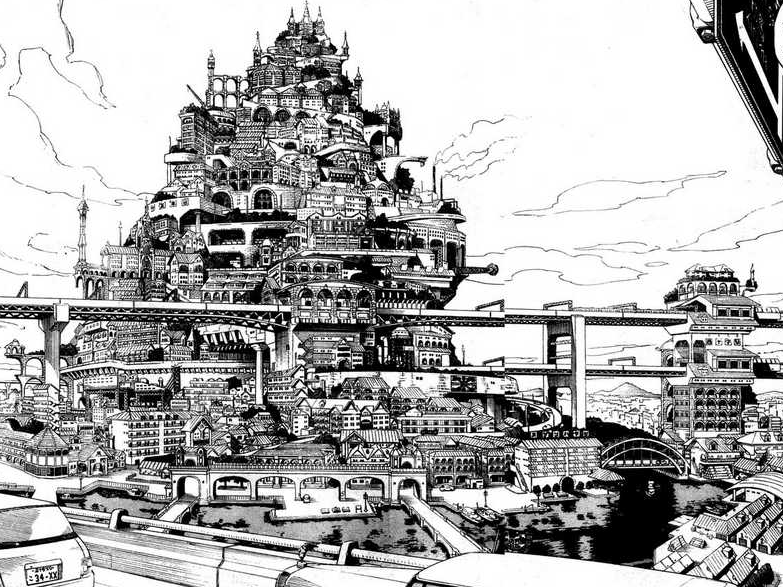
And oh, the artwork! It’s crisp and expressive, filled with small but suggestive details. Mephisto, for example, carries a patched umbrella and wears a polka-dot cravat — two minor flourishes that help establish him as a slightly decadent figure, elegant but down at the heels. The not-very-imaginatively named True Cross Town provides another instructive example of Kato’s meticulous and thoughtful draftsmanship: she lavishes considerable attention on architectural details and infrastructure, stacking layers of houses and buildings on top of one another to form a giant urban ziggeraut:

In short, Kato has created an imaginary urban landscape that seems to have evolved naturally over time, with old and new buildings side-by-side and modern modes of transport straddling canals and rivers. That kind of thoroughness may not serve much purpose in the context of a manga about demon fighters, but it lends Blue Exorcist a temporal and geographic specificity that’s sometimes missing in other areas of the story — like the religious bits.

Whatever my reservations about the first chapter, I freely admit that I’d fallen head-over-heels for Blue Exorcist by the end of the second. The brisk pacing, sharp artwork, and cheeky tone of these later chapters convinced me that Kazue Kato is in firm control of her story, and has successfully laid the foundation for the series’ first major story arc. Bring it on, I say!

BLUE EXORCIST, VOL. 1 • BY KAZUE KATO • VIZ MEDIA • 198 pp. • RATING: OLDER TEEN (16+)

Filed Under: Manga Critic Tagged With: blue exorcist, Kazue Kato, Shonen, Shonen Jump, VIZ

Blue Exorcist, Vol. 1

April 22, 2011 by Katherine Dacey

Have you ever seen the pilot episode of Law & Order? Most of the regular characters are present, and the script follows the three-act structure familiar to anyone who’s watched an episode of any Law & Order series, but the pacing is slack; the dialogue fizzles where it should crackle; and the actors struggle to create believable relationships between the characters, even as the script demands that they explain things to one another that, presumably, they’d already know from working together. Small wonder that “Everybody’s Favorite Bagman” languished for nearly a year before NBC rescued the show from limbo and ordered a full season of episodes.

So it is with Blue Exorcist, which has a first chapter that might charitably be described as a “pilot episode.” In these opening thirty pages, Kato introduces orphan Rin Okimura, a hot-tempered young man; Yukio, Rin’s snot-nosed fraternal twin; and Father Fujimoto, their guardian. Rin, we learn, is a direct descendant of Satan, and is in imminent danger of going over to the dark side. Father Fujimoto, however, has kept this information from his young charge, seeing fit only to explain the complexities of Rin’s lineage when Satan’s minions try to spirit Rin back to Gehenna, the demon realm. (Like all manga priests, Father Fujimoto spends more time fighting demons than preparing Sunday sermons or ministering to the sick, hungry, and bereaved.) An epic confrontation between Satan and Father Fujimoto leaves Rin’s mentor dead, forcing the boy to decide whether to cast his lot with Satan or with humanity.

There’s no reason why this opening prelude has to be such a bumpy, predictable ride, but Kato seems so intent on relating Rin’s entire Tragic Past in one installment that she trades naturalism for economy. (Sample: “I see you’ve returned. An overnight trip to the job center? How diligent of you.” And how helpful of Father Fujimoto to ask Rin a question to which he already knows the answer!) In the second chapter, however, Kato finds her stride with the material: the dialogue is looser and funnier; the characters’ relationships are more firmly and plausibly established; and she introduces her first genuinely memorable character, Mephisto Pheles. The plot is stock, with Rin vowing to avenge Father Fujimoto by enrolling in an exorcism “cram school,” but Kato enlivens the proceedings with humorous twists and nifty artwork.

And oh, the artwork! It’s crisp and expressive, filled with small but suggestive details. Mephisto, for example, carries a patched umbrella and wears a polka-dot cravat — two minor flourishes that help establish him as a slightly decadent figure, elegant but down at the heels. The not-very-imaginatively named True Cross Town provides another instructive example of Kato’s meticulous and thoughtful draftsmanship: she lavishes considerable attention on architectural details and infrastructure, stacking layers of houses and buildings on top of one another to form a giant urban ziggeraut:

In short, Kato has created an imaginary urban landscape that seems to have evolved naturally over time, with old and new buildings side-by-side and modern modes of transport straddling canals and rivers. That kind of thoroughness may not serve much purpose in the context of a manga about demon fighters, but it lends Blue Exorcist a temporal and geographic specificity that’s sometimes missing in other areas of the story — like the religious bits.

Whatever my reservations about the first chapter, I freely admit that I’d fallen head-over-heels for Blue Exorcist by the end of the second. The brisk pacing, sharp artwork, and cheeky tone of these later chapters convinced me that Kazue Kato is in firm control of her story, and has successfully laid the foundation for the series’ first major story arc. Bring it on, I say!

BLUE EXORCIST, VOL. 1 • BY KAZUE KATO • VIZ MEDIA • 198 pp. • RATING: OLDER TEEN (16+)

Filed Under: Manga, Manga Critic, REVIEWS Tagged With: blue exorcist, Kazue Kato, Shonen, Shonen Jump, VIZ

My 10 Favorite TOKYOPOP Titles

April 19, 2011 by MJ 54 Comments

Like many other readers who first discovered manga in the mid-2000s, TOKYOPOP played a major role in introducing me to to the medium. Tokyo Babylon was the first TOKYOPOP title I ever read, followed soon after by Legal Drug, The Legend of Chun-Hyang, and — God help me — Model, a manhwa about a Korean art student who lives in a crumbling mansion with two European vampires. (I should add that the vampires are male and the student is female, and both vampires appear to have bought their wardrobes at Hot Topic.) Though I’d be the first to admit that some of the manga I read were terrible, what I remember most about them was their romanticism: these were big, bold stories featuring impossibly beautiful characters in ridiculous situations, and I couldn’t get enough of them.

Over the years, my tastes have changed considerably, but I still feel a special allegiance to TOKYOPOP: its catalog is so large and diverse that I found plenty of other series to read when I outgrew my initial infatuation with overripe shojo. I had a hard time confining myself to just ten titles; I agonized about whether to include Mitsuhazu Mihara’s Doll, and Erica Sakakurazawa’s Between the Sheets, and Kenji Sonishi’s Neko Ramen, and Minetaro Mochizuki’s Dragon Head, all excellent series that still have pride of place in my manga library. In the end, however, I decided I had to put a cap on the number of titles to prevent my list from swelling to unmanageable proportions. Below are my ten favorite TOKYOPOP manga.

10. JYU-OH-SEI (Natsumi Itsuki)

After their parents are assassinated, twin brothers Rai and Thor are exiled to the penal colony of Kimaera, where they discover extreme weather, man-eating plants, and an elaborate tribal system in which women call the shots. Their only hope of escaping the planet’s inhospitable surface is for one of them to fight his way up the social ladder to become The Beast King, or supreme ruler of Kimaera. Like Invasion of the Body Snatchers and District 9, Jyu-Oh-Sei addresses social taboos and scientific issues while serving up generous portions of what audiences crave most: action, romance, monsters, and explosions. Best of all, Jyu-Oh-Sei comes in a neat, three-volume package that’s long enough to allow for world-building and character development but short enough to stay fresh and surprising until the end. –Reviewed at The Manga Critic on 8/14/09

9. PETSHOP OF HORRORS (Matsuri Akino)

You won’t mistake Count D’s emporium for PETCO—the animals he sells are, in fact, demons, demi-gods, and shape-shifters who assume various guises. (One of the series’ running jokes is that some pets take human form, arousing the landlord’s suspicions that Count D actually runs a brothel.) Count D selects a pet for each customer that will help its owner realize a long-repressed dream. Of course, Count D’s services don’t come cheap; each character suffers an unexpected and often terrible consequence for seeking a magical solution to her problems. What sets Petshop apart from other examples of comeuppance theater is the writing. The characters’ plights elicit genuine sympathy from the reader; though we want these mothers and writers and lovesick twenty-something to find happiness, we can see that their own wishes are sometimes selfish, unwise, or genuinely harmful. –Reviewed at PopCultureShock on 2/13/08

8. SHIRAHIME-SYO: SNOW GODDESS TALES (Clamp)

This lovely anthology is a radical departure for CLAMP. Gone are the super-detailed costumes and fussy character designs of their early, post-doujinshi work; in their place are spare, simply-drawn figures that seem consciously modeled on examples from eighteenth- and nineteenth-century scroll paintings. The stories themselves are told directly without embellishment, though CLAMP infuses each tale with genuine pathos, showing us how the characters’ anger and doubt lead to profound despair. As a result, the prevailing tone and spirit are reminiscent of Masaki Kobayashi’s 1964 film Kwaidan, both in the stories’ fidelity to the conventions of Japanese folklore and in their lyrical restraint. My favorite work by CLAMP.

7. SUPPLI (Mari Okazaki)

After being dumped by a long-term boyfriend, twenty-seven-year-old ad executive Minami carves a new identity for herself, accepting more challenging work assignments, forging friendships with her office mates, and exploring her feelings for two very different men: Ishida, a blunt co-worker with bad-boy sex appeal, and Ogiwara, a Tokyo University grad who looks great on paper, but has some nasty romantic baggage of his own. Suppli vividly and humorously evokes office life, from the unproductive meetings and grueling all-nighters to the horseplay and flirtatious banter between co-workers. The denizens of Minami’s office are colorful, if one-dimensional, characters: a salty old maid, two flamboyant karaoke fiends, and a tart-tongued temp who offers sound relationship advice to her officemates while sleeping with a married man. Anyone who’s watched Ally McBeal, The Office, or Ugly Betty has encountered these types before, but Mari Okazaki breathes fresh life into her scenario with stylish artwork, sharp dialogue, and a heroine who occasionally doubts herself, but isn’t neurotic . —Reviewed at PopCultureShock on 12/5/07

6. CYBORG 009 (Shotaro Ishimontori)

Cyborg 009 was one of TOKYOPOP’s few forays into classic manga — a pity, because TOKYOPOP did a solid job translating and packaging Shotaro Ishimonori’s best-known work. For readers unfamiliar with this iconic series, the plot revolves around a group of people who have been kidnapped and brought to the lair of the Black Ghost organization, where surgeons transform them into robot-human fighting machines. The cyborgs soon turn on their creators and escape, intent on preventing armaggedon. I’d be the first to admit that Cyborg 009 is dated: the Black Ghost’s world-domination schemes have the same quaintly outdated ring as Dr. Evil’s, and several characters embody unfortunate gender and racial stereotypes. (As Shaenon Garrity dryly observes, “Cyborg 003 is a French girl with enhanced senses. Her duties are to hold the baby and occasionally hear things.”) Yet Ishimonori’s crisp cartooning, imaginatively staged battle scenes, and fundamental — if fumbling — humanism remain as arresting now as they did when the series first debuted in 1964.

5. QWAN (Aki Shimizu)

Meet Qwan, a child-like figure who possesses super-human strength and speed. Though Qwan realizes he isn’t human, he’s never questioned his origins or abilities — that is, until he meets Shaga, a courtesan who urges him to seek the Essential Arts of Peace, a sutra that will reveal where Qwan came from and why he was sent to live among humans. Questing boys and magical scrolls are de rigeur in fantasy-adventure stories, but Qwan distinguishes itself in two crucial areas: terrific characters and gorgeous artwork. Aki Shimizu’s hero is far more quirky and interesting than the typical shonen lead — Qwan never promises to do his best, or to put friends before himself — while Shimizu’s fight scenes are among the most beautifully choreographed in any licensed manga. TOKYOPOP never finished this one-of-a-kind series, but it’s still worth seeking out, if only to get acquainted with a criminally under-appreciated artist. –Reviewed at The Manga Critic on 3/3/11

4. PARADISE KISS (Ai Yazawa)

Ai Yazawa knows how to have her cake and eat it, too: though she loves to write stories about such fantasy professions as runway model and rock star, she populates those stories with characters whose relationships and values are firmly rooted in everyday life. Consider Yukari (a.k.a. “Caroline”), the heroine of Paradise Kiss: Yukari becomes the muse for a group of aspiring fashion designers, modeling their clothing at a big design-school show and inspiring their most talented member, George, to new creative heights. In most manga, Yukari and George would bicker like teenage versions of Beatrice and Benedict until they finally admitted their mutual feelings of attraction; in Paradise Kiss, however, Yukari and George’s relationship unfolds in a more haphazard, organic way that reflects the fact that George is far more worldly and romantically experienced than Yukari. For my money, Paradise Kiss is Yazawa’s best work to date.

3. YOUR & MY SECRET (Ai Morinaga)

Your & My Secret focuses on Nanako, a swaggering tomboy who lives with her mad scientist grandfather, and Akira, an effeminate boy who adores her. With the flick of a switch, Akira becomes the unwitting test subject for the grandfather’s latest invention, a gizmo designed to transfer personalities from one body to another. Nanako revels in her new-found freedom as a boy, enjoying sudden popularity among classmates, earning the respect of Akira’s contemptuous little sister, and discovering the physical strength to dunk a basketball. Akira, on the other hand, finds his situation a mixed bag: for the first time in his life, his sensitive personality endears him to both male and female peers, but many of the things his maleness had previously exempted him from turn out to be much worse than he’d imagined. There are plenty of gender-bending hijinks — and the inevitable blackmail scene in which someone threatens to reveal Akira’s secret — but Morinaga still allows her characters moments of vulnerability and decency, preventing the humor from curdling into pure meanness. –Reviewed at The Manga Critic on 4/25/10

2. TRAMPS LIKE US (Yayoi Ogawa)

Twenty-eight-year-old Sumire Iwaya is frustrated: though she’s a successful journalist with degrees from Tokyo U. and Harvard, she’s hit the glass ceiling at her job and has just been dumped by her fiance. When she discovers a cute but dissheveled young man sleeping in a box outside her apartment, Sumire “adopts” him, allowing Takeshi to stay in her apartment as her “pet.” You don’t need a PhD in manga to guess the outcome of their unusual arrangement, but romantic triangles and workplace intrigue prevent Tramps Like Us from spinning into complete silliness or offensive gender stereotyping. But what really stayed with me was the depiction of Sumire’s romance with her handsome senpai Hasumi; almost every woman I know has had a relationship like theirs — perfect on paper, but stressful and unhappy in practice — and Yayoi Ogawa captures Sumire and Hasumi’s awkward dynamic in pitch-perfect detail. Now that’s good writing.

1. PLANETES (Makoto Yukimura)

Planetes is that rarest of manga: a human interest story that just happens to have some sci-fi trappings.Planetes focuses on a motley crew of junk collectors that includes Hachimaki, a young astronaut who aspires to join a pioneering mission to Jupiter; Yuri, a Russian astronaut with a Tragic Past; Tanabe, a sensitive but emotionally resilient trainee; and Fee, the ship’s balls-to-the-wall captain. Makoto Yukimura skillfully uses of each of his principal characters’ personal histories to explore meaty issues such as eco-terrorism, space pollution, and good old-fashioned racism. I know, I know — I’m making Planetes sound like Star Trek: Deep Space Waste Removal Station, but Yukimura is a more graceful storyteller than Gene Rodenberry every was, allowing the characters’ actions to speak louder than their words. Vivid, detailed artwork brings the terrestrial and extra-terrestrial settings to life.

* * * * *

So I turn the floor over to you: which titles were your favorites? Which ones deserve to be rescued and finished by another publisher? Inquiring minds want to know!

POSTSCRIPT, 4/20/11: Readers seeking a list of titles published by TOKYOPOP may wish to consult the ANN database entry on TOKYOPOP, the Comic Book DB entry on TOKYOPOP, or Wikipedia’s list of titles published by TOKYOPOP. I can’t vouch for their accuracy, but a quick glance at all three website suggests that these lists are comprehensive. Special thanks to all the folks on Twitter who pointed me towards these resources: @skleefeld, @yuriboke, @Funkgun, and @andrecomics.

Filed Under: Manga Critic Tagged With: Ai Morinaga, Ai Yazawa, Aki Shimizu, clamp, Comedy, Josei, Matsuri Akino, Natsumi Itsuki, Sci-Fi, shojo, Shonen, Shotaro Ishimontori, Tokyopop

The Best Manga You’re Not Reading: Kekkaishi

April 7, 2011 by Katherine Dacey 33 Comments

I have a challenge for all you Shonen Jump readers: pick up a copy of Kekkaishi. It may not be as sexy as Death Note, or as goofy as One Piece, or as battle-focused as Bleach, but what it lacks in flash, it makes up in heart, humor, and good old-fashioned storytelling.

The premise of Kekkaishi is simple: Yoshimori Sumimura, a seemingly unremarkable fourteen-year-old boy, is a kekkaishi, or barrier-master. When he isn’t consuming unhealthy amounts of coffee-flavored milk, dozing off in class, or baking architecturally magnificent cakes (one of his pet obsessions), he’s patrolling the grounds of his school, which sits atop the Karasumori, a locus of magical energy that proves irresistible to ayakashi (demons) looking to augment their power. Yoshimori traps unwanted visitors within cube-shaped barriers, then vaporizes them, barrier and all.

Joining him on patrol are his sixteen-year-old neighbor Tokine Yukimura—a more disciplined kekkaishi whom Yoshimori secretly adores—and a small complement of demons that includes two dog spirits, Madarao and Hakubi, and a half-human, half-ayakashi, Gen Shishio. Further complicating matters are the families themselves: the Sumimuras and Yukimuras detest one another. Though their clans have been tasked with protecting the Karasumori for nearly 500 years, the oldest generation carries on an energetic feud, making it difficult for Yoshimori and Tokine to work together harmoniously. In short, Kekkaishi reads like an entertaining mash-up of Bleach, InuYasha, and Romeo and Juliet. (Or maybe Romeo Must Die. Take your pick.)

Each volume unfurls at a brisk clip, in part because Tanabe doesn’t feel the need to explain the entire mythology of the Karasumori site all at once. Nor does she resort to the kind of lazy, expository dialogue found in many shonen series with complicated backstories. (You know the kind: “As you know, Tokine, we’ve been combating ayakashi together for almost a year, and our faithful demon dog sidekicks have played an indispensable role in helping us rid the site of ayakashi. Don’t you think, childhood friend and neighbor of mine?”) Instead, Tanabe reveals details about the Karasumori site’s past gradually as she introduces new characters and confronts her principal cast members with new demonic challenges. In fact, the kekkaishis’ greatest adversaries—the Kokuburo, a group of powerful demons whose plan for world domination involves taking over the Karasumori site—don’t even appear in the first volume of the series.

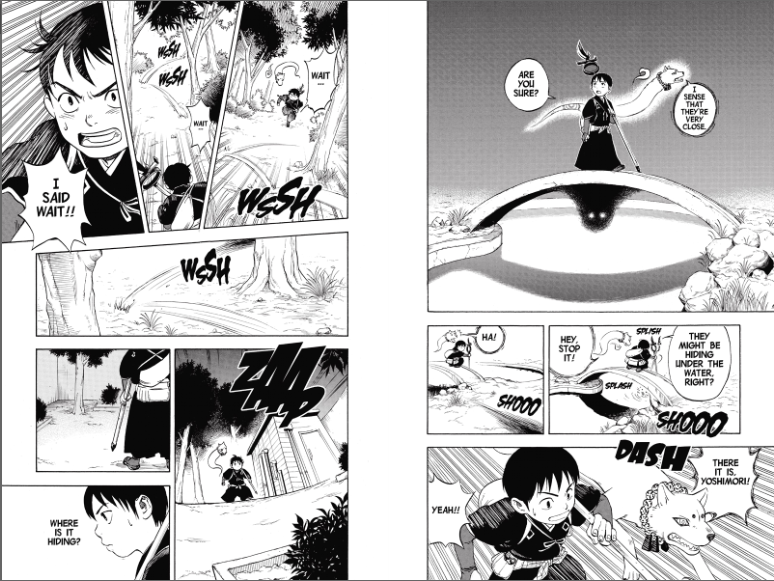
What makes Kekkaishi such a joy to read is Yellow Tanabe’s consummate skill as both an illustrator and storyteller. Her artwork is clean and attractive, with bold lines and nicely composed pictures. Though her character designs are immensely appealing—and seem ready-made for the inevitable assortment of lunchboxes, t-shirts, shijikis, and coffee milk drinks that the series inspired—it’s her action sequences that really shine. Kekkaishi is one of the few shonen series where the fight scenes are (a) dynamic (b) thrilling (c) easy to follow (d) essential to the plot and (e) just the right length. There’s also a wonderful sense of play in Tanabe’s combat. Yoshimori and Tokine use kekkaishi not only as traps, but also as aerial stepping-stones that allow them to pursue demons mid-air.

There’s another appealing—and slyly didactic—aspect to these fight scenes as well. Though Yoshimori possesses greater spiritual powers than Tokine, it’s Tokine who frequently saves the day. Why? Because she practices creating barriers with the same diligence as she does her homework. Yoshimori, on the other hand, struggles to master his powers, sometimes embarking on marathon training sessions and other times neglecting to practice at all.

Kekkaishi offers readers more modest pleasures as well. Tanabe creates a colorful cast of supporting characters that include Yoshimori and Tokine’s sparring grandparents, who prove surprisingly spry for a couple of sexagenarians; Yoshimori’s father, who reminds me of James Dean’s apron-clad dad in Rebel Without a Cause; Masahiko Tsukijigaoka, a genial ghost who was a baker in life; Heisuke Matsudo, a nattily-dressed friend of Yoshimori’s grandfather with a specialty in weird science; and Mamezo, the grouchy guardian spirit of the Karasumori site who looks a bit like Kermit the Frog on a bender. Tanabe’s villains are a less colorful and distinctive bunch than, say, Naraku’s various incarnations, but I find that refreshing. For once the hero—and pals—are as vivid and appealing as the bad guys without having sordid or unnecessarily complicated backstories.

Like all shonen series, Kekkaishi suffers from an occasional dry spell. In volumes seven and eight, for example, the series seemed to have lost its mojo; I found the fight scenes tedious and felt Tanabe had fumbled in her depiction of Tokine, who went from being an appealing, competent character to a mere tag-along. But Tanabe quickly righted the ship in volume nine, introducing new characters, fleshing out the Kokoburo’s motives for capturing the Karasumori, staging some ecological intrigue at the Colorless Marsh, and revealing that Yoshimori’s dad has some demon-busting skills of his own. Though volume nine features two dramatic fight scenes, it’s the quieter, character-building moments that really shine, raising the emotional stakes by revealing unexpected facets of the heroes’ personalities; what happens in volume ten is all the more devastating because Tanabe makes us care deeply about her characters’ welfare.

If I still haven’t persuaded you that Kekkaishi is more fun than a barrel of demon monkeys, let me sing the praises of Yellow Tanabe’s omake. I don’t usually read sidebars or gag strips for reasons that David Welsh so aptly summarized in a memorable blog entry:

The content is generally pretty repetitive. They’re working really hard, and they’re sorry they’re behind on their fan mail. This volume isn’t as good as they’d have liked, but they’re trying, and reader support keeps them going. They wish they had a kitty. That sort of thing.

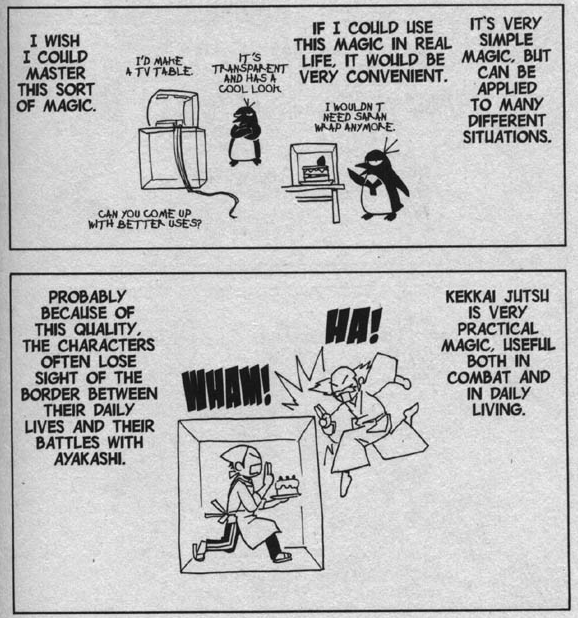
Tanabe’s omake steer clear of the usual bowing and scraping before the fandom. Instead, she depicts herself as a slightly tubby penguin with a perpetual scowl and an implacable panda for an editor. Not much happens in a typical strip, but the back-and-forth between penguin and panda is amusing and, for anyone who’s ever been on the receiving end of editorial criticism, all too true. She also has a lot of fun explaining her creative decisions:

And if you’re still on the fence, let me pull out my trump card: Kekkaishi is complete. Done. Finished. Finito.

After a successful eight-year run in Weekly Shonen Sunday, the series wrapped on April 6th with the publication of its 334th chapter. And by successful, I mean successful in Japan, where the series inspired a 52-episode television series and a robust assortment of video games, and nabbed nabbed the 2007 Shogakukan Award for Best Shonen Series. Here in the US, however, Kekkaishi has barely made a ripple. VIZ has been making a concerted effort to promote the series, featuring sample chapters on its Shonen Sunday website, licensing broadcasting rights to Cartoon Network, and releasing two budget editions: one digital (for the iPad), and one print. (Look for the first three-in-one edition on May 3, 2011.) I’m not sure why Kekkaishi hasn’t caught on with American audiences yet, but now is a great time to jump into this addictive series. I dare you not to like it!

This is a revised version of an essay that originally appeared at PopCultureShock on 5/14/07.

Filed Under: Manga Critic Tagged With: Horror/Supernatural, Shonen, shonen sunday, VIZ, Yellow Tanabe, Yokai

The Best Manga You’re Not Reading: Kekkaishi

April 7, 2011 by Katherine Dacey

I have a challenge for all you Shonen Jump readers: pick up a copy of Kekkaishi. It may not be as sexy as Death Note, or as goofy as One Piece, or as battle-focused as Bleach, but what it lacks in flash, it makes up in heart, humor, and good old-fashioned storytelling.

The premise of Kekkaishi is simple: Yoshimori Sumimura, a seemingly unremarkable fourteen-year-old boy, is a kekkaishi, or barrier-master. When he isn’t consuming unhealthy amounts of coffee-flavored milk, dozing off in class, or baking architecturally magnificent cakes (one of his pet obsessions), he’s patrolling the grounds of his school, which sits atop the Karasumori, a locus of magical energy that proves irresistible to ayakashi (demons) looking to augment their power. Yoshimori traps unwanted visitors within cube-shaped barriers, then vaporizes them, barrier and all.

Joining him on patrol are his sixteen-year-old neighbor Tokine Yukimura—a more disciplined kekkaishi whom Yoshimori secretly adores—and a small complement of demons that includes two dog spirits, Madarao and Hakubi, and a half-human, half-ayakashi, Gen Shishio. Further complicating matters are the families themselves: the Sumimuras and Yukimuras detest one another. Though their clans have been tasked with protecting the Karasumori for nearly 500 years, the oldest generation carries on an energetic feud, making it difficult for Yoshimori and Tokine to work together harmoniously. In short, Kekkaishi reads like an entertaining mash-up of Bleach, InuYasha, and Romeo and Juliet. (Or maybe Romeo Must Die. Take your pick.)

Each volume unfurls at a brisk clip, in part because Tanabe doesn’t feel the need to explain the entire mythology of the Karasumori site all at once. Nor does she resort to the kind of lazy, expository dialogue found in many shonen series with complicated backstories. (You know the kind: “As you know, Tokine, we’ve been combating ayakashi together for almost a year, and our faithful demon dog sidekicks have played an indispensable role in helping us rid the site of ayakashi. Don’t you think, childhood friend and neighbor of mine?”) Instead, Tanabe reveals details about the Karasumori site’s past gradually as she introduces new characters and confronts her principal cast members with new demonic challenges. In fact, the kekkaishis’ greatest adversaries—the Kokuburo, a group of powerful demons whose plan for world domination involves taking over the Karasumori site—don’t even appear in the first volume of the series.

What makes Kekkaishi such a joy to read is Yellow Tanabe’s consummate skill as both an illustrator and storyteller. Her artwork is clean and attractive, with bold lines and nicely composed pictures. Though her character designs are immensely appealing—and seem ready-made for the inevitable assortment of lunchboxes, t-shirts, shijikis, and coffee milk drinks that the series inspired—it’s her action sequences that really shine. Kekkaishi is one of the few shonen series where the fight scenes are (a) dynamic (b) thrilling (c) easy to follow (d) essential to the plot and (e) just the right length. There’s also a wonderful sense of play in Tanabe’s combat. Yoshimori and Tokine use kekkaishi not only as traps, but also as aerial stepping-stones that allow them to pursue demons mid-air.

There’s another appealing—and slyly didactic—aspect to these fight scenes as well. Though Yoshimori possesses greater spiritual powers than Tokine, it’s Tokine who frequently saves the day. Why? Because she practices creating barriers with the same diligence as she does her homework. Yoshimori, on the other hand, struggles to master his powers, sometimes embarking on marathon training sessions and other times neglecting to practice at all.

Kekkaishi offers readers more modest pleasures as well. Tanabe creates a colorful cast of supporting characters that include Yoshimori and Tokine’s sparring grandparents, who prove surprisingly spry for a couple of sexagenarians; Yoshimori’s father, who reminds me of James Dean’s apron-clad dad in Rebel Without a Cause; Masahiko Tsukijigaoka, a genial ghost who was a baker in life; Heisuke Matsudo, a nattily-dressed friend of Yoshimori’s grandfather with a specialty in weird science; and Mamezo, the grouchy guardian spirit of the Karasumori site who looks a bit like Kermit the Frog on a bender. Tanabe’s villains are a less colorful and distinctive bunch than, say, Naraku’s various incarnations, but I find that refreshing. For once the hero—and pals—are as vivid and appealing as the bad guys without having sordid or unnecessarily complicated backstories.

Like all shonen series, Kekkaishi suffers from an occasional dry spell. In volumes seven and eight, for example, the series seemed to have lost its mojo; I found the fight scenes tedious and felt Tanabe had fumbled in her depiction of Tokine, who went from being an appealing, competent character to a mere tag-along. But Tanabe quickly righted the ship in volume nine, introducing new characters, fleshing out the Kokoburo’s motives for capturing the Karasumori, staging some ecological intrigue at the Colorless Marsh, and revealing that Yoshimori’s dad has some demon-busting skills of his own. Though volume nine features two dramatic fight scenes, it’s the quieter, character-building moments that really shine, raising the emotional stakes by revealing unexpected facets of the heroes’ personalities; what happens in volume ten is all the more devastating because Tanabe makes us care deeply about her characters’ welfare.

If I still haven’t persuaded you that Kekkaishi is more fun than a barrel of demon monkeys, let me sing the praises of Yellow Tanabe’s omake. I don’t usually read sidebars or gag strips for reasons that David Welsh so aptly summarized in a memorable blog entry:

The content is generally pretty repetitive. They’re working really hard, and they’re sorry they’re behind on their fan mail. This volume isn’t as good as they’d have liked, but they’re trying, and reader support keeps them going. They wish they had a kitty. That sort of thing.

Tanabe’s omake steer clear of the usual bowing and scraping before the fandom. Instead, she depicts herself as a slightly tubby penguin with a perpetual scowl and an implacable panda for an editor. Not much happens in a typical strip, but the back-and-forth between penguin and panda is amusing and, for anyone who’s ever been on the receiving end of editorial criticism, all too true. She also has a lot of fun explaining her creative decisions:

And if you’re still on the fence, let me pull out my trump card: Kekkaishi is complete. Done. Finished. Finito.

After a successful eight-year run in Weekly Shonen Sunday, the series wrapped on April 6th with the publication of its 334th chapter. And by successful, I mean successful in Japan, where the series inspired a 52-episode television series and a robust assortment of video games, and nabbed nabbed the 2007 Shogakukan Award for Best Shonen Series. Here in the US, however, Kekkaishi has barely made a ripple. VIZ has been making a concerted effort to promote the series, featuring sample chapters on its Shonen Sunday website, licensing broadcasting rights to Cartoon Network, and releasing two budget editions: one digital (for the iPad), and one print. (Look for the first three-in-one edition on May 3, 2011.) I’m not sure why Kekkaishi hasn’t caught on with American audiences yet, but now is a great time to jump into this addictive series. I dare you not to like it!

This is a revised version of an essay that originally appeared at PopCultureShock on 5/14/07.

Filed Under: Manga, Manga Critic, Recommended Reading, REVIEWS Tagged With: Horror/Supernatural, Shonen, shonen sunday, VIZ, Yellow Tanabe, Yokai

7 Short Series Worth Adding to Your Manga Bookshelf

February 23, 2011 by Katherine Dacey 37 Comments

I like getting lost in a long, twisty story as much as the next person, but I often lose interest in a manga around the five- or ten-volume mark. As a service to other people afflicted with Manga ADHD, therefore, I’ve compiled a list of seven shorter series that enjoy pride of place on my shelves.

There were a few ground rules that guided my list-making. First, the series needed to be complete in five volumes or fewer. Second, every volume of the series needed to be readily available through a major retailer like Amazon. Third, the list needed to be diverse, covering a range of genres and demographics. Had I expanded the list to include out-of-print favorites — Antique Bakery, Apocalypse Meow, Club 9, Domu: A Child’s Dream, The Name of the Flower, Planetes — it would have been an unwieldy beast, and one sure to disappoint: why recommend a book that’s selling for $100 on eBay?

So without further ado… here are seven short series worth adding to your manga bookshelf.

A DISTANT NEIGHBORHOOD

JIRO TANIGUCHI • FANFARE/PONENT MON • 2 VOLUMES

A Distant Neighborhood is a wry, wistful take on a tried-and-true premise: a salaryman is transported back in time to his high school days, and must decide whether to act on his knowledge of the past or let events unfold as they did before. We’ve seen this story many times at the multiplex — Back to the Future, Peggy Sue Got Married — but Taniguchi doesn’t play the set-up for laughs; rather, he uses Hiroshi’s predicament to underscore the challenges of family life and the awkwardness of adolescence. (Hiroshi is the same chronological age as his parents, giving him special insight into the vicissitudes of marriage, as well as the confidence to cope with teenage tribulations.) Easily one of the most emotional, most intimate stories Taniguchi’s ever told. (A Distant Neighborhood was one of my picks for Best Manga of 2009; click here for the full list.)

ICHIGENME… THE FIRST CLASS IS CIVIL LAW

FUMI YOSHINAGA • DMP • 2 VOLUMES

One of the things that distinguishes Fumi Yoshinaga’s work from that of other yaoi artists is her love of dialogue. In works like Antique Bakery and Solfege, she reminds us that conversation can be an aphrodisiac, especially when two people are analyzing a favorite book or confessing a mutually-shared passion for art, cooking, or manga. True to form, the sexiest scenes in Ichigenme: The First Class Is Civil Law are conversations between law professors and their students. We feel the erotic charge of more experienced scholars engaging their proteges in intense debates over legal procedure and philosophy, even when the topics themselves are rather dry. Not that Yoshinaga skimps on the smut: there’s plenty of bedroom action as the carefree Tohdou helps his uptight, closeted classmate Tamiya explore his sexuality, but the series’ best moments are fully clothed. An entertaining manga that gets better with each reading. (Reviewed at PopCultureShock on 3/14/08.)

ODE TO KIRIHITO

OSAMU TEZUKA • VERTICAL, INC. • 2 VOLUMES

While investigating an outbreak of a mysterious disease, an earnest young doctor contracts it himself, becoming a hideous dog-man who craves raw meat. Kirihito’s search for the cause — and the cure — is the backbone of this globe-trotting adventure, but Kirihito’s quest to reclaim his humanity is its heart and soul; his travels bring him into contact with hustlers, racists, and superstitious villagers, each of whom greets him with a mixture of suspicion and fear. As its dog-man premise suggests, Ode to Kirihito is Tezuka at his bat-shit craziest: in one storyline, for example, Kirihito befriends a nymphomaniac circus performer who transforms herself into human tempura. But for all its over-the-top characters and plot developments (see “nympho human tempura,” above), Ode to Kirihito is one of Tezuka’s most moving stories, a thoughtful meditation on the the fluid boundaries between man and animal, sanity and insanity, good and evil. (Reviewed at The Manga Critic on 4/7/10.)

THE SECRET NOTES OF LADY KANOKO

RIRIKO TSUJITA • TOKYOPOP • 3 VOLUMES

Kanoko, the sardonic heroine of The Secret Notes of Lady Kanoko, is a student of human behavior, gleefully filling her notebooks with detailed observations about her classmates. Though Kanoko would like nothing more than to remain on the sidelines, she frequently becomes embroiled in her peers’ problems; they value her independent perspective, as Kanoko isn’t the least bit interested in dating, running for student council, or currying favor with the alpha clique. Kanoko’s sharp tongue and cool demeanor might make her the mean-girl villain in another shojo manga, but Ririko Tsujita embraces her heroine’s prickly, opinionated nature and makes it fundamental to Kanoko’s appeal. The perfect antidote to shojo stories about timid good girls and boy-crazy spazzes. UPDATE 4/16/11: TOKYOPOP announced that it would be shutting down its US publishing operations on May 31, 2011. Unfortunately, that means that Lady Kanoko will likely remain incomplete at two volumes. The stories are largely self-contained, so it is still possible to enjoy Lady Kanoko without reading the last volume.

7 BILLION NEEDLES

NOBUAKI TADANO • VERTICAL, INC. • 4 VOLUMES

Nobuaki Tadano gives Hal Clement’s Needle a manga makeover, moving the action from a remote island in the South Seas to Japan, and replacing Clement’s wholesome, Hardy Boy protagonist with a sullen teenage girl who’s none too pleased to discover that an alien bounty hunter has taken control of her body. The decision to make Hikaru a troubled loner with a difficult past is a stroke of genius; her social isolation proves almost as formidable an obstacle for her to overcome as the monster that she and Horizon (as the bounty hunter is known) are pursuing. Her personal struggles also add a level of raw, emotional authenticity to the story — something that was largely absent from the fascinating, though clinically detached, original. Oh, and the monster? It’s a doozy. (7 Billion Needles was one of my picks for Best Teen-Friendly Comic of 2010; see Good Comics for Kids for the full list. Volumes one and two were reviewed at The Manga Critic on 11/21/10; volume three was reviewed on 2/17/11. The fourth and final volume will arrive in stores on April 26, 2011.)

TO TERRA

KEIKO TAKEMIYA • VERTICAL, INC. • 3 VOLUMES

If Richard Wagner wrote space operas, he might have composed something like Keiko Takemiya’s To Terra, an inter-generational drama about a race of telepathic mutants who’ve been exiled from their home world. Under the leadership of the charismatic Jomy Marcus Shin, the Mu embark on a grueling voyage back to Terra to be reunited with their human creators. Their principle foe: an evil supercomputer named Mother. Takemiya’s richly detailed artwork makes To Terra an almost cinematic experience, suggestive of 2001: A Space Odyssey and Star Wars. But don’t be fooled by those blinking computers and blazing starships: To Terra is an unabashedly Romantic saga about two ubermensch locked in a struggle of cosmic proportions. No doubt Richard would approve. (To Terra was one of my picks for Best Manga of 2007; read the full list at PopCultureShock. For more information on To Terra‘s history, click here.)

TOTO! THE WONDERFUL ADVENTURE

YUKO OSADA • DEL REY • 5 VOLUMES

Shonen series often run to 10, 20, or 40 volumes, but Toto! The Wonderful Adventure proves that good stories come in shorter packages, too. Yuko Osada brazenly steals ideas from dozens of other sources — Castle in the Sky, One Piece, Last Exile, The Wizard of Oz — to produce a boisterous, fast-paced story about a tyro explorer who crosses paths with sky pirates, military warlords, and a high-kicking senjutsu expert named Dorothy. Though the jokes are hit-or-miss, Toto! boasts crisp artwork, strong female characters, and an infectious sense of bonhomie among the series’ protagonists; Kakashi and his traveling companions are impossible to dislike. (Reviewed at The Manga Critic on 9/16/10.)

HONORABLE MENTIONS

CAT-EYED BOY (Kazuo Umezu • VIZ • 2 volumes): Readers looking for an introduction to Kazuo Umezu’s work could do a lot worse than this two-volume collection of stories about a strange little boy who’s half-human, half-demon. Umezu gives free reign to his imagination, conjuring some of the most bizarre monsters in the J-horror canon. The results aren’t always as shocking as they might be, but Cat-Eyed Boy is by turns funny, scary, and sad. (Reviewed at The Manga Critic on 10/3/10.)

LADY SNOWBLOOD (Kazuo Koike and Kazuo Kimimura • Dark Horse • 4 volumes): Now that everyone’s forgotten Kill Bill, the epic mess “inspired” by Kazuo Koike’s Lady Snowblood, it’s possible to read this series for what it is: a deliciously trashy story about a beautiful assassin who manipulates, cajoles, seduces, and stabs her way through Meiji-era Japan. Expect copious nudity, buckets of blood, and fight scenes so outrageous they have to be seen to be believed.

ONE POUND GOSPEL (Rumiko Takahashi • VIZ • 4 volumes): In this charming sports comedy, a struggling boxer is torn between his love for food and his love for a pretty young nun who wants him to lay down his fork, lose some weight, and win a few matches. The series is a little episodic (Takahashi published new chapters sporadically), but the dialogue and slapstick humor have a characteristically Takahashian zing.

For additional suggestions, see:

  • 5 Underrated Shojo Manga, which includes Setona Mizushiro’s X-Day;
  • My 10 Favorite CMX Titles, which includes such short series as Astral Project, Chikyu Misaki, Kiichi and the Magic Books, The Name of the Flower, and Presents. Note that many of these series are out of print and may be hard to find through retailers like Amazon;
  • My 10 Favorite Spooky Manga, which includes such short series as Dororo, Gyo, Mail, and School Zone.

Filed Under: Manga Critic Tagged With: Dark Horse, del rey, DMP, fumi yoshinaga, Historical Drama, Horror/Supernatural, Kazuo Koike, Kazuo Umezu, Keiko Takemiya, Osamu Tezuka, Romance/Romantic Comedy, Rumiko Takahashi, Sci-Fi, Seinen, shojo, Shonen, Tokyopop, vertical, VIZ, Yaoi

Amnesia Labyrinth, Vol. 1

February 8, 2011 by Katherine Dacey 6 Comments

In public, Souji Kushiki leads a charmed life: he’s wealthy and handsome, popular with girls, smarter than his classmates, and faster than anyone on the track team. In private, Souji lives under a dark cloud: his older brother disappeared, a possible victim of foul play, while his sisters paw and flirt with him like Aphrodite and Hera competing for Paris’ affections. Souji’s private and public lives collide when a family emergency requires him to return home from boarding school. Souji’s new school turns out to be Murder High: the school’s top student, best athlete, and council president have all been brutally killed, and the evidence suggests that someone in the Kushiki household is responsible.

For a manga that features incest, murder, and at least one character with a split personality, Amnesia Labyrinth is awfully dull, plodding from scene to scene with little sense of urgency. Part of the problem lies with the source material; as writer Nagaru Tanigawa explains in the afterword to volume one, Amnesia Labyrinth was “based on a story that, while it didn’t have enough to become a full-fledged novel, had been kicking around in my head for years.” He admitted that he had to “dismantle” his original idea and “reinvent the characters”; small wonder that the published version was, by his own admission, filled with “lazy, phantom passages,” vestiges of an earlier story idea.

Those “phantom passages” crop up repeatedly throughout the manga, especially when Souji interacts with his sisters. In one excruciatingly pointless scene, Souji watches younger sis Harumi eat a popsicle, a wordless moment that serves no dramatic purpose other than to reinforce the idea that Harumi is more demure than sibling rivals Youko and Saki. Other scenes go on too long; in chapter one, for example, Tanigawa makes one of his female characters recite Souji’s entire CV in comic detail. (“Your grades… they’re among the top in the nation,” Sasai declares. “You put everyone to shame on Sports Day. You weren’t even on the track team, but you still cleaned up in the races.”)

That expository soliloquy points to one of Amnesia Labyrinth‘s other problems: Souji. Though we learn a lot about him from other characters, we never see Souji do anything that warrants their high esteem; it’s hard to imagine why his three sisters are so keen to bed him, as he seems like a rather ordinary teen, passive in attitude and behavior. The only moments in which we get a glimpse of his true personality are when he interacts with Sasai, a pushy classmate from his new school. She teases and flatters Souji, trying to provoke a response, and when that strategy fails, engages him in a semi-philosophical conversation about death. Their conversation might be trivial from an adult point of view, but from a teenage perspective, it feels right, two young people trying to make a terrible abstraction seem less scary.

Souji’s sisters are equally problematic. They’re a harem of types, rather than three distinctive characters: Youko, Souji’s full sister, is crazy and wears a kimono; Harumi, Souji’s stepsister, is the embodiment of moe, blushing and stammering around Souji; and Saki, Souji’s half sister, is a fetish object, cheerfully trading a maid’s outfit for a school uniform. The girls’ sexual aggression isn’t beyond the realm of possibility; one might plausibly infer that their gamesmanship and flirtation are an attempt to establish a pecking order. But the scenes lack emotion or context, registering more as cheap titillation — hey, Souji’s such a stud that even his sisters want him! — than an essential element of the plot.

The one bright spot in this otherwise lackluster affair is the art. Using clean, precise linework, Natsumi Kohane renders each setting in careful detail, drawing a sharp distinction between the Kushiki’s isolated rural home and the school’s bustling urban neighborhood. There’s a lovely — if unnecessary — sequence of panels showing us what kind of flowers grow in the Kushiki’s garden, thus establishing the time of year and suggesting the home’s claustrophobic, hothouse atmosphere. (It’s a bit like finding a tribute to Kazuo Miyagawa’s cinematography embedded in a Vin Diesel flick.) Even the fanservice is handled tastefully; the female characters have plausible, pleasing body shapes that demonstrate a firm grasp of basic anatomy. There’s some brief nudity, but we’re spared the panty shots and boob collisions typical of harem manga.

I’m hesitant to pan Amnesia Labyrinth, as I know I’m not its target audience. Souji is clearly intended to be a surrogate for teenage boys who fantasize about being brilliant, athletic, and irresistible to girls without the slightest effort. For readers outside this demographic, however, the series’ main draw — the mystery — is too underdeveloped to be interesting, and the characterizations too thin to inspire sympathy for or identification with any of the cast.

Review copy provided by Seven Seas. Volume one will be released on February 28, 2011.

AMNESIA LABYRINTH, VOL. 1 • STORY BY NAGARU TANIGAWA, ART BY NATSUMI KOHANE, CHARACTER DESIGNS BY HINATA TAKEDA • SEVEN SEAS • 194 pp. • RATING: OLDER TEEN (16+)

Filed Under: Manga Critic Tagged With: Mystery/Suspense, Seven Seas, Shonen

Amnesia Labyrinth, Vol. 1

February 8, 2011 by Katherine Dacey

In public, Souji Kushiki leads a charmed life: he’s wealthy and handsome, popular with girls, smarter than his classmates, and faster than anyone on the track team. In private, Souji lives under a dark cloud: his older brother disappeared, a possible victim of foul play, while his sisters paw and flirt with him like Aphrodite and Hera competing for Paris’ affections. Souji’s private and public lives collide when a family emergency requires him to return home from boarding school. Souji’s new school turns out to be Murder High: the school’s top student, best athlete, and council president have all been brutally killed, and the evidence suggests that someone in the Kushiki household is responsible.

For a manga that features incest, murder, and at least one character with a split personality, Amnesia Labyrinth is awfully dull, plodding from scene to scene with little sense of urgency. Part of the problem lies with the source material; as writer Nagaru Tanigawa explains in the afterword to volume one, Amnesia Labyrinth was “based on a story that, while it didn’t have enough to become a full-fledged novel, had been kicking around in my head for years.” He admitted that he had to “dismantle” his original idea and “reinvent the characters”; small wonder that the published version was, by his own admission, filled with “lazy, phantom passages,” vestiges of an earlier story idea.

Those “phantom passages” crop up repeatedly throughout the manga, especially when Souji interacts with his sisters. In one excruciatingly pointless scene, Souji watches younger sis Harumi eat a popsicle, a wordless moment that serves no dramatic purpose other than to reinforce the idea that Harumi is more demure than sibling rivals Youko and Saki. Other scenes go on too long; in chapter one, for example, Tanigawa makes one of his female characters recite Souji’s entire CV in comic detail. (“Your grades… they’re among the top in the nation,” Sasai declares. “You put everyone to shame on Sports Day. You weren’t even on the track team, but you still cleaned up in the races.”)

That expository soliloquy points to one of Amnesia Labyrinth‘s other problems: Souji. Though we learn a lot about him from other characters, we never see Souji do anything that warrants their high esteem; it’s hard to imagine why his three sisters are so keen to bed him, as he seems like a rather ordinary teen, passive in attitude and behavior. The only moments in which we get a glimpse of his true personality are when he interacts with Sasai, a pushy classmate from his new school. She teases and flatters Souji, trying to provoke a response, and when that strategy fails, engages him in a semi-philosophical conversation about death. Their conversation might be trivial from an adult point of view, but from a teenage perspective, it feels right, two young people trying to make a terrible abstraction seem less scary.

Souji’s sisters are equally problematic. They’re a harem of types, rather than three distinctive characters: Youko, Souji’s full sister, is crazy and wears a kimono; Harumi, Souji’s stepsister, is the embodiment of moe, blushing and stammering around Souji; and Saki, Souji’s half sister, is a fetish object, cheerfully trading a maid’s outfit for a school uniform. The girls’ sexual aggression isn’t beyond the realm of possibility; one might plausibly infer that their gamesmanship and flirtation are an attempt to establish a pecking order. But the scenes lack emotion or context, registering more as cheap titillation — hey, Souji’s such a stud that even his sisters want him! — than an essential element of the plot.

The one bright spot in this otherwise lackluster affair is the art. Using clean, precise linework, Natsumi Kohane renders each setting in careful detail, drawing a sharp distinction between the Kushiki’s isolated rural home and the school’s bustling urban neighborhood. There’s a lovely — if unnecessary — sequence of panels showing us what kind of flowers grow in the Kushiki’s garden, thus establishing the time of year and suggesting the home’s claustrophobic, hothouse atmosphere. (It’s a bit like finding a tribute to Kazuo Miyagawa’s cinematography embedded in a Vin Diesel flick.) Even the fanservice is handled tastefully; the female characters have plausible, pleasing body shapes that demonstrate a firm grasp of basic anatomy. There’s some brief nudity, but we’re spared the panty shots and boob collisions typical of harem manga.

I’m hesitant to pan Amnesia Labyrinth, as I know I’m not its target audience. Souji is clearly intended to be a surrogate for teenage boys who fantasize about being brilliant, athletic, and irresistible to girls without the slightest effort. For readers outside this demographic, however, the series’ main draw — the mystery — is too underdeveloped to be interesting, and the characterizations too thin to inspire sympathy for or identification with any of the cast.

Review copy provided by Seven Seas. Volume one will be released on February 28, 2011.

AMNESIA LABYRINTH, VOL. 1 • STORY BY NAGARU TANIGAWA, ART BY NATSUMI KOHANE, CHARACTER DESIGNS BY HINATA TAKEDA • SEVEN SEAS • 194 pp. • RATING: OLDER TEEN (16+)

Filed Under: Manga, Manga Critic, REVIEWS Tagged With: Mystery/Suspense, Seven Seas, Shonen

Toriko, Vol. 1

February 3, 2011 by Katherine Dacey 12 Comments

Imagine, if you can, an extreme sports edition of Iron Chef, one in which the contestants have to catch and cook the show’s theme ingredient. That’s essentially what Toriko is: an over-the-top food manga in which a hunter and a chef find — and eat — the world’s rarest delicacies.

Toriko, the titular character, is a peculiar mix of id and super-ego. On the one hand, he’s pure instinct: he hunts with his nose, uses brute strength to overwhelm his opponents, and gobbles every meal with animalistic gusto. On the other, he’s a hunter-philosopher who disdains slaughter for sport; Toriko may wrestle six-armed gorillas into submission, but he only kills creatures for food.

His sidekick, Komatsu, is a small, nervous chef who plays Chester to Toriko’s Spike, twitching and talking up a storm whenever they embark on a new mission or face danger. Komatsu is initially assigned to supervise Toriko; Komatsu’s boss, head of the International Gourmet Organization (IGO), wants to make sure that Toriko successfully fulfills an order for garara gator, an eight-legged, bus-sized monster prized for its delicate meat. Though Komatsu spends most of their expedition screaming, cowering, and clinging to Toriko, Komatsu is moved by Toriko’s passion. “When I saw you on the hunt close up,” Komatsu tells Toriko, “I decided it’s worth risking my life to follow you.” He elaborates:

I want to understand where those ingredients come from and what they look like in their natural habitat. By the time the high-level prey are shipped to us, they’re already slaughtered and just pieces of meat.

I never thought I’d see a Shonen Jump character extol the value of slow foods, but that’s a big part of Toriko‘s appeal: the concept screams Ted Nugent, but the underlying philosophy says Michael Pollan. Toriko still barks like a shonen manga, of course, with lengthy fight scenes, colorful opponents, and jokes a-plenty. But there’s a more thoughtful dimension to the story than is warranted by the material; many of the characters’ soliloquies wouldn’t be out of place in Oishinbo or The Omnivore’s Dilemma, as Toriko and Komatsu wax poetic about the flavor and succulence of freshly-caught meat.

Toriko‘s other strength is the artwork; look past that god-awful cover, and what you’ll find is some excellent cartooning. The monsters are fierce and slightly repulsive but plausibly edible, while the humans run the gamut from ridiculously virile — Toriko looks like a youthful Sylvester Stallone — to thoroughly decadent — the IGO’s Bureau Chief wears a leisure suit, aviator shades, and an ill-advised shag. Artist Mitsutoshi Shimabukaro renders each setting with enough detail to make it feel like a distinctive habitat; his mangrove swamp, where the garara gator lives, looks just pre-historic enough to harbor a pterodactyl or two. Not all of the visual gambits work: Toriko lives in a candy house, for example, a choice that seems out of character for a manly meat-eater, while a rainbow fruit tree falls flat in grayscale. Shimabukaro never belabors a sight gag, however, nimbly moving to the next set-piece before the failures even register.

I’d be the first to admit that Toriko won’t be every locavore’s idea of fun. I nearly lost my appetite watching Toriko lay waste to an entire banquet’s worth of food, and found some of the hunting scenes too protracted. If you’ve got a hearty constitution and a deep, abiding love of cooking competitions, however, this macho food-fest might just tickle your taste buds.

TORIKO, VOL. 1 • BY MITSUTOSHI SHIMABUKARO • VIZ MEDIA • 207 pp. • RATING: TEEN (13+)

Filed Under: Manga Critic Tagged With: Shonen, Shonen Jump, VIZ

Toriko, Vol. 1

February 3, 2011 by Katherine Dacey

Imagine, if you can, an extreme sports edition of Iron Chef, one in which the contestants have to catch and cook the show’s theme ingredient. That’s essentially what Toriko is: an over-the-top food manga in which a hunter and a chef find — and eat — the world’s rarest delicacies.

Toriko, the titular character, is a peculiar mix of id and super-ego. On the one hand, he’s pure instinct: he hunts with his nose, uses brute strength to overwhelm his opponents, and gobbles every meal with animalistic gusto. On the other, he’s a hunter-philosopher who disdains slaughter for sport; Toriko may wrestle six-armed gorillas into submission, but he only kills creatures for food.

His sidekick, Komatsu, is a small, nervous chef who plays Chester to Toriko’s Spike, twitching and talking up a storm whenever they embark on a new mission or face danger. Komatsu is initially assigned to supervise Toriko; Komatsu’s boss, head of the International Gourmet Organization (IGO), wants to make sure that Toriko successfully fulfills an order for garara gator, an eight-legged, bus-sized monster prized for its delicate meat. Though Komatsu spends most of their expedition screaming, cowering, and clinging to Toriko, Komatsu is moved by Toriko’s passion. “When I saw you on the hunt close up,” Komatsu tells Toriko, “I decided it’s worth risking my life to follow you.” He elaborates:

I want to understand where those ingredients come from and what they look like in their natural habitat. By the time the high-level prey are shipped to us, they’re already slaughtered and just pieces of meat.

I never thought I’d see a Shonen Jump character extol the value of slow foods, but that’s a big part of Toriko‘s appeal: the concept screams Ted Nugent, but the underlying philosophy says Michael Pollan. Toriko still barks like a shonen manga, of course, with lengthy fight scenes, colorful opponents, and jokes a-plenty. But there’s a more thoughtful dimension to the story than is warranted by the material; many of the characters’ soliloquies wouldn’t be out of place in Oishinbo or The Omnivore’s Dilemma, as Toriko and Komatsu wax poetic about the flavor and succulence of freshly-caught meat.

Toriko‘s other strength is the artwork; look past that god-awful cover, and what you’ll find is some excellent cartooning. The monsters are fierce and slightly repulsive but plausibly edible, while the humans run the gamut from ridiculously virile — Toriko looks like a youthful Sylvester Stallone — to thoroughly decadent — the IGO’s Bureau Chief wears a leisure suit, aviator shades, and an ill-advised shag. Artist Mitsutoshi Shimabukaro renders each setting with enough detail to make it feel like a distinctive habitat; his mangrove swamp, where the garara gator lives, looks just pre-historic enough to harbor a pterodactyl or two. Not all of the visual gambits work: Toriko lives in a candy house, for example, a choice that seems out of character for a manly meat-eater, while a rainbow fruit tree falls flat in grayscale. Shimabukaro never belabors a sight gag, however, nimbly moving to the next set-piece before the failures even register.

I’d be the first to admit that Toriko won’t be every locavore’s idea of fun. I nearly lost my appetite watching Toriko lay waste to an entire banquet’s worth of food, and found some of the hunting scenes too protracted. If you’ve got a hearty constitution and a deep, abiding love of cooking competitions, however, this macho food-fest might just tickle your taste buds.

TORIKO, VOL. 1 • BY MITSUTOSHI SHIMABUKARO • VIZ MEDIA • 207 pp. • RATING: TEEN (13+)

Filed Under: Manga, Manga Critic, REVIEWS Tagged With: Shonen, Shonen Jump, VIZ

  • « Go to Previous Page
  • Page 1
  • Interim pages omitted …
  • Page 3
  • Page 4
  • Page 5
  • Page 6
  • Page 7
  • Go to Next Page »
 | Log in
Copyright © 2010 Manga Bookshelf | Powered by WordPress & the Genesis Framework