• Skip to primary navigation
  • Skip to main content
  • Skip to primary sidebar
  • Home
  • About Us
    • Privacy Policy
    • Comment Policy
    • Disclosures & Disclaimers
  • Resources
    • Links, Essays & Articles
    • Fandomology!
    • CLAMP Directory
    • BlogRoll
  • Features & Columns
    • 3 Things Thursday
    • Adventures in the Key of Shoujo
    • Bit & Blips (game reviews)
    • BL BOOKRACK
    • Bookshelf Briefs
    • Bringing the Drama
    • Comic Conversion
    • Fanservice Friday
    • Going Digital
    • It Came From the Sinosphere
    • License This!
    • Magazine no Mori
    • My Week in Manga
    • OFF THE SHELF
    • Not By Manga Alone
    • PICK OF THE WEEK
    • Subtitles & Sensibility
    • Weekly Shonen Jump Recaps
  • Manga Moveable Feast
    • MMF Full Archive
    • Yun Kouga
    • CLAMP
    • Shojo Beat
    • Osamu Tezuka
    • Sailor Moon
    • Fruits Basket
    • Takehiko Inoue
    • Wild Adapter
    • One Piece
    • After School Nightmare
    • Karakuri Odette
    • Paradise Kiss
    • The Color Trilogy
    • To Terra…
    • Sexy Voice & Robo
  • Browse by Author
    • Sean Gaffney
    • Anna Neatrour
    • Michelle Smith
    • Katherine Dacey
    • MJ
    • Brigid Alverson
    • Travis Anderson
    • Phillip Anthony
    • Derek Bown
    • Jaci Dahlvang
    • Angela Eastman
    • Erica Friedman
    • Sara K.
    • Megan Purdy
    • Emily Snodgrass
    • Nancy Thistlethwaite
    • Eva Volin
    • David Welsh
  • MB Blogs
    • A Case Suitable For Treatment
    • Experiments in Manga
    • MangaBlog
    • The Manga Critic
    • Manga Report
    • Soliloquy in Blue
    • Manga Curmudgeon (archive)

Manga Bookshelf

Discussion, Resources, Roundtables, & Reviews

manga

My Week in Manga: March 9-March 13, 2015

March 16, 2015 by Ash Brown

My News and Reviews

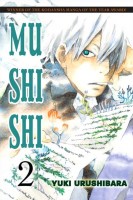
Two reviews at Experiments in Manga last week! First up, I finally got around to reading Kouhei Kadono’s Boogiepop at Dawn. Technically the sixth Boogiepop novel, and the fourth to be released in English, it actually serves as a prequel to the entire series. I’ve really enjoyed what I’ve read of the Boogiepop series and found Boogiepop at Dawn to be particularly satisfying. I’m hoping to do a Boogiepop Adaptation Adventures post once I have a chance to read the manga and watch the anime and live-action adaptations. The second review posted last week was of Yuki Urushibara’s Mushishi, Volume 2. Mushishi is one of my favorite manga, and the second volume includes some of my favorite stories in the series. The review is part of my monthly manga review project focusing on horror manga. Next month will feature Setona Mizushiro’s After School Nightmare again.

Sparkler Monthly has been getting some good press recently, which I’m happy to see. Jason Thompson delves into the comics side of the magazine in the most recent House of 1000 Manga. Lianne Sentar was interviewed by Brigid Alverson at Robot 6 about Marketing to the Female Gaze. Sparkler has been adding a bunch of new comics lately. The most recent is actually a rescue from the closure of Inkblazers, Heldrad’s Orange Junk. More comics and more print releases will be announced in the very near future (I’m particularly looking forward to the Tokyo Demons Cherry Bomb collection), so now is a better time than ever to consider becoming a member to support the creators and the rest of the Sparkler team.

Last week was apparently “manga week” at ICv2, which included interviews with Dark Horse’s Mike Richardson (Part 1 and Part 2) and Viz Media’s Kevin Hamric (Part 1 and Part 2). The Comics Journal has been collecting and posting tributes to the late Yoshihiro Tatsumi, and Ryan Holmberg has written an in-depth article on Tatsumi for the site as well. Elsewhere online, Comics Forum posted Masafumi Monden’s article Shōjo Manga Research: The Legacy of Women Critics and Their Gender-Based Approach and Reflecting Lights has a nice publisher spotlight on Vertical Comics. Finally, Sean has a roundup of all the manga and light novel licenses that have recently been announced.

Quick Takes
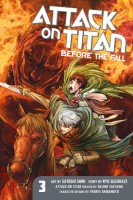
Attack on Titan: Before the Fall, Volume 3Attack on Titan: Before the Fall, Volume 3 written by Ryo Suzukaze and illustrated by Satoshi Shiki. An adaptation of a series of light novels, Before the Fall is a prequel to Hajime Isayama’s immensely popular and successful manga Attack on Titan. It takes place well before the original series, during a time in which humanity is facing the Titans, but has yet to really find a way to effectively deal with them. At this point, the Survey Corps at least knows how to destroy the Titans, but it is lacking the resources—specifically the three-dimensional maneuvering gear—that greatly aids in actually accomplishing the feat. Apparently, as the extra manga at the end of the third volume implies, Kuklo will somehow be involved in reclaiming that crucial bit of technology. However, most of the volume is devoted to the intense battle and tragic outcomes of the Survey Corps and Kuklo’s unfortunate confrontation with a Titan outside of the walls. There’s some plot and story development as well, but the action takes precedence this time around. In general, I don’t find Before the Fall to be quite as compelling as the original Attack on Titan, but it is interesting to see more of the overall worldbuilding and backstory that has been created for the franchise as a whole.
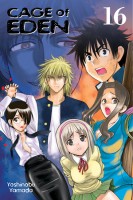
Cage of Eden, Volume 16Cage of Eden, Volume 16 by Yoshinobu Yamada. It’s been a while since I’ve read any of Cage of Eden, though the sixteenth volume seems to be pretty par for the course. I enjoy a good survival story, but the manga is just not as enthralling as I want it to be. It doesn’t help that the fanservice tends to be narratively awkward; the sixteenth volume includes not one but two naked bath scenes of buxom middle school girls that interrupt the flow of the story. As for the story itself, there have been a few interesting developments. Having split into separate groups to investigate the spire and the pyramid on the island, the survivors have been able to begin piecing together exactly where they are as they uncover more and more secrets. Considering the number of deaths in Cage of Eden so far, it’s probably a safe bet that not everyone is going to survive to the end of the series. Especially taking into account the fact that the dinosaurs and other beasts aren’t the only dangerous creatures on the island. Humans can also be extremely deadly. And manipulative, too. It’s this menacing human element that the sixteenth volume of Cage of Eden focuses on. Trying to survive on the island has definitely taken its toll on the characters both mentally and physically.
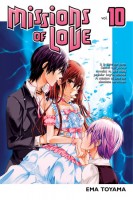
Missions of Love, Volume 10Missions of Love, Volume 10 by Ema Toyama. To be completely honest, I wasn’t expecting to enjoy Missions of Love nearly as much as I do, but here I am, ten volumes later, still completely hooked on the series’ melodrama and exceptionally twisted train wrecks of relationships. And there are some pretty momentous developments in those relationships in this volume, specifically a confession of love that can’t be mistaken or ignored. It seems as thought the time is drawing very near in which Yukina will have to choose either Shigure or Akira, but she’s only now realizing that might mean losing one of them completely. Partially in an attempt to avoid having to make an immediate decision, she challenges them both with a mission: to take her on a date as boyfriend and girlfriend. Missions of Love has always been suggestive, often skirting the edge of what would be deemed appropriate behavior and occasionally crossing over the line, and the tenth volume is no different. The relationships in the series aren’t healthy ones and never have been. Seeing as how many of them were initially based on manipulation and blackmail that probably isn’t too surprising, but it is interesting to see the characters develop legitimate feelings of affection for one another. They just don’t always go about expressing it in the best fashion.
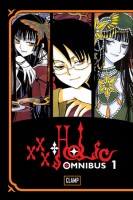
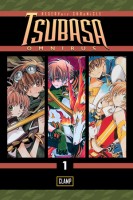
xxxHolic, Omnibus 1xxxHolic, Omnibuses 1-2 (equivalent to Volumes 1-6) by CLAMP. I read the first few volumes of xxxHolic when the manga was originally being published by Del Rey Manga but never got around to finishing the series before it went out of print, so I’m happy that Kodansha Comics is releasing the omnibuses. xxxHolic is a manga of extremes. One moment it’s ridiculously comedic and the next it’s deadly serious. The manga can be a strange mix of humor and horror; sometimes the balance between those two aspects of the series works better than others. I like the incorporation of yokai in xxxHolic since I have a particular interest in yokai. Generally, CLAMP’s renditions of the traditional stories are much more contemporary and free-form in nature. Yokai and folk tales serve more as a source of loose inspiration rather than a rigid structure for the manga to build upon. xxxHolic and Tsubasa: Reservoir Chronicle are directly related to each other, although they can be read separately without to much of a problem. So far, I find the Tsubasa references to be some of the least interesting in xxxHolic, but I do get a kick out of some of the throwaway nods to other CLAMP manga. For example, the leads from Legal Drug make a brief appearance with a minor (yet arguably crucial) role selling a hangover cure.
Filed Under: FEATURES, My Week in Manga Tagged With: attack on titan, Cage of Eden, clamp, Ema Toyama, manga, missions of love, Ryo Suzukaze, Satoshi Shiki, xxxholic, Yoshinobu Yamada

Mushishi, Vol. 2

March 13, 2015 by Ash Brown

Mushishi, Volume 2Creator: Yuki Urushibara
U.S. publisher: Del Rey
ISBN: 9780345496447
Released: July 2007
Original release: 2002
Awards: Japan Media Arts Award, Kodansha Manga Award

Yuki Urushibara’s debut manga series Mushishi is a work that is quite dear to me. I discovered it more by accident than anything else, but Mushishi quickly became one of my favorite manga when it was first released in English and it remains a series that I enjoy immensely. Urushibara has taken cues from traditional Japanese folklore and mythology, creating a series with a quiet yet creepy atmosphere and a subtle sense of horror that relies on the interactions between humans and natural powers beyond their control. Mushishi has inspired multiple anime adaptations, which are also excellent, as well as a live-action film. The series has also been honored with a Japan Media Arts Award and a Kodansha Manga Award. Mushishi, Volume 2 was originally published in Japan in 2002. The volume was first released in English by Del Rey Manga in 2007. It is now available digitally by Kodansha Comics, but I hope that one day Mushishi will be brought back into print.

Mushishi, Volume 2 collects five stories, some of which are among my personal favorites in the series. “The Mountain Sleeps” finds Ginko coming to the aid of a fellow mushishi who is feared to have gone missing. “The Sea of Brushstrokes” tells the tale of a young woman whose family has collected stories about mushi for generations, becoming the guardians of a vast library of valuable knowledge. Ginko travels to a remote island that can only be accessed once every lunar month due to the tides and currents in “They That Breathe Ephemeral Life.” Back on the mainland, he joins up with a man wandering the countryside searching for a rare type of mushi in “Rain Comes and a Rainbow Is Born.” In the final story, “The Green Veil,” Ginko must convince a recently married couple to give up their children, none of whom are human despite their outward appearances.

Mushishi, Volume 2, page 86Mushishi tends to be fairly episodic, though the stories do share similar elements. The individual chapters don’t necessarily build directly on one another, but they do expand and develop more and more about the world Urushibara has created. What I particularly enjoy about Mushishi, Volume 2 is how it places Ginko within the greater context of the relatively small community of mushishi. He is only one mushishi out of many, sharing some likenesses with the others in his profession but also exhibiting personal differences. It is revealed in the second volume of Mushishi that one of the reasons Ginko is constantly traveling from place to place is that he attracts mushi; if he doesn’t keep moving the area around him will become infested. However, as is also seen in Mushishi, Volume 2, some mushishi are able to make permanent homes for themselves. In some extreme cases, they even become trapped by their duties, unable to leave without causing great harm to others.

Mushishi, Volume 2 reinforces one of the most important themes of the series—the sanctity of life and the deep respect that it deserves—and emphasizes the need for humans to coexist with mushi. These concepts are explored in various ways throughout Mushishi. In the second volume, Ginko in particular is shown to give priority to human lives, but he also avoids destroying mushi whenever possible. However, some mushishi seem to take great delight in the eradication of the mushi they encounter. This lack of compassion and understanding by mushishi as well as other humans can be problematic; they try to exert their control over, manipulate, and use to their advantage these creatures which are frequently beyond their ken, often with tragic results. At times mushi can be dangerous if left completely unchecked, but just as dangerous is unrestrained human arrogance.

Filed Under: REVIEWS Tagged With: del rey, Japan Media Arts Award, Kodansha Manga Award, manga, mushishi, Yuki Urushibara

My Week in Manga: March 2-March 8, 2015

March 9, 2015 by Ash Brown

My News and Reviews

And the honor of the first in-depth manga review for the month of March at Experiments in Manga goes to Tetsu Kariya and Akira Hanasaki’s Oishinbo, A la Carte: Vegetables which, as is probably fairly obvious, is a food manga about vegetables. I tend to enjoy the Oishinbo, A la Carte collections, finding them to be both educational and entertaining. Vegetables is a good volume, but it does get pretty political. I also posted a list of manga featuring immortals last week as part of the announcement of the UQ Holder! Giveaway Winner. February’s Bookshelf Overload was posted as well, which can mostly be summarized by me yelling “JooooooJoooooo!”

I was fairly busy last week, but a few things did catch my eye online. Viz Media’s Shojo Beat imprint announced two new licenses: Bloody Mary by Akaza Samamiya and Honey So Sweet by Amu Meguro. Seven Seas had a pretty big surprise, too—it’s opened a division focused on producing anime and manga themed tabletop games. First up? A deck-building game based on Space Dandy. Tofugu posted a great article about choosing the best yokai books available in English. I’ve reviewed two of the books mentioned—Yokai Attack: The Japanese Monster Survival Guide and The Night Parade of One Hundred Demons: A Field Guide to Japanese Yokai—and have read some of the others, so I can confirm that it’s a worthwhile list. Also, Paul Gravett has a lovely post remembering mangaka Yoshihiro Tatsumi, who passed away over the weekend.

Quick Takes

Black Rose Alice, Volume 3Black Rose Alice, Volume 3 by Setona Mizushiro. After a brief detour into lighter territory in the second volume, the third volume Black Rose Alice has taken a definite turn for the darker again. The series can be legitimately disconcerting and oddly provocative at the same time. Alice is getting to know all of the vampires in the nest a little better, but it’s Leo who is in the lead for her affections. The twins are somewhat immature and Dimitri is intentionally trying to not get involved with her, so Leo seems to be Alice’s obvious choice for procreation. Going through with it will lead to both of their deaths, so she is taking her time in making the decision, wanting to feel confident that her choice is the correct one. However, time is not on Leo’s side; his death is already imminent. Alice is unaware of this, though she does notice him acting out-of-character. Black Rose Alice is a strange and disturbing series. As a whole the vampire mythology that Mizushiro has created continues to be unlike any other that I’ve encountered. There is a very dark eroticism to the story as well. Occasionally there are more humorous moments, but they only serve to emphasize the underlying horror of the series.

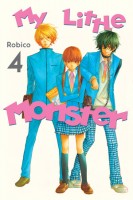
My Little Monster, Volume 4My Little Monster, Volumes 4-6 by Robico. The third volume back-pedaled from the progress that the story and characters had made in the first two volumes and now with these three it seems as though My Little Monster is stuck in some sort of mire. I still like the characters, most of whom are quirky or weird in one way or another, but I find it immensely frustrating that the series just isn’t going anywhere. Actually, other than the awkward romance, I’m not entirely sure what the overarching story is even supposed to be at this point. However, there is definitely one heck of a love polygon going on. But even with so many unrequited feelings, there doesn’t seem to be as much drama as would be expected. In some ways, that’s actually a little refreshing. It’s nice that the characters can enjoy one another’s company even considering the romantic rivalries. I am glad to see that Haru’s volatile and frequently violent emotional state hasn’t been romanticized, although occasionally it is used for a bit of humor. In part, My Little Monster is intended to be a comedy, but these volumes are generally a bit more serious overall. There are still some genuinely funny and endearing moments, though.

Not Enough TimeNot Enough Time by Shoko Hidaka. Because I’m enjoying her ongoing series Blue Morning so much, and to make the wait for the next volume a little easier, I’ve made a point to read more of Hidaka’s manga. Not only was Not Enough Time Hidaka’s debut in English, it was also her first volume of boys’ love manga to be released in Japan. Even though it’s an early work, Hidaka’s storytelling and nuanced characterizations were already quite excellent. Her artwork is lovely, too. Not Enough Time is a collection of six short boys’ love manga, some of which share a few recurring characters while others are completely unrelated. One lead couple consists of two high school students, but all of the other romances in the volume are between adult men. The basic settings and overall scenarios of the stories collected in Not Enough Time aren’t particularly unusual or unique. What makes them stand out is Hidaka’s willingness to allow the relationships to be complicated and messy; the endings aren’t always wrapped up happily or neatly. Instead, there is a sense of ambiguity and the feeling that characters’ lives continue on well after the manga has concluded. I thoroughly enjoyed the collection.

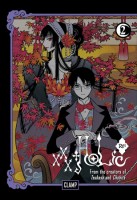
xxxHolic: Rei, Volume 2xxxHolic: Rei, Volume 2 by CLAMP. After two volumes, I’m not yet convinced that CLAMP knows exactly where Rei is going as it feels a bit aimless. I find that I’m much less interested in the episodic stories of the series than I am in its underlying plot. Only ominous hints are given as to what is going on, just enough to keep the manga engaging. Watanuki is as clueless as the readers are at this point (if not more so), though he is becoming increasingly suspicious about his precarious situation. Both Yuko and Domeki obviously know what is what, but they either can’t or won’t tell him. Rei may be somewhat haphazard story-wise, but I really do enjoy the series’ striking artwork. It might not be absolutely necessary to have read xxxHOlic to follow Rei, but I do get the feeling that the manga will be more meaningful to those who have at least passing familiarity with the original series. (I should actually get around to finishing xxxHolic one of these days, especially now that it’s back in print; I’ve only ever read the first few volumes or so.) I’m very curious to see how Rei ties back into xxxHolic proper, or if it ever does. The third volume of Rei has been released in Japan, but apparently the series is currently on hiatus.

Filed Under: FEATURES, My Week in Manga Tagged With: Black Rose Alice, clamp, manga, My Little Monster, Robico, Setona Mizushiro, Shoko Hidaka, xxxholic

Oishinbo, A la Carte: Vegetables

March 6, 2015 by Ash Brown

Oishinbo, A la Carte: VegetablesAuthor: Tetsu Kariya
Illustrator: Akira Hanasaki

U.S. publisher: Viz Media
ISBN: 9781421521435
Released: September 2009
Original release: 2006
Awards: Shogakukan Manga Award

When it comes to food manga, the long-running and sometimes controversial Oishinbo is one of the most successful series in Japan. Written by Tetsu Kariya and illustrated by Akira Hanasaki, the popular Oishinbo is well over a hundred volumes long and earned its creators a Shogakukan Manga Award in 1987. I don’t expect Oishinbo to ever be released in English in its entirety, but Viz Media did license seven volumes of Oishinbo, A la Carte–thematic collections of stories selected from throughout the series. Oishinbo, A la Carte: Vegetables is technically the nineteenth A la Carte volume, published in Japan in 2006, but in 2009 it became the fifth collection to be released in English under Viz Media’s Signature imprint. If I recall correctly, Oishinbo, A la Carte: Japanese Cuisine was the very first food manga that I ever read. Since then, I have enjoyed slowly making my way through the other A la Carte collections available in English, and so was looking forward to a serving of Vegetables.

While Vegetables collects Oishinbo stories from different points the series, it also includes some of the earliest arcs. One of the primary, ongoing plotlines of the manga is the competition between Yamaoka, a newspaper journalist heading the “Ultimate Menu” project, and his estranged father Kaibara, who is developing the “Supreme Menu” for a rival paper. The three-part “Vegetable Showdown!” that opens the volume is only their second official battle for culinary dominance. Appropriately for a volume about vegetables (since getting kids to eat them is apparently a worldwide struggle), many of the stories feature children discovering that produce like eggplants, bean sprouts, and carrots might not be so bad after all. At least when they’re prepared well. Adults preconceived notions are challenged in the manga as well, not just about how vegetables are prepared and taste but also about how they are grown and produced. The stories in Vegetables often follow produce from the field to the table.

Oishinbo, A la Carte: Vegetables, page 90Oishinbo frequently delves into the politics of food and the series’ characters (and I would assume by extension its creators) have very strong opinions about the matter. Vegetables joins the previous two A la Carte collections in English–Fish, Sushi & Sashimi and Ramen & Gyōza–in particularly stressing the importance of quality ingredients and in arguing very strongly for food that has been safely, responsibly, sustainably, and often locally produced. So far, however, Vegetables seems to be the volume that is most blatant in its activism, villainizing the use of herbicides and pesticides. Opposing viewpoints are briefly entertained, but it is very clear which side of the debate Oishinbo supports. The environmentalist message in Vegetables can be very heavy-handed. Organic produce is often ideal for a number of the reason explained in Vegetables, but the reality is perhaps much more complicated and nuanced than the manga might lead readers to believe.

Overall, I think that Vegetables may actually be one of the weaker A la Carte volumes to have been released in English, but I still enjoyed it. Oishinbo is a series that is educational as well as entertaining and Vegetables is no exception. Although not particularly subtle about its politics, the manga is informative, the individual stories exploring different aspects of produce from how they are grown to what a chef should keep in mind when preparing them. When it comes to vegetables, Oishinbo would seem to argue for simplicity. Produce grown in ideal conditions and in their native environments require very little to enhance their natural goodness and flavor. A dish may be refined, but if the ingredients are of high quality to begin with it does not need to be overly complex. Sometimes only a bit of salt is all that is called for. Food is a major source of the drama in Oishinbo and is often what drives the manga’s plot. And even when it’s not, food–and in this particular volume vegetables–always plays a significant supporting role.

Filed Under: REVIEWS Tagged With: Akira Hanasaki, manga, Oishinbo, Shogakukan Manga Award, Tetsu Kariya, viz media, VIZ Signature

Manga Giveaway: UQ Holder! Giveaway Winner

March 4, 2015 by Ash Brown

UQ Holder!, Volume 1And the winner of the UQ Holder! manga giveaway is… Jenni!

As the winner, Jenni will receive a copy of UQ Holder!, Volume 1 by Ken Akamatsu as published by Kodansha Comics. With recent series like UQ Holder! and Ajin: Demi-Human coming out, I’ve been thinking about immortals in manga, and so for this giveaway I asked people to tell me about some of their favorite immortals. Check out the giveaway comments for all of the specifics, or the even longer (but still select) list of manga below.

Some of the manga available in English featuring immortals of various types:
3×3 Eyes by Yuzo Takada
Ajin: Demi-Human by Tsuina Miura and Gamon Sakurai
Black Butler by Yana Toboso
Blade of the Immortal by Hiraoki Samura
Blood+ by Katsura Asuka
Code Geass: Lelouch of the Rebellion by Majiko!
Durarara!! written by Ryohgo Narita, illustrated by Akiyo Satorigi
Five Star Stories by Mamoru Nagano
Hellsing by Kouta Hirano
Hoshin Engi by Ryu Fujisaki
Kamisama Kiss by Julietta Suzuki
Immortal Rain by Kaori Ozaki
Lunar Legend Tsukihime by Sasaki Shounen
Mermaid Saga by Rumiko Takahashi
Olympos by Aki
Kieli written by Yukako Kabei, illustrated by Shiori
Mystique Mandala of Hell by Hideshi Hino
Phoenix by Osamu Tezuka
The Seven Deadly Sins by Nakaba Suzuki
Suikoden III by Aki Shimizu
Trigun by Yasuhiro Nightow
UQ Holder! by Ken Akamatsu
Vassalord by Nanae Chrono
Vampire Knight by Matsuri Hino
Vampire Princess Miyu by Narumi Kakinouchi and Toshiki Hirano
Wish by CLAMP
Ze by Yuki Shimizu

Thank you to everyone who shared your favorite immortals with me! I hope you’ll all join me again for the next giveaway.

Filed Under: UNSHELVED Tagged With: Ken Akamatsu, manga, UQ Holder

My Week in Manga: February 23-March 1, 2015

March 2, 2015 by Ash Brown

My News and Reviews

February has come to an end, but there is still time to enter Experiments in Manga’s most recent manga giveaway for a chance to win the first volume of Ken Akamatsu’s newest series UQ Holder!, published in English by Kodansha Comics. (The winner will be announced on Wednesday, so get those entries in!) Also last week, I posted two in-depth reviews. The first was of Yaya Sakuragi’s manga Hide and Seek, Volume 1. Because Sakuragi was my introduction to boys’ love manga I tend to be interested in and enjoy her work, but I think Hide and Seek may very well be one of her strongest series yet. The second review I posted was of Richard Reeves’ nonfiction work Infamy: The Shocking Story of the Japanese American Internment in World War II. Technically the book won’t be released until April, but I received an advance copy from the publisher. It’s an informative though strongly worded examination of the internment camps and the service of Japanese Americans in the military during the war.

Elsewhere online, MangaBlog‘s Brigid Alverson has a new gig writing about manga for Barnes and Noble’s Sci-Fi & Fantasy Blog. The Comics Journal has an interview with Breakdown Press, which includes additional information about its manga releases. Paste Magazine posted an overview of Fantagraphics’ manga publishing efforts. Seven Seas made two license announcements: Eiji Matsuda’s My Monster Secret and Kashiwa Miyako’s The Testament of Sister New Devil. Yen Press snuck some license announcements in over the weekend as well: Ryukishi07 and Souichirou’s Rose Gun Days: Season 1, Takatoshi Shiozawa’s Final Fantasy Type-0: The Reaper of the Icy Blade, and Daisuke Hagiwara’s Horimiya. Also of note, Drawn & Quarterly will be publishing a new paperback edition of Seiichi Hayashi’s Red Colored Elegy (bringing it back into print) which will include an essay by Ryan Holmberg not found in the original hardcover release. Finally, Graham Kolbeins put together a short documentary, The House of Gay Art, about a private museum in Japan devoted to the preservation of homoerotic artwork.

Quick Takes

His Favorite, Volume 1His Favorite, Volumes 1-7 by Suzuki Tanaka. I didn’t realize it at first since His Favorite is so completely different, but I actually read (and enjoyed) another of Tanaka’s boys’ love manga several years ago—her collection of short stories Love Hurts. Whereas Love Hurts tended to be a little on the dark side, His Favorite is most definitely a comedy. For the most part, it’s fairly chaste as well. I had actually intended to only read a few volumes last week, but I found myself enjoying the series so much that I ended up reading everything that is currently available in English. There’s really not much of a plot to His Favorite, just an entertaining set up and cast of characters. I especially adore Yoshida, the series’ protagonist who, with his short stature, unpopularity, and somewhat strange appearance, is an extraordinarily atypical boys’ love lead. Then there’s Sato, the other half of the manga’s main couple, who makes all the girls (and some of the guys) literally swoon. Honestly, although he has good looks, Sato is not a very nice person. He does, however, love Yoshida dearly. Of course, since he’s also a sadist, he loves tormenting and teasing him, too. While some aspects of their relationship are questionable, His Favorite is a genuinely amusing series.

Prophecy, Volume 2Prophecy, Volume 2 by Tetsuya Tsutsui. I was very impressed by the first volume of Prophecy and so was looking forward to reading the second a great deal. One of the reasons Prophecy works so well is that the intense social drama the manga deals in feels incredibly relevant. Paperboy’s desire for justice is understandable, but the methods employed by the group of vigilantes really can’t be condoned, though there are many who find their actions satisfying and even entertaining. The sudden shift in Paperboy’s popularity, the increase in the support of the group despite its blatant criminal activity, the appearance of copycats, the Anti Cyber Crimes Division becoming the villains in the eyes of the public, and many of the other developments found in the second volume of Prophecy are frighteningly believable. Internet culture can be extremely toxic and the manga presents a plausible scenario resulting from that. Though I didn’t find the second volume to be quite as compelling the first—much of the manga is focused on the chase rather than the character’s underlying motivations—Prophecy continues to be an excellent series; I’ll definitely be picking up the third and final installment.

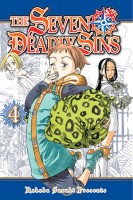
The Seven Deadly Sins, Volume 4The Seven Deadly Sins, Volumes 4-6 by Nakaba Suzuki. Currently, the fights in The Seven Deadly Sins are probably what appeal to me most about the series, but they can also be a rather frustrating part of the manga. The problem is that when everyone is so incredibly overpowered, and because Suzuki seems to be making up new abilities and powers on the fly, the battles have a tendency to lose their meaning; it never feels like anyone is in danger of actually losing anything of significance. So far, when supposedly important deaths and sacrifices do occur in the series, it tends to be side characters who have barely managed to establish themselves that are falling victim. As a result, the impact isn’t as great as it could or should be. These particular volumes of The Seven Deadly Sins feature a good number of battles, which admittedly can be entertaining. Unfortunately, for the most part the plot falls by the wayside and the protagonists don’t even approach the fighting tournament that they have entered intelligently. However, I was happy that the fourth volume included a side story that explores Ban’s background a bit more since he continues to be my favorite character in The Seven Deadly Sins.

Filed Under: FEATURES, My Week in Manga Tagged With: his favorite, manga, Nakaba Suzuki, Prophecy, Seven Deadly Sins, Suzuki Tanaka, Tetsuya Tsutsui

Hide and Seek, Vol. 1

February 27, 2015 by Ash Brown

Hide and Seek, Volume 1Creator: Yaya Sakuragi
U.S. publisher: Viz Media
ISBN: 9781421555720
Released: July 2013
Original release: 2012

Ever since reading and enjoying Hey, Sensei?, my introduction to boys’ love manga, I have made a point to follow the work of Yaya Sakuragi in English. And so I was particularly pleased when Hide and Seek—one of her most recent series, completed at three volumes in Japan in 2014—was licensed. The first volume of Hide and Seek was published in Japan in 2012 while the English-language edition was released in 2013 by Viz Media’s Sublime Manga. Hide and Seek is a spinoff of another of Sakuragi’s boys’ love series, Bond of Dreams, Bond of Love, which in turn is tangentially related to her earlier four-volume manga Tea for Two. (Tea for Two and Bond of Dreams, Bond of Love share a supporting character while another supporting character in Bond of Dreams, Bond of Love is one of the leads of Hide and Seek.) Although technically all three series are loosely connected, it is not necessary to have read the first two series in order to understand or enjoy Hide and Seek. However, those who have read Bond of Dreams, Bond of Love will better appreciate some of the secondary characters and minor references that are made.

Shuji Tanihara is single, divorced, and currently the parent who is primarily responsible for taking care of Chii, his young daughter. Granted, sometimes it seems as though she is really the one taking care of him. Between Chii, tending the small candy store he owns, and the occasional drink with friends, Shuji doesn’t have much else going on in his life. He’s happy, but also a little bored. But that changes when his shop unexpectedly gains a new customer—Saji, a young, successful doctor whose serious and reserved personality is the complete opposite of Shuji’s relaxed, easy-going attitude. Saji is gay and Shuji, while not usually attracted to other men, has developed an interest in him as well. Though in the past he was a notorious heartbreaker, it’s been a while since Shuji has dated anyone. He intends to enjoy his fling with Saji, but what he didn’t anticipate was actually falling for the guy.

Hide and Seek, Volume 1, page 135Hide and Seek may very well be one of Sakuragi’s strongest manga yet. And, if the first volume is anything to judge by, it’s also one of her works with the most sexual content. What is perhaps most thrilling about that is the sex in Hide and Seek is completely consensual between two mature, adult men. There are absolutely no dubious connotations, means, or coercion involved. (Sadly, all of this seems to be somewhat rare in boys’ love manga.) Both Shuji and Saji know what they want in bed and they actually communicate, going on to enjoy themselves without shame; Shuji is sexually adventurous and Saji, it turns out, is an especially skilled, experienced, and considerate lover. Though they have their differences, the two men enter into their relationship as equals. Most importantly, they respect each other, which is wonderful to see. Their interactions both inside the bedroom and outside of it reveal a lot about them as individuals.

The sex in Hide and Seek is great (Shuji and Saji would be the first to admit this), but the series’ drama and heart is found elsewhere. While there is still plenty of humor and lightheartedness to be seen in the first volume, Hide and Seek is one of Sakuragi’s more serious manga, especially when compared to its immediate predecessor Bond of Dreams, Bond of Love. Shuji in particular comes across as a slightly more responsible adult than he did in that earlier series, although he is still very carefree and gets a kick out of provoking people to get a reaction out of them. His personality both conflicts with and complements Saji’s. This becomes the basis of much of the series’ humor. It’s also the source of the manga’s drama. Saji, despite his kindness and thoughtful nature, can be socially awkward and has been rejected many times before by other flighty partners reluctant to take a relationship too seriously. Shuji and Saji are a mismatch but seem perfect for each other. I’m anxious to see how their relationship continues to develop.

Filed Under: REVIEWS Tagged With: Hide and Seek, manga, Sublime Manga, viz media, Yaya Sakuragi

Manga Giveaway: UQ Holder! Giveaway

February 25, 2015 by Ash Brown

Despite being the shortest month of the year, for me February always seems to stretch on forever. With that in mind, I thought it oddly appropriate to offer for this month’s giveaway a manga that features immortals. Specifically, this month you will all have the chance to enter for a chance to win the first volume of Ken Akamatsu’s most recent series UQ Holder!, a sequel of sorts to his manga Negima!: Magister Negi Magi, as published in English by Kodansha Comics. (Don’t worry if you’ve never read Negima!, UQ Holder! can be easily read on its own.) As always, the giveaway is open worldwide!

UQ Holder!, Volume 1

At this point it’s probably not much of a secret that I enjoy manga about immortals and the consequences of immortality. Hiroaki Samura’s Blade of the Immortal was one of the very first manga that I read and it continues to be a favorite. (It was even the focus of my first monthly manga review project.) More recently, manga series like Ken Akamatsu’s UQ Holder! and Tsuina Miura and Gamon Sakurai’s Ajin: Demi-Human have caught my attention specifically because immortals are involved. Granted, there are other elements in both of those series that intrigue and appeal to me as well. When it comes to immortals, UQ Holder! is interesting in that it features a variety of characters with different types of immortality; most series I’ve read tend to stick to just one.

So, you may be wondering, how can you win a copy of UQ Holder!, Volume 1?

1) In the comments below, tell me a little about your favorite immortal from a manga. (Never encountered an immortal in your manga reading? Simply mention that instead.)
2) For a second entry, name a manga featuring immortals that hasn’t yet been mentioned by me or by someone else in the comments.
3) If you’re on Twitter, you can earn a bonus entry by tweeting, or retweeting, about the contest. Make sure to include a link to this post and @PhoenixTerran (that’s me).

It’s as easy as that. Each person is able to earn up to three entries for this giveaway and has one week to submit comments. Giveaway entries can also be emailed to be directly at phoenixterran(at)gmail(dot)com. (I will then post your comments here in your name.) The giveaway winner will be randomly selected and announced on March 4, 2015.

VERY IMPORTANT: Include some way that I can contact you. This can be an e-mail address in the comment form, a link to your website, Twitter username, or whatever. If I can’t figure out how to get a hold of you and you win, I’ll just draw another name.

Contest winner announced–Manga Giveaway: UQ Holder! Giveaway Winner

Filed Under: FEATURES Tagged With: Ken Akamatsu, manga, UQ Holder

My Week in Manga: February 16-February 22, 2015

February 23, 2015 by Ash Brown

My News and Reviews

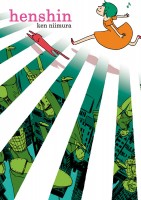
Happy (belated) Chinese New Year, everyone! It’s already been a busy season for me with multiple lion dance and taiko performances for the lunar new year over the last few days (with more to come!), but was I still able to get some reading and writing in, too. Last week was another two-review week at Experiments in Manga, except this time both in-depth reviews were actually of manga. First up was my review of Ken Niimura’s collection of short manga Henshin, which I enjoyed immensely. Niimura is actually a Spanish artist, but Henshin was first released online by the now sadly departed Ikki manga magazine. The second review was of Gamon Sakurai’s Ajin: Demi-Human, Volume 2. I had enjoyed the first volume, but things are starting to get really good with the second. Hopefully the trend continues.

So, earlier this year I wrote a quick take of Under the Sign of Capricorn, the first release in the new English-language edition of Hugo Pratt’s Corto Maltese comics. Much to my surprise, I ended up getting a brief mention in an Italian article about Americans’ responses to the comic. (I’ll admit, that was pretty cool.) Elsewhere online, Vertical’s survey for recommendations for Spring 2016 manga licenses is currently underway. Viz Media announced two new manga licenses of its own: Eiichi Shimizu and Tomohiro Shimoguchi’s Ultraman and Kohei Horikoshi’s My Hero Academia. And speaking of Viz, Hope Donovan, one of the publisher’s manga editors, was interviewed over at Panels. I also want to mention Purity, a new Kickstarter project featuring some fantastic creators. Described as a “post-yaoi anthology,” it’s a collection of comics from artists whose work has been influenced in some way by the boys’ love genre.

Quick Takes

BattleAngelAlitaLastOrder5Battle Angel Alita: Last Order, Omnibus 5 (equivalent to Volumes 13-15) by Yukito Kishiro. First of all, I just want to say that I absolutely love the cover of this omnibus; the Space Karate team as a group of rock stars is just about perfect. This may also very well be my favorite installment of Last Order that I’ve read so far. It features epic, over-the-top battles and action as well as some additional backstory. In particular, more about Zazie is revealed. Also, Sechs (who is still one of the characters I like best) plays a major role and gets to be a badass in addition to being an occasional source of comic relief. Although the styles of martial arts in Last Order are fictional, I appreciate that Kishiro actually incorporates small kernels of traditional teachings to create the super-evolved combat forms found in the series. The Space Karate team is prominently featured in this omnibus. As a karateka myself, I get a kick out of the characters and I particularly enjoyed seeing the progression of their tournament fights. Kishiro’s cyborgs and genetically modified creatures allow for some pretty incredible and entertaining combat feats and techniques that otherwise would be impossible.

Food Wars!: Shokugeki no Soma, Volume 2Food Wars!: Shokugeki no Soma, Volumes 2-4 written by Yuto Tsukuda and illustrated by Shun Saeki. While the fanservice certainly hasn’t disappeared from Food Wars!, each volume seems to tone down the overly sexually suggestive imagery a little more. Personally, I generally found the over-the-top reaction shots amusing rather than offensive. They’re becoming more and more ridiculous and absurd, however they may still present a barrier for some people. But to the creators’ credit, at least there’s eye-candy in Food Wars! for all sorts of readers–nudity and bare skin isn’t limited to just one gender. And then there’s the eye-candy for the foodies, too; the dishes in the series are gorgeously drawn. Saeki’s artwork in Food Wars! really is one of the highlights of the series. I’m liking the characters and their designs as well. Plenty more have been introduced in these volumes, all with their own personality quirks and culinary specialties. Which, of course, presents plenty of opportunities for some fantastically epic battles and competition in the kitchen. I also like that Soma isn’t the only student at Totsuki Institute who doesn’t come from a rich, high-class background.

RestartRestart by Shoko Hidaka. Since I’m loving Hidaka’s ongoing series Blue Morning, I figured that I should probably look into her other boys’ love manga that have been released in English. Restart is a collection of manga that includes some of her earliest professional work, including the titular “Restart”–her first story to be published in a magazine. Most of the stories follow Tadashi and Aki, two male models who end up in a relationship with each other. Tadashi is the older and more experienced professional of the two, but his popularity is fading while Aki’s star begins to rise, which understandably causes some tension and frustration. A tangentially related story features a fashion photographer and another young model who has yet to really break into the industry. The other short manga shares no connection with the others. It’s about a college student who was never able to confess his feelings because the young man he was in love with went missing. However, over time he finds himself growing closer to his crush’s younger brother. Perhaps unsurprisingly, I didn’t find Restart to be as compelling overall as Blue Morning but even Hidaka’s early manga exhibit solid story-telling and well-developed characters.

Filed Under: FEATURES, My Week in Manga Tagged With: Battle Angel Alita, food wars, manga, Shoko Hidaka, Shun Saeki, Yukito Kishiro, Yuto Tsukuda

Ajin: Demi-Human, Vol. 2

February 20, 2015 by Ash Brown

Ajin: Demi-Human, Volume 2Creator: Gamon Sakurai
U.S. publisher: Vertical
ISBN: 9781939130853
Released: December 2014
Original release: 2013

I tend to enjoy darker-toned stories about immortals, so I wasn’t particularly surprised that I enjoyed the first volume of Ajin: Demi-Human. The manga series was conceived of by writer Tsuina Miura and artist Gamon Sakurai, but by the second volume it appears as though Sakurai has taken over the story of Ajin as well. (Although, it should be noted that Miura and Sakurai’s pilot chapter for Ajin, “The Shinya Nakamura Incident,” is also included in the series’ second volume.) Ajin: Demi-Human, Volume 2 was originally published in Japan in 2013 while the English-language edition of the manga was released by Vertical at the end of 2014. The first volume of the series established an intriguing premise—immortal beings, considered to be less than human, who are persecuted and subjected to cruel experiments—as well as an exceptionally dark atmosphere, and so I was particularly interested in seeing where Sakurai would take the story next.

Kei is on the run. Recently discovered to be an immortal demi-human—only the third to have been officially confirmed to exist in Japan—he is trying to avoid capture by the Demi-Human Control Commission and hoping to find allies in other immortals. When he is contacted by two rogue demi-humans, Sato (also known as “Hat”) and Tanaka, it seems as though Kei’s hopes have been answered, except for the small matter of the two men having taken his sister hostage. But with a little bit of effort and some unexpected theatrics, Sato is able to readily explain away the kidnapping and even manages to earn Kei’s trust in the process. Though Kei is unaware of it at the time, that misplaced trust will have severe repercussions for him. Sato and Tanaka are very interested in the young man. Not only is he a demi-human, just like the two of them Kei is a variant immortal capable of manifesting and controlling a black ghost. However, it is a power that he has yet to understand or to completely control.

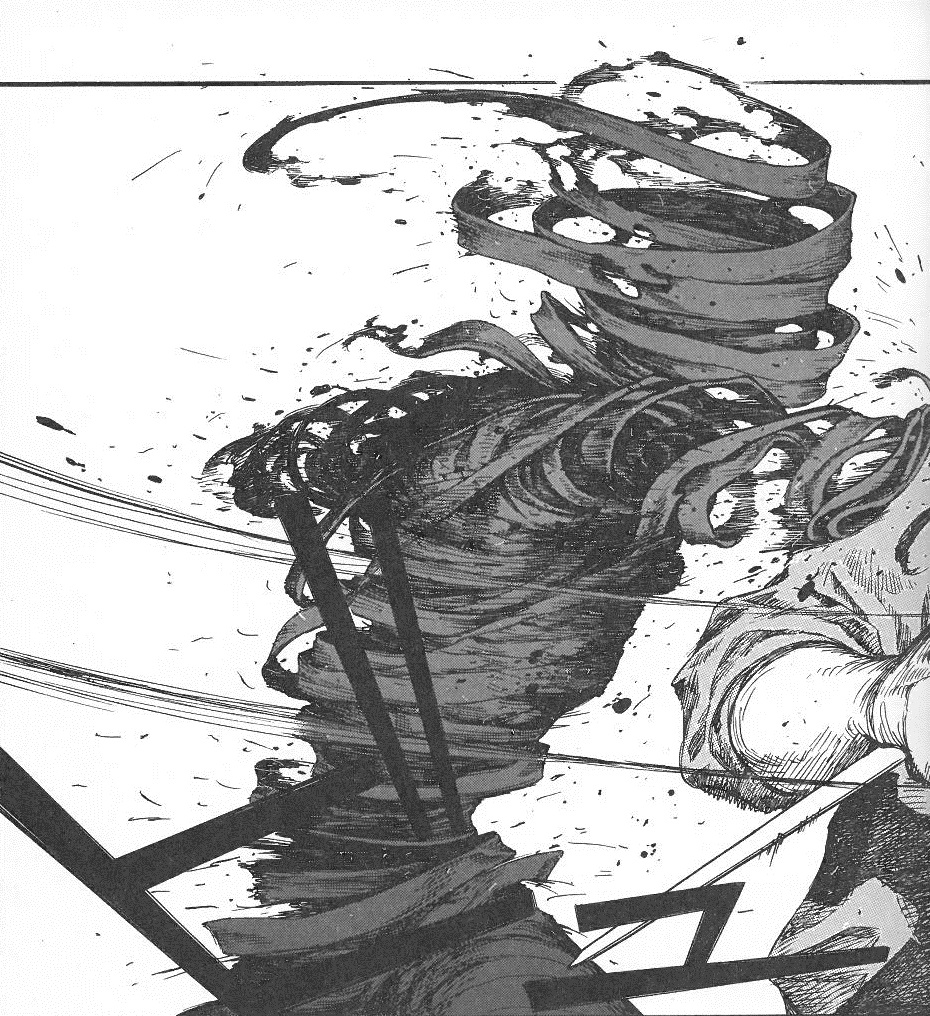
Ajin: Demi-Human, Volume 2, page 61Despite being a large focus of the first two volumes of Ajin and around whom much of the manga’s plot revolves, currently Kei is actually one of the least compelling characters in the series. The people and events surrounding Kei tend to be much more engaging. Sato in particular is a tremendous presence. It is easy to see why he instills such fear among those in the Demi-Human Control Commission—he cannot be controlled. Sato is a coldly calculating and ruthless strategist with extraordinary combat skills and the ability to manipulate both the people around him and the situations in which he finds himself. He is terrifyingly effective in the execution of his plans. At this point only some of those plans have been completely revealed, but it is obvious that Sato is willing to sacrifice anyone in order to accomplish them. In comparison, Kei seems to be incredibly weak-willed and naive, lacking a strong sense of self. Granted, almost anyone would when compared to Sato, but it’s also somewhat understandable since Kei’s entire worldview has been shattered. With his new-found immortality, he is still trying to understand who he is.

Ajin is a very dark and violent manga. The experiments carried out on the demi-humans are brutal and cruel. Generally, the most graphic moments are implied rather than seen, but that makes the torture no less disturbing. Demi-humans, especially those controlling black ghosts, are more than capable of fighting back, though. For example, Sato’s repeated attacks on research facilities associated with the Demi-Human Control Commission and his complete disregard for life are astonishing. Sakurai’s artwork is particularly effective during action sequences, of which there are plenty in the second volume of Ajin. The second volume also addresses some of the social issues surrounding demi-humans, in particular the fact that not everyone feels that demi-humans should be discriminated against just because they happen to be immortal. So far, Sakurai has been able to strike a good balance between the series’ intense action and horror and its exploration of deeper moral and ethical concerns. I’m certainly looking forward to seeing how the series continues to develop.

Filed Under: REVIEWS Tagged With: Ajin, Gamon Sakurai, manga, Tsuina Miura, vertical

Henshin

February 18, 2015 by Ash Brown

HenshinCreator: J. M. Ken Niimura
U.S. publisher: Image Comics
ISBN: 9781632152428
Released: January 2015
Original release: 2014

J. M. Ken Niimura is probably best known for his collaboration as an illustrator with writer Joe Kelly on I Kill Giants, an award-winning American comic that was completed in 2008. Among many other honors, the work earned Niimura and Kelly the top International Manga Award in 2012. A Spanish artist of Japanese descent, Niimura currently lives and works in Tokyo. Henshin is his first major Japanese publication. The collection includes thirteen short manga that were originally released online between 2013 and 2014 on the website for Ikki, a magazine that has been the home to some of my favorite mangaka, before finally being collected into a single volume. (An interesting sidenote: I Kill Giants was also published in Japan by Ikki Comix.) Henshin was subsequently released in Spanish in 2014 by Norma Editorial and in English by Image Comics in 2015. Out of the three print releases of Henshin, the English-language edition has the largest trim size.

The manga collected in Henshin are short, anywhere from twelve to twenty-eight pages in length. Although there are a variety of genres and styles, the stories generally fall into one of two broad categories: those that are semi-autobiographical, focusing on either Niimura’s creative processes or his love of cats, and those that are fictional narratives largely set in or near Tokyo or otherwise featuring Tokyoites. For the most part, the individual manga are unrelated and stand perfectly well on their own, but the first and last stories do share the same lead characters and there is a running episodic story about Niimura and a cat that lives near his apartment. Henshin includes slice-of-life manga, as well as manga with science fiction and fantasy elements, pieces infused with nostalgia, family and friends, pieces where loneliness and missed connections predominate, stories with a bit of humor, and stories with a bit of sadness.

MerciAlthough the manga in Henshin are all different, they do share some thematic and narrative similarities. The first story, “No Good,” perfectly captures the tone of the volume as a whole. It starts out as a seemingly innocent tale but it suddenly shifts into something completely unexpected and outlandish. Most of the stories in Henshin have some sort of twist to them that require the reader to reconsider and reevaluate everything that has come before. Those surprising plot developments may be humorous, touching, absurd, disconcerting, or even morbid, in any combination. In Japanese, “henshin” means transformation, metamorphosis, or change, which is exactly what the stories collected in the volume have to offer—pivotal moments in which all of a sudden things are no longer the same, demanding a new and different understanding of reality.

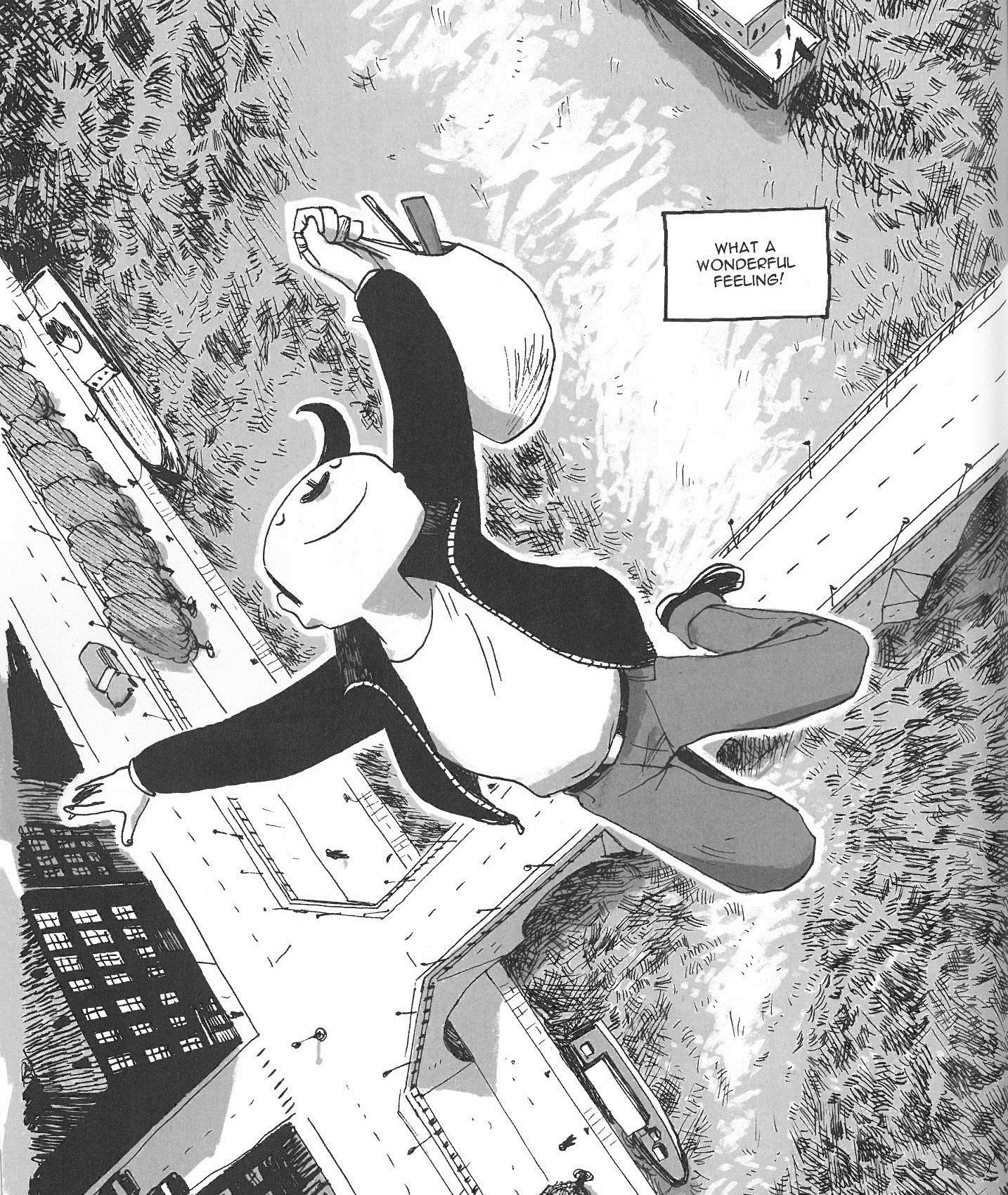
Niimura exhibits a range of art styles in Henshin, drawing influence from Asian, European, and American comics traditions. Some of the illustrations are simple caricatures while others are more detailed or involved, some even reminiscent of classic ink wash paintings. The artwork in each of the short manga is tailored to fit the specific story and its mood, but in every case Niimura’s illustrations show impressive narrative strength. In general, Henshin uses minimal text and dialogue—one manga is even completely wordless—relying on the artwork (which performs magnificently) to actively aid in the telling of the stories. Henshin is an excellent and rather delightful collection of charming and quirky short manga that, in all of its strangeness and occasional absurdity, remains emotionally relevant and carries an impact. I enjoyed Henshin immensely and hope to have the opportunity to read more of Niimura’s comics and manga in the future.

Filed Under: REVIEWS Tagged With: Image Comics, J. M. Ken Niimura, manga

My Week in Manga: February 9-February 15, 2015

February 16, 2015 by Ash Brown

My News and Reviews

Last week was a two-review week here at Experiments in Manga. I read and loved Ellery Prime’s Gauntlet, the first novel to have both started and finished in Sparkler Monthly. I’m not sure the review really does the book justice–the story is difficult to write about without spoiling it–but Gauntlet is really good stuff. Ever since reading the novel, I haven’t been able to get it out of my head. (Coincidentally, both Gauntlet and Jen Lee Quick’s marvelous comic Off*Beat are currently on sale!) The second review posted last week was of Setona Mizushiro’s After School Nightmare, Volume 2. So far, the series remains a disconcerting but compelling work. The manga has a lot of dark, psychological drama, which I tend to enjoy, although that can also make it a difficult read from time to time. Many of the characters simply aren’t very nice people. The review is a part of my monthly horror manga review project; next month it will be Mushishi‘s turn again.

On to other interesting reading and news from elsewhere online! The Young Adult Library Services Association has released its 2015 Great Graphic Novels for Teens. The annual list is always worth a look. The manga for 2015 include All You Need is Kill, My Little Monster, My Love Story, Seraph of the End, Summer Wars, Voice Over! Seiyu Academy, Wolf Children: Ame & Yuki (the only manga included on the top ten list), and World Trigger. Over at Organization Anti-Social Geniuses, Laura from Heart of Manga provides The 2015 Shoujo Manga Forecast, a comprehensive overview of the shoujo manga that has so far been announced for this year, listed by publisher and expected release date. And on the Vertical Tumblr there is a post Reviewing the “Best Manga of 2011” from a licensing angle which I found to be particularly fascinating. Speaking of Vertical, three new licenses!–Seraph of the End light novels, Ninja Slayer manga, and KizuMonogatari.

Quick Takes

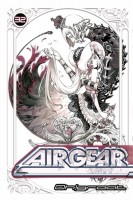
Air Gear, Volume 32Air Gear, Volume 32 by Oh!Great. This is actually the first volume of Air Gear that I’ve ever read, and the only other manga by Oh!Great that I’ve been exposed to is the very beginning of Tenjo Tenge. From that limited experience, I expected there to be violence and a fair amount of fanservice in Air Gear, and there certainly is. Since I’m not particularly familiar with Air Gear, its plot, or its characters, unsurprisingly I was a bit lost reading the thirty-second volume. It didn’t help that Oh!Great’s use of flashbacks and flashforwards seems haphazard, making it difficult to maintain a firm grasp on the manga’s chronology, and therefore was not as effective as intended. There are only five more volumes in the series and even though I’m unaware of all of the details, it is quite obvious that there has been a tremendous buildup to reach the thirty-second. The volume concludes at least one major battle and leaves several important characters dead. Even though I wasn’t able to follow everything that was going on story-wise, I could still appreciate Oh!Great’s dynamic artwork (beginning with the stunning cover illustration) and the series’ over-the-top action. If nothing else, Oh!Great can draw.

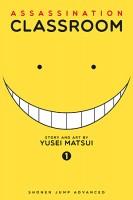
Assassination Classroom, Volume 1Assassination Classroom, Volumes 1-2 by Yusei Matsui. The junior high students of class 3-E are the academic underachievers and juvenile delinquents whom no one else in the school wants to deal with, but they’re apparently also the only ones who have any chance of saving the world from being destroyed. The teens have less than a year to assassinate their teacher, a superpowered tentacle creature who plans on disintegrating the planet after their graduation. Although he has a few weaknesses, Koro Sensei is extremely powerful, impervious to most weapons, and able to move at Mach 20. A successful assassination will require a significant amount of creativity and teamwork. Surprisingly, even though he intends to destroy Earth, Koro Sensei is actually a great teacher who seems to genuinely care about his students, challenging them to better themselves and encouraging them not only in their studies but in their assassination attempts as well. Assassination Classroom is a strange but enjoyable series. 3-E is a class of losers and outcasts who, when given the opportunity and shown that someone actually believes in them, are able to overcome challenges even if they haven’t figured out a way to kill Koro Sensei yet.

From the New World, Volume 6From the New World, Volumes 6-7 written by Yusuke Kishi and illustrated by Toru Oikawa. The manga adaptation of From the New World frustrates me immensely. The story is fantastic, the setting intriguing, and the atmosphere incredibly dark. But overall the manga just isn’t very satisfying, suffering from tonal imbalance and uneven worldbuilding and plot development. Although there’s still some ridiculous fanservice–Saki’s breasts in particular are constantly being emphasized to the point of distraction–these volumes fortunately are mostly lacking in the explicit sex scenes found throughout the rest of the series that seem completely out-of-place and interrupt the narrative flow of the story. The final volume with its dramatic conclusion of the war between the morph rats and the humans, would have been one of the strongest in the series except for the fact that the last chapter, which serves as a lengthy epilogue, slightly fumbles what is perhaps the series’ biggest twist. Quite a few of the reveals in the final volumes likely would have been more powerful if they had been encountered earlier in the story. In the end, I still think what I really want is to read Kishi’s original novel.

Stones of PowerStones of Power by Isora Azumi. A few years ago I read and enjoyed the first quarter or so of Stones of Power when it was initially being serialized in the Gen anthology. The manga has since been collected into a single volume, including material that I believe hadn’t previously been released. Stones of Power is admittedly unpolished and its artwork fairly generic, but there are things I really like about the manga. It mixes the mundane with the supernatural in rather curious ways, especially in the beginning. Fujita is a young man with a passion for fish who ends up being hired to maintain the aquarium at a small cafe. That might not be a particularly strong hook for most readers, but I happen to really like fish and used to keep a tank of my own. It just so happens that the fish Fujita’s been put in charge of are actually dragon gods and the two siblings he works for are fox spirits. From there Stones of Power spins off into an increasingly strange and dangerous situation in which Fujita, who apparently has an unexpected affinity for the occult (or at least the dragons), is unwittingly dragged into a battle between the foxes and an ancient power that threatens the life of an innocent young girl.

Filed Under: FEATURES, My Week in Manga Tagged With: air gear, assassination classroom, From the New World, Isora Azumi, manga, Oh Great, Toru Oikawa, Yusei Matsui, Yusuke Kishi

After School Nightmare, Vol. 2

February 13, 2015 by Ash Brown

After School Nightmare, Volume 2Creator: Setona Mizushiro
U.S. publisher: Go! Comi
ISBN: 9781933617176
Released: December 2006
Original release: 2005

The second volume of Setona Mizushiro’s After School Nightmare, a disconcerting shoujo manga series with dark psychological elements, was originally released in Japan in 2005. The English-language translation was published by Go! Comi in 2007. The entire ten-volume series is now out-of-print in English, but happily the individual manga can still be found relatively easily. I had initially read the first few volumes of After School Nightmare by borrowing them from a library before deciding to track down a set of my own. However, I never got around to reading the entire manga until now because, although the beginning of the series immediately captured my attention, the manga was honestly discomforting. The first volume introduces a surreal setting in which dreams can be just as terrifying and damaging as the realities from which the characters would like to escape. After School Nightmare is a manga that is both fantastically strange and oddly compelling.

Conflicted and confused over his gender due to having a body that is neither entirely male nor female, Mashiro has tried to keep his physical condition hidden from others by living his life as a boy, but now that closely kept secret is out. Every Thursday after school, he and a handful of other students participate in a special class required for their graduation. During the class they literally share a dream, or rather a nightmare, together. In the process their true selves are revealed to the other students, and so a few of Mashiro’s classmates have found out about his body. Within the dreams, Mashiro has fallen victim to the cruel Black Knight, another student whose identity he is unsure of but who he suspects may be Sou. In waking reality, Sou has forcibly kissed Mashiro, insisting that he is a girl and even going so far as to declare his love for him. It is not a situation that Mashiro is comfortable with and if he can get up the courage he intends to confront Sou, whether it be in the nightmare or outside of it.

After School Nightmare, Volume 2, page 56Frankly, Sou is a jerk. He may be earnest in his feelings for Mashiro, and he’s at least started to try to reign in his aggressiveness, but he has yet to show Mashiro any sort of respect. I can’t like the guy because of the way he treats Mashiro, however I do still have some sympathy for him. Sou, like all of the other students in the special class, suffers greatly from emotional abuse and trauma. Still, that does not excuse his behavior towards Mashiro. Even so, he is positioned as one of Mashiro’s two potential romantic interests in After School Nightmare, the other being Kureha. Although she has made an exception and is currently dating Mashiro, she hates and despises men. Mashiro and Kureha generally get along, but their relationship isn’t as healthy as it could be, mostly but not entirely due to Mashiro’s continued insecurities over his gender. He seems to believe that his identity is defined and determined by the person he is intimate with. Because he’s desperate to be seen as a man, this calls into question whether or not he’s actually in love with Kureha, or if he’s simply dating her as a way to prove his masculinity.

The shared dreams in After School Nightmare are a way of forcing the students to face and work through the darkness that exists within their hearts and psyches. In theory, those nightmares are supposedly intended to be kept separate from reality, but the two worlds do have an effect on each other. The distorted forms the students take within the dreams can be terrifying, but what really makes them so disturbing are the troubling truths and dark pasts that they reveal. The pain, suffering, and hatred that is readily visible in the nightmares still exists and is present in their waking lives. Usually hidden, suppressed, or otherwise concealed, the prejudices that the students carry within them occasionally erupt violently. The skills and maturity needed to deal with these emotional, psychological, and physical disturbances are at least in part being developed within the dreams. In After School Nightmare, Volume 2, Mashiro begins to learn the importance and power of mental strength and fortitude, but both he and his classmates all still have room to learn and grow.

Filed Under: REVIEWS Tagged With: after school nightmare, Go! Comi, manga, Setona Mizushiro

My Week in Manga: February 2-February 8, 2015

February 9, 2015 by Ash Brown

My News and Reviews

A small variety of posts went up at Experiments in Manga last week. First up, the Cinderalla manga giveaway winner was announced. The contest was a tie-in to the Female Goth Mangaka Carnival, so the post also includes a list of the featured creators’ manga available in English. The first in-depth manga review for February was Saki Nakagawa’s Attack on Titan: Junior High, a parody spinoff of the immensely popular Attack on Titan franchise. The series’ funniness can be somewhat uneven, but it can be absolutely hilarious at times. And posted over the weekend was January’s Bookshelf Overload, revealing the absurd amount of manga that came into my household last month.

Elsewhere online, Viz Media’s Shojo Beat announced two new licenses: QQ Sweeper by Kyousuke Motomi (the creator of Dengeki Daisy, which I rather enjoy) and Idol Dreams by Arina Tanemura. Organization Anti-Social Geniuses posted The Very Unofficial Guide to Discovering Manga in 2015, which is a nice overview of demographics, publishers, where to read and buy manga, and so on. Den of Geek has an interview with comics historian Graham Kolbeins, one of the editors behind Massive: Gay Erotic Manga and the Men Who Make It and The Passion of Gengoroh Tagame: The Master of Gay Erotic Manga. Finally, Otaku USA interviews Patrick Macias about Hypersonic Music Club, his collaboration with artist Hiroyuki Takahashi and the first of Crunchyroll Manga’s original series.

Quick Takes

Sky LinkSky Link by Shiro Yamada. Like many boys’ love mangaka, before making her professional debut Yamada started by creating doujinshi (she seems to have been particularly fond of pairing Gintoki and Hijikata from Gin Tama together). Sky Link is Yamada’s first original manga and is currently the only work of hers available in English. The volume collects two unrelated boys’ love stories, the titular “Sky Link” and “You through a Kaleidoscope.” Unfortunately, neither of the short manga are particularly satisfying; while her artwork can at times be quite lovely (occasionally her characters’ eyes are unintentionally creepy), Yamada definitely has room to grow as a storyteller. “Sky Link” had too many disparate elements to it. It could have worked quite well as a longer series, but as a short story Yamada didn’t have enough time to effectively develop the plot or characters and everything is left frustratingly vague. Ritsuki is a first year college student with some sort of troubled past who has caught the attention and affections of one of his new professors who, it is later revealed, has a troubled past of his own. “You through a Kaleidoscope,” a fairly standard high school boys’ love romance, isn’t as ambitious but is more successful as a result.

Tsubasa: Reservoir Chronicle, Omnibus 1Tsubasa: Reservoir Chronicle, Omnibuses 1-2 (equivalent to Volumes 1-6) by CLAMP. I originally read the first few volumes of Tsubasa back when it was being released by Del Rey. Because I was borrowing it from the library and people had a tendency to steal volumes Tsubasa and its sort-of crossover series xxxHolic, I never got very far with the series. I’m glad that Kodansha is bringing Tsubasa back into print, because it really is an immensely enjoyable adventure tale. And because the setting is constantly moving from one dimension to the next, CLAMP is able to have a lot of fun with the clothing designs and worldbuilding from one short story arc to the next. The drive of the series is the search for Princess Sakura’s memory, pieces of which have been scattered throughout space and time, but the remembrances of her and the other characters form an important part of the story as well. I do think I’m enjoying Tsubasa a little more my second time trying to read it. I’ve now been exposed to more of CLAMP’s work, so I can better appreciate the references being made and the alternate-dimension versions of characters from the group’s other manga. (Seeing couples originally from X actually have a chance at happiness is both touching and heart-wrenching.)

UQHolder3UQ Holder!, Volume 3 by Ken Akamatsu. I enjoyed the third volume of UQ Holder more than I did the first two, but the series has yet to win me over. It seems as though the manga is starting to focus a bit more, which it desperately needed to do, but that may simply be because Akamatsu spends very little time on trying to develop a coherent plot and primarily sticks with the action sequences. The third volume is almost entirely devoted to a sequence of fight scenes. Right now the battles in UQ Holder are probably my favorite thing about the series. They are entertaining, exciting, and extremely energetic. And because immortals are involved, they can be pretty epic, too. The damage inflicted on both persons and property is impressive. Many of the characters, even the non-immortals, have superhuman powers of some sort. Incredible strength, quick regeneration, shape-shifting, and magic—either alone or in combination—are only a few examples of the over-the-top abilities found in UQ Holder. But as entertaining as the battles can be, from time to time the action is unclear. Something will happen and it will be extremely difficult to understand exactly what or how. I’m not even going to try to attempt to explain why Yukihime suddenly loses her skirt for seemingly no reason.

Filed Under: FEATURES, My Week in Manga Tagged With: clamp, Ken Akamatsu, manga, Shiro Yamada, tsubasa, UQ Holder

Attack on Titan: Junior High, Vol. 2

February 6, 2015 by Ash Brown

Attack on Titan: Junior High, Omnibus 2Creator: Saki Nakagawa
U.S. publisher: Kodansha
ISBN: 9781612629186
Released: November 2014
Original release: 2013-2014

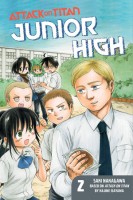
I was actually a little surprised by how much I ended up liking the first omnibus of Attack on Titan: Junior High. Created by Saki Nakagawa with input from Hajime Isayama (both of whom actually attended the same design school, though that fact is more of a coincidence than anything else), Attack on Titan: Junior High is specifically a parody spinoff of Isayama’s immensely popular manga series Attack on Titan. More generally, the series is also a parody of just about any manga with a school setting. Attack on Titan: Junior High is an odd mix of Attack on Titan and contemporary school life that actually manages to work much of the time. The second Attack on Titan: Junior High omnibus, released by Kodansha Comics in 2014, collects the third and fourth volumes of the series’ original Japanese edition, published in 2013 and 2014 respectively. Kodansha was kind enough to send me a review copy of Attack on Titan: Junior high, Omnibus 2 which, because I enjoyed the first omnibus, I was particularly happy to see.

Life isn’t easy for the human students of Attack Junior High. Not only do they have to worry about the normal sorts of challenges encountered at school–getting a passing grade in class, surviving the ire of upperclassmen, daring to ask another student on a date, ensuring their clubs aren’t suspended, and so on–they also have to worry about the rest of the student body, the Titans. It doesn’t help that Attack Junior High’s principal just so happens to be a Titan as well, meaning most of the administration looks the other way as the Titans terrorize the much smaller students, the victims of bullying and stolen lunches. But then there’s the beloved teacher Mr. Erwin Smith who on the surface seems to favor the Titans when in actuality he harbors a deep-seated hatred so intense that it rivals Eren’s. Considering Eren’s single-minded commitment to taking on and taking out all of the Titans, this is rather impressive.

There is no denying that Attack on Titan: Junior High is an utterly ridiculous manga series. In general, I think that overall I probably enjoyed the first omnibus slightly more. The novelty of the spinoff has worn off some, but the second omnibus still managed to make me laugh on multiple occasions. I do find that the series works best for me when it is directly riffing on the original Attack on Titan manga and its fandom rather than playing around with more generic story tropes. Granted, from time to time those parodies can be entertaining, as well. But ultimately Attack on Titan: Junior High tends to be rather uneven with its humor. Sometimes the manga can be absolutely hilarious, but just as often the attempts at comedy just aren’t very funny. Unsurprisingly, many of the jokes in the series require readers to already be very familiar with Attack on Titan to really appreciate them, but it’s those readers for whom the series is intended to begin with.

Attack on Titan: Junior High and its style of humor certainly will not appeal to everyone. It’s not particularly clever and much of the manga can only be enjoyed by readers who are already predisposed towards random, absurd, and frequently nonsensical comedy. The English translation and localization of Attack on Titan: Junior High is fairly loose in sections, adding a few jokes here and there and freely changing pop culture references to ones that will likely be more recognizable to Western audiences. I’m not sure how funny or effective some of the changes will be in a few years’ time since they often refer to recent events, but for now they are amusing. The best gags are those where Nakagawa takes the characters of Attack on Titan and emphasizes and distorts their personality quirks to extremes. One of the most appealing things about the original Attack on Titan is its ensemble cast, and that is true of Attack on Titan: Junior High as well. Fortunately, that’s something that doesn’t rely on timeliness.

Thank you to Kodansha for providing a copy of Attack on Titan: Junior High, Omnibus 1 for review.

Filed Under: REVIEWS Tagged With: attack on titan, kodansha, Kodansha Comics, manga, Saki Nakagawa

  • « Go to Previous Page
  • Page 1
  • Interim pages omitted …
  • Page 18
  • Page 19
  • Page 20
  • Page 21
  • Page 22
  • Interim pages omitted …
  • Page 60
  • Go to Next Page »
 | Log in
Copyright © 2010 Manga Bookshelf | Powered by WordPress & the Genesis Framework