• Skip to primary navigation
  • Skip to main content
  • Skip to primary sidebar
  • Home
  • About Us
    • Privacy Policy
    • Comment Policy
    • Disclosures & Disclaimers
  • Resources
    • Links, Essays & Articles
    • Fandomology!
    • CLAMP Directory
    • BlogRoll
  • Features & Columns
    • 3 Things Thursday
    • Adventures in the Key of Shoujo
    • Bit & Blips (game reviews)
    • BL BOOKRACK
    • Bookshelf Briefs
    • Bringing the Drama
    • Comic Conversion
    • Fanservice Friday
    • Going Digital
    • It Came From the Sinosphere
    • License This!
    • Magazine no Mori
    • My Week in Manga
    • OFF THE SHELF
    • Not By Manga Alone
    • PICK OF THE WEEK
    • Subtitles & Sensibility
    • Weekly Shonen Jump Recaps
  • Manga Moveable Feast
    • MMF Full Archive
    • Yun Kouga
    • CLAMP
    • Shojo Beat
    • Osamu Tezuka
    • Sailor Moon
    • Fruits Basket
    • Takehiko Inoue
    • Wild Adapter
    • One Piece
    • After School Nightmare
    • Karakuri Odette
    • Paradise Kiss
    • The Color Trilogy
    • To Terra…
    • Sexy Voice & Robo
  • Browse by Author
    • Sean Gaffney
    • Anna Neatrour
    • Michelle Smith
    • Katherine Dacey
    • MJ
    • Brigid Alverson
    • Travis Anderson
    • Phillip Anthony
    • Derek Bown
    • Jaci Dahlvang
    • Angela Eastman
    • Erica Friedman
    • Sara K.
    • Megan Purdy
    • Emily Snodgrass
    • Nancy Thistlethwaite
    • Eva Volin
    • David Welsh
  • MB Blogs
    • A Case Suitable For Treatment
    • Experiments in Manga
    • MangaBlog
    • The Manga Critic
    • Manga Report
    • Soliloquy in Blue
    • Manga Curmudgeon (archive)

Manga Bookshelf

Discussion, Resources, Roundtables, & Reviews

Josei

Full-Time Wife Escapist Vols 1 and 2

July 8, 2017 by Anna N

Full-Time Wife Escapist Volume 1 and 2 by Tsunami Umino

Kodansha seems to be putting out so many digital titles, I’m having a hard time keeping track of them all. I’m always curious to check out josei titles and Full-Time Wife Escapist is a unique title, as it isn’t as overtly focused on romance as some of the other josei titles that have been translated over here.

Mikuri is in a bind after attending graduate school in psychology. She’s having difficulty finding a full-time job, and makes ends meet as a temp. When her temp job ends, she’s caught in a difficult situation because her parents are moving to the country, where there will be even less work for her. She picks up some shifts here and there doing housework and meets a man named Tsuzaki, and she becomes his regular part-time housekeeper. They become closer when she takes care of him during an illness. Mikuri and Tsuzaki come up with the solution where Mikuri will move in as his platonic paid wife, taking over housekeeping duties, making him lunch and dinner, and generally making his bachelor apartment more comfortable.

Tsuzaki is a bit of a loner at work, and somewhat emotionally stunted and has a way of relating to other people that make them assume that he’s cranky, but it seems more like he just hasn’t developed his social skills very well. The transnational nature of the relationship is one of the aspects of this manga that makes it both interesting and refreshing. When Mikuri and Tsuzaki go to visit his parents, they set the terms of Mikuri’s overtime by negotiating back and forth. It is interesting to see tasks that would be unacknowledged emotional labor in a real relationship being assigned a dollar value in this one.

Mikuri’s background in psychology shows her observing other people as opposed to getting real insight on herself. She does have some amusing daydream sequences when her mind wanders and she projects herself into some dream tv interviews that offer some commentary on her life choices. Her aunt Yuri, an unmarried career woman, serves as a counterpoint to Mikuri’s more aimless lifestyle. I enjoy manga when it gets a little didatic, and there are some great asides in Full-Time Wife Escapist where the characters start discussing the economic conditions facing younger adults in Japan, providing some real world background and context to Mikuri’s unconventional lifestyle choice.

The first volume sets up the unique relationship situation in The Full-Time Wife Escapist fairly quickly, and the second volume shows some of the issues that happen when the couple continues to try to portray their relationship as real to friends and colleagues, who sense that something is a bit off in the way the couple relate to each other. At the same time, the close proximity of the fake couple is showing some awareness developing between them. This series has a nice slice-of life pace to the storytelling, as everyday activities like preparing dinner have a new slant due to the unique relationship. At the same time, there are some moments of pathos, as Tsuzaki reflects that if Mikuri ever decides to get married for real, he’s going to be alone for the rest of his life.

Tsuzaki’s friend Kazami starts appearing a bit more and more, and he and Mikuri have a few easy friendly conversations. Kazami starts envying the married lifestyle, but he’s not interested in settling down at all. Intriguing changes are signaled for the next few volumes. I enjoy a good josei romance series, but one of the things I appreciate about The Full-Time Wife Escapist is that it is focused more on transactions and slowly developing friendships than overt romance. It’ll also be interesting to see if Mikuri’s unconventional wife for hire lifestyle is sustainable over the long term.

Filed Under: Manga Reviews, REVIEWS Tagged With: full-time wife escapist, Josei, Kodansha Comics

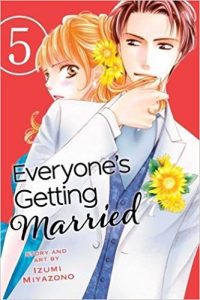
Everyone’s Getting Married, Vol. 5

May 4, 2017 by Anna N

I still very much enjoy Everyone’s Getting Married, but this volume was a little bit of a letdown, mostly because I’m not terribly fond of the way the “suddenly a rival appears!” storyline is being executed.

At the end of the last volume Kamiya, a work colleague of Asuka’s decided that she would be his ideal wife. He was not put off by the fact that she’s dating Ryu, and Kamiya’s persistence was one of the most annoying things about this volume, even though he did bring up some good and rational points about Asuka and Ryu’s counterproductive relationship. Asuka is mostly reduced to a bargaining chip between the men, and her actions are a little bit too passive, although I suppose it is an accurate portrayal of where a woman might end up when she has been thoroughly socialized to be nice all the time. The volume opens with Ryu and Kamiya getting a drink together, and even though Ryu warns Kamiya to stop his pursuit of Asuka, Kamiya is undeterred, pointing out the futility of a relationship where one person wants to get married and the other is set against it. Kamiya is convinced that the couple will eventually break up, and when that happens he will be there, ready to scoop up Asuka and take advantage of her innate intelligence and competence to have the supportive live partner of his dreams.

Kamiya proceeds to both threaten and manipulate Asuka into spending time with him, and I started feeling very annoyed that Asuka was so passive that she got thrown into situations with Kamiya when she didn’t really want to spend time with him. Ryu and Asuka always do reaffirm their relationship, and a brief trip away with a break from work serves to smooth things over. One of the reasons why this manga is so interesting to read is the fact that either one of the main characters is going to have to fundamentally change, or they will have to break up, and that dramatic tension is intriguing. This volume felt like a bit more of a placeholder, and I hope there’s a more satisfying story in the next volume.

Filed Under: Manga Reviews, REVIEWS Tagged With: everyone's getting married, Josei, shojo beat, viz media

A First Look at Tokyo Tarareba Girls

February 13, 2017 by Katherine Dacey

Are you breathlessly awaiting the next installment of Princess Jellyfish? Still fuming over Tokyopop’s cancellation of Suppli? Eagerly searching for a manga romance whose heroine is old enough to drink? Then I have the cure for what ails you: Akiko Higashimura’s Tokyo Tarareba Girls, which makes its digital debut tomorrow (2/14) courtesy of Kodansha Comics. This fizzy, fast-paced comedy is every bit as good as Higashimura’s Princess Jellyfish, deftly mixing wacky misunderstandings and witty banter with moments of genuine rue and self-reflection.

The first chapter begins with the narrator declaring, “I spent all my time wondering ‘What if,’ and then one day I woke up and was 33.” As Rinko fills us in on her career, female readers will feel an immediate sense of identification with her — she’s smart, capable, and constantly imagining her future instead of being fully invested in the present, something many of us are guilty of doing in our twenties and early thirties. Though Rinko has forged her own career path, she frets over being single. Rinko isn’t alone in her frustration, since Kaori and Kayuki — her gal pals and drinking buddies — are in the same boat.

The plot is set in motion by a cryptic message from Rinko’s co-worker Hayasaka. In a brief flashback to 2004, we see Rinko and Hayasaka on an uncomfortable date: she focuses on his shyness, his clothing, and his fumbling efforts to be suave, while he ignores her squirming and tries to give her an unwanted gift. Ten years later, both still work for the same company, although there’s a lingering note of tension — or is that romantic frisson? — between them. When Hayasaka sends Rinko a text asking, “I would like to discuss something with you. Could I trouble you for some time later this week?” Rinko immediately declares a “four-alarm” emergency and reaches out to her girls for counsel: after all this time, is Mr. Hayasaka planning to propose? And if so, should she say yes?

If you’re thinking been there, seen that, I get it. Tokyo Tarareba Girls sounds like a hundred other comedies about single women navigating a paired-off world, from Bridget Jones’ Diary to How to Be Single. What prevents Tarareba Girls from reading like a Sex in the City clone is Higashimura’s storytelling chops.

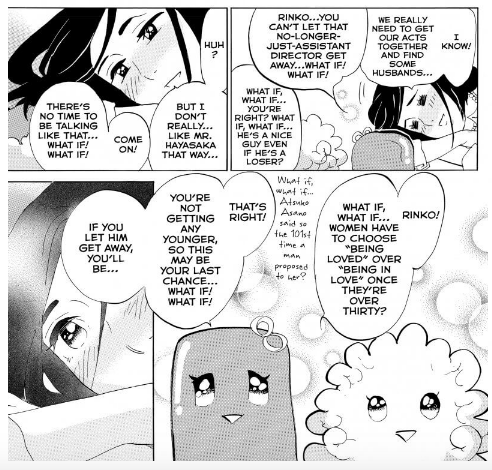
Consider Higashimura’s strategy for making us privy to Rinko’s thoughts. Though Rinko often functions as the series’ narrator, Higashimura looks for more imaginative ways to dramatize Rinko’s emotional life than simple disclosure. In one scene, for example, Rinko’s food — yes, you read that right — cheerfully engages her in a conversation about her romantic dilemma:

Coming from one of her gal pals, this exchange would sound too on-the-nose, a bald statement of the manga’s main thesis. But coming from an izakaya dish? That’s genius! It allows us a window into Rinko’s state of mind (and her state of intoxication) without falling back on such shop-worn devices as the “Dear Diary” entry or the “Little did I know then…” voice-over.

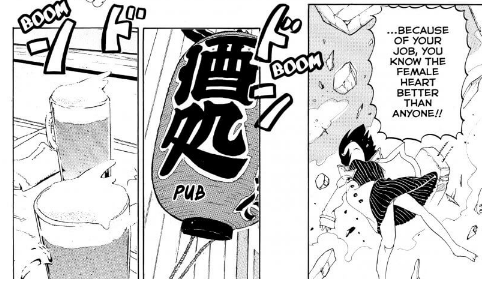
Elsewhere in chapter one, Higashimura uses a similar technique of transposing Rinko’s inner thoughts onto the outer world, using the visual language of action movies — explosions, falling debris — to evoke the intensity of Rinko’s embarrassment over misunderstanding a friendly overture:

This sequence, too, is genius: anyone who’s ever read too much into an email, a voice mail, a text, or a friendly conversation knows exactly how Rinko feels in that moment and can laugh — or cringe — in self-recognition. At the same time, however, the reader can also see that Rinko’s romantic delusions are blinding her to the real lesson of turning 33: that she should learn what — or who — she really wants instead of settling for Mr. Not Quite Right.

The first chapter ends with the introduction of a prickly, truth-telling character whose appearance adds a welcome jolt of energy to the story; his barroom sermon about self-defeating female behavior is a show-stopper, both for its blunt honesty and for the impact it has on Rinko and her pals. Whether he becomes Rinko’s enemy or love interest, his memorable exit leaves the reader wanting to know what happens next — further proof of Higashimura’s storytelling mojo.

TOKYO TARAREBA GIRLS, VOL. 1 • BY AKIKO HIGASHIMURA • KODANSHA COMICS • RATED OT, FOR OLDER TEENS (16+) 

Filed Under: Manga, Manga Critic, REVIEWS Tagged With: Akiko Higashimura, Josei, Kodansha Comics, Romance/Romantic Comedy

Everyone’s Getting Married Vol. 3

November 15, 2016 by Anna N

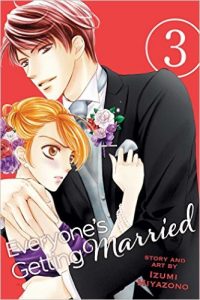
Everyone’s Getting Married, Volume 3 by Izumi Miyazono

Is everyone getting married? I see no evidence of it yet in this series where aspiring housewife Asuka and committed bachelor Ryu continue to fall in love with each other despite their utterly incompatible life goals. This manga manages to balance the twists and turns of a soap opera with some very touching moments as Ryu and Asuka continue to struggle with their feelings for each other, balance their demanding work schedules, and navigate their possibly doomed relationship.

One of the things I like about this series is how little it relies on conflict due to people not talking to each other. Sure it happens sometimes, but not talking about a problem isn’t stretched over multiple volumes as sometimes happens in romance manga. Even when some standard plot elements pop up in the form of Ryu’s Complicated Ex-Girlfriend and Asuka’s Flirty Co-Worker, this continues to lead the couple to reflect on their relationship.

Two events happen in fairly short succession that cause some strain. Yuko, a married actress who Ryu had a long-term affair with years ago is back in town. She’s touched by scandal due to her philandering husband, and Ryu is maneuvered by combative questions from the press into joking on tv that he’d dump his girlfriend for a chance to date her. In addition, Asuka gets news of a upcoming work transfer and is spending time with Kamiya, a colleague. They’re walking down the street together and they agree to do a “couple interview” as a joke, only Asuka is shocked when she sees that Ryu is interviewing her.

These additional people popping up near Asuka and Ryu cause them to confront some of the issues in their relationship. Asuka wonders if Yuko is the reason why Ryu is so set against marriage. Ryu is jealous of Kamiya, even though his relationship with Asuka is professional. But while the only person Asuka wants to marry is Ryu, she wonders what might happen if she takes Kamiya’s overtures seriously since it seems he does really want to get married.

As always the art is attractive and easy to follow, easily handling cute scenes of Ryu and Asuka supporting each other in addition to some tumultuous relationship drama. I wish Shojo Beat could bring out more series like this all at the same time, but I’ll be happy with what I can get.

egm3

Filed Under: REVIEWS Tagged With: everyone's getting married, Josei, shojo beat, viz media

Everyone’s Getting Married, Vol. 2

September 5, 2016 by Anna N

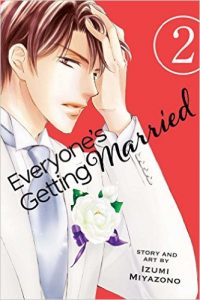
Everyone’s Getting Married, Volume 2 by Izumi Miyazono

I’m always a happy camper when Viz is putting out a josei title, and with two volumes so far in the Everyone’s Getting Married series, I’m very much enjoying a periodic escape into adult romance trials and tribulations as a nice contrast from all the shoujo I usually read.

One of the things I liked very much about the first volume was that the main couple Asuka and Ryu are so clearly attracted to each other and yet their respective goals of becoming a housewife and never getting married are clearly going to come into conflict. Even when they might have attempted to avoid each other, they find themselves getting closer and closer and in a relationship that is going to have a sudden expiration date if neither of them are going to change.

While Asuka and Ryu are more emotionally connected than ever, they find that their hectic work schedules prevents them from seeing each other very often, causing a bit of tension. Ryu also finds himself enjoying some of the extra homemaker type things that Asuka does a little too much, as she’s able to whip up dinner at short notice and do some extra things to help him through an extra demanding time with his news anchor job.

They manage to navigate their first big fight and end up stronger than ever, but one of the things that I enjoy about this manga is that both characters are sympathetic, their points of view about life are intrinsically opposed, and I’m left rooting for a solution but I can’t picture how they’re going to pull it off. This ends up amping up my curiosity about what is going to happen in the story quite a bit, so I’m eager to see how everything progresses.

egm2

Filed Under: REVIEWS Tagged With: everyone's getting married, Josei, viz media

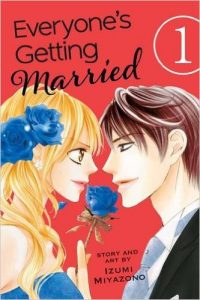
Everyone’s Getting Married, Vol. 1

June 8, 2016 by Anna N

Everyone’s Getting Married Volume 1 by Izumi Miyazono

As far as I’m concerned, Shojo Beat’s recent practice of releasing the occasional josei title is one of the best things ever. Manga featuring non-highschoolers is still not so easy to find, so I was looking forward to Everyone’s Getting Married. At the same time, just based on the title I was a bit concerned that this would be a josei version of The Rules or something that would involve trapping a man into marriage. I was really happy to discover that I enjoyed the personalities and relationship dynamic between the main couple in this manga.

Asuka Takahashi is a successful real estate agent, but her main ambition in life is to get married and become a homemaker. Asuka takes the idea of being a housewife very seriously, mainly due to the fact that she has strong childhood memories of the type of home her mother provided for her as a child. She’s thwarted in her goal in the first chapter when her long term boyfriend breaks up with her. Asuka has a brief encounter with Ryu Nanami when she’s attending a wedding. He’s a newscaster who is determined to never settle down. Asuka and Ryu have an unusually frank exchange about their incompatible goals in life and then part, fully expecting to never see each other again. He tells her “You seem like a great woman, but it would never work out between us,” and she thinks “This man…is not at all what I am looking for.”

Of course, they get thrown together over and over again, because Ryu is the roommate of Asuka’s co-worker Ono. Ryu and Asuka start getting to know each other better, unconstrained by the possibility of a romantic relationship since they’ve mutually ruled each other out. Asuka sees that Ryu is much more of an ordinary person than he appears to be based on his TV persona. He sees that she’s genuinely kind, and he respects the work that goes into keeping a household running even though he has no desire for a wife. They both begin to fall a little in love with each other, but their goals in life for a family and future remain absolutely different. Miyazono’s art is pretty to look at and easy to follow, even though her style isn’t particularly unique.

egm1

Asuka and Ryu end up both being sympathetic and quirky enough to make me wonder which way this story is going to go, even though I’m totally expecting a happy ending. They’re also balanced out a bit by secondary couple Ono and Rio, who have the opposite relationship dynamic where Ono wants to settle down and Rio is determined to keep dating. Overall, this first volume seems like a great addition to the under the radar josei titles coming out under the Shojo Beat line.

Filed Under: REVIEWS Tagged With: everyone's getting married, Josei, shojo beat, viz media

Spell of Desire Vol 3

January 31, 2015 by Anna N

Spell of Desire Volume 3 by Tomu Ohmi

Well, there have been plenty of suggestive scenes in the first couple volumes of Spell of Desire, but finally in the third volume accidental witch Kaoruko and her mother’s favored protector Kaname get it on, due to witchy aphrodisiacs, necessary spell casting, and their growing yet not fully acknowledged feelings for each other! What more would a reader want in a josei paranormal romance?

Kaoruko has been delivered to the coven, and they decide it is necessary for her to fully become a black witch in order for her to gain some control over her powers. Black witches can’t be virgins, so they’ve decided to set Kaoruko up with an incubus in order for her to start down the path towards black magic. Kaoruko is drugged into compliance, but she’s still not cool with the idea of being with anyone but Kaname, and fortunately her knight protector decides to intervene in the ritual deflowering, breaking several rules in the process.

Kaname and Kaoruko end up seeking refuge in a house in the woods owned by an impressive looking white wolf (this is a crossover appearance with a character from a series that hasn’t been translated into English yet), and Kaoruko learns a bit more about Kaname’s background and why he’s so devoted to her mother. As always in this series, Kaname’s commitment to the Witch Queen causes Kaoruko to have doubts about their future. When the couple return to the coven, Kaoruko meets more of her mother’s knights, and Kaname is punished horribly. Kaoruko is determined to learn more about witchcraft so she can protect him.

A bunch of new characters get introduced in this volume, and the plot grows more complex as Kaoruko starts to learn more about the differences between white and black magic. It’ll be interesting to see what she can accomplish once she’s fully in command of her powers. I continue to enjoy Ohmi’s art, and I enjoy the way Kaoruko’s power still manifests as vine-like tendrils that curve around the panels of the manga. This series is only 5 volumes long, and this volume served as an effective middle volume, showing Kaoruko about to start gathering more knowledge and power. I recommend this series for any fans of paranormal romance manga!

Filed Under: REVIEWS Tagged With: Josei, shojo beat, spell of desire

Spell of Desire, Vol. 2

October 19, 2014 by Anna N

Spell of Desire Volume 2 by Tomu Ohmi

This series is rapidly becoming my favorite josei masked as shoujo series released on the Shojo Beat imprint. When I picked up the second volume, I was expecting a bit of filler with a few more episodes of Kaoruko’s runaway witch powers manifesting, with the obligatory makeout sessions with Kaname in order to keep her powers under control. While this certainly happened, Ohmi also went full speed ahead with plot development, introducing us to more backstory, evil covens, and Kaname actually admitting he has feelings for the young witch he has sworn to protect.

The sensual nature of Kaoruko’s magic ensures that she’s going to be an object of attraction to men, and Kaname is struggling with this himself. She wants to be able to control her magical abilities, but the fact is that having her mother’s power sealed inside her, in addition to her own magic has made her a bit of a danger to herself. Kaname returns to the coven, leaving one of his mystical animal sidekicks behind for Karuoku’s protection. In his dealings with the coven we see how Kaname is struggling with wanting what is best for his charge as person, in contrast to the way the coven views her as a valuable pawn. He wants to protect her freedom as much as possible, but the powerful witches he reports to might make this difficult.

Kaoruko’s neighbor Yu finds himself irresistibly attracted to her when her magic spirals out of control, but fortunately Unicorn delays things a bit. When some additional witches show up at Kaoruko’s house, she’s almost attacked again, but Kaname returns just in time to save her. Towards the end of the volume, Kaoruko makes a fateful decision to protect Kaname herself. While she’s been a bit passive so far due to reacting to her out of control powers, Kaoruko shows that she has plenty of willpower when someone she cares about is threatened.

I still really enjoy the way Ohmi portrays Kaoruko’s powers as black vines becoming entwined around the panels of the manga, it’s a visual device that is both pretty and ominous at the same time. I was happy that by the second volume, both Kaoruko and Kaname are clear that they love each other, even if they aren’t clear yet that their feelings are reciprocated. I think there will be interesting times ahead if Kaoruko is able to control her own powers and doesn’t need Kaname’s protection as much. I highly recommend this series if you enjoy paranormal romance manga.

Filed Under: REVIEWS Tagged With: Josei, shojo beat, spell of desire, viz media

Pick of the Year – 2013

December 30, 2013 by MJ, Sean Gaffney, Michelle Smith, Ash Brown and Anna N 2 Comments

MJ: 2013 was a pretty dramatic year for manga in many ways, both good and bad. I can’t help but feel pangs of sadness and regret when I look back at last year’s column, in which I named now-defunct digital publisher JManga as my Pick of the Year. Their titles dominated both my BL and digital “best of” lists as well.

heartofthomasDespite that tragedy, I gaze fondly back at 2013, as the year that brought me new favorites like Knights of Sidonia and Sunny. When thinking about my final Pick this year, however, I guess I’ve little choice but to sound like a broken record, because for me, there can be no other than Moto Hagio’s The Heart of Thomas. When Michelle and I discussed this book back in January, I wrote:

“In case it isn’t obvious to anyone reading this, I loved this manga with my whole heart. And I’ll admit that’s not exactly what I expected. I expected to find it visually beautiful and worthy as a classic, but I also expected it to be very dated and I thought the story might not appeal to my tastes as a modern fan. Instead, I found it to be both beautiful and emotionally resonant to an extent I’ve rarely experienced—especially in BL manga. This is a book I’d wholeheartedly recommend to any comics fan, without reservation. It’s an absolute treasure.”

We were working from digital review copies at the time, and though I’d clearly fallen in love, it wasn’t until my own print copy finally shipped later that month that I realized just how much of a treasure this book truly is. It is glorious to behold. As the year passed, nothing else has come close.

gundamoriginSEAN: There was a lot of great manga released in 2013, even if you just stick with titles that began this year. My mind keeps drifting over to one title in particular, and that’s the deluxe hardcover release of Mobile Suit Gundam: The Origin from Vertical. Leaving aside the fact that it looks expensive and fantastic with lovely paper and color and everything, it’s a terrific story. Gundam wouldn’t be what it is today without that original story, and reading about the slow maturation (very slow at times) of Amuro Ray, the increasing leadership abilities of Bright Noah, and the political backstabbing of everyone on the Zeon side (but particularly Char Aznable) is as addicting as anything.

With 4 hardcover volumes out so far this year and more on the way, this has to be the Pick of the Year for me.

knights1MICHELLE: I am finding this profoundly difficult. I picked Taiyo Matsumoto’s Sunny for our gift-giving edition last week, so I obviously love it a great deal and think it’s something every manga fan should check out. But if we’re talking about the new-for-2013 manga that pushes my personal buttons the most, it would have to be Tsutomu Nihei’s Knights of Sidonia. Quite simply, I love everything about it, especially Nihei’s art and how the interior nooks and crannies of Sidonia are depicted. It’s also the most accessible of his works that I’ve read, with an endearing cast thrown into a desperate, seemingly impossible conflict.

I very much want to read more Sunny, but I’m kind of desperate to read more Knights of Sidonia, and so it gets the edge and becomes my official Pick of the Year.

seiichi-hayashi-gold-pollen-and-other-stories-3ASH: Oh, this really is difficult! I always have a hard time choosing bests or favorites, but I did recently manage to write about some of the manga from the last year that were particularly notable for me. As for my selection for Pick of the Year, I’m actually going to cheat a little and choose the publisher PictureBox. Sadly, PictureBox will not be releasing any new titles, but I was greatly impressed and intrigued by all of the manga it published in 2013.

PictureBox was taking manga publishing in some very exciting directions. The releases were high-quality, too. I was especially interested in the two series helmed and edited by Ryan Holmberg: Ten-Cent Manga (which brought us The Last of the Mohicans by Shigeru Sugiura and The Mysterious Undergound Men by Osamu Tezuka) and Masters of Alternative Manga (which brought us Gold Pollen and Other Stories, an anthology of short manga by Seiichi Hayashi). Plus, PictureBox actually had the guts to release The Passion of Gengoroh Tagame: The Master of Gay Erotic Manga. So, while PictureBox may not be releasing any more manga, I’m very grateful for the risks it took in 2013.

helterskelter
ANNA: I’m relieved that Sean picked Gundam: The Origin because that gives me room to pick something else. And I’m happy that Ash decided to cheat a little, because I’m going to do that too!

My pick of the year isn’t a manga volume or series, but a genre. I want to highlight josei manga! Just when I was about to give up hope of seeing much more josei manga published in English, 2013 ended up being a great year for manga targeted at older female readers. Viz Media had the commercial but incredibly addictive Midnight Secretary and Happy Marriage, Vertical highlighted more challenging and edgy fare by translating works of Kyoko Okazaki, and Digital Manga Publishing released a ton of Harlequin manga on emanga.com. This makes me a very happy reader! I hope for more josei in 2014.

Readers, what manga made your year?

Filed Under: PICK OF THE WEEK Tagged With: Josei, knights of sidonia, mobile suit gundam, picture box, the heart of thomas

07 Ghost, Vol. 1

November 29, 2012 by Anna N

07 Ghost, Vol. 1 by Yuki Amemiya and Yukino Ichihara

I’m always a little curious about license rescues, and I hadn’t read 07 Ghost when it was released earlier by GoComi. I was even more interested when I saw that in Japan the series ran in Monthly Comic Zero Sum, the same magazine that features Saiyuki Reload and Loveless. In manga genre terms, I suppose that 07 Ghost is josei, although it would be a bit hard to tell from the trade dressing that Viz provided, as it isn’t released under any of the Viz sub-imprints and it is labeled as being for teen readers. 07 Ghost is one of those titles that I can see appealing to a wide variety of readers, as it features a nice combination of world-building, a solid protagonist, magical battle scenes, and perky nuns.

Teito Klein is an orphan going to school in an militarized area. Teito and his fellow students are trained in a form of magical combat called Zaiphon, which uses hand gestures to evoke energy. Teito’s acerbic nature and favored status by one of his instructors ensures that he’s just about the least popular student at the Barsburg Military Academy, but he does have a best friend named Mikage whose sunny disposition contrasts with Teito’s more brooding personality. Teito is An Orphan With A Forgotten Past, and when he starts getting flashbacks to memories from his previous life he begins to think that Barsburg isn’t the right place for him anymore. He confronts Aya, who he suddenly remembers as having killed his father. Aya says that Teito is a “slave from Raggs” and puts him in chains. Teito manages a daring escape and winds up in District 7, the City of God. District 7 is filled with handsome priests and pretty but interchangeable nuns. Teito starts to adjust to a different way of life.

There’s a ton of plot explored in this first volume, but overall I thought that the pacing and world building aspects of 07 Ghost were handled very well. Teito’s journey serves as a way to introduce the tricky geopolitical issues of his world, and the fantasy and action aspects of the manga are visually striking. In District 7, the religious order believes in seven ghosts that serve as guardians against evil. The guardians are depicted as hooded figures with dramatic scythes inscribed with runes. When the unconventional priests battle their spells are also depicted as sweeping scythes that cut across the panels of the manga. This results in some action scenes that are a bit more pretty than coherent, but it was still not to hard to follow what was going on. A large cast of characters are introduced but aside from Teito and Mikage the most prominent person from District 7 is Frau, the cynical priest who rescues Teito and sticks around to make sarcastic comments and protect him occasionally. There’s a bit of a Saiyuki vibe with Frau and Teito’s relationship, which makes sense given the source magazine for the manga.

When I finished 07 Ghost I wanted to see what would happen next with Teito’s story. While Teito’s amnesias-orphan status isn’t particularly novel, I enjoyed seeing the world he lives in and it was fun to read a fast-paced fantasy manga. I feel like many of the series I’ve been reading recently develop much more slowly, so 07 Ghost‘s storytelling pace was a nice contrast. The attractive art, fighting priests, and hints of a larger magic/spiritual system to explore all have me looking forward to the next volume. I can see why Viz chose to put out this series again. It has plenty of commercial appeal, but is still quirky enough to be genuinely intriguing.

Review copy provided by the publisher

Filed Under: MANGA REVIEWS, REVIEWS Tagged With: 07 Ghost, Josei, viz media

Short Takes: Olympos and Utahime: The Songstress

June 22, 2012 by Katherine Dacey 8 Comments

When I first spotted the cover for Olympos, I had a nagging feeling I’d read something else by Aki, but couldn’t remember the title. A quick surf of the internet and presto! I had my answer: Aki also wrote Utahime: The Songstress, which DMP released in 2009 to strong reviews. In preparation for reading Olympos, I tracked down a new copy of Utahime. I had a vague notion of reviewing both books, then decided that the two-books-one-author concept would make a swell basis for a Short Takes column.

Which title did I like better? The answer might surprise you.

OLYMPOS

BY AKI • YEN PRESS • RATING: OLDER TEEN (16+)

Have you ever spotted a stunningly attractive person at a party, only to discover that he or she was a crashing bore? (Or worse, a boor?) If so, you may experience a few pangs of deja-vu while reading Olympos, a beautiful manga with a shapeless script.

Early in the story, the Sun God Apollo kidnaps Heinz, a human whose dearest wish is to marry his childhood sweetheart. Apollo offers Heinz a chance to perform a task in exchange for Maria’s hand — a task far more difficult than it initially seems. That sounds like a decent starting point for a cat-and-mouse game between Apollo and a plucky mortal, but Heinz soon disappears from the narrative altogether, creating a vacuum that’s never satisfactorily filled. Other figures from Greek mythology wander in and out of the story — Zeus, Poseidon, Artemis, and Hades all pop by for a cup of coffee and a little prophecy — but the endless stream of chatter grows tiresome.

That’s a pity, because Aki’s sensual linework is ideally suited to the material. Olympos is one of the few graphic novels in which the gods are so physically perfect, so pansexual in their appeal, that one can imagine why the gods bristled at the suggestion that any mortal might surpass them in beauty. Consider Hades, god of the underworld: Aki renders him as lithe man with goat horns, cloven feet, and a long mane of hair. For all his animal parts, however, Hades is undeniably attractive, moving with the grace of a Bolshoi dancer and meeting the other characters’ gazes with eyes that are both terrifying and alluring. The other gods are executed with similar care; even Poseidon, who’s portrayed as a bearded buffoon, has a handsome, agreeable face.

Some readers may find these drawings so appealing that the aimless script won’t spoil their enjoyment of Olympos. Others may find — as I did — that no amount of sensual imagery can hold their interest while the gods hold forth on the meaninglessness of their existence.

Review copy provided by Yen Press.

UTAHIME: THE SONGSTRESS

BY AKI • DIGITAL MANGA PUBLISHING • RATING: OLDER TEEN (16+)

Is gender destiny? That’s the question at the heart of Utahime: The Songstress, which takes place in a kingdom in which utahime, or “song princesses,” preserve the fragile peace through the power of their singing.

The story focuses on a trio of characters: fraternal twins Kain and Maria, whose mother is an utahime, and Thomas, whose father is the head of the nearby village. Kain, Maria, and Thomas’ relationship is shown at several stages, beginning with Kain’s return from a self-imposed exile of ten years. We then jump back in time to explore the characters’ childhoods, watching them come to terms with the ugly truth about Kain and Maria’s mother: she’s a virtual prisoner, jealously guarded by the local townspeople to ensure that their village remains safe and prosperous.

If you can soldier through the first few pages — which, I grant, are a mess — you’ll find an intimate story that focuses as much on the characters’ interior states as their actions. Aki allows her characters room for growth and reflection; though Kain and Thomas have a predictably antagonistic relationship as children, their shared concern for Maria overrides that hostility in adulthood. Aki also makes good use of her setting to explore the relationship between gender and destiny; if only women are allowed to be songstresses, what happens when a young man is born with the requisite voice?

If the artwork isn’t as lush as Olympos‘, it nonetheless makes a strong impression. Aki devotes the most attention to character designs, giving each cast member a distinctive appearance and an elastic, expressive face capable of registering subtle shifts in mood and energy. Her backgrounds, by contrast, are very sparse, making use of an occasional prop to establish the setting: a table and a few rickety chairs for a saloon, a high window and a iron frame bed for the utahime’s home.

That artistic restraint serves her story well, firmly establishing the characters’ emotional states without excessive reliance on dialogue and thought balloons. As a result, Utahime‘s script is leaner and more focused than Olympos‘, gently but insistently leading the reader through a series of effective (and affecting) scenes that help us appreciate the utahime’s plight. Recommended.

Filed Under: Manga Critic Tagged With: Aki, DMP, Greek mythology, Josei, yen press

An Introduction to Feel Young Magazine

August 25, 2011 by Erica Friedman 9 Comments

If you’re an average American reader of manga, you have probably never heard of Shodensha Publishing’s Feel Young Magazine. For one thing, it’s Josei, the genre of manga least represented on American manga shelves. Nonetheless, many of the artists featured in the pages of Feel Young have made it over our to shores and so, while the magzine itself lives a life of near-complete anonymity here, it’s practically glows with talent.

Yumi Unita (Bunny Drop,) Moyoco Anno (Happy Mania), Tomoko Yamashita (Dining Bar Akira,) Mitsukazu Mihara (The Embalmer,) Kiriko Nananan (Blue,) Mari Okazaki (Suppli,) Erica Sakurazawa (Between the Sheets,) have all at one time or another penned stories for the adult, female audience that makes up the readership of Feel Young. For this reason, as I perused the piles of magazines that live in my house, I chose to take a look at Feel Young as my first josei magazine.

Feel Young was first launched in 1989, as a sister magazine to the now-suspended FEEL magazine. Its intended audience is adult women and, based on the comments it receives and publishes, it is indeed reaching women 18-45 years of age. Based on the a JMPA’s magazine sales data, Feel Young has a circulation of 45,542 (and one overseas reader….)

While stories in Feel Young often star women in their early 20s, juggling careers and romantic relationships, as in Suppli, stories of women in their 30s and 40s attempting to maintain work-life balance are not uncommon. Recently more stories about one-parent or alternative families, such as Bunny Drop and Ohana Holoholo have been serialized in its pages. When the popular series from the 1980s, Hana no Asuka-gumi was re-started after an 18-year hiatus, it was run in Feel Young to try to attract those women who had been fans of the original series when they were in middle and high school. New Hana no Asuka-gumi ran for an additional 8 volumes, so I think we can say that approach worked. The magazine also occasionally runs stories with Boy’s Love motifs, for an overall feeling of “a little of everything that might appeal to women.”

Other than Bunny Drop, currently running in Feel Young is Mari Okazaki’s new series, &, which combines the popular “young woman making her way in the world” with a stong strain of suspense. If  Suppli is re-licensed and sells well, I would be surprised not to see & licensed. Personally, I’d love to see Yamashita Tomoko’s work, HER be licensed – her current series in the magazine is another set of short character profiles that dig surprisingly deeply into people’s live in a short story format.

I currently read the magazine for Shimano Shino’s Ohana Holoholo, a story about an alternative family made up of a single mother, her former female lover, her child, and the child’s late father’s former male lover. (It sounds more dire than it is. It’s quite cute.) Finally, Shinobu Nishimura’s RUSH is something that I am constantly sure must *certainly* be licensed already, but never is. I know of two companies that were, at some point in time, interested in Yamaji Ebine’s Love My Life – which had a live-action movie based on it come out just a few years ago – but neither company managed to get the book over here.

It would be easy to dismiss Feel Young as something filled with soap operas and daytime dramas, but…it’s not. Feel Young is a consistantly excellent women’s manga magazine, with less of an oppressive “style” than many magazines have. The stories vary in temperment, in tone, in art style and often in levels of reality. Stories of meals at home with the family live right next to dramatic stories of pretty boy detectives tracking down Goth-Loli fantasy figures, gang girls roam the streets of Tokyo right next to a well-meaning hospital staff Office Lady trying to figure out what it means when the Doctor who kissed her also tries to kill her. And these live cheerfully next to stories of raising children and having careers. Of the josei magazines I’ve read, Feel Young stands out as a platform for some of Japan’s best josei talent.

This article was originally published at Mangacast.net.

Filed Under: Magazine no Mori Tagged With: Josei, Manga Magazine, Shodensha

Soapbox: Women’s Manga

June 29, 2011 by MJ 69 Comments

Over the weekend, I participated in a discussion about josei manga (manga for women) on Ed Sizemore’s Manga Out Loud podcast, along with Manga Out Loud regular Johanna Draper Carlson and guest David Welsh. I was pretty surprised to be invited to this discussion since I’m not particularly knowledgeable about josei manga, nor have I written much about it here at Manga Bookshelf. In the end, though, I was quite thrilled to be there, as the topic resonated strongly with me in one way especially.

I’ve harped a bit on this before, in articles like Twilight & the Plight of the Female Fan at The Hooded Utilitarian, about fan perception of fiction for girls, and most recently in a mini-rant (scroll to item 3) about industry perception of boys’ love manga. One of the things that bothers me most as a fan of comics created for female readers is how little respect they command outside of their target audience (and often even within their target audience), to the point that we as an industry end up either apologizing for or deliberately concealing their intended demographic in order to try to make them palatable to others.

Publishers do it, and who can blame them? Would Ooku and Bunny Drop sell if they were marketed as part of a josei line? Would Wild Adapter have remained in print so long if TOKYOPOP had released it on their BLU imprint? Sadly, the answer is, “probably not.” Everybody’s research has proven to them that while women will buy books marketed for men, the opposite is simply not true. So who can blame them for trying to attract a broader audience, if all that means is that they simply decline to mention that a book was originally created for women? It’s still the same book after all, right? Do I want to see these things in print, or would I rather they just faded away, like all the books from Aurora Publishing and NETCOMICS, whose awesome collection of women’s manhwa apparently couldn’t survive even in digital form?

Readers do it, and it’s hard to blame them either. Who hasn’t been put in the position of having to over-explain to a skeptical friend, “I know the cover is pink, but it’s really good, I swear!” We explain because we think we have to, and we think we have to because we’ve been conditioned to believe that something specifically created with girls or women in mind is less well-crafted, less intelligent, and less universally relevant than something that’s not. I came down pretty hard on female readers in that earlier HU article for distancing themselves from “girly” stuff, but there are a lot of reasons why that happens, a lot of traps set for women to fall into, and it’s really quite difficult to avoid those traps since they’ve been in place for so long.

We’ve been told repeatedly (and many of us, recently) that certain traits most often attributed to works for women are inherently inferior to those valued by men, and it’s difficult to make an argument against biases that are treated as fact to begin with. Not all that long ago, for instance, after I’d taken the time to write a thoughtful, heartfelt explanation of what I look for in fiction, how I talk about it, and why I think that is important, a man commented with this reductive statement, “MJ: Your school of fiction was established over 200 years ago: sentimentalism. It had its virtues, but there are good reasons why sentimentalism is generally deprecated today.”

Well. How can someone argue with “facts” like those?

And the truth is, I’m far from immune to the traps, especially when it comes to talking about romance comics, and particularly boys’ love, which I’ve made the mistake of critiquing as a genre in the past. Take my writing for the recent Manga Moveable Feast, for instance. Though I think I should be able to say, “Wild Adapter is an excellent manga,” explain why it is excellent, and leave it at that, what I found myself saying (sometimes subtly) throughout all my features was, “Yes, Wild Adapter is BL, but you should read it anyway, because it’s an excellent manga,” or even “Yes, Wild Adapter is BL, but you should read it anyway because this really smart man says it’s an excellent manga.” It was desperate and out of character, but I could feel myself doing it, and I couldn’t stop because I felt so strongly that the series was being dismissed out of hand specifically for that reason.

So what can we do when the biases are so clear? What can we even ask for in an industry that struggles for readers regardless of demographic?

Maybe all we can do is continue talking about it, at least for now. So, readers, what do you think?


Download the podcast, “The Plight of Josei Manga,” at Manga Out Loud.

Filed Under: UNSHELVED Tagged With: Josei, manga out loud, rants, shoujo, yaoi/boys' love

The Josei Alphabet: O

May 11, 2011 by David Welsh

“O” is for…

Ohimesama no Yurikago, written and illustrated by Emiko Yachi, originally serialized in Shueisha’s Young You, three volumes. After her father passes away, outspoken Chizu is dragged from her home in Las Vegas to live with family in Japan. Will she adjust?

Oishii Kankei, written and illustrated by Satoru Makimura, originally serialized in Shueisha’s Young You, 16 volumes. When her wealthy family falls on hard times, Momoe takes a job in a French restaurant and enters into a contentious relationship with gifted shelf chef Oda.

Otoko no Isshou, written and illustrated by Keiko Nishi, currently serialized in Shogakukan’s Flowers. You know I can resist a book that’s been nominated for a Manga Taisho Award. Way back in the day, Viz published some of Nishi’s manga – Love Song and two of the Four Shôjo Stories. This one’s about a relationship between a younger woman and an older man.

Otona no Yuru no Otogibanshi, written and illustrated by Megumi Toda, originally serialized in Shogakukan’s Petit Comic, one volume. It’s been too long since I’ve included a title simply because it included “Smut” as one of its genre search options. In this case, a marriage-minded office lady loses her prime husband candidate to a friend, gets drunk, and winds up in bed with a younger man of seemingly limited prospects.

Oujisama to Waltz wo, written and illustrated by Chisato Nakamura, based on a novel by Nicole Burnham, originally published by Ohzora Shuppan, one volume. I’m so taken with this first sentence of the plot synopsis: “Jennifer Allen had come to save refugees, not to be swept away by some pampered, fairy-tale prince of neighboring San Rimini.” I’m reasonably certain she’ll find a way to make time for both. But seriously, don’t you hate that? You just want to dig irrigation ditches, but you keep getting wooed.

Licensed josei:

  • An Officer and a Princess, written and illustrated by Megumi Toda, based on a novel by Carla Cassidy, originally published by Harlequinsha, published in English by eManga, one volume.
  • One Summer in Italy, written and illustrated by Nanami Akino, based on a novel by Lucy Gordon, originally published by Harlequinsha, published in English by eManga, one volume.
  • Only By Chance, written and illustrated by Chieko Hara, based on a novel by Betty Neels, originally published by Harlequinsha, published in English by eManga, one volume.
  • Ôoku: The Inner Chambers, written and illustrated by Fumi Yoshinaga, currently serialized in Hakusensha’s Melody, published in English by Viz.
  • Object of Desire, written and illustrated by Tomoko Noguchi, originally published by Ohzora Shuppan, published in English by LuvLuv, one volume.

What starts with “O” in your josei alphabet?

Reader recommendations and reminders:

  • Olimpos, written and illustrated by Aki, originally serialized in Ichijinsha’s Comic Zero-Sum and Zero-Sum Ward, two volumes.

Filed Under: FEATURES Tagged With: Comic Zero-Sum, Flowers, fumi yoshinaga, Ichijinsha, Josei, Ohzora Shuppan, Petit Comic, Shogakukan, Shueisha, Young You, Zero-Sum Ward

Six to grow on

May 6, 2011 by David Welsh

Viz has certainly delivered some beloved manga to English-reading audiences in their almost-25-year history, haven’t they? Yesterday’s discussion has certainly reinforced that belief. So, by all means, let us extend warm and gracious thanks for the seinen, the shônen, the shôjo, the josei, the fifth genre, and so on!

And yet…

It would not be Friday if I didn’t at least obliquely express a little dissatisfaction with what’s on our shelves, and Viz co-owners Shueisha and Shogakukan certainly aren’t exempt in terms of onus for rectifying perceived shortcomings. So, instead of adding a new, unlicensed title to the pile, I’ll offer a polite but firm reminder of some of the titles these two publishing giants might consider sending through the Viz pipeline.

Bartender, written by Akari Joh and Illustrated by Kenji Nagatomo, currently serialized in Shueisha’s Super Jump. While I hope Vertical’s release of wine epic Drops of God succeeds for its own sake, I hope one of the side effects is that it helps create a market for intoxicant-driven manga like this one. Sure, it’s great to enjoy a cocktail while reading manga, but it would be even better to enjoy a cocktail while reading manga that’s about cocktails.

The Cornered Mouse Dreams of Cheese, written and illustrated by Setona Mizushiro, originally serialized in Shogakukan’s Judy. If you’re looking for someone who can explain to you why there isn’t more Mizushiro manga available in English, you can just keep on looking, because I am not even remotely equipped to do so. It’s honestly hard to pick just one of Mizushiro’s yet-to-be-licensed works, but I settled on this one to add a little boys’-love spice to the mix.

Gokusen, written and illustrated by Kozueko Morimoto, originally serialized in Shueisha’s You. If assembling The Josei Alphabet has led me to no other conclusion, it’s further convinced me that we need more josei in English. By all accounts, this tale of a math teacher trying to get the delinquents at her all-boys’ school on the right path, is funny and sprightly and could certainly reach a fairly diverse audience.

Hime-Chan’s Ribbon, written and illustrated by Megumi Mizusawa, originally serialized in Shueisha’s Ribon. There are almost certainly more important shôjo titles in both Shogakukan and Shueisha’s catalogs that are crying out for licensing, but this one sounds really adorable, and its accessory-driven storytelling might both catch and support the wave that I hope is created by the re-release of Sailor Moon.

Otherworld Barbara, written and illustrated by Moto Hagio, originally serialized in Shogakukan’s Flowers. I give Viz all the credit in the world for being the first stateside publisher to introduce Hagio’s work to readers, but what have they done for us lately? It’s been a long time since Fantagraphics released A Drunken Dream and Other Stories, and I need a new Hagio fix. This award-winning, four-volume series would do the trick.

Witches, written and illustrated by Daisuke Igarashi, originally serialized in Shogakukan’s IKKI. I love Viz’s SigIKKI initiative, but they desperately need to add another substantial, ongoing series to their roster, and I would love it if that series was Witches, because I can star at Igarashi’s illustrations for hours.

So there are my top six Viz-friendly license requests of the moment. What about you? What Shueisha or Shogakukan titles top your wish lists?


Filed Under: LICENSE REQUESTS Tagged With: Daisuke Igarashi, Flowers, IKKI, Josei, Judy, moto hagio, Ribon, Seinen, Shogakukan, shojo, Shueisha, Super Jump, You

  • « Go to Previous Page
  • Page 1
  • Page 2
  • Page 3
  • Go to Next Page »
 | Log in
Copyright © 2010 Manga Bookshelf | Powered by WordPress & the Genesis Framework