• Skip to primary navigation
  • Skip to main content
  • Skip to primary sidebar
  • Home
  • About Us
    • Privacy Policy
    • Comment Policy
    • Disclosures & Disclaimers
  • Resources
    • Links, Essays & Articles
    • Fandomology!
    • CLAMP Directory
    • BlogRoll
  • Features & Columns
    • 3 Things Thursday
    • Adventures in the Key of Shoujo
    • Bit & Blips (game reviews)
    • BL BOOKRACK
    • Bookshelf Briefs
    • Bringing the Drama
    • Comic Conversion
    • Fanservice Friday
    • Going Digital
    • It Came From the Sinosphere
    • License This!
    • Magazine no Mori
    • My Week in Manga
    • OFF THE SHELF
    • Not By Manga Alone
    • PICK OF THE WEEK
    • Subtitles & Sensibility
    • Weekly Shonen Jump Recaps
  • Manga Moveable Feast
    • MMF Full Archive
    • Yun Kouga
    • CLAMP
    • Shojo Beat
    • Osamu Tezuka
    • Sailor Moon
    • Fruits Basket
    • Takehiko Inoue
    • Wild Adapter
    • One Piece
    • After School Nightmare
    • Karakuri Odette
    • Paradise Kiss
    • The Color Trilogy
    • To Terra…
    • Sexy Voice & Robo
  • Browse by Author
    • Sean Gaffney
    • Anna Neatrour
    • Michelle Smith
    • Katherine Dacey
    • MJ
    • Brigid Alverson
    • Travis Anderson
    • Phillip Anthony
    • Derek Bown
    • Jaci Dahlvang
    • Angela Eastman
    • Erica Friedman
    • Sara K.
    • Megan Purdy
    • Emily Snodgrass
    • Nancy Thistlethwaite
    • Eva Volin
    • David Welsh
  • MB Blogs
    • A Case Suitable For Treatment
    • Experiments in Manga
    • MangaBlog
    • The Manga Critic
    • Manga Report
    • Soliloquy in Blue
    • Manga Curmudgeon (archive)

Manga Bookshelf

Discussion, Resources, Roundtables, & Reviews

DMP

7 Short Series Worth Adding to Your Manga Bookshelf

February 23, 2011 by Katherine Dacey

I like getting lost in a long, twisty story as much as the next person, but I often lose interest in a manga around the five- or ten-volume mark. As a service to other people afflicted with Manga ADHD, therefore, I’ve compiled a list of seven shorter series that enjoy pride of place on my shelves.

There were a few ground rules that guided my list-making. First, the series needed to be complete in five volumes or fewer. Second, every volume of the series needed to be readily available through a major retailer like Amazon. Third, the list needed to be diverse, covering a range of genres and demographics. Had I expanded the list to include out-of-print favorites — Antique Bakery, Apocalypse Meow, Club 9, Domu: A Child’s Dream, The Name of the Flower, Planetes — it would have been an unwieldy beast, and one sure to disappoint: why recommend a book that’s selling for $100 on eBay?

So without further ado… here are seven short series worth adding to your manga bookshelf.

A Distant Neighborhood
By Jiro Taniguchi • Fanfare/Ponent Mon • 2 volumes
A Distant Neighborhood is a wry, wistful take on a tried-and-true premise: a salaryman is transported back in time to his high school days, and must decide whether to act on his knowledge of the past or let events unfold as they did before. We’ve seen this story many times at the multiplex — Back to the Future, Peggy Sue Got Married — but Taniguchi doesn’t play the set-up for laughs; rather, he uses Hiroshi’s predicament to underscore the challenges of family life and the awkwardness of adolescence. (Hiroshi is the same chronological age as his parents, giving him special insight into the vicissitudes of marriage, as well as the confidence to cope with teenage tribulations.) Easily one of the most emotional, most intimate stories Taniguchi’s ever told. (A Distant Neighborhood was one of my picks for Best Manga of 2009; click here for the full list.)

Ichigenme: The First Class
By Fumi Yoshinaga • DMP • 2 volumes
One of the things that distinguishes Fumi Yoshinaga’s work from that of other yaoi artists is her love of dialogue. In works like Antique Bakery and Solfege, she reminds us that conversation can be an aphrodisiac, especially when two people are analyzing a favorite book or confessing a mutually-shared passion for art, cooking, or manga. True to form, the sexiest scenes in Ichigenme: The First Class Is Civil Law are conversations between law professors and their students. We feel the erotic charge of more experienced scholars engaging their proteges in intense debates over legal procedure and philosophy, even when the topics themselves are rather dry. Not that Yoshinaga skimps on the smut: there’s plenty of bedroom action as the carefree Tohdou helps his uptight, closeted classmate Tamiya explore his sexuality, but the series’ best moments are fully clothed. An entertaining manga that gets better with each reading. (Reviewed at PopCultureShock on 3/14/08.)

Ode to Kirihito
By Osamu Tezuka • Vertical, Inc. • 2 volumes
While investigating an outbreak of a mysterious disease, an earnest young doctor contracts it himself, becoming a hideous dog-man who craves raw meat. Kirihito’s search for the cause — and the cure — is the backbone of this globe-trotting adventure, but Kirihito’s quest to reclaim his humanity is its heart and soul; his travels bring him into contact with hustlers, racists, and superstitious villagers, each of whom greets him with a mixture of suspicion and fear. As its dog-man premise suggests, Ode to Kirihito is Tezuka at his bat-shit craziest: in one storyline, for example, Kirihito befriends a nymphomaniac circus performer who transforms herself into human tempura. But for all its over-the-top characters and plot developments (see “nympho human tempura,” above), Ode to Kirihito is one of Tezuka’s most moving stories, a thoughtful meditation on the the fluid boundaries between man and animal, sanity and insanity, good and evil. (Reviewed at The Manga Critic on 4/7/10.)

The Secret Notes of Lady Kanoko
By Ririko Tsujita • Tokyopop • 3 volumes
Kanoko, the sardonic heroine of The Secret Notes of Lady Kanoko, is a student of human behavior, gleefully filling her notebooks with detailed observations about her classmates. Though Kanoko would like nothing more than to remain on the sidelines, she frequently becomes embroiled in her peers’ problems; they value her independent perspective, as Kanoko isn’t the least bit interested in dating, running for student council, or currying favor with the alpha clique. Kanoko’s sharp tongue and cool demeanor might make her the mean-girl villain in another shojo manga, but Ririko Tsujita embraces her heroine’s prickly, opinionated nature and makes it fundamental to Kanoko’s appeal. It’s the perfect antidote to shojo stories about timid good girls and boy-crazy klutzes.

7 Billion Needles
By Nobuaki Tadano • Vertical, Inc. • 4 volumes
Nobuaki Tadano gives Hal Clement’s Needle a manga makeover, moving the action from a remote island in the South Seas to Japan, and replacing Clement’s wholesome, Hardy Boy protagonist with a sullen teenage girl who’s none too pleased to discover that an alien bounty hunter has taken control of her body. The decision to make Hikaru a troubled loner with a difficult past is a stroke of genius; her social isolation proves almost as formidable an obstacle for her to overcome as the monster that she and Horizon (as the bounty hunter is known) are pursuing. Her personal struggles also add a level of raw, emotional authenticity to the story — something that was largely absent from the fascinating, though clinically detached, original. Oh, and the monster? It’s a doozy. (Volumes one and two were reviewed at The Manga Critic on 11/21/10.)

To Terra
By Keiko Takemiya • Vertical, Inc. • 3 volumes
If Richard Wagner wrote space operas, he might have composed something like Keiko Takemiya’s To Terra, an inter-generational drama about a race of telepathic mutants who’ve been exiled from their home world. Under the leadership of the charismatic Jomy Marcus Shin, the Mu embark on a grueling voyage back to Terra to be reunited with their human creators. Their principle foe: an evil supercomputer named Mother. Takemiya’s richly detailed artwork makes To Terra an almost cinematic experience, suggestive of 2001: A Space Odyssey and Star Wars. But don’t be fooled by those blinking computers and blazing starships: To Terra is an unabashedly Romantic saga about two ubermensch locked in a struggle of cosmic proportions. No doubt Richard would approve. (To Terra was one of my picks for Best Manga of 2007; read the full list at PopCultureShock. For more information on To Terra‘s history, click here.)

Toto! The Wonderful Adventure
By Yuko Osada • Del Rey • 5 volumes
Shonen series often run to 10, 20, or 40 volumes, but Toto! The Wonderful Adventure proves that good stories come in shorter packages, too. Yuko Osada brazenly steals ideas from dozens of other sources — Castle in the Sky, One Piece, Last Exile, The Wizard of Oz — to produce a boisterous, fast-paced story about a tyro explorer who crosses paths with sky pirates, military warlords, and a high-kicking senjutsu expert named Dorothy. Though the jokes are hit-or-miss, Toto! boasts crisp artwork, strong female characters, and an infectious sense of bonhomie among the series’ protagonists; Kakashi and his traveling companions are impossible to dislike. (Reviewed at The Manga Critic on 9/16/10.)

HONORABLE MENTIONS

Cat-Eyed Boy (Kazuo Umezu • VIZ • 2 volumes): Readers looking for an introduction to Kazuo Umezu’s work could do a lot worse than this two-volume collection of stories about a strange little boy who’s half-human, half-demon. Umezu gives free reign to his imagination, conjuring some of the most bizarre monsters in the J-horror canon. The results aren’t always as shocking as they might be, but Cat-Eyed Boy is by turns funny, scary, and sad. (Reviewed at The Manga Critic on 10/3/10.)

Lady Snowblood (Kazuo Koike and Kazuo Kimimura • Dark Horse • 4 volumes): Now that everyone’s forgotten Kill Bill, the epic mess “inspired” by Kazuo Koike’s Lady Snowblood, it’s possible to read this series for what it is: a deliciously trashy story about a beautiful assassin who manipulates, cajoles, seduces, and stabs her way through Meiji-era Japan. Expect copious nudity, buckets of blood, and fight scenes so outrageous they have to be seen to be believed.

One Pound Gospel (Rumiko Takahashi • VIZ • 4 volumes): In this charming sports comedy, a struggling boxer is torn between his love for food and his love for a pretty young nun who wants him to lay down his fork, lose some weight, and win a few matches. The series is a little episodic (Takahashi published new chapters sporadically), but the dialogue and slapstick humor have a characteristically Takahashian zing.

For additional suggestions, see:

  • 5 Underrated Shojo Manga, which includes Setona Mizushiro’s X-Day;
  • My 10 Favorite CMX Titles, which includes such short series as Astral Project, Chikyu Misaki, Kiichi and the Magic Books, The Name of the Flower, and Presents. Note that many of these series are out of print and may be hard to find through retailers like Amazon;
  • My 10 Favorite Spooky Manga, which includes such short series as Dororo, Gyo, Mail, and School Zone.
Filed Under: Manga, Manga Critic, Recommended Reading Tagged With: Dark Horse, del rey, DMP, fumi yoshinaga, Historical Drama, Horror/Supernatural, Kazuo Koike, Kazuo Umezu, Keiko Takemiya, Osamu Tezuka, Romance/Romantic Comedy, Rumiko Takahashi, Sci-Fi, Tokyopop, Vertical Comics, VIZ

The Best Manga of 2010: The Manga Critic’s Picks

December 6, 2010 by Katherine Dacey

For all the upheaval within the manga industry — the demise of CMX, Del Rey, and Go! Comi, the layoffs at VIZ — 2010 proved an exceptionally good year for storytelling. True, titles like Black Butler, Naruto, and Nabari no Ou dominated sales charts, but publishers made a concerted effort to woo grown-ups with vintage manga — Black Blizzard, A Drunken Dream and Other Stories — edgy sci-fi — Biomega, 7 Billion Needles — underground comix — AX: A Collection of Alternative Manga, The Box Man — and good old-fashioned drama — All My Darling Daughters, Bunny Drop. I had a hard time limiting myself to just ten titles this year, so I’ve borrowed a few categories from my former PCS cohort Erin Finnegan, from Best New Guilty Pleasure to Best Manga You Thought You’d Hate. Please feel free to add your own thoughts: what titles did I unjustly omit? What titles did I like but you didn’t? Inquiring minds want to know!

10. Cross Game
By Mitsuri Adachi • VIZ Media
In this sometimes funny, sometimes melancholy coming-of-age story, a family tragedy brings teenager Ko Kitamura closer to neighbor Aoba Tsukishima, with whom he has a fraught relationship. Though the two bicker with the antagonistic gusto of Beatrice and Benedict, their shared love of baseball helps smooth the course of their budding romance. To be sure, Cross Game can’t escape a certain amount of sports-manga cliche, but Mitsuri Adachi is more interested in showing us how the characters relate to each other than in celebrating their amazing baseball skills. (Not that he skimps on the game play; Adachi clearly knows his way around the diamond.) The result is an agreeable dramedy that has the rhythm of a good situation comedy and the emotional depth of a well-crafted YA novel, with just enough shop-talk to win over baseball enthusiasts, too.

9. AX: A Collection of Alternative Manga
Edited by Sean Michael Wilson • Top Shelf
The next time someone dismisses manga as a “style” characterized by youthful-looking, big-eyed characters with button noses, I’m going to hand them a copy of AX, a rude, gleeful, and sometimes disturbing rebuke to the homogenized artwork and storylines found in mainstream manga publications. No one will confuse AX for Young Jump or even Big Comic Spirits; the stories in AX run the gamut from the grotesquely detailed to the playfully abstract, often flaunting their ugliness with the cheerful insistence of a ten-year-old boy waving a dead animal at squeamish classmates. Nor will anyone confuse Yoshihiro Tatsumi or Einosuke’s outlook with the humanism of Osamu Tezuka or Keiji Nakazawa; the stories in AX revel in the darker side of human nature, the part of us that’s fascinated with pain, death, sex, and bodily functions. Like all anthologies, the collection is somewhat uneven, with a few too many scatological tales for its own good, but the very best stories — “The Hare and the Tortoise,” “Push Pin Woman,” “Six Paths of Wealth,” “Puppy Love,” “Inside the Gourd” — attest to the diversity of talent contributing to this seminal manga magazine. —Reviewed at The Manga Critic on 5/21/10

8. Neko Ramen
By Kenji Sonishi • Tokyopop
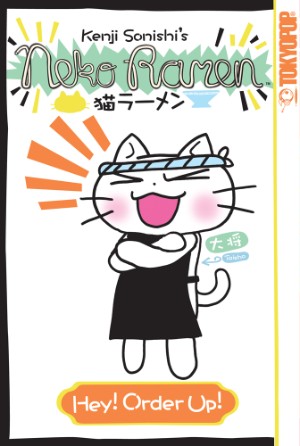
If you’ve ever lived with a cat or dog, you know that no meal is complete without a pet hair garnish. Now imagine that your beloved companion actually prepared your meals instead of watching you eat them: what sort of unimaginable horrors might you encounter beyond the stray hair? That’s the starting point for Neko Ramen, a 4-koma manga about a cat whose big dream is to run a noodle shop, but author Kenji Sonishi quickly moves past hair balls and litter box jokes to mine a richer vein of humor, poking fun at his cat cook’s delusions of entrepreneurial grandeur. Taisho is the Don Quixote of ramen vendors, dreaming up ludicrous giveaways and unappetizing dishes in an effort to promote his business, never realizing that he is the store’s real selling point. The loose, sketchy artwork gives the series an improvisational feel, while the script has the pleasant, absurdist zing of an Abbott and Costello routine. —Reviewed at The Manga Critic on 6/2/10

7. Ayako
By Osamu Tezuka; Vertical, Inc.
Combining the psychological realism of Dostoevsky with the social consciousness of Tolstoy and Zola, Osamu Tezuka uses conflicts within the once-powerful Tenge clan to dramatize the social, political, and economic upheaval caused by the American occupation of post-war Japan. No subject is off-limits for Tezuka: the Tenge commit murders, spy for the Americans, join the Communist Party, imprison a family member in an underground cell, and engage in incest. It’s one of Tezuka’s most sober and damning stories, at once tremendously powerful and seriously disturbing, with none of the cartoonish excess of Ode to Kirihito or MW. The ending is perhaps too pat and loaded with symbolism for its own good, but like Tezuka’s best work, Ayako forces the reader to confront the darkest, most corruptible corners of the human soul. As with Apollo’s Song, Black Jack, and Buddha, Vertical has done a superb job of making Tezuka accessible to Western readers with flipped artwork and a fluid translation.

6. Bunny Drop
By Yumi Unita; Yen Press
Stop me if you’ve heard this one before: a thirty-something bachelor unexpectedly becomes a parent to a cute little girl, leading to hijinks, misunderstandings, and heart-tugging moments. That’s a fair summary of what happens in Bunny Drop, but Yumi Unita wisely avoids the pitfalls of the single-dad genre — the cheap sentiment, the unfunny scenes of dad recoiling in horror at diapers, runny noses, and tears — instead focusing on the unique bond between Daikichi and Rin, the six-year-old whom he impetuously adopts after the rest of the family disavows her. (Rin is the product of a liaison between Daikichi’s grandfather and a much younger woman.) Though Daikichi struggles to find day care, buy clothes for Rin, and make sense of her standoffish behavior, he isn’t a buffoon or a straight man for Rin’s antics; Unita portrays him as a smart, sensitive person blessed with good instincts and common sense. Clean, expressive artwork and true-to-life dialogue further inoculate Bunny Drop against a terminal case of sitcom cuteness, making it one of the most thoughtful, moving, and adult manga of the year.

5. Black Blizzard
By Yoshihiro Tatsumi • Drawn & Quarterly
Written in just twenty days, this feverish pulp thriller plays like a mash-up of The Fugitive, The 39 Steps, and The Defiant Ones as two convicts — one a hardened criminal, the other a down-on-his luck musician — go on the lam during a blinding snowstorm. The heroes are more archetypes than characters, drawn in bold strokes, but the interaction between them crackles with antagonistic energy; they’re as much enemies as partners, roles that they constantly renegotiate during their escape. Evocative artwork — slashing lines, dramatic camera angles, images of speeding trains — infuses Black Blizzard with a raw, nervous energy that nicely mirrors the characters’ internal state. Only in the final, rushed pages does manga-ka Yoshihiro Tatsumi falter, tidily resolving the story through an all-too-convenient plot twist that hinges on coincidence. Still, that’s a minor criticism of a thoroughly entertaining story written during a crucial stage of Tatsumi’s artistic development. —Reviewed at The Manga Critic on 9/9/10

4. House of Five Leaves
By Natsume Ono • VIZ Media
Timid ronin Akitsu Masanosuke can’t hold a steady job, despite his formidable swordsmanship. When a businessman approaches him with work, Masanosuke readily accepts, not realizing that his new employer, Yaichi, runs a crime syndicate that specializes in kidnapping. Masanosuke’s unwitting participation in a blackmailing scheme prevents him from severing his ties to Yaichi; Masanosuke must then decide if he will join the House of Five Leaves or bide his time until he can escape. Though Toshiro Mifune and Hiroyuki Sanada have made entire careers out of playing characters like Masanosuke, Natsume Ono makes a persuasive case that you don’t need a flesh-and-blood actor to tell this kind of story with heartbreaking intensity; she can do the slow-burn on the printed page with the same skill as Masaki Kobayashi (Hara Kiri, Samurai Rebellion) and Yoji Yamada (The Twilight Samurai) did on the big screen. —Reviewed at The Manga Critic on 8/20/10

3. Twin Spica
By Kou Yaginuma • Vertical, Inc.
Asumi Kamogawa is a small girl with a big dream: to be an astronaut on Japan’s first manned space flight. Though she passes the entrance exam for Tokyo Space School, she faces several additional hurdles to realizing her goal, from her child-like stature — she’s thirteen going on eight — to a faculty member who blames her father for causing a fiery rocket crash that claimed hundreds of civilian lives. Yet for all the setbacks she’s experienced, Asumi proves resilient, a gentle girl who perseveres in difficult situations, offers friendship in lieu of judgment, and demonstrates a preternatural awareness of life’s fragility. Twin Spica follows Asumi through every stage of training, from physics lectures to zero-G simulations, showing us how she befriends her fellow cadets and gradually learns to rely on herself, rather than her imaginary friend, Mr. Lion. Though Twin Spica was serialized in a seinen magazine, it works surprisingly well for young adults, too, an all-too-rare example of a direct, heartfelt story that’s neither saccharine nor mawkish.  —Reviewed at The Manga Critic on 5/3/10

2. All My Darling Daughters
By Fumi Yoshinaga • VIZ Media
The five vignettes in All My Darling Daughters depict women negotiating difficult personal relationships: a daughter confronts her mother about mom’s new, much younger husband; a college student seduces her professor, only to dump him when he tries to court her properly; a beautiful young woman contemplates an arranged marriage. Like all of Yoshinaga’s work, the characters in All My Darling Daughters love to talk. That chattiness isn’t always an asset to Yoshinaga’s storytelling (see Gerard and Jacques), but here the dialogue is perfectly calibrated to reveal just how complex and ambivalent these relationships really are. Yoshinaga’s artwork is understated but effective, as she uses small details — how a character stands or carries her shoulders — to offer a more complete and nuanced portrait of each woman. Quite possibly my favorite work by Yoshinaga.

1. A Drunken Dream and Other Stories
By Moto Hagio • Fantagraphics
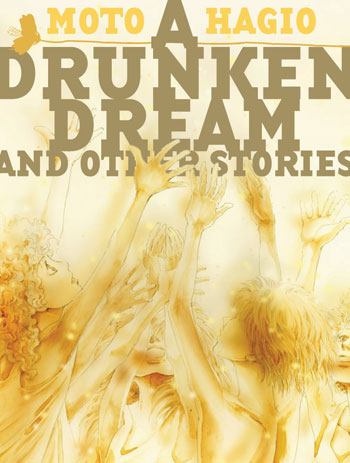
Not coincidentally, A Drunken Dream and Other Stories was my nomination for Best New Graphic Novel of 2010 as well. Here’s what I had to say about the title over at Flashlight Worthy Books:

Moto Hagio is to shojo manga what Will Eisner is to American comics, a seminal creator whose distinctive style and sensibility profoundly changed the medium. Though Hagio has been actively publishing stories since the late 1960s, very little of her work has been translated into English. A Drunken Dream, published by Fantagraphics, is an excellent corrective — a handsomely produced, meticulously edited collection of Hagio’s short stories that span her career from 1970 to 2007. Readers new to Hagio’s work will appreciate the inclusion of two contextual essays by manga scholar Matt Thorn, one an introduction to Hagio and her peers, the other an interview with Hagio. What emerges is a portrait of a gifted artist who draws inspiration from many sources: Osamu Tezuka and Shotaro Ishimonori, Ray Bradbury and Isaac Asimov, Frances Hodgson Burnett and L.M. Montgomery.

For the complete list — including nominations from David “Manga Curmudgeon” Welsh, Brigid “MangaBlog” Alverson, Lorena “i heart manga” Ruggero, and Matthew “Warren Peace Sings the Blues” Brady — click here. To read my full review of A Drunken Dream, click here.

HONORABLE MENTIONS
Done because there are too menny… great manga, that is, to confine myself to a traditional top ten list. With apologies to Thomas Hardy, here are some of the other titles that tickled my fancy in 2010:

  • Other Awesome Debuts: Not Love But Delicious Foods Make Me Happy (Yen Press), Saturn Apartments (VIZ), 7 Billion Needles (Vertical, Inc.)
  • Best Continuing Series: Itazura na Kiss (DMP), Ooku: The Inner Chambers (VIZ), Suppli (Tokyopop), 20th Century Boys (VIZ)
  • Best New All-ages Manga: Chi’s Sweet Home (Vertical, Inc.)
  • Best New Series That’s Already on Hiatus: Diamond Girl (CMX), Stolen Hearts (CMX)
  • Best New Guilty Pleasure: Demon Sacred (Tokyopop), Dragon Girl (Yen Press)
  • Best Reprint Edition: Cardcaptor Sakura (Dark Horse), Little Butterfly Omnibus (DMP)
  • Best Manga I Thought I’d Hate: Higurashi When They Cry: Beyond Midnight Arc (Yen Press)
  • Best Finale: Pluto: Tezuka x Urasawa (VIZ)

Filed Under: Manga, Manga Critic, Recommended Reading Tagged With: cmx, Dark Horse, DMP, Drawn & Quarterly, fantagraphics, fumi yoshinaga, moto hagio, Naoki Urasawa, Osamu Tezuka, SigIKKI, Tokyopop, Top Shelf, Vertical Comics, VIZ, yen press, Yoshihiro Tatsumi

The Best Manga of 2010: The Manga Critic’s Picks

December 6, 2010 by Katherine Dacey 16 Comments

For all the upheaval within the manga industry — the demise of CMX, Del Rey, and Go! Comi, the layoffs at VIZ — 2010 proved an exceptionally good year for storytelling. True, titles like Black Butler, Naruto, and Nabari no Ou dominated sales charts, but publishers made a concerted effort to woo grown-ups with vintage manga — Black Blizzard, A Drunken Dream and Other Stories — edgy sci-fi — Biomega, 7 Billion Needles — underground comix — AX: A Collection of Alternative Manga, The Box Man — and good old-fashioned drama — All My Darling Daughters, Bunny Drop. I had a hard time limiting myself to just ten titles this year, so I’ve borrowed a few categories from my former PCS cohort Erin Finnegan, from Best New Guilty Pleasure to Best Manga You Thought You’d Hate. Please feel free to add your own thoughts: what titles did I unjustly omit? What titles did I like but you didn’t? Inquiring minds want to know!

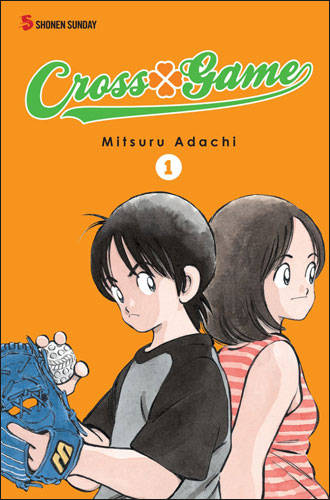
10. CROSS GAME (Mitsuri Adachi; VIZ)

In this sometimes funny, sometimes melancholy coming-of-age story, a family tragedy brings teenager Ko Kitamura closer to neighbor Aoba Tsukishima, with whom he has a fraught relationship. Though the two bicker with the antagonistic gusto of Beatrice and Benedict, their shared love of baseball helps smooth the course of their budding romance. To be sure, Cross Game can’t escape a certain amount of sports-manga cliche, but Mitsuri Adachi is more interested in showing us how the characters relate to each other than in celebrating their amazing baseball skills. (Not that he skimps on the game play; Adachi clearly knows his way around the diamond.) The result is an agreeable dramedy that has the rhythm of a good situation comedy and the emotional depth of a well-crafted YA novel, with just enough shop-talk to win over baseball enthusiasts, too.

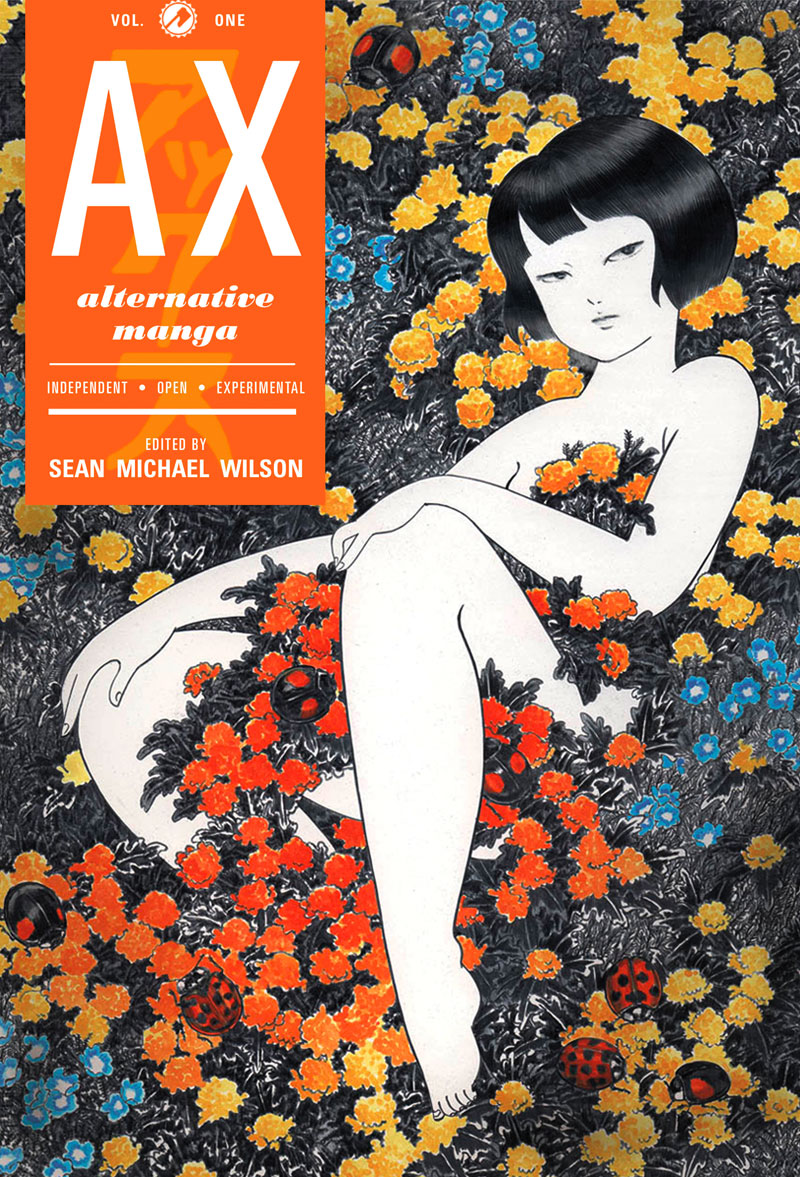
9. AX: A COLLECTION OF ALTERNATIVE MANGA (Various Artists; Top Shelf)

The next time someone dismisses manga as a “style” characterized by youthful-looking, big-eyed characters with button noses, I’m going to hand them a copy of AX, a rude, gleeful, and sometimes disturbing rebuke to the homogenized artwork and storylines found in mainstream manga publications. No one will confuse AX for Young Jump or even Big Comic Spirits; the stories in AX run the gamut from the grotesquely detailed to the playfully abstract, often flaunting their ugliness with the cheerful insistence of a ten-year-old boy waving a dead animal at squeamish classmates. Nor will anyone confuse Yoshihiro Tatsumi or Einosuke’s outlook with the humanism of Osamu Tezuka or Keiji Nakazawa; the stories in AX revel in the darker side of human nature, the part of us that’s fascinated with pain, death, sex, and bodily functions. Like all anthologies, the collection is somewhat uneven, with a few too many scatological tales for its own good, but the very best stories — “The Hare and the Tortoise,” “Push Pin Woman,” “Six Paths of Wealth,” “Puppy Love,” “Inside the Gourd” — attest to the diversity of talent contributing to this seminal manga magazine. –Reviewed at The Manga Critic on 5/21/10

8. NEKO RAMEN (Kenji Sonishi; Tokyopop)

If you’ve ever lived with a cat or dog, you know that no meal is complete without a pet hair garnish. Now imagine that your beloved companion actually prepared your meals instead of watching you eat them: what sort of unimaginable horrors might you encounter beyond the stray hair? That’s the starting point for Neko Ramen, a 4-koma manga about a cat whose big dream is to run a noodle shop, but author Kenji Sonishi quickly moves past hair balls and litter box jokes to mine a richer vein of humor, poking fun at his cat cook’s delusions of entrepreneurial grandeur. Taisho is the Don Quixote of ramen vendors, dreaming up ludicrous giveaways and unappetizing dishes in an effort to promote his business, never realizing that he is the store’s real selling point. The loose, sketchy artwork gives the series an improvisational feel, while the script has the pleasant, absurdist zing of an Abbott and Costello routine. –Reviewed at The Manga Critic on 6/2/10

7. AYAKO (Osamu Tezuka; Vertical, Inc.)

Combining the psychological realism of Dostoevsky with the social consciousness of Tolstoy and Zola, Osamu Tezuka uses conflicts within the once-powerful Tenge clan to dramatize the social, political, and economic upheaval caused by the American occupation of post-war Japan. No subject is off-limits for Tezuka: the Tenge commit murders, spy for the Americans, join the Communist Party, imprison a family member in an underground cell, and engage in incest. It’s one of Tezuka’s most sober and damning stories, at once tremendously powerful and seriously disturbing, with none of the cartoonish excess of Ode to Kirihito or MW. The ending is perhaps too pat and loaded with symbolism for its own good, but like Tezuka’s best work, Ayako forces the reader to confront the darkest, most corruptible corners of the human soul. As with Apollo’s Song, Black Jack, and Buddha, Vertical has done a superb job of making Tezuka accessible to Western readers with flipped artwork and a fluid translation.

6. BUNNY DROP (Yumi Unita; Yen Press)

Stop me if you’ve heard this one before: a thirty-something bachelor unexpectedly becomes a parent to a cute little girl, leading to hijinks, misunderstandings, and heart-tugging moments. That’s a fair summary of what happens in Bunny Drop, but Yumi Unita wisely avoids the pitfalls of the single-dad genre — the cheap sentiment, the unfunny scenes of dad recoiling in horror at diapers, runny noses, and tears — instead focusing on the unique bond between Daikichi and Rin, the six-year-old whom he impetuously adopts after the rest of the family disavows her. (Rin is the product of a liaison between Daikichi’s grandfather and a much younger woman.) Though Daikichi struggles to find day care, buy clothes for Rin, and make sense of her standoffish behavior, he isn’t a buffoon or a straight man for Rin’s antics; Unita portrays him as a smart, sensitive person blessed with good instincts and common sense. Clean, expressive artwork and true-to-life dialogue further inoculate Bunny Drop against a terminal case of sitcom cuteness, making it one of the most thoughtful, moving, and adult manga of the year.

5. BLACK BLIZZARD (Yoshihiro Tatsumi; Drawn & Quarterly)

Written in just twenty days, this feverish pulp thriller plays like a mash-up of The Fugitive, The 39 Steps, and The Defiant Ones as two convicts — one a hardened criminal, the other a down-on-his luck musician — go on the lam during a blinding snowstorm. The heroes are more archetypes than characters, drawn in bold strokes, but the interaction between them crackles with antagonistic energy; they’re as much enemies as partners, roles that they constantly renegotiate during their escape. Evocative artwork — slashing lines, dramatic camera angles, images of speeding trains — infuses Black Blizzard with a raw, nervous energy that nicely mirrors the characters’ internal state. Only in the final, rushed pages does manga-ka Yoshihiro Tatsumi falter, tidily resolving the story through an all-too-convenient plot twist that hinges on coincidence. Still, that’s a minor criticism of a thoroughly entertaining story written during a crucial stage of Tatsumi’s artistic development. –Reviewed at The Manga Critic on 9/9/10

4. HOUSE OF FIVE LEAVES (Natsume Ono; VIZ)

Timid ronin Akitsu Masanosuke can’t hold a steady job, despite his formidable swordsmanship. When a businessman approaches him with work, Masanosuke readily accepts, not realizing that his new employer, Yaichi, runs a crime syndicate that specializes in kidnapping. Masanosuke’s unwitting participation in a blackmailing scheme prevents him from severing his ties to Yaichi; Masanosuke must then decide if he will join the House of Five Leaves or bide his time until he can escape. Though Toshiro Mifune and Hiroyuki Sanada have made entire careers out of playing characters like Masanosuke, Natsume Ono makes a persuasive case that you don’t need a flesh-and-blood actor to tell this kind of story with heartbreaking intensity; she can do the slow-burn on the printed page with the same skill as Masaki Kobayashi (Hara Kiri, Samurai Rebellion) and Yoji Yamada (The Twilight Samurai) did on the big screen. –Reviewed at The Manga Critic on 8/20/10

3. TWIN SPICA (Kou Yaginuma; Vertical, Inc.)

Asumi Kamogawa is a small girl with a big dream: to be an astronaut on Japan’s first manned space flight. Though she passes the entrance exam for Tokyo Space School, she faces several additional hurdles to realizing her goal, from her child-like stature — she’s thirteen going on eight — to a faculty member who blames her father for causing a fiery rocket crash that claimed hundreds of civilian lives. Yet for all the setbacks she’s experienced, Asumi proves resilient, a gentle girl who perseveres in difficult situations, offers friendship in lieu of judgment, and demonstrates a preternatural awareness of life’s fragility. Twin Spica follows Asumi through every stage of training, from physics lectures to zero-G simulations, showing us how she befriends her fellow cadets and gradually learns to rely on herself, rather than her imaginary friend, Mr. Lion. Though Twin Spica was serialized in a seinen magazine, it works surprisingly well for young adults, too, an all-too-rare example of a direct, heartfelt story that’s neither saccharine nor mawkish.  –Reviewed at The Manga Critic on 5/3/10

2. ALL MY DARLING DAUGHTERS (Fumi Yoshinaga; VIZ)

The five vignettes in All My Darling Daughters depict women negotiating difficult personal relationships: a daughter confronts her mother about mom’s new, much younger husband; a college student seduces her professor, only to dump him when he tries to court her properly; a beautiful young woman contemplates an arranged marriage. Like all of Yoshinaga’s work, the characters in All My Darling Daughters love to talk. That chattiness isn’t always an asset to Yoshinaga’s storytelling (see Gerard and Jacques), but here the dialogue is perfectly calibrated to reveal just how complex and ambivalent these relationships really are. Yoshinaga’s artwork is understated but effective, as she uses small details — how a character stands or carries her shoulders — to offer a more complete and nuanced portrait of each woman. Quite possibly my favorite work by Yoshinaga.

1. A DRUNKEN DREAM AND OTHER STORIES (Moto Hagio; Fantagraphics)

Not coincidentally, A Drunken Dream and Other Stories was my nomination for Best New Graphic Novel of 2010 as well. Here’s what I had to say about the title over at Flashlight Worthy Books:

Moto Hagio is to shojo manga what Will Eisner is to American comics, a seminal creator whose distinctive style and sensibility profoundly changed the medium. Though Hagio has been actively publishing stories since the late 1960s, very little of her work has been translated into English. A Drunken Dream, published by Fantagraphics, is an excellent corrective — a handsomely produced, meticulously edited collection of Hagio’s short stories that span her career from 1970 to 2007. Readers new to Hagio’s work will appreciate the inclusion of two contextual essays by manga scholar Matt Thorn, one an introduction to Hagio and her peers, the other an interview with Hagio. What emerges is a portrait of a gifted artist who draws inspiration from many sources: Osamu Tezuka and Shotaro Ishimonori, Ray Bradbury and Isaac Asimov, Frances Hodgson Burnett and L.M. Montgomery.

For the complete list — including nominations from David “Manga Curmudgeon” Welsh, Brigid “MangaBlog” Alverson, Lorena “i heart manga” Ruggero, and Matthew “Warren Peace Sings the Blues” Brady — click here. To read my full review of A Drunken Dream, click here.

HONORABLE MENTIONS

Done because there are too menny… great manga, that is, to confine myself to a traditional top ten list. With apologies to Thomas Hardy, here are some of the other titles that tickled my fancy in 2010:

  • OTHER AWESOME DEBUTS: Not Love But Delicious Foods Make Me Happy (Yen Press), Saturn Apartments (VIZ), 7 Billion Needles (Vertical, Inc.)
  • BEST CONTINUING SERIES: Itazura na Kiss (DMP), Ooku: The Inner Chambers (VIZ), Suppli (Tokyopop), 20th Century Boys (VIZ)
  • BEST NEW ALL-AGES MANGA: Chi’s Sweet Home (Vertical, Inc.)
  • BEST NEW SERIES THAT’S ALREADY ON HIATUS: Diamond Girl (CMX), Stolen Hearts (CMX)
  • BEST NEW GUILTY PLEASURE: Demon Sacred (Tokyopop), Dragon Girl (Yen Press)
  • BEST REPRINT EDITION: Cardcaptor Sakura (Dark Horse), Little Butterfly Omnibus (DMP)
  • BEST MANGA I THOUGHT I’D HATE: Higurashi When They Cry: Beyond Midnight Arc (Yen Press)
  • BEST FINALE: Pluto: Tezuka x Urasawa (VIZ)

Filed Under: Manga Critic Tagged With: cmx, Dark Horse, DMP, Drawn & Quarterly, fantagraphics, fumi yoshinaga, moto hagio, Naoki Urasawa, Osamu Tezuka, SigIKKI, Tokyopop, Top Shelf, vertical, VIZ, yen press, Yoshihiro Tatsumi

Little Butterfly Omnibus

March 27, 2010 by Katherine Dacey

As a feminist, yaoi puts me in a difficult position. On the one hand, I love the idea of women creating erotica for other women, of creating a safe and fun space where female readers can explore their sexual fantasies. (I don’t know about you, but Ron Jeremy has never factored into any of mine.) On the other hand, I’m often uncomfortable by the way in which rape is conflated with extreme romantic desire in yaoi; it’s disappointing to see the “you’re so irresistible, I couldn’t help myself!” defense trotted out as a justification for sexual violation. To be sure, the rape-as-love trope abounds in romance novels and mainstream pornography as well, but as a feminist, it makes me just as uncomfortable to encounter it in yaoi as it does to encounter it in an episode of General Hospital. Then, too, there’s the issue of the characters’ homosexuality, which is sometimes trivialized (i.e., they’re not gay, they’re just so good-looking they couldn’t help themselves!), ignored, or “explained” by a character’s tragic past, as if sexual orientation were a simple, situational decision.
Still, I’d be remiss in my manga critic duties if I ignored such an important publishing category. With a little encouragement from readers, therefore, I decided to take a chance on Hinako Takanaga’s Little Butterfly (DMP), a title I’ve heard praised by folks whose interest in yaoi fell everywhere on the spectrum between Can’t Get Enough to Not My Cup of Tea. And you know what? I liked it. So much, in fact, that I would recommend Little Butterfly to just about any manga fan as a first-rate character study about two teens exploring the boundary between friendship and love.

Those teens are Kojima, a popular, cheerful student, and Nakahara, brooding loner with a troubled home life. (Dad is abusive; mom is mentally ill.) Kojima finds Nakahara intriguing and makes a concerted effort to befriend him — overtures that Nakahara ignores or rebuffs until circumstances (namely, a class field trip) throw them together. To his great surprise, Nakahara discovers that Kojima is kind and sympathetic, while Kojima discovers that Nakahara is intelligent and mature for his years, qualities that Kojima greatly admires. (In a genuinely funny and revealing scene, Nakahara names an NHK newscaster as his “favorite celebrity.”) As the teens spend time together, Nakahara develops an intense, romantic attachment to Kojima that leaves Kojima bewitched, bothered, and bewildered: is he falling for Nakahara? Is he gay? And is he ready for a sexual relationship?

What makes Little Butterfly work is Hinako Takanaga’s ability to capture the ebb and flow of close, same-sex friendships; anyone who’s ever felt a strong attachment to a high school friend will recognize the dynamic between Kojima and Nakahara as it vacillates between intense candor and intense self-consciousness. As their friendship shades into romance, Takanga shows us, through her characters’ awkward body language and behavior, how uncertain both boys are about what to do next. In one chapter, for example, Kojima frets that his lack of sexual experience will be a turn-off for Nakahara (who, in reality, isn’t much more experienced than Kojima is), nearly derailing their relationship in the process. That realism carries over to their actual encounters, which are clumsy, start-and-stop affairs, characterized by miscommunication and fumbling as each boy tries to figure out what he feels comfortable doing. These scenes feel real enough, in fact, that they aren’t sexy; anyone reading this book out of prurient interest will be sorely disappointed.

Though Takanaga handles the boys’ friendship with great sensitivity, Little Butterfly has some dramatically unpersuasive moments. In one unintentionally comic scene, for example, Kojima throws his arms around a friend to gauge his interest in other men, concluding that he only has eyes for Nakahara. (Presumably he didn’t get the memo that being gay doesn’t mean you’re attracted to every member of the same sex.) Takanaga also lays it on thick with Nakahara’s home life; not only is Nakahara’s father violent and emotionally distant, he’s also willing to use his wife and son as a bargaining chip for a loan, while Nakahara’s mother is such a perfectionist that she suffered a psychotic break after Nakahara failed to gain admission to an elite elementary school. I suppose these things happen — undoubtedly, New York Magazine has published a trend piece about Upper East Side moms afflicted with the same condition — but these touches register as melodramatic excess, as if having an abusive father and a crazy mother wasn’t quite enough to explain why Nakahara sought an emotional and physical connection with Kojima.

Still, it’s impossible not to read Little Butterfly without growing attached to the characters; their sincerity and awkwardness are genuinely endearing. I can’t say that Little Butterfly worked for me as yaoi, but I certainly enjoyed it as a coming-of-age story (no pun intended) that captured the difficulties and joys of teenage relationships in an engaging, emotionally honest manner. Recommended.

LITTLE BUTTERFLY: OMNIBUS • BY HINAKO TAKANAGA • DMP • RATING: MATURE (18+) • 560 pp.

Filed Under: Manga, Manga Critic, REVIEWS Tagged With: DMP, LGBTQ, Romance/Romantic Comedy

Little Butterfly Omnibus

March 27, 2010 by Katherine Dacey

butterfly_omnibusAs a feminist, yaoi puts me in a difficult position. On the one hand, I love the idea of women creating erotica for other women, of creating a safe and fun space where female readers can explore their sexual fantasies. (I don’t know about you, but Ron Jeremy has never factored into any of mine.) On the other hand, I’m often uncomfortable by the way in which rape is conflated with extreme romantic desire in yaoi; it’s disappointing to see the “you’re so irresistible, I couldn’t help myself!” defense trotted out as a justification for sexual violation. To be sure, the rape-as-love trope abounds in romance novels and mainstream pornography as well, but as a feminist, it makes me just as uncomfortable to encounter it in yaoi as it does to encounter it in an episode of General Hospital. Then, too, there’s the issue of the characters’ homosexuality, which is sometimes trivialized (i.e., they’re not gay, they’re just so good-looking they couldn’t help themselves!), ignored, or “explained” by a character’s tragic past, as if sexual orientation were a simple, situational decision.

Still, I’d be remiss in my manga critic duties if I ignored such an important publishing category. With a little encouragement from readers, therefore, I decided to take a chance on Hinako Takanaga’s Little Butterfly (DMP), a title I’ve heard praised by folks whose interest in yaoi fell everywhere on the spectrum between Can’t Get Enough to Not My Cup of Tea. And you know what? I liked it. So much, in fact, that I would recommend Little Butterfly to just about any manga fan as a first-rate character study about two teens exploring the boundary between friendship and love.

Those teens are Kojima, a popular, cheerful student, and Nakahara, brooding loner with a troubled home life. (Dad is abusive; mom is mentally ill.) Kojima finds Nakahara intriguing and makes a concerted effort to befriend him — overtures that Nakahara ignores or rebuffs until circumstances (namely, a class field trip) throw them together. To his great surprise, Nakahara discovers that Kojima is kind and sympathetic, while Kojima discovers that Nakahara is intelligent and mature for his years, qualities that Kojima greatly admires. (In a genuinely funny and revealing scene, Nakahara names an NHK newscaster as his “favorite celebrity.”) As the teens spend time together, Nakahara develops an intense, romantic attachment to Kojima that leaves Kojima bewitched, bothered, and bewildered: is he falling for Nakahara? Is he gay? And is he ready for a sexual relationship?

What makes Little Butterfly work is Hinako Takanaga’s ability to capture the ebb and flow of close, same-sex friendships; anyone who’s ever felt a strong attachment to a high school friend will recognize the dynamic between Kojima and Nakahara as it vacillates between intense candor and intense self-consciousness. As their friendship shades into romance, Takanga shows us, through her characters’ awkward body language and behavior, how uncertain both boys are about what to do next. In one chapter, for example, Kojima frets that his lack of sexual experience will be a turn-off for Nakahara (who, in reality, isn’t much more experienced than Kojima is), nearly derailing their relationship in the process. That realism carries over to their actual encounters, which are clumsy, start-and-stop affairs, characterized by miscommunication and fumbling as each boy tries to figure out what he feels comfortable doing. These scenes feel real enough, in fact, that they aren’t sexy; anyone reading this book out of prurient interest will be sorely disappointed.

Though Takanaga handles the boys’ friendship with great sensitivity, Little Butterfly has some dramatically unpersuasive moments. In one unintentionally comic scene, for example, Kojima throws his arms around a friend to gauge his interest in other men, concluding that he only has eyes for Nakahara. (Presumably he didn’t get the memo that being gay doesn’t mean you’re attracted to every member of the same sex.) Takanaga also lays it on thick with Nakahara’s home life; not only is Nakahara’s father violent and emotionally distant, he’s also willing to use his wife and son as a bargaining chip for a loan, while Nakahara’s mother is such a perfectionist that she suffered a psychotic break after Nakahara failed to gain admission to an elite elementary school. I suppose these things happen — undoubtedly, New York Magazine has published a trend piece about Upper East Side moms afflicted with the same condition — but these touches register as melodramatic excess, as if having an abusive father and a crazy mother wasn’t quite enough to explain why Nakahara sought an emotional and physical connection with Kojima.

Still, it’s impossible not to read Little Butterfly without growing attached to the characters; their sincerity and awkwardness are genuinely endearing. I can’t say that Little Butterfly worked for me as yaoi, but I certainly enjoyed it as a coming-of-age story (no pun intended) that captured the difficulties and joys of teenage relationships in an engaging, emotionally honest manner. Recommended.

LITTLE BUTTERFLY: OMNIBUS • BY HINAKO TAKANAGA • DMP • RATING: MATURE (18+) • 560 pp.

Filed Under: Manga Critic Tagged With: DMP, Yaoi

The Best Manga of 2009: The Manga Critic’s Picks

December 17, 2009 by Katherine Dacey

I pity the poor critic who panned Up — it’s not fun to buck the tide of critical approbation, especially when it seems like everyone else is wholeheartedly embracing the film or book in question. I say this because my best-of-2009 list is missing two titles that I’ve seen on many others: Yoshihiro Tatsumi’s A Drifting Life and Fumi Yoshinaga’s Ooku: The Inner Chambers. The first, I’ll admit, is a beautifully crafted book, proof that manga can be a great medium for biography. Yet for all its artistry, I found A Drifting Life oddly uninvolving; too many chapters read more like historical pageants than personal drama. The second title I found more problematic. Yoshinaga starts from a humdinger of a premise, inverting the social order of Tokugawa Japan by placing women in charge of everything. Yoshinaga never fulfills the promise of her idea, however, saddling her narrative with long-winded conversations that are both tin-eared and dull, two adjectives I never thought I’d be applying to Yoshinaga’s work.

So what manga *did *I like this year? Read on for the full list.

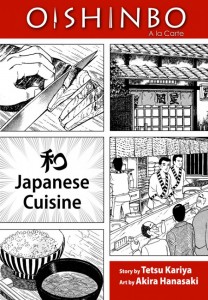
oishinbo110. Oishinbo a la Carte
Story by Tetsu Kariya • Art by Akira Hanasaki • VIZ Media
Equal parts Iron Wok Jan, Mostly Martha, and The Manga Cookbook, this educational, entertaining series explores Japanese cuisine at its most refined — sake, seabream sashimi — and its most basic — rice, pub food. The stories fall into two categories: stories celebrating the important role of food in creating community, and stories celebrating the culinary expertise of its principal characters, newspaperman Yamaoka Shiro and his curmudgeonly father Kaibara Yuzan. (Fun fact: Yuzan is such a food snob that he drove Yamaoka’s mother to an early grave, causing an irreparable break between father and son.) Though the competition between Yamaoka and Yuzan yields some elegant, mouth-watering dishes, Oishinbo is at its best when it focuses on everyday food in everyday settings, shedding light on how the Japanese prepare everything from bean sprouts to ramen. Warning: never read on an empty stomach! (Click here for my review of Oishinbo A la Carte: Japanese Cuisine; click here for my review of Oishinbo A la Carte: Vegetables.)

dmc39. Detroit Metal City
By Kiminori Wakasugi • VIZ Media
Satirizing death metal is a bit like shooting fish in a barrel: how hard can it be to parody a style associated with bands named Cannibal Corpse or Necrophagia? Poking fun at death metal while respecting the sincerity of its followers, however, is a much more difficult trick to pull off. Yet Kiminori Wakasugi does just that in Detroit Metal City, ridiculing the music — the violent lyrics, the crudely sexual theatrics — while recognizing the depth of DMC fans’ commitment to the metal lifestyle. Though the musical parodies are hilarious, the series’ funniest moments arise from classic fish-out-of-water situations: Negishi driving a tractor on his parent’s farm while dressed as alter ego Lord Krauser (complete with make-up, fright wig, and platform boots), Negishi bringing a fruit basket to a hospitalized DMC fan while dressed as Krauser… you get the idea. Rude, raunchy, and quite possibly the funniest title VIZ has licensed since Even a Monkey Can Draw Manga. (Click here for my review of volume one; click here for my review of volumes two and three.)

itazura18. Itazura Na Kiss
By Kaoru Tada • Digital Manga Publishing
In the twenty years since Itazura Na Kiss first appeared in Margaret, Kaoru Tada’s breezy romantic comedy has been widely imitated, but seldom surpassed. The story is as basic as they come: an airhead falls in love with a genius, is rebuffed by him, and is eventually pursued by him when he realizes just how sincere and kind she is. Tada manufactures a ridiculous situation to bring her characters together under the same roof — earthquake ahoy! — yet the story never devolves into brainless sitcom territory, thanks to her large supporting cast of characters, brisk comic timing, and strategic use of humor to reveal the characters’ true natures. Pure shojo bliss. (Click here for my review of volume one.)

7. Gogo Monster (VIZ Media)
By Taiyō Matsumoto • VIZ Media
Every elementary school has a kid like Yuki, a smart, odd student who says things that unsettle classmates and teachers alike. In Yuki’s case, it’s the matter-of-fact way he reports seeing monsters that leads to his social isolation. Newcomer Makoto doesn’t share Yuki’s vision, but he admires Yuki’s nonchalant attitude, and struggles mightily to understand what makes his friend tick. It’s to Taiyo Matsumoto’s credit that we’re never entirely sure what aspects of the story are intended to be real, and which ones might be unfolding in the characters’ heads; Yuki’s monsters remain largely unseen, though their presence is felt throughout the story. Matsumoto’s stark, primitive style suits the material perfectly, inoculating Gogo Monster against the sentimentality that imaginary friends and childhood fears inspire in so many authors.

nameflower26. The Name of the Flower
By Ken Saito • CMX Manga
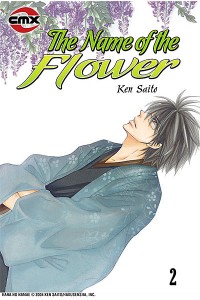
Had the Bronte sisters been born in twentieth-century Japan instead of nineteenth-century England, they might have penned something along the lines of The Name of the Flower, a tear-jerker about a young woman who falls in love with her guardian. Ken Saito employs many favorite Victorian tropes — muteness, garden imagery, orphans — in service of the plot, creating an atmosphere of palpable yearning that will be familiar to anyone who’s read Jane Eyre or Wuthering Heights. For all of its Victorian window-dressing, however, The Name of the Flower favors a slice-of-life approach over crazy-wives-in-the-attic melodrama. (Well, almost; the main love interest is a misanthropic — but hot! — novelist who favors yukatas over jeans, is prone to fits of anger, and writes dark, pessimistic fiction.) Saito’s elegant, understated art is the perfect complement to this delicate drama, making good use of floral imagery to underscore the heroine’s emotional state. For my money, the best new shojo manga of 2009.

distant_neighborhood25. A Distant Neighborhood
By Jiro Taniguchi • Fanfare/Ponent Mon
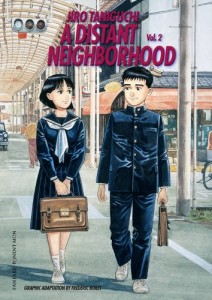
A Distant Neighborhood is a wry, wistful take on a tried-and-true premise: a salaryman is transported back in time to his high school days, and must decide whether to act on his knowledge of the past or let events unfold as they did before. We’ve seen this story many times at the multiplex — Back to the Future, Peggy Sue Got Married — but Taniguchi doesn’t play the set-up for laughs; rather, he uses Hiroshi’s predicament to underscore the challenges of family life and the awkwardness of adolescence. (Hiroshi is the same chronological age as his parents, giving him special insight into the vicissitudes of marriage, as well as the confidence to cope with teenage tribulations.) Easily one of the most emotional, most intimate stories Taniguchi’s ever told.

pluto4. Pluto: Urasawa x Tezuka
By Naoki Urasawa • VIZ Media
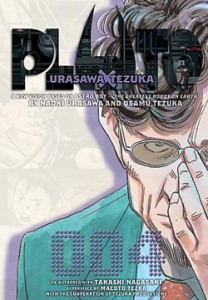
What amazes me the most about Naoki Urasawa is his ability to transform a tried-and-true genre like the whodunnit into a vehicle for exploring deeper questions about human nature, morality, and identity. As he did with the equally compelling Monster, Urasawa starts in familiar territory — in this case, a murder investigation — but quickly takes the story in unexpected directions, pausing to fill us in on the interior lives of both the principal and secondary characters — no mean feat, given that many cast members are, in fact, robots. Though Pluto takes its inspiration from “The Greatest Robot on Earth,” a short story within Osamu Tezuka’s long-running Astro Boy series, you don’t need to know anything about the original to appreciate the smart pacing, crisp artwork, or intelligent dialogue. In almost any other year, Pluto would have been my #1 pick; it’s a testament to the depth and breadth of 2009’s new releases that it isn’t.

pelu13. Little Fluffy Gigolo Pelu
By Junko Mizuno • Last Gasp
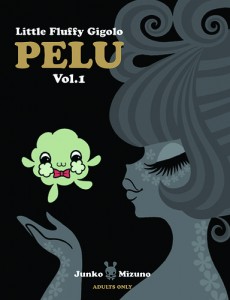
Poignant is a word I seldom use to describe Junko Mizuno’s work, given the frequency with which her characters pop pills, wield chainsaws, and whip each other. But Little Fluffy Gigolo Pelu is poignant, a perversely sweet and sad meditation on one small, sheep-like alien’s efforts to find his place in the universe. In richly detailed images — if one can use the phrase “richly detailed” to describe artwork that draws its inspiration from Hello Kitty, My Little Pony, and Faster, Pussycat! Kill! Kill! — Mizuno offers one of the most bizarre, most original variations on that chick-lit staple, the quest to find a mate before one’s biological clock runs out. It’s not entirely clear how Mizuno expects her audience to react to Little Fluffy Gigolo Pelu — as a social satire? a tragedy? a Sanrio promotion? — but the clarity and appeal of her vision is undeniable. (Click here for my review of volume one.)

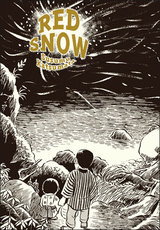
redsnow2. Red Snow
By Susumu Katsumata • Drawn & Quarterly
Through a series of ten vignettes, Red Snow depicts life in pre-industrial Japan, when men depended on the sea, the forest, and the field for their survival. Kappa and kitsune mingle freely with humans in Susumu Katsumata’s world, their presence treated as a matter of fact, rather than something extraordinary — a reflection of man’s close relationship with the natural world. Though Katsumata employs a self-consciously primitive style, the stories are neither bleak nor condescending towards their subjects; if anything, Katsumata’s drawings of farmers, woodcutters, and drunken monks have a rude vigor that reflects the resilience of his characters.

1. Children of the Sea
By Daisuke Igarashi • VIZ Media
Children of the Sea defies easy categorization; it’s a high-seas adventure, an exploration of pan-Asian mythology, a cautionary tale about the environment, and a meditation on the ocean as a life-giving force. Though Children of the Sea could easily devolve into mystical hoo-ha — two of its characters were raised by dugongs, for Pete’s sake — Igarashi embeds a coming-of-age story within the main narrative that grounds Children of the Sea in everyday experience, even as the plot takes a turn for the fantastic. (See “raised by dugongs,” above.) Igarashi’s naturalistic art captures the beauty and strangeness of the ocean settings, as well as the sheer diversity of undersea life; you won’t soon forget the site of a sea turtle leaving a starry trail in its wake or the image of a young boy hitching a ride on a humpback whale. Eerie and poetic. (Click here for my review of volume one.)

HONORABLE MENTIONS
Done because there are too menny… great manga, that is, to confine myself to a traditional top ten list. With apologies to Thomas Hardy, here are some of the other manga that tickled my fancy in 2009:

  • Best Continuing Series: Black Jack (Vertical, Inc.) and Real (VIZ Media)
  • Best Dressed Characters: The History of the West Wing (Yen Press)
  • Best Final Volume: Emma (CMX)
  • Best Guilty Pleasure: Cat Paradise (Yen Press)
  • Best Kid-Friendly Title: Dinosaur Hour (VIZ) and Leave it to PET! The Misadventures of a Recycled Super-Robot (VIZ)
  • Best License Rescue: Yotsuba&! (Yen Press)
  • Best Manhwa: Small-Minded Schoolgirls (NETCOMICS)
  • Best New Manga That’s Already on Hiatus: The Manzai Comics (Aurora)
  • Best Prose Novel Released by a Manga Publisher: The Cat in the Coffin (Vertical, Inc.)
  • Best Reprint Edition: Clover (Dark Horse)
  • Best Substitute for Television: Fire Investigator Nanase (CMX)
  • Best Translation of a Dense, Culturally-Specific Text: Sayonara, Zetsubou-Sensei: The Power of Negative Thinking (Del Rey)
  • Best Use of Wagner in a Manga: Ludwig II (DMP)
  • Best Yaoi: Future Lovers (Aurora/Deux)

Filed Under: Manga, Manga Critic, Recommended Reading Tagged With: cmx, DMP, Drawn & Quarterly, Fanfare/Ponent Mon, Jiro Taniguchi, Junko Mizuno, Last Gasp, Naoki Urasawa, VIZ

The Best Manga of 2009

December 17, 2009 by Katherine Dacey

I pity the poor critic who panned Up — it’s not fun to buck the tide of critical approbation, especially when it seems like everyone else is wholeheartedly embracing the film or book in question. I say this because my best-of-2009 list is missing two titles that I’ve seen on many others: Yoshihiro Tatsumi’s A Drifting Life and Fumi Yoshinaga’s Ooku: The Inner Chambers. The first, I’ll admit, is a beautifully crafted book, proof that manga can be a great medium for biography. Yet for all its artistry, I found A Drifting Life oddly uninvolving; too many chapters read more like historical pageants than personal drama. The second title I found more problematic. Yoshinaga starts from a humdinger of a premise, inverting the social order of Tokugawa Japan by placing women in charge of everything. Yoshinaga never fulfills the promise of her idea, however, saddling her narrative with long-winded conversations that are both tin-eared and dull, two adjectives I never thought I’d be applying to Yoshinaga’s work.

So what manga *did *I like this year? Read on for the full list.

…

Read More

Filed Under: Manga Critic Tagged With: cmx, DMP, Drawn & Quarterly, Fanfare/Ponent Mon, Jiro Taniguchi, Junko Mizuno, Last Gasp, Naoki Urasawa, VIZ

Itazura Na Kiss, Vol. 1

December 6, 2009 by Katherine Dacey

itazura1Seventeen-year-old Kotoko Aihara is a ditz, the kind of girl who gets easily flustered by math problems, blurts whatever she’s thinking, and burns every dish she attempts to make, be it a kettle of boiling water or beef bourguignon. Though Kotoko’s poor academic performance consigns her Class F — the so-called “dropout league” at her high school — she has her eye on Naoki Irie, the star of Class A. Rumored to be an off-the-chart genius — some peg his IQ at 180, others at 200 — Naoki is an outstanding student whose good looks and natural athletic ability make him an object of universal admiration. Kotoko finally screws up the courage to confess her feelings to him, only to be curtly dismissed; Naoki “doesn’t like stupid girls.” Furious, Kotoko resolves to forget Naoki.

This being a shojo manga, however, author Kaoru Tada contrives an only-in-the-pages-of-Margaret scenario to bring her reluctant lovebirds together: an earthquake. When a tremor flattens Kotoko’s house, she and her father don’t go to a shelter or a hotel. No, they take up residence at… the Iries! (Kotoko and Naoki’s fathers are lifelong friends, having attended the same high school thirty years prior.) Though Mr. and Mrs. Irie warmly embrace Kotoko, Naoki balks at her presence, forbidding her to acknowledge him at school or tell her friends where she’s staying. Making matters worse are Naoki’s younger brother Yuuki, a fiercely intelligent third grader who shares Naoki’s contempt for Kotoko, and Naoki’s mother, a cheerful busybody who tries engineering a relationship between Kotoko and her son; their intrusions into Kotoko’s life are a constant reminder of just how awkward her situation really is.

…

Read More

Filed Under: Manga Critic Tagged With: Classic, DMP, shojo

Itazura Na Kiss, Vol. 1

December 6, 2009 by Katherine Dacey

Seventeen-year-old Kotoko Aihara is a ditz, the kind of girl who gets easily flustered by math problems, blurts whatever she’s thinking, and burns every dish she attempts to make, be it a kettle of boiling water or beef bourguignon. Though Kotoko’s poor academic performance consigns her Class F — the so-called “dropout league” at her high school — she has her eye on Naoki Irie, the star of Class A. Rumored to be an off-the-chart genius — some peg his IQ at 180, others at 200 — Naoki is an outstanding student whose good looks and natural athletic ability make him an object of universal admiration. Kotoko finally screws up the courage to confess her feelings to him, only to be curtly dismissed; Naoki “doesn’t like stupid girls.” Furious, Kotoko resolves to forget Naoki.

This being a shojo manga, however, author Kaoru Tada contrives an only-in-the-pages-of-Margaret scenario to bring her reluctant lovebirds together: an earthquake. When a tremor flattens Kotoko’s house, she and her father don’t go to a shelter or a hotel. No, they take up residence at… the Iries! (Kotoko and Naoki’s fathers are lifelong friends, having attended the same high school thirty years prior.) Though Mr. and Mrs. Irie warmly embrace Kotoko, Naoki balks at her presence, forbidding her to acknowledge him at school or tell her friends where she’s staying. Making matters worse are Naoki’s younger brother Yuuki, a fiercely intelligent third grader who shares Naoki’s contempt for Kotoko, and Naoki’s mother, a cheerful busybody who tries engineering a relationship between Kotoko and her son; their intrusions into Kotoko’s life are a constant reminder of just how awkward her situation really is.

Tada’s set-up is credulity-straining — to say the least! — but she populates her story with so many fabulous supporting players it’s easy to forgive the absurd plot twists. Yuuki is my favorite character, a pint-sized terror who’s equal parts Stewie Griffin and Harriet the Spy, filling a notebook with detailed (and unflattering) descriptions of Kotoko’s daily routine. When Kotoko discovers his “observation diary,” a hilarious battle royale ensues, as she tries to persuade Yuuki that she is, in fact, smart, kind, and attractive. Kotoko’s Class F pals are another welcome source of comic relief. Though her friends are strictly one-note characters — a wiseacre, a wiseguy who carries a torch for Kotoko — they function as a kind of salty Greek chorus, alternately rooting for Kotoko and ruing her impulsive behavior.

Even Tada’s lead couple are more appealing than they initially seem. Kotoko, for example, turns out to be spunkier and smarter than one might have guessed from the opening pages, tapping into a hidden reserve of cunning when she discovers an incriminating photo of Naoki. Naoki, for his part, demonstrates a capacity for chivalrous behavior, even though he remains appalled by Kotoko’s… well, stupidity. (Spoiler alert: She doesn’t become a Nobel laureate overnight.)

Tada’s artwork is serviceable, with simple layouts and minimal attention to background detail, save for the occasional patch of screentone. Though crude, her sketchy character designs prove surprisingly effective, neatly encapsulating each cast member’s personality in just a few simple shapes and lines: Naoki’s hauteur by his sharp nose and rooster-like shock of hair, Kotoko’s naivete by her round, girlish face. The characters’ rough, unfinished look readily lends itself to the kind of facial and bodily deformations so characteristic of the shojo rom-com; I’ll take Tada’s unpolished yet soulful cartooning over the super-slick stylings of Arina Tanemura any day.

Reading Itazura Na Kiss, it’s easy to see why the series proved so influential. Tada makes opposites-attract comedy seem effortless — just throw your leads under the same roof and presto! hilarity and romance ensue. What Tada did better than many of her admirers, however, is make the comedy count for something more than just a few laughs; her characters’ pratfalls and humiliations serve as catalysts for self-reflection and growth, making it seem plausible that Naoki and Kotoko might be right for one another… some day. (I never rule out the possibility of a deus ex-mangaka bringing them together before then, however.) Highly recommended.

ITAZURA NA KISS, VOL. 1 • BY KAORU TADA • DMP • 342 pp. • RATING: TEEN (13+)

Filed Under: Manga, Manga Critic, REVIEWS Tagged With: Classic, DMP, Romance/Romantic Comedy

Picks for Right Stuf’s DMP Sale!

October 21, 2009 by MJ 5 Comments

Like many of you I’m a sucker for a sale and though I missed the recent sale on Vertical books while I was out of town (*snif*) I’ve perked up a bit over this week’s specials at rightstuf.com from Digital Manga Publishing, whose eclectic mix of titles (on sale through tomorrow, October 22nd) offers something for everyone. Taking a look at my review index, I realize I’ve actually reviewed very few of these, but my recommendations are as hearty as ever!

floweroflifeAt the top of my list are a couple of titles from the brilliant Fumi Yoshinaga, Antique Bakery and Flower of Life, both wonderfully quirky series as only Yoshinaga can produce. She has a great gift for painting her characters through dialogue that is uniquely hers and it is this that draws me most to her work. Also, she’s funny–really, really funny, yet simultaneously poignant and frequently deep. If that alone is not enough to sway you, check out Michelle Smith’s lovely review of Antique Bakery and Shaenon Garrity’s hilarious overview of Flower of Life. As Shaenon says at the end of her write-up, “Thank you, Fumi Yoshinaga, for continuing to be better than everyone!” …

Read More

Filed Under: FEATURES Tagged With: DMP, manga, right stuf

Shopping eManga

August 18, 2009 by MJ 19 Comments

ilgattosulg1It was almost two months ago, when I first started reviewing some DMP titles here, that the folks behind eManga.com asked if I’d review the website itself. Now that I’ve finally taken a good look at the place, I’m sorry it took me so long. With a few small caveats, my experience was very positive and I even discovered some new series I’d like to follow.

The general setup is similar to another pay-to-read website, NETCOMICS, with a few significant differences. While NETCOMICS charges a small fee (25 cents) per chapter for a 48-hour period (with no option to buy long-term), eManga charges by the volume–between 200 points (approximately $2) and 600 points (or less, if one takes advantage of their current sale), depending on the series. Manga released on their June imprint seems to be the cheapest, followed by 801 Media, with titles from DMP’s primary imprint coming in on top. Single volumes can be “rented” for a 72-hour period or purchased (not for download, but for unlimited online access) for an additional fee. Anything rented for a second time is automatically considered a lifetime purchase. Though the price per volume is nicely affordable, it should be mentioned that the minimum purchase is 500 points, so if you’re only interested in one low-price volume, there’s no way to buy only that.

…

Read More

Filed Under: FEATURES Tagged With: DMP, emanga, manga, yaoi/boys' love

Short Takes: Black Bird, The Girl Who Leapt Through Time, and Ludwig II

July 21, 2009 by Katherine Dacey

This week’s Short Takes column focuses on three very different comics. The first, Black Bird (VIZ), is a supernatural tale about a young girl whose flesh is as prized among demons as Kobe beef is among salarymen. The second, The Girl Who Leapt Through Time (Bandai Entertainment), is a one-volume adaptation of the 2006 film (which, in turn, is an “update” on the 1976 novel of the same name). And the third is Ludwig II (June Manga/DMP), an overripe costume drama about Wagner’s most famous sponsor, Mad King Ludwig of Bavaria.

BLACK BIRD, VOL. 1

BY KANOKO SAKURAKOJI • VIZ • 196 pp. • RATING: OLDER TEEN (16+)

blackbird1Since childhood, Misao has been cursed with an unlucky gift: the ability to see ghosts and demons. As her sixteenth birthday approaches, however, Misao’s luck begins to change. Isayama, the star of the tennis team, asks her out, and Kyo, a childhood friend, moves into the house next door, pledging to protect Misao from harm. Kyo’s promise is quickly put to the test when Isayama turns out to be a blood-thirsty demon who’s intent on killing — and eating — Misao. Just before Isayama attacks Misao, he tells her that she’s “the bride of prophecy”: drink her blood, and a demon will gain strength; eat her flesh, and he’ll enjoy eternal youth; marry her, and his whole clan will flourish. Kyo rescues Misao, revealing, in the process, that he himself is a tengu (winged demon) who’s also jonesing for her blood. Kyo then offers her a choice: marry him or die. Actually, Kyo is less tactful than that, telling Misao, “You can be eaten, or you can sleep with me and become my bride.”

…

Read More

Filed Under: Manga Critic Tagged With: bandai, DMP, shojo, VIZ, Yaoi

Swallowing the Earth

July 9, 2009 by Katherine Dacey

swallowingearthcoverNineteen sixty-eight was a critical year in Osamu Tezuka’s artistic development. Best known as the creator of Astro Boy, Jungle Emperor Leo, and Princess Knight, the public viewed Tezuka primarily as a children’s author. That assessment of Tezuka wasn’t entirely warranted; he had, in fact, made several forays into serious literature with adaptations of Manon Lescaut (1947), Faust (1950), and Crime and Punishment (1953). None of these works had made a lasting impression, however, so in 1968, as gekiga was gaining more traction with adult readers, Tezuka adopted a different tact, writing a dark, erotic story for Big Comic magazine: Swallowing the Earth.
Like MW (1976-78), which was also serialized in Big Comic, Swallowing the Earth is an overripe, overstuffed period piece that’s both entertaining and frustrating for modern readers. The basic plot is simple: seven beautiful young women seek to avenge the untimely death of their mother by wrecking havoc on the political, social, and economic systems that robbed Zephryus of her money and her home. The only thing standing in their way is Gohonmatsu, a perpetually drunken longshoreman who’s immune to their charms.

Tezuka’s presentation of the story, however, is anything but straightforward, as he employs flashbacks, subplots, and red herrings galore to sustain the reader’s interest. Some of these gambits are so ridiculous and nervy they work. Zephyrus’ daughters, for example, team up with a female scientist to produce Dermoid Z, a synthetic skin that can completely transform a person’s appearance. From a manga-ka’s standpoint, Dermoid Z is a brilliant device, as it allows him to plausibly conceal his characters’ identities from the reader and the other actors in the drama, giving him latitude to do just about anything.

Other gambits flat fall, as they rely on outdated notions of gender and race for their dramatic impact. When Dermoid Z arrives in the United States, for example, African-Americans begin buying white “skins” in vast quantities, donning them to commit crimes, enjoy privileges that had been denied them, and exact retribution on their oppressors. White retaliation is swift and brutal, plunging American cities into a race war that destroys the very fabric of society. Lacking a deep understanding of American history, or the underlying causes of the 1968 riots that erupted after Martin Luther King, Jr. was assassinated, Tezuka’s subplot feels like a crude attempt to be topical. He’s grasped the basic injustice of segregation, yet he never humanizes his black characters; they remain a violent, faceless mob throughout this unfortunate episode.

Tezuka’s treatment of women is likewise muddled. He clearly recognizes that men have treated women as property throughout human history, a point he illustrates both through Zephryus’ story (which unfolds in Nazi-occupied France) and through an interlude in the South Seas, where a tribal chief barters with Gohonmatsu for a downed airplane, offering his two daughters in exchange for the machine. Yet Tezuka’s own notions of female sexuality frequently undermine his critique of male privilege. He depicts Gohonmatsu’s South Seas brides as sexual grotesques, with bodies as roundly deformed as the Venus of Willendorf’s and libidos that verge on nymphomania. Women from the developed world don’t fare much better, as Tezuka neatly divides them into two camps: man-hating hysterics (e.g. Zephyrus’ daughters) and tormented victims (e.g. a beautiful aphasiac who lost her ability to speak after she was raped).

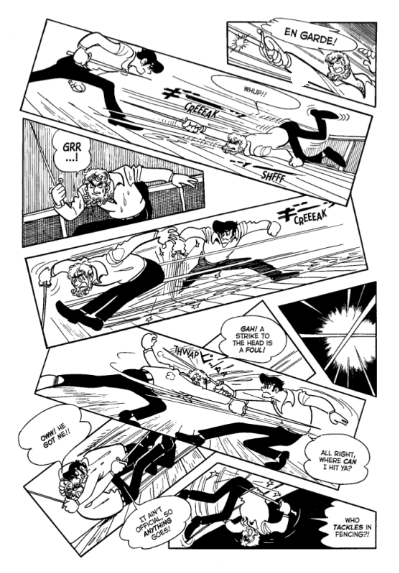
However dated Swallowing the Earth‘s racial and sexual politics may be, it’s hard to deny the sheer exuberance of Tezuka’s artwork. His imagination yields some stunning — and stunningly weird — images. Zephyrus’ palace, in particular, is a marvelous creation, an Art Deco ziggeraut filled with enormous cat statues that look like they were swiped from Cleopatra’s tomb. Tezuka frequently experiments with the layout, varying the shape of the panels to suit the pace and intensity of the action, or to suggest the simultaneity of two events. One of the best examples occurs early in the story, when Gohonmatsu duels a handsome Spanish count on the deck of a tugboat:

fightscene

Tezuka uses diagonal panels to mimic the rocking motion of a ship anchored in choppy water. The shape of the panels also demonstrate just how difficult it is for both characters to find their footing on the slippery deck — a small but tricky detail that isn’t easy to capture in a static image.

In an excellent companion essay to the English-language edition, manga scholar Frederick Schodt acknowledges Swallowing the Earth‘s myriad flaws — its surfeit of plotlines, its racial caricatures — while celebrating the almost anarchic way in which the story unfolds. He encourages readers to enjoy Earth as a “wild ride” and a window into a critical period in Tezuka’s development, showing us “how he began to make the transition from a children’s artist to someone who could push the manga medium in every genre, even for adult readers.” It’s in this spirit that I recommend Swallowing the Earth, as testament to Tezuka’s fertile imagination, and his ability to grow as an artist and a storyteller.

SWALLOWING THE EARTH • BY OSAMU TEZUKA • DMP • 516 pp. • RATING: OLDER TEEN (16+)

Filed Under: Manga Critic Tagged With: Classic, DMP, Osamu Tezuka

Swallowing the Earth

July 9, 2009 by Katherine Dacey

Nineteen sixty-eight was a critical year in Osamu Tezuka’s artistic development. Best known as the creator of Astro Boy, Jungle Emperor Leo, and Princess Knight, the public viewed Tezuka primarily as a children’s author. That assessment of Tezuka wasn’t entirely warranted; he had, in fact, made several forays into serious literature with adaptations of Manon Lescaut (1947), Faust (1950), and Crime and Punishment (1953). None of these works had made a lasting impression, however, so in 1968, as gekiga was gaining more traction with adult readers, Tezuka adopted a different tact, writing a dark, erotic story for Big Comic magazine: Swallowing the Earth.

Like MW (1976-78), which was also serialized in Big Comic, Swallowing the Earth is an overripe, overstuffed period piece that’s both entertaining and frustrating for modern readers. The basic plot is simple: seven beautiful young women seek to avenge the untimely death of their mother by wrecking havoc on the political, social, and economic systems that robbed Zephryus of her money and her home. The only thing standing in their way is Gohonmatsu, a perpetually drunken longshoreman who’s immune to their charms.

Tezuka’s presentation of the story, however, is anything but straightforward, as he employs flashbacks, subplots, and red herrings galore to sustain the reader’s interest. Some of these gambits are so ridiculous and nervy they work. Zephyrus’ daughters, for example, team up with a female scientist to produce Dermoid Z, a synthetic skin that can completely transform a person’s appearance. From a manga-ka’s standpoint, Dermoid Z is a brilliant device, as it allows him to plausibly conceal his characters’ identities from the reader and the other actors in the drama, giving him latitude to do just about anything.

Other gambits flat fall, as they rely on outdated notions of gender and race for their dramatic impact. When Dermoid Z arrives in the United States, for example, African-Americans begin buying white “skins” in vast quantities, donning them to commit crimes, enjoy privileges that had been denied them, and exact retribution on their oppressors. White retaliation is swift and brutal, plunging American cities into a race war that destroys the very fabric of society. Lacking a deep understanding of American history, or the underlying causes of the 1968 riots that erupted after Martin Luther King, Jr. was assassinated, Tezuka’s subplot feels like a crude attempt to be topical. He’s grasped the basic injustice of segregation, yet he never humanizes his black characters; they remain a violent, faceless mob throughout this unfortunate episode.

Tezuka’s treatment of women is likewise muddled. He clearly recognizes that men have treated women as property throughout human history, a point he illustrates both through Zephryus’ story (which unfolds in Nazi-occupied France) and through an interlude in the South Seas, where a tribal chief barters with Gohonmatsu for a downed airplane, offering his two daughters in exchange for the machine. Yet Tezuka’s own notions of female sexuality frequently undermine his critique of male privilege. He depicts Gohonmatsu’s South Seas brides as sexual grotesques, with bodies as roundly deformed as the Venus of Willendorf’s and libidos that verge on nymphomania. Women from the developed world don’t fare much better, as Tezuka neatly divides them into two camps: man-hating hysterics (e.g. Zephyrus’ daughters) and tormented victims (e.g. a beautiful aphasiac who lost her ability to speak after she was raped).

However dated Swallowing the Earth‘s racial and sexual politics may be, it’s hard to deny the sheer exuberance of Tezuka’s artwork. His imagination yields some stunning — and stunningly weird — images. Zephyrus’ palace, in particular, is a marvelous creation, an Art Deco ziggeraut filled with enormous cat statues that look like they were swiped from Cleopatra’s tomb. Tezuka frequently experiments with the layout, varying the shape of the panels to suit the pace and intensity of the action, or to suggest the simultaneity of two events. One of the best examples occurs early in the story, when Gohonmatsu duels a handsome Spanish count on the deck of a tugboat:

fightscene

Tezuka uses diagonal panels to mimic the rocking motion of a ship anchored in choppy water. The shape of the panels also demonstrate just how difficult it is for both characters to find their footing on the slippery deck — a small but tricky detail that isn’t easy to capture in a static image.

In an excellent companion essay to the English-language edition, manga scholar Frederick Schodt acknowledges Swallowing the Earth‘s myriad flaws — its surfeit of plotlines, its racial caricatures — while celebrating the almost anarchic way in which the story unfolds. He encourages readers to enjoy Earth as a “wild ride” and a window into a critical period in Tezuka’s development, showing us “how he began to make the transition from a children’s artist to someone who could push the manga medium in every genre, even for adult readers.” It’s in this spirit that I recommend Swallowing the Earth, as testament to Tezuka’s fertile imagination, and his ability to grow as an artist and a storyteller.

SWALLOWING THE EARTH • BY OSAMU TEZUKA • DMP • 516 pp. • RATING: OLDER TEEN (16+)

Filed Under: Manga, Manga Critic, REVIEWS Tagged With: Action/Adventure, Classic, DMP, Osamu Tezuka

  • « Go to Previous Page
  • Page 1
  • Page 2
 | Log in
Copyright © 2010 Manga Bookshelf | Powered by WordPress & the Genesis Framework