Guest Review
Higurashi: When They Cry, Vols. 4-5
By Ryukishi 07, Yutori Houjyou, and Jiro Suzuki
Published by Yen Press
Review by Megan M.
 |
 |
Buy This Book
|
Buy This Book </td </td |
A newcomer to the small hamlet town of Hinamizawa, Keiichi Maebara makes friends quickly among the students at his new school. He also learns that the town has a history of grisly murders occurring on the night of the local Cotton Drifting. What’s more, some of his new friends seem to be intimately (and tragically) involved in the town’s gruesome history.
Based on a popular murder mystery game, Higurashi: When They Cry depicts multiple versions of a single story, drawn by various artists. Volume four wraps up the “Cotton Drifting” arc and volume five begins the “Curse Killing” arc. The difference in approach between these two volumes is most easily demonstrated by discussing their art styles. Yutori Houjyou’s art in “Cotton Drifting” is a fairly standard in terms of character design, but dark, creepy, and occasionally shocking. Her characters, even the more lighthearted ones, have a depressing air of gravity to them. Jiro Suzuki’s art in “Curse Killing,” on the other hand, is in broad slapstick, featuring plenty of visual humor and moe character designs (along with the usual fanservice). I found the adjustment jarring, and volume five’s borderline-inappropriate comedy kept me from being able to care about the tragedy surrounding the characters.
One interesting note: unlike similar stories, which tend toward gratuitous display of female corpses, Higurashi doesn’t play gender favorites when it comes to victims. Though it’s true there are more female corpses than there are male, there are also far more female characters overall.
I consider it to almost be a crime to watch Clue (a brilliant black comedy from the 1980s) without watching all the endings, so I’m intrigued by a canon that centers around different possibilities in a single story. Unfortunately, this one didn’t quite work for me. Though Higruashi: When They Cry is by no means bad manga, I don’t think it’s a series for me.
Review copies provided by the publisher.


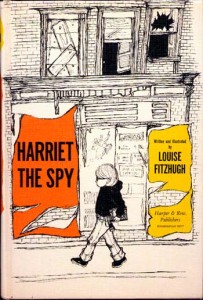 First published in 1964, Harriet the Spy featured a radically different kind of heroine than the sweet, obedient girls found in most mid-century juvenile lit; Harriet was bossy, self-centered, and confident, with a flair for self-dramatization and a foul mouth. She favored fake glasses, blue jeans, and a “spy tool” belt over angora sweaters or skirts, and she roamed the streets of Manhattan doing the kind of reckless, bold things that were supposed to be off-limits to girls: peering through skylights, hiding in alleys, concealing herself in dumbwaiters, filling her notebooks with scathing observations about classmates and neighbors. Perhaps the most original aspect of Louise Fitzhugh’s character was Harriet’s complete and utter commitment to the idea of being a writer; unlike Nancy Drew, Harriet wasn’t a goody-goody sleuth who wanted to help others, but a ruthless observer of human folly who viewed spying as necessary preparation for becoming an author.
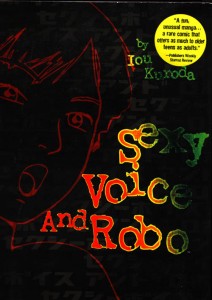 Nico Hayashi, code name “Sexy Voice,” is a bit older than Harriet — Nico is 14, Harriet is 11 — but she’s cut from the same bolt of cloth, as Sexy Voice and Robo amply demonstrates. Like Harriet, Nico entertains fanciful ambitions: “I want to be a spy when I grow up, or maybe a fortune teller,” she informs her soon-to-be-employer. “Either way, I’m in training. A pro has to hone her skills.” Nico, too, has a spy outfit — in her case, comprised of a wig and falsies — and an assortment of “spy tools” that include her cell phone and a stamp that allows her to forge her parents’ signature on notes excusing her from school. Like Harriet, Nico hungers for the kind of adventure that’s supposed to be off-limits to girls, skipping school to pursue leads, analyzing a kidnapper’s ransom call, luring bad guys into traps. Most importantly, both girls are students of adult behavior. Both Harriet the Spy and Sexy Voice and Robo include a scene in which the heroine constructs detailed character profiles from a few snippets of conversation. The similarities between these moments are striking. In Fitzhugh’s book, Harriet visits a neighborhood diner, nursing an egg cream while listening to other customers’ conversations: