• Skip to primary navigation
  • Skip to main content
  • Skip to primary sidebar
  • Home
  • About Us
    • Privacy Policy
    • Comment Policy
    • Disclosures & Disclaimers
  • Resources
    • Links, Essays & Articles
    • Fandomology!
    • CLAMP Directory
    • BlogRoll
  • Features & Columns
    • 3 Things Thursday
    • Adventures in the Key of Shoujo
    • Bit & Blips (game reviews)
    • BL BOOKRACK
    • Bookshelf Briefs
    • Bringing the Drama
    • Comic Conversion
    • Fanservice Friday
    • Going Digital
    • It Came From the Sinosphere
    • License This!
    • Magazine no Mori
    • My Week in Manga
    • OFF THE SHELF
    • Not By Manga Alone
    • PICK OF THE WEEK
    • Subtitles & Sensibility
    • Weekly Shonen Jump Recaps
  • Manga Moveable Feast
    • MMF Full Archive
    • Yun Kouga
    • CLAMP
    • Shojo Beat
    • Osamu Tezuka
    • Sailor Moon
    • Fruits Basket
    • Takehiko Inoue
    • Wild Adapter
    • One Piece
    • After School Nightmare
    • Karakuri Odette
    • Paradise Kiss
    • The Color Trilogy
    • To Terra…
    • Sexy Voice & Robo
  • Browse by Author
    • Sean Gaffney
    • Anna Neatrour
    • Michelle Smith
    • Katherine Dacey
    • MJ
    • Brigid Alverson
    • Travis Anderson
    • Phillip Anthony
    • Derek Bown
    • Jaci Dahlvang
    • Angela Eastman
    • Erica Friedman
    • Sara K.
    • Megan Purdy
    • Emily Snodgrass
    • Nancy Thistlethwaite
    • Eva Volin
    • David Welsh
  • MB Blogs
    • A Case Suitable For Treatment
    • Experiments in Manga
    • MangaBlog
    • The Manga Critic
    • Manga Report
    • Soliloquy in Blue
    • Manga Curmudgeon (archive)

Manga Bookshelf

Discussion, Resources, Roundtables, & Reviews

Reviews

Codename: Sailor V, Vol. 1

September 12, 2011 by Michelle Smith

By Naoko Takeuchi | Published by Kodansha Comics | Squee

There are few things in this world that can literally make me do “the dance of squee,” but the arrival of the first volumes of Codename: Sailor V and Pretty Guardian Sailor Moon at my house definitely did the trick. My husband can bear witness.

I’ve read Codename: Sailor V before (back in 2003), but that was with the Japanese edition in hand and a text translation on the computer screen, doing my best with my limited Japanese skills to put words and images together. But now it’s out in English, and translated by the venerable William Flanagan, to boot! I feel like I got a lot more out of this time, but whether that’s due to increased comprehension or a change in personal perspective, I can’t really say.

First, a bit of publication history. After completing her first series, The Cherry Project, Naoko Takeuchi and her editor decided that her next series would feature a magical girl in a sailor suit who fights for love and justice. The result was Codename: Sailor V, which premiered in the magazine Run-Run in July 1991. An anime was soon planned, but instead of starring only Sailor V, it would feature a five-person team, with the focus on a new character named Sailor Moon.

The Pretty Guardian Sailor Moon manga debuted in 1992, with the anime premiering shortly thereafter. Chapters of Codename: Sailor V continued to be released periodically, and actually wrapped up a couple of months after the Sailor Moon series. In this way, it functions both as a prequel and as a companion series to the more famous work.

Now to the story itself! Minako Aino is thirteen years old and in her first year of middle school. She’s got some… quirks—she is described at one point as a “binge-eating, nap-taking, below-average student” who “likes standing out in a crowd”—but also thinks fast on her feet and has acute physical reflexes. After observing her for a while, a mysterious white cat introduces himself as Artemis and tells her she has been chosen by the planet Venus. “You were born to fight to protect the world of incandescent heat. And you have a mission. A duty that no one but you can fulfill.” This whole sequence reminds me a lot of a young Buffy, similar in temperament and ability, hearing similar words from her first Watcher.

Minako promptly faints, and when she wakes she thinks the conversation was just a dream. When she spots her crush brainwashing a girl into becoming his slave, however, the “boss” speaks to her through a magical pen (really) and tells her that he is her enemy and that she must defeat him and save everyone. (She’s also got a crescent-shaped compact that can be used as a weapon and for creating disguises.) Her first transformation into Sailor V is accompanied by the following narration:

I feel liberated! I’m overflowing with power!! I’m struck with the urge to act!

And there, in a nutshell, is why this magical girl franchise appeals to feminists like me. It’s not about a girl in a sailor suit looking cute to attract boys or being validated by them. It’s about a girl choosing to become strong herself, to achieve her full potential, and to contribute to the welfare of the planet by actively engaging “the enemy.” If you’re tired of passive heroines—got those Black Bird blues?—then you really do need to read these books.

Further adventures pit Sailor V against a series of idols represented by the Dark Agency, whose modus operandi is to stage concerts and suck out the energy of their fans, who then become their slaves. The Agency president is a woman named Fluorite and she reports to an unseen guy named Danburite, and so far they seem content to try to take over the world by repeating the same tactics over and over, though they do eventually change things up a little near the end. These episodic stories do dull the impact of Sailor V’s mission slightly, but her introductions to her foes are always fun. Here’s my favorite:

Using idols to brainwash both men and women, young and old… Now that’s just greedy! Those are horrendous business practices and the Japanese Tax Office will not stand for it!

I am sometimes a GI Fighting Girl, and sometimes a Debuting Idol Beauty… But my true form is…—Moon Power: Transform!—Codename: Sailor V!! Champion of Justice!! The Pretty Guardian in a Sailor Suit! Sailor Venus… has arrived!

Takeuchi’s art is lovely, if somewhat busy. (Sometimes I wonder if she has a phobia of white space, because a lot of screentone is used to fill those areas. My favorite is the one that inexplicably mixes stamps and penguins.) I’m particularly fond of the chapter title pages, because Sailor V looks especially cool and mature in those. The English translation reads well, too, so it’s really too bad that the rest of the text has so many minor errors. For the most part, these consist of misattributed dialogue or sound effects being placed in the wrong spot. Though annoying, they don’t hamper one’s enjoyment much. The reference to Science Ninja Team Gotchaman (sic) in the end notes did elicit a cry of dismay from me, though.

So, yes. It is truly wonderful to have Codename: Sailor V available in English. Perhaps it won’t appeal to everyone as much as it does to me, but it’s got more depth that one might expect, and is definitely worth checking out.

Codename: Sailor V is published in English by Kodansha Comics. They’ve licensed the tenth anniversary edition, which condensed the original three volumes into two.

Review copy provided by the publisher.

Filed Under: REVIEWS Tagged With: Kodansha Comics, Naoko Takeuchi

Butterflies, Flowers, Vol. 8

September 12, 2011 by Sean Gaffney

By Yuki Yoshihara. Released in Japan as “Chou Yo Hana Yo” by Shogakukan, serialized in the magazine Petit Comic. Released in North America by Viz.

It’s the final volume of this josei series being marketed here as mature shoujo, and there’s still a lot up in the air. Can Masayuki fulfill his dream of regaining the land Choko’s family lost? Can Choko get him to think of her as a woman rather than as a ‘Milady’ he must be subservient to? And can he ever stop being incredibly crass at the most inappropriate moments?

The answer to the last of those questions is thankfully no. Masayuki is as over the top as ever, and the ending to the first chapter, with his telling Choko’s intended about her ‘security blanket’, is one of the better ones. Choko’s reaction is picture perfect as well – she loves this man, but god, he can be such a terrible horndog and seems to think of absolutely nothing except his penis. On the downside, there wasn’t quite as much Gundam in this volume, Combattler getting the obligatory otaku reference this time around.

The middle of the book is comparatively serious, featuring some flashbacks to a surprisingly selfish Choko, and a crisis involving the land that Masayuki has been trying to earn back for so long being sold to an American developer. This actually leads to some conflict, as Choko knows that his desire to get back her land is the ‘servant’ part of him, and she doesn’t care about it if she can have him treat her as an equal. Unfortunately, much like the omiai suitor we saw at the start, the developer has sordid plans for the land, and Choko has to bring out her ‘Milady’ persona in order to get past the crisis… which makes him a more devoted servant than ever.

I will grant the series this, it is aware of its basic conflict, which is the fact that Masayuki will not let Choko get down off of that goddamn pedestal. The proposal in the second to last chapter seems almost too good to be true… and it is, as it’s Masayuki reacting on instinct rather than thinking things through. Sadly, when he uses his brain he realizes that he can’t go through with it, and even Choko proposing herself (an awesome moment) can’t turn him around.

Which is good, as it lets us have a final chapter of slapstick comedy, with some of the best violence and faces in the series. Choko is determined to get him to stamp a marriage license, and he is equally determined to avoid it. The shot of Masayuki leaping 20 feet into the air vertically, and then Choko throwing a huge steel desk at him (it’s helpfully footnoted ‘steel’ in case we were unaware) is priceless. But it’s not humor that gets us resolution – Choko finally gives up, and seems prepared to move on, as she notes that if he can’t do this for her then they can’t be a couple. And she’s right. And so (barring the ending gag, which is clearly a gag) he does, managing to call her Choko at last, and the final page is a wedding.

And so the series ends as it began, with a bunch of sweet moments interspersed with some of the most horrible sexism imaginable. If the series had taken this more seriously it would have been repulsive. But, like Ai Ore but even more so, there’s an undercurrent of humor that makes it more palatable to me. So much of Masayuki’s attitude is not designed to make you uncomfortable – it’s there to make your jaw drop. Exaggerated to grotesque proportions, it loses a lot of its bite. And in this final volume, Choko’s vacillating and tendency to be a damsel in distress is almost entirely absent, allowing her to finally be a strong heroine equal to her partner. This was an experiment for Viz, and I’m not entirely sure it sold well enough that we’ll see more Petit Comic stuff in the future. But I’d like to see more. Despite some reservations, recommended.

Filed Under: REVIEWS

Arata: The Legend, Vols. 1-6

September 11, 2011 by Michelle Smith

By Yuu Watase | Published by VIZ Media

As a fan of Yuu Watase’s shoujo classic, Fushigi Yûgi, I expected that I would like Arata: The Legend, her first shounen series. Turns out, I had underestimated my enjoyment: I really like it!

The story begins in a world known as Amawakuni, where the child-like princess is preparing to yield the thrown to her successor after reigning for 60 years. There are no suitable females in the royal (Hime) clan to take her place, however, and so a fifteen-year-old boy named Arata is coerced into passing himself off as a girl until another suitable candidate can be found. During the ceremony, the twelve retainers of the princess—known as the shinsho, because they are masters of powerful sword-gods known as hayagami—revolt and the princess is cut down before Arata’s eyes. The shinsho pin the deed on him and his flight to evade capture takes him to the mysterious Kando Forest, where he is swallowed up and exchanged with his counterpart from another world: Arata Hinohara.

Hinohara has been having a tough time lately. In middle school, he was bullied so much that he eventually stopped going altogether. Now it’s his first year of high school, and at first everything seems to be going okay. He purposefully chose a school far away, where no one would know his old self, and is able to make friends quickly, thanks to his quick actions in capturing a train groper. After a month, however, his former nemesis Kadowaki arrives and the torment starts anew, capped off by the betrayal of Arata’s closest new friend, Suguru.

When he arrives in Amawakuni—and is taken for Arata by everyone he meets—Hinohara is thrust into Arata’s role as a wanted criminal. When his touch awakens a slumbering family artifact—what turns out to be a legendary hayagami known as Tsukuyo—he is suddenly recognized as a sho, which means he’s part of the battle for the the throne. The shinsho overthrew the princess because they were tired of the control she exerted over their powers, but now they must battle and dominate each other until one stands supreme. Like it or not, as a sho, Arata is swept up in the conflict and has two choices: submit himself (this essentially means death) or force others to submit. (Meanwhile, Arata contends with life in modern Japan, including going to school and eventually beating up Kadowaki.)

I really love how Watase fleshes out Hinohara’s complex character here, because everything he does makes sense based on what he’s been through. When he first arrives, he refuses to trust anyone, but when Arata’s childhood friend, Kotoha, makes good on her promises to stick by him no matter what, it has a profound effect on him. Too, the prospect of forcing others to submit reminds him too much of the domination he suffered.

Because of his experiences—and because of the unique property that allows Tsukuyo to safeguard the souls of other sho without actually causing their death—he is gradually able to win over a few sho by sympathizing with their own suffering, whether it be betrayal, isolation, or loneliness. In a conversation with the princess—courtesy of the special necklace that also occasionally allows him to converse with Arata—he promises to unite the hayagami under Tsukuyo and return to her before she dies completely. He’s got a long road ahead, and it’s one that can only be won by changing the hearts of others.

It is this mission of Hinohara’s—not unlike those usually assigned to magical girls—that makes me want to apply the demographic label “jounen” to this series. It’s definitely shounen in scope and feel, but it’s also attuned to its shoujo side. The slowly developing romance between Hinohara and Kotoha is very well done, for example, with Hinohara cognizant of Kotoha’s love for the real Arata and Kotoha confused because “Arata” is responding to her in a way he never did before. I also like that Kadowaki eventually arrives in Amawakuni because a) that is so very Yuu Watase, for two outsiders to come into a fantasy world and immediately assume powerful destinies and b) the ultimate test of Hinohara’s newfound bravery and purpose is for him to be able to sustain it in the face of Kadowaki’s unrelenting hostility.

The pacing of the series is also outstanding. There’s just enough foreshadowing of significant things—the gravestone that connects one of the shinsho, Kannagi, with his reasons for rebelling against the princess—to make the eventual reveal more significant, but one never has to wait too long for the answer to a question. Similarly, Hinohara frequently actually comes out and says what he’s thinking, so misunderstandings are not allowed to perpetuate for long. In fact, revealing the truth behind things—like when Hinohara finally convinces Kotoha that he is not her beloved Arata—gives the story more places to go rather than reducing all dramatic options.

My one complaint about the series is largely rectified by Kadowaki’s entrance into Amawakuni, and that’s that Arata is given very little to do. At first, there’s only a chapter or two from his point of view every once in a while, but once he meets an intriguing girl named Oribe—who can tell he’s an entirely different person than Hinohara—things begin looking up, especially when one of the shinsho is transplanted to Japan in Kadowaki’s place. Suddenly, Arata is in genuine peril, which is bad for him but good for the story!

In the end, while there’s a lot going on in Arata, it never feels like too much, always makes sense, and yet always leaves one wondering what is going to happen next. Not only am I genuinely excited about continuing the series, it has also rekindled my determination to read Fushigi Yûgi: Genbu Kaiden, of which I have heard good things.

Arata: The Legend is still in serialization in Japan; the twelfth collected volume was released there in August 2011.

Review copies for volumes one, two, four, and five provided by the publisher.

Filed Under: REVIEWS Tagged With: shonen sunday, VIZ, Yuu Watase

The Goon Show Compendium, Vol. 6

September 10, 2011 by Sean Gaffney

As readers of this blog know, I don’t always talk about manga. Sometimes I’m discussing other comics, sometimes I’m droning on for hours about Frank Zappa, and sometimes I’m going into great detail about which previously censored Looney Tunes blackface gags are now uncut on the new DVDs. And then there’s British Comedy, which I have had a great love for for years. I started with Python, and of course devoured all the interviews with the cast, where they discussed the influence of Spike Milligan. I then watched The Goodies, where the cast ALSO discussed Spike’s influence. And heck, even the Beatles have a song (You Know My Name, Look Up The Number) directly influenced by the Goons. I had to find out more.

And I did. The Goon Show scripts book was in my local library. That was it for a while, as importing from the UK was not as easy in those days. But then the BBC started releasing cassettes and CDs of old Goon Shows, and I quickly grew even more obsessed. Then a few years back, the BBC decided to do things properly. No more CDs of 4 randomly selected shows plonked down for a few bob. Now we got all the shows from Series 5 onwards (the earliest series that completely survives) in giant CD box sets, restored from the best materials by Ted Kendall, with previously censored jokes put back in, all with copious liner notes and annotations by Radio and TV scholar Andrew Pixley. This is the 6th such box, containing the 2nd half of series 7 (which ran in 1957).

The Goon Show was a radio comedy on the BBC from 1951 to 1960. The scripts were primarily by Spike Milligan, but he usually had helpers at various points in the series, either for reasons of time or for reasons of mental stability (Spike was bipolar, a diagnosis unknown to everyone, including him, until the 1970s). The shows in this box are co-written by Larry Stephens, a friend of Spike’s and another BBC radio scriptwriter.

The cast was Spike Milligan (known to North Americans for his Muppet Show appearance, where he debated Sam the Eagle and sang It’s a Small World), Harry Secombe (known to North Americans as Mr. Bumble in the movie Oliver!, and for the song If I Ruled The World, which he debuted), and Peter Sellers (known to North Americans). Each week Spike and Peter would take on a variety of roles, all of which would revolve around Secombe’s well-meaning but dim oaf Neddie Seagoon, who Harry always described as “myself, only more so”. Generally speaking, there was no continuity except the characters; the plot resets every week and starts on another venue.

The plots varied, but tended to rely on a fixed form. Neddie was the main character, and would be approached by unscrupulous con-men Hercules Grytpype-Thynne (Sellers) and Jim Moriarty (Milligan) to do something incredibly stupid and/or impossible for money. Neddie would start on the task, usually with the help of fellow idiots Bluebottle (Sellers), a crack-voiced Boy Scout, and Eccles (Milligan), a cheerfully idiotic simpleton (Spike based Eccles’ voice partially off Goofy from the Disney cartoons, which many Americans will note immediately). He’ll also run into Major Dennis Bloodnok (Sellers), a retired Army officer and filthy lying coward. I’m not being mean – Bloodnok admits it himself. Events would spiral out of control, and usually the show ended with one or more (or all) of the cast dead – only to be resurrected the following week.

This set is a particularly good time for the series. The cast know their roles well, and the shows have a deft combination of surrealist humor, old vaudeville gags, and a wafer-thin plot to hang it all on. The set contains a few of the best known Goon Shows, including The Mysterious Punch-Up-The-Conker, which has the skit ‘What time is it, Eccles?’, a legendary classic showing off the way Eccles’ brain worked. It’s particularly fun as Spike enjoyed savagely mocking the brain power of these characters, but also felt a great affection for them – Harry and Peter both noted Spike was closest to Eccles in real life, not for the idiocy but for the skewed view of absolutely everything that is displayed.

Other episodes of note on the set include Shifting Sands, set in India around 1900 (as many Goon Shows were – Spike grew up there, and was fascinated with the ragged edges of the British Empire holding on despite everything) with special guest star Jack Train from an even earlier BBC radio comedy, It’s That Man Again; Ill Met By Goonlight, a World War II parody involving the capture of a suspected German spy (and one of the best-times awful puns in the entire series); and The Histories of Pliny the Elder, a Roman parody. There’s a few duffers in here, inevitable when you’re trying to write a half-hour of comedy every week. Emperor of the Universe is a parody of Bulldog Drummond that doesn’t quite savagely attack its subject enough to really work. The set also contains The Reason Why, a one-off comedy written without an audience about the moving of Cleopatra’s Needle to Britain. It’s a very odd duck, with Seagoon playing a different character that nevertheless has Neddie written all over him, and Bloodnok popping in as well. Goon Show once removed, shall we say.

The set comes, as I noted, with a long series of production notes detailing what was going on behind the scenes as these shows were being aired. They’re a nice look at what show-business Britain was like in the 50s – Harry and Peter were constantly off doing other shows and performances, and the BBC at one point told off Peter’s agent for booking him so much that he was unable to do the Goons easily. There is also a short guide to some of the more obscure jokes – Britain in the late 50s is a while ago, and not many would recall who Hughie Green or Field Marshal Alan Brooke are these days.

A word of warning to those who buy the set – there are some jokes that were made in 1950s British radio that would not be made today, particularly as regards racial stereotypes. The show had musical interludes, and the singer of the 2nd interlude, Ray Ellington, was frequently employed in the show to play African tribesman, servants, etc. – usually with a Rochester-type voice (Ray’s own voice, smooth and BBC English-sounding, was also heard in his songs.) There’s also several Chinese stereotypes in Emperor of the Universe, which, being a Bulldog Drummond parody, is all about the fiendish Chinese and how they are destroying our lovely Britain. Spike was quite progressive in many ways, but his jokes are a product of their time, and it’s best we view them the same way we view Bugs Bunny doing Al Jolson impressions in blackface to sell war bonds – as a slice of history.

The Goon Show has dated somewhat, especially as so much of modern British comedy is influenced by it. Some people may listen to the shows and wonder why they rely so much on old, hoary gags (you should have heard the other comedies on the radio at the time!). But even they will then listen in disbelief at the sheer surrealistic nonsense that then pours out the speaker. Spike could take gibberish and work magic with it, so that the cast could hold each other hostage with boa constrictors, bribe each other with receipts of a photo of a five-pound note, or have the time written down for them on a piece of paper. I could listen to these shows over and over again and still get new things out of them. Priceless.

Filed Under: REVIEWS

Drifters, Vol. 1

September 8, 2011 by Sean Gaffney

By Kohta Hirano. Released in Japan by Shonen Gahosha, serialization ongoing in the magazine Young King OURS. Released in North America by Dark Horse.

Drifters is the newest title from the author of Hellsing and is spanking brand new – even Japan doesn’t quite have Volume 2 yet. That said, it does *not* have vampires. Which means it loses a lot of North America’s strong “I will buy anything with vampires in it” market. Can it get past this obvious handicap and manage to find its own voice?

Yes indeed it can, even though that voice most of the time is a big guy with a sword going “FUCK YEAH!!” Drifters is not particularly a manga for those who want subtle, intricate displays of emotion or great attention to historical detail. It takes famous soldiers from all over earth’s history and plants them in a fantasy world with elves, then watches them simply roll up and start to do battle. And the battle is the main draw of the manga. If you’ve seen Hellsing, you know how much Hirano loves to draw melee combat. This is all about that.

There is, of course, a bit of a plot. Our hero is Shimazu Toyohisa, who is real life was believed to have died in the Battle of Sekigahara in 1600. In this manga, he wanders off the battlefield, wounded, and ends up in a modern-looking hallway, where a mysterious man signs his name onto a sheet and teleports him through a gate to another world, where he’s found by some very Lodoss Wars-looking teens. He’s apparently not the first stranger to be found in these parts, so they dutifully take him off to a ruined castle, where he meets Oda Nobunaga, the Sengoku warlord, and Nasu Yoichi, a famous samurai from 400 years earlier.

They have apparently been brought there to try to stop a great evil from destroying the land (which appears to be controlled by a woman with the amusing name of Easy, who confronts Hallway Guy in a brief scene). What’s more, it would appear they will be joining up with Hannibal and Scipio, both seen here at a different castle that is being laid siege to, as well as Butch Cassidy and the Sundance Kid. Opposing them? Oh, just Hijitaka Toshizo, Joan of Arc, and Anastasia Romanov, all of whom are on the side of the bad guys, and also seem to have supernatural powers.

As you can see, this reads like a fanfiction written by a 12-year-old boy. Luckily, Hirano is mature and has a number of manga series under his best, so the execution is far more interesting. Provided you just turn off your brain and roll with events, this is a hell of a lot of fun. Shimazu makes a good “Who wants strategy, just point me at the enemy!” type hero, and the Black King, although seemingly a straight rip from Lord of the Rings, is a satisfyingly scary villain. And there’s sword fights, and battles, and people saying “Who can possibly save us now?” It is essentially Hirano having a ball every week, drawing whatever the hell he wants. And oddly, it works.

Admittedly, it has anime-style elves, who I normally avoid like the plague. But if you can get past the fantasy setting, what we have here is a bunch of historical soldiers fighting each other wile laughing and making trash talk. It almost reads like something Marvel or DC would put out. Definitely recommended to anyone who likes this sort of thing.

Filed Under: REVIEWS

Book Girl and the Captive Fool

September 6, 2011 by Sean Gaffney

By Mizuki Nomura. Released in Japan by Enterbrain. Released in North America by Yen Press.

By now I’ve grown somewhat used to how a Book Girl novel will feel. It will be based around a book of some sort (in this case, Saneatsu Mushanokoji’s 1919 novel Friendship) and the mystery plot will parallel the book in some way. It will flesh out the backstory of one of the minor characters we’ve met in the previous books. There will be dark, emotional themes that will connect with Konoha’s own thoughts and emotions. And in the end, Konoha will have grown a little bit more and moved on a bit from the girl in his past he can’t let go of.

But in general, the plot and mystery is not why anyone reads Book Girl. There were a few mystery aspects in this book, but I guessed at the most important one straight away, so they didn’t matter as much. However, it’s the characterization, style and prose that keep you coming back here, and in that respect Captive Fool is a worthy successor to the first two books.

This volume focuses on Konoha’s stoic and calm friend Akutagawa, and the discovery that much of his personality is a mask he puts on to conceal his past tragedies – both from others and from himself. Of course, this sounds a lot like what Konoha is doing now, and the irony is not lost on him. What’s more, the girl who was the focus of the first novel, Takeda, shows Konoha that being ‘cured’ of crushing emotional despair is not something that can happen over the course of a few weeks.

Much of the impetus of this book revolves around being unable to move on from a past tragedy, to the point where self-doubt and pressure make it impossible for you to do anything. Again, these novels are written for 15-17 year old readers, and I think these emotions would resonate well with them. How do you talk with someone after “ruining their life”? What if you make the exact same mistakes? What if one kind action turns out to be absolutely the wrong thing to do?

The author also manages to convey this to Konoha, the one who really needs to hear these words, in a way that doesn’t sound like everyone is acting as his therapist. The book Friendship mentioned above is being performed by the Book Club (and their assorted hangers-on) as a play, and so we see similar doubts and feelings play themselves out on three levels – elementary school (Akutagawa’s past), high school (Konoha’s present), and adulthood (the events of the novel/play). Growing up doesn’t always solve the problem.

Then there’s the ending to the book. I had discussed this with another reader, and it was felt that the revelation (which was a bit of a surprise, but not the complete shocker it was meant to be) was somewhat underwhelming, especially given that we’re only 3 volumes into what promises to be an 8-book “main story”. It seems a bit early for this particular plot gun to be fired off, in my opinion. But if nothing else, t shows us that when you are somebody’s mirror, you take on the same qualities as the person you are mirroring. Even if it’s unintentional.

Again, what I love most about this series is how much it makes me think about human nature. We see the growth of the characters, and even though it’s through artificial “what’s the mysterious tragic past of the novel?” means, that doesn’t make it less valid. And yeah, given the arc, I suspect the next book will focus on whatever demons Kotobuki has. But the writing and characters really make me want to find out what happens next. A great page turner, highly recommended.

Filed Under: REVIEWS

Bookshelf Briefs pointer

September 6, 2011 by Sean Gaffney

For those who read my reviews by category (like me), I have reviews of Deltora Quest 1, The Melancholy of Haruhi Suzumiya 9 and The Story of Saiunkoku 4 in this week’s Bookshelf Briefs.

I also review the first volume of Soredemo Machi wa Mawatteiru in this month’s Going Digital.

Filed Under: REVIEWS

Cardcaptor Sakura Omnibus, Vol. 2

September 2, 2011 by Sean Gaffney

By CLAMP. Released in Japan by Kodansha, serialized in the magazine Nakayoshi. Released in North America by Dark Horse.

The second omnibus of Cardcaptor Sakura gives us Vol. 4-6 of the original series, which was effectively the end of ‘Season One’ of the manga. As such, Sakura continues to find and capture Clow Cards one by one, gaining strength and confidence, until the climax where she is forced against the most powerful card – and a powerful enemy. Or is he?

I always have to remember to downshift my brain a bit when I read the early 90s shoujo stylings of Cardcaptor Sakura. In a modern, 21st century world where most manga, shonen and shoujo, are targeted to the largest possible market, it’s refreshing to see something that is clearly meant to primarily entertain 6 to 8-year-old girls. That said, the downside to this – although perhaps not a downside so much as simply a different way of seeing things – is that there really doesn’t seem to be much happening for the first two thirds of this book.

There’s certainly lots of entertaining things going on. Kaho Mizuki, the new teacher of Sakura’s that showed up at the end of the last book, continues to hang around, trying to guide Sakura by means of subtle hints and gentle boosts to her confidence. The relationship between Sakura’s brother Toya and his friend Yukito is subtle (well, really, everything about Toya is subtle – he’s not a man of many words or emotions), but also nice to see defined as much as it’s going to be in this sort of manga. And the chapter where Sakura and Syaoran have to put on a play is the funnest of the lot, with some classic gender reversal going on, and Yamazaki at his funniest.

That said, it does seem to meander a bit, so I was quite happy when things started to heat up towards the end. CLAMP have a lot of plot gun surprises going on, most of which they did a good job of building up to or giving hints for, and they pop out one by one – Cerebus’ true form, the final Clow Card, the Card’s other guardian, and finally Sakura, having proven that she can capture the cards, has to be judged worthy of being the cards’ leader. Of course, the outcome is not really in doubt – Sakura has spent the previous five books being awesome, after all, it’s not going to reject her right at the end – but the way that the cards end up judging her, rather than Yue, the aforementioned guardian, is excellent. As for Yue’s identity, it gives him a certain gravitas that I don’t think he’d have had as ‘just a random, last-minute character’, and adds some depth to his alter ego as well.

I missed Tomoyo, who was all over the first volume of these but appeared far less in this one. Syaoran is clearly the co-star of the series with Sakura now, and though we have not yet approached the romance stage – Sakura’s still far too young and naive – it’ clear that’s where we’re headed. I also note that people who like shaded characters and some flaws in their heroes are going to have issues with this manga – Sakura may worry and lack confidence at times, but she’s also a kickass magical girl good at sports and beloved by all her friends. As for Kaho, I like her, but I wish she was less nice and sweet. Everyone’s kind and considerate and seems to have all their ducks in a row, so to speak.

So it’s not exactly great angsty drama, but the second CCS omnibus is fun, fluffy magical girl shoujo that is perfect for a young girl wanting to read some manga. And Dark Horse’s presentation matches the first volume – crisp, sharp images, nice thick paper, oversize, and with lots of color pages. Also, despite being CLAMP, fear not – this series has an ending. Though not quite yet. Volume 3 will arrive soon, and bring with it one of the most controversial characters in the series, Eriol.

In the meantime, we have this book. Guaranteed to make you feel all floaty.

Filed Under: REVIEWS

Buffy the Vampire Slayer Season Eight, Vol. 7

August 31, 2011 by Michelle Smith

By Brad Meltzer, et al. | Published by Dark Horse

When I write a review, I do my best to articulate what I liked and didn’t like as clearly as possible. When one is a passionate fan of something, however—as I undoubtedly and unabashedly am of Buffy the Vampire Slayer—such clarity becomes more difficult to achieve. I will do my best to explain my aversion to the “Twilight” arc contained in this volume, but what it really boils down to is that I just don’t like it.

Spoilers abound. Beware.

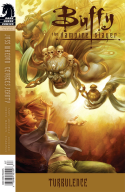
The volume actually starts off pretty well, with a Joss-penned one-shot called “Turbulence” (issue #31) that finally gets rid of those irksome colorful goddesses for good and contains an amazing scene between Buffy and Xander wherein she reacts to seeing him kissing Dawn by confessing that she has begun to see him in a romantic light. He is appropriately incredulous:

Xander: Yoooou… have feelings. At me.
Buffy: Would that be good?
Xander: That would be great. If it was a bunch of years ago and you actually meant it.

He also points out that, even if her feelings were genuine, once she saw him and Dawn together she should’ve realized that the decent thing to do would be to keep quiet. Honestly, I’m a little bothered by how immature and selfish Buffy is here, but her desperate loneliness coupled by Xander’s rejection might play a part in her actions a few issues later. Xander, on the other hand, comes off as entirely in character; I think he is probably the best thing about the Season Eight comics, actually.

Really, the first 2.5 issues of the “Twilight” arc are pretty good, too. Buffy and Xander explore the extent of her newfound superpowers. Dawn is concerned, pointing out that “you don’t get power for free,” and she is proven correct when Willow’s search for the missing Faith, Giles, and Andrew leads to the discovery of a bunch of dead Slayers. It turns out that 206 Slayers have died since the start of the conflict, and Buffy has inherited all of their powers. She’s understandably pretty freaked out by this. “If I’m sucking their power… it makes me a vampire.”

Meanwhile, the missing trio are being held at Twilight headquarters, where Giles recognizes the enemy’s voice and many hints are dropped concerning what’s going on and Giles’s knowledge of it. “Every Watcher wonders if his Slayer might be the girl… and you’ve had more reason than any.”

The high point of the arc is when Buffy interrupts this conversation to attack Twilight, at which points he unmasks himself. Angel. Buffy’s anger is initially white-hot. “You killed my girls! Two hundred and six girls!” and “Why did you put us through this fucking hell for the past year?!” Angel rationalizes his actions as a way to keep the body count lower than if governments had gotten involved. If he posed as the masked villain and talked of “master plans,” he would distract others who might’ve wanted to take action. Simultaneously, he would focus Buffy and help her superpowers develop.

And here’s where things start to break down for me. What it boils down to is this: by activating all the Potentials, Buffy upset the balance of the Universe. But also, there’s this prophecy (referred to as merely a myth by Giles when he’s accused of not sharing his awareness of the possibility) that a Slayer and Vampire will be used to usher in a new reality of superbeings. Or something. It’s all very vague. When this new reality is established, the old one (and humanity with it) will be discarded. This is what the whole season has been building toward, and it’s just such a disappointment. Ugh.

What I really hate about this idea is that it basically retcons Buffy’s personal attraction to vampires and makes it something that the Universe’s grand plan was engineering. How much of what is happening is free will, and how much is the Universe controlling their actions? Does Angel really believe all this stuff? Or is he essentially possessed? Did Buffy really want to jump his bones so desperately (which she does, in fact, proceed to do) because she’s in a lonely and vulnerable place, or did the Universe make it easy for her to put aside her fury and make with the sexy times?

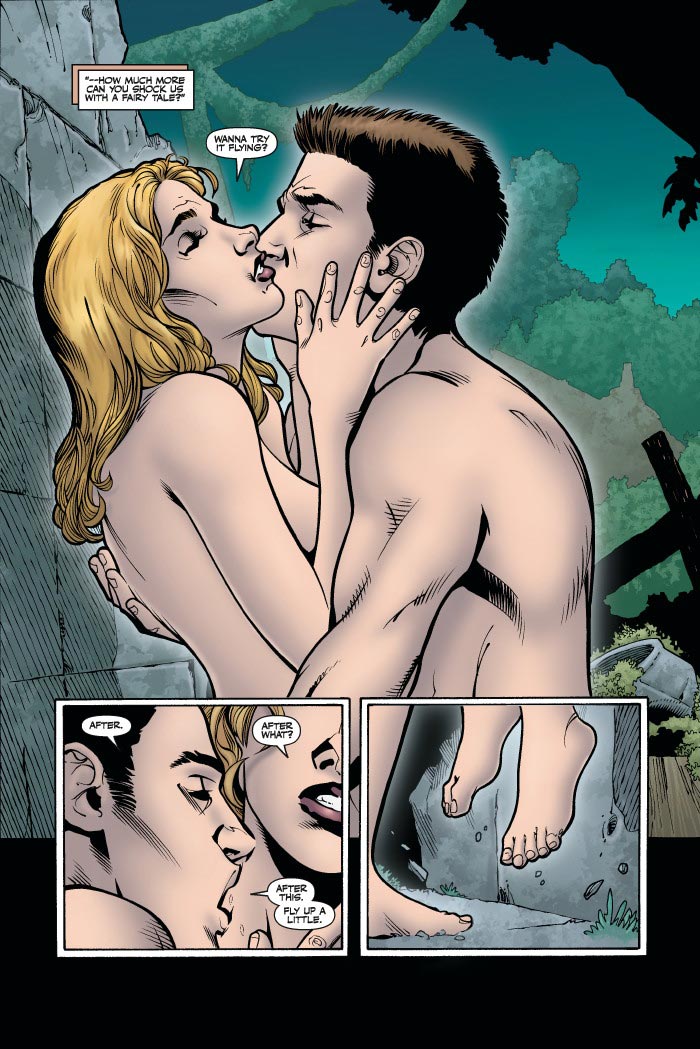
I also hate how their sexual encounter is treated, with a peanut gallery making jokes about it and many silly panels where they zoom across the sky, bodies entwined, while the world erupts in seaquakes and cyclones. It just looks stupid, but more than that, I think it was done to shock the reader. Is this juxtaposition (NSFW) of imagery and text coincidence? I think not, especially after the whole Buffy/Satsu thing.

The final issue of the arc offers some redemption, with Buffy gradually regaining her focus after sexual bliss and being dissatisfied with the pleasure paradise to which she and Angel have ascended. He is ready to believe in it (and, again, is this really his personal opinion?) and dwell there together forever but she doesn’t trust it and, more than that, can’t be happy in a nirvana while her friends are fighting for their lives. Her exact words are “Fuck evolution,” and, after a brief sad smile to acknowledge what might have been, she and Angel return to help her family fight off the hordes of demons who have invaded “the lower plane.” Willow is suitably pissed at Angel—“What you got coming you better hope never comes”—and then Spike arrives, seemingly with the intent of knocking a bunch of sense into everyone. Yay, Spike!

So, anyway, I just don’t like this arc. I don’t think it was thought through very well, and I don’t like the implications it retroactively conveys upon the events of the series. While I’m airing grievances, I shall also point out that Meltzer gets a basic fact wrong—Faith did not become a Slayer upon Buffy’s death—that no one on the editorial staff was knowledgable (or attentive) enough to spot. Too, Georges Jeanty’s renderings of Faith continue to be extremely ugly. The only way to enjoy her scenes is to just try really hard to imagine Eliza Dushku in her place.

The volume is rounded out by “Willow: Goddesses and Monsters,” another Joss-penned one-shot set before the beginning of Season Eight. In it, Willow takes some sort of magical journey that she originally skipped over in her accelerated path to power. There’s really not a lot going on here, and a lot of the dialogue is supposed to be funny but isn’t, but it’s noteworthy because it’s the first time we’ve glimpsed Tara in the comics.

One more volume to go, and it includes Spike! I never did read the final two issues, so though I am spoiled on one pivotal event, much of it will be new to me. I hope I don’t hate it.

Filed Under: REVIEWS Tagged With: Buffy the Vampire Slayer, Dark Horse

Bloody Monday, Vol. 1

August 30, 2011 by Katherine Dacey

To judge from all the shonen manga I’ve read, the fate of the world rests in teenage boys’ hands: not only do they have the power to kill demons and thwart alien invasions, they’re also blessed with the kind of superior intelligence that makes them natural partners with law enforcement. Bloody Monday is a textbook example of the teen-genius genre: high school student Fujimaru Takagi dabbles in crime-solving, hacking into secure networks and decoding encrypted files on behalf of the Public Security Intelligence Agency. (Naturally, he works for the PSIA’s super-secret “Third-I” division, which is “comprised solely of elites.”) Fujimaru’s deductive skills are put to the ultimate test when his father is falsely implicated in a murder. To find the real killer, Fujimaru must uncover the connection between his father and the “Christmas Massacre,” a terrorist attack that left thousands of Russian civilians dead, their bodies covered in boils.

In the right hands, Bloody Monday might have been good, silly fun, 24 for the under-twenty-four crowd. The script, however, is pointed and obvious, explaining hacker culture and internet technology to an audience that has grown up on the world-wide web: are there any fifteen-year-olds who don’t grasp the basics of computer viruses? The characters, too, seem impossibly dim, thinking out loud, missing obvious connections, and reminding each other how they’re related, whether they’re fellow reporters for the school newspaper or siblings. Small wonder they don’t realize that their school has been infiltrated by an enemy agent.

The art is more skillful than the script, with polished character designs and detailed backgrounds. The adults actually look like adults, not teenagers with unfortunate laugh lines, while the scenes aboard the Transsiberian Railroad convey the harshness of the Russian landscape. Though artist Kouji Megumi nevers misses an opportunity to show us an attractive woman in her underwear — and really, what well-trained assassin doesn’t snuff a target or two while wearing only a matching bra-and-panty set? — the fanservice never overwhelms the plot. The action sequences, too, are well-staged, using swift cross-cuts and imaginative camera angles to heighten the suspense.

In the end, however, the slick visuals aren’t enough to compensate for the flat-footed storytelling. A plot as potentially interesting and complex as Bloody Monday‘s should challenge the reader to arrive the solution independently, not spoon-feed it; too often, the story seems to have been written in boldface, depriving the reader of an opportunity to guess the outcome of the story for herself.

BLOODY MONDAY, VOL. 1 • STORY BY RYOU RYUMON, ART BY KOUJI MEGUMI • KODANSHA COMICS USA • 200 pp. • RATING: TEEN (13+)

Filed Under: Manga, Manga Critic, REVIEWS Tagged With: Action/Adventure, Bloody Monday, yen press

Tenjo Tenge, Vol. 2

August 30, 2011 by Sean Gaffney

By Oh!Great. Released in Japan by Shueisha, serialized in the magazine Ultra Jump. Released in North America by Viz.

We left off last time in the middle of a big melee at a bowling alley, and that’s where we stay for about half of this omnibus volume (it was Vol. 3-4 in Japan), as our ongoing villains begin to show their badassery, and our heroes realize that they really aren’t strong enough right now to do much about it. Not even Maya.

In terms of plot, there is some stuff thrown to us. Aya’s supernatural powers become more clear in these chapters, and it’s noted that her sister does NOT have the same ability – despite apparently being able to turn into a little kid. Of course, with great power comes great responsibility, and Aya’s still a moody teenager – she knows there’s no one to blame regarding Soichiro falling for her sister, but gets jealous anyway, and luckily there’s a handy demon blade to bring out her darker emotions. We don’t get to see what happens with her here, but I imagine it won’t be pleasant.

Then there’s her sister Maya, who gets expelled from school as a consequence of ‘defying’ the executive council at the bowling alley. In the present-day, she’s seemingly trying to do what’s best for the club, despite having ‘I am doomed’ written across her forehead. We do start to get a look at her past towards the end, though, featuring a Maya who has all the bravado of Soichiro – and like Soichiro, gets her ass handed to her. Multiple times. We also meet her brother in the flashback, whose death plays such a huge role in the mentalities of the cast.

To be honest, after 2 omnibus volumes of Tenjo Tenge, the character I probably like and respect most is Chiaki, Bob’s girlfriend, who’s also the only non-combatant. Trapped in the bowling alley with the rest of the fighters, and at one point literally shoved into a locker to protect her, she nevertheless manages to talk Bob down when he’s given an offer by the head bad guy to join them so he can achieve his true potential. What’s more, her confrontation with Maya, and subsequent discussion with Bunshichi shows her trying to come to terms with the aftermath of her rape, and trying to help Bob by understanding exactly how it is things at the school got to this point. I know she’s merely a minor character, but she’s handled quite well.

All this chatter about plot and characterization is deceptive, of course. For all the demon powers, the tragic pasts, and the philosophy of why mankind fights, this is still just a lot of people hitting each other hard, occasionally contrasted with the nudity and fanservice. The appearance of depth does not equal actual depth, and so while Tenjo Tenge is an addictive page-turner, it’s still like eating cake rather than eating steak, no matter how many manly fights are in it.

Oh yes, and Masataka’s comic relief persona gets very old very fast.

Filed Under: REVIEWS

Ekiben Hitoritabi, Vol. 1

August 29, 2011 by Michelle Smith

By Jun Hayase | Published by Futabasha | Available in English at JManga

Even if JManga didn’t offer anything else to interest me, I think I would still love them forever for introducing me to Ekiben Hitoritabi. (The ekiben in the title refers to the boxed meals sold at train stations throughout Japan, while hitoritabi means “a trip undertaken alone.”)

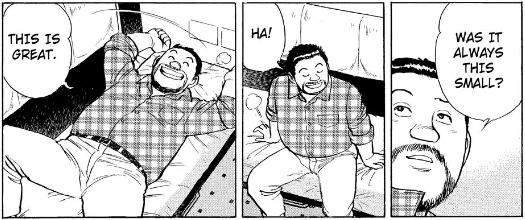
Ekiben Hitoritabi is a slice-of-life story about an ordinary 35-year-old train enthusiast named Daisuke Nakahara whose wife gives him a ticket to Kyushu by special express sleeper train for their tenth anniversary. Once he gets to Kyushu, Daisuke begins making his way north by taking a variety of local and little-used rail lines. He’s accompanied throughout most of the first volume by a journalist named Nana, whom he educates on railroad history and exposes to the wide variety of tasty ekiben to be found at the stations they visit. When they’re not rhapsodizing over the contents of these ekiben, they’re admiring the scenery or the trains themselves.

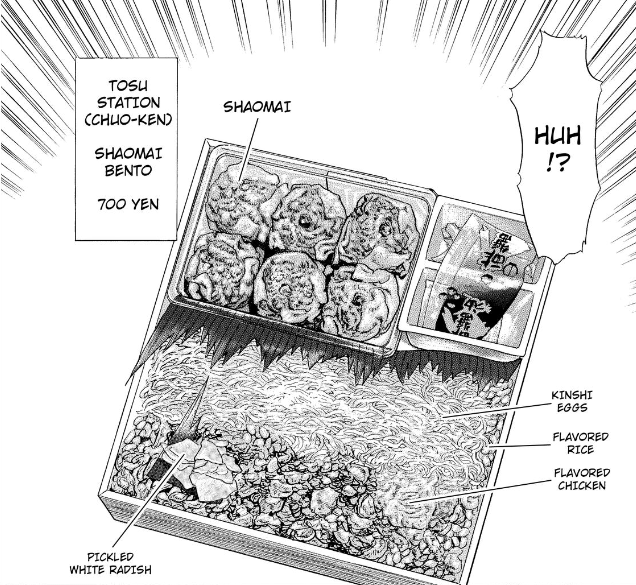
I don’t think this is a manga for everyone. The biggest source of tension, for example, is worrying whether Daisuke and Nana are going to miss their train when it’s taking longer than expected to procure ekiben. Daisuke likes everything he tastes—and, indeed, his love of ekiben has inspired him to open a bento shop of his own in Tokyo—and is in perpetually good spirits. There’s always a page turn before the contents of the bento are revealed, so that each always appears on the upper right-hand side, with each component identified. Someone is bound to make a remark about the taste permeating his/her mouth, too.

But it’s just so charming. (One learns a lot about Japanese geography, too.) Daisuke is content with his life and with taking his leisurely time, and he makes it look so awesome that I am frankly envious. Now I want to travel Japan by local rail and sample a bunch of ekiben! I must admit, though, that I’d be reluctant to try some of them. And the one that looked the best to me was the only one Daisuke had anything even slightly negative to say about. Here it is, the Shaomai Bento:

(Click to enlarge.)

Shaomai is the Kyushu term for shumai, and after noticing that many of the ekiben contain kinshi eggs, I had to look them up and I WANT SOME ON RICE RIGHT NOW. That, of course, is the danger with Ekiben Hitoritabi: reading it while hungry is sheer torture.

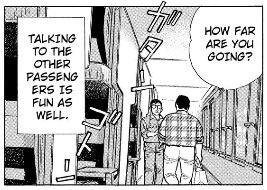
What’s not torture is the translation, which is better than I expected. I did get the sense that the work was spread between several people, however, because treatment of sound effects was inconsistent and some errors (like “bento’s” instead of “bentos”) cropped up only intermittently. I never had any issues with comprehension, though, and JManga welcomes feedback, so I did leave them a few notes about the minor problems I noticed. Splitting a word between two lines seemed to be an issue, for example:

On the whole, however, I am utterly delighted that I got to read Ekiben Hitoritabi. I doubt it would’ve sold too well in print format, so if digital is the only way I can get it, then I am just grateful to have the chance. Grateful and yet impatient, because I am going to need volume two pretty soon. And some kinshi eggs.

Ekiben Hitoritabi is up to volume thirteen in Japan and is still ongoing.

Filed Under: REVIEWS Tagged With: Futabasha, JManga

Dorohedoro, Vol. 4

August 29, 2011 by Sean Gaffney

By Q Hayashida. Released in Japan by Shogakukan, serialization ongoing in the magazine Ikki. Released in North America by Viz.

It’s really amazing how much I still enjoy every page of this series, considering that there’s so little forward progression in it. Those who get frustrated by a lack of plot are going to get very annoyed very fast reading this volume, which contains a baseball game featuring our heroes, two of the villains, and various zombies… apparently because Hayashida felt like it, who knows? But the game is still a lot of fun.

That’s not to say there’s absolutely nothing happening here – there’s a ton going on. It’s just not immediately plot-oriented. Caiman has figured out by now that Nikaido is actually a sorcerer, and though conflicted, he’s trying not to let that destroy their friendship. Fujita discovers that he can get revenge on Caiman and Nikaido, who killed his partner (remember that opening scene in Vol. 1?) and goes out to do his best, along with tag-along Ebisu. Fujita’s on the cover this time, so seeing him get more to do makes sense, even though he still tends to be a bit of a sad sack who is there for bad things to happen to. Which makes him a good partner for Ebisu, come to think of it, as that’s what she’ there for as well.

Speaking of Ebisu, we continue to discover little bits about her past before getting attacked by Caiman. Turns out her magic is connected to lizard people, so she too could be the one who created Caiman… except that doesn’t appear to be the case. Her magic appears to be quite dangerous, taking over Noi and transforming her into a rampaging lizard woman as well, forcing Shin to take measures against her. Then they have to go find En’s partner in order to save her, in what might be the shippiest scene in the manga to date. Fans of Shin/Noi (of which I am one) will be delighted.

We also get some development of Risu, the guy walking around wearing Caiman’s face. But the big development here is Shin, whose backstory is given here. As one might expect, it is rather tragic and filled with blood and gore, but it does serve to underscore how determined Shin can get whenever he’s after something. It’s getting harder and harder to see who the good and bad guys are in this series… there’s just a bunch of guys doing mostly bad things.

It’s not a perfect volume by any means. The baseball game was fun, but does meander a lot. And the way that they got Noi to be attacked by Ebisu’s smoke, with an assistant coming along, tripping, and dumping it all over her, is the worst of sitcom cliches. Still, Caiman’s off to the Sorcerer’s World by himself now, no doubt because a man’s gotta do what a man’s gotta do. I look forward to seeing what happens. Dorohedoro is a series that requires a lot of patience, but I feel that if you hang in there there’s a lot of reward to it.

Filed Under: REVIEWS

Anesthesiologist Hana, Vol. 1

August 26, 2011 by Sean Gaffney

By Kappei Matsumoto and Hakua Nakao. Released in Japan by Futabasha, serialization ongoing in the magazine Manga Action. Released in the United States by Futabasha on the JManga website.

Sometimes you buy a manga for a striking cover, or because of good word of mouth, or because you enjoyed the works of the author previously. And sometimes you simply have to buy a manga because of the title. That was definitely the case with Anesthesiologist Hana, one of Futabasha’s seinen offerings that, true to its word, is the story of a young doctor named Hana and her days working at a local hospital as an anesthesiologist.

While the precise genre of anesthesia manga may be unfamiliar, it becomes apparent on reading this manga that it’s the latest in a long line of workplace seinen, the sort of story that shows our everyman (or woman, in this case) hero and their struggles as they strive to do their thankless job. There are times when it seems to get overwhelming, or they think about quitting, but that never happens, because they grow to understand the importance of their job, and learn to take happiness in it.

And that’s pretty much what you get here. Hana is a young doctor who’s been with her hospital for about three years, and has come to learn the thanklessness that comes with it. In the first chapter, she even tries to resign, though can’t quite follow through with it. The surgeons she works in the operating room with are either obnoxious jerks who call her incompetent or sexist boors who try to cop a feel. The hours are mind-numbing and they’re constantly short-staffed. She rarely sees the sky, eats cup ramen for most meals, and her love life is zero. Most importantly, the job is thankless; everyone loves the surgeons who perform the operation, or doctors in other fields such as ophthalmology, but an anesthesiologist is only singled out if something goes wrong and a patient is lost.

Nevertheless, Hana manages to keep herself going – mostly. She has a grumpy, cynical older sister friend and a bubbly, more naive younger sister type who are her two fellow female anesthesiologists. Her boss is stern but overall a good-hearted guy. And one of her fellow doctors, though a bit weird and suspicious, is even quite handsome – and seems to notice the good qualities in her, possibly as he feels he’s lost them in himself (he has a somewhat sad backstory). The chapters are mostly episodic, but as the series goes on we do see the cast all banding together to help each other out, much like any good workplace.

There is a lot of focus on the actual ins and outs of anesthesia. Sometimes a bit too much – the manga can get a little dry at times, and it has to be careful not to look like a textbook, a la Stone Bridge Press’s ‘Manga Guide To’ series. I have no medical education, so have no idea how accurate everything really is. But it seems accurate. This isn’t a fantasy comic book world where you can always tell the psychics by their nosebleeds. The manga goes into great detail about exactly hat Hana has to do and watch out for, and the inherent dangers involved. There’s even a chapter discussing drug use, and how it’s not just using drugs properly for anesthesia, but keeping an eye out for drug takers among the staff that can be a problem.

Despite being a seinen title, there’s surprisingly little fanservice – Hana takes a shower in the first chapter, and is quite busty, though not overly so; she’s also groped a couple of times. The author’s notes make it clear that they had an original idea of making the hero a male doctor, but the editors told them to change it to a busty female. Not unsurprising; this kind of story, with all its exposition, earns more charm points by having a cute young woman as our viewpoint character.

Overall, I enjoyed this first volume. It can be very dry at times, and is never going to be incredibly exciting. But I feel I’ve learned an awful lot about anesthesiology, and I want to know more about Hana and her ongoing adventures (is she going to hook up with sexy doctor? Or is he just a mentor figure?). If you like workplace medical shows, give this a try.

Filed Under: REVIEWS

Cage of Eden, Vol. 1

August 25, 2011 by Katherine Dacey

Stop me if you’ve heard this one before: a trans-Pacific flight encounters turbulence, and before any of the passengers can shout “J.J. Abrams!” — or “William Golding!” for that matter — the plane crash-lands an uninhabited tropical island, far from civilization’s reach. In some variations of the story, the island itself poses the greatest danger to survivors, harboring monsters or malevolent spirits. In other versions, the survivors’ own fear and narcissism proves more deadly than any jungle-dwelling creatures, as the rude wilderness strips away the survivors’ veneer of humanity.

In Cage of Eden, Yoshinobu Yamada combines these two survival narratives to tell the story of a high school holiday gone horribly wrong. Cage’s teen heroes crash-land in a prehistoric forest populated by long-extinct animals: saber-toothed tigers, horse-sized birds. These big, hungry predators aren’t the only threat to the students’ safety, however. Yarai, the class delinquent, seizes the opportunity to act on his darkest impulses, terrorizing his peers and the doomed flight’s captain. Only Akira, a small, self-described loser, and Mariya, a bespectacled, anti-social genius, have the skills and the smarts to outwit both enemies.

Though the story unfurls at a good clip, the execution is a little creaky. The opening chapter is a choppy information dump, as Yamada introduces the principal characters, delineates their relationships, and reveals the purpose of their plane trip. Once on the island, Mariya’s computer proves shockingly durable — it boots up without protest, despite plunging 35,000 feet — and helpfully equipped with a searchable database of extinct animals. (“Even without internet, I can still access program files,” Mariya solemnly informs an incredulous Akira.) The characters speak fluent exposition, frequently explaining things to one another that are readily obvious from Yamada’s crisply executed drawings. Worse still, the intelligent dialogue is reserved for the male characters; the few female characters’ primary role is to be menaced, rescued, and ogled, though not necessarily in that order.

However obvious the script or ubiquitous the cheesecake — and yes, the fanservice is executed with all the subtlety of a tap-dancing hippopotamus — Cage of Eden has a cheerful, B-movie vibe that’s hard to resist. The monsters are rendered in loving detail, down to their sinews and feathers and claws; as they tear across the page, it’s not hard to imagine how terrified the characters must be, or how fast they need to run in order to escape. The setting, too, is a boon, offering Yamada numerous places to conceal a dangerous animal or booby trap. Even the characters are effective. Though drawn in broad strokes, Akira is a sympathetic lead; he’s prone to self-doubt after years of being a bench warmer, an academic failure, a mama’s boy, and a second banana to the most popular student in his class. That the island provides him a chance to prove his worth isn’t surprising — that’s de rigeur for the genre — but Akira’s mixture of humility and bravery is refreshing, helping distract the reader from the absurdity of his action-movie heroics.

I won’t make any grand claims for Cage of Eden: on many levels, it’s dumber than a peroxide blonde, with characters doing and saying things that defy common sense. Yet Yoshinobu Yamada demonstrates a genuine flair for writing popcorn-movie manga, populating the island with scary-looking monsters and staging thrilling action sequences that temporarily erase the memory of the clumsy dialogue and panty shots. Cage of Eden is the perfect beach read for the final days of August: it’s fun and fast-paced, placing few demands on the sun-addled reader.

CAGE OF EDEN, VOL. 1 • BY YOSHINOBU YAMADA • KODANSHA COMICS USA • 200 pp. • RATING: OLDER TEEN (16+)

Filed Under: Manga, Manga Critic, REVIEWS Tagged With: Cage of Eden, Horror/Supernatural, Sci-Fi, yen press

  • « Go to Previous Page
  • Page 1
  • Interim pages omitted …
  • Page 293
  • Page 294
  • Page 295
  • Page 296
  • Page 297
  • Interim pages omitted …
  • Page 346
  • Go to Next Page »
 | Log in
Copyright © 2010 Manga Bookshelf | Powered by WordPress & the Genesis Framework