• Skip to primary navigation
  • Skip to main content
  • Skip to primary sidebar
  • Home
  • About Us
    • Privacy Policy
    • Comment Policy
    • Disclosures & Disclaimers
  • Resources
    • Links, Essays & Articles
    • Fandomology!
    • CLAMP Directory
    • BlogRoll
  • Features & Columns
    • 3 Things Thursday
    • Adventures in the Key of Shoujo
    • Bit & Blips (game reviews)
    • BL BOOKRACK
    • Bookshelf Briefs
    • Bringing the Drama
    • Comic Conversion
    • Fanservice Friday
    • Going Digital
    • It Came From the Sinosphere
    • License This!
    • Magazine no Mori
    • My Week in Manga
    • OFF THE SHELF
    • Not By Manga Alone
    • PICK OF THE WEEK
    • Subtitles & Sensibility
    • Weekly Shonen Jump Recaps
  • Manga Moveable Feast
    • MMF Full Archive
    • Yun Kouga
    • CLAMP
    • Shojo Beat
    • Osamu Tezuka
    • Sailor Moon
    • Fruits Basket
    • Takehiko Inoue
    • Wild Adapter
    • One Piece
    • After School Nightmare
    • Karakuri Odette
    • Paradise Kiss
    • The Color Trilogy
    • To Terra…
    • Sexy Voice & Robo
  • Browse by Author
    • Sean Gaffney
    • Anna Neatrour
    • Michelle Smith
    • Katherine Dacey
    • MJ
    • Brigid Alverson
    • Travis Anderson
    • Phillip Anthony
    • Derek Bown
    • Jaci Dahlvang
    • Angela Eastman
    • Erica Friedman
    • Sara K.
    • Megan Purdy
    • Emily Snodgrass
    • Nancy Thistlethwaite
    • Eva Volin
    • David Welsh
  • MB Blogs
    • A Case Suitable For Treatment
    • Experiments in Manga
    • MangaBlog
    • The Manga Critic
    • Manga Report
    • Soliloquy in Blue
    • Manga Curmudgeon (archive)

Manga Bookshelf

Discussion, Resources, Roundtables, & Reviews

Manga

Wake Up, Sleeping Beauty, Vol. 1

January 14, 2018 by Michelle Smith

By Megumi Morino | Published by Kodansha Comics
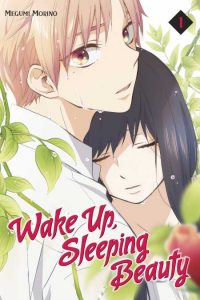
Tetsu Misato makes up for what he lacks in height with his energy and determination. Due to a mysterious promise he made to his hospitalized mother, Tetsu is driven to earn money. So much so that he plains to join the work force after graduation and already is working several part-time jobs while in high school, abandoning the soccer team as a result. To prove to his father that he is ready to hold down a job, he begins working through his father’s housekeeping agency at the Karasawa mansion. There have long been rumors that the place is haunted, but Tetsu soon learns that the “frail, sickly daughter” who allegedly lives in a separate building is a real and friendly girl, no apparition at all.

In fact, Shizu doesn’t seem ill at all, but some of the things she says are strange, like “I’d like you to come see me… to see Shizu Karasawa again.” And when Tetsu confesses his love (thankfully without prolonged angst) Shizu is troubled and invites him to visit again on his next work day before she gives him a straight answer. When he complies, he finds a completely different Shizu, who refers to the personality Tetsu interacted with as “Haru” and only vaguely remembers Tetsu. She doesn’t seem to know who she herself really is.

Most of this first volume is Tetsu figuring out the mystery of what exactly Shizu’s deal is, which I don’t want to spoil, but I will say I definitely enjoyed the read. Early on, there are some gag reaction panels that aren’t particularly amusing, but which make the darker, creepier moments later on land with more impact. Tetsu is quite the scaredy cat, and while he initially visits Shizu because he cares about her (well, the Haru version, at least) and doesn’t want her to be lonely, by the end of the volume, Shizu’s mother has made him an offer he can’t refuse, and though he’s now scared of Shizu because of what he’s learned, he’s compelled to stay near her to protect someone he cares about—and this time, I think that’s referring to his mother or his family and ties in to the unknown reason that he needs to earn all that money. It’s a nice shift in his motivations, especially as it occurs after the real Shizu has shown that she cares about Tetsu, a first for her.

The tables have turned in their relationship, and I very much look forward to see how the story progresses from here.

Wake Up, Sleeping Beauty is complete in six volumes. Volume two will be out in English next week.

Review copy provided by the publisher.
Filed Under: Manga, REVIEWS, Shoujo, Supernatural Tagged With: Megumi Morino

Waiting for Spring, Vols. 1-3

January 12, 2018 by Michelle Smith

By Anashin | Published by Kodansha Comics

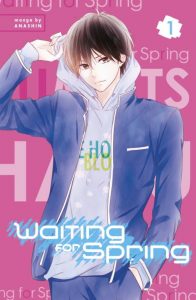
Mitsuki Haruno is a first-year in high school who has always had trouble making friends. Her luck begins to change when she befriends the most popular quartet of boys in school. If someone read those sentences to me and asked me to guess in which magazine this manga was serialized, I’d say Dessert, based on past offerings we’ve seen from them (like Say I Love You.). And I would be right.

The fact that it’s a familiar premise doesn’t preclude Waiting for Spring from being enjoyable, however. Although the four boys can be almost instantly categorized into standard roles based on their appearance—the playful one, the intellectual one, the hotheaded one, the princely one—I appreciated that, like typical teenage boys, they are still occasionally jerks. Oh, sure, they’re idealized and do things like try to cheer up little kids through the power of basketball, but at least they’re not saints.

I also quite liked Mitsuki as a character. I could foresee a version of this story in which her failures to initiate social interaction with others might be frustrating, but that’s not the case here at all. The key seems to be Mitsuki’s honesty about the past experiences that are holding her back in the present, and by the end of the third volume she has made two female friends. Reina is, awesomely, a major fujoshi and envisions the four boys (all of whom are on the basketball team) in romantic pairings. I love the little background gags of her taking surreptitious pictures of them. Maki is a member of the girls basketball team who, unbeknownst to Mitsuki, also has a thing for princely Asakura.

We also meet Aya, the childhood friend whom Mitsuki thought was a girl. Turns out (no real surprise) that he is a boy and is determined to win Mitsuki’s affections. He’s insistent to a troubling degree, but again, I appreciate that Mitsuki is firm in her refusals, even managing to defuse conflict between Aya and Asakura by proposing that she’ll go on the date Aya wants after the inter-high tournament, but that Asakura will come too and it’ll be a fun group thing. I get that we’re supposed to appreciate how much Aya’s friendship meant to Mitsuki when she was young, given that she had no other friends, but I wonder… are readers really supposed to like this guy? At least his presence spurs Asakura (generally sleepy and/or oblivious) to realize what his feelings for Mitsuki are.

But will he act on those feelings? The boys on the basketball team are not allowed to date. I did find it strange that although these boys talk about how much basketball means to them, because this is shoujo manga, we see sadly little of it. In volume three, the inter-high preliminaries have begun and in the space of 1.5 pages, the boys have won five games. I know this isn’t a sports manga, but c’mon… I’d like to see more than that! Another thing to appreciate about Mitsuki is that, while many of the team’s other female fans are just there to look at the cute boys, she understands how important the game is to Asakura and overcomes her shyness and orchestrate a cheering section when they fall behind during a practice game. Too, I greatly appreciate that she hasn’t had to deal with any mean girls warning her away from the boys. (Reina’s occasional “grr” reactions at girls hanging around them are enough.)

So, yes, this is a low-key series that isn’t breaking any new ground. That said, I still like it. The sweet moments between Mitsuki and Asakura take me back to adolescence when the first time you hold hands with someone is a tremendously big deal and the art style is attractive. The conclusion seems pretty obvious already, but I expect I’ll enjoy getting there all the same.

Waiting for Spring is ongoing in Japan, where it is up to eight volumes. Three volumes are currently out in English, with the fourth scheduled for release next week.

Review copies provided by the publisher.

Filed Under: Manga, REVIEWS, Shoujo Tagged With: Anashin

Drifting Dragons, Vols. 1-2

January 10, 2018 by Katherine Dacey

The nineteenth century whaler was a tough character. He’d board a ship in Nantucket or New Bedford, sail around the tip of South America and then into the Pacific hunting grounds in quest of sperm whales. Every aspect of his job was dangerous and unpleasant; as author Eric Jay Dolin notes in Leviathan: The History of Whaling in America, crewmen endured “backbreaking work, tempestuous seas, floggings, pirates, putrid food, and unimaginable cold” during their long stints at sea. At the end of a two- or three-year tour, a whaler might still be in debt from all the equipment he’d purchased at the outset of his journey, especially if the ship’s yield was low. Yet the gruesome work he performed was vital to the Victorian economy: whales’ bodies yielded the fat, bones, and oils that illuminated homes, corseted ladies, and gave shine and staying power to paint (Dolin 12).

The characters in Taku Kuwabara’s Drifting Dragons are engaged in a similar enterprise: they trawl the skies in a flying ship looking for dragons. The opening pages of the story make the connection between whaling and “draking” explicit, as we join the crew of the Quin Zaza on an aerial Nantucket sleigh ride. We glimpse a dragon through a parting in the clouds: first its back, then its tail, and finally the entire animal, as enormous and majestic as a blue whale. As the wounded dragon begins to tire, a crew member rappels down the tow line to plunge a harpoon into the animal’s back, delivering the final blow:

This image is a perfect introduction to draking, simultaneously conveying the peril and thrill of hunting such a powerful, swift animal at high altitude. Kuwabata’s thin, graceful lines and sparing use of screen tone capture the speed of the wind, the texture of the dragon’s skin, and the delicate feathering on the dragon’s ears, but also the vast emptiness of the sky. These details allow us to imagine for ourselves what it would be like to stand astride the dragon’s back, gazing at a mountain peak that’s poking above the clouds, or looking back at the ship and realizing the impossibility of rescue if something goes wrong.

As exciting as the dragon hunting sequences are, Drifting Dragons is as much an exercise in careful world-building as action-oriented storytelling. Kuwabara devotes page after page to the crew’s routines, capturing the heat, smell, and physical labor of stripping meat from bones and rendering fat. He also renders the physical environment of the Quin Zaza in precise detail, from the main deck and crow’s nest to the sleeping quarters and the hold, where most of the butchering, smoking, and boiling takes place. Last but not least, Kuwabara shows us how each member of the crew contributes to the functioning of the ship, and explains what first drew them to the skies.

Though the crew is drawn in broader strokes than the ship itself, the characters are distinctive enough to register as people with feelings, desires, motivations, and frustrations. Kuwabara is generous with his supporting cast, giving each a scene or subplot that reveals an unexpected facet of their personalities. Kuwabara lavishes the most attention, however, on the Mutt-and-Jeff duo of Mika and Takita: he’s a bold risk-taker with little regard for his own safety, while she’s a cautious newbie, eager to learn the ropes and prove her worth.

In trying to make Mika a more fully rounded character, however, Kuwabara depicts him as a swaggering gourmet, an Anthony Bourdain of the air. Mika is always dreaming up new strategies for preparing dragon meat, regaling his shipmates with lengthy monologues about a new technique he tried or goading the Quin Zaza’s cook into making his favorite dishes. This culinary concept carries over to the end of each chapter, which concludes with detailed recipes for Dragon Tail Meat Sandwich, Dragonet alla Diavola, and Pressed Dragon Liver Confit. These interludes aren’t very funny or appetizing; if anything, they feel more like a naked attempt to jump on the weird-cooking-manga bandwagon than an organic part of the story Kuwabara’s trying to tell.

If Drifting Dragons’ efforts at comedy fall flat, the manga is nonetheless engrossing. Kurabawa clearly knows the history of whaling, and has found a clever way to integrate those details into his fantasy world. At the same time, however, the vividness of the world he’s created has its own integrity; one could read Drifting Dragons in blissful ignorance of Moby Dick or The Wreck of the Whaleship Essex and still be swept up in the activity of the Quin Zaza’s crew and the thrill of flying alongside dragons in the clouds. Highly recommended.

WORKS CITED

Dolin, Eric Jay. Leviathan: The History of American Whaling. W.W. Norton & Co., 2007.

Kuwabata, Taku. Drifting Dragons, vols. 1-2. Translated by Adam Hirsch. Kodansha Advanced Media, LLC, 2018.

Filed Under: Manga, Manga Critic, REVIEWS Tagged With: Dragons, Fantasy, Kodansha Comics

The Best Manga You’re Not Reading: Star Wars

December 29, 2017 by Katherine Dacey

I was five years old when Star Wars: A New Hope blasted its way into movie theaters. Like most members of Generation X, the film cast a long shadow over my childhood, dictating my Halloween costumes, afterschool play, Happy Meal purchases, toy collections, and clothing; I had Princess Leia action figures, Star Wars drinking glasses, Star Wars t-shirts, and a Star Wars beach towel. One of the few tie-in products I didn’t own, however, was a comic book adaptation of the movie. I’d purchased The Star Wars Storybook at a Scholastic book fair in 1978, but never knew that Marvel Comics or manga publishers were peddling something similar.

That’s a pity, because Star Wars has a long and fascinating history in print. Marvel’s six-issue adaptation of A New Hope, for example, was cooked up by a Lucasfilm executive to drum up business for the film — in essence, it was a trailer for comic geeks, arriving on newsstands a month before the movie opened. Though Marvel executives had been reluctant to license Star Wars — according to former editor Jim Shooter the “Prevailing Wisdom” at Marvel was that “science fiction doesn’t sell”  — it proved one of the company’s best business decisions of the 1970s. “The first two issues of our six issue adaptation came out in advance of the movie,” Shooter observed:

Driven by the advance marketing for the movie, sales were very good. Then about the time the third issue shipped, the movie was released. Sales made the jump to hyperspace. Star Wars the movie stayed in theaters forever, it seemed. Not since the Beatles had I seen a cultural phenomenon of such power. The comics sold and sold and sold. We reprinted the adaptation in every possible format. They all sold and sold and sold.

By contemporary standards, Roy Thomas and Howard Chaykin’s version is skillful but a little stodgy, relying on voice-overs to introduce key characters and explain plot points, rather than allowing the art to shoulder the responsibility of telling the story. Nonetheless, as Star Wars fever crossed the Pacific, Weekly Shonen Magazine republished Thomas and Chaykin’s comic, touching off a Star Wars manga blitz in Japan.

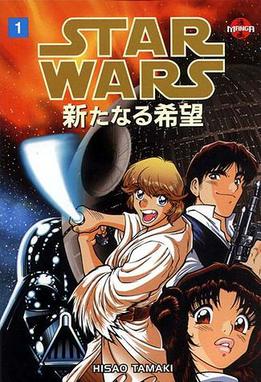
Japan caught Star Wars fever again in 1997, when the Special Edition trilogy hit theaters across the globe. Kadokowa’s MediaWorks division churned out a new set of Star Wars manga, hiring Hisao Tamaki (A New Hope), Toshiki Kudo (The Empire Strikes Back), and Shin-Ichi Hiromoto (Return of the Jedi) to handle the adaptations. And while all three are good, faithfully reproducing the main beats from each film, Tamaki’s version of A New Hope is that rarest of tie-in products: it captures the look and feel of the movie without slavishly copying it, offering both a fresh perspective on a canonical text and a point of entry for someone wholly unfamiliar with Star Wars. 

Part of what makes Tamaki’s version so fascinating is how he compensates for the absence of a soundtrack — no mean feat, given how noisy the Star Wars universe is. While Tamaki uses plenty of hand-lettered sound effects, he never uses them as a crutch, instead finding nifty ways to help us imagine the sound of a landspeeder skimming the desert floor or a Stormtrooper firing his blaster. Tamaki’s most effective tactic is careful attention to the velocity and direction of moving objects; through deft placement of speedlines and artful manipulation of the panels’ shape and size, he conveys the same information that a well engineered roar, squeak, thud, or electronic rumble might.

Then there’s the film’s lush, Wagnerian score, the kind of movie music that had been fashionable in the era of Ben Hur and Lawrence of Arabia but was considered unhip in the gritty, naturalistic world of early 70s cinema. The opening fanfare and dense web of leitmotifs are unquestionably part of A New Hope‘s appeal, goosing fight scenes and capturing the melancholy of a young Luke Skywalker as he gazes at a Tatooine sunset. Absent those musical prompts, however, Tamaki is forced to think about how to elicit the same emotions in words and pictures. One of the most dramatically successful attempts to bridge sound and silence occurs in volume one of Tamaki’s adaptation, right after R2D2 and C3PO land on Tatooine:

In the film, John Williams accompanies C3PO’s trek with music cribbed from The Rite of Spring — a decent choice, as Stravinsky’s dour ostinati and octatonic harmonies imbue the harsh landscape with an otherworldly quality. Tamaki, however, distills this two-minute scene to an evocative two-page spread in which a wide-angle view of the Tatooine desert unfolds beneath the individual panels, reminding us just how small and vulnerable both droids are. These images track closely with Lucas’ own vision, but the implied silence of the first and final panels in this sequence more powerfully conveys C3PO’s isolation than any musical gesture could:

The absence of sound has another unexpected benefit: minus the actors’ desperate attempts to make George Lucas’ dialogue sound… well, like conversation, the script has more room to breathe. Tamaki plays the earnest stuff straight and ramps up the comedy whenever someone is surprised or indignant. Luke, in particular, benefits from such an approach, given his age and naivete; in Tamaki’s hands, he’s Monkey D. Luffy with a lightsaber, freaking out over chores, the Millennium Falcon’s shabby appearance, Obi-Wan Kenobi’s death, a kiss from Princess Leia… you get the idea. Tamaki’s elastic deformations of Luke’s face transform him from blandly handsome farm boy to Shonen Jump hero, equal parts brave and ridiculous:

One of the manga’s other great virtues is its ability to expand and contract time in ways that a purely temporal medium like film can’t. The ability to speed up and slow down the unfolding the plot isn’t unique to comics, of course; filmmakers can use slow motion imagery or cross-cutting to manipulate the viewer’s perception of time, but a good manga artist takes advantage of the fact the reader can, in fact, stop time by poring over an image or a scene for minutes, savoring small but telling details that would otherwise get lost in the cinematic flow. Writing for Animerica in 2004, Patrick Macias offered a thoughtful explanation of how this kind of creative expansion of time adds new layers of meaning to Tamaki’s story:

It is in Tamaki’s take on destruction of the planet Alderaan that he really shows off his stuff. A scene that took mere moments to depict on-screen is drawn out to fill half a dozen pages. He inserts images of the Alderaan populace looking up to the heavens, and you can almost hear those “millions of voices suddenly crying out in terror” with more dramatic impact in the manga than in the film.

Of course, none of this would matter if Tamaki lacked the precision to bring Lucas’ vision to life on page. Again and again, Tamaki delivers amazingly detailed drawings of space ships, aliens, and weapons that pulse with the same life as Katsuhiro Otomo’s AKIRA and Shirow Masamune’s Ghost in the Shell; if you’d never seen or heard of Star Wars, you might reasonably infer that Tamaki dreamt up this world on his own. Tamaki proves equally adept at staging deep space dogfights, too, conveying both the dizzying speed with which the ships are moving and the maze-like surface of the Death Star:


For readers coming to the manga from the films, the biggest stumbling block will be the character designs: did Tamaki get them right? The short answer is yes, if you can tolerate a little artistic license with hairdos and body types. Not surprisingly, R2D2 and C3PO look most like their big-screen counterparts — no pesky noses or mouths to draw — but the rest of the cast bear a passing-to-strong resemblance to the actors who portrayed them, though Obi-Wan Kenobi looks and moves more like Chuck Norris than Sir Alec Guiness. Tamaki does an even better job of bringing Darth Vader and his Stormtroopers to life on the page, adding an extra touch of menace in the way he draws their helmets; you can almost see the soldiers grimacing under their plastic armor from the way he draws their browlines.

If I’ve sold you on manga Star Wars, you’ll be happy to know it’s a relatively inexpensive way to relive the original trilogy. The digital versions — currently available through Amazon and ComiXology — retail for $1.99 per volume. There’s also a Phantom Menace manga for the morbidly curious; Kia Asamiya is the author, and he’s been given the truly thankless task of condensing that stinker into two volumes. At least it won’t be as interminable as the movie.

WORKS CONSULTED

Macias, Patrick. “Star Wars, The Manga.” Animerica, VIZ LLC, 7 Apr. 2004, https://web.archive.org/web/20040407180902/http://www.animerica-mag.com/features/starwars.html. Accessed 27 Dec. 2017.

Rickard, Ron. “Retro Foreign: Japanese Weekly Shōnen Magazine #18 – 23 (1978).” Star Wars Comic Collector, 20 May 2016, http://swcomiccollector.blogspot.com/2016/05/retro-foreign-japanese-weekly-shonen.html. Accessed 27 Dec. 2017.

Shooter, Jim. “Roy Thomas Saved Marvel.” Jim Shooter, 5 July 2011, https://web.archive.org/web/20150912134444/http://www.jimshooter.com/2011/07/roy-thomas-saved-marvel.html. Accessed on 28 Dec. 2017.

Spellman, Ron. “A Long Time Ago: The Strange History of Marvel’s Original Star Wars Universe.” Comics Alliance, Townsquare Media, 28 Jan. 2016, http://comicsalliance.com/original-marvel-star-wars-comics-history/. Accessed 28 Dec. 2017.

Tamaki, Hisao. Star Wars: A New Hope, adapted from an original script by George Lucas, Marvel Comics, 1998. 4 vols.

Filed Under: Manga, Manga Critic, Recommended Reading, REVIEWS Tagged With: Dark Horse, Hisao Tamaki, Kadokawa, Marvel Comics, star wars

Kigurumi Guardians, Vol. 1

December 23, 2017 by Katherine Dacey

The first ten or so pages of Kigurumi Guardians are a gas. Hakka, a cheerful fifteen-year-old, comes home from school to find a kigurumi (animal mascot) in her kitchen. Though Ginger looks like the product of a Holstein/penguin tryst, no one in Hakka’s family is fazed by Ginger’s appearance, treating him like one of Hakka’s classmates. And if the Sasakuras’ warm embrace of Ginger wasn’t strange enough, Ginger’s method of communication puts things over the top: he’s reduced to scrawling short messages on cue cards since he can’t speak. Not until Hakka attends a school council meeting does she learn that Ginger is one of three animal-shaped guardians defending Earth from a race of puppet masters, and she’s his new handler.

So far, so good: the oddball premise, brisk pacing, and tart exchanges between Hakka and Ginger are executed with comic zest. As Hoshino begins laying the groundwork for the magical combat, however, it becomes clear that she’s making it up as she goes along. That tendency is most pronounced in the fight scenes, which are devoid of any tension, surprise, or humor, since it’s a forgone conclusion that Hoshino will think of a new rule or magical power that helps her heroes win the day.

More problematic is the dynamic between Hakka and Ginger. Bickering leads are a staple ingredient of romantic comedies, but the main point of contention between girl and mascot gets hammered into the ground by the end of chapter three. That joke — if one can call it a joke — is that Hakka must kiss Ginger to activate his magical powers; when she does, he immediately transforms into a dashing young warrior. Hakka hates kissing Ginger, but is repeatedly forced to go against her own wishes because, y’know, Earth’s future hangs in the balance. In our current #MeToo moment, this gag is an unpleasant reminder of how many books, movies, television shows, and manga reinforce the idea that women who refuse unwanted hugs and kisses are difficult, confused, or selfish.

It’s a shame that this gag is so central to the story, as Hoshino clearly intends Guardians to be naughty fun for teen girls — why else would all three mascots transform into tousle-haired bishonen?— but gets too caught up in drawing costumes and mascots to pay careful attention to the plot or consider the full implications of Hakka and Ginger’s relationship. By the end of volume one, the story has traded wacky hijinks for messy fight scenes and sappy conversations, losing its screwball zing in the process.

The verdict: File under D, for disappointment, and S, for squandered potential.

KIGURUMI GUARDIANS, VOL. 1 • STORY AND ART BY LILY HOSHINO • KODANSHA COMICS • RATED: TEEN (13+) • 160 pp.

Filed Under: Manga, Manga Critic, REVIEWS Tagged With: Comedy, Kigurumi, Kodansha Comics, Lily Hoshino, Magical Girl Manga

A Polar Bear in Love, Vol. 1

December 5, 2017 by Katherine Dacey

Don’t be fooled by the cute cover: A Polar Bear in Love is neither gag strip nor conventional rom-com about an improbable couple overcoming their differences. It’s a fitfully amusing, sometimes melancholy reflection on what it’s like to fall in love for the first time, filled with the awkward moments and misunderstandings that all dating newbies experience.

The set-up is simple: Polar Bear falls head-over-paws for Lil’ Seal. Lil’ Seal, for his part, is understandably terrified by Polar Bear’s declaration of love and suffers violent tremors and visions of his imminent demise. Author Koromo complicates this one-joke premise, however, by revealing that both Polar Bear and Lil’ Seal are male, and that neither of them are old enough to understand what it means to be in an adult relationship. Polar Bear, for example, labors under the impression that it’s normal for people to eat their loved ones. While that sounds like a cutesy, kids-believe-the-darndest-things punchline, Polar Bear’s belief is rooted in a fundamental law of the Arctic: the strong eat the weak. His own experiences with love, loss, and scavenging tug — OK, yank — on the heartstrings in an unexpected way, revealing the extent to which his carnivorous instincts are complicated by his desire for friendship.

The art, too, is deceptively minimalist. Both Polar Bear and Lil’ Seal are rendered as thick outlines against a wintery landscape, an artistic decision that allows Koromo to deform her characters for maximum humorous effect, but also underscores the fact that their white fur coats are intended to camouflage them from one another. Though the characters’ conversations are distinctively human, their physical movements are not; even when Polar Bear clasps Lil’ Seal to his chest in a tender embrace — a seemingly anthropomorphic moment — Koromo poses Polar Bear firmly on his haunches, capturing the muscular weight of his enormous hind quarters, and emphasizing the disparity between his size and Lil’ Seal’s.

But is it good, you ask? I’m not sure. There’s a brisk efficiency in Koromo’s artwork and a few delightfully absurd moments that illustrate the major gap between what Polar Bear says and what Lil’ Seal hears — an apt metaphor for what happens when two people try sorting out their feelings for one another. The story never finds a consistent rhythm or tone, however, lurching between somber reflections on arctic survival and antic scenes of Polar Bear glomping Lil’ Seal. The same is true of the characters; in some scenes, their chatter pegs them as worldly seven- or eight-year-olds, while other conversations make them seem like jejune high schoolers.

What I can say, however, is that I was genuinely surprised by A Polar Bear in Love. The manga didn’t follow any obvious formula, and wasn’t afraid to explore dark or weird emotional terrain in the service of character development. I wish I’d laughed more, or found the narrative less circular, but I won’t lie: a few scenes made me sniffle and feel protective of Polar Bear, despite his penchant for over-the-top pronouncements and bone-crushing hugs. His sincerity carried me past volume one’s weaker moments, and made me curious about what’s next for him and his harp seal pal.

A POLAR BEAR IN LOVE, VOL. 1 • STORY AND ART BY KOROMO • TRANSLATED BY TAYLOR ENGEL • YEN PRESS • 160 pp. • RATED A, FOR ALL AGES

Filed Under: Manga, Manga Critic, REVIEWS Tagged With: Comedy, Koromo, Polar Bear, yen press

Shojo FIGHT!, Vols. 1-2

November 30, 2017 by Michelle Smith

By Yoko Nihonbashi | Published digitally by Kodansha Comics

Neri Oishi was a great volleyball player in elementary school, when she was captain of a team that took second place in the national championship. At her prestigious middle school, however, she’s a benchwarmer, often tasked with picking up balls and doing laundry. One of her teammates, Chiyo, is vocally frustrated by the situation, since she played against Neri’s team and knows how good she is. After injuring Chiyo during an argument, Neri must play in her stead in a practice game. Try as she might to suppress them, her aggressive tendencies flare, and she ends up injuring a teammate. Disaster is further assured when her childhood friend/osteopath Shigeru chooses the boys’ bathroom as a treatment venue. Upon discovery (and subsequent misunderstanding), Neri is forced to resign from the volleyball club.

It’s a neat setup, introducing Neri in this environment where she’s not flourishing. By the end of the second volume, readers have learned about the childhood trauma that led to Neri becoming obsessed with volleyball as a means to forget, and the consequences that single-minded focus had on her relationship with her elementary teammates, all of whom bailed on their plans to attend middle school together. She also enrolls in Kokuyodani Private High School, where her sister attended and whose volleyball team is now coached by her sister’s former teammate.

Neri is ashamed of the selfish way she sometimes plays, and wants to change. She’s also absolutely certain that anyone trying to be friends with her is going to end up regretting it. To this end, she initially keeps her #1 fan, Manabu Odagiri, at a distance. Neri saved Manabu from bullies when they were kids, and Manabu has never forgotten it. It soon becomes clear that Manabu is now in the one in the position to help, urging Neri to try to talk to people instead of simply interpreting things in the worst way possible.
Manabu also ends up joining the volleyball team, despite being a total newbie, leading to the most enjoyable part of the series so far: a three-on-three game between the new first years. All of the firsties on the Kokuyodani team have distinct personalities (and, actually, the upperclassmen are seriously fun and awesome, too) and their different training styles are fascinating to watch, especially as Neri manages to drill Manabu in the basics while tasked with spending the first three days only on cleaning duty. Seeing Manabu succeed is gratifying, and I loved that, after Neri’s “mad dog” persona emerges during the game, none of her new teammates harbors a grudge about it.

I am very impressed with how vivid these characters are so far, and 100% addicted already. I also want to note that although the art style is a bit unconventional, it doesn’t take long to get used to it and after a while I stopped noticing it entirely. Although I will always love shounen sports manga, after Shojo FIGHT! and Giant Killing, seinen sports manga might be my new fave.

Shojo FIGHT! is ongoing in Japan, where it is up to fourteen volumes.

Review copies provided by the publisher

Filed Under: Manga, REVIEWS, Seinen

A First Look at The Promised Neverland

November 27, 2017 by Katherine Dacey

Crack pacing, crisp artwork, and a shocking plot twist in chapter one — those are just three reasons to pick up The Promised Neverland when it arrives in comic shops on December 5th. The first volume is a masterful exercise in world-building, introducing the principal characters and the main conflict in a few economic strokes, avoiding the trap that ensnares so many fantasy authors: the info-dump introduction. Instead, the writer-artist team of Kaiu Shirai and Posuka Demizu allow the reader to figure out what’s happening by revealing important plot details as the characters uncover them, and letting the artwork establish the setting. That makes the very earliest pages of the story flow more like a rollercoaster than a Star Wars screen crawl, making every page turn feel like an urgent necessity.

The story begins at Grace Field House, an orphanage plucked from a Victorian novel: the main building is a homey Tudor villa that’s surrounded by open meadows and lush forest, perfect for a game of tag. Our first hint that something is amiss comes just six pages into the story, as Emma, the narrator, makes a mental note of all the things she’s grateful for: “a warm bed, delicious food” and “an all-white uniform.” Before we can ponder the significance of the uniform, however, Demizu inserts a panel revealing that every resident of Grace Field House has a number tattooed on her neck, a sure sign that the orphans are more prisoners than temporary wards:

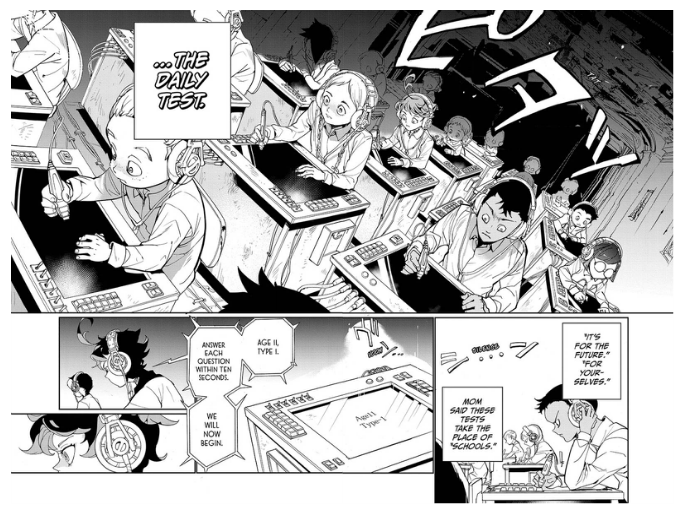
A smattering of other clues — including a series of daily IQ tests and a fence encircling the property — reinforce our perception that Emma and her friends Roy and Norman are in grave danger. And while the earliest chapters occasionally bow to Shonen Jump convention with on-the-nose narration, it’s the artwork, not Emma’s voice-over, that makes each new revelation feel so sinister. Consider the panel that introduces the testing ritual:

In the first ten pages of the story, Demizu uses little to no shading to create volume or contrast, instead depicting the setting and characters through clean, graceful linework. The image above, which appears on pages 12-13, is the first time that we see such a dramatic use of tone; the students at the back of the frame look like they’re being swallowed by a black hole, while the students at the front sit under a klieg light’s glare. Demizu’s subsequent drawings are more restrained than this particular sequence, but her artwork becomes more detailed and complex than what we saw in the story’s first pages — it’s as if the setting is coming into focus for the first time, complicating our initial impressions of Grace Field House as a place of refuge.

I’m reluctant to say more about the plot, since the first chapter’s spell loses some of its potency if you know the Big Terrible Secret beforehand. (If you absolutely, positively must know what happens, Wikipedia has a decent, one-paragraph summary of the premise.) By the time Emma, Roy, and Norman realize the real purpose of their incarceration, however, the basic “rules” of the Promised Neverland universe have been firmly established, and the characters fleshed out enough for us to care whether they succeed in escaping. More importantly, the lead trio are smart and capable without seeming like miniature adults, making their likelihood of success seem uncertain, rather than preordained. That element of suspense may be difficult to sustain for 10 or 20 volumes, but hot damn — volume one is a nail-biter. Count me in for more!

Volume one debuts on December 5th in print and ebook form. Chapters 1-3 are available for free on the VIZ website; the story is currently being serialized in the English edition of Weekly Shonen Jump.

Filed Under: Manga, Manga Critic, REVIEWS Tagged With: Fantasy, Shonen, Shonen Jump, The Promised Neverland, VIZ

Astra Lost in Space, Vol. 1

November 14, 2017 by Katherine Dacey

While the US manga market has plenty to offer teen readers, there’s a dearth of titles for kids who have aged out of Yokai Watch but aren’t quite ready for Bleach or Soul Eater. Astra Lost in Space, a new addition to the VIZ catalog, is a perfect transitional title for ten, eleven, and twelve-year-olds who want to read “real” manga: its slick illustrations and adventure-driven plot feel just edgy enough for this group, while the content falls safely within the boundaries of what’s appropriate for the middle school crowd.

The plot of Astra Lost in Space may remind older fans of Moto Hagio’s sci-fi classic “They Were Eleven”: nine high school students find themselves stranded aboard a spaceship whose communication system has been disabled. With only a few days’ supply of water and food on board, the group is forced to improvise a plan for making the five-month journey home. Their solution: hopscotching between planets — let’s call them “Class M” for the sake of convenience — where an abundant supply of water, plants, and animals await harvesting.

As you might guess, the planet-of-the-week formula provides artist Kenta Shinohara (Sket Dance) ample opportunity to draw menacing fauna and flora, and stage imaginative action sequences. In the volume’s best scene, for example, team captain Kanata Hoshijima leap-frogs across a field of sky-high lily pads to rescue the group’s youngest member from a flying, six-legged monster. Shinohara lavishes more attention to detail on Kanata’s long jump technique than on the turgon itself, breaking down each of Kanata’s jumps into discrete steps recognizable to any track-and-field fan: the approach, the takeoff, the hang, and the landing. In a further nod to realism, Shinohara shows us the physical toll that each jump exacts from Kanata; we can practically hear Kanata’s heaving breaths as he readies himself for the next one, an effective gambit for casting doubt on Kanata’s ability to reach Funicia.

For all the skill with which this rescue is staged, Shinohara can’t disguise the fact his characters feel like they’re the products of a Shonen Jump reader’s poll, rather than original creations. Kanata, for example, is a walking, talking checklist of shonen hero traits: he’s strong, friendly, over-confident, and burdened with a tragic backstory that gives him the will to persevere in any situation, no matter how dire. He also happens to be a decathlete, a fact that’s revealed as he rescues Funicia from the turgon’s grip. (At least that explains his javelin-throwing skills.) The other characters are less developed than Kanata, but will seem familiar to anyone who’s read three or four Shonen Jump titles: there’s Quittierre, a pretty rich girl whose tantrums conceal a good heart; Aries, a cute spaz who makes Edith Bunker look like a genius; Zack, a calm, smart boy who speaks in complete paragraphs; Charce, a boy who’s so handsome he sparkles; and a handful of less-defined characters who — according to the Third Law of Manga Plot Dynamics — will either be monster fodder or directly responsible for their classmates’ terrible predicament.

Manga novitiates, however, will be less troubled by these nods to convention, thanks to the story’s brisk pacing, smart-looking layouts, and game attempts at humor. Though there’s a mild bit of fanservice and “fantasy violence” (VIZ’s term, not mine), parents, teachers, and librarians should feel comfortable allowing middle school students to read Astra.

N.B. The first 45 chapters are currently available through the VIZ website for anyone wishing to screen the story for younger readers. Volume one of Astra is also available in a Kindle edition, and will be available in a print edition that’s slated for a December 5th release.

ASTRA LOST IN SPACE, VOL. 1 • STORY AND ART BY KENTO SHINOHARA • TRANSLATED BY ADRIENNE BECK • VIZ • 204 pp. • RATED T for TEEN

Filed Under: Manga, Manga Critic, REVIEWS Tagged With: Kenta Shinohara, Sci-Fi, Shonen, Shonen Jump, VIZ

Yokai Rental Shop, Vol. 1

October 31, 2017 by Katherine Dacey

Yokai Rental Shop is a classic example of Monkey Paw Theater, in which a foolish person comes into possession of a magical object, uses said object to grant an ill-advised wish, then pays a terrible price for his rash decision. Author Shin Mashiba puts a Japanese spin on W.W. Jacob’s famous story, substituting a nekomata and an okuri-inu for a cursed paw, but otherwise conforms the tenets of the genre. The clientele of Pet Shop Crow seek quick or unwise solutions to everyday problems: one mourns the untimely demise of her favorite idol, another dreads his daily encounter with bullies, and a third worries that her younger sister is trying to steal her boyfriend. To help each client “solve” her problem, shop owner Karasu rents them an exotic pet with special abilities. That pet comes with specific instructions — defy them and the deal goes sideways, resulting in bodily harm or emotional trauma.

I liked this story better when it was called Pet Shop of Horrors.

Part of the problem is that Karasu’s clientele is an unsympathetic lot, especially when contrasted with the characters in “The Monkey’s Paw” or Pet Shop of Horrors. The bullying victim, for example, is so enraptured by his yokai companion’s powers that he explicitly ignores Karasu’s instructions, fantasizing about how he will utilize his new-found strength. Within two pages, however, he realizes the folly of his arrogance, as the okuri-inu metamorphoses into a canid Godzilla with a taste for human flesh. Only a quick intervention from Karasu prevents the chapter from devolving into a gruesome spectacle, though you may wish that Karasu had adopted a more laissez-faire attitude towards his foolish client.

The other major issue plaguing Yokai Rental Shop is that Mashiba doesn’t stick with the monster-of-the-week formula for long. A subplot involving Karasu and his half-brother Hiiragi, a fussy civil servant, takes a detour into InuYasha territory when Karasu makes an important discovery about their father. Mashiba tries milking the brothers’ temperamental differences for laughs, but the jokes don’t land with much force; if you’ve seen one episode of The Odd Couple or read a chapter of xxxHolic, you’ve seen this dynamic executed with more gusto and imagination, two qualities that Yokai Rental Shop sorely lacks.

Neither of these deficiencies would be so glaring if the artwork was less perfunctory, but Mashiba’s serviceable character designs and settings do little to imbue the story with its own identity. The shop’s clientele, in particular, are blandly interchangeable; they look like they belong in a government-issue manga about tax returns or recycling, lacking the kind of individuality that might highlight the poignancy of their dilemmas or underscore just how determined they are to get what they want. Even the “turn” in each story — in which the yokai reveal their true natures — is executed in get-the-job-done manner, relying too much on dialogue, smudgy screentone, and slashing lines to suggest what’s happening.

By skimping on these moments, Mashiba misses a crucial opportunity to make the reader feel pity, revulsion, satisfaction, or fear at the outcome of each story; the strongest reaction that any of these scenarios elicits is a shrug of the shoulders. The reader is left wondering why the author even bothered with the horror angle when her true objective seems to be writing a dramedy about a Mutt-and-Jeff pair of brothers—albeit eccentric ones.

YOKAI RENTAL SHOP, VOL. 1 • BY SHIN MASHIBA • TRANSLATED BY AMANDA HALEY, ADAPTED BY JULIA KINSMAN • SEVEN SEAS ENTERTAINMENT • RATED TEEN

Filed Under: Manga, Manga Critic, REVIEWS Tagged With: Horror/Supernatural, Seven Seas, Shin Mashiba, Yokai

Until Your Bones Rot, Vol. 1

October 20, 2017 by Katherine Dacey

When Lois Duncan passed away in 2016, fans and critics alike fondly remembered her as the author of I Know What You Did Last Summer, the first great psychological thriller for teens. Duncan’s story took a tried-and-true plot and retooled it for younger readers, focusing on a quartet of teens who commit and conceal a crime, only to be stalked by an anonymous avenger. While the plot was pure potboiler, Duncan’s characterizations were remarkably realistic, convincingly depicting the confusion, uncertainty, and rashness of the teenage mind under extreme duress.

Until Your Bones Rot explores similar terrain as I Know What You Did Last Summer. Bones’ teen protagonists — Shintaro, Akira, Haruko, Ryu, and Tsubaki — are bound by a gruesome crime they committed when they were eleven years old. Artist Yae Utsumi doesn’t immediately reveal what, exactly, they did, though he plants tantalizing clues throughout volume one: a fleeting glimpse of a nighttime ritual, a nightmarish vision of a bloodied face. The plot is set in motion by an anonymous phone call threatening to expose the group unless they meet the caller’s demands. Though the five initially work together to protect their secret, fault lines soon develop within the group, particularly between Akira — the group’s alpha male — and Shintaro, the odd man out.

Utsumi handles the set-up with finesse, but his tone is less assured. Some passages feel like they’ve been ripped from Love Hina, with bikini-clad girls fawning over the nebbishy Shintaro; other passages read more like MPD Psycho, with characters doing disgusting things to dead bodies; and still other passages play out like a Very Special Episode of The OC in which one character silently copes with an abusive boyfriend. None of these scenes feel like they belong to the same story; about the only common thread that binds them is Utsumi’s fanservice, which gratuitously eroticizes a scene of sexual assault.

It’s a pity that the first volume is so uneven, as Utsumi makes a game attempt to create believable characters. Tsubaki and Shintaro, in particular, behave like real teenagers whose emotional and sexual attraction to one another is so overwhelming that they don’t know how to have a normal conversation or behave like friends; their one-on-one interactions suggest that both were deeply scarred by their participation in the murder, but lack the words — or the maturity — to say how it effected them, instead turning to each other for physical comfort. That’s a level of psychological nuance that Lois Duncan herself might have appreciated, even if Utsumi takes a few narrative shortcuts to establish the dynamic between Tsubaki and Shintaro.

And that, in a nutshell, is what makes Until Your Bones Rot so frustrating: Utsumi clearly understands the teenage mind, but can’t decide if he’s writing a finely observed psychological thriller or a junior-league Saw. The push-pull of these two different storytelling modes robs the most gory scenes of their horror and the most dramatic scenes of their poignancy, yielding a muddled stew of blood, boobs, and tears. Someone should make him read I Know What You Did Last Summer for a few pointers on how to walk the line between Grand Guignol and Afterschool Special more convincingly.

UNTIL YOUR BONES ROT, VOL. 1 • STORY AND ART BY YAE UTSUMI • TRANSLATION BY URSULA KU • KODANSHA COMICS • RATED 16+ (SEX, PARTIAL NUDITY, GRAPHIC VIOLENCE)

Filed Under: Manga, Manga Critic, REVIEWS Tagged With: Horror/Supernatural, Kodansha Comics

H.P. Lovecraft’s The Hound and Other Stories

October 11, 2017 by Katherine Dacey

If you admire the fecundity of H.P. Lovecraft’s imagination but not the turgidity of his prose, you might find Gou Tanabe’s manga adaptations of The Hound and Other Stories an agreeable alternative to the originals. Tanabe sticks close to the source material while pruning away the florid language characteristic of Lovecraft’s writing, offering more polished — and, frankly, unnerving — versions of three early works: “The Temple,” first published in 1925, “The Hound,” from 1922, and “The Nameless City,” from 1921.

Tanabe is no stranger to literary adaptations; he’s also tackled works by Maxim Gorky (“Twenty-Six Men and a Girl”), Franz Kafka (“A Hunger Artist”), and folklorist Lafcadio Hearn (“The Story of O-Tei”). Lovecraft’s writing, however, occupies a unique place in Tanabe’s oeuvre, as he’s published adaptations of other Lovecraft stories — “The Color Out of Space” (1927) and “The Haunter of the Dark” (1935)” — and expanded Lovecraft’s novella “At the Mountains of Madness” into an ongoing, multi-volume series. Reflecting on his fascination with Lovecraft, Tanabe reverentially describes him as a “priest of his own Mythos,” capable of summoning “unknowable darkness” on the page. “By illustrating his stories,” Tanabe declares, “I intend to become an apostle of the gods he made” (172).

And while Tanabe’s sentiments are a little purple, his affinities with Lovecraft are evident in his artful translation of words into images. Consider “The Temple,” a tense drama set aboard a German U-boat in the waning days of World War II. While Lovecraft’s narrator baldly ascribes the crew’s irrational behavior to “peasant ignorance” and “soft, womanish” dispositions, Tanabe focuses instead on the extraordinary claustrophobia of their environment, cramming every panel with ducts, pipes, valves, levers, and gauges; the walls of the ship seem to press in on the characters as their disabled submarine plunges to its doom. That sense of entombment is heightened by Tanabe’s stark use of tone in the story’s final act, when the light emanating from the ship barely pierces the jet-black depths of the ocean. A fleeting glimpse of a dolphin — normally a symbol of innocent playfulness — becomes a sinister omen when lit from below, its smiling visage transformed into a sneer.

Tanabe also demonstrates a flair for drawing lost cities, evoking the grandeur and mystery of ancient civilizations through sheer scale: his temples and monuments are so large that they spill off the page, while their interiors are cramped and dark, more cave than castle. In “The Nameless City,” for example, we follow the narrator through a labyrinth of dark tunnels, his torch briefly illuminating objects and surfaces that hint at the true nature of the city’s inhabitants. These panels culminate in an extraordinary two-page spread revealing a Romanesque fresco that, on closer inspection, is populated not with demons, angels, and men, but reptilian monsters arranged in concentric circles around a Christ-like figure.

The revelation of who lived there — and how they treated their human subjects — provides a moment of thematic continuity with the other two stories in the anthology. As writer Robert M. Price explains in his forward to The New Lovecraft Circle, Lovecraft’s heroes seek forbidden knowledge, “gradual[ly] piecing together… clues whose eventual destination one does not know.” Price elaborates:

The knowledge, once gained, is too great for the mind of man. It is Promethean, Faustian knowledge. Knowledge that destroys in the moment of enlightenment, a Gnosis of damnation, not of salvation. One would never have contracted with Mephistopheles to gain it. One rather wishes it were not too late to forget it. (xviii–xix)

At the same time, however, the narrator’s terrible discovery exemplifies another important strand in Lovecraft’s writing: a sense of cosmic indifferentism, the idea that the universe is, in Lovecraft’s words, “only a furtive arrangement of elementary particles” that “presage of transition to chaos.” As Lovecraft observed,

The human race will disappear. Other races will appear and disappear in turn. The sky will become icy and void, pierced by the feeble light of half-dead stars. Which will also disappear. Everything will disappear. And what human beings do is just as free of sense as the free motion of elementary particles. (Riemer)

Viewed in this light, the rendering of the fresco seems less like a simple artistic choice by Tanabe than an expression of Lovecraft’s own cosmic indifferentism. By parodying the Christian iconography enshrined on Medieval cathedral walls, ceilings, and portals, Tanabe points both the futility of belief — it didn’t save the monsters, after all — and the inevitability that mankind will repeat the cycle of birth, life, and death that the monstrous fresco depicts.

And if all of this sounds like the ruminations of a freshman philosophy major, fear not; The Hound and Other Stories can still be enjoyed on its own merits. All three stories are well paced and vividly rendered, each embodying the Romantic definition of the sublime — “all that stuns the soul, all that imprints a feeling of terror”— while offering the kind of satisfying twists that pulp fiction readers craved in the 1920s. And for those more invested in the Lovecraft mythos, The Hound provides an opportunity to revisit these stories afresh, seeing them through the eyes of an artist who has dedicated his career to finding the poetry, the mystery, and the weirdness in Lovecraft’s words. Recommended. 

References

Price, Robert M. “Introduction.” The New Lovecraft Circle. Del Rey, 2004, xiii-xxvi.

Riemer, Andrew. “A Nihilist’s Hope Against Hope.” Sydney Morning Herald, 28 June 2003, http://www.smh.com.au/articles/2003/06/27/1056683892274.html. Accessed on 11 Oct. 2017.

Tanabe, Gou. H.P. Lovecraft’s The Hound and Other Stories. Translated by Zack Davisson, Dark Horse, 2017.

Filed Under: Manga, Manga Critic, REVIEWS Tagged With: Dark Horse, Gou Tanabe, H.P. Lovecraft, Horror/Supernatural

A First Look at Shojo FIGHT!

September 26, 2017 by Katherine Dacey

We’re in the middle of a sports-manga renaissance in the US, with publishers offering an unprecedented range of titles from Kurokuro’s Basketball and Haikyu!! to Yowamushi Pedal and Welcome to the Ballroom. Leading the pack is Kodansha Comics, which is making an astonishing range of titles available through their digital-only and digital-first initiatives. And astonishing it is: alongside obvious choices like the baseball-centric Ace of the Diamond, you’ll also find soccer manga (Days, Giant Killing, Sayanora, Football), rugby manga (All Out!!), mixed-martial arts manga (All-Rounder Meguru), and card game manga (Chihayafuru). Kodansha’s latest acquisition is Shojo FIGHT!, a volleyball series that reads like Dynasty with knee pads.

I mean that as a compliment.

The first chapter briskly introduces us to the three principle members of the Hakuumzan Private Academy Middle School volleyball team: Neri, a talented but difficult personality who has trouble playing well with others (literally and figuratively); Koyuki, a telegenic setter who moonlights on the Junior National team; and Chiyo, a jealous teammate who slots into the Joan Collins role of Queen Bitch. As we learn in the opening pages, Neri’s temper frequently relegates her to the bench, even though her teammates firmly believe that she’s in a league of her own as both a setter and a hitter — a point that Chiyo lords over the emotionally vulnerable Koyuki. Koyuki, for her part, feels isolated from her teammates who say nice things to her face but trash her playing when she’s not around. Though Chiyo bluntly dismisses Neri as “a wolf in sheep’s clothing,” Koyuki makes a concerted effort to befriend Neri, whom she views as a peer on the court.

The dynamic between these three players would be enough for an entire series, but Yoko Nihonbashi surrounds them with a boisterous cast of supporting characters who run the gamut from Odagiri, a shy Neri fangirl, to the Shikisama brothers, two gifted volleyball players who are, of course, handsome, sharp-witted, and fiercely loyal to their childhood friend… well, I’ll let you figure out that particular triangle on your own, though it’s not hard to guess who she is. While these figures are sketched more hastily than the principle trio, Nihonbashi offers tantalizing clues about how they will figure into the conflict between Neri and her teammates.

What will make or break this series for most readers is the art. As numerous folks have observed, Nihonbashi’s thick lines, wide-eyed characters, and computer-generated fills more closely conform to Americans’ perception of what OEL manga looks like — think Peach Fuzz or Van Von Hunter — than a licensed seinen or shojo title. I think that’s a valid observation, though it’s worth noting that Nihonbashi is a Japanese artist writing for Evening magazine, not a Tokyopop Rising Star of Manga. The boldness of Nihonbashi’s linework, and her dense but well structured layouts, aren’t the least bit amateurish or unpolished. If anything, they demonstrate a good understanding of game mechanics and a flair for drawing expressive, animated faces that telegraph the characters’ emotional states; the malicious twinkle in Chiyo’s eye speaks more loudly than her poisonous words — and that’s saying something.

My suggestion: try before you buy! The first 50 pages of Shojo FIGHT! can be viewed for free at the Kodansha Comics website. There’s enough drama packed into that opening chapter to hook any soap opera fan or sports enthusiast, and if the sudsy plotting isn’t enough to pique your interest, Neri will be: she’s prickly and complicated but appealing, not least because she seems like a real teenage athlete struggling to reconcile her desire to dominate the court with her desire to be part of the team.

The entire first volume goes on sale today (September 26th) via Amazon, B&N, ComiXology, and other digital book platforms.

Filed Under: Manga, Manga Critic, REVIEWS Tagged With: Kodansha Comics, Seinen, Shojo Fight!, Sports Manga, Volleyball, Yoko Nihonbashi

After Hours and My Lesbian Experience with Loneliness

September 22, 2017 by Katherine Dacey

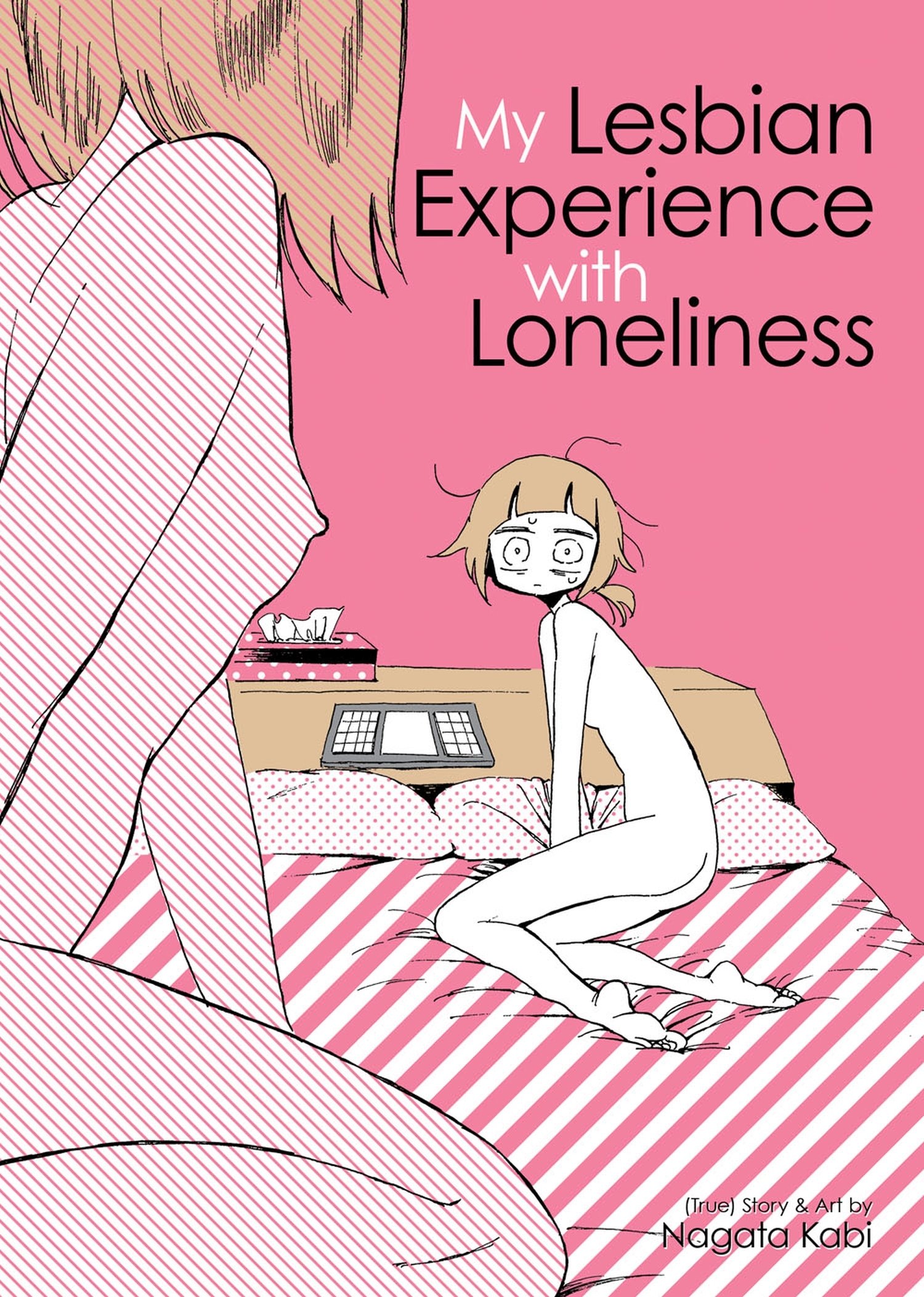
After Hours and My Lesbian Experience with Loneliness epitomize a small but growing trend in yuri manga licensing: both focus on women in their twenties exploring their sexuality, rather than depicting middle- or high-school aged girls crushing on each other.

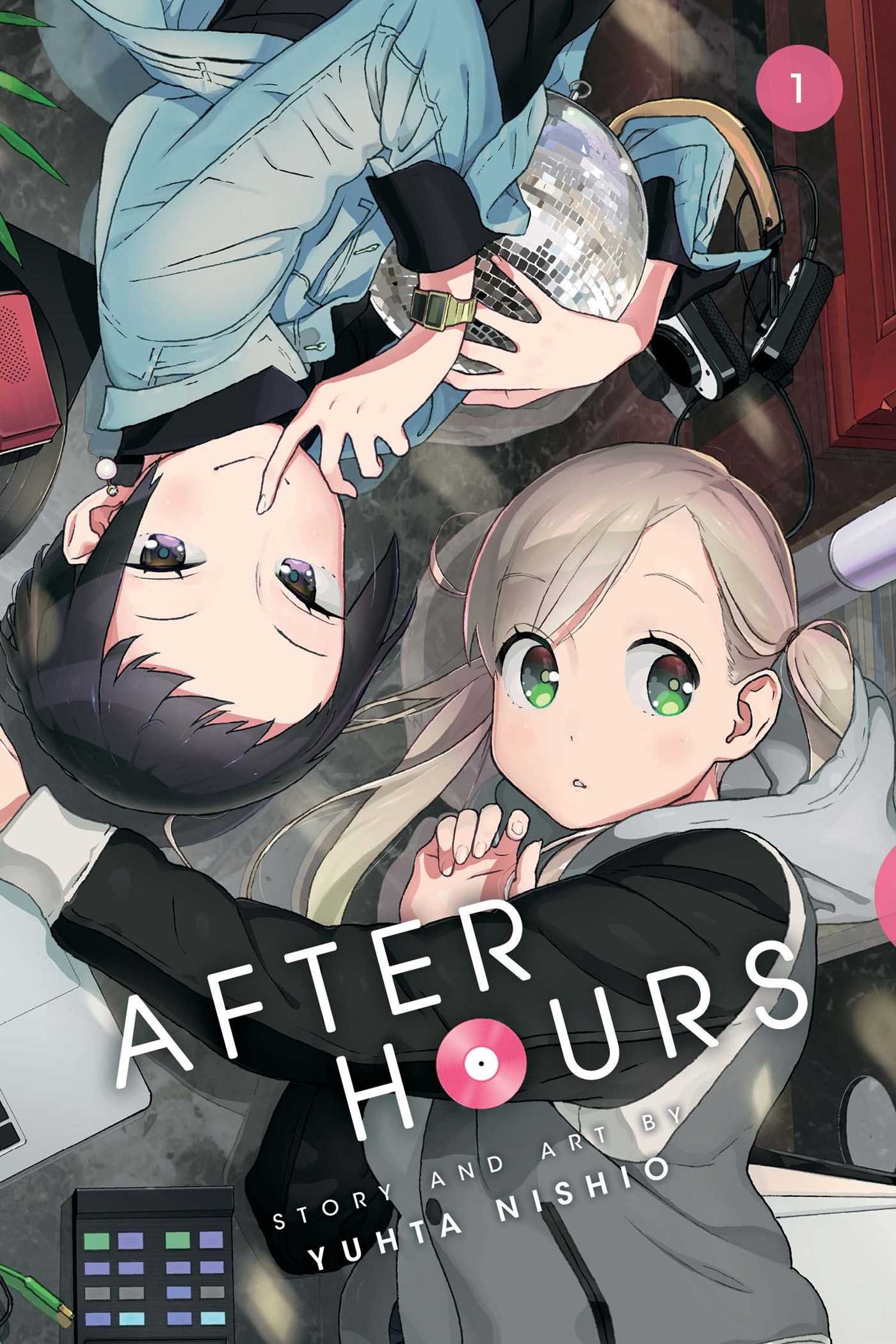
After Hours is the more upbeat of the two, a sympathetic portrait of twenty-three-year-old Emi, a recent college graduate who’s just quit her job and is struggling to figure out what comes next. A chance encounter with Kei, a twenty-nine-year-old deejay, is a turning point in Emi’s young adult life: not only is she drawn to Kei’s confidence, she’s also intrigued by Kei’s passion for spinning records. As their connection deepens, Emi takes a more active role in supporting Kei’s career, joining Kei’s circle of friends and trying her hand at “veejaying,” selecting videos to complement Kei’s set lists.

One of the most striking aspects of After Hours is Yuhta Nishio’s sensitive depiction of Emi and Kei’s sexual encounters. He uses a handful of discrete signifiers — a pile of clothing on the floor, a tender embrace, a flirtatious post-coital chat — rather than explicit or provocative imagery. That’s a wise choice, I think, as it allows Nishio to portray Emi and Kei as grown women with healthy sexual urges without reducing them to sexualized objects. Nishio’s restrained approach also emphasizes the aspects of Emi and Kei’s bodily intimacy that foster a mutual sense of trust, familiarity, and affection — a dimension of sexual experience that’s often missing from straight romance manga.

Though the first chapters are largely uneventful, future volumes promise dramatic complications. Emi has yet to disclose her relationship to her friends or her not-quite-ex-boyfriend, with whom she’s still sharing an apartment. More interestingly, Emi hasn’t really thought about what it means to be in a relationship with another woman; she’s initially surprised by her attraction to Kei, but resists labeling those feelings as lesbian, bisexual, or queer, choosing instead to savor the sense of purpose and joy that being with Kei brings to her life. The ease with which Emi embraces her new love is a refreshing development, a quiet rebuttal of the idea that sexual orientation is absolute or easily defined.

By contrast, Nagata Kabi’s My Lesbian Experience with Loneliness is a more complex story, a confessional comic documenting the author’s sexual awakening in her late twenties. Nagata narrates her odyssey with candor, acknowledging the degree to which mental illness dictated her adult life. She describes the bodily ravages of disordered eating — she vacillated between anoxeria and bulimia — and the emotional toll of disordered thinking, noting the degree to which both depression and body dysmorphia prevented her from holding down a job, maintaining friendships, or thinking about herself as a sexual person. She also ruminates on her chilly relationship with her parents, and her profound sense of shame in disappointing them by not becoming a “real” adult with a conventional office job.

After hitting rock bottom, Nagata realizes the degree to which she’s suppressed her sexuality. In an effort to reassert control over her life, Nagata decides to hire a female escort for her first sexual experience. Nagata documents this encounter in an almost clinical fashion, contrasting her feverish anticipation with her stiff, detached response to being touched. For all of her progress towards mental health and self-acceptance, she realizes that she cannot yet surrender to the bodily sensations of desire — a tension that remains unresolved at the end of her narrative, even though Nagata’s final panels suggest her sense of relief and pride for taking such a bold step.

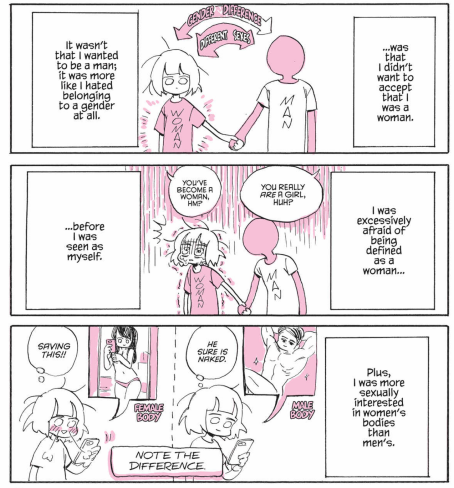
That Nagata’s journey is more inspiring than depressing is a testament to her writing skills (and, I might add, Jocelyne Allen’s artfully wry translation). Though Nagata never shies away from describing uncomfortable thoughts or self-destructive behavior, she finds moments of grace and humor in even the darkest situations, especially as she begins to contemplate what it means to be a sexual person. In three sharp, economical panels, for example, she explores her profound discomfort with binary gender labels, even as she begins to recognize her sexual attraction to women:

It feels churlish to criticize such a personal work, and yet I found myself wishing that Nagata’s art felt more essential to the story she was telling. Writing for The Comics Journal, critic Katie Skelly voiced similar concerns, arguing that Nagata’s tendency to mix big blocks of text with cute drawings keeps the reader at arm’s length when Nagata discloses intimate, sometimes disturbing, details of her eating disorders and self-mutilation. “Nagata can’t find a suitable bridge to mend the gap between the story of her experience and aesthetic,” Skelly notes. “[H]er style can read as generic and her tone never quite finds its mark.” I admit to feeling the same way about Nagata’s work: I admired her raw honesty, but felt that My Lesbian Experience with Loneliness could have been a book, a movie, or a Moth Radio Hour segment just as easily as a comic; nothing about the way Nagata related her experiences felt like it was uniquely suited to manga, as her drawings were more illustrative of what she felt than genuinely revelatory about why she felt such profound self-loathing.

For all the things that go unsaid in My Lesbian Experience with Loneliness, however, there’s much wisdom in Nagata’s story, especially for people struggling with what it means to be healthy, whole, and sexual. Nagata’s recovery is a testament to the human capacity for resilience, and her willingness to share her most vulnerable moments with strangers an act of genuine courage. Here’s hoping that she continues to document her journey of self-discovery.

VIZ Media provided a complimentary review copy of After Hours.

AFTER HOURS • STORY AND ART BY YUHTA NISHIO • TRANSLATION BY ABBY LEHRKE • 160 pp. • RATED TEEN+ (for older teens)

MY LESBIAN EXPERIENCE WITH LONELINESS • STORY AND ART BY NAGATA KABI • TRANSLATED BY JOCELYNE ALLEN • SEVEN SEAS • 152 pp. • RATED OT (for older teens)

Filed Under: Manga, Manga Critic, REVIEWS Tagged With: LGBTQ, My Lesbian Experience With Loneliness, Nagata Kabi, Seven Seas, VIZ, yuri

Elegant Yokai Apartment Life, Vol. 1

September 18, 2017 by Katherine Dacey

Elegant Yokai Apartment Life suffers from multiple personality disorder, lurching awkwardly from one situation to the next without comfortably settling into one storytelling mode long enough for the reader to decide if it’s a sitcom, a soap opera, or a horror show.

In fairness to creators Hinowa Kouzuki and Waka Miyama, few stories purely embody a single genre; the labels that the publishing and entertainment industries have coined — rom-com, dramedy — give ample proof that hybridization is a common strategy for enlivening familar plots. For such hybrid forms to work, however, the tonal shifts must be intrinsic to the story, arising naturally from the interactions between the characters and their environment. Elegant Yokai‘s narrative swerves, however, feel more like a desperate attempt to appeal to as many different constituencies as possible: there’s fanservice for guys (a female ghost who wears only panties and a well-placed towel) and girls (a hot onmyoji with a ponytail and a silver fox with an eye patch), yokai drawn from folklore and urban myth, a potential love interest for the hero, a raft of comic-relief characters who get brief turns in the spotlight, a subplot borrowed from a 1983 Afterschool Special, and tragic backstories for several characters just in case the idea of a “ghostly boarding house” doesn’t tickle your funny bone.

The most frustrating part of this narrative abundance is that so much of it feels… extra. Any one of these elements could be excised from the story without fundamentally changing the premise, making room for more character development. That point is crucial: Elegant Yokai‘s lead is less a person than a reader surrogate, walking from one situation to another in a state of mild befuddlement about his supernatural neighbors. Author Hinowa Kouzuki has saddled Inaba with motivations that explain how he ended up rooming with yokai, but hasn’t actually given him any discernible personality traits. Kouzuki and Miyama’s few attempts to flesh out Inaba’s character are clumsy and, frankly, illogical: what well-adjusted person marks his middle school graduation by fighting his BFF in an abandoned lot because he’s “always wanted to do that”? (Shouldn’t Inaba quote one of the rules of Fight Club or something?)

The artwork suffers from a similarly overdetermined quality. The human characters are less drawn than assembled from bits and pieces of other artists’ work — a dash of CLAMP here, a bit of Yuu Watase there — while the yokai have been shamelessly copied from Rumiko Takahashi and Hayao Miyazaki’s oeuvre. Making deliberate allusions to other artists’ work is, of course, a time-honored tradition, but here, these nods feel less like tribute and more like theft; readers tempted to compare Miyama’s art with Miyazaki’s are bound to find hers a poor substitute.

It’s only in the final chapter of volume one that we get a glimpse of what Elegant Yokai might have been. The story trains the spotlight on Inaba’s fellow apartment dwellers Kuga and Shiro, a boy and his dog who were murdered by Kuga’s mother. Once a month, Kuga’s mother — also a ghost — shows up at the apartment building to reclaim her son. Over time, however, her human form has deteriorated and memories have faded, reducing her to a pitiful demonic state, more scribble monster than angry wraith. The frankness with which Kouzuki and Miyama depict her crime prevents these scenes from descending into bathos; these moments are the only ones that elicit an authentic emotional response from the reader, not least because Kuga and Shiro’s predicament has a demonstrable effect on the other characters. Too bad the rest of volume one is such a frantic, disjointed mess.

ELEGANT YOKAI APARTMENT LIFE, VOL. 1 • STORY BY HINOWA KOUZUKI, ART BY WAKA MIYAMA • TRANSLATED BY ADAM HIRSCH • 206 pp. • RATED T (13+)

Filed Under: Manga, Manga Critic, REVIEWS Tagged With: Comedy, Horror/Supernatural, Kodansha Comics, Yokai

  • « Go to Previous Page
  • Page 1
  • Interim pages omitted …
  • Page 5
  • Page 6
  • Page 7
  • Page 8
  • Page 9
  • Interim pages omitted …
  • Page 26
  • Go to Next Page »
 | Log in
Copyright © 2010 Manga Bookshelf | Powered by WordPress & the Genesis Framework