• Skip to primary navigation
  • Skip to main content
  • Skip to primary sidebar
  • Home
  • About Us
    • Privacy Policy
    • Comment Policy
    • Disclosures & Disclaimers
  • Resources
    • Links, Essays & Articles
    • Fandomology!
    • CLAMP Directory
    • BlogRoll
  • Features & Columns
    • 3 Things Thursday
    • Adventures in the Key of Shoujo
    • Bit & Blips (game reviews)
    • BL BOOKRACK
    • Bookshelf Briefs
    • Bringing the Drama
    • Comic Conversion
    • Fanservice Friday
    • Going Digital
    • It Came From the Sinosphere
    • License This!
    • Magazine no Mori
    • My Week in Manga
    • OFF THE SHELF
    • Not By Manga Alone
    • PICK OF THE WEEK
    • Subtitles & Sensibility
    • Weekly Shonen Jump Recaps
  • Manga Moveable Feast
    • MMF Full Archive
    • Yun Kouga
    • CLAMP
    • Shojo Beat
    • Osamu Tezuka
    • Sailor Moon
    • Fruits Basket
    • Takehiko Inoue
    • Wild Adapter
    • One Piece
    • After School Nightmare
    • Karakuri Odette
    • Paradise Kiss
    • The Color Trilogy
    • To Terra…
    • Sexy Voice & Robo
  • Browse by Author
    • Sean Gaffney
    • Anna Neatrour
    • Michelle Smith
    • Katherine Dacey
    • MJ
    • Brigid Alverson
    • Travis Anderson
    • Phillip Anthony
    • Derek Bown
    • Jaci Dahlvang
    • Angela Eastman
    • Erica Friedman
    • Sara K.
    • Megan Purdy
    • Emily Snodgrass
    • Nancy Thistlethwaite
    • Eva Volin
    • David Welsh
  • MB Blogs
    • A Case Suitable For Treatment
    • Experiments in Manga
    • MangaBlog
    • The Manga Critic
    • Manga Report
    • Soliloquy in Blue
    • Manga Curmudgeon (archive)

Manga Bookshelf

Discussion, Resources, Roundtables, & Reviews

Manga

5 Underrated Shojo Manga

July 10, 2010 by Katherine Dacey

Earlier in the week, I sang the praises of Kaze Hikaru, my all-time favorite shojo manga (and one of my all-time favorite manga, period). Today I shine the spotlight on five great titles that haven’t garnered as much favorable notice as they deserve. Sadly, all but one are officially out of print or will be soon, owing to publisher closings, lapsed licenses, and so-so sales. If you can’t find them through retailers such as Amazon, Buy.com, or Right Stuf!, you might wish to cast your net wider to include sites like Robert’s Anime Corner Store (a good source for older titles) and eBay, or try your local library for copies.
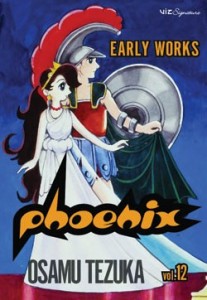
phoenix125. Phoenix: Early Years, Vol. 12
By Osamu Tezuka • VIZ Media • 1 volume (complete)
A better subtitle for volume twelve of Phoenix would be I Lost It At the Movies, as these four stories reveal just how passionately Osamu Tezuka loved American cinema. In a 1980 essay, Tezuka explained that “watching American big-screen spectacle movies such as Helen of Troy and Land of the Pharaohs made me want to create a similar sort of romantic epic for young girls’ comics.” Looking at this collection, the sword-and-sandal influence manifests itself in almost every aspect of Tezuka’s storytelling, from the costumes and settings to the dialogue, which the characters declaim as if it were of Biblical consequence. (Paging Charlton Heston!) What makes this Hollywood pomposity bearable — even charming — is the tempering influence of Walt Disney. The character designs owe an obvious debt to Snow White, while the supporting cast could easily belong to Cinderella or Sleeping Beauty’s entourage of chatty animal friends.Anyone looking for the moral complexity of later Phoenix stories will be disappointed in volume twelve, as Tezuka’s villains are cartoonishly evil and his heroes (and heroine) chastely noble. If one approaches this collection in the spirit of, say, a musicologist flipping through Beethoven’s pre-Eroica manuscripts, however, the rewards are more palpable. In these early stories we see Tezuka developing his comedic chops with pop culture references and physical slapstick; we see him experimenting with layout, as he renders the battlefields of Troy and Rome in sweeping, full-page panels; and we see him creating his first cycle of interconnected stories, introducing some of the themes that would unify the entire Phoenix saga. In short, we see Tezuka’s first attempts to find his own voice as he pays tribute to the artists who influenced him, learning more about his exuberant, unique artistry in the process. (Originally reviewed at PopCultureShock on 3/19/08.)
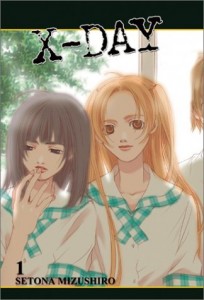
xday14. X-Day
By Setona Mizushiro • Tokyopop • 2 volumes (complete)
When star high jumper Rika injures her leg and loses her boyfriend to a teammate, she becomes profoundly depressed. She soon discovers an online community of similarly disaffected students, however, all of whom share her desire to “make the school disappear.” Their internet chats soon give way to in-person meetings, where Rika comes face-to-face with three very different people: “Polaris,” a shy teen who dresses like a Goth off campus, “Mr. Money,” a friendly underclassman, and “Janglarian,” a young biology teacher who wants to dynamite the school. Setona Mizushiro’s dark story could easily spiral into melodrama, but she does a fine job of showing us how the normal tribulations of being a teenager — fighting with parents, enduring harassment from peers, feeling overwhelmed by anxiety — have led these four fragile people to hatch such a radical plan for coping with their pain. The second volume lacks the dramatic urgency of the first, as the students’ plot begins to come unraveled, but X-Day remains persuasive until its final pages, thanks to Mizushiro’s vivid characterizations and nuanced artwork.
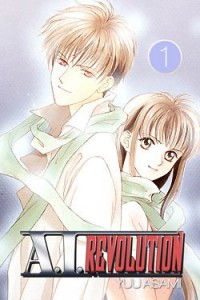
airevolution13. A.I. Revolution
By Yuu Asami • Go! Comi • 5 volumes (incomplete; 17 volumes in Japan)
A.I. Revolution starts from a premise familiar to legions of Isaac Asimov fans: a human builds a robot, only to discover his creation has a mind and feelings of its own. Sui, the story’s human protagonist, initially views robots as household appliances, not unlike toasters or vaccuum cleaners. When her father presents her with an android companion, however, Sui develops a strong bond with it, discovering that Vermillion has a capacity for emotion that far outstrips her expectations.

A.I. Revolution may sound like I, Robot Hottie, but Yuu Asami puts a thoughtful spin on the material, filtering familiar sci-fi themes through a shojo lens. Though she weaves evil scientists and corporate espionage into the narrative, the story is at its best when focusing on Vermillion’s interactions with his human family; Sui’s father, for example, has modeled Vermillion in the image of a colleague that he admired, leading to a few funny, awkward moments of human-robot flirtation, while Sui seesaws between sisterly protectiveness and romantic attachment to her handsome companion. (Really, is there any other kind of robot in shojo manga?) Asami’s art reminds me of Akimi Yoshida’s with its elongated character designs, delicate linework, and sparing use of screentone. It’s a little dated perhaps, but a welcome change of pace from the slicker, busier layouts characteristic of the titles licensed by Tokyopop and VIZ. Highly recommended for fans of old-school shojo. (Originally reviewed at PopCultureShock on 3/4/08.)
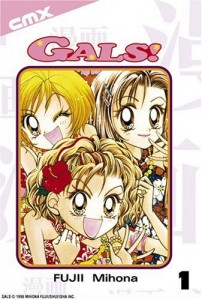
gals12. GALS!
By Mihona Fuji • CMX Manga • 10 volumes (complete)
This wacky comedy is one of the better shojo licenses in the CMX catalog, a rude, raunchy, and oddly moral tale about a feisty kogal named Ran Kotobuki. Though Ran and her pals are primarily interested in shopping for outrageous outfits, visiting the tanning salon, and stealing book bags from students at rival schools, Ran’s upbringing in a household full of police officers (dad, mom, and big brother are all cops) has taught her to adhere to a strict code of conduct: no sex for favors, and no tolerance for anyone who disrespects her friends.

Ran is a terrific, memorable character — impetuous, loud, funny, and tough, the kind of person who would literally smack sense into another girl if she thought it would work. Better still, she’s not easily swayed by boys; her relationship with the sweet but dim Tatsuki is surprisingly chaste, limited primarily to hand-holding and awkward discussions about feelings. (Ran won’t deign to say, “I love you,” as it compromises her tough-girl image.) As befits a manga that was serialized in Ribon, all of the characters have enormous, doll-like eyes in the Arina Tanemura style, and fabulous outfits that shame the Gossip Girls. The backgrounds are surprisingly detailed, conveying the look and feel of the Shibuya district with a specificity that’s all too rare in shojo manga. In sum, Gals! is the kind of good-natured gang comedy that I hoped My Darling! Miss Bancho would be: full of humor and heart, but with fewer capitulations to shojo convention.
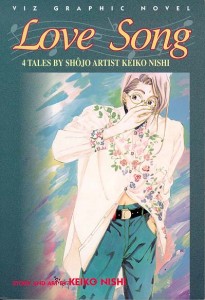
lovesong1. Love Song
Keiko Nishi • VIZ Media • 1 volume (complete)
Back in the 1990s, Matt Thorn labored hard to make Keiko Nishi a household name among American manga readers, translating six of her stories for VIZ; two appeared in Four Shojo Stories alongside work by Moto Hagio and Shio Sato, and four appeared in a stand-alone volume called Love Song. Though Nishi didn’t catch on with Western shojo fans, it’s easy to see why Thorn championed her work: she’s a terrific, versatile storyteller, equally capable of writing light-hearted fantasies and character studies of deeply damaged people.

Of the four stories that appear in Love Song, two are standouts: “Jewels of the Seaside,” a black comedy about three sisters who compete for the same man’s affection, with disastrous results, and “The Skin of Her Heart,” a quiet sci-fi tale about a young woman torn between what she wants and what her mother wants for her. (Readers who enjoyed A, A’ or Twin Spica are a natural audience for “Skin of Her Heart,” though it works equally well for folks who aren’t big sci-fi buffs.) Nishi’s artwork is an acquired taste, at times precise, elegant, and naturalistic, and at times loose and sketchy, with the white of the page playing an important role in underscoring the emotional distance between her characters. Her minimalist approach won’t be to every shojo fan’s liking, but she demonstrates that it’s perfectly possible to convey the interior lives of her characters without resorting to the kind of visual shorthands — flowers, sweatdrops, nosebleeds — that have been overused in contemporary shojo manga. Love Song is out of print, but unlike Four Shojo Stories and A, A’, is still relatively easy to obtain through online retailers like Amazon. Highly recommended.

HONORABLE MENTIONS
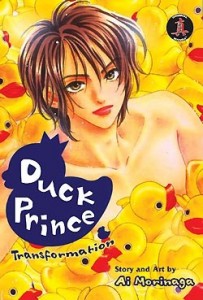
duckprince1Duck Prince
By Ai Morinaga • CMP • 3 volumes (suspended)

Morinaga’s battle-of-the-sexes comedy takes a standard shojo plot — homely gal gets makeover to win the guy of her dream — and turns it on its head, substituting a sweet, helmet-haired nerd for the customary plain Jane, and adding a novel twist: Reiichi appears to most girls as a smokin’ hottie, but in the presence of his beloved Yumiko, he reverts to his original form. As in all her work, Morinaga uses humor to make deeper points about gender roles and physical beauty, though Duck Prince is too rude and risque to be mistaken for an Afterschool Special. Central Park Media released three of the five volumes before suspending Duck Prince; of all the titles left homeless by CPM’s demise, it seems like one of the strongest candidates for a license rescue, though middling sales of Your & My Secret and My Heavenly Hockey Club may have scared American publishers away from Morinaga’s distinctive comedies.
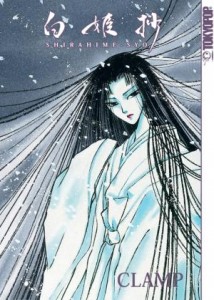
shirahimesyoShirahime-Syo: Snow Goddess Tales
By CLAMP • Tokyopop • 1 volume

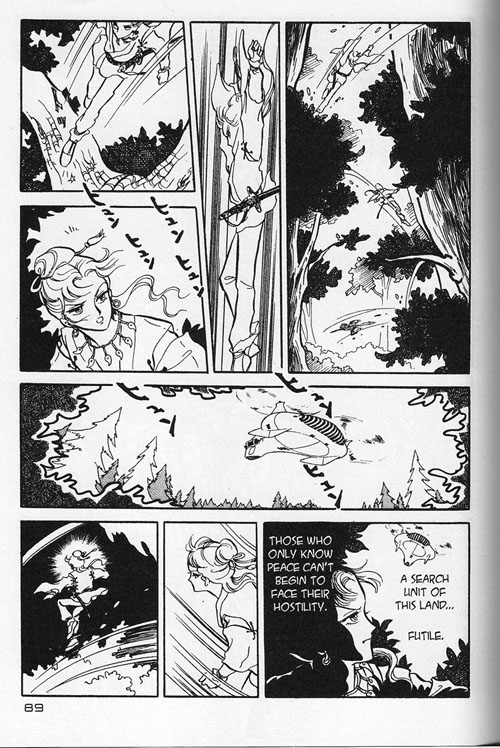
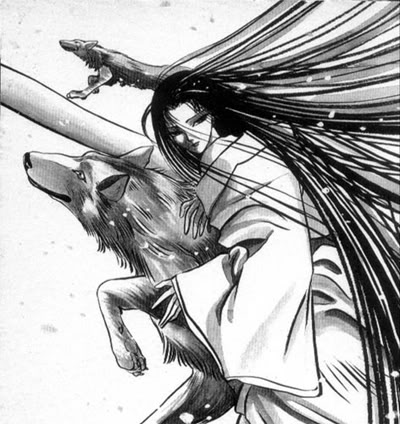
This lovely anthology is a radical departure for CLAMP. Gone are the super-detailed costumes and fussy character designs of their early, post-doujinshi work; in their place are spare, simply-drawn figures that seem consciously modeled on examples from eighteenth- and nineteenth-century scroll paintings. The stories themselves are told directly without embellishment, though CLAMP infuses each tale with genuine pathos, showing us how the characters’ anger and doubt lead to profound despair. As a result, the prevailing tone and spirit are reminiscent of Masaki Kobayashi’s 1964 film Kwaidan, both in the stories’ fidelity to the conventions of Japanese folklore and in their lyrical restraint. And if my description didn’t sell you on Shirahime-Syo, let this beautiful image, taken from the final story of the collection, persuade you to give this out-of-print gem a try:
snowgoddess2

* * * * *

So what titles top your list of underrated shojo manga? Inquiring minds want to know!

Filed Under: Manga, Manga Critic, Recommended Reading Tagged With: Ai Morinaga, clamp, Classic, cmx, Comedy, CPM, Drama, Go! Comi, Historical Drama, Osamu Tezuka, Sci-Fi, Setona Mizushiro, Tokyopop, VIZ

Saturn Apartments 1 by Hisae Iwaoka: B+

July 9, 2010 by Michelle Smith

In this low-key, dystopic sci-fi story, a boy named Mitsu takes up his missing father’s occupation as a window washer in the hopes that it will yield answers about his disappearance, or maybe just life in general.

Humanity has vacated Earth. They were not, however, willing to move too far away from their former home, now declared a vast nature preserve, and have instead taken up residence in a gigantic ring around the planet. Within the ring, a very stratified society exists, with public facilities located on the relatively airy middle levels, spacious homes for the wealthy in the upper levels, and dark and cramped living conditions for everyone else in “the basement.” Saturn Apartments is essentially a slice-of-life story that follows Mitsu as he begins his new job (washing the ring’s external windows) and interacts with residents from the various levels of society. Most of the guild’s work is either assigned by the government or commissioned by the very rich, so when his first job is cleaning windows on the lower level, it’s rare.

This job has been requested by a young couple who are about to get married—the groom-to-be is Sohta, a very bright young man who obtained an advanced degree with the hopes of finding a job in the middle levels. Only after Sohta graduated was he told that, even if he goes to grad school, he’s still not going to be employable because he’s from the basement. He ends up settling for a job as a technician in a power plant instead. Many of the following stories also serve to illustrate the plight of the basement-dwellers while offering in contrast the excesses of the rich, including one eccentric fellow who keeps a near-extinct sea creature in his home and another who tinkers with robots all day long and has the crew back to redo his windows over and over without offering any explanation as to what they’ve done wrong.

Meanwhile, Mitsu seeks to learn more about the accident that apparently claimed the life of his father, Akitoshi. Five years ago, Akitoshi’s rope was cut and he plunged toward Earth. Mitsu had always suspected that his father cut the rope intentionally, but when he’s sent to work at the same spot, he notices some damage to the ring’s hull that could’ve been responsible for severing the rope, along with many handprints that suggest his father fought to stay alive. Later, he meets his Akitoshi’s former partner, Tamachi, and begins to hear about a side of his father that he never knew.

As I wrote in my introduction, the world of Saturn Apartments is what I would call a low-key dystopia. Those who dwell in the basement aren’t too happy with their lot, but they seem resigned to the fact that they can’t do anything about it. The only one who really has any spunk is Jin, the experienced window washer with whom Mitsu is partnered, but his frustration at rich folks manifests as bursts of ill temper that pass quickly. Iwaoka’s art excels at depicting the oppressive feeling of life in the basement—narrow alleyways and towering buildings reinforce the notion of insurmountable obstacles and one can almost feel the weight of all the rooms above Mitsu’s pressing down on him.

Mitsu himself is perhaps the weakest link here because he is so much an observer. We do learn that his mother died when he was very young and that, after his father’s death, some kindly neighbors attempted to care for him but he always kept a respectful distance from them. Now that he’s finished school and is working, he is determined to pay his own way and seeks to find meaning in the work that he’s doing. Too, he believes that following in his father’s footsteps and working hard will enable him to learn something. What that is, exactly, he doesn’t know, but perservering feels important.

I certainly find Mitsu’s quest interesting and will keep reading about him and his world, but it’s as if he’s keeping a respectful distance from the reader, too, which makes it difficult to become more than simply curious how things will turn out.

This review was originally published at Comics Should Be Good.

Saturn Apartments is published in English by VIZ. One volume has been released so far, though two chapters of volume two are available on the SigIKKI website. The series is still ongoing in Japan; five volumes are currently available there.

Filed Under: Manga Tagged With: VIZ, VIZ Signature

My Favorite Shojo Manga: Kaze Hikaru

July 7, 2010 by Katherine Dacey

In Manga: Sixty Years of Japanese Comics, author Paul Gravett argues that female mangaka from Riyoko Ikeda to CLAMP have often used “the fluidity of gender boundaries and forbidden love” to “address issues of deep importance to their readers.” Taeko Watanabe is no exception to the rule, employing cross-dressing and shonen-ai elements to tell a story depicting the “pressures and pleasures of individuals living life in their own way and, for better or worse, not always as society expects.”

Kaze Hikaru begins in 1863, a period of immense political and social upheaval in Japan, as the ruling class divided into factions loyal to the emperor (whose seat was in Kyoto), and factions loyal to the shogun (whose government was housed in Edo, or present-day Tokyo). Exacerbating the tension between these groups was the looming question of sakoku, or isolationism, a centuries-old policy that was crumbling in the face of military and economic pressure from the West, an unstable currency, and the dawning realization that certain Western technologies might have a role to play in the modernization of Japan. Taeko Watanabe draws on the events of the Bakumatsu (or late shogunate era, 1863 – 1867) for Kaze Hikaru, incorporating real historical figures into the story and dramatizing some of the major and minor conflicts of the period, from the Ikedaya Affair of 1864 to the Shinsengumi’s ambivalence about adopting rifles and canons into the samurai arsenal.

In the opening pages of Kaze Hikaru, Sei Tominaga, the heroine, lives a sheltered existence under the watchful eye of her father and older brother. Local rabble-rousers accuse the Tominagas of harboring spies at the medical clinic they operate and burn it to the ground, leaving Sei homeless and orphaned. Determined to avenge her family, Sei disguises herself as a boy, adopts the name Kamiya Seizaburo, and joins the Mibu-Roshi, a band of ronin who are fiercely loyal to the Tokugawa Shogunate. (The Mibu-Roshi would come to be known as the Shinsengumi, or “newly chosen corps.” At the height of their power, their ranks numbered around 300, and included a few members who were not born into the samurai caste.) Sei finds a mentor in the slightly older Okita Soji, an accomplished swordsman who acts as a den mother for new recruits. He accidentally discovers Sei’s identity, agreeing to keep her secret if she can demonstrate her worth as bushi, or an honorable warrior.

Watanabe’s art is clean and crisp, conveying enough period detail to firmly establish the setting without overwhelming the eye. A similar attention to facial features and body shapes also informs her nuanced and varied character designs, a godsend for a such a densely populated series. The action sequences are staged simply but effectively, conveying the skill and physical strength necessary to best an opponent in hand-to-hand combat, or suggesting the dangers of a night-time raid. But it’s in the everyday moments that Watanabe’s artistry really shines, as she has a talent for depicting the energy and activity of an urban marketplace, a soliders’ encampment, or a red-light district. We see the Shinsengumi recruits train, squabble, drink, gamble, and abuse their power with innkeepers and merchants, with careful attention paid to the objects they handle, the clothing they wear, and the posture they adopt as they interact with people of higher and lower social status.

Much of the drama — as well as the humor — in Kaze Hikaru stems from Sei’s attempts to fit in with her fellow soldiers by proving her worth as a man — no mean feat, given her small size, feminine appearance, and cultivated upbringing. (This is one of the few cross-dressing stories in which characters routinely ask the question on readers’ minds: “Aren’t you a little too pretty to be a guy?” Not surprisingly, some of the men desire Sei as an exceptionally handsome boy, further confusing our protagonist.) Sei’s greatest challenge, however, is concealing her deep love for Okita as both a mentor and a man. She wants Okita to respect her as a warrior, yet fears that her gender-bending transgression may prevent him from reciprocating her romantic feelings. It’s a classic shojo predicament — think of Lady Oscar and her manservant Andre — that simultaneously reveals Sei’s vulnerability and resolve. Her fierce commitment to the Shinsengumi, however, eventually prevails over her desire to reclaim her feminine identity, as she decides to honor Okita’s wish that she be Seizaburo and not Sei.

When contrasted with other Shojo Beat titles, Kaze Hikaru seems a little old-fashioned. Watanabe tends to favor neat grids and clearly-defined panels over the freer, more expressive layouts used in series like We Were There, Sand Chronicles, and Vampire Knight. The pace, too, is more stately, demanding a higher level of attention from the reader than most Shojo Beat titles; Watanabe’s characters discuss political matters, clan rivalries, and military strategy in considerable detail, giving some scenes the feeling of a Kurosawa movie. Even Sei and Okita’s friendship, rooted as it is in mutual warrior regard, seems out of step with the racier romances depicted in Absolute Boyfriend and B.O.D.Y.: would a school council president or magical girl swoon when she received a customized katana from the object of her affection, even if it was a sincere expression of his respect for her skill and courage?

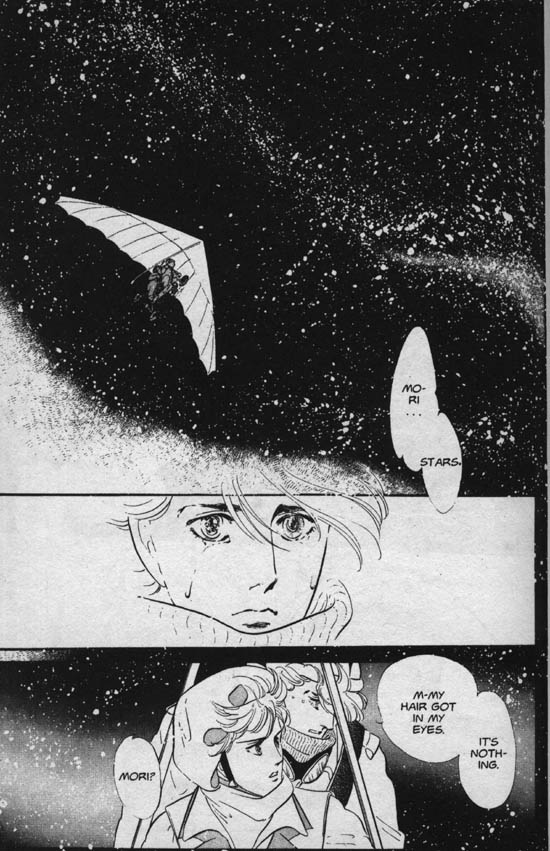
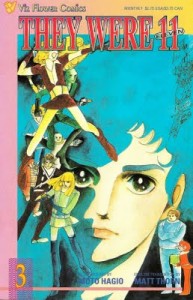
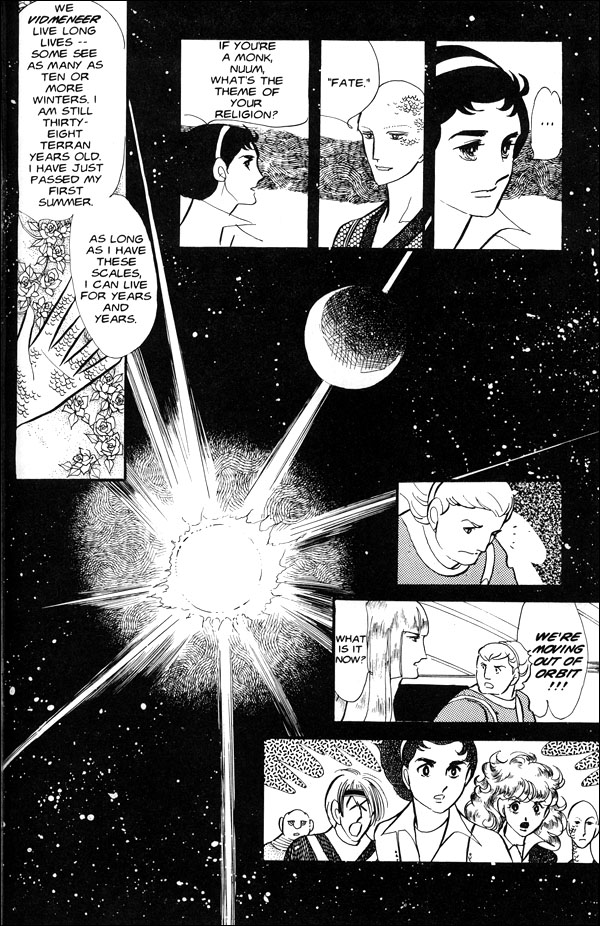
Yet for all its squareness — or perhaps because of it — Kaze Hikaru remains my all-time favorite shojo manga. What makes Kaze Hikaru so compelling is the way in which Watanabe appropriates a very tired story — samurai seeks revenge in a time of social and political turbulence — and infuses it with a fresh, feminine sensibility. I might call it Satsuma Gishiden for Girls, but I think that downplays Watanabe’s achievement. She’s created an action-filled drama in the vein of The Rose of Versailles or They Were Eleven but transplanted the setting from the relatively safe, romanticized worlds of the French Revolution and outer space to a period in Japanese history in which the male-identified virtues of courage, discipline, and patriotism dominated public discourse. She may not have intended it as a bold political statement, but Watanabe has done something extraordinary: she’s given girls the freedom to project themselves into Japan’s past without gender constraints. American artists looking to connect with female readers would do well to read Kaze Hikaru for inspiration — there’s a great graphic novel to be written about a cross-dressing Minuteman or Union solider, and Sei would make a terrific prototype for its spunky heroine.

Review copies of volumes 17 and 18 provided by VIZ Media, LLC. This is an expanded version of a review that appeared at PopCultureShock on 5/17/07.

KAZE HIKARU, VOLS. 1-18 • BY TAEKO WATANABE • VIZ • RATING: OLDER TEEN (16+)

Filed Under: Manga, Manga Critic, Recommended Reading, REVIEWS Tagged With: Samurai, shojo, shojo beat, VIZ

The Best Manga You’re Not Reading

July 2, 2010 by Katherine Dacey

On Saturday, June 26th, Brigid Alverson, Robin Brenner, Martha Cornog, and I gave a presentation at the American Library Association’s annual conference called “The Best Manga You’re Not Reading.” The goal of our talk was to remind librarians about all the weird, wonderful, and diverse offerings for older teens and adults. Recommendations ran the gamut from Junko Mizuno’s Cinderalla (one of Martha’s picks) to ES: Eternal Sabbath (one of Brigid’s), with an emphasis placed on titles that are in-print and appealing to readers who self-identify as manga fans — and those who don’t. Below are my four picks, plus a “mulligan” (to borrow a term from Brigid).

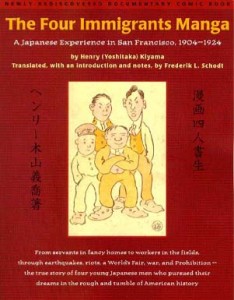
fourimmigrantsThe Four Immigrants Manga
Henry Yoshitaka Kiyama • Stone Bridge Press • 1 volume
In 1904, aspiring artist Henry Kiyama sailed from Japan to the United States in search of economic opportunity. After living in San Francisco for nearly twenty years, Kiyama documented his experiences in the form of 52 short comics. His memoir — one of the very first examples of a graphic novel — examines the racism and economic hardships that he and his friends encountered on a daily basis. Kiyama also addresses major events of the day, critiquing several Congressional acts designed to curtail Asian immigration, and remembering what it was like to live through the Great Earthquake of 1906, attend the Panama Pacific International Exposition of 1915, and survive the flu pandemic of 1918.

What makes these autobiographical comics truly extraordinary, however, was that they were originally published in 1931 in a bilingual edition right here in America. As Frederik Schodt explains in his introductory essay, Kiyama’s work was aimed at other first-generation immigrants who, like him, were caught between two worlds, trying to make sense of their place in both. The visual style and subject matter may not strike contemporary readers as manga-esque (Schodt notes the influence of American cartoonist George McManus on Kiyama), but the intimate quality of the stories will leave as lasting an impression as graphic memoirs such as Marjane Satrapi’s Persepolis and Alison Bechdel’s Fun Home.

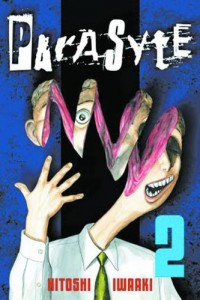
parasyte-v2Parasyte
Hitoshi Iwaaki • Del Rey • 8 volumes, complete
Imagine, if you can, a manga that combined elements of My Left Foot, Invasion of the Body Snatchers, and The Defiant Ones with the witty banter of a good buddy cop picture, and you have some idea of what Hitoshi Iwaaki’s Parasyte is all about. The story focuses on Shin, a high school student who wakes up one night to find a worm-like alien tunneling up his right arm towards his brain. In a moment of panic, Shin applies a tourniquet, arresting the creature’s progress but creating a brand-new problem in the process: the parasite takes up residence in his right hand, manifesting itself as a snail-like entity with googly eyes, a mouth, and the ability to transform itself into an astonishing array of shapes. Recognizing that their bodies are becoming interdependent, Shin and Migi (as he decides to call the parasite) agree to an uneasy truce. It isn’t long before other aliens are alert to Shin and Migi’s presence, forcing Shin and Migi to flee when it becomes apparent that the other parasites won’t tolerate their symbiotic existence. Shin and Migi can’t go to the human authorities, either, without risking imprisonment, quarantine, or worse.

Like a good B-movie, Parasyte uses elements of science fiction and horror to explore Big Questions about human nature while scaring the hell out of readers; the series is filled with nail-biting scenes of Shin and Migi trying to escape detection or fight other parasites. The violence is graphic but not sadistic; most of the action takes place between panels, with only the grisly aftermath represented in pictorial form. (Read: no torture scenes, no female characters being sexually assaulted before becoming an alien’s dinner.) The script is clever and funny, as Shin and Migi trade barbs with the antagonistic affection of Ernie and Bert, Oscar Madison and Felix Unger, or Detectives Mike Logan and Lenny Briscoe. Their relationship is one of Parasyte‘s greatest strengths, adding an element of novelty to a familiar story while deftly critiquing the idea that human beings’ intellect and emotional attachments place them squarely atop the food chain.

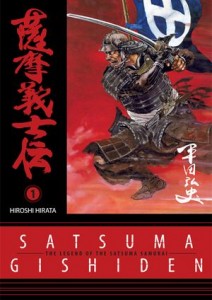
satsumaSatsuma Gishiden
Hiroshi Hirata • Dark Horse • 3 volumes, suspended
With its heady mix of social commentary, political intrigue, and battlefield action, Hiroshi Hirata’s Satsuma Gishiden reads like Kagemusha as told by Sam Peckinpah. Hirata dramatizes the plight of a powerful southern province that rebelled against the shogunate in the late eighteenth century (and would again, more famously, in the nineteenth). The story unfolds in a kaleidoscopic fashion, introducing us to the the sanpin and goshi, low-born samurai who eked out a living as farmers and laborers between military engagements; the daimyo, the leaders of Satsuma’s ruling Shimazu clan; and the administrators, spies, and chonin swept up in the violent conflict.

In the wrong hands, this material would be horribly dull; the initial showdown between Satsuma and shogunate stems from a public works project. (Makes you wonder: was Satsuma Gishiden the favorite manga of Robert Moses?) But Hirata successfully balances historical narrative and dramatic action. He explains the caste system and politics of the Edo period, the ritual of hiemontori, the concept of nise — even the type of water works found in eighteenth-century Japan — tossing in some jokey panels of winged ryo and money-grubbing donjon to illustrate the shogunate’s corruption. Some readers may find these passages didactic, but they provide an essential foundation for grasping nuances of plot and character. Lest the tone become too pedantic, Hirata liberally sprinkles the story with passages of bawdy humor and baroque violence. In one gruesomely funny scene, for example, a dying character uses his own broken rib to puncture an opponent’s skull. Top that, Mr. Peckinpah!

The chief attraction of Satsuma Gishiden, however, is its distinctive visuals. Hirata’s layouts evoke the films of mid-century masters such as Kurosawa, Kobayashi, and Ozu, blending cinematic realism with the rough-hewn aesthetic of woodblock prints. The characters, costumes, and horses are rendered in meticulous detail, yet the artwork is never static; through creative use of perspective, Hirata immerses the reader in vivid battle scenes, lively clan meetings, and ocean voyages. (Just a thought: Satsuma Gishiden would be awesome in 3-D. Maybe Dark Horse could repackage future editions with goggles to enhance the effect?) Recommended for samurai movie buffs, amateur Japanese historians, and readers who’ve exhausted the Kazuo Koike canon. (Originally reviewed at PopCultureShock on 2/16/07.)

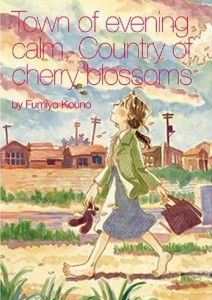
town_coverTown of Evening Calm, Country of Cherry Blossoms
Fumiyo Kouno • Last Gasp • 1 volume
If Barefoot Gen shows readers what it was like to live through the Hiroshima bombing and its horrific aftermath, Town of Evening Calm, Country of Cherry Blossoms shows readers what it was like to live with the memories of that day ten, twenty, and forty years later. Fumiyo Kouno’s book is divided into two stories. The first, “Town of Evening Calm,” is set in 1955, and focuses on one young woman’s attempt to preserve the remnants of her family, while the second, “Country of Cherry Blossoms,” is set in the 1990s, and focuses on the strained relationship between a survivor and his adult daughter. Both stories are simply but beautifully illustrated, avoiding the kind of visual tropes (big eyes, tiny noses, super-cute deformations) that many Western readers find jarring when reading Serious Manga.

In the few panels alluding to the actual events of August 6, 1945, Kouno’s art becomes more primitive and stylized, suggesting the horrific effects of the blast by depicting the victims as stick figures with swollen faces. The child-like simplicity and directness of these images are startling yet effective, a powerful representation of the radiation’s devastating ability to rob its victims of their identities by destroying their hair, hands, and faces. These scenes are notable as well for the skillful way in which present and past co-exist within the same panels; we see the landscape as the survivors do, alive with vivid memories of the blast. None of these images are graphic, though they are an unsettling reminder of the characters’ deep emotional scars.

The book’s strong anti-war message is balanced by the story’s emphasis on quiet, everyday moments, preventing Town of Evening Calm, Country of Cherry Blossoms from succumbing to didacticism or sensationalism. Though Kouno did not grow up in Hiroshima, her meticulous research and careful reading of survivor memoirs lends her work a kind of emotional authenticity that a more dramatic story might have lacked. The result is a moving work that challenges readers to imagine how they might rebuild their lives in the aftermath of incomprehensible tragedy. (Reviewed at The Manga Critic on 1/4/10.)

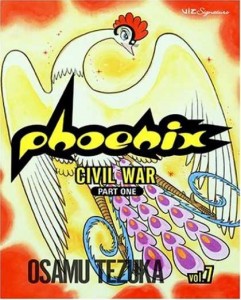
phoenix7BONUS PICK: Phoenix: Civil War
Osamu Tezuka • VIZ • 2 volumes
A quick glance through Phoenix: Civil War might not suggest that this is the stuff of high art. The characters bear an uncanny resemblance to the denizens of Popeye and jokey anachronisms abound. (Although the story ostensibly takes place in twelfth-century Japan, one character receives a telephone call and chows down on a bucket of KFC.) But flip to the back pages, where VIZ has included a brief statement from the manga-ka explaining the origins and meaning of Phoenix, and you’ll learn that Tezuka claimed Igor Stravinsky’s ballet The Firebird as the inspiration for Phoenix. Tezuka saw parallels between Stravinsky’s firebird and a similar creature from Japanese legend, Hou-ou. The phoenix, Tezuka decided, was a powerful symbol of “man’s attachment to life and the complications that arise from greed.” Using the phoenix as a touchstone, Tezuka constructed an elaborate, twelve-volume series exploring Japan’s historic past and possible future. He planned a final volume set in present-day Japan (“where past and future converge”), but passed away without completing his epic.

One of the best things about Phoenix is that readers can enjoy it as a series or a collection of stand-alone stories. Though I love Sun (the series’ epic, two-volume conclusion) and Karma (the fourth volume of the English edition), I think the two-volume Civil War (the seventh and eight volumes of the English edition) make the best introduction to Tezuka’s masterpiece. Civil War is set in Heian-era Kyoto, where several powerful families vie for control of the city. We experience the conflict through myriad perspectives: a lowly woodcutter and his fiancee, a ragtag band of samurai, an apolitical sage, and two powerful clan leaders, both of whom seek the phoenix in an effort to consolidate their political victories and perpetuate their bloodlines. The story may remind readers of The Hidden Fortress as it moves between epic battles and domestic drama, romance, and earthy comedy. While Tezuka isn’t above a little flatulence humor, he never condescends to his characters, using such lowbrow moments to demonstrate the common humanity of his entire cast. The character designs may be too cartoonish for some tastes, but Tezuka’s artwork is never short of spectacular; his imaginative layouts and flair for caricature are as distinctive as Igor Stravinsky’s brilliant orchestrations, churning rhythms, and pungent octatonic harmonies. (Originally reviewed at PopCultureShock on 10/26/06.)

* * * * *

Click here to read Brigid and Martha’s recommendations; click here to read Robin’s. Have a title you’d like to suggest? Let me know in the comments — we’re hoping to do this panel again at another convention, and would welcome your feedback.

Filed Under: Manga, Manga Critic, Recommended Reading, REVIEWS Tagged With: Classic, Dark Horse, del rey, Last Gasp, Osamu Tezuka, Samurai, VIZ

Manga Artifacts: Pineapple Army

June 30, 2010 by Katherine Dacey

About two years ago, I reached a tipping point in my manga consumption: I’d read enough just enough stories about teen mediums, masterless samurai, yakuza hit men, pirates, ninjas, robots, and magical girls to feel like I’d exhausted just about everything worth reading in English. Then I bought the first volume of Taiyo Matsumoto’s No. 5. A sci-fi tale rendered in a stark, primitivist style, Matsumoto’s artwork reminded me of Paul Gauguin’s with its mixture of fine, naturalistic observation and abstraction. I couldn’t tell you what the series was about (and after reading the second volume, still can’t), but Matsumoto’s precise yet energetic line work and wild, imaginative landscapes filled with me the same giddy excitement I felt when I first discovered the art of Rumiko Takahashi, CLAMP, and Goseki Kojima.

In a rush of enthusiasm to see what else was out there, I began trawling eBay for forgotten treasures, using Jason Thompson’s Manga: The Complete Guide as my map. What I found were an eclectic assortment of titles released in a variety of formats: Katsuhiro Otomo’s Memories, Leiji Matsumoto’s Galaxy Express 999, Jiro Taniguchi’s Hotel Harbor View, Keiko Nishi’s Love Song. Some proved exciting, others abysmal, but all were interesting as artifacts of English-language manga’s pre-history, of the days before Fruits Basket and Naruto were ubiquitous in chain stores and malls. As I’ve been assembling a collection of older titles, I’ve found myself wondering why some of these books were originally licensed and whether there’s a place for them in the current market. To explore these questions, I decided to dedicate more space at my website to examining out-of-print titles, from the undiscovered gems to the unmitigated disasters.

goshiPINEAPPLE ARMY

For my inaugural Manga Artifacts column, I chose one of my happiest discoveries: Pineapple Army (VIZ), a collaboration between writer Kazuya Kudo (Mai the Psychic Girl) and artist Naoki Urasawa. Reading Pineapple Army is like opening a time capsule from the mid-1980s, when wars were Cold, American cities were crime-ridden, and Central America was as important a theater of operations as the Middle East. Jed Goshi, the reluctant hero of Pineapple Army, is an ex-Marine who hasn’t quite managed to re-integrate himself into civilian life after two tours of duty in ‘Nam. Goshi now works for a mysterious agency that helps people who can’t or won’t turn to the proper authorities for help. Though Goshi doggedly insists he’s an instructor, not a bodyguard — “I turn people into combat-ready soldiers in a short amount of time,” he informs one client — he always becomes embroiled in the action, rescuing an inexperienced fighter after a costly bungle or coaching a client out of a tight corner.

Pineapple Army is positively steeped in Reagan-era politics and paranoia. In “The Selva Game,” for example, Goshi runs afoul of the Sandinistas — remember that foreign policy fiasco? — while on a mission along the Honduran/Nicaraguan border, while “The Man From the Past” chronicles his experiences in Zaire, where he tried to teach US-backed troops to resist Communist guerillas. Other stories portray New York City as a kind of urban selva, filled with unscrupulous law enforcement officials, gangsters, and vigilantes; anyone who’s read Banana Fish will immediately recognize the milieu. These stories have the same ripped-from-the-headlines quality of the very earliest Law & Order episodes, borrowing elements of well-known criminal cases and putting a fictional spin on them: “The False Hero,” for example, pits a young female detective against a Curtis Sliwa-esque figure who treats the IRT as his own fiefdom, while “Goshi: The Preceptor” culminates in a showdown between a corrupt cop’s family and the gangster he swindled.

The artwork, like the stories, dates Pineapple Army to the decade of big hair and hair metal. Naoki Urasawa’s style was heavily influenced by Katsuhiro Otomo’s; the characters have the kind of well-fed look — stubby bodies, round faces, sturdy limbs — that Otomo popularized in the 1980s with AKIRA and Domu: A Child’s Dream. A few villains’ faces hint at the distinctive character designs that Urasawa would cultivate in later hits Master Keaton and Monster, but an unpracticed eye might reasonably attribute Pineapple Army to any number of competent artists. Urasawa’s trademark attention to detail, however, is evident throughout the series; he meticulously establishes the setting for each story, whether it’s an overgrown Mayan ruin, a Honduran hacienda, the grubby subway platforms of the IRT, or The Limelight, a church-cum-nightclub that was a Sixth Avenue fixture throughout the 1980s and 1990s.

The original series, which ran in Shogakukan’s Big Comic Original from 1986-88, was collected in several different tankubon editions in Japan, each comprised of about 1,000 pages of material. For the US edition, VIZ cherry-picked ten stories, releasing them first as 32-page floppies, then as a single trade paperback. Though each story works reasonably well as a self-contained adventure, Pineapple Army suffers from some of the same continuity problems as Oishinbo, another longer series that was pared down and repackaged for Western readers. Two of the stories, for example, feature another agent named Janet, who spends most of her time trying to buttonhole Goshi for a date. We never learn much about her or how she knows Goshi, though it’s obvious the pair have some kind of history, perhaps related to their line of work. There’s also a reporter who trails Goshi from Africa to the US, hell-bent on exposing Goshi as a murderer; from their pulpy, melodramatic exchanges, one might infer they have a Jean Valjean-Inspector Javert relationship, but the VIZ edition doesn’t even bother to give the reporter a name. (No, really: Goshi and Janet both refer to him as “Mr. Reporter.”) Such small narrative hiccups are irritating but hardly fatal; the stories and crackling dialogue are strong enough to carry the reader past such interruptions.

Would VIZ ever re-issue Pineapple Army, perhaps in its entirety? I’m tempted to say no, as the artwork would strike most manga fans as passe. Urasawa’s tracings and screentone application sometimes look crude by contemporary standards, and his unfortunate tendency to draw black characters with thick, light-colored lips might necessitate revisions for a new American edition. (In Urasawa’s defense, the characters are not drawn in the grossly exaggerated style that Osamu Tezuka or Shotaro Ishinomori used in Swallowing the Earth or Cyborg 009, respectively, but for many American readers, a long history of nasty racial caricatures makes it difficult to excuse the practice.) Then, too, the stories have the same rhythm and sensibility of a 1980s TV show; one could be forgiven for comparing Pineapple Army with such period gems as The Equalizer, both for Pineapple Army‘s dogged adherence to formula and its deep suspicion of authority.

Yet it’s easy to overlook Pineapple Army‘s flaws, thanks to the strong script and dynamic layouts. Kudo and Urasawa create tough, memorable female characters; dream up creative ways to integrate current events into the storylines; and stage the kind of action scenes that were de rigeur on The A-Team and MacGuyver, complete with car chases, gun battles, and jerry-rigged explosive devices. The stories may be as predictable as taxes, but they’re still entertaining, especially for those of us with vivid memories of “Frankie Says Relax!” t-shirts and Bernhard Goetz’s subway vigilantism.

NOTE TO THE INTREPID BUYER

The comics are much easier to find than the trade paperback, and generally cheaper to boot; I picked up all ten issues for about $9 on eBay. Scanning the web, I’ve found almost no copies of the TPB available, although a few Amazon sellers appear to be offering it for non-usurious prices. French and Spanish speakers, see below for more information about European editions of Pineapple Army. (Hat tip to reader Althalus for information about both series’ availability.)

PINEAPPLE ARMY • STORY BY KAZUYA KUDO, ART BY NAOKI URASAWA • VIZ COMMMUNICATIONS

Filed Under: Manga, Manga Critic, REVIEWS Tagged With: Classic, Kazuya Kudo, Naoki Urasawa, Thriller, VIZ

Solanin

June 26, 2010 by Katherine Dacey

The characters in Solanin are suffering from what I call a “pre-life crisis”—that moment in your twenties when you realize that it’s time to join the world of adult responsibility, but you aren’t quite ready to abandon dreams of indie-rock stardom, literary genius, or artistic greatness. From a dramatic standpoint, the pre-life crisis doesn’t make the best material for a novel, graphic or otherwise, as twenty-something angst can seem trivial when compared with the vicissitudes of middle and old age. Yet Asano Inio almost pulls it off on the strength of his appealing characters and astute observations.

Solanin focuses on a quartet of twenty-somethings, each struggling to shed their collegiate persona and forge adult identities. To be sure, these characters are familiar types, working dead-end jobs, remaining in relationships out of habit, and clinging to unrealistic dreams. Yet Inio never dismisses or romanticizes their pseudo-bohemian aspirations, instead viewing these angstful young adults with a parental mixture of frankness and affection.

Early in the book, for example, a young woman (Meiko) introduces her boyfriend (Naruo) to her mother while trying to conceal the fact they live together. Inio might have milked the scene for its dramatic potential, staging a confrontation between Meiko and her mother. Yet he opts for something quieter and, frankly, truer to life: Meiko’s mother calls her daughter’s bluff, then offers the couple practical advice and encouragement. Instead of being pleased, however, Meiko is dumbfounded and embarrassed, leaving Naruo to stumble alone through an awkward conversation with her mother. What makes this scene work is Inio’s even-handedness; though we feel sympathy for Meiko — she’s genuinely afraid of upsetting her parents — we also realize that she’s disappointed that her decision to move in with Naruo hasn’t caused a scandal, a symptom of her not-quite-adult-relationship with her mother.

Solanin flounders, however, when Inio injects some drama into the proceedings. His big plot twist wouldn’t seem out of place in a deliciously overripe soap opera like NANA, but it feels too contrived for a low-key, slice-of-life story like Solanin; more frustrating still, Inio telegraphs what’s going to happen more than a chapter before that Big, Life-Changing Event, blunting its emotional impact. The book never quite regains its footing, culminating in a concert scene that’s as hokey as anything in The Commitments. Granted, that scene is beautifully executed, using wordless panels to convey the blood, sweat, and tears needed to pull off a live performance, but it feels too pat to be a satisfactory resolution to what is, in essence, a detailed character study.

I also felt ambivalent about the artwork. On the one hand, Inio draws his characters in a refreshingly soft and realistic fashion; as David Welsh noted in his 2008 review, Inio captures the transitional nature of their age through small but important visual cues: gangly limbs, baby fat still evident in their cheeks and tummies, soul patches and other “unpersuasive” attempts to grow beards and mustaches. Inio nails their body language, too, evoking his characters’ emotional and physical awkwardness as they try to forge connections. In this scene, for example, Inio’s characters can barely look one another in the eye, even though it’s evident from their conversation that each has a deep personal investment in music that s/he wants to share with the other:

solanin_interior

On the other hand, the backgrounds sometimes look like poorly retouched clip art. Such shortcuts are common in manga, but when done poorly (as they are in a few sequences in Solanin), the resulting images look more like dioramas or collages than organic compositions. In several key scenes, the characters appear to be pasted into the picture frame, floating above their surroundings instead of actually inhabiting them, spoiling the mood and pulling me out of the moment.

Artistic and narrative shortcuts aside, I’d still recommend Solanin. Inio’s book is funny, rueful, and honest, filled with beautifully observed moments and conversations that ring true, even if it occasionally succumbs to Brat Pack cliche.

SOLANIN • BY INIO ASANO • VIZ MEDIA • 432 pp • RATING: OLDER TEEN (16+)

This is a revised version of a review that appeared at PopCultureShock on 11/19/2008.

Filed Under: Manga, Manga Critic, REVIEWS Tagged With: Drama, Inio Asano, Musical Manga, VIZ, VIZ Signature

Chi’s Sweet Home, Vol. 1

June 24, 2010 by Katherine Dacey

Come for the cat, stay for the cartooning — that’s how I’d summarize the appeal of Chi’s Sweet Home, a deceptively simple story about a family that adopts a wayward kitten. Chi certainly works as an all-ages comic, as the clean, simple layouts do a good job of telling the story, even without the addition of dialogue or voice-overs. But Chi is more than just cute kitty antics; it’s a thoughtful reflection on the joys and difficulties of pet ownership, one that invites readers of all ages to see the world through their cat or dog’s eyes and imagine how an animal adapts to life among humans.

Though Kanata Konami accomplishes some of this by revealing Chi’s thoughts in the form of a simple monologue, delivered — or should that be “dewivered”? — in a child-like voice, it’s the artwork that really drives home the point that Chi is bewildered and intrigued by her new environment. Early in the volume, for example, the newly-rescued Chi awakes in a panicked state: she doesn’t know where she is, and she’s desperate to find her mother. Konami first gives us an overhead view of the living room, tracing Chi’s frantic attempt to find the door, then cuts to a panel of Chi trapped against a wall, two pieces of furniture looming over her. Konami employs a similar tactic when Mr. Yamada takes Chi to the veterinarian for her first check-up, again using an overhead shot of the waiting room to establish the human scale of the space before offering a cat’s eye perspective; as Chi sees things, the vet’s office is filled with enormous, Godzilla-sized dogs who seemed poised to eat her. In both sequences, the quick shift in perspective gives the reader a clear sense of Chi’s disorientation by reminding us how small she is, and how alien the environment seems to her.

The other secret to Konami’s success are her character designs. Though Chi is clearly a cat, Konami draws her face as a round, moon-like shape with two enormous eyes — if anything, Chi resembles the heroine of Kiyohiko Azuma’s Yotsuba&! more than, say, Neko Ramen‘s cat cook or Cat Paradise‘s feline warriors. Like Azuma, Konami demonstrates that it’s possible to contort and bend these simple, circular shapes into an enormous range of expressions, from wide-eyed wonder to fear, sadness, and, for want of a better term, hunterly attentiveness. (Chi considers all of her cat toys a form of prey.) Even the very youngest reader will immediately understand how Chi is feeling, even if he isn’t able to parse the accompanying text or make sense of other imagery. (To wit: there’s a marvelous, trippy dream sequence in which Chi is pursued by what could best be described as a canine matryoshka, a chain of barking dogs, each a smaller imitation of the one before it. I don’t know what a four-year-old would make of it, but Chi’s reaction is priceless.)

Given the strength of Konami’s artwork, I would have liked Chi’s Sweet Home even better without the voice-overs. Most of Chi’s comments seem obvious — cats usually fear dogs and vets — or deliberately calculated to tug at the heartstrings. Interior monologues of this kind are generally more effective when they ascribe uniquely human sentiments to an animal: think of Snoopy’s Walter Mitty-esque fascination with the Red Baron, or Garfield’s contempt for Jon Arbuckle, which stems less from a general disdain of humans and more from Garfield’s embarrassment that his owner is a loser. Chi’s voice-overs aren’t a deal-breaker by any means; at times, they prove quite effective, especially in illustrating Chi’s gradual transference of affection from her feline mother to her human family. Moreover, Konami wisely avoids putting words into Chi’s mouth that suggest an unnatural awareness of human behavior or language, allowing Chi to remain completely oblivious to the Yamadas’ numerous attempts to find her a new home. (Their apartment complex doesn’t allow pets.)

If you’re the kind of person who unironically refers to children and housepets as “social parasites,” Chi’s Sweet Home is not the manga for you. But if you’re ever lived with a cat or a dog or any other animal whose companionship you enjoyed, then you’ll find a lot to like about Chi, from its frank treatment of housebreaking and separation anxiety to the numerous scenes of Chi exploring her surroundings, transforming ordinary household items into “prey.” You don’t need to be a manga lover, either, to find Chi’s Sweet Home accessible; the simple artwork and flipped layout (Chi reads left to right, like an English-language book) make this a great place for newbies to begin their exploration of the medium. Highly recommended for readers of all ages.

Volume one will be released on June 29, 2010. Review copy provided by Vertical, Inc.

CHI’S SWEET HOME, VOL. 1 • BY KONAMI KANATA • VERTICAL, INC. • 162 pp. • NO RATING

Filed Under: Manga, Manga Critic, REVIEWS Tagged With: All-Ages Manga, Animals, Cats, Kanata Konami, Vertical Comics

Gankutsuou: The Count of Monte Cristo, Vols. 1-3

June 18, 2010 by Katherine Dacey

The Count of Monte Cristo, arguably Alexander Dumas’ best novel, is a big, sprawling beast, stuffed to the gills with characters, subplots, secret identities, suicides, and dramatic confrontations; small wonder that GONZO felt it would provide a solid foundation for a twenty-four episode anime. The series debuted to critical acclaim in 2004, thanks largely to its arresting visuals (designer Anna Sui had a hand in creating the characters’ elaborate costumes) and its dramatic soundtrack, which employed key musical themes from Donizetti’s Lucia di Lammermoor (the gold standard for operatic madness scenes) and Tchaikovsky’s Manfred Symphony (a piece of program music inspired by Byron’s poem of the same name).

The three-volume manga offers a darker, more focused presentation of the anime’s main plot while taking greater liberties with the source material. Like the anime, the manga follows the basic contours of Dumas’ novel: Edmond Dantes, an honest, hardworking sailor, is falsely imprisoned for treason, serving nearly fourteen years at the remote Chateau d’If before escaping and reinventing himself as the Count of Monte Cristo, a dashing aristocrat who uses his social standing, good looks, and vast fortune to exact revenge on the three friends who betrayed him. Though Dumas tells the story in a chronological fashion, Mahiro Maeda begins Gankutsuou at the novel’s midpoint, relating the circumstances of Dantes’ trial and punishment in several extensive flashbacks. Maeda adds a few ruffles and flourishes of his own, moving the action to the year 5053, transforming the Count into a space vampire — hard time will do that to a man, I’m told — and adding a faintly homoerotic element to the relationship between the Count and Albert de Morcerf, the son of Edmond’s former fiancee Mercedes.

As anime-to-manga adaptations go, Gankutsuou is better than average. Maeda wins points for employing a visual style that evokes the look of the anime without slavishly copying it, and for wisely limiting the scope of the story to the Count’s take-down of Gerard de Villefort, the ambitious prosecutor responsible for framing him. Volume one follows the anime closely, depicting the first meeting between the Count and Albert, and documenting how the Count insinuates himself into Parisian society. From there, however, the manga follows a somewhat different track, revealing both the full extent of Villefort’s duplicity and the true nature of Gankutsuou, the demon who possessed Edmon Dantes’ body while he was still imprisoned at the Chateau d’If (here played by a remote, unmanned space station).

The flashbacks to Dantes’ imprisonment are rendered in sensual, swirling lines suggestive of a Van Gogh painting; many panels verge on the abstract, taking the story out of the realm of the literal into a feverish dream world that effectively dramatizes Dantes’ emotional anguish without resorting to cliche imagery. Though these scenes are an inspired addition to the story (nothing like them appears in the anime), the manga’s big denouement is not. Maeda greatly simplifies the Count’s elaborate revenge on Villefort, trimming several key players from the drama and contriving a ludicrous love scene between Villefort’s second wife and his daughter Valentine that has as much to do with real Sapphic desire as a Budweiser commercial starring blond twins. It’s a shame that Maeda diverged so greatly from the original, as the Count’s revenge on Villefort is one of the novel’s most gripping subplots, filled with double-crosses, estrangements, murders (by poison, no less), and a secret love child who plays an instrumental role in destroying the trust between Villefort and Danglars, another key player in the original conspiracy against Dantes.

Folks who haven’t seen the anime or read The Count of Monte Cristo are probably the best audience for this series, as they won’t be encumbered with expectations about how events should unfold. Anyone with a strong investment in the anime or the novel, however, is likely to find this chamber piece an unsatisfying effort to represent the full complexity and drama of Dumas’ seminal work.

GANKUTSUOU, VOLS. 1-3 • BY MAHIRO MAEDA AND YURI ARIWARA • DEL REY • RATING: OLDER TEEN (16+)

Filed Under: Manga, Manga Critic, REVIEWS Tagged With: Alexander Dumas, Anime Adaptation, del rey, Gankutsuou, Sci-Fi

My 10 Favorite CMX Titles

June 14, 2010 by Katherine Dacey

CMX may not have had the biggest titles or the biggest sales, but its catalog had a pleasing eclecticism:  who else would license series as utterly different as Moon Child, Madara, and Go West? I didn’t always love what they published, but I appreciated their efforts to bring important artists and off-beat series to American audiences’ attention. I also appreciated the care and consistency with which they edited books; it’s a sad irony that many fans will remember them for the Tenjo Tenghe fiasco and not for the fine job they did with Emma and Shirley. Below are the ten CMX titles I plan to keep in my permanent collection. (Click here for a kid-friendly list of CMX manga.)

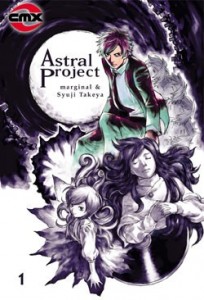
astral110. Astral Project
By Marginal and Suyuji Takeda • 4 volumes (complete)
Astral Project might have been an indigestible stew of pseudo-science and Deep Thoughts About Jazz, as it focuses on a young man discovers a connection between his sister’s disappearance and an Albert Ayler recording that helps facilitate out-of-body experiences. Marginal spins a ripping yarn, however, grounding the story’s more fantastic elements in the gritty realism of Tokyo’s red light district. He immerses us in the story to such a degree, in fact, that we learn things as Masahiko does; we’re never one step ahead of our protagonist, a common problem in thrillers. Syuji Takeya’s artwork won’t appeal to everyone, as it sometimes has a rough, sketchy quality that doesn’t mesh well with the dark, Photoshopped backgrounds, but Takeya creates a memorable assortment of faces and bodies that suggest the seediness of Masahiko’s world more readily than dialog could. Quite possibly Ornette Coleman’s favorite manga. (Originally reviewed at PopCultureShock on 10/27/08. )

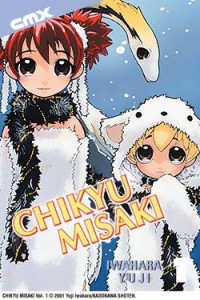
chikyu19. Chikyu Misaki
By Yuji Iwahara • 3 volumes (complete)
This fast-paced adventure plays like best live-action film Disney never made, mixing comedy, family drama, and fantasy elements to tell the story of fourteen-year-old Misaki, who discovers that the local lake is inhabited by a pint-sized Loch Ness Monster. The twist? Little Neo transforms into a cute little boy on land — a nifty trick when a band of kidnappers-cum-poachers get wind of his existence. Chikyu Misaki has a kind of fierce kid logic to it: who but a ten-year-old would dream up a story in which a dinosaur, a downed airplane, a lost suitcase filled with gold, and a potential stepmother all get a turn in the spotlight? Yuji Iwahara’s artwork is also a big plus: his character designs do a fine job of delineating each cast member’s personality and role in the drama, while his action scenes are crisp and fluid. Only a few odd, squicky moments of sexual humor prevent this from being a slam-dunk recommendation for the under-twelve crowd.

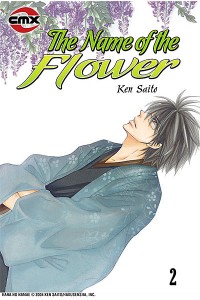
nameflower28. The Name of the Flower
By Ken Seito • 4 volumes (complete)
Did Ken Saito have Charlotte Brontë on the brain when she dreamed up the plot for The Name of the Flower? I ask because Flower‘s storyline seems like pure Masterpiece Theater fodder: Chouko, a young orphan left mute and despondent by her parents’ death, is sent to live with a male guardian who  endured a similarly tragic past. Over time, the two form a deep attachment that neither dares admit, an attachment tested by Chouko’s decision to enroll in college and Kei’s general reclusiveness. If the set-up is ripe for melodrama, Saito manages to craft a story that’s rooted in everyday experience; her characters’ journey to self-awareness and romance is complicated by real-life obstacles, not mad wives in the attic. Lovely art cements the bittersweet mood of this borderline josei title. One of my nominees for Best New Manga of 2009.

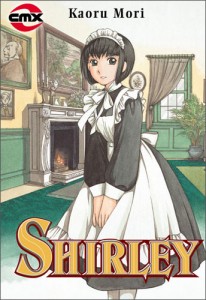
Shirley_Cover7. Shirley
By Kaoru Mori • 1 volume (complete)
At first glance, Shirley looks like a practice run for Emma, a collection of pleasant, straightforward maid stories featuring prototype versions of Emma‘s main characters. A closer examination, however, reveals that Shirley is, in fact, a series of detailed character sketches exploring the relationships between three maids and their respective employers. While some of these sketches aren’t entirely successful — Kaoru Mori cheerfully describes one as “an extremely cheap story about a boy and an animal” and attributes the inspiration for another to The A-Team — the five chapters focusing on thirteen-year-old Shirley Madison and her independent, headstrong employer are as good as any passage in Emma. (Reviewed at The Manga Critic on 3/9/10.)

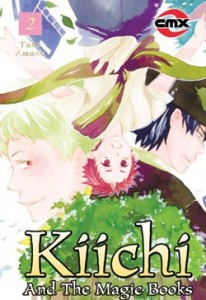
kiichi26. Kiichi and the Magic Books
By Taka Amano • 5 volumes (complete)
This poignant coming-of-age story focuses on Kiichi, a young oni whose lonely existence is transformed by a chance encounter with a traveling librarian. Inspired by the information in one of Mototaro’s books, Kiichi decides to leave his village in search of others like himself. Kiichi’s journey brings him into contact with a variety of people, many of whom seek to harm him or profit from his unique abilities, or who simply fear his appearance. Though Taka Amano never shies away from the darker implications of her story, showing us just how unscrupulous, ignorant, and venal people of all ages can be, Kiichi and the Magic Books is never mawkish or didactic; the fantasy elements add considerable interest and charm, while Kiichi proves emotionally resilient in the face of prejudice and mistrust. Readers more accustomed to the look and feel of Naruto may not initially respond to Amano’s starkly beautiful pen-and-ink drawings. Encourage them to try Kiichi anyway, as this series offers the same degree of complexity, imagination, and emotional authenticity as an Ursula LeGuin or Phillip Pullman novel. CMX’s best title for readers under the age of twelve. (Originally reviewed at Good Comics for Kids on 1/23/09.)

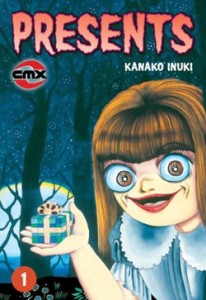
presents15. Presents
By Kanako Inuki • 3 volumes (complete)
Any series that prompted John Jakala to coin a phrase as useful and catchy as “comeuppance theater” deserves a place on a top ten list of some kind; the fact that Kanako Inuki’s horror-comedy is fiendishly entertaining earns it a spot on this particular countdown. Presents reads a lot like Tales of the Crypt, with each story adhering to the same formula: creepy child-woman Karumi offers an enticing present to an unsuspecting person, a present that quickly reveals itself to be an instrument of punishment for the recipient’s bad behavior or poor character. (Hence Jakala’s term “comeuppance theater.”) Though she loves drawing bugs and hideously deformed faces, Inuki is less interested in scaring us than making us laugh and squirm with recognition at our own folly; Inuki’s creepiest stories are also her funniest, satirizing commercial culture and female vanity with aplomb. A must for fans of Kazuo Umezu and Hideshi Hino.

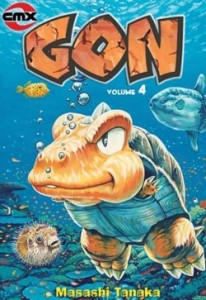
gon44. Gon
By Masashi Tanaka • 7 volumes (complete)
Billed as “the pint-sized terror from the Jurassic era,” Gon is a small orange dinosaur who runs amok in present-day forests, oceans, and arctic tundras, terrorizing predators, defending small animals, and doing whatever else suits his mood. Masashi Tanaka’s artwork is old school in the best sense, employing cross-hatching and delicate lines in lieu of screentone to create volume and depth. His panels are astonishingly detailed yet never fussy or poorly composed — if anything, Tanaka’s technique yields sharper images than the contemporary practice of mixing computer-generated fill with hand-drawn lines. Though Tanaka endows his creatures with unusually expressive faces, he resists the urge to fully anthropomorphize them; their behavior seems species-appropriate even if their expressions occasional verge on human. (Read: the elephants don’t wear spats or drive automobiles, the dogs don’t pretend to be World War I flying aces.) His restraint inoculates Gon against a terminal case of the cutes, resulting in a sometimes funny, sometimes violent, sometimes heartbreaking look at the natural world. (Originally reviewed at PopCultureShock on 2/20/08.)

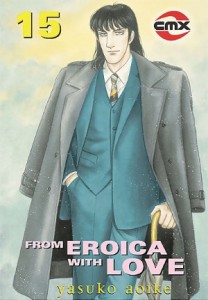
eroica153. From Eroica with Love
By Yasuko Aoike • 15 volumes (incomplete)
What begins as an unsatisfying story about a trio of telepathic teens quickly takes a turn for the awesome with the introduction of Dorian Red, an openly gay British earl who dresses like a rock star and crisscrosses the globe to steal priceless works of art. Eroica eventually settles into an entertaining cat-and-mouse game between Dorian and uptight NATO intelligence officer Klaus Heinz von dem Eberbach, a stoic homophobe who detests the winking, flirtatious Dorian. Though they travel separately, their paths frequently converge in hilarious and explosive ways: hijackings, kidnappings, car chases. The frosting on the cake is Yasuko Aoike’s vintage seventies character designs: Dorian is the spitting image of Robert Plant, right down to the ridiculously tight pants and flowing scarves, while Klaus wears a ‘do as severe and straight as he is. The result is a delirious, over-the-top action-adventure that brings rock-n-roll swagger to a James Bond premise.

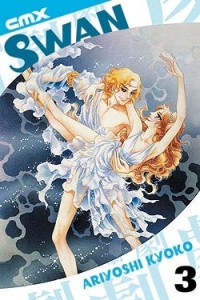
swan32. Swan
By Kyoko Ariyoshi • 15 volumes (incomplete)
Swan captures a particular moment in ballet history when the best Russian troupes commanded large, enthusiastic audiences on both sides of the Iron Curtain; when every developed nation had a ballet company of its own (even if the form was imported from elsewhere); and when dancers like Nuryev and Fonteyn were bonafide international celebrities. Into this glamorous world comes sixteen-year-old Masumi, a Japanese girl from the sticks who has passion and raw talent, but lacks refinement. She wins a spot at a national academy for dance, and begins clawing her way up the ranks, learning the repertoire (cue the Tchaikovsky!), making friends and enemies, and eventually finding her way to New York for immersion in new styles and techniques. As compelling as the drama may be, the real star of Swan is the art: the dance choreography is beautifully rendered, capturing both the heroine’s graceful intensity and the music’s lyricism. A few aspects of Swan haven’t aged well — the heroine falls victim to bouts of hysterical deafness, for example — but the strong visuals, historically accurate details, and sports manga vibe keep this marvelous series buoyant throughout.

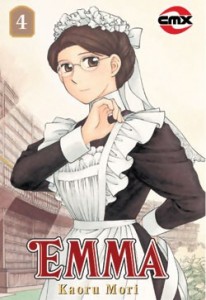
emma41. Emma
By Kaoru Mori • 10 volume (complete)
If Emma‘s rich-boy-loves-poor-maid storyline suggests a lost volume of The Forsyte Saga, the expert way in which William and Emma’s courtship is told more than compensates for a few moments of narrative cliche. Kaoru Mori immerses us in the very different worlds of her lead characters, from the elaborate dinner parties and country outings of William’s circle to the scut work and boozy revelry of Emma’s fellow servants. Mori occasionally fumbles small details (pssst… Tosca didn’t debut until 1900!), but most of the time she convincingly recreates the period through her exquisite pen-and-ink drawings of intricate costumes, ornate furnishings, and fussy architecture. That keen sense of observation extends to her cast as well: Emma bursts at the seams with memorable supporting players, from Kelly Stowner, William’s crusty but kind-hearted former governess, to Hakim Atawari, an Eton-educated raj and friend of the Jones family. The main story concludes with volume seven; volumes eight, nine, and ten feature stories about some of the secondary characters, as well as a resolution for Emma and William’s long and tortured romance. (Originally reviewed at PopCultureShock on 9/19/07.)

* * * * *

Here’s a friendly challenge to everyone who’s still mourning the loss of a favorite CMX title: if I didn’t include your favorite on this list, add your suggestion(s) to the comments thread. I’ll compile everyone’s recommendations into a poll and let you choose one for me to review next month.

Filed Under: Manga, Manga Critic, Recommended Reading Tagged With: Animals, Classic, cmx, Historical Drama, Horror/Supernatural, Kanako Inuki, Kaoru Mori, Kid-Friendly, Magnificent 49ers, Romance/Romantic Comedy

Silent Möbius, Vol. 1

June 10, 2010 by Katherine Dacey

I like science fiction, I really do, but I have limited tolerance for certain tropes: futures in which all the women dress like strippers — or worse, fascist strippers — futures in which giant bugs menace Earth, and futures in which magic and technology freely commingle. Small wonder, then, that Kia Asamiya’s Silent Möbius has never been on my short list of must-read manga — it’s a festival of cheesecake, gooey monsters, and pistol-packing soldiers who, in a pinch, must decide whether to cast a spell or fire a rocket launcher at the enemy. Imagine my surprise when I discovered just how entertaining Silent Möbius turned out to be, gratuitous panty shots, bugs, and all.

When shorn of its mystical mumbo-jumbo and elaborate character histories, Silent Möbius is, at heart, a classic “They came from outer space!” tale. The story begins in 2026, when the Earth is under siege from interdimensional beings known as Lucifer Hawks, fierce, shape-shifting beasties that can assume a variety of forms: dragons, humans, oversize millipedes. Only a small team of elite agents — the so-called Attacked Mystification Police Force (AMP) — are capable of killing the Hawks with a mixture of up-to-the-minute technology and good old-fashioned sorcery. Where the Hawks are coming from and why remains mysterious — at least in the very early stages of the story — though we learn that one agent’s father may be responsible for opening the floodgate between Earth and the Hawks’ home world.

If the plot is pedestrian, Asamiya’s towering cityscapes and appealing character designs aren’t. To be sure, there are plenty of other sci-fi manga from the 1980s and 1990s peddling similar visions of a dysfunctional future paved in concrete and lit by neon, but Asamiya and his helpers pull off even the busiest compositions, bringing the urban scenes to energetic life; I dare you not to compare Silent Möbius with Blade Runner. (Someone else must have thought so, too, as Asamiya was tapped to do the manga adaptation of Star Wars: The Phantom Menace, yet another work that pilfered visuals from Scott’s ground-breaking film.) Then there are the character designs: each member of the AMP seems to be taking her grooming cues from the golden age of MTV, when video vixens came in two flavors: those with enormous feathered hair, and those with short, heavily lacquered locks. Better still, their uniforms consist of jackets with epaulets, neckties, and stirrup leggings. Who knew that 2026 would look suspiciously like 1986?

The other thing that won me over was the characters. I wouldn’t construe Asamiya’s decision to make the AMP a strictly female force as a nod to feminism; there are enough costume failures and half-clad characters to suggest Asamiya was as interested in satisfying the male gaze as he was in promoting the idea that women can kick ass just as well as men. At the same time, however, the ladies of AMP are tough and decisive, and don’t take guff from their male peers; in one of the series’ few nods to realism, the largely male police force resents the AMP for their ability to assume control of any investigation, grumbling about jurisdiction and occasionally baiting the women into fights.

Not that Silent Möbius doesn’t have moments of eyeball-rolling stupidity. Asamiya saddled his characters with borderline stripper names, for example: who but an adult entertainer would choose a name like “Rally Cheyenne” or “Katsumi Liqueur”? (Worse still: Katsumi’s father was Gilgelf Liqueuer, a name best suited for a drunken Hobbit.) Then, too, the series’ rather complicated mythology isn’t well explained; it’s the kind of universe where some characters kill aliens by drawing pentagrams on the ground while others use bazookas. And the cheesecake… sigh. I often had the sinking feeling that Asamiya was secretly auditioning to do a Pirelli Tire calendar with his frequent images of semi-naked women in provocative poses.

Costume failures and panty shots aside, I enjoyed the first volume of Silent Möbius well enough to continue with the series. It’s a fun, escapist romp that occasionally takes itself a little too seriously, but never bogs down in its own ridiculous mythology.

SILENT MÖBIUS: COMPLETE EDITION, VOL. 1 • BY KIA ASAMIYA • UDON ENTERTAINMENT • 200 pp. • RATING: OLDER TEEN (16+)

Filed Under: Manga, Manga Critic, REVIEWS Tagged With: Classic, Kia Asamiya, Post-Apocalyptic Sci-Fi, Silent Moebius, Udon Entertainment

Fullmetal Alchemist 1-2 by Hiromu Arakawa: B+

June 6, 2010 by Michelle Smith

I’ve been hoarding volumes of Fullmetal Alchemist for several years. Having heard it praised for its impressive storytelling, I decided to wait until it was nearer to being finished in Japan before starting it, with the idea that I might be spared some of the long waits between volumes that other fans have endured. But now, word is that the end is nigh, and with MJrecommending it to me so ardently, the time has finally come. Cracking open that first volume felt like quite the momentous occasion.

Edward and Alphonse Elric are unlike normal teenage boys. Both studied alchemy as children and when Edward found a way to bring their beloved mother back to life, the boys performed the ritual without a second thought, not realizing—in the “equivalent exchange” demanded by alchemy—that it would cost Edward his left leg and Alphonse his entire body. After exchanging his right arm for Alphonse’s soul, Edward grafted the soul into the one human-shaped thing that was handy at the time: a suit of armor. Edward is haunted by this mistake, not to mention the memory of what they actually managed to resurrect for their sacrifice, and his primary concern is regaining their original bodies. To that end, they travel the world looking for the Philosopher’s Stone, an alchemical power booster that might make this possible.

The brothers’ travels bring them into contact with trouble in various forms. Their first deed is to expose an alchemist posing as a religious figure, followed by freeing occupants of a mining town from the corruption of a military official and foiling a train hijacking. While this is going on, Edward is also trying to learn as much as he can about biological transmutation. In the second volume, his research leads him to a state alchemist who’s had some success in this area, which in turn takes the story down a very dark avenue involving human experimentation and a vigilante named Scar who takes it upon himself to execute alchemists who have violated the laws of nature.

I knew exceedingly little about Fullmetal Alchemist going into this, which is great. I knew about the brothers’ injuries, though not how they obtained them, and I knew they’d meet a mechanically inclined girl at some point. That’s it. As a result, I was surprised by a number of things as I read, including the presence of comedy. I’m not sure why I thought there wouldn’t be any, but having lighthearted moments sprinkled throughout is definitely welcome, especially once the story delves into more disturbing territory. I particularly love anything that shows that Alphonse, trapped inside a hulking steel shell, is really just a kid.

I was also surprised (and impressed) that the series tackles the religion vs. science question right away with the story of the fraudulent holy man. This also provides an opportunity to introduce Edward’s feelings about alchemy: because alchemists strive to understand the laws of nature, they are perhaps the closest to God that a human can achieve, but overstepping certain bounds—he likens this to the hubris of Icarus—leads only to sorrow and pain. His conflicted feelings resurface several times in these two volumes; one gets the idea that he would like to avoid the very kind of alchemy he’s been researching, but because it’s his best chance at bodily restoration, he’s got no choice.

Lastly, I was downright shocked by some things in the second volume. Somehow, I had expected the Elric brothers to save Nina, the child of a desperate alchemist about to lose state funding, from her father’s experimentation, but this was not to be. Similarly, I expected them to escape grievous bodily harm when fighting Scar so imagine my surprise when both are gravely injured in volume two. That’s just not normal! Shounen heroes are supposed to sustain wounds that would kill an average guy three times over and then get up for more!

I had originally planned to read three volumes for this review, but so much had happened by the end of volume two that I required time to digest it all. I’m used to a shounen manga’s second volume being the stage of the story where some wacky episodic hijinks introduce our hero to the rivals who’ll eventually become part of his entourage. It’s usually not until half a dozen volumes later that you glimpse the real meat of the story. Not so with Fullmetal Alchemist, which lulls you into expecting that episodic setup but makes with the buildup and continuity right away. I can already tell, and believe me that I mean this as a most sincere compliment, that this is going to be one challenging series.

Fullmetal Alchemist is published in English by VIZ. There are 22 volumes currently available, with volume 23 due out next month. We’re pretty close to being caught up to Japan, where volume 25 just came out in late April.

Filed Under: Fantasy, Manga, Shounen Tagged With: Hiromu Arakawa, VIZ

Neko Ramen, Vol. 1: Hey! Order Up!

June 2, 2010 by Katherine Dacey

If you’ve ever lived with a cat or dog, you know that no meal is complete without a pet hair garnish. Now imagine that your beloved companion actually prepared your meals instead of watching you eat them: what sort of unimaginable horrors might you encounter beyond the stray hair? That’s the starting point for Neko Ramen, a 4-koma manga about a cat whose big dream is to run a noodle shop, but author Kenji Sonishi quickly moves past hair balls and litter box jokes to mine a richer vein of humor, poking fun at his cat cook’s delusions of entrepreneurial grandeur.

Taisho is forever dreaming up ways to expand his business, ideas that seem sound in the abstract, but prove disastrous in the execution: a dessert ramen consisting of noodles and milk, a delivery service that’s thwarted by feline territoriality, a playing card promotion featuring unappetizing pictures of soup. In fact, Taisho is so completely misguided that he doesn’t grasp what’s novel about Neko Ramen; when a competitor in a cat costume opens a shop, hoping to capitalize on Taisho’s appearance on “The World’s Most Amazing Animals,” Taisho thinks he, too, needs an animal costume in order to drum up business. His sole customer, the long-suffering Tanaka-san, tries hard to offer sensible advice, but Tanaka’s counsel falls on deaf ears. (Why Tanaka sticks around for ramen that he freely admits is “awful” is one the series’ great mysteries.)

Sonishi’s artwork is crude and sketchy; each character is rendered with just enough lines to give a general impression of who or what he’s supposed to be. The primitive quality of the art actually works in the series’ favor, conveying the low-rent nature of Taisho’s business. More effective still is Sonishi’s strategy for differentiating Taisho from the other cats who regularly appear in the series: Taisho resembles a maneki neko (beckoning cat statue) in an apron, while other felines are depicted as simple, rounded shapes with ears and tails.

None of this would work if the translation were stiff or colorless, but TOKYOPOP wisely employed the husband-and-wife team of Emily Gordon and Kumail Nanjiani to adapt the script for English-speaking audiences. Both are experienced writers and performers (she wrote for Bust and Jane, he does stand-up comedy), and their ear for language is evident throughout volume one; the dialogue is idiomatic and the punchlines are snappy. The other secret to the script’s success is the care with which the adaptors distinguish Taisho’s voice from Tanaka’s, infusing the characters’ owner-customer banter the feeling of a good manzai routine, with Taisho as the boke and Tanaka as the tsukkomi.

The biggest surprise about Neko Ramen is that Sonishi manages to wring so many laughs out of what could be a one-joke premise. Sonishi’s gags remain fresh throughout the first volume, thanks, in part, to several interludes in which he abandons the 4-koma format to relate stories of Taisho’s past: his ill-fated stint as a cat model, his rivalry with a noodle shop staffed by a dog, a monkey, and a bird. These interludes nicely set the table for volume two, providing Sonishi more avenues for his absurd humor without straying too far from the series’ basic idea. Highly recommended, whether or not you fancy cats.

NEKO RAMEN, VOL. 1: HEY! ORDER UP! • BY KENJI SONISHI • TOKYOPOP • 156 pp. • RATING: TEEN (13+)

Filed Under: Manga, Manga Critic, REVIEWS Tagged With: 4-koma, Cats, Comedy, Cooking and Food, Tokyopop

Library Wars: Love & War, Vol. 1

June 1, 2010 by Katherine Dacey

If I were thirteen years old, Library Wars would be at the top of my Best Manga Ever list, as it reads like a catalog of the things I dug in my early teens: books about the future, books about women breaking into male professions, books with bickering leads who harbor secret feelings for each other. I can’t say that Library Wars works as well for me as an adult, but I can recommend it to younger female manga fans who are tired of stories about wallflowers, doormats, or fifteen-year-old girls whose primary objective is to nab a husband.

The story focuses on Iku Hasahara, a former track star and future librarian who enlists in the Library Defense Force (LDF), a paramilitary organization dedicated to combating censorship. Formed in response to the Media Betterment Act, the LDF actively challenges the national government’s efforts to remove books from stores and libraries, using weapons and strong-arm tactics when necessary. Iku is the only female recruit who can keep pace with the guys, push-up for push-up, and is the frequent target of abuse from Atsushi Dojo, a handsome drill sergeant who takes grim delight in pointing out her weaknesses. (Her mastery of the Japanese Decimal System leaves a lot to be desired.) As Iku advances through basic training, however, she begins to realize that Dojo isn’t so bad; his sometimes brusque demeanor masks genuine concern for his pupil, and a sincere desire to help her become a top-notch officer.

Library Wars‘ premise certainly invites comparisons with Fahrenheit 451. The future society depicted in Library Wars isn’t nearly as bleak or disorderly as the one Ray Bradbury imagined back in 1951, but creators Hiro Arakawa and Kiiro Yumi are just as insistent on the importance of standing up for free speech; Iku joined the Defense Forces after the Media Betterment Committee’s jack-booted thugs attempted to confiscate a book from her. (A hot guy also factored into her decision to enlist.) The MBC is as arbitrary and ruthless as the Firemen of Fahrenheit 451, working hard to restrict citizens’ access to potentially “harmful” materials, even going so far as to infiltrate libraries to weed out undesirable material.

In adapting Library Wars from novel to manga, however, Kiiro Yuki places less emphasis on the book-banning crisis and more on her characters’ relationships, preserving just enough background about the LDF’s history to justify the action sequences. That’s not necessarily a bad choice; Iku and Dojo’s banter has a pleasant, antagonistic zing to it that infuses the boot camp scenes with some playful energy. The LDF’s rationale for existing, however, often seems underdeveloped, as we don’t know what prompted the national government to pass the Betterment Act. In leaving these details vague, one could argue that Yuki is simply being true to historical fact; oppressive regimes from tsarist Russia to Maoist China have arbitrarily banned books and condemned authors in the interest of “the national welfare,” yet in the context of the Library Wars manga, that lack of specificity comes off as sloppiness. We don’t know whether censorship is having a real impact on citizens’ ability to say and think what they please; the few scenes in which we glimpse the MBC in action suggest that they’re more of a nuisance than a genuine threat to the social order.

The artwork is serviceable but not great. The character designs are about as basic as they get, with haircuts playing a pivotal role in establishing each cast member’s personality; we know Iku is a tomboy from her sensible and slightly androgynous bob, for example, while Dojo’s neat ‘do paints him as a hardcore military man. (By contrast, Sgt. Komaki, the series’ designated McDreamy character, has the kind of tousled locks that wouldn’t pass muster in the Marines.) The action scenes are hasty affairs, rendered with little respect for continuity or background detail, while the layouts often feel busy, with too many small panels and design elements hampering the visual flow.

If the censorship theme and artwork aren’t as well executed as I might have hoped, Library Wars earns high marks for having a smart, capable heroine and a smart, topical premise. Iku may not be a wonder woman, but she’s a plausible mixture of strength and uncertainty; teen girls will relate to her shifting moods, fierce temper, and high principles, even if they can’t agree whether she should end up with Dojo. And really, what’s not to like about a series that features hot guys who hate censorship but like books, libraries, and butt-kicking women? Now there’s a fantasy female readers of all ages can endorse.

LIBRARY WARS: LOVE & WAR, VOL. 1 • STORY & ART KIIRO YUMI, ORIGINAL CONCEPT BY HIRO ARAKAWA • VIZ • 200 pp. • RATING: OLDER TEEN (16+)

Filed Under: Manga, Manga Critic, REVIEWS Tagged With: Sci-Fi, shojo beat, VIZ

Manga Artifacts: A, A’ and They Were Eleven

May 31, 2010 by Katherine Dacey

Though Vertical has published two series by Keiko Takemiya, the Magnificent 49ers’ work remains largely unavailable in English, with a few exceptions: Yasuko Aoike’s From Eroica With Love (which debuted in 1976 in Akita Shoten), and Moto Hagio’s short stories “A, A’ [A, A Prime],” “4/4 [Quatre/Quarts],” “X+Y,” and “They Were Eleven.”* These four stories comprise a mere 330 pages of material, but they offer readers a window into a key stage in shojo manga’s development, when women artists began pushing the medium in new directions, visually and thematically. Hagio’s work, like Takemiya’s, is unabashedly Romantic, filled with yearning characters who are struggling to uncover their true selves, even when that quest puts them at odds with societal norms. Though there is an intense, adolescent sensibility to some of her stories, that — for me, at least — is part of their beauty; Hagio clearly remembers what it feels like to be sixteen or eighteen, yet the way she frames those emotions is so exquisite and refined that the reader can appreciate her craft, even if the drama seems a little overripe from an adult perspective.

If you’ve been curious about what Takemiya’s peers were doing while she was writing To Terra and Song of the Wind and the Trees, or are wondering what to expect if you purchase Hagio’s A Drunken Dream this fall, read on.

aa_coverA, A’ [A, A Prime]

This sometimes lyrical, sometimes bizarre anthology contains three interrelated stories. In the first, “A, A’, [A, A Prime],” a group of researchers struggle to accept Addy, a new team member who is, in fact, the clone of a colleague who perished several years earlier; in the second, “4/4 [Quatre/Quarts],” Mori, a telepath, becomes obsessed with Trill, a strange young woman who’s virtually mute; and in the third, “X+Y,” a now-older Mori falls in love with Tacto, an androgynous young man who resembles Trill. Addy, Trill, and Tacto are Unicorns, a humanoid species bred for deep-space travel. Though Unicorns share common physical characteristics — most notably a shock of red hair running down the center of their heads — and high IQs — their original purpose was to serve as computer technicians on long space missions — they have a hard time negotiating the human world: emotions baffle them, and the act of forming deep attachments to other people can destabilize their personalities.

Though Hagio rehearses some time-honored sci-fi tropes — especially the danger of genetic tampering — one of her most striking themes is the relationship between memory and identity. Addy, for example, is born with all of her predecessor’s memories of childhood, but none of her predecessor’s memories of Proxima, the remote ice world where the original Addy worked for three years before dying in an accident. That gap in Addy’s memory proves especially difficult for her co-worker Regg, who had been romantically involved with Addy’s predecessor. Addy has no idea who he is, and is bewildered that Regg knows about events from her “childhood” — events that Addy hasn’t discussed with anyone. More troubling still, these “memories” are deeply upsetting, even though Addy knows she isn’t reliving her own history.

Tacto, on the other hand, teeters on the verge of a breakdown because his memory is incomplete. As a young child, he stumbled across a gruesome sight, one which his father attempted to erase from Tacto’s memory. That seemingly humane gesture backfired, however, leaving Tacto with only an emotional echo of the traumatic event and no concrete information about what he’d actually seen; only by recovering those painful memories does Tacto escape his emotional paralysis and embrace Mori’s love for him.

Hagio’s artwork supports the intensely Romantic quality of all three stories, as she represents her characters’ memories with symbolically rich imagery. In “4/4,” for example, Trill is haunted by a recurring vision of corpses, each fastened to the floor with a lepidopterist’s pin — Trill’s memory of numerous, unsuccessful attempts to clone her. (Dr. Sazzan, her caretaker, is obsessed with breeding more Unicorns.) Tacto’s unformed memory of his childhood resembles the nightmare paintings of John Fuselli; Tacto sees a disembodied, demonic face emerge from the rocky surface of an asteroid, a swirling black cloud with eyes and a terrible mouth.

That dream-like quality extends to the settings as well, which mirror the characters’ turbulent emotional states. Trill and Mori, for example, visit a spectacular aviary aboard a space station; it’s a lush, erotically charged setting evocative of a Rousseau painting, and one that suggests the intensity of Mori’s desire for Trill. Hagio performs a similar trick in this sequence, transforming an interstellar reconnaissance mission into an intimate windsailing expedition through the stars:

aprime

Lest A, A’ sound like The Unbearable Lightness of Being in Space, let me assure you that Hagio demonstrates a unique ability to mix the sublime with the ridiculous. Her characters’ names, for example, are just about as goofy as they come: Dr. Wright Moonsault. Regg Bone. Marble. Professor Sazzan. Their costumes, too, have the same overripe quality as the names, with men sporting headbands, half capes, tall boots, and Renn Fair hats, and women clad in off-the-shoulder jumpsuits. The subplots take the cake, however, for their sheer moonbattiness: in “X+Y,” for example, Tacto’s father invents a temporary sex change drug that enables a male colleague to become pregnant, a subplot that actually holds the key to unlocking Tacto’s past.

Now out of print, VIZ originally released A, A’ in 1997. Expect to pay about $25.00 for a decent used copy if you choose to buy it online through ALibris or Amazon’s network of retailers. You might also try the library or your local comic shop’s bargain bin.

theywereeleven3THEY WERE ELEVEN

Ten cadets at an interstellar space academy are dispatched to a decommissioned ship. Their task: remain on board for 53 days without pressing the panic button; if they persevere, all ten will pass their final exam. Once aboard the ship, however, the cadets realize something is amiss. Not only do they have an extra crew member, but a series of mechanical failures and explosions threaten to send the ship hurtling into the surface of a neighboring star.

Though the premise could be spun out in the manner of, say, Event Horizon, Hagio favors a Gene Rodenberry approach, emphasizing character development and social commentary over gunplay, robots, or totally icky alien life forms. (You know the kind: they embed themselves in your chest cavity, hunt you down like a rabbit, or just spray toxic venom in your face.) Like the good astronauts of the starship Enterprise, They Were Eleven‘s cast are humanoids of various shapes and sizes. A few seem empathic; one has remarkable healing powers; another is tall and scaly; yet another looks like a distant relative of The Thing; and one pretty character has yet to decide whether it will develop into a man or woman. The dilemmas the cadets face — technical, social, and medical — also place us firmly in Star Trek territory, inspiring the characters to ruminate on issues as varied as gender roles and the ethics of sacrificing an individual for the good of the collective.

In fact, the exploration of gender is one of They Were Eleven‘s most interesting subplots; Frol, the sexually indeterminate member of the crew, is furious that her shipmates construe her as female. “I hate women!” she shouts. “Women are nothing but a waste of space!” Midway through the story, Hagio reveals the source of Frol’s misogyny: her parents want her to become the ninth wife of a prominent nobleman. If Frol passes the Galactic Academy exam, however, she will earn the right to become a man, a privilege usually reserved for a family’s eldest child. (Frol’s people are born hermaphrodites, becoming male or female only in adulthood.) Hagio’s critique of gender roles is both obvious and sly — obvious, in that Frol’s objection to being a woman stems from the division of labor on her home world (men rule the roost; women do all the work and bear lots of children) and sly, in that Hagio uses primogeniture as a metaphor for the broader sense of entitlement that comes with being born male.

If Hagio’s aliens are strictly by the Star Trek book, all funny foreheads and funky hides, her layouts are stunning, punctuated by several arresting, full-page images: an enormous hall of cadets taking their exams (each in a groovy, womb-like isolation pod to prevent cheating), a picture of the dying star around which the test ship is orbiting, a character’s profile dissolving into a trail of stars. Hagio juxtaposes these expansive images with long, almost claustrophobically tight scenes of shipmates bickering and coping with the latest mechanical failures. It’s a neat trick, giving us a sense of how tight quarters really are aboard the White, and suggesting how that small space exacerbates tensions among the crew. And oh, those interiors! Like Takemiya, Hagio loves to draw detailed banks of computers and rows of tubes and wires and pipes, bringing the ship to vivid life. (Or, perhaps more accurately in the case of They Were Eleven, showing the ship in all its decrepitude.)

theywere11_page

Much as I would like to recommend They Were Eleven, the story is out of print in English. In the mid-1990s, VIZ issued it in two forms: as a four-issue comic (1995), and in the anthology Four Shojo Stories (1996). Used book dealers have gotten wise to the scarcity of this title; copies of Four Shojo Stories generally retail for $60 and up. Though I didn’t have too much difficulty scaring up the old VIZ Flower floppies on eBay (and I rather enjoyed the American-style presentation), it would be great to see this chestnut re-issued for a generation of readers who think that Black Bird is the first and last word in girls’ comics.

* Hagio’s story “Hanshin” was reprinted in The Comics Journal‘s shojo manga issue from 2005 (no. 269). For the purposes of this essay, I’m focusing on Hagio’s commercially available work. And speaking of work by pioneering shojo artists, Swan, which ran in Margaret from 1976 to 1981, is also available in English (CMX), and is the work of artist Kyoko Ariyoshi, who was born in 1950.

This an expanded version of a review that originally appeared at PopCultureShock on 1/20/07.

Filed Under: Manga, Manga Critic, REVIEWS Tagged With: Classic, Magnificent 49ers, moto hagio, Sci-Fi, VIZ

Andromeda Stories, Vols. 1-3

May 26, 2010 by Katherine Dacey

Ah, Keiko Takemiya, how I love your sci-fi extravaganzas! The psychic twins. The giant spiderbots. The evil, omniscient computers. The sand dragons. The fantastic hairdos. Just think how much more entertaining The Matrix might have been if you’d been at the helm instead of the dour, self-indulgent Wachowski Brothers! But wait… you did create your very own version of The Matrix — Andromeda Stories. Your version may not be as slickly presented as the Wachowski Brothers’, but you and collaborator Ryu Mitsuse engage the mind and heart with your tragic tale of doomed love, lost siblings, and machines so insidious that they’ll remake anything in their image—including the fish.

But I’m getting ahead of myself.

Mitsuse and Takemiya invert the normal order of events in a classical drama and begin Andromeda Stories with a wedding — a royal wedding, to be exact, forging an alliance between Cosmoralia and Ayoyoda, two kingdoms on the planet Astria. On the eve of the ceremony, newlyweds Prince Ithaca and Princess Lilia spot a mysterious blue star pulsating in the night sky. Shortly after the star’s appearance, a meteorite crashes through Astria’s atmosphere with a deadly cargo: an army of nanobots seeking human hosts. Only Il, a fierce female warrior, and Prince Milan, Lilia’s devoted brother, realize that these cyber-critters are rapidly transforming Cosmoralia’s population into a Borg-like race of automatons. Il and Milan set out to liberate Cosmoralia from the grips of this cyber-invasion force before the contagion of violence and fear spreads to Ayoyoda.

As Il soon discovers, there’s a small resistance movement led by the Murat, an alien race who lost their homeworld to the same invading force eight generations earlier. The survivors settled on Astria and married into Ayoyoda’s royal family with the goal of preventing the Astrians from becoming technologically sophisticated enough to attract the nanobots’ attention — and if that effort failed, doing whatever they could to defeat the machines. The Murat’s secret weapon against the nanobots are Jimsa and Affle, twins born to Princess Lilia and kept apart for over twelve years to escape detection by the new regime. Jimsa and Affle both possess the power to kill with a thought, a power amplified when the two fight side by side. Of course, there’s a drawback to so much empathetic energy: if one is injured, the other feels his pain, just like the Corsican Brothers. Then, too, there’s that pesky issue of trust: will Jimsa and Affle ever see themselves as sibilings, or have their separate upbringings driven a permanent wedge between them, thus thwarting the Murats’ hope?

In other words, it’s Star Trek by way of Anne McCaffrey, with a dash of Wagner and a little Arthur C. Clarke for good measure.

One of the things I love most about Takemiya’s work is the way she freely commingles sci-fi and fantasy elements in an effort to suggest the setting: a long time ago, in a galaxy far away. Her characters carry swords and wear togas, and live in castles with turrets, yet employ the kind of gadgetry—mind-reading computers, laser guns—that wouldn’t be out of place on the Death Star. Art-wise, the spirit of Osamu Tezuka lingers over many pages in Andromeda Stories, especially in its busier scenes. The Cosmoralian marketplace, for example, comes alive thanks to Takemiya’s vivid caricatures of merchants, wrestlers, farmers, dancing girls, snakes, and sloe-eyed dinosaurs, while many of the full-page cityscapes suggest the future worlds of Phoenix and Apollo’s Song, with their abundant towers and tubular skywalks. Though Takemiya’s principal characters clearly belong to the world of 1970s shojo with their flowing manes, gypsy outfits, and sparkling eyes, some of her supporting characters — especially Balga, a Bluto-esque bodyguard — look like refugees from Buddha or Dororo. (In a sly nod to the kind of anachronistic humor that Tezuka loved, Takemiya depicts Balga playing with a Rubix’s cube while standing watch outside Princess Lilia’s chambers. 1980, you are so busted!)

Takemiya also demonstrates a Tezukian flair for staging short, effective action sequences that make creative use of panel shapes to convey movement, speed, and distance. Midway through volume one, for example, Il leaps through the canopy of a forest in an effort to investigate a mysterious crater not far outside the Cosmoralian walls:

andromeda_page

In just four panels, we can gauge how far she’s traveled and how high off the ground she is — a point underscored by the tapered edge of the top row’s middle panel. The diagonal border amplifies the effect of the vertical speedlines, drawing the eye downwards in an rapid fashion that mimics Il’s motion. As Derik Badman observes in a concise analysis of this same page, Takemiya uses a number of tricks — drawing two iterations of the same character in one panel, using panel shape to direct the reader’s eye through the sequence, allowing sound effects to bleed outside the panels — to help us trace Il’s path through the tree tops, showing us, in compressed form, how many jumps it takes for her to reach a secure perch. It’s a technique that Tezuka perfected in works like MW, Ode to Kirihito, and Swallowing the Earth, where he gooses very basic components of the layout — especially panel shapes — to evoke the speed and energy of, say, a sword fight or a car chase.

At times, the richness of Takemiya’s visual imagination camouflages the more pedestrian aspects of the story, such as its one-dimensional principals. Lilia, in particular, is the kind of beautiful, virtuous, and long-suffering creature that seems to exist only in old-school Disney movies, while Il is a classic lone wolf, answering to no one, even when it might benefit her cause; the only real novelty here is that Mitsuse and Takemiya assign a stereotypically male role to a female character. The plot is simpler and more transparently allegorical than To Terra‘s, touching on a variety of standard science fiction themes, from the dangers of relegating too much responsibility to machines to the evils of totalitarianism. None of these themes are developed with the same level of sophistication as they are in To Terra, as the characters are generally too busy dodging death rays and mechanized piranha to wax poetic about their inner lives.

If Andromeda Stories never reaches the grand, operatic heights of To Terra, it nonetheless proves entertaining, building steady momentum over its 600+ page run, pausing occasionally to meditate on the nature of free will, creation, and individual responsibility. And c’mon… what’s not to like about a manga that looks like a 1979 cover of Heavy Metal magazine?!

This review is a synthesis of two shorter reviews that originally appeared at PopCultureShock on 10/3/07 and 1/31/08, respectively.

Filed Under: Manga, Manga Critic, REVIEWS Tagged With: Classic, Keiko Takemiya, Magnificent 49ers, Sci-Fi, Vertical Comics

  • « Go to Previous Page
  • Page 1
  • Interim pages omitted …
  • Page 19
  • Page 20
  • Page 21
  • Page 22
  • Page 23
  • Interim pages omitted …
  • Page 26
  • Go to Next Page »
 | Log in
Copyright © 2010 Manga Bookshelf | Powered by WordPress & the Genesis Framework