• Skip to primary navigation
  • Skip to main content
  • Skip to primary sidebar
  • Home
  • About Us
    • Privacy Policy
    • Comment Policy
    • Disclosures & Disclaimers
  • Resources
    • Links, Essays & Articles
    • Fandomology!
    • CLAMP Directory
    • BlogRoll
  • Features & Columns
    • 3 Things Thursday
    • Adventures in the Key of Shoujo
    • Bit & Blips (game reviews)
    • BL BOOKRACK
    • Bookshelf Briefs
    • Bringing the Drama
    • Comic Conversion
    • Fanservice Friday
    • Going Digital
    • It Came From the Sinosphere
    • License This!
    • Magazine no Mori
    • My Week in Manga
    • OFF THE SHELF
    • Not By Manga Alone
    • PICK OF THE WEEK
    • Subtitles & Sensibility
    • Weekly Shonen Jump Recaps
  • Manga Moveable Feast
    • MMF Full Archive
    • Yun Kouga
    • CLAMP
    • Shojo Beat
    • Osamu Tezuka
    • Sailor Moon
    • Fruits Basket
    • Takehiko Inoue
    • Wild Adapter
    • One Piece
    • After School Nightmare
    • Karakuri Odette
    • Paradise Kiss
    • The Color Trilogy
    • To Terra…
    • Sexy Voice & Robo
  • Browse by Author
    • Sean Gaffney
    • Anna Neatrour
    • Michelle Smith
    • Katherine Dacey
    • MJ
    • Brigid Alverson
    • Travis Anderson
    • Phillip Anthony
    • Derek Bown
    • Jaci Dahlvang
    • Angela Eastman
    • Erica Friedman
    • Sara K.
    • Megan Purdy
    • Emily Snodgrass
    • Nancy Thistlethwaite
    • Eva Volin
    • David Welsh
  • MB Blogs
    • A Case Suitable For Treatment
    • Experiments in Manga
    • MangaBlog
    • The Manga Critic
    • Manga Report
    • Soliloquy in Blue
    • Manga Curmudgeon (archive)

Manga Bookshelf

Discussion, Resources, Roundtables, & Reviews

Manga

The Best Manga You’re Not Reading: Rica ‘tte Kanji!?

June 1, 2011 by Katherine Dacey

The most basic yuri plotline — what publisher Erica Friedman calls “Story A” — traces its roots back to the pioneering Class S fiction of Nobuko Yoshiya (1896-1973). In works such as Hana monogatari (1916-24) and Yaneura no nishojo (1919), schoolgirls developed intense, often romantic, feelings for other schoolgirls. Given the period in which Yoshiya wrote, it’s not surprising that her characters’ relationships were never consummated; the girls might exchange passionate letters or meaningful glances, but marriage, graduation, or death prevented them from being together as a couple. Fifty years later, when manga artists such as Ryoko Yamagishi and Riyoko Ikeda began writing girls’ love stories, they, too, favored tragic endings; Yamagishi’s Shiroi Heya no Futari (1971), for example, culminates in a melodramatic death (suicide by ex-boyfriend, to be exact), as do Ikeda’s Oniisama e… (1975) and Claudine…! (1978).

Small wonder, then, that manga-ka Rica Takashima saw a vacuum that needed filling. “There were very few manga with lesbian stories,” Takashima explains in the afterword to Rica ‘tte Kanji!? “Only depressing, sad stories about ‘forbidden love’ and with a break-up in the end. For example, ‘If I were a man, I could marry you.’ That kind of thing, but I wanted to read a HAPPY story.”

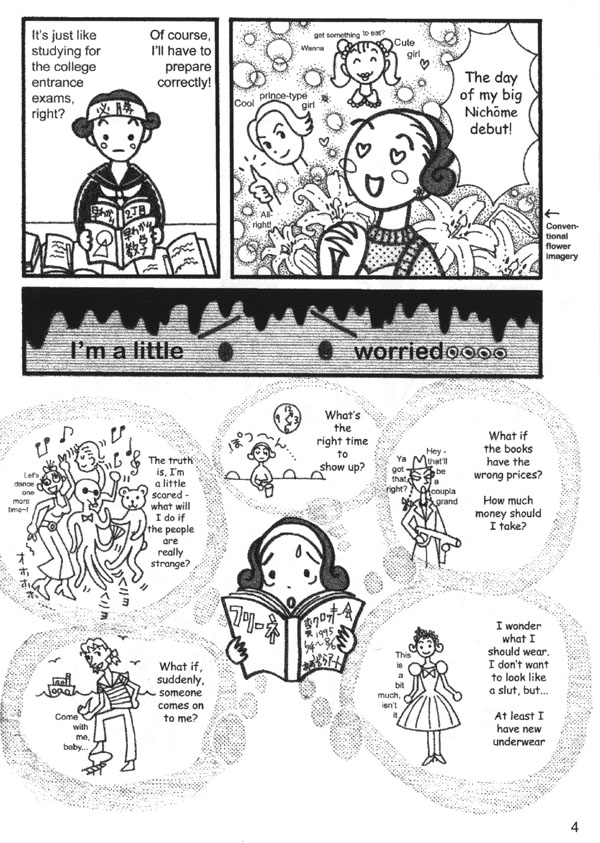
And “happy” is the perfect adjective to describe Rica ‘tte Kanji!? Rica, the heroine, is a cheerful optimist who moves to Tokyo to attend junior college (she plans to major in early childhood development) and explore the Nichome district, home to the city’s gay community. At the beginning of the series, Rica is nervous about visiting Nichome for the first time, worrying about what to wear and how to handle pick-up lines:
Rica’s fears are quickly allayed when she’s introduced to Miho, a sardonic art student a few years Rica’s senior. The two meet cute on Rica’s first trip to Nichome’s Lily Bar, where Rica confesses that she’s never met “an actual lesbian.” “I grew up out in the country,” she explains to Miho. “It’s the same for everyone in the beginning,” Miho assures her, prompting Rica to declare Miho her first gay friend. Though Miho falls for Rica right away, Rica’s lack of experience and general ditziness makes her oblivious to Miho’s advances. Their relationship has another hurdle to clear as well: Rica is just as nervous about the idea of having sex as she was about making a good impression at the Lily Bar, and keeps Miho at arm’s length — figuratively and literally — as she tries to decide what she’s comfortable doing.

What Takashima does better than most is to find the comedy in these situations, not by creating artificial misunderstandings between the characters, or manufacturing romantic rivals, but by making us privy to Rica and Miho’s thoughts. The two women’s internal monologues are funny, peppered with cute and weird observations, but they’re also very truthful; who among us hasn’t worried about putting the moves on a friend or being naked with a new partner?
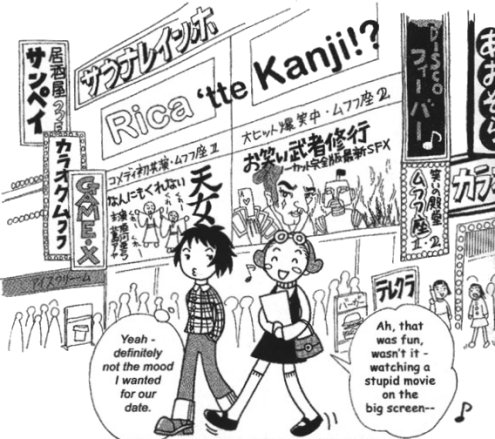
Though Takashima’s script is charming, what really makes Rica ‘tte Kanji!? work is the art. That may seem like a funny thing to say about a story in which the characters are little more than well-dressed stick figures with cute, round faces, but Takashima’s illustrations have a warm, handmade quality. Better still, the artwork never panders to male yuri fans; by rendering the characters as cute, paper-doll figures, Takashima directs the eye away from Rica and Miho’s bodies towards their faces, compelling the reader to see the women as two people fumbling through a relationship, not fantasy objects.

And speaking of fantasy, a few reviewers have pointed out the absence of real conflict in Rica ‘tte Kanji!?. Though Miho and Rica’s relationship hits a few minor snags, their romance takes place in a bubble untouched by homophobia or workaday concerns. It’s a fair criticism, I suppose, but one that misses the point; Rica ‘tte Kanji!? is a cheeky, cheerful rebuke to the Tragic Gay Story, substituting a happily-ever-after ending for death and separation.

Impatient readers can find copies of Rica ‘tte Kanji on Amazon for about $24.00. If you’re willing to wait a few months, however, ALC Publishing will be releasing a new omnibus edition that will include the original Rica ‘tte Kanji stories, as well as material written for ALC’s Yuri Monogatari anthologies.

RICA ‘TTE KANJI!? • BY RICA TAKASHIMA • ALC PUBLISHING • 96 pp.

Filed Under: Manga, Manga Critic, Recommended Reading, REVIEWS Tagged With: ALC Publishing, Rica 'tte Kanji Review, Rica Takashima, yuri

Kamisama Kiss 2 by Julietta Suzuki

May 31, 2011 by Michelle Smith

From the back cover:
Nanami Momozono is alone and homeless after her dad skips town to evade his gambling debts and the debt collectors kick her out of her apartment. So when a man she’s just saved from a dog offers her his home, she jumps at the opportunity. But it turns out that his place is a shrine, and Nanami has unwittingly taken over his job as a local deity!

Nanami doesn’t want to miss out on the fun when a hot teen idol joins the student body. Tomoe reluctantly agrees to let her go, as long as she conceals her divine mark. After all, what could possibly go wrong at high school…?

Review:
Nanami has been out of school for three months, living in the shrine that is her new home, but the appalling lack of worshippers means her days are very dull indeed. When she sees a TV news story about a famous pop idol transferring to her high school, her school spirit is suddenly reinvigorated and she decides to return, even though Tomoe (her fox-eared familiar) insists she wear a stupid-looking headscarf to cover the mark that identifies her as a tochigami (deity of a specific area of land), lest yokai detect her presence and attack.

The pop idol, Kurama, turns out to be a jerk, but he’s intrigued by Nanami’s ability to resist his charms. The other students aren’t too friendly, either, and tease Nanami about her poverty. Enter Tomoe to save the day, clearing her name when she is accused of theft, delivering a delicious lunch when she’s too poor to afford something from the cafeteria, and generally making it appear as if she’s now under the care of a wealthy family. When Tomoe later finds himself in need, having been shrunk by another deity who has taken over the shrine, Nanami is grateful to be able to give back to him, watching over him as his child’s body struggles to contain his powers. In the end, when the other deity is ousted, Tomoe chooses to reenter into a contract with Nanami.

I’m still unsure exactly what to make of Kamisama Kiss. I definitely like its sense of humor—it’s pleasantly absurd, like when Kurama (who predictably turns out to be a yokai) is chased through the halls of the school by one of Tomoe’s fireballs while in the form of an ostrich—and the supporting cast (like the two onibi-warashi who occupy the shrine along with Nanami and Tomoe), but the main characters have yet to really intrigue me. It’s nice that Tomoe and Nanami are building a more friendly relationship, and that both clearly care about each other, but there’s nothing to really distinguish this development from all the other stories in which two argumentative sorts wind up falling for each other.

I think part of the problem is that I am still mentally comparing it to Suzuki’s other series released in English, the very charming Karakuri Odette. I shouldn’t, because they’re very different types of stories, but every now and then Nanami gets an expression on her face that reminds me so much of Odette that I can’t help myself.

Because Karakuri Odette turned out to be so good, I am reasonably confident that Kamisama Kiss will eventually win me over, but in the meantime I’m left a little bit disappointed.

Review copy provided by the publisher.

Filed Under: Manga, REVIEWS, Shoujo, Supernatural Tagged With: Julietta Suzuki, shojo beat, VIZ

A Zoo in Winter

May 28, 2011 by Katherine Dacey

One of the best-selling manga in the US right now is Bakuman, a drama about two teens trying to break into the Japanese comics industry. Flipping through the first two volumes, it’s easy to see why the series has such an ardent following: Tsugumi Ohba and Takeshi Obata have portrayed the characters’ journey not as an aesthetic or introspective process, but as an adventure story in which the boys battle progressively more talented opponents while they work toward their ultimate goal of creating a hit series.

For all its lip service to perseverance and craft, Bakuman is, at heart, a fantasy that trumpets youth, native ability, and confidence as the keys to artistic success. To be sure, Ohba and Obata make a concerted effort to show their characters engaged in the less dramatic aspects of manga-making: brainstorming story ideas, working with an editor, experimenting with unfamiliar tools. These scenes aren’t really meant to chart the boys’ growth as artists, however, but to reinforce the idea that Mashiro and Takagi are naturals.

Jiro Taniguchi’s forthcoming A Zoo in Winter offers a very different perspective on breaking into the manga industry, one in which the principle character engages in a long, complicated, and frequently humbling process of refining his skills. When we first meet seventeen-year-old Mitsuo Hamaguchi, he’s working at a manufacturing company, contemplating a future designing textiles while harboring dreams of becoming an artist. Hamaguchi spends his free time sketching animals at the local zoo, and chaperoning his boss’ wayward daughter on excursions around town.

At loose ends, Hamaguchi visits Tokyo on a whim, landing a position as an assistant to popular manga-ka Shiro Kondo. The work is anything but glamorous: Hamaguchi frequently pulls all-nighters, erasing pencil marks, blacking in objects, drawing speedlines, and copying backgrounds from other assistants’ drawings. Working on Kondo’s manga rekindles Hamaguchi’s own childhood ambition to become an artist, inspiring Hamaguchi to take live drawing classes and start work on his own story — a goal that proves more elusive than Hamaguchi imagined.

Hamaguchi’s emotional development is as fitful as his artistic. Though he’s savoring his independence, he frequently reverts to adolescent behavior whenever he hits a roadblock, wallowing in self-pity when another assistant seems poised to get his big break, for example, or drinking himself into a stupor when his girlfriend moves away. Hamaguchi’s relationship with his older brother is particularly telling: separated by ten years, Hamaguchi continues to view him as a father figure, squirming in embarrassment when his brother visits Kondo’s studio. (“Please, brother, try to mind your own business,” Hamaguchi pleads.) As their visit progresses, however, Hamaguchi marvels at his brother’s ability to chat up Kondo and mix with the bohemian element at the assistants’ favorite dive-bar, gradually realizing that his older brother isn’t as judgmental or rigid as Hamaguchi assumed, just deeply concerned with the family’s welfare.

In another artist’s hands, Hamaguchi’s brother might have been a sterner figure, one who dismissed an artistic career as a frivolous or irresponsible choice. Yet Jiro Taniguchi resists the temptation to make Hamaguchi’s brother into a straw man, instead allowing Hamaguchi to discover his brother’s relaxed decency for himself; Hamaguchi’s epiphany is a small one, but one that brings him a few steps closer to adulthood. Taniguchi manages the difficult feat of honoring the sincerity of Hamaguchi’s feelings while creating emotional distance between Hamaguchi and the reader; we’re not invited to experience Hamaguchi’s embarrassment so much as remember what it was like to learn that our parents were, in fact, just like all the other adults we knew and liked.

What makes these passages even more effective is Taniguchi’s draftsmanship. Though he has always been a superb illustrator, capable of evoking the bustling sprawl of a Japanese city or the craggy face of a mountain, his characters’ faces often had an impassive, Noh-mask quality. In Zoo in Winter, however, the characters’ facial expressions are rendered with the same precision he usually reserves for landscapes and interiors, capturing subtle shifts in their attitudes and emotions. Not that Taniguchi neglects the urban environment; one of the manga’s loveliest sequences unfolds in a zoo on a snowy day. Anyone who’s had the experience of running in Central Park on a rainy November afternoon, or walking a winter beach will immediately recognize Hamaguchi’s elation at having the zoo to himself, and of seeing the landscape transformed by the weather.

It’s the subtlety of the characterizations, however, that will remain with readers long after they’ve finished A Zoo in Winter. The story does more than just dramatize Hamaguchi’s journey from adolescence to adulthood; it shows us how his emotional maturation informs every aspect of his artistry — something that’s missing from many other portrait-of-an-artist-as-a-young-man sagas, which place much greater emphasis on the pleasure of professional recognition than on the satisfaction of mastering one’s craft. To be fair, Ohba and Obata address the issue of craft in Bakuman, but I’ll take the quiet honesty of A Zoo in Winter over the sound and fury of a Shonen Jump title any day. Highly recommended.

Review copy provided by Fanfare/Ponent Mon. A Zoo in Winter will be released on June 23, 2011.

A ZOO IN WINTER • BY JIRO TANIGUCHI • FANFARE/PONENT MON • 232 pp.

Filed Under: Manga, Manga Critic, REVIEWS Tagged With: Fanfare/Ponent Mon, Jiro Taniguchi, Seinen

A Bride’s Story, Vol. 1

May 24, 2011 by Katherine Dacey

For nearly 3,000 years, the Silk Road connected Asia with Africa and the Middle East, providing a conduit for the ancient world’s most precious commodities: silk, spices, glassware, medicine, perfume, livestock. By the nineteenth century, when A Bride’s Story takes place, the overland trade routes had been eclipsed in importance by maritime ones that linked China directly with India, Somalia, and the Mediterranean. Yet the Silk Road continued to play a vital role in bridging smaller geographical divides, as the main plot in A Bride’s Story demonstrates.

Set in Central Asia, A Bride’s Story focuses on two clans: the Halgal, a nomadic tribe whose livelihood depends on a mixture of hunting and herding, and the Eihon, farmers with a permanent homestead near the Caspian Sea. The families arrange a marriage between twenty-year-old Amir, the oldest Halgal daughter, and twelve-year-old Karluk, the future Eihon patriarch. As that age gap implies, Amir and Karluk’s union is one of political and economic expedience, designed to help the Eihon clan preserve its territory. Each family has reservations about the match: the Eihon believe that Amir is too old to bear Karluk a good-sized family, while the Halgal want to dissolve the union and betroth Amir to the leader of a neighboring tribe.

Amir and Karluk, however, seem more content with the arrangement than their elders. Given their age gap, Amir is more mother than wife to Karluk. There’s a note of urgency and purpose in Amir’s ministrations — she’s keen to prove her worth to the Eihons, especially when Karluk falls ill — but there’s also a genuine warmth and kindness in her gestures. Karluk, for his part, seems very much like a young teenager, intrigued by Amir’s beauty and charisma, but still too uncomfortable in his own skin to be physically demonstrative with her; Amir seems much keener to consummate their marriage, lest she lose her standing with the Eihon clan.

One of the great pleasures of A Bride’s Story is its strong cast of female characters. Balkirsh, the Eihon matriarch, proves Amir’s staunchest ally, fiercely rebuffing the Halgal’s efforts to reclaim Amir with a well-placed arrow. Though Balkirsh never explicitly states why she identifies with her daughter-in-law, the bow-and-arrow scene is telling, hinting at a shared cultural heritage that binds the two women. Amir, too, is a memorable character; she’s a terrific physical specimen, agile and fearless on horseback, but her true strength is her keen emotional intelligence. She accepts her new marriage without complaint, rapidly insinuating herself into the Eihon clan while preserving her own sense of self by introducing Karluk to her family’s customs.

The artwork, too, is another compelling reason to read A Bride’s Story. As she did in Emma and Shirley, Kaoru Mori pours her energy into period detail: clothing, furnishings, architecture. By far her most striking designs are the tribal costumes worn by the Eihon and the Halgal. Mori painstakingly draws embroidery, ornaments, and layers of fabric; watching Amir mount her horse, one can almost hear the swish of her skirts and the jingle of her earrings. Mori is similarly meticulous when rendering the surfaces of common household objects; she etches an intricate floral design into a silver tea set and weaves elegant, delicate patterns into the rugs that grace the walls and floors of the Eihon compound, luxuriating in the artistry with which these items were made.

At the same time, however, the Central Asian setting grants Mori greater license to make her characters move — something she rarely did in the overstuffed parlors  and crowded London streets in Emma and Shirley. To be sure, Mori’s flair for staging dynamic scenes was evident in Emma, when Hakim Atawari made a show-stopping entrance astride an elephant. In A Bride’s Story, however, Mori’s active sequences are less flashy and more fluid; they feel less like dramatic stunts than an organic part of the story, helping the reader understand how physically taxing Amir and Karluk’s labors are while helping us appreciate the scale and severity of the landscape.

Perhaps the most striking aspect of volume one is just how uneventful it is. Kaoru Mori is content to let her narrative follow the rhythms of everyday life, pausing to show us a master carver in his wood shop, or a group of women cooking a meal, or a young boy tending chickens. Yet A Bride’s Story is never dull, thanks to Mori’s smart, engaging dialogue; as she demonstrated in Emma and Shirley, Mori can make even the simplest moments revealing, whether her characters are preparing a manor house for the master’s return or discussing the merits of rabbit stew. By allowing her story to unfold in such a naturalistic fashion, A Bride’s Story manages to be both intimate and expansive, giving us a taste of what it might have been like to live along the Silk Road in the nineteenth century. Highly recommended.

A BRIDE’S STORY, VOL. 1 • BY KAORU MORI • YEN PRESS • 192 pp. • RATING: OLDER TEEN (16+)

Filed Under: Manga, Manga Critic, REVIEWS Tagged With: A Bride's Story Review, Kaoru Mori, Silk Road, yen press

Arisa 1 by Natsumi Ando

May 22, 2011 by Michelle Smith

From the back cover:
Tsubasa thinks that her pretty and popular twin sister, Arisa, has the perfect life. Everyone at school loves Arisa—unlike the hot-tempered Tsubasa, whose nickname is “the Demon Princess.” But when Arisa attempts suicide, Tsubasa learns that her seemingly perfect sister has been keeping some dark secrets. Now Tsubasa is going undercover at school—disguised as Arisa—in search of the truth. But will Arisa’s secrets shatter Tsubasa’s life, too?

Review:
So, you’ve read After School Nightmare and are casting about for more creepy and suspenseful school-based shoujo to consume. Have I got the manga for you!

Despite their different surnames, Tsubasa Uehara and Arisa Sonoda are twin sisters who, due to split custody arising from their parents’ divorce, have not seen each other in person for three years. They’ve kept in contact via letters, however, and tomboyish Tsubasa has envied her sister’s seemingly perfect life, as conveyed by her letters. When Arisa proposes they meet, Tsubasa is overjoyed, and she also goes along with her sister’s suggestion to pose as Arisa for the following day at school. Everything seems to go so well—Arisa is popular, respected by classmates and teachers, and has a cute boyfriend—until the end of the day when Tsubasa discovers a cryptic card in her sister’s shoe locker. “Arisa Sonoda is a traitor.”

Arisa is surprised to hear that Tsubasa had fun, and after cryptically remarking, “You don’t know their secrets… or mine,” leans backward out of the open apartment window. Trees break her fall enough that she survives, but the accident leaves her in a coma. Tsubasa, determined to find out what’s going on, returns to Arisa’s school and soon discovers a weekly ritual known as “King Time,” during which the students submit a wish to some mysterious person, who grants one per week. On this particular occasion, a pervy gym teacher is made to disappear quite effectively. When a fellow classmate questions his fate, she too receives the “traitor” notice and is thereafter bullied and ostracized. Did Arisa raise similar objections and receive the same treatment?

Mangaka Natsumi Ando handles Tsubasa’s confusion expertly, as students (particularly Arisa’s best friend, Mariko) go from chipper to menacing in the blink of an eye. Whom can she trust? Manabe, the bad boy who attacked her with a 2×4 but who also expressed a desire to destroy “the King”? Midori, Arisa’s mild-mannered and considerate boyfriend? At least she has an ally in her friend Takeru, who does some investigation on her behalf. I like how the initially friendly mood of the class breaks down into genuine creepiness, and am really looking forward to seeing how the mystery progresses from here.

The first volume of Arisa was published in English by Del Rey, but Kodansha Comics took over beginning with the second volume, which was released last Tuesday. (I’m saving that one for Wednesday’s Off the Shelf column.) The series is still ongoing in Japan, where it is currently up to seven volumes.

Review copy provided by the publisher.

Filed Under: Manga, Shoujo, Suspense Tagged With: del rey, Natsumi Ando

Moon and Blood, Vol. 1

May 22, 2011 by Katherine Dacey

If Rumiko Takahashi and Kaoru Tada collaborated on a manga, the results might look a lot like Nao Yazawa’s Moon and Blood, a cheerful mish-mash of slapstick humor, romance, and light horror.

Sayaka, the protagonist, walks into her kitchen one morning to discover that a handsome, imperious teenager named Kai has taken up residence with her family. “He’s the son of an old friend,” dad explains, though no one seems to remember which friend’s son Kai might be or when Kai’s family arranged the visit. Kai promptly enrolls in Sayaka’s school, where he distinguishes himself primarily by sleeping through every class, stirring only to solve a complex equation or dunk a basketball. Though Sayaka is annoyed by her new house guest, she’s also deeply curious about his nocturnal wanderings, as he slips out of the house every night, returning only at dawn. (Gee, I wonder what he could be up to?)

For a manga that covers such familiar territory, Moon and Blood proves surprisingly nimble and charming, poking gentle fun at many of shojo mangadom’s hoariest tropes. The first chapter reads like an affectionate parody of Itazura na Kiss, as Sayaka struggles to adjust to living under the same roof as Kai — he’s as smart and smug as Itazura‘s Naoki — and tries to fend off Takeshi, her big, goofy neighbor who’s adored her since childhood. Moon and Blood also scores points for allowing the reader to figure out what’s happening, rather than relying on an omniscient narrator to explain who Kai is, and why he’s insinuated himself into Sayaka’s home. Better still, Yazawa doesn’t artificially prolong that mystery by insisting the other characters behave like willful idiots; by the end of volume one, Sayaka and her brother are both on the verge of uncovering Kai’s true identity.

Art-wise, the characters boast the same upturned noses and rubbery faces of the Itazura na Kiss gang. The notable exception is Ai, a shape-shifting vampire who looks more like one of Takahashi’s sinister child minions, with her feline eyes, doll-like clothes, and blank, bored expression. (Her cat-form, too, has a Takahashian flair; Ai wouldn’t be out of place in Rin-ne, perhaps as Rokumon’s arch-nemesis.) Though Yazawa’s linework is clean, and her use of tone sparing, Yazawa isn’t quite Tada or Takahashi’s artistic peer; her character designs aren’t as refined as either Tada or Takahashi’s, and her reaction shots distort the characters’ faces and bodies to near-abstractions.

On the whole, however, Moon and Blood is a light, entertaining read that feels like something Tada or Takahashi might have produced in the late 1980s or early 1990s. That’s not a knock on Yazawa; if anything, the story’s character-driven plotlines, bickering antagonists, and horror-lite subplot are a welcome departure from the kind of intense, sexually fraught supernatural romances that are posting big numbers on the New York Times Manga Bestseller List in 2011. Recommended.

Review copy provided by Digital Manga Publishing, Inc.

MOON AND BLOOD, VOL. 1 • BY NAO YAZAWA • DMP • 70 pp. • RATING: TEEN (13+)

Filed Under: Manga, Manga Critic, REVIEWS Tagged With: DMP, Nao Yazawa, shojo, Vampires

Shugo Chara! 1-9 by Peach-Pit

May 21, 2011 by Michelle Smith

Shugo Chara! has all the basic requirements for a magical girl series: costume changes, loads of sparkles and hearts, and a focus on dreams, believing in one another, and protecting the people one cares about. And yet somehow, it doesn’t feel generic at all!

The main character is Amu Hinamori, a shy fourth grader who, because of her awkward communication skills, comes off as tough and cool. As a result, her classmates admire her but keep their distance. One day, Amu wishes for the courage to “be reborn as the person I want to be,” and the next morning, she wakes up with three brightly colored eggs in her bed. One by one, the eggs hatch into Guardian Characters. There’s perky Ran, who is good at sports; level-headed Miki, who is good at artistic endeavors; and sweet Su, who is good at domestic tasks, especially cooking. Each one represents something that Amu would like to be, and can lend these traits to her as needed.

Eventually, Amu is invited to join a group at her elementary school known as the Guardians. Each of the other students has a Guardian Character of their own, and soon they become involved in fending off the efforts of an evil corporation known as Easter, who is extracting heart’s eggs from children (these represent their dreams for the future) and casually destroying them in their search for a particular wish-granting egg known as the Embryo. This aspect of the story reminds me of Sailor Moon, specifically the S season, where the villains are targeting victims with pure hearts and extracting their “pure heart crystals,” which are then examined to see whether they happen to be a “talisman.”

So far, the action in Shugo Chara! has spanned nearly two years (it’s the winter break of Amu’s sixth-grade year in volume nine) and is paced very well. The Guardians go up against Easter time and time again, but actually make progress—usually by reforming its operatives by reminding them of their own dreams—instead of being stuck in a “monster of the week” loop. New characters come and go, characters harbor and hint at their secrets, and everyone powers up at a believable rate of speed. Of course, Amu is the awesomest, eventually hatching a fourth Guardian Egg, and has the most power and tranformation potential, but this is somehow never irritating, nor is the fact that several boys fall for her over the course of the series.

The interpersonal relationships between the kids are also important. Amu has long had a crush on Tadase, the “king” figure of the Guardians, and though he initially rejects her, then goes through a period where he’s infatuated by one of her transformations, he eventually comes to return her feelings. Complicating matters is Ikuto, the tortured high school senior who’s being manipulated by Easter into doing their bidding. Amu can’t help but be interested in him, and he’s certainly flirty enough in his own right, but this brings about conflict with Tadase, who hates Ikuto due to an incident that occurred before the beginning of the series.

Friendship is equally important. Amu quickly becomes close with Nadeshiko, the “queen” of the Guardians, but Nadeshiko has a secret that she still hasn’t shared with Amu, and which might damage their friendship. Rima, who replaces Nadeshiko as queen after the latter departs to study dance abroad, is rather obnoxious at first, but once Amu understands where she’s coming from, a friendship begins to develop between them that allows Rima to enjoy her life more. A similar thing occurs with Utau, Ikuto’s little sister, who worked with Easter for a time in an effort to save her brother.

Even while expertly managing a long-term plot and evolving character relationships, Shugo Chara! doesn’t forget that a magical girl series needs a lot of cute. As mentioned, sparkles and hearts abound, as do feathers and twinkly crystals, like the Humpty Lock Amu carries, which matches the Dumpty Key in Ikuto’s possession. Sometimes things are carried to a silly extreme, though, particularly in the realm of the Character Transformations, which occur when a child merges with one of their Guardian Characters. Yaya, the youngest and most immature of the Guardians, wishes to forever remain a pampered baby, so her character transformation is suitably ridiculous, with a bib and a mysteriously large posterior. Her attack moves involve rubber duckies and mobiles. Tadase, meanwhile, transforms into a frilly and ruffled princely personage known as Platinum Royale. Hands up if you think that sounds like a stripper name!

Ultimately, Shugo Chara! is a lot of fun to read. It’s the perfect shoujo blend of feelings and fighting, and emphasizes the importance of figuring out one’s own goals and desires. Though the series is rated for ages 13+ (presumably because of the slightly steamy interaction between Amu and Ikuto), it would probably be suitable for kids the same age as its protagonists.

Shugo Chara! was originally published in English by Del Rey, who put out the first nine volumes. Kodansha Comics then took over releasing the series, the tenth volume of which just came out on May 10th. (I’m saving that one for an Off the Shelf column on Wednesday.) The series is complete in Japan with twelve volumes, and will wrap up in the US in September. Kodansha has also licensed Shugo Chara Chan!, a spin-off four-panel manga, which will debut in November.

Review copies for volumes seven and nine provided by Del Rey.

Filed Under: Fantasy, Manga, Shoujo Tagged With: del rey, Peach-Pit

The Color of Love by Kiyo Ueda

May 20, 2011 by Michelle Smith

For this month’s BL Bookrack, I decided to check out The Color of Love, which was among the BL titles Amazon recently removed from its store for (theoretically) violating its content requirements.

Did it deserve this fate? Not in my opinion! Check out my review for the details.

Filed Under: Boys' Love, Manga Tagged With: digital manga publishing, Juné, Kiyo Ueda

Your Story I’ve Known by Tsuta Suzuki

May 20, 2011 by Michelle Smith

While I’d stop short of calling myself an actual fan of A Strange and Mystifying Story, it was at least interesting and I found Tsuta Suzuki’s distinct art style very appealing. When the opportunity to read another work from her arose, therefore, I was eager to seize it.

You can find my review for Manga Bookshelf’s BL Bookrack column here.

Review copy provided by the publisher.

Filed Under: Boys' Love, Manga Tagged With: digital manga publishing, Juné, Tsuta Suzuki

Blood Alone, Vols. 1-3

May 14, 2011 by Katherine Dacey

In his essay Moe: The Cult of the Child, Jason Thompson argues that one of the most pernicious aspects of moe is the way in which the father-daughter relationship is sentimentalized. “Moe is a fantasy of girlhood seen through chauvinistic male eyes,” he explains, “in which adorable girls do adorable things while living in questionable situations with adult men.” The idealized “daughters” found in Kanna, Tsukuyomi: Moon Phase, and Yotsuba&! adore their “fathers” in an uncritical fashion, showering them with affection and trying — often unsuccessfully — to play the role of wife and mother, in the process endearing themselves to both the hero and the reader with their burnt meals, singed shirts, and sincere desire to please.

Blood Alone provides an instructive example of this phenomenon. The story focuses on Misaki, a young female vampire whose appearance and mental age peg her as an eleven- or twelve-year-old girl. Misaki lives with Kuroe, a twenty-something man who’s been appointed as her guardian — though in Yotsuba-eqsue fashion, the circumstances surrounding their arrangement remain hazy in the early volumes of the manga. When we first meet Kuroe, he seems as easygoing as Yotsuba’s “dad,” a genial, slightly bumbling man who supports himself by writing novels and moonlighting as a private detective. And if that isn’t awww-inducing enough, Kuroe’s first gig is to locate a missing pet, a job that Misaki takes upon herself to complete when Kuroe bumps up against a publisher’s deadline.

As soon as Misaki’s cat-hunting mission goes awry, however, we see another side of Kuroe: he’s handy with his fists, quickly dispatching a rogue vampire who threatens Misaki’s safety. Small wonder, then, that Misaki has a crush on her guardian; not only is he the kind of sensitive guy who writes books and rescues kitties, he’s also the kind of guy who goes to extreme lengths to protect his family.

If that were the extent of their relationship, Blood Alone would provide enough heart-tugging moments to appeal to moe enthusiasts without offending other readers’ sensibilities, but Masayuki Takano plays up the romantic angle to an uncomfortable degree. The most unsettling gambit, by far, is Kuroe and Misaki’s penchant for sleeping in the same bed together. That a grown man would even entertain such behavior is disturbing enough, but what makes it particularly egregious is that Kuroe rationalizes this arrangement because Misaki is afraid of “ghosts and monsters.” I think we’re supposed to find this endearing — a vampire who’s afraid of the dark! — but it serves to infantilize Misaki even more than her little-girl dresses, terrible cooking, and fierce jealousy of Sainome, the one adult woman in Kuroe’s life. If we only saw things from Misaki’s point of view, one could make a solid argument that Masayuki Takanao is deliberately showing us things through a distorted lens, but Takano’s narrative technique simply isn’t that sophisticated; Kuroe’s behavior — his solicitousness, his guilt — suggests that Misaki’s understanding of their relationship isn’t as far off the mark as an adult reader might hope.

This kind of confusion extends to other aspects of the manga as well. About one-third of the stories fall into the category of supernatural suspense. The dialogue favors information dump over organic revelation of fact, while the plot frequently hinges on characters suddenly disclosing a convenient power or revealing their vampire connections. Yet these chapters are more effective than the slice-of-life scenes, blending elements of urban fantasy, police procedural, and Gothic horror into atmospheric stories about vampires who use the anonymity of cities to hide among — and prey on — the living.

The rest of the series, however, is jarringly at odds with the suspenseful mood of these stories; we’re treated to numerous chapters in which very little happens, save a Valentine’s Day exchange of chocolates or a jealous spat. As a result, the series feels aimless; whatever overarching storyline may bind the supernatural element to the domestic is too deeply buried to give the series a sense of narrative urgency.

Art-wise, Blood Alone boasts attractive, cleanly executed character designs and settings, but stiff, unpersuasive action scenes. Backgrounds disappear when fists fly, and the bodies look like awkwardly posed mannequins, their legs and arms held away from the torso at unnatural angles.

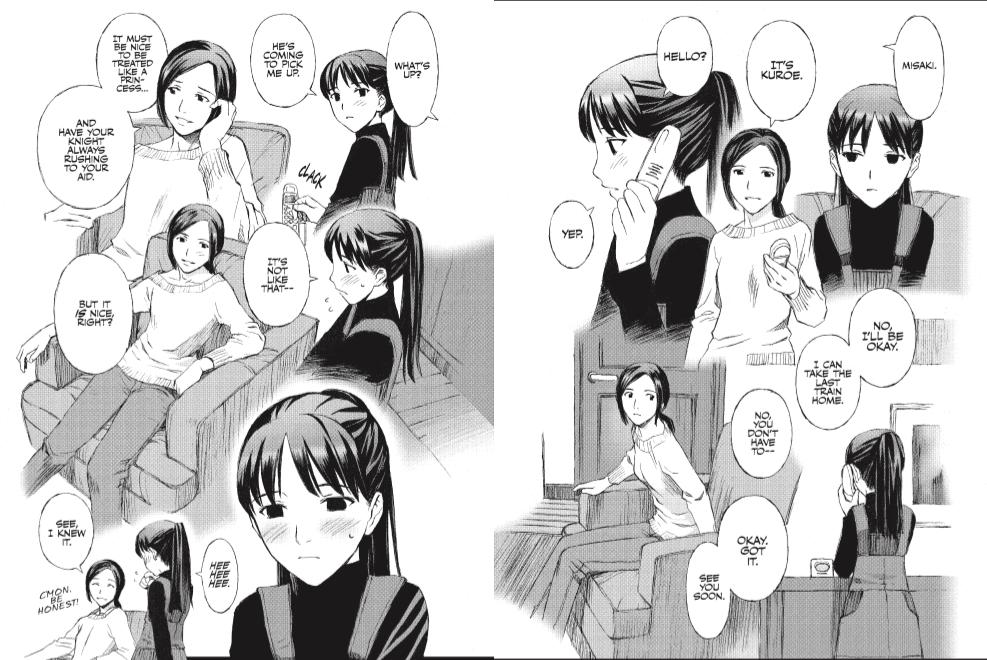
The most distinctive element of the artwork is Takano’s willingness to abandon grids altogether, creating fluid, full-page sequences in which the characters’ faces play a similar role to panel boundaries and shapes in directing the eye across the page. In this spread, for example, Sainome gently teases Misaki about her relationship with Kuroe:

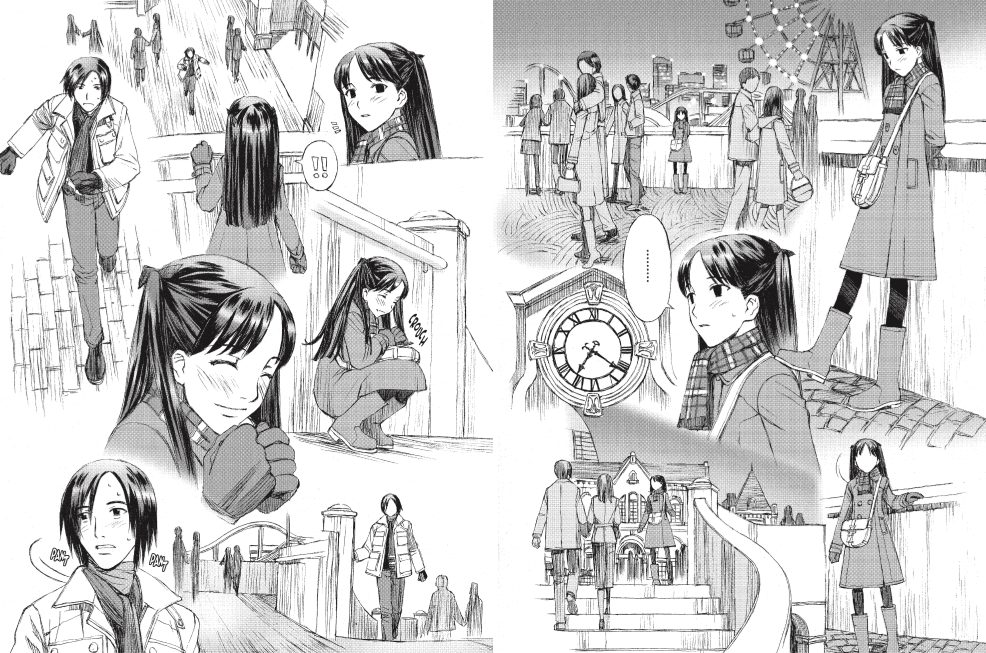
The undulating lines and overlapping images give these pages a pleasing, sensual quality, but what’s most striking is the way in which the strongest lines on the page point to Misaki’s eyes and mouth, showing us how difficult it is for Misaki to conceal her feelings for Kuroe. The wordless sequence below — in which Misaki waits for Kuroe to join her on a date — works in a similar fashion, using the direction of Misaki’s gaze to lead us through the proper sequence of events:

Though these two scenes are gracefully executed, they point to the biggest problem with Blood Alone: Misaki and Kuroe aren’t portrayed as ward and guardian, or brother and sister, but as star-crossed lovers whose age and circumstance make it impossible for them to fully express their true feelings for one another. Some readers may find their unconsummated romance heartwarming, the story of a love that can never be, but for other readers, Misaki and Kuroe’s relationship will be a deal-breaker, a sentimental and uncritical portrayal of an inappropriate relationship between a young vampire and her adult protector.

Review copy provided by Seven Seas.

BLOOD ALONE, VOLS. 1-3 • BY MASAYUKI TAKANO • SEVEN SEAS • 600 pp. • RATING: TEEN (13+)

Filed Under: Manga, Manga Critic, REVIEWS Tagged With: Blood Alone, Seven Seas, Vampires

Spice and Wolf, Vol. 4

May 4, 2011 by Katherine Dacey

At some point in your childhood, a well-meaning adult — a parent, a teacher, Mr. Rodgers — exhorted you “not to judge a book by its cover.” I’m not as diligent about following that advice as I should be, though I have enough experience as a consumer to correctly guess a book’s contents and intended audience from the packaging. Every now and then, however, I completely misjudge a title, as I did with volume four of Spice and Wolf. The cover suggested a fantasy-adventure in a medieval setting — perhaps something along the lines of Claymore — but the story read more like an economics textbook with sexy illustrations.

Ostensibly, Spice and Wolf focuses on the relationship between Holo, a six-hundred-year-old wolf god, and Lawrence, a twenty-five-year-old human. The two meet cute when Holo stows away in Lawrence’s wagon, looking for a ride to her homeland of Yoitsu. Though they’re temperamental opposites — Holo is crafty and impulsive, Lawrence is deliberate and careful — the two discover that they make good business partners; Holo’s ability to manipulate trading partners complements Lawrence’s financial acumen and risk assessment skills.

That’s not a bad premise for a manga; in the right hands, Holo and Lawrence’s travels could be the basis for a smart social satire or an engaging comedy. Unfortunately, the script frequently requires Lawrence to explain the finer points of loans, currency, and inventory control to Holo, expositions that are about as much fun to read as a chapter from Modern Management: Concepts and Skills. Holo’s responses are equally stultifying; in one scene, she cheerfully tells Lawrence, “It’s my intention to pay you back with interest. That means the more I borrow, the more you profit.” Ace student, that Holo.

These tedious exchanges about interest rates and guild politics are occasionally interrupted by comic interludes, usually prompted by Holo’s discovery of a stash of booze or Holo’s decision to groom her tail, an elaborate procedure that requires her to assume a number of fetching poses as she preens. If there was any chemistry between Holo and Lawrence, these scenes might not feel so completely perfunctory, but they serve little purpose beyond catering to the male reader’s gaze. Worse still, the story lacks any sense of urgency or purpose; the dramatic climax of volume four involves Lawrence discovering that he bought a wagon’s worth of worthless armor. There’s more at stake in a typical episode of The Apprentice, and they’re hawking salad dressing and mattresses.

Yet for all my criticisms of Spice and Wolf, I can see why the series has a devoted following. The artwork is immaculate, with clean lines, appealing character designs, and meticulously rendered landscapes, buildings, and urban markets; Keito Koume’s crowd scenes bustle with activity, as characters negotiate deals and flirt with each other, bringing the walled medieval towns to vivid life. The supporting cast, too, boasts some memorable characters. In volume four, for example, Lawrence and Holo cross paths with Norah, a shepherdess whose pleasant demeanor masks a complicated personal history. The volume closes with a bonus story showing us Norah’s visit to a local town, followed by a difficult night when she and her dog Ennek hide from Church authorities. It’s a simple mood piece, but it’s tense and effectively staged, hinting at the broad — even overreaching — power invested in religious authorities.

That the Church’s power and history remain mysterious four volumes into the manga points to the series’ biggest problem: most of the interesting conflicts in Spice and Wolf are so deeply buried beneath the commercial shop-talk that they barely register at all. As a result, Spice and Wolf reads more like Project X: Cup Medieval Noodle than a proper drama; what it desperately needs is a high-speed wagon chase, sword fight, or — dare I say it? — a love scene to goose the proceedings.

Review copy provided by Yen Press. Volume four of Spice & Wolf arrives in stores on May 31, 2011.

SPICE AND WOLF, VOL. 4 • STORY BY ISUNA HASEKURA, ART BY KEITO KOUME • YEN PRESS • 192 pp. • RATING: MATURE

Filed Under: Manga, Manga Critic, REVIEWS Tagged With: Seinen, Spice and Wolf, yen press

5 Reasons to Read InuYasha

April 29, 2011 by Katherine Dacey

InuYasha was the first comic that I actively collected, the manga that introduced me to the Wednesday comic-buying ritual and the very notion of self-identifying as a fan. Though I followed it religiously for years, trading in my older editions for new ones, watching the anime, and speculating about the finale, my interest in the series gradually waned as I was exposed to new artists and new genres. Still, InuYasha held a special place in my heart; reading it was one of my seminal experiences as a comic fan, making me reluctant to re-visit InuYasha for fear of sullying those precious first-manga memories. VIZ’s recent decision to re-issue InuYasha in an omnibus edition, however, inspired me to pick it up again. I made a shocking discovery in the process of re-reading the first chapters: InuYasha is good. Really good, in fact, and deserving of more respect than it gets from many critics.

What makes InuYasha work? I can think of five reasons:

1. The story arcs are long enough to be complex and engaging, but not so long as to test the patience.

There’s a Zen quality to Rumiko Takahashi’s storytelling that might not be obvious at first glance; after all, she loves a pratfall or a sword fight as much as the next shonen manga-ka. Don’t let that surface activity fool you, however: Takahashi has a terrific sense of balance, staging a romantic interlude between a demon-of-the-week episode and a longer storyline involving Naraku’s minions, thus preventing the series from devolving into a punishing string of battle arcs. The other great advantage of this approach is that Takashi carves out more space for her characters to interact as people, not just combatants; as a result, InuYasha is one of the few shonen manga in which the characters’ relationships evolve over time.

2. Takahashi knows how to stage a fight scene that’s dramatic, tense, and mercifully short.

‘Nuff said.

3. InuYasha‘s villains are powerful and strange, not strawmen.

Though we know our heroes will prevail — it’s shonen, for Pete’s sake — Takahashi throws creative obstacles in their way that makes their eventual triumph more satisfying. Consider Naraku. In many respects, he’s a standard-issue bad guy: he’s omnipotent, charismatic, and manipulative, capable of finding the darkness and vulnerability in the purest soul. (He also has fabulous hair, another reliable indication of his villainy.) Yet the way in which Naraku wields power is genuinely unsettling, as he fashions warriors from pieces of himself, then reabsorbs them into his body when they outlive their usefulness. Naraku’s manifestations are peculiar, too. Some are female, some are children, some have monstrous bodies, and some have the power to create their own demonic offspring, but few look like the sort of golem I’d create if I wanted to wreak havoc. And therein lies Naraku’s true power: his opponents never know what form he’ll take next, or whether he’s already among them.

Sesshomaru, too, is another villain who proves more interesting than he first appears. In the very earliest chapters of the manga, he’s a bored sociopath who has no qualms about using InuYasha’s mama trauma to trick his younger brother into revealing the Tetsusaiga’s location. As the story progresses, however, Sesshomaru begins tolerating the company of a cheerful eight-year-old girl who, in a neat inversion of the usual human-canine relationship, is dependent on her dog-demon master for protection, food, and companionship. Takahashi resists the urge to fully “humanize” Sesshomaru, however; he remains InuYasha’s scornful adversary for most of the series, largely unchanged by his peculiar fixation with Rin.

And did I mention that Sesshomaru has awesome hair? Oh, to be a villain in a Takahashi manga!

4. InuYasha‘s female characters kick ass.

Back in 2008, Shaenon Garrity wrote a devastatingly funny article about the seven types of female characters in shonen manga, from The Tomboy to The Little Girl to The Experienced Older Woman. I’m pleased to report that none of these types appear in InuYasha; in fact, InuYasha boasts one of the smartest, toughest, and most appealing set of female characters in shonen manga. And by “tough,” I don’t mean that Kagome, Kikyo, and Sango brandish weapons while wearing provocative outfits; I mean they persist in the face of adversity, even if their own lives are at stake. They’re strong enough to hold their own against demons, ghosts, and heavily armed bandits, and wise enough to know when words are more effective than weapons. They’re not adverse to the idea of romance, but recovering the Shikon Jewel takes precedence over dating. And they’re woman enough to cry if something awful happens, though they’d rather shed their tears in private than show their pain to others.

5. The horror! The horror!

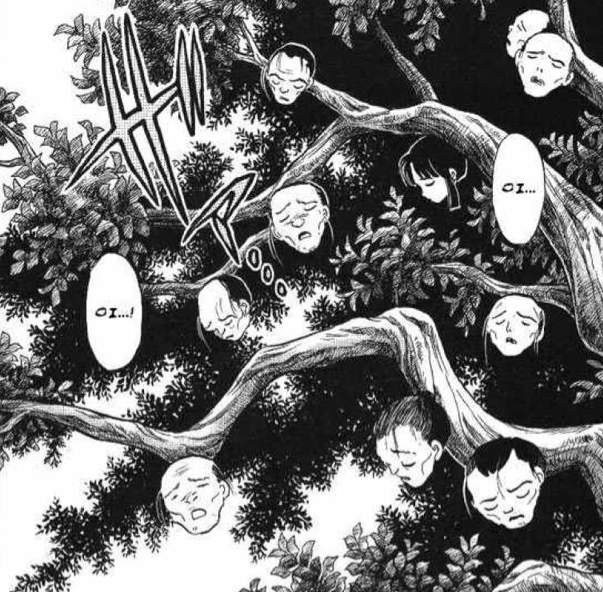
Takahashi may have the coolest resume of anyone working in manga today; not only did she study script writing with Kazuo Koike, she also worked as an assistant to Kazuo Umezu — an apprenticeship that’s evident in the early chapters of InuYasha. In between Kagome and InuYasha’s first encounters with Naraku are a handful of short but spooky stories in which seemingly benign objects — a noh mask, a peach tree — are transformed by Shikon Jewel shards into instruments of torture and killing. Takahashi’s horror stories are less florid than Umezu’s, with fewer detours into WTF? territory, but like Umezu, Takahashi has a vivid imagination that yields some decidedly scary images. Here, for example, is the demonic peach tree from chapter 79, “The Fruits of Evil”:

Takahashi doesn’t just use these images to shock; she uses them to illustrate the consequences of ugly emotions, impulsive actions, and violent behavior, to show us how these choices slowly corrode the soul and transform us into the most monstrous version of ourselves. (Also to show us the consequences of substituting human bones and blood for Miracle Gro. Kids, don’t try this at home.)

What Takahashi does better than almost anyone is walk the fine line between terror and horror. Gothic novelist Ann Radcliffe, author of The Mysteries of Udolpho (1794) and The Italian (1797), was one of the first writers to argue that terror and horror were different states of arousal. “Terror and Horror are so far opposite, that the first expands the soul and awakens the faculties to a high degree of life; the other contracts, freezes and nearly annihilates them,” she wrote in an 1826 essay, “On the Supernatural in Poetry.” Critiquing Radcliffe’s work in 1966, Devendra P. Varma explained that difference more concretely: “The difference between Terror and Horror is the difference between awful apprehension and sickening realization: between the smell of death and stumbling against a corpse.” And that’s exactly where Takahashi operates: she gives us tantalizing, suggestive glimpses of scary things, then keeps them obscured until the denouement of the story, allowing our imaginations to supply most of the grisly details. We read her work in a heightened state of awareness, which only intensifies our pleasure — and revulsion — when the true nature of Kagome and InuYasha’s foes are revealed.

* * * * *

If you haven’t looked at InuYasha in a while, or missed it during the height of its popularity, now is a great time to give it a try. Each volume of the VIZBIG edition collects three issues, allowing readers to more fully immerse themselves in the story. And if you’re a purist about packaging, you’ll be happy to know that VIZ is finally issuing InuYasha in an unflipped format — a first in the series’ US history.

Filed Under: Manga, Manga Critic, Recommended Reading, REVIEWS Tagged With: Horror/Supernatural, inuyasha, Rumiko Takahashi, Shonen, shonen sunday, VIZ, Yokai

Manga Artifacts: Rumiko Takahashi’s Rumic Theater

April 26, 2011 by Katherine Dacey

Most American readers know Rumiko Takahashi through her work in Shonen Sunday, but Takahashi has a foot in the seinen world as well. Maison Ikkoku ran in Big Comic Spirits from 1980-87, alongside Area 88 and Wounded Man, while short stories such as “To Grandmother’s House We Go” and “One Hundred Years of Love” appeared in Big Comic Spirits‘ sister publication Big Comic Original. In Japan, Takahashi’s seinen shorts have been collected into four volumes: 1 or W, The Tragedy of P, The Executive’s Dog, and Red Bouquet. Here in the US, however, only two have been translated into English: The Tragedy of P, which was re-titled Rumic Theater (1996), and 1 or W, which was published as Rumic Theater: One or Double (1998). (N.B. One or Double includes a handful of shonen and josei stories that appeared in Shonen Sunday and Petit Flower, respectively.)

These two translated volumes showcase Takahashi’s ability to work in almost genre. There are sports comedies (“The Grandfather of All Baseball Games”), domestic dramas (“Hidden in the Pottery,” “House of Garbage,” “The Tragedy of P”), rom-coms (“The Merchant of Romance,” “The Diet Goddess”), pop-culture spoofs (“Shake Your Buddha”), and ghost stories (“To Grandmother’s House We Go,” “One or Double”). As with Takahashi’s work in Shonen Sunday, many of these stories fold supernatural elements into everyday situations. In “Extra-Large Size Happiness,” for example, a woman’s relationship with her mother-in-law is strained by the sudden and frequent appearance of a household spirit that only she can see, while in “Reserved Seat,” a ghostly grandma takes possession of her grandson’s body so that she can honor her season tickets at the Takarazuka Revue.

Takahashi is a master at establishing her premise in just a few pages, allowing plenty of room for character development and broad comedy without compromising narrative momentum. One of the reasons Takahashi can be so economical is that she invests even the smallest moments with telling detail, making sure that every aspect of a character’s behavior is consistent with the story’s premise. In “Excuse Me for Being a Dog,” for example, the hero — who turns into a shiba inu whenever he suffers a nosebleed — acts like a canine even in his human form: he investigates an abandoned book bag with his nose, curls his lip at strangers, and recoils in the presence of pungent odors. Takahashi doesn’t make a big deal of these behavioral tics, but their inclusion in the story elevates Shiro’s condition from a wacky plot contrivance to a fundamental aspect of his existence. (OK, it’s also a wacky plot contrivance.)

Takahashi’s deep affection for her characters also contributes to the stories’ success. Though they bicker and tease and goad one another, the characters’ good will and mutual affection is seldom in question, even when their judgment is. Takahashi is as generous with her least sympathetic characters as she is with her leads, allowing them moments of wisdom and decency that often challenge the other characters’ perception of them. In “The Story of P,” for example, a man agrees to care for his eccentric client’s pet penguin, despite the fact the Hagas’ apartment complex doesn’t allow pets. For most of the story, Mrs. Haga plays cat-and-mouse with her neighbor Mrs. Kakei, the head of tenants’ association and a reputed animal hater. (Mrs. Kakei keeps tabs on the other tenants, notifying the management of any pet violations.) Yet in the last pages of the story, we learn that Mrs. Kakei has complicated, emotional reasons for ratting out her neighbors that stem, in part, from a genuine concern for animal welfare and not a humorless love of rules.

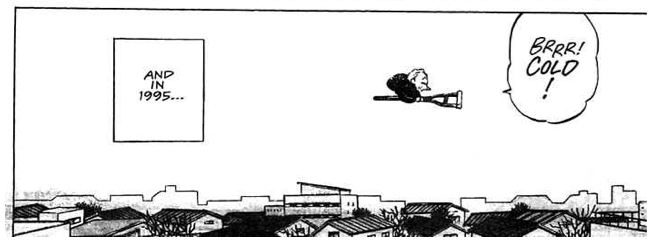
Art-wise, Takahashi produces some of the cleanest, most accessible layouts in manga. Her characters’ faces are easy to read, and her scenes are staged for maximum clarity and emotional impact; no one times a scare or a punch line better than Takahashi. Even more striking is the sense of mischief and play that informs her artwork. The elderly heroine of “One Hundred Years of Love,” for example, gains the ability to fly after surviving a near-death experience. Takahashi draws the old woman astride an enormous crutch, soaring over an urban landscape. At first, Mrs. Hoshino mutters about the weather, but soon she embraces the possibilities of flight, buzzing an unsuspecting eight-year-old apartment dweller:


That same sense of mischief is evident in “Extra-Large Size Happiness,” in which a giant yokai pops into the frame — directly behind the frazzled heroine’s mother-in-law. Readers familiar with InuYasha‘s Shippo and Myogi will immediately recognize this round, genial figure:

The similarities between this nameless yokai and Myoga could be construed as a flaw or weakness of Takahashi’s style, but there’s an argument to be made that Takahashi employs a “star system” of her own. Granted, Takahashi never constructed a neat theoretical framework to explain the recurrence of certain characters in her stories, as Osamu Tezuka famously did for his. Flipping through the pages of Rumic Theater, however, it’s easy to imagine these characters as actors who specialize in certain types of roles, retaining something of their own “off-screen” personality and appearance in every story; as David Welsh observed in his recent essay on Ranma 1/2, “The fun is in seeing the specialists find variations on their distinctive themes.” And here, in Rumic Theater, the fun comes from seeing Takahashi’s regulars tackle more grown-up themes — marital discord, neighborhood politics, growing old — than might otherwise be permissible in the context of a long-form adventure such as InuYasha or Ranma 1/2 .

Filed Under: Manga, Manga Critic, Recommended Reading, REVIEWS Tagged With: Manga Movable Feast, Rumic Theater, Rumiko Takahashi, Seinen, VIZ

Blue Exorcist, Vol. 1

April 22, 2011 by Katherine Dacey

Have you ever seen the pilot episode of Law & Order? Most of the regular characters are present, and the script follows the three-act structure familiar to anyone who’s watched an episode of any Law & Order series, but the pacing is slack; the dialogue fizzles where it should crackle; and the actors struggle to create believable relationships between the characters, even as the script demands that they explain things to one another that, presumably, they’d already know from working together. Small wonder that “Everybody’s Favorite Bagman” languished for nearly a year before NBC rescued the show from limbo and ordered a full season of episodes.

So it is with Blue Exorcist, which has a first chapter that might charitably be described as a “pilot episode.” In these opening thirty pages, Kato introduces orphan Rin Okimura, a hot-tempered young man; Yukio, Rin’s snot-nosed fraternal twin; and Father Fujimoto, their guardian. Rin, we learn, is a direct descendant of Satan, and is in imminent danger of going over to the dark side. Father Fujimoto, however, has kept this information from his young charge, seeing fit only to explain the complexities of Rin’s lineage when Satan’s minions try to spirit Rin back to Gehenna, the demon realm. (Like all manga priests, Father Fujimoto spends more time fighting demons than preparing Sunday sermons or ministering to the sick, hungry, and bereaved.) An epic confrontation between Satan and Father Fujimoto leaves Rin’s mentor dead, forcing the boy to decide whether to cast his lot with Satan or with humanity.

There’s no reason why this opening prelude has to be such a bumpy, predictable ride, but Kato seems so intent on relating Rin’s entire Tragic Past in one installment that she trades naturalism for economy. (Sample: “I see you’ve returned. An overnight trip to the job center? How diligent of you.” And how helpful of Father Fujimoto to ask Rin a question to which he already knows the answer!) In the second chapter, however, Kato finds her stride with the material: the dialogue is looser and funnier; the characters’ relationships are more firmly and plausibly established; and she introduces her first genuinely memorable character, Mephisto Pheles. The plot is stock, with Rin vowing to avenge Father Fujimoto by enrolling in an exorcism “cram school,” but Kato enlivens the proceedings with humorous twists and nifty artwork.

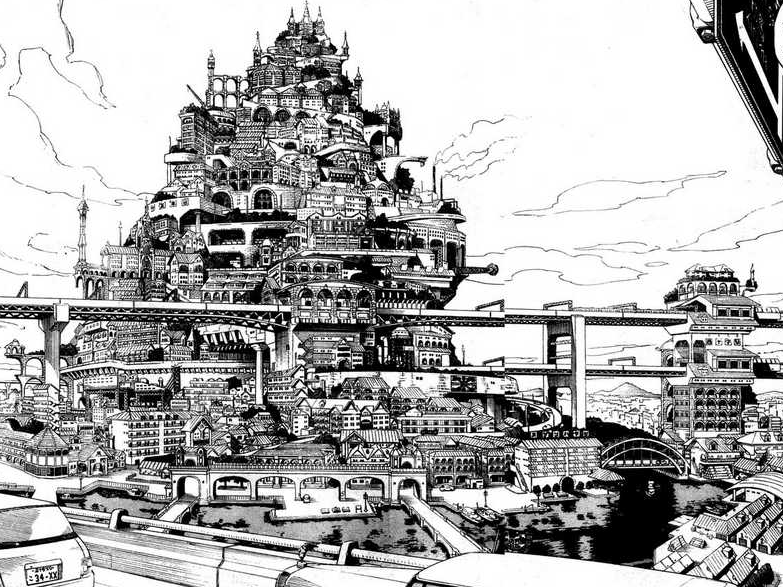
And oh, the artwork! It’s crisp and expressive, filled with small but suggestive details. Mephisto, for example, carries a patched umbrella and wears a polka-dot cravat — two minor flourishes that help establish him as a slightly decadent figure, elegant but down at the heels. The not-very-imaginatively named True Cross Town provides another instructive example of Kato’s meticulous and thoughtful draftsmanship: she lavishes considerable attention on architectural details and infrastructure, stacking layers of houses and buildings on top of one another to form a giant urban ziggeraut:

In short, Kato has created an imaginary urban landscape that seems to have evolved naturally over time, with old and new buildings side-by-side and modern modes of transport straddling canals and rivers. That kind of thoroughness may not serve much purpose in the context of a manga about demon fighters, but it lends Blue Exorcist a temporal and geographic specificity that’s sometimes missing in other areas of the story — like the religious bits.

Whatever my reservations about the first chapter, I freely admit that I’d fallen head-over-heels for Blue Exorcist by the end of the second. The brisk pacing, sharp artwork, and cheeky tone of these later chapters convinced me that Kazue Kato is in firm control of her story, and has successfully laid the foundation for the series’ first major story arc. Bring it on, I say!

BLUE EXORCIST, VOL. 1 • BY KAZUE KATO • VIZ MEDIA • 198 pp. • RATING: OLDER TEEN (16+)

Filed Under: Manga, Manga Critic, REVIEWS Tagged With: blue exorcist, Kazue Kato, Shonen, Shonen Jump, VIZ

Right Here, Right Now! 1-2 by Souya Himawari

April 20, 2011 by Michelle Smith

This time travel historical romance is actually a lot more rational than one would expect. Unfortunately, the romance is the least successful element of the story.

You can find my review for BL Bookrack here.

Review copies provided by the publisher.

Filed Under: Boys' Love, Historical Fiction, Manga Tagged With: digital manga publishing, Juné, Souya Himawari

  • « Go to Previous Page
  • Page 1
  • Interim pages omitted …
  • Page 14
  • Page 15
  • Page 16
  • Page 17
  • Page 18
  • Interim pages omitted …
  • Page 26
  • Go to Next Page »
 | Log in
Copyright © 2010 Manga Bookshelf | Powered by WordPress & the Genesis Framework