• Skip to primary navigation
  • Skip to main content
  • Skip to primary sidebar
  • Home
  • About Us
    • Privacy Policy
    • Comment Policy
    • Disclosures & Disclaimers
  • Resources
    • Links, Essays & Articles
    • Fandomology!
    • CLAMP Directory
    • BlogRoll
  • Features & Columns
    • 3 Things Thursday
    • Adventures in the Key of Shoujo
    • Bit & Blips (game reviews)
    • BL BOOKRACK
    • Bookshelf Briefs
    • Bringing the Drama
    • Comic Conversion
    • Fanservice Friday
    • Going Digital
    • It Came From the Sinosphere
    • License This!
    • Magazine no Mori
    • My Week in Manga
    • OFF THE SHELF
    • Not By Manga Alone
    • PICK OF THE WEEK
    • Subtitles & Sensibility
    • Weekly Shonen Jump Recaps
  • Manga Moveable Feast
    • MMF Full Archive
    • Yun Kouga
    • CLAMP
    • Shojo Beat
    • Osamu Tezuka
    • Sailor Moon
    • Fruits Basket
    • Takehiko Inoue
    • Wild Adapter
    • One Piece
    • After School Nightmare
    • Karakuri Odette
    • Paradise Kiss
    • The Color Trilogy
    • To Terra…
    • Sexy Voice & Robo
  • Browse by Author
    • Sean Gaffney
    • Anna Neatrour
    • Michelle Smith
    • Katherine Dacey
    • MJ
    • Brigid Alverson
    • Travis Anderson
    • Phillip Anthony
    • Derek Bown
    • Jaci Dahlvang
    • Angela Eastman
    • Erica Friedman
    • Sara K.
    • Megan Purdy
    • Emily Snodgrass
    • Nancy Thistlethwaite
    • Eva Volin
    • David Welsh
  • MB Blogs
    • A Case Suitable For Treatment
    • Experiments in Manga
    • MangaBlog
    • The Manga Critic
    • Manga Report
    • Soliloquy in Blue
    • Manga Curmudgeon (archive)

Manga Bookshelf

Discussion, Resources, Roundtables, & Reviews

Manga Critic

The Best Manga of 2009: The Manga Critic’s Picks

December 17, 2009 by Katherine Dacey

I pity the poor critic who panned Up — it’s not fun to buck the tide of critical approbation, especially when it seems like everyone else is wholeheartedly embracing the film or book in question. I say this because my best-of-2009 list is missing two titles that I’ve seen on many others: Yoshihiro Tatsumi’s A Drifting Life and Fumi Yoshinaga’s Ooku: The Inner Chambers. The first, I’ll admit, is a beautifully crafted book, proof that manga can be a great medium for biography. Yet for all its artistry, I found A Drifting Life oddly uninvolving; too many chapters read more like historical pageants than personal drama. The second title I found more problematic. Yoshinaga starts from a humdinger of a premise, inverting the social order of Tokugawa Japan by placing women in charge of everything. Yoshinaga never fulfills the promise of her idea, however, saddling her narrative with long-winded conversations that are both tin-eared and dull, two adjectives I never thought I’d be applying to Yoshinaga’s work.

So what manga *did *I like this year? Read on for the full list.
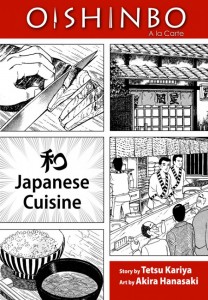
oishinbo110. Oishinbo a la Carte
Story by Tetsu Kariya • Art by Akira Hanasaki • VIZ Media
Equal parts Iron Wok Jan, Mostly Martha, and The Manga Cookbook, this educational, entertaining series explores Japanese cuisine at its most refined — sake, seabream sashimi — and its most basic — rice, pub food. The stories fall into two categories: stories celebrating the important role of food in creating community, and stories celebrating the culinary expertise of its principal characters, newspaperman Yamaoka Shiro and his curmudgeonly father Kaibara Yuzan. (Fun fact: Yuzan is such a food snob that he drove Yamaoka’s mother to an early grave, causing an irreparable break between father and son.) Though the competition between Yamaoka and Yuzan yields some elegant, mouth-watering dishes, Oishinbo is at its best when it focuses on everyday food in everyday settings, shedding light on how the Japanese prepare everything from bean sprouts to ramen. Warning: never read on an empty stomach! (Click here for my review of Oishinbo A la Carte: Japanese Cuisine; click here for my review of Oishinbo A la Carte: Vegetables.)
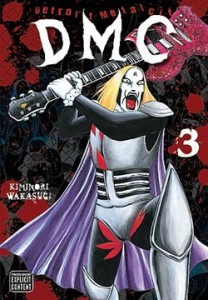
dmc39. Detroit Metal City
By Kiminori Wakasugi • VIZ Media
Satirizing death metal is a bit like shooting fish in a barrel: how hard can it be to parody a style associated with bands named Cannibal Corpse or Necrophagia? Poking fun at death metal while respecting the sincerity of its followers, however, is a much more difficult trick to pull off. Yet Kiminori Wakasugi does just that in Detroit Metal City, ridiculing the music — the violent lyrics, the crudely sexual theatrics — while recognizing the depth of DMC fans’ commitment to the metal lifestyle. Though the musical parodies are hilarious, the series’ funniest moments arise from classic fish-out-of-water situations: Negishi driving a tractor on his parent’s farm while dressed as alter ego Lord Krauser (complete with make-up, fright wig, and platform boots), Negishi bringing a fruit basket to a hospitalized DMC fan while dressed as Krauser… you get the idea. Rude, raunchy, and quite possibly the funniest title VIZ has licensed since Even a Monkey Can Draw Manga. (Click here for my review of volume one; click here for my review of volumes two and three.)
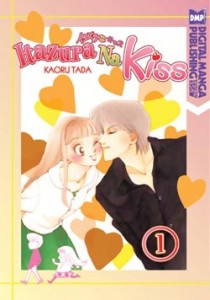
itazura18. Itazura Na Kiss
By Kaoru Tada • Digital Manga Publishing
In the twenty years since Itazura Na Kiss first appeared in Margaret, Kaoru Tada’s breezy romantic comedy has been widely imitated, but seldom surpassed. The story is as basic as they come: an airhead falls in love with a genius, is rebuffed by him, and is eventually pursued by him when he realizes just how sincere and kind she is. Tada manufactures a ridiculous situation to bring her characters together under the same roof — earthquake ahoy! — yet the story never devolves into brainless sitcom territory, thanks to her large supporting cast of characters, brisk comic timing, and strategic use of humor to reveal the characters’ true natures. Pure shojo bliss. (Click here for my review of volume one.)

7. Gogo Monster (VIZ Media)
By Taiyō Matsumoto • VIZ Media
Every elementary school has a kid like Yuki, a smart, odd student who says things that unsettle classmates and teachers alike. In Yuki’s case, it’s the matter-of-fact way he reports seeing monsters that leads to his social isolation. Newcomer Makoto doesn’t share Yuki’s vision, but he admires Yuki’s nonchalant attitude, and struggles mightily to understand what makes his friend tick. It’s to Taiyo Matsumoto’s credit that we’re never entirely sure what aspects of the story are intended to be real, and which ones might be unfolding in the characters’ heads; Yuki’s monsters remain largely unseen, though their presence is felt throughout the story. Matsumoto’s stark, primitive style suits the material perfectly, inoculating Gogo Monster against the sentimentality that imaginary friends and childhood fears inspire in so many authors.
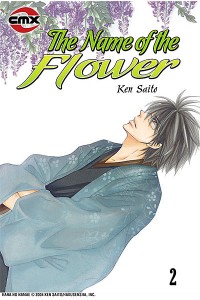
nameflower26. The Name of the Flower
By Ken Saito • CMX Manga
Had the Bronte sisters been born in twentieth-century Japan instead of nineteenth-century England, they might have penned something along the lines of The Name of the Flower, a tear-jerker about a young woman who falls in love with her guardian. Ken Saito employs many favorite Victorian tropes — muteness, garden imagery, orphans — in service of the plot, creating an atmosphere of palpable yearning that will be familiar to anyone who’s read Jane Eyre or Wuthering Heights. For all of its Victorian window-dressing, however, The Name of the Flower favors a slice-of-life approach over crazy-wives-in-the-attic melodrama. (Well, almost; the main love interest is a misanthropic — but hot! — novelist who favors yukatas over jeans, is prone to fits of anger, and writes dark, pessimistic fiction.) Saito’s elegant, understated art is the perfect complement to this delicate drama, making good use of floral imagery to underscore the heroine’s emotional state. For my money, the best new shojo manga of 2009.
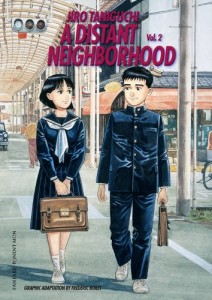
distant_neighborhood25. A Distant Neighborhood
By Jiro Taniguchi • Fanfare/Ponent Mon
A Distant Neighborhood is a wry, wistful take on a tried-and-true premise: a salaryman is transported back in time to his high school days, and must decide whether to act on his knowledge of the past or let events unfold as they did before. We’ve seen this story many times at the multiplex — Back to the Future, Peggy Sue Got Married — but Taniguchi doesn’t play the set-up for laughs; rather, he uses Hiroshi’s predicament to underscore the challenges of family life and the awkwardness of adolescence. (Hiroshi is the same chronological age as his parents, giving him special insight into the vicissitudes of marriage, as well as the confidence to cope with teenage tribulations.) Easily one of the most emotional, most intimate stories Taniguchi’s ever told.
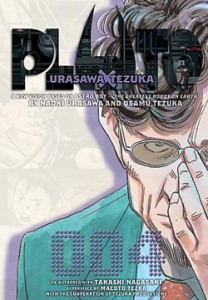
pluto4. Pluto: Urasawa x Tezuka
By Naoki Urasawa • VIZ Media
What amazes me the most about Naoki Urasawa is his ability to transform a tried-and-true genre like the whodunnit into a vehicle for exploring deeper questions about human nature, morality, and identity. As he did with the equally compelling Monster, Urasawa starts in familiar territory — in this case, a murder investigation — but quickly takes the story in unexpected directions, pausing to fill us in on the interior lives of both the principal and secondary characters — no mean feat, given that many cast members are, in fact, robots. Though Pluto takes its inspiration from “The Greatest Robot on Earth,” a short story within Osamu Tezuka’s long-running Astro Boy series, you don’t need to know anything about the original to appreciate the smart pacing, crisp artwork, or intelligent dialogue. In almost any other year, Pluto would have been my #1 pick; it’s a testament to the depth and breadth of 2009’s new releases that it isn’t.
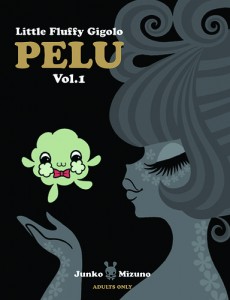
pelu13. Little Fluffy Gigolo Pelu
By Junko Mizuno • Last Gasp
Poignant is a word I seldom use to describe Junko Mizuno’s work, given the frequency with which her characters pop pills, wield chainsaws, and whip each other. But Little Fluffy Gigolo Pelu is poignant, a perversely sweet and sad meditation on one small, sheep-like alien’s efforts to find his place in the universe. In richly detailed images — if one can use the phrase “richly detailed” to describe artwork that draws its inspiration from Hello Kitty, My Little Pony, and Faster, Pussycat! Kill! Kill! — Mizuno offers one of the most bizarre, most original variations on that chick-lit staple, the quest to find a mate before one’s biological clock runs out. It’s not entirely clear how Mizuno expects her audience to react to Little Fluffy Gigolo Pelu — as a social satire? a tragedy? a Sanrio promotion? — but the clarity and appeal of her vision is undeniable. (Click here for my review of volume one.)
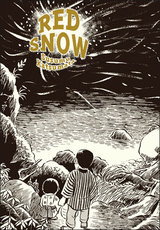
redsnow2. Red Snow
By Susumu Katsumata • Drawn & Quarterly
Through a series of ten vignettes, Red Snow depicts life in pre-industrial Japan, when men depended on the sea, the forest, and the field for their survival. Kappa and kitsune mingle freely with humans in Susumu Katsumata’s world, their presence treated as a matter of fact, rather than something extraordinary — a reflection of man’s close relationship with the natural world. Though Katsumata employs a self-consciously primitive style, the stories are neither bleak nor condescending towards their subjects; if anything, Katsumata’s drawings of farmers, woodcutters, and drunken monks have a rude vigor that reflects the resilience of his characters.

1. Children of the Sea
By Daisuke Igarashi • VIZ Media
Children of the Sea defies easy categorization; it’s a high-seas adventure, an exploration of pan-Asian mythology, a cautionary tale about the environment, and a meditation on the ocean as a life-giving force. Though Children of the Sea could easily devolve into mystical hoo-ha — two of its characters were raised by dugongs, for Pete’s sake — Igarashi embeds a coming-of-age story within the main narrative that grounds Children of the Sea in everyday experience, even as the plot takes a turn for the fantastic. (See “raised by dugongs,” above.) Igarashi’s naturalistic art captures the beauty and strangeness of the ocean settings, as well as the sheer diversity of undersea life; you won’t soon forget the site of a sea turtle leaving a starry trail in its wake or the image of a young boy hitching a ride on a humpback whale. Eerie and poetic. (Click here for my review of volume one.)

HONORABLE MENTIONS
Done because there are too menny… great manga, that is, to confine myself to a traditional top ten list. With apologies to Thomas Hardy, here are some of the other manga that tickled my fancy in 2009:

  • Best Continuing Series: Black Jack (Vertical, Inc.) and Real (VIZ Media)
  • Best Dressed Characters: The History of the West Wing (Yen Press)
  • Best Final Volume: Emma (CMX)
  • Best Guilty Pleasure: Cat Paradise (Yen Press)
  • Best Kid-Friendly Title: Dinosaur Hour (VIZ) and Leave it to PET! The Misadventures of a Recycled Super-Robot (VIZ)
  • Best License Rescue: Yotsuba&! (Yen Press)
  • Best Manhwa: Small-Minded Schoolgirls (NETCOMICS)
  • Best New Manga That’s Already on Hiatus: The Manzai Comics (Aurora)
  • Best Prose Novel Released by a Manga Publisher: The Cat in the Coffin (Vertical, Inc.)
  • Best Reprint Edition: Clover (Dark Horse)
  • Best Substitute for Television: Fire Investigator Nanase (CMX)
  • Best Translation of a Dense, Culturally-Specific Text: Sayonara, Zetsubou-Sensei: The Power of Negative Thinking (Del Rey)
  • Best Use of Wagner in a Manga: Ludwig II (DMP)
  • Best Yaoi: Future Lovers (Aurora/Deux)

Filed Under: Manga, Manga Critic, Recommended Reading Tagged With: cmx, DMP, Drawn & Quarterly, Fanfare/Ponent Mon, Jiro Taniguchi, Junko Mizuno, Last Gasp, Naoki Urasawa, VIZ

Oishinbo A la Carte: Vegetables

December 14, 2009 by Katherine Dacey

oishinbo_veggiesI mean no disrespect to Tetsu Kariya or Akira Hanasaki when I say that the Vegetables volume of Oishinbo A la Carte irresistibly reminded me of 1970s television. Back in the day when there were only three networks, hour-long dramas doggedly followed the same formula: they dramatized a problem — say, drinking and driving, or falling in with a bad crowd — then resolved it with a little action and a lot of talking, culminating in a freeze-frame shot of the entire cast laughing at corny situational humor. Oishinbo follows this template to a tee, using hot-button issues such as bullying and pollution to preach the healing power of vegetables. The stories are as hokey and predictable as an episode of CHiPs or Little House on the Prairie, but entertaining in their sincerity.

Take “The Joy of a New Potato,” for example. The story begins with big-shot executive Misaki Hacho treating the Ultimate Menu team to an expensive meal. Shortly afterwards, Yamaoka discovers that Misaki has fallen on hard times, selling his business interests and trading his lavish home for a two-room flat. Kurita and Yamaoka invite Misaki’s family on a country outing, teaching his children how to harvest and cook potatoes. Though the denouement of the story is predictable and a little credulity-straining — Misaki’s son declares the potato outing “a hundred times better” than the extravagant birthday party that dad threw him the previous year — the message is heartfelt: doing things with your children is more important than doing things for them. Other stories in this vein include “The Bean Sprout Kid,” in which Yamaoka defends a quiet, frail boy from his classmates; “Good Eggplant, Bad Eggplant,” in which Tomio’s son overcomes his lifelong hatred of aubergines; “The Story of Vegetables, Now and Then,” in which a wealthy industrialist learns an important lesson about pesticides; “The Breath of Spring,” in which a cook woos her estranged lover with an asparagus dish; and “The Taste of Chicken, The Taste of Carrots,” in which a grandmother’s homemade chicken soup inspires a picky eater to add veggies to her diet.

…

Read More

Filed Under: Manga Critic Tagged With: Seinen, VIZ

Oishinbo A la Carte: Vegetables

December 14, 2009 by Katherine Dacey

I mean no disrespect to Tetsu Kariya or Akira Hanasaki when I say that the Vegetables volume of Oishinbo A la Carte irresistibly reminded me of 1970s television. Back in the day when there were only three networks, hour-long dramas doggedly followed the same formula: they dramatized a problem — say, drinking and driving, or falling in with a bad crowd — then resolved it with a little action and a lot of talking, culminating in a freeze-frame shot of the entire cast laughing at corny situational humor. Oishinbo follows this template to a tee, using hot-button issues such as bullying and pollution to preach the healing power of vegetables. The stories are as hokey and predictable as an episode of CHiPs or Little House on the Prairie, but entertaining in their sincerity.

Take “The Joy of a New Potato,” for example. The story begins with big-shot executive Misaki Hacho treating the Ultimate Menu team to an expensive meal. Shortly afterwards, Yamaoka discovers that Misaki has fallen on hard times, selling his business interests and trading his lavish home for a two-room flat. Kurita and Yamaoka invite Misaki’s family on a country outing, teaching his children how to harvest and cook potatoes. Though the denouement of the story is predictable and a little credulity-straining — Misaki’s son declares the potato outing “a hundred times better” than the extravagant birthday party that dad threw him the previous year — the message is heartfelt: doing things with your children is more important than doing things for them. Other stories in this vein include “The Bean Sprout Kid,” in which Yamaoka defends a quiet, frail boy from his classmates; “Good Eggplant, Bad Eggplant,” in which Tomio’s son overcomes his lifelong hatred of aubergines; “The Story of Vegetables, Now and Then,” in which a wealthy industrialist learns an important lesson about pesticides; “The Breath of Spring,” in which a cook woos her estranged lover with an asparagus dish; and “The Taste of Chicken, The Taste of Carrots,” in which a grandmother’s homemade chicken soup inspires a picky eater to add veggies to her diet.

No volume of Oishinbo would be complete with at least one epic food battle, and Vegetables opens with a doozy: a three-part contest revolving around cabbage and turnips. For most of the showdown, Yuzan appears to have the upper hand, preparing simple dishes that emphasize the unique flavors of the star ingredients. Yamaoka’s fortunes change, however, when Arakawa’s mother comes to the city for a visit, bringing wild grape juice and walnuts with her. The bold flavors of the grapes and walnuts inspire Yamaoka to take a page from his father’s book, trading elaborate preparations for straightforward ones that enhance the “muddiness” of the turnip.

As I noted in my review of the first volume, the structure of the A la Carte edition of Oishinbo is both its strength and weakness. On the one hand, organizing each volume around a particular kind of food makes for a fun, educational introduction to Japanese cuisine; a better title for the US edition would be Oishinbo: Beyond Pocky and California Rolls, given the sheer diversity of the food described in each volume. On the other hand, the series’ thematic organization robs the series of its continuity; we never have a chance to see Kurita and Yamaoka’s relationship evolve from co-workers to spouses, as we’re constantly seeing them at different stages of their courtship, nor do we have any sense of how the Ultimate Menu vs. Supreme Menu contest is unfolding.

Still, it’s difficult to deny Oishinbo‘s appeal. Imagine Iron Chef crossed with Mostly Martha, and you have some idea of why this sincere, somewhat hokey, series is as addictive as gyoza: it reminds us that food is an essential ingredient in all human relations, the glue that binds friends, families, and lovers in times of joy and crisis alike. The best of the A la Carte series.

Review copy provided by VIZ Media, LLC.

OISHINBO A LA CARTE: VEGETABLES • STORY BY TETSU KARIYA, ART BY AKIRA HANASAKI • VIZ • 266 pp. • RATING: TEEN

Filed Under: Manga, Manga Critic, REVIEWS Tagged With: Cooking and Food, VIZ, VIZ Signature

Itazura Na Kiss, Vol. 1

December 6, 2009 by Katherine Dacey

itazura1Seventeen-year-old Kotoko Aihara is a ditz, the kind of girl who gets easily flustered by math problems, blurts whatever she’s thinking, and burns every dish she attempts to make, be it a kettle of boiling water or beef bourguignon. Though Kotoko’s poor academic performance consigns her Class F — the so-called “dropout league” at her high school — she has her eye on Naoki Irie, the star of Class A. Rumored to be an off-the-chart genius — some peg his IQ at 180, others at 200 — Naoki is an outstanding student whose good looks and natural athletic ability make him an object of universal admiration. Kotoko finally screws up the courage to confess her feelings to him, only to be curtly dismissed; Naoki “doesn’t like stupid girls.” Furious, Kotoko resolves to forget Naoki.

This being a shojo manga, however, author Kaoru Tada contrives an only-in-the-pages-of-Margaret scenario to bring her reluctant lovebirds together: an earthquake. When a tremor flattens Kotoko’s house, she and her father don’t go to a shelter or a hotel. No, they take up residence at… the Iries! (Kotoko and Naoki’s fathers are lifelong friends, having attended the same high school thirty years prior.) Though Mr. and Mrs. Irie warmly embrace Kotoko, Naoki balks at her presence, forbidding her to acknowledge him at school or tell her friends where she’s staying. Making matters worse are Naoki’s younger brother Yuuki, a fiercely intelligent third grader who shares Naoki’s contempt for Kotoko, and Naoki’s mother, a cheerful busybody who tries engineering a relationship between Kotoko and her son; their intrusions into Kotoko’s life are a constant reminder of just how awkward her situation really is.

…

Read More

Filed Under: Manga Critic Tagged With: Classic, DMP, shojo

Itazura Na Kiss, Vol. 1

December 6, 2009 by Katherine Dacey

Seventeen-year-old Kotoko Aihara is a ditz, the kind of girl who gets easily flustered by math problems, blurts whatever she’s thinking, and burns every dish she attempts to make, be it a kettle of boiling water or beef bourguignon. Though Kotoko’s poor academic performance consigns her Class F — the so-called “dropout league” at her high school — she has her eye on Naoki Irie, the star of Class A. Rumored to be an off-the-chart genius — some peg his IQ at 180, others at 200 — Naoki is an outstanding student whose good looks and natural athletic ability make him an object of universal admiration. Kotoko finally screws up the courage to confess her feelings to him, only to be curtly dismissed; Naoki “doesn’t like stupid girls.” Furious, Kotoko resolves to forget Naoki.

This being a shojo manga, however, author Kaoru Tada contrives an only-in-the-pages-of-Margaret scenario to bring her reluctant lovebirds together: an earthquake. When a tremor flattens Kotoko’s house, she and her father don’t go to a shelter or a hotel. No, they take up residence at… the Iries! (Kotoko and Naoki’s fathers are lifelong friends, having attended the same high school thirty years prior.) Though Mr. and Mrs. Irie warmly embrace Kotoko, Naoki balks at her presence, forbidding her to acknowledge him at school or tell her friends where she’s staying. Making matters worse are Naoki’s younger brother Yuuki, a fiercely intelligent third grader who shares Naoki’s contempt for Kotoko, and Naoki’s mother, a cheerful busybody who tries engineering a relationship between Kotoko and her son; their intrusions into Kotoko’s life are a constant reminder of just how awkward her situation really is.

Tada’s set-up is credulity-straining — to say the least! — but she populates her story with so many fabulous supporting players it’s easy to forgive the absurd plot twists. Yuuki is my favorite character, a pint-sized terror who’s equal parts Stewie Griffin and Harriet the Spy, filling a notebook with detailed (and unflattering) descriptions of Kotoko’s daily routine. When Kotoko discovers his “observation diary,” a hilarious battle royale ensues, as she tries to persuade Yuuki that she is, in fact, smart, kind, and attractive. Kotoko’s Class F pals are another welcome source of comic relief. Though her friends are strictly one-note characters — a wiseacre, a wiseguy who carries a torch for Kotoko — they function as a kind of salty Greek chorus, alternately rooting for Kotoko and ruing her impulsive behavior.

Even Tada’s lead couple are more appealing than they initially seem. Kotoko, for example, turns out to be spunkier and smarter than one might have guessed from the opening pages, tapping into a hidden reserve of cunning when she discovers an incriminating photo of Naoki. Naoki, for his part, demonstrates a capacity for chivalrous behavior, even though he remains appalled by Kotoko’s… well, stupidity. (Spoiler alert: She doesn’t become a Nobel laureate overnight.)

Tada’s artwork is serviceable, with simple layouts and minimal attention to background detail, save for the occasional patch of screentone. Though crude, her sketchy character designs prove surprisingly effective, neatly encapsulating each cast member’s personality in just a few simple shapes and lines: Naoki’s hauteur by his sharp nose and rooster-like shock of hair, Kotoko’s naivete by her round, girlish face. The characters’ rough, unfinished look readily lends itself to the kind of facial and bodily deformations so characteristic of the shojo rom-com; I’ll take Tada’s unpolished yet soulful cartooning over the super-slick stylings of Arina Tanemura any day.

Reading Itazura Na Kiss, it’s easy to see why the series proved so influential. Tada makes opposites-attract comedy seem effortless — just throw your leads under the same roof and presto! hilarity and romance ensue. What Tada did better than many of her admirers, however, is make the comedy count for something more than just a few laughs; her characters’ pratfalls and humiliations serve as catalysts for self-reflection and growth, making it seem plausible that Naoki and Kotoko might be right for one another… some day. (I never rule out the possibility of a deus ex-mangaka bringing them together before then, however.) Highly recommended.

ITAZURA NA KISS, VOL. 1 • BY KAORU TADA • DMP • 342 pp. • RATING: TEEN (13+)

Filed Under: Manga, Manga Critic, REVIEWS Tagged With: Classic, DMP, Romance/Romantic Comedy

Little Fluffy Gigolo Pelu, Vol. 1

November 5, 2009 by Katherine Dacey

pelu1Poignant — now there’s a word I never imagined I’d be using to describe one of Junko Mizuno’s works, given her fondness for disturbing images and acid-trip plotlines. But Little Fluffy Gigolo Pelu is poignant, a perversely sweet and sad meditation on one small, sheep-like alien’s efforts to find his place in the universe.

The story is simple: on the “cute and pink” planet of Princess Kotobuki, Pelu lives with a beautiful race of women and a “calm but carnivorous giant space hippo.” Pelu has always been aware of how different he is from his fellow Kotobukians, but when he learns that he will never be able to have a family of his own, he falls into a terrible funk, begging the hippo to eat him. When the hippo demurs — Pelu is just too woolly to be appetizing — Pelu borrows the hippo’s magic mirror and teleports to Earth in search of others like him. What Pelu discovers, however, is that Earth women view him as an  exotic pet, a companion who’s entertaining but disposable. He careens from one unhappy situation to another, meeting young women who are down on their luck: an aspiring singer with a lousy voice, a homely orphan who’s raising an ungrateful brother, a pearl diver plying her trade in the sewer.

…

Read More

Filed Under: Manga Critic Tagged With: Junko Mizuno, Last Gasp, Seinen

Little Fluffy Gigolo Pelu, Vol. 1

November 5, 2009 by Katherine Dacey

Poignant — now there’s a word I never imagined I’d be using to describe one of Junko Mizuno’s works, given her fondness for disturbing images and acid-trip plotlines. But Little Fluffy Gigolo Pelu is poignant, a perversely sweet and sad meditation on one small, sheep-like alien’s efforts to find his place in the universe.

The story is simple: on the “cute and pink” planet of Princess Kotobuki, Pelu lives with a beautiful race of women and a “calm but carnivorous giant space hippo.” Pelu has always been aware of how different he is from his fellow Kotobukians, but when he learns that he will never be able to have a family of his own, he falls into a terrible funk, begging the hippo to eat him. When the hippo demurs — Pelu is just too woolly to be appetizing — Pelu borrows the hippo’s magic mirror and teleports to Earth in search of others like him. What Pelu discovers, however, is that Earth women view him as an  exotic pet, a companion who’s entertaining but disposable. He careens from one unhappy situation to another, meeting young women who are down on their luck: an aspiring singer with a lousy voice, a homely orphan who’s raising an ungrateful brother, a pearl diver plying her trade in the sewer.

Like Mizuno’s other works, Little Fluffy Gigolo Pelu aims for maximum shock value by depicting cute characters engaged in degenerate behavior: popping pills, doing the nasty in nasty places. Yet Fluffy Gigolo leaves a very different aftertaste than Mizuno’s other manga. Pure Trance, for example, is far less coherent, a set of vivid, Hieronymus Bosch-meets-Hello Kitty set pieces, with doll-like girls binging and purging, brandishing chainsaws, and enduring medical procedures that might give Dr. No pause. One could argue that Pure Trance was intended to point out the absurd lengths to which women go to achieve physical perfection, though one could also argue, as Shaenon Garrity does, that Pure Trance is really a vehicle for Mizuno to draw whatever crazy-ass things popped into her head (i.e. naked, chainsaw-wielding Bratz dolls). Either way, Pure Trance feels like a stunt, its Grand Guignol excesses trumping whatever social commentary might inform the story.

By contrast, Fluffy Gigolo‘s shock tactics serve dramatic and thematic functions, inviting the reader to feel sympathy for Pelu while prompting reflection on pregnancy and motherhood — or perhaps more accurately, the way in which childlessness is dramatized in manga, movies, and soap operas, as if being childless were worse than being afflicted with a terminal disease. “I’m better off dead!” Pelu declares. “I can’t have a baby, and I’ll always be alone for life.” Whether or not Mizuno is striving for deeper social commentary is hard to gauge — after all, her story features copious nudity, drug use, and a teleporting, man-eating space hippo from the Planet of the Dolls — but in Pelu’s odyssey, many readers will recognize the way in which biology, social conditioning, and hormones can prompt us to make compromises in pursuit of motherhood.

LITTLE FLUFFY GIGOLO PELU, VOL. 1 • BY JUNKO MIZUNO • LAST GASP • 168 pp. • RATING: MATURE (NUDITY, SEXUALITY, STRONG LANGUAGE, VIOLENCE, DRUG USE — IN SHORT, THE WORKS)

Filed Under: Manga, Manga Critic, REVIEWS Tagged With: Alt-Manga, Junko Mizuno, Last Gasp

Short Takes: Haunted House, Mermaid Saga, and School Zone

October 29, 2009 by Katherine Dacey

Boo! This week, I’m taking the highly imaginative step of writing about spooky manga. The twist? All three titles are penned by trailblazing female artists. First up is Mitsukazu Mihara’s Haunted House (Tokyopop), a comedy about a normal teen whose parents have clearly embraced Addams Family Values. Next on the agenda is Rumiko Takahashi’s Mermaid Saga (VIZ), an older series that mixes horror and folklore to good effect. (You can read the first chapter for free at the Shonen Sunday website.) And last but not least is Kanako Inuki’s School Zone (Dark Horse), a three-volume series about a school built atop a cemetery — always a bad idea, kids, even when the land is being offered at bargain-basement prices.

hauntedhouseHAUNTED HOUSE

BY MITSUKAZU MIHARA • TOKYOPOP • 192 pp. • RATING: OLDER TEEN (16+)

Remember that brief but excruciating period in your adolescence in which everything your parents said, did, or wore proved horribly embarrassing? Sabato Obiga, the hero of Haunted House, is living through that very stage. The crucial difference between his experience and yours, however, is that his family is genuinely odd: they look and act like something out of a Charles Addams cartoon, from their dramatic attire — Mom dresses like Morticia Addams, Dad like an undertaker — to their penchant for ghoulish pranks. Though Sabato desperately wants to date, his family members do their best to sabotage each new relationship by staging ridiculous scenes in front of his girlfriend du jour. In the first chapter, for example, Mom blithely picks up the family cat and announces that she’ll be “cooking something special on account of our guest,” while in a later chapter, his parents don hockey masks for a visit to the video store where he works. (Note to fellow animal saps: no cats were harmed in the making of this comic.)

…

Read More

Filed Under: Manga Critic Tagged With: Dark Horse, Josei, Mitsukazu Mihara, Rumiko Takahashi, Shonen, shonen sunday, Tokyopop, VIZ

Domu: A Child’s Dream

October 25, 2009 by Katherine Dacey

domu1Revisiting AKIRA prompted me to re-read Domu: A Child’s Dream, an earlier work that helped cement Katsuhiro Otomo’s reputation as the leading manga-ka of his generation. Though both series include elements of horror and science fiction, the two are utterly different in approach: AKIRA is sweeping, grand, and allegorical, whereas Domu is compact, a taut psychological thriller that unfolds in a mere 230 pages.

Domu begins like a police procedural: an older detective and his hot-headed young partner arrive at a Tokyo apartment complex to investigate a series of deaths. Though the victims’ histories suggest foul play rather than suicide, the detectives are baffled by the crime scenes: all of the victims have jumped off rooftops or slashed their own throats, with no evidence of anyone watching or aiding them. A few tantalizing clues lead investigators to “Old Cho,” a seemingly benign, senile resident who spends most of his time sitting on a bench and muttering. Inspectors Yamagawa and Tamura can’t connect Cho to the crimes, but Etsuko, a stolid little girl who has just moved into the complex, knows how Cho killed them: telekinesis and hypnotic suggestion.

What follows is an intensely creepy cat-and-mouse game between Etsuko and Cho. Though Cho is nominally an adult, his mind is terrifyingly child-like; he kills his neighbors for their “treasures”: a baseball cap with wings, a fake ruby ring, an umbrella, a stuffed toy. Cho initially regards Etsuko as an impediment to his fun, but when he discovers that Etsuko can also move objects with her mind, he begins testing her strength and sense of morality. Their battle begins in the narrow hallways and dim elevator shafts of Etsuko’s building, but quickly consumes the entire complex as Cho attempts to annihilate Etsuko.

domu_page

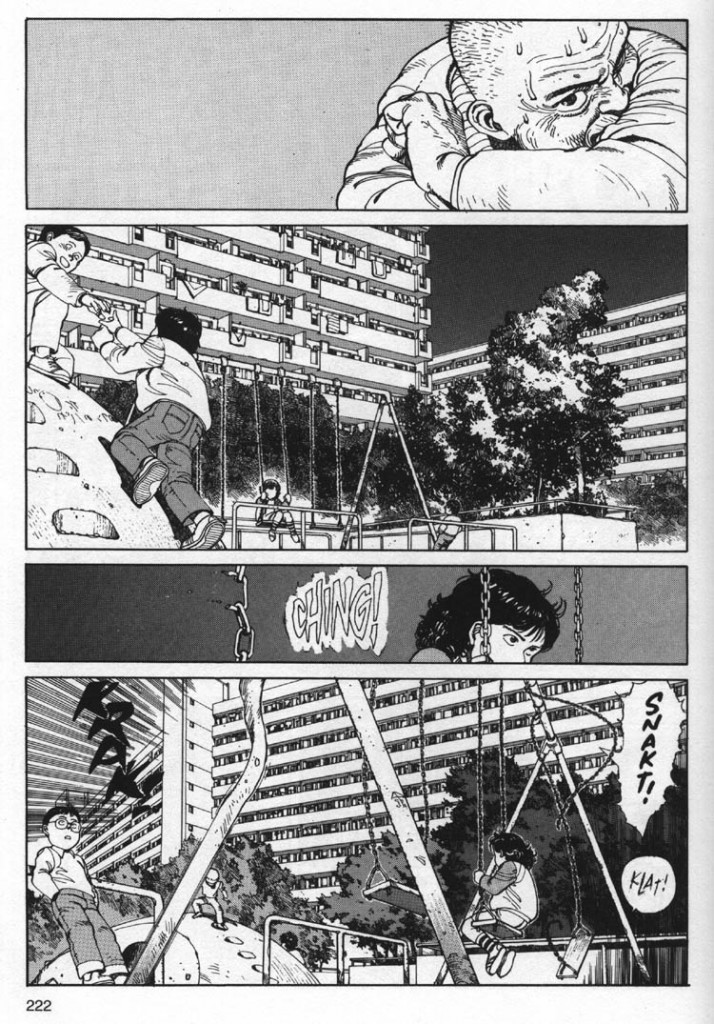
Though I found the artwork for AKIRA a bit dated, a relic of a particular moment in sci-fi history, Domu seemed less mired in the 1980s. The characters are refreshingly realistic in their appearance; Cho actually looks like an eighty-year-old man, with a stooped frame, a deeply-etched face, and liver-spotted hands, while Etsuko’s plump cheeks and slightly awkward proportions seem appropriate for an eight-year-old. Otomo lavishes similar attention on his bit players, too, giving each apartment dweller a distinctive look that speaks volumes about his economic status, age, and fear of being swept up in Yamagawa and Tamura’s murder investigation. Even the apartment complex functions as a kind of character, a sterile collection of high-rise buildings whose imposing exteriors give way to dark, dingy interiors and cramped apartments. As Otomo guides us through its labyrinthine hallways and stairwells, we feel a palpable sense of dread; the complex is filled with the kind of dead ends and blind spots that feature prominently in our worst nightmares.

Domu would be a solid, if not remarkable, thriller on the strength of its artwork alone, but Etsuko’s predicament gives the story an added jolt of energy and terror. She’s the strongest, most adult character in the story, the only one with a clear sense of what’s happening, and the only one powerful enough to stop Cho. Making her plight more compelling is the fact that Etsuko behaves like an eight-year-old who just happens to have a deadly gift, rather than a god-like creature who just happens to be eight years old; she’s small and vulnerable, eager for the comfort of her mother’s arms, but she’s also fiercely moral and incredibly brave in the face of nightmarish events, a child whose natural desire to set things right is cruelly tested by a childish adult.

N.B. Domu has been out of print for several years, though copies are relatively easy to find through eBay and Amazon’s extended seller network. Dark Horse released Domu in several formats, including three slim TPBs and an omnibus edition.

DOMU: A CHILD’S DREAM • BY KATSUHIRO OTOMO • DARK HORSE • NO RATING (RECOMMENDED FOR OLDER TEENS)

Filed Under: Manga Critic Tagged With: Classic, Dark Horse, Katsuhiro Otomo, Seinen

Manga Artifacts: Domu: A Child’s Dream

October 25, 2009 by Katherine Dacey

Revisiting AKIRA prompted me to re-read Domu: A Child’s Dream, an earlier work that helped cement Katsuhiro Otomo’s reputation as the leading manga-ka of his generation. Though both series include elements of horror and science fiction, the two are utterly different in approach: AKIRA is sweeping, grand, and allegorical, whereas Domu is compact, a taut psychological thriller that unfolds in a mere 230 pages.

Domu begins like a police procedural: an older detective and his hot-headed young partner arrive at a Tokyo apartment complex to investigate a series of deaths. Though the victims’ histories suggest foul play rather than suicide, the detectives are baffled by the crime scenes: all of the victims have jumped off rooftops or slashed their own throats, with no evidence of anyone watching or aiding them. A few tantalizing clues lead investigators to “Old Cho,” a seemingly benign, senile resident who spends most of his time sitting on a bench and muttering. Inspectors Yamagawa and Tamura can’t connect Cho to the crimes, but Etsuko, a stolid little girl who has just moved into the complex, knows how Cho killed them: telekinesis and hypnotic suggestion.

What follows is an intensely creepy cat-and-mouse game between Etsuko and Cho. Though Cho is nominally an adult, his mind is terrifyingly child-like; he kills his neighbors for their “treasures”: a baseball cap with wings, a fake ruby ring, an umbrella, a stuffed toy. Cho initially regards Etsuko as an impediment to his fun, but when he discovers that Etsuko can also move objects with her mind, he begins testing her strength and sense of morality. Their battle begins in the narrow hallways and dim elevator shafts of Etsuko’s building, but quickly consumes the entire complex as Cho attempts to annihilate Etsuko.

domu_page

Though I found the artwork for AKIRA a bit dated, a relic of a particular moment in sci-fi history, Domu seemed less mired in the 1980s. The characters are refreshingly realistic in their appearance; Cho actually looks like an eighty-year-old man, with a stooped frame, a deeply-etched face, and liver-spotted hands, while Etsuko’s plump cheeks and slightly awkward proportions seem appropriate for an eight-year-old. Otomo lavishes similar attention on his bit players, too, giving each apartment dweller a distinctive look that speaks volumes about his economic status, age, and fear of being swept up in Yamagawa and Tamura’s murder investigation. Even the apartment complex functions as a kind of character, a sterile collection of high-rise buildings whose imposing exteriors give way to dark, dingy interiors and cramped apartments. As Otomo guides us through its labyrinthine hallways and stairwells, we feel a palpable sense of dread; the complex is filled with the kind of dead ends and blind spots that feature prominently in our worst nightmares.

Domu would be a solid, if not remarkable, thriller on the strength of its artwork alone, but Etsuko’s predicament gives the story an added jolt of energy and terror. She’s the strongest, most adult character in the story, the only one with a clear sense of what’s happening, and the only one powerful enough to stop Cho. Making her plight more compelling is the fact that Etsuko behaves like an eight-year-old who just happens to have a deadly gift, rather than a god-like creature who just happens to be eight years old; she’s small and vulnerable, eager for the comfort of her mother’s arms, but she’s also fiercely moral and incredibly brave in the face of nightmarish events, a child whose natural desire to set things right is cruelly tested by a childish adult.

N.B. Domu has been out of print for several years, though copies are relatively easy to find through eBay and Amazon’s extended seller network. Dark Horse released Domu in several formats, including three slim TPBs and an omnibus edition.

DOMU: A CHILD’S DREAM • BY KATSUHIRO OTOMO • DARK HORSE • NO RATING (RECOMMENDED FOR OLDER TEENS)

Filed Under: Manga, Manga Critic, Recommended Reading, REVIEWS Tagged With: Classic, Dark Horse, Katsuhiro Otomo, Sci-Fi

AKIRA, Vol. 1

October 22, 2009 by Katherine Dacey

akira_coverMy first exposure to Katsuhiro Otomo came in 1990, when a boyfriend insisted that we attend a screening of AKIRA at an artsy theater in the Village. I wish I could say that it had been a transforming experience, one that had awakened me to the possibilities of animation in general and Japanese visual storytelling in particular, but, in fact, I found the film tedious, gory, and self-important. Little did I imagine that I’d be reviewing AKIRA nineteen years later, let alone in its original graphic novel format.

I was pleasantly surprised to discover that Otomo’s epic tale works better on the page than it does on the screen, though it’s easy to see why Otomo felt the lengthy motorcycle chases and fight scenes were swell fodder for a movie. Ditto for the setting: what artist wouldn’t want the chance to destroy and rebuild a city as complex and ultra-modern as Tokyo?

The story, however, demands the more intimate medium of print, as those chases and fights seem more urgent and surprising on the page than on the screen. The story’s setting works better in print as well; the city feels feels more claustrophobic when rendered in black and white than in color. The story’s length, too, is a factor; the movie compresses over 2,000 pages of material into two hours, trimming some of the manga’s more interesting subplots and secondary characters in order to accommodate the explosions and high-speed chases. More significantly, the film grossly simplifies the relationship between principal characters Tetsuo and Kaneda, reducing Tetsuo’s transformation from juvenile delinquent to god-like being to a mere plot device. The manga, however, gives each character more room to be, and not just react; as a result, Tetsui and Kaneda seem like real teenage boys, not generic action figures.

Plot-wise, AKIRA is still as topical as ever. Its paranoid vibe seems as resonant in 2009 as it did when the manga was first released in 1982, as does its message about the devastating consequences of weapons of mass destruction. Watching China prepare for the Beijing Olympics in 2008 — leveling shanty towns, silencing protests — suggested parallels with AKIRA‘s own Olympic subplot, both in the secrecy surrounding the facilities’ construction and in the government’s adamant denial of citizen opposition.

The artwork hasn’t aged quite as gracefully as the story; it’s the manga equivalent of a mullet, betraying its early eighties roots. Otomo’s backgrounds and weaponry look liked they’ve been traced from The Star Wars Storybook, exuding the same mixture of sterility and rust that was a hallmark of period science fiction, while his characters have thick bodies and pudgy faces, just like the heroes of Tsukasa Hojo’s manga. Yet it’s hard to deny AKIRA‘s visual appeal. Otomo is one of the few artists who can make a chase or an explosion seem like it’s actually happening on the page, thanks to his ability to convey the “geography” of the scene: how big the space is, how far apart the characters are standing. The sound effects are almost superfluous, as Otomo does such a superb job of showing us how the characters move through the space that one can almost hear the whoosh! and vroom! as they fly past.

If you didn’t finish collecting AKIRA when it was still a Dark Horse property, you can round out your set without compromising its appearance on your shelf; the Kodansha edition is virtually identical, save for the logo on the spine. (No, really: it’s the same translation, same trim size, same cover design, and same price as the 2000 version.) And if you haven’t read it yet? Well, now’s your chance to read one of the medium’s greatest sci-fi epics in a nice, oversized package. Recommended.

Review updated on October 5, 2010.

AKIRA, VOL. 1 • BY KATSUHIRO OTOMO • KODANSHA • RATING: OLDER TEEN (16+) • 368 pp.

Filed Under: Manga Critic Tagged With: Classic, Katsuhiro Otomo, kodansha, Seinen

AKIRA, Vol. 1

October 22, 2009 by Katherine Dacey

My first exposure to Katsuhiro Otomo came in 1990, when a college boyfriend insisted that we attend a screening of AKIRA at an artsy theater in the Village. I wish I could say that it had been a transforming experience, one that had awakened me to the possibilities of animation in general and Japanese visual storytelling in particular, but, in fact, I found the film tedious, gory, and self-important. Little did I imagine that I’d be reviewing AKIRA nineteen years later, let alone in its original graphic novel format.

I was pleasantly surprised to discover that Otomo’s epic tale works better on the page than it does on the screen, though it’s easy to see why Otomo felt the lengthy motorcycle chases and fight scenes were swell fodder for a movie. Ditto for the setting: what artist wouldn’t want the chance to rebuild a city as complex and ultra-modern as Tokyo from the ground up?

The story, however, demands the more intimate medium of print, as those chases and fights seem urgent and kinetic on the page, an essential tool for drawing the reader into the story, rather than an opportunity for the animators to dazzle audiences with their technical prowess. The story’s setting works better in print as well; the city feels feels more claustrophobic when rendered in black and white than in color. And the story’s length, too, is a factor; the movie compresses over 2,000 pages of material into two hours, trimming some of the manga’s more interesting subplots and secondary characters in order to accommodate the explosions and high-speed chases, and grossly simplifying the relationship between Tetsuo and Kaneda. As in the movie, neither personality is firmly established before Tetsuo begins morphing from juvenile delinquent to god-like psychopath, yet the manga gives each character more room to be, and not just react. As a result, both seem human and vulnerable, more teenage boys than action figures.

The basic plot has held up well. Its paranoid, don’t-trust-the-military vibe seems as resonant in 2009 as it did when the manga was first released in 1982, as does its message about the devastating consequences of WMDs. Watching China prepare for the Beijing Olympics in 2008 — leveling shanty towns, silencing protests — suggested parallels with AKIRA‘s own Olympic subplot, both in the secrecy surrounding the facilities’ construction and in the government’s adamant denial of citizen opposition to the projects.

The artwork hasn’t aged quite as gracefully as the story; it’s the manga equivalent of a mullet, betraying its early eighties roots. Otomo’s backgrounds and weaponry look liked they’ve been traced from The Star Wars Storybook, exuding the same mixture of sterility and rust that was a hallmark of period science fiction, while his characters have thick bodies and pudgy faces, just like the heroes of Tsukasa Hojo’s manga. Yet it’s hard to deny AKIRA‘s visual appeal. Otomo is one of the few artists who can make a chase or an explosion seem like it’s actually happening on the page, thanks to his ability to convey what I call the “geography” of the scene: how big the space is, how high off the ground it is, how far apart the characters are standing. The sound effects are almost superfluous, as Otomo does such a superb job of showing us how the characters move through the space that one can almost hear the whoosh! and vroom! as they fly past.

If you didn’t finish collecting AKIRA when it was still a Dark Horse property, you can round out your set without compromising its appearance on your shelf; the Kodansha edition is virtually identical, save for the logo on the spine. (No, really: it’s the same translation, same trim size, same cover design, and same price as the 2000 version.) And if you haven’t read it yet? Well, now’s your chance to read one of the medium’s greatest sci-fi epics in a nice, oversized package. Recommended.

Review updated on October 5, 2010.

AKIRA, VOL. 1 • BY KATSUHIRO OTOMO • KODANSHA • RATING: OLDER TEEN (16+) • 368 pp.

Filed Under: Manga, Manga Critic, REVIEWS Tagged With: Classic, Katsuhiro Otomo, Kodansha Comics, Post-Apocalyptic Sci-Fi

Rin-Ne, Vol. 1

October 18, 2009 by Katherine Dacey

rinne1_coverI read a Rumiko Takahashi manga for the same reason I watch an Alfred Hitchcock thriller: I know exactly what I’m going to get. Certain plot elements and motifs recur throughout each artist’s work — Hitchcock loves pairing a brittle blond with a rakish cad on the run from authorities, for example, while Takahashi loves pairing a female “seer” with a demonically-tinged boy — yet the craft with which Hitchcock and Takahashi develop such tropes prevents either artist’s work from feeling stale or repetitive. Takahashi’s latest series gives ample proof that while she may have a limited repertory, she’s the undisputed master of the supernatural mystery.
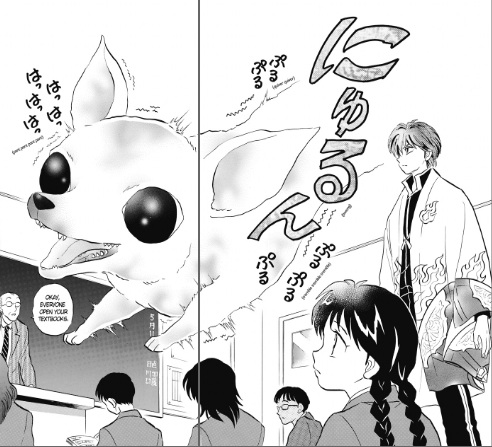
Sakura Mamiya and Rinne Rokudo, Rin-ne‘s oil-and-water leads, are a classic Takahashi pair: Sakura is a seemingly ordinary teenager with the ability to see ghosts, while Rinne is a hot-headed boy who’s part human and part shinigami. The two meet cute in Sakura’s tenth-grade classroom when Rinne arrives to claim his long-empty seat. “Looks like he made it,” Sakura whispers to a friend before realizing that she’s the only person who can see the tall, flame-haired boy in a fancy ceremonial robe. Sakura then watches Rinne  attempt to banish an enormous Chihuahua demon to the afterlife — an exorcism that goes horribly (and comically) awry when the dog’s spirit merges with the spirit of a love-starved teen. Now forced to contend with an even more powerful, angry ghost, Rinne uses Sakura to lure it to the Wheel of Reincarnation, an enormous portal that separates the material and spirit worlds.

…

Read More

Filed Under: Manga Critic Tagged With: Rumiko Takahashi, Shonen, shonen sunday, VIZ

Rin-Ne, Vol. 1

October 18, 2009 by Katherine Dacey

I read a Rumiko Takahashi manga for the same reason I watch an Alfred Hitchcock thriller: I know exactly what I’m going to get. Certain plot elements and motifs recur throughout each artist’s work — Hitchcock loves pairing a brittle blond with a rakish cad on the run from authorities, for example, while Takahashi loves pairing a female “seer” with a demonically-tinged boy — yet the craft with which Hitchcock and Takahashi develop such tropes prevents either artist’s work from feeling stale or repetitive. Takahashi’s latest series gives ample proof that while she may have a limited repertory, she’s the undisputed master of the supernatural mystery.

Sakura Mamiya and Rinne Rokudo, Rin-ne‘s oil-and-water leads, are a classic Takahashi pair: Sakura is a seemingly ordinary teenager with the ability to see ghosts, while Rinne is a hot-headed boy who’s part human and part shinigami. The two meet cute in Sakura’s tenth-grade classroom when Rinne arrives to claim his long-empty seat. “Looks like he made it,” Sakura whispers to a friend before realizing that she’s the only person who can see the tall, flame-haired boy in a fancy ceremonial robe. Sakura then watches Rinne  attempt to banish an enormous Chihuahua demon to the afterlife — an exorcism that goes horribly (and comically) awry when the dog’s spirit merges with the spirit of a love-starved teen. Now forced to contend with an even more powerful, angry ghost, Rinne uses Sakura to lure it to the Wheel of Reincarnation, an enormous portal that separates the material and spirit worlds.

rinne_chihuahua

After their dramatic introduction, Sakura and Rinne forge a reluctant partnership. Sakura provides material assistance and ethical guidance to Rinne, while Rinne banishes the spirits that plague Sakura’s high school. Sakura soon learns that Rinne’s grandmother, a shinigami, fell in love with a young man whose spirit she was sent to collect. In exchange for extending his life by fifty years, Rinne’s grandmother agreed to “fulfill her shinigami duties at ten times her usual quota.” When she failed to reach that target, Rinne was forced to enter the family trade, operating on the fringes of both the human and spectral worlds with limited ability to function in either realm — hence his weak exorcism skills.

Where, exactly, Takahashi plans to take the story is still something of a mystery. As she did with InuYasha, she’s using the first few volumes to establish the premise, explain how the Wheel of Incarnation works, and develop the chemistry between her lead characters by subjecting them to a host of unhappy spirits. The first eight chapters have a pleasant, spook-of-the-week feeling, as Sakura and Rinne tangle with a ghostly cell phone caller, a damashigami (a shinigami who meets his quota by luring innocent people to their deaths), and an ochimusa (a disgraced warrior). At the same time, however, Takahashi is clearly laying the groundwork for a more extended storyline, introducing several supporting characters, leaving key questions about Sakura’s past unanswered, and creating space for a Naraku-esque villain to fill.

The first volume’s leisurely pace also allows Takahashi plenty of room to showcase her comedic talents. Though InuYasha, Mermaid Saga, and Rumic World have canted more strongly towards horror, Rin-ne is decidedly humorous, incorporating supernatural elements into everyday settings in delightfully absurd ways. Takahashi’s demon Chihuahua is a great example: the demon continues to behave like a nervous, short-haired toy even after it grows to enormous size, and remains susceptible to the savory appeal of milk bones. Rinne’s grandfather is another example of the supernatural made ridiculous; as Rinne’s grandmother wistfully notes, her husband was reincarnated as a mackerel — the destiny for which he was slated when she fell in love with him.

Though utterly enjoyable, Rin-ne has its flaws. Takahashi relies a little too heavily on interior monologues to cue us into what’s happening; Sakura is frequently called upon to mutter, “So that’s why no one can see him!” even when the illustrations make it plain that Rinne is invisible to humans when he dons his flame-patterned haori. Takahashi isn’t above recycling bits from other works, either; Rokumon, a familiar introduced in chapter six, bears a strong resemblance to InuYasha‘s Shippo in both appearance and plot function, comic relief in the form of a child-like animal spirit. Sakura, too, seems more like a Kagome clone than a character in her own right, though she’s a little edgier and more skeptical than her jewel-seeking predecessor.

Still, it’s hard to dismiss a manga that’s crafted with as much skill and good humor as Rin-ne. The story and characters may remind readers of other works in the Takahashi canon, but that strikes me as a good thing — yet another opportunity to spend time with the kind of spunky heroines, rash-but-kind heroes, and oddball supporting characters that give Takahashi’s work its distinctive flavor.

Review copy provided by VIZ Media, LLC. Volume one of Rin-ne will be available on October 20, 2009.

RIN-NE, VOL. 1 • BY RUMIKO TAKAHASHI • VIZ • 182 pp. • RATING: OLDER TEEN (16+)

Filed Under: Manga, Manga Critic, REVIEWS Tagged With: Action/Adventure, Rumiko Takahashi, shonen sunday, VIZ

Summit of the Gods, Vol. 1

October 12, 2009 by Katherine Dacey

On a brilliant summer day in 1924, British explorer George Mallory began what would be his third and final attempt to climb Mt. Everest. Armed with oxygen tanks and masks, he and fellow mountaineer Andrew Irvine began their approach to the summit on the morning of June 8th, reaching the Northeast Ridge around one o’clock in the afternoon — a potentially fatal mistake, as they had barely enough time to reach the peak and return safely to camp before nightfall. Noel Odell, another member of Mallory’s expedition, spotted the pair ascending the so-called “steps,” three rock formations located 2,000 vertical feet below the top. As he would recall in the 1924 book The Fight for Everest, Odell caught a brief glimpse of his mates through a break in the cloud cover:

I saw the whole summit ridge and final peak of Everest unveiled. I noticed far away on a snow slope leading up to what seemed to me to be the last step but one from the base of the final pyramid, a tiny object moving and approaching the rock step. A second object followed, and then the first climbed to the top of the step. As I stood intently watching this dramatic appearance, the scene became enveloped in cloud once more, and I could not actually be certain that I saw the second figure join the first. (p. 130)

Odell was the last to see either man alive; for the next 75 years, Mallory and Irvine’s fate remained a mystery, though a few tantalizing clues — Irvine’s ice axe, Mallory’s discarded oxygen canister — suggested that neither had reached the top. In 1999, a joint American-British expedition recovered Mallory’s body not far from where Irvine’s axe was discovered, spurring new questions about their climb: had Odell, in fact, watched the men descending the Steps after a successful trip to the summit? Had Irvine and Mallory become separated on the mountain face, or did they fall together to their deaths? And where was Irvine’s body?

…

Read More

Filed Under: Manga Critic Tagged With: Fanfare/Ponent Mon, Jiro Taniguchi, Seinen

  • « Go to Previous Page
  • Page 1
  • Interim pages omitted …
  • Page 33
  • Page 34
  • Page 35
  • Page 36
  • Page 37
  • Interim pages omitted …
  • Page 39
  • Go to Next Page »
 | Log in
Copyright © 2010 Manga Bookshelf | Powered by WordPress & the Genesis Framework