 If you’ve ever been to Canal Street in New York City — the Counterfeit Capital of North America — you know that there are two types of goods for sale there. The first are inept knock-offs: the “Cooch” purse with plastic handles, the “Rollex” with cubic zirconia insets and a flimsy metal band. The second are just as fake as the first, but are executed with enough panache that style-conscious women get a secret thrill in owning them: the plastic “Birkin” bag that looks like the real thing but costs $30, the canvas “Louis Vuitton” wallet that comes in prettier colors than the original.
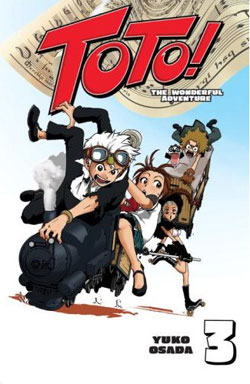
The same principles apply to manga as well: there are series which shamelessly imitate a best-selling title like Dragonball or InuYasha, rehearsing the same plot without capturing the original’s charm, and there are copycats which bear a strong resemblance to the original but nonetheless work well on their own terms. Toto! The Wonderful Adventure falls into the latter category, a good-natured rip-off of One Piece and Rave Master that accomplishes in five volumes what many shonen series need twenty or thirty to pull off.
…








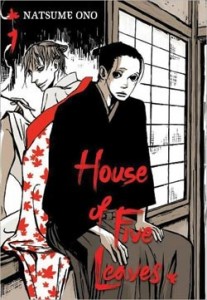 House of Five Leaves, too, focuses less on Big Events and more on everyday activity, but in Leaves, Ono’s restraint serves an important dramatic purpose: she’s showing us events through Masanosuke’s eyes, as he tries to reconcile the bandits’ seemingly ordinary lives with their extraordinary behavior. Making the reader‘s task more difficult is that Masanosuke isn’t very astute. He tends to focus on a kind gesture or a friendly conversation, missing many of the important aural and visual cues that might enable him to understand what’s happening — a trait that the group exploits. In one chapter, for example, Yaichi encourages Masanosuke to accept a job as a bodyguard for a merchant family while the group plans its next kidnapping. Masa befriends his new employer’s son, never realizing that his true assignment is to infiltrate the target’s household so that Yaichi’s minions can snatch the boy for ransom.
 Back in the 1980s and 1990s, before publishers realized that they could sell manga to teenagers through Borders and Books-A-Million, VIZ and Dark Horse actively courted the comic-store crowd with blood, bullets, and boobs. It was a golden age for manly-man manga — think Crying Freeman and Hotel Harbor View — but it was also a period in which publishers licensed some bad stuff. And when I say “bad stuff,” I mean it: I’m talking ham-fisted dialogue, eyeball-bending artwork, and kooky storylines that defy logic. Lycanthrope Leo (1997), an oddity from the VIZ catalog, is one such manga, a horror story with a plot that might best be described as Teen Wolf meets The Island of Dr. Moreau with a dash of WTF?!