• Skip to primary navigation
  • Skip to main content
  • Skip to primary sidebar
  • Home
  • About Us
    • Privacy Policy
    • Comment Policy
    • Disclosures & Disclaimers
  • Resources
    • Links, Essays & Articles
    • Fandomology!
    • CLAMP Directory
    • BlogRoll
  • Features & Columns
    • 3 Things Thursday
    • Adventures in the Key of Shoujo
    • Bit & Blips (game reviews)
    • BL BOOKRACK
    • Bookshelf Briefs
    • Bringing the Drama
    • Comic Conversion
    • Fanservice Friday
    • Going Digital
    • It Came From the Sinosphere
    • License This!
    • Magazine no Mori
    • My Week in Manga
    • OFF THE SHELF
    • Not By Manga Alone
    • PICK OF THE WEEK
    • Subtitles & Sensibility
    • Weekly Shonen Jump Recaps
  • Manga Moveable Feast
    • MMF Full Archive
    • Yun Kouga
    • CLAMP
    • Shojo Beat
    • Osamu Tezuka
    • Sailor Moon
    • Fruits Basket
    • Takehiko Inoue
    • Wild Adapter
    • One Piece
    • After School Nightmare
    • Karakuri Odette
    • Paradise Kiss
    • The Color Trilogy
    • To Terra…
    • Sexy Voice & Robo
  • Browse by Author
    • Sean Gaffney
    • Anna Neatrour
    • Michelle Smith
    • Katherine Dacey
    • MJ
    • Brigid Alverson
    • Travis Anderson
    • Phillip Anthony
    • Derek Bown
    • Jaci Dahlvang
    • Angela Eastman
    • Erica Friedman
    • Sara K.
    • Megan Purdy
    • Emily Snodgrass
    • Nancy Thistlethwaite
    • Eva Volin
    • David Welsh
  • MB Blogs
    • A Case Suitable For Treatment
    • Experiments in Manga
    • MangaBlog
    • The Manga Critic
    • Manga Report
    • Soliloquy in Blue
    • Manga Curmudgeon (archive)

Manga Bookshelf

Discussion, Resources, Roundtables, & Reviews

Reviews

The Best Manga You’re Not Reading: Star Wars

December 29, 2017 by Katherine Dacey

I was five years old when Star Wars: A New Hope blasted its way into movie theaters. Like most members of Generation X, the film cast a long shadow over my childhood, dictating my Halloween costumes, afterschool play, Happy Meal purchases, toy collections, and clothing; I had Princess Leia action figures, Star Wars drinking glasses, Star Wars t-shirts, and a Star Wars beach towel. One of the few tie-in products I didn’t own, however, was a comic book adaptation of the movie. I’d purchased The Star Wars Storybook at a Scholastic book fair in 1978, but never knew that Marvel Comics or manga publishers were peddling something similar.

That’s a pity, because Star Wars has a long and fascinating history in print. Marvel’s six-issue adaptation of A New Hope, for example, was cooked up by a Lucasfilm executive to drum up business for the film — in essence, it was a trailer for comic geeks, arriving on newsstands a month before the movie opened. Though Marvel executives had been reluctant to license Star Wars — according to former editor Jim Shooter the “Prevailing Wisdom” at Marvel was that “science fiction doesn’t sell”  — it proved one of the company’s best business decisions of the 1970s. “The first two issues of our six issue adaptation came out in advance of the movie,” Shooter observed:

Driven by the advance marketing for the movie, sales were very good. Then about the time the third issue shipped, the movie was released. Sales made the jump to hyperspace. Star Wars the movie stayed in theaters forever, it seemed. Not since the Beatles had I seen a cultural phenomenon of such power. The comics sold and sold and sold. We reprinted the adaptation in every possible format. They all sold and sold and sold.

By contemporary standards, Roy Thomas and Howard Chaykin’s version is skillful but a little stodgy, relying on voice-overs to introduce key characters and explain plot points, rather than allowing the art to shoulder the responsibility of telling the story. Nonetheless, as Star Wars fever crossed the Pacific, Weekly Shonen Magazine republished Thomas and Chaykin’s comic, touching off a Star Wars manga blitz in Japan.

Japan caught Star Wars fever again in 1997, when the Special Edition trilogy hit theaters across the globe. Kadokowa’s MediaWorks division churned out a new set of Star Wars manga, hiring Hisao Tamaki (A New Hope), Toshiki Kudo (The Empire Strikes Back), and Shin-Ichi Hiromoto (Return of the Jedi) to handle the adaptations. And while all three are good, faithfully reproducing the main beats from each film, Tamaki’s version of A New Hope is that rarest of tie-in products: it captures the look and feel of the movie without slavishly copying it, offering both a fresh perspective on a canonical text and a point of entry for someone wholly unfamiliar with Star Wars. 

Part of what makes Tamaki’s version so fascinating is how he compensates for the absence of a soundtrack — no mean feat, given how noisy the Star Wars universe is. While Tamaki uses plenty of hand-lettered sound effects, he never uses them as a crutch, instead finding nifty ways to help us imagine the sound of a landspeeder skimming the desert floor or a Stormtrooper firing his blaster. Tamaki’s most effective tactic is careful attention to the velocity and direction of moving objects; through deft placement of speedlines and artful manipulation of the panels’ shape and size, he conveys the same information that a well engineered roar, squeak, thud, or electronic rumble might.

Then there’s the film’s lush, Wagnerian score, the kind of movie music that had been fashionable in the era of Ben Hur and Lawrence of Arabia but was considered unhip in the gritty, naturalistic world of early 70s cinema. The opening fanfare and dense web of leitmotifs are unquestionably part of A New Hope‘s appeal, goosing fight scenes and capturing the melancholy of a young Luke Skywalker as he gazes at a Tatooine sunset. Absent those musical prompts, however, Tamaki is forced to think about how to elicit the same emotions in words and pictures. One of the most dramatically successful attempts to bridge sound and silence occurs in volume one of Tamaki’s adaptation, right after R2D2 and C3PO land on Tatooine:

In the film, John Williams accompanies C3PO’s trek with music cribbed from The Rite of Spring — a decent choice, as Stravinsky’s dour ostinati and octatonic harmonies imbue the harsh landscape with an otherworldly quality. Tamaki, however, distills this two-minute scene to an evocative two-page spread in which a wide-angle view of the Tatooine desert unfolds beneath the individual panels, reminding us just how small and vulnerable both droids are. These images track closely with Lucas’ own vision, but the implied silence of the first and final panels in this sequence more powerfully conveys C3PO’s isolation than any musical gesture could:

The absence of sound has another unexpected benefit: minus the actors’ desperate attempts to make George Lucas’ dialogue sound… well, like conversation, the script has more room to breathe. Tamaki plays the earnest stuff straight and ramps up the comedy whenever someone is surprised or indignant. Luke, in particular, benefits from such an approach, given his age and naivete; in Tamaki’s hands, he’s Monkey D. Luffy with a lightsaber, freaking out over chores, the Millennium Falcon’s shabby appearance, Obi-Wan Kenobi’s death, a kiss from Princess Leia… you get the idea. Tamaki’s elastic deformations of Luke’s face transform him from blandly handsome farm boy to Shonen Jump hero, equal parts brave and ridiculous:

One of the manga’s other great virtues is its ability to expand and contract time in ways that a purely temporal medium like film can’t. The ability to speed up and slow down the unfolding the plot isn’t unique to comics, of course; filmmakers can use slow motion imagery or cross-cutting to manipulate the viewer’s perception of time, but a good manga artist takes advantage of the fact the reader can, in fact, stop time by poring over an image or a scene for minutes, savoring small but telling details that would otherwise get lost in the cinematic flow. Writing for Animerica in 2004, Patrick Macias offered a thoughtful explanation of how this kind of creative expansion of time adds new layers of meaning to Tamaki’s story:

It is in Tamaki’s take on destruction of the planet Alderaan that he really shows off his stuff. A scene that took mere moments to depict on-screen is drawn out to fill half a dozen pages. He inserts images of the Alderaan populace looking up to the heavens, and you can almost hear those “millions of voices suddenly crying out in terror” with more dramatic impact in the manga than in the film.

Of course, none of this would matter if Tamaki lacked the precision to bring Lucas’ vision to life on page. Again and again, Tamaki delivers amazingly detailed drawings of space ships, aliens, and weapons that pulse with the same life as Katsuhiro Otomo’s AKIRA and Shirow Masamune’s Ghost in the Shell; if you’d never seen or heard of Star Wars, you might reasonably infer that Tamaki dreamt up this world on his own. Tamaki proves equally adept at staging deep space dogfights, too, conveying both the dizzying speed with which the ships are moving and the maze-like surface of the Death Star:


For readers coming to the manga from the films, the biggest stumbling block will be the character designs: did Tamaki get them right? The short answer is yes, if you can tolerate a little artistic license with hairdos and body types. Not surprisingly, R2D2 and C3PO look most like their big-screen counterparts — no pesky noses or mouths to draw — but the rest of the cast bear a passing-to-strong resemblance to the actors who portrayed them, though Obi-Wan Kenobi looks and moves more like Chuck Norris than Sir Alec Guiness. Tamaki does an even better job of bringing Darth Vader and his Stormtroopers to life on the page, adding an extra touch of menace in the way he draws their helmets; you can almost see the soldiers grimacing under their plastic armor from the way he draws their browlines.

If I’ve sold you on manga Star Wars, you’ll be happy to know it’s a relatively inexpensive way to relive the original trilogy. The digital versions — currently available through Amazon and ComiXology — retail for $1.99 per volume. There’s also a Phantom Menace manga for the morbidly curious; Kia Asamiya is the author, and he’s been given the truly thankless task of condensing that stinker into two volumes. At least it won’t be as interminable as the movie.

WORKS CONSULTED

Macias, Patrick. “Star Wars, The Manga.” Animerica, VIZ LLC, 7 Apr. 2004, https://web.archive.org/web/20040407180902/http://www.animerica-mag.com/features/starwars.html. Accessed 27 Dec. 2017.

Rickard, Ron. “Retro Foreign: Japanese Weekly Shōnen Magazine #18 – 23 (1978).” Star Wars Comic Collector, 20 May 2016, http://swcomiccollector.blogspot.com/2016/05/retro-foreign-japanese-weekly-shonen.html. Accessed 27 Dec. 2017.

Shooter, Jim. “Roy Thomas Saved Marvel.” Jim Shooter, 5 July 2011, https://web.archive.org/web/20150912134444/http://www.jimshooter.com/2011/07/roy-thomas-saved-marvel.html. Accessed on 28 Dec. 2017.

Spellman, Ron. “A Long Time Ago: The Strange History of Marvel’s Original Star Wars Universe.” Comics Alliance, Townsquare Media, 28 Jan. 2016, http://comicsalliance.com/original-marvel-star-wars-comics-history/. Accessed 28 Dec. 2017.

Tamaki, Hisao. Star Wars: A New Hope, adapted from an original script by George Lucas, Marvel Comics, 1998. 4 vols.

Filed Under: Manga, Manga Critic, Recommended Reading, REVIEWS Tagged With: Dark Horse, Hisao Tamaki, Kadokawa, Marvel Comics, star wars

The Devil Is a Part-Timer!, Vol. 9

December 29, 2017 by Sean Gaffney

By Satoshi Wagahara and 029. Released in Japan by ASCII Mediaworks. Released in North America by Yen Press. Translated by Kevin Gifford.

Sometimes there’s one scene or chpater of a book that has more impact than the rest of the volume. This is not uncommon, and does not mean that the rest of the book is lacking in any way. It just means that the chapter or scene in question is JUST THAT GOOD. In Vol. 9 of this series, we get that in a chapter entitled “The Hero Discovers That She Can’t Go Home Again”, which flashes back to show us Emi arriving back on Enta Isla and how she ended up in the position we saw her in at the end of Vol. 8, captured by Olba and being blackmailed. We see her being a detective, we see her learning more about her parents (indeed, possibly far more than she’d have liked), and we see that the bond she has with Alas Ramus may not be as direct as she’d though,. though to her credit she doesn’t reject Alas Ramus in any way because of this. And we see her longing for Japan, and modern times. If this light novel series ends up with the main cast back in Enta Isla, they’re going to need to modernize.

As for the rest of the cast, well, they’re back in Japan, getting ready for a rescue mission. This is not as easy as it seems – Maou has to get people to cover his shifts for a week, so that he doesn’t get fired from his McRonald’s job (the way I suspect Emi is going to be fired from her call center one). He and Suzuno need to buy supplies, which leads to them clashing over everything, as he’s a penny-pinching scrounger, and she has enough cash that “just buy the best thing” is always the first option. And they also have to deal with Rika, who after the events in Vol. 8 now knows their secrets. Do they erase her memory or let her in on the full story, which might put her in danger? The answer is not surprising, but it’s nice to see them asking the right questions. It’s also nice to see Chiho has come so far in nine books, and even though she can’t come along on the rescue mission her intelligence and calm is a great help.

Of course, Chiho is in love with Maou, and we see some jealousy flare up here, mostly as Acieth has the appearance of a clingy 14-year-old who keeps going on about being inside Maou. More seriously, though, Suzuno begins to realize that she may also be developing feelings for Maou. This is something of a surprise, as the ‘harem’ aspect of this series has really mostly been a love triangle before now, with Emi and Chiho – not that Emi will admit it, but she’s still the clear favorite. But when Suzuno hears the backstory explaining why Maou raised up a demon army to invade Enta Isla, she begins to realize that he’s not the demon she’d thought. Combine this with the ongoing revelations that the Angels may be the actual villains of this story, and she has the classic example of a maiden’s trembling heart. The sleeping bag helps take the edge off that, though.

Unsurprisingly, things end in a cliffhanger here, with every single character in Enta Isla about to get involved in something nasty. I’m not sure how long this arc will be, but I am sure that if you’ve been reading Devil Is a Part-Timer, you absolutely will not be disappointed with this book.

Filed Under: devil is a part-timer!, REVIEWS

Graineliers, Vol. 1

December 28, 2017 by Sean Gaffney

By Rihito Takarai. Released in Japan as “Grainerie” by Square Enix, serialization ongoing in the magazine GFantasy. Released in North America by Yen Press. Translated by Jocelyne Allen.

There are some series with a complex plot and deep, developing characterization, and then there are those series that want to get along just by style or mood. Graineliers definitely feels like one of the latter, and fortunately it’s very good at portraying the style and mood to keep a reader turning the pages. The author has mostly done BL series before, and in fact is well known here for the series Ten Count and Only the Flower Knows, but this is not a romance work. Instead it’s (I know, try to contain your surprise) something of a supernatural thriller (GASP!)set in a world where plant seeds can given superpowers of a sort… well, honestly, it seems more like a curse than anything else. In this world we have our handsome and tortured hero, who is seen on the cover baring his chest to show off that instead of manly, virile chest hair he has manly, virile plant roots growing there.

The cast is pretty likable. Luca is our cover boy, who actually becomes a cover man after escaping from the coma being exposed to a seed puts him in. He’s curious but sensible, and it’s actually his father’s experiments that lead to the plot going forward. His friend Abel (the traditional handsome blond to be the best friend of the hero brunet, though there’s no shoujo heroine here, and in fact GFantasy straddles the line between the two genres) rescues and hides him, and finds after he awakens that he now has some characteristics of plant life, including apparently just needing water. Unfortunately, the vaguely evil government is not likely to look kindly on this, so Luca has to hide his features. He’s also not alone, as a cute young girl trying to help her beloved grandfather turns out to share a similar fate, in what’s probably the big “startle” panel of the volume.

It’s always hard for me to review books like these, where nothing really wowed me but there are no crippling flaws either. It’s a solid, readable manga that knows what its fans want to read and gives it to them. Luca and Abel are close and slashable, but can also be read as regular old best friends. For the most part the book is fairly serious, though there was an amusing joke at the end that surprised me, mostly as I wasn’t expecting anything of the sort. There’s also a fair bit on the seeds that this world contains, and why the government might be trying to suppress knowledge of them. Basically, it’s the first fifty pages of a mystery, setting things up but hard to read on its own.

But the setup is good, and leaves you wanting to see what happens next. That said, we’re almost caught up with Japan already, and after Vol. 2 drops early next year there may be a bit of a wait. Definitely a series to grab if you like mystery with a dash of fantasy and a heaping teaspoon of pretty boys.

Filed Under: graineliers, REVIEWS

Konosuba: God’s Blessing on This Wonderful World!: You Good-for-Nothing Quartet!

December 27, 2017 by Sean Gaffney

By Natsume Akatsuki and Kurone Mishima. Released in Japan as “Kono Subarashii Sekai ni Shukufuku o!: Chūnibyō demo Majo ga Shitai!” by Kadokawa Sneaker Bunko. Released in North America by Yen On. Translated by Kevin Steinbach.

KonoSuba returns with its fourth light novel, though unusually there’s plenty of manga in this volume, which adds an extended ‘what you will see in this book’ manga chapter (none of it is seen), as well as a two-page spread in the middle. This is perhaps not surprising given that our heroes spend much of their time at a town devoted to hot springs. The subtitle this time around is a parody of the manga Yozakura Quartet, started by Del Rey and finished by Kodansha Comics digitally in North America, from the artist behind DRRR!!. You would think, given Wiz’s presence on the front cover, that she is the fourth member of the group to merit the title, but no, Wiz is sensible (and quite powerful) throughout, except for her horrible shopkeeping skills. No, Kazuma is just as bad as the rest of his crew, and this volume is happy to emphasize that.

We’re on a vacation this time around, ending up, as I indicated, at a city renowned for their hot springs. Sadly, Aqua keeps turning their springs into plain old hot water whenever she uses them, so things aren’t going well. You’d think she’d be happy, given that the town is filled with Axis Church followers – i.e. HER followers – but she’s as whiny and put upon as ever. Darkness, meanwhile, is having a ball – as a follower of Eris, she’s treated like absolute dirt, which makes her incredibly happy (and by happy I mean aroused). She’s a bit less happy with the fact that the group is now perfectly willing to use her family name to get their way, something she’s really rather avoid. As for Megumin, aside from a few stray moments, she’s the sensible one this time around. Kazuma may seem a better candidate, but not only does he die AGAIN, but he also gets everyone in trouble by not realizing that this ISN’T a transported-to-a-game world and that some “easy-level” monsters are in fact not so easy.

No one really reads KonoSuba for the plot, which is good as there isn’t much. Our villain is seen meeting with a busty woman who is never seen again, so I imagine she’ll pop up as an antagonist in future books. No, KonoSuba is read for the humor, and there are many, many wonderful jokes here – the dog food and “Legendary Sword Excalibur” being two of my favorites. (Let’s take a moment to realize that Kazuma, who is on the verge of being allowed to reincarnate into a nice life on Earth, is literally annoyed into returning to the KonoSuba world.) The cast are all terrible, with the exception of Wiz, and possibly Yunyun, who shows up at the end to deliver the ridiculous cliffhanger. We’re now caught up with the anime, meaning Book 5 should be new to most readers. (I’m going to take a wild guess and say the anime did NOT end with Yunyun’s request.) If you like tremendously silly light novels, KonoSuba is exactly what you’re looking for.

Filed Under: konosuba, REVIEWS

Cardcaptor Sakura: Clear Card, Vol. 1

December 26, 2017 by Sean Gaffney

By CLAMP. Released in Japan by Kodansha, serialization ongoing in the magazine Nakayoshi. Released in North America by Kodansha Comics. Translated by Devon Corwin.

I won’t lie, it can be a bit disappointing to see CLAMP return to the well of old hits. Tsubasa Reservoir Chronicle was a menage of most of their series with a few new characters, xxxHOLIC ended only to return as an ongoing sequel, and now we have that old standby, Cardcaptor Sakura, getting a sequel with the characters in middle school. Now admittedly writing brand new material is not a guarantee of success – Gate 7 is an excellent example of that, and is still on hiatus. As a result, I can’t blame the creators for returning to a guaranteed draw. That said, there’s not really much here that’s new or innovative – instead, it’s the same old favorites back again. Sakura’s here, her family, Tomoyo, and yes, Syaoran has returned as well, and can now go to school with his “we’re too young to be dating” girlfriend once more. Except… the cards are changed.

Sakura’s having prophetic dreams of mysterious hooded enemies, and they’ve essentially blanked all her cards. But she gets a powerup as well, so now (you knew this was coming, admit it) she will have to go around collecting cards again, though they seem to be the Cool Millennial version – they’re transparent and fancy, and the sweet, mild ‘Windy’ has now apparently become ‘Gale’, and there’s a ‘trapped in a room’ card that becomes ‘Siege’. The cards sound more mature. Tomoyo is mostly delighted, as this means she gets to film Sakura in new costumes – though she misses her catching the first card, which seemingly devastates her. (As with the first series, Tomoyo’s motivations tend to be deeper than they outwardly seem. Also as with the first series, Tomoyo is the main reason I’m reading this.) As for Eriol, he still seems to be keeping things from Sakura, no doubt “for her own good”, but sigh. Didn’t we learn this lesson before?

I mentioned the gang’s all here, but that’s not entirely accurate – while most of Sakura’s muggle friends have returned to her school, Rika has gone to a different school and will presumably not be appearing. Given that her relationship with her adult teacher, complete with a pseudo wedding ring, was easily the creepiest aspect of the original series, it’s no surprise that CLAMP decided to quietly push her out the door rather than give it more attention. (Kaho is still with Eriol, but that’s far vaguer, and in any case Eriol is one of those “I’m really decades older than I look” sorts.) Everyone else gets a “greatest hits” appearance – Sakura’s father is still kind and widower-ey, and mentions he hasn’t seen Nadeshiko’s spirit lately. Touya and Yukito are still very vaguely gay, and while Yukito seems a bit more savvy as to his true nature, it’s still Yue in the driver’s seat when that nature is needed. And Yamazaki is still making up amusing and obvious lies for Syaoran to fall for.

If you enjoyed Cardcaptor Sakura, there’s no reason not to read this – it’s cute and fun. I do hope that it at least tries to go to some new places, however.

Filed Under: cardcaptor sakura, REVIEWS

The Saga of Tanya the Evil: Deus lo Vult

December 25, 2017 by Sean Gaffney

By Carlo Zen and Shinobu Shinotsuki. Released in Japan by Enterbrain. Released in North America by Yen On. Translated by Emily Balistrieri and Kevin Steinbach.

The first thing I noticed when I saw the first volume of Tanya the Evil on my phone is that it is long. Really very long indeed. You could fit four volumes of Kagerou Daze into one volume of Tanya the Evil. I noticed that this volume has two translators, and I wonder if the main reason for it is that each volume is so long. (I double checked – the second volume is actually longer.) The second thing that I noticed about Tanya the Evil is that it is, at heart, a military novel with a dash of magic and “reincarnated into another world” as its gimmick. If you’re reading it for the reincarnation or the magic, you may be disappointed – if you’re reading it for the military maneuvers, you’re in luck, this is absolutely the book for you. This is the story of not-Germany, its new war hero who has the appearance of a small girl but the mind of a cynical, calculating HR director, and the evil God who sets things in motion.

OK, “evil God” may be stretching the point, as it’s more petulant hissy fit God, but once again we have a book I’d ask the hardcore religious to stay away from. Our hero is a ruthless HR director who is pushed in front of a train after laying off someone with a grudge. He meets God, who is upset at the lack of faith in him these days, which our hero can’t help but snark back at him for. In response, God reincarnates him in a world that is on the brink of war, as a young orphan girl. He keeps all his memories, though, and apparently in addition to being an HR director he was a bit of a military nut. As now we have Tanya von Degurechaff, a 9-year-old child prodigy sent to the front line to battle as a mage because, well, the Empire is mostly OK with this. The problem is that Tanya is just a bit too brilliant, and also somewhat disturbing…

One of the more interesting aspects of this book is also one of its most aggravating: the narration, which is mostly first person from Tanya’s perspective with a few exceptions, alternates between “I” and “Tanya” constantly, as the HR director still tends to think of himself as being slightly separate from the little girl’s body he now inhabits. This really shows off the disconnect that should normally be there for most people who go through the standard reincarnation schtick, but it’s also very disorienting, and by the end of the volume I was wishing the author had chosen a different way to achieve this. The gimmick that works much better in the book is Tanya constantly doing things as a way to ither a) stay alive or b) get herself assigned away from combat, and having her actions misinterpreted as insane gung-ho soldiering by the generals and powers that be. It doesn’t help that her main weapon that makes her even more powerful literally runs on the power of prayer, much to her bitter chagrin.

The author says at the end of the book that those who like happy endings should stay away from this series, and indeed I’m not sure I can read this on a regular basis. For this one volume, though, it was fascinating, even with all the military jargon. Yes, we have yet another Japanese author fascinated with World War I/II Europe, and our heroes are yet again essentially Germany with the fascism toned down (you’ll likely think of Legend of Galactic Heroes as you read it). But I just liked the back and forth between Tanya and the rest of the cast, and also liked the occasional glimpses we saw of her judging humans as something other than meat shields. Well, OK, one human. Pretty much just Visha. But you have to start somewhere. The Saga of Tanya the Evil is a rich and rewarding read, provided you spend the time to plough through it, and don’t mind Tanya’s constant first/third person perspective switches.

Filed Under: REVIEWS, saga of tanya the evil

Angels of Death, Vol. 1

December 25, 2017 by Sean Gaffney

By Makoto Sanada and Kudan Naduka. Released in Japan as “Satsuriku no Tenshi” by Media Factory, serialization ongoing in the magazine Comic Gene. Released in North America by Yen Press. Translated by Ko Ransom.

I’ve mentioned before that I will sometimes dip back into a genre that I’m not fond of to see if a new series might catch my eye. With horror, this has been something of a mixed back. When it works, it works seriously well – see Higurashi or Kurosagi Corpse Delivery Service. But for each one of those there are five or six “let’s gather a cast of people together and winnow them down one by one” that leaves me cold. Angels of Death is my latest look in to the horror/survival game genre. It’s based on a game which I believe you can actually get on Steam, and has an amnesiac heroine waking up in an abandoned building, where she’s informed she has to go from floor to floor and avoid being killed. What makes Angels of Death more interesting than most others of this sort is that the cast is kept to a bare minimum, which allows us to skip piles of introduction and get right to business. And also Rachel looks a bit more interesting than most faceless game protagonists.

The moment we see an adorable wounded bird get brutally slaughtered in a giant two-page spread, we know the emphasis here is not going to be on friendship, training or victory. She first runs into Zack, who is an absolute cliche of a serial killer and the sort of character you’d expect to get killed off pretty quickly in this sort of series, but somehow she manages to escape him. She then ends up on a different floor with Dr. Irie… sorry, Dr. Danny, who is very much like what Dr. Irie from Higurashi would be if he was deeply sociopathic and awful. To the manga’s credit, it doesn’t bother to try to convince us that he’s really another good guy – we already know there’s a killer on each floor, and he’s already so shady that it barely raises an eyebrow when he starts going on about eyes. Eventually Zack ends up chasing Rachel once more, but Zack is now put off by her personality so allies with her to try to get out.

As I said, the odd moments when Rachel shows off how broken she is are the best in the book. They manage to combine hidden tragedy and loss with a truly scary feeling, particularly when dealing with the bird. The artist, in fact, is very good at showing off the strengths of this genre – scary scenes, over the top faces, and a lot of bloody action. On the downside, unlike, say, Higurashi or Kurosagi Corpse Delivery Service, I doubt the final goal here is to show how a team can become true friends and band together to defeat the bad guy. The goal here is to frighten and shock. This first volume does a decent job of that, and therefore if you like survival horror, I’d definitely recommend it, though I likely won’t be reading further.

Filed Under: angels of death, REVIEWS

Kigurumi Guardians, Vol. 1

December 23, 2017 by Katherine Dacey

The first ten or so pages of Kigurumi Guardians are a gas. Hakka, a cheerful fifteen-year-old, comes home from school to find a kigurumi (animal mascot) in her kitchen. Though Ginger looks like the product of a Holstein/penguin tryst, no one in Hakka’s family is fazed by Ginger’s appearance, treating him like one of Hakka’s classmates. And if the Sasakuras’ warm embrace of Ginger wasn’t strange enough, Ginger’s method of communication puts things over the top: he’s reduced to scrawling short messages on cue cards since he can’t speak. Not until Hakka attends a school council meeting does she learn that Ginger is one of three animal-shaped guardians defending Earth from a race of puppet masters, and she’s his new handler.

So far, so good: the oddball premise, brisk pacing, and tart exchanges between Hakka and Ginger are executed with comic zest. As Hoshino begins laying the groundwork for the magical combat, however, it becomes clear that she’s making it up as she goes along. That tendency is most pronounced in the fight scenes, which are devoid of any tension, surprise, or humor, since it’s a forgone conclusion that Hoshino will think of a new rule or magical power that helps her heroes win the day.

More problematic is the dynamic between Hakka and Ginger. Bickering leads are a staple ingredient of romantic comedies, but the main point of contention between girl and mascot gets hammered into the ground by the end of chapter three. That joke — if one can call it a joke — is that Hakka must kiss Ginger to activate his magical powers; when she does, he immediately transforms into a dashing young warrior. Hakka hates kissing Ginger, but is repeatedly forced to go against her own wishes because, y’know, Earth’s future hangs in the balance. In our current #MeToo moment, this gag is an unpleasant reminder of how many books, movies, television shows, and manga reinforce the idea that women who refuse unwanted hugs and kisses are difficult, confused, or selfish.

It’s a shame that this gag is so central to the story, as Hoshino clearly intends Guardians to be naughty fun for teen girls — why else would all three mascots transform into tousle-haired bishonen?— but gets too caught up in drawing costumes and mascots to pay careful attention to the plot or consider the full implications of Hakka and Ginger’s relationship. By the end of volume one, the story has traded wacky hijinks for messy fight scenes and sappy conversations, losing its screwball zing in the process.

The verdict: File under D, for disappointment, and S, for squandered potential.

KIGURUMI GUARDIANS, VOL. 1 • STORY AND ART BY LILY HOSHINO • KODANSHA COMICS • RATED: TEEN (13+) • 160 pp.

Filed Under: Manga, Manga Critic, REVIEWS Tagged With: Comedy, Kigurumi, Kodansha Comics, Lily Hoshino, Magical Girl Manga

Accel World: The Red Crest

December 23, 2017 by Sean Gaffney

By Reki Kawahara and Hima. Released in Japan by ASCII Mediaworks. Released in North America by Yen On. Translated by Jocelyne Allen.

Why do we play fighting games? That’s the question being asked many times over the course of Accel World, and the idea of winning and losing seems to linger in some people more than others. Certainly in the case of Wolfram Cerberus, it’s a matter of life and death, especially as, for some odd reason, his Accelerated form seems to have multiple personalities, a la the legendary dog it’s named after. For others, it’s a way to bond with friends, such as the new character we meet here, Chocolat Puppeteer. Sadly, her friends have been infected with ISS kits, which leads to a chilling new revelation: you can now be infected against your will. Fortunately, Haruyuki and Chiyuri (and it’s nice to see the two of them team up without an overdose of sexual tension) manage to help her and temporarily save the day. Unfortunately, that just means that the enemy changes their focus, and the reader realizes that yes, this is another 4-5 book arc.

As for Kuroyukihime, we finally get the answers we’ve been waiting for since the first book – why did she kill Red Rider, and what drove her to leave her family? The answer turns out to be the same thing, unsurprisingly. Kuroyukihime may be strong and a guiding light to Haruyuki, but she’s also horrible at anything regarding subterfuge, much less outright lying, so it’s no surprise that she’s played like a sucker by White Cosmos. It’s nice to see Haruyuki has matured enough to take this calmly and offer support, even when she’s sobbing on his shoulder – a few volumes ago he would have been a total wreck. (It’s possible the author saved all the total wreck parts for the short story at the end of the book, which features 200% more Fuko teasing than normal, but also goes into the circumstances of her birth and dealing with being born without legs in the real world.)

It’s looking as if things might come to a head at the school’s culture festival, which may turn out to be a disaster as they’re all supposed to be keeping their real-life identities secret. As is usually the case with Accel World, the battles are well-written and concise, and I rarely find myself getting lost in technobabble. (It’s very clear that he wrote a lot of this after he had more experience, whereas Sword Art Online sometimes shows off his immaturity.) I’m not entirely sure if this will wrap up in the 13th book or not – at least, this particular arc, I’ve no doubt that White Cosmos is the Big Bad and will be part of whatever final End Kawahara has in mind – if he has one, the series is well over 20 volumes in Japan. That said, I’m perfectly content to let him slowly spin his tale – the fanservice may occasionally grate on me, but for the most part Accel World has developed into one of the most solid, dependable light novel series being put out by Yen.

Filed Under: accel world, REVIEWS

Sweet Blue Flowers, Omnibus 2

December 22, 2017 by Sean Gaffney

By Takako Shimura. Released in Japan as “Aoi Hana” by Ohta Shuppan, serialized in the magazine Manga Erotics F. Released in North America by Viz. Translated by John Werry.

Shameful confession to make: while I always enjoy Shimura’s series when I read them, I will note that it’s sometimes hard for it to stay in my memory, particularly when so much other yuri is already coming out. Not helping the matter is the fact that, while I do love her art, I sometimes have trouble telling her characters apart, particularly secondary characters. And thirdly, this particular omnibus seems to have backloaded the more interesting material. (There is a very helpful “Let’s meet the cast” list at the start of the second half/4th volume, which I realize is meant to be something of a parody but which I could honestly have used at the beginning.) Add all these things together and I’m left with a volume that I did not enjoy as much as the first. I suspect Sweet Blue Flowers may be a series that rewards marathoning the entire series in one gulp.

The first half, Volume 3, has the cast invited to Kyoko’s summer home for a vacation, which has horseback riding, and scary stories, and one of the secondary girls falling for Akira’s brother, which I’m honestly happy about because he gets so much abuse from his sister that he could use some nice things happening to him. Akira, meanwhile, is stricken with a cold, as is Fumi. This means that Akira is there to overhear some of Kyoko’s family drama and also with Fumi finally admitting that Akira was her first love, with all the awkwardness that comes with it. And we write Yasuko out of the story, at least for now, as she comes to terms with the fact that her crush is marrying the girl he loves (which isn’t her), and tries to apologize to Fumi for what happened between them (which doesn’t go well), then flies off to England. And so the fourth volume introduces new first-years, new potential relationships, and more and more of Fumi being a bit of a wreck.

This is not an easy yuri series, one that goes down smoothly and leaves a smile on your face. And it’s also not a series that seems to magically have no men in it whatsoever. Men are here, and they get into relationships with some of the cast. Girls have crushes on other girls, and then get over them. But we also have their teacher Yamashina-sensei, who gets a chapter devoted to her which seems to be about the bitter, unrequited love of youth – followed by the bitter, unrequited love of a student with a crush on her – but ends in a sweet way that shows us that it’s not ALL going to be angst and drama. I think Shimura may have realized that she was laying it on a bit thick – in the second half we get Haruka and Ryoko, two students who seem so far to be a bit less burdened with baggage than others. But we still have Fumi, and her attempts to try to be a bit more outgoing – which doesn’t work well – are very true-to-life but also painful.

Sweet Blue Flowers is a good series. That said, it’s exhausting as well, and I suspect that it’s best enjoyed either in one gulp – waiting till the other two omnibuses are out – or in smaller quantities, such as reading only half and then coming back. There is such a thing as too much Fumi. (And too be fair, too much Akira, though that’s slightly less pressure-heated.)

Filed Under: REVIEWS, sweet blue flowers

Baccano!: 1933 The Slash -Cloudy to Rainy-

December 21, 2017 by Sean Gaffney

By Ryohgo Narita and Katsumi Enami. Released in Japan by ASCII Mediaworks. Released in North America by Yen On. Translated by Taylor Engel.

After a brief foray into the 21st century, Baccano! returns to its main plot, which takes place in the 1930s. Many of the main characters are featured in some way or another here, and in a way it feels like the author is writing enjoyable set pieces, as if he’s finally gotten a grip on writing everyone. Isaac and Miria are fun, loud, and seemingly completely random; Luck is seemingly cool but in reality rather frustrated with everything happening around him; Jacuzzi cries a lot but buckles down when he needs to, etc. That said, the book also features two minor characters from earlier books who get the spotlight here, and I suspect enjoyment of it depends on how much you enjoy those characters. It’s also, as you may have guessed by the title, the first of a two-parter, and unlike Grand Punk Railroad, this is definitely incomplete.

Tick Jefferson is in the top third of the cover art. We saw him before as the Gandor family’s torture expert, and he seemed like another of Narita’s ‘smiling insane guys’. Which he may be, to a lesser degree – he still really loves cutting people apart. But we get a bit of his family background, as well as a surprising amount of his philosophy, and see that when he’s not torturing people he’s surprisingly level-headed. His partner in the book (middle third of the cover) is Maria Barcelito, one of the assassins that we saw Claire completely destroy in the 4th novel, who joined the Gandors because she was so impressed by Keith stopping Claire. On the bright side, the Gandors gained a powerful assassins, probably their most powerful fighter. On the down side, Maria is annoying as hell, immature, can’t stop trying to cut anyone and anything with her swords, and is desperately in need of some humbling. Fortunately, she gets it in spades at the end of the book.

The bottom third of the cover art is Chane Laforet, the “girl in the black dress” from the Railroad books. The cliffhanger to those books had her being picked up by Jacuzzi’s gang, and she’s now living with them in Eve Genoard’s mansion in upper Manhattan (the explanation for why a gang is living in the Genoard mansion made me roll my eyes a bit, but I can see Eve just agreeing and then forgetting about it, especially given her obsession with finding Dallas). Chane doesn’t interact with Jacuzzi’s gang as much as I’d have liked, but she clearly values them highly as friends. She’s also clearly hooked up with Claire, something also implied at the end of the railroad arc, and I suspect Claire will have more to do in the next volume.

As for the villains, well, technically I suppose it’s Huey, though his daughter is unaware of what he’s doing. He has a group of people trying to offer Jacuzzi’s gang the power of immortality (please God no, I love the fact that Jacuzzi and Nice’s gang are just normal scrappy kids), though this goes south when their demo – Dallas Genoard, freshly retrieved from a sunken river and just as much of a giant dumbass – ends up getting too obnoxious and gets slashed. A lot. Immortality sounds great till you see that you can still feel horrible pain. We really only meet two of the villainous gang here. Tim is the leader and also shares a secret past with Tick Jefferson, and seems to be there to watch what was supposed to be a smooth situation spiral out of control. Adele is seemingly shy and meek… but in reality seems to really love fighting more than anyone. And we haven’t even met the mysterious Christopher yet…

This is a decent book, and I recommend it for those reading the series, obviously. That said, it really needs its second half, and feels slight as a result. It does have some rewards for the careful reader (watch Isaac and Miria’s reaction to the Genoard mansion), and Tick and Maria can be a lot of fun provided you don’t pay too much attention to how aggravating Maria is most of the time. You may want to wait till April and read this with its conclusion.

Filed Under: baccano!, REVIEWS

Umineko: When They Cry, Vol. 16

December 19, 2017 by Sean Gaffney

Story by Ryukishi07; Art by Eita Mizuno. Released in Japan in three separate volumes as “Umineko no Naku Koro ni: Requiem of the Golden Witch” by Square Enix, serialized in the magazine Shonen Gangan. Released in North America by Yen Press. Translated by Stephen Paul.

It’s been nearly a year since we last checked in on Rokkenjima. We have two arcs left, and they’re both packed to the gills – each is nine volumes total. And they’re sometimes big volumes. That means this first omnibus of three by Yen is 826 pages long, but fortunately it doesn’t feel like you’re reading a lot. By now we’re familiar with everyone in the story, and since Requiem is, for the most part, devoted to explaining the mysteries from the previous six arcs, everything glides along very smoothly. Well, we’re familiar with almost everyone in the story. This volume is noticeably short on Battler, who only shows up at the very start. Instead we get Willard D. Wright, who is to S. S. Van Dine what Dlanor is to Ronald Knox. Battler was a teenager who liked mysteries, Willard is an actual detective. And he’s here to get answers, along with his Watson, the heir to the Ushiromiya family, Lion.

That’s Lion on the front cover there, and you might be forgiven for a certain lack of recognition. And also wonder, as Will does, what Lion’s gender is. Ryukishi07 has deliberately hidden this from us, and explicitly told the manga artist (best known for Spiral: Bonds of Reasoning) to do the same, so I will try not to use gender pronouns. That said, if you understand Kinzo’s monstrous sexism from previous arcs, you can easily hazard a guess as to what gender his beloved grandchild and heir is. Lion is a lot of fun (and yes, the name completes the horrible Eva – Ange – Lion pun), pinching Will’s ass whenever he acts callous, which is a lot of the time. Will is retired, and doesn’t want to be here, but Bernkastel is basically forcing him to solve everything for her master. So we see him ask Rosa about what happened that day in 1967, talk to Jessica about her own experiences with being rude to Beatrice (or more accurately, Maria), and find out how Kinzo really got all that gold and who Beatrice was originally. (Admittedly, Kinzo’s story seems very romantic and idealized – you’re left wondering if that’s really all that happened.)

The ugliest part of this volume is, hands down, the section where everyone talks about the fact that Kinzo raped his own daughter, and all the servants basically say “well, yeah, that happened, but he really loved her mother, see?”. It’s infuriating, and at least Genji had the good sense to hide the next generation down until he was sure it wouldn’t happen AGAIN. Speaking of which, as rapidly becomes clear, Lion’s existence here ties into the 5th arc, where Natsuhi shoved the baby she’d been given by Kinzo to raise as her own off a cliff. Lion is what happens when she DOESN’T do that, something that Bern says is an incredibly rare thing. It’s to Lion’s credit that the first thing that comes to mind is defending Natsuhi, who really is a loving mother here. Honestly, Lion holds up pretty well with everything that’s going on, especially when we find out that in all the worlds where Natsuhi shoved the baby off the cliff, we get Beatrice, not Lion.

Towards the end of this omnibus, Will reveals the culprit to Lion and Bernkastel – but not to us, as we’re still supposed to make guesses. That said, many of the hints are laid out in front of us this volume as well. The fact that Shannon and Kanon are the only ones besides Will to not know who Lion is. The fact that when Will asks Shannon to go get Kanon so he can talk to them together, Shannon has possibly the scariest mental breakdown in the entire series. And the fact that when we get the “culprit” POV at the end, we see her, in 1976, working with a Shannon who looks exactly the same age as she does in 1986. Speaking of the word culprit, if you weren’t already horrified by the Evangelion pun, the fact that the nickname for the culprit is “Yasu” will surely have you rolling your eyes and grinding your teeth – that is, if you know Japanese mystery games.

This is, incest apologia aside, one of my favorite arcs, and the manga artist does a great job bringing it to life. Next time around we’ll get more flashbacks, as “Yasu” grows up, falls in love, and becomes a witch. If you’ve been reading Umineko all along, this is an essential volume.

Filed Under: REVIEWS, umineko

Mangasia: The Definitive Guide to Asian Comics

December 18, 2017 by Katherine Dacey

The strengths and weaknesses of Paul Gravett’s latest book are neatly encapsulated in its title. Though the book purports to be a “definitive guide to Asian comics,” Gravett’s true aim is to trace the influence of the Japanese manga industry on comic book traditions across the Asian continent, from China and South Korea to Bhutan, India, Indonesia, Malayasia, Mongolia, and Vietnam.

Gravett’s thesis rests on two core assumptions. First, he argues that manga is Asia’s dominant comic book tradition, as evidenced by its “cultural influence and its extraordinary sales figures” (24); even Japan’s dojinshi (amateur) scene, he observes, “has more participants and publications than entire national markets” (31). Second, Gravett argues that colonialism played an essential role in extending manga’s reach beyond Japanese borders. The first wave of colonization was physical: as Japan invaded and occupied neighboring countries, manga proved “an ideal medium for spreading propaganda about the benefits of Japan’s leadership” and painting the Japanese as liberators, freeing Asia from Europe’s tyrannical grasp. The second wave of colonization was virtual: in the years following World War II, a demilitarized Japan reinvented itself as an industrial powerhouse, exporting consumer goods and pop-cultural products — manga, anime, and video games — in what Gravett characterizes as a “soft cultural invasion” of Asia and the West (14-15).

Gravett eschews a strictly chronological or geographical approach to the material, instead grouping his examples under six suggestive headings: “Mapping Mangasia,” “Fable and Folklore,” “Recreating and Revising the Past,” “Stories and Storytellers,” “Censorship and Sensibility,” and “Multimedia Mangasia.” This thematic approach gives him the freedom to explore parallels between manga and other Asian comic traditions in a creative — if sometimes non-linear — fashion. In his introductory chapter, for example, he traces the influence of Western comic strips across East Asia, showing how syndicated cartoons such as George McManus’ Bringing Up Father (1913-2000) and Oscar Jacobsson’s Adamsson (1920-1953) helped popularize the comic strip format with artists in Japan, Korea, China, and the Philippines, inspiring them to develop their own characters who were wrestling with “the allure of affluence, the desire for upward social mobility, and the nostalgia… for simpler past pleasures,” just as McManus’ Jiggs and Maggie did (28).

Two later chapters — “Recreating and Revising the Past” and “Censorship and Sensibility” — offer Gravett an opportunity to examine the complex dynamic between nationalism, censorship, and comics. Using the Phillippines as an example, Gravett explores the changing way in which Filipino artists depicted Japanese colonialism. His analysis focuses on three series: The Kalibapi Family, a wartime comic strip created at the behest of the Japanese Propaganda Corps; Kalawang sa Bakal (Corrosion of Steel), one of the first postwar comics to grapple with the horrors of Japan’s invasion of the Philippines; and Suicide Susy, a long-running series that pitted a spunky Filipina saboteur against Japanese soldiers. Over the course of forty years, Gravett observes, Japanese characters evolved from benign overlords to symbols of foreign oppression, reminders of Filipino collaboration, and — in the Marcos era — bumbling villains whose foolish antics distracted from the Marcos’ ruthless treatment of their own people.

“Censorship and Sensibility” also delves into gender politics. As one might expect, Gravett addresses genres such as yaoi, recognizing them as both pornography and resistance. “Manga about male-male romance,” he argues, “offer women an expressive playground in which to question and customize the alternatives to the oppressive heteronormativity of the powerful male and the weak female” (217). Gravett examines the legal complexities of obscenity laws as well, using Rokudenashiko’s protracted battle with the Japanese government to expose the inherent misogyny in many such regulations. He notes that she was convicted of distributing digital pictures of her vagina, but not for hanging manko (pussy) art in a gallery that only admitted women. “In the Japanese court’s eyes,” Gravett drily notes, “only men can be aroused by a vagina” (218-19).

For sheer visual beauty, Mangasia‘s stand-out chapter of  is “Fables and Folklore,” which focuses on comic-book adaptations of such important national texts as the Romance of the Three Kingdoms (China) and the Ramayana (India). The imagery runs the gamut from the merely functional to the photorealistic, with some genuinely striking selections. Zhang Guangyu’s wordless treatment of Journey to the West (1945), for example, is a unique synthesis of Chinese, Persian and Mexican influences, yielding a series of images that are at once playful and somber, rendered in a muted palette similar to Diego Rivera’s most famous murals, while Anant Pai and Ram Waeerkar’s Hanuman (1971) strikes an elegant balance between classical Hindu depictions of the popular deity and contemporary portrayals of superheroes and martial artists.

As one might expect from such a wide-ranging book, Mangasia‘s chief fault is its ambition: Gravett discusses examples from nineteen countries over a 100-year period, a tall order for a single volume. Important texts and artists get a few sentences each, making it difficult to fully appreciate their impact on the comics medium in their own countries or elsewhere. Likewise, historical contexts are rendered in broad strokes, through timelines and generalizations. In “Stories and Storytellers,” for example, Gravett asserts that “In the aftermath of World War II, the next generation in Japan strived to make their lives better,” a sentence that only hints at the incredible devastation caused by American bombing, or the economic hardships faced by ordinary Japanese citizens in the 1950s (164).

The title itself points to another drawback of Gravett’s approach: some of the examples in Mangasia bear only a tenuous visual connection to manga. In the absence of a clear, specific discussion of how manga influenced comics outside the immediate sphere of Japanese colonization, the reader is left to wonder whether a comic book retelling of the Mahabharata owes a debt to Shotaro Ishimonori, or if the story borrows more heavily from Indian sources. Some attempt to demonstrate the size of the international manga market, identify the countries where manga is most popular with readers, discuss the global piracy of manga, or examine manga fandoms across the Asian continent would have provided useful context for understanding how manga has insinuated itself into such a diverse array of comic traditions.

Whatever the limitations of a pan-Asian survey, Gravett recognizes the enormous cultural, religious, and historical differences that separate Muslim Indonesia from Hindu India, Buddhist Tibet, and the Catholic Philippines. If these differences are sometimes glossed over in service to his thesis, Gravett nonetheless does an admirable job of balancing discussion of Asian comics as a singular phenomenon and Asian comics as a set of discrete but overlapping traditions. The book’s design complements Gravett’s curatorial approach with evocative juxtapositions that reveal how certain themes and storytelling techniques manifest themselves across cultural lines.

The real stars of the show, however, are the 1,000 images that grace Mangasia‘s pages, allowing readers to see the transformation of a rough pencil sketch into a finished page, savor the richly saturated color palette and dynamic flow of a martial-arts adventure, and note the growing influence of digital technology on comic art. Whether you’re a manga reader or a comics scholar, the best way to tackle Mangasia is to follow Park Chan-wook’s advice, which appears at the very beginning of the text. “There’s the joy of simply taking in the art,” he observes (13), an apt assessment of this fascinating, flawed book’s appeal. Recommended.

Thames & Hudson provided a review copy.

Gravett, Paul. Mangasia: The Definitive Guide to Asian Comics, foreword by Park Chan-wook, Thames & Hudson, 2017.

Filed Under: Books, Manga Critic, REVIEWS Tagged With: Mangasia, Paul Gravett, Thames & Hudson

Rokka: Braves of the Six Flowers, Vol. 3

December 18, 2017 by Sean Gaffney

By Ishio Yamagata and Miyagi. Released in Japan by Shueisha. Released in North America by Yen Press. Translated by Jennifer Ward.

I have to say that I was groaning when the beginning of this third volume dealt once again with “which one of us is the traitor”. Fortunately, like Book 2, the question quickly gets set aside as we deal with an ever-growing threat. We also deal with the return of Nashetania, who’s still trying to pursue her goal even if she has to kill a bunch of people. Her loopy amorality was a highlight of the first book, so I was looking forward to this. Sadly, we don’t get nearly as much Nashetania in the book as I’d like. Chamo is also sidelined, and Mora reduced to support. The first half mostly focuses on Adlet, Fremy and Rolonia getting into various fights and trying to figure out how to stop Nashetania – or at least find her. The other half of the book focuses on Goldof, as you might have guessed from the cover, and we get his backstory and see why he is so devoted to his princess.

The main problem with this is that Goldof is fairly stoic, with his quirk being a berserker rage and urge to destroy that only turns off around Nashetania. His past is tragic, but his churlish acceptance of it (and violence against women and children) make it harder to sympathize. Nashetania is the most interesting part of the flashback, and we also learn a bit about how she got to be the way she is (pretty much brainwashed since birth into being a cultist, which… well, fits her pretty well). In the present, Goldof’s narration shows him trying to figure out what the fiends are doing, who’s lying, and how he can be both a Brave and save Nashetania. I found it rather frustrating that Goldof kept thinking of himself as not as smart as Adlet, particularly as Adlet has never been all that smart in this series. He’s not all that smart here either, basically just running around till he arrives at the climax.

The best part of Rokka continues to be the mysteries of each book, which are pretty hard to figure out – the revelation about how one trick is done is sort of impressive and also rather disgusting. Even if the solutions aren’t as satisfying as the author thinks, it did keep me constantly trying to figure things out, the goal of any mystery. Sadly, the main issue with Rokka continues to be that I just don’t find the characters all that compelling. I enjoyed Mora when she was the focus in Book 2, but without her backstory she’s basically dull. Adlet is nowhere near as main character-ish as he should be, and as I said before, Goldof is supposed to be dumb muscle, but can come across easily as unlikable dumb muscle, especially when give the standard “save the world or save the woman you love” choice.

We’re now halfway through the series, and I’m not ready to give up on it just yet, but I really would like the real traitor to be found so that the book can move forward, and I’ll be honest: this series cries out for a manga spinoff that’s a high school AU. Mildly recommended, with reservations.

Filed Under: REVIEWS, rokka: braves of the six flowers

Children of the Whales, Vol. 1

December 17, 2017 by Sean Gaffney

By Abi Umeda. Released in Japan as “Kujira no Kora wa Sajou ni Utau” by Akita Shoten, serialization ongoing in the magazine Mystery Bonita. Released in North America by Viz. Translated by JN Productions.

In general, I try to review something fairly soon after I read it, if only to ensure the volume sticks in my head. But sometimes the queue gets really long and things slide to the back. This can be unfortunate. When I read Children of the Whales back in November, I thought it was pretty creepy but intriguing, if a bit too depressing for my taste, and firmly in the genre of “we discover that our world is not what it seems and must fight for survival”. All of which is true. Then I read The Promised Neverland, one of Viz’s new Jump titles, which is not the same premise, but has enough similarities that I couldn’t help but compare the two. And, two be honest, Children of the Whales is not as good. The desire to immediately see more and figure out how the cast will succeed that I got with The Promised Neverland is, with Children of the Whales, replaced with “I wonder if the author is finished killing off interesting characters yet?”.

Our hero is Chakuro, who lives on a “mud whale” (hence the title), an island that seemingly moves through the desert in some post-apocalyptic land. Chakuro is an archivist, meaning he records births, deaths, etc. He’s also a bit of a weirdo. The mud whale has its own culture, with a mayor and everything, and its own taboos – such as grieving for those who have died, something that comes naturally to Chakuro, and thus gets him into trouble. He’s also got a cute childhood friend who clearly likes him. Then one day they run across another mud whale, and while exploring it find a seemingly emotionless girl, Lykos, who seems to be the last survivor. Unfortunately, though she doesn’t bring it herself, once she returns with them to their sand whale, terrible things begin to happen, as we find the world is not as abandoned as they had thought.

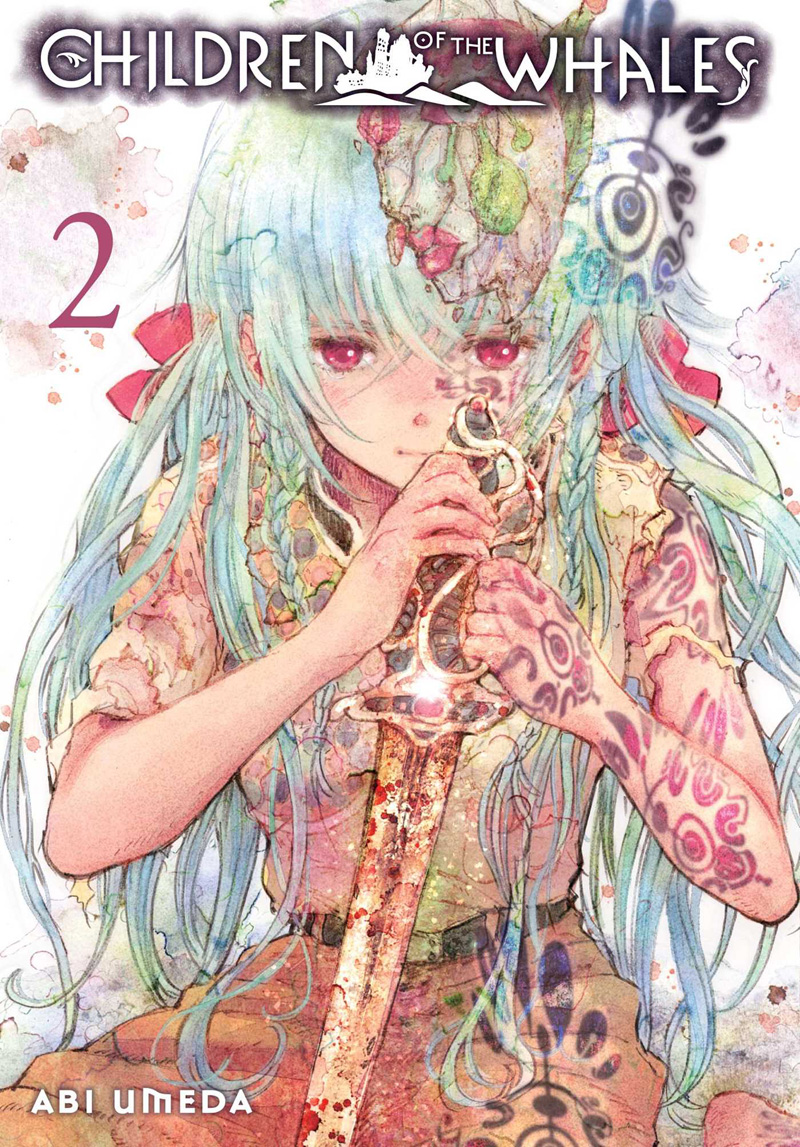
I think my main issue with Children of the Whales so far is that it seems to bleak. One of the characters killed off near the end was, in my mind, going to be used to set up a couple of different plots involving Chakuro and Lykos that would carry over into future volumes, but no, they’re brutally killed off to show us that Nothing Is The Same Anymore. And where The Promised Neverland shows us heroes who plan to fight back using pluck and grit, the cliffhanger to this book shows more of having to fight due to simple “otherwise I will be dead” despair. I just can’t really get involved with anyone here. It’s a shame, as the art is great, and the best reason to read this – the cover alone is fantastic. It conveys both the wonder of this world we’re discovering as well as its vicious, bloody destruction.

I know I shouldn’t be comparing two titles that are for different audiences in different magazines. But I find it very telling that after reading Children of the Whales, it drifted to the bottom of my review stack, whereas after reading The Promised Neverland I had to review it the very next day. Still, fans, of creepy fantasy/mystery series will likely enjoy this more than I did.

Filed Under: children of the whales, REVIEWS

  • « Go to Previous Page
  • Page 1
  • Interim pages omitted …
  • Page 178
  • Page 179
  • Page 180
  • Page 181
  • Page 182
  • Interim pages omitted …
  • Page 342
  • Go to Next Page »
 | Log in
Copyright © 2010 Manga Bookshelf | Powered by WordPress & the Genesis Framework