• Skip to primary navigation
  • Skip to main content
  • Skip to primary sidebar
  • Home
  • About Us
    • Privacy Policy
    • Comment Policy
    • Disclosures & Disclaimers
  • Resources
    • Links, Essays & Articles
    • Fandomology!
    • CLAMP Directory
    • BlogRoll
  • Features & Columns
    • 3 Things Thursday
    • Adventures in the Key of Shoujo
    • Bit & Blips (game reviews)
    • BL BOOKRACK
    • Bookshelf Briefs
    • Bringing the Drama
    • Comic Conversion
    • Fanservice Friday
    • Going Digital
    • It Came From the Sinosphere
    • License This!
    • Magazine no Mori
    • My Week in Manga
    • OFF THE SHELF
    • Not By Manga Alone
    • PICK OF THE WEEK
    • Subtitles & Sensibility
    • Weekly Shonen Jump Recaps
  • Manga Moveable Feast
    • MMF Full Archive
    • Yun Kouga
    • CLAMP
    • Shojo Beat
    • Osamu Tezuka
    • Sailor Moon
    • Fruits Basket
    • Takehiko Inoue
    • Wild Adapter
    • One Piece
    • After School Nightmare
    • Karakuri Odette
    • Paradise Kiss
    • The Color Trilogy
    • To Terra…
    • Sexy Voice & Robo
  • Browse by Author
    • Sean Gaffney
    • Anna Neatrour
    • Michelle Smith
    • Katherine Dacey
    • MJ
    • Brigid Alverson
    • Travis Anderson
    • Phillip Anthony
    • Derek Bown
    • Jaci Dahlvang
    • Angela Eastman
    • Erica Friedman
    • Sara K.
    • Megan Purdy
    • Emily Snodgrass
    • Nancy Thistlethwaite
    • Eva Volin
    • David Welsh
  • MB Blogs
    • A Case Suitable For Treatment
    • Experiments in Manga
    • MangaBlog
    • The Manga Critic
    • Manga Report
    • Soliloquy in Blue
    • Manga Curmudgeon (archive)

Manga Bookshelf

Discussion, Resources, Roundtables, & Reviews

Features & Reviews

Twin Spica, Vol. 1

April 26, 2010 by MJ 7 Comments

Twin Spica, Vol. 1
By Kou Yaginuma
Published by Vertical, Inc.
Rated 13+


Buy at RightStuf | Buy at Amazon

Fourteen years after a catastrophic space shuttle accident that was responsible for numerous civilian casualties, Japan’s space program is finally getting back on its feet, beginning with the establishment of Tokyo Space School’s Astronaut Training Course. There, fourteen-year-old Asumi competes with other prospective students, hoping to be accepted into the program and perhaps one day join Japan’s first successful manned excursion into space.

Though this series finished its run in seinen magazine Comic Flapper just last year, its simple artwork and wistful tone make its first volume read like an instant classic. Even the volume’s cover art, with its innocent imagery and sepia-like warmth, evokes feelings of nostalgia. Also, though the story’s foundation is set firmly in hard sci-fi, it is its heroine’s poignant and occasionally whimsical inner life that really defines its voice. Asumi provides the heart of this story, and it is a strange and wonderful heart indeed.

With her mother gone and her father often working, Asumi’s only confidante is a self-proclaimed ghost with a lion mask covering his head, whom she refers to as “Lion-san.” Even as Asumi begins her teen years, Lion-san remains a constant in her life, serving as a source of insight into a world she’s never truly felt a part of. He also provides a walking, talking symbol of the disaster that took her mother from her–a memory that she has safely locked away in the depths of her subconscious. That the volume opens with a spirited conversation between Asumi and her ghostly friend establishes the series’ supernatural/psychological focus from the start.

Asumi is both idiosyncratic and relatable. As a child, she is quiet and baffling to others–leaning into her mother’s corpse to find out how it smells and later stealing the ashes in order to give her mother a better view of the sea she so loved. As a teen, her concerns are more typical, focusing on dreams for her future and her ability to make friends, but the lonely little girl is still there, seeking comfort and advice from her supernatural friend.

All that said, Twin Spica is hardly a one-woman show. Supporting characters shine in this volume, from Asumi’s lonely teacher (whose first love was also killed fourteen years ago) to the girls with whom Asumi completes her astronaut exam. Even Asumi’s mother, seen mainly in a coma, bandaged from head to toe, is a compelling figure. One particularly complicated character is Asumi’s father. Though he obviously loves his daughter and supports her dreams, he is somewhat lost as a single parent and too often expresses himself through violence.

Yagimuna’s artwork is utterly charming. Simple, clean, and full of heartfelt emotion, it flows easily from panel to panel. Again here, there is a persistent air of nostalgia to the series, enhanced even by Vertical’s choice of font.

This volume feels short–just 124 pages of main story, followed by two short comics that provide a good chunk of backstory (written by Yagimuna before the series proper)–though that perception could just as easily be attributed to its overall delightfulness. Though the series was published as seinen in Japan, it provides substantial appeal for teen girls as well, especially those with their own dreams of space travel.

Hopeful, charming, and tinged with sadness, Twin Spica leaves us wanting more. Highly recommended.

Review copy provided by the publisher.

Filed Under: MANGA REVIEWS Tagged With: manga, twin spica

Your & My Secret, Vols. 1-5

April 25, 2010 by Katherine Dacey

If you ever wondered what Freaky Friday might have been like if Jodie Foster had switched bodies with Leif Garrett instead of Barbara Harris, well, Ai Morinaga’s Your & My Secret provides a pretty good idea of the gender-bending weirdness that would have ensued. The story focuses on Nanako, a swaggering tomboy who lives with her mad scientist grandfather, and Akira, an effeminate boy who adores her. Though Akira’s classmates find him “cute and delicate,” they declare him a timid bore — “a waste of a man,” one girl snipes — while Nanako’s peers call her “the beast” for her aggressive personality and uncouth behavior, even as the boys concede that Nanako is “hotter than anyone.” Akira becomes the unwitting test subject for the grandfather’s latest invention, a gizmo designed to transfer personalities from one body to another. With the flick of a switch, Akira finds himself trapped in Nanako’s body (and vice versa).

The joke, of course, is that Nanako and Akira have found the ideal vessels for their gender-atypical personalities. Nanako revels in her new-found freedom as a boy, enjoying sudden popularity among classmates, earning the respect of Akira’s contemptuous little sister, and discovering the physical strength to dunk a basketball. Akira, on the other hand, finds his situation a mixed bag: for the first time in his life, his sensitive personality endears him to both male and female peers, but many of the things his maleness had previously exempted him from — housework and cooking, menstrual cycles, unwanted advances from boys — turn out to be much worse than he’d imagined. He struggles to feel comfortable in Nanako’s skin, insulted by the grandfather’s refusal to do chores and bewildered by his old buddy Senbongi’s growing attraction to him.

Much of the humor in Your & My Secret stems from the war between head and hormones. Akira still identifies as a boy, lusting after Nanako’s sweetly feminine friend Shiina and suffering volcanic nosebleeds in the girls’ locker room, yet his body is drawn to Senbongi; after Senbongi makes a pass at him, the flustered Akira wonders how Senbongi “got to be such a good kisser.” Nanako, who is quick to embrace her new male identity, struggles as well; though she asks Shiina out, she’s reluctant to consummate their relationship, and shows an all-too-prurient interest in Senbongi’s, um, equipment. Making things even more complicated for Akira is that he’s trapped in the body of the girl he adores. He’s both disgusted and aroused by the sight of himself, and filled with conflicting emotions about the growing relationship between Nanako and Shiina.

Perhaps the most interesting wrinkle in Your & My Secret is that Nanako’s experiences transform her into a sexist pig. She rebuffs Akira’s pleas to reverse the experiment, belittling his gentle, conciliatory personality and asserting her right to have fun in his body. At the same time, she insists that Akira refrain from dating, having sex, or exploring her body; she repeatedly describes her body as a sacred temple that must remain “unpolluted” before her wedding day, and threatens Akira with humiliation if he acts on his conflicted feelings for Senbongi — or Shiina. (Apparently, Nanako is a bit of a homophobe, too.)

While the gender-swapping hijinks provide most of the comedic fodder for Your & My Secret, Morinaga also has a ball poking fun at manga tropes from incestuous infatuation to cultural festivals. The best of these gags revolves around the school’s manga club: in a sly nod to Tezuka, the group is helmed by a beret-wearing artist who transforms Akira and Senbongi’s friendship into a steamy boys’ love comic in which Akira is the seme and Senbongi is the uke. (“It’s not that I like guys,” Akira’s avatar tells Senbongi’s. “The person I fell in love with just happened to be a guy.”) Morinaga also wrings laughs from her characters’ desperate behavior; the grandfather, for example, thinks nothing of blackmailing Akira to get closer to Shiina (he dreams of having a pretty teenage girl sit in his lap and clean his ears), while Senbongi hatches up a love-hotel scheme to drive a wedge between Akira and Nanako.

Yet for all the black comedy, Morinaga still allows her characters moments of vulnerability and decency, preventing the humor from curdling into pure meanness. She wisely avoids the trap of making her characters too dumb to notice the transformations in Akira and Nanako, allowing her to sustain the body-swapping premise without straining credulity or testing the reader’s patience. Morinaga avoids another trap as well: that of making her leads so repellent the reader wishes for their comeuppance. (Even Nanako — she of the karate chops and withering put-downs — demonstrates a capacity for kindness and selflessness when wooing Shiina.) The artwork supports Morinaga’s characterizations, showing us both their nastier and nicer sides. When Akira assumes ownership of Nanako’s body, for example, there’s a visible softening of Nanako’s features, her lips becoming moistly inviting, her chin turning ever-so-slightly upward, and her eyes shining like a proper shojo heroine’s. If provoked, however, Akira’s body language and gestures revert back to Nanako’s coarse, tomboy persona, right down to the maniacal gleam in his eye; the gap between the two personalities proves smaller than either would like the admit.

No, it isn’t Taming of the Shrew, but Your & My Secret manages to make some worthwhile points about gender roles (and gender norms) while serving up plenty of dopey slapstick and risque jokes. Frankly, I’d take a big helping of Morinaga’s un-PC humor over an earnest, socially responsible “girls’ comic” any day of the week. Highly recommended.

This is an expanded version of a review that originally appeared at PopCultureShock on 3/12/08. The original review can be read by clicking here.

Filed Under: Manga, Manga Critic, REVIEWS Tagged With: Ai Morinaga, Comedy, Tokyopop

Kingyo Used Books, Vol. 1

April 19, 2010 by Katherine Dacey

Kingyo Used Books starts from a simple premise: an eccentric group of people run a second-hand bookstore in an out-of-the-way location. Various customers stumble upon the shop — usually by accident — and, in the process of browsing, find a manga that helps them reconnect with a part of themselves that’s been suppressed, whether it be a youthful capacity for romantic infatuation or a desire to paint expressively.

Is there such thing as agit-manga? Because Kingyo Used Books seems like the brainchild of an editor who’s desperately trying to convince adults that one never outgrows manga. In the first story, for example, a salaryman tries to unload his collection at the store, telling the owner, “I’m not a kid anymore. Besides, it’s kind of pathetic to keep reading manga forever.” He gets a gentle comeuppance at a class reunion, where his friends’ fond memories of Dr. Slump remind him what an important role manga played in their young lives. The story is pleasant and enjoyable, but suffers from a bad case of predictability; as soon as the salaryman sees his friends engaged in tearful, rhapsodic discussions of their childhood reading habits, he’s overcome with emotion and — natch — a strong desire to keep the manga he’d previously hoped to sell.

<!—more—>

Other stories in volume one follow the same basic template. In “Far Away,” for example, an archery champion discovers that laughter and downtime are as essential to winning as practice, thanks to a pair of Kingyo employees whose snot-rolling-down-the-face, tears-in-eyes response to Moretsu Ataru inspires the archer to pick up a manga instead of his bow and quiver. “Fujiomi-kun,” another chapter that adheres to this formula, focuses on a frustrated housewife who makes some small but important changes in her life after rediscovering Chizumi and Fujiomi-kun, a romance about a handsome athlete who falls in love with a clumsy but kind-hearted girl.

The series’ episodic structure cuts both ways, see-sawing between a fun exercise in formula — which manga will feature prominently in this story? who will be drawn into the store? — and a frustratingly obvious collection of beats culminating in a character’s decision to make a change in her life. I’d be lying if I didn’t admit the appeal of a series that highlights some famous (and, sadly, untranslated) manga, or that validates my own experiences as an adult manga reader; like many of the characters in Kingyo Used Books, I, too, have found titles as different as Suppli, Phoenix, and Night of the Beasts an outlet for emotions that don’t always find expression in my daily life. In settling for such a tidy approach to dramatizing manga’s transformative power, however, author Seimu Yoshizaki misses an opportunity to really move readers, instead treating us to sentimental, sometimes mawkish, scenes in which adults recover childhood memories of favorite books. Yoshizaki never acknowledges the messiness or risk that her characters take when acting on their epiphanies or experiencing personal growth, choosing instead to end every story on a positive note.

The artwork is clean, conveying the characters’ interior lives with directness and simplicity. Though her style isn’t particularly distinctive, Yoshizaki does a fine job evoking other artists’ styles, recreating images from famous series and altering one of her own characters to look like the hero of his favorite manga. The most striking image in the book is just such a recreation: it’s Hokusai’s iconic wave print, drawn in the sand by two students who then watch the incoming tide erase it. In the story’s final panels, the two reflect on their emotions as they watch their work vanish. One is pensive and wishes the work was permanent; the other responds by noting that permanence can be its own trap. “I’ve seen the pictures Hokusai drew when he was our age,” he says. “They really sucked.” Here’s hoping that volume two has more of these frank, funny, and true-to-life moments and fewer scenes of tearful housewives and salarymen reliving their childhoods through manga.

KINGYO USED BOOKS, VOL. 1 • BY SEIMU YOSHIZAKI • VIZ • RATING: OLDER TEEN (16+) • 208 pp.

Filed Under: Manga, Manga Critic, REVIEWS Tagged With: Drama, SigIKKI, VIZ

Manhwa Monday: Spring Slump

April 19, 2010 by MJ Leave a Comment

Welcome to another Manhwa Monday! It’s been a quiet week for manhwa, with just a couple of series stealing most of the focus from reviewers.

I’ll lead off with a review of my own, featuring YoungHee Lee’s You’re So Cool, complete in six volumes from Yen Press. This review is also my first guest spot at Brigid Alverson’s MangaBlog, which is quite an honor for me.

You’re So Cool is a series that benefits greatly from being read straight-through, particularly in its first half. Though its heroine is spunky and adorable from the start, the romantic premise is so problematic, it would be easy to abandon just two volumes in. “Fortunately, midway through the series’ third volume, Lee forgets that she’s writing a hopelessly clichéd, emotionally-backwards romance and gets caught up in the real heart of the story: how people (especially families) shape each other, for better or worse.” …

Read More

Filed Under: Manhwa Bookshelf Tagged With: manhwa, Manhwa Bookshelf

Wild Ones, Vol. 9

April 18, 2010 by MJ Leave a Comment

By Kiyo Fujiwara
Viz, 200 pp.
Rating: Teen

Having finally agreed to speak to the father who abandoned him so many years ago, Rakuto is confronted with the possibility that he may eventually have to leave Sachie’s side in order to make peace with his own past. Meanwhile, Azuma is determined to let Sachie know how he feels, whether Rakuto is ready to play his part or not. Who does Sachie truly love? Has this ever been in question? If so, this volume provides an answer at long last!

Finally the series’ romantic tension is resolved, exactly as it was certain to be from the beginning. Some formulaic romances are enjoyable to read simply because they are so predictable. With these stories, the charm is in the writing, and watching their familiar scenarios play out is, frankly, comforting and downright delightful. Unfortunately, this is not one of those series. Though the couple in question are undeniably sweet, their relationship is so labored and so painfully drawn out, one finds oneself wishing something truly shocking would happen (a deadly plague? an alien invasion? ) just to break up the monotony. With its unbelievable premise and its terminally clueless lovers, this series seems determined to remain lifeless until the end.

Well, almost, anyway. To be fair, this volume’s final pages are honestly sweet, and may even evoke tears from desperate readers grateful for a bit of romantic satisfaction. It may not be an alien invasion, but long-time readers are at least assured some payoff.

Review copy provided by the publisher. Review originally published at PopCultureShock.

Filed Under: MANGA REVIEWS Tagged With: manga, wild ones

Honey Hunt 4 by Miki Aihara: B

April 18, 2010 by Michelle Smith

Despite having no prior interest in acting, Yura Onozuka, the relatively normal daughter of celebrity parents, discovers a talent for it when she resolves to surpass her mother in the dramatic sphere. She has achieved some moderate success pretty quickly, including a spot in a commercial and a supporting role on a new TV drama.

Yura’s career is less the focus in this volume than are her romantic prospects, however. While volume three ended with one pop star (Haruka) confessing his feelings, here Yura is swept away by his twin brother (Q-ta, also a pop star), to the point where she’s distracted during an audition and later ditches a dinner planned by her housemates—to celebrate her drama’s debut—in favor of spending a night on the town with Q-ta.

Although one might wish for a heroine more doggedly dedicated to her career, it’s not hard to sympathize with Yura as she faces the choice between two dreams—the nurturing family-type environment offered by her housemates and the love of a prince-like suitor. Even though she makes some mistakes, she’s still likeable. Q-ta, however, comes off as quite the brat here, and one can’t help but wonder whether his protestations that he likes Yura for herself rather than for her famous father are truly genuine. If not, I suppose it’ll make for good drama.

In the end, while Honey Hunt doesn’t leave a particularly strong impression with the reader, it’s still something I enjoy reading.

Review copy provided by the publisher. Review originally published at Manga Recon.

Filed Under: REVIEWS Tagged With: Miki Aihara, shojo beat, VIZ

Diamond Girl, Vol. 1

April 15, 2010 by Katherine Dacey

Part Bad News Bears, part Boys of Summer, Diamond Girl follows a time-honored sports-comedy formula in which a team of losers have their pennant dreams rekindled after an unlikely but undeniable talent joins their ranks. In Diamond Girl, those hard-luck athletes are Baba, Seto, and Takagi, the heart and soul of the Ryukafuchi High School baseball club. The trio discovers, by accident, that the new transfer student has the throwing arm of a youthful Roger Clemens, capable of nailing a moving object hundreds of feet away or throwing a shotput with the ease and precision of a softball. The catch: Tsubara is a girl, making her ineligible to play.

Actually, there’s another obstacle to Tsubara joining the team: she doesn’t want to. At first, Tsubara vehemently denies her skills, feigning bewilderment at her ability to snatch a line drive from the air, bare-handed. When Tsubara’s classmates remain unpersuaded, Tsubara finally concedes her athletic prowess, but rebuffs Baba and Takagi’s suggestion that she play baseball in drag. (“We hide her chest by wrapping it up in bandages,” Takagi confidently asserts. “I see no problem.”) How Tsubara came by her skills, and why she refuses to play, are the central mysteries of volume one, and provide most of the series’ comedic — and dramatic — juice.

Anyone expecting a baseball version of Crimson Hero will be in for a rude shock with Diamond Girl. There’s fan service a-plenty, from a “whoops, I didn’t mean to collide with your chest!” gag to a bath scene that seems calculated to reassure readers that Tsubara is 100% girl, even if she could beat the snot out of her teammates, on or off the field. (The author annotates one panel with the cheerful admission that “Today, we bring you more fan service than usual.”) Aside from a truly distasteful scene in which the team pervert assesses Tsubara’s panty preferences — he bemoans her tendency to wear “little kid underpants” — the fan service is easy enough to overlook, even for an old feminist curmudgeon like me.

The real joy of Diamond Girl is watching Tsubara lose herself in the moment. Midway through volume one, for example, a monkey steals Tsubara’s treasured purse, ripping it open and fleeing to the safety of the school roof to examine its contents. Tsubara doesn’t hesitate; she transforms herself into a human pitching machine, lobbing balls and rocks at the culprit until one well-timed throw knocks the purse of the monkey’s hands. A similar sense of joyful abandon informs a scene in which Tsubara plays fetch with her dog Hachi, who shares his mistress’s talent for fielding extreme fly balls — as well as her ability to tune out her surroundings. (He crash-lands on top of Tsubara’s classmate, ball in mouth.) Tsubara runs their game with the intensity of a drill sargeant or big league coach, treating Hachi as if he’s a star right fielder.

Manga-ka Takanori Yamazaki demonstrates a genuine knack for caricature, neatly encapsulating each character’s personality in a few gestures: a mohawk for the slightly chubby, irreverent Takagi; a row of earrings and a maniacal gleam for the more energetic Baba; a pair of ratty pigtails and a scowl for Tsubara. Though Yamazaki makes a game effort to immerse us in the action, his fondness for dramatic camera angles and freeze-frames occasionally results in an awkwardly composed drawing; in more than one scene, he foreshortens characters to such a degree that they look a bit squashed. Yamazaki also relies on tracing just a little too often, as the monkey scene attests; all of the monkeys have a straight-off-the-lightbox quality that suggests a National Geographic spread on the hot-tubbing macaque of Honshu. Even with such obvious limitations, however, the artwork suits the story’s broad comedic tone without becoming too frantic.

If the one-note characters and suggestive situations prevent Diamond Girl from scoring a homerun, it’s certainly a solid base hit, offering an enjoyable mixture of game play and humor that should appeal to baseball enthusiasts, manga lovers, and female athletes of all stripes. Recommended.

DIAMOND GIRL, VOL. 1 • BY TAKANORI YAMAZAKI • CMX MANGA • RATING: TEEN (13+) • 160 pp.

Filed Under: Manga, Manga Critic, REVIEWS Tagged With: Baseball, cmx, Comedy, Sports Manga

You’re So Cool, Vols. 1-6

April 15, 2010 by MJ Leave a Comment

My big news for the afternoon is the event of my guest review of YoungHee Lee’s You’re So Cool (full series) over at Brigid Alverson’s MangaBlog. This is a series that began on weak footing with me, setting itself up to be another Hot Gimmick or Black Bird or any number of other girls’ comic series dedicated to romanticizing smug, controlling men.

Fortunately, by the time I got around to this series, there was enough of it released for me to avoid being turned off by just the first couple of volumes. It’s not a perfect series by any means, but the romantic content is surprisingly satisfying (thanks mainly to the series’ secondary romance) and its heroine is the most endearing little tomboy you’ll ever meet. The artist doesn’t go crazy prettying her up in the later volumes, either, which is a refreshing choice indeed.

This is also my very first guest review at MangaBlog, so if you like it, be sure to say so! Click here for more!

Filed Under: REVIEWS Tagged With: manhwa, you're so cool

Libre Books Available on Kindle

April 13, 2010 by MJ 1 Comment

Here’s an interesting press release that made it into my inbox today, from Japanese BL publisher Libre (via Animate U.S.A.), who are releasing English versions of several of their titles for the Kindle. See the full press release below:

…

Read More

Filed Under: REVIEWS Tagged With: kindle, manga, yaoi/boys' love

Oh! My Brother 2 by Ken Saito: B-

April 12, 2010 by Michelle Smith

It’s been one month since Masago Kamoguchi’s brilliant older brother, Shiro, died and began possessing her. With all of this going on, Masago hasn’t been studying, so when exam time comes around, she allows Shiro to take the tests for her and ends up with a perfect score. Her impressive performance prompts a teacher to encourage her to run for student council, a decision she waffles about for a little while until gaining some confidence. Meanwhile, Shiro debates the wisdom of lingering in his sister’s body while his friend, Kurouma, deals with the knowledge that Masago likes him but views him as utterly unattainable.

I really want to like Oh! My Brother, and sometimes I manage to do so. I like Kurouma a lot, for example—it’s so refreshing that he actually notices Masago’s feelings!—and also the way Shiro’s possession is portrayed as a double-edged sword. True, his presence lends Masago strength in crucial moments, particularly in dealing with a bullying older girl, but her reliance on him is also holding her back in certain areas; although Shiro is willing to let go, it’s Masago who desperately makes him promise to stay with her forever.

On the other hand, there is a lot of extranneous material here that detracts from what’s good about this series. Some of the comedy feels out of place, and there are a few too many Shiro-obsessed characters floating around, from the aforementioned bully, to a former soccer rival, to a cool and competent member of the student council. If the focus had been more on the drama of Masago’s situation, coupled with the need to let go of Shiro in order to become open to other kinds of love, I’d like it so much more. As it is, I must be content with the occasional glimmer of what could have been.

Review copy provided by the publisher. Review originally published at Manga Recon.

Filed Under: REVIEWS Tagged With: cmx, Ken Saito

Manhwa Monday: Go West!

April 12, 2010 by MJ 7 Comments

Welcome to another Manhwa Monday! I type this column from my sickbed, where I’m feeling weary and, frankly, old as I realize that to me, that title is a Marx Brothers reference, but to the rest of you… probably not.

On to the topic at hand: as if answering a call from the depths of my heart, Manga Critic Kate Dacey recently visited the “Korean Comics: A Society Through Small Frames” exhibit at the San Francisco Public Library and wrote up a detailed report in her blog, including footnotes and suggested reading.

Something Kate notes in her article, which has been pointed out previously by readers familiar with the manhwa scene in Korea, is just how little the English-translated manhwa we see here represents Korean manhwa as a whole. As a fan of what’s currently being translated, I’m not necessarily complaining, but it would be exciting to see a broader spectrum of work being offered in English. …

Read More

Filed Under: Manhwa Bookshelf Tagged With: manhwa, Manhwa Bookshelf

One Thousand & One Nights, Vol. 10

April 10, 2010 by MJ 3 Comments

One Thousand and One Nights, Vol. 10
By Han SeungHee & Jeon JinSeok
Published by Yen Press


Buy at RightStuf | Buy at Amazon

While reading Sehara’s translation of The Romance of the Three Kingdoms, it becomes clear to McLeod that Sehara is leaving him, though this realization comes too late for him to stop it. Unfortunately, as Sehara rushes back to Baghdad, he is met with the news of Shahryar’s death, throwing him into a state of deep despair. Meanwhile, Shahrayr (not quite dead) finds himself in the care of the Nauar Gypsies, one of whom beseeches him to travel east to seek out his “other half,” whom Shahryar now recognizes to be Sehara.

Though Sehara and Shahryar spend the entirety of this volume apart, the volume is a gift to BL fans and anyone else who might be hoping against hope that their highly eroticized relationship actually turn to romance. Not that anything happens, of course, but there is a sense that if our story’s heroes ever manage to find their way back to each other, it will be a warm reunion indeed.

Fortunately, the romance is well-earned and should hold up nicely, even with Shahryar’s bloody past as an obvious moral obstacle. “You were already dead, drowned in a whirlpool of sin,” a gypsy tells Shahryar. “And then someone brought you back to life.” It’s a tricky business–letting a character with so much blood on his hands realize happiness–but writer Jeon JinSeok has worked hard to create a situation in which this could be palatable. Now with only one volume remaining, we’ll soon find out what Jeon really has in store for the characters he’s so carefully tortured. Er. Nurtured.

With the stakes so high in the main story line, it might be easy at this point to dismiss Sehara’s stories-within-the-story, but fortunately The Romance of the Three Kingdoms (even in such an abridged state) is far too compelling to allow it. Part of what makes this series work so well is the fact that Sehara’s stories consistently move the primary tale forward, rather than acting as diversions. And part of the series’ charm is the fact that these stories are at least as important to their storyteller as they are to the sultan they are meant to entertain–a truth delightfully accented at the end of this volume as Shahryar sets out disguised as a bookseller in hopes of luring a distraught Sehara out of hiding.

Every aspect of this series remains engaging–storytelling, plot, characterization, artwork–crafted into a kind of ultimate fantasy with its lush, period settings and unapologetic violence. Fans of escapist romance could hardly find an escape more delicious than One Thousand and One Nights.

Review copy provided by the publisher.

Filed Under: REVIEWS Tagged With: manhwa, one thousand and one nights

Vanish with the Rose by Barbara Michaels: B+

April 7, 2010 by Michelle Smith

From the back cover:
Diana Reed has much to hide when she arrives at the Nicholsons’ 18th-century estate. Masquerading as a landscape architect specializing in “ancient” roses, she’s hired by the eccentric couple to restore the gardens, but her real interest lies in the manor’s more recent history.

Sinister scenarios ensue at the Nicholsons’ estate. Ghostly music echoes in the halls. The smell of roses haunts empty rooms. Diana must hurry if she is to solve her highly personal mystery before she becomes another of the garden’s well-kept secrets.

Review:
While I definitely enjoyed reading Vanish with the Rose, it was quite a slow read for me. At first, all we know about Diana Reed is that she’s pretending to be an expert on roses in order to gain access to property newly acquired by a pair of lottery winners, Emily and Charles Nicholson. Her true agenda is not mentioned for some time, but it eventually comes out after she befriends the Nicholsons’ housekeeper, Mary Jo, and all of a sudden things change quite a bit.

As it turns out, Diana is there investigating the disappearance of her brother, Brad, who had worked for the previous owner, an old woman notorious for her ornery disposition. The handling of this revelation is interesting in that several members of the cast, whom we’ve already met without suspicion, are suddenly revealed as potential suspects. Meanwhile, ghostly music disturbs Diana’s sleep and she experiences several visions from what seems to be someone else’s perspective. After the Nicholsons head off on vacation while landscaping work proceeds, Diana, Mary Jo, Walt (the head landscaper), and Andy (Emily’s son) remain at the centuries-old home where they look for leads on Brad and try to avoid Mary Jo’s abusive ex-husband, Larry.

So, essentially what we have here is a supernatural cozy mystery, with a dash of romance thrown in for good measure. As I said, I enjoyed reading the book, but the narrative would meander something awful. Things do come together tidily enough at the end, with some fun misleads and twists along the way, but I can’t help but feel some liberal editing would’ve produced a tighter story.

I have no complaints at all about the characters, though, since I liked them all quite a lot. Diana has a lot of baggage from her parents, and takes some time coming out of her shell, but her new friendships help her to achieve this. Walt is gruff and sensible, Mary Jo is “determinedly rational,” and Andy is one of those fellows who appears glib and irresponsible, but is actually dependable in a pinch. The interplay between them is amusing, and while Diana has chemistry with both the guys, I’m quite happy about how things ultimately turn out in this regard.

Even though the story drags in places, Vanish with the Rose is a solidly entertaining tale, and definitely one worth reading.

Filed Under: Books, Mystery, Supernatural Tagged With: Barbara Michaels/Elizabeth Peters

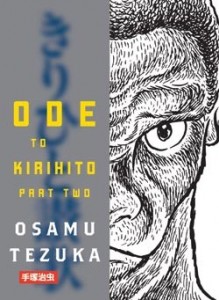
Ode to Kirihito, Vols. 1-2

April 7, 2010 by Katherine Dacey

“When he heard his cry for help, it wasn’t human” — so went the tagline for Ken Russell’s Altered States (1980), a bizarre fever-dream of Nietzchean philosophy, horror, and mystical hoo-ha in which a scientist’s experiments result in his spontaneous devolution. That same tagline would work equally well for Osamu Tezuka’s Ode to Kirihito (1970-71), a globe-trotting medical mystery about a doctor who takes a similar step down the evolutionary ladder from man to beast. In less capable hands, Kirihito would be pure, B-movie camp with delusions of grandeur — as Altered States is — but Tezuka synthesizes these disparate elements into a gripping story that explores meaty themes: the porous boundaries between man and animal, sanity and insanity, godliness and godlessness; the arrogance of scientists; and the corruption of the Japanese medical establishment.

At its most basic level, Ode to Kirihito is a beat-the-clock thriller in which a charismatic young doctor named Kirihito Osanai tries to discover the cause of Monmow, a mysterious condition that reduces its victims to hairy, misshapen creatures with dog-like snouts. Kirihito’s superior, the ambitious Dr. Tatsugaura, dispatches Kirihito to Doggodale, a remote mountain village where hundreds of residents have developed suggestive symptoms. Once in Doggodale, Kirihito contracts Monmow himself, thus beginning a hellish odyssey to escape the village, arrest the disease’s progress, and share his findings with the medical community.

kirihito2At a deeper level, however, Ode to Kirihito is an extended meditation on what distinguishes man from animal. Kirihito’s physical transformation forces him to the very margins of society; he terrifies and fascinates the people he encounters, as they alternately shun him and exploit him for his dog-like appearance. (In one of the manga’s most engrossing subplots, an eccentric millionaire kidnaps Kirihito for display in a private freak show.) The discrimination that Kirihito faces — coupled with Monmow’s dramatic symptoms, such as irrational aggression and raw meat cravings — lead him to question whether he is, in fact, still human. Throughout the story, he wrestles with a strong desire to abandon reason and morality for instinct; only his medical training — and the ethics thus inculcated — prevent him from embracing the beast within.
Tezuka explores the boundaries between the rational and the instinctual in other ways as well. Running in tandem with Kirihito’s metamorphosis is another devolution of sorts: Kirihito’s colleague Dr. Urabe, who descends into madness after uncovering a sinister plot within the administration of M University Hospital. When we first meet Urabe, he’s a self-interested cad who lusts after Kirihito’s fiancee Izumi, views Kirihito as more rival than friend, and lacks the will to challenge Tatsugaura, even when data suggests Tatsugaura’s hypothesis about Monmow is flat-out wrong. The slow dawning of Urabe’s conscience, however, precipitates a dramatic change; his psyche splits in two, with one half striving after truth and the other succumbing to base impulse. Even as Urabe begins to redeem himself, collaborating with Izumi to reveal Tatsugaura’s dishonesty, he frequently lapses into savage, sexual aggression.

Other characters’ reactions to these transformations — especially characters in positions of authority or power — provide Tezuka with ample opportunity to engage in one of his favorite activities: exposing institutional hypocrisy. The scandal surrounding Tatsugaura’s Monmow hypothesis, for example, lays bare the corruption within the barely fictional Japanese Medical Association. In his relentless quest to become head of the organization, Tatsugaura seeks to establish an international reputation as an infectious disease expert, even going so far as to suppress evidence that contradicts his thesis. Yet the revelation of Tatsugaura’s deceit does little to jeopardize his position among his peers; only the young doctors find his behavior objectionable, yet they cannot dislodge him from his powerful position.

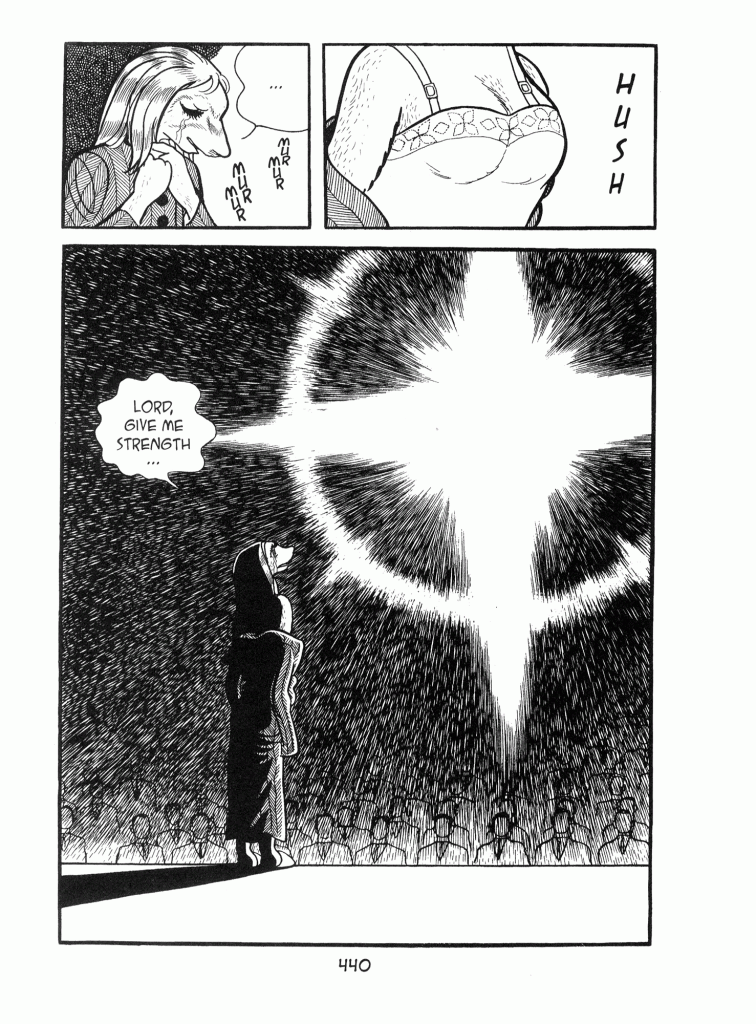
One of the key figures in revealing Tatsugaura’s treachery, Sister Helen, also provides Tezuka a chance to tear away the veil of hypocrisy from another institution — in this case, the Catholic Church. Midway through the first volume, a priest attempts to murder Sister Helen after she contracts Monmow disease. When confronted with his act, he acknowledges his intent but denies his purpose was evil; he insists on protecting the Church’s reputation at all costs, fearing that news of Helen’s condition would bring a scandal, as the received wisdom about Monmow disease held that Caucasians were immune to it.

sisterhelen

At the same time, however, Tezuka uses his characters’ metamorphoses to reveal the human capacity for selflessness and spirituality. Sister Helen provides the most obvious example; after entertaining thoughts of suicide, she has an epiphany — literally, as the cross imagery above suggests — and begins emulating Christ’s example, eventually finding her place ministering to the residents of an impoverished industrial town. Other characters demonstrate a similar capacity for selfless behavior: Urabe, for example, devotes himself to finding Kirihito, while Reika, a circus performer, helps Kirihito escape from captivity and reassert his humanity by practicing medicine.

One could certainly view Ode to Kirihito as heavy-handed allegory; there’s nothing subtle about its Christian imagery or Elephant Man storyline. Yet Tezuka’s fondness for Baroque subplots, over-the-top action sequences, and larger-than-life villains demands an equally bold approach for exploring the story’s greater themes. After all, Kirihito features dog men, sideshow freaks, an evil millionaire who hosts his own private circus, a German geneticist sporting a monocle, and an acrobat who risks life and limb to become human tempura; had Tezuka played things straight, or tried to state his man-vs-inner-beast conflict in less obvious terms, the story would seem preposterous and arty, a surreal experiment devoid of genuine human feeling.

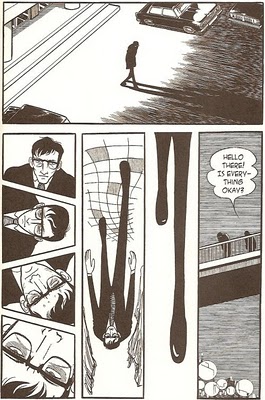
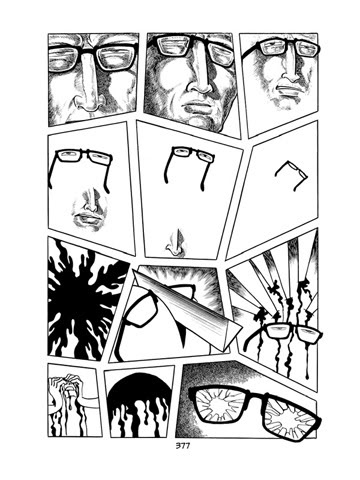
As he would do in MW (1976-78), Tezuka pushes the boundaries of the comics medium in Ode to Kirihito, aiming for a cinematic style capable of immersing us not only in the action but in the characters’ own thought processes. Though Kirihito has its share of artfully staged chases, fights, and dramatic confrontations, the most visually arresting sequences depict Urabe’s fragile mental state:

urabe_breakdown2urabe_breakdown

The panel shapes alone are a brilliant stroke; not only do they suggest his fractured and chaotic thought process, they also have a hint of the insect about them, as if we’re viewing Urabe’s consciousness through a fly’s eye. The knife and blood imagery are cliche, to be sure, but the shattered glasses are a novel and unsettling gesture open to multiple interpretations. Even the more conventional sequence on the left, in which Urabe leaves a hospital in a murderous rage, employs its share of neat visual tricks: Tezuka dramatizes Urabe’s personality shift by rotating the character’s image until he appears to be walking through an upside-down hall of mirrors. Amplifying the effect is the ambiguous way in which Tezuka draws Urabe’s legs in the bottom panel; as Matthew Brady observed in his review of Ode to Kirihito, the image simultaneously evokes dripping blood and moving limbs.

Perhaps the best compliment I can pay Ode to Kirihito is to say that Tezuka achieves on paper what John Frankenheimer achieved on film with The Train, Seven Days in May, and The Manchurian Candidate, transforming the humble thriller into a vehicle for telling thought-provoking, challenging stories that enlighten as they entertain. Kirihito may not surpass the narrative sophistication or visual poetry of Phoenix, but it comes awfully close. A must-read for serious manga lovers.

Review copies provided by Vertical, Inc.

ODE TO KIRIHITO, VOLS. 1-2 • BY OSAMU TEZUKA • VERTICAL, INC. • RATING: OLDER TEEN (16+)

Filed Under: Manga, Manga Critic, REVIEWS Tagged With: Action/Adventure, Classic, Horror/Supernatural, Osamu Tezuka, Vertical Comics

Marvel 1602 by Neil Gaiman, Andy Kubert, and Richard Isanove: B

April 5, 2010 by Michelle Smith

From the front flap:
The year is 1602, and strange things are stirring in England. In the service of Queen Elizabeth, court magician Dr. Stephen Strange senses that the bizarre weather plaguing the skies above is not of natural origin. Her majesty’s premier spy, Sir Nicholas Fury, fends off an assassination attempt on the Queen by winged warriors rumored to be in service to a mad despot named Doom. News is spreading of “witchbreed” sightings—young men bearing fantastic superhuman powers and abilities. And in the center of the rising chaos is Virginia Dare, a young girl newly arrived from the New World, guarded by a towering Indian warrior. Can Fury and his allies find a connection to these unusual happenings before the whole world ends?

Review:
The basic premise of Marvel 1602 is an interesting one: characters from Marvel’s roster of heroes are born 400 years too early, and here we see them as they would appear in the final days of Queen Elizabeth’s reign. Nick Fury is Elizabeth’s intelligence chief, Dr. Strange is her physician, and various other familiar characters appear as either “witchbreed” (the X-Men), inquistors (Magneto), freelance agents of the crown (Daredevil), or antagonists (Doctor Doom).

This would seem like a recipe for much coolness, but unfortunately the plot is a rather convoluted. There are no less than four subplots going on at once, and though they do converge at the end, early chapters are rather disjointed and later ones feel rushed. Even though I was never really invested in the story, it’s still fairly decent overall, with some elements that are more appealing than others. One thing that I thought was kind of lame was having characters make prescient comments, like when Professor Xavier remarks, “Sometimes I dream of building a room in which danger would come from nowhere.” Okay, even I get that and know how cheesy it is.

Possibly I would’ve liked this more had I more readily recognized the characters that were being portrayed. Certain ones are easy—I can recognize most of the standard good guys in Marvel’s stable of stars, it seems—but I completely failed to grasp clues as to the Grand Inquisitor’s identity (two major ones being the identities of his two helpers) until his ability to manipulate metal made me go, “Ohhhh.” I’m sure that real Marvel fans had figured it out way before then. I’ve also never before encountered the character of Black Widow so I didn’t recognize her. Kudos to Gaiman for employing her in a role—a freelance agent helping Nick Fury and Daredevil—that seems to be perfectly in keeping with the character’s established history.

In the end, Marvel 1602 is a pretty fun read. It didn’t rock my world or anything, but it did familiarize me a little more with some elements of the Marvel universe, even while presenting them in an alternate time line. I can’t complain about that!

Filed Under: REVIEWS Tagged With: Marvel, neil gaiman

  • « Go to Previous Page
  • Page 1
  • Interim pages omitted …
  • Page 495
  • Page 496
  • Page 497
  • Page 498
  • Page 499
  • Interim pages omitted …
  • Page 553
  • Go to Next Page »
 | Log in
Copyright © 2010 Manga Bookshelf | Powered by WordPress & the Genesis Framework