• Skip to primary navigation
  • Skip to main content
  • Skip to primary sidebar
  • Home
  • About Us
    • Privacy Policy
    • Comment Policy
    • Disclosures & Disclaimers
  • Resources
    • Links, Essays & Articles
    • Fandomology!
    • CLAMP Directory
    • BlogRoll
  • Features & Columns
    • 3 Things Thursday
    • Adventures in the Key of Shoujo
    • Bit & Blips (game reviews)
    • BL BOOKRACK
    • Bookshelf Briefs
    • Bringing the Drama
    • Comic Conversion
    • Fanservice Friday
    • Going Digital
    • It Came From the Sinosphere
    • License This!
    • Magazine no Mori
    • My Week in Manga
    • OFF THE SHELF
    • Not By Manga Alone
    • PICK OF THE WEEK
    • Subtitles & Sensibility
    • Weekly Shonen Jump Recaps
  • Manga Moveable Feast
    • MMF Full Archive
    • Yun Kouga
    • CLAMP
    • Shojo Beat
    • Osamu Tezuka
    • Sailor Moon
    • Fruits Basket
    • Takehiko Inoue
    • Wild Adapter
    • One Piece
    • After School Nightmare
    • Karakuri Odette
    • Paradise Kiss
    • The Color Trilogy
    • To Terra…
    • Sexy Voice & Robo
  • Browse by Author
    • Sean Gaffney
    • Anna Neatrour
    • Michelle Smith
    • Katherine Dacey
    • MJ
    • Brigid Alverson
    • Travis Anderson
    • Phillip Anthony
    • Derek Bown
    • Jaci Dahlvang
    • Angela Eastman
    • Erica Friedman
    • Sara K.
    • Megan Purdy
    • Emily Snodgrass
    • Nancy Thistlethwaite
    • Eva Volin
    • David Welsh
  • MB Blogs
    • A Case Suitable For Treatment
    • Experiments in Manga
    • MangaBlog
    • The Manga Critic
    • Manga Report
    • Soliloquy in Blue
    • Manga Curmudgeon (archive)

Manga Bookshelf

Discussion, Resources, Roundtables, & Reviews

Features & Reviews

The Princes in the Tower by Alison Weir: B+

January 11, 2010 by Michelle Smith

princesintowerFrom the front flap:
Despite five centuries of investigation by historians, the sinister deaths of the boy king Edward V and his younger brother Richard, Duke of York, remain one of the most fascinating murder mysteries in English history. Did Richard III really kill “the Princes in the Tower,” as is commonly believed, or was the murderer someone else entirely? In this utterly absorbing and meticulously researched book, English writer Alison Weir, an authority on the history of the British royal family, at last provides a conclusive solution to this age-old puzzle.

Review:
There are two schools of thought on Richard III. One group, dubbed “revisionists,” believes that Richard’s unsavory reputation is undeserved and that he did not do the awful things attributed to him. The second, “traditionalists,” hold that Richard was tyrannical and ambitious and certainly did commit many terrible acts. Alison Weir is firmly in the traditionalist camp and, after reading her work, I must (reluctantly) conclude that Richard probably was behind the deaths of his nephews.

The way Weir organizes her information is interesting. After devoting the entire first chapter to an introduction and evaluation of her sources, especially contemporary ones, she proceeds to tell the story by citing many of the sources in turn. These do not always agree, and when they don’t, she points it out and explains which, in her opinion, is likely the most accurate account. The result is a narrative that feels thorough and yet not unnecessarily bogged down by detours into conjecture. While I lament the passing of my romanticized view of Richard III, Weir ultimately did compile enough irrefutable evidence to convince me of his villainy.

Some things about the way the information is presented rankle a bit, however. It’s clear from pretty early on that Weir, despite claiming that she approached the question of Richard’s guilt with an open mind, is completely dismissive of the revisionist view, saying “the majority of serious historians have rejected it.” Too, she often seems to base her arguments on behavioral assumptions like (paraphrased) “Surely a man of such integrity would verify his facts” or “This was published during a time when many people who knew Richard III were still alive and would spot inaccuracies.” Okay, sure, but in a political climate where beheadings occur frequently—and when the monarch (Henry VII) in power wants to avoid attention being called to the House of York, as Weir points out herself—are these people really going to feel free to defend him? It’s not that I dispute her conclusions based on the evidence, and I’m by no means a historian myself, but I do have to wonder whether this is how research is normally conducted and presented.

In any case, Weir’s account of Richard’s life, deeds, and legacy is a fascinating and, ultimately, convincing read, even to someone like me who has enjoyed (and likely will continue to enjoy) reading historical fiction in which Richard is presented in a positive light.

Filed Under: Books Tagged With: Alison Weir

Manhwa Monday: January 11th, 2010

January 11, 2010 by MJ 16 Comments

First things first! The winner of last week’s giveaway is commenter Eva D., who will receive volume one of Yen Press’ Goong: The Royal Palace! Eva, drop me an e-mail with your address and I’ll send it right out!

This week’s featured review is Noah Berlatsky’s thoughtful look at the first six volumes of Dokebi Bride (NETCOMICS) over at Comixology. Though he spends a surprising amount of time trying to reconcile the series within Japanese demographic categories which seems, at best, a pointless exercise, it is a beautiful review of a gorgeous series that remains, to this date, sadly unfinished. “The book, like many ghost stories, is about grief and dislocation and how the two circle around each other like black, exhausted smudges,” he says early on in the review–an observation indicative of the its eloquence as a whole. The review is honestly a great read and I’d recommend it whether you’ve read the series or not. …

Read More

Filed Under: Manhwa Bookshelf Tagged With: manhwa, Manhwa Bookshelf

Blue Sheep Reverie 1-2 by Makoto Tateno: B-

January 11, 2010 by Michelle Smith

bluesheep2When Kai’s lover, Maria, is murdered, he sets out to find her killer. His one clue is that the ring Maria always wore—a man-made blue jewel resembling the eye of a sheep—is missing, and he thinks he’s found it on the hand of Lahti Bara, a bigwig in Sarte, one of the gangs ruling the gritty city of Akatsuki. To get close to Lahti and check out his ring, Kai makes a bid to be his bodyguard and later consents to be his lover. It turns out that Lahti isn’t Maria’s murderer, but Kai has already grown fascinated by the powerful and enigmatic leader and gets embroiled in a bunch of gang politics involving a rival gang, an elite group within Sarte called the Four Kings, a renegade Sarte member attempting to bring them down, and a power struggle over gang leadership.

While I very heartily applaud any BL series for having as much plot as this one does, I must regretfully admit that I found most of the gang-related action dull and repetitive. Nearly every time something bad happens, the aforementioned renegade is the culprit but never seems to get caught. Kai isn’t a very strong character, either, but I do think his relationship with Lahti is an interesting one. It definitely isn’t love, as Lahti occasionally keeps Kai on door guard duty while he’s bedding other men, but Kai realizes that it’s not love and kindness he craves, but rather the strength to be worthy to stand at Lahti’s side, to be necessary to him.

So, is this good? Well, almost. It’s one of those cases where I like it despite its faults. I actually struggled a lot with whether to give it a B, since Tateno-sensei bothered to create such an intricate plot, but I just couldn’t do it.

Review copy for volume two provided by the publisher. Review originally published at Manga Recon.

Filed Under: REVIEWS Tagged With: digital manga publishing, Juné, Makoto Tateno

Fullmetal Alchemist, Vol. 21

January 10, 2010 by MJ 2 Comments

Fullmetal Alchemist, Vol. 21
By Hiromu Arakawa
Published by Viz Media


Buy This Book

Winry makes her way safely back to Resembool only to discover that Ed has beaten her to it. Though she’s grateful to find him all in one piece, she’s less thrilled with his insistence that she flee the country. Meanwhile, Al has encountered newly-uncovered homunculus Pride (aka Selim Bradley), whose terrifying power is enough to take control of him and set him against his own brother. Only the the surprise appearance of an old ally can turn this fight around! Now with President Bradley and his dangerous son out of Central City, Mustang’s group of rebels finally makes their move, taking the President’s wife hostage. Can they be prepared for the result?

After the last volume’s calm before the storm, Arakawa ramps up the tension by revealing the true horror of Pride’s power, wrapped up in the package of a cute little boy–one so ruthless he’ll consume his own allies if it will help him to win. Even so, Arakawa manages to balance this kind of pure evil with just the smallest drop of pathos, keeping the story from ever settling into comfortable black and white. This is one of her most impressive (and consistent) balancing acts and part of what makes her story so powerful. The series somehow maintains both pure-hearted shonen morality and multiple shades of gray, side by side, even in its primary characters. It is dark, but never pessimistic–moralistic, but never self-righteous. It follows established conventions of its genre without ever losing its persistent freshness.

Though the story’s increasingly serious bent has (understandably) overwhelmed its early humor, especially now as the climax draws near, there is still quite a bit to be found, particularly in the wonderfully dry humor of Major General Olivier Armstrong and pretty much anyone associated with Colonel Mustang. As the series reaches further into darkness and anxiety, these characters help keep the atmosphere from becoming too heavy, something I expect we’ll all be grateful for by series’ end.

“Tension” is the keyword in this harrowing volume of one of my favorite series in current publication. Keep a look out for tomorrow’s installment of Manga Recon‘s Manga Minis to see how things explode in the series’ next volume!

Review copy provided by the publisher.

Filed Under: MANGA REVIEWS Tagged With: fullmetal alchemist, manga

Oh, What a Year Can Bring

January 9, 2010 by MJ 13 Comments

As some on Twitter may recall, December marked my official one-year anniversary as a manga reviewer. I’ve been blogging about manga since late 2007, but it was December of 2008 when Kate Dacey e-mailed me to ask if I’d be interested in joining the crew at Manga Recon. Having declared several times before then that “I don’t write reviews!” I was not especially confident, but I plowed in anyway and it’s been a fantastic year. My first review subject was volume thirteen of Claymore for the December 8th Manga Minis column. I’d like to think I’ve come a ways since then.

An old entry that springs to mind is one called Life of Me, posted on January 1st of last year, in which I included a photo of the desk where I write. I think you’ll notice the most significant change over the course of the year: …

Read More

Filed Under: DAILY CHATTER, FEATURES Tagged With: home, photos

20th Century Boys, Vols. 1-6

January 9, 2010 by Katherine Dacey

Do you remember those first, glorious seasons of Heroes and Lost? Both shows promised to reinvigorate the sci-fi thriller with complex, flawed characters and plots that moved freely between past, present, and future. By the middle of their second seasons, however, it was clear that neither shows’ writers knew how to successfully resolve the conflicts and mysteries introduced in the first, as the writers resorted to cheap tricks — the out-of-left-field personality reversal, the all-too-convenient coincidence, and the arbitrary let’s-kill-off-a-character plot twist — to keep the myriad plot lines afloat, alienating thousands of viewers in the process. Heroes and Lost seemed proof that even the scariest doomsday scenario would fall flat if saddled with too many subplots and secondary characters.

Reading Naoki Urasawa’s 20th Century Boys, however, convinced me that it is possible to tell a twisty, layered story about ordinary people saving the world from annihilation without succumbing to cliche or unduly testing the audience’s patience. The key to Urasawa’s success? A strong script with vivid characters and a clear sense of purpose, reassuring the reader that all the plot strands are just that: strands, not loose threads.

In 20th Century Boys, humanity’s future rests in the hands of an unpromising lot. There’s Kenji, a college dropout who runs a convenience store; Maruo, a cheerful, plump soul who owns a shop down the street from Kenji; Yoshitune, a shy, bespectacled office man; Otcho, a scruffy renegade who’s been living off the grid in Thailand; and Yukiji, a K-9 officer who can’t control her drug-sniffing dog. All five were childhood friends, members of a secret club that wrote The Book of Prophecy, an elaborate doomsday scenario involving superheroes and giant robots. Now in their thirties, the gang has disbanded — that is, until their pal Donkey, a high-school science teacher, leaps to his death off a building.

Or did he? As Kenji begins pushing for answers, he discovers that Donkey was investigating a mysterious cult, known only as The Friends, that had appropriated the club’s “official” symbol. The more Kenji probes, the more parallels he discovers between The Friends’ clandestine activities and the Book of Prophecy, parallels that suggest the cult is headed by one of Kenji’s old schoolmates. Terrified that The Friends will attempt to recreate the story’s climatic battle, Kenji tracks down his clubmates one by one, assembling a small army to oppose the cult.

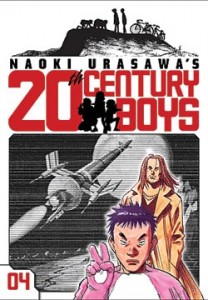
20thcentury4From the very first pages of volume one, Urasawa demonstrates an uncommon ability to move back and forth in time, juxtaposing scenes from Kenji’s past with brief glimpses of the future. The success of these scenes is attributable, in part, to Urasawa’s superb draftsmanship, as he does a fine job of aging his characters from their long-limbed, baby-faced, ten-year-old selves into thirty-somethings weighed down by adult responsibilities.
The integrity of Urasawa’s characterizations also contribute to the success of these temporal leaps; his characters’ adult behavior jives with what we know about them from childhood flashbacks. Otcho, for example, was the club’s most worldly member, the kid who introduced his pals to rock-n-roll and gave them the lowdown on Woodstock; it’s not surprising to see him reincarnated as a long-haired thug-for-hire who despises authority. Ditto for Yanbo and Mabo, twins who terrorized Kenji and friends back in the day. When Yanbo and Mabo resurface in volume five, Urasawa gives them a more pleasing appearance and demeanor than we might have expected, luring us into a false sense that they’ve outgrown their bullying ways. Urasawa then slaps us on the wrist for not trusting our original assessment of the twins, uncorking a fiendish plot twist that’s in keeping with what we already knew about them.

Urasawa uses these flashbacks and flash-forwards to build a dense network of connections among his characters, gradually revealing how and why Kenji’s childhood fantasies are providing the blueprint for a real-life apocalyptic scenario. Heroes and Lost attempted to do the same thing, but neither show succeeded in convincing us that those connections were lying just below the surface waiting for us to discover them; those connections had an arbitrary, bolt-from-the-blue quality. With 20th Century Boys, however, Urasawa makes us feel that we might have unearthed these links without any editorial guidance, as even the most surprising developments still make sense within the story’s elaborate framework.

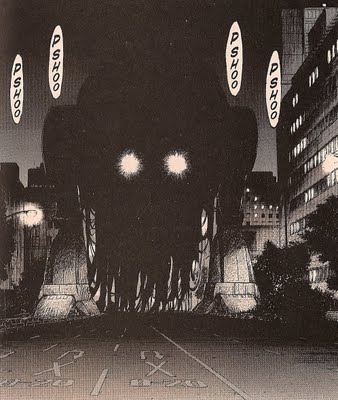
What gives the story its sense of urgency is Urasawa’s ability to create and sustain a strong sense of fear and anticipation. Six volumes into 20th Century Boys, we’ve had a few tantalizing glimpses of the robot that menaces Tokyo on the eve of the millennium, but we still don’t know what it looks like or what it can do. Urasawa has only shown us the enemy in silhouette:

20thcentury_robot

It’s a point I’ve raised in other reviews: an unseen menace is much scarier than one that’s routinely trotted out of the shadows to spook us. Consider the difference between Jaws and its sequels. In the original, Steven Spielberg hinted at the shark’s presence, showing us a dorsal fin or a dark outline moving rapidly beneath the water’s surface, but withholding the “money” shot (“tooth” shot, perhaps?) until the third reel. The few times that we see Jaws attack are genuinely scary because they finally put us face-to-face with those terrible teeth and dead eyes, confirming just how deadly the shark really is. In the sequels, however, the shark is featured prominently; we see it dine on boaters and swimmers in lurid detail. We may marvel at the stupidity of the shark’s victims, or feel disgusted by the gallons of fake blood, but we never feel scared, as we know what we’re up against from the very first scenes.

Urasawa takes a page from Spielberg’s book, showing us just enough of the robot’s form to engage our imagination. The robot’s silhouette hints at its size and strength; if anything, it looks like an enormous man-o-war lumbering through Tokyo. But what stays with us are those fierce, penetrating headlights, so evocative of a prison searchlight or a pair of eyes. As David Ford observes at Are You a Serious Comic Book Reader?, we feel a palpable sense of despair when we see the robot: how can Kenji hope to escape its all-seeing gaze? (By the way, I highly encourage you to read Ford’s essay, though spoiler-phobes should stay away until they’ve finished volume five.)

With more than ten volumes left in 20th Century Boys, I have no idea how Urasawa plans to tie all of the stories’ threads together. I’m confident, however, that he’ll do so with the skill of a master weaver, seamlessly incorporating all of the relationships, plot twists, and motives into an intricate, beautiful tapestry.

Review copies provided by VIZ Media, LLC. Volume seven will be released on February 10, 2010.

20TH CENTURY BOYS, VOLS. 1-6 • BY NAOKI URASAWA • VIZ • RATING: OLDER TEEN (16+)

Filed Under: Manga, Manga Critic, REVIEWS Tagged With: Naoki Urasawa, Sci-Fi, Thriller, VIZ, VIZ Signature

Gaudy Night by Dorothy L. Sayers: A+

January 9, 2010 by Michelle Smith

gaudynightFrom the back cover:
When Harriet Vane attends her Oxford reunion, known as the “Gaudy,” the prim academic setting is haunted by a rash of bizarre pranks: scrawled obscenities, burnt effigies, and poison-pen letters—including one that says, “Ask your boyfriend with the title if he likes arsenic in his soup.” Some of the notes threaten murder; all are perfectly ghastly; yet in spite of their scurrilous nature, all are perfectly worded. And Harriet finds herself ensnared in a nightmare of romance and terror, with only the tiniest shreds of clues to challenge her powers of detection, and those of her paramour, Lord Peter Wimsey.

Review:
I’m trying to recall precisely when I first heard of Gaudy Night. It must’ve been somewhere around 2001 or 2002, because my first attempt to read the Wimsey series (I couldn’t just jump straight to the penultimate novel, after all!) occurred early in 2002. In any case, here is a book I’ve been waiting to read for at least eight years and, unlike so much else in life, it completely lived up to (and even exceeded) my expectations.

Because I blindly accepted the accounts of this book’s excellence, I didn’t read much about it before its time came. Therefore, it was an exceedingly pleasant surprise that the narrative is told from the point of view of Harriet Vane, a mystery novelist and long-time object of Wimsey’s affections. After discovering a couple of disturbing messages when attending her Oxford reunion, Harriet is later called back to the college to conduct a discreet investigation. While investigating the origins of poison-pen letters, foiling pranks, and settling into the academic life once more, Harriet also engages in many conversations with the members of the Senior Common Room on the virtues of a life devoted to scholarship as opposed to the traditional womanly duties, and uses the experience of her former schoolmates to help form conclusions about whether marriage is worth it. The overall message is an unapologetically feminist one, though some characters do persist in advocating for stereotypical gender roles.

Of course, this isn’t the first book to present Harriet’s point of view. Have His Carcase is similar, but it’s more breezy and amusing. This time, it feels like we really get to know Harriet inside and out and understand exactly what it is that keeps her from accepting Peter’s marriage proposals: her belief that she has so thoroughly messed up attempts at love (Peter first meets her in Strong Poison when she is on trial for killing her lover) that she had better give up, and, most strongly, the pesky feelings of gratitude toward Peter that would forever keep them on unequal footing. As fond as she is of Peter, she can’t really believe he would be happy with her or treat her as an equal, and it’s in this novel that he finally, finally manages to convince her that both are true.

Eventually, Harriet reaches a point in the case where it’s necessary to call for Peter’s assistance and it’s here that she begins to compare the kind of marriage he would offer as opposed to the variety more normally encountered. For example, Peter doesn’t want a sweet, uncritical, and dependent spouse: he wants an honest and independent one. “Anybody can have the harmony,” he says, giving voice to a lovely musical metaphor, “if they will leave us the counterpoint.” It takes a little bit for this to sink in, however. Instead of trying to dissuade Harriet from continuing the investigation when her life is in jeopardy, for example, Peter teaches her self-defense moves. He basically encourages all the independence she could ask for and more, giving her the freedom to risk the life she still believes she owes to him. Lastly, he reveals more of his own weaknesses, showing that he’s flawed and human, too. At last she realizes that he truly means to accept her as she is and when Peter proposes one last time, she accepts.

While the disturbances on campus and Harriet’s investigation are truly fascinating—I’m thinking particularly of the fabulous scene where the culprit is dashing about removing fuses from all of the buildings and casting everyone into darkness—it really is the relationship between these two that shines most brightly. In terms of intelligence and independence, Harriet and Peter perhaps the closest thing 20th century literature has to a couple like Elizabeth Bennet and Fitzwilliam Darcy. Without them, Gaudy Night would’ve earned a solid A, which is nothing to sneer at.

Reiterating that Gaudy Night is highly recommended is unnecessary at this point, but I do advise reading at least the Wimsey novels that have been linked to here before tackling it so as to have a better idea as to the origins of Harriet and Peter’s relationship and how they’ve circled around one another for the last five years. That’ll make the novel’s conclusion all the more satisfying.

Filed Under: Books, Mystery Tagged With: Dorothy L. Sayers

Love Skit

January 6, 2010 by MJ 2 Comments

Love Skit
By Rie Honjoh
Published by 801 Media

love skit
Buy This Book

At eighteen years old, Aoto has had more than his share of tragedy. Orphaned in his youth, he’s dedicated himself to taking care of his older sister, Ryouko. Though relief eventually arrives in the form of Ryouko’s fiancé, Takashi, it brings along with it a new set of troubles, as Aoto quickly realizes he’s fallen in love with his new brother-in-law. Now, after his sister’s death, Aoto is left alone with Takashi, experiencing both grief and guilt over his own feelings. Then enters Masayuki, an old classmate of Takashi’s who is smitten with Aoto and determined not to let him pine after his dead sister’s husband for the rest of his life.

I’d anticipated this release quite enthusiastically, based on the emotionally affecting trailer offered up on YouTube by 801 Media, and at the outset it indeed seemed to have all the elements required to make up a rather touching (if conventional) boys’ love story. Unfortunately there are also several moves taken from the Creepy Yaoi Playbook, preventing the story’s early promise from quite following through.

Though fourteen years his senior, Masayuki chases Aoto like a sex-obsessed teen, grabbing at him incessantly at the least appropriate times and forcing himself on Aoto the moment he receives the slightest reciprocation of his feelings. Finally able to release his apparently uncontrollable urges, Masayuki forges on, regardless of Aoto’s obvious physical and emotional discomfort, whispering sweet nothings like, “Don’t worry. It’ll be over soon. Come on,” while Aoto winces in pain.

… be still my heart?

The manga’s reliance on questionably consensual sex is honestly a real shame, as it is otherwise quite thoughtful, exploring the internal struggles of its three main characters with unexpected insight. Though its “gender doesn’t matter” theme stubbornly refuses to grant the characters a shred of gay identity, even this could pass as a minor quibble if the sexual politics were not so blatantly askew. Rie Honjoh’s art is expressive and even whimsical, giving the romantic scenes a sense of playfulness that is distinctly refreshing in a story of this kind. Though the volume’s primary tale is interrupted halfway through to make way for a short side story involving one of its supporting characters, it still manages to feel substantial, especially in terms of character development.

For those who can stomach the bedroom dynamics, Love Skit certainly has its charms. For less fervent fans of the genre, it is probably best left on the shelf.

Filed Under: BL BOOKRACK Tagged With: love skit, manga, yaoi/boys' love

Town of Evening Calm, Country of Cherry Blossoms

January 4, 2010 by Katherine Dacey

In The Idea of History, author R. G. Collingwood argues that nineteenth-century historians viewed their task in a different spirit than their predecessors. While previous generations of scholars treated history as a simple chain of events, the Romantics wanted to recreate the past through their writings. The Romantic historian, Collingwood explained, “entered sympathetically into the actions which he described; unlike the scientist who studied nature, he did not stand over the facts as mere objects for cognition; on the contrary, he threw himself into them and felt them imaginatively as experiences of his own.”

I found myself revisiting The Idea of History as I read Town of Evening Calm, Country of Cherry Blossoms, a project that might well have resonated with Collingwood’s pioneering nineteenth-century historians in its efforts to “enter sympathetically” into the lives of Hiroshima’s survivors, the hibakusha, a group both pitied and shunned by their fellow Japanese in the years following the 1945 bombing. In the introduction to Town of Evening Calm, manga-ka Fumiyo Kouno explains her approach to the subject in terms that are strikingly similar to Collingwood’s:

I always thought all I needed to know about the bomb was that it was a terrifying thing that happened once upon a time, and a subject best avoided. After living in Tokyo for a while, however, I came to realize that people outside of Hiroshima and Nagasaki didn’t really know all that much about the ravages of the atomic bomb. Unlike me, they weren’t avoiding the subject—they never had the opportunity to learn about it even if they wanted to… I hadn’t experienced the war or the bomb first-hand, but I could still draw on the words of a different time and place to reflect on peace and express my thoughts.

Kouno’s decision to focus on the hibakusha and their descendants makes Town of Evening Calm an immediate, accessible work, one less concerned with recreating a specific historical moment than in imagining what it would be like to rebuild one’s life in the aftermath of that event. It’s a wise strategy, I think, given how difficult it is to convey the horror of war without relying on dramatic devices that can trivialize survivors’ experiences.

Kouno’s approach is not without pitfalls, however. In her review of Town of Evening Calm, Country of Cherry Blossoms, Casey Brienza argues that Kouno portrays her characters as victims of American aggression without acknowledging Japan’s role in precipitating the bombing, a tactic that could be interpreted as a “myopic… preoccupation with [Japan’s] wartime suffering” that “allow[s] the Japanese to forget that they started the war.” At the end of the first story, for example, a woman dying of radiation sickness wonders “if the people who dropped the bomb are pleased with themselves: ‘Yes! Got another one!'” It’s a powerful moment; the character’s comment is shocking in its raw honesty, especially for American readers. It’s an ambiguous moment, too; one could certainly read a note of national self-pity into the character’s words, as she never mentions the war itself, only the suffering caused by the bomb. Yet I think this passage invites a second reading as well, as a very human attempt to make sense of tragedy, to express the character’s understandable need to know why she — a civilian — was subjected to such unimaginable horror, rather than a denial of the suffering caused by the Japanese occupation of Korea, Manchuria, and the Philippines.

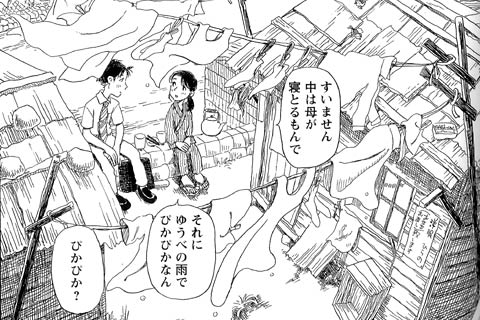
In less skillful hands, scenes like these might be mawkish, but Kouno crafts an emotionally authentic story from survivor narratives, deftly moving between present and past to show us how her characters hear the echoes of August 6th in their everyday lives. The first story, “Town of Evening Calm,” focuses on Minami, a young seamstress living in Hiroshima ten years after the atomic blast. Superficially, the city seems to be healing: its downtown is bustling with activity, as is the dressmaker’s shop where Minami works. Yet subtle signs of the devastation remain, from the ramshackle houses of the residential district to the scarcity of everyday goods. (In a particularly effective scene, we see Minami walk home barefoot so as to preserve her only pair of shoes.) Minami herself bears psychic wounds from the day, as is evident in her brusque demeanor with outsiders and her staunch refusal to leave her ailing mother’s side. Underneath her bravado, we see a fearful, guilt-ridden young woman who wonders when she will succumb to the long-term effects of the radiation, who cannot escape her horrifying memories, and who mourns the disintegration of her family. (Her father and sister perished in the blast; her brother was sent to live in Mito, and had yet to return to Hiroshima.)

town_interior1

The second story, “Country of Cherry Blossoms,” takes place nearly twenty years later in Tokyo. We first meet Nanami, a baseball-addled tomboy, as an eleven-year-old girl. Through a few telling details–Nanami’s dirty baseball uniform, Nanami’s interactions with classmates–we see that she suffers acutely from her mother’s absence. (Her mother, a hibakusha, succumbed to cancer.) Lacking a female role model, she latches onto Toko, a classmate who epitomizes girly grace. Kouno depicts a few ordinary moments from this odd pair’s childhood: a playground discussion of a homework assignment, a baseball game, a trip to the hospital where Nagio, Nanami’s younger brother, is hospitalized with severe asthma.

We then jump forward seventeen years. Nanami and Toko are estranged; Nagio, now healthy, is training to be a doctor; and Asahi, their elderly father, has been behaving oddly. Fearful that Asahi is losing his faculties, Nanami tails him through the streets of Tokyo, where she bumps into Toko. Their initial conversation is awkward and forced; seeing Toko dredges up some of Nanami’s most painful childhood memories. Toko, undeterred by Nanami’s rudeness, furnishes Nanami with a disguise, and the two set off for Hiroshima, where Asahi seems intent on completing a mysterious errand. As Nanami and Toko follow Asahi, we realize that Asahi is the link between the first and second stories; he is Minami’s “lost” brother, the one who was living with relatives when the Americans bombed Hiroshima, returning only after the death of his sister in 1955.

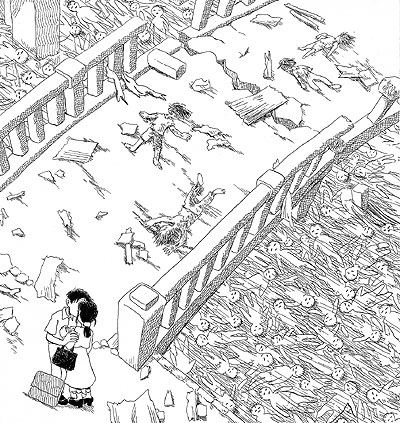
Kouno’s meticulously detailed illustrations create a strong sense of place, underscoring the contrast between Hiroshima’s orderly new business district and the crowded Aioi Doori neighborhood where the hibakusha live. In the few panels alluding to the actual events of August 6, 1945, Kouno’s art becomes more primitive and stylized, suggesting the horrific effects of the blast by depicting the victims as stick figures with swollen faces. The child-like simplicity and directness of these images are startling yet effective, a reminder both of Minami’s youth at the time of the attack and of the radiation’s devastating ability to rob its victims of their identities by destroying their hair, hands, and faces — in short, the very parts of their bodies that give them their individual appearance. These scenes are notable as well for the skillful way in which present and past co-exist within the same panels; we see the landscape as Minami does, alive with vivid, horrific memories of surviving the blast.

town_interior2

Kouno’s character designs exhibit a similar attention to detail and mood as her landscapes. Nanami, for example, bears a striking resemblance to her aunt Minami, not just in her behavior (Minami shared Nanami’s love of baseball and her brusque demeanor) but also in her facial expressions and carriage; she’s a subtle visual echo of the previous generation. Like all of Kouno’s characters, Nanami and Minami have a slightly rough, clumsy quality to them, with heads and hands that seem just a little too big for their wiry bodies. Yet these awkward proportions don’t detract from the beauty of the work; if anything, the illustrations make Kouno’s characters seem more vulnerable, more imperfect, more fragile—in short, more human and more believable. And that honest vulnerability, in turn, makes it possible for readers from all walks of life to enter sympathetically into Kouno’s haunting yet life-affirming story, to look past the politics of suffering and representation to understand the price that civilians pay in every war.

This is a revised version of a review posted at PopCultureShock on March 23, 2007. Click here for the original text; click here for a Japanese translation of the original review.

Filed Under: Manga, Manga Critic, REVIEWS Tagged With: Fumiyo Kōno, Hiroshima, Historical Drama, Last Gasp

Tactics, Vol. 8

January 4, 2010 by MJ Leave a Comment

tactics8By Sakura Kinoshita and Kazuko Higashiyama
TOKYOPOP, 192 pp.
Rating: Teen (13+)

This volume opens with the conclusion to Kantarou’s latest conflict with Raikou Minamoto and his underlings. Haruka arrives to save the day (and to reassure Kantarou of his loyalty) but though Minamoto’s immediate plans are destroyed, the fight ultimately ends in a draw. Things are looking up for Kantarou, however, as Haruka makes a promise to one day tell him about his past. The story then takes a break to make way for a string of short “Bedtime Stories” featuring the series’ regular characters, which provide filler for the latter two-thirds of the volume.

Though the volume starts strong, thanks to the underlying tension between Kantarou and Haruka, it quickly falls apart with the introduction of its short story series, “Record of One Hundred Goblins.” With a single exception, these shorts provide neither humor nor substance sufficient to hold readers’ attention. Fortunately, the volume’s final story, “Otoshi,” about an artist whose ability to paint youkai (supernatural creatures) has mysteriously failed him, has enough strength of its own to turn things around. Focusing on relationships between humans and youkai, this story provides one of the most poignant moments of the series so far, rescuing the volume from its flat middle chapters. “… How precious an ‘existence’ is to youkai,” muses Kantarou, having finally returned the artist’s ability to him. “… That’s why I use my writing to make them immortal and [the artist] uses his art to pass on to future generations.”

Despite its uneven storytelling and tone, the eighth volume of Tactics manages its way out of complete destruction with a healthy dose of true feeling.

Review copy provided by the publisher. Review originally published at PopCultureShock.

Filed Under: REVIEWS Tagged With: manga, tactics

Manhwa Monday: A New Year!

January 4, 2010 by MJ 28 Comments

goong1Happy New Year, Manhwa Monday readers!

Last week at Manga Bookshelf, I invited some friends to help me build a list of our Favorite Manhwa of 2009. Now, to start the year off right, I’m giving away one copy of the first volume of the most popular manhwa on that list, Goong: The Royal Palace. If you’ve not yet been bitten by the manhwa bug, or if you just haven’t gotten around to this addictive girls’ manhwa from Yen Press, here’s your chance!

Just leave a comment to this entry and you’ll automatically be entered in the drawing! You may also enter by sending an e-mail to mj@mangabookshelf.com with the subject line: “Goong.” The winner will be announced in next week’s column. Note: You must be age 13 or older to enter.…

Read More

Filed Under: Manhwa Bookshelf Tagged With: manhwa, Manhwa Bookshelf

Ludwig II, Vols. 1-2

January 2, 2010 by MJ 5 Comments

ludwig2Ludwig II, Vols. 1-2
By You Higuri
Published by Digital Manga Publishing
Rating: 18+ (Mature)

Repulsed by affairs of the state and obsessed with the beauty of the arts, young King Ludwig II of Bavaria would much rather attend the opera than discuss his country’s vulnerability to power-hungry Prussia. As his ministers struggle to turn his focus to politics, Ludwig seeks the company of kindred spirits, particularly attractive young men whom he also desires as sexual partners.

With his greatest love apparently unrequited (that for notoriously decadent composer Richard Wagner, who uses Ludwig’s patronage to conceal his affair with a married woman) and his effusive relationship with Prince Paul of Thurn and Taxis nearing its end, Ludwig becomes infatuated with his new stable boy, an attractive young blond named Richard Hornig, whom he soon appoints as his personal manservant. Despite numerous obstacles, including a criminal plot hatched by Hornig’s brother and Ludwig’s brief engagement to his devoted cousin, Sophie, their mutual love grows, threatened only by political enemies and Ludwig’s increasingly frequent hallucinations.

As a matter of historical fact, King Ludwig II’s tragic and unexplained death can hardly be treated as a spoiler, a point wisely taken by mangaka You Higuri, who uses the event to open the series while also introducing Ludwig’s cousin Elizabeth (Empress of Austria), with whom he shared an exceptionally close relationship. Elizabeth, whose restless spirit earned her the name “The Wandering Queen,” begins as narrator and is portrayed throughout the story as the only person capable of truly understanding her cousin, doomed (as he is) to a fretful life as penance for the sin of dreaming. Higuri also makes good use of Ludwig’s well-known obsession with Wagner and his controversial legacy as “The Mad King,” by giving him recurring visions of a beautiful male “Valkyrie” (mythical Norse maidens who act as angels of death, portrayed extensively in Wagner’s opera Die Walküre) who draws him slowly into darkness and away from Hornig.

Though early on, Higuri tosses in a half-hearted reference to Ludwig’s lifelong struggle with religion and sexuality (as documented in his diaries), Ludwig’s imaginary Valkyrie is given most of the dirty work when it comes to tearing him away from his One True Love, Hornig, as well as the task of explaining his death. That Higuri’s story is highly fictionalized is not only obvious but intentional, yet it is its historical foundation that gives it much of its resonance, so much so that it’s tempting to wish she had gone just a bit further.

Higuri has set up a very attractive tragedy—its beautiful lovers doomed by circumstance, position, and mental instability. This premise, as stated, is perfectly primed for romantic fantasy and certainly a staple of the genre. What’s a bit sad is that the demands of boys’ love must take precedence over the opportunity to illustrate Ludwig’s true tragedy—one better told by historians and biographers. Much more heartbreaking than a tale of star-crossed lovers is that of a sensitive and artistically inclined young man, shackled by position and ruined by wealth, tortured by the impossibility of reconciling his deeply ingrained religious beliefs with the reality of his own sexuality, and doomed to lose lover after lover to disenchantment or, worse, matrimony.

Not only does Higuri romanticize Ludwig’s famously mysterious end, she also carefully leaves out his pain over Hornig’s real-life marriage, which took place years before. Though the true tale, of course, fails to provide the stuff of romantic fantasy, it reveals far more poignant truths about life as a gay monarch in the nineteenth century.

Even the New York Times, in their 1886 obituary, described Ludwig as a man born “too soon or too late”—a reclusive lover of the arts burdened with the weight of deep feeling, and ill-suited to an environment of politics and war. That Ludwig’s loneliness is palpable, even in the coldest historical accounts, is painfully revealing and unfortunately far removed from the world of boys’ love manga, as is his eventual decline into obesity. Given Ludwig’s aesthetic tastes, it is likely that Higuri’s ending for him—young, beautiful, and adored even in his final moments—would better satisfy his sensibilities than the one he came to himself.

One aspect of Ludwig’s personality that Higuri captures quite well is his devotion to his own fantasies—bestowing lavish gifts on those who pleased him and pouring his personal fortune into the construction of a series of elaborate castles—something that caused strife amongst his ministers but inspired considerable loyalty in the Bavarian people. It is Ludwig’s increasing retreat into fantasy that Higuri uses to justify his romantic and beautiful demise, something Ludwig himself would no doubt have appreciated.

Historical inaccuracies aside, Higuri’s tale is undeniably engaging and honestly romantic, despite her tendency to sentimentalize some disturbingly imbalanced bedroom dynamics which, granted, may not be far removed from class-based sexual politics of the day. The series’ detailed artwork and lush, period setting provide a feast for the eyes as well, with special attention given to the emotional tone of each scene. Ludwig’s inner world is especially well established, both visually and otherwise, and Higuri’s ability to portray him equally well in ecstasy as in despair gives him the range necessary to rise above the melodrama as a genuinely poignant character.

With just enough fact behind the fiction, Ludwig II manages to be more than a stylish costume piece, and if it inspires yearning for a deeper look at history, this can hardly be a bad thing. Succinct yet satisfying in two double-sized volumes, this series provides enough substance to please even casual fans of the genre.

Review copies provided by the publisher. Review originally published at PopCultureShock.

Filed Under: BL BOOKRACK Tagged With: ludwig II, manga, yaoi/boys' love

Love*Com, Volume 14

January 1, 2010 by Deanna Gauthier 2 Comments

Guest Review: Love*Com, Vol. 14
By Aya Nakahara
Published by VIZ Media

Review by Deanna Gauthier

love*com14
Buy This Book

In this volume, Risa and Otani’s relationship is once again under attack. To Risa’s horror, her own grandfather has hired a woman to seduce Otani and break them up. Even worse, Otani believes the sob story he’s been given by the beautiful, buxom Hitomi and accuses Risa of lying to him about her grandfather’s scheme. When the truth comes out will it matter who was wrong and who was right now that a jealous and conniving Hitomi has tricked Risa and left her at the mercy of two yakuza thugs?

This is a romantic comedy so of course a plotline like this will never end as tragically as it could. Still, it is the darkest plotline (and Hitomi, the character with the blackest heart) to appear in Love* Com. Being the gullible reader I am, I believed Risa was in real danger. The threat of rape just doesn’t sit right with me as fodder for comedic misunderstanding. Love*Com has always delivered liberal doses of fluffy silliness along with angst as Risa and Otani discover what they mean to each other and learn what it means to like someone, let alone be in love with them. The mangaka, Aya Nakara, has characterized her manga as intended to bring a smile to the faces of her readers and give them even a moment of enjoyment in their lives. In that regard she has always delivered in spades. I found plenty to laugh about in this volume as I have in the volumes that preceded it–not to mention warm and fuzzy moments to make me smile. Risa and Otani are such innocent and awkward leads–two loveable stumbling idiots who are absolutely made for each other. I do not mean to pick on Nakahara too much for this storyline. It just struck me as too serious and dark a dilemma for an otherwise non-threatening shojo romantic comedy.

Speaking of non-threatening, this volume marks the return of the clownishly-drawn, not-too-bright punks who Risa’s brother nearly came to blows with in the previous volume. Nakahara’s artwork is strongest when it comes to facial expression, especially the eyes. Yet the facial features of her yakuza are drawn with very thin lines and no shading, reducing them almost to doodles that look like they don’t quite belong in the same universe as our main characters. I don’t particularly like the design and execution of the yakuza characters. It feels sloppy in comparison to how beautiful (or at least human) the rest of her characters look most of the time. However, I do feel Nakahara successfully uses this same technique of reducing the facial features of the rest of her cast to thin lines that stretch or contort into odd shapes to comically express certain emotions more strongly. It’s funny, but it’s only just now, fourteen volumes into the series, that it occurs to me: Nakahara uses this instead of drawing chibis!

I really am enjoying this series. It has given me reason to smile when I have really needed it during the dreary fall and winter days, and it holds up well to re-reads. It is definitely one for my keeper shelf. I look forward to the final three volumes!

Review copy provided by the publisher.

Filed Under: REVIEWS Tagged With: love*com, manga

Memories of the Future 1 by Wil Wheaton: B

January 1, 2010 by Michelle Smith

memfuture1From the back cover:
The away team returns from the planet with some very good news: it’s clean, it’s beautiful, it’s populated with friendly humanoids… and they really like to do the nasty.

“At the drop of a hat,” according to Geordi.

“Any hat,” Tasha says knowingly.

Picard sends a second, larger team down to the planet to see exactly how many hats they’re going to need.

From “Encounter at Farpoint” to “Datalore,” relive the first half of Star Trek: The Next Generation‘s unintentionally hilarious first season through the eyes, ears, and memories of cast member and fan, Wil Wheaton (Wesley Crusher) as he shares his unique perspective in the episode guide you didn’t even know you were dying to read.

Review:
I came a little late to Star Trek: The Next Generation. I don’t come from a family of Trekkies and didn’t know anyone who watched the original show, so I was not glued to my set for TNG‘s 1987 debut (like I’d later be for Deep Space Nine‘s). Instead, I got into it in 1992, when my brother was watching the episodes in syndication every afternoon and hanging TNG action figures (still in the package, of course) on his walls. I began watching with him and was soon hooked, acquiring Larry Nemecek’s The Star Trek: The Next Generation Companion so that I could read all about the making of the episodes and keep track of the ones I’d seen. (Side note: I still haven’t seen 1.5 of them, but I kind of like it that way. It makes it seem like it’s not quite over.)

Although I eventually came to prefer DS9, TNG still holds a place in my heart. Like many people, I never did much care for the character of Wesley Crusher, but when I spotted Wil Wheaton’s episode reviews on TV Squad, I did read a few of them. In his introduction to Memories of the Future, Wheaton explains how the site lost a chunk of its funding and, therefore, the ability to pay him, but that he wanted to at least complete reviews for the first season, and so this book was born.

If you’re looking for a tawdry tell-all book, you’re not going to find it here. Wheaton doesn’t talk specifically about his castmates much, but when he does, he has nothing but positive things to say about them. Instead, his vitriol is reserved for the writers; he critiques the way various characters are written (Wesley, primarily, but also Worf and Troi, who are particularly one-dimensional during the first season) and points out many logic flaws and other problems with episode construction. I found his arguments to be compelling—especially how, contrary to many fans’ beliefs, Wheaton himself was in no way responsible for Wesley’s tendencies to save the day and be smug about it—and insightful.

There’s a chapter for each episode including a synopsis, quotable dialogue, obligatory technobabble, behind-the-scenes memory, bottom line, and final grade. The synopses are very snarky, though occasionally he’ll break from that mold to praise a particularly nice piece of acting. Many, many pop culture references abound—Strong Bad, Pulp Fiction, Animal Farm, et cetera—which is okay when I get them but rather annoying when I don’t. I have a feeling I was supposed to find some of the snark funny, but I never did, though I think there was a pretty clever/esoteric shabu shabu joke in there.

Memories of the Future is published by Monolith Press, which was founded by Wheaton “on the idea that publication should not be limited by opportunity.” I’m not sure, therefore, whether anyone else ever read and edited the book before its release. There are a few instances where an incorrect but not misspelled word is used—“marshal arts” or “when Picard apologies or something”—and a lot of inconsistency in the treatment of words that come after colons (don’t capitalize them unless they’re proper nouns!). Also, the header for each episode is accompanied by some grey bars with a lot of random numbers on them. I could never figure out whether they have any significance; perhaps they’re supposed to look like an Enterprise computer display or something? In any case, some tighter editorial controls would’ve provided a bit more polish.

(Update: After realizing that the numbers never go above 26, I tried my hand at cryptanalysis. All I could figure out is that the letters for the Introduction spell “Wesley.” Beyond that, it’s either gibberish or a code too complex for a lazy person like me to bother with.)

Ultimately, while I had some complaints I still wished I had volume two immediately on hand after finishing this one and I wish, too, that Wheaton will continue beyond the first season. While he is occasionally (and rightly) critical of some aspects of the show, his perspective is undeniably interesting and, above all, affectionate.

Additional reviews of the first volume of Memories of the Future can be found at Triple Take.

Filed Under: Books Tagged With: Star Trek: The Next Generation

Vampire Knight, Volume 8

December 30, 2009 by Megan M. 2 Comments

Guest Review: Vampire Knight, Vol. 8
By Matsuri Hino
Published by Viz Media

Review by Megan M.

vampireknight8
Buy This Book

Cross Academy is divided into two groups of students: the Day Class, made up of seemingly normal high school students, and the Night Class, whose members are actually vampires. Protecting the human students from the vampires are Yuki Cross (the headmaster’s foster daughter) and her childhood friend, Zero Kiryu. Yuki has always had a strange relationship with the head of the Night Class, Kaname, on whom she must rely to explain the mysteries of her past. Fortunately for Yuki, circumstances have reached a point where Kaname has no other choice but to do so.

I read the first three volumes of this series when they first came out in the U.S., but eventually dropped it. While I found the main plotline interesting and liked Yuki and Zero, I found Kaname to be extremely creepy and his relationship with Yuki even more so. The real deal breaker for me, however, was that the entire cast (excepting Zero) behaved as if Yuki was one of Kaname’s personal possessions. Having now read this volume, there is virtually nothing I can say on this topic that would not be considered a major spoiler, but suffice it to say that the story itself now appears to support this view of Yuki. Not only has Kaname been firmly established as a love interest, but we also learn that Yuki was literally created purely for the purpose of being Kaname’s bride. There are other plot elements that briefly appear–the mythology of the vampire hunters and the dangers of twin hunters, for instance–but these items are clearly secondary.

In addition to giving life to the creepiest implications of the story’s core premise, the overall quality of the series seems to have declined. In early volumes, I recall that Yuki had quite a bit to do. In this volume, she literally does nothing but run around in a nightgown. In addition, Zero does nothing but point his gun and angst. Only Kaname has anything of real substance on his plate, which unfortunately consists of obsessing over Yuki and seeking revenge. Had I not read previous volumes, I would wonder if Hino’s characters were capable of anything but angst (alternately tragic and angry), aside from some supporting characters, whose range extends to ominous, mysterious, and tragic.

The series’ art has also suffered a serious decline. In the past, I’ve found Matsuri Hino’s art to be too cluttered for my taste–more focused on looking pretty than storytelling–but her designs and backgrounds were interesting and appealing, and her art very detailed. Unfortunately, she has degenerated to substituting backgrounds with white space or hazy textures and her characters have become so generic that they are difficult to tell apart except by hairstyle.

I decided to give Vampire Knight another try thanks to a growing fondness for other gothic shojo titles over the last two years. Unfortunately, whatever it is that CLAMP, Higuri You and Kaori Yuki have, Matsuri Hino doesn’t.

Review copy provided by the publisher.

Filed Under: REVIEWS Tagged With: manga, vampire knight

  • « Go to Previous Page
  • Page 1
  • Interim pages omitted …
  • Page 489
  • Page 490
  • Page 491
  • Page 492
  • Page 493
  • Interim pages omitted …
  • Page 541
  • Go to Next Page »
 | Log in
Copyright © 2010 Manga Bookshelf | Powered by WordPress & the Genesis Framework