MICHELLE: Welcome to a brand-new Feature here at Soliloquy in Blue: Let’s Get Visual! Each month, Manga Bookshelf‘s MJ and I will select a page or sequence of pages from our recent manga reads that we find intriguing and attempt to develop our visual-critiquing muscles by sharing our thoughts about it. Neither of us is particularly adept at this, but it’s our hope that by a little regular exercise, we’ll get better.
MJ: Should we talk a little about why we each decided to do this?
MICHELLE: Personally, I’ve always felt that my attempts to discuss comic or manga art have been desultory at best. Usually, they take the form of an afterthought paragraph tacked at the end of the review after I’ve said everything I have to say about the plot and characters. I’ve read a few things about pacing and paneling online and, in general, would simply like to be stronger in this area and train myself to think more about it while I read.
MJ: I think my motivation is very similar. I know what works for me as a reader and I can even take a stab at expressing why, but I don’t really have the vocabulary necessary for discussing the visual aspects of comics, despite my love for them. I’m hoping I’ll get some help with that from the folks who read this column, and that it might give me a greater understanding of this medium that I spend so much of my time thinking and talking about.
MICHELLE: Yes, I’m hoping we’ll get some (hopefully benevolent) guidance, too! With that, shall we get started?
MJ: Yes, let’s!
MICHELLE: For our first attempt, we’ve started simply; I’ve picked one page from volume three of Rei Hiroe’s Black Lagoon while MJhas chosen a sequence of pages from the game-changing fifteenth volume of Yumi Hotta and Takeshi Obata’s Hikaru no Go. All images can be enlarged by clicking on them.
Black Lagoon, Volume 3, Chapter 17, Page 112 (VIZ Media)
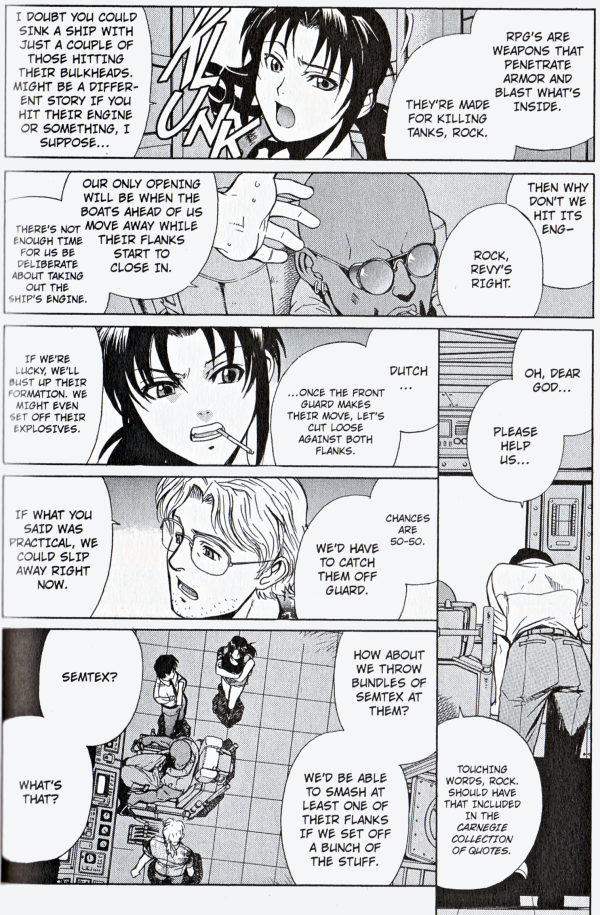
MICHELLE: A little background information is required to explain why I found this page from Black Lagoon so interesting. The protagonists of this series are the Lagoon Traders, operating in the waters of South Asia. They routinely accept dangerous jobs, but the one they’re currently on—attempting to deliver detailed Hezbollah plans to a CIA agent—is more fraught with peril than most. They’re being pursued by a number of other vessels and their chances of getting away are slim.
The basic layout of this page—two long horizontal pages on top, one long vertical column on the far right, then some shorter panels on the bottom left—is one that Hiroe has used a few times in the series so far. What struck me in this particular instance is how the flow of the panels directs one’s eye, and how that direction mirrors the characters’ spirits.
In that vertical panel in the bottom right, Rock is dejected. He has finally acknowledged that they’re doomed, and the trailing bottom edge of that panel and placement of Dutch’s dialogue bubble pulls our eyes just about as low as they can go, just like Rock’s hopes. But then Revy has an idea, and our eyes locate her halfway up the page, like a cautious rebound of hope. The rest of the page involves the whole team expanding upon her plan, including the mention of the explosives that will be their ticket to escape.
This may look like a very simple page, but its execution is nothing short of elegant.
MJ: Oh, that is nicely done! I’ll make a comparison here using a medium I do have the vocabulary to discuss intelligently. Your observation here reminds me of something I frequently talk about with my voice students (I used to be a singer, and I still teach) regarding various composers’ level of skill in writing for singers. The best composers tell you everything you need to know about what you should be feeling in any particular moment—whether you’re singing opera, art song, musical theater, whatever—using music only. Pitch, rhythm, dynamics–everything is there if you just pay enough attention, and as long as you use those tools given to you, your audience will understand, whether they speak the language you’re singing in or not.
This visual language reminds me very much of that, and I feel like even if we were looking at this in Japanese, though we’d certainly lack specifics, we’d still comprehend the emotional trajectory of the story here.
MICHELLE: That’s a very apt comparison. Rock’s body language being so easy to read helps, too.
MJ: So, what else do you like about this? I was wondering if you had particular thoughts about the final panel, which suddenly zooms high above them.
MICHELLE: I think this is meant to emphasize how much of a team solution it is. I also love that although the original suggestion about the Semtex does not have a tag on it to designate the speaker, the way everyone else is turned toward Revy suggests that she was the one who spoke.
MJ: Oh, you’re much smarter than I am, though I did have a thought as well. I was thinking about what you said in your original paragraph about the rest of the panels being about the whole team expanding on Revy’s idea, and I thought “expand” was just the word I’d use to describe that final panel. Most of the rest of the page is made up of close-ups, and then that one just zooms way out, suddenly lending a real sense of space.
MICHELLE: Ooh, that’s a very clever point! Go you! Anyway, that’s all I’ve got this time. Why don’t you tell us about the pages you chose?
Hikaru no Go, Volume 15, Chapter 124, Pages 74-77 (VIZ Media)


MJ: Okay, so I’m not even going to introduce these pages, because part of what I think is so brilliant about them is that I don’t have to.
So, you’ve got Hikaru, who is obviously really tired, in that sort of raw way that can only really exist when you’re forcing yourself to be awake. His entire body expresses this, and he’s pretty much holding up his head with his hand. Someone’s talking to him (readers of the series will understand it to be Sai), but Hikaru’s so out of it, he’s not even really with him. Hikaru’s unmoving, frame after frame, in a kind of zone of nothingness.Then something happens at the bottom of the first page and *wham* the door behind Hikaru is sharp again, like the world has shifted from a half-dream state into the harsh light of day.
The real awakening, though, happens on the next page, when Obata widens the lens to make the empty space in the room the focus of panel. This is accented perfectly by the curtains blowing the breeze and the bright sun lighting up the room. Everything is set to evoke a feeling of wide, empty space in this tiny little room. I can almost hear the sounds of everyday life outside that might be wafting in to this quiet room through Hikaru’s open window.
My favorite touch, though, is the way this ends. That wide shot could have easily been the last image in the chapter, and probably it would have had even more impact if it had been. But rather than leave readers with the dramatic lack of Sai, the next two panels bring us back to the *presence* of Hikaru. He’s small, he’s bewildered, and he’s just been awakened in a really harsh way, but there’s a warmth and poignancy in those last two panels that reminds me why I love this series so much.
MICHELLE: There are two things in what you’ve said that really resonate with me. Firstly, I’m struck with the import of the door. I almost feel like I’m back in tenth grade, analyzing poetry, but now that you’ve mentioned its abrupt clarity, I’m convinced that there’s some pretty heavy symbolism behind that door being so conspicuously and firmly shut.
Also, I had the exact same reaction to the open window and billowing curtain—I felt like I could hear the sounds of everyday life carrying on even after something immense has happened. This reminds me of the scene in “The Body,” the fifth-season Buffy the Vampire Slayer episode in which Buffy comes home to find her mother dead on the couch. At one point she steps outside and there’s the world, carrying on as normal while she is going through something devastating.
Lastly, the one thing in that scene that draws my attention in a strange way is the reflection of the books on the floor opposite Hikaru. It’s such a small detail, yet it seems to emphasize the emptiness even more.
MJ: I actually thought of that scene from “The Body” when I was writing here, and I wondered if you’d bring it up! Yes, that’s exactly the kind of thing I mean. I love your observations about the door and the reflection of the books, too. I think you’re absolutely right on both counts.
MICHELLE: I can always be counted on to reference Buffy! It’s interesting that we both chose examples wherein someone has their back to the audience; it seems like that’s something that may not happen too often, though I’ll have to pay more attention from now on to see whether that’s really true. Why do you think Obata decided not to show Hikaru’s expression right away?
MJ: I think he didn’t need to. I think Hikaru and the reader are feeling the same thing in that moment, so illustrating it is totally unnecessary, and doing so might actually lessen the panel’s impact.
MICHELLE: I think so, too. It would place a limit on Hikaru’s comprehension of the situation, as well.
MJ: I also like the fact that when we do see Hikaru’s face in the next panel, it’s not straight-on. The vantage point and slight distance makes it clear that he’s still processing what’s in front of him (or not) . It also makes him appear small and vulnerable, but not in an overly cartoonish way. It’s perfect.
MICHELLE: I agree! Well, how do you think we did, our first time out? We might be a bit sore tomorrow, but it certainly felt good to stretch some little-used muscles.
MJ: I think we did all right… hopefully scoring relatively low on the scale for potential embarrassment. Heh. I’m really looking forward to seeing what kind of wisdom we might glean from our more knowledgeable readers!
MICHELLE: As am I. We look forward to your feedback, and hope that you’ll join us again next month for the next installment of Let’s Get Visual!


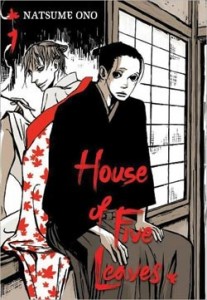 House of Five Leaves, too, focuses less on Big Events and more on everyday activity, but in Leaves, Ono’s restraint serves an important dramatic purpose: she’s showing us events through Masanosuke’s eyes, as he tries to reconcile the bandits’ seemingly ordinary lives with their extraordinary behavior. Making the reader‘s task more difficult is that Masanosuke isn’t very astute. He tends to focus on a kind gesture or a friendly conversation, missing many of the important aural and visual cues that might enable him to understand what’s happening — a trait that the group exploits. In one chapter, for example, Yaichi encourages Masanosuke to accept a job as a bodyguard for a merchant family while the group plans its next kidnapping. Masa befriends his new employer’s son, never realizing that his true assignment is to infiltrate the target’s household so that Yaichi’s minions can snatch the boy for ransom.
 – Kazuaki is a mild-mannered young salaryman in a passionless job whose world is turned upside-down when he (literally) runs into Kira, a successful porn actor, who is filming in a nearby park. Kira falls for Kazuaki in the moment, and though Kasuaki initially rejects his romantic advances, the two pursue a friendship that gradually turns to love.
 – I don’t always like the stories Digital Manga Publishing issues under their DokiDoki imprint (like, say, Millennium Prime Minister), but I usually do. That’s where less explicit boys’ love stories reside and, indeed, the title story of this collection, “Midnight Bloom,” fits the bill quite well.
 – When I reviewed Hiro Madarame’s Cute Devil back in May, I mentioned that while I liked her frequently cute (and amusing) art, I’d like to see what she could do with more sympathetic characters. Scarlet is actually her first comic but it ended up providing the answer.
 – Having been convicted of murdering his lover’s husband, Sen is sentenced for life to an underground prison buried in the depths of Long Island, nicknamed “Under Grand Hotel” by those who live there. It’s a rough introduction for Sen, who is beaten, raped with mop, and stuffed in a dryer by a child-molesting cannibal (no, really) all within the first 24 hours or so of his imprisonment.

 – As orphan Teru Kurebayashi’s older brother prepared to pass from this world, he gave her the gift of a cell phone–one which she could use to contact his mysterious friend “Daisy” who he promised would protect Teru in his absence.
 – This is an emotionally heavy volume for Rasetsu, who tries to get over her feelings for Yako at the same time as she’s confronted with new truths about Kuryu (and his feelings for her). Meanwhile, Yako faces some very old spirits who mistake him for the person he most needs to forget.
 – In this installment, Choko and Masayuki take their first overnight trip together, with the intention of finally consummating their relationship. Of course the weekend is crashed by a collection of family and friends, though the two eventually find some time alone to do the deed.
 – The plot thickens in this volume, as it is revealed that Soichiro’s plan for success revolves entirely around manipulating his friend, Nozomu, into falling in love with his new wife, Sumi. Meanwhile, Sumi’s brother has already frittered away the money she sacrificed herself for, leaving the kids in the care of a slovenly drunk.
 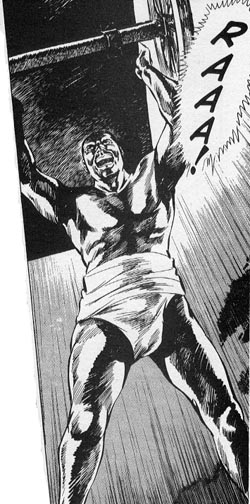 The bigger problem, however, is that King entertains notions of race, class, and gender that would have been as alien to American colonists as they were to Japanese farmers and overlords. His blind commitment to addressing inequality wherever he encounters it — on the road, at a brothel — leads him to do and say incredibly reckless things that require George’s boffo swordsmanship and insider knowledge of the culture to rectify. If anything, King’s idealism makes him seem simple-minded in comparison with George, who comes across as far more worldly, pragmatic, and clever. I’m guessing that Koike thought he’d created an honorable character in King without realizing the degree to which stereotypes, good and bad, informed the portrayal. In fairness to Koike, it’s a trap that’s ensnared plenty of American authors and screenwriters who ought to know that the saintly black character is as clichéd and potentially offensive a stereotype as the most craven fool in Uncle Tom’s Cabin. By relying on American popular entertainment for his information on slavery, however, Koike falls into the very same trap, inadvertently resurrecting some hoary racial and sexual tropes in the process.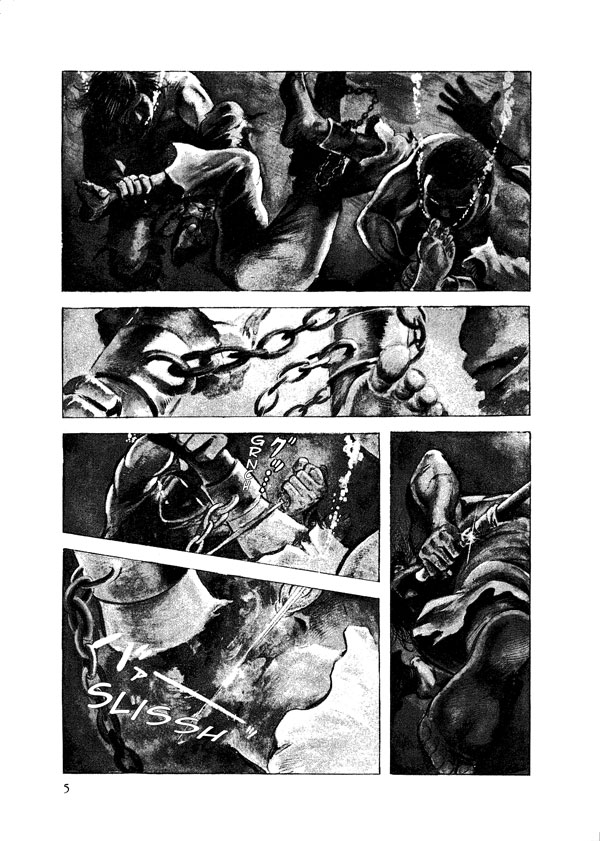

 Orange Planet, Vol. 1
 Red Hot Chili Samurai, Vol. 1
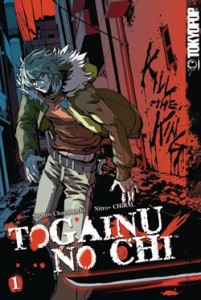 Togainu no Chi, Vol. 1

