• Skip to primary navigation
  • Skip to main content
  • Skip to primary sidebar
  • Home
  • About Us
    • Privacy Policy
    • Comment Policy
    • Disclosures & Disclaimers
  • Resources
    • Links, Essays & Articles
    • Fandomology!
    • CLAMP Directory
    • BlogRoll
  • Features & Columns
    • 3 Things Thursday
    • Adventures in the Key of Shoujo
    • Bit & Blips (game reviews)
    • BL BOOKRACK
    • Bookshelf Briefs
    • Bringing the Drama
    • Comic Conversion
    • Fanservice Friday
    • Going Digital
    • It Came From the Sinosphere
    • License This!
    • Magazine no Mori
    • My Week in Manga
    • OFF THE SHELF
    • Not By Manga Alone
    • PICK OF THE WEEK
    • Subtitles & Sensibility
    • Weekly Shonen Jump Recaps
  • Manga Moveable Feast
    • MMF Full Archive
    • Yun Kouga
    • CLAMP
    • Shojo Beat
    • Osamu Tezuka
    • Sailor Moon
    • Fruits Basket
    • Takehiko Inoue
    • Wild Adapter
    • One Piece
    • After School Nightmare
    • Karakuri Odette
    • Paradise Kiss
    • The Color Trilogy
    • To Terra…
    • Sexy Voice & Robo
  • Browse by Author
    • Sean Gaffney
    • Anna Neatrour
    • Michelle Smith
    • Katherine Dacey
    • MJ
    • Brigid Alverson
    • Travis Anderson
    • Phillip Anthony
    • Derek Bown
    • Jaci Dahlvang
    • Angela Eastman
    • Erica Friedman
    • Sara K.
    • Megan Purdy
    • Emily Snodgrass
    • Nancy Thistlethwaite
    • Eva Volin
    • David Welsh
  • MB Blogs
    • A Case Suitable For Treatment
    • Experiments in Manga
    • MangaBlog
    • The Manga Critic
    • Manga Report
    • Soliloquy in Blue
    • Manga Curmudgeon (archive)

Manga Bookshelf

Discussion, Resources, Roundtables, & Reviews

Features & Reviews

Off the Shelf: Supernatural Sunday

March 31, 2013 by MJ and Michelle Smith 8 Comments

MICHELLE: Hey, MJ! Why did the Easter egg hide?

MJ: Hmmm… I don’t know, Michelle. Why did the Easter egg hide?

MICHELLE: ‘Cos he was a little chicken.

MJ: Ouch. Ouch, ouch. Er. I mean. Ha ha!

MICHELLE: It actually genuinely makes me giggle, but I am predisposed to find chickies amusing.

Anyway! Encounter anything amusing in the realm of manga this week?

sabrina1MJ: Indeed I did! My first read this week was volume one of Tania del Rio’s Sabrina the Teenage Witch: The Magic Within, a manga-style graphic novel collecting the first ten issues of her series, which began its run in 2004. This came out just last week from Archie Comics, and though I realize it’s comprised of previously released material, I’m surprised it hasn’t gotten more buzz.

Sabrina’s been an Archie Comics staple since the 1960s, and she’s appeared in such a variety of mediums (comic books, animated television, live-action television), it’s difficult to imagine that more than a handful of Americans my age and younger could have avoided running into her one way or another. When this graphic novel appeared in our mailbox, my husband—who’d been a fan of the 1996 live-action sitcom starring Melissa Joan Hart—grabbed it up to read before I even had a chance. I was in the thick of my own professional acting career during most of that series’ 7-year run, and I hadn’t been a fan of comic books growing up, so my own history with Sabrina was fairly minimal. Yet here she is now, right in my wheelhouse!

For the two or three people who’ve never encountered her, Sabrina Spellman is a typical North American teenager—mostly. Her days are spent navigating the treacherous world of high school, friendships, and teen romance. Her nights are spent in another world entirely—the Magical Realm, where she studies her true birthright, witchcraft. As one of a growing number of witches who have chosen to live in the mortal world (Sabrina shares a house with her two grownup aunts and a talking cat, Salem), Sabrina delicately balances two separate lives and two separate love interests—shy jock Harvey in the mortal world and charismatic player Shinji in the Magical Realm.

If this sounds like ideal fodder for shoujo manga, Archie Comics obviously agrees—and they’re not wrong, for the most part. Though the series’ episodic format is initially a bit lacking in the kind of depth and character development we tend to expect from manga, later chapters really begin to gel, growing into a character-driven supernatural romance with one hell of a cliffhanger at the end of the volume. And if I’d like to see the story tip a bit more towards supernatural adventure and a bit less towards romance, that’s a very personal quibble.

Where the series really betrays itself as North American manga style comics, is in the artwork—not that this is a big surprise. For my tastes as a manga fan, The Magic Within fails where a whole lot of OEL manga fails, and that’s with cramped, over-toned pages filled to the last inch with ink. As a shoujo manga fan accustomed to delicate line art, sparse backgrounds, and gracefully flowing panel layouts, Sabrina begins as a cluttered, disorienting, inky assault. Fortunately, it’s engaging enough to ultimately render this a non-issue, and by the end of the book I was anxious for more.

MICHELLE: I actually watched some of the live-action Sabrina, though not avidly. And so it feels weird to me that there’s suddenly a love interest called “Shinji” in this comic. Perhaps this is jaded, and I am completely overlooking all of the good things you just mentioned, but this strikes me as “manga fans will think it’s manga if there’s a Japanese guy in it!”

MJ: I definitely get where you’re coming from, and maybe my minimal exposure to earlier versions of Sabrina makes that easier for me to swallow. But the truth is, Shinji is so charming a character, it’s difficult not to just plain like him. I think a chapter later in the book where we meet more of his family (including a mortal uncle who visits from Japan and popularizes Salem as a stuffed mascot—much to Salem’s dismay) helps, too, by giving him some real background. And I’ll admit I can’t help rooting for him in the ongoing Harvey-Shinji romantic showdown (where, as Guy #2, he’s obviously doomed), though at this point, I’m more interested in the volume-end cliffhanger, which is actually all about Shinji, and looks to be potentially quite serious.

The truth is, I enjoyed this book a lot. And for what it’s worth, my Sabrina-fan husband gave it an enthusiastic thumbs-up as well.

So what have you been amusing yourself with this week?

onepiece66MICHELLE: The most amusing manga I read this week was our mutual read for today’s column, but I suppose we’ll get to that in a moment.

My solo read this week was volume 66 of One Piece, which you totally still need to read. This series experienced a two-year time jump prior to volume 61, and volume 66 wraps up the first arc of the “New World,” in which the Straw Hat pirates have reunited and helped thwart an attempt by some human-hating fish-men pirates to take over Fish-Man Island.

This arc has not been an emotional one for our characters—they’re helping, but they’re not personally invested. Rather, the arc is about a fresh start, and so far seems intended as a backdrop against which our heroes can show off the new techniques they’ve learned in the past two years, as well as some of the insecurities they’ve conquered—Chopper no longer has stigma about being a monster, Usopp no longer reacts to taunts about being the weak link in the crew. That isn’t to say that there aren’t some truly nice moments—I’m particularly fond of the several pages depicting the celebratory feast after the battle is won.

A lot of the other things I thought were nifty were more plot-related. I always like it when there’s talk of adding someone to the crew, for example, and then there was a lot of stuff about the mystery of the missing 100 years of history—a subplot that’s been on the back burner recently—and a suggestion that Luffy might possess an ability rare for a human, one which only the previous Pirate King possessed. The one sour note was the depiction of a large female villain, but then I realized that Oda actually does extremely well at involving large heroic people in his series (of both genders), so my brief flare of irritation quickly faded.

Ultimately, this arc’s been fun, but not One Piece at its best.

MJ: I suspect any really long series is going to have its less exciting arcs, and at 66 volumes One Piece has certainly earned a rest. I hope for your sake that it is leading up to further greatness, and not petering out like most long series eventually do. I’ll admit it’s that 66 volumes that makes venturing further than the three I’ve personally read feel really daunting, but I keep planning to dig back in!

MICHELLE: I think if you could just get to volume nine, you’d see what the fuss is about!

Feel up to introducing our mutual read?

bloodlad2MJ: Sure! Our mutual read this week was volume two of Yuuki Kodama’s Blood Lad, a sort of horror/comedy seinen manga currently running in Kadowaka Shoten’s Young Ace and being released here in double-length omnibus editions by Yen Press. I read (and enjoyed!) the first volume of the series back in December, but Michelle’s just catching up now, so for those of you who are also tuning in for the first time, I’ll briefly go over the premise.

Staz is a young vampire who is also boss of a largish territory in the lower (read: slummier) levels of the demon world. He’s also obsessed with mortal Japanese pop culture, so when a Japanese teenager named Fuyumi accidentally turns up in the demon world, he latches on to her right away, demanding her opinions on manga, anime, and video games. As a human, Fuyumi’s chances of survival are slim in the demon world, and it isn’t long before she’s killed and becomes a ghost. This leads Staz on a quest to bring her back to life—partly for his own sake (he’s dying for some real time in the human world) and partly for hers, which is surprising to Staz, as he generally cares little for others. This leads to all sorts of mayhem, including a run-in with Staz’ friend/rival (a werewolf creatively named “Wolf”), who ultimately joins him in his quest to resurrect Fuyumi.

One thing that’s mentioned a few times in volume one is that though Staz lives in the lower-class area of the demon world, he’s actually a pure-blood vampire—a direct descendant of Dracula, even—and this becomes even more important in volume two, where he finds himself in the thick of a family plot, hatched by his manipulative older brother Braz and carried out with the help of their ruthless little sister, Liz. Though volume two begins with Staz directly at odds with his siblings, one of the volume’s nicest surprises is the evolution of Liz’s character as she begins to realize just how controlling and self-serving her oldest brother is. The series’ other delightful surprise—in my opinion at least—is its genuinely funny comedy, but I probably should let Michelle weigh in before going on further about that.

MICHELLE: Originally, I really didn’t think Blood Lad would be something I’d enjoy, but after your experience with it, I couldn’t help but be curious. And now I’m quite glad I decided to check it out, because I liked it very much!

While I like Staz and Fuyumi and am reasonably interested in the fulfillment of his quest, the thing I like best about this series is how it doesn’t do what I expect. For example, one might expect female characters as blatantly buxom as these to be put into fan service poses at every turn, but that doesn’t really happen too often. And that friend/rival, Wolf? He actually takes a break from a fight he’s losing, allowing Staz to take over. Like, with absolutely zero posturing or hurt pride! That is certainly rare!

The very best part, though, is the comedy. Many of the best lines go to Mamejirou, a three-eyed, prescient, low-level demon critter who is pretty much as adorable as it gets. There’s a recurring gag in this volume where boisterous teleportation expert Bell makes a grand entrance to a scene, at which point Mamejirou says something like, “Seriously. Rude.” I love him. (I suppose this is not surprising, considering my love for Koh in Silver Diamond.) The adaptation is also well done, and incorporates a few meme references that I found fun.

So I suppose I need to thank you for convincing me to give Blood Lad a chance!

MJ: I’m both thrilled and relieved that you ended up enjoying this manga, because I would have felt very guilty if you hadn’t! And yes, yes on the comedy. Volume two in particular contains a lot of older manga references as well, from Lupin III to Dragon Ball (chapter 15’s Dragon Ball bit is just plain awesome), though probably these are most enjoyable for long-time manga fans. That’s really much of the series’ charm, though. It’s a love song to otaku, through and through, and who can resist that?

MICHELLE: I had expected it to be longer (only seven volumes appear to be out in Japan right now, with the eighth due next week, if I am interpreting Amazon.jp correctly), but I guess because it’s seinen, it’s serialized less often. Which means after the third Yen Press volume in May (comprising volumes five and six), we might have to wait a while. I will miss Mamejirou in the interim!

MJ: As will I! Thanks for bringing this over, Yen Press!

Filed Under: OFF THE SHELF Tagged With: blood lad, One Piece, sabrina the teenage witch

License This! Tera Girl by Mizusawa Megumi

March 31, 2013 by Travis Anderson Leave a Comment

Tera Girl vol. 1

Today’s title is one I really think stands very little chance of seeing the light of day in the US, but that won’t stop me from gushing over it and hoping for a miracle to occur.

Tera Girl (or Temple Girl) by Mizusawa Megumi is the story of three sisters whose dad is a Buddhist priest. The three girls, Satoru, Hikari, and Ogami, could not be more different. Satoru is a university student studying medicine. She doesn’t hate that her family owns a temple, but she decided to focus on her own goals rather than the family business. Ogami is the youngest. She hates living in a temple and chose to go to a high school in another town so that no one would know about her family. Then there’s Hikari, the middle daughter. Also still in high school, she loves everything about the way she was raised and is a devout Buddhist. As a daughter, she can’t take over the temple herself, but her dad is counting on her to marry a man who is willing to become a priest and take over the temple.

Not only is this just a cute story in general and my favorite genre of shoujo (sweet romance with genuinely nice male characters, strong female friendships, no magic or anything out of the ordinary), it’s also a really neat look at how Buddhism works in Japan. Most Japanese people are culturally Buddhist, but not at all religious, so the manga is written for an audience who has little in common with Hikari’s upbringing. One reason I like school manga and workplace manga is that I like reading about everyday life in different places (though I also love things that take place in familiar settings, so maybe I just like stories about ordinary stuff), and this hits that same kink.

Tera Girl is a fairly recent series, with its third volume just released in February, and it’s by a very prolific, popular author, so that should mean it has a good chance at getting picked up, right? But no. I don’t know what it is about Mizusawa Megumi, maybe she is one of those authors who do doesn’t want her work translated, or maybe publishers just don’t think anyone is interested in the sort of stories she writes, but not a single one of her manga have ever been published in the US. Even scanlators don’t seem to care for her (so maybe that is a sign that there isn’t a lot of interest in what she writes, I don’t know).

If you were into anime in the mid ’90s, you probably remember Hime-chan no Ribbon, which while never officially licensed in the US, was very popular on the fansub circuit at the time and often shown at anime clubs. That’s probably her most well-known series outside of Japan, and that was twenty years ago. It’s also not at all typical of what she writes, since it’s a sort-of magical girl story, whereas the vast majority of her manga is the sort of everyday romance/slice-of-life stuff I love.

I know I said much the same thing in my post about Aozora Yell, but I feel like the US manga industry could really use more shoujo of this sort. So much of what’s put out here skews towards obnoxious love interests and female rivals. Kimi ni Todoke is popular, so it’s not like no one at all is interested in stories where the majority of the characters are nice and friendship is as strongly valued as romance, but there’s so much more like that in Japan and I don’t know why more of it isn’t given a chance.

Filed Under: License This! Tagged With: Mizusawa Megumi, shojo

Higurashi: When They Cry, Vol. 21

March 31, 2013 by Sean Gaffney

Story by Ryukishi07; Art by Hinase Momoyama. Released in Japan as “Higurashi no Naku Koro ni: Minagoroshi-hen” by Square Enix, serialized in the magazine GFantasy. Released in North America by Yen Press.

And so we come to the end of the penultimate Higurashi arc, and – no surprise here – everyone is dead. And I do mean everyone, as this volume, having finally given away most of the secrets, goes into great detail how the “disaster” that wipes out the village actually occurs. Things are not particularly improved by Takano, who is waving her arms around during all this as if she’s a conductor, and has a final face that is perhaps the template for all “crazy Higurashi faces”. But let’s jump back a bit and see how we got here.

massacre3

Rika and Hanyuu both feature on Yen’s chosen omnibus cover art (sorry, Takano, you just aren’t cute enough), with Rika having a resolved, determined face and Hanyuu looking depressed and dead inside. Most of this volume is showing us how Rika gets that determined, as getting the news about Tomitake’s death just seems to take all the fight out of her. Especially when she hears Oishii’s theories about who did it. A lot of fans have gotten on Rika’s case about being unable to figure out the killer, who seems really obvious in retrospect, and that she should have pieced it together after so many worlds in a row. Of course, as we see here, this is the first world where she’s not drugged up at the time of her execution. More to the point, she may have a hundred worlds of experience, but they’re the experience of a girl who only gets to about 12 years old. Rika has years, but not maturity, and it shows clearly here, when she resolves to hide everything from her friends so they don’t get killed.

That’s hardly going to work, however, given what happened with Satoko just a few days ago. Indeed, Satoko points this out to Rika directly, and Keiichi and the others make it clear that they’re not going to sit there and let Rika be sacrificed. We even have Rika quoting one of Bernkastel’s poems – usually reserved for the start and end of each arc, and indeed we get one at the end as well – which talks about who has a right to happiness. It’s easy to stand up against someone when it’s for the sake of others. When you do it for yourself, it can seem selfish, especially if it will put your friends in danger. Rika has to break through that barrier before she can accomplish anything.

We are – finally! – starting to get answers here, and indeed most of the pieces are together now. Not only is Takano the villain, but so are the “Wild Dog” bodyguards, who have always resembled a militia a bit too much for my taste. (I like how they are mook enough to have Keiichi and company take them out in order to rescue Rika, but not actually mook enough to have that last more than a few minutes – in the end, the kids lose.) And Hinamizawa Syndrome, the disease that causes the paranoia and killing impulses, is explained as well. This leads to why Rika keeps getting ritually slaughtered on an altar – Takano has gone mad and believes that if she kills the Queen Carrier, she’ll gain godlike powers.

And then there’s Hanyuu. We still don’t know much about her. She’s the incarnation of Oyashiro-sama, but strangely powerless, except for her ability to reset the worlds. She’s also even more worn down than Rika, and is also terrified that if she loses Rika this time she’ll be alone again… as she was for about a thousand years. Rena calls her out on this, as she too has the reoccurring theme of the Massacre arc – fighting back hurts too many people, it’s best not to have any hope. We’ve just proven how wrong this is, even if it did end badly. What’s more, we don’t really have much background on why the hell Takano is doing this, aside from “She’s insane”.

Luckily, we have one more arc – the longest yet, 8 volumes/4 omnibuses! – that should tell us about them, and will hopefully finally give us something that the characters and readers truly deserve after all this tragedy – a happy ending. Stay tuned for Vol. 1 of the awkwardly titled “Festival Accompanying” arc, where we meet a young girl named Miyoko Tanashi, and find out what makes her tick.

Filed Under: REVIEWS

Pretty Guardian Sailor Moon, Vol. 10

March 30, 2013 by Sean Gaffney

By Naoko Takeuchi. Released in Japan as “Bishoujo Senshi Sailor Moon” by Kodansha, serialized in the magazine Nakayoshi. Released in North America by Kodansha Comics.

In the last volume of Sailor Moon, we had chapters each devoted to the development of a senshi, be it Mercury, Mars, Jupiter, Venus, or the Outers. That having been done, it’s time for an action-packed climax to the SuperS arc. Now, this can also be a drawback. Takeuchi’s battles do tend to have a certain sameness to them, and in many ways this is just another variation on “our light is purer than your dark”. So with that in mind, let me talk about all the other things that I loved about this volume.

sailormoon10

First of all, the entire arc has been a look at the dreams and nightmares of the world, with the Dark Moon Circus dealing out both with impunity. We’re definitely on the nightmare end of the scale for this volume, with many grotesque, horrific images that look even better in Takuuchi’s long-limbed shoujo style. Seeing Usagi’s face melting off was what caused me to buy a copy of the manga in my comic store years ago (this was an older Japanese tankobon, I think), and it hits Venus and the rest of the senshi right where they live – the Princess is dead, they failed to protect her. (A flashback showing the very Sleeping Beauty-esque appearance of Nehelenia in the Silver Millennium only reinforces that – also, Venus and the others as chibi-Senshi are adorable.) Usagi, meanwhile, is caught in what seems an idealistic dream – she and Mamoru are the same age, and he makes her breakfast before they go to school together. But she immediately starts to see through it, even if regretfully – Mamoru was never that sicky sweet. It’s a childish Usagi dream, and she’s moved beyond that.

The other senshi mostly get to stand around and gape, but there are occasional moments of awesome. Venus and Uranus are the clear team leaders of their respective groups, and there’s a brief moment where we see they don’t really get along. We also see a magic mirror that needs to be broken, and after senshi attacks fail to do the job Jupiter goes with her Plan A – punch it really hard. (Who needs superpowers when you have MONSTER STRENGTH?) But the big winner here is Saturn, who is back, is around Chibi-Usa’s age, and is clearly the most savvy of the entire group – so much so that she and Chibi-Moon actually have to be banished from the plot for half the book (in another really creepy and well-drawn sequence where they’re imprisoned in shards of mirror). She confronts the Amazoness Quartet, abut can see them for who they really are – and almost manages to get them to remember before Nehelenia steps in and turns them into dull black orbs. (Also, she gets to do something in the volume on which she’s the cover star – a rarity for this re-released series.)

After Nehelenia is defeated (sorry, honey, no redemption for you here), we see everyone transformed into their ‘royalty’ dresses (we actually see it earlier as well, and it’s worth noting a couple of things. First, Serenity apparently has powers so vast that she can give her retinue prom formal gowns almost by default. Secondly, everyone gets white gowns bar Pluto and Saturn’s, which are black. I’d like to think there’s meaning to that beyond “breaking up the color scheme”), Saturn is still in her senshi outfit as she has another duty – have Serenity purify the orbs. And after she does so, we see the true forms of the Amazoness Quartet – the Asteroid Senshi, Chibi-Moon’s own inner retinue from the future. (This is actually not explained quite as well as I’d like, and is another weakness of this volume.) Add that to Helios, who is at last free to not be a giant magic horse and romance Chibi-Moon as himself – and one purpose of this arc is to give Chibi-Usa her own group to turn to in Crystal Tokyo that’s not simply her parents and guardians. She’s free to grow up.

For a volume that seems to be, on flip through, about half ‘senshi gape at encroaching darkness’ pictures over and over, there was a lot going on here. We’ve got two volumes of the main storyline to go, which will be the last arc, Stars. I’m especially looking forward to these as it’s the arc I re-read the least first time round, so I want to see what new insights I can find in it. (I also want a street date for the Takeuchi artbook – some of the title pages in this cry out for big color prints.) Still a can’t miss shoujo classic.

Filed Under: REVIEWS

Manga the Week of 4/3

March 29, 2013 by Sean Gaffney, Anna N, MJ and Michelle Smith 3 Comments

SEAN: Too much manga next week. Luckily, a good chunk of it came in everywhere except Diamond *this* week, so that takes a bit of the curse off.

Attack on Titan 4 still has lots of horrible death, grotesque horror, and the fear that this series will end with *everyone* dead. But – BUT – it has Potato Girl. More on her in my weekend brief. Suffice to say, she’s a great reason to grab this.

lastorder1

ANNA: I remember being vaguely intrigued when I saw the license announcement for this manga, but I never really followed up on that. Should I give it a whirl? I’m feeling a bit ambivalent knowing that there’s a “Potato Girl” in it.

MJ: I really liked the first volume of Attack on Titan, yet never bought more. “Potato Girl” might be the tipping point, though, for getting me into the bookstore.

SEAN: Battle Angel Alita: Last Order starts its omnibuses. I already reviewed this one, and suffice to say that I was mostly pleased, even if it is losing something by Kodansha being unable/unwilling to license the original Alita.

Fairy Tail 24 wraps up its Edolas arc and starts a new one, with a competition to see who will be the next S-class mage. Oh, and a surprise return! Big surprise – it divided the fandom when this came out in Japan.

Love Hina finishes its re-release with the 5th omnibus, a slightly smaller one containing the last two volumes. No surprises to see who gets paired off in the end, but the amount of focus on swordswoman Motoko may surprise people.

Sailor Moon hits the big 1-0 and wraps up the SuperS arc. (That’s right, there’s no cliffhanger for once.) This was the first Sailor Moon manga I ever read back in the day, and its disturbing nightmarish imagery still stays with me.

MICHELLE: Volume 10 wasn’t the first Sailor Moon manga I read, but it was the first one I reviewed. The review mostly consisted of squee about the Outers and Amazoness Quartet, though. Up next – the Sailor Starlights! I might be in the minority, but I do love them so. (Probably more in the anime, though.)

ANNA: Several years ago I would not have thought that there would be such an abundance of Sailor Moon. I am unfortunately behind on this series, but am looking forward to indulging in some binge reading one day.

MJ: Same here. I bogged down after a few volumes, mainly due to a limited budget. I need to pick up the pace!

SEAN: Meanwhile, on the Vertical beat, we have the penultimate volume of GTO: Shonan 14 Days. Given the cliffhanger from 7, I expect most of this volume to be things going very, very badly. Luckily, Onizuka doesn’t know how to give up.

MJ: I have so much love for this little series. I can’t believe it’s nearly over!

SEAN: Limit hits Vol. 4, and has a new girl on the cover, and no doubt lots of tense survivalist horror and teen drama.

MJ: After volume three, I’m really on the edge of my seat, though I approach volume four with some real apprehension. This series is that tense.

gundam1

SEAN: Mobile Suit Gundam: The Origin 1 is Vertical’s big release. It’s a deluxe omnibus hardcover, and simply looks expensive and gorgeous. I’ve heard good things about the content as well, as many Gundam fans apparently cherish this.

ANNA: I am sooooooo annoyed that my copy of this is currently languishing on a FED EX truck somewhere.

MJ: I really want to love this, though I’m a little nervous, given the weight of its fandom. Having never watched the anime nor read any of the other manga adaptations, will I be able to approach it as a fresh, new fan?

SEAN: The rest of the list is aaaaaall Viz. Barrage ends its short run with Vol. 2, hitting the Shonen Jump new series wall. Still, this does not necessarily mean that it’s a failure as a story. It’s worth checking out.

MICHELLE: I definitely liked volume one enough to check out volume two. I agree that it’s worth reading.

ANNA: This was an enjoyable series.

MJ: Indeed!

SEAN: Bleach hits Vol. 56, and has probably survived that early cancellation problem that befell Barrage. It’s not as popular as it once was, but it’s still a mainstay.

MJ: Heh. Yes.

SEAN: Blue Exorcist is the cream of the crop at Jump Square, and every volume brings fresh new delights. I think they’re still fighting toxic monsters from beyond, so it’ll be nice to see how they fix that.

MICHELLE: I really need to catch up on this!

SEAN: Also at Volume 9 is Dawn of the Arcana, which runs in Cheese! but so far has not been nearly as saucy as I was expecting from that shoujo/josei straddling magazine title.

MICHELLE: There are a couple of small “huh?” moments in the plot in this volume, but overall it provides some good drama, as Nakaba’s power proves to be quite a burden.

ANNA: I enjoy it, mostly because it has a sensibility that reminds me of some of CMX’s great fantasy titles.

SEAN: Anna may be gone, but Maria’s problems are still around as Devil and Her Love Song enters its second half. Vol. 8 will no doubt introduce new plot twists. I suspect the choral director may feature. (At least we haven’t seen the evil teacher lately…)

MICHELLE: Another one I intend to catch up on soon.

ANNA: The choral director seems a bit too invested in Maria. I am suspicious of him.

SEAN: By popular demand, Hana-Kimi continues its cheap 3in-1 omnibuses, containing Vols. 10-12. Do you like crossdressing, misunderstandings, and as close to BL as Hana to Yume ever gets these days? Then this is for you.

MICHELLE: Snerk. I read this the first go ’round, and while I liked it for most of the time, the ending profoundly irked me. I have a hard time recommending it because of that.

ANNA: I love this series!

SEAN: Jiu Jiu has hits Vol. 4, and I’m still on the fence about it. It has its good points and its bad points, but I’m not sure there’s enough good points to keep up with it. Still, wolf boys. Gotta love ’em.

MICHELLE: Yeah, I think I’m done. I really did try.

ANNA: I am not feeling this series either.

MJ: I really wanted to like wolf boys, but… no. Not really.

SEAN: I have no such issues with Kimi ni Todoke, which is at Vol. 16 but will never be unwelcome in my come. With one exception (sorry, Kent, I still have issues), the cast is absolutely perfect. Who isn’t reading this?

MICHELLE: If you aren’t, get on it!

ANNA: Kimi ni Todoke is so great. I love reading the stories of the supporting cast.

MJ: What they said!

librarywars9

SEAN: Library Wars: Love & War is yet another Vol. 9, and has hit the dreaded “caught up with Japan” stage (or at least as caught up as Viz allows itself to get). When we left off, they were using Iku as cute bait to catch a molester. I expect CUTE VIOLENCE will ensue.

MICHELLE: I ended up enjoying the eighth volume a lot more than I expected to, so I’m looking forward to volume nine. Also, don’t forget to check out the trailer for the movie that Anna recently posted!

ANNA: There is no way I wasn’t going to love a series about weaponized librarians, but let’s face it, this series is mega adorable.

SEAN: Nura: Rise of the Yokai Clan. Saigon. I can’t believe we’re still in Saigon. Substitute “Kyoto” for Saigon and you have the gist of where I am with Nura. Still, I like it enough to soldier on. Especially as I know we still have at least two volumes to go.

Slam Dunk hits Vol. 27. I think basketball is involved in this particular volume.

MICHELLE: Hee. I’ve gotten to the stage where I’m starting to hoard the final volumes of Slam Dunk so I can read them back-to-back. That means I’ll have to wait ’til December, but it’ll be totally worth it.

ANNA: It is amazing how Slam Dunk can spread out one basketball game over several volumes and still manage to be utterly engrossing.

SEAN: Our last Vol. 9, as Story of Saiunkoku continues to be the shoujo Yes, Minister. Civil Service intrigue has never been so pretty.

MICHELLE: I’m looking forward to this one, too!

ANNA: I am sorry to see this series end as I would happily have read 9+ more volumes.

MICHELLE: Oh, is this the end?! Somehow I completely missed that.

SEAN: It is the last one, and I totally missed it as well. The story continues in the 11 billion light novels that will never, ever come over here.

ANNA: That makes me sad, as I really enjoy this story. But I’m glad we at least got the manga!

MJ: I, too, am really sorry to see this series end. It was a rare and wonderful treat.

SEAN: Toriko is up to Vol. 15, and has a cover that can best be described as TEETH. I think we start a new arc here as well.

MICHELLE: Yeesh. I intend to read Toriko, really I do, but this cover is giving me pause.

MJ: I have never been able to stomach this series. So to speak.

SEAN: Lastly, there’s Vol. 4 of Yu-Gi-Oh 5Ds, which I dunno, whatever, I fell off about 4 Yu-Gi-Ohs ago.

There has to be something in that pile for everyone. What’s yours?

Filed Under: FEATURES, manga the week of

3 Things Thursday: Late to the Party

March 28, 2013 by MJ 7 Comments

Having become a manga fan quite a while after its arrival to North America, I often find myself in the position of being “late to the party.” Which is to say, I’m often discovering newly beloved series years after everyone else. Though I’ve occasionally acquired such series slowly and painstakingly (and often expensively) long after they’ve gone out of print, new trends in omnibus and digital re-releases have recently made such discoveries much easier and more accessible than ever before. With that in mind, here are a few series I’ve belatedly discovered over the past few months!


3 older series to which I’m (fashionably?) late:

loveless1-21. Loveless | By Yun Kouga | Viz Media – This series should not have been a surprise for me in the slightest, given my well-established fondness for Yun Kouga’s work, notably Crown of Love and Gestalt. Yet somehow, it was. After rescuing its license from Tokyopop’s now-defunct North American publishing division, Viz has not only continued where Tokyopop left off (volume 9), but has also begun re-releasing Loveless from the beginning in 2-in-1 omnibus format, making it possible for latecomers like me to catch up with relative haste. Viz’s third omnibus volume (containing volumes 5-6) comes out in just a couple of weeks, leaving only one more to collect before I can finally dig into their new releases, and that day can’t come too soon. Yun Kouga’s genius for wrapping up complex characterization in the most decadent genre tropes may leave her generally underrated—but certainly not by me. For my thoughts on Viz’s first two omnibus editions, check out Off the Shelf and My Week in Manga.

fromfaraway12. From Far Away | By Kyoko Hikawa | Viz Media – I’ve talked about this series a lot lately, but it’s been just that difficult to get out of my mind. As part of Viz’s new wealth of digitally re-released shoujo epics, the reappearance of From Far Away is what I’ve long dreamed of, even just in concept. And in practice, it’s even better. Its high fantasy setting, fast-paced adventure, and brave, determined heroine add up to pretty much my ideal shoujo fantasy, trumped by Yumi Tamura’s Basara perhaps only due to length. From my review of the first volume: “Another factor in From Far Away‘s success as fantasy-adventure is its overall complexity and sense of intrigue … everyone is a potential enemy, and it’s not clear at all whom we should be rooting for—including Noriko herself!” I’ll take fourteen volumes of that any day. Thanks, Viz, for giving this series a second chance!

kurosagi13. The Kurosagi Corpse Delivery Service | By Eiji Ōtsuka and Housui Yamazaki | Dark Horse Comics – This horror manga about five Buddhist college graduates who use their (sometimes supernatural) abilities to provide paid services to the dead had always sounded intriguing, and with other members of the Battle Robot (along with half the manga blogosphere) frequently singing its praises, you’d think I’d have hopped on board without question. But I’ll admit that series’ high (still rising) volume count and the sketchy availability of its early volumes kept me at arm’s length. Fortunately, its availability on Dark Horse’s iPad app has given me the opportunity not only to obtain the first few volumes without having to rely on Amazon third-party sellers, but also to feel comfortable buying and reading at my own pace, for a reasonable price ($5.99 a pop) on the device I most prefer. I’ve just finally read this series’ first volume, and I’ve become a fast fan.


Readers, what manga parties have you been late to?

Filed Under: 3 Things Thursday Tagged With: from far away, kurosagi corpse delivery service, loveless

Weekly Shonen Jump Recap: March 25, 2013

March 28, 2013 by Derek Bown Leave a Comment

March 25, 2013 Cover PageThe impossible has happened. Somehow a manga other than One Piece was my favorite manga of this week. I didn’t think it possible, but One Piece was just the right level of “Okay” and Nisekoi was just the right level of “really, really funny” that it managed to beat One Piece. Who knew? It really is possible.

Naruto Ch. 624
Oh those rascally Uchiha. And here I thought I was supposed to feel some kind of sympathy for one of them. Well, if that was the case then I have to confess it didn’t work. Madara’s turning against Hashirama was exactly what I’ve come to expect from practically every single Uchiha character. I will say, though, these past few chapters have endeared Tobirama to me more and more.

I think I’ll make some kind of pin or badge with the catchphrase “Tobirama was right” on it. Literally every single time he’s said someone should be killed, he has been completely right. Had he just killed Madara there? Everything bad that happened to Konoha never would have happened. Sure Hashirama makes his excuses, but if what Madara said is true, and the Uchiha clan was basically broken, then killing him would have been completely the right choice.

Naruto

World Trigger Ch. 007
Not a lot has really happened in these past seven chapters. The biggest problem with this chapter is that once again it’s nothing but talking, and talking, and talking about things that I as a reader barely understand. The learning curve is steep in this series, and while I don’t like being babied by a story, a bit more explanation as to what the deal is with the Neighbors and Border would be nice—except when the explanation is half a page with a diagram explaining that rank A is higher than rank C. I know that many Japanese are not quite proficient in English, but all it takes is a working knowledge that English is in fact a language that exists to grasp this very simple concept.

World Trigger

One Piece Ch. 702
While this week’s chapter of One Piece was good, it was just a level or so below that of the preceding chapters—not for any fault in the chapter, but mostly because nothing really stood out. We already knew about Ace’s fruit, so that wasn’t a big reveal. And I find it a bit worrisome that we seem to have the makings of a tournament arc—a staple of shounen manga that One Piece has avoided over the course of more than a decade. If Oda decides to do a tournament arc, I believe he will make it entertaining. Or he might make it very short, like Shimabukuro did with Toriko. Still, I would very much prefer if Oda stayed far, far away from the tournament arc cliché.

One Piece

Nisekoi Ch. 067
How can a chapter be so funny, and so gut wrenchingly heartbreaking at the same time. I was laughing throughout the entire chapter, up until Onodera trips. That last page is so heart wrenching specifically because it downplays the emotional impact. There are no streams of oddly globular tears, in fact there are barely even tears at all. For a series that gets most of its humor out of over-the-top expressions—many seen in this chapter alone—Onodera’s face on the very last page is one of the saddest things I’ve seen in manga for a while.

Toriko Ch. 227
Because Toriko employs the omniscient narrator so often I think it’s safe to say that Tommyrod is in fact bug food. I was right in that this was the last chapter dealing with that fight, but after most fights in Toriko ended without any lethal blows being landed, it comes as a shock to see a fairly major antagonist die. And with the introduction of Neo I think it’s safe to say that Shimabukuro intends to have the Gourmet Corp be dealt a heavy blow—one that will set them back quite some time. I was worried that this was far too soon for such a major confrontation, but the introduction of a second antagonistic organization, one that has flown under the radar but been well foreshadowed, shows promise. Shimabukuro most likely intends for the Gourmet Corp to be out of the picture for a while, and he has another antagonistic group ready to pick up where they left off.

Cross Manage Ch. 026
Once again it’s a bit of a shock to be reminded that this series is actually a sports manga. I liked the anecdote about the Celtic’s match, especially with how it tied into Sakurai’s plan to defeat a team significantly stronger than them. I do get the feeling that this match will be the final confrontation, and that Cross Manage is not much longer for this world. Which is a shame, I would have liked to see this series stretched out over a few more chapters. There was so much more character development I wanted to see for the other girls. Maybe we’ll get lucky, but we’ll have to just wait and see.

One-Punch Man Ch. 010
How can a character look both so blasé and horrifying at the same time. While I know Saitama will end this fight in one punch, I am glad that the story is being stretched beyond a single chapter. We’ve had the same joke a few times, now it’s time to show us how strong the actual story is. Is it possible to build a story around such a simple premise as a hero who cannot be beaten? I say yes. All it takes is playing around with the dynamics of the fight scenes. While Saitama is the hero, he’s also played up as the real monster in this confrontation—not because he is a bad person, but because he is in fact the most terrifying creature in the world. Next week we get to find out why he is so strong. Let’s hope the reveal is good. (Probable Spoiler: It will be.)

One Punch Man

Dragon Ball Z Ch. 008
Goku is an odd character. He’s the archetypal foolish protagonist, but there are times, such as in this chapter, when we see exactly how foolish he really is. Or perhaps it would be better to use the word gullible. Either way, whichever word you prefer, he shouldn’t have let go of Raditz’s tail. Surprising no one, turns out Raditz is lying scum who is perfectly willing to murder his own brother. Though, considering that they don’t actually know each other, I can assume that the bond of brotherly love hasn’t exactly had much time to be forged.

Yu-Gi-Oh! Zexal
Confession time, again, I didn’t really read this chapter. Well, I did skim it, but I didn’t get much out of it. While the domestic scenes were fun enough to skim, I was distracted by how outlandish the art style is. Somehow it manages to be ludicrous while still being art of the most commercial grade. While I wasn’t invested in the conflict later on in the chapter, I was amused by how the big source of conflict was dealt with within a few pages.


And that wraps up this week. If you have any comments about this week’s chapters please leave them below. If you want to praise my insight, leave a comment below. If you want to call me out for the hack that I am, the button to close this tab is up on the top.

If you want to hear more, check out the Manga^3 Podcast Archives. Or go directly to last week’s episode, Episode 040 – March 18, 2013 – How Batman Improves Any And All Manga | Toriko Vol. 2.

Filed Under: FEATURES & REVIEWS, WSJA Recaps

Tokyo Babylon Omnibus, Vol. 1

March 28, 2013 by Sean Gaffney

By CLAMP. Released in Japan by Shinshokan, serialized in the magazine Wings. Released in North America by Dark Horse Comics.

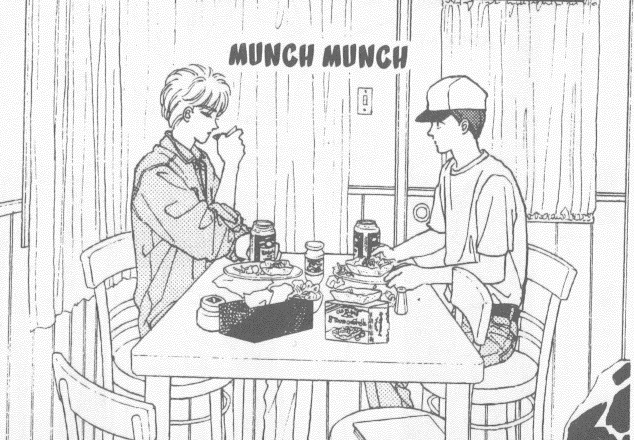
This is one of the big CLAMP series, the ones that first come to mind when you mention the creative team. It was their first really big hit (sorry, RG Veda), and when you read this first volume you can easily pick out why. Some manga are about the storyline and characters, some deal with building a world. But Tokyo Babylon is about building a mood, and it combines terrific artwork and a naive, somewhat somber hero to show us the world careening towards an inevitable apocalypse, one we’d see play out in the semi-sequel to this work, X.
tokyobabylon1

I’ve made a habit of pointing out CLAMP’s shortcomings in their post-2000 works, so it’s important to note how much they get right here. The artwork alone is worth buying the volume for, with a cute/handsome cast, striking settings, and strong, confident action scenes. Each story is self-contained so far, and has a plot that we’ve seen in many series before – a young spiritualists deals with restless ghosts and helps them find eternal rest – but it doesn’t feel tired, thanks in no small part to keeping the cast small and nuanced. Subaru’s noble idealism shines off the page, and makes an excellent contrast with his sister Hokuto’s eccentric extrovert. and then there’s Seishiro…

Let’s face it, Seishiro’s got something going on. I’m not spoiling anything, it’s just signposted – Hokuto even notes how he keeps changing the subject. At the start of the book he seems to be the most shallow – a nice, always smiling guy who tries to give Subaru gentle, older-man to younger-man advice while making cute jokes about seducing him. But by the time we get to the end of this volume, it’s clear that there’s something dark and unpleasant underneath that, and that Subaru’s idealism is going to run into it with a giant crunch. Honestly, in a way I can sort of see it. Subaru’s shininess is *so* over the top that it’s hard not to look at him every day and want to try to break it just a little bit…
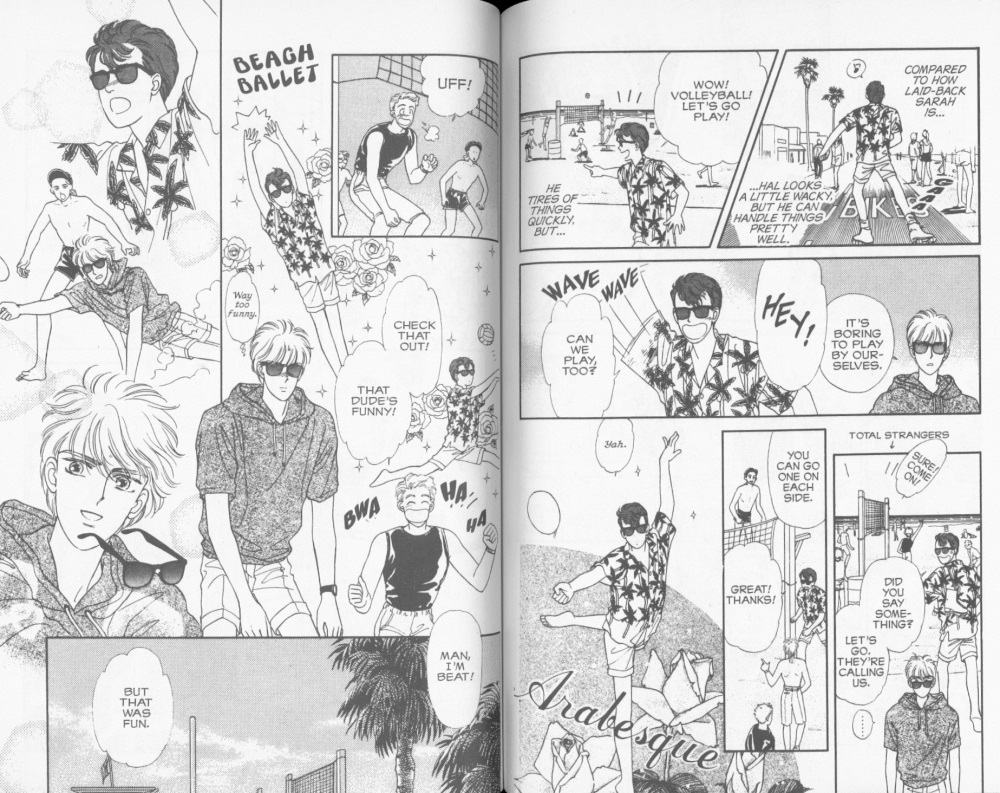
I’ve jokes before about the magazine that Tokyo Babylon ran in, Wings, which is a shoujo/josei/fantasy/BL-lite hybrid that essentially became its own genre. Dark Horse advertises the series as one of the first BL manga to come out over here, but the BL in it is quite mild. Hokuto and Seishiro constantly joke about his love for Subaru, but Subaru’s lack of response beyond the occasional blush means that things don’t really go very far. Honestly, Hokuto is the big reason that this title isn’t completely bleak and grim – she’s a spark of life that brightens every scene she appears in. This will become far more important in the second volume, believe you me.

Dark Horse has done a really nice omnibus here, based on the re-released version from Japan (in case you’re wondering where Hokuto’s side-story got off to – it’ll be in the next one). A little oversize, nice thick paper, it’s a quality release. I’m not certain how changed the translation is from the Tokyopop edition, but it’s likely worth exchanging your old copies for this one anyway. And for those who haven’t tried this series, you really should – it’s CLAMP at their mightiest.

Filed Under: REVIEWS

Manga Shopping Bag: March

March 27, 2013 by Anna N, MJ and Sean Gaffney 2 Comments

ANNA: Welcome to Manga Shopping Bag, a new monthly feature that will showcase what exactly the Manga Bookshelf crew has been spending their hard-earned money on. We’ll cover both print and digital purchases, and highlight a few shopping deals along the way.

20centboys1I don’t order from RightStuf very frequently, but sometimes they have deals that are so good you would have to be crazy to pass them up. Right now, they have discounted sets and individual volumes of 20th Century Boys, and I decided to dive in and get the volumes that I need to finish off the series. These bargain bundles are only good until April 4th, so snag this series while you can! I stopped reading at around volume 13 but always meant to get back to the series, so I’m looking forward to being able to experience the rest of Urasawa’s masterwork.

I also picked up Demon Love Spell 2 and I ordered Gundam: The Origin Vol. 1, which is coming out on March 26th. I’m looking forward to being able to read about perverted demons and giant mecha.

On the digital front, I decided to pick up volumes 1-3 of Please Save My Earth on the Viz iPad app. I’ve read a few volumes of this when it was first coming out but didn’t collect it, so I’m looking forward to reading this properly for the first time.

I was also really happy to see that Vertical was moving into digital editions for 7 Billion Needles, Twin Spica, and Drops of God, but since I already own print volumes of Twin Spica and Drops of God, I decided to pre-order the first volume of 7 Billion Needles. I am super happy that Twin Spica is coming out digitally, since the print volumes are going out of print.

I think that was plenty of manga shopping for me for March, what are you buying?

fromfaraway1MJ: I’ve been feeling giddy on the digital front as well, especially regarding Viz’s new wealth of older shoujo—much of which I missed completely when it was being released in print. I picked up first two volumes each of From Far Away, Red River, and Angel Sanctuary (the first two of which Michelle & I discussed in this week’s Off the Shelf), and I plan to follow all these series through to the end, now that I can.

In print, I picked up volume one of Dark Horse’s new release of CLAMP’s Tokyo Babylon. I already discussed much of the content, but I guess this is my opportunity to report that it’s an absolutely gorgeous edition. Dark Horse’s large trim size and smooth, bright white paper really make the most of the series’ clean lines and deep blacks. I suspect I’ll hang on to my well-loved Tokyopop volumes for nostalgia’s sake, but Dark Horse’s edition is vastly more beautiful. I should note that though this officially retails for $19.99, Amazon lists it at $10.98, which is an impressive savings. I’ll be preordering the second volume soon.

As you can see, 80s and 90s shoujo is where my money most often goes. I don’t see that changing anytime soon.

Lastly, this may sound a little silly, but I saw a couple of sets of Fumi Yoshinaga’s Antique Bakery for sale on ebay that were just too good to pass up. I picked them both up to give as gifts. I just couldn’t let them go unsold. I should note, too, that a few of these volumes are currently on clearance at Akadot Retail.

bleach1SEAN: Generally I tend to review the print manga I buy (hence go read my blog or the Briefs for those opinions), but there’s quite a few digital titles that I’m revisiting thanks to Viz. One of the more interesting is Bleach, a series that I’d grown increasingly jaded about once I realized that it was better to read it in chunks of 20 so that I could read in real time. Back with the first few volumes, though, it’s a different beast, and almost seems like it’s going to be about death and how we ceremonialize and respect those that have gone before us. It also has Rukia’s drawings, which are hysterical, and Orihime’s crush on Ichigo, which is adorable. It’s easy to see why it became popular, in the days before it was battles lasting for 52 weeks.

I’ve evangelized about Excel Saga quite a bit, both on my blog and on Twitter, and it’s just fantastic to see that Viz has made nearly the entire series available on digital, including the hideously out of print Vols. 7 and 8. Now, I’ve gotten some flak about pimping this out on the Excel Saga forums, most of whom live in England or Europe and are thus regarding me as a brat dangling their favorite toy just out of reach. Sigh… international rights are still a bear. But for North American fans, it’s a great way to see that the anime is not the be-all-and end-all in regards to this series, and there’s plenty of plot and characterization excellence to be found among the biting satire and zany humor.

ANNA: Early Bleach is pretty great, and I’m also very excited about the older shoujo series that are coming out digitally.

Readers, what have you been spending your manga money on this month?

Filed Under: Manga Shopping Bag Tagged With: shopping

It Came from the Sinosphere: Ashes of Time

March 26, 2013 by Sara K. 2 Comments

ashes16

This movie is a critics’ darling and a box office flop. It often gets placed on lists of “Best Chinese-Language Movies”—for example, this movie is ranked at #35 in the Hong Kong Film Awards list of 100 Best Chinese Movies (this is a bit like the AFI 100 list).

This movie is also plain weird.

The Story

Ouyang Feng contracts sword fighters and martial artists to carry out paid assassinations. His best friend is Huang Yaoshi. Someone called Murong Yang wants Ouyang Feng to kill Huang Yaoshi for jilting his sister. Then Murong Yin (the sister) comes to ask Ouyang Feng to kill Murong Yang (her brother) for getting between her and Huang Yaoshi, and … *sigh* … I quit this synopsis.

A shot of Ouyang Feng

I don’t want to spoil anything, and even if I did write a comprehensible plot summary (which would be spoilerful), it would completely miss the point. Just know that this takes place in a desert, there are love polygons, and that the men, at least, are all skilled fighters.

More Background

This is a film by Wong Kar-wai, one of Hong Kong’s most recognized film directors. He’s the only Chinese-language director who has won an award at the Cannes Film Festival. He’s famous for making movies with lots of lush visual imagery that explores personal relationships and memories, which describes this specific film to a T.

This film also features many of Hong Kong’s top stars of the era.

This movie is supposedly a prequel to Jin Yong’s Condor Trilogy. Indeed most of the main characters (Ouyang Feng, Huang Yaoshi, and Hong Qi) are also significant characters in the trilogy, and a few of the plot points in this movie (specifically Ouyang Feng’s relationship with his brother’s wife) are also mentioned in Jin Yong’s work. But this movie is so different, that I would describe it as fanfiction loosely inspired by the Condor Trilogy rather than an actual prequel (though being a work of fanfiction doesn’t mean that it has any less merit).

ashes09

It took a lot of time to shoot this movie, which caused it to go over-budget. To try to get some more cash, the makers of this movie spent about a week putting together a spoof of the The Eagle-Shooting Heroes, which ironically made more money than Ashes of Time itself.

In 2005, Wong Kar-wai put together Ashes of Time Redux. I haven’t seen it (I saw the original film), but I’ve read that the story is easier to understand in the “redux” version.

The Cinematography

I generally don’t talk much about cinematography or editing, since I know close to nothing about such things. However, even someone like me who has never taken a film class in her life can tell that this movie has great imagery. This movie also makes creative use of moving light/show, such as in scenes where light shines through a twirling wicker cage, which causes the light to shine in moving lines across the actors’ faces.

Wicker cage shadows!

Wicker cage shadows!

Another example is this scene with a woman on horseback, in which the light reflected off the water makes the woman’s face look almost white (the whiteness of her face is starkly contrasted with her otherwise dark surroundings).

The woman on horseback with light reflecting off the water (this is really hard to convey in a single screenshot)

The woman on horseback with light reflecting off the water (this is really hard to convey in a single screenshot)

Reflections in the water is actually a theme in this movie.

reflection in the water

reflection in the water

And the desert is … very scenic. I won’t say “beautiful,” since that’s not the intention, but it certainly has visual impact.

landslide in the desert

ashes02

ashes11

ashes12

I’m sure somebody who actually knows something about cinematography could make more insightful comments.

Position in Wuxia

This is obviously a wuxia film, and it’s the kind of wuxia film which defies what many non-Asians imagine wuxia is. Though there are a few furious fights, they are also furiously brief, therefore I can’t enjoy this film in the same way I would enjoy a Lau Kar-leung film for the exciting kung-fu choreography. It’s also not a tearjerking melodramatic romance. This, in a way, makes it the opposite of a Jin Yong story, since Jin Yong stories tend to be very high in technically-detailed fighting and melodramatic romance (soap operas with swords!)

This is a quietly-meditative kind of wuxia story, which uses the psychologically heightened setting of wandering fighters to look at personal relationships (I’ve seen this before in novels, though not in a movie—in fact, I’m impressed it works at all in a film format). The relationships aren’t there to make drama; the drama is there to reveal the relationships.

The Pacing

If you haven’t guessed it already, this is a slow movie, and it’s not until the end that the various bits and pieces of the story cohere into something that feels complete.

Being familiar with The Eagle-Shooting Heroes makes it a little easier to understand what is going on, but not much easier. I understand why this bombed at the box office.

ashes10

On the other hand, I did not find the film boring at any point. Aside from the eye-catching imagery, the individual moments were usually pretty interesting, even though it was sometimes hard to understand what was connecting the various moments together.

And the fact that this film feels so disjointed actually helps make its point. It’s a film about memory and personal reflection, and when we think back on our own memories, we generally think of them in sets of particular vivid moments, rather than a linear narrative.

Personal Relationships and Regret

This movie is basically about how we let our personal relationships deteriorate, how we fail to value the most meaningful things in life, and how we mourn for that loss when it’s too late. The most positive reviews I’ve seen of this movie came from people who watched it after a breakup, and a few people recommend watching it alone (then again, some people recommend watching it in a theater if possible to fully experience the cinematography).

ashes08

The current state of my life is not such that I can fully appreciate this film. It does not speak to what are currently my deepest personal issues. Therefore, I feel that I haven’t felt the full impact of this film. Perhaps I should revisit this film again when my life is different.

ashes06

However, the film still has some relevance to my current life. I have spent most of my life in San Francisco, and prior to moving to Taiwan, I had spent all of my life living in northern California (aside from brief trips to other places). Modern technology makes it much easier to maintain the relationships which are most important to me … but not being in the Bay Area has meant that relationships which are not so close, but still valuable, have gradually withered away.

During my first year in Taiwan, I didn’t think at all about returning to the United States since I was still dazzled by the novelty of being on a different continent, but now I often think about returning, and of all the things I should do to re-establish myself before it’s too late (the United States as a whole, and my neighborhood specifically, has changed since I left, and if I wait too long, I will only be able to return as a stranger). The fact that I think so much about returning also affects my relationships here in Taiwan—I’m afraid to go deeper into relationships, lest they break when I leave. Heh, maybe this film is a preview of how I’ll feel after I return to the United States, in which case, it’s a bit scary.

Availability in English

This movie is readily available with English subtitles, and they don’t suck. Since this movie is in Cantonese, I actually used a combination of Chinese and English subtitles to watch it, so I was able to compare the two. While I’m certain the Chinese subtitles are closer to what is being said in Cantonese, most of the departures in the English subtitles make the English feel more natural, and a more literal translation would feel much stiffer.

Non-Conclusion

I think I need to see the film again before I have a conclusion. And seeing the film again right now wouldn’t count—I need to wait at least six months before seeing the film again. I might conclude that this film is really deep, or I might conclude that it’s bullshit dressed up with impressive cinematography. Perhaps I’ll watch the redux version next time.

ashes13

Next time: Burning Moon (manhua)


Sara K. finally went to Sun Moon Lake. She had been warned that she shouldn’t get her expectations too high, but she thinks Sun Moon Lake is gorgeous, and that Nantou County is fantastic. She suspects the people who find Sun Moon Lake disappointing/boring either have a different temperament from her, were doing/seeing the wrong things, or simply had super-high expectations (Sara’s learned to never have super-high expectations during travel).

Filed Under: It Came From the Sinosphere Tagged With: condor trilogy, movie Wong Kar-Wai, wuxia

Welcome to the Erotic Bookstore, Vol. 1

March 26, 2013 by Sean Gaffney

By Pon Watanabe. Released in Japan as “Momoiro Shoten e Youkoso” by Media Factory. Released in North America digitally by Yen Press.

This was definitely one of the most intriguing announcements of SDCC, and I wondered what sort of title it would be like? How mature were we walking here? Was it plot-oriented, or just a slice-of-life gag comedy? Well, having now seen it, slice-of-life is definitely the road it travels down. If it weren’t for the sex talk, this would be almost a typical workplace gag manga. It’s just that here, the workplace sells pornography and sex toys as well as the regular used books, and the clientele it gets can be a little special.

Watanabe_WelcomeToTheEroticBookstoreV1_TP

There’s only one scene that I would call so questionable that I’d grab it away from the under-18s (where the bookstore staff goes to the shooting of a porn movie… the most explicit parts of which are drawn using cute cat mascots instead), but make no mistake about it, this book is about a sex shop, and every single chapter is filled with sex talk. Masturbatory aids, adult videos, exhibitionists, voyeurs, you name it, they’re all in here. The author, by the way, is also the narrator/star, but mostly serves to stand aside and make snarky comments – she doesn’t get involved in any of the activities.

Judging by Watanabe’s other two titles, she seems to specialize in slice-of-life gag works like this. It’s broken up into short 8-page chapters, which examine the lives of the owner and staff, the varied customers, and also gets quite philosophical at times. The general rule of thumb in this book seems to be that sexuality is good and nothing to hide provided that it’s not hurting other people. This seems to be an especially good moral to have in times like these, where propriety is seen as everything.

The title is also quite funny, in a mild “causes a smile” way usually, but sometimes the more risque humor made me jaw drop a bit. It’s mostly about the shop, its merchandise, and the customers, but the real world intrudes quite a bit – you see Watanabe having to bust middle school students pretending to be over 18, dealing with yakuza and undercover police (she wasn’t arrested, but had to give a statement – no uncensored porn, please!), and going on karaoke nights with her co-workers. She’s also a female, and quite tall, so there’s talk about how sex shop customers react at having to pay for things through her. And yes, her manga skills do come up once or twice, as she tries drawing things for the shop. We also see her naivite occasionally, such as when she tries to lure more females into the store, only to find that this depletes the much larger male customer base (as they feel even more uncomfortable).

Overall, it’s a cute little title. That said, I wouldn’t get it unless you like slice-of-life mild humor stories, sexual content or no. The style is very “superdeformed” and abstract, so there’s no real nudity or sexual situations. It simply is what it is, a cute title about a woman who manages a used bookstore that has a back room filled with sex stuff.

Filed Under: REVIEWS

Bookshelf Briefs 3/25/13

March 25, 2013 by Sean Gaffney, Anna N and Michelle Smith Leave a Comment

This week, Sean, Anna, and Michelle look at recent releases from Kodansha Comics and Viz Media.


dawn9Dawn of the Arcana, Vol. 9 | By Rei Toma | Viz Media – Dawn of the Arcana is shaping up to be a decent fantasy adventure! Nakaba and friends are presently in Lithuanel, attempting to broker an alliance with Senan, but the foreign land is no stranger to ruthless political machinations, as Nakaba soon knows all too well, thanks to her power, the Arcana of Time. In fact, this volume makes it clear that the ability to see into the past and the future is far more of a curse than a blessing, as Nakaba learns just what it is that her attendant Loki has been hiding and soon faces a terrible choice. Meanwhile, her husband, Caesar, sails home to an uncertain fate. A little bit of sloppy plotting and art that’s a bit too simple keep this title from achieving true epic status, but it’s still quite entertaining. Highly recommended. – Michelle Smith

genshiken2Genshiken: Second Season, Vol. 2 | By Shimoku Kio | Kodansha Comics – Most of the original cast of Genshiken has moved on by this volume – Sasahara barely appears, Saki is absent, etc. But Madarame has always been Genshiken’s heart, so it’s no surprise that he can’t drag himself away from the narrative for long. Which is good, as it’s becoming clear that he’s having a mini-harem form around him. Not that he’s aware of it or anything. It’s good as this is a goldmine of humor, and allows Genshiken’s funniest characters – particularly Sue, who gets her own omake devoted to how awesome she is – shine. But what the 2nd season really seems to be about is Hato and his gender identity, and that’s handled quite realistically and sensitively. In short, it may be a second season with a new cast, but Genshiken still does what it’s always done best – give otaku nerds depth and heart.– Sean Gaffney

kimi16Kimi Ni Todoke, Vol 16 | by Karuho Shiina | Viz Media This is one of those shoujo series that is just always excellent. We see Sawako and her friends move forward with more self-awareness and maturity into their developing relationships. Sawako senses some distance between her and Kazehaya and attempts to deal with the issue. Kento attempts to develop his relationship with Ayane. Some of the best moments in this manga are when characters are just sitting and talking to each other, as Kento and Kazehaya discuss their relationship woes. Shiina’s use of paneling and shifting perspective makes everything visually interesting even when most of the manga focuses on heartfelt discussions as opposed to action. – Anna N

psyren9Psyren, Vol. 9 | By Toshiaki Iwashiro | Viz Media – I’ve been more of a fan of the modern day parts of Psyren than the dystopian future, though the leveling up of the Elmore Wood kids helped a lot in Vol. 9. Still, in a manga where the future can change such as this one, it’s hard to invest in it. Which is why it’s good to see a subplot with someone like Amakusa, a slimeball who is determined that since the world is destroyed, he may as well rule it. There’s always going to be people like him around after a tragedy. Luckily, he’s merely small fry, getting taken out merely by Marie getting very mad… and crumpling the entire building into a ball around him. Still, there’s no getting around it – this is a “fighting volume” of a Jump series, meaning that the plot mostly takes a pause… with the exception of Nemesis Q’s creator, whose big appearance is the cliffhanger of this good but not great volume. – Sean Gaffney

rinne11Rin-Ne, Vol. 11 | By Rumiko Takahashi | Viz Media – One of the big reasons that I go on about Sakura having her negative emotions stolen when she was in the afterlife is that she’s so normally passive that it’s hard to get a grip on her and understand her, and thus she runs the risk of becoming dull. Dull Takahashi characters make me sad. That said, the start of Vol. 11 continues to make me think there’s something to it, as Sakura gets some candy that allows her to not see ghosts… including Rinne himself. And, in her own subtly, low-key way, she realizes that she’s bored out of her gourd without them. (On the bright side, she does miss the many, many attempts on her life.) Other than that, we get the usual: ship tease that doesn’t really go anywhere, unhappy spirits who can easily move on because the whole things a misunderstanding, and lots of violence. Rin-Ne is what it is. – Sean Gaffney

strobe3Strobe Edge, Vol. 3 | By Io Sakisaka | Viz Media – This third volume of Strobe Edge is primarily devoted to Ando, who is being groomed to take over the rival spot from Daiki now that he’s been quickly paired off. It’s always fun seeing the so-called player who’s found a girl that he’s genuinely fallen for, but can’t make that clear. Ando’s player tendencies have a serious past to them, much like every other character in this series. The pain of teenage love, and the fact that it doesn’t work out most of the time, is why we read Strobe Edge, a series that so far has no real bad guys. Even Mayuka seems beset by doubts when she shows up towards the end. But of course, if things remain as they are, we won’t have a plot, so that’s no surprise. Strobe Edge is slow paced, and may frustrate some people, but its bittersweet feelings seem just about right for me. – Sean Gaffney

Filed Under: Bookshelf Briefs

License Request Day: Another Look At Medaka Box

March 24, 2013 by Sean Gaffney

By NisiOisiN and Akira Akatsuki. Released in Japan by Shueisha, serialization ongoing in the magazine Weekly Shonen Jump.

Back in 2010, I did a License Request post regarding a Shonen Jump manga called Medaka Box, and explained why I thought it was a great series, and also why I thought it was unlikely to get picked up. Well, it’s now almost two and a half years later, and the series is still running in Weekly Jump, and gotten two anime seasons (which, sadly, animated the least interesting part of the manga) and has more reasons I’d love to see it licensed… as well as even more reasons it won’t. So let’s discuss.

medakabox1

Since my original post, the manga has kept going, and gotten even more ludicrous. It now projects to be over 20 volumes, and just began a new arc after faking readers into thinking it was ending – the 2nd time the authors have done that! It’s introduced even more overpowered characters, including Najimi Ajimu, who can seemingly control the narrative and utilizes her 12,858,051,967,633,865 skills to waltz around the story being smug. And it still has a small core of hardcore fans who enjoy discussing what it’s really trying to say – even if they all disagree with each other, and half of them are fans of the series but despise the lead.

So, why do I want to see this series over here? Let’s see…

1) Tons of strong female characters, including many leads, several of which have no romances whatsoever. Medaka Box sails through the Bechdel test, honestly. Medaka herself is currently one of two Jump series with a female lead (and the other, Novice Policewoman Kiruko-san, may not last long). We also meet characters such as the aforementioned Najimi Ajimu, Youka Naze (a genius mad scientist with a knife sticking out of her bandaged head), Hansode Shiranui (who is primarily comic relief in the anime-adapted shows, but proves to be far more dangerous – and far more broken – than everyone expected), and Mukae Emukae (who makes anything she touch rot and die, including animals and, presumably, people. )

Each arc has at least one or two major female antagonists or protagonists, and some are entirely female, such as the Jet Black Bride arc. Now yes, there is some romance, with some characters falling in love or obsessing over a person. But it’s not a requirement. More to the point, almost every single female in this series beyond about chapter 26 can kick anyone’s ass right ways from Sunday. I have never seen such a larger group of BAMFs. It’s pretty amazing.

2) Examination, parody, and deconstruction of shonen themes. Many series do this subtextually, but Medaka Box goes right ahead and makes this text. Misogi Kumagawa, who is easily the most popular character among Western fans of the series (and probably Japanese fans as well – the anime did a final episode just devoted to him as if to make up for its likely cancellation), often refers to events by saying “If this were in Weekly Shonen Jump”. Ajimu takes it one step further, and seems entirely aware that this is a serial – it’s made into a plot point, and once led to one of the greatest lines in the entire series, “Manga that go longer than 10 volumes just coast on their success, and this has already gone three volumes over that. So just watch… I’ll end this manga before the anime begins.” (Spoiler: she didn’t.)

But it’s not just pointing out the series is fictional. Medaka Box goes to great pains to mock and undercut many of Shonen Jump’s most treasured values, with several monologues noting that while Jump is supposedly about “Friendship, Training, Victory”, the reality is that the stronger characters defeat the weak ones, so more power always wins. And indeed that is the case throughout Medaka Box. Medaka is insanely powerful, so she wins despite everything. The only exceptions are characters who are (temporarily) stronger than she is. Kumagawa is set up to rebel against this – his entire purpose in life is to be the one representing the weak, loser characters whose only purpose is to fail.

But with all that said, the beauty of a series like Medaka Box – and something that a few of its fans don’t quite get – is that for all that it’s deconstructing Jump series, it also IS a Jump series, and thus in the end it serves what Jump strives for after all. This is not a series that will end with our heroes broken and Medaka humiliated and tarnished – that’s not its goal. Its goal is to show the wonders of humanity in all its forms, even when humans are equipped with various types of superhuman abilities. (Medaka Box sometimes seems like X-Men there’s so many people with insane superpowers.) It may say Jump is all about who is most powerful, but Medaka succeeds because of the bonds she has with Zenkichi – and his bonds with all the others.

3) It’s simply fun. Everyone acts gloriously over the top, almost in a Higurashi sort of way. The series is peopled with larger than life superheroes, so it’s only natural that they are larger than life. Kumagawa can be terrifying or hysterically funny, often in the same chapter, and his juvenile pursuit of seeing girls’ panties, girls in naked aprons, and girls in “hand-bra jeans” (don’t ask) is a nice reminder that all these superhuman geniuses really are teenagers after all. There’s fun wordplay, and later volumes introduce Nienami, who seems determined to be the ultimate boke just to have everyone scream at her. You’re never quite sure if the manga is a parody or not – which is the point, of course.

Now, I mentioned I don’t think this will be licensed. Why? I already discussed in my prior post that it starts off very slowly. In fact, it’s quite mediocre for the first few volumes. (You know, the ones they chose to animate). But let’s update things.

1) It’s now over 20 volumes and counting, and is not a huge hit the way Toriko or Bakuman were. This is reason #1 with a bullet.

2) It would make the translators cry. There is an entire ARC given over to battles using kanji and wordplay, culminating in a final confrontation involving the Japanese game where the next person starts a word with a syllable that the previous person ended with. Oh yes, and there’s a chapter where Ajimu tries to inspire Zenkichi by recalling about 25 old Shonen Jump heroes, many of whom never appeared over here and would require extensive translation notes – something which Viz has never used in its shonen series.

3) One character, Shori Wanizuka, walks around at times with a revolver sticking out of her mouth, sucking on the barrel. Oh, Viz would just LOVE that.

4) Medaka herself. Not since Ichigo Kurosaki has there been a more polarizing lead character in Shonen Jump. Medaka is meant to be a deconstruction of the “Mary Sue” sort of character – she is perfect at anything she tries, has a killer body, is genius level IQ, a physical powerhouse, etc. Despite this, Medaka throughout the series is shown to have difficulty with basic humanity. This is a thread that exists in a lot of NisiOisiN’s works, where he shows the basic disconnects anyone that far ahead of/in front of us would have with average people.

As such, a lot of the time, Medaka is unlikeable, particularly when dealing with Zenkichi, her childhood friend. Now, one of the main plots in the series is showing that she is gradually improving at human interaction, and is not a superhuman freak but merely a teenage girl like everyone else. Of course, character development is frequently not welcome by some fans, who form their opinions and then refuse to change them ever. I’d argue that a majority of the fans support Zenkichi or (especially) Kumagawa as a “main character”, seeing Medaka as an antagonist. In addition, a small minority of fans seem to suffer from “nice guy syndrome”, demanding that Medaka treat Zenkichi nicer because, well, he’s the male love interest and why won’t she learn her place?

5) For those who like Jump for its BL elements, you’ll find some of that here as well. (There’s a couple of yuri teases too.) That said, Medaka’s figure and habit of exhibitionism can also put off female readers who might see the title as pure fanservice.

With all that said, I remain fascinated by this series, one of the most addictive I’ve seen in Jump in years. Even with all the pitfalls, I’d still love to see someone take a chance on it. Hey, it’s licensed in France! Can North America be that far away?

Filed Under: FEATURES, LICENSE REQUESTS

Drama Diary: My Princess Eps. 8-16

March 24, 2013 by Anna N 3 Comments

Here’s my first My Princess post covering the beginning of the series, if you haven’t read it before!

The second half of My Princess becomes more serious as the political machinations pick up and everybody has to deal with Events From The Past, as one does in kdramas. The restoration of the Monarchy is going to go up to a public vote, so the President and other politicians are very interested in the outcome. The President supports the Monarchy on the surface because he owes Hae Young’s Grandfather a great deal, but in reality he is not thrilled about a new ceremonial Korean Monarchy pulling focus from the elected government. The toppling of the Monarchy is aided by the evil Yoon Joo, who gets a willing accomplice in Seol’s sister Lee Dan. Lee Dan manages to steal a royal artifact from Seol’s house and starts claiming to be the real princess. Professor Nam tries to head off Yoon Joo, but isn’t entirely successful. While most of the time in kdramas the evil second woman isn’t particular sympathetic, I thought that Yoon Joo was so irredeemably bitchy that as a viewer I wouldn’t really be satisfied unless she was somehow seriously maimed by a runaway truck at the end of the series. Unfortunately, no maiming of Yoon Joo actually happens.

Please die in a fire, evil lady!

Please die in a fire, evil lady!

Seol and Hae Young are pushed apart by the rumor that his father persecuted her father and caused his death. Seol is dedicated to bringing back the monarchy in order to restore his reputation, and the idea that Hae Young’s father might have caused her tragic early life is very painful to her. One of the repetitive aspects of this kdrama that actually gets a bit wearying as the series goes on is the sheer number of times that Seol runs away from Hae Young, only to be reunited with him a half hour later. Also, it seems like the South Korean government just places travel bans on people willy nilly, as everyone is always fleeing to the airport only to be told that they are unable to leave the country. Seol’s constant fleeing might have decent motivations, but it does make me question her sanity in avoiding a brooding rich diplomat who clearly adores her.

Seriously, would you run away from a man with this face!?

Seriously, would you run away from a man with this face!?

As things begin to get worse for the would be Monarchy, Professor Nam and Hae Young begin to grudgingly work together. One of the most amusing things about this series are the random displays of alpha male posturing when they start arguing over ridiculous things like cuts of meat in an attempt to establish who is doing a better job looking out for Seol.

Who is more handsome!  I am!  No, I am!

Who is more handsome!
I am!
No, I am!

This series manages to last for 16 episodes purely because Seol and Hae Young are each determined to suffer in silence and not burden each other with their problems. While this might be noble, it is a bit infuriating that Seol never comes out and tells the Professor or Hae Young how badly Yoon Joo is bullying her, although both men figure out what is going on. Hae Young ends up solving many problems through his sneaky diplomatic skills, but by putting the Monarchy first, the Princess and the Diplomat might have to put romance aside.

So cute, I can't stand it.

So cute, I can’t stand it.

Hae Young and Seol are one of my favorite couples out of all of the kdramas I’ve watched so far. The actors have great chemistry. The relationship between them has an amusing dynamic, because while Hae Young tends to act in a very high-handed manner most of the time, when Seol decides to get back at him by doing something like pretending to go to a marriage meeting he immediately drops his arrogant pretenses and starts acting overly concerned. I enjoyed rewatching this series, because I was reminded of some of my favorite moments, like Seol trying to erase her slightly perverted internet history and Seol and Hae Young bonding by sitting together in an antique car museum exhibit. The final episode pairs everybody off nicely, and while I would like to see the villains of the series be punished even more, there’s something to be said for the comfort found in happy endings.

Watch now at DramaFever!

Filed Under: Drama Diary Tagged With: dramas, kdramas, my princess

Off the Shelf: Shoujo Fantasy Double Feature

March 23, 2013 by MJ and Michelle Smith 22 Comments

MJ: Good morning, Michelle! I greet you this morning, dizzy with the particular brand of glee that can only be brought on by epic shoujo fantasy. How about you?

MICHELLE: Much the same, actually! With a side of gratitude that the epic shoujo fantasy in question is a) completely available in English and b) in the process of becoming easier to obtain!

MJ: Indeed it is! And really, it is a dream come true. When manga publishers first began launching their various digital initiatives, one of the things many of us hoped for was that these venues would eventually become a platform for re-releasing out of print manga. In particular, I expressed a hope that we might see some of Viz Media’s “scads of fantastic 80s and 90s shoujo,” most of which has become difficult to obtain in print.

Fortunately, Viz seems to be on the same page, as they’ve recently begun releasing some of these older shoujo series in digital form! They began with one of my favorite series of all time, Saki Hiwatari’s 21-volume epic Please Save My Earth (volumes 1-6 are available now), originally serialized in Japan beginning in 1987, followed recently by three series from the early 1990s, Kaori Yuki’s Angel Sanctuary, Chie Shinohara’s Red River, and Kyoko Hikawa’s From Far Away. This week, Michelle and I decided to delve into the latter two of these series, whose first volumes are now available at both vizmanga.com and on Viz’s mobile apps.

Michelle, would you like to choose which we’ll discuss first?

redriver1MICHELLE: I’m inclined to save the best for last, which means that in my personal opinion, Red River should go first!

I actually own all of Red River in print, but had never read any of it ’til now. It has the distinction of being the final series in the now-defunct “shojo” imprint to reach completion. Though it starts off rated for older teens, I have a distinct memory of the later volumes being shrinkwrapped, so presumably sexy times will eventually ensue.

Anyway! Both of the series we’re going to discuss today involve a modern-day Japanese schoolgirl being transported to an unfamiliar environment. In the case of Red River, things are looking good for fifteen-year-old Yuri Suzuki. She has just passed the entrance exam for the high school of her choice and shared a first kiss with her good friend turned love interest, Satoshi. But on the evening of her family’s celebration dinner for her achievement (the exam, not the smooch), she begins to notice that water is acting strange around her. Soon, a pair of arms is reaching out to her from fish tanks and bath tubs, trying to pull her in. Though she manages to avoid water for a little while, she’s eventually captured via a puddle and transported to the Hittite Empire in 14th century B.C., where a scheming queen seeks to use her as a sacrifice to ensure that her son (currently sixth in line for the throne) becomes king.

MJ: Fortunately, Yuri quickly becomes acquainted with Kail, third son of the king and no friend to his stepmother, the scheming queen. Though he’s a notorious player (whose methods of “saving” Yuri generally involve pretending she’s his sexual conquest—something he’d clearly like to achieve in reality as well), Kail appears to be genuinely trustworthy, at least when his own life is on the line. Unfortunately, though Yuri is grateful for his protection, her desire to return to her own land drives her to recklessness, placing both her life and that of a devoted slave, Tito, in peril.

As it happens, I agree with your choice of which to discuss first (and why), which isn’t to say that I disliked Red River in the slightest. It’s immediately engaging and action-packed, with a relatable, plucky heroine and a fascinating historical setting. Even playboy Kail manages to be a genuinely attractive love interest, despite my weariness with his classic rake persona. What does weaken this story, however, is just how easy things are for Yuri, at least in this first volume.

While it may seem odd that I’d consider her path “easy” at this point—she has been marked for death, after all—there are some ways in which things really are inexplicably so. The issue of language, for instance, is immediately discarded, as Yuri finds she can suddenly understand the Hittite’s tongue simply by kissing Kail (insert inappropriate “tongue” joke here). Because of this, she’s able to grasp her situation immediately, including recognizing exactly where (and when) she is. Also, by being under Kail’s protection, she’s also suddenly a princess, with the ability to stop executions and generally direct people to do her bidding, which puts her in an immediate position of power, at least within Kail’s realm.

MICHELLE: Your last paragraph there neatly encapsulates my main criticism of Red River, though there are things about Kail that bother me, too. (I don’t think he’d follow through with the threat, but dialogue like “Now stop grousing or I’ll bed you for real” will never sit well with me.) It feels a little like Shinohara is squandering this rich environment and the potential for adventure in favor of romance. True, Yuri does end up in peril by the end, but it’s due to her impetuous, uninformed insistence on retrieving her clothes from the scheming queen and pretty much just a plot device designed to allow Kail to swoop in and save the day.

However! This series does run for 28 volumes, so I am willing to acknowledge that the story could move beyond its origins and go interesting, complicated places.

MJ: Wholeheartedly agreed! Despite my quibbles (and I do share your discomfort with Kail’s threats—hello, rape culture), 28 volumes of 90s shoujo fantasy is not something I can possibly reject, and my expectations are high!

MICHELLE: Of course, 14 volumes of shoujo fantasy is nothing to sniff at, either. Want to do the honors of introducing From Far Away?

fromfaraway1MJ: I’d love to! Though half the length of Red River, Kyoko Hikawa’s From Far Away took several years longer to complete, running in Hakusensha’s LaLa magazine from 1993 to 2003. And if the first volume is any indication, this was time well-spent.

High school student Noriko has been experiencing a recurring dream set in a mysterious land filled with gorgeous landscapes and unfamiliar wildlife. As she walks home from school with her friends on one ordinary afternoon, television news anchors warn of a terrorist threat involving small bombs planted around the city by a recently captured suspect. While her friends hash out theories about Noriko’s dream—whether it’s a past life, a portal to another dimension, or pure fantasy fueled by Noriko’s sci-fi author dad—Noriko’s attention is drawn by a stray ball, leading her to an abandoned paper bag which explodes just as she approaches.

Though no trace is left of her body, Noriko is presumed dead. Meanwhile, Noriko has fallen into the same world she’s been dreaming about, where she is identified as “The Awakening,” a supernatural being prophesied to grant power over the legendary Sky Demon—the most destructive evil known in that world—to any nation that possesses it.

MICHELLE: Like Yuri, Noriko is fortunate enough to encounter a formidable ally right off the bat, though things are distinctly less easy for them. Izark might be a powerful warrior who saves Noriko from the political factions attempting to capture her (not to mention gigantic caterpillar things), but the language barrier prevents them from understanding one another and her fear and confusion seems to get on his nerves. Still, he’s unable to ignore her when she’s obviously upset and she comes to trust him. The non-verbal storytelling here is great, and I love that Noriko grows ashamed of her earlier behavior and starts trying to learn the language so that they may better communicate.

Despite being an imaginary fantasy world, the setting here feels more real than the Hittite setting in Red River, and has an abundance of the adventure feeling that I was missing in the other series.

MJ: My feelings exactly, Michelle, on all counts. And really, much of this story’s strength is due to the author’s inclination to prioritize adventure over romance, at least in the first volume. Though strong, roguish Izark is clearly leading man material by any shoujo fan’s standards, both he and Noriko are entirely focused on survival at this point in the story, with no romantic action to be found.

Another factor in From Far Away‘s success as fantasy-adventure is its overall complexity and sense of intrigue. While Red River‘s villain is firmly established from the beginning, things are less clear-cut in Noriko’s new world. With every nation competing for control over The Awakening, everyone is a potential enemy, and it’s not clear at all whom we should be rooting for—including Noriko herself! Though it seems fair to hope that our heroine can’t really be the harbinger of evil, it’s little more than a hope this early in the story, and Izark’s origins and intentions are even less clear. Furthermore, the series is already peppered with some extremely interesting supporting characters, including pint-sized seer Geena Haas, her mercenary father Agol, and a whole host of potential enemies who are aggressively hunting The Awakening.

Perhaps most telling is the fact that as soon as I finished From Far Away‘s first volume, I rushed to purchase the second. I suspect I’ll begin reading it the moment we’ve finish this column.

MICHELLE: I also wanted to immediately proceed to the second volume! I actually read and reviewed the first five volumes of From Far Away a little over three years ago, and though I no longer remember specifics, I remember feeling that it just kept getting better and better.

I do want to mention a couple of random thoughts. Something about the setting of this world—probably the huge insects and people standing whilst piloting flying craft/creatures—reminds me of Nausicaä of the Valley of Wind, and it’s not a comparison in which From Far Away suffers. Too, I wonder if the story will take on a Life on Mars idea… like, is Noriko dead/injured in the present day or is she really experiencing all of this? Granted, it doesn’t seem at all like Hikawa plans to go in this direction, but what with the bombing and witnesses to Noriko’s disappearance, it makes me wonder.

MJ: I’ve been wondering that, too, Michelle! Unlike Yuri in Red River, Noriko really is assumed to be dead in her world—and reasonably so—which immediately puts her mortal status in question, and also raises questions about what place she’ll have back in her world if she really is alive and able to return. I also can’t help being curious about Noriko’s father, whose career as a science fiction writer just makes him… interesting. And potentially involved somehow? Who knows?

I think it’s pretty obvious that we find this series compelling.

MICHELLE I’d say so!

Of course, no column like this would be complete without me throwing in a plea for Basara to be the next out-of-print epic shoujo fantasy in VIZ’s catalog to receive the digital treatment.

MJ: I second that plea and add (predictably) Akimi Yoshida’s Banana Fish! Because, let’s face it, Yoshida’s New York is every bit the fantasy that is Tamura’s post-apocalyptic Japan. Bring ’em on, Viz!


Read Red River and From Far Away at vizmanga.com.

Filed Under: OFF THE SHELF Tagged With: Digital Manga, from far away, red river, viz media, vizmanga.com

  • « Go to Previous Page
  • Page 1
  • Interim pages omitted …
  • Page 379
  • Page 380
  • Page 381
  • Page 382
  • Page 383
  • Interim pages omitted …
  • Page 538
  • Go to Next Page »
 | Log in
Copyright © 2010 Manga Bookshelf | Powered by WordPress & the Genesis Framework