• Skip to primary navigation
  • Skip to main content
  • Skip to primary sidebar
  • Home
  • About Us
    • Privacy Policy
    • Comment Policy
    • Disclosures & Disclaimers
  • Resources
    • Links, Essays & Articles
    • Fandomology!
    • CLAMP Directory
    • BlogRoll
  • Features & Columns
    • 3 Things Thursday
    • Adventures in the Key of Shoujo
    • Bit & Blips (game reviews)
    • BL BOOKRACK
    • Bookshelf Briefs
    • Bringing the Drama
    • Comic Conversion
    • Fanservice Friday
    • Going Digital
    • It Came From the Sinosphere
    • License This!
    • Magazine no Mori
    • My Week in Manga
    • OFF THE SHELF
    • Not By Manga Alone
    • PICK OF THE WEEK
    • Subtitles & Sensibility
    • Weekly Shonen Jump Recaps
  • Manga Moveable Feast
    • MMF Full Archive
    • Yun Kouga
    • CLAMP
    • Shojo Beat
    • Osamu Tezuka
    • Sailor Moon
    • Fruits Basket
    • Takehiko Inoue
    • Wild Adapter
    • One Piece
    • After School Nightmare
    • Karakuri Odette
    • Paradise Kiss
    • The Color Trilogy
    • To Terra…
    • Sexy Voice & Robo
  • Browse by Author
    • Sean Gaffney
    • Anna Neatrour
    • Michelle Smith
    • Katherine Dacey
    • MJ
    • Brigid Alverson
    • Travis Anderson
    • Phillip Anthony
    • Derek Bown
    • Jaci Dahlvang
    • Angela Eastman
    • Erica Friedman
    • Sara K.
    • Megan Purdy
    • Emily Snodgrass
    • Nancy Thistlethwaite
    • Eva Volin
    • David Welsh
  • MB Blogs
    • A Case Suitable For Treatment
    • Experiments in Manga
    • MangaBlog
    • The Manga Critic
    • Manga Report
    • Soliloquy in Blue
    • Manga Curmudgeon (archive)

Manga Bookshelf

Discussion, Resources, Roundtables, & Reviews

Features

MMF: Bathtub manga

June 21, 2011 by David Welsh

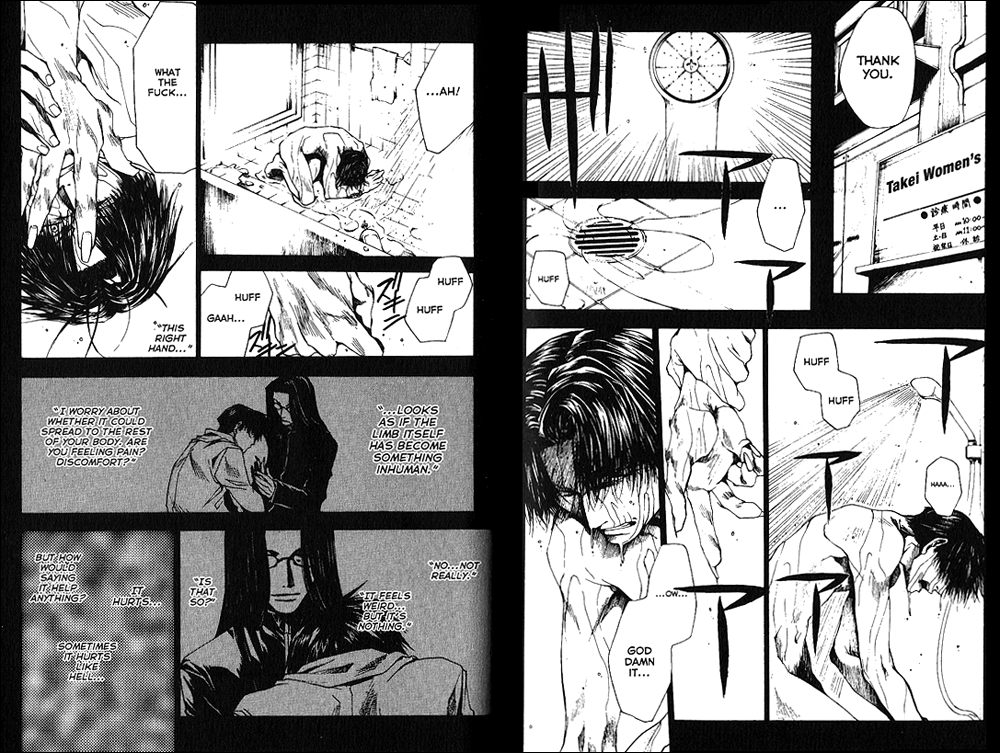
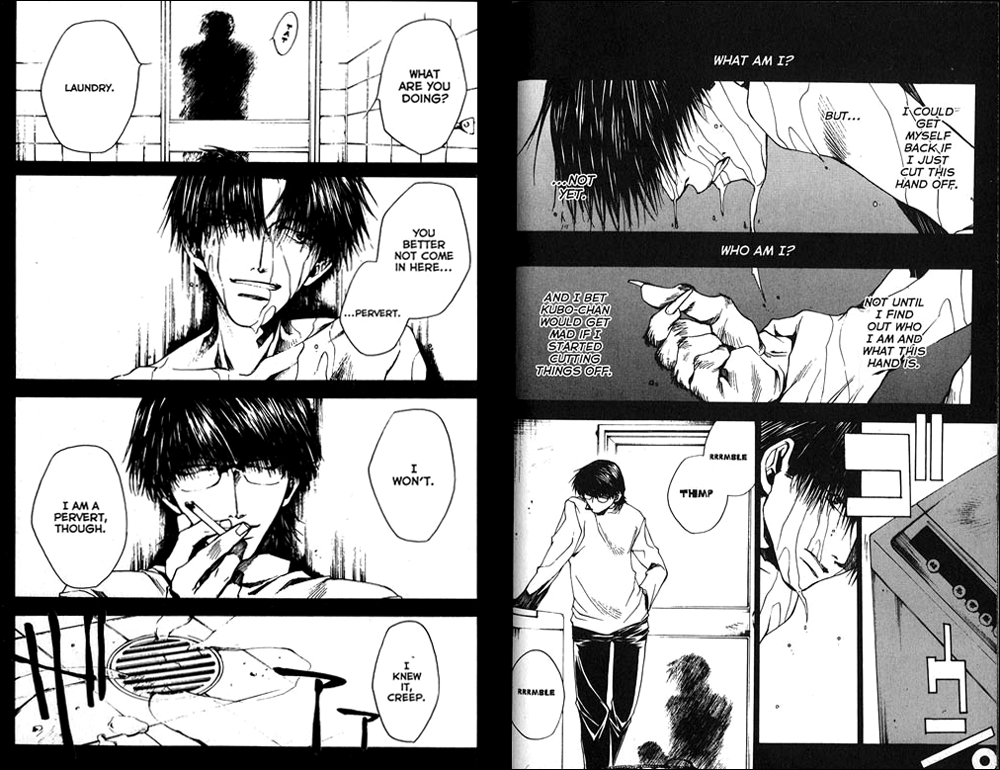
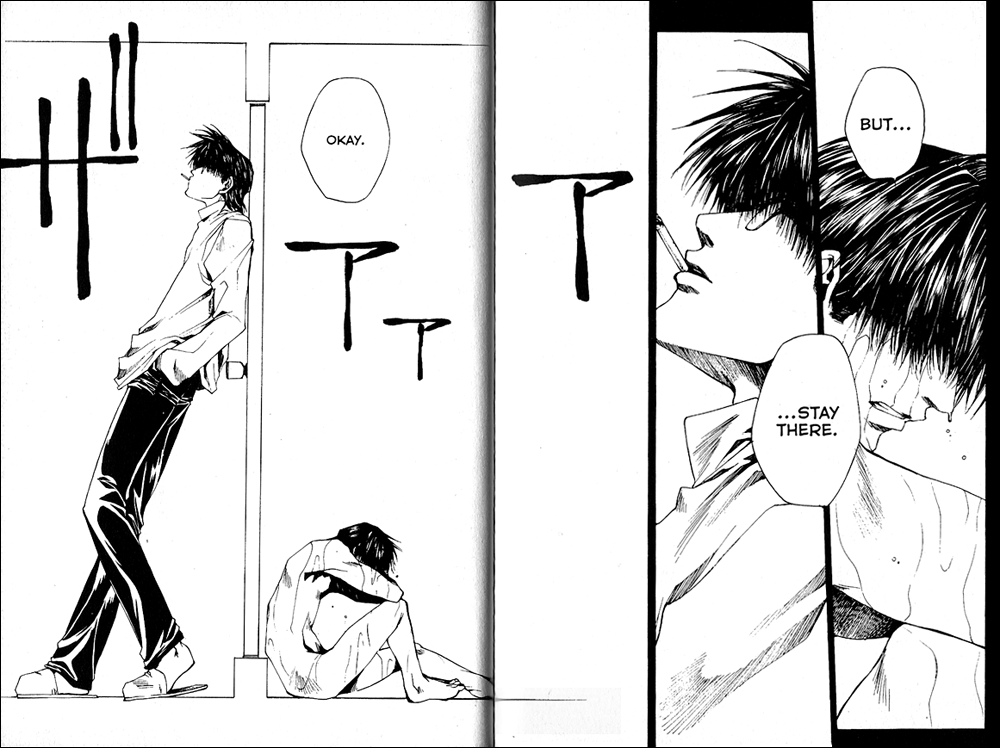
Whenever I think of Kazuya Minekura’s Wild Adapter (Tokyopop), an image pops into my mind: my bathtub. The water is hot and scented with some kind of mood-altering essential oil, possibly juniper, maybe rosemary, occasionally lavender. There is an alcoholic beverage perched on the edge of the tub to help me stay hydrated. And there is a volume of manga nearby.

Yes, I am a bathtub reader. It’s not my go-to hygiene technique, more an occasional indulgence. And, if you’re going to indulge, why not gild the experience? (My fondness for baths is such that I really, really want someone to license Mari Yamazaki’s Thermae Romae. Erica Friedman sent me the first two Japanese volumes, and I can’t read a character of the dialogue, but it looks terrific.)

Now, not just any manga will do. It needs to have a certain languid, moody quality. Ideally, it should be impregnated with feelings, even if those feelings are ambiguous. I love One Piece (Viz), but it is not bathtub manga. I’m impatient for the next volume of The Kurosagi Corpse Delivery Service (Dark Horse), but it is not bathtub manga. A new volume of Bunny Drop (Yen Press) cannot come soon enough, but even it is not bathtub manga. Wild Adapter is bathtub manga.

Why is that? Well, it’s partly because, empirically good and ambitious as Wild Adapter is, it doesn’t wear its quality on its sleeve. It gives you the opportunity to believe that you’re indulging in a guilty pleasure, even though you’re actually seeing a spectacular piece of craftsmanship. That, right there, is what makes manga bathtub manga for me.

So, in celebration of the current Manga Moveable Feast, I thought I’d list some other titles that may achieve their fullest entertainment potential when paired with bubbles and booze:

Antique Bakery by Fumi Yoshinaga (Digital Manga): It’s very, very difficult to pick just one of Yoshinaga’s works for this list, because she’s all about the appearance of effortlessness. She can go very dark places in her storytelling, and she does so routinely in work like Ôoku: The Inner Chambers (Viz), but you’ll rarely see her congratulating herself on her daring. Darkness is a part of life, and it can consume a moment without warning, which is certainly a recurring motif in Antique Bakery. Of course, the primary adjectives the series suggests are “funny” and “sexy,” and there are tons of illustrations of beautiful desserts.

Emma by Kaoru Mori (CMX): If there’s a mangaka better than Mori at dissecting a single, seemingly trivial moment and turning it into something telling and revealing, I’m hard-pressed to think of one. Aside from Jiro Taniguchi’s The Walking Man (Fanfare/Ponent Mon), Emma may be one of the most leisurely manga I’ve ever encountered. There’s certainly a story here – a star-crossed romance between a domestic and a member of the emerging middle class – but it’s draped in such obsessive interest in the behaviors and values of the era in which its set that it scarcely matters if you find Emma and William’s relationship plausible or sympathetic. You can just lose yourself in the minutiae of their lives and still be really, really satisfied.

Genshiken by Kio Shimoku (Del Rey): A lot of nerd comedy is frantic and unfunny. Your average ugly duckling hero is thrown into humiliating misadventure, allowing the audience to laugh at them (and cringe at the parts of themselves that identify with the poor loser). That’s all well and good, and no one will ever go broke catering to the audience for that kind of material, but my nerd comedy of choice is pretty much embodied by Genshiken. I don’t think anyone would ever use the term “frantic” to describe it. It’s much more likely to be called “contemplative,” even “leisurely” and possibly “wistful.” Shimoku goes for neither shame comedy nor canonization with his cast of geeks. Instead, he takes them seriously as characters, which is to say he gives them highs and lows over a period of time and gives readers a clear and satisfying portrayal of their thoughts and feelings.

Nana by Ai Yazawa (Viz): Okay, the lead characters are sitting in a bathtub on the cover. A lesser blogger may simply rest his or her case based on the overwhelming evidence that image provides, but no! I will soldier on to say that it’s Yazawa’s facility for big, messy emotions writ achingly small and her feverish ability to convey a vibe that’s both stylish and strangely nostalgic that make Nana ideal for a good, long soak. She’s packed the book with fascinating, complex, sometime unlikable characters that interact in ways that are constantly surprising but make perfect sense. And, since they’re very often shown to be imbibing, you won’t have to drink alone.

Suppli by Mari Okazaki (Tokyopop): Of all the manga heroines who could use a good long soak in a buble-filled tub, I would have to rank Minami very near the top. She works too hard for an advertising agency that’s often unappreciative of her efforts. It would display an excess of delicacy to describe her love life as “messy.” And yet this manga is indulgent because it’s very beautifully drawn and because Minami’s trials feel so delicately true. She feels very much like someone you might know, and she’s definitely someone you wish well. And, since it seems likely that we may never see the remainder of this wonderful series, it’s nice to be someplace private where you can cry into your washcloth.

So, who’s with me? Are there any other bathtub manga readers out there? What are your titles of choice?


Filed Under: FEATURES

MMF: Introduction to Wild Adapter

June 19, 2011 by MJ and Michelle Smith 7 Comments


MJ: Hello, everyone! I’m MJ.

MICHELLE: And I’m Michelle Smith.

MJ: We come before you today to introduce the subject of this month’s Manga Moveable Feast, Kazuya Minekura’s Wild Adapter.

MICHELLE: It’s rather hard to describe Wild Adapter in a succint manner, so I think I am just going to quote myself, from my 2009 review of the series:

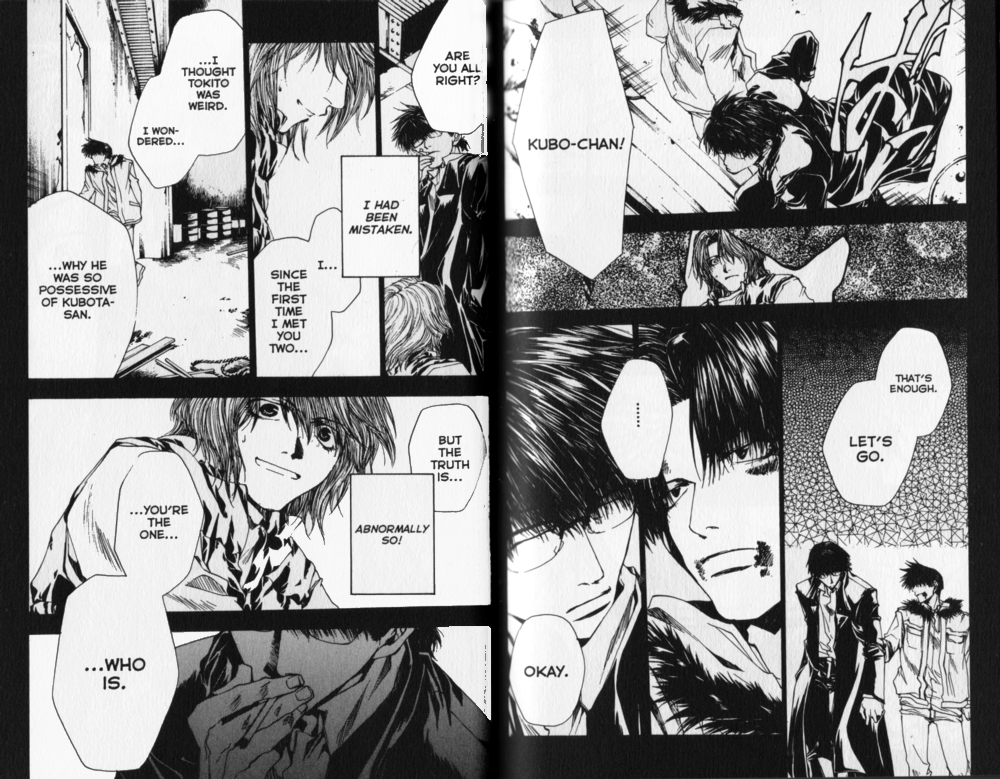
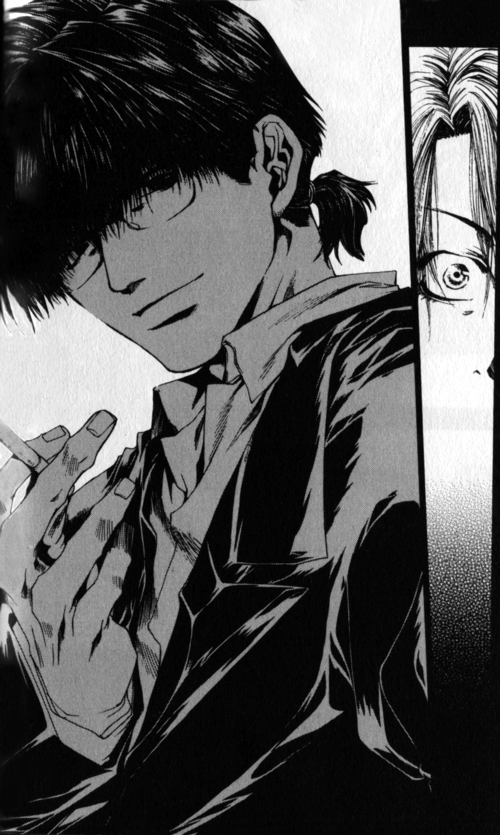
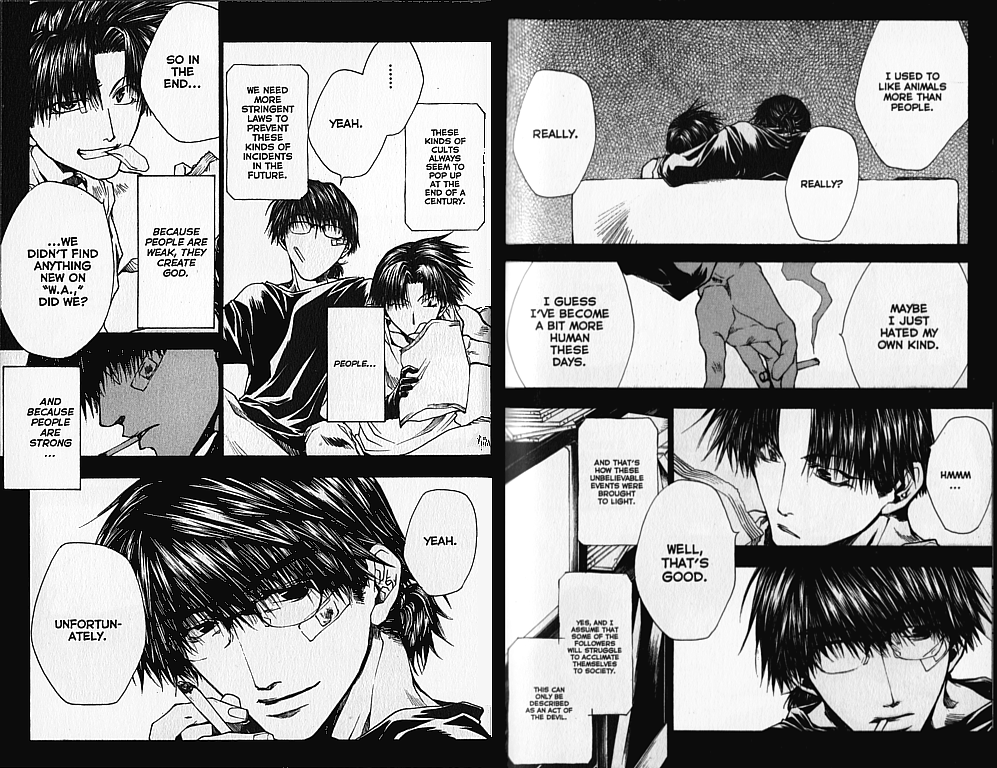
“On its surface, Wild Adapter is the story of Makoto Kubota, a former leader of a yakuza youth gang who is looking into a string of gruesome deaths, victims transformed into beasts by overdosing on a drug known as Wild Adapter. He takes in a “stray cat,” Minoru Tokito, with no memory of his past and a bestial right hand that indicates he’s had at least some exposure to the drug. Together, they attempt to unravel the mystery while Tokito strives to regain his memories and rival yakuza groups pursue Kubota for various reasons. Delving deeper, Wild Adapter is about two broken men who care for each other deeply but are so damaged that their affection manifests in unusual ways.”

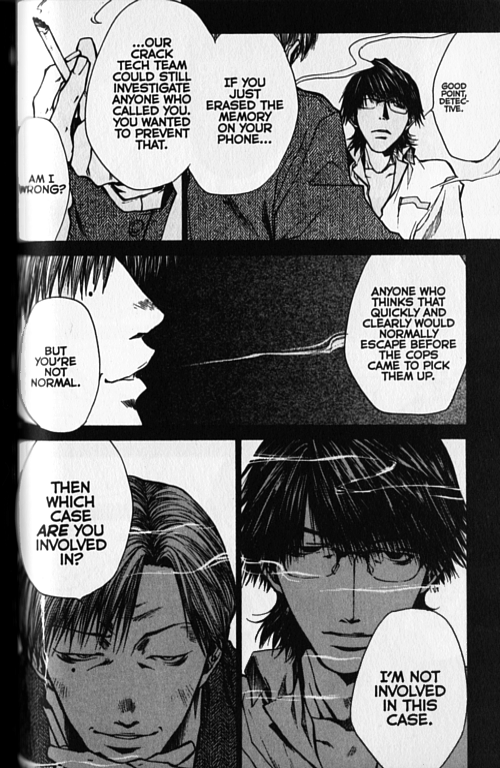
Each volume can stand alone, as Kubota and Tokito, for example, infiltrate a cult with possible connections to Wild Adapter (volume three) or undergo questioning as a person of interest in a murder investigation (volume four). One unique trait of the series is that, in each volume, a new supporting character is introduced through whose eyes we see the lead characters. This results in all manner of interesting observations regarding them and their relationship. Kubota generally comes off as mysterious and untouchable and Tokito as brash yet honest, but only the more astute observers recognize how deeply the aloof Kubota, who has never cared for much of anything before, cares about and relies on Tokito. It’s pretty fascinating.

MJ: Wild Adapter has been serialized in Tokuma Shoten’s Chara since 2001, with six tankobon releases to date, all of which were published in English by TOKYOPOP (the last in November of 2008). The series has been on hiatus since 2009, leaving five chapters hanging without tankobon release or official translation. Given the author’s other obligations and many health problems it is unclear when or if it will be continued.

Minekura is best known for her series Saiyuki and its many offspring, originally published in Square Enix’s pretty, pretty shounen magazine, G-Fantasy and later moving onto the more overtly female-aimed pages of Ichijinsha’s Comic Zero-Sum, a progression that highlights one of the elements that makes Wild Adapter so appealing. With her talent for fantasy-adventure, Minekura prefers to explore the relationships between her male characters in the thick of battle rather than in the bedroom, even in a boys’ love series like Wild Adapter. She also prefers sly innuendo over explicit romance, which forces her to create intimacy in other ways, something I find particularly refreshing in a BL series. Like Akimi Yoshida’s Banana Fish, Minekura’s non-romance feels more intimate than many outright love stories. Unlike Yoshida, Minekura also has an unbeatable sense of style and a wicked sense of humor about the genre that’s difficult to resist.

MICHELLE: The fifth volume of the series is my favorite, because it combines all of the elements MJjust mentioned into a touching whole. This volume backtracks to fill in the missing year between volumes one and two and depicts the early days of Tokito and Kubota’s acquaintance, as seen through the eyes of their lonely elementary-school neighbor, Shouta. There’s action, as Kubota is pursued by yakuza toughs, and there’s humor, particularly in the form of the shounen-style manga Shouta is drawing about his neighbors, but the most affecting part of the story is the wary way in which Kubota and Tokito gradually get closer, as caring for someone else this much is new territory for both of them.

MJ: But why just take our word for it? Here are a few thoughts from other reviewers online:

“The third volume of Wild Adapter offers everything I loved about the first two: improbably sexy characters posing through mostly outlandish scenarios, all of which manage to be unexpectedly involving beyond their considerable surface sheen. From time to time, it’s also hysterically, intentionally funny. There’s a bit in the third volume that I don’t want to spoil, but it made me laugh out loud. It combines everything that I love about the book: deft plotting, high style, and Minekura’s standing as one of manga’s premiere teases.”
– David Welsh, The Manga Curmudgeon

“At risk of sounding like a repeat of my review of volume five, Wild Adapter continues to keep me completely hooked with its fast paced action, potent character drama and wickedly dark tone. My only disappointment is how short each volume feels by the time I’m done. As usual I’m looking forward to the next one with great anticipation and hope the series continues to maintain its grittily-charged charm.”
– Lissa Pattillo, Kuriousity

“Let’s not mince words. You’ve got a story about drugs and the mafia, so the M for Mature rating on the back cover should come as no surprise to you. There’s also a bit of boy love going on during several pages, so if that’s not your cup of tea, you might also consider passing on this series. Those who stick around, though, are in for a very well written series that definitely creates a dark and gritty tone…perfect for this kind of story. There’s a lot of roughness to the book, both in terms of artistic style and panel placement, which keeps things just a bit off center, never allowing the reader to feel truly balanced. Accidental or intentional, it complements this book nicely.”
– A. E. Sparrow, IGN

“I think this series is considered by many to be Kazuya Minekura’s strongest work, and it’s not hard to see why. The pacing and story construction of Wild Adapter are deliberate, artistic, and effective. The entire first volume works as a sort of prologue with a definite beginning, middle, and end, and the second lead doesn’t appear until the very end of said volume; it’s simultaneously self-contained and an excellent starting point for a broader premise. I like Volume 2 even more. Wild Adapter has its fair share of homosexual themes, but with the exception of a silly yazuka kiss, they’re handled with surprising care and subtlety–a far cry from the ridiculous nature of most Boy’s Love stories.”
– Lianne Sentar, Sleep is For the Weak

MICHELLE: Please join us throughout the week as we highlight more coverage of this remarkable series. Participation is highly encouraged (see this post for details) but not mandatory.

But, seriously, you really should read it.

MJ: We’ll be posting special Wild Adapter-themed features here from Wednesday through Saturday, and of course we’ll be collecting links to your contributions! All links will be archived on this page. Please remember to e-mail or message one of us with links to your posts. And if you happen to be blogless, we’ll be happy to post on your behalf!

Enjoy Wild Adapter!


Filed Under: FEATURES Tagged With: Manga Moveable Feast, MMF, wild adapter

Taking a Close Look at Ultra Jump

June 16, 2011 by Erica Friedman 11 Comments

This article was originally published at Mangacast.net.

As sure as boys become men, some boys who read manga become men who read manga. And, at some point, battles for ninja clan supremacy fail to fully meet the emotional needs of that audience. No, that audience wants more violence, less focus on teamwork and strangely uncomfortable series that resolve without ending or end without resolving. For these readers, Ultra Jump is the magazine of choice.

Running 16 series currently, Ultra Jump is heavy on the sci-fi/fantasy and action, with some martial arts and a soupçon of magic. Ultra Jump got it’s start in 1999, some 30 years after it’s younger brother Shounen Jump. UJ is a monthly magazine, retailing in Japan for ¥560 ($6.65USD at time of writing) for just over 500 pages and like Shounen Jump, it’s available pretty much anywhere manga magazines are sold in Japan and in most Japanese bookstores in America. The 2010 circulation for Ultra Jump is reported to be 73,20 which is slightly up from 2009’s 70,834 and close to the 2008 circulation.  Ultra Jump has a digital magazine called Ultra Jump Egg, which provides sample chapters of manga series that have just begun to run in the magazine or, are perhaps being considered for it.

Of the series running currently in Ultra Jump, several have had a checkered experience on US shores. Infamously, Tenjou Tenge, which recently finished, was originally licensed by CMX, who had the nerve to deprive the readership of a glimpse of girl’s underwear and was therefore censured strongly by the folks least likely to actually buy the thing anyway. Viz has rescued this audience from that hell of not being able to see girl’s underwear, and new omnibus volumes are starting to hit the shelves.  Hayate x Blade (the actual reason that I get Ultra Jump) has been licensed and published through volume 6 by Seven Seas. Because Sevens Seas licensed the title from the original publisher, Mediaworks (who ran it in Dengeki Daioh magazine through Volume 8, when it moved to Shuiesha and Ultra Jump,) there is some confusion among fans whether Seven Seas will be able to continue it at least through that point or whether Volume 6 will be as far as the series makes it in English.

Because Ultra Jump is a Shueisha book, it’s no surprise that Viz has a strong presence in the UJ license game. Hyperviolent dystopian Gumn, known here as Battle Angel Alita, has undergone only slightly fewer iterations on these shores as it has in Japan and has managed to successfully reach Volume 14 of the Final Order series. Volume 15 is slated to be released in autumn 2011 Bastard!!, which made it to Volume 19 in English, is known for going on hiatus with some regularity (and has reached that stage of “venerable old series, which means it is serialized on the order of twice a year, perhaps.) Bastard!! is now on hiatus in English, as well. Also currently published by Viz is the hyperviolent dystopian Dogs, Bullets and Carnage.

Ultra Jump series have a tendency to be very long-running as manga series, (Ninku, Tenjou Tenge, Gunm, Steel Ball Run) but if they are turned into an anime at all, the anime tend to be OVAs or short series without second seasons. The overwhelming feeling as a reader is that this is a magazine for readers of manga, as opposed to anime/manga fans. And not just readers, but readers who are in for the long haul, who are content to see the plot develop through long fight arcs and the small spaces in between them. Of the remaining unlicensed titles, I can see Jumbor being ported here, fueled by any success with Takei Hiroyuki’s collaboration with Stan Lee, Ultimo – Jumbor has very similar character designs, but a slightly more classic sci-fi feel. And I wonder if America would be ready for a Wild West manga like Minagawa Ryouji’s Peace Maker. Viz is still slowly popping out Jojo’s Bizarre Adventure, so there’s at least a chance that, when that finishes, Steel Ball Run, a hyperviolent dystopian tale of the meanest polo game you ever did see, might make it over here. That, or when they hit the lottery and want to throw some of that money away on something people want, but will never buy.

The hyperviolent dystopian magical series Anima Chal Lives (one of my personal faves in the magazine), Grandeek Reel, Heaven’s Prison and Hatsukoi Magical Blitz all have about the same chance of being licensed as Needless, which is to say little, for any number of reasons, from constant, uneditable nudity, to constant, uneditable semi-nudity. (The Needless anime was licensed, I’m still not sure why. never was there a better-named series.)

I’ve seen UJ alternately labeled shounen (for boys, say 12-15) and seinen (for young men, say 16-25.) I’d weigh in on the side of seinen. It’s not that young boys can’t or won’t read and stick with long series – One Piece proves the lie on that pretty quickly – but that the sensibility of the stories, and the crises of identities are more “adult,” if you will. When I began this article, I was surprised, pleasantly, at how many of the series for this magazine have made it over here.  Viz has already resurrected Tenjou Tenge and, damn I’d love to hear that Hayate x Blade will be continued.

Ultra Jump, published monthly by Shueisha. http://ultra.shueisha.co.jp/


Erica Friedman write reviews of Yuri Manga, Anime and related media at her blog Okazu .

Filed Under: Magazine no Mori Tagged With: Manga Magazine, Seinen, Shounen, Shueisha

The Josei Alphabet: T

June 15, 2011 by David Welsh

“T” is for…

Tamashii no Futago, written and illustrated by Mitsuzaku Mihara, originally serialized in Shodensha’s Feel Young, two volumes. One of Tokyopop’s most focused efforts in publishing josei centered around Mihara’s works like The Embalmer and others. Here’s another Mihara title featuring two ghosts and the people who can see them.

Teke Teke Rendezvous, written and illustrated by George (A Perfect Day for Love Letters) Asakura, originally serialized in Shodensha’s Zipper, two volumes. The aggressive exterior of agricultural student Tayoko masks a novice in the ways of love. She’s working her way through school in a hostess club, so that should help out with the experience shortage.

Ten no Hate Chi no Kagiri, written and illustrated by Waki Yamato, originally serialized in Kodansha’s mimi, one volume. I note this tale of a poetess and seer wooed from a life of celibacy and service by rival princes not so much because it sounds particularly interesting but because its creator seems overdue for introduction to English-language audiences. Yamato is quite prolific, and it seems unfortunate that none of her work is available in print and in English.

Tenpari Ninpu no Shussan Icchokusen! written and illustrated by Tomoko Tamiya, originally published by Futubasha, one volume. This comic was developed to help women overcome their fear of childbirth and to give them strategies to help them enjoy pregnancy. Do you find that cover comforting? I think it looks like something by Junko Mizuno.

Tokyo Girls Bravo, written and illustrated by Kyoko (Helter Skelter) Okazaki, originally serialized in Takarajimsha’s CUTIE, two volumes, published in French by Casterman: A girl from the sticks finally gets the chance to live in Tokyo and fulfill her punk-rock dreams, but obstacles are thrown in her path by her conservative family. Every version of the covers for this book that I’ve seen is absolutely awesome.

Licensed josei:

  • Tomie, written and illustrated by Junji Ito, originally published by Asahi Sonorama, published in English by Comics One and Dark Horse, two volumes.
  • Tramps Like Us, written and illustrated by Yayoi Ogawa, originally serialized in Kodansha’s Kiss, published in English by Tokyopop, 14 volumes.

What starts with “T” in your josei alphabet?

Filed Under: FEATURES

Don’t Fear the Adaptation: Ristorante Paradiso

June 4, 2011 by Cathy Yan 9 Comments

Ristorante Paradiso | by Natsume Ono | Manga: Ohta Shuppan / Viz | Anime: David Production / Crunchyroll

Whenever you write a review of Ristorante Paradiso, you always have to get one thing out of the way first: which one is your favorite gentleman? When I read the manga, Luciano was mine, because I fall pretty hard for the gruff types who despite their claims of disinterest can’t help but meddle. And while the anime cemented my love of Luciano, I have to say anime Teo is exactly the handsome aniki I’d fall in love with at Casetta dell’Orso. It helps that he’s a dessert chef, mouthy, and also rides a motorcycle. (Lorenzo is disqualified from my rankings — he’s too perfect and there’s no way to avoid being in love with him and horribly, horribly jealous of Olga.)

Ristorante Paradiso is primarily about Nicoletta, a twenty-one year old determined to exact revenge on her mother Olga, who left Nicoletta behind in order to marry Lorenzo, a restaurant owner in Rome. But when she arrives in Rome, Nicoletta falls in love with Claudio, a waiter at Lorenzo’s restaurant, and ends up staying there as a kitchen apprentice. Like most of Natsume Ono’s stories, it’s a mature slice-of-life production with a slow plot and an ensemble cast filled with enigmatic men and self-assured women. The manga is short at one volume but has a three-volume prequel-sequel entitled Gente: The People of Ristorante Paradiso. The anime mixes and matches the overall Nicoletta-and-Claudio plot of Ristorante Paradiso but detours heavily into the backstories of Gente. The end product is very, very much House of Five Leaves meets Antique Bakery. Why else do you think I pleaded with MJto let me do a Natsume Ono double punch? ;)

Ristorante Paradiso the anime is a feel-good jousei version of a dating game crossed with a butler café. It falls somewhere in between the beloved reverse harem romcoms like Ouran Host Club and the “counseling session of the week” trope of Bartender (which, incidentally, was also adapted into an anime). Like Antique Bakery, Ristorante Paradiso has its moments of drama — some might even argue, melodrama — but it’s one of those series that ultimately boils down to its playful sampling of human life. It’s bursting with little stories about romance, family, growing up, and, well, more romance. There’s a particularly memorable side story about a woman whose husband keeps cheating on her. The dell’Orso staff, especially Gigi and Vito, get involved, and the episode caps off with a very serious, but touching, lesson about marriage and coincidence that even O’Henry would have been proud of. Episode eight and nine owe more to Giuseppe Tornatore than Iron Chef, and episode four, which chronicles the founding of dell’Orso, could be a movie all by itself.

All the characters, especially the gentlemen, get a boost from being animated and paired with a voice actor. Gigi and Lorenzo as twenty-somethings are heartwrenchingly adorable when animated, and Claudio as a young and awkward server trying to find off the amorous intentions of a rich patron will make you swoon. Of special note for me are the relatively unknown Mitsutaka Tachikawa as Luciano and Jin Yamanoi as Claudio. Listening to Yamanoi really makes you believe you’re in the presence of a saint, while Tachikawa’s Luciano is beyond endearing, especially when he growls.

The additional materials from Gente, on top of keeping the anime from having to stretch out one volume’s worth of material into eleven slow episodes, also gives more depth to Nicoletta and her relationship with Claudio. Nicoletta’s observation that love comes in different shapes makes more sense when you get to meet all the significant others of the dell’Orso staff. That they spend more time together and go through a lot more troubles together makes their ending in the anime far sweeter and more conclusive. An unexpected benefit of getting to know Luciano better in the anime was that Claudio, in the process, came into better focus. Their friendship and comparable statuses (Luciano as a widow and Claudio, a divorcee) meant Claudio comes off in the anime as more than just a nice guy. You struggle with him over his idealistic nature, sympathize with his inability to move past his ex-wife Gabrielle, and really, truly wish for his happiness. You feel like you understand just what it is that Nicoletta sees in him.

David Production is a smaller, newer studio compared to Madhouse, the studio responsible for Ono’s other anime adaptation House of Five Leaves. The style in Ristorante Paradiso is less obviously Ono’s this time around, but David Production still did an excellent job translating Ono’s art style. The glimpses of food in the series are mouthwatering, and the shots of the staff’s favorite enoteca, with shelves and shelves of wine bottles, make me want to follow Nicoletta’s journey and spend an extended vacation in Rome. There’s some awkward use of CG as well as a laughable moment in episode six, where if you pause the video in Olga’s office, you can see that the certificate behind her is issued to “Bob Fields”, Cambridge, and qualifies the recipient to teach English to adults. Other than that, the animation is top notch. Episode seven introduces Luciano’s daughter Margherita who is almost indistinguishable from Nicoletta, but that, I think, is more the fault of Ono herself and not the studio’s.

For fans of the manga who were frustrated with the slowness of Ristorante Paradiso‘s first few chapters, but liked Gente‘s character development, the anime is the best of both worlds. (It’s just a terrible shame that Crunchyroll took down their videos.) For those of you who have yet to read the manga, while some have complained that the anime’s flashbacks were too confusing, I would recommend watching the anime over reading the manga. The meshing of Gente with Ristorante Paradiso makes for a fuller, more fleshed out cast and also tempers the ending of Nicoletta’s storyline, which I found unsatisfactorily abrupt when reading the manga. It’s far from realistic, the initial conflict between Olga and Nicoletta is still solved too easily, and very few of the staff’s backstories cover truly original ground. But if you like food, are a people-watcher, or simply enjoy a little romanzo in your life, Ristorante Paradiso welcomes you to Casetta dell’Orso.

Filed Under: Don't Fear the Adaptation Tagged With: anime, gente, Natsume Ono, ristorante paradiso

The Josei Alphabet: S

June 3, 2011 by David Welsh

“S” is for…

Sekai de Ichiban Yasashii Ongaku, written and illustrated by Mari Ozawa, originally serialized in Kodansha’s Kiss, 16 volumes. Most series about single parents that have been licensed are about single fathers, so this tale of a single mother would be most welcome. Also, I’m kind of in love with the covers; you can view more of them at Kodansha’s site for the title.

Shibou to lu Na no Fuku o Kite, written and illustrated by Moyocco (Sugar Sugar Rune, Happy Mania) Anno, originally serialized in Shufu to Seikatsusha’s Shuukan Josei, one volume. Anno looks at a woman’s ambivalent struggle with her weight in a thin-dominated society.

Shin Yami no Koe – Kaidan, written and illustrated by Junji (Uzumaki, Gyo, Tomie) Ito, originally serialized in Asahi Sonorama’s Nemuki, one volume. I’m not a huge horror fan, but I find Ito’s work irresistibly unsettling, so I’d love to read this collection of shorts created for a josei magazine.

Silver, written by Penny Jordan, adapted to manga by Kazuko Fujita, originally serialized in Shogakukan’s Josei Seven, nine volumes. An innocent heiress marries badly and realizes that her husband was just in it for the money. She remakes herself into the perfect woman to avenge herself and her family. It sounds kind of trashy but awesome.

Spicy Pink, written and illustrated by Wataru (Ultra Maniac, Marmalade Boy) Yoshizumi, originally serialized in Shueisha’s Chorus, two volumes, published in French by Glénat. I would be happy as a clam if someone finally decided to publish a josei series from this terrific creator. This one’s about a busy mangaka with no time for a social life who meets an obnoxious but not entirely unpromising doctor on a group date.

Josei Magazines:

  • Shuukan Josei, published by Shufu to Seikatsusha

Licensed josei:

  • Saiyuki Reload, written and illustrated by Kazuya Minekura, originally serialized in Ichijinsha’s Comic Zero-Sum, published in English by Tokyopop, 10 volumes.
  • Sengoku Nights, written by Kei Kusunoki, illustrated by Kaoru Oohashi, originally serialized in Shueisha’s Comic Crimson, published in English by Tokyopop, two volumes.
  • Suppli, written and illustrated by Mari Okazaki, originally serialized in Shodensha’s Feel Young, partly published in English by Tokyopop, 10 volumes plus extra.

What starts with “S” in your josei alphabet?

Reader recommendations and reminders:

  • Sounds of Love, written and illustrated by Rin Tanaka, originally serialized in Ohzora Shuppan’s Renai Hakusho Pastel, published in English by Luv Luv Press, three volumes.
  • Sugiru Juunana no Haru, written by Fuyumi Ono, illustrated by Kotetsuko Yamamoto, currently running in Gentosha’s Spica. 
  • Shuukatsu!! – Kimi ni Naitei, written and illustrated by Aki Yoshino, originally serialized in Shogakukan’s Petit Comic, two volumes.

Filed Under: FEATURES

The Josei Alphabet: R

June 2, 2011 by David Welsh

“R” is for…

Real Clothes, written and illustrated by Satoru Makimura, currently serialized in Shueisha’s You: This fashionable manga features a plain salesclerk who is transferred to the women’s clothing department of her store. Needless to say, a makeover is in order. We need more fashion manga.

Receptacle, written and illustrated by Rendou Kurosaki, currently serialized in Hakusensha’s Rakuen le Paradis. This has barely started, but it’s got a solid magazine provenance and the cover is really cute. It’s apparently about two girls who kind of crush on each other and talk about their lives as geek girls. I love chatty, woman-driven manga.

Reset, written and illustrated by Mayuri Yamamoto, serialized in Bunkasha’s Horror M, eight volumes. Josei combined with episodic horror sounds like two great tastes that taste great together! In this series, a rotating cast of protagonists are given the choice to reset their lives at a critical point. It sounds like an intriguing premise.

River’s Edge, written and illustrated by Kyoko Okazaki, serialized in Takarajimasha’s Cutie, one volume. This dramatic tale of emotionally stunted teens sounds like the perfect cross-marketing opportunity for indie comics fans. In fact, I’m pretty sure there are already seven or eight versions of this story already on the shelves.

Rouge Noir, written and illustrated by Kyoko Mizutani, serialized in Shogakukan’s Petit Comic, two volumes. An aspiring musician takes up private piano instruction, and we all know how that ends up, don’t we? We don’t? Okay, well, in this case, the teacher gets the unrequited hots for one of her students, and they meet years later at an audition for a jazz combo. And surely we all know how that ends up, right?

Josei magazines:

Rakuen le Paradis, published by Hakusensha, enticingly described by Erica (Okazu) Friedman.

What starts with “R” in your josei alphabet?

Reader recommendations and reminders:

  • Real Love, written and illustrated by Mitsuki Oda, originally published by Ohzora Shuppan, published in English by Luv Luv Press, one volume.
  • RIP: Requiem in Phonybrain, written and illustrated by Mitsukazu Mihara, originally published in Index Communications’ Kera, published in English by Tokyopop, one volume.

Filed Under: FEATURES

Manga Moveable Feast: Wild Adapter Archive

June 1, 2011 by MJ

    From Your Hosts

  • Call for Participation
  • Introduction to Wild Adapter
  • BL Bookrack: Wild Adapter Roundtable (with special guest David Welsh)
  • 3 Things Thursday: Wild Adapter
  • Sacrifices made in the name of blogging
  • Fanservice Friday: The Human Touch
  • Let’s Get Visual: Wild Adapter
  • Late Breaking News: Wild Adapter moves to Ichijinsha
    Essays, Roundtables, Discussions, Podcasts, etc.

  • Random weekend question: hot stuff (David Welsh, The Manga Curmudgeon)
  • MMF: Bathtub manga (David Welsh, The Manga Curmudgeon)
  • Cover Watch: Wild Adapter (Lissa Patillo, Kuriousity)
  • Random Musings: Mahjong, Kubota, and Wild Adapter (Ash Brown, Experiments in Manga)
  • MMF: More Minekura (David Welsh, The Manga Curmudgeon)
  • No Us and Them: Theme in Wild Adapter (Chou Jones, Manga Bookshelf)
    Reviews

  • Wild Adapter… reading volume 1 (Linda, Animemiz’s Scribblings)
  • MMF: Likeability (David Welsh, The Manga Curmudgeon)
  • Wild Adapter, Volume 1 (Ash Brown, Experiments in Manga)
  • Saiyuki, volumes 1-3 (Lori Henderson, Manga Xanadu)
  • The slow, wild ride to appreciating Wild Adapter (Jason S. Yadao, Honolulu Star Advertiser)
  • This Genius’s Manga Movable Feast: Wild Adapter (Justin Stroman, Organization Anti Social Geniuses)
  • Rereading Saiyuki Volumes 1-3 (Anna, Manga Report)
  • Connie’s Wild Adapter reviews (Connie C., Slightly Biased Manga) added 2/1/12
    From the Archives

  • Minekura, Kazuya: Wild Adapter, vol. 1-2 (Joy Kim, joykim.net)
  • Wild Adapter (Anna, TangognaT)
  • Wild Adapter 1-6 (Michelle Smith, Soliloquy in Blue)
  • Wild Adapter, Vol. 1 (Deanna Gauthier, Manga Bookshelf)
  • Wild Adapter, Vols. 2-6 (MJ, Manga Bookshelf)
  • Wild Adapter Mini Review (Lianne Sentar, Sleep is for the Weak)
  • Wild Adapter Vol. 1 Review (A. E. Sparrow, IGN)
  • Quick comic comments: Wild Adapter vol. 3 (David Welsh, The Manga Curmudgeon)
  • Review: Wild Adapter, Vol. 6 (Lissa Pattillo, Kuriousity)
    Past Feasts

  • May 2011: Cross Game (Derik Badman, The Panelists)
  • April 2011: Rumiko Takahashi (Rob McMonigal, Panel Patter)
  • March 2011: Aqua and Aria (Linda, Animemiz’s Scribblings)
  • February 2011: Barefoot Gen (Sam Kusek, A Life in Panels)
  • January 2011: Karakuri Odette (Anna, Manga Report)
  • December 2010: One Piece (David Welsh, The Manga Curmudgeon)
  • September 2010: Afterschool Nightmare (Sean Gaffney, A Case Suitable for Treatment)
  • August 2010: Yotsuba&! (Robin Brenner, Good Comics for Kids)
  • July 2010: Paradise Kiss (Michelle Smith, Soliloquy in Blue)
  • June 2010: The Color Trilogy (MJ, Manhwa Bookshelf)
  • May 2010: To Terra (Kate Dacey, The Manga Critic)
  • April 2010: Mushishi (Ed Sizemore, Comics Worth Reading)
  • March 2010: Emma (Matt Blind, Rocket Bomber)
  • February 2010: Sexy Voice and Robo (David Welsh, The Manga Curmudgeon)

Filed Under: FEATURES Tagged With: Manga Moveable Feast, MMF, wild adapter

Let’s Get Visual: Mono no Aware

May 28, 2011 by MJ

MICHELLE: It’s the last Saturday of the month, and that means it’s time for another Let’s Get Visual column! Joining me as always is MJ, from Manga Bookshelf. This month, we’ve chosen images that convey the feeling of mono no aware, which Wikipedia defines as, “the awareness of impermanence, or the transience of things, and a gentle sadness (or wistfulness) at their passing.”

If I’m interpreting that definition correctly, there appears to be a subtle difference between mono no aware and outright nostalgia, where the former is more of-the-moment (Honey and Clover springs to mind here) while the latter would be something like the retrospective narration in Ai Yazawa’s NANA.

What’s your take on it, MJ?

MJ: I actually feel rather unclear myself, so I’m hoping that between you and our generous readers I’ll gain a better understanding via this column. Though I’ve read the Wikipedia entry, along with several other web pages that attempt to explain the concept, I’m not entirely sure I understand the true essence of mono no aware. I’ll do my best, of course, to take a stab at it!

MICHELLE: As will I! And if we do get it wrong, generous readers, please go easy on us!

What images have you chosen to talk about? (Click images to enlarge.)

Blue, Pages 224-end (Fanfare/Ponent Mon)

MJ: Well, since we do focus on visuals here, I chose a series of panels from the end of Kiriko Nananan’s bittersweet yuri romance, Blue, published in English by Fanfare/Ponent Mon. To a great extent, I think the entire manga exemplifies mono no aware, at least as I understand it at this time, as its primary romance seems obviously transient from the beginning. There’s never a sense that its protagonists, Kirishima and Endo, have a long-term future together, so the tone is wistful throughout. Every detail, down to the artist’s stark drawing style, suggests a gentle melancholy, even in the characters’ happiest moments.

As you can see, the story’s final pages are nearly text-free. After exchanging restrained parting words, Kirishima rides off to Tokyo in a train, leaving Endo on the platform, smiling sadly. As the train pulls away, Kirishima turns and leans against the door, finally letting her tears fall, unseen by Endo.

Not only do these panels express the sadness of an (apparently) inevitable parting, but they deliberately display this in the simplest, most beautiful way possible. Nananan’s barely toned artwork accents the slightest movement, giving enormous weight to a single teardrop–even to a single fold in Kirishima’s clothing. This sadness is elegant in every way, down to the strands of black hair tumbling over Kirishima’s fingers in the books’ final frame. It’s gorgeous, truly, and so simply bittersweet.

Though, as I’ve said, I’m not entirely sure I fully understand mono no aware, these panels perfectly illustrates what I think it might be. I hope someone will tell me if I’m wrong or right.

MICHELLE: I think you’ve got it right, because we can tell that Kirishima realizes that this is the last time she is going to see Endo. She still loves her, but their time together is over. It’s a very sad scene, but it’s also a beautiful scene, and because this heartbreaking moment is depicted with such care and such clarity, I think it qualifies as mono no aware.

MJ: I’m relieved to know that you think so!

So what have you chosen to share with us tonight?

Shugo Chara!, Volume 10, Pages 148-149 (Kodansha Comics)

MICHELLE: I’ve chosen a two-page spread from the tenth volume of Peach-Pit’s magical girl series, Shugo Chara!. The series has followed its protagonist, Amu Hinamori, since she was in the fourth grade, and now her final days of sixth grade are drawing nigh. She and her friends are responsible for planning the graduation ceremony and Amu has gone to check out the state of the auditorium.

When she gets there, Amu is stunned by the sight of a room full of empty chairs. It’s silent and still, and its emptiness is only emphasized by the barrel ceiling. The sight reminds her of the many things that have happened at school and with her new friends, times when this room was full of life, but there’s more to it than that. There is still one more occasion where they will all be together—graduation. Things are not quite over for them, this room will once more be peopled by those whom Amu cares about, but still, the knowledge that change is imminent makes Amu wistful somewhat in advance.

Maybe the difference between mono no aware and nostalgia can be summed up as “these days will never come again” versus “those were the days.”

MJ: What a perfect choice for illustrating that point! You’re absolutely right, the wistfulness here is for the present much more than it is for the past. She’s living in the very moment she mourns, struck by the warmth of the present and its imminent loss all at once. What a lovely example, Michelle!

MICHELLE: Thanks! This image was the inspiration for this column, actually. I’ve certainly read other series that employ mono no aware—I loved that aspect of Honey and Clover before I even knew that it had a specific name—but I was struck by how this one spread conveyed the same idea almost completely wordlessly. “Living in the very moment she mourns” is a beautiful way to put it.

MJ: So I suppose it’s up to our readers now to let us know how well we’ve done in our attempt to interpret mono no aware?

MICHELLE: Indeed! And if anyone has images they’d like to share, please feel free! Also, please come back and join us next month for a special Wild Adapter-themed edition of Let’s Get Visual to coincide with the Manga Moveable Feast being hosted at Manga Bookshelf the week of June 19th through 25th!

Filed Under: FEATURES, Let's Get Visual Tagged With: Fanfare/Ponent Mon, Kodansha Comics

The Josei Alphabet: Q

May 25, 2011 by David Welsh

“Q” is for…

… not very much at all, but there is one title that sounds potentially awesome.

QB Karin – Keishichou Tokushu SP-ban, written and illustrated by Yuriko Nishiyama, currently serialized in Kodansha’s Kiss. A female police inspector leads an elite squad of hunks tasked with protecting very important female persons. Nishiyama also created the well-liked Dragon Voice and long-running street basketball saga Harlem Beat, both of which were partially published by Tokyopop. (The fate of Dragon Voice was particularly cruel, as it stopped just one volume short of completion.) In other words, Nishiyama has suffered from what Kate Dacey might call the Ai Morinaga Syndrome. She could use some luck, and perhaps this enticing-sounding mash-up could be the solution. Here’s the Kiss site for the series.

What starts with “Q” in your josei alphabet?


Filed Under: FEATURES

Breaking Down Banana Fish, Final

May 24, 2011 by MJ, Michelle Smith, Connie C., Eva Volin, Robin Brenner and Khursten Santos 25 Comments

Welcome again, and for the very last time, to our roundtable, Breaking Down Banana Fish!

We greet you this month with our final installment, covering volumes seventeen through nineteen of this epic series, as well as two side stories (“Angel Eyes” and “Garden of Light”) which are included in the final volume of the English-language edition of the manga. It’s hard to believe we’ve finally come to the end!

I’m joined again in this round by Michelle Smith (Soliloquy in Blue), Khursten Santos (Otaku Champloo), Connie C. (Slightly Biased Manga), Eva Volin (Good Comics For Kids), and Robin Brenner (No Flying, No Tights).

Just a note before we begin, this final edition of “Breaking Down Banana Fish” contains in-depth discussion of the series’ final chapters, including the outcome of the all series’ main conflicts and the fates of its characters. Obviously this means spoilers, so if you’re new to the series we recommend you begin reading along with the discussions listed below.

Read our roundtable on volumes one and two here, volumes three and four here, volumes five and six here, volumes seven and eight here, volumes nine and ten here, volumes eleven through thirteen here, and volumes fourteen through sixteen here. On to roundtable eight!

…

Read More

Filed Under: FEATURES Tagged With: banana fish, breaking down banana fish, roundtables

License Request: Crazy for You

May 20, 2011 by Michelle Smith

I contributed a guest license request to David Welsh’s weekly feature at his blog, Manga Curmudgeon. My pick was Crazy for You, a six-volume shoujo series by Karuho Shiina, creator of Kimi ni Todoke: From Me to You, a series which I adore.

I don’t expect to love Crazy for You to the same extent, but it certainly sounds interesting! Check out the post for more details. In the meantime, I’ve got the German editions (published by TOKYOPOP!) on their way here, and will be getting my Google Translate on something fierce.

Filed Under: FEATURES Tagged With: Karuho Shiina

BL Bookrack: May

May 19, 2011 by MJ 5 Comments

Welcome to the May installment of BL Bookrack, a monthly feature co-written with Soliloquy in Blue‘s Michelle Smith.

This month, we take a look at three offerings from Digital Manga Publishing’s Juné imprint, The Color of Love, That Was Good, and Your Story I’ve Known, as well as a rare offering from Yen Press, volume two of Tale of the Waning Moon.


The Color of Love | By Kiyo Ueda | Published by Juné | Rated Mature (18+) | Buy at Akadot – Although we generally review new releases for these BL Bookrack columns, I wanted to take the opportunity to check out The Color of Love (released in 2008), as it is among several DMP works recently pulled from Amazon for violating their content requirements. After reading the book, it is hard to see why it was targeted, when much more explicit BL—Under Grand Hotel, anyone?—is still available for purchase.

Like many BL releases, The Color of Love is a collection of short stories. Most of them, including the title story, feature pairs of friends who are in love with each other but concerned about what this will mean for their friendship. In “The Color of Love,” Nao is worried that his best friend Taira might learn about his “wicked thoughts,” and so helps a classmate cover up her romance with a teacher by posing as her boyfriend. Taira is demonstrably jealous, and a confession ensues.

In “The Ideal Love,” a recent college graduate with a particular type gradually realizes that his former classmate might just be the perfect match. In “How to Be Happy,” Kouta can’t quite believe that his best friend, Kazuyuki, has confessed his love since Kazuyuki rejected him back in high school. In “Mix,” Yoshino can’t reconcile Yamazaki his best friend with Yamazaki his boyfriend, so removes his glasses during intimate moments to make his partner look like a blurry stranger. In “Friendship Formula,” Nitta attempts to cheer up a jilted (straight) classmate by confessing his own feelings. The one exception to this theme is “Direction of a Smile,” depicting a romance between a hotel front desk manager and a bellboy.

In all of these stories, the characters involved care about each other very much. Are they depicted in the act of sex? Well, yes, but it’s generally only a panel or two showing bodies locked together lovingly. The Color of Love is no more explicit than your average BL manga and actually far less explicit than many. I suspect that whoever filed the complaint didn’t get past the first page, which, admittedly, devotes its first couple of panels to Nao enjoying a private moment whilst indulging in those “wicked thoughts” of his. This might give an undeserved impression of overall smuttiness.

So, don’t let Amazon’s actions fool you. In reality, The Color of Love is far more nice than naughty.

-Review by Michelle Smith


Tale of the Waning Moon | By Hyouta Fujiyama | Published by Yen Press | Rated Mature (18+) | Buy at Amazon – Memory is a funny thing. When the second volume of Houta Fujiyama’s Tale of the Waning Moon arrived at my doorstep, my first reaction was “ugh.” I’d remembered clearly reviewing the first volume, at which time I’d declared it, “…unrealistic, essentially plotless, outrageously fluffy” and most emphatically, “Not My Kind of Yaoi.” What I apparently forgot between then and now, however, is that I also called it “energetic,” and “genuinely funny,” qualities I’m unfortunately having difficulty attributing to the series’ second volume.

Though this manga first won me over with its simultaneous satire of common BL tropes and RPG-style questing, Fujiyama’s sly humor doesn’t wear all that well. The questing in particular has begun to lose its luster, as the characters are sent out on a seemingly endless journey to acquire a series of objects required to get our hero, Ryuka, to his celestial destination, and what once read as sharp humor now resembles too closely the very things it strives to lampoon.

The same can be said for the series’ campy, everyone-is-gay landscape, which risks outright earnestness in this volume—a trait that should never be blended with scantily-clad cat boys. And were jokes about constipation ever funny? Perhaps I missed the memo.

That said, there’s a consistent sense here that the comic is in good hands. Even at her worst, Fujiyama writes smoothly and confidently, stringing us along with the promise of better things.

Will she make good on that promise in volume three? We live in hope.

-Review by MJ


That Was Good | By CJ Michalski | Published by Juné | Rated Mature (18+) | Buy at Akadot – When I go into a BL anthology, I’m always expecting the worst. Questionable plot, shoddy characterization, outrageously rushed romance—these things are standard in any romance anthology. It’s almost guaranteed. Also common in this type of BL is humor so broad it borders on homophobia. Oh, and don’t forget: lots and lots of smut.

That Was Good has everything I just described and more. Its three stories each feature a previously heterosexual, dashing hunk who falls for a (questionably heterosexual) boyish beauty whom he forces into sex, but it’s okay ’cause HE’S IN LOVE. Other special features here include grown men making jokes about eating sausage to a toddler who catches them in bed, and vampire/elf cosplay, though I’ll admit the latter offers up the only genuine bit of humor in the entire book. Skip to the cosplay, people, just skip to the cosplay.

If I sound a bit sarcastic and jaded… okay, yeah, I’m feeling slightly bitter over having read the whole thing. Thing is, it was listed as an anthology, so I should have known better.

Michalski’s straightforward artwork is more crisp than expressive, though she at least depicts sex more deftly than some. This can’t save the book by any means, but it’s perhaps enough reason to read for the porn. Overall, however, the title is sadly ironic. That Was Good is one to miss.

-Review by MJ


Your Story I’ve Known | By Tsuta Suzuki | Published by Juné | Rated YA (16+) | Buy at Akadot – Although I’d stop short of calling myself an outright fan of Tsuta Suzuki’s series, A Strange and Mystifying Story—sexual healing as administered by guardian beast isn’t really my thing—it is nonetheless memorable, and I’ve been looking forward to reading Your Story I’ve Known ever since the license was announced.

There aren’t any supernatural elements in these stories, which I consider a good thing. The first three stories, including the title piece, depict the relationship between Hart Matsumoto, a dim-witted but handsome boy with an abusive mother, and a yakuza named Shibuzawa, who was the kindest of his mother’s many boyfriends. Shibuzawa provides a safe place for Hart to go when his mother turns violent and continues to look after him into young adulthood.

Although he’s aware of Hart’s feelings for him, Shibuzawa maintains a policy of gentle discouragement until Hart’s mother is killed. Somehow, Shibuzawa ends up in bed with Hart—as consolation, perhaps? Giving the boy what he’s always wanted while withholding the upsetting news? Shibuzawa’s motivations here are quite complex, and it’s a shame that the story of his relationship with Hart wraps up quickly thereafter.

A similar problem plagues the next story in the collection, “Sautéed Onions,” a mostly forgettable story of two friends who’ve recently become a couple and are feeling insecure about the other’s feelings. It’s not bad, but it’s so short that there’s no chance whatsoever to get to know either of the characters. “As Long As You Can Hear Me,” about a fight-prone kid and the samurai ghost who protects him, fares somewhat better.

The real gem of the collection is the final story, “Without the Gods Seeing.” When Narasaki was in high school, he reacted harshly to a friend’s confession of love, and in the intervening ten years, has come to regret that he responded the way he did. When Wakakki, a handsome coworker, makes his own confession, Narasaki reacts more thoughtfully, taking the time to talk to Wakakki about his feelings and gaining new perspective on how much bravery is required to make such an admission to a friend.

It’s a really sweet story and Suzuki makes good use of her pages, painting Narasaki’s and Wakakki’s characters in quick strokes that define their personalities reasonably well. I absolutely love, for example, that it was Narasaki’s habit of feeding neighborhood kitties on his lunch break that caught Wakakki’s eye in the first place.

While a couple of the stories are disappointingly brief, on the whole this is an enjoyable collection, complemented by Suzuki’s unique artistic style. I’m not sure whether devotees of A Strange and Mystifying Story would find it to their liking, since it is quite different, but I’d personally rate it the better of the two.

-Review by Michelle Smith


Review copies provided by the publisher.

Filed Under: BL BOOKRACK Tagged With: tale of the waning moon, that was good, the color of love, yaoi/boys' love, your story I've known

The Josei Alphabet: P

May 18, 2011 by David Welsh

“P” is for…

Patisserie Mon, written and illustrated by Kira, originally serialized in Shueisha’s You, ten volumes. It’s a josei title about baking. I have nothing to add, but do I really need to add anything?

Pikupiku Sentarou, written and illustrated by Tsubasa Nunoura, currently serialized in Kodansha’s Be Love. As not everyone has a side in the dogs-versus-cats debate, I give you a long-running comedy about a pet bunny.

Porando Hishi Ten no Hate Made, written and illustrated by Riyoko Ikeda, three volumes. Who wouldn’t want to read Ikeda’s fictional examination of the elective monarchy of the 18th century Polish-Lithuanian Commonwealth? No one I want to know, that’s who wouldn’t. The Amazon Japan listings for the first and second volumes let you “look inside.” Just search using 天の涯まで.

Pride, written and illustrated by Yukari Ichijo, originally serialized in Shueisha’s Chorus, 12 volumes. This award-winning title follows the careers of dueling, would-be opera divas. My money’s on the woman on the cover above. Diva looks like she came to play.

Pure Maple Pancake, by Keiko Shiomori, originally serialized in Shueisha’s You, five volumes. A career woman’s messy life gets messier when her estranged older sister goes missing and leaves a young son behind.

Josei magazines:

  • Petit Comic, published by Shogakukan
  • Petit Flower, published by Shogakukan, defunct

Licensed josei:

  • Paradise Kiss, written and illustrated by Ai Yazawa, originally serialized in Shodensha’s Zipper, published in English by Tokyopop, five volumes.
  • Pet Shop of Horrors, written and illustrated by Matsuri Akino, originally published by Ohzora Shuppan, published in English by Tokyopop, 10 volumes.
  • Planet Ladder, written and illustrated by Yuri Narushima, originally serialized in Sobisha’s Comic Crimson, published in English by Tokyopop, seven volumes.
  • Pretty Poison, written and illustrated by Yutta Narukami, originally published by Ohzora Shuppan, published in English by LuvLuv Press, one volume.
  • Public Wife, Private Mistress, by Masami Hoshino, adapted from a novel by Sarah Morgan, originally published by Harlequinsha, published in English by eManga, one volume.

What starts with “P” in your josei alphabet?

Reader recommendations and reminders:

  • Private Prince, written and illustrated by Maki Enjoji, originally serialized in Shogakukan’s Petit Comic, published in French by Kaze, five volumes.

Filed Under: FEATURES

The Josei Alphabet: O

May 11, 2011 by David Welsh

“O” is for…

Ohimesama no Yurikago, written and illustrated by Emiko Yachi, originally serialized in Shueisha’s Young You, three volumes. After her father passes away, outspoken Chizu is dragged from her home in Las Vegas to live with family in Japan. Will she adjust?

Oishii Kankei, written and illustrated by Satoru Makimura, originally serialized in Shueisha’s Young You, 16 volumes. When her wealthy family falls on hard times, Momoe takes a job in a French restaurant and enters into a contentious relationship with gifted shelf chef Oda.

Otoko no Isshou, written and illustrated by Keiko Nishi, currently serialized in Shogakukan’s Flowers. You know I can resist a book that’s been nominated for a Manga Taisho Award. Way back in the day, Viz published some of Nishi’s manga – Love Song and two of the Four Shôjo Stories. This one’s about a relationship between a younger woman and an older man.

Otona no Yuru no Otogibanshi, written and illustrated by Megumi Toda, originally serialized in Shogakukan’s Petit Comic, one volume. It’s been too long since I’ve included a title simply because it included “Smut” as one of its genre search options. In this case, a marriage-minded office lady loses her prime husband candidate to a friend, gets drunk, and winds up in bed with a younger man of seemingly limited prospects.

Oujisama to Waltz wo, written and illustrated by Chisato Nakamura, based on a novel by Nicole Burnham, originally published by Ohzora Shuppan, one volume. I’m so taken with this first sentence of the plot synopsis: “Jennifer Allen had come to save refugees, not to be swept away by some pampered, fairy-tale prince of neighboring San Rimini.” I’m reasonably certain she’ll find a way to make time for both. But seriously, don’t you hate that? You just want to dig irrigation ditches, but you keep getting wooed.

Licensed josei:

  • An Officer and a Princess, written and illustrated by Megumi Toda, based on a novel by Carla Cassidy, originally published by Harlequinsha, published in English by eManga, one volume.
  • One Summer in Italy, written and illustrated by Nanami Akino, based on a novel by Lucy Gordon, originally published by Harlequinsha, published in English by eManga, one volume.
  • Only By Chance, written and illustrated by Chieko Hara, based on a novel by Betty Neels, originally published by Harlequinsha, published in English by eManga, one volume.
  • Ôoku: The Inner Chambers, written and illustrated by Fumi Yoshinaga, currently serialized in Hakusensha’s Melody, published in English by Viz.
  • Object of Desire, written and illustrated by Tomoko Noguchi, originally published by Ohzora Shuppan, published in English by LuvLuv, one volume.

What starts with “O” in your josei alphabet?

Reader recommendations and reminders:

  • Olimpos, written and illustrated by Aki, originally serialized in Ichijinsha’s Comic Zero-Sum and Zero-Sum Ward, two volumes.

Filed Under: FEATURES Tagged With: Comic Zero-Sum, Flowers, fumi yoshinaga, Ichijinsha, Josei, Ohzora Shuppan, Petit Comic, Shogakukan, Shueisha, Young You, Zero-Sum Ward

  • « Go to Previous Page
  • Page 1
  • Interim pages omitted …
  • Page 94
  • Page 95
  • Page 96
  • Page 97
  • Page 98
  • Interim pages omitted …
  • Page 114
  • Go to Next Page »
 | Log in
Copyright © 2010 Manga Bookshelf | Powered by WordPress & the Genesis Framework