Why You Should Read (and Want More) Evyione: Ocean Fantasy
Part I
Overview
Evyione: Ocean Fantasy is an extremely loose adaptation of Hans Christian Andersen’s “The Little Mermaid”. It is obvious just how loose the adaptation is the moment it is revealed that it’s not a story of love between a mermaid and a prince, but a merman and a princess. He eventually gets the name Yaxin Tapileile (note: I read this in Chinese. I have no idea what the European equivalent of ‘Yaxin Tapileile’ would be, so I am stuck with his sinicized name), and her name is Evyione.
Udon Entertainment published the first volume in English in 2008. Since then no new volumes have been published in English. You should want this situation to change. In this piece (and in part II) I’ll explain why.
The art was the first thing which drew me into this series, so it feels like the most appropriate place to start.
The Style
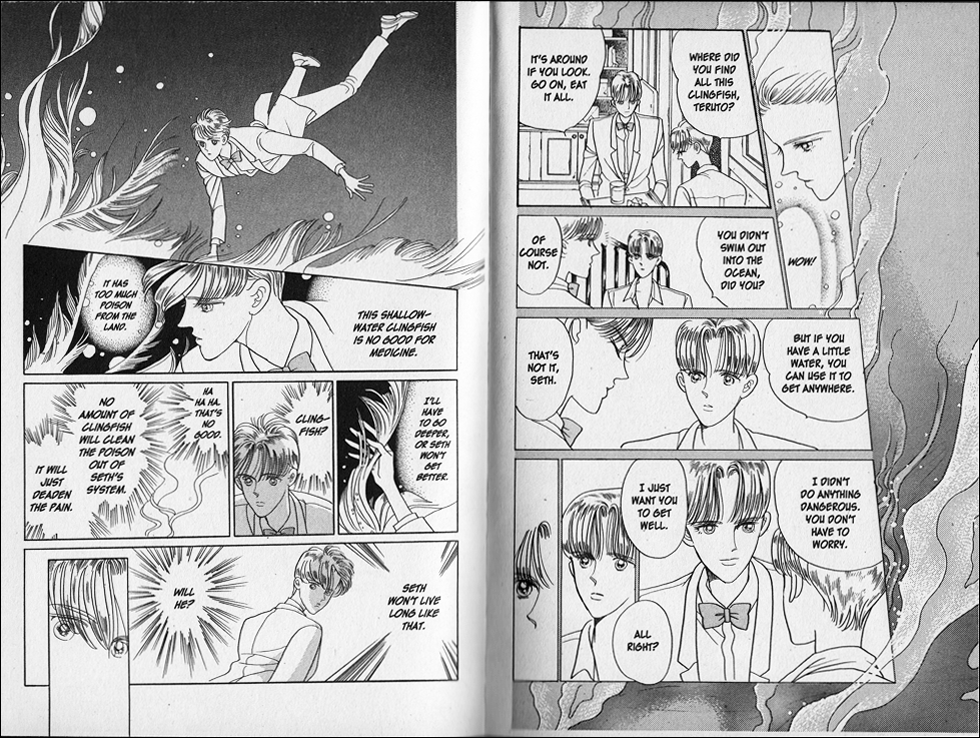
You know those comics where there are lots of diagonals, irregularly yet creatively shaped panels, flowers and other decorative embellishments, and half of the pictures illustrate, not what is happening in the material world, but what is happening inside the characters hearts? Like the shojo comics of the 1970s, for example? Evyione: Ocean Fantasy is not like that.
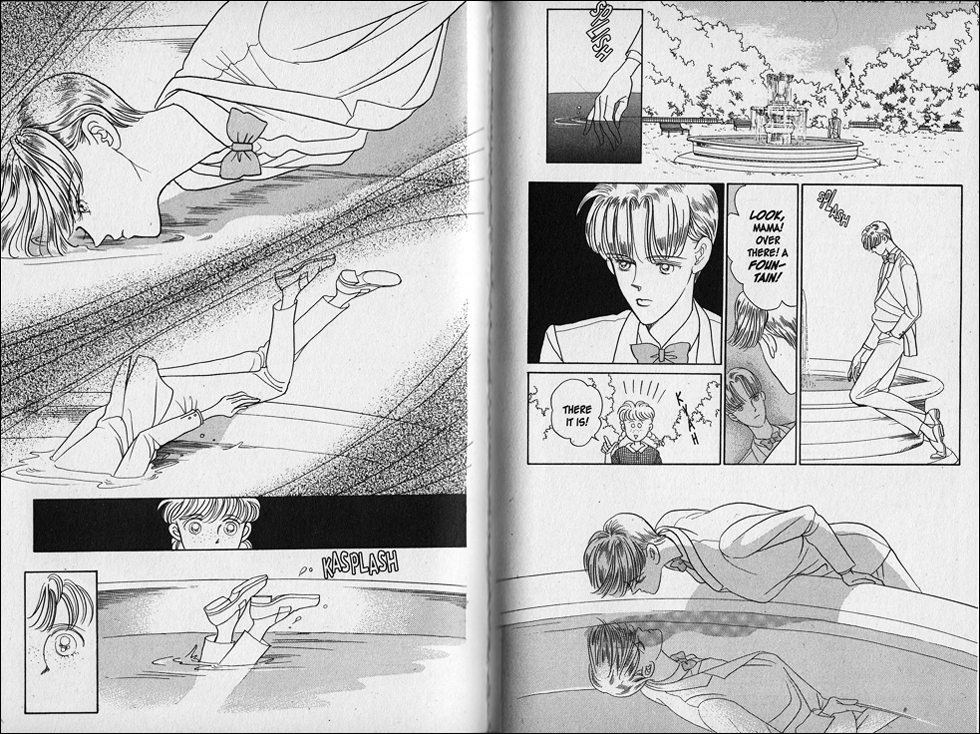
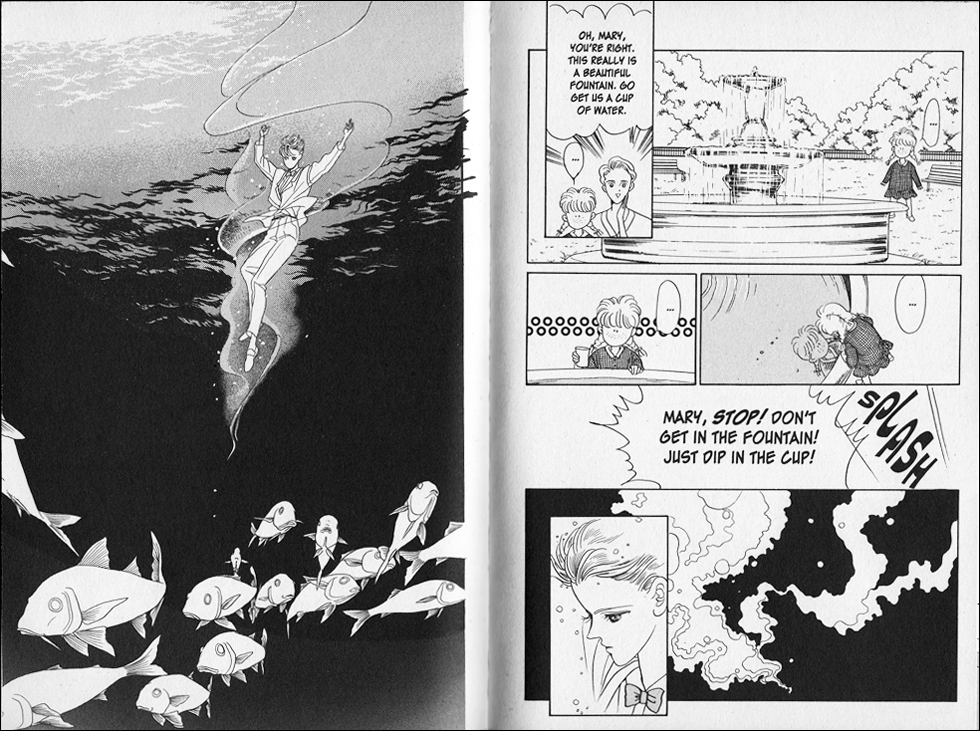
Instead, the art in Evyione: Ocean Fantasy embodies a spirit of orderly, natural, and refined elegance. This was the spirit of the Rococco style popular in the 18th century Europe prior to the revolutionary era, which is when Evyione: Ocean Fantasy is set. The artwork of Evyione: Ocean Fantasy is Mozart, not Beethoven.
All of the most beautiful illustrations in Evyione: Ocean Fantasy incorporate nature. As the name “Ocean Fantasy” suggests, much of the story takes place by the sea, which provides plenty of opportunities to show dramatic scenery. One of the most visually stunning sequences is when Yaxin goes horseriding through the countryside during a thunderstorm. Likewise, the best portraits of Evyione incorporate bits of nature – for example, in the picture I show below, her hair is wet and dripping with rain.
Clothes!
I went through the first 6 volumes, and counted how many unique dresses Evyione wears in each volume during the main story. They are all Rococco dresses, mainly based on the style of the 1750s-1770s. I did not count it when she wore the same dress again, only when she wore a dress she had never previously worn.
Volume 1 – 4 dresses
Volume 2 – 8 dresses
Volume 3 – 10 dresses
Volume 4 – 8 dresses
Volume 5 – 8 dresses
Volume 6 – 4 dresses
Most comic book characters, even main characters, rarely wear 4 never-before-seen outfits over 180 or so pages. While it is historically accurate that an 18th century princess would wear many different dresses, considering that the story is set up in the imaginary kingdom of Emvonia, there is no reason to be historically accurate. Furthermore, there is no story-related reason for her to wear so many dresses – rather, the dress count is so low in volumes 1 and 6 because the plot forces Evyione to be cut off from her wardrobe for an extended period of time. Even without her wardrobe, Evyione still gets to wear new dresses in volume 1 and 6 because other characters come in and say “Hey Evyione, I brought you some new clothes” – an action which is not necessary to move the plot forward.
And in my count, I did not include the extras at the end of each volume, where Evyione and other characters pose in various attires not seen during the main story.
There is only one logical explanation for this abundance of outfits. Kim Young-Hee loves drawing Rococco dresses.
Let’s look at one, specifically a dress from Volume 4.
(click image to enlarge)
The overall effect of the dress is to make Evyione look like a flower. Not in the literal sense, but to give her the qualities which make flowers beautiful. Notice first that the silhouette of her figure forms a soft bell shape, like a flower that is hanging down. The engageants (those are the extensions of her sleeves) are layered like petals. The layers of her gowns, with a flower-print upper layer contrasted against a lower white layer, have the same petal-like effect on her entire body. The lace-like material on her stomacher is cut into vertical strands, which are allowed for form a wavy, natural shape. Likewise, the vertical cuts of the lace-like material help form a bridge between the lower part of the dress and Evyione’s face. The large ribbon on Evyione’s stomacher forms a central point, giving the dress focus. The low neckline creates a sense of openness, while the choker shows restraint. And to, literally, top it off, the hat caps the entire picture, and the hat’s slight angle slants the viewer’s attention towards Evyione’s face. Like I said, this is orderly, refined, yet natural elegance.
Kim Young-Hee’s love for these clothes shines throughout the art. Many comics set in various historical eras uses the clothes only as a marker saying ‘this is [historical era]’. These comics often use various shortcuts to make the historical dress easier and faster to draw. And there is nothing wrong with prioritizing the story in a story-telling medium. But Kim Young-Hee never skimps on the details for the clothes. Instead, she plays with them – which is why there are so many different designs. Ultimately, I think it not the adherence to the Rococco style, but the love and sense of play which makes these dresses a delight to behold.
No Clothes!

While’s it’s fun to play dress-up with Evyione, it would be a bit much if other characters, specifically Yaxin and the queen, didn’t balance it out. With nudity. Rather than going against the Rococco aesthetic, the nudity actually complements it. Roccoco emphasizes the natural; nothing is more natural than the naked body. The nudity is very tasteful – no genatalia is ever exposed. Storywise, the nudity does not so much evoke eroticism (though it does that too) as help flesh out the characters.
Yaxin, of course, is the one who most often shows his natural assets. A fanservice element is operating here; Yaxin is a bishounen after all. It’s also a source a humor – I love it in Volume 6 when Evyione figures that asking him to put on some clothes would only make the situation even more awkward. But ultimately, the nudity shows that Yaxin does not belong in human society. While he sometimes wears clothes, and functions in society to some extent, he really belongs in the sea.
The queen’s nudity, on the other hand, shows how vulnerable she is. One of the most striking images in all of Evyione: Ocean Fantasy is also of the of few abstract images; it is an image in Volume 5 of the queen, naked. In that image, her back exposed as arms come from out of the shadows and wrap around her. It is part of a scene expressing grief, jealousy, and especially rage. Nudity expresses in a visual manner how defenceless the queen is.
Storytelling
Say what? This…

… is not enough for you? You want a plot? Well, as it happens, there is a story. The scenery, dresses, and nudity even help tell it.
The artwork has been very supportive to me. Reading Evyione: Ocean Fantasy in Chinese, which is not my native language, forces me to rely on the art to a much greater degree than if I were reading it in English. And the artwork delivers. What is going on is almost always clear. Even the fight scenes are easy to follow. That means Evyione does all of the right visual pacing. Whatever the techniques are, they work.
There is one particularly memorable page from Volume 6. There are only three panels and no dialogue. In the top panel, Evyione notices [spoiler]. In the middle panel, the reader gets a better view of [spoiler]. In the bottom panel, Evyione decides what to do about [spoiler]. She conveys her choice with her eyes alone. Because the story had been building up to [spoiler], the fact that Evyione made that choice would have been powerful stuff no matter how she communicated it. But the fact that she only used her eyes? Not only does that show Kim Young-Hee’s ability to tell a story with pictures, that makes that moment all the more moving. The first time I saw that final, bottom panel, it sent a shiver through my spine, and I had go through those three panels over and over again before I was able to turn the page. That’s what I call good visual storytelling.
Of course, Yaxin has to communicates things with his body language all the time, being a mute and all. I take it so much for granted that I didn’t realize until the final edit that Yaxin does things like I describe in the paragraph above all the time.
So, about that Story…
While the artwork is what first drew me in, it’s the story which keeps me reading, and stays with me after I close the book. I hope you’ll read Part II, which is all about the story.
In the mean time, if a picture is worth a thousand words, then the 33-page preview at Udon Entertainment’s website is worth about 20 times more than this piece.
See you when Part II gets posted.
Big thanks to Julie Engelbrecht for being an awesome teacher; I wouldn’t have been able to write this if I hadn’t been her student.
Sara K. has spent almost all of her life in San Francisco, California. She got tired of living in San Francisco, so one day she boarded a plane bound for Haneda Airport, and has never been back to San Francisco ever since. She currently lives in an Asian city you have never heard of.