• Skip to primary navigation
  • Skip to main content
  • Skip to primary sidebar
  • Home
  • About Us
    • Privacy Policy
    • Comment Policy
    • Disclosures & Disclaimers
  • Resources
    • Links, Essays & Articles
    • Fandomology!
    • CLAMP Directory
    • BlogRoll
  • Features & Columns
    • 3 Things Thursday
    • Adventures in the Key of Shoujo
    • Bit & Blips (game reviews)
    • BL BOOKRACK
    • Bookshelf Briefs
    • Bringing the Drama
    • Comic Conversion
    • Fanservice Friday
    • Going Digital
    • It Came From the Sinosphere
    • License This!
    • Magazine no Mori
    • My Week in Manga
    • OFF THE SHELF
    • Not By Manga Alone
    • PICK OF THE WEEK
    • Subtitles & Sensibility
    • Weekly Shonen Jump Recaps
  • Manga Moveable Feast
    • MMF Full Archive
    • Yun Kouga
    • CLAMP
    • Shojo Beat
    • Osamu Tezuka
    • Sailor Moon
    • Fruits Basket
    • Takehiko Inoue
    • Wild Adapter
    • One Piece
    • After School Nightmare
    • Karakuri Odette
    • Paradise Kiss
    • The Color Trilogy
    • To Terra…
    • Sexy Voice & Robo
  • Browse by Author
    • Sean Gaffney
    • Anna Neatrour
    • Michelle Smith
    • Katherine Dacey
    • MJ
    • Brigid Alverson
    • Travis Anderson
    • Phillip Anthony
    • Derek Bown
    • Jaci Dahlvang
    • Angela Eastman
    • Erica Friedman
    • Sara K.
    • Megan Purdy
    • Emily Snodgrass
    • Nancy Thistlethwaite
    • Eva Volin
    • David Welsh
  • MB Blogs
    • A Case Suitable For Treatment
    • Experiments in Manga
    • MangaBlog
    • The Manga Critic
    • Manga Report
    • Soliloquy in Blue
    • Manga Curmudgeon (archive)

Manga Bookshelf

Discussion, Resources, Roundtables, & Reviews

Blog

Between the Sheets

September 12, 2014 by Ash Brown

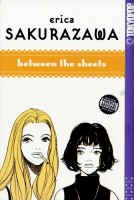
Between the SheetsCreator: Erica Sakurazawa
U.S. publisher: Tokyopop
ISBN: 9781591823230
Released: May 2003
Original release: 1996

Between 2003 and 2004, Tokyopop published six manga by Erica Sakurazawa, some of the very first josei manga to be released in English. More than a decade later josei has still yet to establish a firm foothold in North America, though things seem to be improving and publishers continue to make an effort. Most of the josei that I have read I have thoroughly enjoyed. I wish that there was more available in English, but in the meantime I make the point to support what is currently available and to track down those titles, like Sakurazawa’s, that have gone out of print. The first of Sakurazawa’s manga to be translated was Between the Sheets, which was originally published in Japan in 1996. The volume was not my introduction to her work but out of all of Sakurazawa’s manga that I have so far read, I feel that it is one of the strongest in terms of storytelling. Between the Sheets was initially brought to my attention due to the elements of same-sex desire that play a critical role in the manga’s story.

Minako and Saki are extraordinarily close friends. They frequently hang out together, enjoying the bars and party scene where Saki, despite having a boyfriend, is constantly on the lookout for men. But when Saki and Minako share a drunken kiss in order to convince an undesirable suitor that they’re a couple and to leave them alone, Minako finds her feelings for her best friend beginning to change. Minako had always admired and cared deeply for Saki, but now her love has turned obsessive. She wants to be with Saki. In some ways she wants to be Saki. Saki views Minako as an extremely important person in her life but nothing more than a friend while Minako wants to be everything for Saki: her lover, her protector, her one and only. Convinced she knows what’s best for Saki, Minako will do anything to get closer to her and to drive others away, including sleeping with Saki’s boyfriends.

Frankly, Between the Sheets is an exceptionally disturbing and even horrifying work. Minako’s obsession with Saki creates an ominous and foreboding atmosphere. Each turn of the page seems as though it could reveal some sort of horrible tragedy worse than what has already occurred. Minako’s feelings become self-destructive and her way of dealing with them hurt not only herself but Saki and the men in their lives as well. Often in fiction and romance one person’s utter devotion to another is held as an ideal. However, Between the Sheets takes a much more realistic approach to this sort of extreme, obsessive desire. Minako’s fixation on Saki becomes all-consuming. It’s not flattering and it’s not romantic. In fact, it can hardly even be called love anymore. Her friendship with Saki has evolved into something much darker and much more dangerous. The damage done may be irreparable.

Because of its subject matter Between the Sheets can be a tough and uncomfortable read; it is not at all a feel-good story and there is very little happiness to be found. The characters are entangled in a web of lies, cheating, and betrayal. Unpleasant emotions like hatred, anger, and jealously overshadow those of adoration, love, and affection. However, Sakurazawa handles the intensity of those feelings in a believable way. That realism is probably one of the reasons that Between the Sheets is so troubling. Minako appears to be normal and innocent, her twisted way of thinking hidden safely from view. Sakurazawa’s artwork reflects this–on the surface nothing seems amiss. If readers weren’t privy to Minako’s inner thoughts, they might never suspect the unhealthiness of her state of mind. But eventually her actions and their tragic consequences cannot be ignored and make it quite clear to everyone involved how unbalanced she has become.

Filed Under: REVIEWS Tagged With: Erica Sakurazawa, manga, Tokyopop, Year of Yuri

Manga the Week of 9/17

September 11, 2014 by Sean Gaffney, Ash Brown, MJ and Michelle Smith 2 Comments

SEAN: Given the beginning and end of September have far more manga than is really sensible, it makes sense that there are also weeks where very little comes out. This is one of those weeks.

tit

Guidebooks are quite popular in Japan, but have never sold well in North America for some reason. Kodansha hopes that changes with the publication of Attack on Titan Guidebook: INSIDE & OUTSIDE. I think this omnibuses two separate guides from Japan, and will tell you far more than you could imagine about the world of the Titans.

ASH: I’m rather curious to read this one, especially since Kodansha has been so adamant about only publishing manga until now.

SEAN: Actually, back in the Del Rey days they released guidebooks for Tsubasa.

Kodansha also has the 5th volume of Genshiken 2nd Season, which continues to fascinate with its attempts to grab a new BL audience while still courting its old one via the harem antics.

MJ: So, I never picked this up, because I’d never read the original Genshiken and so on… but I do sort of want to let them attempt to grab me as a BL audience. That’s always fun. So. Hm.

ASH: Well, I can say that I’ve been enjoying the second season!

SEAN: Speaking of Attack on Titan, for those who enjoyed Kodansha’s release of Before the Fall, the prequel series, the novel it was based on comes out via Vertical, who have said it’s selling even better than hotcakes – and you know how well hotcakes sell.

MJ: Mmmmm, hotcakes.

ASH: Mmmmm, light novels. If I recall correctly, Vertical has already had to order a second printing of Before the Fall, and it hasn’t even been released yet!

SEAN: The final volume of Bokurano: Ours from Viz has been anticipated for so long that I made the joke about it back a month ago when Ikigami ended. So go look at that entry instead.

MICHELLE: I should muster my fortitude and finish Bokurano. I think I will have to do it on a sunny day amidst frolicking unicorns or something, just to keep my spirits up.

SEAN: Viz also has the second volume of Terra Formars.

So, ignoring that deliberate silence, what will you be picking up next week?

Filed Under: FEATURES, manga the week of

Phantom Thief Jeanne, Vol. 4

September 11, 2014 by Sean Gaffney

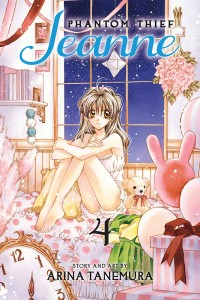
By Arina Tanemura. Released in Japan as “Kamikaze Kaitou Jeanne” by Shueisha, serialized in the magazine Ribon. Released in North America by Viz.

Before I get started, I want to note that I remain immensely pleased with this series. It has a lot of what magical girl series should have, a nice sense of humor even in its darkest moments, a good deal of cuteness, and the ongoing plot is fascinating. Everyone should be picking this up. With that said, let me spend this review dwelling a bit on things that felt problematic to me in this volume.

jeanne4

To be fair, one of these things is sort of unavoidable. In her massive villain rant at the start of the series, Finn Fish reveals that Maron has been manipulated, not just since she met Finn, but since birth, as it was the influence of Satan that led to her parents breaking up. I dislike the agency that this removes, and feel that it makes her parents less interesting people – their almost shallow horribleness was a large part of what made Maron so strong and interesting. But then that’s Finn’s point, and certainly if you’re in a series where God and Satan are real, you have to expect temptation to have more concrete forms.

Less excusable is Maron’s forgiveness of Noin’s actions once they go back in time to meet Jeanne D’Arc. She immediately rationalizes the attempted rape by noting that if he’d meant to go through with it, he would have done it while she slept, and also points out that it was due to both being possessed by a demon and his love for Jeanne. Which, yes, is true, but the whole “It’s OK, you were just overcome in the heat of the moment” forgiveness rankles in many shoujo titles. We also have several moments in the second half where Chiaki is attracted to Maron so much that he forces himself on her multiple times. This is meant to be half-amusing, and he beats himself up over it, but that doesn’t actually stop the attempts, even when he knows she’s in a fragile state.

And then there’s Miyako. She gets less of a role to play in this volume until the end, clearly upset that the “phantom thief” isn’t appearing anymore. The problem is that her plotline is mostly resolved – she’s realized that Chiaki loves Maron, and that she can’t really do anything to change that. So, as she herself notes, all that’s left to do is confess to him, get rejected and move on. She is, therefore, too nice to be an antagonist anymore. And that has to be fixed, so at the end of the volume we see her abducted by Finn, and she later pops up, I suspect, clearly possessed by evil. I wish there were a more natural way to do this.

That said, there’s still so much to love about this volume, don’t get me wrong. Everything about Finn’s past and her relationship with Access is beautifully tragic, and (typical for Japan) paints God as being not all that much better when it comes to forgiveness. Yamato’s confession to Maron, and subsequent rejection, plays out beautifully, and is likely why Tanemura wanted to avoid repeating it with Miyako. And the time travel arc is handled surprisingly well and logically, and among its questionable forgiveness does have Maron assuring Jeanne that being raped does not make you less good of a person.

To sum up, see the start of this review. Even with my issues, it’s still far and away by favorite Tanemura series.

Filed Under: REVIEWS

Boogiepop and Others

September 10, 2014 by Ash Brown

Boogiepop and OthersAuthor: Kouhei Kadono
Illustrator: Kouji Ogata

Translator: Andrew Cunningham
U.S. publisher: Seven Seas
ISBN: 9781933164168
Released: January 2006
Original release: 1998
Awards: Dengeki Novel Prize

Boogiepop and Others is the first volume in a series of light novels written by Kouhei Kadono and illustrated by Kouji Ogata. The novel was originally released in Japan in 1998 after winning the Dengeki Game Novel Prize (now known simply as the Dengeki Novel Prize). Boogiepop and Others has been credited with igniting the light novel trend in Japan. Whether that is true or not, the novel has inspired more than a dozen other volumes in the Boogiepop novel series as well as other books, short stories, manga, music, a live-action film adaptation, an anime, and more. Out of the fairly large franchise, four of the light novels–including Boogiepop and Others–two short manga series, the anime, and the film have been released in English. The English-language edition of Boogiepop and Others, translated by Andrew Cunningham, was published by Seven Seas in 2006. Although I had been aware of the Boogiepop Phantom anime series for quite some time, Boogiepop and Others was actually my introduction to the franchise and is set before the events of the anime.

No one is entirely sure who or what Boogiepop is, but there are several rumors and theories among the students of Shinyo Academy. Stories are told about a spirit of death, an assassin who can kill instantly and painlessly. When a number of female students at Shinyo Academy go missing, many naturally assume that Boogiepop must have had something to do with their disappearances. Others believe Boogiepop to be nothing more than a myth or urban legend, but they can’t deny that something very strange and very wrong is going on at their school. Most of the missing girls are written off as runaways by the police and their cases are quickly dropped. And so a few of their classmates take it upon themselves to investigate since they can’t rely on the adults to pursue the matter. But it’s already too late. Some of the girls who have disappeared have lost their lives and there will be even more deaths before those who are responsible can be stopped. If they can be stopped. Any survivors will be left struggling to comprehend everything that occurred at Shinyo Academy.

Boogiepop and Others isn’t told from a single point of view, within a single time frame, or even through a single narrative. Instead, each chapter is seen from the perspective of a different student. Some of the characters are directly involved with the events unfolding at Shinyo Academy while others are only tangentially related. However, none of them know everything about what is going on, though they may have their suspicions. There’s Takeda Keiji, who becomes one of the people closest to Boogiepop, Suema Kazuko, who once was almost the victim of a serial killer herself, Saotome Masami, a deceptively unassuming underclassman, Kimura Akio, one of several boyfriends of one of the missing students, and Niitoki Kei, the president of the discipline committee. They each have their own story to tell, and each version of the events is accurate, but the complete truth can only be understood when all of the individual accounts have been completely disclosed and are then considered and taken together as a whole.

The narrative structure of Boogiepop and Others is actually quite effective in creating and sustaining the mystery and mood of the novel. It’s a slow build as little by little information is revealed and connections are made between characters and their stories. Piecing together everything is an incredibly engaging part of the novel. At times, Boogiepop and Others can be legitimately creepy and disconcerting. The elements of horror in the novel are just as strong as those of science fiction and mystery. Several of the characters are dealing with extreme mental and psychological disturbances and unfortunate family circumstances in addition to the apparent supernatural occurrences. Personally, I preferred Kadono’s exploration of the more reality-based issues over the more outrageous ideas, but in combination even those could be oddly compelling in their strangeness. I thoroughly enjoyed Boogiepop and Others, perhaps even more than I initially anticipated. I definitely plan on reading more of the series.

Filed Under: REVIEWS Tagged With: Boogiepop, Dengeki Novel Prize, Kouhei Kadono, Kouji Ogata, Light Novels, Novels, Seven Seas

Gangsta, Vol. 3

September 9, 2014 by Anna N

Gangsta Volume 3 by Kohske

I continue to thoroughly enjoy this seinen title set in a world where two men with a brotherly bond make money doing odd jobs for the mafia, in a world where genetically enhanced humans are both fearsome soldiers and a disrespected underclass. I thought after reading volume 2 and getting a peak at the cover for this volume that the reader would be getting a bit more backstory on how Nic and Worick first met, and I wasn’t disappointed.

We get a glimpse of Worick’s life before he became a handyman at large and sometime gigolo. He was brought up by a wealthy family with an abusive father who never hesitated to remind him of his illegitimacy. He’s all alone until he gets assigned an unconventional bodyguard Nic, who is working through his own problems as a deaf Twilighter with few communication skills. The two young men gradually grow closer together, with Worick acting as a bit of a tutor. They pour over a sign language book together. This isn’t an idyll by any means, as Worick is beaten by his father, and Nic is abused by the mercenary troop that just wants to take advantage of his skills and dump him when he’s useless.

In the present day Alex finds herself more drawn in to the daily lives of the two handymen and their friends at the nearby medical clinic. There are some mafia conspiracies going on that I’m sure will be drawing in everybody into a violent confrontation. More Twilighters are popping up, and I think things are going to get even more bloody in the volumes ahead The violence in this manga contrasts with some of the slice of life pacing and the strong relationships that develop as the characters intersect. The art manages to be both stylish and dynamic, and the action scenes are effective in showing the enhances powers of the Twilights, and the aftereffects of their actions. Kohske is building an interesting world. If you enjoy seinen with an edge, you can’t go wrong with this manga.

Filed Under: REVIEWS

One Piece, Vol. 72

September 9, 2014 by Sean Gaffney

By Eiichiro Oda. Released in Japan by Shueisha, serialization ongoing in the magazine Weekly Shonen Jump. Released in North America by Viz.

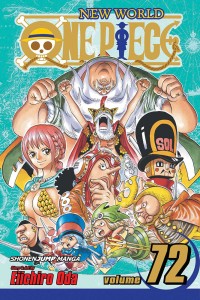
When I reviewed the last volume, I said that there was a bit too much going on for me to get a handle on all of it, and that goes double for this volume, which rarely stays on one character for longer than a few pages. As such, I think it’s time to bring out the bullet point review style, which I haven’t done in some time.

onepiece72

— So we get to see Sanji’s reputation as a loser who is easily manipulated by women, but this is undercut a great deal by having him actually be right about her needing help, of course. Sigh. One day I’d like to see a pretty girl who isn’t swayed by Sanji’s annoying chivalry. (Well, one can argue Nami and Robin perform this function…)
— I like the reveal that Donflamingo had the press send a retraction on this quitting the Warlords 12 hours later, right after all his enemies would have taken the bait. It’s quite clever. I also like that Law, given an easy chance, still respects Luffy enough to not take it, and proclaims that they are equal allies.
— Naturally, Usopp playing the hero is getting him into all sorts of trouble, as now he has to lead a Tontatta army to rescue their missing princess (who is apparently a horrible person, but is one of them, so must be rescued). Meanwhile, Robin is resting after using up her one big surprised face last volume, so she’s mostly stoic here.
— Nami, Chopper, and Brook get very little to do, but I have to admit that Oda still knows how to use fruit powers to his advantage. The Picasso fruit allows him to try styles for the characters that are both horrifying and hilarious.
— As I suspected last volume, the big reveal about the toys is that they were once people – and, tragically, they remember this, but the people who they were connected to (wives, children) do not. This is incredibly sad if you think about it, especially as it’s been going on for years. I wonder how this will fall out once the Straw Hat Pirates save the day?
— Much of Luffy’s fight in the ring is taken up by a bunch of seemingly awesome fighters who get taken out by a slew of other even more awesome fighters, as in most tournament arcs. I did like the Ideon ref. The one to note here is Chin Jao, who, as per One Piece tradition, has a backstory both extraordinarily sad and extraordinarily stupid at the same time. (Seriously, without his head being pointy, nothing can happen? He’s that much of a can opener?) That said, in the end it’s Luffy punching the grudge out of him.
–And then there’s Rebecca, who has an even more tragic backstory, which resembles Nami and Robin’s a bit too much for my liking. She’s going out their to kick ass, but I have a sinking feeling that she’s going to need saving. There was much discussion when she appeared that she might join the crew, but her tragic past flashback is only a few pages, so chances aren’t good. We shall see.

Oda is still doing what he does best, and tehre are some very clever twists in this volume. One Piece fans should be quite satisfied.

Filed Under: REVIEWS

Pick of the Week: Legal Drug & More

September 8, 2014 by Sean Gaffney, Michelle Smith, Anna N, Ash Brown and MJ Leave a Comment

potwSEAN: My pick is fairly obvious, so I will start. It’s well known among Hayate the Combat Butler fans that when Athena Tennos arrives, the comedy gives way to emotional drama with potentially tragic consequences. Vol. 24 of the series features the climax of that story. Not to say there’s no comedy at all – when one of your allies is dressed as a Power Ranger, there’s always something to laugh at. But the stakes are higher here than they’ve ever been, and Hayate fans, unless they hate Athena, should be ecstatic to finally see this in English.

MICHELLE: I’m going to have to go with the Dark Horse omnibus reissue of Legal Drug this week. I’m always delighted to see a former TOKYOPOP title back in print, and now fans can read it without the frustration of its unfinished status, as Dark Horse also plans to bring out the sequel next year! It’s definitely a good time to get on board.

ANNA: I’ll go ahead and pick the concluding volume of Dawn of the Arcana, since we left it off the list last week. This shoujo fantasy series was a delightful read, featured an occasionally sassy heroine, and delved into geopolitical issues much more than many readers would expect. There’s a sudden plot twist at the end that actually does put everything that happened in the previous volumes in an entirely new perspective.

ASH: I’ll admit, the release that I’m most interested in this week is the new Legal Drug omnibus. I still have my old TOKYOPOP volumes, but Dark Horse been doing a nice job with its CLAMP releases so I may end up picking it up anyway. Plus, it’s great to see the series finally available again for new readers.

MJ: It is pretty much impossible for me not to pick Dark Horse’s re-release of CLAMP’s Legal Drug. Yeah, I’m well-known as a CLAMP fan, but this is one of the series’ I’ve waited to see continued with the most verve, and this re-issue of the original series is the first step forward. Additionally, I was a huge fan of Carl Horn’s updated translation of Tokyo Babylon, so that’s something I’m looking forward to in this release as well. I’m really quite excited!

What looks good to you this week?

Filed Under: PICK OF THE WEEK

Bookshelf Briefs 9/8/14

September 8, 2014 by Sean Gaffney and Michelle Smith Leave a Comment

Sean and Michelle look at recent releases from Viz Media and Vertical, Inc.

cage ofeden15Cage of Eden, Vol. 15 | By Yoshinobu Yamada | Kodansha Comics – Romance is not really one of the main reasons to read Cage of Eden, but it’s been clear from the beginning that Akira and Rion love each other, and the start of this volume reinforces that, with both admitting they’re being strong for the other (though not admitting that out loud, of course). Elsewhere, it’s becoming apparent that the cast have not ended up in the past, mostly due to finding modern machinery that suggests that everything on this island was created by man. Yes, it’s a vast international conspiracy. Not that this matters to Ohmori, who ends up being crucified and set on fire to serve as a cliffhanger. Cage of Eden is still fun, pulpy trash, and I still like it a lot. – Sean Gaffney

chi11Chi’s Sweet Home, Vol. 11 | By Konami Kanata | Vertical, Inc. – One thing I generally do not expect to be whilst reading Chi’s Sweet Home is stressed. Chi’s adorable kitten antics typically have the opposite effect! In this volume, however, we see her future with the Yamada family genuinely in peril. Throughout the series, Chi has had flickers of memory of her mother and siblings, and in the last panel of this volume, she finally comes face to face with the former, who has never stopped looking for her. On top of this, there’s a “lost” poster bearing Chi’s face, and Mr. Yamada has a job prospect that would require the family to move to France. Will Chi be able to stay with Yohei, or will she return to her original home? I am more upset about this cliffhanger than I care to admit. – Michelle Smith

librarywars12Library Wars: Love & War, Vol. 12 | By Hiro Arikawa and Kiiro Yumi | Viz Media – After last volume’s exhausting action-filled heroics, I was expecting a step back, and I’m mostly right, though there is some action here as they try to protect an author who may be kidnapped by the government to stop him writing. Instead, we get romantic progression, mildly on the Dojo and Iku front (they’re cute together, but forward motion is as slow as you’d expect), but quite a lot on the Tezuka and Shibasaki front, as she starts to take a more active role and tries to stop Tezuka’s brother from more emotional damage. And if stopping this involves kissing him, well, SO BE IT. This is still one of my favorite shoujo series from Viz, and has really come into its own. – Sean Gaffney

phantomjeanne4Phantom Thief Jeanne, Vol. 4 | By Arina Tanemura | Viz Media – After the big reveal at the end of volume three, which I shan’t spoil, volume four opens with a bit of backstory and explanation that nicely turns the whole magical girl concept of this series on its end. Happily, or perhaps not, Jeanne’s saintly status is restored when a thoroughly random trip back in time culminates with the original Jeanne d’Arc transferring her powers directly to Maron, who returns to the present reinvigorated. It’s really feeling like we’re heading into a final arc, even though there haven’t been many hints as to what shape that will take. But first, there are romantic confessions to agonize over and to gently reject, and then another big reveal at the end. Occasionally far too silly for me, Phantom Thief Jeanne is nonetheless a good read and probably the best Tanemua series in existance. – Michelle Smith

skipbeat33Skip Beat!, Vol. 33 | By Yoshiki Nakamura | Viz Media – I know some people are getting tired of seeing Cain and Setsuka, but those people are not me, particularly when it leads to scenes as sexy as the one we get at the start of this volume. Indeed, the tension between Rena and Kyoko, their burgeoning feelings for each other – which for Kyoko is an issue, since love for her is also a trigger for emotional trauma – and the desire to bury themselves in their roles to escape themselves are all present here. There’s also comedy, mostly in Kyoko’s OTT reactions in her head to what Setsuka is doing, but also having to deal with a Cain fangirl, and facing up to jealousy. The fact that Kyoko admitting she’s in love may be a tragic event is part of what makes Skip Beat! still so interesting. – Sean Gaffney

thewallflower33The Wallflower, Vol. 33 | By Tomoko Hayakawa | Kodansha Comics – You would think, given how often the series has dealt with them, that yet another chapter about Noi and Takenaga having a fight would just tread the same water as before. But this is more about how friends in a peer group interact with other friends, as the outgoing Noi finds more fun at the amusement park with Ranmaru and Kyohei, and Takenaga has to deal with jealousy as well as needing to ‘look cool’ despite his introverted qualities. The rest of the volume isn’t so hot, though I was amused at the chapter featuring a Tim Burton lookalike coming to Japan and trying to utilize Kyohei and Sunako in his new film (spoiler: it’s a disaster). This series desperately needs to end, but I still enjoy its zombie progression. – Sean Gaffney

Filed Under: Bookshelf Briefs

My Week in Manga: September 1-September 7, 2014

September 8, 2014 by Ash Brown

My News and Reviews

There were three posts of note at Experiments in Manga last week in addition to the usual My Week in Manga feature. First of all, the winner of the Nana manga giveaway has been announced. The post also includes a short list of manga that people gave a second chance only to discover that they enjoyed them better than they did the first time they read them. I also posted August’s Bookshelf Overload, revealing how out of hand things can get when it comes to the number of manga I obtain over the course of a month. The first in-depth manga review of the month was also posted, the honor going to Hinoki Kino’s No. 6, Volume 8, the series penultimate volume. As a bonus, the first print run of the volume also includes sixteen color pages!

A few things of note from elsewhere online: The Beautiful World, which hosted the Kaori Yuki Manga Moveable Feast a while back, has issued a call for participation for a blog carnival to feature female goth mangaka in January. Sean has a nice roundup of some of the recent license announcements at A Case Suitable for Treatment. And Anna at Manga Report checks out Sparkler Monthly, which is currently running a membership drive for its second year. Please consider subscribing if you can; Sparkler Monthly has some great content and I hope for its continued success.

Quick Takes

AliveAlive by Hajime Taguchi. Gen Manga publishes independent manga, mostly focusing on the seinen demographic. Often, Gen’s releases are the first time the creator’s doujinshi have received any sort of “official” publication. Alive is a collection of over a dozen short manga of varying lengths by Hajime Taguchi. There’s not really a central theme to the volume, and the stories aren’t related to each other, but they all tend to be fairly melancholy. A few of the tales have some fantastical or surreal elements to them–a pair of glasses that obscures everything the wearer dislikes, a bizarre frog-like creature that talks, and so on–but most of the manga in the collection tend to be realistic, slice-of-life stories. Alive primarily explores the emotional lives of the stories’ characters. Love, heartbreak, self-confidence, guilt, personal growth, and loss are all present within the manga. Generally Alive focuses on the darker aspects of the human psyche and experience, but there are glimpses happiness as well. As with any collection, some stories are stronger than others, but as a whole Alive is a satisfying and somewhat unusual read.

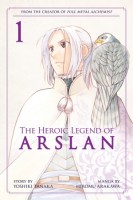
The Heroic Legend of Arslan, Volume 1The Heroic Legend of Arslan, Volume 1 by Hiromu Arakawa. Based on a series of fantasy novels by Yoshiki Tanaka, Arakawa’s The Heroic Legend of Arslan is one of several adaptations that have been made. Although the animated film had previously been released in English, Arakawa’s manga was actually my introduction to The Heroic Legend of Arslan. The first volume feels a bit like a prologue, introducing the characters and setting the stage for the story which will be the series’ real focus. Arslan is the young prince of Pars, mostly ignored by his parents but hoping to be seen as worthy by them. His chance to prove himself comes when the kingdom of Lusitania invades Pars, bringing war and destruction with it. In the first volume alone there have already been several battles and betrayals. Blood and death will not be strangers to Arslan, though it seems he would much prefer to find peaceful solutions to the fighting. So far, I’m enjoying The Heroic Legend of Arslan. It’s shaping up to be a solid fantasy series and the setting, which is influenced by historical Persia, is particularly interesting. I certainly look forward to reading more of the series to see how it develops.

Kokoro Connect, Volume 1 Kokoro Connect, Volume 1 written by Anda Sadanatsu, illustrated by CUTEG. I tend to enjoy series that involve body-swapping of some sort (it often provides clever opportunities for the exploration of personal identity), so I was curious about the Kokoro Connect manga, especially after hearing good things about the anime. In most of the body-swapping series that I’ve been exposed to generally only two people are involved, usually of the opposite gender. Kokoro Connect, however, involves five high school students–two boys and three girls–who one day begin to spontaneously switch places in all sorts of different combinations. This means that there are plenty of comedic possibilities for the series, but for the most part Kokoro Connect seems to be taking a more serious approach, addressing some of the more sobering implications of involuntarily swapping places with another person. The group does seem to be handling the whole situation remarkably well so far, though. There is a half-hearted attempt to begin to explain the whole swapping phenomenon, but it’s not especially compelling at this point.

Rabbit Man, Tiger Man, Volume 2Rabbit Man, Tiger Man, Volume 2 by Akira Honma. It might not be the most believable boys’ love series out there, but I was amused by and rather enjoyed the first volume of Rabbit Man, Tiger Man. While there is still plenty of humor in the second volume of the series, the manga has really started to take a turn for the serious. The yakuza plotline has become more prominent, introducing a significant amount of danger to the story. However, the delightful awkwardness between the series’ two leads still remains. Nonami and Uzuki are complete opposites in personality and demeanor. (They would be the titular tiger and rabbit.) It’s actually rather funny and sweet to see how hard the rough, tough yakuza boss has fallen for the meek, diminutive surgeon. I do think that I probably enjoyed the first volume of Rabbit Man, Tiger Man slightly more than the second, but I definitely want to read the third and final volume. Sadly, there’s no indication that it has or will be licensed. This is particularly frustrating since the second volume ends on one heck of a cliffhanger.

Filed Under: FEATURES, My Week in Manga Tagged With: Akira Honma, Anda Sadanatsu, CUTEG, Hajime Taguchi, Heroic Legend of Arslan, Hiromu Arakawa, Kokoro Connect, manga, rabbit man tiger man

Otome Game Review: Love Letter from Thief X

September 7, 2014 by Anna N

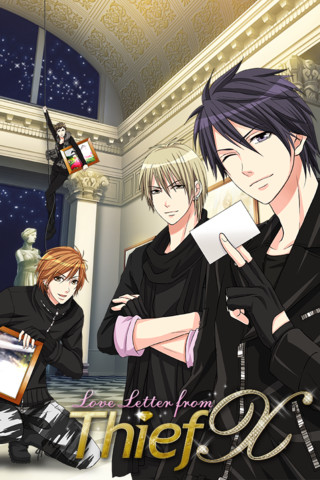
Love Letter from Thief x is availabe on Android and iPhone.

love_letter_from_thief_x

I played a few Otome games a year ago, and I’m playing a couple again. Perhaps there is something about fall that makes me want to play Otome games. Before I move on to the games I am currently playing (spoiler alert! there might be sushi and ninjas involved), I thought I would go back and write about my favorite game to date, Love Letter from Thief X.

There’s something about the premise that really appeals to me, even more than games involving pirates and ninjas, as hard as it may seem. In this game, the heroine works in a museum and finds herself caught up in a ring of Robin Hood-like thieves. It is vaguely like that great Audrey Hepburn and Peter O’Toole move “How to Steal a Million”, except there’s no Givenchy costumes and instead of Peter O’Toole, you get six Japanese dudes.

The heroine of this game works in a museum. Her great-grandfather was the Japanese equivalent of Leonardo da Vinci. One day when she’s at work after hours, she runs into two thieves. She bumps into a display case as she chases after them, almost toppling a statute on top of her. One of the thieves saves her from being brained by the bronze. They notice that she’s wearing an heirloom ring from her great-grandfather, then quickly run away as the police approach. There are rumors floating around about a ring of thieves known as the Black Foxes, and the heroine wonders if the strange men she encountered are part of the group.

thiefx1

The next day the heroine finds herself meeting two other strange men who are also part of the secret band of thieves. She finds herself at a bar where they all hang out, told that she’s the key to unlocking the secret of her great-grandfather’s legacy, and has to pick a thief to accompany her at all times in her new role as a member of the Black Foxes.

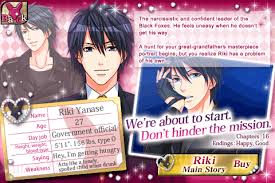
There’s Riki, the arrogant leader:

riki

Screenshot_2013-09-25-00-48-33

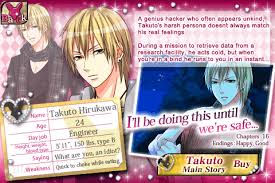
Takuto, a socially inept computer genius.

takuto

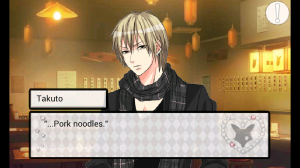
Screenshot_2013-09-27-00-47-57

Takuto and the heroine often get into fights over who ate the last serving of pork noodles.

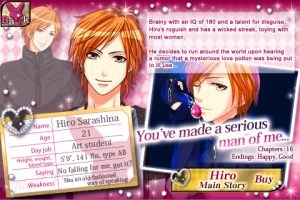
Hiro, an androgynous art student and master of disguise:

hiro

and Kenshi, the boy next door:

kenshi

Screenshot_2014-09-07-16-37-00

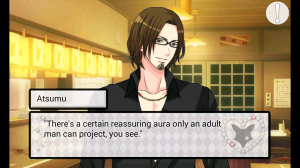
You can also play storylines with Atsumu, the oddly superstitious older boss of the gang, and Tatsuro, an old childhood friend of the heroine’s who happens to be a police detective tracking down the Black Foxes.

Screenshot_2014-09-07-18-38-50

Depending on the route you pick, you get a different scenario for the mystery the Black Foxes need the heroine to solve. Sometimes they are chasing paintings, an advanced scientific invention, an Indiana Jones style lost city, or a precious artifact. I played through all the routes on this game, although I haven’t invested the time and money to play the many sequels, epilogues, and special stories.

There are a lot of similarities in the personalities of the characters to Pirates in Love. In particular, Riki and Eduardo and Atsumu and Morgan were a bit similar. This was the first Otome game where I’ve been interested in playing every route, and it was interesting to see the variations on the story with each character. Riki’s story is good if you enjoy the whole clumsy maiden with a chaebol dynamic that pops up so often in k-dramas, and there’s even a bit of second lead syndrome as Riki and Takuto struggle a bit over the heroine’s affections. Takuto’s story was probably the most emotionally intense. Kenshi’s storyline was simple but sweet. Atsumu’s storyline delves into issues that unfold when you have a leading man who is superficial on the service because he’s dealing with a tragic past. I was happy to play through all the stories, but Hiro and Tatsuro were a bit less entertaining for me.

There’s plenty of humor throughout. I know that many otome game aficionados aren’t necessarily the biggest fans of Voltage Games, but if you aren’t able to play games in Japanese, at least the translation quality is good, you do get plenty of chapters for the $4.99 per game route you’re playing, and the storylines are generally entertaining. This has been my favorite otome game so far, and I would rank Pirates in Love second. I always meant for these reviews to turn into a regular feature! We’ll see what I can manage with the few games I just started playing recently. If you have suggestions for games for me to check out, please let me know. I know that Alice in the Country of Hearts was just released in English, but the translation quality seems so bad, I’m not sure if I can stomach paying for any chapters.

Filed Under: REVIEWS Tagged With: love letter from thief x, otome game, voltage

  • « Go to Previous Page
  • Page 1
  • Interim pages omitted …
  • Page 589
  • Page 590
  • Page 591
  • Page 592
  • Page 593
  • Interim pages omitted …
  • Page 1048
  • Go to Next Page »
 | Log in
Copyright © 2010 Manga Bookshelf | Powered by WordPress & the Genesis Framework