• Skip to primary navigation
  • Skip to main content
  • Skip to primary sidebar
  • Home
  • About Us
    • Privacy Policy
    • Comment Policy
    • Disclosures & Disclaimers
  • Resources
    • Links, Essays & Articles
    • Fandomology!
    • CLAMP Directory
    • BlogRoll
  • Features & Columns
    • 3 Things Thursday
    • Adventures in the Key of Shoujo
    • Bit & Blips (game reviews)
    • BL BOOKRACK
    • Bookshelf Briefs
    • Bringing the Drama
    • Comic Conversion
    • Fanservice Friday
    • Going Digital
    • It Came From the Sinosphere
    • License This!
    • Magazine no Mori
    • My Week in Manga
    • OFF THE SHELF
    • Not By Manga Alone
    • PICK OF THE WEEK
    • Subtitles & Sensibility
    • Weekly Shonen Jump Recaps
  • Manga Moveable Feast
    • MMF Full Archive
    • Yun Kouga
    • CLAMP
    • Shojo Beat
    • Osamu Tezuka
    • Sailor Moon
    • Fruits Basket
    • Takehiko Inoue
    • Wild Adapter
    • One Piece
    • After School Nightmare
    • Karakuri Odette
    • Paradise Kiss
    • The Color Trilogy
    • To Terra…
    • Sexy Voice & Robo
  • Browse by Author
    • Sean Gaffney
    • Anna Neatrour
    • Michelle Smith
    • Katherine Dacey
    • MJ
    • Brigid Alverson
    • Travis Anderson
    • Phillip Anthony
    • Derek Bown
    • Jaci Dahlvang
    • Angela Eastman
    • Erica Friedman
    • Sara K.
    • Megan Purdy
    • Emily Snodgrass
    • Nancy Thistlethwaite
    • Eva Volin
    • David Welsh
  • MB Blogs
    • A Case Suitable For Treatment
    • Experiments in Manga
    • MangaBlog
    • The Manga Critic
    • Manga Report
    • Soliloquy in Blue
    • Manga Curmudgeon (archive)

Manga Bookshelf

Discussion, Resources, Roundtables, & Reviews

Blog

Manga Giveaway: Anonymous Noise Giveaway

May 31, 2017 by Ash Brown

Not only is it the last Wednesday of May, it’s the last day of May, so it is once again time for a giveaway at Experiments in Manga! For this month’s giveaway you will all have the opportunity to win the first volume of Ryoko Fukuyama’s manga series Anonymous Noise as published in English by Viz Media’s Shojo Beat imprint. And as usual, the giveaway is open worldwide!

Anonymous Noise, Volume 1

As a musician, I have a particular affinity for manga which incorporates music in some way, whether it’s tangentially or as a primary theme. So when Anonymous Noise was licensed, it immediately caught my attention. The series’ lead loves to sing and many of the other characters introduced are musically inclined as well. As I was reading the first volume of Anonymous Noise, it occurred to me that there were a fair number of other manga that I could think of which aren’t music manga per se but which do include characters with notable singing voices. (For example, Tomoyo Daidouji from Cardcaptor Sakura or Yuzuki Seo from Monthly Girls’ Nozaki-kun.) And for some reason, that realization made me really happy.

So, you may be wondering, how can you a copy of the Anonymous Noise, Volume 1?

1) In the comments below, tell me about your favorite singer or vocalist from a manga. (Don’t have a favorite or haven’t come across any? Simply mention that instead.)
2) If you’re on Twitter, you can earn a bonus entry by tweeting, or retweeting, about the contest. Make sure to include a link to this post and @PhoenixTerran (that’s me).

It’s as simple as that. Giveaway participants have one week to submit comments and can earn up to two entries. Comments can also be sent directly via email to phoenixterran(at)gmail(dot)com if needed or preferred. I will then post those entries here in your name. The giveaway winner will be randomly selected and announced on June 7, 2017. Best of luck to you all!

VERY IMPORTANT: Include some way that I can contact you. This can be an e-mail address in the comment form, a link to your website, Twitter username, or whatever. If I can’t figure out how to get a hold of you and you win, I’ll just draw another name.

Contest winner announced–Manga Giveaway: Anonymous Noise Giveaway Winner

Filed Under: FEATURES, Giveaways Tagged With: Anonymous Noise, manga, Ryoko Fukuyama

My Lesbian Experience With Loneliness

May 31, 2017 by Sean Gaffney

By Nagata Kabi. Released in Japan as “Sabishisugite Lesbian Fuzoku Ni Ikimashita Report” by East Press. Released in North America by Seven Seas. Translated by Jocelyne Allen.

This book took me by surprise several times, mot least of which is the fact that it was licensed at all. A realistic look at depression and sexuality done autobiographically, and then released first on the art board Pixiv, then by the small publisher East Press? It was not the type of story I expected to see picked up by the publishers of Monster Girl Encyclopedia. But no publisher ever quite fits its cliche, and Seven Seas decided to take a chance on this book. I’m so glad they did, and you should be as well, because this is a raw but fascinating and ultimately uplifting read for anyone. I was actually surprised at how much of it spoke to me, being that I am seemingly not the typical audience for this book, but the experiences here also hold a touch of the universal, and the way they play out is excellent.

After a brief flashforward to the event on the cover, which is mostly covered in the second half of the book, we get the author’s examination of her life after high school. She was doing art at college but dropped out, and attempts to hold down a part-time job were hampered by her issues of self-esteem, eating disorders, and a serious case of depression. This is not a lighthearted title, and we get a lot of examination of the thought process that goes into being depressed and having anxiety. It’s one of the best parts of the book – by working over everything in such detail, with the author also analyzing her own behavior at the time as she writes it, she shows us how difficult it can be to get yourself out of that hole you dig. There’s also a realization that she may not want to be the person that her parents are pushing her to be – which then leads into an examination of her sexuality.

Again, like the depression, she lays this out in a very straightforward, visible manner, showing how she didn’t even think of herself as a gender, because she didn’t want to be seen first as a woman, then as a person. This leads to her realizing that she’s more attracted to women’s bodies, and a wonderful examination of the need for affection and physical contact, beyond the bounds of sexuality. It culminates in the decision to have a session with a worker from an escort agency, so that she can experience what she’s been obsessing over. Of course, this being realistic autobiography, the experience is as awkward and difficult as you’d imagine (I liked where she expressed regret that she forgot to hug them), but things do end up more hopeful by the end of the book, with the author taking this experience and deciding to use it to create the story we’re reading, and the online reaction she gets, leaves you smiling and hoping that she finds fulfillment.

Basically, this manga may make you uncomfortable at times, but it is well worth it to see how one person can talk about such universal topics as anxiety, depression, and sexual identity on the page. Please go buy it, you won’t regret it.

Filed Under: my lesbian experience with loneliness, REVIEWS

Water Dragon’s Bride, Vol. 2

May 30, 2017 by Anna N

The Water Dragon’s Bride, Volume 2 by Rei Toma

The first volume of Water Dragon’s Bride was surprisingly dark, which made it feel quite a bit refreshing as it was quite a tonal shift from the usual shoujo fantasy fare. The second volume wasn’t quite as dark in theme, but it was still quite absorbing, ensuring that this series is rapidly becoming a current favorite of mine.

Modern girl Asahi finds herself transported to another world where she ends up being brutalized by humans, offered up as a sacrifice to the Water Dragon God, and almost starves to death due to the Water Dragon’s utter incomprehension of human frailty. Her one ally is Subaru, a village boy with a scheming and overbearing mother. The Water Dragon appears and heals Asahi from her injuries as she is recuperating in the village. Asahi has a few normal hours where she attempts to communicate while being robbed of speech and she is able to enjoy the outdoors a little bit.

The Water Dragon begins to exhibit some gradual signs of change with the mild protectiveness he exhibits towards Asahi. He becomes angry at the human villagers and finds the rituals and stories they’ve made up about him ridiculous, but he still has no idea how easily breakable humans are, causing yet another accident to Asahi and Subaru as he gets caught up in rage. Asahi is left to care for Subru on his own when he’s injured and she ends up being incredibly resourceful even when she is helped along a little bit by the gods who seem to regard her as a pet project.

Asahi’s situation stabalizes somewhat, as she’s given the role of a priestess and a caretaker. The Water Dragon decided to wait to claim his bride until she’s older and the last few pages give a glimpse of Asahi and Subaru much older, giving a hint to the next story arc. The art on The Water Dragon’s Bride continues to be delightful, and I’m still in awe of Toma’s deceptively simple illustration style. The art isn’t overdecorated, but she manages to portray everything she needs with great economy. It is always clear what Asahi is thinking, even when she’s robbed of the power of speech. The character designs for the pantheon of gods that keep popping in and out to offer sly commentary on the Water Dragon’s inexplicable choices are also charming. My only complaint is that there’s too much of a wait between volumes for this series!

Filed Under: Manga Reviews, REVIEWS Tagged With: shojo beat, shoujo, viz media, water dragon's bride

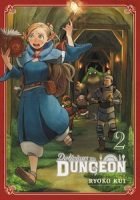
Delicious in Dungeon, Vol. 1

May 30, 2017 by Katherine Dacey

Food manga comes in two flavors: the tournament series, in which a brash young baker or chef enters cook-offs that stretch his culinary skills to the limit, and the food-is-life series, in which family, friends, or colleagues prepare food together, resolving their differences over tasty dishes. Delicious in Dungeon straddles the fence between these two types by combining elements of a role-playing game, cooking show, and workplace comedy. Expressed as a recipe, the formula for volume one might look something like this:

2 cups Dungeons & Dragons
1 cup Iron Wok Jan
1/2 cup Toriko
1/2 cup Oishinbo
1/2 cup What Did You Eat Yesterday?
2 tbsp. Food Wars: Shokugeki no Soma
2 tbsp. Not Love But Delicious Foods Makes Me Happy!
Dash of Sweetness & Lightning

Though that recipe sounds unappetizing — the manga equivalent of a herring-and-banana smoothie — Delicious in Dungeon is surprisingly good.

Volume one plunges us into the action, pitting a team of warriors and spell-casters against an enormous dragon. Though all six fighters are experienced, they’re so compromised by hunger that they make silly mistakes that result in one member getting eaten. When the team regroups, two members defect to another guild, leaving just Laois, a knight, Chilchuck, a “pick-lock,” and Marcille, an elf magician. The three resolve to rescue Laois’ sister from the Red Dragon’s belly, but their chronic lack of funds forces them to adopt a novel cost-saving strategy: foraging for food inside the dungeon instead buying supplies for the mission.

The trio soon learns that catching and cooking monsters is harder than it looks. Despite the astonishing variety of creatures and man-eating plants that inhabit the dungeon, almost none appear to be edible: some have stingers or hard shells, while others are so disgusting that no one can imagine how to prepare them. When Senshi, a dwarf, volunteers his culinary services, the group is pleasantly surprised by his ability to transform the most unpromising specimen into a delicious array of soups, tempuras, and jerkies. Even more impressive is Senshi’s ability to improvise the tools he needs to make gourmet dishes; he’s the D&D answer to Angus MacGyver.

Subsequent chapters follow a similar template: the group enters a new area of the dungeon, encounters new monsters, and devises new ways to cook them. What prevents this basic plotline from growing stale is Ryoko Kui’s imaginative artwork. Every chapter is studded with charts and diagrams illustrating the dietary habits of dungeon crawlers and the unusual anatomy of dungeon dwellers, from slime molds to basilisks. These meticulous drawings provide a natural jumping-off point for Senshi to wax poetic about the flavor of dried slime, or describe the safest method of harvesting mandrakes.

By contrast, the backgrounds resemble the kind of generic settings of early computer RPGs, providing just enough detail — cobblestone hallways, winding staircases — to establish each location. That allows Kui to lavish attention on the monsters and people — a wise decision, I think, since the artwork plays such a vital role in establishing each character’s personality and powers. Marcille, for example, is a worrywart, her semi-permanent frown mirrored by the angle and shape of her ears. Though her peevish monologues suggest that she’s food-phobic, her slumping posture and clumsy attempts at spell-casting tell a different story: Marcille feels superfluous, and longs for an opportunity to demonstrate her usefulness to the group. Chilchuck, by contrast, is small and nimble; his child-like size belies his maturity and skill as a locksmith and minesweeper, while his cat-like movements remind us that he’s not fully human. (The other characters refer to him as a “halfling.”)

If the series’ rhythm is predictable and the jokes sometimes obvious — one character declares that basilisk “tastes like chicken” — the specificity of Kui’s vision keeps Delicious in Dungeon afloat. Every chapter yields a funky new monster and an even funkier recipe from Senshi — all rendered in precise detail — while the script has the rhythm of a great workplace sitcom; it’s a bit like watching The Office or WKRP in Cincinnati, but with jokes about the merits of giant scorpion meat instead of arguments about the annual Christmas party. I don’t know if I’d want to read 10 or 20 volumes of Delicious in Dungeon, but I’m eager to see where the next installment goes.

DELICIOUS IN DUNGEON, VOL. 1 • BY RYOKO KUI • RATING: T, FOR TEEN (13+) • YEN PRESS

Filed Under: Manga, Manga Critic, REVIEWS Tagged With: Cooking and Food, Delicious in Dungeon, RPG, Ryoko Kui, yen press

My Youth Romantic Comedy Is Wrong, As I Expected, Vol. 2

May 30, 2017 by Sean Gaffney

By Wataru Watari and Ponkan 8. Released in Japan as “Yahari Ore no Seishun Rabukome wa Machigatte Iru” by Shogakukan. Released in North America by Yen On. Translated by Jennifer Ward.

In many ways, this second volume of OreGairu does not have a heck of a lot going on. There are school ativities and discussion of career plans, as befits high schoolers. There is the Service Club and their attempts to help people, which features two cases this time around, both of which are solved relatively quickly. But that’s appropriate, as the problems are very much those of typical high-schoolers – feeling like the odd man out in a group of friends, and trying to find a way to pay for higher education. They’re also solved relatively quickly because both Hachiman and Yukino are both amazingly intelligent and observant, and normally they’d be praiseworthy. But they aren’t, mostly because of the reason anyone would read OreGairu in the first place: to read about these horrible, broken people lacerating each other with words.

I read this book right after reading Death March to the Parallel World Rhapsody, and the contrast between narrative style is mindblowing. Hachiman’s cynical bitterness overflows every page, and his defensive asides only serve to make him more pathetic and yet strangely endearing. His insight into human nature, particularly the way that high school students interact around each other, is high-level stuff, and if he was looking for a career at all I’d suggest he move in a direction where he could use those talents for the better good. But his crushing apathy and disaffection ensures that this isn’t going to happen. Yukino is similar to him, though without the outward self-hatred. I say outward because this second volume shows us that there is a topic that really upsets Yukino and cracks her jerkass facade, and that’s showing family issues in her face. Clearly Yukino’s issues are family-related just as Hichiman’s are peer-related, and I have no doubt that future books will explore this in agonizing detail.

Thank goodness for Yui. I feel a little bad for her, as much of the time she feels like a character from a far more cliched light novel trapped inside this series. But she’s desperately needed to offset the bile coming from her two clubmates, and her relatively normal reactions to everything show off both how intelligent and broken Hachiman and Yukino are. She’s also tied to the accident at the start of his high school life, something he is now aware of, and this culminates in a stunning final scene where she gives him a perfect opening to get closer to her and possibly lead up to something more, and he just shuts her down as callously as possible. This series would never work if Hachiman’s attitude was fixed as quickly as this, so the pushback was expected. But it’s beautifully, heartbreakingly written, and you feel bad for Hachiman while wanting to kick him in the head. And Yui needs a hug.

That said, the actual plot is mostly irrelevant for this series, which runs on snappy dialogue and clever characterization. It’s not a happy, feel-good series at all, but it’s absolutely worth a read for light novel fans.

Filed Under: my youth romantic comedy is wrong as i expected, REVIEWS

Bookshelf Briefs 5/29/17

May 29, 2017 by Michelle Smith and Sean Gaffney Leave a Comment

Bloom Into You, Vol. 2 | By Nakatani Nio | Seven Seas – While there is a lot of yuri out there that can be defined by the words “what is this strange feeling in my heart?,” I’m not sure if any of them are quite as fascinating as Yuu. I’m not entirely sure if this manga is going to go with “Yuu is asexual,” but the first couple of volumes can certainly be read at that. She’s not really aromantic, though, and her relationship with Touko is complicated—and becoming known to others, who may also be asexual. Touko, meanwhile, is the ever-popular “problematic” we see in so many yuri titles as well, and is having trouble balancing that line between consent and just giving in to her desires. Bloom Into You may start like typical yuri, but it’s not headed that way. Good stuff. – Sean Gaffney

Chihayafuru, Vol. 2 | By Yuki Suetsuki | Kodansha Comics (digital only) – Oh, happy sigh. I do love Chihayafuru so much. In this volume, we see the conclusion to the elementary tournament Chihaya, Taichi, and Arata have entered. Sadly, they lose and Arata moves away not long after. Chihaya is certain that they’ll meet again, but as we skip ahead three years to high school, it’s clear that they haven’t really kept in contact. She’s determined to start a karuta club and makes Taichi promise to join if she finally achieves class A ranking. Seeing her compete rekindles his own love of karuta, but when she calls Arata to tell him the good news, she learns he’s stopped playing for a really awful reason. I actually got sniffly when they came face to face again at last. This is the kind of manga where I wish I had dozens of volumes stacked up to marathon. Unequivocally recommended. – Michelle Smith

The Full-Time Wife Escapist, Vol. 3 | By Tsunami Umino | Kodansha Comics (digital only) – Although I enjoy a good cliffhanger as much as the next person, I’m not normally as invested in their outcome as I was for the one at the end of volume two of this series. Before we find out exactly what Tsuzaki and Kazami mean by “sharing” Mikuri, however, there’s an interlude where she and her fake husband must field questions from relatives about their procreation plans. I really enjoy the way Umino is plotting this series—it makes sense why Mikuri would want to take Kazami up on his arrangement, and neatly dovetails into her aunt finding out about it, prompting her to be concerned about the nature of her niece’s marriage. Mikuri doesn’t engage in any flights of fancy this time, but she does do a lot of psychoanalyzing her husband, which is interesting. Definitely looking forward to volume four! – Michelle Smith

Girls’ Last Tour, Vol. 1 | By Tsukumizu | Yen Press – I’m not entirely sure what to make of Girls’ Last Tour. Chito and Yuuri are two chibi-faced young women roaming a post-apocalyptic wasteland on their Kettenkrad motorbike, just trying to survive. There are parts of this series I really liked. I love the depictions of desolate cities, or cavernous interiors… it reminds me a little of BLAME! in that respect, which is a major compliment. Too, I like their brief interaction with a guy named Kanazawa, who has found meaning for his life in creating maps, and that other levels exist where conditions might be different. I find that I really want to know how things turned out this way. That said, I strenuously dislike Yuuri, and there are some really unfunny gags featuring her that I guess are supposed to be moe or something but just piss me off. Still, I’ll be continuing! – Michelle Smith

Golden Time, Vol. 7 | By Yuyuko Takemiya and Umechazuke | Seven Seas – Linda is mostly absent from this volume, which allows us to focus on the odd triangle between Kouko, Banri, and Banri’s old self, which seems to literally be sabotaging his relationship, though he’s also being helped by coincidental disaster and bad choices, particularly “don’t drive home when you’re all sleepy,” which leads to Kouko, understandably, having a complete nervous breakdown as several of her long-standing issues combine with nightmares she’s having about the car accident. Fortunately, Bari gets over his own issues to an extent in time to be there for her, and much to my surprise we get a ‘girlfriend’s dad’ who’s supportive and not a caricature. As good as ever. – Sean Gaffney

Kase-san and Bento | By Hiromi Takashima | Seven Seas – After getting together in the first volume, this second in the “Kase-san and” series continues to show off the awkwardness that comes with having just gotten together. Both girls still don’t know each other that well, and misunderstandings abound. But they’re all relatively easy to resolve misunderstandings, which is good, because no one is reading this for overwrought lesbian drama. We’re reading it because Yamada is adorable, Kase-san is spunky, and the two of them together are wonderful. There are a few more kisses, and Yamada is slowly gaining confidence. And there are bentos. Which, you know, you would expect thanks to the title. Cuteness personified. – Sean Gaffney

Maid-sama!, Vols. 15-16 | By Hiro Fujiwara | Viz Media – I had thought Maid-sama ended with volume sixteen, but I was wrong. And indeed, much of this volume is about reminding me that it’s not just as simple as “Misaki admits she likes him, the end.” Usui comes with baggage, though, and we learn a lot about that baggage in this volume, including the story of how his parents met—it’s steeped in class issues and tragedy. And as such Misaki, who is as common as they come, has it hammered into her that she can never be with him as she can’t cross those class barrier. Misaki, of course, is ready to kick your class barrier down with her best quality—her sheer stubbornness. Oh yes, and Misaki’s father returns. Please ignore that entire plotline; it’s awful. – Sean Gaffney

Requiem of the Rose King, Vol. 6 | By Aya Kanno | Viz Media – There’s a lot of good stuff going on in this volume, not the least of which is the tragic death of a major character, but it’s sort of hard to get past THAT SCENE. I said “poor Anne” at the end of my last review, and boy, I wasn’t kidding, though frankly she takes it far better than I expected. But man, Margaret. She’s always been one of my favorite Shakespeare villains, as well as one of his best female characters, and BOY HOWDY does Kanno convey that in a fantastic way. You want to recoil from the page. As for Henry and Richard, I think by necessity we are headed to the end of that relationship soon, unless there’s some rewriting of canon beyond what we’ve already seen. Riveting. -Sean Gaffney

Toriko, Vol. 38 | By Mitsutoshi Shimabukuro | Viz Media – Thankfully, this volume was considerably more interesting than the previous one, though I am still grateful we’re heading for the end. Most of the volume focuses on Komatsu and the other cooks, and I am reminded that this is really Komatsu’s story as much as Toriko’s, and he’s had a lot farther to develop. Beyond that, we have the usual impressive shone n stunts, monsters galore, and a decent amount of food, though I miss the days when food was the only thing driving this manga. And again, the relationship between Toriko and Komatsu may not be explicitly gay, but it’s certainly far deeper than any relationships the two of them have with their love interests. Keep at it if you’ve been reading it. – Sean Gaffney

Welcome to the Ballroom, Vol. 5 | By Tomo Takeuchi | Kodansha Comics – The Tenpei Cup has come to an end, and Tatara Fujita must return to normal life. After successfully getting into high school, he is upfront about his love of dancesport in his self-introduction, earning the mockery of the girl who sits in front of him, Chinatsu Hiyama. However, it soon becomes apparent that not only is Chinatsu a big fan of Sengoku and his partner, Chizuru Hongo, but she has some experience with ballroom dance. Hey, how convenient that such a character shows up right when Tatara is in need of a new partner! Imagine that. Anyway, this is mostly a transitional volume, and featured a couple of people saying unkind things about their overweight friend, so I didn’t enjoy it as much as previous volumes. I’m still on board for the next one, though. – Michelle Smith

Filed Under: Bookshelf Briefs

My Week in Manga: May 22-May28, 2017

May 29, 2017 by Ash Brown

My News and Reviews

As has been previously mentioned, a couple of weekends ago I attended the Toronto Comic Arts Festival (which I’ve apparently been going to for five years now). It took me a little longer than I had originally planned, but I did finally manage to post my random musings on TCAF 2017. In the post I write about some of the major highlights of the trip and attempt to summarize prominent themes that emerged during the panels that I attended. Last week I also spent a fair amount of time with my family in Ohio. I was already planning on going down for the long weekend, but that weekended turned out to be much longer than initially anticipated–my maternal grandmother passed away on Tuesday, so I left town on Thursday instead of Saturday. While the occasion was a sad one (though not entirely unexpected), it was wonderful to see so much of my family and everyone is doing really well considering. I also got to hear some great family stories and learned a bit more family history than I previously knew.

Unsurprisingly, I wasn’t really online much at all last week and was all sorts of distracted, so I’m sure there are plenty of things that I missed. However, The OASG had a great feature on Kazuhiro Fujita’s The Ghost and The Lady which combines a review and an interview with Finola Austin, the cultural consultant for the English-language edition of the manga. Seven Seas also made another series of interesting and exciting manga license announcements: Giant Spider & Me: A Post-Apocalyptic Tale by Kikori Morino, Fauna and the Dragonewts’ Seven Kingdoms by Kiyohisa Tanaka, Ultra Kaiju Anthropomorphic Project by Shun Kazakami, Saint Seiya: Saintia Shō by Chimaki Kuori, and Leiji Matsumoto’s original Captain Harlock.

Quick Takes

Girls' Last Tour, Volume 1Girls’ Last Tour by Tsukumizu. There is a fairly common conceit in manga and anime which can basically be described as cute girls doing things. Though I’ll still happily read it, it’s a category of manga that doesn’t especially interest me and I don’t usually intentionally seek it out unless there’s an additional hook of some sort that I am curious about. In the case of Girls’ Last Tour, it was the manga’s post-apocalyptic setting and a recommendation from a friend that caught my attention. And I’ll admit: I enjoyed the first volume much more than I expected I would and definitely plan on reading more. For the most part I find Tsukumizu’s artwork appealing, although in general the character designs are less inspired than the backgrounds. Chito and Yuuri are two young women traveling together across the wasteland in search of food, fuel, and the comforts of home. At this point in the manga it’s unclear what brought about the end of civilization or even how many survivors there are. (Chito and Yuuri spend most of the first volume alone together, but at one point they do meet and briefly team up with a mapmaker, so they aren’t the only ones left.) The backstory may never be fully explained as Girls’ Last Tour is mostly about Chito and Yuuri’s everyday lives. Girls’ Last Tour is a surprisingly delightful and charming series although it it has a melancholy air to it as well.

My Monster BoyfriendMy Monster Boyfriend edited by C. Spike Trotman. Smut Peddler started as a series of minicomics before blossoming into a series of anthologies. My Monster Boyfriend is the first thematic Smut Peddler project as well as being the first Smut Peddler anthology to feature full-color artwork. The stories in My Monster Boyfriend are also longer than the ones included in the series’ previous installments–the anthology features ten erotic comics, the work of fourteen different creators. Unlike most of the comics anthologies that I’ve recently read, I was actually already familiar with most of the contributors to My Monster Boyfriend. The volume has a great lineup and I was not at all disappointed with the collection. I was particularly pleased to see the representation of a wide array of genders and sexualities. My Monster Boyfriend continues the sex-positive, queer-friendly trend of Smut Peddler. Considering the volume’s motif (inhuman men and their sexual partners), all of the stories included are fantastic by nature. However, there is still wonderful variety in style, approach, and genre. Some of the stories are comedic while others are quite serious; some comics lean towards horror while others tend towards romance. My Monster Boyfriend can in turns be sweet, scary, and sentimental.

Filed Under: FEATURES, My Week in Manga Tagged With: comics, Girls' Last Tour, manga, Smut Peddler, Tsukumizu

Cage of Eden, Vol. 21

May 29, 2017 by Sean Gaffney

By Yoshinobu Yamada. Released in Japan as “Eden no Ori” by Kodansha, serialized in the magazine Weekly Shonen Magazine. Released in North America by Kodansha Comics. Translated by Mari Morimoto

It’s been six and a half years since I last did a full review of Cage of Eden on this site. The series pretty much was the definition of “this is worthy of a Bookshelf Brief”, featuring a lot of fun action, thrilling adventures, and copious nudity. It’s been over in Japan for a while now, and for a while I wondered if it would ever end here – this final volume comes out a full year after the last one did. But now it’s here, giving us more of what I just said above. There’s huge beasts killing off a few villainous guys whose names I can’t even remember. There’s deadly slime mold that almost, but not quite, manages to kill off our heroes who we do care about. There is an explanation of everything that has been going on, though it is quite rushed. And as for romantic resolution… the hand-holding on the cover is the best you’ll get.

While I did enjoy this last volume, the whole thing screams “your popularity is waning, wrap it up in 4 chapters even though you won’t have time to fit anything in”. As such, much of the back end of this volume is devoted to Akira’s mother, and her POV as her son’s flight is lost with everyone on board presumed dead. The grief and loss she shows is actually some of the best writing in the volume, and helps to make up for the “and therefore I became the heir to a huge scientific conspiracy” that follows. As for the solution to how the class is on the island and why, it’s a reasonable one given the vaguely science-fictional stuff we’ve already seen, and probably a bit more satisfying than Lost, a series that Cage of Eden hes reminded many people of. The ending is wide open, as we never do find out what happens to everyone once they return to Japan… it’s intentionally left as a blank slate.

As for the romance I mentioned earlier, it’s even lampshaded by the author. Despite the occasional overture towards romantic triangles and the obvious attraction and love Akira and Rion feel for each other, the closest we get to a payoff is one last bathing scene, with the peepers helpfully telling us that no one has gotten any, not even Yarai ad his teacher. Honestly, we shouldn’t be surprised. Cage of Eden has always, despite the occasional attempt at depth, been more about surface impressions than anything else. And also, a lot of romance manga these days ends with no resolution to avoid annoying readers. That said, I think even the most hardcore of those fans might have forgiven at least Alira/Rion. Still, we’ll always have that hand-holding.

Cage of Eden was exciting, sometimes horrifying, frequently blatantly sexist, and tried to aim a bit higher than it could really reach, but overall I’m happy I read it. It’s a good example of a typical Shonen Magazine title from about 10 years ago, and I’m glad we got to see it finish up here.

Filed Under: cage of eden, REVIEWS

Pick of the Week: Is This The Real Life? Is This Just Fudanshi?

May 29, 2017 by Sean Gaffney, Katherine Dacey, Michelle Smith, Ash Brown, MJ and Anna N 1 Comment

SEAN: It’s an odd week with the majority of titles being digital ones. I’m not blown away by anything, but I guess I’ll go with the debut of Real Girl, a Dessert series that almost seems to be a genderbent version of a very common shoujo trope.

KATE: That’s some slim pickings… oof. If I had to choose a title — and death was not an option — I’d cast my vote for The High School Life of a Fudanashi. After reading several relentlessly grim books, I could use a silly palette cleanser. Fudanashi looks like it fits the bill: it’s a 4-koma title about a straight boy who likes BL but feels weird about telling his friends. It will either be a hoot or a dreary compendium of “But I’m not gay!” jokes. Let’s hope it’s the former.

MICHELLE: I intend to check out Kasane and Real Girl, but of all the options, I’m most happy that the digital release of Nodame Cantabile continues briskly, so I’ll pick volume twenty of that series this time.

ASH: Like Kate, my pick this week goes to The High School Life of a Fudanshi. The premise has promise, but it also has the potential to go completely off the rails (and not in a good way). I’m curious to see which direction the series takes!

MJ: There’s not a lot for me this week, but I’m cautiously edging towards The High School Life of a Fudanshi, with the understanding that it could turn out to be either awesome or horrifyingly offensive. I’m open to finding out which.

ANNA: There really isn’t much that’s an automatic pick for me, so like Sean, I’ll go with Real Girl as I enjoy genderbent shoujo from time to time.

Filed Under: PICK OF THE WEEK

Random Musings: Toronto Comic Arts Festival 2017

May 28, 2017 by Ash Brown

TCAF 2017 Poster - Sana Takeda

©Sana Takeda

I didn’t actually realize it until I started writing up my random musings for the 2017 Toronto Comic Arts Festival (TCAF), but this year was actually my five-year TCAF anniversary! For the first two years I coordinated the trip with a friend (a different one each year), but for the last three years my TCAF adventures have been combined with a Toronto family vacation. 2017’s TCAF trip leaned a little more heavily towards family activities than in years past, but I still found the opportunity to enjoy what the festival had to offer. And seriously, TCAF has a tremendous amount to offer. It’s the only comics-related event that I currently attend, and it’s absolutely worth challenging my social anxiety and general awkwardness.

Although there are TCAF-related events throughout May, the festival-proper usually takes place on Mother’s Day weekend which was May 13th and 14th this year. As mentioned, much of the emphasis of my trip this year was on family vacationing. We made a long weekend of it, leaving on Thursday and returning on Sunday. On Thursday, after treating ourselves to breakfast at a favorite local restaurant and taking the young one to a weekly language development play group (which I hadn’t actually had the opportunity to visit before since I’m usually working when the class is held), the four of us (three adults and a toddler) piled into the car on headed out.

If we were to drive straight through from where we live in Michigan to Toronto, it would take about four and a half hours but we arrived a little over six hours after we left. Things always seem to take a bit longer when kids are involved, not to mention the fact that we also happened to stop for a leisurely picnic lunch once we were in Canada and well on our way. I don’t remember exactly what time we finally pulled into Toronto, but it was late enough that I missed the book launch party for Jane Mai and An Nguyen’s newest collaboration So Pretty / Very Rotten: Comics and Essays on Lolita Fashion and Culture which I had hoped to attend. Instead, we all took our time settling into the room for our stay and then ordered tasty takeout from a place that was a surprising combination of pizzeria and Asian fusion.

On Friday, the whole family spent most of the day at the Ontario Science Centre, which was fantastic. We mainly focused on the interactive areas geared towards younger ages and so certainly didn’t see everything there was to see; I would like to go back sometime and explore even more of the centre because we all had a great time. After resting up in our room for a bit, we eventually made our way down to The Distillery Historic District for dinner, drinks, and other diversions. In the past, Friday night would have been the night that I would take off for the Sparkler Monthly mixer, but this year that party was held on Saturday evening instead. (Sadly, this also meant Sparkler’s party conflicted with the annual queer mixer.)

After spending most of Thursday and Friday with the family, I was mostly off on my own on Saturday enjoying the first day of TCAF. As in years past, I started my morning off wandering the exhibitor areas before they got super crowded. I mostly explored the Toronto Reference Library,  which had three floors of exhibitors this year, but eventually made my way to the exhibitors situated in the Masonic Temple as well. I wasn’t quite as social as I have been at previous festivals, but I did make a point to at least say hello to the creator’s that I recently supported through Kickstarter who were at the festival. I spent a fair amount of time going through all of the exhibitor’s online portfolios before arriving in Toronto, making notes to myself of the tables that I wanted to be sure to stop by, but in the end I really did try to see everything there was to see. One of the things I love about TCAF is the wide variety of comics at the event, but I especially appreciate the number of queer creators and the amount of queer content present.

Ontario Science Centre Rainforest

Exploring the rainforest at the Ontario Science Centre

In addition to all of the phenomenal exhibitors, TCAF also has a strong lineup of panels, workshops, and creator spotlights. As usual, it was a tremendous challenge deciding which events I wanted to go to, especially as so many of the conflict with one another. In the end I settled on six, all but one of which were held on Saturday. There were definitely others that I wanted to attend, too, but for one reason or another (such as waking up with a migraine on Sunday morning or a cranky toddler) I wasn’t ultimately able to fit them all into my schedule.

Since I’m a musician on top of being a huge fan of comics, one of the panels that immediately caught my interest was “Sounds and Vision: Music in Comics,” moderated by Phillipe Leblanc, which explored how artists portray and convey music and sound in a visual medium. Although I haven’t actually read any of their comics (yet), I did recognize the panelists by name–Dave Chisholm, Nick Craine, Anya Davidson, Sandrine Revel, and Eric Kostiuk Williams. All of the creators on the panel had at least some musical background, formal or otherwise (Chisholm even has a doctorate in jazz trumpet), and consider music to be one of their passions. In some ways the two artforms, music and comics, are incompatible since each one requires so much time to master as an artist, but they can still be brought together. If nothing else, creators’ experiences as musicians can inform and influence the stories they want to tell. Effectively incorporating music into a comic requires more than just putting music notes on a page. As Chisholm pointed out, musical notation isn’t really music either–it’s simply ink on paper, a visual shorthand (much like comics themselves). In order to convey the intended feeling of the music, comic creators must instead rely on page and panel design to capture a sense of tempo, movement, and flow. Creative use of typography can also be effective, especially when lyrics are involved, and imaginative onomatopoeiae can serve as a device to form a visual soundscape. Often a literal representation of music isn’t what is demanded by a narrative, it’s the emotional resonance and impact of that music that needs to be seen, whether it’s the focus of a comic or simply being used as a background element to help set a scene.

After spending a little more time browsing the exhibitor areas, the next panel that I attended was simply titled “Sports!” which included Michael Nybrandt, Ngozi Ukazu, Sonam Wangyal, and Jarrett Williams as panelists and RJ Casey as a moderator. While in Japan sports comics have been immensely successful, the subgenre hasn’t thrived in the same way in the North American comics industry. Although there have been some independent sports comics with impressive followings, such as Ukazu’s Check, Please!, in general sports comics continue to be a hard sell for many major publishers. In the 1990s there were some unsuccessful mainstream attempts that basically tried to turn sports comics into superhero narratives rather than focusing on the underlying human story, something that didn’t work well at the time. There’s also the question of audience since there is a lingering and inaccurate stereotype that “nerds don’t like sports.” (Ukazu commented that it might actually be more difficult to sell sports comics to sports fans than to comics fans.) Sports stories provide ready-made and easily understood narratives which allow the incorporation and exploration of other subjects such as politics, religion, and performance of gender, making those issues more acceptable or palatable for readers. Emotional highs and lows are inherent to the stories, often directly tied to the athletes’ successes and failures in competition. Sports comics can risk becoming repetitive since the most basic story arc is the often same–someone will win and someone will lose–but while the ending may be already be determined, how the comic arrives at that ending is not. Changing the implications of winning and losing can introduce new dynamics and not all the conflict and drama has to happen within the context of the sport itself.

TCAF 2017 Haul

TCAF Haul 2017!
(minus a t-shirt and poster)

While the first two panels I went to were both held at the Stealth Lounge at The Pilot, my next three panels were located at another of TCAF’s primary event locations, the Toronto Marriott Bloor Yorkville Hotel which allows for larger gatherings. It’s a good thing, too. Glen Downey, who was moderating “Creating While Depressed,” noted that it was one of the most well-attended TCAF panels with which he has been involved. The subject matter being discussed appeared to strike a very personal chord with many of the people in the audience, myself included. The panelists–Meredith Gran, Tara Ogaick, Meredith Park, and Shivana Sookdeo–were all very candid and open, sharing their own experiences as creators who have to carefully balance their mental health with their creative work. They talked about how damaging the idealized stereotype of the “tortured artist” is and how the romanticized portrayal of depression found in popular culture is often vastly different from actual experience. In reality, people with depression are creating despite depression rather than because of it. For them, comics can be an outlet for expression and a way to alleviate some of the symptoms of depression, but at their lowest points it may be impossible for them to produce any work at all. It is at those times when communication and honesty are particularly crucial in order to clearly delineate limitations and establish realistic expectations not only for themselves but for the people with whom they might be working. The panelists also emphasized the importance of finding a supportive, close-knit community. Although they were specifically speaking as artistic creators with depression, I found that their experiences strongly resonated with my own and could be more broadly relatable.

My fourth panel of the day was “21st Century Webcomics,” featuring Michael DeForge, Blue Delliquanti, Priya Huq, Matt Lubchansky, and moderated by Tom Spurgeon. I don’t actually follow as many comics online as I used to–I find reading digital content difficult and/or frustrating for a wide variety of reasons–but I am still a huge supporter of webcomics, frequently buying print editions if they exist. As with any medium, webcomics have evolved over time especially as advances in the creation of digital artwork have also been made. Likewise, the relationship between webcomics and print comics have changed and there is less of a sense that they are at war these days. Instead, webcomics are often used to support their print equivalents. Because they are online, webcomics are inherently more discoverable and more widely accessible which helps to build an audience and further promote a creator’s work. Webcomics can also give a creator the opportunity to experiment with new methods and formats of expression that simply aren’t realistically feasible or even possible in print, such as the use of infinite canvass, animation techniques, or interactive elements. Creators have a tremendous amount of freedom when it comes to webcomics, allowing personal or experimental works to be produced and distributed that more traditional or mainstream comic publishers might initially be reluctant to take a risk on. However, while it was hoped that the Internet would allow creators to more directly deliver their content to readers and flatten out publishing hierarchies (which to some extent has occurred), the reality is that there has been a rise in intermediaries. More and more, creators find they frequently have to rely on multiple external systems and platforms like Kickstarter, Patreon, and social media to sustain their work.

“LGBTQ Comics Abroad,” moderated by Justin Hall, was the one panel that I wanted to be sure to make it to above all others not just because the subject matter had to do with queer comics but because Gengoroh Tagame was participating. (Even if someone isn’t a fan of Tagame’s works, his immense historical knowledge and experience as a gay comics creator makes his panels well-worth seeking out.) The other panelists included A.C. Esguerra, Molly Ostertag, Tommi Parrish, and Martina Schradi. Anne Ishii was also there, technically to assist with interpretation for Tagame, but she also had her own thoughts and experiences to bring to the discussion. The panelists talked about their work and the state of queer comics within their own countries (Japan, United States, Australia, and Germany) but also the challenges presented when considering international audiences. Queer identities are formed differently from culture to culture, and some of the nuances of those differences can be difficult to convey or translate, however there are still some shared and common experiences that are not limited by borders; social mores and contexts will often vary, but universal themes can still be found. The online environment has presented an opportunity for queer comics to be successful in ways that are currently difficult through traditional publishing, although the mainstream comics industry has been slowly making progress. The Internet allows for an unprecedented ease of global access to and distribution of queer content; it has been possible for numerous communities and support networks to be established which aren’t limited by geographic boundaries. But along with the good, there is also the bad–the piracy, scanlations, and extreme levels of fan entitlement present online can be hugely damaging.

TCAF 2017 Poster - Eleanor Davis

©Eleanor Davis

As mentioned, Saturday night I went to the Sparkler TCAF Mixer. I brought the little one along with me to allow the family’s other two adults to have a child-free dinner date. A good time was had by all and I had the chance to catch up with not only the Chromatic Press/Sparkler Monthly folks but some of Seven Seas’ people as well. There’s a bit of an overlap between the two groups even though the demographics of each company’s audience are currently the inverse of each other. (Interesting tidbit: According to a recent Sparkler Monthly survey, while women form the core readership, at present Chromatic Press has more nonbinary readers than male readers.) Expect some really great things and exciting announcements to come from both publishers in the near future.

Sunday ended up being a much shorter day than was originally planned (I was really hoping to attend the So Pretty / Very Rotten discussion on Lolita culture at the Japan Foundation, for one). However, I and one of my partners were able to at least make it to The Pilot for the panel “Looks Good Enough to Eat: Comics and Food” before we all headed back to Michigan. We sadly missed out 2016’s food comics panel, so we were particularly happy to be there this year. Perhaps unsurprisingly considering my well-known love of food comics, I was already familiar with the work of most of the panelists: Sarah Becan, Emily Forster, Robin Ha, Jade Feng Lee, and Kat Verhoeven. Along with moderator Lauren Jorden, the group discussed what appealed to them about creating and reading comics that prominently feature or incorporate food. The subgenre of food comics is actually quite diverse, including comics explicitly about food (recipe comics, autobiographical works, or journalistic reviews) as well as comics that use food as a theme or aesthetic. Everyone has to eat, which can make food comics particularly accessible; it’s a shared experience that can serve as a gateway into comics. Food is a multisensory experience, so it can be challenging when working in a medium that primarily relies on one. However, an important part of eating is the visual experience, so to that extent comics are a natural fit. Comics can evoke a feeling or mood that can’t be captured in the same way with photography or other visual artforms. Often there is a strong emotional component to food comics. Even when the subject matter is specifically about food, food itself isn’t just food–it’s history, community, culture, relationships, and personal expression. And comics can be all of those things, too.

And with that,  and after one last tour through the exhibitor areas, the whole family prepared to depart for home. Though I didn’t end up doing everything that I had originally planned or hoped to do,  but I still had a fantastic trip. Toronto is a terrific city and TCAF is a phenomenal festival. However inadequately, I’ve tried to convey some of that greatness here by highlighting a little of what I learned and experienced. However, there’s so much more that I could have (and perhaps should have) written about because there’s so much more to the festival. I definitely plan on attending TCAF for the foreseeable future.

Filed Under: FEATURES, Random Musings Tagged With: comics, Gengoroh Tagame, manga, TCAF

  • « Go to Previous Page
  • Page 1
  • Interim pages omitted …
  • Page 432
  • Page 433
  • Page 434
  • Page 435
  • Page 436
  • Interim pages omitted …
  • Page 1053
  • Go to Next Page »
 | Log in
Copyright © 2010 Manga Bookshelf | Powered by WordPress & the Genesis Framework