• Skip to primary navigation
  • Skip to main content
  • Skip to primary sidebar
  • Home
  • About Us
    • Privacy Policy
    • Comment Policy
    • Disclosures & Disclaimers
  • Resources
    • Links, Essays & Articles
    • Fandomology!
    • CLAMP Directory
    • BlogRoll
  • Features & Columns
    • 3 Things Thursday
    • Adventures in the Key of Shoujo
    • Bit & Blips (game reviews)
    • BL BOOKRACK
    • Bookshelf Briefs
    • Bringing the Drama
    • Comic Conversion
    • Fanservice Friday
    • Going Digital
    • It Came From the Sinosphere
    • License This!
    • Magazine no Mori
    • My Week in Manga
    • OFF THE SHELF
    • Not By Manga Alone
    • PICK OF THE WEEK
    • Subtitles & Sensibility
    • Weekly Shonen Jump Recaps
  • Manga Moveable Feast
    • MMF Full Archive
    • Yun Kouga
    • CLAMP
    • Shojo Beat
    • Osamu Tezuka
    • Sailor Moon
    • Fruits Basket
    • Takehiko Inoue
    • Wild Adapter
    • One Piece
    • After School Nightmare
    • Karakuri Odette
    • Paradise Kiss
    • The Color Trilogy
    • To Terra…
    • Sexy Voice & Robo
  • Browse by Author
    • Sean Gaffney
    • Anna Neatrour
    • Michelle Smith
    • Katherine Dacey
    • MJ
    • Brigid Alverson
    • Travis Anderson
    • Phillip Anthony
    • Derek Bown
    • Jaci Dahlvang
    • Angela Eastman
    • Erica Friedman
    • Sara K.
    • Megan Purdy
    • Emily Snodgrass
    • Nancy Thistlethwaite
    • Eva Volin
    • David Welsh
  • MB Blogs
    • A Case Suitable For Treatment
    • Experiments in Manga
    • MangaBlog
    • The Manga Critic
    • Manga Report
    • Soliloquy in Blue
    • Manga Curmudgeon (archive)

Manga Bookshelf

Discussion, Resources, Roundtables, & Reviews

Blog

Silver Spoon, Vol. 1

March 25, 2018 by Katherine Dacey

The title of Hiromu Arakwa’s latest series is a pointed reference to Kansuke Naka’s The Silver Spoon: Memoir of a Japanese Boyhood. First serialized in the pages of the Asahi Shimbun in 1913, The Silver Spoon traced Naka’s journey from childhood to adolescence through a series of vignettes that recalled turn-of-the-century Tokyo in vivid detail, describing both the bustle of its modern neighborhoods and the rustic isolation of its western regions, a contrast underscored by one of the book’s most important events: Naka’s move to rural Tokyo. “For me to be born in the midst of Kanda was as inappropriate as for a kāppa to be hatched in a desert,” he declares, viewing the country as a place of rebirth.

Yuugo Hachiken, the fictional protagonist of Arakawa’s Silver Spoon, undertakes a similar journey, moving from Sapporo to the Hokkaido countryside, where he enrolls at at Ooezo Agricultural High. Though his peers chose the school for its curriculum, Hachiken chose it to escape the college prep grind — cram schools and high-stakes tests — and his parents, who seem indifferent to his misery. His competitive streak remains intact, however; he assumes that he’ll be the top student at Ezo AG, sizing up his classmates’ mastery of English and geometry with all the condescension of a prep school boy in a backwoods schoolhouse.

Hachiken’s path to redemption predictably begins with a rude awakening: there’s no spring break and no sleeping in at Ezo AG, where students rise at 4:00 am to muck stalls and harvest eggs. Adding insult to injury, his cosmopolitan prejudices are challenged by his peers, who are more ambitious, motivated, and knowledgable than he is; in one of the volume’s best scenes, Hachiken’s elation turns to despair when he overhears his classmates discussing the transformative effect of somatic cell cloning on the Japanese beef market. “Are they speaking in tongues!!?” he fumes, rivers of sweat pouring down his ashen face. “Are you guys smart or stupid? Make up your minds!!”

After a series of humiliating trials, Hachiken makes tentative steps towards fitting into the community and finding his purpose. His incentive for trying a little harder is, unsurprisingly, a girl — specifically Aki Mikage, a pragmatic, cheerful soul whose horse-wrangling skills, can-do attitude, and endless patience with dumb questions endear her to Hachiken. Though she’s instrumental in persuading Hachiken to join the equestrian club, her main role in volume one is to help Hachiken overcome his sentimental ideas about farm life, encouraging him to see the farm as a factory or business rather than a collection of cute animals.

This bracing dose of reality is one of the manga’s strengths, preventing the story from devolving into a string of sight gags and super-deformed characters screaming and flapping their arms at the sight of poop. Near the end of volume one, for example, Mikage invites Hachiken and fellow classmate Ichirou Komaba to the Ban’ei Racetrack to watch a draft horse pull, an outing that quickly turns somber when they stumble upon a horse funeral in progress. “Some souls are thrust into a cruel existence where there are only two options, life or death, simply because they happen to be born livestock,” Mikage’s uncle observes — a statement that makes a deep impression on Hachiken, who’s just beginning to realize that many of the piglets and chickens he’s raising will be on someone’s dinner table in a matter of months.

The racetrack episode also highlights Silver Spoon‘s other secret weapon: its terrific supporting cast. Though Hachiken, Komaba and Mikage’s more serious conversations dominate the chapter, one of the series’ most memorable personalities — Nakajima, the equestrian club supervisor — makes a cameo appearance as well. Nakajima exemplifies Arakawa’s gift for creating visually striking characters whose goofy, exaggerated appearances belie their true nature. He looks like a Bodhisattva but acts like a gambler, a tension that plays out almost entirely on his face. When riding a horse or encouraging Hachiken to join the equestrian club, for example, his eyes are half-open, framed by two semi-circular brows that suggest a meditative state, but when he visits the race track, the thrill of betting brings a maniacal gleam to his eyes, pulling his eyebrows into two sharp peaks. He even dresses the part of a Saratoga regular, trading his pristine riding outfit for a trenchcoat — collar popped, of course — and low-slung fedora.

As this comic interludes suggests, the twists and turns of Hachiken’s evolution from sullen teen to happy young man are dictated more by shonen manga convention than fidelity to Naka’s The Silver Spoon — there are 200% more jokes about cow teats and chicken anuses — but the sincerity with which Arakawa captures the emotional highs and lows of adolescence shows affinity with Naka’s writing. Hachiken’s mopey interior monologues and fumbling efforts to connect with his classmates are as authentic as Naka’s own reminiscences; both convey youthful angst without irony, embarrassment, or “the layered remembrances of adulthood” (Kosaka). And for readers more interested in laffs than literary references, there are plenty of those, too; Hachiken spends as much time hanging out with ornery ruminants as he does ruminating, all but ensuring a bumper crop of manure gags in volume two. Highly recommended.

Works Cited:

Arakawa, Hiromu. Silver Spoon, Vol. 1, translated by Amanda Haley, Yen Press, 2018.

Kosaka, Kris. “A misanthropic memoir from Meiji Era Tokyo.” The Japan Times, 26 Sep. 2015, https://www.japantimes.co.jp/culture/2015/09/26/books/misanthropic-memoir-meiji-era-tokyo/#.Wres_5PwY1g. Accessed 24 Mar. 2018.

Filed Under: Manga, Manga Critic, REVIEWS Tagged With: Agricultural Manga, Comedy, Hiromu Arakawa, Silver Spoon, yen press

Twinkle Stars, Vol. 5

March 24, 2018 by Sean Gaffney

By Natsuki Takaya. Released in Japan as three separate volumes by Hakusensha, serialized in the magazine Hana to Yume. Released in North America by Yen Press. Translated by Sheldon Drzka.

Endings are important, and often affect how we view the rest of the work in retrospect. Which is sometimes annoying. If you love fourth fifths of a thing, but it doesn’t stick the ending, can you really say that the whole is a failure? No, of course not. The journey to get there was spectacular. But you can say that the ending makes the series a disappointment. And I am sad to say that I felt the ending to Twinkle Stars made the series as a whole a disappointment. This is not to say I did not enjoy myself as I read it. Indeed, the first third of this omnibus was wonderful, featuring Chihiro and Sakuya finally bonding and going out on sort of dates and getting beyond all the past trauma of their lives to admit their love is wonderful. And then you hear “Sakura woke up”, and everything falls apart.

And yes, I am aware that falling apart is exactly the author’s intention. Indeed, a lot of the following volume is also excellent, showing the poignant agony of Chihiro giving up everything in order to be with Sakura, and Sakuya’s horrible pain, which she manages to work through, because she’s stronger now, thanks, in part, to Chihiro. The reactions of the others are also pretty much on point and in character. For Kanade, it’s the sympathetic ear of an adult. For Hijiri, it’s a punch, because she is the reader right now. So much of this depends on the reader being just as angry at Chihiro as the rest of the cast is, even if they don’t always show it as blatantly. The problem is that Sakura’s past was not as large a part of the story as the author intended. Indeed, I forgot she existed for volumes at a time.

That said, the good outweighs the bad for me with this final plot twist, and the emotions are well conveyed. The problem is the resolution, which feels very much like “you have this many pages to wrap everything up”. Takaya says this wasn’t the case – in fact, she says she went a volume over what she planned – but Chihiro’s revelation to Sakura as the manga draws to a close – that he’s still in love with Sakuya, and is there to make sure that Sakura gets better and nothing else. Which… would be fine, if he hadn’t kept that fact from everyone else, over the course of several years that the series timeskips forward to. Sakura, to be fair, does seem like she’ll fall apart if he’s away from her, and even after several years still seems fragile when she and Sakuya finally meet (she also still continues to use third-person when she speaks about herself, a “cutesy” Japanese thing that translates badly to English, in my opinion).

And so in the end our main couple don’t have time for much more than a reunion and tears before we hit the end. It’s very… unsatisfying. That said, before that, we had some excellent Takaya storytelling, and I’d say this is my second favorite story of hers. And let’s face it, I definitely prefer this to the trainwreck that is Fruits Basket Another, but I’ll save that rant for when it comes out in the summer. If you’ve been enjoying Twinkle Stars, there’s no reason not to get this final volume, even if I found the ending less than it could have been.

Filed Under: REVIEWS, twinkle stars

The Master of Ragnarok & Blesser of Einherjar, Vol. 1

March 23, 2018 by Sean Gaffney

By Seiichi Takayama and Yukisan. Released in Japan as “Hyakuren no Haou to Seiyaku no Valkyria” by Hobby Japan. Released in North America digitally by J-Novel Club. Translated by Amber Tamosaitis.

I think we may finally have hit saturation point where I have simply read too many isekai books in a row. This is not surprising, given that I doubt the average light novel company expeects a reader to try to keep up with ALL the titles they put out. Still, it’s hard not to feel a certain jaded malaise as one reads Master of Ragnarok. I was having particular difficulty not comparing it to other series that came out after it in Japan but before it over here in North America. Not that I think Ragnarok has been influential in any way. But it’s hard not to see “isekai guy struggles with how to properly run a kingdom” and not think of Realist Hero, just as it’s hard not to see him save the day with his smartphone and not think of… well,Smartphone. That said, both of those titles try to subvert the norm in at least one or two ways, while Ragnarok is quite happy to play it straight.

(Also, parenthetically, what is it with Japanese isekai and the throne room pose? Almost always, it shows the hero looking satisfied and smug when in the actual book itself he’s nothing of the sort – that’s the case here as well. I just wonder how it got so popular. Robert E. Howard? John Norman?)

Our hero, Yuuto, goes to visit a shrine with his childhood friend and not-quite-girlfriend Mitsuki and, due to a superstition gone horribly wrong, ends up summoned to another world. What happens next… is quickly elided, as we timeskip forward to see he has already gained the trust of most of the kingdom and rules over them all. Admittedly a somewhat odd way to handle thing, but I suppose the author did not want to get bogged down in the “introductory” scenes that plague a lot of isekai. It also helpfully allows him to skip a lot of character development. Now he’s leading his clan into battle with the help of his buxom and intelligent female advisor, who wants to get into his pants; his devoted bodyguard, who we briefly see was cool to him when he first arrived but somehow is now his most loyal fan; a tsundere engineer (no, really, that’s about it); and the princess of the clan he just conquered, who slowly begins to realize how awesome he is.

How is he so awesome? Well, he still gets smartphone reception – somehow – near the mirrors where he was summoned from. He can’t go back, but can talk to the childhood friend, who he now realizes he was in love with (hence the rest of the harem isn’t getting anywhere, at least not now) and he can also download books to his not-Kindle. Thus he saves the world and rules the kingdom by applying modern warfare and concepts to this dark ages-ish period. As I said earlier, if you saw “In Another World With My Smartphone”, just the title, and wondered what the hero would be doing with his smartphone, this is what you’d come up with. Likewise, if you heard about Realist Hero without seeing it, you’d imagine him fighting a lot more battles as a general (as Yuuto does here) and not quite as many civics lessons (though both heroes are fond of, sigh, Machiavelli’s The Prince.)

This isn’t poorly written, and no one’s all that aggravating. It has 14+ volumes in Japan, and apparently an anime is coming soon, so it has fans. But usually I can at least summon something that makes this stand out from the pack and makes a reader want to continue. That’s not happening here. This IS the pack. If someone asks “what’s an isekai?”, this is an ideal book to give them. But have them branch out afterwards to more compelling titles and concepts.

Filed Under: master of ragnarok and blesser of einherjar, REVIEWS

Manga the Week of 3/28/18

March 22, 2018 by Sean Gaffney, Michelle Smith, Ash Brown and Anna N 1 Comment

SEAN: Stuff. Lots of stuff. Endless stuff. What stuff? Well…

Dark Horse gives us a 9th volume of Blood Blockade Battlefront.

ASH: Looks like the entire series might actually be released at this point!

SEAN: Ghost Ship has a 3rd omnibus of To-Love-Ru, featuring Vols. 5-6.

J-Novel Club has, after a brief hiatus, new volumes for Demon King Daimaou (4) and I Saved Too Many Girls and Caused the Apocalypse (7).

Kodansha Digital has a new release, Liar x Liar. It’s a shoujo manga from Dessert, about a girl who pretends to be someone else to hide her identity from her stepbrother… then begins dating him? I think I will pass.

MICHELLE: Yeeeeeah.

ANNA: There’s a lot of other Kodansha Digital manga that I would get caught up on before trying this.

SEAN: They’ve also got ongoing volumes. Beauty Bunny 4, Domestic Girlfriend 16, Drowning Love 8, Kounodori: Dr. Stork 8, My Boyfriend in Orange 4, My Brother the Shut-In 3, and Until Your Bones Rot 5.

And if you like print, there’s a 5th volume of Waiting for Spring.

MICHELLE: Yay! And no easily dupable stepbrothers in sight.

ASH: I do in fact like print! And I’ve been enjoying Waiting for Spring, too.

SEAN: Seven Seas has Cutie Honey a Go-Go!, a recent variation on the classic Go Nagai manga (which Seven Seas will also be releasing later in the year). I’ve actually heard good things about this variation, so am looking forward to it.

ASH: As have I, and as am I.

ANNA: Interesting….

SEAN: They’re also debuting New Game! This is about a young graduate who looks middle-school aged and her adventures at a game company. It’s a 4-koma, and runs in Houbunsha’s Manga Time Kirara Carat. It had an anime.

And we also get Soul Liquid Chambers. Zombies, nudity, blood and gore, fanservice, and it runs in Shonen Gahosha’s Young King Ours GH, home of many other titles with ‘ecchi’ in their descriptions. I… think I will pass. Again.

MICHELLE: Same.

SEAN: In terms of ongoing series, Seven Seas has Devils and Realist 14, Shomin Sample 8, and There’s a Demon Lord on the Floor 5. And Don’t Meddle with My Daughter comes to an end with its third volume.

Vertical debuts CITY, a new series from the creator of Nichijou. I look forward to seeing if it’s still very funny and strange, or slightly more normal.

Vertical also has a Seven Deadly Sins novel, Seven-Colored Recollections, which seems to be a short story collection.

Yen Press, of course, has stuff. There’s new digital volumes. Crimson Prince 15, Kuzumi-kun, Can’t You Read the Room? 5, and Sekirei 15.

Yen On also gives us the remainder of Kieli digitally, with Vols. 6-9. This completes that series.

Yen On has no debuts this month, but we do see Durarara!! 9, The Irregular at Magic High School 7, Magical Girl Raising Project 3, Re: Zero EX 2 (the last volume to date of this side-series), The Saga of Tanya the Evil 2 (which is EVEN LONGER than the first), So I’m a Spider, So What? 2, and the 19th Spice & Wolf. That’s a lot of light novel.

ASH: That it is! I’m not following as many series as I once was, but I’m very happy that so much is being translated.

SEAN: There are also a few manga out, though a lot of March’s releases were pushed back to mid-April. Forbidden Scrollery (aka the Touhou manga) has a 2nd volume, Graineliers has its 2nd book, Horimiya has its 10th volume, and there’s a 15th Spice & Wolf manga.

MICHELLE: Yay for Horimiya. Despite the endless stuff, looks like I only really like two titles this week.

ASH: I’m interested in seeing how Graineliers develops; the first volume was a little uneven, but had potential.

SEAN: And we have a debut: Laid-Back Camp (Yurukyan △). It’s also a Houbunsha title, from Manga Time Kirara Forward, about girls who camp. It also has an anime. I believe the symbol in the Japanese title is meant to be a tent. Which should tell you what level we’re going for here. The level of CUTE.

ASH: I suspect this won’t be The Summit of the Gods, but I do like camping enough to give the series a try!

SEAN: Does this whet your appetite? Are you starving for titles now?

Filed Under: FEATURES, manga the week of

Arifureta: From Commonplace to World’s Strongest, Vol. 5

March 21, 2018 by Sean Gaffney

By Ryo Shirakome and Takayaki. Released in Japan as “Arifureta Shokugyou de Sekai Saikyou” by Overlap. Released in North America digitally by J-Novel Club. Translated by Ningen.

After a few volumes of pretending to be your standard “reader surrogate gains immense powers and a wide variety of women” isekai story, Arifureta has settled down as it finally realizes the type of story it wants to tell, which is a messianic narrative. I’m not actually being facetious here, we have seen seeds of this before, but they come to full flower here. Hajime is here to save the world by being badass at it. Those who believe will be rewarded, those who do not believe will get their asses kicked. We see one of his believers doubt herself in this volume, and Hajime makes it very clear that this is no easy task – believe in him and stop stewing in self-hatred, or get out. Needless to say, we know which choice she makes. We also see Hajime go up against the powerful Church, which regards him as a heretic, and a demon who may as well be filling in for Lucifer. Subtle this ain’t.

Shizuka’s on the cover, but doesn’t appear much, though we do see her bonding with the princess of the royal family, who I had honestly forgotten. Most of the book is taken up with Hajime getting Myu back home, which also involves conquering not one but TWO of the remaining dungeons. Kaori is left behind for one of them as support, which seems quite sensible given that this is the MAGMA DUNGEON, but she comes along on the water dungeon crawl, which leads to her crisis of faith I mentioned above. Said crisis of faith is resolved by Hajime showing that he cares about her by threatening an entity that’s possessed her – indeed, most of the harem’s self-esteem issues are resolved by simply having the undemonstrative Hajime pat their head or vow to protect them or somesuch. In all honestly, as Hajime notes, he’ll basically do whatever they say, but I suspect the typical “I hate OP harem guys” fan won’t mind as Hajime is stoic rather than friendly.

We get a lot more background on the past of the world Hajime and company have been brought to here, and find that if we’re headed for a massive Holy War, it won’t be the first. I suspect the next volume will have Hajime’s group divert their plans to save Aiko, who is being imprisoned and tortured for believing in Hajime. No, really. As I said, if you don’t accept this as a messianic narrative, it may be hard to get past its inherent ridiculousness. Oh yes, we also meet Myu’s mother, who the author admits is straight up a ripoff of Alicia from Aria, and who clearly would be quite happy to be an addition to Hajime’s harem, though I’m not sure it will actually happen. It would be nice to have an “ara, ara” sort in the harem. In any case, the next volume will be as action-packed as this one, I imagine, thoguh knowing Hajime, he is unlikely to be crucified and die for anyone’s sins. Recommended for fans of ridiculously overpowered guys and the women who adore them.

Also, “Fish-san was a fishmancer.” I’ll just leave that there.

Filed Under: arifureta, REVIEWS

Sweet Blue Flowers, Omnibus 3

March 20, 2018 by Sean Gaffney

By Takako Shimura. Released in Japan as “Aoi Hana” by Ohta Shuppan, serialized in the magazine Manga Erotics F. Released in North America by Viz. Translated by John Werry.

Everyone wants to read about the awkward pangs of unrequited love. Will they feel the same way? Will they hate me? Will this destroy our friendship? But it has to be said, and Sweet Blue Flowers does a very good job at conveying this, the issues don’t magically go away after you’ve started dating. Admittedly Akira’s acquiescence is somewhat lukewarm, which is no doubt why Fumi is feeling this way. But let’s face it, Fumi is the sort of person to overthink things anyway, and these sorts of worries DO stick around. Communication does not necessarily become easier when you’ve confessed. In many ways it’s harder. And of course if you want to keep dating, you have to keep yourself interesting and fun, because what if your partner gets bored with the real you? Sweet Blue Flowers may not be getting any closer to resolution of its main romance, but it certainly knows how to convey its painful emotions.

Sweet Blue Flowers does feature an awful lot of relationships between girls, but unlike some other series of this ilk, they aren’t every single relationship. There are men in this world. Indeed, sometimes the reader thinks that the man is the better choice – Ko breaks up with Kyoko here, and you can’t blame him, but I honestly do hope that she gets it together and gets back together with him, as he’s a good guy, and her pining away is not getting her anywhere. It’s weird to feel this way in a yuri manga, where the nature of fandom tends to regard any man who might get in the way of a relationship between two women as evil. We also have different types of relationships here – Akira and Fumi start to date, but it’s very vague, and you get the sense they’re doing it so that Akira can figure things out more than anything else. Some of the girls in the school are clearly in an “akogare” situation that they’re going to grow out of, but some are not – one of the minor characters outright says she’s a lesbian, and Akira’s teacher is in a happy relationship with another woman. This isn’t just yuri’s classic “Story A“. (Well, OK, sometimes it is.)

Sweet Blue Flowers, of course, also has the same issues that it’s had before. Shimura’s character designs are too damn similar, and I find myself struggling to tell some of the girls apart, which makes it harder for me to remember the plotlines. Akira and Fumi’s teenage passion and fears are endearing but also exhausting, especially given this is an omnibus of two separate volumes. And I have to confess, I don’t like Yasuko all that much, and was irritated when she showed up again. Her going to England really helped this series find its feet. That said, this is still a very good volume, and since I believe it ends with the fourth book, there’s no reason for you not to get it so that you can wallow in panga of young love once more.

Filed Under: REVIEWS, sweet blue flowers

Bookshelf Briefs 3/19/18

March 19, 2018 by Michelle Smith, Sean Gaffney and Ash Brown Leave a Comment

Anonymous Noise, Vol. 7 | By Ryoko Fukuyama | Viz Media – To answer the question I posed in my last brief, apparently this will be running a little longer, as the cliffhanger indicates we’re starting up a new subplot. That said, as the end of an “arc” this wasn’t bad, though I admit that I always take more notice when the focus is on Nino and Yuzu—I honestly want Ayumi’s domestic angst drama to end as quickly as possibly, as it’s annoying me. Still, Nino and Yuzu are both fantastic here, and the art gives us lots of fantastic screams. Both are now ready to expand their horizons, which for Yuzu may mean getting past a few psychological blocks. I’m still happy to let this play out, though I do hope it wraps up in a few more volumes. – Sean Gaffney

Astra: Lost in Space, Vol. 2 | By Kenta Shinohara | Viz Media – The cast is advised to forget about who the traitor is among them for the moment, and I think the reader is meant to as well—the pacing of the main plot in this series can be awkward, and you get the sense things are being walked back. Things get a bit more interesting when we’re exploring more bizarre alien worlds, which can be both amazing and deadly. We also get some development of our shyest, most introverted crew member, who has a ball of self-worth issues and a voice like an angel. (The two are connected, as you might guess.) And there’s also some hints of romance. This is solid, but not great, and you get the sense the author is starting to realize this is not going to be the next One Piece. – Sean Gaffney

Barakamon, Vol. 15 | By Satsuki Yoshino | Yen Press – Handa is a good guy, but he’s impulsive and doesn’t think things through, such as the fact that his dad had been paying his rent up till now, or that he’s charging an exorbitant fee to get island folks to learn calligraphy. He needs someone like Kawafuji, who is angry and contrary and guides Handa along every step of the way even as it goes against the reason he came there in the first place. They make great friends, even if Kawafuji seems more like a minder at times. When Handa actually starts trying to teach the kids, he’s awkward at first, but you gradually realize that he’s going to be quite good at this. As for whether he can make enough money doing it, well… – Sean Gaffney

Beasts of Abigaile, Vol. 3 | By Spica Aoki| Seven Seas – Poor Eva, in the end she doesn’t have it in her to be the chief Evil Girl in the series, being more of a jealous little sister who wants her brother a bit too much. So we need to introduce the new Evil Girl in Angelica, the Student Council President, daughter of the warden, and all-around manipulative… well, you know. Nina, of course, is not all that easily manipulated, being that she wears her heart on her sleeve so much she’s willing to risk death just to pick some flowers on the side of a cliff. Luckily, that’s why drugs were invented, just to keep folks like Nina docile. This is a total potboiler, but fun. – Sean Gaffney

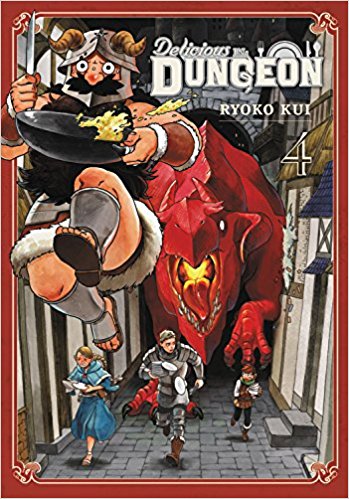
Delicious in Dungeon, Vol. 4 | By Ryoko Kui | Yen Press – I love the mix of food, fantasy, and humor in Delicious in Dungeon and have been enjoying the series a great deal. However, while the ingredients are the same, the exact proportions of the mix has changed somewhat with the fourth volume. Food is still an important element, and the manga’s terrific comedic moments continue to be a staple, but the story has taken a significantly darker, more serious turn–the series’ intrepid adventurers must now face off with the red dragon they’ve been hunting down from the very beginning. It’s an intense battle brilliantly executed by Kui who demands both sacrifices and clever thinking from the manga’s quirky yet endearing cast. This easily could have been the series’ grand finale, but there’s more to come; I’m intensely curious to see where the manga, and its frequently unexpected cuisine, goes from here. – Ash Brown

Frau Faust, Vol. 4 | By Kore Yamazaki | Kodansha Comics – You get the sense, reading this volume of Frau Faust, that Johanna is the sort of protagonist who has the magical ability to have good friends die around her so that she can suffer and also deal out justice and a good moral lesson. Which means that this series is not exactly filled with fun and games, but the title might have been a clue that wasn’t going to happen. Johanna’s undying nature is unhelpful here, as she spends half the book being gruesomely tortured on behalf of the evil nun in charge of hating demons—except, of course, the ones she can use for her own benefit. Still greatly enjoying Frau Faust, but you need to realize going in the premise is “everything is awful and everything hurts.” – Sean Gaffney

Giant Spider & Me: A Post-Apocalyptic Tale, Vol. 1 | By Kikori Morino | Seven Seas – I almost passed up on Giant Spider & Me, but as soon as I learned that it was in part a food manga, I couldn’t resist giving the first volume a try. One day, Nagi, a young woman largely living on her own in the mountains, encounters a strange but intelligent creature in the woods that looks an awful lot like a giant spider. It ultimately follows her home, essentially becoming Nagi’s pet and guard animal, but more importantly her companion against loneliness (even if food is their most successful means of communication). The worldbuilding is a little vague at this point which can be frustrating, and Morino’s artwork isn’t always consistent when it comes to scale, but as a whole Giant Spider & Me is charming and surprisingly sweet. I was delighted by the first volume, so I’ll certainly be picking up more of the series. – Ash Brown

The Girl from the Other Side: Siúil, a Rún, Vol. 4 | By Nagabe| Seven Seas – If you’re still comparing this with The Ancient Magus’ Bride, I can see why, but this series seems to be turning down a far darker alley. Teacher has decided that things will be best if he, Shiva and her aunt all live together. but just because the aunt is now cursed does not mean that she’s ready to trust and forgive the teacher—quite the opposite,. There is a stereotypical cooking scene where everything goes wrong and the three end up covered in white flour that is simply brutally jarring in terms of tone—it helps put the rest of the book in stark relief. Meanwhile, the main mystery for this series is “what is Shiva’s deal?”, and I hope we find out more about that next time. – Sean Gaffney

Lovesick Ellie, Vol. 4 | By Fujimomo | Kodansha Comics (digital only) – My least favorite attribute of Ellie’s personality is how her fantasy life blinds her to the reality of certain things, like… if you fail your final exams, you’re going to have to take remedial classes during winter break. Of course, the angst over missing Christmas with Akira and not recognizing that he has been looking forward to it just as much as she was eventually leads to a really sweet moment (and smooch!) so I guess we have to suffer through some “derp” stuff to get to the good stuff. Meanwhile, Ellie seems to have made a couple of new friends in class thanks to her ping pong prowess (yes, really); we get to know Sara’s second-year protector, Takagi, a little better; and a boy in Ellie’s remedial class seems to be the one commenting on her Twitter fantasies. Not groundbreaking shoujo, but I enjoy it. – Michelle Smith

One-Punch Man, Vol. 13 | By ONE and Yusuke Murata | Viz Media – Last time I said the tournament was the least interesting part of the volume, this time the opposite is true. Saitama’s fight with Suiryu is not only filled with a lot of fantastic and ludicrous action, but also helps once again to define what Saitama’s ideas of being a hero and being strong are compared to other people—and why he’s the title character. That said, he learns the wrong lesson from the battle—but that’s why One-Punch Man remains very funny. Of course, things aren’t all fun and games, and I worry that we may lose some innocent bystanders in this ongoing war between heroes and monsters—especially as Saitama is running away and may not be able to help. – Sean Gaffney

One-Punch Man, Vol. 13 | By ONE and Yusuke Murata | VIZ Media – You know you’re middle-aged when you’re watching heroes battle a giant octopus and you keep thinking about how massive and costly the cleanup will be from all the damage! At least we learn more about the source for all these monsters, and that Saitama will probably be facing them soon, since they invade the martial arts tournament at the end of the volume. The tourney was quite entertaining this time, as Saitama faces the one guy (who could be called One-Kick Man, based on his previous bouts) who he thought could give him a challenge, only to realize once again that it’s not the case. Still, I enjoyed their fight and hope that Saitama will now get back to the hero game. Also, I missed Genos! Thankfully, the wait for the next volume is not as long this time. – Michelle Smith

Skip Beat!, Vol. 40 | By Yoshiki Nakamura | Viz Media – The cover to this volume is adorable—Kyoko just wants to act together with Kanae SO MUCH, and you can hope that she will get her wish someday, though the cliffhanger implies it may be a lot more difficult than the usual “audition.” Fortunately she has Yashiro in her corner, who is acting as a temporary manager for her, and reminds the reader once again that when it comes to “manager” activities, he is essentially superhuman. More seriously, we meet an old rival in this volume and, like Kyoko, our jaw drops when we finally realize who she is. I will admit that I was more interested in Kyoko’s swordfighting and rhythmic gymnastics training than I was anything with Erika. That does not change the fact that Skip Beat remains essential.-Sean Gaffney

UQ Holder, Vol. 13 | By Ken Akamatsu | Kodansha Comics – I have to admit, I have no idea how time, dreamscapes, or indeed any aspect of magic work in Akamatsu’s universe, and I suspect neither does he, as we’re in a dreamscape that is also the past, except we also get the rest of the main UQ Holder heroines here as mind-controlled darkness versions of themselves, before EVERYONE is saved by Asuna showing up with her big-ass sword, something so unbelievable even Eva has to say she doesn’t think she’s the real Asuna. She certainly acts like her, though, and is ready to help Touta and company battle against the evil Negi and his evil sentai team. This is exciting when you read it, but logic and proportion have fallen softly dead a long time ago. – Sean Gaffney

Filed Under: Bookshelf Briefs

Voices of a Distant Star

March 19, 2018 by Katherine Dacey

What would it be like to embark on a deep space voyage, knowing that when you returned, nothing on Earth would be as you remembered it? That’s the question at the heart of Makoto Shinkai and Mizu Sahara’s Voices of a Distant Star, a thoughtful — if sometimes clumsy — rumination on the human toll of interstellar travel.

The story begins in 2046, as sixteen-year-old Noboru Terao anxiously awaits text messages from his childhood friend Mikako Nagamine, who’s enlisted in the military. As we learn through snippets of conversation and text, Nagamine isn’t at a conventional boot camp: she’s been deployed to Mars, where humanity is preparing for a lengthy campaign against an alien race known as the Tharsians. Her early exchanges with Noboru arrive in a matter of days or weeks, but when she’s transferred to the front lines, she realizes that it may be years before Noboru receives her next text; as she ruefully observes, “By the time this message reaches you, everyone will be growing up into people I don’t know.”

The emotional honesty of their epistolary romance is the best reason to read Voices of a Distant Star. Through their brief exchanges, we grasp that Noboru and Nagamine are torn between the desire for a normal relationship and the dawning realization that they may be better off pursuing their own destinies — a realization made more poignant by the sharp contrast between Noboru’s ordinary school life and Nagamine’s extraterrestrial mission. Their dilemma would be more moving, however, if the artwork wasn’t executed in such a desultory fashion. The characters are utterly generic, lacking any semblance of individuality, while the space combat lacks any sense of place; the story could just as easily be unfolding in Phoenix, AZ as on a planet eight light years from Earth. I know — the story is supposed to give me the feels, not the chills — but a little more attention to the dangerous aspects Nagamine’s mission would have raised the emotional temperature of Voices of a Distant Star from mild to muy caliente. In spite of these artistic shortcomings, Noboru and Nagamine’s plight remains powerful, reminding us that our greatest obstacle to space travel isn’t distance — it’s time. Recommended.

Voices of a Distant Star
Story by Makoto Shinkai, Art by Mizu Sahara
Translated by Melissa Tanaka
Vertical Comics, 238 pp.

Filed Under: Manga, Manga Critic, REVIEWS Tagged With: makoto shinkai, Sci-Fi, voices of a distant star

Pick of the Week: An Assortment of Manga

March 19, 2018 by Sean Gaffney, Michelle Smith, Ash Brown, Anna N, Katherine Dacey and MJ Leave a Comment

MICHELLE: There are quite a few good things coming out this week! I’ll definitely be reading the latest Giant Killing and Wake Up, Sleeping Beauty, and I’m happy to see more Sweet Blue Flowers. Too, there’s Perfect World, a josei series with a very interesting premise. But still, Twinkle Stars is coming to an end, and I find I’m really in the mood to see how this one wraps up, so that’s my pick for this week.

SEAN: Sadly, I suspect I will be the only one picking this, meaning I can’t call Pick of the Week “Take Back Your Mink”. But my Pick this week is definitely the first omnibus of Dragon Half, which I’m hoping will let me wallow in nostalgia.

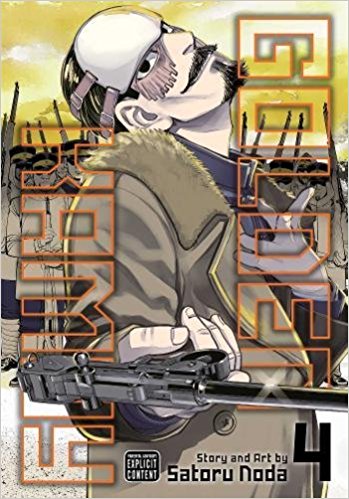
KATE: I hate to be predictable, but my pick is volume four of Golden Kamuy. Is it a cooking manga with action sequences, or an action manga with lengthy discussions about squirrel meat preparation? Danged if I know, but I’m hooked.

ASH: So much is coming out this week that I’m looking forward to! Sweet Blue Flowers, Golden Kamuy, Twinkle Stars, Dragon Half and more. I’ll take this opportunity to pick one that hasn’t been mentioned by someone else yet, Natsume Ono’s ACCA 13-Territory Inspection Department. The first volume was a slow burn, but stylish and intriguing.

ANNA: There’s a lot of great titles coming out this week! I have to go with my general inclination to celebrate josei whenever a new series comes out, so my pick is Perfect World.

MJ: since I’m going last here, I’ll round things out by picking the third omnibus of Sweet Blue Flowers. I’m a fan of this series, and I’m a fan of angst, so this works well for me.

Filed Under: PICK OF THE WEEK

Infinite Dendrogram: Those Who Bind the Possibilities

March 19, 2018 by Sean Gaffney

By Sakon Kaidou and Taiki. Released in Japan by Hobby Japan. Released in North America by J-Novel Club. Translated by Andrew Hodgson.

I’ll pick up with a point I made in the last review: there was honestly no reason that the author couldn’t have simply kept this with the fourth book and released it as one big tome. It took me a while to get back into where the action was, as if you were watching the climax of a movie and stopped with 15 minutes to go so you could go on a two-week vacation. That said, given that we’ve not only got the climax of the previous book, but also an extended epilogue and a side story or two, this is a light, easy read. In fact, the side stories may be the best part of the book. Because this is a series where the world not only is a game, but also one where people are not trapped in said game, we’re actually allowed to deal with real life issues like making sure you do all your pre-college prep. And having the hero and villain pass each other like ships in the night.

We also get more of the Starling brothers and their eccentric awesomeness, though it appears it’s more “the Starling family”, as we hear about an older sister who’s more insane than either brother. (It would be nice to meet her, but I expect she’s just the sort of character to be talked about but never show up.) Shu proves to be, as the reader likely guessed all along, a phenomenal powerhouse who uses his incredibly unbalanced build and real-life martial arts skills to completely decimate Franklin’s army of monsters, all while making the bear minimum number of puns. And then there is Ray, who still sees himself as the typical, normal male protagonist even as he gets himself some evil blood-red armor and also loses an arm, replacing it with a hook. Nemesis was introduced into the book as his lovestruck familiar, but lately she seems to exist to occasionally sigh and mutter to herself about Ray’s tastes.

As for Franklin and Hugo, I was fairly surprised by their relationship, though again, I do think it would have had more impact if the book hadn’t been divided into two parts. Franklin’s “character” is a classic sneering, arrogant villain, the sort who thinks they’re being stoic but really they’re just being awful. I’m not entirely sure if the obsession with Ray Starling will extend into the real world – they’re oblivious to each other at the moment, but I don’t expect that to change anytime soon. I was slightly saddened to see that Marie’s character, while still remaining relatively badass, has acquired a bit of a comic relief quality, mostly in everyone knowing her real identity despite everything. I also enjoyed the two adult Superiors going out for a drink with a third one who, it’s implied, has just turned ten. Again, this is the nature of online gaming.

This book ends the first “arc” of the series, and we’re also almost caught up with Japan, though I think we’ll have one more volume to go before we have to wait. I expect the next arc will deal with what Franklin implied in this one, which is that of course Dendrogram is not “just” a game, there’s clearly something else to it. Till then, enjoy working your way through this book, though you might want to re-read the previous one first.

Filed Under: infinite dendrogram, REVIEWS

  • « Go to Previous Page
  • Page 1
  • Interim pages omitted …
  • Page 377
  • Page 378
  • Page 379
  • Page 380
  • Page 381
  • Interim pages omitted …
  • Page 1048
  • Go to Next Page »
 | Log in
Copyright © 2010 Manga Bookshelf | Powered by WordPress & the Genesis Framework