• Skip to primary navigation
  • Skip to main content
  • Skip to primary sidebar
  • Home
  • About Us
    • Privacy Policy
    • Comment Policy
    • Disclosures & Disclaimers
  • Resources
    • Links, Essays & Articles
    • Fandomology!
    • CLAMP Directory
    • BlogRoll
  • Features & Columns
    • 3 Things Thursday
    • Adventures in the Key of Shoujo
    • Bit & Blips (game reviews)
    • BL BOOKRACK
    • Bookshelf Briefs
    • Bringing the Drama
    • Comic Conversion
    • Fanservice Friday
    • Going Digital
    • It Came From the Sinosphere
    • License This!
    • Magazine no Mori
    • My Week in Manga
    • OFF THE SHELF
    • Not By Manga Alone
    • PICK OF THE WEEK
    • Subtitles & Sensibility
    • Weekly Shonen Jump Recaps
  • Manga Moveable Feast
    • MMF Full Archive
    • Yun Kouga
    • CLAMP
    • Shojo Beat
    • Osamu Tezuka
    • Sailor Moon
    • Fruits Basket
    • Takehiko Inoue
    • Wild Adapter
    • One Piece
    • After School Nightmare
    • Karakuri Odette
    • Paradise Kiss
    • The Color Trilogy
    • To Terra…
    • Sexy Voice & Robo
  • Browse by Author
    • Sean Gaffney
    • Anna Neatrour
    • Michelle Smith
    • Katherine Dacey
    • MJ
    • Brigid Alverson
    • Travis Anderson
    • Phillip Anthony
    • Derek Bown
    • Jaci Dahlvang
    • Angela Eastman
    • Erica Friedman
    • Sara K.
    • Megan Purdy
    • Emily Snodgrass
    • Nancy Thistlethwaite
    • Eva Volin
    • David Welsh
  • MB Blogs
    • A Case Suitable For Treatment
    • Experiments in Manga
    • MangaBlog
    • The Manga Critic
    • Manga Report
    • Soliloquy in Blue
    • Manga Curmudgeon (archive)

Manga Bookshelf

Discussion, Resources, Roundtables, & Reviews

Michelle Smith

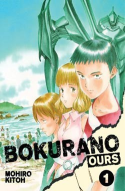
Bokurano: Ours 1-2 by Mohiro Kitoh: B

November 22, 2010 by Michelle Smith

Fifteen kids—most of them, except for one boy’s kid sister, in 7th grade—are taking part in a summer program called “Seaside Friendship and Nature School.” Chafing at the instruction to go out and observe nature, the kids decide to explore a nearby cave, where they inexplicably discover a computer lab and a strange guy who calls himself Kokopelli.

Kokopelli tells the kids he’s working on a game in which the “chosen heroes” will pilot a giant robot as it faces off against alien invaders, and offers them the chance to play. Of course, they’re all interested and when he asks them to seal their contract before explaining the rules, they comply. It’s only when Kokopelli’s subsequent demonstration claims the life of a fighter pilot that they begin to grasp that the battle—and the damage it causes—is real.

Over the course of these first two volumes, the kids begin to learn exactly what they’re in for. After the disappearance of Kokopelli, “assistance” is provided by (possibly untrustworthy) Koyemshi, a floating creature almost cute enough to be a plushie if not for his menacing set of pointed teeth. He doles out information sparingly, and it’s not until two of their comrades have died that the kids learn the truth: the giant robot will fight to defend humanity from the invaders, but derives the power to do so from the life force of its pilot.

Obviously, the kids want to quit, but Koyemshi points out that they signed a contract and warns that if they should refuse to fight, Earth will be destroyed within 48 hours. The same fate awaits if they should lose a battle. As he puts it, “Win, save the planet and die… or lose and die when your planet is destroyed. Those are your options.” Believing that they really are helping to save the world, the kids soldier on.

At this point, the feel of the story reminds me a lot of another VIZ Signature title, Ikigami. For those unfamiliar with the story, Ikigami envisions a Japan in which the government attempts to encourage its citizens to lead a more productive life by instilling in them the fear of death. Anyone could receive a death notice (an ikigami) at any time informing them that they have 24 hours left to live, and the series follows each recipient in turn as they deal with the news.

Bokurano is structured similarly, focusing on each pilot as he or she “gets the call.” There are merits and flaws to this approach: obviously, the current pilot receives a lot of attention, and it’s interesting to see how each approaches the responsibility differently. One boy cares nothing for human casualties while another carefully takes the battle out into the harbor to minimize damage. One girl uses her final hours to sew morale-boosting uniforms for the group. Unfortunately, this also means that at any given time there are about a dozen characters relegated to the background, waiting for their turn to contribute to the story.

Because of lack of time spent with individual characters, it’s hard to care about them much, despite their awful predicament. I might realize I like someone based on how he handles his turn as pilot, but I know the opportunity to see things from his perspective will be brief. The most compelling aspect of the story to me is the notion of where these invaders came from in the first place, and what the human population as a whole thinks about giant monsters in their midst.

During Kokopelli’s demonstration, as he occupies the sole chair in a circle of many, he admits that he’s as much a pawn as the kids are and that he isn’t from our planet. It would appear, then, that he is the final pilot from a previous incarnation of this “game” who was sent to Earth to find a new set of players. Is this “invasion” real? Why are there precisely fifteen enemies and no more? This may not be a game for the young pilots or the humans threatened by these monsters, but is it a game for someone, somewhere?

Dark, grim, and mysterious, Bokurano is probably not for everyone, but I’ll definitely be reading more.

Bokurano: Ours is published in English by VIZ. The series is complete in Japan with eleven volumes.

This review was originally published at Comics Should Be Good.

Review copy for volume two provided by the publisher.

Filed Under: Manga, Sci-Fi, Seinen Tagged With: VIZ, VIZ Signature

Breaking Down Banana Fish, Vols. 9-10

November 21, 2010 by MJ, Michelle Smith, Connie C., Khursten Santos and Robin Brenner 26 Comments

Hello readers, and welcome to the fifth installment of our roundtable, Breaking Down Banana Fish!

This month we take on volumes nine and ten, in which Ash faces Arthur in their final showdown, Eiji is nabbed by the fuzz, Yut-Lung reveals his vulnerable side, and government conspiracy runs amok.

I’m joined this month by Michelle Smith (Soliloquy in Blue), Khursten Santos (Otaku Champloo), Connie C. (Slightly Biased Manga), and Robin Brenner (No Flying, No Tights). Eva’s taking a break this time around, but she’ll be back with us in January as we head into the second half of the series!

Just a note: We’ll be moving to three volumes per installment beginning in January, so if you’re following along, be sure to read up through volume 13!

I would like to take just a moment to thank everyone on the roundtable for working to make time for this project. Nineteen volumes is a large commitment to make, and I have a great deal of gratitude toward these women for sticking it out, especially Eva who will have to marathon five volumes to catch up next time around! Thanks also to Viz for printing this series in its entirety. Perhaps if we’re very lucky, it might receive an omnibus treatment somewhere down the line, to put it all back in print.

Read our roundtable on volumes one and two here, volumes three and four here, volumes five and six here, and volumes seven and eight here. On to part five!
…

Read More

Filed Under: FEATURES Tagged With: banana fish, breaking down banana fish, roundtables

BL Bookrack: Juné in November

November 17, 2010 by MJ and Michelle Smith 15 Comments

Welcome to November’s installment of BL Bookrack, a monthly feature co-written with Soliloquy in Blue‘s Michelle Smith.

This month, we take a look at four offerings from Digital Manga Publishing’s Juné imprint, Endless Comfort, Kiss Blue (volume two), Seven Days: Monday-Thursday, and Stay Close to Me.


Endless Comfort | By Sakura Sakuya | Published by Juné | Rated Mature (18+) Buy at Akadot – Two years ago, when Masaki Kuzumi’s sickly mother finally succumbed to illness, his primary emotion was relief. Not wanting to confront these feelings, Masaki immersed himself in business in Hong Kong. Now, just shy of the second anniversary of her death, he has returned to the manor home he inherited a changed man. His friends remark that he is no longer as cold as he once was, and he is soon intrigued by Yuu Kanai, a seemingly easy-going dog trainer with some inner darkness of his own.

The path that Masaki and Yuu’s relationship takes is fairly straightforward and predominantly sweet. Yuu is good-natured when awake, but at night suffers terrible nightmares brought on by sexual abuse perpetrated by his stepfather when he was an adolescent. Masaki wants to help Yuu get over this, and very gently puts himself in the position to provide support when necessary, also achieving sufficient closeness to confess his own feelings about his mother’s death. Through the power of Masaki’s love, Yuu is able to overcome the terror of physical closeness, and an absolutely adorable epilogue chapter (featuring the show-stealing dogs) suggests a happy future.

There are definitely good things about Endless Comfort. Masaki is quite secure in his homosexuality and is upfront about it with Yuu, giving him the option to speak up if he ever feels uncomfortable. And, as mentioned, the dogs have a lot of personality. Unfortunately, quite a lot of the middle is pretty dull. The characters initially seem stiff, and some moments that should be dramatic—Yuu freaking out and crying, “Father, no, I don’t want to!”—are so stilted as to almost be comedic. Additionally, a side couple consisting of a pair of Masaki’s coworkers doesn’t add much to the story. The status of their relationship is confusing and I think the story would’ve been better off without them.

If I had to pick one word to decsribe Endless Comfort it would be “nice.” It’s a gentle story and a worthwhile read, but you might want to load up on caffeine first.

-Review by Michelle Smith


Kiss Blue, Vol. 2 | By Keiko Kinoshita | Published by Juné | Rated YA (16+) | Buy at Akadot – The first volume of this short series introduces us to Tomosaka, a quiet high school student who realizes he’s in love with his womanizing best friend, Noda. Though his eventual confession to Noda lands the two of them in bed, Noda’s inability to take their new romantic relationship seriously makes the encounter a regretful one for Tomosaka. Anxious to salvage the relationship they once had, Tomosaka asks that they return to just being friends.

As volume two opens, it becomes quickly apparent that this new arrangement is a strain for both of them. Struck with the impossibility of returning things to normal and unable to swallow his jealousy over Noda’s female conquests, Tomosaka waffles between repressed anger and forced apathy, leaving Noda confused and frustrated by his passivity. Complicating things further, Tomosaka is faced with romantic attention from both a female classmate and his openly gay boss, neither of whom he’s interested in. Can even accidental lovers ever return to being friends?

This series’ first volume was remarkable for its understated, intimate look into its characters’ emotional world and a sort of quiet ambiguity more characteristic of Bildungsroman than straight-out romance. Though the story’s premise is certainly nothing new, its thoughtful execution set it apart from showier romances. Thankfully, nothing has changed. Now in its second (and final) volume, Kiss Blue remains as intriguingly introverted as its protagonist, Tomosaka, favoring awkward kisses and inner monologue over sex and emotional theatrics–a sensibility enhanced further by Keiko Kinoshita’s sparse, wispy artwork.

“Intimacy” is still the series’ major characteristic, both in its style of storytelling and the relationship between its main characters, whose estrangement from and affection for each other are both driven by their keen awareness of each other’s personalities, for better or worse. Deeply flawed characters are usually the most interesting, and that goes for relationships as well, so it’s no surprise that the series gets its greatest mileage out of its characters’ failures, both as friends and lovers.

It’s taken over two years for this volume of Kiss Blue to appear, thanks to the first volume’s poor sales performance, according to this thread at the DMP user forums. Let’s hope that the release of its second volume will encourage new readers to take a look at this thoughtful little manga. Recommended.

-Review by MJ


Seven Days: Monday-Thursday | By Rihito Takarai & Venio Tachibana | Published by Juné | Rated YA (16+) | But at Akadot – Each Monday morning, without fail, high school freshman Touji Seryou will agree to date the first girl who asks him, only to break up with her by the week’s end. Despite this unusual reputation, Seryou’s respectful treatment of his endless string of girlfriends keeps them in fresh supply. One Monday morning, curious about Seryou’s motivations, upperclassman Yuzuru Shino jokingly offers himself up as Seryou’s date for the week, only to be surprised when his proposal is accepted. As the volume continues, both carry on with the motions of their arrangement, neither quite sure of the other’s intentions.

Much like Kiss Blue above, what really makes this story work is its characters’ flaws and hangups, and how these affect their ambiguously developing relationship. As it turns out, Seryou’s hung up on his brother’s ex-girlfriend, whose aggressive pursuit of Seryou (both before and after the breakup) keeps him concurrently hooked and wracked with guilt. Given this, it’s unsurprising to discover that Shino’s domineering personality is striking a chord with him as well, awakening within him the first shreds of real attachment he’s felt since he began his bizarre dating ritual.

Meanwhile, Shino finds ways to make light of any burgeoning feelings on his part, while using his new influence over Seryou to make him show up to archery practice, forcing Seryou into displaying commitment for something in his life, while also possibly working through his own ambivalence for a discipline at which he once excelled.

There are a lot of layers to this odd little story, and though it’s unclear at this point how anything might be resolved within (presumably) just three more days, writer Venio Tachibana provides more than enough reason for us to want to find out. And though that reason includes school club drama, at least two love triangles, one wonderfully tough female character, and, of course, attractive archery uniforms, it’s still the story’s idiosyncratic leads who steal the show with a mountain of mixed signals, persistent defensiveness, and awkward moments of affection.

Rihito Takarai’s artwork is a mixed bag of expressive movement, dully similar facial designs, and moments of real beauty. Fortunately, the visual storytelling is strong throughout, making the most of Tachibana’s offbeat tale.

There’s still a lot of story to be told in this two-volume series. I, for one, can hardly wait ’til “Friday,” to see how it plays out. Recommended.

-Review by MJ


Stay Close to Me | By Yaya Sakuragi | Published by Juné | Rated Mature (18+) | Buy at Akadot – I don’t always fare well with BL comedies, which too often revolve around a bigger guy trying to manhandle a littler one at every opportunity. Happily, Stay Close to Me is not that kind of comedy.

Yuzuru Shibata and Issei Yogi have been close friends since elementary school, when Issei stepped in to save Yuzuru from bullies. Yuzuru has pretty much been in love with “Icchan” since that day, whom he regards as princely, and is “in training to be a homemaker.” Alas, a growth spurt has stymied Yuzuru’s efforts to feel like the proper princess, since at 6’0” he towers over the 5’8” Issei.

The couple stars in a quartet of episodic stories that derive their comedy more from the characters than wacky hijinks (though those do ensue). First, Yuzuru is oblivious to the true reasons the captain of the karate club is pursuing him, even though the guy has some terrifically cheesy lines like, “Today is the day I will seduce you… I mean… convince you to join the karate club!” Then he’s drafted to participate in a school play, receives a love letter from a girl, and finally is prevented from spending quality time with Issei when the latter’s brother moves back home. Each time, blunt but kind Issei ends up saving him in one form or another, though he informs Yuzuru he won’t be treating him like a princess, since he can handle himself.

I can easily see such a storyline irritating me if done poorly, but both Yuzuru and Issei are very likeable, and Sakuragi’s art is quite attractive, as well. The end result is a manga that is often silly—indeed, in her author’s notes Sakuragi writes “Please don’t think too hard while reading it”—but at the same time incorporates scenes of genuine emotion. A pair of similarly lighthearted stories featuring a ronin and a gambler round out the volume, and though our time with them is brief, it’s still enjoyable.

Stay Close to Me balances humor and emotion to become one of the few BL comedies I have genuinely liked.

-Review by Michelle Smith


Review copies provided by the publisher.

Filed Under: BL BOOKRACK Tagged With: kiss blue, seven days, Yaoi, yaoi/boys' love

Off the Shelf: “Too Many Books”

November 11, 2010 by MJ and Michelle Smith 7 Comments

Welcome to another edition of Off the Shelf with MJ & Michelle! I’m joined, once again, by Soliloquy in Blue‘s Michelle Smith.

This week, we take a look at a few favorites from Viz Media, Tokyopop, and Vertical, Inc.


MICHELLE: Ne, ne, MJ? Know what’s awesome? Manga is awesome. I was experiencing the slightest sense of “meh” about manga last weekend, and then I read House of Five Leaves and I am cured.

MJ: Oh, those moments of renewal are so fantastic, aren’t they? And House of Five Leaves is certainly up to the task.

MICHELLE: Definitely. I hope you feel similarly about what you read this week!

MJ: You know, I do. Maybe not as dramatically, but I’ve had a very good week in manga so far.

MJ: My first read this week is the final volume of Yun Kouga’s Crown of Love, a fairly dark josei romance, published here under Viz’s Shojo Beat imprint.

What’s been fascinating about this series from the beginning is the starkly intimate view Kouga provides of her characters’ darkest impulses, particularly those of the story’s protagonist, Hisayoshi. His stalker-like obsession with teen idol Rima has been consistently riveting, mainly because we’ve been privy not only to its creepiest aspects, but also to Hisayoshi’s own reflections on just how creepy they really are. This heightened self-awareness on the part of its characters is what makes the story really work. It also forces us to acknowledge our own creepiest thoughts, which, though perhaps not exactly desirable, is certainly effective.

When I discussed volume three back in July, I expressed some concern that the story might be headed for a more conventional conclusion. And though this does indeed come to pass, I’m happy to report that it doesn’t really make things any less complicated, even to the end.

What this series ultimately succeeds at pointing out is that love is essentially a pretty creepy thing. And though I’m not sure that’s a philosophy I’d personally want to live by, it’s not exactly wrong, either. Despite its obvious emotional focus, this is a series that analyzes itself and its characters constantly, from the inside out. The fact that its conclusions are disturbing is pretty much undeniable. They’re also uncomfortably (and remarkably) true. :) …

Read More

Filed Under: OFF THE SHELF Tagged With: chi's sweet home, crown of love, maid sama!, saturn apartments

Two by Natsume Ono

November 8, 2010 by Michelle Smith

For my latest column at Comics Should Be Good, I reviewed the debut volumes of two (relatively) new Natsume Ono series: House of Five Leaves and Gente: The People of Ristorante Paradiso. I really loved House of Five Leaves, with its story of a hapless samurai drawn into the schemes of a fascinating criminal. Gente is more a collection of low-key short stories than a single narrative, which means it’s slightly less awesome but still very entertaining.

You can find those reviews here.

Both House of Five Leaves and Gente are published in English by VIZ. The former is still ongoing in Japan, where it is up to eight volumes, but the latter (a “delightfully whimsical continuation” of Ristorante Paradiso) is complete with three volumes.

Review copy for Gente provided by the publisher.

Filed Under: REVIEWS Tagged With: Natsume Ono, VIZ

Off the Shelf: Sports, Ghosts, Books, & Boys

November 3, 2010 by MJ and Michelle Smith 7 Comments

Welcome to another edition of Off the Shelf with MJ & Michelle! I’m joined, as always, by Soliloquy in Blue‘s Michelle Smith.

This week, we check out new volumes of currently-running series from Yen Press and Viz Media, as well as a sweet, new one-shot from Digital Manga Publishing.


MJ: Hi, Michelle! So… I am totally out of semi-clever lines with which to begin this exchange. Um. Got books?

MICHELLE: Have I ever! I came close to answering “Far too many,” but then wondered if that could ever really be true.

MJ: I think emphatically not. :)

MJ: They really are! Also, I have to say that your description of the book has completely charmed me. I hadn’t had much interest in checking out this title, but now I feel I must read it!

MICHELLE: More like there are far too many I want to read right this minute!

One book that I did manage to read this week is Cool/Uncool, a recent release under DMP’s DokiDoki imprint. Cool/Uncool follows a pair of life-long friends turned lovers as they progress from high school to college and deal with various insecurities in their relationship. In the title story, Yukihisa can’t figure out why his friend Takashi keeps avoiding him. Savvy BL readers will think “It’s because he loves you, silly!” and that does tie into it, but the actual reason is completely random and rather endearing.

Each successive story visits the boys after the passage of months or more and reveals the status of their relationship at that point in time. Much of the plot is derived from one fellow feeling like he’s the only one feeling a certain way, whether it be the desire to stay together forever or jealousy of a female classmate. In the end, the message is “be straightforward with your concerns,” which is not exactly the most riveting conclusion ever, but it fits well with such a cute and cozy story.

I liked the art in this one, as well. There are quite a few comedic interludes that look positively adorable, but the artist has quite a way with eyes. Here, check out this example! (see attachment)

Aren’t they pretty?

MJ: They really are! Also, I have to say that your description of the book has completely charmed me. I hadn’t had much interest in checking out this title, but now I feel I must read it! …

Read More

Filed Under: OFF THE SHELF Tagged With: cool/uncool, kingyo used books, real, time and again

Millennium Snow 1-2 by Bisco Hatori: B-

October 29, 2010 by Michelle Smith

Millennium Snow is the first series by Bisco Hatori (of Ouran High School Host Club fame), one of those that began as a stand-alone but eventually achieved serialization. It’s been on hiatus for some time, but now that Ouran has wrapped up, some fans are hoping that Hatori will return to it. I’m not so sure that’s a worthy endeavor.

Chiyuki Matsuoka has had a weak heart since birth, and wasn’t expected to live past the age of fifteen. She’s managed to make it to seventeen, but spends most of her time in the hospital. One day, as she is gazing out the window, she spots a boy fall from a building and dashes out of the hospital to check on him. He is Toya, the very personification of the seemingly gruff hero who actually has a heart of gold. He’s also a vampire, weak from his refusal to drink blood.

Toya is exceedingly abrasive to begin with, but eventually demonstrates he’s not such a bad guy by doing things like accompanying Chiyuki on an afternoon outing (vampires have overcome their aversion to sunlight) and catching a little kid’s loose balloon. Chiyuki falls for him pretty quickly and offers to become his partner. Having a human to feed upon will cure the exhaustion he suffers from abstaining and the arrangement will also allow Chiyuki to share his 1000-year lifespan. Toya refuses, because if his partner should ever despair of their unending life, he would be the one to blame—he’s watched humans he cared for die, and wouldn’t want to wish the same on his partner.

It’s an interesting dynamic, and the first chapter—which I assume constituted the original one-shot—is quite good. Unfortunately, one the story gets serialized, Hatori seems hard-pressed to come up with plots. First, she introduces Satsuki, a werewolf boy whose transformation is limited to fangs and clawed hands and feet in order to best preserve his bishounen appearance. When the story focuses on his desperate attempts to be normal, he’s a fairly compelling character, but he quickly becomes dim-witted and entirely too glomp-happy, existing only to incite Toya’s perturbation. Their incessant squabbling means that on practically every page someone’s yelling or getting kicked in the back of the head.

To demonstrate the dearth of plot ideas, in volume two the trio is suddenly lost in the Alps in Switzerland, where they stumble upon a deserted mansion. It is incredibly random, and brings home the point that while you may have two likable leads—plus a completely adorable talking bat!—you may find yourself without sufficient material to sustain a longer story.

I’m not sure how it can be salvaged at this point, honestly. I think I’d rather see Hatori embark upon something new and leave this one unfinished. When the romantic tension between Toya and Chiyuki takes center stage, the story’s potential is obvious, but the directionless plotting and constant bickering makes for a frustrating reading experience.

Millennium Snow is published in English by VIZ. The series is currently on hiatus in Japan.

Filed Under: REVIEWS Tagged With: Bisco Hatori, shojo beat, VIZ

Halloween Rain by Christopher Golden and Nancy Holder: C-

October 28, 2010 by Michelle Smith

From the back cover:
Around Sunnydale, they say a scarecrow saturated with Halloween rain will come alive and slaughter anyone in sight. (Lovely place, Sunnydale.) Buffy’s best friends, Xander and Willow, used to think the tale was nonsense—but after a few adventures with Buffy, they’re not so sure.

Even without a maniacal scarecrow, a Sunnydale Halloween is a truly horrific happening. There are enough zombies and vampires about, ready to party hearty and eat some brains, to keep the Slayer and her friends up all night.

And then the rain starts to fall…

Review:
It just wouldn’t be Halloween Week without a Buffy book, now would it? Unfortunately, this one is nothing to get excited about.

The story is set in the first season, after the episode “The Pack,” since former principal Mr. Flutie (eaten by some hyena-possessed students in that episode) is dead and buried. It’s also Halloween, which is a problem, as Buffy was not in Sunnydale for Halloween of her tenth-grade year (1996-1997). I mean, I didn’t conduct an exhaustive search for confirmation that she transferred in the spring, but I’m pretty sure that is the case. (Update: A sign in episode three, “The Witch,” confirms that it’s 1996, so I was wrong.)

Anyway, there’s apparently a legend in town that says to stay away from scarecrows on rainy Halloweens, because they come alive. After hearing about this from Willow and Xander, a memory niggles at Giles until he works out a connection between scarecrows and Samhain, who is referred to as “the dark lord,” the spirit of Halloween,” and “the pumpkin king.” While Buffy is off fighting a slew of zombies in the graveyard, Giles prepares a bunch of symbols and wards and stuff to fight Samhain. There’s a battle in a field, a barn burns down with Samhain trapped inside, and Buffy wins. The end. Yawn.

The humdrum nature of the plot is really nothing new for a Buffy media tie-in novel; usually the main draw of these is how well the writers capture the characters’ voices. Christopher Golden and Nancy Holder went on to write many more Buffy books, but I’m sure this was their first, as it’s only the second of the series, published in 1997 (before the season two episode “Halloween” established that demons are actually not very interested in the holiday). As a result, their success with the characters is hit or miss.

A lot of Buffy’s dialogue is cheesy and her thoughts rather vapid. Like this one, for example:

If she didn’t start hanging with her friends more, they might adopt a new Slayer as their bud. Or not, since there weren’t any others.

On the other hand, the Xander/Willow dynamic is conveyed pretty well, and there is one brief, simple exchange that would’ve been fully at home in the show.

“It gets worse,” Willow said, and tugged on Xander’s hand.

“I hate worse,” Xander grumbled.

The authors also seem to have a fondness for the phrase “clone that thought,” since it’s used at least three times.

I can forgive a lame plot if the characters are written well, but Halloween Rain is a success in neither category.

Filed Under: Books, Media Tie-In, Supernatural Tagged With: Buffy the Vampire Slayer, Christopher Golden, Nancy Holder

Off the Shelf: Boo!

October 27, 2010 by MJ and Michelle Smith 11 Comments

Welcome to the Halloween edition of Off the Shelf with MJ & Michelle! I’m joined, once again, by Soliloquy in Blue‘s Michelle Smith.

In keeping with the holiday, Michelle and I take a look at some creepy comics from Yen Press, Tokyopop, and Manga BlackBox.


MICHELLE: Hey, did you hear that skritching noise? I think some zombies are trying to get in!

MJ: I’m safe! The workday already ate my brains. But wait, is that the howl of a werewolf?

MICHELLE: A ravenous one, no doubt! To take our minds off our impending doom, why don’t you tell me about a manga you read this week?

MJ: Okay! Well, my first selection isn’t exactly manga, though it is an East Asian comic. With Halloween approaching, I thought it was time to dig into some horror, but nothing from my to-be-reviewed shelf quite fit the bill. Fortunately, my husband is addicted to his iPad where he found a new app, just released yesterday, featuring award-winning Malaysian artist Leong Wan Kok’s From a Twisted Mind, published for iOS by a company called Manga BlackBox.

The book’s cover is immediately striking, with a surreal, psychedelic creepiness one might expect if, say, the Yellow Submarine had carried mad scientists instead of musicians. I plunked down my $3.99 based on the cover alone, which turned out to be a pretty good deal, all told. What I got for my money was a collection of seventeen short comics by Leong (sometimes known as “Puyuh”), originally published in four volumes, mostly horror (with one short volume’s worth of black & white fantasy/sci-fi stories in the back), all visually stunning.

The quality of the storytelling is uneven, as is the case of most short comic collections. The series’ first story, “Fantasy Aquarium,” (click title for screenshot) about a carnival run by vengeful fish, is delightful, and though it makes for a splendid opening, it sets the bar perhaps a bit too high for many of the comics that follow. Highlights include “Metamorphosis,” a creepy tale with a twist; “Love Virus,” about a biology student who wreaks disgusting vengeance on a backstabbing friend; and “The God of Happiness,” who is definitely not what he seems….

Read More

Filed Under: OFF THE SHELF Tagged With: demon sacred, from a twisted mind, higurashi when they cry, nightschool

Gyo 1-2 by Junji Ito: B+

October 26, 2010 by Michelle Smith

Walking fish aren’t the usual sort of monsters one associates with Halloween, but their invasion makes for creepy reading nonetheless!

Tadashi and his high-maintenance girlfriend, Kaori, are vacationing in Okinawa when Kaori begins complaining of putrid smells. Soon after, a chase ensues between Tadashi and a barely glimpsed, fast-moving creature, culminating with the discovery that said critter is actually a fish with four spindly mechanical legs. This is just the tip of the fishberg, though, as Okinawa is soon overrun by walking fish, which quickly spread to mainland Japan and eventually the rest of the world.

Despite the attempts of the back cover to induce me to regard the series as “horrifying,” the primary adjective I’d use to describe it is “weird.” The scenes of walking fish—and sharks, squids, and whales—swarming down city streets are alarming but fun in a disaster movie kind of way. For most of the first volume, I actually smiled as I read. Things get more serious in the second volume, with revelations about what the creepy legs will do once they run out of fish bodies to use as fuel, but the weird only gets weirder—there’s a critter circus, for example—and the series never loses its page-turning momentum.

While I’d primarily classify Gyo as something fun that’s not too deep, it does offer some commentary on scientific ethics, particularly in the person of Tadashi’s uncle, who immediately begins trying to create a walking machine of his own. Some will be put off by the lack of a finite ending, but I find it interesting. If this were a disaster movie, we’d probably be given the opportunity to cheer on our battered heroes as they figure out the creatures’ vulnerability and blow them all to smithereens, but Gyo stops short of that point. Will mankind prevail? Will the world be overrun? We’ll never know.

Two short stories are included in volume two. “The Sad Tale of the Principal Post” is short and random, but I liked “The Enigma of Amigara Fault” a lot. In it, an earthquake has revealed a rock formation riddled with human-shaped holes that go farther back into the rock than researchers are able to measure. People have flocked to the site after seeing it on TV, somehow drawn to holes that seem to have been tailor-made for them. A young man named Owaki tries to keep his new female friend, Yoshida, from entering her hole, and suffers some vivid (and way more horrifying than the fish-monsters!) nightmares about what could happen to a person who enters. The final page suggests he was right.

In the end, I wouldn’t classify Gyo as amazing, but it—and “The Enigma of Amigara Fault”—are certainly entertaining and memorable. I may have to check out more from Junji Ito, like the spooky spiral menace of Uzumaki!

Gyo is published in English by VIZ and is complete in two volumes.

Filed Under: Books Tagged With: Junji Ito, VIZ, VIZ Signature

In the Walnut 1-2 by Toko Kawai: B+

October 20, 2010 by Michelle Smith

More mystery than romance, this BL series features some unremarkable “cases” but a pair of interesting leads who are already an established couple when the story begins! Shocking!

You can find my review for Manga Bookshelf here.

In the Walnut is published in English by Digital Manga Publishing. The series is still ongoing in Japan; the third volume was just released there on October 9th.

Review copies provided by the publisher.

Filed Under: Uncategorized Tagged With: digital manga publishing, Juné, Toko Kawai

BL Bookrack: October Mix

October 20, 2010 by MJ and Michelle Smith 8 Comments

Welcome to the October installment of BL Bookrack, a monthly feature co-written with Soliloquy in Blue‘s Michelle Smith.

First up this month, I take a short look at two one-shots, Baseball Heaven from BLU Manga and Deeply Loving a Maniac from DMP’s 801 Media. Then Michelle provides the real meat of this installment, with a thoughtful look at DMP/Juné’s In the Walnut.


Baseball Heaven | By Ellie Mamahara | Published by BLU | Rated Mature – Tokyo Elephants shortstop Chiaki Ogata is concerned when otherwise friendly rookie pitcher Eiji Uno seems to like everyone but him. It comes as a surprise to Ogata, then, when he discovers that Uno actually believes himself in love with him. Unable to consider getting involved with a much younger teammate, Ogata declares he won’t sleep with Uno until he pitches a perfect game, hoping to delay any need for decision. Can Uno stay interested under these conditions?

Romance manga is a tricky thing. Even the most realistic example of the genre must contain some element of fantasy in order to fulfill the expectations of its readers. On the other hand, the genre also provides an opportunity for complete immersion in a fantasy space for authors who wish to explore their readers’ more unlikely desires. Where writers most often stumble is in achieving believability within the construct of this fantasy, and unfortunately that is exactly the problem with Baseball Heaven.

Though there are plenty of scenarios, even in the workplace, in which an author might reasonably insert middle-school-quality romantic comedy, complete with wacky misunderstandings, wide-eyed confessions, chaste kisses, and blushing embraces, the world of professional baseball is simply not one of them.

Had Mamahara chosen a lighter, more commonplace fictional universe–a restaurant, perhaps, or a supernatural detective agency (for that fantasy touch)–her sweet (if mundane) romance might have gained a little traction. As it is, however, the incongruity of the story’s setting and its characterization is just too great to be satisfying for anyone. Readers looking for fantasy will be distracted by the intrusion of stony-voiced baseball announcers, while those with any knowledge of or interest in baseball will just feel embarrassed and sad.

Could there be a great BL baseball manga out there? I surely hope so. Unfortunately, Baseball Heaven is not it.

-Review by MJ


Deeply Loving a Maniac | By You Higashino | Published by 801 Media | Rated Mature (18+) – Morita is a dedicated otaku, who up until recently had spent all his waking hours buried in magazines filled with drawings of scantily-clad anime girls. This was before he met Sakura, a sexy, gay classmate and his first true love. Though trading in endless 2D girls for one hot 3D boy comes pretty naturally to Morita, he’s worried about what Sakura must think of him as a sex-obsessed otaku with no interests other than him. Can joining the track team make him into a more desirable man?

The answer is, hilariously, “yes,” a sentiment that might be applied to nearly everything in this oddly realistic piece of cracktastic pornography. Though perhaps this is due more to the high school yaoi genre’s predisposition to saccharin romance than it is to You Higashino’s actual skill, there is something incredibly refreshing about a story featuring two high school guys who simply admit to being total horndogs.

Really, though, it’s not just that. While the manga is steeped in explicit sexual fantasy, even from its very first pages, it is, overall, one of the most realistic depictions of actual high school boys I’ve yet to see in this genre. Though they each have their own urgent emotional concerns (Sakura’s worried that Morita’s new athletic-induced hotness will turn him back onto girls, and Morita wonders whether his obsession with a Sakura-like anime figure constitutes “cheating”) they are unable to communicate any of it to each other in a remotely coherent way. Sakura rages, Morita spaces out, and if they’re not really successful at anything but sex, that’s okay, since it’s all they’re really thinking about anyway.

Higashino’s artwork is filled with over-the-top BL imagery that manages to be genuinely sexy even as it pokes fun at the genre’s most ridiculous tropes. Her voice is satirical but never cutting, and she’s careful to skewer her characters (and readers!) with love. And for that we love her right back.

For suprising mix of otaku humor, hot porn, and unexpected realism, check out Deeply Loving a Maniac.

-Review by MJ


In the Walnut, Vols. 1-2 | By Toko Kawai | Published by Juné | Rated YA (16+) – The back cover of In the Walnut‘s second volume describes the series as “light and quirky.” While both are true at times, that makes it sound a lot more frivolous than it really is.

In what is a welcome departure from the typical BL formula, the leads are an established couple: sloppy and enigmatic Hideo Tanizaki, who has inherited a gallery (the titular In the Walnut) from his grandfather, and Sohei Nakai, a cheerful aspiring filmmaker. In the Walnut is known as a gallery that doesn’t ask too many questions, so Tanizaki is constantly fielding requests that seem a bit shady.

In the Walnut reads more like a mystery than a romance, as Tanizaki encounters a new art-related puzzle each chapter and must figure out what’s going on. Coincidence plays a huge factor in these “cases,” like when Tanizaki is asked to restore a battered old painting only to have a customer offer him its twin later the same day, or the way Tanizaki solves the mysteries—in a manner reminiscent of the TV show House—thanks to Nakai saying or doing something that sparks a realization.

While the cases themselves really are not that interesting, the same can’t be said for the characters. Eventually we do go back in time to see how Tanizaki and Nakai met, and while their current-day relationship seems rather casual, the depth of their feelings for one another becomes more clear as the series progresses. I also love that they talk to each other about things other than their relationship—if there were such a thing as a BL Bechdel Test, this would pass! True, Nakai, being the cheerful one who “grew up among goats” in Hokkaido, doesn’t really get fleshed out too much, but Tanizaki is a delightfully complicated character.

In early chapters, Tanizaki does a few things that might be construed as wrong but which have beneficial results for his customers. From this, we conclude that he’s a good man. Nakai reaches the same conclusion, and when he tells Tanizaki so, the latter is surprisingly affected, thinking, “I needed to know that I’m not evil.” But! It turns out things aren’t so cut and dry after all when, in the second volume, Tanizaki sells a painting to a young woman who lacks artistic knowledge for nearly six times its worth and later fails to tell another customer the full story behind what appears to be a cheap souvenir. He does do good, but sometimes his actions are spurred by greed rather than benevolence, which is a dichotomy I find intriguing.

Ultimately, I enjoyed In the Walnut quite a lot and it’ll be a sad wait until the third volume (just released in Japan earlier this month) finally makes its way here. Hopefully then we’ll learn more about Nakai!

-Review by Michelle Smith


Review copies provided by the publishers.

Filed Under: BL BOOKRACK Tagged With: yaoi/boys' love

Cross Game 1 by Mitsuru Adachi: A-

October 20, 2010 by Michelle Smith

When the first volume of Cross Game arrived at my house, I’m pretty sure my exact words were, “Eee!” Happily, I liked it every bit as I thought I would.

The back cover really says it best: “Cross Game is a moving drama that is heartfelt and true, yet in the brilliant hands of manga artist Mitsuru Adachi, delightfully flows with a light and amusing touch. The series centers around a boy named Ko, the family of four sisters who live down the street and the game of baseball. This poignant coming-of-age story will change your perception of what shonen manga can be.”

Warning: it’s impossible to discuss one of the nicest aspects of this series without revealing a major spoiler. Proceed at your own risk.

The first of the three volumes of Cross Game that VIZ has bundled together in an attractive omnibus serves as a prologue, of sorts. We meet protagonist Ko Kitamura when he’s in fifth grade, a mischievous and lazy kid whose parents run a sporting goods shop. Nearby, Mr. Tsukishima runs a batting center and his four daughters are a part of Ko’s life, though none more so than sunny Wakaba, who was born the same day as Ko and who alone has the power to motivate him. She’s a very special girl, with a knack for befriending other kids despite their appearance or reputation; the influence her acceptance has on her classmate Akaishi, commonly regarded as somewhat of a hoodlum, is destined to be lifelong.

Tragedy strikes at swimming camp when Wakaba attempts to save someone else and ends up drowning herself. Despite her physical absence from the story after this point, Wakaba’s presence remains a palpable one. As the story jumps ahead four years, we find Ko still continuing to perform the daily workout he promised her he would do as a means of improving his baseball skills and Akaishi leading the junior high baseball team (and staying out of trouble). Ko hasn’t joined the team because of some jerks that were on it when he was a first year, but once Akaishi tells him that on the last morning of her life, Wakaba passed by his parents’ store and mentioned that she’d dreamed about Akaishi and Ko going to Koshien together, he begins training without another word necessary. Ko may be a slacker if left to his own devices, but if it’s something Wakaba wanted, he is going to make sure it becomes reality, no matter what. It’s clear Akaishi feels the same.

The boys move into high school, where the interim principal has hired an unprincipled baseball coach with a good record at Koshien. Ko, Akaishi, and their friend Nakanishi don’t want to play for such a fellow and opt to remain on the junior varsity team; as the volume ends they’re preparing to show up the varsity team in an upcoming scrimmage game. Tying in with this is the sad story of Aoba, Wakaba’s younger sister. Aoba is passionate about baseball and is even the captain of the junior high team. Unfortunately, because she’s a girl she can only ever pitch in practice games and can never be deemed more than a devoted fan. Aoba and Ko clash personally, as well, as she still resents him for the closeness he shared with Wakaba, though it’s clear they’re destined to end up together.

Cross Game is a pretty low-key story that’s part slice-of-life and part sports manga. Typically, the protagonists in the latter don’t have such a touching reason for wanting to excel at their sport, and neither do they feature two guys nurturing a bittersweet memory of the same beloved girl in their hearts. The characters really grow on you—Ko seems a little bratty at first, but shows time and again that he’s a good person, particularly in how he treats Momiji, Wakaba and Aoba’s little sister—and I love that Ko’s two best friends are kind of burly and unattractive. You don’t see that a lot in manga.

I have two minor complaints, but I’ve been given to understand that they’re both common attributes of Mitsuru Adachi’s manga. The first is that some of the character designs—particularly of children—are positively dumpy. Too, a lot of the recurring characters have faces that are difficult to remember, though this is not the case at all for the primary players. Secondly, the fourth wall gets broken all the time. Adachi himself appears and the characters are often shown reading his manga. The story doesn’t take itself too seriously, so this is not as glaring as similar moments in NANA, for example, but I found it kind of irksome all the same.

The second omnibus of Cross Game, this time containing volumes four and five of the original Japanese releases, is due in January. I am looking forward to that scrimmage game—and Ko finally getting to show off his amazing baseball abilities—so much that it isn’t even funny.

Cross Game is published in English by VIZ, who is bundling the seventeen-volume series into eight chunky tomes. This one is comprised of the first three volumes and the others will contain two each.

This review was originally published at Comics Should Be Good.

Review copy provided by the publisher.

Filed Under: Manga, Shounen Tagged With: Mitsuru Adachi, shonen sunday, VIZ

Tidbits: Shonen Jumping for Joy

October 17, 2010 by Michelle Smith

Welcome back to Tidbits, a new feature for shorter reviews! This time I take a look at three continuing series from VIZ’s Shonen Jump imprint. First up, it’s volumes 28-31 of One Piece, followed by volumes 9-12 of Slam Dunk and a single volume (the third) of the aesthetically pleasing Tegami Bachi: Letter Bee.

One Piece 28-31 by Eiichiro Oda: B+
Volumes 28-30 consist almost entirely of fighting, as the forces of the all-powerful “Kami” of Skypiea, Eneru, clash with the Shandians (fighting to regain their lost city), while the Straw Hat pirates (just lookin’ for some gold) are caught in the middle. Eneru, as it turns out, has staged the whole thing as a survival game, and figures that after three hours, only five of the original 81 combatants will survive. After this, we get periodic updates as to how many remain, a device I found strangely satisfying.

Although some of the battles are between characters we’ve never seen before, those encounters are usually brief. While Luffy spends the entirety of volume 29 stuck inside a giant serpent, many of the other Straw Hats get a chance to shine, especially Chopper and Robin, whose battles with Eneru’s minions show off the versatility of their respective powers. Nami, too, gets more experience using her new weapons and Conis, a resident of Skypiea, marshals her courage to defy the Kami and warn the people of his plans to destroy the island. There’s been some discussion lately about manga that passes the Bechdel Test, and these volumes exemplify why One Piece does so with flying colors.

Speaking of Robin, I am liking her more and more. This is the first time we’ve really seen her on her own and though it’s always been evident how intelligent and competent she is, it’s nice to see she’s also trustworthy and kind of a badass. She’s generally reserved but is passionate about archaeology, and through her we begin to get hints about a 100-year gap in the history of the world, something that could turn out to be huge. At one point she references “the unspoken history that the land below has ceased to talk about,” and later discovers that Shandora “fought against the enemy.” Thirty volumes in and we’re just starting something so big and potentially awesome? Oda, I think I love you.

After Eneru puts in motion his plan to destroy Skypiea, a mass exodus of its residents ensues. Volume 31 departs from the present panic to flesh out the history of the island and how it ties in with Mont Blanc Noland. This is actually the best part of the Skypiea arc so far and explains quite a few things while being a durn good story in and of itself. The arc doesn’t quite wrap up here, but now that I fully understand the significance of the golden bell in the city of Shandora, I care a lot more about the outcome than I have done in recent volumes!

Slam Dunk 9-12 by Takehiko Inoue: B+
It takes some willpower not to devour each new release of Slam Dunk, but it’s so immensely satisfying to read multiple volumes back-to-back that the wait is worth it!

Volume nine marks the start of the Kanagawa Prefectural Tournament, in which the Shohoku team is able to take part thanks to Hanamichi’s friends taking responsibility for the on-court brawl that occurred in the previous volume. Shohoku is underestimated at first, but the return of Miyagi and Mitsui to the team—both of whom are greeted with somewhat awed recognition from the crowd—makes them a force to be reckoned with. They progress steadily through the tournament, eventually ending up in the final four against Kainan, a school that has made it to Nationals sixteen years in a row.

Hanamichi is his usual annoying self to begin with, demanding that the ball be passed to him and proclaiming himself a genius at every opportunity. After fouling out in each of the first four games, and after recognizing the skills and strengths of his teammates, he finally realizes that he’s not such hot stuff after all. Despite occasional relapses, this marks a real turning point for Hanamichi, as he is able to accept tutelage more readily and function better as a part of the team. For example, though he originally harbored dreams of outscoring Rukawa, once he makes snagging rebounds his focus instead, he’s able to contribute a great deal to Shohoku’s success. His progress and maturation combined with a slightly more humble attitude go a long way toward making him more likable, and it’s quite touching when he gets his first rousing cheer from the crowd.

Structurally, Slam Dunk is very similar to The Prince of Tennis. Though I love the latter a lot, Slam Dunk is the more exciting read, a fact I’d chalk up to the nature of the sport. In tennis, our lead characters battle either singly or in pairs against their foes, while the rest are relegated to commentary until it’s their turn. Here, all the principle characters are on the court at the same time, which gives more immediacy to the way they’re able to motivate each other. True, the characters in Eyeshield 21 all play simultaneously, too, but because basketball moves at a faster pace than football, the effect here is exhilarating, bordering on addictive.

Unfortunately, there’s no more Slam Dunk due until December! Perhaps I’ll investigate whether Inoue’s more dramatic basketball manga, REAL, can help stave off the cravings.

Tegami Bachi: Letter Bee 3 by Hiroyuki Asada: C+
Tegami Bachi: Letter Bee is the story of Lag Seeing, a twelve-year-old boy who has just become a Letter Bee (government mail carrier) in the perpetually dark country of Amberground, inspired by Gauche Suede, a Letter Bee he met five years ago. Lag had hoped to reunite with Gauche, but after learning that his hero disappeared six months after he last saw him, he meets with Gauche’s sister, Sylvette, and promises to find out what happened to her brother.

Gauche was by far the more interesting of the two characters featured in volume one, so it’s nice to get a few glimpses of him here. These tibits—and the bonus story about reuniting an aging dingo (animal companion) with the Letter Bee he faithfully served—are the best things about the volume. Lag is still not a very interesting protagonist and I’ve grown to pretty much hate his dingo, Niche. I’m sure she’s intended to be comic relief, but the story would be better served by cutting her unfunny antics and devoting that page space to clarifying the narrative, which is still going on and on about the importance of “heart.”

Back in January when I reviewed volume two, I said I’d give Tegami Bachi one more chance to win me over. As problematic as the series continues to be, after what we learn about Gauche’s disappearance and mysterious memory loss in this volume, I can’t imagine myself stopping without learning what happened to him. I don’t think this counts as “won over” so much as “minimally intrigued,” but either way, I’ll probably keep reading.

Review copies for volumes nine, eleven, and twelve of Slam Dunk provided by the publisher.

Filed Under: Manga, Shounen, Tidbits Tagged With: Eiichiro Oda, Hiroyuki Asada, Shonen Jump, Takehiko Inoue, VIZ

Off the Shelf: All About the Hair

October 13, 2010 by MJ and Michelle Smith 13 Comments

Welcome to another edition of Off the Shelf with MJ & Michelle! I’m joined, once again, by Soliloquy in Blue‘s Michelle Smith.

Back from our pre-NYCC break, Michelle and I take some time to discuss recent releases from Viz Media, and Vertical, Inc, and Digital Manga Publishing.


MJ: So, after a weekend at New York Comic Con, where I enjoyed the opportunity to discuss manga with a bunch of smart fans and critics, I have returned home to this column… where I enjoy the opportunity to discuss manga with a smart fan and critic.

I spend money on cons why?

MICHELLE: Actually, I’m kind of relieved I didn’t spend a bunch of money to go, given the paucity of new manga licenses, although I admit not getting to meet people as a result is a serious drawback.

MJ: Well, I think the company right here is pretty good. Though, as I gaze at my dinner of frozen pizza, I’ll admit that the food in New York was better.

In any case, with or without new manga licenses, we have plenty of current titles to discuss right here. Why don’t you start us off?

MICHELLE: Alrighty.

This week I got caught up with Rumiko Takahashi’s latest series, RIN-NE. I used to read each new chapter of this series online, but fell out of the habit, and had volumes three and four here demanding my attention. RIN-NE is an episodic supernatural comedy from the pages of Shonen Sunday and features Rinne Rokudo, a “sort of” shinigami whose chief character trait appears to be stinginess, and Sakura Mamiya, a human girl who can see spirits and who helps Rinne bring closure to those hanging around their school and send them off to the wheel of reincarnation.

Volume three introduces a new character, Tsubasa Jumonji. He’s an exorcist, though he seems to think all ghosts are evil, and immediately asks Sakura to go out with him. She’s not enthusiastic but doesn’t exactly reject him, either, which troubles Rinne. Even though he tells Sakura he has no interest in going out with anyone, he’s beginning to ponder what she means to him. For her part, Sakura is incredibly level-headed and calm, to the point where neither boy has any inkling what’s really going on in her head.

Still, Tsubasa becomes a part of the gang and the trio contends with the ghost of a boy who would like one fun date with the girl he liked before passing on, a toilet-haunting spirit, evil mechanical pencils, and Rinne’s mooching dad, who is the president of a damashigami (a corrupt shinigami who harvests the souls of those not yet destined to die) company and intends for Rinne to inherit. An incredibly over-the-top fight ensues, which I can’t fully describe except to say that it features a giant slab of wagyu beef and a mysterious stranger in a seal costume.

To look at RIN-NE objectively, I admit that this is quite a lot of wacky hijinks with very little payoff in terms of plot or character relationships. Still, it’s kind of… homey and pleasant, which is just what one needs sometimes. Plus, the tiny dribbles of romantic angst ensure that I’ll be coming back for more….

Read More

Filed Under: OFF THE SHELF Tagged With: rin-ne, the story of saiunkoku, twin spica, yokan

  • « Go to Previous Page
  • Page 1
  • Interim pages omitted …
  • Page 146
  • Page 147
  • Page 148
  • Page 149
  • Page 150
  • Interim pages omitted …
  • Page 182
  • Go to Next Page »
 | Log in
Copyright © 2010 Manga Bookshelf | Powered by WordPress & the Genesis Framework