• Skip to primary navigation
  • Skip to main content
  • Skip to primary sidebar
  • Home
  • About Us
    • Privacy Policy
    • Comment Policy
    • Disclosures & Disclaimers
  • Resources
    • Links, Essays & Articles
    • Fandomology!
    • CLAMP Directory
    • BlogRoll
  • Features & Columns
    • 3 Things Thursday
    • Adventures in the Key of Shoujo
    • Bit & Blips (game reviews)
    • BL BOOKRACK
    • Bookshelf Briefs
    • Bringing the Drama
    • Comic Conversion
    • Fanservice Friday
    • Going Digital
    • It Came From the Sinosphere
    • License This!
    • Magazine no Mori
    • My Week in Manga
    • OFF THE SHELF
    • Not By Manga Alone
    • PICK OF THE WEEK
    • Subtitles & Sensibility
    • Weekly Shonen Jump Recaps
  • Manga Moveable Feast
    • MMF Full Archive
    • Yun Kouga
    • CLAMP
    • Shojo Beat
    • Osamu Tezuka
    • Sailor Moon
    • Fruits Basket
    • Takehiko Inoue
    • Wild Adapter
    • One Piece
    • After School Nightmare
    • Karakuri Odette
    • Paradise Kiss
    • The Color Trilogy
    • To Terra…
    • Sexy Voice & Robo
  • Browse by Author
    • Sean Gaffney
    • Anna Neatrour
    • Michelle Smith
    • Katherine Dacey
    • MJ
    • Brigid Alverson
    • Travis Anderson
    • Phillip Anthony
    • Derek Bown
    • Jaci Dahlvang
    • Angela Eastman
    • Erica Friedman
    • Sara K.
    • Megan Purdy
    • Emily Snodgrass
    • Nancy Thistlethwaite
    • Eva Volin
    • David Welsh
  • MB Blogs
    • A Case Suitable For Treatment
    • Experiments in Manga
    • MangaBlog
    • The Manga Critic
    • Manga Report
    • Soliloquy in Blue
    • Manga Curmudgeon (archive)

Manga Bookshelf

Discussion, Resources, Roundtables, & Reviews

Michelle Smith

Backstage Prince 1-2 as viewed on VIZmanga.com

July 26, 2011 by Michelle Smith

One of the more exciting manga-related announcements to come out of San Diego Comic-Con was the debut of VIZ’s new online manga portal, which syncs user accounts between the web browser and various supported devices. This is great news for me: since I don’t own any of those supported devices, I’ve been hoping a site like this would come along.

Of the assortment of shoujo, shounen, and seinen series available on the site, the two-volume Backstage Prince by Kanoko Sakurakoji—whose smutty supernatural series Black Bird is currently being published by VIZ—caught my eye, and being both short and something I didn’t already own in print, seemed like the perfect vehicle through which to test out the VIZmanga interface. (For MJ’s thorough report on both the VIZ and Square Enix online initiatives, click here.)

I had an utterly hassle-free experience creating an account and browsing the manga available on the site. There are two options for paying for one’s purchases: Paypal and Amazon. Since most people already have payment information saved in at least one of these places, this makes for a convenient checkout experience. My one complaint is that I had to go through the payment process separately for each volume, which I’m sure would get really annoying if one were buying more than just two volumes. It would be nice if there were an “add to cart” function so multiple volumes could be purchased simultaneously.

The web viewer requires no software installations and defaults to a two-page layout in a size I’d describe as “mostly readable.” To resize to full screen (“perfectly readable”) or to set a bookmark, users must hover their mouse pointer over the top of the image until a taskbar appears. (I discovered this by accident, and would recommend that VIZ make the option much clearer somehow.) When you set a bookmark and return to the manga later, you’re still taken to the beginning initially, but clicking on the bookmark icon by the progress bar underneath the viewer will quickly take you where you want to go. Aside from the taskbar hiccup, navigation is intuitive and easy.

Moving on to Backstage Prince itself!

Akari is a thoroughly ordinary girl with no interest in kabuki, but when she accidentally bruises the distinguished son of a famous kabuki family, she agrees to become his assistant until he heals up. Ryusei Horiuchi is bad around people—his only friend is his cat, Mr. Ken—but gradually warms up to Akari, who does not approach him with expectations only to be disappointed when he turns out to be so stiff and unfriendly. They’re a couple by the end of the first chapter.

Various challenges to their relationship appear in subsequent chapters. A pretty costar for Ryusei, possessive fangirls, Ryusei’s disapproving father… Most disruptive is Naoki, a kabuki understudy who finds it extremely easy to undermine Akari and Ryusei’s confidence in their relationship, so is always inspiring angst and insecurity in the former and anger and jealousy in the latter. All of this opposition is supposed to be making them a stronger couple, but if you think it grows tiresome to read, you are correct!

On the surface, Backstage Prince is a lot more tame than Black Bird. Akari isn’t sought after by demons who want to devour and/or ravish her and Ryusei isn’t controlling or purposefully cruel to her, but the series is still guilty of some backwards gender politics, and perhaps in an even more insidious manner.

You see, Ryusei needs Akari in order to do his job well. Whenever he gets stressed out from dealing with all those people, he rushes back to his dressing room to be with Akari, with whom he is able to relax. This might not sound so bad, but the end result is that he expects her to be there all the time while he is working. And she’s apparently just sitting there, staring into space, waiting for her man to come and give her purpose, because at one point her grades take a nosedive (any sensible girl would at least use the time to study!) and she’s dismissive of her parents’ concern. Akari quite literally has no goals in her life other than being near Ryusei. I find this far more depressing than romantic.

The bottom line: if you’re open to the idea of reading manga online, VIZ’s new site provides a clean, simple, and legal way to do so. I can definitely see myself using the site again in the future and recommend it without reservation. But maybe you should read something other than Backstage Prince.

Filed Under: REVIEWS Tagged With: Kanoko Sakurakoji

Pick of the Week: Boys, Girls, & Ghosts

July 25, 2011 by David Welsh, Katherine Dacey, Michelle Smith, Sean Gaffney and MJ 1 Comment

It’s a slow but not quite dismal week at Midtown Comics. Check out the Manga Bookshelf bloggers’ picks below!


DAVID: It’s a narrow but interesting selection at Midtown Comics. In one of my experiments in crowd-sourcing, I ended up pre-ordering Kikuko Kihuya’s Entangled Circumstances, which will consequently earn my Pick of the Week status. I admit that I’m shallow enough that part of this was because I really found the cover design to be striking. It’s also about grown-ups with jobs, which makes my heart flutter, though the protagonists also share a past of some degree of awkwardness tracking back to their university days. I’m really just that easy to please, though: make it look nifty, and make your protagonists old enough to drink or sign a lease.

KATE: Them’s some slim pickings at Midtown Comics this week! But if I had to pick something from the list, I’d choose the sixth and final volume of Time and Again (Yen Press). I admit that I found the first few volumes a bumpy ride, as the script abounded in slangy phrases and anachronistic jokes that detracted from the spooky atmosphere. By volume three, however, author JiUn Yun had a better handle on the material, and the series began to evolve into something more interesting: a character study about a troubled young exorcist. The final volume explores the family curse that doomed Baek-On to a life of lonely wandering, allowing us to fully appreciate the origins of his prickly, detached personality. Oh, and that flashback? It’s a heck of a ghost story, too.

MICHELLE: You’re not kidding about the paucity of options on Midtown’s list! Still, like David, I find myself intrigued by the new batch of DMP releases. Entangled Circumstances has the prettiest cover, it’s true, but some of the others fare pretty well, too, like This Night’s Everything, which definitely doesn’t look like your typical BL. It also involves grown up with jobs—apparently a politician and his bodyguard who coldly handles dirty work—and sounds like it has potential to be an interesting story.

SEAN: I am going to rebel against the Midtown list, as they are apparently involved in some giant Kodansha boycott or something, and make my pick the thirtieth volume of Ken Akamatsu’s Negima!, which Diamond will be shipping to all non-Midtown stores this week. The manga has been in its ‘Magical World’ for about 10 volumes now, and things are finally getting to a big action-packed climax, which will take several volumes and is still ongoing as of this writing. This is the start of it, where Negi finds out the truth about his mother’s so-called treachery and the enemy makes their move against his students. Also, I believe this volume is low on fanservice, so it’s a great one to pick up if you dislike that aspect of it.

MJ: Since Kate’s already put the spotlight on what would have been my pick from Midtown, the final volume of JiUn Yun’s Time and Again, I’ll follow Sean’s lead and go rebel against the list by naming volume eleven of Peach Pit’s Shugo Chara! from Kodansha Comics, which by all appearances should be arriving this week, but isn’t. Shugo Chara! is a long-time favorite of mine, thanks to its feisty, deeply-conflicted heroine, her idiosyncratic team of friends, heart-pounding tween-fantasy romance, adorable artwork, and identity-searching themes that resonate more personally with this forty-something reader than they probably should. This is the final volume of the original series, with volume 12 picking up the published chapters of its sequel, Shugo Chara! Encore!, thankfully continued by Kodansha Comics after being pulled from Del Rey Manga. So if you’ve never tried this thoughtful magical-girl series, this is the time to start!


Readers, what looks good to you this week?

Filed Under: PICK OF THE WEEK Tagged With: negima!, shugo chara!, time and again, yaoi/boys' love

Bookshelf Briefs 7/24/11

July 25, 2011 by Sean Gaffney, Michelle Smith, MJ and Katherine Dacey Leave a Comment

This week, Michelle, MJ, Kate, & Sean check out recent releases from Kodansha Comics, Viz Media, Seven Seas, & Vertical, Inc.


Dengeki Daisy Vol. 5 | By Kyousuke Motomi | Published by Viz –I cannot help but compare the cover of this volume of Dengeki Daisy to those of Black Bird, which runs in the same magazine in Japan. Black Bird’s covers always reminded me of sexual assault, with inappropriately placed blood and a terrified heroine. Dengeki Daisy also features a somewhat bloody hero clutching his heroine, but the image here is meant to invoke protection, and she isn’t frightened of him at all. I find that much better. As for the story itself, the plot continues to get more and more dangerous, as Tasuku is even briefly hospitalized. The enemy is trying to confront Teru psychologically, and it’s to her credit that she’s keeping it together as much as she is. Meanwhile, she and Tasuku are still hiding things from each other about her knowledge of Daisy, and are finding it increasingly hard to deal with their burgeoning feelings. Tense, gripping stuff, this series is a real page-turner.– Sean Gaffney

Ikigami: The Ultimate Limit, Vol. 7 | By Motoro Mase | Viz Media – Every volume of Ikigami: The Ultimate Limit follows the same template: Motoro Mase introduces the victim, then shows us how he or she copes with the news of his impending death. Though a few victims have violently resisted their fates, almost all the stories have an uplifting ending in which the victim reaches out to an estranged relative, apologizes to a friend for callous behavior, or gives a final performance. I think these stories are meant to underscore how unjust the National Welfare Act really is, but the cumulative effect induces numbness, not outrage. Death messenger Fujimoto’s own journey to conscientious objection is unfolding at such a slow pace that it’s hard to know if he’ll ever have the courage to resist his charge. And with no one actively fighting the government, Ikigami is rapidly devolving into an unpleasant hybrid of Afterschool Special and snuff film. In a word: grim. -Katherine Dacey>

RIN-NE, Vol. 6 | By Rumiko Takahashi | Published by VIZ Media – Even though RIN-NE is now up to its sixth volume, nothing has really changed much. (Sort of) shinigami Rinne is still stingy and still besotted by perpetually calm classmate Sakura Mamiya, who assists him in aiding spirits to pass on. The addition of a female shinigami with the hots for Rinne (Ageha) and the continued presence of incompetent exorcist Jumonji (with the hots for Sakura) do little except fuel occasional episodic diversions, such as when Jumonji is tricked into cursing Rinne. Storylines are usually wrapped up within three or four chapters, with few lasting repercussions aside from a slowly growing cast of recurring characters. Speaking of which, I am seriously weary of Sabato, Rinne’s irresponsible dad, whose deceitful ways just bring more misfortune upon our hero. It’s probably expecting too much to hope for his comeuppance to happen any time soon, alas. – Michelle Smith

Shugo Chara!, Vol. 11 | By Peach-Pit | Published by Kodansha Comics – Three of Amu’s Guardian Characters have disappeared and, led by the fourth in an effort to find them, she embarks upon a journey along the wibbly-wobbly, timey-wimey (not to mention sparkly) “road of stars,” catching glimpses of various characters with whom she interacted over the course of the series—friend and foe alike—who are all now working hard and having fun. What would be a warm and fuzzy conclusion is marred slightly by the fact that the mystery of the Embryo is never explained and one of Amu’s friends never divulges an important secret, but maybe these things will be rectified in the final volume, which “explores the side stories of the other characters.” My advice is to try not to think too hard about the dangling plot threads and just enjoy the good-hearted vibe of this delightful magical girl series. – Michelle Smith

Toradora! Vol. 2 | By Yuyuko Takemiya and Zekkyo | Published by Seven Seas –Memo to the manga artist for Suzumiya Haruhi: take a few lessons from Toradora’s adaptation. The series finishes up Vol. 1 of the light novels here and starts Vol. 2, and manages to keep the romantic comedy aspects going without it ever becoming tiresome. Taiga can be incredibly overbearing, but we see a lot more of her softer side than most manga tsunderes, and her facial expressions make this worth the purchase price alone. The artist knows when to do exaggeration and when to keep it real, fortunately. As for the plot, well, after the worst love confession I’ve seen in a long time, Taiga and Ryuuji seem to be back to Square One. But they’re not giving up, not even as a new girl arrives on the scene to make everything much worse. A fun, breezy read for those who like comedic romance hijinks and don’t mind tsunderes.– Sean Gaffney

Twin Spica, Vol. 8 | Kou Yaginuma | Vertical, Inc. – I often worry that I don’t have enough new to say about continuing volumes of Twin Spica, not because there is little worth noting, but because it so faithfully maintains its high quality over the course of its run that it’s hard to keep topping my own praise. The truth is, no matter how much I’ve raved about any particular volume, each new installment renews those feelings ten-fold, as mangaka Kou Yaginuma continues to dig deeper into the minds and hearts of his young student astronauts. This volume is largely about partings (or the prospect thereof) and left me teary at several points, while also steadily building up my anticipation and imagination as I ponder what’s in store for its characters, personally and professionally. Yaginuma’s nostalgia-tinted artwork is especially effective in this volume, and I’m constantly surprised by how expressive it is, despite its simple aesthetic. Still recommended. – MJ

Filed Under: Bookshelf Briefs Tagged With: Dengeki Daisy, ikigami, rin-ne, shugo chara!, toradora!, twin spica

Pick of the Week: Something for everyone

July 18, 2011 by MJ, David Welsh, Katherine Dacey, Michelle Smith and Sean Gaffney 5 Comments

It’s a relatively slow week at Midtown Comics, but what’s there is well worth reading, as the Manga Bookshelf bloggers reveal below!


MJ: I’m feeling pretty indecisive this week, with new volumes of a couple of my favorite series shipping into Midtown Comics, as well as new work from a favorite creator. Viz Media’s releases are few but fantastick, as they offer up the latest volume of Fumi Yoshinaga’s Ooku as well as the older (but new to us!) La Quinta Camera from the ever-glorious Natsume Ono. Still, I’ll throw my vote to volume eight of Kou Yaginuma’s Twin Spica, just out from Vertical. Twin Spica contains everything I look for in a series, thoughtful characterization, carefully crafted plot, awesome female characters, and more than a dash of bittersweet whimsy. It’s one of my favorite series currently running, and I wouldn’t miss this volume for the world. Neither should you!

DAVID: Ono and Yoshinaga have become linked in my thinking, as they’re both creators who seem to tell precisely the kind of stories that please them, and if someone would like to publish those stories in their magazines, that’s lovely, but neither is inclined to accommodate the house style. And I love that in a creator. So, while it’s cruel of Viz to force me to pick just one of their works, circumstances demand it. As a result, I’ll go with Yoshinaga’s Ooku, as it’s been longer since I’ve read a new volume of her work than Ono’s. I’m looking forward to more mesmerizing period drama about women in power.

KATE: Tempting as it is to join the chorus of folks praising La Quinta Camera, Ooku: The Inner Chambers, or Twin Spica, I’m going a little further off the reservation with my Pick of the Week: Marvel Comics’ 15 Love. Anyone who’s read my site knows that I’m not a Big Two kinda gal; I’m not keen on superhero comics, and seldom find much outside of DC’s Vertigo imprint that appeals to me as a reader. But I’m genuinely excited to buy 15 Love, a three-issue mini-series about a teenage tennis player who’s juggling competition, school, and a modeling career. The series has an interesting history: originally commissioned in 2003, the project was completed but never published — until now. I’m not sure who Marvel hoped would read it, but the concept and preview art have a pleasant, shojo manga vibe. (You can view a few pages at The Beat.) Even if the story doesn’t live up to Sho Murase’s awesome cover, art 15 Love seems like the kind of comics project that deserves my support as a female reader.

MICHELLE: I am a huge fan of Takehiko Inoue’s Slam Dunk, and though I must admit that I have yet to actually read his other VIZ series, Real and Vagabond, I have been buying them faithfully. I started picking up the Vagabond VIZBIG editions when I had a Border’s gift certificate to burn and, seeing the first one on the shelf, proceeded to flip through it, whereupon I encountered color illustrations so gorgeous I immediately, and without hesitation, proceeded to the checkout counter. My pick this week, therefore, is the tenth VIZBIG edition of Vagabond, collecting what I presume is volumes 28 to 30 of the series.

SEAN: I will be picking the latest Natsume Ono, La Quinta Camera. I didn’t really get into not simple, which I found a bit too depressing for my taste. This new one-shot seems to be more along the lines of Ristorante Paradiso and Gente, however, which is fantastic, as I loved those to death. Ono seems to be at her best when people are sitting around having a conversation, usually while not looking at each other. And this still isn’t quite all of her backlog, either, as we’re supposed to get the short-story collection Tesoro later in the year.


Readers, what looks good to you this week?

Filed Under: PICK OF THE WEEK

Bookshelf Briefs 7/18/11

July 18, 2011 by Michelle Smith, MJ, David Welsh, Katherine Dacey and Sean Gaffney 1 Comment

This week, Michelle, MJ, David, Kate, & Sean check out recent releases from Kodansha Comics, Viz Media, Yen Press, & Vertical, Inc.


Arisa, Vol. 3 | By Natsumi Ando | Kodansha Comics – With the help of classmate Manabe, Tsubasa continues to look for the identity of the “king,” an unknown person who grants wishes and made her twin sister Arisa his target. In this volume, suspicion falls on Midori, Arisa’s boyfriend, who is nearby after a nicely creepy fun-house mirror King sighting, and who is also one of the chosen five, an elite group of students allowed to submit their wishes to the king. Tsubasa can’t believe he’s involved, though, as his friendliness seems too genuine, but she may have to do some untrustworthy things herself if she wants to help her sister. Fast-paced, spooky, and yet thoroughly shoujo, Arisa is a great deal of fun to read. Each time I finish a volume I lament that I do not already have the next in hand. – Michelle Smith

Black Butler, Vol. 6 | By Yana Toboso | Yen Press – The sixth volume of Yana Toboso’s Black Butler finds young aristocrat Ciel Phantomhive and his devilish (literally) butler Sebastian infiltrating a circus upon Queen Victoria’s orders. They’ve been assigned to investigate a string of missing children whose last-known whereabouts coincide with the troupe’s itinerary, and the bulk of the volume sees them first qualifying to join and then attempting to find an opportunity to do some poking around while contending with chores and the appearance of an unfriendly grim reaper. It’s not a bad volume by any means—certainly better than the recent silliness involving a curry competition—but suffers some from being only the first half of the story. Still, the creepy atmosphere Toboso creates for the circus is fun, and there’s a certain satisfaction to be derived from watching imperious Ciel peel potatoes. – Michelle Smith

Black Jack, Vol. 15 | By Osamu Tezuka | Vertical, Inc. – Readers who love Tezuka in his crazy, kitchen-sink mode will find plenty of over-the-top stories in volume fifteen. Black Jack performs a full-body skin graft on a porphyria patient, saves a boy who’s begun sprouting leaves from his body, and gets trapped not once but twice in caves with critically injured people. Entertaining as these stories are, the real highpoint of volume fifteen is “A Surgeon Lives for Music,” in which a famous doctor finds an ingenuous way to circumvent a totalitarian regime’s ban on “decadent” music. “A Surgeon” may not be Tezuka’s best work, but it’s a deeply personal story, touching on two of the most important things in his life: his medical training, and his passion for Ludwig van Beethoven. Highly recommended. – Katherine Dacey

Cross Game, Vol. 4 | By Mitsuru Adachi | Viz Media – Due to an error on Viz’s Facebook page, some of us were afraid that this was the final volume that Viz would publish. Unpleasant as those hours of uncertainty were, they served as a reminder that this series should be praised as often as decency allows, if not somewhat more frequently. The most consistently amazing thing about Adachi’s tale of high-school baseball players is that there’s absolutely no contrivance to it – not in the evolution of the team, not in the prickly relationship between star pitcher Ko and childhood frenemy Aoba, not even in the endearing bits of fourth-wall demolition that Adachi occasionally indulges in. I can think of few manga where the reader is invited to know the characters so well and like them so much, and even fewer examples where that was accomplished with this kind of gentle understatement. Just read it. You won’t be sorry. – David Welsh

Eyeshield 21, Vol. 36 | By Riichiro Inagaki and Yusuke Murata | Viz Media – This is the penultimate volume of Eyeshield 21, and like the volume before it there is a sense that it should have ended with the Christmas Bowl. Much as it’s nice to see Sena take on Panther one last time, this feels more like a victory lap than an actual plot point. Still, it’s a fun victory lap, as we see lots of what make shonen sports manga so great – thinking you’re the strongest and then finding guys who are even stronger, faster, and smarter than you. The second half is the football game, and it’s great seeing all the Japanese stars on the same team. But the highlight is earlier in the book, watching Hiruma and Clifford in a high-stakes poker game, where both parties come out feeling like they’ve lost. Tense stuff. – Sean Gaffney

Seiho Boys’ High School!, Vol. 6 | By Kaneyoshi Izumi | Viz Media – For shoujo manga veterans, the fact that this volume begins with preparations for a school festival (one that involves slapstick humor mixed with cross-dressing, no less) does not bode particularly well. Fortunately, the real purpose of the festival plotline is to explore further one of the series’ most unconventional relationships—that between crude student Nogami and school nurse Fukuhara. The fact taht Izumi is the first creator since Fumi Yoshinaga to make me even remotely interested in a high school student/faculty affair is noteworthy on its own, and if Izumi doesn’t quite have Yoshinaga’s genius, her work still stands out, and in a decidedly positive way. This volume remains true to the tone of the series so far, with its refreshing mix of thoughtful drama and boy-centric humor. Still recommended. – MJ

Skip Beat!, Vol. 24 | By Yoshiki Nakamura | Viz Media – From the creator of Tokyo Crazy Paradise, still unlicensed! (Yes, it never gets old.) After the method acting controversy of the last volume (which apparently bothered me a lot more than it did everyone else), we move on to romance again for this Skip Beat!, as Kyoko is dealing with Valentine’s Day attacks on three fronts: she’s missed Ren’s birthday, and is debating a Valentine gift for him; the loathsome Reino blackmailing her into chocolates; and Sho’s jealousy becoming almost its own separate character. Misunderstandings fuel that last one, but it’s a reminder that it’s not all the Ren and Kyoko show yet. Sho still has a hold of her heart, and isn’t about to give it up easily, as we find out in a gripping cliffhanger. Sho and Kyoko are far more alike than either is really comfortable with. – Sean Gaffney

Skip Beat!, Vol. 24 | By Yoshiki Nakamura | VIZ Media – Valentine’s Day is a staple of shoujo manga, but never has it been so awesome as in volume 24 of Skip Beat!. Just about every male character is hyper-interested in who Kyoko is giving chocolates to and why, from first love and current enemy Sho, who mistakes the “go to hell” chocolates Kyoko makes under duress for Reino (his musical rival) for the real thing, to Ren, who already receives a plethora of chocolates that he never eats but who would still secretly like to receive something romantic from Kyoko. There’s so much misunderstanding—of the justifiable, non-annoying variety, thank goodness—that I’m almost reminded of a Shakespearean comedy. And if that isn’t high praise, I don’t know what is! – Michelle Smith

The Story of Saiunkoku, Vol. 4 | Art by Kairi Yura, Story by Sai Yukino | Viz Media – The latest volume of Saiunkoku focuses on masked Minister Ko, revealing the real reason he hides his face from all but a few close associates. Though these passages have a delicious, soap opera quality to them, volume four feels a little pokey whenever the spotlight shifts to one of the other supporting cast members. The script often bogs down in expository dialogue and voice-overs; a little judicious pruning of subplots and minor characters would do wonders for improving the story’s pace. On the whole, however, Saiunkoku remains an engaging read, thanks to its smart, capable heroine and her dedication to becoming the first woman to take Saiunkoku’s civil service exam — think Yentl with bishies. – Katherine Dacey

Yotsuba&!, Vol. 9 | By Kiyohiko Azuma | Yen Press – I was listening to a podcast in which the participants were discussing some of the pop culture artifacts that they particularly missed. One that came up was Bill Watterson’s Calvin and Hobbes, that marvelous ten-year look into the mind of a rambunctious little boy and his stuffed tiger. This volume of Yotsuba&! reminded me forcefully of Watterson’s strip, and not just because the title tot gets her own teddy bear. Like Watterson, Azuma absolutely respects the inner life and logic of the kid at the center of his storytelling. Azuma’s approach may be less fanciful than Watterson’s, but it has the same combination of raucous humor and emotional truth. Highlights here include an extended trip to a hot air balloon festival and dinner out for grilled meat. Lovely and spot-on as the balloon outing proved to be, few things delight me as much as seeing Yotsuba hang out with her father and his friends. – David Welsh

Filed Under: Bookshelf Briefs Tagged With: black butler, black jack, cross game, eyeshield, seiho boys high school, Skip Beat!, the story of saiunkoku, yotsuba!

The Strange Case of Origami Yoda by Tom Angleberger

July 17, 2011 by Michelle Smith

From the back cover:
Meet Dwight, a sixth-grade oddball. Dwight does a lot of weird things, like wearing the same t-shirt for a month or telling people to call him “Captain Dwight.” This is embarrassing, particularly for Tommy, who sits with him at lunch every day.

But Dwight does one cool thing. He makes origami. One day he makes an origami finger puppet of Yoda. And that’s when things get mysterious. Origami Yoda can predict the future and suggest the best way to deal with a tricky situation. His advice actually works, and soon most of the sixth grade is lining up with questions.

Tommy wants to know how Origami Yoda can be so smart when Dwight himself is so clueless. Is Yoda tapping into the Force? It’s crucial that Tommy figure out the mystery before he takes Yoda’s advice about something VERY IMPORTANT that has to do with a girl.

This is Tommy’s case file of his investigation into “The Strange Case of Origami Yoda.”

Review:
If you had asked me to sum up The Strange Case of Origami Yoda in one word, my initial answer would have simply been “cute.” When I first finished it, I was left with a pleasant impression but wasn’t sure I had too much to say about it. After a period of mulling, however, I realized that, even if the story itself is fairly straightforward, Angleberger does some interesting things with the way he tells it.

“The big question,” protagonist Tommy begins, “is Origami Yoda real?” The weirdest kid in sixth grade, Dwight, has made an origami Yoda finger puppet, which seems to dispense good advice even though Dwight himself is a big spaz. Tommy compiles a case file of students’ interactions with Yoda in an effort to determine if he’s for real and, therefore, if his advice concerning the girl that Tommy likes should be followed or if it will lead to total humiliation. He allows his friends to add comments and doodles, giving the book a bit of flair.

Origami Yoda offers advice on various topics, like helping a boy not burst into angry tears whenever he strikes out in softball, or helping another kid live down an unwelcome nickname (“Cheeto Hog”). Each chapter recounts a different incident, and though they are nominally written by different students, there is no discernible difference in narrative voice, except in the case of Harvey, Tommy’s obnoxious friend.

Angleberger doesn’t spell out the answer concerning Yoda’s authenticity in detail, but he does show that Tommy gradually gets fed up of Harvey “criticizing everything and everybody all the time” and realizes that he would rather be friends with Dwight, even if he is an oddball. Everyone probably has a toxic friend like Harvey at some point and must make the difficult decision to stop associating with them, and I thought Angleberger handled Tommy’s revelation in this regard rather well.

He also incorporates themes of inclusion and tolerance with subtlety. At no point, for example, is a racial characteristic ever assigned for any of these characters. We know that Tommy is short with unruly hair, Harvey is perpetually smirking, and Kellen is thin, but that’s it. Too, one of the female characters is described as “cute and cool” before it’s revealed a few paragraphs later that she also happens to be deaf. True, characterization doesn’t go much deeper than this for anyone, but I still appreciated the lack of preachiness.

Again, I come back to the idea that The Strange Case of Origami Yoda is a cute read, but I reckon late elementary Star Wars fans would have fun with it. A sequel, Darth Paper Strikes Back (in which Harvey is out for revenge), is due out next month.

Additional reviews of The Strange Case of Origami Yoda can be found at Triple Take.

Filed Under: Books, Children's Fiction, Triple Take Tagged With: Tom Angleberger

Off the Shelf: the good & the great

July 14, 2011 by MJ and Michelle Smith 4 Comments

MICHELLE: Hey, MJ. How is a majestic field different from a gaudy shrimp?

MJ: Hmmm, I don’t know, how *is* a majestic field different from a gaudy shrimp?

MICHELLE: One’s a proud lawn and the other is a loud prawn!

MJ: Ba-dum-dum *chick*

MICHELLE: That one can be blamed on Stephen Fry. Now that I’ve done my obligatory bad joke, want to get on with the real reason why we’re here?

MJ: Sure! My turn?? Me, me, me??

MICHELLE: You, you, you.

MJ: Okay! I’m actually pretty excited to talk about both of my selections this week (in case you couldn’t quite tell), as both of them really embody the beauty and power of the medium.

I’ll begin with Kaoru Mori’s A Bride’s Story, published in hardcover splendor by Yen Press. The story is set in nineteenth-century Central Asia, along the Silk Road, where 20-year-old Amir, daughter of the semi-nomadic Halgal tribe is meeting her betrothed, twelve-year-old Karluk, for the first time. Karluk is the oldest son of the Eihon tribe who are settled near the Caspian Sea, and whose culture differs significantly from that of the Halgal. Though the age difference is a shock for both of them, the greater challenge for Amir is finding her place in her new tribe and proving her worth to Karluk’s family.

So much about this manga is beautiful and refreshing, it’s difficult to know where to begin. Though there is some tribal drama here in the background, with Amir’s tribe determined to take her back from the Eihon in order to marry her more advantageously, the story’s focus is much more on the day-to-day, as Amir and Karluk adjust to their marriage and to each other—a much more compelling subject in my view.

Though Amir is clearly the center of things (she is the title character, after all), the story’s narrative remains staunchly objective, with no particular insight into anyone’s inner thoughts or feelings. While a lesser writer might easily lose the thread without a clear point of view to cling to, Mori uses the opportunity to focus on detail. No expression or bit of dialogue is wasted. Every moment is deliberate and carefully crafted to eke out these characters and their burgeoning relationships. As a result, we feel that we’re getting to know the characters just as slowly as they are becoming comfortable with each other, something I found to be incredibly effective as a reader.

This is a quiet, slow-moving manga, with an emphasis on character development, yet it also has some of the most thrilling moments I’ve experienced in my comics reading to date. Perhaps most spectacular is a scene early on, in which Amir has gone off to catch the ingredients for rabbit stew (something her new family has never eaten). Concerned for her welfare, Karluk follows after her, only to witness her deftly hunting rabbits from horseback with a bow and arrow, a skill his tribe has long forgotten. Amir is full of moments like these, quietly winning Karluk’s heart (and ours) with her knowledge and ability, so different from anything he’s grown up with. More tentative are her efforts towards consummating her marriage, which obviously requires some patience and delicacy.

And “delicacy” is the key word here. While there are any number of things that could be either completely creepy or played for laughs in a story about a 20-year-old bride and her child groom, there is absolutely no trace of either in this manga.

Have I mentioned, too, that it’s just completely gorgeous? From the meticulous period details to the truly adorable livestock, this series is a feast for the eyes. It’s really just a treat in every possible way.

MICHELLE: That sounds wonderful indeed. I love stories where the introduction to the world and its people feels completely organic, especially when you’re able to see how the way they’ve lived has influenced the person they are now. My copy is literally six inches from my left arm, so I will definitely be reading this soon.

MJ: It’s really the loveliest thing, Michelle. I think you will love it. I should also note that I am one of the two manga bloggers still in existence who hasn’t yet read Emma, but seeing this, I feel I have to rectify that immediately.

MICHELLE: I’ve only read part of Emma, though I own all of it.

MJ: So what have you got for us tonight?

MICHELLE: I’ve also got a story about a skilled and awe-inspiring young woman making her way in a new environment, though this one is played for laughs. Oresama Teacher is up to its third volume now, and though I can’t honestly call it the greatest thing I’ve ever read, it definitely makes me giggle.

As you’re aware, Oresama Teacher revolves around the struggle of Mafuyu Kurosaki, a former gang leader expelled from her old school for fighting, to stay out of trouble at her new school and make the best of her second chance. This isn’t easy, since she doesn’t feel at ease around girls (they just seem too fragile) and so instead develops a friendship with the class delinquent in addition to reuniting with her childhood love, the guy who basically groomed her for gang life in the first place, who is now her homeroom teacher.

In volume three, Mafuyu laments the state of her larder and decides to go home for the weekend, where she immediately finds herself in the middle of gang strife once again. But, y’know, funny gang strife. A rival gang sets a trap for her by staging various crimes—knowing that Mafuyu will rush to the rescue—and she ends up tied up in some building with two of her former underlings.

One of my favorite things about the series is mangaka Izumi Tsubaki’s impeccable comic timing, as illustrated by the following scene:

Mafuyu: *discovers similarly bound underlings*
Underling #1: Oh.
Underling #2: Oh.
Nice big pause emphasized by a large airy panel.
Underling #2: Did you cut your hair?

End of chapter.

I can totally imagine this happening in an episode of Buffy the Vampire Slayer. In fact, it probably did.

Wacky hijinks ensue, but unlike most wacky hijinks, these are actually amusing. By the end of the volume Mafuyu has met a new nemesis, the bishounen student council chairman whose beguiling charisma makes others do his bidding. It’s not all hilarity, of course, and there are some very nice scenes as Mafuyu confronts the unpleasant fact that things have gone on pretty much unchanged without her around.

Really, I can’t recommend the series enough. And I’m finding it harder and harder to believe that Tsubaki’s previous Shojo Beat series, The Magic Touch, was really as bad as people said.

MJ: Having been a one of the people who hated The Magic Touch, I’m kinda bowled over by how hilarious this manga sounds. I enjoyed the first volume, certainly, but I hadn’t quite decided whether to carry on. That exchange you quote, though… that’s definitely my kind of funny.

MICHELLE: Do you remember what was so bad about it, or has too much time passed?

MJ: Probably too much time has passed, but I do remember feeling that it was very tedious. Which can’t possibly be said for Oresama Teacher.

MICHELLE: Hm. Well, I may need to check it out anyway, if only to appreciate how Tsubaki has improved at her craft.

So what is your second incarnation of “beauty and power”?

MJ: My second subject is actually the manga I’ve been most looking forward to discussing with you this week, and that would be Takako Shimura’s Wandering Son, also in hardcover, from Fantagraphics.

This manga tells the story of two elementary school students, Shuichi Nitori and Yoshino Takatsuki, who, besides navigating everyday pre-teen challenges like siblings and school friends, are also slowly becoming aware that they are transgender. It’s a gradual and individual process for each of them, but the two bond quickly when Shuichi is seated next to Yoshino on his first day at her school, and it isn’t too long before they begin to suspect that this is something they have in common.

There has been a lot of really eloquent discussion of this volume already (David’s review from just this morning comes immediately to mind, along with your early review), so I won’t attempt to do anything here but explain some of the reasons why I personally loved this manga, and I really do have quite a bit to say on that front.

First of all, this is a elegantly-crafted, character-driven story that lets us into its characters’ private worlds with both candor and delicacy. We are brought into their lives completely, and though we’re privy to their some of their most private thoughts and fears, there is never a sense that we’re observing them as “subjects” or invading their privacy—something I often feel when experiencing “issue”-focused fiction. the real secret to this is that they aren’t treated as though their gender is all that they are, despite how much weight that aspect of their identity is being given in their thoughts and hearts over the course of this volume.

Many of this volume’s most affecting moments are its most quiet and private—Shuichi buying himself a girl’s headband, Yoshino (more commonly referred to by her classmates as “Takatsuki-kun”) riding the train out of town in her brother’s old school uniform—with very little in the way of Big Dramatic Moments, which helps to maintain the silent tension growing in the hearts of both of its leads as they begin to let themselves think more and more about their feelings. Shuichi’s realization that he really should have been born a girl comes not as some kind of melodramatic epiphany, but rather as a private moment of honesty. And these kinds of moments—these quiet bits of realization—don’t magically fix anything or create any kind of grand determination within the characters’ hearts to be themselves or do their best. They simply add to the characters’ growing self-awareness and (to an extent) their bond with each other.

I could go on here, but actually I’m pretty eager to talk with you about this manga.

MICHELLE: It’s been four months since I read this, but so many moments remain indelibly stamped on my brain, like when Shuichi has dressed as a girl while home alone and ends up passing as a girl in an interaction with a solicitor, or the absolutely wrenching scene in which Yoshino experiences her first period. Each of these moments is quiet and understated, but so vastly important in the lives of the characters.

MJ: Oh, the scene with Yoshino and her period… it’s the ultimate betrayal of her body against her, and yet as you say, it’s not at all overstated. It doesn’t have to be, because it’s important without the author having to telegraph that to us. Even when Yoshino leaves school crying after some boys accidentally reinforce exactly what the period means for her, it’s not played for drama in the least.

MICHELLE: I also liked that the story is so completely innocent. Thus far, the children have not been concerned with sexuality; what they’re feeling has simply to do with their own personal identity, uncomplicated by any other factors.

MJ: I don’t think bringing sexuality into the picture would necessarily damage the story’s innocence. But they have plenty to think about as it is, so I’m not bothered at all that it has not come up in a major way.

Mostly, I’m just completely charmed by this story, and content to take it as it comes. I feel like I’m in very sure hands.

So Michelle, what’s our final volume for the evening?

MICHELLE: Well, as you know, I’ve spent the last week catching up on Pandora Hearts, and wanted to talk about the sixth and most recent volume.

It’s actually a lot more simple plot-wise than recent volumes have been, as Oz’s uncle, Oscar, decides to give his nephew a fun diversion by whisking him off to visit his little sister (who, thanks to the ten-year time lapse, is now older than him) at school. Much forced hilarity ensues, with Oscar pretending to be daft in order to encourage Oz to enjoy himself, and Oz playing along to avoid worrying others. Along the way he meets a couple of other students, engaging in a lengthy bickerfest with one of them, and a girl who spirits him away to a Baskerville lair.

The most interesting aspect of Pandora Hearts is its characters, and in this volume it seems that everyone—even near total strangers—is coming down on Oz for his tendency to accept things as they are. Oz makes no effort to protect himself—getting easily nabbed by the Baskervilles, for example—and so inconveniences others when they have to save him, but there’s such a solid backstory reason for his behavior that it never comes across as annoying. I don’t know if some of the words Oz hears in this volume will have a lasting effect, but it looks like some may have gotten through, at least.

Even more interesting to me is the brief snippet of background we get for Xerxes Break, the Shigure-like figure in the story who is friendly and silly but extremely capable of manipulating those closest to him for his own goals. What’s so interesting about him is how honest he is about what he’s done after the fact, and everyone just keeps on trusting him. Still, he does seem to have his own code of honor, and downplays his own actions when making a personal sacrifice to save someone he cares about. He’s extremely hard to figure out, and thus quite intriguing.

But, of course, Raven is still my favorite.

MJ: There was a point in this volume where I began to worry that it was going to let itself linger too long in school-based silliness, but I was relieved to discover that it was all really a ploy to lead us into some terrific character development for Oz. I developed an immediate fondness for the volume’s new characters too—another son of the Nightray household and his outspoken valet.

Also, I’m a pretty big Break fan, so I definitely agree on that point. Even if Raven is still the best. ;)

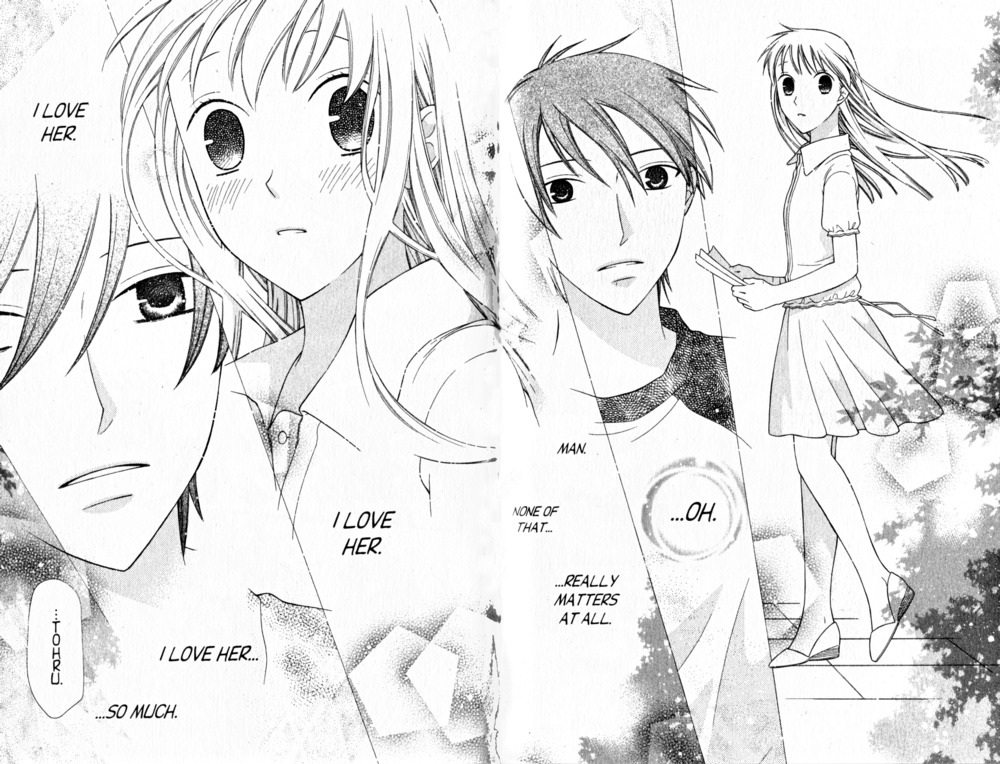
MICHELLE: To continue on with Fruits Basket comparisons, much like Manabe was essential for challenging Yuki and drawing him out of his shell, I think someone like Elliot is essential for Oz. Sure, I didn’t much enjoy their protracted arguing, but at least Oz was reacting passionately to something.

MJ: That’s an excellent point. Oz needs someone to make him mad, and though Alice seems pretty well-equipped to serve that purpose for just about everyone else (or maybe it’s just Raven), Oz identifies with her too strongly for her to fulfill that role in his life.

MICHELLE: Exactly. But she’s also very important in other ways, like seeing through his feigned good humor to the fear of meeting his sister again that lies beneath. Really, just about every character in this series represents something vitally important to Oz, which is pretty impressive.

MJ: Agreed! Though with a plot-heavy series like this, it would be easy to focus on all the events that are going on, I think Jun Mochizuki’s greatest strength is with characterization, and you’ve pointed out one of the reasons why.

MICHELLE: Now that I have caught up with the series, I vow never to fall behind again!

MJ: Hurrah!

Filed Under: OFF THE SHELF Tagged With: a bride's story, oresama teacher, pandora hearts, Wandering Son

Pandora Hearts 2-5 by Jun Mochizuki

July 13, 2011 by Michelle Smith

Reading Pandora Hearts is like mentally treading water. There is so much going on that one is constantly churning the plot waters, trying to stay afloat. It’s not that I’m saying this is a bad thing or that I object to thinking—far from it!—but that I never appreciated episodic lulls so much as when they weren’t around to give me a chance to understand and process what just happened.

The first volume introduced readers to fifteen-year-old Oz Vessalius, who is banished to a mysterious dimension known as “the Abyss” during his coming-of-age ceremony. He escapes by entering into a contract with a “chain” (denizen of the Abyss) named Alice, who wants to search for her scattered memories in the real world. When they arrive, ten years have passed and they are welcomed by a strange trio, one of whom (Raven) bears a striking resemblance to Oz’s childhood friend, Gilbert.

The search for Alice’s memories begins in the second volume, with strong hints that the answer Oz seeks—what was the “sin” that led to his banishment?—lies within them. Oz and Alice have agreed to help an organization known as Pandora (which has several goals regarding investigating and gaining control over the Abyss) and have been assigned by one of its employees, the eccentric Xerxes Break, to take down an illegal contractor whose chain is devouring humans.

Now, at this point, I was thinking, “Okay, here’s our episodic gimmick. Oz and Alice deal with the dangerous contractors and collect memories and it’ll be a sort of basic shounen fantasy.” But that’s actually not how it turns out. Any time Xerxes arranges some sort of encounter with a contractor or chain, it always leads to major plot developments. Sometimes this involves answering some questions—the identity of the braided man we keep seeing in Alice’s memories, for example—but just as often generates several more. I considered keeping a scorecard of questions raised and questions answered so that I could keep track of what issues were still outstanding.

Mangaka Jun Mochizuki also skillfully employs flashbacks to flesh out our understanding of Oz, who is far more complex (and clever and resilient) than he initially appears. His affinity for and faith in Alice, for example, persists despite various people advising him not to trust her, and we gradually learn that this is because he sees a lot of himself in her. Both he and Alice have cause to question why they exist, and since he, as a child, was afraid to pursue the truth regarding his father’s animosity towards him, he admires that Alice is fearlessly pursuing the recovery of her memories. Too, Oz displays an almost alarming equanimity about his situation, which can again be traced back to his father’s coldness, when Oz learned to “accept everything as it is.”

The end result is a story that combines a non-stop spooling out of multi-layered plot threads with some genuinely affecting character work. I particularly appreciate that the female leads—Alice and Sharon, a Pandora employee—are not the character types they initially seem to be (tsundere and meek girl, respectively) and just about any scene wherein Alice feels left out at the signs of affection between Oz and others or just vulnerable in general is a big favorite of mine.

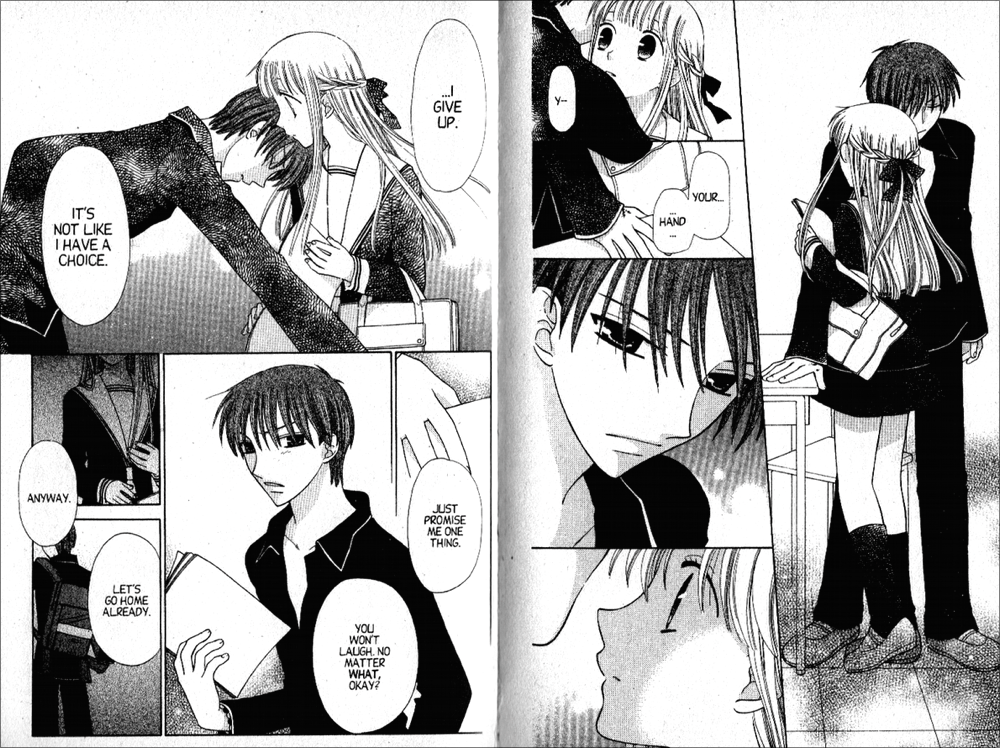
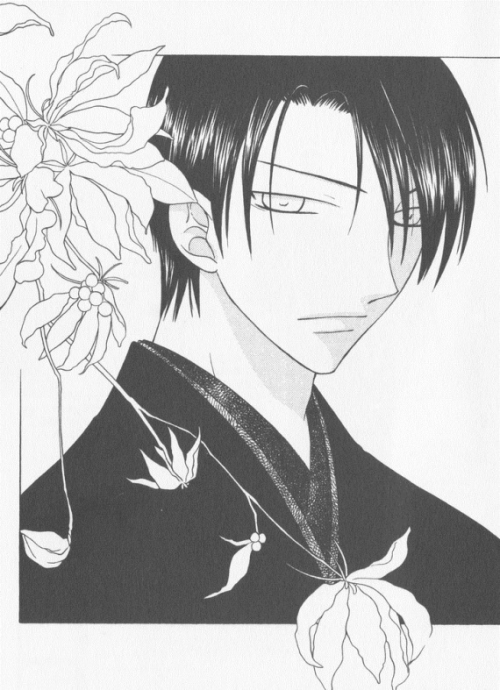
Another aspect of Pandora Hearts that I must commend is the artwork, which, as MJ amply illustrated in a Fanservice Friday post on Manga Bookshelf, is definitely fujoshi-friendly. Consider the evidence:

Shallow confession: although I really like Raven for himself, I admit that I also enjoy just looking at him. It’s not all pretty fellows, though, as Mochizuki’s renderings of the Abyss are creepy and imaginative, and the inhabitants even more so. There are a few references to Alice in Wonderland scattered throughout, too, but it’s nothing that even comes close to dominating the story or its landscape.

As of the fifth volume, Pandora officials have vowed to protect Oz, who is destined to play a major role in their conflict with the Baskervilles, remnants of a clan that battled the four great families (who eventually formed Pandora) 100 years ago and sacrificed the capital city as an offering to the entity in control of the Abyss (not to mention being responsible for sending Oz there in the first place). Plus, Sharon has been abducted and someone just may be in league with the enemy. Many other questions—about both past and future—abound, which ensure that I will keep reading (and hoping everything is ultimately resolved) to the very end.

I hope I haven’t given the impression that Pandora Hearts is a slog, because it truly isn’t. It’s engaging, intriguing, and sometimes even funny. What it never is is tranquil or relaxing, so be sure to save it for a time when your brain needs a little exercise.

Review copies for volumes three through five provided by the publisher.

Filed Under: REVIEWS Tagged With: yen press

Pick of the Week: Cross Game & Others

July 11, 2011 by Sean Gaffney, MJ, David Welsh, Katherine Dacey and Michelle Smith 1 Comment

It’s another heavy release week at Midtown Comics. Join the Manga Bookshelf gang as they choose their week’s picks with new battle robot limb Sean Gaffney leading the way!


SEAN: My pick of the week is Cross Game Volume 4, which has now reached the halfway mark with this volume. Judging by what few sales numbers we see, Cross Game seems to do ‘OK, not great’. Therefore, we must continue to push it to everyone we know, as it really is a fantastic series, not only making baseball exciting even to non-fans, but also having a completely different mood and flow compared to both the typical shonen plot and the typical shonen lead couple. Plus it’s an omnibus, so you get two here! This will have the Japanese volumes 8 & 9.

MJ: I have a feeling Cross Game could be a popular choice this week, so I’ll take up the cause for one of my favorite shounen series, Jun Mochizuki’s Pandora Hearts. Yen Press releases volume six this week, and while it is probably the goofiest installment in the series so far, it still maintains the beautifully creepy vibe I’ve enjoyed all along. Currently running in Square Enix’s GFantasy, this series brings on the girl-friendly fanservice I’ve come to expect from that magazine, along with healthy portions of supernatural adventure, wry humor, and heart-wrenching human drama. And did I mention that it’s creepy? Throw in some really gorgeous costuming, and you’re pretty much got me hooked.

DAVID: MJ’s intuition is correct, as I’m going to second Sean’s recommendation of the fourth Cross Game collection. In spite of industry contractions, we’re still getting a ton of great new manga, and I would put this series right near the top of the list in terms of quality, inventive storytelling, and overall entertainment value.

KATE: Sean said everything that I would have said in support of Cross Game, so I’m going to recommend volume thirty-nine of Case Closed instead. Don’t be intimated by the sheer number of volumes; readers can jump into Case Closed at almost any point in its run and follow the action without difficulty, as the stories are generally short and self-contained. The latest volume pits kid sleuth Conan Edogawa against a serial arsonist whose likes to leave a small model horse at the scene of his fires. True, the story rehearses some familiar mystery/crime procedural tropes, but the brisk pace, smart-looking artwork, and snappy dialogue prevent the series from devolving into a manga re-hash of the Agatha Christie canon.

MICHELLE: Count me in as another voice in support of Mitsuru Adachi’s Cross Game, but I’m also personally looking forward to revisiting Rumiko Takahashi’s RIN-NE, which is now up to its sixth volume. I don’t love the series as ardently as I do some of Takahashi’s other creations, but I’m feeling in the mood to see what’s happening in the story since I last picked it up in volume four. Plus, with InuYasha wrapping up earlier this year, this is now the only Takahashi series with new releases to look forward to. I would probably continue to follow it just for that reason alone!


Readers, what looks good to you this week?

Filed Under: PICK OF THE WEEK

Bookshelf Briefs 7/10/11

July 11, 2011 by Katherine Dacey, MJ, David Welsh and Michelle Smith 18 Comments

This week, Kate, MJ, David, and Michelle are joined by new battle robot member Sean, as they check out new a host of releases from VIZ Media, Yen Press, and Seven Seas, as well as a few final stragglers from recently defunct TOKYOPOP.


Ai Ore!, Vol. 2 | By Mayu Shinjo | VIZ Media – I share David Welsh’s general disdain for romances in which one character tries to persuade the other that it’s “just a matter of time” before they get together, so it’s not a surprise that I found the second volume of Ai Ore! as punishing an ordeal as the first. Author Mayu Shinjo’s greatest misstep is confusing possessive behavior with manliness; Akira unironically calls Mizuki his “woman” so many times I’d swear he’s auditioning to play Stanley Kowalski. Adding insult to injury is Akira’s obsession with getting Mizuki into bed — no matter how many times she refuses him, Akira keeps hounding her to go all the way. Normally in a story this absurd, any nod to realism would be welcome, but here it’s an unpleasant reminder of just how retrograde the story’s sexual politics really are, and no amount of wacky hijinks or cool costumes can conceal that fact. – Katherine Dacey

Ai Ore!, Vol. 2 | By Mayu Shinjo | VIZ Media – Not long after I criticized its first volume, I spotted a conversation in which it was explained that Ai Ore! is intended as a parody. While I generally think that if you have to tell people that something is a parody, it’s not really working, reading through the series’ second volume I can see where that argument is coming from. Unfortunately, making fun of something doesn’t automatically translate into being smarter or better than it is, and this is where Ai Ore! goes horribly wrong for me. Even as it mocks some of shoujo manga’s sillier trends, it reinforces those that offend me most. Most tragically, however, all this parody and pandering is wrapped around what really could be a genuinely revealing look at the relationship between two teens whose bodies don’t conform to accepted gender norms. I would read this story eagerly. Unfortunately, that’s not the story being told. – MJ

Amnesia Labyrinth, Vol. 2 | By Nagaru Tanigawa and Natsumi Kohane | Seven Seas – I gave a mixed review to Volume 1 of this series, but unfortunately the second volume has lost even the slight amount of goodwill I had for the series. An extended dream sequence about 2/3 through just makes things even more muddled, and by separating Souji from Yukako you end up losing any sympathy you may have had for him in the first place. Evil doppelgangers molesting the heroine do add a frisson of discomfort to the proceedings – as does one sister trying to attack/seduce Souji while in a gas mask and military uniform – but this is an unpleasant mess overall. Fans of Tanigawa should stick with the Haruhi Suzumiya novels. – Sean Gaffney

Daniel X: The Manga, Vol. 2 | Story by James Patterson, Art by SeungHui Kye | Yen Press – The James Patterson book-making machine excels at cranking out dystopian teen fantasies in which seemingly ordinary kids possess tremendous, world-changing powers. Small wonder, then, that Yen Press has had such commercial success translating Patterson’s stories into graphic novels. Daniel X, their second Patterson adaptation, focuses on a fifteen-year-old with the ability to create objects with a thought. After his parents are killed by “an intergalactic criminal” — Yen’s words, not mine — Daniel vows to avenge their deaths, using his unique ability to find and destroy extra-terrestrials. The story and dialogue are thoroughly unsurprising — at least from an adult standpoint — but SeungHui Kye’s clean, attractive artwork, gooey aliens, and briskly-paced script will definitely appeal to younger teen readers. A good buy for a school or public library’s YA collection. – Katherine Dacey

Happy Cafe, Vol. 8 | By Kou Matsuzuki | Tokyopop – This is, of course, the final volume of Happy Cafe we’re getting in North America, even though the series ran for a further seven volumes in Japan. Another victim of the Tokyopop closure. It’s a type of manga I’ll miss from Hakusensha, the sort they only seemed to sell to TP and CMX. The plot isn’t that original, the characters are types, and there are far too many of them – here we meet a shy girl with a crush on a boy who has a crush on Uru, as well as Ichiro’s identical twin father – but it’s meat-and-potatoes shoujo that leaves you with a smile on your face and a warm heart. I’ll miss this sort of series. – Sean Gaffney

Ichiroh!, Vol. 5 | By Mikage | Yen Press – I stopped reading newspaper comics a long time ago, and reading the fifth volume of Ichiroh reminds me why I did: the four-panel strip is seldom conducive to good writing. There are plenty of exceptions — Neko Ramen, Peanuts — but more often than not, the format yields tepid jokes, recycled gags, and one-note characters whose personality traits annoy more than they endear. Although Ichiroh! has a more promising set-up than most, focusing on a group of slackers trying to clean up their act and get into college, it’s about as funny as Tank McNamara. Most of the humor depends on the audience’s investment in the characters; if you find Nanako and company cute, their squabbles might bring a smile to your face, but if you don’t, Ichiroh! will grate with the intensity of a Debbie Gibson song, as characters repeat the same behaviors with Sisyphean consistency. – Katherine Dacey

Kekkaishi 3-in-1, Vol. 2 | By Yellow Tanabe | VIZ Media – I’m very glad that Viz is providing an inexpensive entry point for this long-running title. Volumes four through six build a supernatural subculture for the demon-fighting heroes of the series, which yields some entertaining supporting characters, giving the stories additional variety. Chief among Tanabe’s many strengths as a creator is the fact that she has an excellent way with battle sequences. They never run too long, she comes up with great creature designs, the use of her heroes’ powers is imaginative, and the scenes are sprinkled with character-driven humor. You could hardly ask for anything more from battle shônen. The only weakness to this volume is that tough, level-headed Tokine doesn’t get quite as much focus as I’d like. She’s such a great partner for and foil to protagonist Yoshimori that it seems like a waste not to have her in the thick of things. – David Welsh

La Quinta Camera | By Natsume Ono | VIZ Media – The gifted Ono’s professional debut looks like not simple and reads like Gente, which is fine by me. A quartet of men shares an apartment in Italy, and we meet their friends, lovers, and boarders who move in and out of the apartment’s extra room. It’s good-natured slice of life, and I’ve always enjoyed Ono’s work in that category. (I actually enjoy Ono’s work in all categories, so I may not be the most unbiased judge of relative success.) What particularly strikes me about this work is the level of confidence that’s already in evidence. Ono reveals a lot by implication, making the characters’ moods and reactions evident without minute explications of their sources. It’s like the reader is observing their lives without the benefit of an omniscient narrator. You may not know everything there is to know, but you get everything you need to know. – David Welsh

Maid Shokun, Vol. 1 | By Akira Kiduki and Nanki Satou | TOKYOPOP – If you had told me a few weeks ago that I would enjoy a seinen series about pretty young women working in a maid café so much that I would seriously consider buying the rest of the series in Japanese just to see what happens, I would never have believed it. But it’s true! Maid Shokun charms by treating its characters not as objects for fanservice but as employees concerned with the success of their enterprise. Here, the café is a job, not merely an environment where wacky hijinks ensue, and plots revolve around issues like standards of service, interoffice dating, overzealous customers, and whether the establishment should be reclassified as adult entertainment and what that would mean. I’m genuinely bummed that more won’t be available in English, thanks to TOKYOPOP’s untimely demise. – Michelle Smith

Nura: Rise of the Yokai Clan, Vol. 3 | By Hiroshi Shiibashi | VIZ Media – So, remember how in Nura‘s first chapter, protagonist Rikuo (¾ human boy, ¼ yokai) transformed into his yokai self, dealt competently with a rival who challenged his right to inherit leadership of the Nura yokai consortium, and then declared his intent to become Nura’s supreme commander? Well, all of that stuff happens again in volume three. It’s about time—ever since the plot was reset in chapter two (presumably due to the story getting picked up for serialization) it’s been working its way back to this point. I hope Rikuo’s resolution sticks this time and the story can progress, but for now I’m content with the fun cast of supporting characters, the added complication of Rikuo’s friend Kana crushing on his yokai form, and the fact that human Rikuo has started showing some gumption. – Michelle Smith

Pandora Hearts, Vol. 6 | By Jun Mochizuki | Yen Press – Though this volume begins on a serious note, it soon degenerates into utter goofiness as our heroes infiltrate a prestigious high school in order to reintroduce Oz to his younger sister, Ada. Even amidst complete silliness, however, this story finds its way back to the real horror at its core. Pandora Hearts is long on style but not short on substance, and that’s part of what makes it such a great read. That said, this volume’s blushing moe faces (both male and female) become a bit repetitive, and I could do without seeing Oz’s uncle Oscar in a high school uniform ever again. Fortunately, Mochizuki never leaves Dark Creepyville for long, and the volume’s two new characters show a lot of promise. Bring on the drama and gore, Pandora Hearts! – MJ

Filed Under: Bookshelf Briefs Tagged With: Ai Ore!, amnesia labyrinth, daniel x, happy cafe, ichiroh!, kekkaishi, La Quinta Camera, maid shokun, nura: rise of the yokai clan, pandora hearts

The Prince of Tennis 40-42 by Takeshi Konomi

July 8, 2011 by Michelle Smith

Although the final three volumes of The Prince of Tennis contain many ridiculous things and are, objectively speaking, really not that good, I still think the story wraps up reasonably well.

Volume 40 begins with the tail end of the set between Seishun’s captain, Tezuka, and Sanada of the Rikkai team. Tezuka is dragging things out to buy time for absentee Ryoma to arrive, and ultimately ends up losing. Then Momoshiro and Kaidou lose, but not before we get this sentence that has never been written before at any time in the course of human history: “The tornado snake won’t work against a player with red eyes.” Good to know, that.

Fuji is up next, taking on a player with the ability to mimic anyone’s ability. And who should he emulate but Tezuka, so we get a match that is drawn like the two of these guys playing against each other. Somehow I think this was intended to appeal to the fujoshi, but I’m certainly not complaining. “Maybe we’ve both been avoiding facing off against each other. Because we’re afraid of finding out who’s better,” Fuji thinks at one point. Too bad the promise of a real face-off between them is not realized before the end of the series.

Fuji wins, so we move briskly on to the second doubles round, and somewhere around here Ryoma arrives with, and I am quoting the back cover here, “a wicked case of amnesia.” It’s completely stupid, and while Oishi and Eiji stall for time, various players (including rivals) go reacquaint Ryoma with his tennis memories by playing him off-camera. Why even employ an amnesia plot if it’s going to be cured so simply? It just makes me shake my head.

Anyway, it should be no surprise to anyone at all that Ryoma regains his memory and, though he starts off his match at a disadvantage, he soon summons the ultimate skill—“the pinnacle of perfection”—with which to vanquish his opponent. (Everyone can tell that he has achieved this because white light bursts from his body. As it often does in tennis.) And Ryoma’s dad drops by to tell everyone this is happening because Ryoma is playing simply for the joy of the game, and so that everyone can finally learn that Ryoma is the son of the famous Samurai Nanjirou. So, Seishun wins and there’s a montage while the lyrics of a song penned by Takeshi Konomi scroll by. It’s all very silly. There’s also a brief prose epilogue depicting the third years’ graduation.

I just really don’t know what to say about The Prince of Tennis at this point. In the pursuit of ways to make games even more exciting, Konomi crossed my personal “suspension of disbelief” border with all these physically observable glowy states. Somehow, I was willing to accept Inui making instant probability calculations or Tezuka being able to control his spin so well that all return shots come directly to his location, but make a guy sparkly and have someone in the stands cry, “L-look at that! All his aura’s concentrated around his left arm!!” and it’s suddenly too much for me to take. Still, it’s not like the series was ever so fabulous that I’m actively disappointed. Just resigned.

Anyway, thus concludes The Prince of Tennis. The sequel, Shin Prince of Tennis (“Shin” means “new”), is currently serialized in Jump SQ magazine. The fifth collected volume came out in March of this year. It lamentably remains unlicensed for US release.

Filed Under: REVIEWS Tagged With: Shonen Jump, VIZ

Off the Shelf: Getting Better All The Time

July 7, 2011 by MJ and Michelle Smith 3 Comments

MJ: Well, hello Michelle! Once again, it feels like forever since we’ve been here!

MICHELLE: It does! Why do we ever leave, anyway? We could just dwell safe within our little Off the Shelf cocoon.

MJ: Sounds like bliss.

MICHELLE: Doesn’t it? Stupid real life.

So let’s distract ourselves! Got any completely made-up drama that you’d like to contemplate for a while?

MJ: I do, but you first!

MICHELLE: Well, if you insist!

Not only are both of my selections this evening published by Kodansha Comics, but each is also the first volume of a new series and based on a CAPCOM video game. I’m not much of a game aficionado, so I can’t speak to how well these manga do at capturing the essence of their respective game universes, but I can at least consider how they work for new readers. I’ll start with Phoenix Wright: Ace Attorney, a five-volume seinen series that originally ran in Bessatsu Young Magazine. I’ve never played the game, but I do love a good mystery, so I hoped that I would like this manga very much. Alas, it was not to be.

Phoenix Wright is a defense attorney who is beginning to make a name for himself. He has a plucky female assistant, Maya Fey, and as the volume begins, they are checking out a wind chime festival. There, Phoenix runs into his acquaintance Larry, a real trouble magnet, and his new girlfriend. They seem happy, but two days later, Phoenix is defending Larry in a trial. Yes, in those two days, Larry has been arrested for the crime of murdering his girlfriend’s former lover and the case has already gone to trial. Evidence is presented swiftly, with Phoenix unaware of most of it, until he eventually solves the case in the courtroom and elicits a dramatic confession. (Incidentally, it was completely obvious from the outset who the real culprit was, so readers are forced to just tag along until Phoenix catches up.)

Next, Phoenix is summoned to the house of a rich businessman who expects to be charged in the death of an employee. He’s got a suspicious family, including a snooty wife, a rebellious daughter, and a creepy brother who lives on the premises in a building full of spider specimens. There’s potential for a diverting little mystery here, but once again, everything just falls flat.

“Fun” is the key ingredient that is missing so far. This is not a serious series, and one shouldn’t go in looking for depth or realism, but it should at least be fun to read. Instead, the word that best describes it is “blah.” All it would take to liven things up would be characters with some personality or some clever cases, but I don’t hold out much hope of either.

MJ: It’s surprising to hear that this manga is so uninteresting, considering how much media the franchise has spawned. Surprising and depressing, I have to say.

MICHELLE: It’s possible that it will work better for fans of the original game. Sean Gaffney enjoyed the volume, for example. I will at least give it another volume to hook me, but it may be that it’s not just my thing.

Okay, now it’s your turn!

MJ: Okay! Well, I’ll start with the most self-consciously dramatic of my week’s selections, which would be the first volume of Hotaru Odagiri’s The Betrayal Knows My Name, just released by Yen Press.

As selfless orphan Yuki is preparing to move out of the orphanage he grew up in, so as to cease being a burden to anyone, he meets members of a supernaturally-talented “family” who change his life forever. As it turns out, Yuki is the reincarnation of the “light of God,” a member of this same “family” with the power to heal other people’s wounds by taking them on himself. He also meets a “duras” (demon) named Zess (aka “Luka”) who he has dreamt about repeatedly, and who is strongly hinted to have been Yuki’s lover in their previous lives. Eventually, Yuki realizes that he’s really found his family, and agrees to move to the group’s mansion to join their battle against a demonic foe.

Oh, Michelle, if only I’d read this when I was thirteen, I think I would have eaten it up with a spoon. The story is earnestly dark and melodramatic, the UST level is high, and the character designs are the sequential art equivalent of the pages of Tiger Beat magazine. Unfortunately, as a jaded 40-something, I spent most of the series’ triple-sized first volume sighing heavily and rolling my eyes.

The series reads something like Ze with an actual plot, which sounds like a positive thing on the face of it, but without the true, dramatic seriousness of a teenager to lend a helping hand, everything just feels too carefully contrived to be believed. Even sexy love interest, Zess, is too obviously crafted for its target audience. Having fallen for Yuki’s soul in female form during their former lives, he manages to provide homoerotic excitement while still appearing accessible to female readers. Perfect? Maybe. But as an older reader, it’s a bit hard to take.

On the plus side, somewhere around three-quarters of the way in, I found myself getting sucked into the delicious drama anyway, so there may be addictive potential for all!

MICHELLE: I’m sorry to hear about the sighing and eyerolling, since I picked this as one of my Picks of the Week not too long ago. Is there anything that would be a problem for a thirteen-year-old reader? I know a teen that might enjoy it.

MJ: Not that I can recall. It’s certainly no more “adult” than, say, Flowers in the Attic, which was definitely part of my 13-year-old library. And, you know, I make a fuss, but as I said, I was pretty well engrossed by the end.

So what’s your other Kodansha offering for the evening?

MICHELLE: The first volume of Monster Hunter Orage (“Orage” is French for “thunderstorm.”) by Hiro Mashima, creator of Fairy Tail, which I’ve previously discussed in this space. Of my two choices this week, this is the one I thought I might not care for much which, of course, ended up being thoroughly enjoyable.

Openings don’t get much shounenier than this one, where a small boy is told, “Your weapon has the power to capture your dreams.” The boy is called Shiki and the speaker is his master, a man named Greylee who promises to teach him everything there is about monster hunting. While they’re training, Greylee also emphasizes the importance of having companions one trusts. Greylee dies in an accident before Shiki’s training is complete, but he’s learned enough to receive a special tattoo that marks him as a Seal Hunter, a hunter privileged to travel and hunt at his own discretion. (Other hunters operate through a guild on an assignment basis very similar to that seen in Fairy Tail)

Some years later, Shiki arrives in town with a list that says 1) arrive in town and 2) find comrades at the guild. Shiki proceeds to step two and, although no one is much impressed when he clambers atop a table and issues a rallying cry for comrades, he ends up following one of the strongest (and most solitary) hunters, a girl named Ailee, and piquing her interest by believing in the same dragon legend she does. As they begin their quest, they meet Sakya, the daughter of a famous armorer. After they defeat a monster responsible for killing Sakya’s father, she joins the team.

What makes Monster Hunter Orage so refreshing is its characters. Shiki is a hero in the style of One Piece‘s Luffy, in that he’s fearless and optimistic and has no preconceived notions about anyone. Of course Ailee could be a thoroughly badass hunter and of course Sakya could be a thoroughly badass armorer! What does their being female have to do with it? I also love how Mashima depicts others’ reactions to Shiki—at first his grandiose declarations about comrades are ignored, but eventually his enthusiasm begins to win people over. He’s got magnetism. Lastly, though it’s a little cheesy that Ailee turns out to be Greylee’s daughter, this is handled in an interesting way, with Ailee realizing Shiki is the boy she was always jealous of because of how much time her dad spent with him, and Shiki realizing that this is the girl he always envied for having such loving parents. There’s no inkling of romance yet, just a trio of friends going off to slay a dragon. And lo, it is good.

MJ: That sounds good indeed! What a treat, after your first Kodansha pick. So, since you’ve already likened the story’s hero to that of One Piece, you know I had trouble getting into that series in the beginning, but it sounds like this hits its stride right away. That’s pretty enticing.

MICHELLE: It does! It’s also only four volumes long, which is much easier to commit to than One Piece and its 62+ volumes! It would also be great for teens; in fact, I wrote my local YA librarian immediately about it, since Fairy Tail is popular with patrons.

I could feign ignorance here about your second book of the evening, but I happen to know that we’re in for a bit of squee regarding the sixth and final volume of Time and Again. Right?

MJ: Yes, we certainly are. When I look back at my review of Time and Again‘s first volume, it’s pretty astounding to see note far this series has come in just six volumes. Though I liked it from the start, none of my initial criticism, from the underdeveloped leads to the confusing visual storytelling, is evident in the slightest here by series’ end. In fact, I’d have to count Time and Again as one of my favorite comics of any kind in the past two years, and this final volume is a perfect example of why.

Finally the full truth comes out regarding Baek-On’s past, revealing for the first time how he really became the man we met at the beginning of the series, but more importantly, revealing the man he will be to his death and why that is so important. Previously, I thought that no character arc could be more heartbreaking than Ho-Yeon’s, but boy was I wrong. I cried through a major portion of this volume, though this manhwa is far from syrupy.

Time and Again kicks you in the gut with elegant brutality, just as karma does its doomed protagonists. Yet if there’s any coherent feeling I came away with at the story’s end, I’d have to say it was “hope.” For once, it’s not just the slasher in me that appreciates a story’s male bonding. There’s just something incredibly comforting about the thought that two people doomed to spend their lives alone don’t actually have to be lonely.

I could certainly go on about the progressive maturity of Yun’s storytelling and her powerful skill with expression, but mostly I just want to sigh contentedly and begin the series all over again. That’s how much I’ve enjoyed it.

MICHELLE: I love the phrase “elegant brutality.” This is what I was talking about in my review when I said that though it’s an exceedingly sad and painful story, Yun is not reveling in the pain. The way she tells it is almost matter-of-fact, and then the enormity of what it means for Baek-On slowly sinks in. And, as it does, readers come to realize what the title has meant all this time.

MJ: I think one of the most compelling reasons I have for wanting to start the series over with fully knowledge of Baek-On’s story, is to see how he deals with karma from the beginning. It’s been a theme throughout the series, but only at the end do we really understand.

MICHELLE: Yes, same here. Plus, now that we know what happened with the girl in his past (Wan), I want to see how that informs his behavior towards women and relationships with others in general.

MJ: Yes, I do too!

I feel like this column has traveled on a steady incline from kinda bad to definitely great. Not too shabby, eh?

MICHELLE: Not at all! It’s, like, an omen or something.

MJ: Well, let’s hope so!

Filed Under: OFF THE SHELF Tagged With: monster hunter orage, phoenix wright ace attorney, the betrayal knows my name, time and again

The Phoenix and the Carpet by E. Nesbit

July 7, 2011 by Michelle Smith

From the back cover:
It’s startling enough to have a Phoenix hatch in your house, but even more startling when it reveals you have a magic carpet on the floor. Conceited it may be, but the Phoenix is also good-hearted, and obligingly accompanies the children on their adventures through time and space—which, magic being what it is, rarely turn out as they were meant…

Review:
The Phoenix and the Carpet (1904) is the second book in the trilogy that begins with Five Children and It. It’s November now and the children—Cyril, Anthea, Robert, Jane, and baby brother “the Lamb”—are back at home in Camden Town. One day, after a small fire ruins their nursery carpet, their mother buys a new one from which emerges a shiny yellow egg. And when that egg falls into the fire, a talking Phoenix is hatched who informs them that the new carpet is actually magic and can take them wherever they’d like to go.

As with the first book in the trilogy, most of the story is comprised of the wishes the children make and their often unexpected outcomes. They wish to go abroad, for example, so the carpet takes them to visit a topless tower in France, where Robert promptly gets stuck on a window ledge. On another occasion, the cook accidentally accompanies them on a trip to a sunny shore and ends up being worshipped by the natives. Other wishes involve visits to India and a plethora of Persian cats.

What’s different this time is that more of the wishes are linked. When the children wish to do a bit of good, they find themselves back in France, where they find the rightful owners of the treasure hidden in the tower. And when a would-be burglar is arrested on suspicion of having stolen said Persian cats, the children rescue him from jail and convey him to the sunny shore, whereupon he promptly falls in love with the cook and they get married on the spot. The emphasis on helping people makes this installment of the series a little more like The Railway Children, which still remains my favorite Nesbit book.

While the adventures are fun—my very favorite is not a wish at all, but a visit the children make with the Phoenix to a fire insurance company who uses his likeness for their logo—Nesbit’s writing is really the main draw here. It’s warm, observant, and clever simultaneously, eliciting many a giggle. I love this evocative line about a cast-aside bit of correspondence:

”The letter… lay on the table, drinking hot bacon fat with one corner and eating marmalade with the other.”

That line not only conjures a vivid mental picture, but tells you something about the letter’s recipients, as well. And, indeed, the characterization of the children is more defined in this second outing, with the two eldest (Cyril and Anthea) showing signs of increased maturity. Nesbit never idealizes the children—“The children were not particularly handsome, nor were they extra clever, nor extraordinarily good. But they were not bad sorts on the whole.”—and their imperfections are what make them likeable. When they discover that sometimes things can get worn out through striving to please, one gets the sense that they’ve learned an Important Lesson about consideration without it coming across as some sort of moral.

Though less famous, The Phoenix and the Carpet is actually better than the first book in the trilogy, and I am definitely looking forward to the third and final installment.

Filed Under: Books Tagged With: E. Nesbit

Time and Again 6 by JiUn Yun

July 5, 2011 by Michelle Smith

From the back cover:
As war rips through the Tang Dynasty, leaving chaos and destruction in its wake, Baek-On and Ho-Yeon continue to eke out a living as traveling exorcists. While confronting vengeful grudges and putting to rest the lingering spirits of those long dead, Baek-On reflects on the tragic curse that led him to turn his back on the company of the living and follow in his father’s footsteps. While the world seems to crumble around him, Baek-On strives to keep moving forward, even if he must do so alone.

Follow Ho-Yeon and Baek-On as they journey on in the final volume of Time and Again.

Review:
I’m always a little wary of the final volume of a series I have really enjoyed. Will it disappoint? Or will it be exactly what I had hoped? Happily, volume six of Time and Again caps the series in a perfect way, which is to say “in a way that is simultaneously melancholy and hopeful.”

Baek-On has yet to recover from his crisis of self-doubt in the previous volume, in which his decision to force a man to see the truth about his inhuman wife had tragic consequences. He’s been holed up in his mother’s house for months, refusing all customers, but when a young woman arrives with a case that seems both simple and desperate, Ho-Yeon ushers her into Baek-On’s presence. Baek-On is rude at first, and it takes a threat of eviction before he actually begins to listen attentively to the girl, but he eventually goes to her home and deals compassionately with the ghost of a jilted girl who has been appearing there.

It’s clear that the words he uses when appeasing the spirit are what he would say himself to the girl in his own past—“I didn’t leave you. I’ve never left you.”—which leads to a gloriously long chapter that reveals the whole story of what happened with the girl (Wan) and why, and how it led to Baek-On being the person he is today. JiUn Yun handles this in a lovely way, because she doesn’t dwell on the pain of it all. Oh, it’s exceedingly painful for Baek-On, and awful and sad and all of those things that make for a great backstory, but it isn’t milked for melodrama. I shan’t spoil the details, but it’s this experience that motivates Baek-On to become an exorcist and to live and die alone.

The final chapter takes place after further time has elapsed. Baek-On and Ho-Yeon continue to travel together after a war has ravaged the country. Big things have happened, and yet they must continue on as usual, driving evil spirits out of children and chickens (really) and confronting the truth that animal spirits don’t seem to be all that innocent of the ways of humans. Baek-On realizes that his famous father was likely as uncertain as he is, which brings some peace, though he still intends to live his life alone and leave no descendants upon whom a spirit might inflict a grude. Ho-Yeon is also alone, having lost the last person he loved to the war, and the series ends with them pledging to carry on as they have been. Alone. And together.

Okay, yes, I totally spoiled that part, but it’s so absolutely perfect a conclusion for the series that I just had to wax rhapsodic about it. Time and Again has become one of my favorite manhwa series and, now that I know for what Baek-On has been seeking atonement all this time, I look forward to rereading it someday with the benefit of new insight.

Review copy provided by the publisher.

Filed Under: REVIEWS Tagged With: yen press

A Pair of TOKYOPOP Stragglers

July 4, 2011 by Michelle Smith

Just when it seemed like none of those May TOKYOPOP titles was going to materialize, Diamond Distributors revealed that it still had a few surprises up its figurative sleeve. Stragglers, originally scheduled for an early May release, began to trickle into comic shops. I managed to acquire several, including two books—volume eight of Happy Cafe and volume three of The Stellar Six of Gingacho—that I had lost all hope of ever seeing. Although I’m still incredibly sad about TOKYOPOP’s demise, I can’t help looking upon these last releases as an unexpected gift.

Happy Cafe 8 by Kou Matsuzuki
The eighth volume of Happy Cafe offers more cheerful yet insubstantial slice-of-life episodes revolving around the staff of Cafe Bonheur. We check back in with sixth-grader Kenji, Uru’s cousin, and meet the girl who likes him. We see Shindo apologize for making Uru cry, meet Ichiro’s doppelganger/father, and watch as two different guys try and fail to express their feelings for the oblivious Uru.

There are actually four guys now who fancy Uru, mostly because of her bright smile and talent at offering sunny advice as necessary. It’s a little much, but at least doesn’t feel as implausible as with series in which the heroine has no redeeming qualities whatsoever and yet seems to attract a bevy of hunky admirers. It also seems like Matsuzuki draws Uru in a regular style more often this volume—because she’s so childlike and spazzy, she’s usually in some state of super deformity but here we get a few, albeit fleeting, moments in which she looks genuinely pretty.

As a warning, however, readers of this volume are at risk of contracting the dreaded festitis (extreme irritability brought on by manga depictions of school festivals of any sort, including athletic). On the heels of Uru’s school festival in volume seven we first have Kenji’s athletic meet and then the school festival of Sou Abekawa, one of Uru’s suitors. I would seriously be happy if I never had to read about another school festival ever again.

So, how does this fare as the final volume (most likely) of Happy Cafe to be produced in English? Pretty well, actually. The episodic nature of the story precludes any sort of cliffhanger ending, and though Uru continues to be utterly clueless about the feelings she’s inspiring in the guys around her, it’s easy to imagine that, after several more volumes of cheerful yet insubstantial happenings, she will realize her feelings for someone (Shindo seems the most likely candidate) and a happy ending will ensue.

The Stellar Six of Gingacho 3 by Yuuki Fujimoto
Like Happy Cafe, The Stellar Six of Gingacho has so far been comprised of warm and fuzzy episodic stories featuring a childlike heroine who is “very dense when it comes to romance.” The third volume is no different, but takes the first tentative steps at fleshing out the other members of the group—while continuing to focus on Mike (Mee-kay) and her pal/partner Kuro, whose love for Mike is a secret to no one but her—and hinting a little at complications to come.

Chapters in this volume feature plots like “Mike and Kuro rescue a stray puppy,” “Mike insists that her friends go dig up a treasure they buried when they were five,” and “a photo of the boys appears in a teen magazine and fangirls descend.” But boiling them down in this way does them a disservice, because each chapter usually has at least one really nice moment, like Mike realizing that Kuro has always been there for her or the boys defending the honor of the girls when some punk insults them. In fact, the theme of the series could be summed up as “friends are precious and special.” If you don’t want to read stories in which this idea gets established over and over again, then The Stellar Six of Gingacho probably isn’t for you.

Although the volume doesn’t end on a cliffhanger, some glimpses of where the story might go make the lack of future releases particularly disappointing. Who is the object of ladies’ man Ikkyu’s (aka “Q”) unrequited love? (I hope it’s ultra-sensible Iba-chan.) Should I be expecting the six friends to form up into three tidy couples for a happy ending, or will messiness ensue when Sato’s feelings for Kuro come to light?

Sato provides the parting thought as we get a glimpse of an older Kuro. “To me you were special. But back then none of us truly understood what that “special” feeling really was. Not yet.” If you really want to get me hooked to a series, pepper it with retrospective narration like that. Jeez. Talk about bad timing.

Filed Under: REVIEWS Tagged With: Tokyopop

  • « Go to Previous Page
  • Page 1
  • Interim pages omitted …
  • Page 141
  • Page 142
  • Page 143
  • Page 144
  • Page 145
  • Interim pages omitted …
  • Page 186
  • Go to Next Page »
 | Log in
Copyright © 2010 Manga Bookshelf | Powered by WordPress & the Genesis Framework