This week, Kate, MJ, David, and Michelle are joined by new battle robot member Sean, as they check out new a host of releases from VIZ Media, Yen Press, and Seven Seas, as well as a few final stragglers from recently defunct TOKYOPOP.
 Ai Ore!, Vol. 2 | By Mayu Shinjo | VIZ Media – I share David Welsh’s general disdain for romances in which one character tries to persuade the other that it’s “just a matter of time” before they get together, so it’s not a surprise that I found the second volume of Ai Ore! as punishing an ordeal as the first. Author Mayu Shinjo’s greatest misstep is confusing possessive behavior with manliness; Akira unironically calls Mizuki his “woman” so many times I’d swear he’s auditioning to play Stanley Kowalski. Adding insult to injury is Akira’s obsession with getting Mizuki into bed — no matter how many times she refuses him, Akira keeps hounding her to go all the way. Normally in a story this absurd, any nod to realism would be welcome, but here it’s an unpleasant reminder of just how retrograde the story’s sexual politics really are, and no amount of wacky hijinks or cool costumes can conceal that fact. – Katherine Dacey
Ai Ore!, Vol. 2 | By Mayu Shinjo | VIZ Media – Not long after I criticized its first volume, I spotted a conversation in which it was explained that Ai Ore! is intended as a parody. While I generally think that if you have to tell people that something is a parody, it’s not really working, reading through the series’ second volume I can see where that argument is coming from. Unfortunately, making fun of something doesn’t automatically translate into being smarter or better than it is, and this is where Ai Ore! goes horribly wrong for me. Even as it mocks some of shoujo manga’s sillier trends, it reinforces those that offend me most. Most tragically, however, all this parody and pandering is wrapped around what really could be a genuinely revealing look at the relationship between two teens whose bodies don’t conform to accepted gender norms. I would read this story eagerly. Unfortunately, that’s not the story being told. – MJ
 Amnesia Labyrinth, Vol. 2 | By Nagaru Tanigawa and Natsumi Kohane | Seven Seas – I gave a mixed review to Volume 1 of this series, but unfortunately the second volume has lost even the slight amount of goodwill I had for the series. An extended dream sequence about 2/3 through just makes things even more muddled, and by separating Souji from Yukako you end up losing any sympathy you may have had for him in the first place. Evil doppelgangers molesting the heroine do add a frisson of discomfort to the proceedings – as does one sister trying to attack/seduce Souji while in a gas mask and military uniform – but this is an unpleasant mess overall. Fans of Tanigawa should stick with the Haruhi Suzumiya novels. – Sean Gaffney
 Daniel X: The Manga, Vol. 2 | Story by James Patterson, Art by SeungHui Kye | Yen Press – The James Patterson book-making machine excels at cranking out dystopian teen fantasies in which seemingly ordinary kids possess tremendous, world-changing powers. Small wonder, then, that Yen Press has had such commercial success translating Patterson’s stories into graphic novels. Daniel X, their second Patterson adaptation, focuses on a fifteen-year-old with the ability to create objects with a thought. After his parents are killed by “an intergalactic criminal” — Yen’s words, not mine — Daniel vows to avenge their deaths, using his unique ability to find and destroy extra-terrestrials. The story and dialogue are thoroughly unsurprising — at least from an adult standpoint — but SeungHui Kye’s clean, attractive artwork, gooey aliens, and briskly-paced script will definitely appeal to younger teen readers. A good buy for a school or public library’s YA collection. – Katherine Dacey
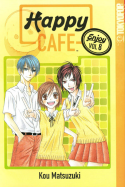
 Happy Cafe, Vol. 8 | By Kou Matsuzuki | Tokyopop – This is, of course, the final volume of Happy Cafe we’re getting in North America, even though the series ran for a further seven volumes in Japan. Another victim of the Tokyopop closure. It’s a type of manga I’ll miss from Hakusensha, the sort they only seemed to sell to TP and CMX. The plot isn’t that original, the characters are types, and there are far too many of them – here we meet a shy girl with a crush on a boy who has a crush on Uru, as well as Ichiro’s identical twin father – but it’s meat-and-potatoes shoujo that leaves you with a smile on your face and a warm heart. I’ll miss this sort of series. – Sean Gaffney
 Ichiroh!, Vol. 5 | By Mikage | Yen Press – I stopped reading newspaper comics a long time ago, and reading the fifth volume of Ichiroh reminds me why I did: the four-panel strip is seldom conducive to good writing. There are plenty of exceptions — Neko Ramen, Peanuts — but more often than not, the format yields tepid jokes, recycled gags, and one-note characters whose personality traits annoy more than they endear. Although Ichiroh! has a more promising set-up than most, focusing on a group of slackers trying to clean up their act and get into college, it’s about as funny as Tank McNamara. Most of the humor depends on the audience’s investment in the characters; if you find Nanako and company cute, their squabbles might bring a smile to your face, but if you don’t, Ichiroh! will grate with the intensity of a Debbie Gibson song, as characters repeat the same behaviors with Sisyphean consistency. – Katherine Dacey
 Kekkaishi 3-in-1, Vol. 2 | By Yellow Tanabe | VIZ Media – I’m very glad that Viz is providing an inexpensive entry point for this long-running title. Volumes four through six build a supernatural subculture for the demon-fighting heroes of the series, which yields some entertaining supporting characters, giving the stories additional variety. Chief among Tanabe’s many strengths as a creator is the fact that she has an excellent way with battle sequences. They never run too long, she comes up with great creature designs, the use of her heroes’ powers is imaginative, and the scenes are sprinkled with character-driven humor. You could hardly ask for anything more from battle shônen. The only weakness to this volume is that tough, level-headed Tokine doesn’t get quite as much focus as I’d like. She’s such a great partner for and foil to protagonist Yoshimori that it seems like a waste not to have her in the thick of things. – David Welsh
 La Quinta Camera | By Natsume Ono | VIZ Media – The gifted Ono’s professional debut looks like not simple and reads like Gente, which is fine by me. A quartet of men shares an apartment in Italy, and we meet their friends, lovers, and boarders who move in and out of the apartment’s extra room. It’s good-natured slice of life, and I’ve always enjoyed Ono’s work in that category. (I actually enjoy Ono’s work in all categories, so I may not be the most unbiased judge of relative success.) What particularly strikes me about this work is the level of confidence that’s already in evidence. Ono reveals a lot by implication, making the characters’ moods and reactions evident without minute explications of their sources. It’s like the reader is observing their lives without the benefit of an omniscient narrator. You may not know everything there is to know, but you get everything you need to know. – David Welsh
 Maid Shokun, Vol. 1 | By Akira Kiduki and Nanki Satou | TOKYOPOP – If you had told me a few weeks ago that I would enjoy a seinen series about pretty young women working in a maid café so much that I would seriously consider buying the rest of the series in Japanese just to see what happens, I would never have believed it. But it’s true! Maid Shokun charms by treating its characters not as objects for fanservice but as employees concerned with the success of their enterprise. Here, the café is a job, not merely an environment where wacky hijinks ensue, and plots revolve around issues like standards of service, interoffice dating, overzealous customers, and whether the establishment should be reclassified as adult entertainment and what that would mean. I’m genuinely bummed that more won’t be available in English, thanks to TOKYOPOP’s untimely demise. – Michelle Smith
 Nura: Rise of the Yokai Clan, Vol. 3 | By Hiroshi Shiibashi | VIZ Media – So, remember how in Nura‘s first chapter, protagonist Rikuo (¾ human boy, ¼ yokai) transformed into his yokai self, dealt competently with a rival who challenged his right to inherit leadership of the Nura yokai consortium, and then declared his intent to become Nura’s supreme commander? Well, all of that stuff happens again in volume three. It’s about time—ever since the plot was reset in chapter two (presumably due to the story getting picked up for serialization) it’s been working its way back to this point. I hope Rikuo’s resolution sticks this time and the story can progress, but for now I’m content with the fun cast of supporting characters, the added complication of Rikuo’s friend Kana crushing on his yokai form, and the fact that human Rikuo has started showing some gumption. – Michelle Smith
 Pandora Hearts, Vol. 6 | By Jun Mochizuki | Yen Press – Though this volume begins on a serious note, it soon degenerates into utter goofiness as our heroes infiltrate a prestigious high school in order to reintroduce Oz to his younger sister, Ada. Even amidst complete silliness, however, this story finds its way back to the real horror at its core. Pandora Hearts is long on style but not short on substance, and that’s part of what makes it such a great read. That said, this volume’s blushing moe faces (both male and female) become a bit repetitive, and I could do without seeing Oz’s uncle Oscar in a high school uniform ever again. Fortunately, Mochizuki never leaves Dark Creepyville for long, and the volume’s two new characters show a lot of promise. Bring on the drama and gore, Pandora Hearts! – MJ