• Skip to primary navigation
  • Skip to main content
  • Skip to primary sidebar
  • Home
  • About Us
    • Privacy Policy
    • Comment Policy
    • Disclosures & Disclaimers
  • Resources
    • Links, Essays & Articles
    • Fandomology!
    • CLAMP Directory
    • BlogRoll
  • Features & Columns
    • 3 Things Thursday
    • Adventures in the Key of Shoujo
    • Bit & Blips (game reviews)
    • BL BOOKRACK
    • Bookshelf Briefs
    • Bringing the Drama
    • Comic Conversion
    • Fanservice Friday
    • Going Digital
    • It Came From the Sinosphere
    • License This!
    • Magazine no Mori
    • My Week in Manga
    • OFF THE SHELF
    • Not By Manga Alone
    • PICK OF THE WEEK
    • Subtitles & Sensibility
    • Weekly Shonen Jump Recaps
  • Manga Moveable Feast
    • MMF Full Archive
    • Yun Kouga
    • CLAMP
    • Shojo Beat
    • Osamu Tezuka
    • Sailor Moon
    • Fruits Basket
    • Takehiko Inoue
    • Wild Adapter
    • One Piece
    • After School Nightmare
    • Karakuri Odette
    • Paradise Kiss
    • The Color Trilogy
    • To Terra…
    • Sexy Voice & Robo
  • Browse by Author
    • Sean Gaffney
    • Anna Neatrour
    • Michelle Smith
    • Katherine Dacey
    • MJ
    • Brigid Alverson
    • Travis Anderson
    • Phillip Anthony
    • Derek Bown
    • Jaci Dahlvang
    • Angela Eastman
    • Erica Friedman
    • Sara K.
    • Megan Purdy
    • Emily Snodgrass
    • Nancy Thistlethwaite
    • Eva Volin
    • David Welsh
  • MB Blogs
    • A Case Suitable For Treatment
    • Experiments in Manga
    • MangaBlog
    • The Manga Critic
    • Manga Report
    • Soliloquy in Blue
    • Manga Curmudgeon (archive)

Manga Bookshelf

Discussion, Resources, Roundtables, & Reviews

Katherine Dacey

Bookshelf Briefs 4/11/11

April 11, 2011 by David Welsh, Katherine Dacey, MJ and Michelle Smith 6 Comments

This week, MJ, Kate, David, & Michelle take a look at several ongoing series from Viz Media, Digital Manga Publishing, TOKYOPOP, and Yen Press.


Bunny Drop, vol. 3 | By Yumi Unita | Yen Press – I think this column is a perfect venue for new volumes of series like Bunny Drop where all I basically have to say is that it’s still excellent. This time around, Daikichi deals with the milestone of Rin starting primary school, carries on traditions that his parents observed for him, and adds to the ever-growing list of responsibilities people face when they’re guardian for a child. For her part, Rin adapts to her new school and helps a friend do the same. Unita is such a smart and warm observer of the small moments that make up everyday life and the subtle connections that represent family at its best. I seriously can’t speak highly enough about this book and hope you’re all reading it. I’m thrilled that it received an Eisner nomination. – David Welsh

Countdown 7 Days | By Kemuri Karakara | Digital Manga Publishing – Kemuri Karakara’s latest series, Countdown 7 Days, focuses on the students at the Sheol Soul School — or should that be Schul? — an academy that prepares the recently deceased for the afterlife. Though I’m temperamentally predisposed to like manga with a supernatural theme, I’d be the first to admit that Karakara doesn’t seem to be in control of the material; the characters have no chemistry with each other, and the basic rules of the afterlife are so poorly explained that much of the action in volume one doesn’t make much sense. It’s a shame the plot is more muddle than linear narrative, as Karakara has a flair for drawing the kind of nattily attired men, fancy weapons, and evocative settings that inspire fan fiction and cosplay. -Katherine Dacey

High School of the Dead, vol. 2 | Story by Daisuke Sato, Art by Shouji Sato| Yen Press – The zombie action continues in volume two, but though the apocalyptic intrigue is beginning to ramp up as police and other authorities begin treating even living citizens as acceptable losses, the series’ fanservice has officially lost all touch with reality. While the volume begins promisingly, it later degenerates into unbelievable sexual fantasy, as we’re asked to believe that not only do average young women spend baths together playfully groping at each other’s (amazingly large) breasts, but that they are also keen to prance about in their thong underwear while all the menfolk remain fully clothed. Meanwhile, the avocados of doom have definitely grown. Suitable as wank-fodder only.– MJ

K-ON!, vol. 2 | By Kakifly | Yen Press – So, I have to wonder… am I really supposed to find any of this funny? When Yui, the ditzy lead guitarist of the band formed by the members of the pop music club, suddenly forgets a simple chord, am I supposed to laugh? How about when she acts superior to the new girl, Azusa, whose talent eclipses her own? Worst of all, how about when their faculty advisor, who is fixated on her students’ bust sizes, actually grabs one girl’s breasts? None of this is in the least bit amusing to me. The only reason I liked this volume a little more than the first is the introduction of Azusa, who motivates the girls to actually practice once in a while. Scintillating stuff, that. – Michelle Smith

Neko Ramen, vol. 3 | By Kenji Sonishi | TOKYOPOP – The third volume of Neko Ramen finds Taisho experimenting with “Boomeramen” (it comes back when the customer throws it), dressing as a panda (“They’re trendy,” he explains), and opening a high-end restaurant called Neko Ramen Hills. Though it’s clear to the reader – and to the shop’s only regular customer – that Taisho’s ideas are terribly misguided, the cat cook remains a fierce optimist, undeterred by failure and impervious to suggestion or criticism. That kind of character isn’t always the easiest to like, but Taisho is oddly winning in his dedication to building a successful business; it’s hard not to root for him, even though he never seems to learn from ill-advised promotions or impulsive hiring practices. Highly recommended. – Katherine Dacey

Otomen, vol. 9 | By Aya Kanno | Viz Media – Just days after rashly claiming my disillusionment with Otomen as a multi-volume series, I decided to give it another chance, with somewhat mixed results. Though a sub-plot in which Juta is nearly (but then not) outed as shoujo mangaka Jewel Sachihana only feeds my frustration with the series’ situation comedy setup, this volume’s ramped-up gender commentary has almost won me back over. Whether it’s enough to keep me hooked for more than another volume remains to be seen, but I can’t deny that things look more promising than they have in a while. Of course it doesn’t hurt that Kanno’s sense of humor and artwork are both just as stunning as ever. Cautiously re-recommended.– MJ

Filed Under: Bookshelf Briefs Tagged With: bunny drop, countdown 7 days, high school of the dead, k-on!, neko ramen, otomen

The Best Manga You’re Not Reading: Kekkaishi

April 7, 2011 by Katherine Dacey 33 Comments

I have a challenge for all you Shonen Jump readers: pick up a copy of Kekkaishi. It may not be as sexy as Death Note, or as goofy as One Piece, or as battle-focused as Bleach, but what it lacks in flash, it makes up in heart, humor, and good old-fashioned storytelling.

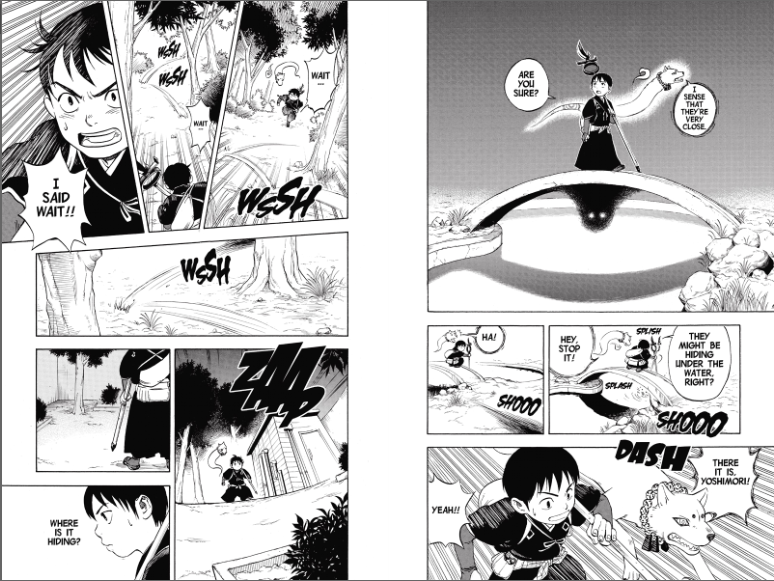
The premise of Kekkaishi is simple: Yoshimori Sumimura, a seemingly unremarkable fourteen-year-old boy, is a kekkaishi, or barrier-master. When he isn’t consuming unhealthy amounts of coffee-flavored milk, dozing off in class, or baking architecturally magnificent cakes (one of his pet obsessions), he’s patrolling the grounds of his school, which sits atop the Karasumori, a locus of magical energy that proves irresistible to ayakashi (demons) looking to augment their power. Yoshimori traps unwanted visitors within cube-shaped barriers, then vaporizes them, barrier and all.

Joining him on patrol are his sixteen-year-old neighbor Tokine Yukimura—a more disciplined kekkaishi whom Yoshimori secretly adores—and a small complement of demons that includes two dog spirits, Madarao and Hakubi, and a half-human, half-ayakashi, Gen Shishio. Further complicating matters are the families themselves: the Sumimuras and Yukimuras detest one another. Though their clans have been tasked with protecting the Karasumori for nearly 500 years, the oldest generation carries on an energetic feud, making it difficult for Yoshimori and Tokine to work together harmoniously. In short, Kekkaishi reads like an entertaining mash-up of Bleach, InuYasha, and Romeo and Juliet. (Or maybe Romeo Must Die. Take your pick.)

Each volume unfurls at a brisk clip, in part because Tanabe doesn’t feel the need to explain the entire mythology of the Karasumori site all at once. Nor does she resort to the kind of lazy, expository dialogue found in many shonen series with complicated backstories. (You know the kind: “As you know, Tokine, we’ve been combating ayakashi together for almost a year, and our faithful demon dog sidekicks have played an indispensable role in helping us rid the site of ayakashi. Don’t you think, childhood friend and neighbor of mine?”) Instead, Tanabe reveals details about the Karasumori site’s past gradually as she introduces new characters and confronts her principal cast members with new demonic challenges. In fact, the kekkaishis’ greatest adversaries—the Kokuburo, a group of powerful demons whose plan for world domination involves taking over the Karasumori site—don’t even appear in the first volume of the series.

What makes Kekkaishi such a joy to read is Yellow Tanabe’s consummate skill as both an illustrator and storyteller. Her artwork is clean and attractive, with bold lines and nicely composed pictures. Though her character designs are immensely appealing—and seem ready-made for the inevitable assortment of lunchboxes, t-shirts, shijikis, and coffee milk drinks that the series inspired—it’s her action sequences that really shine. Kekkaishi is one of the few shonen series where the fight scenes are (a) dynamic (b) thrilling (c) easy to follow (d) essential to the plot and (e) just the right length. There’s also a wonderful sense of play in Tanabe’s combat. Yoshimori and Tokine use kekkaishi not only as traps, but also as aerial stepping-stones that allow them to pursue demons mid-air.

There’s another appealing—and slyly didactic—aspect to these fight scenes as well. Though Yoshimori possesses greater spiritual powers than Tokine, it’s Tokine who frequently saves the day. Why? Because she practices creating barriers with the same diligence as she does her homework. Yoshimori, on the other hand, struggles to master his powers, sometimes embarking on marathon training sessions and other times neglecting to practice at all.

Kekkaishi offers readers more modest pleasures as well. Tanabe creates a colorful cast of supporting characters that include Yoshimori and Tokine’s sparring grandparents, who prove surprisingly spry for a couple of sexagenarians; Yoshimori’s father, who reminds me of James Dean’s apron-clad dad in Rebel Without a Cause; Masahiko Tsukijigaoka, a genial ghost who was a baker in life; Heisuke Matsudo, a nattily-dressed friend of Yoshimori’s grandfather with a specialty in weird science; and Mamezo, the grouchy guardian spirit of the Karasumori site who looks a bit like Kermit the Frog on a bender. Tanabe’s villains are a less colorful and distinctive bunch than, say, Naraku’s various incarnations, but I find that refreshing. For once the hero—and pals—are as vivid and appealing as the bad guys without having sordid or unnecessarily complicated backstories.

Like all shonen series, Kekkaishi suffers from an occasional dry spell. In volumes seven and eight, for example, the series seemed to have lost its mojo; I found the fight scenes tedious and felt Tanabe had fumbled in her depiction of Tokine, who went from being an appealing, competent character to a mere tag-along. But Tanabe quickly righted the ship in volume nine, introducing new characters, fleshing out the Kokoburo’s motives for capturing the Karasumori, staging some ecological intrigue at the Colorless Marsh, and revealing that Yoshimori’s dad has some demon-busting skills of his own. Though volume nine features two dramatic fight scenes, it’s the quieter, character-building moments that really shine, raising the emotional stakes by revealing unexpected facets of the heroes’ personalities; what happens in volume ten is all the more devastating because Tanabe makes us care deeply about her characters’ welfare.

If I still haven’t persuaded you that Kekkaishi is more fun than a barrel of demon monkeys, let me sing the praises of Yellow Tanabe’s omake. I don’t usually read sidebars or gag strips for reasons that David Welsh so aptly summarized in a memorable blog entry:

The content is generally pretty repetitive. They’re working really hard, and they’re sorry they’re behind on their fan mail. This volume isn’t as good as they’d have liked, but they’re trying, and reader support keeps them going. They wish they had a kitty. That sort of thing.

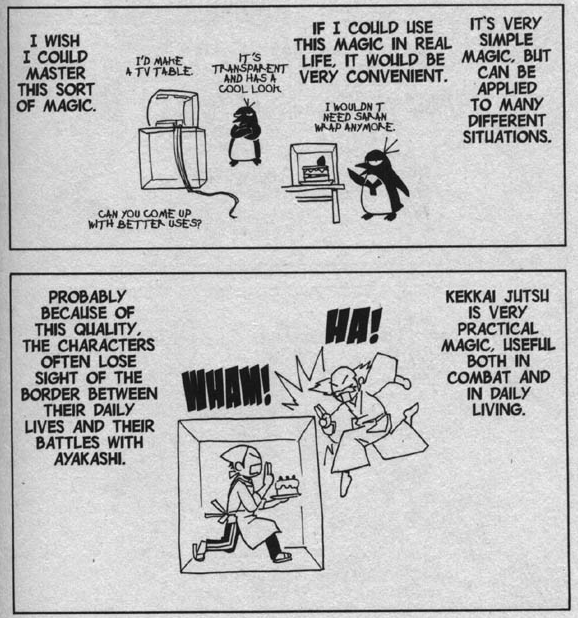
Tanabe’s omake steer clear of the usual bowing and scraping before the fandom. Instead, she depicts herself as a slightly tubby penguin with a perpetual scowl and an implacable panda for an editor. Not much happens in a typical strip, but the back-and-forth between penguin and panda is amusing and, for anyone who’s ever been on the receiving end of editorial criticism, all too true. She also has a lot of fun explaining her creative decisions:

And if you’re still on the fence, let me pull out my trump card: Kekkaishi is complete. Done. Finished. Finito.

After a successful eight-year run in Weekly Shonen Sunday, the series wrapped on April 6th with the publication of its 334th chapter. And by successful, I mean successful in Japan, where the series inspired a 52-episode television series and a robust assortment of video games, and nabbed nabbed the 2007 Shogakukan Award for Best Shonen Series. Here in the US, however, Kekkaishi has barely made a ripple. VIZ has been making a concerted effort to promote the series, featuring sample chapters on its Shonen Sunday website, licensing broadcasting rights to Cartoon Network, and releasing two budget editions: one digital (for the iPad), and one print. (Look for the first three-in-one edition on May 3, 2011.) I’m not sure why Kekkaishi hasn’t caught on with American audiences yet, but now is a great time to jump into this addictive series. I dare you not to like it!

This is a revised version of an essay that originally appeared at PopCultureShock on 5/14/07.

Filed Under: Manga Critic Tagged With: Horror/Supernatural, Shonen, shonen sunday, VIZ, Yellow Tanabe, Yokai

The Best Manga You’re Not Reading: Kekkaishi

April 7, 2011 by Katherine Dacey

I have a challenge for all you Shonen Jump readers: pick up a copy of Kekkaishi. It may not be as sexy as Death Note, or as goofy as One Piece, or as battle-focused as Bleach, but what it lacks in flash, it makes up in heart, humor, and good old-fashioned storytelling.

The premise of Kekkaishi is simple: Yoshimori Sumimura, a seemingly unremarkable fourteen-year-old boy, is a kekkaishi, or barrier-master. When he isn’t consuming unhealthy amounts of coffee-flavored milk, dozing off in class, or baking architecturally magnificent cakes (one of his pet obsessions), he’s patrolling the grounds of his school, which sits atop the Karasumori, a locus of magical energy that proves irresistible to ayakashi (demons) looking to augment their power. Yoshimori traps unwanted visitors within cube-shaped barriers, then vaporizes them, barrier and all.

Joining him on patrol are his sixteen-year-old neighbor Tokine Yukimura—a more disciplined kekkaishi whom Yoshimori secretly adores—and a small complement of demons that includes two dog spirits, Madarao and Hakubi, and a half-human, half-ayakashi, Gen Shishio. Further complicating matters are the families themselves: the Sumimuras and Yukimuras detest one another. Though their clans have been tasked with protecting the Karasumori for nearly 500 years, the oldest generation carries on an energetic feud, making it difficult for Yoshimori and Tokine to work together harmoniously. In short, Kekkaishi reads like an entertaining mash-up of Bleach, InuYasha, and Romeo and Juliet. (Or maybe Romeo Must Die. Take your pick.)

Each volume unfurls at a brisk clip, in part because Tanabe doesn’t feel the need to explain the entire mythology of the Karasumori site all at once. Nor does she resort to the kind of lazy, expository dialogue found in many shonen series with complicated backstories. (You know the kind: “As you know, Tokine, we’ve been combating ayakashi together for almost a year, and our faithful demon dog sidekicks have played an indispensable role in helping us rid the site of ayakashi. Don’t you think, childhood friend and neighbor of mine?”) Instead, Tanabe reveals details about the Karasumori site’s past gradually as she introduces new characters and confronts her principal cast members with new demonic challenges. In fact, the kekkaishis’ greatest adversaries—the Kokuburo, a group of powerful demons whose plan for world domination involves taking over the Karasumori site—don’t even appear in the first volume of the series.

What makes Kekkaishi such a joy to read is Yellow Tanabe’s consummate skill as both an illustrator and storyteller. Her artwork is clean and attractive, with bold lines and nicely composed pictures. Though her character designs are immensely appealing—and seem ready-made for the inevitable assortment of lunchboxes, t-shirts, shijikis, and coffee milk drinks that the series inspired—it’s her action sequences that really shine. Kekkaishi is one of the few shonen series where the fight scenes are (a) dynamic (b) thrilling (c) easy to follow (d) essential to the plot and (e) just the right length. There’s also a wonderful sense of play in Tanabe’s combat. Yoshimori and Tokine use kekkaishi not only as traps, but also as aerial stepping-stones that allow them to pursue demons mid-air.

There’s another appealing—and slyly didactic—aspect to these fight scenes as well. Though Yoshimori possesses greater spiritual powers than Tokine, it’s Tokine who frequently saves the day. Why? Because she practices creating barriers with the same diligence as she does her homework. Yoshimori, on the other hand, struggles to master his powers, sometimes embarking on marathon training sessions and other times neglecting to practice at all.

Kekkaishi offers readers more modest pleasures as well. Tanabe creates a colorful cast of supporting characters that include Yoshimori and Tokine’s sparring grandparents, who prove surprisingly spry for a couple of sexagenarians; Yoshimori’s father, who reminds me of James Dean’s apron-clad dad in Rebel Without a Cause; Masahiko Tsukijigaoka, a genial ghost who was a baker in life; Heisuke Matsudo, a nattily-dressed friend of Yoshimori’s grandfather with a specialty in weird science; and Mamezo, the grouchy guardian spirit of the Karasumori site who looks a bit like Kermit the Frog on a bender. Tanabe’s villains are a less colorful and distinctive bunch than, say, Naraku’s various incarnations, but I find that refreshing. For once the hero—and pals—are as vivid and appealing as the bad guys without having sordid or unnecessarily complicated backstories.

Like all shonen series, Kekkaishi suffers from an occasional dry spell. In volumes seven and eight, for example, the series seemed to have lost its mojo; I found the fight scenes tedious and felt Tanabe had fumbled in her depiction of Tokine, who went from being an appealing, competent character to a mere tag-along. But Tanabe quickly righted the ship in volume nine, introducing new characters, fleshing out the Kokoburo’s motives for capturing the Karasumori, staging some ecological intrigue at the Colorless Marsh, and revealing that Yoshimori’s dad has some demon-busting skills of his own. Though volume nine features two dramatic fight scenes, it’s the quieter, character-building moments that really shine, raising the emotional stakes by revealing unexpected facets of the heroes’ personalities; what happens in volume ten is all the more devastating because Tanabe makes us care deeply about her characters’ welfare.

If I still haven’t persuaded you that Kekkaishi is more fun than a barrel of demon monkeys, let me sing the praises of Yellow Tanabe’s omake. I don’t usually read sidebars or gag strips for reasons that David Welsh so aptly summarized in a memorable blog entry:

The content is generally pretty repetitive. They’re working really hard, and they’re sorry they’re behind on their fan mail. This volume isn’t as good as they’d have liked, but they’re trying, and reader support keeps them going. They wish they had a kitty. That sort of thing.

Tanabe’s omake steer clear of the usual bowing and scraping before the fandom. Instead, she depicts herself as a slightly tubby penguin with a perpetual scowl and an implacable panda for an editor. Not much happens in a typical strip, but the back-and-forth between penguin and panda is amusing and, for anyone who’s ever been on the receiving end of editorial criticism, all too true. She also has a lot of fun explaining her creative decisions:

And if you’re still on the fence, let me pull out my trump card: Kekkaishi is complete. Done. Finished. Finito.

After a successful eight-year run in Weekly Shonen Sunday, the series wrapped on April 6th with the publication of its 334th chapter. And by successful, I mean successful in Japan, where the series inspired a 52-episode television series and a robust assortment of video games, and nabbed nabbed the 2007 Shogakukan Award for Best Shonen Series. Here in the US, however, Kekkaishi has barely made a ripple. VIZ has been making a concerted effort to promote the series, featuring sample chapters on its Shonen Sunday website, licensing broadcasting rights to Cartoon Network, and releasing two budget editions: one digital (for the iPad), and one print. (Look for the first three-in-one edition on May 3, 2011.) I’m not sure why Kekkaishi hasn’t caught on with American audiences yet, but now is a great time to jump into this addictive series. I dare you not to like it!

This is a revised version of an essay that originally appeared at PopCultureShock on 5/14/07.

Filed Under: Manga, Manga Critic, Recommended Reading, REVIEWS Tagged With: Horror/Supernatural, Shonen, shonen sunday, VIZ, Yellow Tanabe, Yokai

The Red Snake

April 5, 2011 by Katherine Dacey 1 Comment

The Red Snake isn’t the most disturbing manga I’ve read — that honor belongs to Mr. Arashi’s Amazing Freak Show, a book so intent on celebrating taboo behavior that I was certain I’d be arrested for having a copy in my house. But The Red Snake earns a special place on my manga-reading list for being one weirdest horror stories I’ve read, a grim fable about a family obsessed with bugs, boils, chickens, and snakes.

The book opens with the narrator wandering the halls of a sprawling house. “For as long as I can remember, I’ve wanted to get away from this house,” he explains. “Something evil lurks within these walls.” As lugubrious as the corridors and empty rooms may be, the inhabitants are even scarier: the grandfather is a tyrant who lavishes more attention on his poultry than on his family; the grandmother believes she’s a chicken and sits on a gigantic nest, attacking anyone who threatens her “territory”; the sister has an almost erotic fascination with insects; and the mother is a virtual slave, forced each day to massage and drain the pus from an enormous boil on the grandfather’s face. (Perhaps they’re the kind of people Tolstoy had in mind when he famously opined that “every unhappy family is unhappy in its own way”?)

What follows the prologue is hard to classify as a story; it’s more a string of loosely connected vignettes, all increasingly horrific, in which:

  • Snakes violate the sister in almost every way imaginable;
  • The sister kills chickens and drinks their blood — straight from their dripping necks;
  • The grandmother transforms into a chicken with a human head;
  • The mother gives birth to a monstrous creature that looks like a Garbage Pail Kid; and
  • The narrator goes mano-a-mano with a flotilla of zombie infants.

After nearly one hundred pages of blood-soaked insanity, we find ourselves right back where we started: the narrator begins his soliloquy about the house again, using the same words and wandering the same corridors as he did in the book’s opening pages.

Hino’s artwork resembles a scratchboard drawing or a woodblock print, characterized by large patches of black ink pierced by thin, white lines. In the opening pages, for example, there’s no visible light source anywhere in the house or the surrounding woods — no sky, no candles or lamps — creating an atmosphere of almost unbearable claustrophobia; the shadows are palpable, pressing in on the narrator just as surely as the demons he unwittingly frees later in the story.

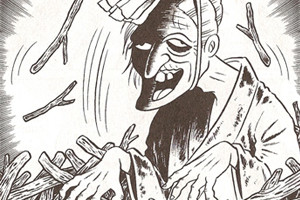
Character-wise, Hino’s designs belong to the same genotype as Kazuo Umezu and Kanako Inuki’s. Hino draws young girls and mothers as beautiful, glassy-eyed dolls and old women, fathers, and boys as grotesques. The narrator, for example, wears his worry like a shirt; he has enormous eyes rimmed in circles and is almost bald, even though his behavior and height peg him as a child of about ten or twelve. The grandparents, by contrast, resemble animals: the grandfather looks like a toad, with a bumpy hide, wide-set eyes, and a broad, leering mouth filled with rotting teeth, while the grandmother increasingly resembles the object of her delusion:

I feel like chicken tonight?

For all Hino’s ability to provoke and amuse, I’m not sure how I feel about The Red Snake. The story unfolds with the feverish logic of a dream, yielding some suitably creepy and bizarre images; I’ve never pictured the Sanzu River as alive with flesh-eating zombie babies, but it’s an arresting idea. The ending, too, is surprisingly effective. It’s not clear if the narrator realizes that he’s trapped in a cycle of unending horror, or is simply puzzled that all of the house’s nameless inhabitants have reverted to their “normal” state; either way, it’s a nasty punchline that subverts our desire — and the narrator’s — for closure.

At the same time, however, Hino has a juvenile fixation with blood, pus, and bugs, relishing every opportunity to draw a close-up of the grandfather’s boil or fill the page with a squirm of insects. Though some of these images merit an appreciative eewww, they’re too broadly cartoonish to really spook us; the grandfather’s ailments reminded me of an old George Carlin routine about the perverse delight humans take in studying their hangnails and pimples, rather than the disturbing metamorphoses found in Junji Ito and David Croenberg’s work. Maybe that’s Hino’s point: that we’re weirdly — almost comically — obsessed with our own bodily existence, but The Red Snake is so packed with ideas and sight gags and detours into the ludicrous that it’s hard to know what, exactly, Hino is trying to do besides mess with our heads.

THE RED SNAKE • BY HIDESHI HINO • DH PUBLISHING • 200 pp. • NO RATING (APPROPRIATE FOR OLDER TEENS AND MATURE AUDIENCES; SEXUAL CONTENT AND DISTURBING IMAGERY)

Filed Under: Manga Critic Tagged With: DH Publishing, Hideshi Hino, Horror/Supernatural

The Red Snake

April 5, 2011 by Katherine Dacey

The Red Snake isn’t the most disturbing manga I’ve read — that honor belongs to Mr. Arashi’s Amazing Freak Show, a book so intent on celebrating taboo behavior that I was certain I’d be arrested for having a copy in my house. But The Red Snake earns a special place on my manga-reading list for being one weirdest horror stories I’ve read, a grim fable about a family obsessed with bugs, boils, chickens, and snakes.

The book opens with the narrator wandering the halls of a sprawling house. “For as long as I can remember, I’ve wanted to get away from this house,” he explains. “Something evil lurks within these walls.” As lugubrious as the corridors and empty rooms may be, the inhabitants are even scarier: the grandfather is a tyrant who lavishes more attention on his poultry than on his family; the grandmother believes she’s a chicken and sits on a gigantic nest, attacking anyone who threatens her “territory”; the sister has an almost erotic fascination with insects; and the mother is a virtual slave, forced each day to massage and drain the pus from an enormous boil on the grandfather’s face. (Perhaps they’re the kind of people Tolstoy had in mind when he famously opined that “every unhappy family is unhappy in its own way”?)

What follows the prologue is hard to classify as a story; it’s more a string of loosely connected vignettes, all increasingly horrific, in which:

  • Snakes violate the sister in almost every way imaginable;
  • The sister kills chickens and drinks their blood — straight from their dripping necks;
  • The grandmother transforms into a chicken with a human head;
  • The mother gives birth to a monstrous creature that looks like a Garbage Pail Kid; and
  • The narrator goes mano-a-mano with a flotilla of zombie infants.

After nearly one hundred pages of blood-soaked insanity, we find ourselves right back where we started: the narrator begins his soliloquy about the house again, using the same words and wandering the same corridors as he did in the book’s opening pages.

Hino’s artwork resembles a scratchboard drawing or a woodblock print, characterized by large patches of black ink pierced by thin, white lines. In the opening pages, for example, there’s no visible light source anywhere in the house or the surrounding woods — no sky, no candles or lamps — creating an atmosphere of almost unbearable claustrophobia; the shadows are palpable, pressing in on the narrator just as surely as the demons he unwittingly frees later in the story.

Character-wise, Hino’s designs belong to the same genotype as Kazuo Umezu and Kanako Inuki’s. Hino draws young girls and mothers as beautiful, glassy-eyed dolls and old women, fathers, and boys as grotesques. The narrator, for example, wears his worry like a shirt; he has enormous eyes rimmed in circles and is almost bald, even though his behavior and height peg him as a child of about ten or twelve. The grandparents, by contrast, resemble animals: the grandfather looks like a toad, with a bumpy hide, wide-set eyes, and a broad, leering mouth filled with rotting teeth, while the grandmother increasingly resembles the object of her delusion:

I feel like chicken tonight?

For all Hino’s ability to provoke and amuse, I’m not sure how I feel about The Red Snake. The story unfolds with the feverish logic of a dream, yielding some suitably creepy and bizarre images; I’ve never pictured the Sanzu River as alive with flesh-eating zombie babies, but it’s an arresting idea. The ending, too, is surprisingly effective. It’s not clear if the narrator realizes that he’s trapped in a cycle of unending horror, or is simply puzzled that all of the house’s nameless inhabitants have reverted to their “normal” state; either way, it’s a nasty punchline that subverts our desire — and the narrator’s — for closure.

At the same time, however, Hino has a juvenile fixation with blood, pus, and bugs, relishing every opportunity to draw a close-up of the grandfather’s boil or fill the page with a squirm of insects. Though some of these images merit an appreciative eewww, they’re too broadly cartoonish to really spook us; the grandfather’s ailments reminded me of an old George Carlin routine about the perverse delight humans take in studying their hangnails and pimples, rather than the disturbing metamorphoses found in Junji Ito and David Croenberg’s work. Maybe that’s Hino’s point: that we’re weirdly — almost comically — obsessed with our own bodily existence, but The Red Snake is so packed with ideas and sight gags and detours into the ludicrous that it’s hard to know what, exactly, Hino is trying to do besides mess with our heads.

THE RED SNAKE • BY HIDESHI HINO • DH PUBLISHING • 200 pp. • NO RATING (APPROPRIATE FOR OLDER TEENS AND MATURE AUDIENCES; SEXUAL CONTENT AND DISTURBING IMAGERY)

Filed Under: Manga, Manga Critic, REVIEWS Tagged With: DH Publishing, Hideshi Hino, Horror/Supernatural

Pick of the Week: April Bounty

April 4, 2011 by Michelle Smith, MJ, David Welsh and Katherine Dacey 5 Comments

After last week’s drought, this week brings riches, with a whole slew of new titles expected in at Midtown Comics. Check out this week’s Picks from the Manga Bookshelf bloggers and special guest Michelle Smith!


MICHELLE: Although it’s a month late appearing on Midtown’s list—it actually came out on March 1st!—my pick this week is the second and final volume of Masami Tsuda’s Eensy Weensy Monster. Over twelve chapters (each covering one month), this charming shoujo series tells the year-long story of the developing relationship between two likable characters. It’s well crafted, employing many of the technical aspects that made Tsuda’s longer and more famous Kare Kano so special, and also super cute. In addition, it’s been nominated for the 2012 list of Great Graphic Novels for Teens so what’s not to like?

MJ: There are a number of compelling titles coming in to Midtown Comics this week, particularly new volumes of Demon Sacred and Seiho Boys’ High School, both of which I think have made this list before. But I’m going to throw my vote in for the debut volume of Yu Aikawa’s Butterfly, new this week from TOKYOPOP. This is a quirky little supernatural manga involving an emotionally damaged teen who reluctantly teams up with an elementary school-aged con artist. From my review: “As weird as this series is, it’s also really interesting. The characters are all filled with dark little nooks and crannies they’re struggling to hide from everyone else. It’s just the strangest little story, but I really can’t wait to read more.” Also, it’s got Squeakears. Need I say more?

DAVID: In spite of the fact that it has one of the most unpromising first chapters of any series of recent vintage, I’m going to give my nod to Kazue Kato’s Blue Exorcist from Viz. Kato corrects her shortcomings so quickly that it’s worth picking up just to see her manage that, but it also offers a very promising story and an interesting relationship between its twin protagonists. One brother, Rin, is the chosen heir of Satan, and the other, Yukio, is a prodigy in the field of exorcism. Rin decides he’d rather fight demons than rule them, and Yukio steps up to train Rin (and make sure he doesn’t inadvertently follow in their father’s footsteps). If course-correction spectacle isn’t your cup of tea, you could skip the first chapter entirely and move right on to the good stuff.

KATE: I’m voting for volume four of Demon Sacred, which is shojo manga at its crack-tastic best: who but Natsumi Itsuki could weave demons, dinosaurs, pop idols, unicorns, and handsome scientific geniuses into a storyline that’s as fun to read as that list implies? I’d be the first to admit that Itsuki seems to be making things up as she goes along, but the story unfolds in such a feverish, breathless fashion that it’s hard not to get caught up in it, even when it’s patently ridiculous.


So, readers, what are your Picks this week?

Filed Under: PICK OF THE WEEK Tagged With: blue exorcist, butterfly, demon sacred, eensy weensy monster

Bookshelf Briefs 4/4/11

April 4, 2011 by MJ, Katherine Dacey, David Welsh and Michelle Smith 6 Comments

This week, MJ, Kate, David, & Michelle take a look at seven ongoing series from Viz Media and Yen Press.


Bakuman, vol. 4 | Story by Tsugumi Ohba, Art by Takeshi Obata | Viz Media – After an unsatisfying summer, Mashiro and Takagi call it quits, only to discover that they’re more suited to each other than they thought. Meanwhile, girlfriends Azuki and Miyoshi make their own choices about how best to move forward in their careers and relationships. Though this series’ two leads are its least sympathetic characters, a bit of petty jealousy between friends goes a long way towards making them into people we can care about, or at least understand. Azuki and Miyoshi become more fully realized too, and if Miyoshi’s decision to chuck her own plans in favor of her man is depressing as hell, it’s depressingly realistic. Though the series’ inside look at Jump is still its most compelling aspect, it’s nice to feel that characterization is beginning to catch up. Gender politics aside, Bakuman is still the most interesting new shounen series I’ve read in the past year. Oddly recommended. – MJ

Laon, vol. 5 | Story by YoungBin Kim, Art by Hyun You | Yen Press – By all rights, Laon should be awesome: it’s the story of a tabloid reporter who gets the scoop of his life when he accidentally stumbles across a gumiho, or fox demon, who’s living among humans as she tries to collect her missing tails. Unfortunately, Laon tries to be too many things at once — a horror story, a journalism satire, a mystery, a romance — resulting in a narrative hodgepodge. Artist Hyun You shows a remarkable gameness for drawing whatever crazy scenarios dreamed up by YoungBin Kim, but struggles to make these scenarios feel like an organic part of the narrative; an underwater fight scene involving sea monsters and demonic piranha is undeniably cool, but serves little dramatic purpose. The frenetic pacing is a further detriment, making it hard for the reader to develop an affinity for any of the characters. File under “Unrealized Potential.” -Katherine Dacey

Library Wars: Love & War, Vol. 4 | by Hiro Arikawa and Kiiro Yumi| Viz Media – SLibrary Wars: Love & War is the story of Iku Kasahara, a corporal in a military task force set up to protect libraries from government censorship. In its purest essence, the series can be perfectly summed up with this line from the back cover of volume four: “What Iku lacks in training she more than makes up for in gumption.” In this latest installment, Iku has been taken hostage by a group protesting the transfer of sensitive materials from a private museum to library custody. While I’m still disappointed that Iku isn’t at least a little bit smarter, she’s definitely courageous, and when her commanding officer expresses absolute confidence in her ability to emerge from the situation unscathed, I found it easier to buy into their burgeoning romance. Too bad I can’t buy any of the characters as actual soldiers! – Michelle Smith

Natsume’s Book of Friends, vol. 4 | by Yuki Midorikawa | Viz Media – The fourth volume of Natsume’s Book of Friends finds Natsume and Nyanko assisting a pair of guardian spirits, one of whom has been so corrupted by her deep anger towards the local villagers that she’s destroying the woods and fields she once protected. The story is eerie and poignant, a sobering reminder of how quickly faith can curdle into despair. The subsequent chapters prove nearly as good as the first, with Natsume falling victim to a demonic painting, and Nyanko reluctantly aiding a child who falls down a well. For all the heart and imagination behind these stories, however, Natsume’s Book of Friends could be better. The art is sometimes flat and lifeless, and the dialogue too pointedly obvious for readers who want to draw their own conclusions about how they’re supposed to feel — in short, it’s perfectly respectable comfort food, but lacks a truly distinctive flavor. – Katherine Dacey

Rosario + Vampire Season II, vol. 4 | by Akihisa Ikeda | Viz Media – This was my introduction to the Rosario + Vampire franchise, and I strongly suspect it will also be my farewell. For those who don’t know, it’s a harem fantasy-adventure about a human boy who ends up going to a school for monsters and has drawn the romantic attention of a bunch of different supernatural girls (the titular vampire, a succubus, a fairy, and a couple of witches). It’s nowhere near as offensive as harem manga can get, but it’s ploddingly average in so many ways that you almost hope it will start offending you to keep your attention. I have no idea why these powerful girls are so smitten with dull Tsukune. Maybe it’s because he’s the only boy in the book. – David Welsh

Slam Dunk, vol. 15 | by Takehiko Inoue | Viz Media – I’m a devoted fan of Inoue’s Real (also from Viz), his saga about wheelchair basketball players. While his illustrations for Slam Dunk are absolutely dazzling, practically charging off the page, this series always strikes me as a sports manga where it’s necessary to be interested in either the sport, sports manga as a genre, or both. It’s an impressive achievement that he manages to stretch 90 seconds of play over six chapters, but I keep wishing I could find out more about these characters as something other than athletes. It’s kind of like yaoi where you don’t see anything but romantic trauma and sex. That said, I don’t think you’re likely to find action sequences that are drawn better in just about any comic from any country. – David Welsh

We Were There, vol. 12 | by Yuki Obata | Viz Media – With Yano’s sudden reappearance in Tokyo, “anxiety” is the real essence of this volume, with no ready relief in sight. And though this is not a bad thing by any means, it certainly left my stomach in knots. Obata’s talent for emotional torture is formidable indeed, but to focus on that would do a great disservice to her real talent, nuance. There is no absolute truth in We Were There, no certainty about right and wrong in the hearts of its characters or its author. Yet Obata proves that “gray” is not the same as “cold,” which is part of what makes this a great shoujo manga. Like the series’ light, wispy artwork, every moment is as fragile as a scrap of antique lace, and every bit as beautiful. Still recommended. – MJ

Filed Under: Bookshelf Briefs Tagged With: bakuman, laon, library wars, natsume's book of friends, rosario + vampire, slam dunk, we were there

Twin Spica, Vols. 5-6

March 30, 2011 by Katherine Dacey 14 Comments

If you spend any time surfing the mangasphere, you don’t need me to tell you that Twin Spica is about a group of teenagers who are training to become Japan’s first astronauts. You probably know — or have heard from other readers — that it’s poignant. And you may have heard pundits declare it one of the best new series of 2010. (It made my best-of list.) Rather than re-hash plot points or tell you how awesome it is, therefore, I thought I’d share what I like best about Twin Spica: every volume makes me want to look up at the sky.

I’m not talking about the simple act of looking through a telescope or watching clouds drift in the wind — I’m talking about the way the act of looking at the sky makes me feel. Reflecting back on my childhood, that act elicited very specific emotions: the sky represented the future, a large canvas on which I could project my most cherished dreams of traveling to distant places, having adventures, and doing things that, from a six or eight-year-old’s perspective, seemed important. Kou Yaginuma clearly remembers that feeling from his own childhood, because his characters are at their most optimistic and thoughtful when they’re looking up at the sky and thinking about their own experiences.

There’s a lovely moment in volume six, for example, when Fuchuya’s grandfather tells six-year-old Asumi to cherish the memory of gazing up at the sky, as the sky will look different to her as she reaches adulthood. He explains:

You might as well spend your time looking up, at the sky. Me, I’ve spent decades staring up the sky in this town. I only thought the sky was very high when I was your age. When you’re old, it doesn’t seem quite that way. The sky you see as a kid is a lifelong treasure. I mean it. Value what you can see now, and only now.

Reading this passage reminds me of “Feldeinsamkeit” (“In Summerfields”), a beautiful piece of juvenilia from Charles Ives’ 114 Songs. The lyrics, taken from German poet Hermann Allmers, describe the experience of lying in a meadow on a summer’s afternoon and watching the sky. The sight of drifting clouds induces melancholy in his poem’s narrator, who — in typical nineteenth-century fashion — sees the clouds’ gentle, unfettered progress across the sky as a symbol of release from earthly burdens:

I’m resting quietly in tall green grass,
and cast my eyes far upwards;
around me crickets chirp unceasing,
the sky’s blue magically encloses me.

The beautiful white clouds float past
through the deep blue, like lovely silent dreams.
It is as if I had been long dead,
and flew in bliss with them through unending space.

Ives’ setting, by his own standards, is rather tame; there’s a running accompaniment figure that suggests fast-moving clouds, and a fleeting moment of bitonality, but it falls squarely within the nineteenth-century Stimmungslied tradition with its rounded binary form and gentle chromaticism. The song has an undeniably haunting quality, however. Its rapid modulation to harmonically distant key signatures and achingly sad melodic line suggest that the singer isn’t simply describing the act of watching clouds, as the lyrics alone might imply, but remembering what she was thinking and feeling as she did so.

That may sound like a minor distinction, but memory — or, more accurately, the act of remembering — is an important motif in the 114 Songs. “At the River,” for example, initially sounds like a straightforward rendition of “Shall We Gather At the River,” only to deviate from the melody as the singer “forgets” the proper tune, while “Memories” re-enacts a child’s enthusiasm at attending a concert. “In Summerfields” is less self-consciously modernist than either of these songs, but all three rely heavily on the illusion that the performer is reliving one of her own memories.

And that’s exactly the quality I find so compelling about Twin Spica: it’s a manga about living with vivid memories — some haunting, some happy — about reconciling past and present, about recognizing the value in both joy and pain, about negotiating the transition from youthful innocence to adulthood. In that scene with Fuchuya’s grandfather, we’re given a powerful reminder of just how much symbolic importance the sky holds for all of us, even if it doesn’t fill us with the same sense of wonder that it did when we were small.

Review copies provided by Vertical, Inc.

TWIN SPICA, VOLS. 5-6 • BY KOU YAGINUMA • VERTICAL, INC. • RATING: TEEN (13+)

Filed Under: Manga Critic Tagged With: Seinen, vertical

Twin Spica, Vols. 5-6

March 30, 2011 by Katherine Dacey

If you spend any time surfing the mangasphere, you don’t need me to tell you that Twin Spica is about a group of teenagers who are training to become Japan’s first astronauts. You probably know — or have heard from other readers — that it’s poignant. And you may have heard pundits declare it one of the best new series of 2010. (It made my best-of list.) Rather than re-hash plot points or tell you how awesome it is, therefore, I thought I’d share what I like best about Twin Spica: every volume makes me want to look up at the sky.

I’m not talking about the simple act of looking through a telescope or watching clouds drift in the wind — I’m talking about the way the act of looking at the sky makes me feel. Reflecting back on my childhood, that act elicited very specific emotions: the sky represented the future, a large canvas on which I could project my most cherished dreams of traveling to distant places, having adventures, and doing things that, from a six or eight-year-old’s perspective, seemed important. Kou Yaginuma clearly remembers that feeling from his own childhood, because his characters are at their most optimistic and thoughtful when they’re looking up at the sky and thinking about their own experiences.

There’s a lovely moment in volume six, for example, when Fuchuya’s grandfather tells six-year-old Asumi to cherish the memory of gazing up at the sky, as the sky will look different to her as she reaches adulthood. He explains:

You might as well spend your time looking up, at the sky. Me, I’ve spent decades staring up the sky in this town. I only thought the sky was very high when I was your age. When you’re old, it doesn’t seem quite that way. The sky you see as a kid is a lifelong treasure. I mean it. Value what you can see now, and only now.

Reading this passage reminds me of “Feldeinsamkeit” (“In Summerfields”), a beautiful piece of juvenilia from Charles Ives’ 114 Songs. The lyrics, taken from German poet Hermann Allmers, describe the experience of lying in a meadow on a summer’s afternoon and watching the sky. The sight of drifting clouds induces melancholy in his poem’s narrator, who — in typical nineteenth-century fashion — sees the clouds’ gentle, unfettered progress across the sky as a symbol of release from earthly burdens:

I’m resting quietly in tall green grass,
and cast my eyes far upwards;
around me crickets chirp unceasing,
the sky’s blue magically encloses me.

The beautiful white clouds float past
through the deep blue, like lovely silent dreams.
It is as if I had been long dead,
and flew in bliss with them through unending space.

Ives’ setting, by his own standards, is rather tame; there’s a running accompaniment figure that suggests fast-moving clouds, and a fleeting moment of bitonality, but it falls squarely within the nineteenth-century Stimmungslied tradition with its rounded binary form and gentle chromaticism. The song has an undeniably haunting quality, however. Its rapid modulation to harmonically distant key signatures and achingly sad melodic line suggest that the singer isn’t simply describing the act of watching clouds, as the lyrics alone might imply, but remembering what she was thinking and feeling as she did so.

That may sound like a minor distinction, but memory — or, more accurately, the act of remembering — is an important motif in the 114 Songs. “At the River,” for example, initially sounds like a straightforward rendition of “Shall We Gather At the River,” only to deviate from the melody as the singer “forgets” the proper tune, while “Memories” re-enacts a child’s enthusiasm at attending a concert. “In Summerfields” is less self-consciously modernist than either of these songs, but all three rely heavily on the illusion that the performer is reliving one of her own memories.

And that’s exactly the quality I find so compelling about Twin Spica: it’s a manga about living with vivid memories — some haunting, some happy — about reconciling past and present, about recognizing the value in both joy and pain, about negotiating the transition from youthful innocence to adulthood. In that scene with Fuchuya’s grandfather, we’re given a powerful reminder of just how much symbolic importance the sky holds for all of us, even if it doesn’t fill us with the same sense of wonder that it did when we were small.

Review copies provided by Vertical, Inc.

TWIN SPICA, VOLS. 5-6 • BY KOU YAGINUMA • VERTICAL, INC. • RATING: TEEN (13+)

Filed Under: Manga, Manga Critic, REVIEWS Tagged With: Seinen, vertical

Ai Ore!, Vol. 1

March 29, 2011 by Katherine Dacey 22 Comments

Androgyny is as much a part of rock-n-roll as sex, drugs, and three-minute guitar solos, so it seems only natural that a music-obsessed manga-ka would write about a female guitarist who struts like Mick Jagger, or a male singer who can wail like Whitney Houston. Putting two such androgynous rock-n-rollers together in the same manga seems like a stroke of genius — think of what Moto Hagio could do with those characters! — until you realize that Ai Ore! is written by the author of Sensual Phrase, quite possibly the silliest manga ever written about rock musicians.

Ai Ore! begins promisingly enough. Mizuki — a tall, masculine girl — reluctantly allows Akira — a short, feminine boy — to join her band Blaue Rosen. At first, Mizuki seems to be the dominant one; not only is she taller and stronger than Akira, she’s also more charismatic, commanding her friends’ loyalty through the strength of her personality, rather than her sexual allure. (Akira, by contrast, relies on his delicate good looks to get what he wants.) Mizuki claims to hate men, but it doesn’t take long before her cover is blown: she’s besotted with Akira.

So far, so good: Mizuki is a believable character, embracing a masculine persona to camouflage how uncomfortable she feels in her own skin. (As someone who was also tall and broad-shouldered in high school, I can attest to the special misery of being bigger than many of my female peers: I vacillated between striding the halls like General MacArthur and secretly wishing I was four inches shorter.) Even Mizuki’s desire to be softer and prettier for Akira makes sense; she can’t imagine that a boy would be interested in a girl who was unconventionally feminine, despite abundant evidence that both her female and male peers find her attractive.

No, where the story really goes off the rails is in its dogged insistence on including every shojo cliche in the Hana to Yume playbook. A few chapters into the series, for example, we learn that Mizuki’s ambivalence about men stems from a distressing childhood experience in which she became so infatuated with a cute boy that she felt physically ill. (In a line straight out of Guys and Dolls, Mizuki declares, “Men are bad for your health!”) Shinjo doesn’t bother to conceal the mystery prince’s identity from readers, nor does she use that revelation to bring her leads closer together; the whole episode feels completely perfunctory, as if Shinjo were ticking off plot points from a checklist. The same goes for a story line that sends Mizuki, Akira, and a bus full of girls on a retreat. You probably don’t need me to tell you that their destination is a resort with hot springs, or that Akira infiltrates the group by pretending to be girl, or that Mizuki’s virtue is threatened by one of Akira’s classmates who’s tagged along for the express purpose of putting the moves on Mizuki.

It’s too bad that the story settles for such predictable plot twists; there’s a germ of a good idea in here, a chance to challenge the way teenagers define “feminine” and “masculine” by celebrating kids who can’t be neatly pegged as either. Instead, Mizuki and Akira revert to stereotypical female and male roles in the drama, with Mizuki sobbing and trembling and needing rescues, and Akira playing the hero. Now where’s the rock-n-roll in that?

Review copy provided by VIZ Media, LLC. Volume one will be available on May 3, 2011.

AI ORE!, VOL. 1 • BY MAYU SHINJO • VIZ • 300 pp. • RATING: OLDER TEEN (16+)

Filed Under: Manga Critic Tagged With: Mayu Shinjo, shojo, shojo beat, VIZ

Ai Ore!, Vol. 1

March 29, 2011 by Katherine Dacey

Androgyny is as much a part of rock-n-roll as sex, drugs, and three-minute guitar solos, so it seems only natural that a music-obsessed manga-ka would write about a female guitarist who struts like Mick Jagger, or a male singer who can wail like Whitney Houston. Putting two such androgynous rock-n-rollers together in the same manga seems like a stroke of genius — think of what Moto Hagio could do with those characters! — until you realize that Ai Ore! is written by the author of Sensual Phrase, quite possibly the silliest manga ever written about rock musicians.

Ai Ore! begins promisingly enough. Mizuki — a tall, masculine girl — reluctantly allows Akira — a short, feminine boy — to join her band Blaue Rosen. At first, Mizuki seems to be the dominant one; not only is she taller and stronger than Akira, she’s also more charismatic, commanding her friends’ loyalty through the strength of her personality, rather than her sexual allure. (Akira, by contrast, relies on his delicate good looks to get what he wants.) Mizuki claims to hate men, but it doesn’t take long before her cover is blown: she’s besotted with Akira.

So far, so good: Mizuki is a believable character, embracing a masculine persona to camouflage how uncomfortable she feels in her own skin. (As someone who was also tall and broad-shouldered in high school, I can attest to the special misery of being bigger than many of my female peers: I vacillated between striding the halls like General MacArthur and secretly wishing I was four inches shorter.) Even Mizuki’s desire to be softer and prettier for Akira makes sense; she can’t imagine that a boy would be interested in a girl who was unconventionally feminine, despite abundant evidence that both her female and male peers find her attractive.

No, where the story really goes off the rails is in its dogged insistence on including every shojo cliche in the Hana to Yume playbook. A few chapters into the series, for example, we learn that Mizuki’s ambivalence about men stems from a distressing childhood experience in which she became so infatuated with a cute boy that she felt physically ill. (In a line straight out of Guys and Dolls, Mizuki declares, “Men are bad for your health!”) Shinjo doesn’t bother to conceal the mystery prince’s identity from readers, nor does she use that revelation to bring her leads closer together; the whole episode feels completely perfunctory, as if Shinjo were ticking off plot points from a checklist. The same goes for a story line that sends Mizuki, Akira, and a bus full of girls on a retreat. You probably don’t need me to tell you that their destination is a resort with hot springs, or that Akira infiltrates the group by pretending to be girl, or that Mizuki’s virtue is threatened by one of Akira’s classmates who’s tagged along for the express purpose of putting the moves on Mizuki.

It’s too bad that the story settles for such predictable plot twists; there’s a germ of a good idea in here, a chance to challenge the way teenagers define “feminine” and “masculine” by celebrating kids who can’t be neatly pegged as either. Instead, Mizuki and Akira revert to stereotypical female and male roles in the drama, with Mizuki sobbing and trembling and needing rescues, and Akira playing the hero. Now where’s the rock-n-roll in that?

Review copy provided by VIZ Media, LLC. Volume one will be available on May 3, 2011.

AI ORE!, VOL. 1 • BY MAYU SHINJO • VIZ • 300 pp. • RATING: OLDER TEEN (16+)

Filed Under: Manga, Manga Critic, REVIEWS Tagged With: Mayu Shinjo, Musical Manga, shojo beat, VIZ

Pick of the Week: Persuasion

March 29, 2011 by Katherine Dacey, MJ and David Welsh 8 Comments

With very little new manga shipping this week, we’ve decided to do something a little different. Instead of choosing something fresh off the presses, each of us will recommend a title we’ve reviewed in the past six months that we feel deserves a moment in the spotlight. Check out our Picks below!


KATE: I’m glad I’m going first this week, because that allows me to recommend a Manga Bookshelf staff favorite: The Secret Notes of Lady Kanoko. The first volume of this delightful, snarky comedy arrived in the final weeks of December, too late to make my Best Manga of 2010 list, but just in time to redeem my opinion of Tokyopop’s recent licensing choices. Many critics have been making favorable comparisons between Lady Kanoko and Harriet the Spy, not least because both stories feature young girls who fill notebooks with observations about their peers. What makes Kanoko so appealing, however, isn’t just that it shares plot points with Louise Fitzhugh’s famous story; it’s Kanoko herself, who uses her position as a neutral observer to help her classmates better understand their own behavior. Kanoko refuses to be pulled into their power struggles and romantic travails, making her an uncommonly independent, powerful shojo heroine. (She’s also blisteringly funny.) Assuming Tokyopop’s recent layoffs haven’t had a significant impact on their release calendar, volume two will arrive in stores next week.

MJ: I’m going to go in a bit of an unexpected direction here and recommend Seven Days: Monday-Thursday, the first of a two-volume BL series by Rihito Takarai & Venio Tachibana, released rather quietly on DMP’s Juné imprint last year. Though the second volume won’t come out here for months still, I have to admit it’s been lurking around in the back of my mind since I reviewed it in November. It’s not a showy series by any means, and its primary charm is in its emotional messiness, something I know I tend to appreciate more than most. Though it starts with an unbelievable premise (a boy offers himself up as a joke to a classmate with a reputation for dating any girl who asks him) the plot is just an excuse to explore adolescent confusion and awkwardness in the very best way possible. This was one of my favorite new BL series last year, and I can’t wait to see how it turns out.

DAVID: My pick is a book that seemed to slide in under the radar: Oji Suzuki’s A Single Match from Drawn & Quarterly. It’s an intriguing and challenging collection of short stories that were originally published in Garo, and Suzuki has a sensibility that’s simultaneously dreamlike and gritty. Chris Mautner did a fine job describing the creator’s approach in a review for The Comics Journal, saying “Perhaps the key is that Suzuki isn’t as interested in telling stories, per se, as much as he is in capturing certain moments — of memory, of awareness — and the emotions that roil underneath.” If all of the stories collected here aren’t equally successful, the majority of them are certainly intellectually and emotionally striking enough to merit close reading (and rereading). If you’re looking for an ambitious change of pace, A Single Match would be a fine choice. I reviewed the book back in February.


Amazon.com Widgets


Readers, recent title would you recommend?

Filed Under: PICK OF THE WEEK

Bookshelf Briefs 3/28/11

March 28, 2011 by MJ, David Welsh, Katherine Dacey and Michelle Smith 12 Comments

Welcome to the first installment of Bookshelf Briefs, a new, weekly collection of short reviews from the Manga Bookshelf crew covering both recent releases and some blasts from the past. This week, David, Kate, and MJlook at ongoing series from Viz Media and Yen Press, while guest Michelle Smith chimes in with an oldie from Dark Horse.


Black Butler, vol. 5 | by Yana Toboso | Yen Press – The fifth volume of Black Butler pits Sebastian against a rival butler in a curry cook-off reminiscent of an Iron Chef episode. (Queen Victoria stands in for Chairman Kaga as the ultimate arbiter of whose curry reigns supreme.) As inspired a development as the curry battle may be, it reveals the biggest problem with Black Butler: the story relies so heavily on gruesome supernatural plot twists that the narrative comes to a grinding halt whenever Yana Toboso depicts more mundane situations. The supporting characters are two-dimensional at best, doomed to sound the same notes over and over, while Sebastian is so relentlessly perfect that the outcome of every conflict is never in doubt. About the best I can say for volume five is that Toboso pulls out all the stops while drawing the interior of the Crystal Palace; every steel arch and palm tree are rendered with loving precision. – Katherine Dacey

Itsuwaribito vol. 2 | by Yuuki Iinuma | Viz Media – This series has such a terrific premise – an habitual liar decides to use his inherent dishonesty to help people – that I keep hoping it will start to make the most of it. Unfortunately, Utsuho is a rather inscrutable protagonist, and there aren’t enough hints at hidden depths to give his adventures the kind of weight the premise promises. It’s pleasant and attractively drawn, but it doesn’t really go any farther than that. Iinuma could build an interesting and novel mythology with the underlying idea, which could transform the series into something quite special. I’ll probably stick with it for a bit longer to see if that happens. – David Welsh

Kimi ni Todoke, vol. 7 | by Karuho Shiina | Viz Media – Sawako’s slowly burgeoning relationship with Kazehaya leaps boldly forward in this installment, leaving Sawako finally certain of her own feelings. Unfortunately, insecurity prevents her from recognizing that those feelings are returned. Though the pace of this series remains as leisurely as the growth of its heroine’s self-confidence, its unabashed sweetness saves this from ever becoming stale. Shiina’s smart, honest writing and expressive artwork serve as a how-to manual for creating effective shoujo manga, with a touch of wry humor as a special bonus. A scene in which Chizu and Ayane give Sawako a whirlwind makeover is worth the cover price, alone. Still recommended.– MJ

Seiho Boys’ High School!, vol. 4 | by Kaneyoshi Izumi | Viz Media -Though Seiho Boys’ High School pretends to be a soap opera about hunky, horny guys trapped at a geographically isolated boarding school, it’s actually a smart comedy about teenage dating rituals. Male and female characters alike struggle mightily to impress the opposite sex: they pretend to be easygoing, or feign indifference, or mistake friendship for romantic attraction, embarrassing themselves in the process. In keeping with the realistic spirit of the comedy, Kaneyoshi Izumi doesn’t always find a way to unite her would-be couples; their interactions are as messy and complicated as real-life relationships, even if her characters are handier with snappy one-liners than most teenagers. Only the dorm room hijinks fall flat, with predictable jokes about the slovenly habits of the adolescent male — a minor complaint about an otherwise entertaining series. Recommended. – Katherine Dacey

Seiho Boys’ High School!, vol. 5 | by Kaneyoshi Izumi | Viz Media – A series of ghost sightings at Seiho High force Maki to confront his lingering feelings for the love of his past, while his present girlfriend pushes for some understanding of where she stands. Meanwhile, Hana finds a new calling in providing photos of his classmates to a nearby girls’ school, and townie Fuyuka makes unexpected progress with her crush, Kamiki. Kaneyoshi Izumi may not be revolutionizing the genre, but she’s surely livening it up with this decidedly indelicate, humorous look at the inner lives of boys left to wallow in each others’ company. As a die-hard fan of shoujo, it’s hard not to be charmed as she alternately mocks and pacifies her readers, and her increasing focus on deeper characterization only makes the series stronger. Five volumes in, Seiho continues to be one of Shojo Beat’s most enjoyable current reads. – MJ

Toriko, vol. 3 | by Mitsutoshi Shimabukuro | Viz Media – It’s hard to imagine a manga that both Ted Nugent and Michael Pollan could agree on, but Toriko comes pretty close: while it celebrates the manly valor of hunting game, it also focuses on the importance of eating “real” food. (Or what counts for “real” food in the fantasy-universe of the manga.) The tonal shifts can be dramatic, with characters waxing poetic about the delicate properties of puffer whale meat in one panel and engaging in brutal, hand-to-hand combat with rival gourmet hunters in the next, but the prevailing spirit is exuberant; every line of dialogue is delivered with emphatic punctuation, and every character seems thoroughly committed to the pursuit of delicacies. I’d be the first to admit that many of the game animals seem more ferocious than delicious, but Mitsutoshi Shimabukuro’s feverish energy and imagination help sell the more improbable story lines. Recommended.
– Katherine Dacey

From the Archives

Metropolis | by Osamu Tezuka | Dark Horse – According to the back cover, the 1949 Tezuka work Metropolis inspired an “astonishing” animated film. Alas, it didn’t inspire me much. For the most part, the narrative consists of a band of vertically challenged middle-aged sleuths pursuing an over-the-top villain who is himself pursuing Michi, an artificial being who is neither male nor female. Later, the villain’s robot slaves, led by Michi, stage a revolt. True, one could talk about the themes present in the work, most notably that life is sacred, no matter if it’s biological or artificial, but the story zooms by too quickly for anything to make much of an impact. I’m left wondering what Naoki Urasawa could make of this one. – Michelle Smith

Filed Under: Bookshelf Briefs

How to Pen & Ink: The Manga Start-Up Guide

March 25, 2011 by Katherine Dacey 2 Comments

Type the words “how to draw manga” into the Amazon.com search engine, and you’ll net over 575 results. These books run the gamut from Manga-for-Dummies manuals, designed to teach beginners the basics of figure drawing and paneling, to highly specialized texts focusing on a specific skill — say, applying screentone or drawing buxom warriors.

One of the biggest drawbacks to these manuals is the lack of examples culled from actual manga; for licensing reasons, many of these how-to books feature original art that may not be drawn by a professional working in the Japanese publishing industry. And while many of these books possess genuine educational value for the beginning artist, teaching from a copy — however good it might be — isn’t the same thing as learning from the original. That’s where DMP’s How to Pen & Ink: The Manga Start-Up Guide comes in: the book is liberally illustrated with sketches, pin-up art, and finished pages from the work of Oh!Great (Tenjo Tenge, Air Gear), Yasuhiro Nightow (Trigun), and Satoshi Shiki (Kami-Kaze), as well as a half-dozen other established artists.

The book is divided into two sections. In the first, billed as a “close-up of how a manga is born,” each of the three featured manga-ka takes readers step-by-step through the creation of a pen-and-ink drawing, offering insights into their own work process. In the second, readers practice drawing their own manga. This section, which comprises most of the book, contains a list of tools used by professional manga artists, a lengthy Q&A section aimed at novice creators, and a variety of exercises, the most useful of which focus on working with pens. Over a four-week period, readers learn how to draw lines of varying weight, length, and straightness; how to draw effective speedlines; and how to use crosshatching to define space and volume.

What distinguishes Pen & Ink from other how-to manuals is its approach: manga isn’t treated as a style but as a storytelling medium. Almost of the advice focuses on how to draw effective stories, whether readers are learning where to place word balloons or how to use speedlines and panel frames to direct the eye to a key element in the layout. Though some of the tips are too vague to be helpful, the book is chock-full of examples culled from the pages of Air Gear, Kami-Kaze, and Trigun, as well as Hikou x Shonen, Oudo no Kishi Moro, Sgt. Frog, Trigun, and Vampire Princess Yui — a diversity that nicely underscores the manga-as-medium message.

Anyone who’s taken a few life drawing courses should be able to complete most of the exercises, though they may wish to supplement Pen & Ink with a manual on character design. (Tips for drawing eyes, hands, and bodies are too scarce to be very helpful to novice cartoonists.) For readers just learning the basics — anatomy, perspective drawing — most of the information in the book is too advanced to be immediately beneficial; the ideal audience is someone who already owns a few pens and drawing tools but needs guidance on how to work more effectively with them.

Review copy provided by Digital Manga Publishing, Inc.

HOW TO PEN & INK: THE MANGA START-UP GUIDE • VARIOUS AUTHORS • DMP • 114 pp. • NO RATING (BEST SUITED FOR TEENS, AS THE SECTION ON OH!GREAT INCLUDES SOME NUDITY)

Filed Under: Manga Critic Tagged With: DMP, How-To, Oh!Great, Satoshi Shiki, Yasuhiro Nightow

How to Pen & Ink: The Manga Start-Up Guide

March 25, 2011 by Katherine Dacey

Type the words “how to draw manga” into the Amazon.com search engine, and you’ll net over 575 results. These books run the gamut from Manga-for-Dummies manuals, designed to teach beginners the basics of figure drawing and paneling, to highly specialized texts focusing on a specific skill — say, applying screentone or drawing buxom warriors.

One of the biggest drawbacks to these manuals is the lack of examples culled from actual manga; for licensing reasons, many of these how-to books feature original art that may not be drawn by a professional working in the Japanese publishing industry. And while many of these books possess genuine educational value for the beginning artist, teaching from a copy — however good it might be — isn’t the same thing as learning from the original. That’s where DMP’s How to Pen & Ink: The Manga Start-Up Guide comes in: the book is liberally illustrated with sketches, pin-up art, and finished pages from the work of Oh!Great (Tenjo Tenge, Air Gear), Yasuhiro Nightow (Trigun), and Satoshi Shiki (Kami-Kaze), as well as a half-dozen other established artists.

The book is divided into two sections. In the first, billed as a “close-up of how a manga is born,” each of the three featured manga-ka takes readers step-by-step through the creation of a pen-and-ink drawing, offering insights into their own work process. In the second, readers practice drawing their own manga. This section, which comprises most of the book, contains a list of tools used by professional manga artists, a lengthy Q&A section aimed at novice creators, and a variety of exercises, the most useful of which focus on working with pens. Over a four-week period, readers learn how to draw lines of varying weight, length, and straightness; how to draw effective speedlines; and how to use crosshatching to define space and volume.

What distinguishes Pen & Ink from other how-to manuals is its approach: manga isn’t treated as a style but as a storytelling medium. Almost of the advice focuses on how to draw effective stories, whether readers are learning where to place word balloons or how to use speedlines and panel frames to direct the eye to a key element in the layout. Though some of the tips are too vague to be helpful, the book is chock-full of examples culled from the pages of Air Gear, Kami-Kaze, and Trigun, as well as Hikou x Shonen, Oudo no Kishi Moro, Sgt. Frog, Trigun, and Vampire Princess Yui — a diversity that nicely underscores the manga-as-medium message.

Anyone who’s taken a few life drawing courses should be able to complete most of the exercises, though they may wish to supplement Pen & Ink with a manual on character design. (Tips for drawing eyes, hands, and bodies are too scarce to be very helpful to novice cartoonists.) For readers just learning the basics — anatomy, perspective drawing — most of the information in the book is too advanced to be immediately beneficial; the ideal audience is someone who already owns a few pens and drawing tools but needs guidance on how to work more effectively with them.

Review copy provided by Digital Manga Publishing, Inc.

HOW TO PEN & INK: THE MANGA START-UP GUIDE • VARIOUS AUTHORS • DMP • 114 pp. • NO RATING (BEST SUITED FOR TEENS, AS THE SECTION ON OH!GREAT INCLUDES SOME NUDITY)

Filed Under: Books, Classic Manga Critic, Manga Critic, REVIEWS Tagged With: DMP, How-To, Oh!Great, Satoshi Shiki, Yasuhiro Nightow

  • « Go to Previous Page
  • Page 1
  • Interim pages omitted …
  • Page 68
  • Page 69
  • Page 70
  • Page 71
  • Page 72
  • Interim pages omitted …
  • Page 89
  • Go to Next Page »
 | Log in
Copyright © 2010 Manga Bookshelf | Powered by WordPress & the Genesis Framework