• Skip to primary navigation
  • Skip to main content
  • Skip to primary sidebar
  • Home
  • About Us
    • Privacy Policy
    • Comment Policy
    • Disclosures & Disclaimers
  • Resources
    • Links, Essays & Articles
    • Fandomology!
    • CLAMP Directory
    • BlogRoll
  • Features & Columns
    • 3 Things Thursday
    • Adventures in the Key of Shoujo
    • Bit & Blips (game reviews)
    • BL BOOKRACK
    • Bookshelf Briefs
    • Bringing the Drama
    • Comic Conversion
    • Fanservice Friday
    • Going Digital
    • It Came From the Sinosphere
    • License This!
    • Magazine no Mori
    • My Week in Manga
    • OFF THE SHELF
    • Not By Manga Alone
    • PICK OF THE WEEK
    • Subtitles & Sensibility
    • Weekly Shonen Jump Recaps
  • Manga Moveable Feast
    • MMF Full Archive
    • Yun Kouga
    • CLAMP
    • Shojo Beat
    • Osamu Tezuka
    • Sailor Moon
    • Fruits Basket
    • Takehiko Inoue
    • Wild Adapter
    • One Piece
    • After School Nightmare
    • Karakuri Odette
    • Paradise Kiss
    • The Color Trilogy
    • To Terra…
    • Sexy Voice & Robo
  • Browse by Author
    • Sean Gaffney
    • Anna Neatrour
    • Michelle Smith
    • Katherine Dacey
    • MJ
    • Brigid Alverson
    • Travis Anderson
    • Phillip Anthony
    • Derek Bown
    • Jaci Dahlvang
    • Angela Eastman
    • Erica Friedman
    • Sara K.
    • Megan Purdy
    • Emily Snodgrass
    • Nancy Thistlethwaite
    • Eva Volin
    • David Welsh
  • MB Blogs
    • A Case Suitable For Treatment
    • Experiments in Manga
    • MangaBlog
    • The Manga Critic
    • Manga Report
    • Soliloquy in Blue
    • Manga Curmudgeon (archive)

Manga Bookshelf

Discussion, Resources, Roundtables, & Reviews

Katherine Dacey

Pick of the Week: Predictable Yet Welcome

January 29, 2018 by Sean Gaffney, Michelle Smith, Katherine Dacey and Ash Brown Leave a Comment

SEAN: Some interesting stuff out this week, both in manga and light novels. I will be predictable, though, in choosing the first Baccano! manga. I read this when it came out as chapters digitally, and am greatly looking forward to seeing it in print. Plus, content that wasn’t in the novels!
MICHELLE: I will be predictable by expressing my anticipation for another installment of Giant Killing, but I’m awarding my official pick to the ninth and final Full-Time Wife Escapist. I’ve enjoyed this series very much!

KATE: I second Sean’s pick of Baccano!, since I am obsessed with the flashback scenes in The Godfather Part II and will watch or read anything that reminds me of them. I realize that Baccano! is even MORE over the top than anything Mario Puzo ever wrote, but I think that’s actually a good thing. It’s an offer I can’t refuse!

ASH: With the promise of a little bit of yuri, a little bit of boys’ love, and a whole lot of complicated relationships, the debut of Nameless Asterism is the release I’m most curious about this week!

Filed Under: PICK OF THE WEEK

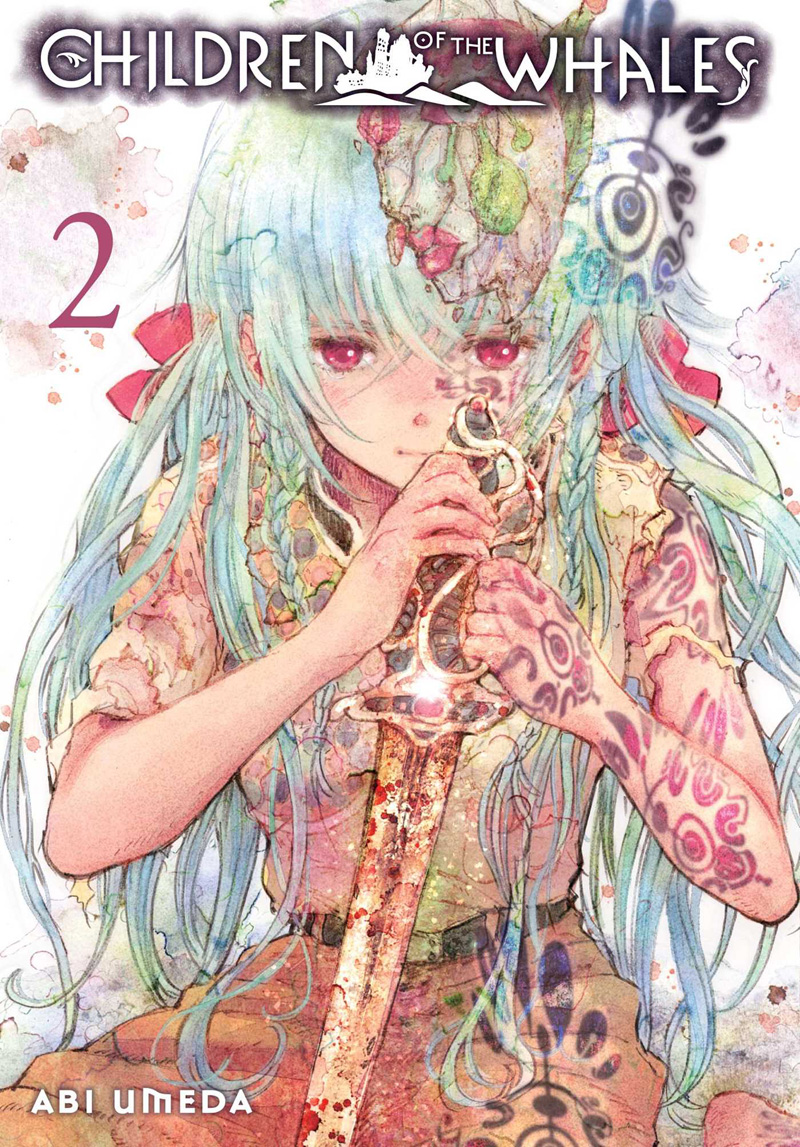
Children of the Whales, Vols. 1-2

January 28, 2018 by Katherine Dacey

Children of the Whales suffers from the same problem as many prestige television shows: it boasts a thought-provoking premise, compelling lead characters, and sophisticated visuals, but is such a relentlessly downbeat experience that you’d be forgiven for abandoning ship after a few chapters.

The story unfolds aboard the Mud Whale, a sentient vessel. Its 513 inhabitants have been exiled from their homeland for over 90 years, drifting across a vast ocean of sand punctuated only by the occasional island or abandoned boat. Fourteen-year-old Chakuro is the community’s archivist, tasked with recording births and deaths, strange encounters, and changes in the Mud Whale’s leadership, events he catalogs with almost fanatical devotion. Making his job more bittersweet is the discrepancy between the “marked” residents, whose ability to wield magic (or “thymia,” in the series’ parlance) dooms them to a short lifespan, and the unmarked residents, whose normal lifespans have forced them into the role of caretakers and governors.

To stave off despair, the Mud Whale’s residents eschew emotional display — a point reinforced in the earliest pages of volume one, when Chakuro sheds a tear at a 29-year-old woman’s funeral. Immediately, his peers enjoin him not to weep, lest “the souls at the bottom of the sea cry out for you.” It’s a simple but effective scene, one that reminds us that the Mud Whale’s inhabitants are caught between the real prospect of extinction and the uncertain possibility of survival; only their fierce commitment to living in the present moment preserves their tenuous existence.

While scavenging for supplies on a seemingly deserted island, Chakuro stumbles across a blank-faced girl about his own age. She attacks him with swords and sorcery, only to collapse, unconscious, from the effort of casting a spell. Chakuro is frightened but intrigued, and brings Lykos back to the Mud Whale where he learns her true identity: she’s an apatheia, an emotionless soldier. “Emotions will destroy the world,” she informs Chakuro. “The outside world you want to know so badly about is ruled by people deficient in feeling, using apatheias who have no heart to fight a war without end.”

The next major plot development — a surprise attack — delivers the series’ first truly grim moments, as the Mud Whale’s inhabitants are beaten, impaled, and gunned down by unknown assailants. Though Chakuro and Lykos have been fleshed out enough to earn the reader’s pity, the sheer size of the cast and the suddenness of the ambush blunt the impact of the carnage; we can see that Chakuro is devastated by the loss of his childhood friend Sami, but Sami is such a stock character — innocent, impetuous, infatuated with Chakuro — that her gruesome death registers as a manipulative attempt to illustrate the truth of Lykos’ earlier comments about the outside world. That same kind of heavy-handed editorializing extends to the villains’ physical appearance as well. They look like Juggalos in chain mail, sporting maniacal grins that scream, “Sadists ahoy!”, a point underscored in the gleeful way in which they violate corpses and taunt sobbing victims.

The most frustrating thing about these frenetic chapters is that they seem fundamentally at odds with the deliberate pacing and meticulous world-building in volume one. In these introductory pages, Umeda maps every nook and cranny of the Mud Whale, creating an environment as imposing and intimate as Hayao Miyazaki’s Laputa. She approaches her character designs with same patience and care, bestowing a semblance of individuality on each resident while establishing their collective identity as a people. Even Chakuro’s frequent voice-overs — presumably read from the Mud Whale’s archives — play an important role in helping us experience time the way the Mud Whale’s residents do; there’s a lyrical quality to Chakuro’s narration that captures the rhythms of their day-to-day existence.

Yet for all Umeda’s world-building skills, Children of the Whales‘ dour tone puts the reader at arm’s length from the characters. Minus the flashes of joy, humor, and warmth that temper Miyazaki’s most downbeat films, Children of the Whales feels more like an episode of The Leftovers or Rectify than Castle in the Sky; it’s so utterly mirthless that it casts a pall over the reader instead of prompting deep thoughts or empathy for the characters. Take my manga, please!

CHILDREN OF THE WHALES, VOLS. 1-2 • BY ABI UMEDA • VIZ • RATED T+ (FOR OLDER TEENS)

Filed Under: Manga, Manga Critic, REVIEWS Tagged With: Abi Umeda, children of the whales, Fantasy, shojo, VIZ Signature

Pick of the Week: My Manga Is Orange

January 23, 2018 by Sean Gaffney, Katherine Dacey, Michelle Smith and Ash Brown Leave a Comment

KATE: I suspect I’m not the only one who’s eager to read orange: future; I still get the sniffles just thinking about orange, and am eager to see how Ichigo Takano continues the story. Looking over this week’s new arrivals, though, I’m also curious about Made in Abyss, which sounds like a dark fantasy-adventure with an interesting heroine. And I’ll also give a plug for PTSD Radio, despite its unfortunate title and godawful covers. It’s a solid horror series that benefits from unique artwork and an unusual narrative structure.

SEAN: There’s several titles I’m interested in, including a final volume of Golden Time and the debut of Made in Abyss. But yeah, in the end the clearly obvious Pick of the Week is orange: future, which I reviewed here in a spoilery fashion, as Seven Seas helpfully noted. It may not please everyone, but it’s well-crafted.

MICHELLE: Having now read and loved the first two volumes of Frau Faust, I am definitely looking forward to volume three. But, yes, my heart really does belong to orange: future. I’m a little afraid of what it might reveal, given how much I loved the original series, but there’s no way I’m skipping it.

ASH: I’ll definitely be reading more of Frau Faust, and I’m rather curious about Made in Abyss, too, but orange: future is unquestionably my pick this week. Like so many others, the original series made a huge impression on me.

Filed Under: PICK OF THE WEEK

RWBY

January 17, 2018 by Katherine Dacey

There was a moment in the early 2000s when Tokyopop slapped the “manga” label on just about anything it published, from licensed Japanese comics to comics made by aspiring American artists who were trying to break into the industry. Looking back on the heated debate over the legitimacy of OEL manga, I wonder how today’s readers will view RWBY, a work that meets the basic definition of manga as “comics created in Japan,” but has a more complicated history than other American properties that have been reimagined for Japanese readers.

RWBY’s path to the Shonen Jump imprint began in 2013 when Rooster Teeth, an American production studio, had a viral hit with an original, anime-influenced show about a team of girls who fight monsters. Over the next four years, interest in RWBY was strong enough to inspire a spin-off series, a video game, four soundtrack albums, and a manga illustrated by Shirow Miwa, creator of Dogs and Dogs: Bullets & Carnage. Like Miwa’s other work, RWBY ran in the pages of Ultra Jump alongside JoJo’s Bizarre Adventure and Bastard!! before being licensed by VIZ for American readers.

Flipping through its pages, there are hints that RWBY is a slightly different animal than Jiro Kuwata’s Bat-Manga or Kia Asamiya’s Star Wars: The Phantom Menace. RWBY reads like a skillful imitation of a battle-heavy shonen manga, a riot of flying fists, kicking legs, swinging scythes, and extreme camera angles. Almost every imaginable visual cliche is on display, from a girl with cat-ears (she’s a Faunus, or a “therianthrope”) to a school uniform that consists of a waist-nipping blazer and impossibly short skirt. And while Miwa’s artistic persona is evident in the story’s best pages, RWBY feels less like a manga adaptation of a popular American show than a compendium of things that American fans like about anime and manga.

The story follows a familiar template: four — or three, or five — special teens attend a special school where they learn how to use their special powers to defend the Earth from demons or aliens. Each teen has one unusual gift — say, teleporting or making killer bento boxes — and one well-defined personality trait that dictates the costume she wears, how much she talks, and whether she plays well with others. Though individually effective, the quartet — or trio, or quintet — is more formidable when they team up against their shared enemy, a lesson that’s reinforced early and often in the series both in the outcome of the battle scenes and in the characters’ on-the-nose conversations about friendship and cooperation. In RWBY, the principal team consists of four girls: Ruby Rose, a weapons expert, Weiss Schnee, a rich girl, Blake Belladonna, a former gang member, and Yang Xiao Long, a cheerful spazz who loves a good brawl. All four attend attend Beacon Academy, where teens train to become Hunters, skillful warriors who wield cool weapons and magical spells against the Grimm, a race of “soulless monsters” that threaten humanity’s existence.

On the screen, such a shopworn premise could still work with the addition of snazzy animation, strong voice acting, great sound design, and judicious pacing. On the page, however, RWBY falls flat. Miwa is hamstrung by the pedestrian source material, cranking out a manga whose principal characters are blandly pretty and prone to explaining things to one another. Just a few pages into chapter one, for example, Ruby blithely asks her teammates about Dust, the magical substance that powers their weapons. Without missing a beat, Schnee responds, “It’s a crystallized energy propellant that helps to power our world.” She then launches into a lengthy rumination on Dust that’s supposed to reveal something about her character — her family’s fortune is tied to Dust — but is such a poorly disguised information dump that it never rises to the level of conversation.

Glimpses of Miwa’s signature style — his sharp-featured characters and spidery linework — emerge most clearly in the battle sequences, when Ruby and friends face off with the Grimm. Miwa frames the action in panels whose bold, diagonal boundaries mimic the combatants’ slashing motions and flying leaps. In one of the manga’s most striking sequences, Miwa traces a bullet from the barrel of Ruby’s gun towards its target. This kind of tracking shot is a hackneyed gesture, but Miwa does something playful and surprising with it: he breaks the frame to create the illusion that the bullet is emerging from the page and whizzing past the reader:

The rest of the sequence, however, is a hot mess. Miwa’s relentless shift in perspective makes the fight as incomprehensible as a badly edited car chase; it’s never clear how many monsters are involved, or what makes the Grimm so lethal, despite the fact that Miwa has tried to mimic the show’s swooping camera work to show the carnage from every possible angle.

Miwa’s indifference to the material also manifests itself in the almost total absence of background detail. Though he introduces the fight sequences with an establishing shot or two — a glimpse of trees, an aerial view of a railroad track — the action unfolds in blank space. Plenty of manga-ka take similar shortcuts, but when a manga is 70% combat and 30% character-building, the effect is like looking at a scene from The Last Jedi or Avatar before the special effects were added; in the absence of any objects, buildings, or landmarks that would contextualize their actions and words, the characters look downright silly.

Part of me wishes RWBY were better, as it’s fascinating to see an American program get the manga treatment, especially one that wears its Bleach and Magic Knight Rayearth influences on its sleeve. Ten years ago, fans would have derided such a program as inauthentic; today, it seems, such trans-Pacific exchanges are unremarkable. Too bad RWBY never escapes the prison of Overused Anime and Manga Tropes to become something more original, compelling, or entertaining.

RWBY • MANGA BY SHIROW MIWA • BASED ON THE ROOSTER TEETH SERIES CREATED BY MONTY OUM • TRANSLATED BY JOE YAMAZAKI, ADAPTED BY JEREMY HAUN & JASON HURLEY • VIZ MEDIA • 260 pp. • RATED T, FOR TEENS (Fantasy violence, mild fanservice)

Filed Under: Manga, Manga Critic, REVIEWS Tagged With: Rooster Teeth, RWBY, Shirow Miwa, Shonen Jump

Pick of the Week: What Is a Dragonewt Anyway?

January 15, 2018 by Sean Gaffney, Ash Brown, Anna N, Katherine Dacey and Michelle Smith Leave a Comment

SEAN: My pick senses are turned towards Viz this week. Fire Punch looks worthy, but I have now read it, and while it is a story well told it is not my kind of story. As such, my pick of the week is RWBY. It’s always nice to see a Japanese take on a Western property, especially when the Western property is anime-influenced. Knock my socks off, RWBY!

MICHELLE: I’ve said Chihayafuru a bunch in this space already, and I’m sure I’ll say it again, so instead this week I will pick the fourth volume of Waiting for Spring. It’s not groundbreaking shoujo, but it’s enjoyable, and I like the lead characters (and the heroine’s fujoshi best friend).

ANNA: I adore Chihayafuru, but sometime I pick titles based on the titles alone. And based on the title, Fire Punch sounds pretty great. That’s my pick!!!

KATE: I’m with Sean: Fire Punch is just too damn grim for me. I’m bullish about Children of the Whales and Kitaro the Vampire Slayer, though, and am intrigued by Juana and the Dragonewts’ Seven Kingdoms — just look at that lovely cover!

ASH: I’m certainly curious about Fire Punch, and I’m definitely looking forward to more of Children of the Whales and Kitaro, but Juana and the Dragonewts’ Seven Kingdoms has caught my eye as well. So, I guess I’m largely following Kate this week!

Filed Under: PICK OF THE WEEK

Drifting Dragons, Vols. 1-2

January 10, 2018 by Katherine Dacey

The nineteenth century whaler was a tough character. He’d board a ship in Nantucket or New Bedford, sail around the tip of South America and then into the Pacific hunting grounds in quest of sperm whales. Every aspect of his job was dangerous and unpleasant; as author Eric Jay Dolin notes in Leviathan: The History of Whaling in America, crewmen endured “backbreaking work, tempestuous seas, floggings, pirates, putrid food, and unimaginable cold” during their long stints at sea. At the end of a two- or three-year tour, a whaler might still be in debt from all the equipment he’d purchased at the outset of his journey, especially if the ship’s yield was low. Yet the gruesome work he performed was vital to the Victorian economy: whales’ bodies yielded the fat, bones, and oils that illuminated homes, corseted ladies, and gave shine and staying power to paint (Dolin 12).

The characters in Taku Kuwabara’s Drifting Dragons are engaged in a similar enterprise: they trawl the skies in a flying ship looking for dragons. The opening pages of the story make the connection between whaling and “draking” explicit, as we join the crew of the Quin Zaza on an aerial Nantucket sleigh ride. We glimpse a dragon through a parting in the clouds: first its back, then its tail, and finally the entire animal, as enormous and majestic as a blue whale. As the wounded dragon begins to tire, a crew member rappels down the tow line to plunge a harpoon into the animal’s back, delivering the final blow:

This image is a perfect introduction to draking, simultaneously conveying the peril and thrill of hunting such a powerful, swift animal at high altitude. Kuwabata’s thin, graceful lines and sparing use of screen tone capture the speed of the wind, the texture of the dragon’s skin, and the delicate feathering on the dragon’s ears, but also the vast emptiness of the sky. These details allow us to imagine for ourselves what it would be like to stand astride the dragon’s back, gazing at a mountain peak that’s poking above the clouds, or looking back at the ship and realizing the impossibility of rescue if something goes wrong.

As exciting as the dragon hunting sequences are, Drifting Dragons is as much an exercise in careful world-building as action-oriented storytelling. Kuwabara devotes page after page to the crew’s routines, capturing the heat, smell, and physical labor of stripping meat from bones and rendering fat. He also renders the physical environment of the Quin Zaza in precise detail, from the main deck and crow’s nest to the sleeping quarters and the hold, where most of the butchering, smoking, and boiling takes place. Last but not least, Kuwabara shows us how each member of the crew contributes to the functioning of the ship, and explains what first drew them to the skies.

Though the crew is drawn in broader strokes than the ship itself, the characters are distinctive enough to register as people with feelings, desires, motivations, and frustrations. Kuwabara is generous with his supporting cast, giving each a scene or subplot that reveals an unexpected facet of their personalities. Kuwabara lavishes the most attention, however, on the Mutt-and-Jeff duo of Mika and Takita: he’s a bold risk-taker with little regard for his own safety, while she’s a cautious newbie, eager to learn the ropes and prove her worth.

In trying to make Mika a more fully rounded character, however, Kuwabara depicts him as a swaggering gourmet, an Anthony Bourdain of the air. Mika is always dreaming up new strategies for preparing dragon meat, regaling his shipmates with lengthy monologues about a new technique he tried or goading the Quin Zaza’s cook into making his favorite dishes. This culinary concept carries over to the end of each chapter, which concludes with detailed recipes for Dragon Tail Meat Sandwich, Dragonet alla Diavola, and Pressed Dragon Liver Confit. These interludes aren’t very funny or appetizing; if anything, they feel more like a naked attempt to jump on the weird-cooking-manga bandwagon than an organic part of the story Kuwabara’s trying to tell.

If Drifting Dragons’ efforts at comedy fall flat, the manga is nonetheless engrossing. Kurabawa clearly knows the history of whaling, and has found a clever way to integrate those details into his fantasy world. At the same time, however, the vividness of the world he’s created has its own integrity; one could read Drifting Dragons in blissful ignorance of Moby Dick or The Wreck of the Whaleship Essex and still be swept up in the activity of the Quin Zaza’s crew and the thrill of flying alongside dragons in the clouds. Highly recommended.

WORKS CITED

Dolin, Eric Jay. Leviathan: The History of American Whaling. W.W. Norton & Co., 2007.

Kuwabata, Taku. Drifting Dragons, vols. 1-2. Translated by Adam Hirsch. Kodansha Advanced Media, LLC, 2018.

Filed Under: Manga, Manga Critic, REVIEWS Tagged With: Dragons, Fantasy, Kodansha Comics

Pick of the Week: Scrounging

January 8, 2018 by Sean Gaffney, Michelle Smith, Katherine Dacey, Anna N and Ash Brown Leave a Comment

MICHELLE: There’s really nothing that I simply must have this week, so I suppose I’ll pick volume two of Lovesick Ellie for no deeper reason than that the cover of volume one kind of reminds me of Honey So Sweet.

SEAN: I’m uninspired as well, so I will go with a favorite author and pick Vol. 2 of Imperfect Girl, which will hopefully continue to be intriguing and disquieting in equal amounts.

KATE: I’m woefully behind on I Am a Hero, so I’m going to take advantage of a light week to dive in and catch up. Zombies ahoy!

ANNA: There isn’t a ton that’s coming out this week that inspires me either, so I’m just going to go with Full-Time Wife Escapist because I picked up a few volumes on sale recently, and that’s going to be my catch-up reading.

ASH: The second volume of Spirit Circle is unquestionably my pick this week! I had largely enjoyed the creator’s other series Lucifer and the Biscuit Hammer so I was expecting to enjoy the manga, but I was still surprised by how much I ended up liking it.

Filed Under: PICK OF THE WEEK

The Manga Critic’s Year in Review: 2017

January 4, 2018 by Katherine Dacey


When I put The Manga Critic on hold in 2012, the Internet was changing: Facebook and Twitter were replacing forums, Live Journals, and personal blogs as the primary way in which Internet users shared opinions. The manga industry, too, was in flux, recovering from the collapse of brick-and-mortar retailers such as Borders, the scourge of One Manga, and the demise of power players such as Tokyopop. Looking back on that transitional moment, I feel pangs of nostalgia for the old blogosphere — where each blog functioned like a virtual water cooler, providing a place for manga lovers to gather and discuss what they were reading — and for the days when teenagers clogged the graphic novel aisles at bookstores as they pored over the latest installments of Naruto.

At the same time, however, I recognize how necessary many of these adjustments were. The introduction of digital manga and the increased emphasis on day-and-date releases have had a positive effect on the market, creating a viable alternative to scanlations (at least for licensed titles). Manga publishers have also gotten bolder with licensing choices: who’d have thought that Seven Seas — the company that brought us Aoi House and Monster Girls — would play such an instrumental role in bringing classic manga to the US, raising the possibility that 2018 might be the first time two manga by Ryoko Ikeda were available in English?

Finding my voice in this new environment has been my biggest challenge this year. I often found myself struggling to say anything insightful about the books I was reviewing, not because they were offensive or poorly executed, but because they were too obvious, too familiar, too… focus grouped. These are occupational hazards for anyone who reviews popular media, to be sure, but I felt that weight more fully this year, in part because I felt a stronger responsibility to myself and to my readers not to treat middle-of-the-road titles with contempt — a goal I didn’t always achieve.

On a more personal note, 2017 was the year I said goodbye to Grendel, my canine sidekick for the last thirteen years. She’d been with me through graduate school, divorce, moving, and job changes — the low points — but also with me for wonderful adventures: climbing Mount Washington and kayaking in the Finger Lakes. I learned a lot from her, from the importance of routine to the importance of being in the moment. Most of all, however, she taught me the importance of boundaries; she was tough, sweet, willful, and not above nipping my ankles when she wanted me to do something. I’d never lived with a dog who was as feisty or independent as Grendel, two qualities that made her a pain in the ass sometimes, but also made our relationship richer and more rewarding. R.I.P., Woozums — I miss you.

What I’ve compiled below is an index of sorts, an attempt to document in numbers and links what I accomplished here at The Manga Critic in 2017. The format owes a debt to — OK, shamelessly copies — the Harper’s Index, but the contents are a lot less stodgy. So without further ado, here is a guide to my first year back in the saddle as a manga reviewer.

THE YEAR IN NUMBERS

  • Total Number of Manga Reviews: 42
  • Total Number of Horror Manga Reviews: 9
  • Total Number of Sci-Fi Manga Reviews: 3
  • Total Number of Fantasy Manga Reviews: 8
  • Total Number of Romance Manga Reviews: 7
  • Total Number of Book Reviews: 2
  • Total Number of Museum Exhibition Reviews: 1
  • Most Viewed Post: Manga Sales Still Going Strong in 2017
  • Most Commented Post: Everybody Hates Death Note
  • Most Viewed Review: The Girl from the Other Side: Siúil, a Rún, Vol. 1
  • Most Commented Review: The Life-Changing Manga of Tidying Up: A Magical Story
  • Most Viewed Feature: The Manga Critic’s Guide to Jiro Taniguchi

BOOKS REVIEWED

  • Manga in Theory and Practice: The Craft of Creating Manga
  • Mangasia: The Definitive Guide to Asian Comics

MANGA REVIEWED

  • After Hours
  • Altair: A Record of Battles*
  • Anonymous Noise
  • Astra Lost in Space
  • Boruto: Naruto Next Generations
  • Deathtopia*
  • Delicious in Dungeon
  • Descending Stories: Showa Genroku Rakugo Shinju
  • Dissolving Classroom
  • Elegant Yokai Apartment Life*
  • The Emperor and I*
  • Flying Witch
  • The Girl from the Other Side: Siúil, a Rún
  • Girls’ Last Tour
  • Golden Kamuy
  • Happiness
  • H.P. Lovecraft’s The Hound and Other Stories
  • I Hear the Sunspot
  • Kakegurui: Compulsive Gambler*
  • Kigurumi Guardians
  • Kuma Miko: Girl Meets Bear
  • Land of the Lustrous
  • The Legend of Zelda: Twilight Princess
  • The Life-Changing Manga of Tidying Up: A Magical Story
  • Master Keaton
  • Melody of Iron
  • My Brother’s Husband
  • My Lesbian Experience with Loneliness
  • Ne Ne Ne*
  • A Polar Bear in Love
  • The Promised Neverland
  • Ravina the Witch?
  • She and Her Cat
  • Sherlock: A Study in Pink
  • Shojo FIGHT!*
  • Star Wars: A New Hope*
  • That Time I Got Reincarnated as a Slime
  • Tokyo Tarareba Girls*
  • Toppu GP
  • Until Your Bones Rot*
  • We Never Learn*
  • Yokai Rental Shop

* Denotes a digital-only or digital-first release

Filed Under: Manga Critic

Pick of the Week: Starting 2018 Off With Manga

January 1, 2018 by Sean Gaffney, Katherine Dacey, Michelle Smith, Ash Brown and Anna N Leave a Comment

SEAN: Starting off 2018, as usual for first weeks of the month, my eyes turn to Viz Media. There’s some really good shoujo out this week, what with Kimi ni Todoke, The Water Dragon’s Bride and Anonymous Noise. That said, every volume of Natsume’s Book of Friends is a treat, so that’s my pick this week.

KATE: I just checked out the preview for Drifting Dragons, and the artwork is AWESOME. The story is similar to Delicious in Dungeon in that characters spend a lot of time discussing how best to prepare monster meat, but there’s a lot more action; the first chapter has a well-staged sky battle that’s more dynamic than any equivalent scene in Dungeon. Looking forward to reading more!

MICHELLE: This week brings new installments of two sports manga I’m really enjoying—Haikyu!! and Ace of Diamond—but since that literally happens every month, I share Sean’s eagerness for a new volume of Natsume’s Book of Friends, which we haven’t had since last March.

ASH: This really is a great week for shoujo! I am terribly far behind with Natsume’s Book of Friends, but it’s an honestly lovely series. Catching up with it would seem like a wonderful way to start off the year!

ANNA: Water Dragon’s Bride is one of my favorite current series, so I’m not going to pass up the chance to make that my pick!

Filed Under: PICK OF THE WEEK

The Best Manga You’re Not Reading: Star Wars

December 29, 2017 by Katherine Dacey

I was five years old when Star Wars: A New Hope blasted its way into movie theaters. Like most members of Generation X, the film cast a long shadow over my childhood, dictating my Halloween costumes, afterschool play, Happy Meal purchases, toy collections, and clothing; I had Princess Leia action figures, Star Wars drinking glasses, Star Wars t-shirts, and a Star Wars beach towel. One of the few tie-in products I didn’t own, however, was a comic book adaptation of the movie. I’d purchased The Star Wars Storybook at a Scholastic book fair in 1978, but never knew that Marvel Comics or manga publishers were peddling something similar.

That’s a pity, because Star Wars has a long and fascinating history in print. Marvel’s six-issue adaptation of A New Hope, for example, was cooked up by a Lucasfilm executive to drum up business for the film — in essence, it was a trailer for comic geeks, arriving on newsstands a month before the movie opened. Though Marvel executives had been reluctant to license Star Wars — according to former editor Jim Shooter the “Prevailing Wisdom” at Marvel was that “science fiction doesn’t sell”  — it proved one of the company’s best business decisions of the 1970s. “The first two issues of our six issue adaptation came out in advance of the movie,” Shooter observed:

Driven by the advance marketing for the movie, sales were very good. Then about the time the third issue shipped, the movie was released. Sales made the jump to hyperspace. Star Wars the movie stayed in theaters forever, it seemed. Not since the Beatles had I seen a cultural phenomenon of such power. The comics sold and sold and sold. We reprinted the adaptation in every possible format. They all sold and sold and sold.

By contemporary standards, Roy Thomas and Howard Chaykin’s version is skillful but a little stodgy, relying on voice-overs to introduce key characters and explain plot points, rather than allowing the art to shoulder the responsibility of telling the story. Nonetheless, as Star Wars fever crossed the Pacific, Weekly Shonen Magazine republished Thomas and Chaykin’s comic, touching off a Star Wars manga blitz in Japan.

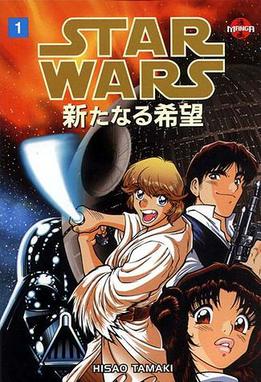
Japan caught Star Wars fever again in 1997, when the Special Edition trilogy hit theaters across the globe. Kadokowa’s MediaWorks division churned out a new set of Star Wars manga, hiring Hisao Tamaki (A New Hope), Toshiki Kudo (The Empire Strikes Back), and Shin-Ichi Hiromoto (Return of the Jedi) to handle the adaptations. And while all three are good, faithfully reproducing the main beats from each film, Tamaki’s version of A New Hope is that rarest of tie-in products: it captures the look and feel of the movie without slavishly copying it, offering both a fresh perspective on a canonical text and a point of entry for someone wholly unfamiliar with Star Wars. 

Part of what makes Tamaki’s version so fascinating is how he compensates for the absence of a soundtrack — no mean feat, given how noisy the Star Wars universe is. While Tamaki uses plenty of hand-lettered sound effects, he never uses them as a crutch, instead finding nifty ways to help us imagine the sound of a landspeeder skimming the desert floor or a Stormtrooper firing his blaster. Tamaki’s most effective tactic is careful attention to the velocity and direction of moving objects; through deft placement of speedlines and artful manipulation of the panels’ shape and size, he conveys the same information that a well engineered roar, squeak, thud, or electronic rumble might.

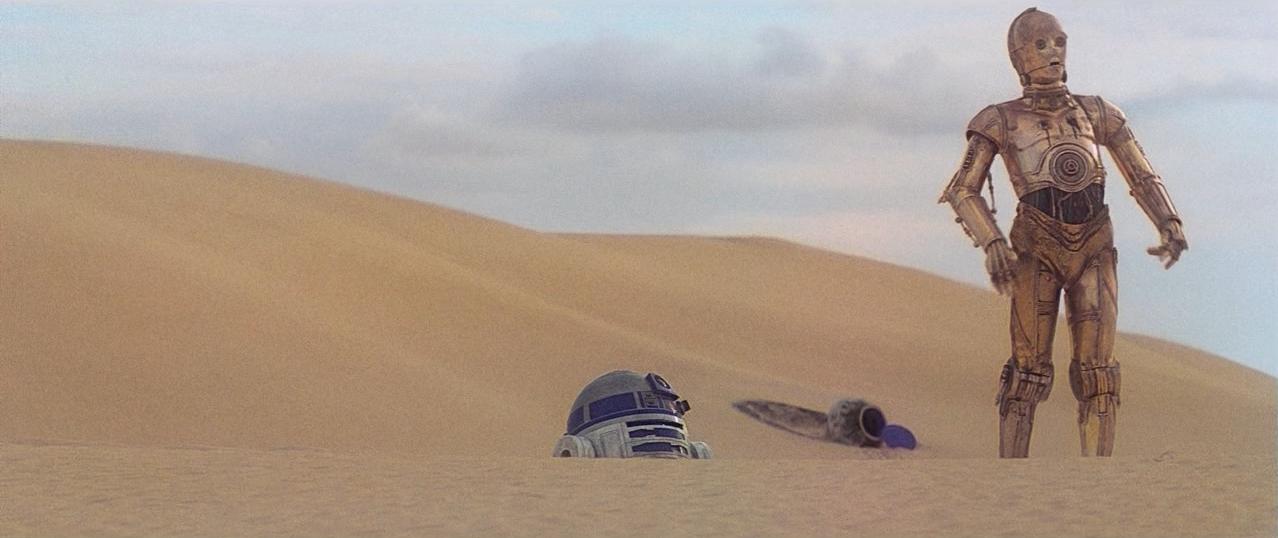
Then there’s the film’s lush, Wagnerian score, the kind of movie music that had been fashionable in the era of Ben Hur and Lawrence of Arabia but was considered unhip in the gritty, naturalistic world of early 70s cinema. The opening fanfare and dense web of leitmotifs are unquestionably part of A New Hope‘s appeal, goosing fight scenes and capturing the melancholy of a young Luke Skywalker as he gazes at a Tatooine sunset. Absent those musical prompts, however, Tamaki is forced to think about how to elicit the same emotions in words and pictures. One of the most dramatically successful attempts to bridge sound and silence occurs in volume one of Tamaki’s adaptation, right after R2D2 and C3PO land on Tatooine:

In the film, John Williams accompanies C3PO’s trek with music cribbed from The Rite of Spring — a decent choice, as Stravinsky’s dour ostinati and octatonic harmonies imbue the harsh landscape with an otherworldly quality. Tamaki, however, distills this two-minute scene to an evocative two-page spread in which a wide-angle view of the Tatooine desert unfolds beneath the individual panels, reminding us just how small and vulnerable both droids are. These images track closely with Lucas’ own vision, but the implied silence of the first and final panels in this sequence more powerfully conveys C3PO’s isolation than any musical gesture could:

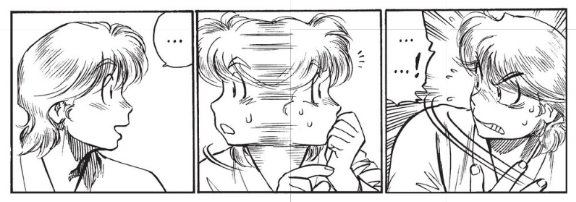
The absence of sound has another unexpected benefit: minus the actors’ desperate attempts to make George Lucas’ dialogue sound… well, like conversation, the script has more room to breathe. Tamaki plays the earnest stuff straight and ramps up the comedy whenever someone is surprised or indignant. Luke, in particular, benefits from such an approach, given his age and naivete; in Tamaki’s hands, he’s Monkey D. Luffy with a lightsaber, freaking out over chores, the Millennium Falcon’s shabby appearance, Obi-Wan Kenobi’s death, a kiss from Princess Leia… you get the idea. Tamaki’s elastic deformations of Luke’s face transform him from blandly handsome farm boy to Shonen Jump hero, equal parts brave and ridiculous:

One of the manga’s other great virtues is its ability to expand and contract time in ways that a purely temporal medium like film can’t. The ability to speed up and slow down the unfolding the plot isn’t unique to comics, of course; filmmakers can use slow motion imagery or cross-cutting to manipulate the viewer’s perception of time, but a good manga artist takes advantage of the fact the reader can, in fact, stop time by poring over an image or a scene for minutes, savoring small but telling details that would otherwise get lost in the cinematic flow. Writing for Animerica in 2004, Patrick Macias offered a thoughtful explanation of how this kind of creative expansion of time adds new layers of meaning to Tamaki’s story:

It is in Tamaki’s take on destruction of the planet Alderaan that he really shows off his stuff. A scene that took mere moments to depict on-screen is drawn out to fill half a dozen pages. He inserts images of the Alderaan populace looking up to the heavens, and you can almost hear those “millions of voices suddenly crying out in terror” with more dramatic impact in the manga than in the film.

Of course, none of this would matter if Tamaki lacked the precision to bring Lucas’ vision to life on page. Again and again, Tamaki delivers amazingly detailed drawings of space ships, aliens, and weapons that pulse with the same life as Katsuhiro Otomo’s AKIRA and Shirow Masamune’s Ghost in the Shell; if you’d never seen or heard of Star Wars, you might reasonably infer that Tamaki dreamt up this world on his own. Tamaki proves equally adept at staging deep space dogfights, too, conveying both the dizzying speed with which the ships are moving and the maze-like surface of the Death Star:


For readers coming to the manga from the films, the biggest stumbling block will be the character designs: did Tamaki get them right? The short answer is yes, if you can tolerate a little artistic license with hairdos and body types. Not surprisingly, R2D2 and C3PO look most like their big-screen counterparts — no pesky noses or mouths to draw — but the rest of the cast bear a passing-to-strong resemblance to the actors who portrayed them, though Obi-Wan Kenobi looks and moves more like Chuck Norris than Sir Alec Guiness. Tamaki does an even better job of bringing Darth Vader and his Stormtroopers to life on the page, adding an extra touch of menace in the way he draws their helmets; you can almost see the soldiers grimacing under their plastic armor from the way he draws their browlines.

If I’ve sold you on manga Star Wars, you’ll be happy to know it’s a relatively inexpensive way to relive the original trilogy. The digital versions — currently available through Amazon and ComiXology — retail for $1.99 per volume. There’s also a Phantom Menace manga for the morbidly curious; Kia Asamiya is the author, and he’s been given the truly thankless task of condensing that stinker into two volumes. At least it won’t be as interminable as the movie.

WORKS CONSULTED

Macias, Patrick. “Star Wars, The Manga.” Animerica, VIZ LLC, 7 Apr. 2004, https://web.archive.org/web/20040407180902/http://www.animerica-mag.com/features/starwars.html. Accessed 27 Dec. 2017.

Rickard, Ron. “Retro Foreign: Japanese Weekly Shōnen Magazine #18 – 23 (1978).” Star Wars Comic Collector, 20 May 2016, http://swcomiccollector.blogspot.com/2016/05/retro-foreign-japanese-weekly-shonen.html. Accessed 27 Dec. 2017.

Shooter, Jim. “Roy Thomas Saved Marvel.” Jim Shooter, 5 July 2011, https://web.archive.org/web/20150912134444/http://www.jimshooter.com/2011/07/roy-thomas-saved-marvel.html. Accessed on 28 Dec. 2017.

Spellman, Ron. “A Long Time Ago: The Strange History of Marvel’s Original Star Wars Universe.” Comics Alliance, Townsquare Media, 28 Jan. 2016, http://comicsalliance.com/original-marvel-star-wars-comics-history/. Accessed 28 Dec. 2017.

Tamaki, Hisao. Star Wars: A New Hope, adapted from an original script by George Lucas, Marvel Comics, 1998. 4 vols.

Filed Under: Manga, Manga Critic, Recommended Reading, REVIEWS Tagged With: Dark Horse, Hisao Tamaki, Kadokawa, Marvel Comics, star wars

Pick of the Week: Week And Year

December 25, 2017 by Ash Brown, Michelle Smith, Sean Gaffney, Katherine Dacey and Anna N Leave a Comment

ASH: It doesn’t seem like there are any truly quiet weeks when it comes to manga releases anymore, but the last week of year does tend to be smaller than others. Still, it’s not hard for me to find something to read. My pick for the week is the most recent volume of Land of the Lustrous, a series I appreciate for its philosophical musings and striking artwork even if its plot can be a little haphazard.

Looking back over everything published in 2017 there have been some tremendous releases; it’s been a great year for manga. The debut series that left the greatest impression on me was Nagabe’s beautiful and haunting The Girl from the Other Side: Siúil, a Rún. The manga is both charming and unsettling, with Nagabe’s exceptional storytelling and atmospheric artwork making it one of the most stand out releases of the year.

MICHELLE: I absolutely agree with Ash for my pick of the year, though honorable mention goes to Chihayafuru.

For this week, I’m most looking forward to the fourth volume of The Night Beyond the Tricornered Window. This complicated, suspenseful story is BL at its best.

SEAN: The week itself does not impress me that much, so I will pick the new volume of The Full-Time Wife Escapist.

And though it seems a bit premature to make a Pick of the Year for something that only debuted in December, I’m still so blown away by The Promised Neverland that I’m going with that one. It may get too bleak for me in future, but for now I can’t look away.

KATE: I liked the first volume of That Time I Got Reincarnated as a Slime. Aside from some totally gratuitous fan service, it was snappy, funny, and heart warming in an unexpected way. The release of volume three seems like a fine excuse to get caught up with Rimuru’s adventures.

As for my pick of the year, it’s Furari, one of the late, great Jiro Taniguchi’s final works. The manga reads like a mash-up of The Times of Botchan and The Walking Man, focusing on Tadataka Ino, a real cartographer who lived in Edo. As with Walking Man, not much happens story-wise, but the book offers a vibrant portrait of eighteenth-century urban life — think Richard Scarry’s Busy Town, Busy People for grown-ups.

ANNA: Although I’m shamefully behind on the series, the most interesting thing coming out this week to me is The Full-Time Wife Escapist. I’m glad others have selected The Girl from the Other Side: Siúil, a Rún, it is absolutely a standout title.

When I was thinking about my pick of the year, the first thing that came to my mind was The Water Dragon’s Bride. Well executed fantasy shoujo should be celebrated! I also agree that Chihayafuru deserves a shout-out as well.

Filed Under: PICK OF THE WEEK

Kigurumi Guardians, Vol. 1

December 23, 2017 by Katherine Dacey

The first ten or so pages of Kigurumi Guardians are a gas. Hakka, a cheerful fifteen-year-old, comes home from school to find a kigurumi (animal mascot) in her kitchen. Though Ginger looks like the product of a Holstein/penguin tryst, no one in Hakka’s family is fazed by Ginger’s appearance, treating him like one of Hakka’s classmates. And if the Sasakuras’ warm embrace of Ginger wasn’t strange enough, Ginger’s method of communication puts things over the top: he’s reduced to scrawling short messages on cue cards since he can’t speak. Not until Hakka attends a school council meeting does she learn that Ginger is one of three animal-shaped guardians defending Earth from a race of puppet masters, and she’s his new handler.

So far, so good: the oddball premise, brisk pacing, and tart exchanges between Hakka and Ginger are executed with comic zest. As Hoshino begins laying the groundwork for the magical combat, however, it becomes clear that she’s making it up as she goes along. That tendency is most pronounced in the fight scenes, which are devoid of any tension, surprise, or humor, since it’s a forgone conclusion that Hoshino will think of a new rule or magical power that helps her heroes win the day.

More problematic is the dynamic between Hakka and Ginger. Bickering leads are a staple ingredient of romantic comedies, but the main point of contention between girl and mascot gets hammered into the ground by the end of chapter three. That joke — if one can call it a joke — is that Hakka must kiss Ginger to activate his magical powers; when she does, he immediately transforms into a dashing young warrior. Hakka hates kissing Ginger, but is repeatedly forced to go against her own wishes because, y’know, Earth’s future hangs in the balance. In our current #MeToo moment, this gag is an unpleasant reminder of how many books, movies, television shows, and manga reinforce the idea that women who refuse unwanted hugs and kisses are difficult, confused, or selfish.

It’s a shame that this gag is so central to the story, as Hoshino clearly intends Guardians to be naughty fun for teen girls — why else would all three mascots transform into tousle-haired bishonen?— but gets too caught up in drawing costumes and mascots to pay careful attention to the plot or consider the full implications of Hakka and Ginger’s relationship. By the end of volume one, the story has traded wacky hijinks for messy fight scenes and sappy conversations, losing its screwball zing in the process.

The verdict: File under D, for disappointment, and S, for squandered potential.

KIGURUMI GUARDIANS, VOL. 1 • STORY AND ART BY LILY HOSHINO • KODANSHA COMICS • RATED: TEEN (13+) • 160 pp.

Filed Under: Manga, Manga Critic, REVIEWS Tagged With: Comedy, Kigurumi, Kodansha Comics, Lily Hoshino, Magical Girl Manga

Pick of the Week: A Bounty of Manga

December 18, 2017 by Sean Gaffney, Katherine Dacey, Michelle Smith, Ash Brown, Anna N and MJ Leave a Comment

SEAN: Honestly, there’s just too much stuff. I feel like I’m drowning in choices. And so (because I suspect the rest of the group will go with CLAMP) I will go with an old favorite and pick the new Umineko When They Cry omnibus volume, Requiem of the Golden Witch. Fans love this arc, and the manga adaptation of it is supposed to be quite good. And at 826 pages, it can also be used as a blunt object.

KATE: I’m torn between the latest volumes of Golden Kamuy and Happiness, two of my favorite ongoing series. Since choosing between them seems like deciding whether you like your daughter better than your son, I’m going with Junji Ito’s Shiver, which has been getting great advanced buzz.

MICHELLE: I am actually not going to go with CLAMP, despite my intense love of Kero-chan, because this is the last time I can choose Say I Love You. I’ve enjoyed this series a lot, and have been anticipating this final volume for a long time. It’s definitely a must-buy for me this week.

ASH: So much manga! And so many new volumes in series that I’m following! Although I will certainly be giving the new Cardcaptor Sakura a try, I will continue to thwart Sean’s prediction by choosing another debut. Kate already has Shiver covered, which I’ll definitely be reading, but I’m also incredibly curious about Graineliers, so that’s my pick!

ANNA: I feel like one of us should not thwart Sean’s prediction! Thus, Cardcaptor Sakura is my pick! Let’s hope it is more like early CLAMP and less like late CLAMP!

MJ: Wow, I’m really torn here. I have a deep, deep love for Cardcapter Sakura so it’s really hard for me to let that go. But I don’t necessarily trust CLAMP to recreate that magic for me at this point, and I’m really a sucker for a new GFantasy title, so I’m with Ash on Graineliers! Thanks, Anna, for making Sean’s prediction at least a little true!

SEAN: I’m not sure I trust all this love for Grenaliers. I think the love for it may have been… planted. (puts on sunglasses, Roger Daltrey scream)

MJ: Wow.

Filed Under: PICK OF THE WEEK

Mangasia: The Definitive Guide to Asian Comics

December 18, 2017 by Katherine Dacey

The strengths and weaknesses of Paul Gravett’s latest book are neatly encapsulated in its title. Though the book purports to be a “definitive guide to Asian comics,” Gravett’s true aim is to trace the influence of the Japanese manga industry on comic book traditions across the Asian continent, from China and South Korea to Bhutan, India, Indonesia, Malayasia, Mongolia, and Vietnam.

Gravett’s thesis rests on two core assumptions. First, he argues that manga is Asia’s dominant comic book tradition, as evidenced by its “cultural influence and its extraordinary sales figures” (24); even Japan’s dojinshi (amateur) scene, he observes, “has more participants and publications than entire national markets” (31). Second, Gravett argues that colonialism played an essential role in extending manga’s reach beyond Japanese borders. The first wave of colonization was physical: as Japan invaded and occupied neighboring countries, manga proved “an ideal medium for spreading propaganda about the benefits of Japan’s leadership” and painting the Japanese as liberators, freeing Asia from Europe’s tyrannical grasp. The second wave of colonization was virtual: in the years following World War II, a demilitarized Japan reinvented itself as an industrial powerhouse, exporting consumer goods and pop-cultural products — manga, anime, and video games — in what Gravett characterizes as a “soft cultural invasion” of Asia and the West (14-15).

Gravett eschews a strictly chronological or geographical approach to the material, instead grouping his examples under six suggestive headings: “Mapping Mangasia,” “Fable and Folklore,” “Recreating and Revising the Past,” “Stories and Storytellers,” “Censorship and Sensibility,” and “Multimedia Mangasia.” This thematic approach gives him the freedom to explore parallels between manga and other Asian comic traditions in a creative — if sometimes non-linear — fashion. In his introductory chapter, for example, he traces the influence of Western comic strips across East Asia, showing how syndicated cartoons such as George McManus’ Bringing Up Father (1913-2000) and Oscar Jacobsson’s Adamsson (1920-1953) helped popularize the comic strip format with artists in Japan, Korea, China, and the Philippines, inspiring them to develop their own characters who were wrestling with “the allure of affluence, the desire for upward social mobility, and the nostalgia… for simpler past pleasures,” just as McManus’ Jiggs and Maggie did (28).

Two later chapters — “Recreating and Revising the Past” and “Censorship and Sensibility” — offer Gravett an opportunity to examine the complex dynamic between nationalism, censorship, and comics. Using the Phillippines as an example, Gravett explores the changing way in which Filipino artists depicted Japanese colonialism. His analysis focuses on three series: The Kalibapi Family, a wartime comic strip created at the behest of the Japanese Propaganda Corps; Kalawang sa Bakal (Corrosion of Steel), one of the first postwar comics to grapple with the horrors of Japan’s invasion of the Philippines; and Suicide Susy, a long-running series that pitted a spunky Filipina saboteur against Japanese soldiers. Over the course of forty years, Gravett observes, Japanese characters evolved from benign overlords to symbols of foreign oppression, reminders of Filipino collaboration, and — in the Marcos era — bumbling villains whose foolish antics distracted from the Marcos’ ruthless treatment of their own people.

“Censorship and Sensibility” also delves into gender politics. As one might expect, Gravett addresses genres such as yaoi, recognizing them as both pornography and resistance. “Manga about male-male romance,” he argues, “offer women an expressive playground in which to question and customize the alternatives to the oppressive heteronormativity of the powerful male and the weak female” (217). Gravett examines the legal complexities of obscenity laws as well, using Rokudenashiko’s protracted battle with the Japanese government to expose the inherent misogyny in many such regulations. He notes that she was convicted of distributing digital pictures of her vagina, but not for hanging manko (pussy) art in a gallery that only admitted women. “In the Japanese court’s eyes,” Gravett drily notes, “only men can be aroused by a vagina” (218-19).

For sheer visual beauty, Mangasia‘s stand-out chapter of  is “Fables and Folklore,” which focuses on comic-book adaptations of such important national texts as the Romance of the Three Kingdoms (China) and the Ramayana (India). The imagery runs the gamut from the merely functional to the photorealistic, with some genuinely striking selections. Zhang Guangyu’s wordless treatment of Journey to the West (1945), for example, is a unique synthesis of Chinese, Persian and Mexican influences, yielding a series of images that are at once playful and somber, rendered in a muted palette similar to Diego Rivera’s most famous murals, while Anant Pai and Ram Waeerkar’s Hanuman (1971) strikes an elegant balance between classical Hindu depictions of the popular deity and contemporary portrayals of superheroes and martial artists.

As one might expect from such a wide-ranging book, Mangasia‘s chief fault is its ambition: Gravett discusses examples from nineteen countries over a 100-year period, a tall order for a single volume. Important texts and artists get a few sentences each, making it difficult to fully appreciate their impact on the comics medium in their own countries or elsewhere. Likewise, historical contexts are rendered in broad strokes, through timelines and generalizations. In “Stories and Storytellers,” for example, Gravett asserts that “In the aftermath of World War II, the next generation in Japan strived to make their lives better,” a sentence that only hints at the incredible devastation caused by American bombing, or the economic hardships faced by ordinary Japanese citizens in the 1950s (164).

The title itself points to another drawback of Gravett’s approach: some of the examples in Mangasia bear only a tenuous visual connection to manga. In the absence of a clear, specific discussion of how manga influenced comics outside the immediate sphere of Japanese colonization, the reader is left to wonder whether a comic book retelling of the Mahabharata owes a debt to Shotaro Ishimonori, or if the story borrows more heavily from Indian sources. Some attempt to demonstrate the size of the international manga market, identify the countries where manga is most popular with readers, discuss the global piracy of manga, or examine manga fandoms across the Asian continent would have provided useful context for understanding how manga has insinuated itself into such a diverse array of comic traditions.

Whatever the limitations of a pan-Asian survey, Gravett recognizes the enormous cultural, religious, and historical differences that separate Muslim Indonesia from Hindu India, Buddhist Tibet, and the Catholic Philippines. If these differences are sometimes glossed over in service to his thesis, Gravett nonetheless does an admirable job of balancing discussion of Asian comics as a singular phenomenon and Asian comics as a set of discrete but overlapping traditions. The book’s design complements Gravett’s curatorial approach with evocative juxtapositions that reveal how certain themes and storytelling techniques manifest themselves across cultural lines.

The real stars of the show, however, are the 1,000 images that grace Mangasia‘s pages, allowing readers to see the transformation of a rough pencil sketch into a finished page, savor the richly saturated color palette and dynamic flow of a martial-arts adventure, and note the growing influence of digital technology on comic art. Whether you’re a manga reader or a comics scholar, the best way to tackle Mangasia is to follow Park Chan-wook’s advice, which appears at the very beginning of the text. “There’s the joy of simply taking in the art,” he observes (13), an apt assessment of this fascinating, flawed book’s appeal. Recommended.

Thames & Hudson provided a review copy.

Gravett, Paul. Mangasia: The Definitive Guide to Asian Comics, foreword by Park Chan-wook, Thames & Hudson, 2017.

Filed Under: Books, Manga Critic, REVIEWS Tagged With: Mangasia, Paul Gravett, Thames & Hudson

Manga the Week of 12/20/17

December 14, 2017 by Sean Gaffney, Michelle Smith, MJ, Katherine Dacey, Ash Brown and Anna N 2 Comments

SEAN: Are you ready? 3-2-1 let’s jam.

MICHELLE: *cracks knuckles in a preparatory fashion*

ASH: Get everybody and the stuff together, because there’s a lot of it!

KATE: There is SO MUCH MANGA that even I had to chime in.

SEAN: We start with Bookwalker, who has the second volume of their light novel The Combat Baker and the Automaton Waitress. I felt it was a good series for them to pick up (certainly better than their other LN series), and will be getting this volume.

J-Novel Club has the 4th volume of Arifureta: From Commonplace to World’s Strongest, which remains the top choice for those who like overpowered isekai and take it Very Seriously Indeed.

Kodansha has many, many things, both digital and print, which I will tackle alphabetically, starting with a 4th All Out!!.

MICHELLE: Woot!

SEAN: Attack on Titan has a big change coming with the 23rd volume, one that (like everything Attack on Titan has ever done) has gotten a mixed reaction.

Cardcaptor Sakura remains one of CLAMP’s most beloved franchise, despite age, appalling Nelvana dubs, and Tsubasa World Chronicle. Now we finally get a sequel with Clear Card, which apparently picks up where the old series left off. I will give it a shot, though I warn you I’m mostly reading for Tomoyo.

MICHELLE: This has been available digitally for a while, and I read it in that format. It’s a cute start, and I loved seeing Kero-chan again.

MJ: I’m obviously on board for this.

ANNA: I enjoy early CLAMP, and am leery of recent CLAMP. That being said, due to my love of Cardcaptor Sakura, I will check this out.

ASH: Same! I really do love Cardcaptor Sakura, though.

SEAN: DEATHTOPIA has its 7th and penultimate volume coming out next week.

And there’s also a 4th volume of Elegant Yokai Apartment Life.

If you haven’t yet picked up Ghost in the Shell’s hardcover deluxe editions, why not get them in a handy box set?

We’ve caught up with Japan for Happiness, so it’s nice to see a 6th volume drop.

ASH: I need to catch up with this series, myself!

KATE: The last volume of Happiness had a big time jump and shift in emphasis — something that worked surprisingly well, and and promoted one of the most interesting (and resourceful) supporting characters to a leading role.

SEAN: Inuyashiki comes to an end with its 10th and final volume. It’s always been a bit too weird for me, but then I felt the same way about Gantz.

Kasane has an 8th volume of suspense and horror.

The digital debut next week is The Prince’s Black Poison, a Betsufure romance that honestly sounds like exactly the sort of title I avoid, but what the hey. Recommended for those who like handsome manipulative men. It’s by the author of Gakuen Prince, which was also very much filled with those.

MICHELLE: Oh dear.

ANNA: Feeling sort of meh on this.

SEAN: And Real Girl has a 9th volume of whatever it is Real Girl does, besides remind me how many of these Kodansha digital titles I have yet to sample.

Say “I Love You” has come to its 18th and final volume. Despite the occasional overdose of melodrama, I greatly enjoyed this series, and am happy to see the conclusion after a long wait (we had, again, caught up with Japan).

MICHELLE: I’ve been awaiting this release for a long time!

SEAN: If you haven’t picked up A Silent Voice’s 7 volumes, Kodansha has a box set for you! (Both this and the Ghost in the Shell box are clearly meant for Christmas purchases.)

Speaking of the author of A Silent Voice, we’re getting a 2nd To Your Eternity next week as well.

ASH: Definitely picking this one up. The first volume was very good and surprising in ways that I didn’t expect.

KATE: What Ash said; To Your Eternity is definitely on my short list of Best Sci-Fi manga of 2017.

SEAN: A 6th Tsuredure Children has more 4-koma romance.

And Until Your Bones Rot has a 3rd volume of what is, let’s face it, NOT 4-koma romance.

Seven Seas is next. Arpeggio of Blue Steel is up to its 12th volume, and I’m still really interested in it, which is surprising given it’s about a bunch of cute girls who are really boats.

There’s also a 3rd “not Alice in the Country of Hearts, but the next best thing” series Captive Hearts of Oz.

Unlucky it may be, but the fact that Magical Girl Apocalypse has gotten to Vol. 13 means it’s popular as well.

Seven Seas is starting to pick up light novels that aren’t J-Novel Club print editions, and we begin with Monster Girl Doctor, whose title speaks for itself, though I’m not sure how this falls on the scale between ‘fetishey’ and ‘spooky’ monster girls.

And if that’s too millennial for you, how about a series from the 1980s? We get the first in the Record of Lodoss Wars novels, The Grey Witch, in a fancy hardcover edition.

MJ: It’s hard for me to dismiss something from the 80s…

ASH: It really is fancy! I’m looking forward to giving the Lodoss novels a try.

SEAN: Chi’s Sweet Coloring Book is a spinoff from Vertical featuring lots and lots of pictures of Chi to color.

Speaking of cats, Nekomonogatari (Black): Cat Tale is the first of a two-part set in the Monogatari series that finally resolves most of Tsubasa Hanekawa’s ongoing issues.

And there’s also a 4th Flying Witch.

Viz gives us a 3rd Golden Kamuy, which I suspect will have a bit less cooking and a bit more life-threatening violence this time around, but who knows?

ASH: I plan on finding out!

KATE: I seem to be stalking you through this week’s column, Ash! I’m butting in to say GOLDEN KAMUY IS AWESOME. I think Asirpa deserves her own damn series. Heck, it could be a cooking manga and I’d read it.

SEAN: If you want to get someone something terrifying for Christmas, you absolutely can’t go wrong with Shiver, a collection of stories selected by the author, Junji Ito.

ASH: I’m always happy to see more Ito being released! This collection should be great.

KATE: Nothing says “Deck the halls” than a little Junji Ito, I always say.

SEAN: And if you want to give some yuri manga, there’s a 2nd Sweet Blue Flowers omnibus.

MICHELLE: Yay!

ANNA: Behind on this already but I’m gonna read it!

ASH: You absolutely should! I’m so glad this series is finally getting the treatment it deserves in English.

SEAN: Lastly (for Viz only, trust me – we’re not even halfway), we have the 2nd Tokyo Ghoul: re.

And now on to Yen Press, pausing only to scream until our throats are raw and we are coughing up blood. (pause) There we go. Onward.

First off, we have the digital-only titles. Aphorism 13 is the second to last volume, and is for fans of survival manga.

Corpse Princess is up to its 14th volume, but it still has a long way to go. It should appeal to fans of fanservice and zombies.

And Saki 13 means we’re close to catching up, but that’s an ongoing series, so no worries there either. Recommended to those who like mahjong and breasts, not in that order.

On the Yen On side, we finish the digital catch-up for Accel World (9-11) and Irregular at Magic High School (5).

There’s also a new digital release of an older, pre-Yen On title. Kieli was a 2009 series of novels about a girl who can see ghosts, and it had an associated manga as well. Yen now has the digital rights to the novels, so we get the first one next week.

There are also a GIANT number of ongoing and new light novels in print. We get a 12th Accel World, which is in the midst of Haruyuki dealing with another mysterious threat.

The Asterisk War’s 5th volume wraps up its tournament arc, I believe… or should I say, it’s first tournament arc.

Baccano! starts a new 2-volume arc taking place in 1933 and subtitled The Slash. This first volume will show us what happened to that Mexican stereotype of an assassin from the Drug & the Dominoes book.

The Devil Is a Part-Timer! 9 has far less part-time work than expected, as the devil has returned to his homeland to rescue Emi and Alas Ramus.

Goblin Slayer 4 will feature what sounds like a collection of short stories judging from the description. And probably goblins being slayed.

The Irregular at Magic High School’s
6th volume starts a new arc called the Yokohama Disturbance Arc, which I think was the final arc adapted for the anime.

Is It Wrong to Try to Pick Up Girls in a Dungeon? asks the same question again, only this time it’s Monsters. Bell says no, others think differently. Vol. 10 drops next week.

KonoSuba’s 4th volume has the inevitable Hot Springs arc.

Rokka: Braves of the Six Flowers has a 3rd volume, and I must admit if the storyline is “who’s the traitor” I may bail.

The first light novel debut is The Saga of Tanya the Evil, which is another isekai. A Japanese HR manager with a cold, ruthless reputation is killed, and then reincarnated by God. Not with the best intentions, though – God dislikes his logical attitude and so puts him in a world where magic exists and there is constant warfare. Oh, and he’s in the body of a little girl.

Sword Art Online has reached a dozen volumes, and we’re still in the midst of the epic Alicization arc. We finally see Alice again, but is she brainwashed? Can Kirito and Eugeo save her?

The other light novel debut this month already has its manga coming out from Kodansha, and is the 2nd of the three ‘ridiculous’ light novels Yen licensed recently. That Time I Got Reincarnated As a Slime arrives next week.

We’re nearly at the end! Only 28 more titles to go! And they’re all Yen Press. We start with a 6th volume of spinoff Akame Ga KILL! ZERO.

Angels of Death is a survival manga with psychological overtimes, which comes from the oddball Comic Gene. I’m not sure what to think of it.

An 8th Aoharu x Machinegun is shipping next week.

And a 5th Bungo Stray Dogs will give us literary references galore.

Light novel adaptations galore! Starting with a 4th manga of Death March to the Parallel World Rhapsody.

Dragons Rioting has a 9th volume, which is also its final volume.

If you like the idea of Goblin Slaying but hate prose, I have good news, the first volume of Goblin Slayer is for you.

I know little about Graineliers except it’s from GFantasy, it has two male leads, and it’s not BL but feels like it should be.

MJ: Did you say GFantasy? Count me in!

ASH: It’s also by Rihito Takarai (of Ten Count fame) so I’m very curious to see how this series develops. If nothing else, the artwork should be great.

SEAN: Manga based on an unlicensed light novel, part one: the 10th volume of High School DxD.

Manga based on an unlicensed light novel, part two: the 8th and final volume of How to Raise a Boring Girlfriend.

After a year’s hiatus, the Kagerou Daze manga picks up again with Vol. 7, and should be arriving more regularly from now on. For light novel fans, the story here is different from the LN (and indeed the Mekakucity Actors anime.)

A 5th Kiniro Mosaic gives you vague yuri galore.

If you liked the idea of Magical Girls dying tragically but hate prose… well, you know. Magical Girl Raising Project, now in manga form.

The 11th Melancholy of Suzumiya Haruhi-chan is the last, which I’m pretty sure means there are no current ongoing projects for this franchise, be it anime, manga, spinoff manga, spinoff anime, or the original novels. We should take off our hats and mourn the end of an era.

My Youth Romantic Comedy Is Wrong as I Expected gets a 7th manga volume, though I’m not sure which novel volume it’s adapting.

No Matter How Much I… sigh. WataMote gives us an 11th volume. Sorry, I’m exhausted.

Of the Red, the Light and the Ayakashi ends with its 9th volume, though I believe there is a Volume 10 with side/after stories.

ASH: Another series that I’ve been enjoying but need to catch up on!

MICHELLE: Aha! I had been thinking it was complete in 9, and then recently noticed there’s actually a tenth. Nice to have an explanation for that!

SEAN: One Week Friends is a Gangan Joker title about a cute friendship and the amnesia that threatens to tear it apart.

Re: Zero finishes its adaptation of the 2nd arc with the 4th A Week at the Mansion volume.

Rose Guns Days has a 2nd volume of its 3rd arc.

School-Live! does not come to an end with this 9th volume per se, but I think the series is on hiatus right now, so this may be the last for some time.

And a 3rd Smokin’ Parade arrives as well.

I enjoyed the first novel of So I’m a Spider, So What?, though am curious as to how a book that’s half internal dialogue will translate to manga. We’ll see with this first manga volume.

Strike the Blood’s manga has a Vol. 9, which, like the light novels, has Yukina and only Yukina on each cover.

Sword Art Online has the manga adaptation of the Calibur arc complete in one volume. It’s a great arc if you like the supporting cast, who all play a role – for the last time to date, in fact.

If you feel that yokai manga have gotten too serious lately, you should enjoy A Terrified Teacher at Ghoul School, a GFantasy title that is terminally ridiculous.

ASH: Yokai comedy, you say? Count me in!

Umineko When They Cry begins its 7th arc, Requiem of the Golden Witch. Battler is nowhere to be found. Nor is Beatrice. Instead meet Kinzo’s heir Lion Ushiromiya. Oh, did I mention this first omnibus is 826 pages?

Lastly (yes, I promise, we are at the end), there’s a 7th omnibus of Yowamushi Pedal, which should be SUPER EXCITING.

MICHELLE: Yay!

ASH: I know I’m excited!

SEAN: (falls over) So are you getting everything on this list, or just most of it?

Filed Under: FEATURES, manga the week of

  • « Go to Previous Page
  • Page 1
  • Interim pages omitted …
  • Page 34
  • Page 35
  • Page 36
  • Page 37
  • Page 38
  • Interim pages omitted …
  • Page 89
  • Go to Next Page »
 | Log in
Copyright © 2010 Manga Bookshelf | Powered by WordPress & the Genesis Framework