• Skip to primary navigation
  • Skip to main content
  • Skip to primary sidebar
  • Home
  • About Us
    • Privacy Policy
    • Comment Policy
    • Disclosures & Disclaimers
  • Resources
    • Links, Essays & Articles
    • Fandomology!
    • CLAMP Directory
    • BlogRoll
  • Features & Columns
    • 3 Things Thursday
    • Adventures in the Key of Shoujo
    • Bit & Blips (game reviews)
    • BL BOOKRACK
    • Bookshelf Briefs
    • Bringing the Drama
    • Comic Conversion
    • Fanservice Friday
    • Going Digital
    • It Came From the Sinosphere
    • License This!
    • Magazine no Mori
    • My Week in Manga
    • OFF THE SHELF
    • Not By Manga Alone
    • PICK OF THE WEEK
    • Subtitles & Sensibility
    • Weekly Shonen Jump Recaps
  • Manga Moveable Feast
    • MMF Full Archive
    • Yun Kouga
    • CLAMP
    • Shojo Beat
    • Osamu Tezuka
    • Sailor Moon
    • Fruits Basket
    • Takehiko Inoue
    • Wild Adapter
    • One Piece
    • After School Nightmare
    • Karakuri Odette
    • Paradise Kiss
    • The Color Trilogy
    • To Terra…
    • Sexy Voice & Robo
  • Browse by Author
    • Sean Gaffney
    • Anna Neatrour
    • Michelle Smith
    • Katherine Dacey
    • MJ
    • Brigid Alverson
    • Travis Anderson
    • Phillip Anthony
    • Derek Bown
    • Jaci Dahlvang
    • Angela Eastman
    • Erica Friedman
    • Sara K.
    • Megan Purdy
    • Emily Snodgrass
    • Nancy Thistlethwaite
    • Eva Volin
    • David Welsh
  • MB Blogs
    • A Case Suitable For Treatment
    • Experiments in Manga
    • MangaBlog
    • The Manga Critic
    • Manga Report
    • Soliloquy in Blue
    • Manga Curmudgeon (archive)

Manga Bookshelf

Discussion, Resources, Roundtables, & Reviews

Archives for November 2018

True Tenchi Muyo!: Yosho

November 9, 2018 by Sean Gaffney

By Yousuke Kuroda and Masaki Kajishima. Released in Japan as “Shin Tenchi Muyo! Ryo-o-ki” by Kadokawa Shoten. Released in North America by Seven Seas. Translated by Lillian Olsen. Adapted by AstroNerdBoy.

The three novels in this series came out around 1997-99 or so in Japan, which was between the 2nd OAV series (the one that came out here when Tenchi was still huge) and the 3rd OAV series (which came out here when Tenchi’s popularity was waning). As such, they serve as both a ‘filling in the blanks’ backstory for what we’ve already seen and a ‘taste of what’s to come’ teaser for future episodes. The first book was something that I enjoyed but it didn’t reach out and say “that was great”, partly as I don’t find Azusa all that likeable. The second volume is a much better book, partly as Yosho may be staid but he’s also a lot of fun, and partly as this volume features Ryoko’s attack on Jurai and everything that comes along with it, so the book ends with an epic battle sequence before it settles down on Earth. We’re also introduced to Airi, who is Yosho’s first love… well, OK, second love, but first consummated love.

Yosho is the 12-year-old crown prince of Jurai, and is being sent off to Galactic Boarding School, essentially, mostly as he’s developing a crush on his stepmother, who has no sense of personal space. (If this surprises you, you’ve never seen Tenchi, which uses incest as a spice – liberally). While there he meets Airi, an older student who’s there to show him around and also comes from a planet of religious zealots. The book balances its time between Yosho coming out of his shell and he and Airi falling in love and the political machinations of Jurai, which is still dealing with the shock and horror of having Funaho as the First Empress. Their relationship is a bad idea politically, at least for now, and what’s more Ryoko attacks Jurai at the behest of Kagato, so Yosho rapidly vanishes to that he can bring her down – and also, it has to be said, to get away from the repressive heritage that he really doesn’t want to deal with.

Lest you think the book is all romantic drama and action movie sequences, there’s also a great deal of humor here as well. Airi is a loud, blunt girl who tells you that she likes you by putting you in a wrestling lock, and she pairs very well with Yosho, who even at his most emotional exhibits a certain Mr. Spock quality. There is a repeated sequence with puppies that is both adorable and hilarious. And I can’t not mention Funaho’s drunken duel with someone who insulted her son, which shows off why you should never, ever get Funaho drunk. In other words, it’s very much still a Tenchi book. It also shows off Ayeka’s massive crush on her brother, and why he finds it uncomfortable (because it reminds him of his crush on Misaki). I haven’t seen the 3rd OAV series, which I understand has Airi in it, but for those who only recall 90s Tenchi, this is also a great read, with a good look at Ryoko’s personality pre-Tenchi.

There’s one last book in the series, which will focus on Washuu. I’m looking forward to it. These books have been a real treat for Tenchi Muyo fans, especially because it reminds them of the time when the series walked the anime fandom like a colossus.

Filed Under: REVIEWS, tenchi muyo

Manga the Week of 11/14/18

November 8, 2018 by Sean Gaffney, Michelle Smith, Ash Brown and Anna N 3 Comments

SEAN: Here we go again, folks. 62 titles next week. Please cry with me.

ASH: Those are tears of joy, right?

SEAN: Dark Horse has a 7th Blade of the Immortal omnibus to start us off.

ASH: A great way to collect the series since many of the single volumes are out-of-print.

SEAN: J-Novel Club debuts My Next Life As a Villainess: All Routes Lead to Doom!. They’re marketing this to men as well, and it does have a sizeable male fandom here, but Bakarina (as it’s known) is actually from a female-oriented publisher. The premise might seem familiar – a woman wakes up in the body of the villain of the otome game she’s been playing, and has to figure out how not to die or be exiled – but I’ve heard very good things about it.

ANNA: Hmmmm.

SEAN: They also have the latest in the Ao Oni series, subtitled Grudge, a 2nd Seirei Gensouki: Spirit Chronicles, and a 2nd volume of Amagi Brilliant Park.

In terms of print, there’s no debuts from Kodansha, but they do have Frau Faust 5 (which Amazon seems to be shipping a bit late on Amazon), Golosseum 4, L*DK 12, Land of the Lustrous 7, Nekogahara: Stray Cat Samurai 5, the 2nd Sailor Moon Eternal Edition, and the 9th Waiting for Spring.

MICHELLE: I’ve been eagerly anticipating the final volume of Frau Faust!

ASH: Oh, I didn’t realize it was the final volume! I’m definitely picking it up, though.

SEAN: Digitally the debut is Alice’s Diet Quest, a Bessatsu Shonen Magazine title about a priestess in a fantasy world who wants to lose weight using any method she can. This… sounds a bit too similar to Plus-Sized Elf for my tastes.

ANNA: No thank you!

SEAN: And we have Boarding School Juliet 6, Kamikamikaeshi 5, The Prince’s Black Poison 8, Tokyo Alice 5, and The Walls Between Us 2.

MICHELLE: I’m already behind on the latter two. Sigh.

SEAN: One Peace has the third volume of the Mikagura School Suite manga.

Seven Seas has only one title, believe it or not: the 2nd Devilman Classic Collection.

ASH: I really liked the first collection, so I’m looking forward to the second.

SEAN: And Vertical Comics has the 9th Mobile Suit Gundam Wing.

Viz debuts Record of Grancest War, which is a fantasy manga based on a light novel with lots of warring states and the mage and knight who try to stop it. It runs in Hakusensha’s Young Animal, so I suspect will also have fanservice or gore.

There is also The Complete Art of Fullmetal Alchemist, which is… what it says.

ASH: Should be great, is what!

ANNA: Yay!

SEAN: Speaking of Fullmetal Alchemist, we have the 3rd Fullmetal Edition omnibus, a 2nd Radiant, a 9th Requiem of the Rose King, and a 28th Rin-Ne.

MICHELLE: Hooray for Requiem of the Rose King!

ASH: I really love this series.

ANNA: Me too!

SEAN: That just leaves Yen, who are shipping most of their titles a bit early this month. JY has the 2nd volume of Little Witch Academia.

Yen On has, believe it or not, only the 2nd silliest light novel debut this month, with The Hero and His Elf Bride Open a Pizza Parlor in Another World. I believe this is just one volume, and corners the market on pizza isekai stories.

Yen On also has A Certain Magical Index 17, Magical Girl Raising Project 5, My Youth Romantic Comedy Is Wrong As I Expected 6, Sword Art Online Progressive 5, and WorldEnd: What Do You Do at the End of the World? Are You Busy? Will You Save Us? 2. So Elf Pizza is not the longest title this week.

On the manga side, we debut Interspecies Reviewers, a monster girl title that runs in Kadokawa’s Dragon Age and looks… um… designed for teenage boys needing to relieve some stress. If you know what I mean.

There’s also two spinoff debuts, as we get the first volume of the manga adaptation of DanMachi’s Lyu sidestory, and also Sowrd Art Online: Hollow Realization, a manga adaptation of the video game that runs in Dengeki Maoh.

Speaking of light novel adaptations, next week we also have the 4th Goblin Slayer manga, an 11th High School DxD, the 4th Hybrid x Heart Magic Academy Ataraxia, a 7th KonoSuba, the 10th Log Horizon: The West Wind Brigade, the 8th Overlord manga, and the 5th volume of Re: Zero’s 3rd arc.

And in titles not based on a novel, we have ACCA 5, Akame Ga Kill! ZERO 8, Angels of Death 5, Chio’s School Road 2, Delicious in Dungeon 6, Dimension W 12, Forbidden Scrollery 5, Fruits Basket Another 2, Laid-Back Camp 4, Love at Fourteen 8 (honestly, they’re almost 16 by now), Mermaid Boys 3, No Matter How You Look At It, It’s You Guys, Fault I’m Not Popular! 12, The Royal Tutor 10, Tales of Wedding Rings 4, Trinity Seven 15, and last but not least, a 14th volume of Yotsuba&!.

MICHELLE: There are several things in that list that I’ll be checking out, but Yotsuba&! for the win!

ASH: Indeed! Delicious in Dungeon and ACCA are very high on my list, too.

ANNA: Been a long time since there was a new volume of Yotsuba&!.

SEAN: This is a lot. (Yen pushed back eight titles two weeks, or it would be even more.) Are you getting anything, or just staring in horror and disbelief?

Filed Under: FEATURES, manga the week of

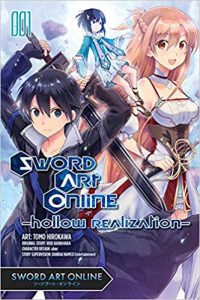
Sword Art Online: Hollow Realization, Vol. 1

November 8, 2018 by Sean Gaffney

By Tomo Hirokawa, based on the series created by Reki Kawahara. Released in Japan by ASCII Mediaworks, serialization ongoing in the magazine Dengeki Maoh. Released in North America by Yen Press. Translated by Stephen Paul.

Fair warning, this review contains spoilers for the video game Sword Art Online: Hollow Realization. And while the average reader may be staring at their screen now and saying “DUR!”, believe me, they came as a surprise to me. I have not played any of the SAO games, but assumed that this adaptation would not really have a lot of barriers to me picking it up and just reading it. And that’s… somewhat true? The main issue being when all the other girls in Kirito’s life start showing up. There’s our usual main harem, but then I ran into a girl who I was pretty sure died tragically in one of the prior books, and Yui’s little sister, and a sysadmin helping the group, and… I had to run crying to the Sword Art Online wiki. Not a pretty sight. So yes, for readers of the manga who have NOT played the game (and its prequels)? You will be confused.

The premise is that Kirito and company are beta testing a new version of SAO based off the original game… but without the ‘trapped and dying’ parts. They immediately run into a few NPCs, including one who appears to be more of a blank slate than you’d expect, particularly as the NPCs here are more lifelike and real than had been seen in SAO previously (let’s leave Kizmel to the side for the moment). Asuna names the NPC Premiere, and we begin to watch her slowly develop wants and needs, such as the desire to protect herself. And she certainly needs to protect herself too, as players are going around killing NPCs for their stuff… and the NPCs don’t return afterwards. Can our heroes help Premiere achieve sentience while also stopping the ‘it’s just a game’ PCs and a creepy swordsman named Genesis?

The concept of NPCs being more than what they seem is something SAO (and indeed many other ‘trapped in a game world’ series) has come back to many times, especially since Kawahara began the “Progressive” series. In fact, one of the very first SAO doujinshi the author wrote, back when it was still a webnovel, featured Kirito and Asuna arguing over whether it was OK to sacrifice NPCs in order to clear a level. Clearly the story is meant to have us rooting for Premiere and her fellow non-players, and I’m fine with that – she’s cute and likeable without being overly cloying. As for the rest of the cast, they all show up, but mostly it’s the Kirito and Asuna show, which is fine by me – there’s lots of “they’re so in love with each other” interaction that makes Lisbeth and company a bit ill. (Quiet, Liz, the artist was very kind to you.) And as I indicated there’s a few extra girls who also show up here, and if Mother’s Rosario left you wishing that it could have gone differently… you might want to check this out, though you’ll be whistling for explanations – “buy Lost Song” is apparently the answer.

Overall, this is a fun tie-in manga that I suspect will appeal more to those familiar with the game, though (as I’ve shown) you can read it without any game knowledge and just be slightly confused.

Filed Under: REVIEWS, sword art online

No Game No Life, Vol. 7

November 7, 2018 by Sean Gaffney

By Yuu Kamiya. Released in Japan by Media Factory. Released in North America by Yen On. Translated by Daniel Komen.

Until I read the afterword of this volume, I was going to comment a lot on how this volume’s release was delayed, I believe, four times, to the point where I’ve forgotten almost everything that came before it. But the afterword indicates that it was delayed in Japan the exact same number of months, which made me suspicious and wonder if it was delayed here deliberately. Probably not, but given the nature of this series, you can never be too paranoid. Things are not helped on the “remember what happened previously” end by the fact that Volume 6 was a flashback, and also the best volume in the series, which Kamiya sheepishly agrees with – he had writer’s block trying to top it. Sadly, I don’t think he did here, as this 7th volume of NGNL is bout 3/4 irritating and wordy faffing about, and it only really picks up towards the end. That said, if the ending is doing what I think it’s doing, the 8th volume may be much better. It’s out in February. Theoretically.

We start off in media res, which is a difficult thing to pull off for a normal writer, and even more difficult when you’re this writer, who tends to expound about eight times more than is necessary. Sora, Shiro and the rest of the cast have apparently agreed to play a game against an Old Deus, with the shrine Maiden’s life at stake. This surprises them, as they have no memory of having agreed to the game. It’s a dice game with complicated rules, which Sora says is based on a game from Earth but which I was mostly blank on. Much of the volume is spent with our heroes (and Steph, who sadly is reduced to a cliche here) whining and being creepily fetishistic as the dice board is the same size as the world, which is to say it takes days to travel across spaces. And they also gain or lose age depending on the dice they have, meaning a lot of 2-year-old Steph here. And when you arrive at a space, you have to do a task that another player has assigned, which can be very difficult and dangerous.

I’ve talked a bit about the translation before. I don’t think it’s the worst thing ever, like some NGNL fans do, but it’s not doing the prose any favors either. Kamiya, as I said earlier, tends to expound a lot, and Sora and Shiro also speak in a jaded gamer sort of way. Add to that the fact that, unlike a lot of other translations, there’s very little “Sora said” or “Steph replied” added to the text to help the reader, and you get a book that feels like a slog much of the time. Thankfully, this changes towards the end, when we see a) Plum trying to become a full-time villain in the real world, and b) Jibril challenging [ ] to a game where SOMEONE is going to have to die. Actually, the nature of the game she’s challenging them to intrigues me quite a bit, and I’m interested in seeing how it’s handled.

Unfortunately, looking forward to Vol. 8 does not make Vol. 7 better. Kamiya was right in his afterword, this is a step down from the previous book. Still, if you enjoye NGNL, you’ll need to read it anyway.

Filed Under: no game no life, REVIEWS

Bookshelf Briefs 11/6/18

November 6, 2018 by Ash Brown, Sean Gaffney and Michelle Smith Leave a Comment

Ace of the Diamond, Vol. 16 | By Yuji Terajima | Kodansha Comics (digitals only) – It’s the semifinals of the Tokyo preliminaries and Sawamura’s middle school friends have come to watch him play. He’s hung up on the previous game, during which he was replaced mid-inning after he fell apart after giving up a home run, but this time he manages to keep it together and Seido advances to the finals. I enjoyed his former classmates noting how he has both changed and hasn’t changed, especially as talking to them prompts him to declare that he loves and respects his teammates and wishes he could play with them forever. Mono no aware at its finest! Next, we’re introduced to the two teams competing to be Seido’s opponent in the finals and Terajima-sensei expertly manipulates me into desperately hoping one of them comes out on top. Alas, I suspect they won’t. I love this series. – Michelle Smith

Anonymous Noise, Vol. 11 | By Ryoko Fukuyama | VIZ Media – It’s the last show of In No Hurry’s tour and Twitter is abuzz with a rumor about Cheshire’s true identity. To counteract this, Silent Black Kitty joins In No Hurry on stage whereupon Yuzu and Momo seemingly have a guitar battle for Nino’s affections. A kiss from Momo throws Nino into a tizzy, but she calms down with Yuzu’s help, which foreshadows later developments, wherein during an intense moment with Momo (requited love, hooray!) she’s longing to sing Yuzu’s music. I like this dynamic—she loves one boy and is super-grateful to the other one who gives her an outlet for these intense emotions—but must say Fukuyama does better at depicting the frenetic energy of concerts that interpersonal drama. It’s big moment after big moment and I find myself longing to spend some more time with Yuzu and his bitter feelings. Oh, well. – Michelle Smith

Dead Dead Demon’s Dededede Destruction, Vol. 3 | By Inio Asano | Viz Media – I noted how much fun the second volume of Dead Dead Demon was, and while there are a few jokes here and there in this third volume, it mostly serves to remind you that this is still being written by Inio Asano. Fortunately, the book maintains its high level of writing and characterization even as things get more bleak and tearjerking, including one major event that I will endeavor to dance around in this review. That said, we are moving forward, as the girls have now graduated (though both our leads failed to get into college), and there’s also a narrative foreshadowing that implies that the friendship that the readers are enjoying may be fractured sooner rather than later. Fantastic, but the fun’s over. – Sean Gaffney

Grand Blue Dreaming, Vol. 2 | By Kenji Inoue and Kimitake Yoshioka | Kodansha Comics – Although partying and boozing remain a prominent part of Grand Blue Dreaming, they have been (ever so slightly) toned down in the second volume when compared to the first. Notably, the second volume’s opening devotes a little more time to the series’ other primary subject matter—diving. Iori didn’t really intend to join the Izu University diving club but, like it or not, he’s been roped into the group. Despite not knowing how to swim, Iori slowly becomes more comfortable in the water as he learns more about diving, his upperclassmen assuring him that swimming ability isn’t technically required. However, it doesn’t take long for college antics and club hazing, drunken and otherwise, to return to the forefront of the manga. (Oh, and copious amounts of male nudity.) Grand Blue Dreaming can be pretty ridiculous at times with most but certainly not all of the absurdity resulting from alcohol-infused revelry. – Ash Brown

Heaven’s Design Team, Vol. 2 | By Hebi-Zou, Tsuta Suzuki, and Tarako | Kodansha Comics (digital only) – In the vein of Cells at Work!, Heaven’s Design Team depicts the biological processes of evolution as a workplace, complete with angels who relay God’s sometimes random requests (like for stripey animals or a species whose males produce milk for their young) to a staff of designers, each with their particular specialties. It’s not a bad series, but the format grows repetitive and dull even before the end of the first volume, which isn’t a good sign. Thankfully, there’s a bit of variance halfway through this second volume, as the designers go on vacation and then (briefly) have a mystery to solve, but then it’s back to the usual. I’m a little bit intrigued by the sudden downfall of one of the angels at the end of the volume, but I’m not sure that’s enough to compel me to return. – Michelle Smith

Spirit Circle, Vol. 5 | By Satoshi Mizukami | Seven Seas – Last time I asked where this was going, and boy, do we find out in this volume. Well, the second half of this volume. First we get a cute, fluffy, gender-reversed life that leaves Fuuta more puzzled than anything else, and he and Kouko go on what is essentially a date so that she can kill him with no hesitation. But why is she SO intent on killing him? Well, we finally get a flash to the Fortuna life, which features the origin of East and Rune, and looks to be just as slice-of-life but unassuming as all the other lives… until you get to the (spoilers go here). Not going to lie, the last quarter of this book makes your jaw drop, and while I don’t want to see Fuuta dead, I absolutely see why Kouko wants to kill him now. Fantastic. – Sean Gaffney

Filed Under: Bookshelf Briefs

Versailles of the Dead, Vol. 1

November 6, 2018 by Katherine Dacey

Kumiko Suekane’s Versailles of the Dead feels like a kissing cousin of Seth Grahame-Smith’s Pride & Prejudice & Zombies. It’s a clever and handsomely drawn manga that also inserts zombies into a well-known story for shock value: who knew the real cause of the French Revolution was an outbreak of “resurrection illness”? The net result, however, is so intentionally kitschy that it sometimes holds the reader at arm’s length, inviting us to appreciate the imagination and research that went into creating Versailles of the Dead without fully drawing us into the story.

You might reasonably think that the zombies were Versailles of the Dead’s most gonzo element, but you’d be wrong: it’s actually Suekane’s decision to invent a sibling for Marie Antoinette. This sibling — a twin brother named Albert — is Marie’s doppelgänger, a handsome lad with the same high cheekbones and pert nose as his infamous sister. En route to Marie’s nuptials, their carriage is ambushed by zombies, forcing Albert to impersonate his sister after she meets a gruesome end. Albert’s identity is quickly discovered by a handful of courtiers, all of whom are invested enough in preserving the status quo at Versailles that they conspire to look the other way, even when rumors surface that Albert beheaded his own sister.

Watching Albert step into the role of Dauphine is fun; he embraces the opportunity to manipulate courtiers through gossip and flirtation, exploiting rivalries within the court to his own advantage. The supernatural interludes, by contrast, sometimes feel like an afterthought, rather than a vital part of the story. Though the zombies are handled in a straightforward fashion, Suekane relies too much on flash-booms, jump cuts, and smudgy silhouettes to imply that certain members of the French court are possessed. Suggestion is an important tool for generating suspense, of course, but here it feels like a half-baked effort at world-building — what if there were demons in eighteenth century France, too? Not everything needs to be explained in a baldly literal fashion, of course, but the demonic angle feels like one accessory too many on a busy outfit.

If the supernatural intrigue is more afterthought than essential element, the artwork is sumptuous, capturing the opulence of Versailles without overwhelming the reader. Suekane’s secret? Lavishing attention on character designs rather than material objects, allowing the intricacy of the hairstyles, gowns, and frock coats to be the focal point of most panels. That approach gives her breathing room to draw the kind of subtle but important details that help establish the characters’ true natures. Albert, for example, never fully disappears into his sister’s clothes and wigs; the twinkle in his eye and the boldness of his carriage are conspicuous signs of his male upbringing, even though he looks ravishing as a woman. Other characters’ personalities are just as thoughtfully embodied through costume and movement. Madame du Barry, the Dauphine’s great rival, makes a dramatic display of her décolletage, framing her chest in a wreath of feathers that accentuate du Barry’s mature womanhood — a not-so-subtle attempt to assert her power and experience over a teenage interloper.

It’s this level of thoughtfulness that helped me soldier through the more clumsy parts of the story, where characters solemnly explain why Albert’s marriage must go forward for “the good of our two countries,” and Madame du Barry thinks in complete Wikipedia paragraphs. (Her internal monologues are surprisingly dull for such a canny strategist.) I’m not sure that all of the plot lines will eventually converge in a satisfying way — there’s a lot of supernatural silliness — but I find Albert a compelling character, a skilled political operator who revels in his ability to sow discord. Count me in for volume two.

VERSAILLES OF THE DEAD, VOL. 1 • STORY & ART BY KUMIKO SUEKANE • TRANSLATION BY JOCELYNE ALLEN • SEVEN SEAS • RATED TEEN (PARTIAL NUDITY, MILD GORE, VIOLENCE)  172 pp.

Filed Under: Manga, Manga Critic, REVIEWS Tagged With: Horror/Supernatural, Kumiko Suekane, Seinen, Seven Seas, Versailles, Zombies

Mob Psycho 100, Vol. 1

November 6, 2018 by Sean Gaffney

By ONE. Released in Japan by Shogakukan, serialization ongoing in the magazine Ura Sunday. Released in North America by Dark Horse Comics. Translated by Kumar Sivasubramanian.

Most folks likely first heard of the manga artist ONE via the series One-Punch Man, which was originally a webcomic (as is Mob Psycho 100) that was picked up by Shueisha. Shueisha, however, realized that it could sell better with an artist with, shall we say, a bit more technique than ONE, and so Yuusuke Murata does the art, though you can see traces of ONE’s style in Saitama and Tatsumaki. Needless to say, One-Punch Man was a success. But there are other series that ONE has written as webcomics, including this one, about a young man who has an average presence but also super psychic powers. This also became big enough in Japan to have an anime, and now we’re getting the manga over here. And in this case, there’s no other artist – ONE’s art is here in all its glory. Sometimes it helps the story/humor immensely, but I will admit at times I felt like I really wanted Murata to be drawing this.

Our hero… arrives on the scene after a bit of a fakeout, as we’re first introduced to Reigen, a supposed spirit medium and exorcist who actually functions more as comedy relief than anything else. This lowly assistant, Shigeo (the ‘Mob’ of the title, referring to his looks being the sort you’d see in a ‘crowd mob’ drawing) is the one with the actual powers. When he’s not helping Reigen with his exorcist work, he’s a “normal” high school student with a crush on a girl (who barely appears) and one of the few people not in a club. This jumpstarts the plot, as the Telepathy Club is desperate for members to avoid getting shut down, and sets their sights on Shigeo. He’s not interested, but ends up dragged in anyway. Even worse, he also ends up being targeted by a group of religious cultists.

For the most part, this is meant to be a funny manga with the plot as an excuse for bizarre reactions and gags, and it succeeds quite well. It definitely picks up in the 2nd half, though, when Shigeo faces the religious cult that forces laughter on people. This leads to the other half of the title, which is the ‘Psycho 100″ part. Shigeo is a very laid-back, mellow sort of guy, but that’s because he’s repressing his emotions. When he hits ‘100%”, he explodes with rage, easily the highlight of the book, and one where the sketchiness of ONE’s art pays off. Unfortunately, sometimes ONE’s art simply looks poor. I realize that’s its charm point, but the flat faces on many of the characters tend to lead me to flat emotions when I think about them, regardless of what they say. I wonder if this is a series that works better in animated form.

Despite those misgivings, this is a very good start to a series, and it’s refreshing to actually have one of the ‘psychic’ manga that used to be omnipresent in Japan but rarely came over here licensed. I look forward to more of Shigeo’s flat, dead face and hope he can keep his rage in check… well, OK, no I don’t. I want more rage.

Filed Under: mob psycho 100, REVIEWS

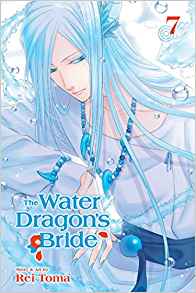
Water Dragon’s Bride, Vol. 7

November 5, 2018 by Anna N

Water Dragon’s Bride, Volume 7 by Rei Toma

I suspected that when the Water Dragon God sent Asahi home, she wouldn’t stay there long, and that was definitely the case. She struggles to feel at home back in her own world, with a younger brother that she’s meeting for the first time, and her parents, especially her mother who desperately missed her. This brief story line shows how The Water Dragon’s Bride is a story of a family tragedy, in addition to exploring how human rules fight for power and resources. Asahi misses her old life, but back in the realm of the Water Dragon God, the young king is struggling with drought and the idea that he’s lost the favor of the heavens since Asahi’s disappearance. Subaru even attempts to intervene with the Water Dragon God in Asahi’s absence. When the Water Dragon God does intervene, in his cold and calculated way, Subaru reflects that Asahi was incredibly powerful to make a god change.

Water Dragon's Bride 7

Asahi’s disarming way of talking with both the Water Dragon God and Subaru show that she doesn’t regret her choice to leave her family behind, and the way the Water Dragon God is actually able to articulate his emotions and even show a sliver of a smile shows how far he’s become from a god who would dispassionately watch a human starve. While so far the elemental gods that we’ve seen seem content to observe and occasionally make some cutting observations to the Water Dragon God, now that Asahi has returned the next storyline for this series looks like it will be even darker than before. When will hte suffering end????

I’m delighted to keep reading this manga, but there was such a great artistic leap for Toma between Dawn of the Arcana and Water Dragon’s Bride (which makes sense given when they were released in Japan), I’m also extremely curious to see other series of hers.

Filed Under: Manga Reviews, REVIEWS Tagged With: shojo beat, shoujo, viz media, water dragon's bride

Pick of the Week: We Enjoy Wide Variety

November 5, 2018 by Ash Brown, Katherine Dacey, Anna N, Sean Gaffney and Michelle Smith Leave a Comment

ASH: For me, it’s a shonen sort of week. In addition to a number of ongoing series from Viz that I’m following (JoJo’s Bizarre Adventure, Haikyuu!, and so on) there’s also the new one-shot That Time I Got Reincarnated as Yamcha which looks like it should be a ridiculous amount of fun.

KATE: As hard as it may be for me to say this… I’m not really jazzed about anything arriving in stores on Wednesday. I think this is going to be a tackle-the-stack week for me. But that’s OK — I have new volumes of Dead Dead Demon, Again!!, The Promised Neverland, and Silver Spoon on my nightstand, as well as a pristine copy of My Favorite Thing Is Monsters that begs to be read.

ANNA: I thought the first volume of Shortcake Cake was super adorable, so volume 2 is my pick this week.

SEAN: I’m still greatly enjoying Kaguya-sama: Love Is War, a very funny take on two overly intellectual nerds and their attempts to understand love. I’ll make that my pick this week.

MICHELLE: I’m looking forward to more Haikyu!! and to checking out Shortcake Cake, but it’s gotta be Chihayafuru for me!

Filed Under: PICK OF THE WEEK

Re: ZERO ~Starting Life in Another World~, Vol. 8

November 5, 2018 by Sean Gaffney

By Tappei Nagatsuki and Shinichirou Otsuka. Released in Japan by Media Factory. Released in North America by Yen On. Translated by Jeremiah Borque.

This arc continues to be very long, with most of this volume involved with trying to destroy the Witch Cult of Sloth, which proves, unsurprisingly, to be very difficult. It doesn’t seem that way at first – Petelgeuse is taken out with apparent ease, to the point where Subaru is naturally thinking “when is the other shoe going to drop? – but as we get further into the story and the Witch Cultists get more and more insane/clever/both, we start to have lives being lost. None of the named characters, mind, but it upsets Subaru nevertheless, as he feels that this time the deaths are directly attributable to his asking them to help him. Actually, this is a very good volume for Subaru watchers – even though he’s on an upswing and not doing stupid things too much, he’s still having trouble with Julius (Ferris notes his apology in the last book was half-assed) and with Emilia (who shows up to save the day towards the end here, but there’s no joyous reunion as of yet.

The cover and color illustrations feature Felt and Reinhard, and at first I wondered if my copy of the book was missing a scene, as they’re not actually IN the book – what you see in the color illustration is what you get. Instead we have the vast we had at the end of the last book, trying to destroy the Witch Cultists and doing lots of cool things. This includes Wilhelm, who is awesome but very injured by the end of the book; Ferris, who is desperately trying to save lives, even of the enemy, and having very little luck; and Julius, who proves to be an excellent combatant and can control spirits, which is of great benefit to Subaru when they save his life. Subaru’s plan is pretty good, though it ends up having one major flaw, which is that the Witch Cult is EVERYWHERE, even among people Subaru assumed were allies.

As for Petelgeuse, as I noted, he is seemingly killed off early on, but appearances can be deceiving. Indeed, the very nature of the Archbishop of Sloth proves to be somewhat elusive until the very end of the book, when Subaru realizes what is going on and flees (this is why we get no warm reunion with Emilia). This leads to the climax of the book, which has something I was not expecting. I have to assume that there’s going to be a new “reset point” and that we’re not going to have to do the entire White Whale battle again, but it’s ironic that just as Subaru is learning the fragile nature of life, his overpowered ability to avoid death has to be the solution. That said, I’m fairly certain the next volume is the final one in this book. Will he fix things? Will he reconcile with Emilia? And what of Rem, entirely absent from this book?

This was a solid volume of Re: Zero, with a lot of action, and Subaru still being less annoying than he has been. I’m looking forward to more.

Filed Under: re: zero, REVIEWS

Is It Wrong to Try to Pick Up Girls in a Dungeon?, Vol. 12

November 3, 2018 by Sean Gaffney

By Fujino Omori and Suzuhito Yasuda. Released in Japan as “Dungeon ni Deai o Motomeru no wa Machigatte Iru Darou ka?” by Softbank Creative. Released in North America by Yen On. Translated by Winifred Bird.

It stands to reason that over the course of a well-written series, you’d expect the characters to grow and change. That said, it’s rare we get such a direct look as we do here. This entire volume of DanMachi is about Bell and his familia’s growth over the course of the last eleven books, and it underlines several times how they’ve matured and are growing up, even if they may not be aware of it themselves. Sometimes the growth is mental, sometimes physical, and sometimes both, but these are not the same people that we met in the first book. It helps that this book is also a pure dungeon crawl, the first in a very long time, and that they face off against a very clever Irregular monster – not one of the Xenos that we’ve gotten to know in the last few books (and we meet another one here), just a monster who was smarter than his brethren, and then started to eat their cores, and now is smart *and* evil.

Bell and Lilly are on the cover, and it’s appropriate that this growth metaphor focuses the most on them. Bell’s has been easier to see in terms of battle prowess, but now we see how he’s matured as a person as well. His “mind has caught up with his body”, as Mikoto puts it, and this has made him a more capable adventurer. That said, he’s still Bell, much to Lilly’s relief, as she worried he was getting too far ahead of everyone else. As for Lilly, she’s learning more how to be a leader, being trained by Daphne here and also imagining a Finn in her head that she strives to be like. (The real Finn does not always match the Finn in Lilly’s head, and I wonder if she knows that his last-minute plan is basically “make myself lose control and go nuts”?) She’s also dealing with abandonment issues, both not wanting to be forsaken by the man she loves and also when she’s told to abandon the injured in her party and escape and seriously considers it. Her maturity is in realizing that’s the most sensible plan… but not doing it.

We meet another Xenos here, a mermaid who seems nice and sweet and has already fallen for Bell, and I suspect we’ll see her again in the future. (I am grateful to the author forgetting her farewell confession to Bell out of the way BEFORE Lilly and the rest arrive – it’s a heartwarming scene that did not need a jealous harem added to it.) We also see that Hestia’s group is now a D group, meaning they have to accept missions from the main office. This first mission was “conquer a new floor”, basically, and it’s implied they failed as they got derailed by this nightmare of a monster, though I’d argue the fact that they took it out should work in their favor. That said, it looks like the next volume may be a murder mystery more than a dungeon crawl, judging by that cliffhanger.

I’m in danger of sounding like a broken record, but DanMachi is simply very well written, and benefits well from being confined to a single volume for once. Any fan of fantasy light novels should have it at the front of their queue.

Filed Under: is it wrong to try to pick up girls in a dungeon?, REVIEWS

Idol Dreams, Vol. 5

November 2, 2018 by Anna N

Idol Dreams Volume 5 by Arina Tanemura

Idol Dreams is a fun, if a bit uneven, soapy series about a repressed office lady reliving her youth in the best way by occasionally taking magic pills that turn her into a teenage aspiring teen idol singer! People fall in and out of love and deal with show business shenanigans, but will Chikage’s teenage adventures translate into any newfound maturity in the real world? Indications in this fifth volume are promising!

Chikage is much more assertive and resourceful in her teen idol persona as Akari. She’s trying to gain more recognition through a sing-off battle and manages to dodge a series of mean girl attacks and come out on the other side victorious even though she’s just a slightly better known aspiring idol singer. One of the things I’ve been wondering about is when Chikage’s old classmate and magical teen pill supplier Tokita was going to get a bit more focus, because so far he seems to be mainly pining in silence. My patience was rewarded with this volume, as it focuses on him. The real world is much more complex than teen idolland, as Chikage learns that Hanami who one of her workplace mean girls is also Tokita’s girlfriend, and she’s been cheating on him. Chikage is able to stick up for Tokita in a way that she’s never managed for herself, but she doesn’t realize what her own feelings are for Tokita until it is far too late. There is more time spent on the characters’ backstory in this volume, especially Tokita, which was a nice change of pace. I’m a bit worried that Chikage is going to bury herself in her teen persona in the next volume to distract herself from her pain as an adult.

It is all breezy fun although I’m slightly terrified about what might happen with Akari and Hibiki. I think that the series would also seem a bit less disjointed if I was reading it all with less time in between volumes, where the quick pace of people falling in and out of love might be less noticeable in a larger chunk of story. Still, I’m always up for an Arina Tanemura manga, and I’m hoping that Chikage becomes a more self-assured woman by the end of the series, and I’m glad that she’s showing some signs of assertiveness, even though she still needs more self-awareness to match.

Filed Under: Manga Reviews, REVIEWS Tagged With: idol dreams, shojo beat, shoujo, viz media

High School Prodigies Have It Easy Even in Another World!, Vol. 1

November 2, 2018 by Sean Gaffney

By Riku Misora, Sacraneco and Kotaro Yamada. Released in Japan as “Choujin Koukousei-tachi wa Isekai demo Yoyuu de Ikinuku you desu!” by Square Enix, serialization ongoing in the magazine Young Gangan. Released in North America by Yen Press. Translated by Caleb D. Cook.

I’ve talked before about whether we’ve reached isekai critical mass in terms of the sheer number of titles. If you went by message boards and forums, you’d think the trend was long over and that fans were desperate for something else. But from what I understand, sales don’t really support that – in fact, they seem to support the opposite, and it’s “anything but isekai” that is suffering. That said, I certainly understand feeling a little burned out by the variations on a theme. This new title, based on a light novel (unlicensed here in North America) hits a lot of the standard fantasy isekai buttons, and reminds me quite a bit of Realist Hero. But the very title itself implies that there will be a minimal amount of conflict, and warns the reader in advance that these are not your “average harem hero” isekai students – they’re top tier. OP is what they have for morning coffee.

We’re briefly introduced to the titular group in their own element – seven teen geniuses who between them control most of Japan. They also all know each other from school, which is why they’re all together on a plane that has a fateful plane crash. When they wake up, they’re in another world, with magic and dragons and overendowed elf girls like the one on the cover, who is absolutely not one of the teen geniuses, but she’s cute, right? They’re not sure if they can get back, but looking around at the poor farming village and the folks who saved them from the wreckage, they are sure they can do something to repay them by bettering their life. But they’ll have to deal with tributes to the local lord, and bandits, and merchants who control the economy, and (inevitably) slavery. Can they turn things in their favor? Easily.

As you’d expect in a series supposedly starring seven kids, not all of them get focus here. Also unsurprisingly, it’s two of the guys who get the bulk of it in this first volume. Tsukasa is Japan’s prime minister (yes, he’s still in high school) and seems the “sensible yet compassionate bishonen” sort, and is also clearly being romantically paired with the elf girl, as if the “I’ll feed you by mouth” wasn’t obvious enough. There’s also Masato, a genius businessman who’s the perfect person to help the village sell their wares and not knuckle under to gougers. They’re both likeable types, but they’re also very obviously types, not people yet. As for the others, the only other one who makes an impact is Shinobu, the reporter/ninja girl who’s there to be perky (and also punish Masato when he reveals she isn’t a virgin, in a tired gag that is nevertheless the best gag in the book). This is very much a first volume, and we’re waiting for more depth.

I suspect I might have enjoyed this more in prose, but it’s all right. If you’re looking for another isekai with cute girls, this is perfectly serviceable. But like its premise, it promises absolutely nothing to the reader who dislikes overpowered heroes who cruise through everything. That is what these kids are. But they invent mayonnaise, so we’re good.

Filed Under: high school prodigies have it easy even in another world, REVIEWS

Manga the Week of 11/7/18

November 1, 2018 by Sean Gaffney, Michelle Smith, Ash Brown, Anna N and MJ Leave a Comment

SEAN: It is election week, and I urge everyone in the United States to please go vote. Meanwhile, on the manga front…

Cross Infinite World has another series, this one apparently from some creators who’ve also done Final Fantasy. emeth: Island of Golems is the title, and the e is small, e.e. cummings style.

Ghost Ship has a 5th Yokai Girls.

J-Novel Club continues to dole out light novels for the hungry fan, as we see Demon King Daimaou 8, Invaders of the Rokujouma!? 17, and The Master of Ragnarok and Blesser of Einherjar 4.

Kodansha is in something of a state of flux – its site’s release dates are not matching Amazon’s, and there have been some schedule slips. But we definitely get the debut of Hiro Mashima’s new manga next week, Eden’s Zero. It’s hard not to make the “Fairy Taiiiil… iiinnnnn SPAAAAAAACCCCEEE!!!!” joke here.

ASH: Ha!

SEAN: Other print titles are Boarding School Juliet 2 and Persona Q: Shadow of the Labyrinth Side: P4 Volume 4 (it hurts me typing that title).

ASH: It does hurt, but it’s a fun series for Persona fans.

SEAN: Digitally we debut Can I Kiss You Every Day?, a Betsufure title whose synopsis, alas, sounds incredibly similar to a lot of other shoujo digital-only titles we’ve seen recently.

MICHELLE: That synopsis earns a hard pass from me.

SEAN: And there’s also Can You Just Die, My Darling? 6, Chihayafuru 12 (yay!), My Boy in Blue 4, and Peach Girl Next 3.

MICHELLE: Yay, indeed!

ANNA: Yes!!!

SEAN: Seven Seas has no debuts, but they do have several of their ongoing series. There’s The Bride and the Exorcist Knight 2, The Dungeon of Black Company 2, Miss Kobayashi’s Dragon Maid 7, Sorry for My Familiar 3, and The Testament of Sister New Devil STORM!! 5.

Though release dates on Amazon for Tokyopop are even more fluid than they are for Kodansha, there is apparently a 2nd Futaribeya out next week.

For those who missed the two-volume Summer Wars manga, Vertical Comics is releasing it as an omnibus.

Viz’s debut combines two incredibly popular trends: Dragon Ball and reincarnated into another world stories. That Time I Got Reincarnated as Yamcha is exactly what it sounds like, which is to say silly.

ASH: This is supposed to be fantastic.

ANNA: Sometimes very silly is a good thing.

MJ: I’m down for this.

SEAN: Some excellent ongoing series. On the shonen side, we have Black Clover 13, Black Torch 2, the 3rd Bleach Box Set (not sure if it’s black or not), the 3rd Demon Slayer, a 2nd Dr. STONE, a 29th Haikyu!!, the 9th JoJo’s Bizarre Adventure: Stardust Crusaders hardcover, an 88th One Piece, and the 4th volume in Yu-Gi-Oh: Arc V.

MICHELLE: I need to check out Dr. STONE.

ASH: Oh yes, there’re some great series in there!

ANNA: I enjoyed the first volume of Dr. STONE.

SEAN: On the shoujo side, we see Anonymous Noise 11, Idol Dreams 5, and Shortcake Cake 2.

MICHELLE: I also need to check out Shortcake Cake.

ASH: The first volume was quite enjoyable!

ANNA: Shortcake Cake is super cute, and I enjoy Idol Dreams.

SEAN: And on the ‘seinen marketed as shonen’ side, we have Kaguya-sama: Love Is War 5.

Did you vote? And what did you buy?

MICHELLE: Last Friday! And I got a sticker!

Filed Under: FEATURES, manga the week of

Kokoro Connect: Kizu Random

November 1, 2018 by Sean Gaffney

By Sadanatsu Anda and Shiromizakana. Released in Japan by Enterbrain. Released in North America by J-Novel Club. Translated by Molly Lee.

The current fashion in North American releases seems to be not to translate something if it’s already better known to fans by the Japanese. I suspect that’s why we see each subtitle in the Kokoro Connect series this way: Hito Random meant Random People, which fits well with the bodyswapping nature of the book. Now we have Kizu Random, which I personally think might have had a greater impact were it translated, as it means Random Wounds. Likewise, due to the nature of the bodyswap, the first book out of necessity had to keep the group as mostly a tight-knit group of friends. This book, however, is darker in tone, and shows how easily such friendships can be sabotaged – mostly by overthinking things, or self-loathing, or any number of details that add up to “we are teenagers”. Indeed, what Heartseed is doing is something I think ideally suited for teenagers, who are going through this kind of thing anyway, and you could argue it’s just helping them along. Of course, you could also argue Heartseed is a sadistic jerk.

A couple of weeks after the events of the first book, our five heroes are told by the alien that is toying with them that they’re going to have moments where they suddenly lose control of their emotions and desires and act on them. Having experienced this sort of thing before, and not looking forward to it at all (mostly as she was the first to be affected, stripping and getting on top of Taichi in the clubroom), Inaba convinces the others that they can get through this as long as they keep an even emotional keel and just try really hard. That… doesn’t work, and soon Yui’s beating up delinquents (which causes her to shut herself at home), Taichi has a lot more desire to “save” people than he normally does (which is amusing, given it’s quite high to begin with), and Inaba is forced to deal with a fact that she’s been avoiding for quite some time. Friendships can be fragile, especially at this time of your life, and by halfway through the book no one is speaking to anyone.

The strengths of this book are once again the writing of the characters, who feels their age and also sound it. There’s a lot of angst and melodrama here, but it’s never really overwrought except where it’s supposed to be. For the most part the book is 3rd person Taichi POV, but we also have several chunks where it’s first-person Inaba, and those show off how screwed up her mindset is and how easy it can be to filter everything you say or do through a negative, self-loathing filter. And then there’s the “love triangle”. Taichi and Iori like each other, but don’t want to date while Heartseed is messing with them. Inaba finally admits she loves Taichi and confesses, but is rejected – for the moment. It’s a very “mature” rivalry so far, but that’s mostly because it resolves itself after a huge outpouring of emotional release from both Iori and Inaba, and I’m curious as to how messy it might get in the future.

Kokoro Connect remains a well-written teen drama, and is a refreshing change of pace for those who are bored by the idea of yet another isekai. Even if you’ve seen the anime, you should pick it up.

Filed Under: kokoro connect, REVIEWS

  • « Go to Previous Page
  • Page 1
  • Page 2
  • Page 3
 | Log in
Copyright © 2010 Manga Bookshelf | Powered by WordPress & the Genesis Framework