• Skip to primary navigation
  • Skip to main content
  • Skip to primary sidebar
  • Home
  • About Us
    • Privacy Policy
    • Comment Policy
    • Disclosures & Disclaimers
  • Resources
    • Links, Essays & Articles
    • Fandomology!
    • CLAMP Directory
    • BlogRoll
  • Features & Columns
    • 3 Things Thursday
    • Adventures in the Key of Shoujo
    • Bit & Blips (game reviews)
    • BL BOOKRACK
    • Bookshelf Briefs
    • Bringing the Drama
    • Comic Conversion
    • Fanservice Friday
    • Going Digital
    • It Came From the Sinosphere
    • License This!
    • Magazine no Mori
    • My Week in Manga
    • OFF THE SHELF
    • Not By Manga Alone
    • PICK OF THE WEEK
    • Subtitles & Sensibility
    • Weekly Shonen Jump Recaps
  • Manga Moveable Feast
    • MMF Full Archive
    • Yun Kouga
    • CLAMP
    • Shojo Beat
    • Osamu Tezuka
    • Sailor Moon
    • Fruits Basket
    • Takehiko Inoue
    • Wild Adapter
    • One Piece
    • After School Nightmare
    • Karakuri Odette
    • Paradise Kiss
    • The Color Trilogy
    • To Terra…
    • Sexy Voice & Robo
  • Browse by Author
    • Sean Gaffney
    • Anna Neatrour
    • Michelle Smith
    • Katherine Dacey
    • MJ
    • Brigid Alverson
    • Travis Anderson
    • Phillip Anthony
    • Derek Bown
    • Jaci Dahlvang
    • Angela Eastman
    • Erica Friedman
    • Sara K.
    • Megan Purdy
    • Emily Snodgrass
    • Nancy Thistlethwaite
    • Eva Volin
    • David Welsh
  • MB Blogs
    • A Case Suitable For Treatment
    • Experiments in Manga
    • MangaBlog
    • The Manga Critic
    • Manga Report
    • Soliloquy in Blue
    • Manga Curmudgeon (archive)

Manga Bookshelf

Discussion, Resources, Roundtables, & Reviews

Archives for August 2015

My Hero Academia, Vol. 1

August 11, 2015 by Sean Gaffney

By Kohei Horikoshi. Released in Japan by Shueisha, serialization ongoing in the magazine Weekly Shonen Jump. Released in North America by Viz.

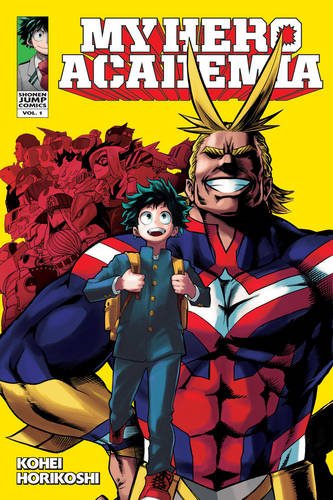
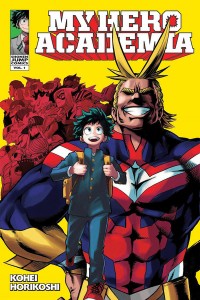
It has to be said, if you’re looking to succeed in Weekly Shonen Jump, ‘write the same thing as everyone else, only your way’ is a pretty good description of how to go about doing it. And to a degree, that’s what the author does with this new series. Even though the front cover parodies Marvel and DC Comics, and the kids are ‘superheroes’ in a Western sense, this is very much in the classic Jump mold – indeed, some of the amusing yet insane superpowers reminded me of the late lamented Medaka Box. Our hero as well is a sweet kid, the Naruto sort who starts off weak and bullied but will improve by leaps and bounds because he tries hard and refuses to back down when his principles tell him it’s wrong.
academia1

Our hero Izuku (abbreviated to ‘Deku’ for reasons that Viz won’t explain because Jump titles don’t have endnotes) is the small guy on the cover, as you no doubt guessed. The world about 25-30 years ago evolved superpowers in about 80 percent of the population. And Izuku really, really loves superheroes – he’s pretty much an otaku. Sadly, he’s in the 20% that doesn’t have powers. This, naturally, leads to bullying on the part of all his school classmates, particularly Katsugi, who plays the role of the selfish ass quite well in this volume, though I suspect he will gain greater depth as the title goes on, particularly give his childhood past with Izuku.

Luckily, Izuku gets a superpower transferred to him from the other guy on the cover. Even more luckily, the power does not just magically make him a superhero – he has to go through an amusing and heartwarming training montage, complete with the usual ‘drag a refrigerator across the beach’ stuff, till he’s no longer a wimpy kid but rather a wimpy kid with a muscular build. And he doesn’t really get a chance to train with his powers, either – which means he’s in trouble when he applies to Superhero School, where the goal is to be awesome immediately.

Nothing here is really original, but also nothing here is really poorly done, either. The author has learned from Barrage, his previous series. Izuku is a bit of a shy coward without being unlikeable, All Might’s secret allows him to be hilarious as well as inspiring, and his new friend Ochako is cute, and not Shiemi from Blue Exorcist despite all appearances saying she is. The fight scenes look smooth and non-confusing, and there is actual tension as you wonder how this will get resolved – it also allows Izuku to be clever, which is the best way to advance when you also have cool superpowers. Add on a reluctant mentor and some random giant woman fanservice, and you can see exactly why this became a bit hit while Barrage was cancelled after 2 volumes.

If you want something you’ve never seen in Jump before… why do you read Jump, exactly? But if you want something light and fun, with potential for more, My Hero Academia may be right up your alley.


Filed Under: REVIEWS

Pick of the Week: Nearly United

August 10, 2015 by Michelle Smith, Sean Gaffney, Anna N and Ash Brown Leave a Comment

magi13MICHELLE: I know I’ve picked Magi at least a half dozen times before, but really it’s just that good. It’s fun, in the way that one expects a shounen adventure to be, but it also prioritizes character growth and world-building. I am really, really enjoying it.

SEAN: Yeah, I’m going to go with Magi as well, which is doing some really great worldbuilding and has some nice smug villains.

ANNA: I will pick Magi too, even though I’m not that far along in reading the series.

ASH: Wow, well, I apparently need to get around to reading Magi at some point! But as for my pick this week, I’m going to go with the third omnibus of Embracing Love. It’s been a while since I’ve read the series, but I’m glad that it was rescued.

What looks good to you this week?

Filed Under: PICK OF THE WEEK

My Week in Manga: August 3-August 9, 2015

August 10, 2015 by Ash Brown

My News and Reviews

Okay! In addition to the usual My Week in Manga feature, I managed to post three other things last week. First up was the announcement of the Sparkler Monthly Giveaway Winner, which also includes a list of the current, ongoing series being released in Sparkler Monthly (which is only a fraction of the total content). The other two posts were in-depth manga reviews; I took a look at a couple of Kodansha Comics’ recent releases. The first in-depth review of the month went to Naoshi Arakawa’s Your Lie in April, Volume 2, which I enjoyed. But then again, it’s a music manga, so it’s not too surprising that I like it. I also reviewed Masayuki Ishikawa’s Maria the Virgin Witch, Volume 3. It’s the last volume of the series, although the seque Exhibition is scheduled to be released in English later this year. Maria the Virgin Witch is somewhat uneven, but I still found it to be both intriguing and engaging.

As seems to always be the case nowadays, life was keeping me very busy last week, but I still came across some interesting things  elsewhere online. A translation of an interview of Daisuke Igarashi, for example. Last week also marked the seventieth anniversary of the dropping of the atomic bombs on Hiroshima and Nagasaki by the United States. It’s quite timely then that Last Gasp launched a Kickstarter project to create a hardcover edition of Keiji Nakazawa’s Barefoot Gen with schools and libraries specifically in mind. To coincide with this, Paul Gravett reposted his article “Keiji Nakazawa: Barefoot in Hiroshima”. Barefoot Gen is a tremendous work. One of the Manga Moveable Feasts was even devoted to it back in the day. If anyone is interested in learning more about Nakazawa himself as well as some of the historical context surrounding Barefoot Gen, his autobiography was translated into English several years ago.

Quick Takes

Prophecy, Volume 3Prophecy, Volume 3 by Tetsuya Tsutsui. The first volume of Prophecy is the one that left the greatest impression on me, but in general it’s a very strong series. I didn’t find the second volume to be quite as compelling as the first, but the third provides a mostly satisfying conclusion to the series even though in some ways it felt a little anticlimactic. One of the members of Paperboy tips off the police and soon the Cyber Crimes Division has been able to identify the four terrorists. As the investigators draw closer and closer to capturing the men, they begin to notice what at first seem to be mistakes, slip ups, and inconsistencies in the group’s behavior. However, everything falls into place once Paperboy’s true motivations for committing all of the crimes are revealed. Prophecy is a realistic, smart, and engaging series with the added bite of social commentary. There’s apparently also a Prophecy spin-off series. I don’t think that it has been licensed, or that there are any current plans to do so, but I’d certainly be interested in reading it.

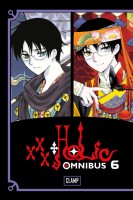
xxxHolic, Omnibus 6xxxHolic, Omnibus 6 (equivalent to Volumes 16-17) by CLAMP. For the most part I have been enjoying xxxHolic since the beginning of the series, but I think this omnibus has been my favorite so far. I really liked its brooding, ominous atmosphere. The humor that was so prevalent earlier in the series is actually almost entirely gone. The comedy in xxxHolic could be fun, but I have a particular penchant for the series’ supernatural angst, and that’s definitely taken the forefront in the last few volumes. I also initially found the crossover between Tsubasa: Reservoir Chronicle and xxxHolic to be intriguing, but I’ll admit that I was happy to see that the other series didn’t intrude too much in this omnibus. Instead, xxxHolic is focusing on how Watanuki and the others are coping now that Yuko is gone. Watanuki takes it especially hard and his tendency to slip in and out of dreams is becoming increasingly dangerous. There’s not much that the people who care about him can actually do except to watch over and support him as best as they can.

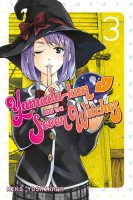
Yamada-kun and the Seven Witches, Volume 3Yamada-kun and the Seven Witches, Volume 3 by Miki Yoshikawa. There really are witches in this series! With its good-natured comedy and gender play, I’ve liked Yamada-kun and the Seven Witches a great deal from the very start. But with the third volume, Yoshikawa has started to really develop the series’ worldbuilding and is diving even further into the details of how the magic works. The relationships between the characters are also becoming more fleshed-out and complicated, which I’m enjoying as well. One of the things that I particularly appreciate about the series is that it seems perfectly okay for a guy to be crushing on another guy. Yes, it’s because there are some strange supernatural powers at work, but it’s also not treated like something gross. The setup also allows kissing to freely occur regardless of gender, which is fun. There’s still plenty of fanservice in Yamada-kun and the Seven Witches, as one would probably expect from a shounen series full of gender- and body-swapping, but I generally find it to be tastefully done.

Filed Under: FEATURES, My Week in Manga Tagged With: clamp, manga, Miki Yoshikawa, Prophecy, Tetsuya Tsutsui, xxxholic, Yamada-kun and the Seven Witches

Bookshelf Briefs 8/10/15

August 10, 2015 by Sean Gaffney and Michelle Smith 1 Comment

Sean and Michelle review print and digital manga from Kodansha Comics, VIZ, and Yen Press.

handa-kun1Handa-kun, Vols. 1-2 | By Satsuki Yoshino | Yen Press – This was going to be Yen’s first digital-only release, but I guess the demand was high enough that it’s getting print in January, so it’s just digital first. This is a prequel to Barakamon, showing the adventures of Handa in high school. If Barakamon is Yotsuba&!, Handa-kun is Azumanga Daioh, being a gag manga that’s sort of the dark mirror of Haven’t You Heard? I’m Sakamoto. Rather than being perfect and having everyone stand in awe, Handa is an unsociable wretch who worries constantly about everyone hating him… except everyone stands in awe. There’s some hilarious comedy here, and you’ll appreciate how far Handa has come by Barakamon. It’s pretty slight, though; don’t expect much plot. – Sean Gaffney

socute2So Cute It Hurts!!, Vol. 2 | By Go Ikeyamada | VIZ Media – Twin siblings Megumu and Mitsuru Kobayashi have traded places for a week so Megumu can help her academically challenged brother. They both end up falling in love and things move swiftly in this second volume, with the nature of the relationship between the twins’ love interests, Aoi and Takenaka, turning out to be what most readers probably expected, and with the masquerade seemingly coming to an end after some ridiculous shenanigans involving a not-really-that-deep hole and an inadequate grip on a towel. I’m still feeling quite “meh” about this series even though this volume is a little better than the first. Not even Aoi’s too-brief questioning of his sexual preferences can add any real depth, and I can’t believe this series is at twelve volumes and still ongoing! It’s so slight, I would’ve pegged it for four, tops. – Michelle Smith

today'scerberus1Today’s Cerberus, Vols. 1-2 | By Ato Sakurai | Yen Press – This is digital-only, and is fluffy enough that you can see why—there’s not much here you haven’t seen in other comedy manga with a supernatural bent. That said, there’s relatively minimal service compared to other titles in this genre, and the male lead’s dilemma is actually rather interesting, as he’s missing the part of his soul that causes him to feel joy. Cerberus is, as you’d expect, a girl who can switch between three heads (with three personalities), each of whom have a crush on her new master. Add the standard human girl who’s loved him from afar, and a few enemies (including a major one for the second cliffhanger), and you have a series I recommend to those who like Monster Musume and the like. – Sean Gaffney

voiceover12Voice Over!: Seiyu Academy, Vol. 12 | By Maki Minami | VIZ Media – I suspect reactions to the final volume of Voice Over! will vary depending on each reader’s tolerance for important moments being left to the imagination. Although we do see Hime’s last performance as Shiro as a rousing success that even affects her cold-hearted mother, we get only the merest glimpse of her subsequent path to stardom as herself. And though we see Senri not only discover that Hime is Shiro, but also understand her motivation and recognize that never once has his interaction with either of her identities been anything less than genuine, we never see them talk about it. There is no confession, no kiss. And yet, it’s still a satisfying ending that stresses that falling in love is not going to derail Hime from pursuing her dream. I can’t really quibble with a message like that! – Michelle Smith

Voice Over! Seiyu Academy, Vol. 12 | By Maki Minami | Viz Media – Well, that was sweet and heartwarming and… really easy. All the conflicts seemed to resolve by simply not conflicting at all. Senri finds out Shiro is Hime… and is OK with it. Sakura’s mom starts to put Shiro under her spell… but is undone by Shiro’s essential shininess. Hime’s mother, who has destroyed her daughter’s sense of self-worth, sees her voice acting and suddenly realizes how wrong she’s been. It’s a bit pat, isn’t it? Couldn’t someone have gotten mad beyond half a page? That said, aside from that, everyone is cute and funny and I thought Shiro taking his glasses off there was a brilliant move that shows how Hime has grown as an actress. I just kinda wish more had actually gotten in her way. – Sean Gaffney

yamada-kun3Yamada-kun and the Seven Witches, Vol. 3 | By Maki Yoshikawa | Kodansha Comics – At last, after what seems like waiting forever, witches have now been mentioned in this title. And the implication is that there are more to come, but most of this is devoted to fallout from Nene trying to blackmail Ryu… which naturally blows up in her face, as it was obvious fairly immediately that she was the arrogant girl who thought too much of herself, so was guaranteed to be taken down a peg. More interesting to me is that the series still seems to love fluid sexuality (an excuse for lots of kissing), and the revelation of Ryu’s real powers added to Nene and Urara’s only helps add to that. I suspect everything will end hetero ever after, but I’ll enjoy it while it lasts. – Sean Gaffney

Filed Under: Bookshelf Briefs

Tokyo Ghoul Tops the Best-Seller List

August 10, 2015 by Brigid Alverson

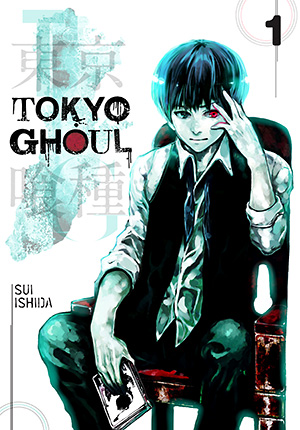
Tokyo Ghoul

The first volume of Tokyo Ghoul tops the New York Times manga best-seller list. Want to check it out? Viz is offering an extended preview on its digital service.

The Attack on Titan: Before the Fall manga is two degrees of separation from the original series—it’s an adaptation of a light novel spinoff—but even so, it’s doing well, with 1.4 million copies in print in Japan, according to Kodansha’s Bessatsu Shōnen magazine, where the series runs. Kodansha Comics publishes the manga in North America, where the fifth volume is due out on August 25, and Vertical publishes the light novels.

Deb Aoki’s advice to journalists who want to interview manga-ka has lots of interesting tidbits about the industry and cultural differences that make it a good read for any manga fan.

Zainab Akhtar has a quick introduction to the two Inio Asano titles that will be published next year, A Girl on the Shore and Goodnight PunPun.

Erica Friedman brings us the latest edition of Yuri Network News at Okazu.

The venerable shoujo manga magazine Margaret has launched a digital edition.

Reviews

Lesley Aeschliman on vol. 1 of Black Rose Alice (Lesley’s Musings on Manga)
Leroy Douresseaux on vol. 13 of Blue Exorcist (The Comic Book Bin)
Zainab Akhtar on Fragments of Horror (Comics & Cola)
Lori Henderson on vols. 2 and 3 of Genkaku Picasso (Manga Xanadu)
Richard Gutierrez on vol. 1 of Log Horizon (The Fandom Post)
Sean Gaffney on vol. 75 of One Piece (A Case Suitable for Treatment)
Matthew Warner on vol. 28 of Toriko (The Fandom Post)

Filed Under: MANGABLOG

Maria the Virgin Witch, Vol. 3

August 9, 2015 by Ash Brown

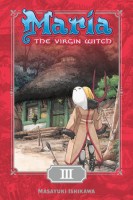
Maria the Virgin Witch, Volume 3Creator: Masayuki Ishikawa
U.S. publisher: Kodansha
ISBN: 9781632360823
Released: June 2015
Original release: 2013

Maria the Virgin Witch is a three-volume manga series (four volumes if counting the sequel Exhibition) created by Masayuki Ishikawa. It was actually because the series was by Ishikawa, who is also the creator of Moyasimon (which I enjoy), that it first came to my attention. The first volume of Maria the Virgin Witch intrigued me, and the second ends with the heroine in a rather dire-looking situation, so I was very curious to see how the story would continue to play out in the third. Happily, Kodansha Comics was kind enough to send a review copy along to me. Maria the Virgin Witch, Volume 3 was originally published in Japan in 2013. Kodansha’s English-language edition of the volume was released in 2015. Despite being a short series, the narrative of Maria the Virgin Witch has the tendency to be a little unfocused, but I still find the manga to be consistently engaging. I especially appreciate the quirkiness of the series in general as well as the quirkiness of its characters specifically.

Maria had been warned by the Archangel Michael: If the young witch continued to interfere with the natural order of the world she would be struck down. However, so devoted to ending the long-lasting war between France and England, Maria continued to flaunt her powers, even while in the presence of Michael’s messenger Ezekiel. Now the time has come for her to face the consequences of her actions. She was, however, somehow able to survive what was intended to be a fatal blow from Michael’s spear. But she’s still vulnerable and must rely on the protection of her two owl familiars and the kindness of her fellow witches who don’t necessarily approve of her efforts to force a peace. Maria was at one point alone in the world—the Heavens, other witches, and even some of the humans she was trying to save all standing against her—but over time her earnestness and innocence has earned her some friends, a few of whom could have at one time been counted among her enemies. But even with their support Maria is beginning to lose her naiveté, realizing that bringing happiness to humanity may be more complicated than she initially considered.

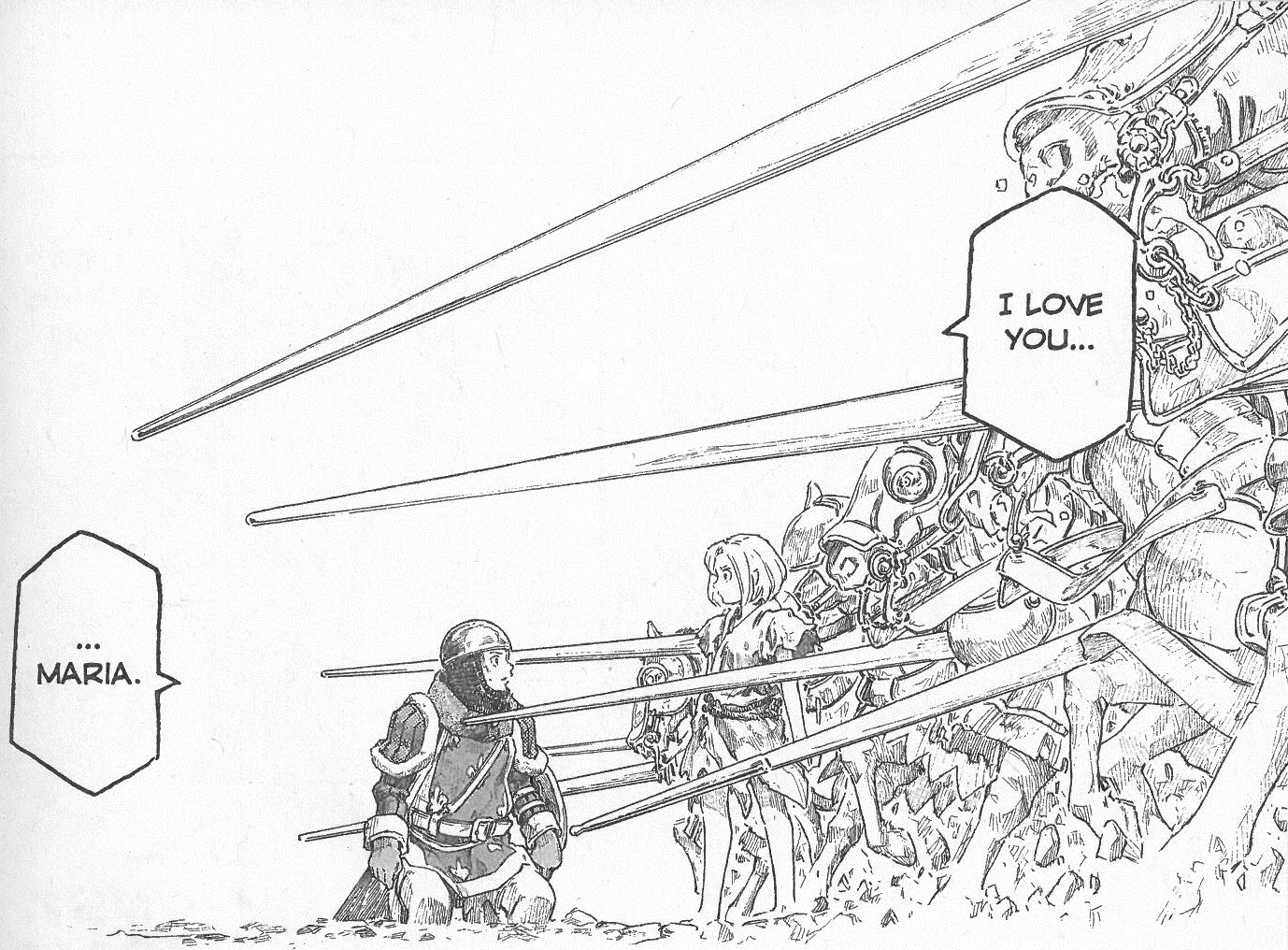
Maria the Virgin Witch, Volume 3, page 154Maria the Virgin Witch has always been a peculiar mix of quirky humor and more serious philosophical and theological reflection. There are a lot of ideas that Ishikawa was able to work into such a short series, although at the same time it’s difficult to thoroughly explore all of them in only three volumes. (It actually makes me wonder if Maria the Virgin Witch was originally intended to be a longer story.) The third volume brings up questions about Maria’s family and backstory without really answering them. Also, apparently many if not all witches are loners, something that wasn’t clearly established until now. Maria’s close friendship with the English witch Viv develops suddenly, and their discussions about the true meaning of happiness and love come across as a little forced. It was as if Ishikawa needed to rush in order to make sure that the heart of the series was addressed and made absolutely clear, paring down the seemingly extraneous elements introduced earlier in the manga.

Although overall the narrative of Maria the Virgin With is somewhat uneven, in the end I did largely enjoy the series and I would like to read Exhibition as well. Since the very beginning of the manga, I’ve been particularly fond of Maria herself. While she and the other witches feel more contemporary in thought and appearance than the rest of the series’ setting, I do appreciated her struggle to come to terms with not only her own position in the world, but also the role of the higher powers of Heaven. It’s a debate that humankind has been wrestling with for ages and is one more link between the manga’s historical backdrop and the present day. Ishikawa explores the answer to this timeless question through Maria’s growth as a character. She begins as a young, determined woman seeking to right the wrongs of the world, becoming wiser and more mature as she is confronted with the often brutal realities of life. But importantly, Maria never loses her ideals or succumbs to despair, which is why so many people come to love her so dearly.

Thank you to Kodansha for providing a copy of Maria the Virgin Witch, Volume 3 for review.

Filed Under: REVIEWS Tagged With: kodansha, Kodansha Comics, manga, Maria the Virgin Witch, Masayuki Ishikawa

One Piece, Vol. 75

August 9, 2015 by Sean Gaffney

By Eiichiro Oda. Released in Japan by Shueisha, serialization ongoing in the magazine Weekly Shonen Jump. Released in North America by Viz.

The Dressrosa arc has gone on for a long time, and it’s got a long, long way to go. This can be a bit exhausting, especially given that this volume takes an already chaotic situation and threatens to turn it into incoherency. Thanks to Usopp, the toys are all turning back into people, and those left behind have regained their memory of them – including Violet and Rebecca. But Doflamingo is not going to let this stop him, as he deploys several body doubles and puts bounties on everyone who has opposed him – including Usopp, who gets the highest bounty of all, possibly the funniest moment in the book. There’s a lot going on, and One Piece is always enjoyable, but I always feel like I should reread the previous few volumes before I start this new one.

op75

At least I’m finally able to talk about some revelations, even though the reappearance of Sabo has been the most obvious plot twist since Sogeking turned out to be Usopp. He and Koala are here representing the Revolutionary Army, who have to stop Doflamingo, but in reality he seems to mostly be here to help Luffy. This now means we have every major force on the island – pirates, marines, revolutionaries, actual residents, Tontattas… and it makes for a giant melee, as there’s just no way Dressrosa can contain this. At least Robin’s not a toy anymore. Oh yes, adn the tournament is over, as the Flame-Flame fruit is claimed by the victor. Somehow I don’t think Luffy will object too much.

Speaking of Luffy, he and Law make for an amusing comedy team throughout. Law is still cuffed with seastone, so literally all he can do is lay there and whine, and boy howdy does he. It’s always wonderful in One Piece to see the incredibly cool characters show off how nobody is ever that cool all the time, and Law’s frustration with Luffy’s ‘whatever, just go with it’ attitude is simply always funny. That said, I do hope he gets unlocked soon, as I’m fairly certain Doflamingo is not going to be as easy to defeat as Caesar Clown.

I’d say there are a few weaknesses. Rebecca continues to not be as strong a character as I’d expected, though to be fair to her she’s really going through a bunch of traumas that would make anyone break down. The huge cast and need to switch to a different part of the city every 2-3 pages does not make for easy reading, and I also miss Sanji, Nami, and other major Straw Hats, who have been shuffled off the page till this is all over. And I will admit, I thought everyone making fun of Pica’s voice was a bit mean. That said, it’s One Piece. If you read it, you’ll love it. If you don’t, you aren’t going to pick up Vol. 75.

Also, Sabo and Koala are totally Luffy and Nami, right? She even carries his hat!

Filed Under: REVIEWS

The Manga Revue: Back to School Special

August 7, 2015 by Katherine Dacey

My inbox is overflowing with emails touting back-to-school deals on everything from sneakers to school supplies–a sure sign that the fall semester is right around the corner, and a nice reminder that Seven Seas, VIZ, and Vertical all have new (well, new-ish) school-themed comedies arriving in stores this month. Today, I take a look at Haven’t You Heard? I’m Sakamoto, a comedy about the World’s Most Fascinating High School Student; My Hero Academia, a shonen adventure about a teen who’s studying to become a superhero; and My Neighbor Seki, a gag series about a slacker who elevates procrastination to an art form.

sakamotoHaven’t You Heard? I’m Sakamoto, Vol. 1
By Miki Sano
Rated Teen
Seven Seas, $12.99

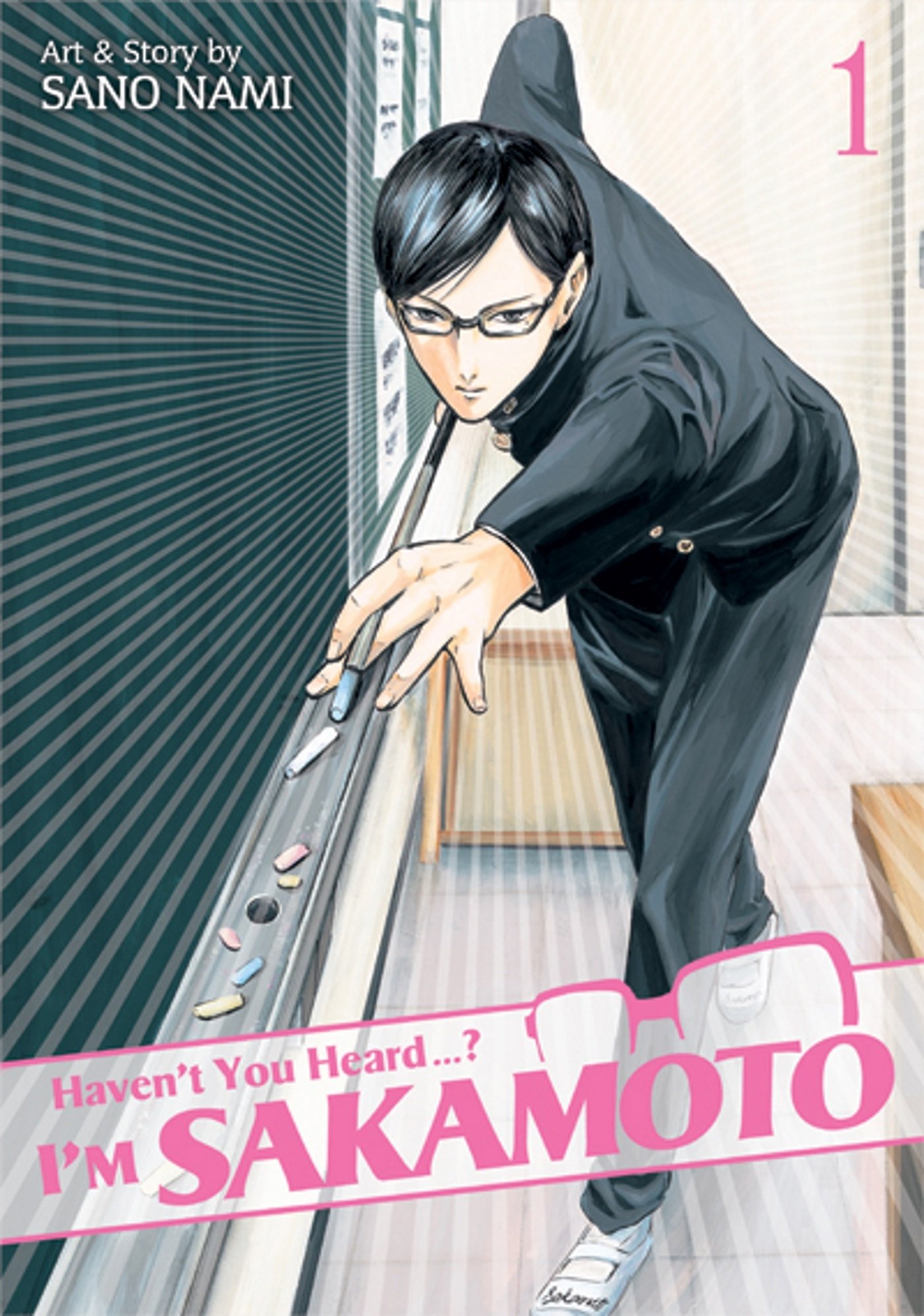
Haven’t You Heard? I’m Sakamoto is “The Aristocrats” of manga, a basic joke that yields endless variations, each more baroque than the last. The premise is simple: transfer student Sakamoto is handsome, brilliant, and athletic, making him a natural target for bullies and lovelorn girls. Any time a challenging situation arises–a bee in a classroom, a classmate injured by a softball–Sakamoto effortlessly meets that challenge, in the process revealing a previously undisclosed talent.

In the hands of a less imaginative storyteller, Sakamoto might be a wish-fulfillment character for every teenager who’s ever been tongue-tied or harassed by other students. Nami Sano puts a distinct spin on the material, however, portraying Sakamoto as so calculating and unflappable that he’s genuinely creepy; Sakamoto never smiles, laughs, or shows any discernible human emotion, even when confronted with other people’s tears or anger. (The real joke seems to be that everyone admires Sakamoto anyway.) I’m not sure that I LMAO, but Sakamoto’s odd persona and equally odd talents are a welcome rebuke to the school council presidents and earnest strivers who populate most teen-oriented manga; I’d much rather spend time with him than a standard-issue shonen prince.

The verdict: You’ll either find Sakamoto’s antics inspired or too weird to be amusing.

academiaMy Hero Academia, Vol. 1
By Kohei Horikoshi
Rated T, for teens
VIZ Media, $9.99

Meet Izuku Midoriya: he’s an ordinary teen living in a world where 80% of humanity possesses a super power. That doesn’t stop Izuku from aspiring to become a professional hero, however; since childhood, he’s dreamed about the day he might gain admission to prestigious U.A. High School, a training ground for future crime-fighters. A chance encounter with All Might, a celebrity superhero, gives Izuku a chance to prove his mettle and get the coaching he needs to pass the U.A. entrance exam.

Though the plot twists are unsurprising, and Izuku’s classmates familiar types (e.g. the Bully, the Spazzy Enthusiast), the breezy script propels My Hero Academia past its most hackneyed moments. The clean linework, playful superhero costumes, and artfully staged combat further enhance the series’ appeal; Kohei Horikoshi could give a master class on the reaction shot, especially when a supervillain is wrecking havoc on a downtown skyline. Most importantly, Horikoshi respects the sincerity of Izuku’s ambitions without letting the character’s earnest intensity cast a pall over the fun–in essence, it’s a Silver Age comic in modern shonen drag, with all the corny humor and fist-pumping action of Stan Lee and Steve Ditko’s best work on Spider-Man.

The verdict: My Hero Academia is as predictable as death and taxes, but a smart script and crisp artwork help distinguish it from other titles in the Shonen Jump catalog.

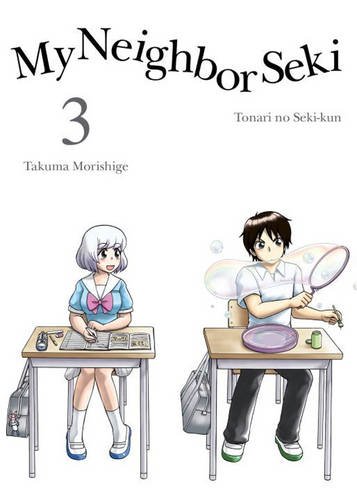
sekiMy Neighbor Seki, Vols. 1-3
By Takuma Morishige
Unrated
Vertical Comics, $10.95

Like Haven’t You Heard? I’m Sakamoto, My Neighbor Seki is a one-joke series: middle-school student Seki goofs off during class, much to the consternation of his seat mate Rumi. Seki isn’t just doodling in his notepad, however. He pets kittens, builds elaborate sculptures from shoji pieces, runs an intraschool mail service, and hosts a tea ceremony. To vary the rhythm of the joke-telling, artist Takuma Morishige occasionally transplants the action from the schoolroom to the playground, though the set-up remains the same; Seki does something outrageous and Rumi reacts, prompting the teacher to scold Rumi for not paying attention.

Given Seki‘s slender premise, it’s not surprising that each volume is a hit-and-miss affair. In volume one, for example, Seki knits a cactus plushie using a double-ended afghan hook. Rumi initially scoffs at his choice of tool; as she observes, “The hallmark of afghan knitting is its unique thickness and softness. It’s a texture best utilized when making sweaters,” not stuffed animals. When she sees the final results, however, she concedes that Seki has chosen the perfect technique and materials for his cactus, sending her into a rapturously funny meditation on yarn. Not all the gags are as successful: Seki’s penchant for staging elaborate scenes with action figures is moderately amusing at first, but grows more tiresome with each new and less imaginative iteration. Still, it’s impossible to deny the energy, creativity, and specificity with which Morishige brings Seki’s exploits to life, making this series more “win” than “fail.”

The verdict: My Neighbor Seki is best enjoyed in one or two chapter installments; when read in large bursts, some scenarios read like 4-koma strips stretched to epic and unfunny proportions.

Reviews: Over at Manga Connection, manjiorin reviews the first four volumes of Princess Jellyfish, which are currently available on Crunchyroll. TCJ columnist Joe McCulloch jumps in the WABAC machine for a nostalgic look at Even a Monkey Can Draw Manga. In honor of 801 Day, Megan R. reviews a title from the Tokyopop/BLU Manga catalog, Shout Out Loud.

Matthew Alexander on vol. 1 of Aoi House (The Fandom Post)
Michael Burns on vol. 5 of Assassination Classroom (AniTAY)
Nick Creamer on vol. 4 of A Bride’s Story (Anime News Network)
Rebecca Silverman on vol. 1 of First Love Monster (Anime News Network)
Michael Burns on vol. 7 of Food Wars! Shokugeki no Soma (AniTAY)
SKJAM! on Fragments of Horror (SKJAM! Reviews)
Connie on vol. 1 of Junjo Romantica (Slightly Biased Manga)
Sean Gaffney on vols. 1-2 of Maid-Sama! (A Case Suitable for Treatment)
Wolfen Moondaughter on vols. 1-2 of Maid-Sama! (Sequential Tart)
Lesley Aeschliman on vol. 1 of My Hero Academia (WatchPlayRead)
Adam Capps on vol. 3 of My Neighbor Seki (Bento Byte)
Connie on No Touching At All (Slightly Biased Manga)
Adam Capps on vol. 75 of One Piece (Bento Byte)
Ken H. on vols. 9-11 of Sankarea: Undying Love (Sequential Ink)
Matthew Warner on vol. 7 of Say I Love You (The Fandom Post)
ebooks girl on vol. 1 of Shiba Inuko-san (Geek Lit Etc.)
confusedmuse and Helen on Shugo Chara (Organization Anti-Social Geniuses)
Marissa Lieberman on vol. 1 of Spell of Desire (No Flying No Tights)
manjiorin on vol. 1 of Tokyo Ghoul (Manga Connection)
Ian Wolf on vol. 1 of Twin Star Exorcists (Anime UK News)
Connie on vol. 1 of Twittering Birds Never Fly (Slightly Biased Manga)
Connie on vol. 2 of Twittering Birds Never Fly (Slightly Biased Manga)
Lori Henderson on vols. 3-4 of Until Death Do Us Part (Manga Xanadu)
Sarah on vol. 9 of What Did You Eat Yesterday? (Anime UK News)
Connie on vol. 1 of World’s Greatest First Love (Slightly Biased Manga)
Alice Vernon on xxxHolic (Girls Like Comics)
SKJAM! on vol. 1 of Yamada-Kun and the Seven Witches (SKJAM! Reviews)
Ash Brown on vol. 2 of Your Lie in April (Experiments in Manga)

Filed Under: MANGABLOG, REVIEWS Tagged With: I'm Sakamoto, Manga Review, My Hero Academia, My Neighbor Seki, Seven Seas, Shonen Jump, Vertical Comics, viz media

Your Lie in April, Vol. 2

August 7, 2015 by Ash Brown

Your Lie in April, Volume 2Creator: Naoshi Arakawa
U.S. publisher: Kodansha
ISBN: 9781632361721
Released: June 2015
Original release: 2012
Awards: Kodansha Manga Award

Your Lie in April is an eleven-volume manga series created by Naoshi Arakawa that began serialization in Japan in 2011. The manga is one of Arakawa’s earliest professional works. Even so, Your Lie in April would go on to win a Kodansha Manga Award in 2013 and in 2014 the series’ anime adaptation debuted. Although I haven’t actually seen it yet, it was the anime that first brought Your Lie in April to my attention. As a lover of both manga and music (in addition to being a musician myself), the basic premise of Your Lie in April appealed to me a great deal. I was glad that Kodansha Comics licensed the series since I’m always excited to see more music manga released in English. I largely enjoyed the first volume of Your Lie in April and so was happy to receive a review copy of the second as well. Your Lie in April, Volume 2 was originally published in Japan in 2012 while the English translation was released in 2015.

Kosei hasn’t played the piano publicly for years, having tried to give it up after the death of his mother and a disastrous performance in competition. He has become so psychologically distraught that he literally can no longer his own music; the sound seems to disappear when he begins to seriously play. Very few people actually know why Kosei no longer performs or competes, and his closest friends continue to encourage him to play despite his reluctance. Somehow Kaori manages to bully him into serving as her accompanist in the second round of her violin competition at the last minute. She’s a passionate and headstrong musician who other pianists find difficult work with, sometimes even refusing to accompany her. But Kaori wants to be remembered by her audiences and she is convinced that Kosei, who was once well-known as a child prodigy, can help her do that. Except that he’s never been an accompanist before, they’ve never practiced together, and he hasn’t even had the change to study the score.

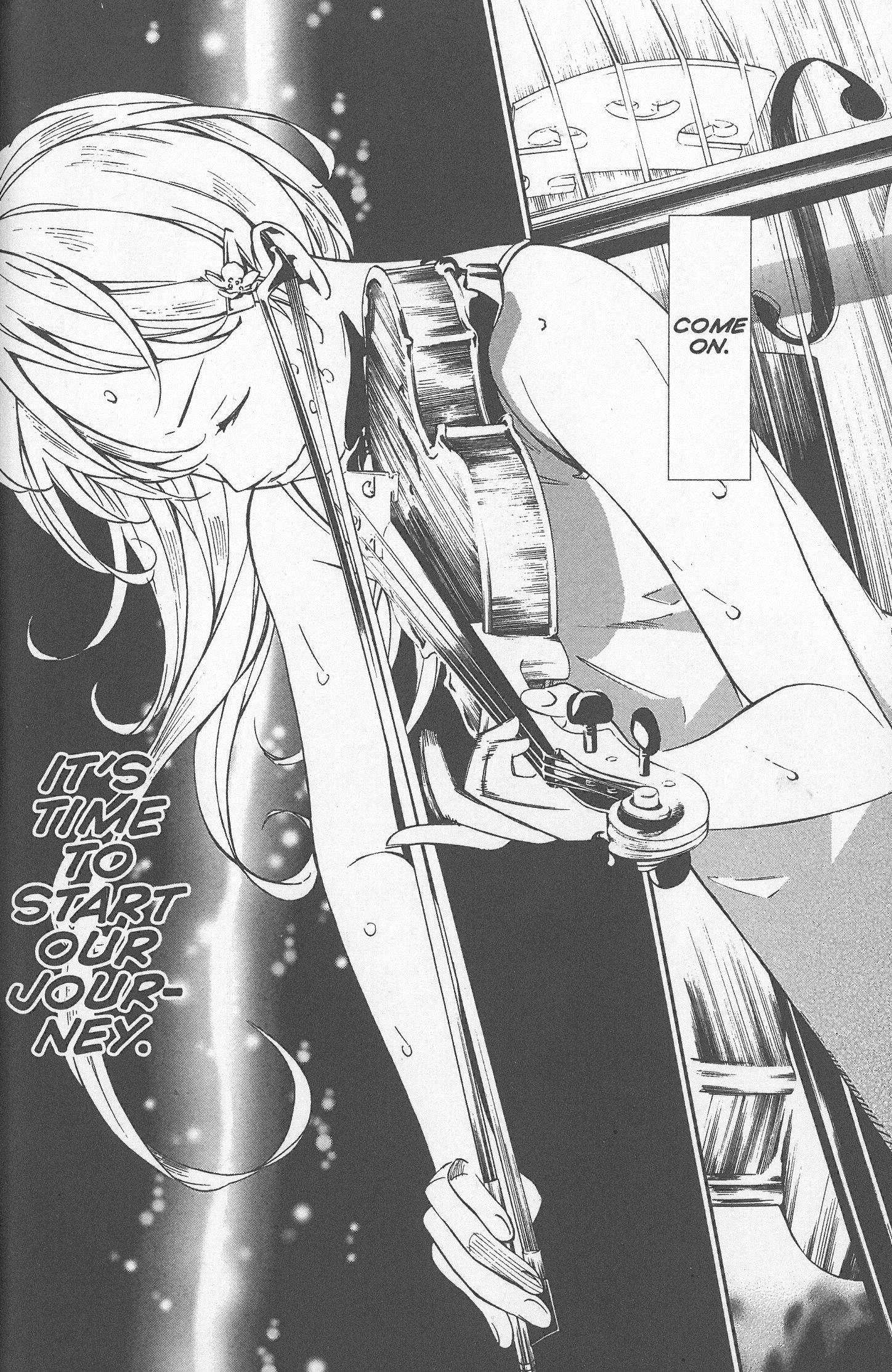
YourLieApril2-68Though Your Lie in April can be somewhat melodramatic at times, I appreciate that Arakawa is leveraging the psychological states of the series’ characters in order to further the story. Kosei being thrust into the spotlight and once again experiencing the thrill of performance doesn’t simply make everything all right or solve his problems. If anything, it actually makes matters more complicated. He continues to be torn between wanting to play and never wanting to touch the piano again. Hovering over Kosei is the shadow of his dead mother, an abusive woman who demanded perfection from him and his playing. But she was also the person who first taught him to love music. By the end of her life she had become cruel, but Your Lie in April, Volume 2 reveals that before she became ill she was much kinder and gentler person. It doesn’t excuse how she eventually treated her son, though it does help to explain in part why Kosei remained and continues to be devoted to her throughout the pain and suffering that was inflicted upon him.

What little is known about Kosei’s mother so far in Your Lie in April provides an interesting counterpoint to what little is known about Kaori. They are both musicians, they both are partly responsible for drawing Kosei into the world of music and, as the second volume of the series shows, they both struggle with physical illness. However, whereas Kosei’s mother became cruel, Kaori’s illness has caused her to devote herself to her music, striving to leave a lasting impression on those around her. No matter what happens in the future, Kosei’s relationship with Kaori, like the one with his mother, will be a formative one. He, at least, will never be able to forget her. She is an inspiration dragging him out of his personal darkness. This is something that is visually reinforced in the manga as well. Kaori is almost always shown in the light, sometimes she even seems to be the source of light, while Kosei is frequently seen in shadow, especially when he is playing. But Kaori is challenging and changing him. The time may come when Kosei will be able to freely stand in the light, too.

Thank you to Kodansha for providing a copy of Your Lie in April, Volume 2 for review.

Filed Under: REVIEWS Tagged With: kodansha, Kodansha Comics, Kodansha Manga Award, manga, Naoshi Arakawa, Your Lie in April

Maid-sama!, Vols. 1 & 2

August 7, 2015 by Sean Gaffney

By Hiro Fujiwara. Released in Japan as “Kaichō wa Maid-sama!” by Hakusensha, serialized in the magazine LaLa. Released in North America by Viz Media.

It’s hard when things that you enjoyed in the past suddenly seem more problematic to you. That hilarious maid from the old sitcom turns out to be a pretty bad stereotype. The running gag in the old British radio show is basically sexist as hell. That heartwarming childhood movie is teaching messages that are disempowering and stultifying. And yes, it even applies to license rescues, as Maid-sama!, the portrait of a gung-ho Type-A high school girl and the stalkerish guy who loves her and keeps saving her from various types of sexual assault… isn’t as funny as it used to be.

maid1

To be fair, looking back over my past reviews of this title back when Tokyopop was releasing it, I wasn’t too wild about Usui then either. But in six short years he’s gotten less tolerable, mostly because the narrative frames him as correct all the time. Part of this is the comedic conceit that he’s perfect at everything – to the point where Misaki begins to wonder if he’s actually human. But part of this is because the narrative enjoys having Misaki be strong, smart and try to rescue herself from danger but also can’t help put her in danger all the time in order to get rescued by the guy who likes her. It simply can’t avoid the standard cliches, and they’re not cliches for a good reason (and yes, there will be more sexual assault attempts as the series goes on.)

Luckily, the title has one big plus going for it, and that is Misaki herself. She’s loud, angry all the time, and can’t understand why boys exist, but at her core is a good heart and a girl who wants to help everyone – which is why she became Student Council President. She’s of a type I personally am very fond of, one that comes up often in Hakusensha titles – see also Special A and I Hate You More Than Anyone. And I do agree with Usui on one thing – teasing her and seeing her blush is adorable, and we will be seeing more and more of that blush as the series goes on. She’s stubborn as a mule (the “keep my job secret” thing isn’t even due to the traditional “no part time jobs” school rule – they’re allowed, she’s just embarrassed), but that’s also presented as a positive.

As for the rest of the cast, we still haven’t seen enough of them to really get an impression. Misaki’s trio of lovestruck idiots are pure comic relief, and the less said about the arrogant rich rapist from the rival school the better. I seem to recall when I first read the series that I liked it more when it was telling stories revolving around the maid cafe more than the school, so I look forward to reminding myself why – particularly Honoka. In the meantime, I am pleased that Viz picked this up, as I do want to see how it ends. But man, Usui is a lot harder to take in 2015 than he was in 2009 – particularly when the author agrees with him.

Filed Under: REVIEWS

Manga the Week of 8/12

August 6, 2015 by Sean Gaffney, Anna N, Ash Brown, Michelle Smith and MJ Leave a Comment

SEAN: If you want a quiet week with not much manga, next week is pretty much the only week in August you’ll get it, so enjoy.

tsubasa5

Kodansha has its 5th Tsubasa Reservoir Chronicle omnibus, which I think is busying itself by walking around the X continuity.

ANNA: You know what would be nice? If X/1999 walked around its own continuity and actually had an end to the series. That would be nice!!!!!

ASH: YES.

SEAN: X Vol. 19: everyone mysteriously vanishes into a hole in the plot except Nokoru, Suoh and Akira, and the series reboots itself as CLAMP Detectives: The Adult Years. With plenty of Utako as well. …OK, perhaps that’s only *my* version of X.

MICHELLE: I fully support this version. My life needs more grown-up Suoh in it.

MJ: I am probably a rare CLAMP fan in that I’m not super-anxious for them to finish X, but I’m not opposed to Sean’s ending here. :D

SEAN: Seven Seas gives us a 2nd volume of angsty coming-of-age story Evergreen, from the Toradora! author.

And a 7th volume of bestselling, anime-producing monster fetish manga Monster Musume. Watch out for snakes.

Sublime hopes you are still embracing the 3rd omnibus of Embracing Love.

ASH: I certainly am! This omnibus includes part of the series that wasn’t previously released in English.

SEAN: Viz gives us the 10th volume of Deadman Wonderland – are they out of prison yet?

And a 15th Itsuwaribito, which is part of the Shonen Sunday imprint! As is…

Magi, which has its lucky 13th volume. Shonen Sunday! It’s an imprint too! You can see it, next to the Jump and Beat titles. Well, sort of next to them. Down the hall. And a stairway. Next to the boiler room. (Buy Sunday titles.)

ANNA: I need to fill in my collection and read more of this series!

MICHELLE: Yay, Magi! And I concur; the Shonen Sunday imprint has a lot of good stuff, like Kekkaishi, Cross Game, and all of the Rumiko Takahashi!

SEAN: Does anything here tickle your fancy?

Filed Under: FEATURES, manga the week of

Giveaway: Sparkler Monthly Giveaway Winner

August 5, 2015 by Ash Brown

Tokyo Demons, Book 2: Add a Little ChaosAnd the winner of the Sparkler Monthly Giveaway is… AshLynx!

As the winner, AshLynx will get to choose one item from the Sparkler Online Shop in addition to receiving a copy of Tokyo Demons, Book 2: Add a Little Chaos written by Lianne Sentar and illustrated by Rem. I coordinated the giveaway to draw more attention to the Sparkler Monthly Year 3 Kickstarter campaign which I’m very happy to say was successful! I absolutely love the work being done at Chromatic Press and Sparkler Monthly, so I’m glad those efforts will be able to continue for at least another year. For the giveaway, I asked participants to tell me about some of their favorite Sparkler stories. Be sure to check out the Sparkler Monthly Giveaway comments for the detailed responses!

Finally, here’s the list of current ongoing series at Sparkler Monthly that will be able to continue thanks to the campaign’s success:

The Cat Lover’s Circumstances by LAMP and Aiwa
(Geeky Modern Comedy Audio Drama)

Gatesmith by Jen Lee Quick
(Dark Fantasy Western Comic)

Knights-Errant by Jennifer Doyle
(LGBT Historical Drama Comic)

Lettera by Studio Kosen
(Comedy Fantasy Adventure Comic)

Orange Junk by Heldrad
(Shoujo Romantic Comedy Comic)

Skyglass by Jenn Grunigen and Mookie
(Sci-Fi Musician Drama Prose)

Tokyo Demons by Lianne Sentar, Rebecca Scoble, Rem, and Romy-chan
(Urban Fantasy Adventure Drama Prose)

Windrose by Studio Kosen
(Historical Adventure Comic)

Witch’s Quarry by Jen Lee Quick
(LGBT Fantasy Adventure Comic)

The above list is only a selection of Sparkler Monthly‘s total output. It doesn’t include any of the stories that have already been completed or any of the new stories that will be added throughout the coming year. Thank you to everyone who shared their favorite Sparkler stories with me. (Sparkler fans are the best fans!) And if you don’t have a favorite yet, start exploring! With the range of formats, genres, characters, and stories, there’s bound to be something that you’ll find appealing. (And most of it’s free!) Personally, I haven’t been disappointed with anything from Sparkler Monthly and am thrilled that there will be even more content in the future.

Save

Filed Under: Giveaways, UNSHELVED Tagged With: Lianne Sentar, Rem, sparkler monthly, Tokyo Demons

August Manga Releases, ‘Barefoot Gen’ Kickstarter

August 4, 2015 by Brigid Alverson

Attack on Titan 16

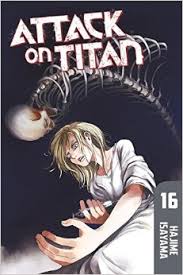
I rounded up the August manga releases at the Barnes and Noble blog; with new volumes of Naruto and Attack on Titan coming out, it’s a big month.

Speaking of Attack on Titan, there has been a flurry of news lately about how big a deal it is, but this sums it all up: There are currently 50 million copies in print of the different volumes of the series; volume 16 is out in Japan and will be out in the U.S. this month.

Last Gasp, the publisher of Barefoot Gen, has launched a Kickstarter to fund the publication of 4,000 hardcover volumes (1,000 each of the first four volumes) and distribution to schools and libraries.

Lori Henderson rounds up the Otakon news, with her own commentary on the new license announcements.

At Heart of Manga, Laura takes a look at this month’s new shoujo manga releases.

Zainab Akhtar writes about Jiro Taniguchi’s The Walking Man and the Japanese concept of ma, or emptiness.

Stop! You’re reading the wrong way! Most MangaBlog readers probably don’t even notice those guides on the last page of each volume that explain how to read manga right to left, but Verneida Vergara does, and she posts a quick survey of which publishers do and don’t include that helpful-to-newcomers information.

Reviews: The Manga Bookshelf team have plenty to say about an eclectic selection of new volumes in their latest Bookshelf Briefs column.

Erica Friedman on Ai Rabu Yuu Yori Aishiteru (Okazu)
Ash Brown on vol. 1 of Akame Ga Kill and vol. 2 of Let’s Dance a Waltz (Experiments in Manga)
Dave Ferraro on vol. 1 of Captain Ken (Comics-and-More)
Amanda Vail on Legal Drug and Drug & Drop (Women Write About Comics)
Leroy Douresseaux on vol. 12 of Magi (The Comic Book Bin)
Kanta Ishida on My Love Story!! (The Japan News)
Kristin on vol. 5 of My Love Story!! (Comic Attack)
Ash Brown on vol. 1 of Orange Junk (Experiments in Manga)
Sarah on vol. 9 of Ranma 1/2 (2-in-1 edition) (nagareboshi reviews)
Sean Gaffney on vol. 2 of A Silent Voice (A Case Suitable for Treatment)
Matthew Warner on vol. 1 of So Cute It Hurts! (The Fandom Post)
Lindsey Tomsu on vols. 1-3 of Zero’s Familiar (No Flying, No Tights)

Filed Under: MANGABLOG

Pick of the Week: Sparkling Series

August 4, 2015 by Sean Gaffney, Michelle Smith, Ash Brown, MJ and Anna N Leave a Comment

voiceover12SEAN: I was originally going to pick Showa here, but Amazon helpfully moved it to late September at the very last minute. So instead I will pick Haven’t You Heard? I’m Sakamoto, Seven Seas’ new series about the coolest high school student around, and how no one else can hold a candle to him. It’s completely hilarious and I want more immediately.

MICHELLE: Voice Over!: Seiyu Academy may not be a classic, but I have grown to like it very much over its run, and so must pick the twelfth and final volume while I can. I hope for a sugary sweet ending with kitties.

ASH: I was all set to choose Haven’t You Heard? I’m Sakamoto, but then the Sparkler Monthly Kickstarter reached its goal over the weekend. I’m so excited that we’ll be seeing another year of fantastic content, beginning this month!

MJ: I’m pretty much MIA due to my teen opera production which goes up next week, but I had to jump in to add to Ash’s excitement. Yay, Sparkler!! We’re so lucky to be getting more of this magazine!

ANNA: I will go with the third volume of JoJo’s Bizarre Adventure: Phantom Blood. So weird! So manly!

What looks good to you this week?

Filed Under: PICK OF THE WEEK

A Silent Voice, Vol. 2

August 4, 2015 by Sean Gaffney

By Yoshitoki Oima. Released in Japan as “Koe no Katachi” by Kodansha, serialized in the magazine Weekly Shonen Magazine. Released in North America by Kodansha Comics.

After the pressure cooker that was the first volume of this series, it was somewhat inevitable that things would slow down and get a bit less traumatic with this second one. this is not to say that nothing happens, but we need to take a step back from the brink and see where our hero and heroine are now. Indeed, taking a step back from the brink is exactly what Shoya does, as after seeing Shoko again he makes a decision not to kill himself (which leads to one of my favorite parts of the book, where his mother confronts him about it and accidentally burns the money that he saved up for her. She’s presented as sort of a grown-up airhead much of the time, but I loved her reasoning in this scene as to why it was fine she burned the money.

silent2

As for Shoko, there’s a nice bit of narrative fooling that makes us think that we’re hearing her fairly negative thoughts about seeing Shoya after all these years. but in fact after a brief moment Shoko proves to be as sweet and understanding as you’d expect from a manga like this, and it turns out the narrative voice we heard hating on Shoko was her younger sister Yuzuru, who understandably thinks that Shoya ruined her sister’s life. This leads to her amusingly pretending to be Shoya’s boyfriend, which I didn’t buy for one moment, mostly as I assumed she was just a young tomboy from the start. Unlike Shoko’s mother (who not only does not remotely forgive Shoya for what he did to her child, but seems to have the ability to literally teleport in order to slap someone across the face), Yuzuru finally sees that Shoya really is making an effort to make amends, and starts to warm up to him by the end of the book.

Of course, it’s not as easy as that. I was impressed with how Shoya can still be resolutely unlikeable at times, even as we see him trying to deal with the fallout of various events (including serving a suspension for leaping into the river to save Shoko’s notebook), he’s still bad at understanding other people to a great degree. He makes friends with Tomohiro, who also seems to be bullied in his classroom, though that’s more for the traditional “I am pudgy and a bit of a nerd” than anything else, but we still get his POV of his fellow students as having X’s over their faces, which is a stark reminder of how in many ways his basic worldview hasn’t changed much. His guilt about Shoko drives him to learn sign language and apologize, but he needs to make more effort with everyone else. And that’s hard, given what happened in Volume 1, as no one will allow him to make that effort.

I’m not sure if this is going to go in a romantic direction – the ending seems to imply it might, but I’m not sure if that’s the best thing for this series, and in any case the two leads still have a lot more to sort through before that can happen. In the meantime, the second volume builds on the success of the first, and is not nearly as discomfiting.

Filed Under: REVIEWS

  • « Go to Previous Page
  • Page 1
  • Page 2
  • Page 3
  • Page 4
  • Go to Next Page »
 | Log in
Copyright © 2010 Manga Bookshelf | Powered by WordPress & the Genesis Framework