• Skip to primary navigation
  • Skip to main content
  • Skip to primary sidebar
  • Home
  • About Us
    • Privacy Policy
    • Comment Policy
    • Disclosures & Disclaimers
  • Resources
    • Links, Essays & Articles
    • Fandomology!
    • CLAMP Directory
    • BlogRoll
  • Features & Columns
    • 3 Things Thursday
    • Adventures in the Key of Shoujo
    • Bit & Blips (game reviews)
    • BL BOOKRACK
    • Bookshelf Briefs
    • Bringing the Drama
    • Comic Conversion
    • Fanservice Friday
    • Going Digital
    • It Came From the Sinosphere
    • License This!
    • Magazine no Mori
    • My Week in Manga
    • OFF THE SHELF
    • Not By Manga Alone
    • PICK OF THE WEEK
    • Subtitles & Sensibility
    • Weekly Shonen Jump Recaps
  • Manga Moveable Feast
    • MMF Full Archive
    • Yun Kouga
    • CLAMP
    • Shojo Beat
    • Osamu Tezuka
    • Sailor Moon
    • Fruits Basket
    • Takehiko Inoue
    • Wild Adapter
    • One Piece
    • After School Nightmare
    • Karakuri Odette
    • Paradise Kiss
    • The Color Trilogy
    • To Terra…
    • Sexy Voice & Robo
  • Browse by Author
    • Sean Gaffney
    • Anna Neatrour
    • Michelle Smith
    • Katherine Dacey
    • MJ
    • Brigid Alverson
    • Travis Anderson
    • Phillip Anthony
    • Derek Bown
    • Jaci Dahlvang
    • Angela Eastman
    • Erica Friedman
    • Sara K.
    • Megan Purdy
    • Emily Snodgrass
    • Nancy Thistlethwaite
    • Eva Volin
    • David Welsh
  • MB Blogs
    • A Case Suitable For Treatment
    • Experiments in Manga
    • MangaBlog
    • The Manga Critic
    • Manga Report
    • Soliloquy in Blue
    • Manga Curmudgeon (archive)

Manga Bookshelf

Discussion, Resources, Roundtables, & Reviews

Archives for October 2014

Monkey Business: New Writing from Japan, Vol. 4

October 18, 2014 by Ash Brown

Monkey Business: New Writing from Japan, Volume 4Editors: Motoyuki Shibata and Ted Goossen
Publisher: A Public Space
ISSN: 2159-7138
ISBN: 9780615962757
Released: March 2014

The original Monkey Business was a Japanese literary journal was published between 2008 and 2011. 2011 also saw the launch of Monkey Business: New Writing from Japan, the English-language, international edition of the journal. Edited by Motoyuki Shibata, who was also heavily involved with the original Monkey Business, and Ted Goossen, the English-language Monkey Business is released annually and collects a variety of fiction, poetry, nonfiction, essays, and manga. The selections found in the fourth volume of the journal, published in 2014, come from a range of sources, including but not limited to the original Monkey Business and its followup journal Monkey (launched in 2013). In addition to works that had previously been published, some of the contributions selected were specifically commissioned for the fourth issue. I’ve been reading and enjoying the international edition of Monkey Business since its beginning and always look forward to the newest volume.

The fourth issue of the international edition of Monkey Business collects twenty-three works, mostly short stories, contributed by creators from Japan, the United Kingdom, and the United States. The earliest work was originally published in 1845 while the most recent contributions were released for the first time in this particular volume. Quite a few of the artists and authors are returning to Monkey Business, including some of my personal favorites. I’m always glad to see more of Toh Enjoe’s work translated and I was not at all disappointed with his bizarre short story “A Record of My Grandmother.” I’ve also become rather fond of Keita Jin’s short stories and very much enjoyed “The Girl Behind the Register Blows Bubbles.” Some selections like Hiromi Kawakai’s “People from My Neighborhood” and Sachiko Kishimoto’s “The Forbidden Diary” are continuations from previous volumes of Monkey Business. I particularly look forward to reading those authors from one issue to the next. I also really enjoyed Masatsuga Ono’s short story, “The Man Who Turned Into a Buoy.” This actually surprised me a bit as I usually struggle with Ono’s work. Another favorite was Gen’ichirō Takahashi very strange story “Demon Beasts.”

Other returnees to Monkey Business include Stuart Dybek with the short story “Naked,” Hideo Furukawa with “The Bears of Mount Nametoko,” Yoko Hayasuke with “Eri’s Physics,” Mina Ishikawa with “The Lighthouse on the Desk” (which is a collection of tanka poems), Mieko Kawakami with the story “The Little Girl Blows Up Her Pee Anxiety, My Heart Races,” Taki Monma with “White Socks,” and Richard Powers with “The Global Distributed Self-Mirroring Subterranean Soul-Sharing Picture Show,” a fascinating essay about Haruki Murakami’s fiction and brain science. The two manga contributions included in the fourth volume of Monkey Business are also from artists who have been a part of the journal in the past. Brother and Sister Nishioka adapt Bruno Schulz’ story “Tailors’ Dummies” (it’s nice to see them branch out from works by Franz Kafka) and Fumiko Takano illustrates a highly abstract adaptation of “The Little Match-Girl” by Hans Christian Anderson. A translation of Anderson’s original story is also included, which is particularly helpful for those readers who are not familiar with it when trying to make narrative sense of Takano’s rendition.

While it’s wonderful to see so many returning creators to Monkey Business, I also greatly appreciate that the journal always includes someone or something new. “Everybody’s Got Something to Hide Except Me and My Monkey”, the fourth volume’s opening work by Craft Ebbing & Co., is probably the most unusual–a series of photographs of an art piece with accompanying narration. Of all the newcomers to this issue of Monkey Business, I particularly enjoyed Brian Evenson’s short story “The Punish” and the tangentially related “A Message to My Japanese Readers,” a collection of short essays by Evenson and three other authors (Laird Hunt, Denis Johnson, and Salvador Plascencia). Other short stories from authors new to the journal include Doppo Kunikida’s “Unforgettable People,” Kenji Miyazawa’s “The Restaurant of Many Orders” (previously I had only read examples of his poetry), David Peace’s “After Ryūnosuke, Before Ryūnosuke” and Hyakken Uchida’s “The Sarasate Disk.” Overall, I don’t feel that the fourth volume was quite as diverse as previous issues of Monkey Business. However, it’s still a solid collection. Many of the stories tend toward the slightly strange, bizarre, and absurd, but that’s a sort of fiction that I happen to enjoy.
Filed Under: REVIEWS Tagged With: A Public Space, manga, Monkey Business, Motoyuki Shibata, Nonfiction, Poetry, Ted Goossen

Sweet Blue Flowers, Vol. 1

October 17, 2014 by Jocilyn Wagner

Earlier this year my good friend Jocilyn Wagner contributed a review of Hiroki Ugawa’s Shrine of the Morning Mist, Volume 1 to Experiments in Manga. She was recently inspired to do so more manga blogging and to write another review, and so I’m happy to welcome Jocilyn back to Experiments in Manga! This time she’ll be taking a look at the Digital Manga Guild edition of Sweet Blue Flowers, Volume 1 by Takako Shimura.

* * *

Cover400

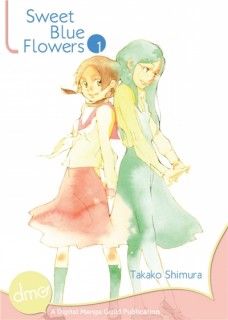
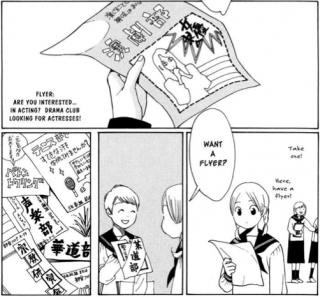
Easily Shimura Takako’s most well-known manga endeavour, Sweet Blue Flowers is an unforgettable bildungsroman of the classic Japanese girl’s school (minus the dorm boarding). The story focuses on two heroines: Manjoume Fumi and Okudaira Akira. Childhood friends who were separated for elementary and junior high and by coincidence have moved into the same neighborhood together for high school. The girls, who don’t at first recognize each other, are reintroduced when Akira (called “Aki” in this version) saves the timid Fumi from train molestation. Although the two attend different schools, their close friendship and shared interest in acting cause Fumi to find excuses to attend theatre club at Aki’s much more wealthy/prestigious school.

The setting of two close-knit girls’ schools often lends itself to a Yuri manga and Sweet Blue Flowers positively embraces the plot line. As the story opens, Fumi (tall and bashful) is recovering from her separation with Chizu, Fumi’s first love, a cousin who’s getting married. Enter in the dashing heartbreaker Sugimoto Yasuko who’s been recently cast against her will as the swoon-worthy Heathcliff. Yasuko is immediately smitten of Fumi and Fumi is quick to return her feelings (…perhaps too quick?). Despite being easily embarrassed and a worrier, Fumi manages to confide the relationship and her sexuality in Aki. The level-headed Aki doesn’t really understand why this would be a problem but ponders the issue while Fumi, who’s assumed it will come between them slips into fear-induced avoidance of her. When Aki’s finally able to snag Fumi aside she asks her, “What can I do to support you?”

Sweet Blue Flowers is as wonderful and poignant in English as it is in Japanese. The story is moving and rapturous. I’m really hopeful DMP can publish Sweet Blue Flowers in print…

But now I think I have a better understanding of why they might not. Compared to Fantagraphics’ Wandering Son, this version of Aoihana is frankly an embarrassment that in no way lives up to the beauty of the original and really shouldn’t be printed as is. It’s in desperate need of an English adapter and some real copy editing. As a Shimura fangirl, I really want to see Aoihana in print, so just in case the project leader is listening, the following is a substantial critique. The optimist should stop reading here. :)

The biggest problem in my mind is that bizarrely, instead of how it’s always been rendered “Ah-chan” in both the original manga AND the anime near and dear by now to the hearts of North Americans, this version replaces all the Ah-chans with “Aki.” To be fair, Aki is more of a fleshed out name than Ah-chan, but it’s really a boy’s name and it doesn’t suit Akira’s character, besides which it’s not a name Shimura-sensei chose. Part of what makes Aoihana so cute is that the Okudaira siblings have their names reversed: that is to say, Akira is usually though not always a boy’s name and Shinobu is similarly a girl’s name occasionally used for boys. Perhaps the idea here with “Aki” was to emphasize that her name doesn’t fit the image? Yet I think Shimura-sensei would argue that’s exactly why she’s always been called Ah-chan (to make up for/ignore the more masculine Akira). Put simply, Akira is always called Ah-chan because she’s ridiculously cute and her role in the story is to be the best friend and onee-chan from Fumi’s childhood, thus someone you’d want to give a cute nickname to like “Ah-chan.” Perhaps because she’s given a bit more wisdom than other characters or because of her future role in the story, the DMG team chose to call her Aki. At any rate, it feels like an awkward and unnecessary change that will stick out painfully to most fans of the work.

Additionally, there’s just too much left untranslated in terms of signage with parenthetical notes given instead that really detract from the flow of the reading. As far as I can tell, all the signs and documents are left untranslated (even ones that couldn’t possibly be hurt by replacement with English such as the heading card in the photo album scrapbook that reads “Christmas Party” or the words on the cake for Chizu’s party) which comes off looking like the typesetter just couldn’t be bothered/too inexperienced to handle the job. For the none-Japanese reader it’s too much work to constantly be hunting for marginalia. Shimura’s penmanship isn’t all that legible anyway (most were drawn with marker), so if you can read Japanese, leaving the signs as is doesn’t necessarily help things–except in the case of one of her school gateway engravings, it doesn’t exactly have a “Shoudo” quality. Perhaps the concept here is to give the English reader a sense that they’re really in Kamakura, but that’s actually doing Shimura-sensei a disservice as the gorgeous well-researched setting she’s drawn is more stark and striking than most mangaka can muster.

sweet blue flowers snippita

Add to this a lot of really tiring typographical errors such as “Pap” for “Pat” and “Beautiful is Youth” “Hasegawwa” and “Fajisawa”, really detract from the reading experience. The emanga version of Sweet Blue Flowers is very welcome and we love you for it, but please consider further editing before sending it to the printer.

In terms of the digital file, it’s definitely topknotch. Emanga allows you to choose from among seven or eight major formats as well as offering you the option of reading your books through their proprietary online reader. I was really happy to be able to get Sweet Blue Flowers in PDF since it looks and functions the best on the iPad. It’s not always the most annotation friendly, but since manga is an artistic medium it makes sense to use an Adobe format to access it. Unfortunately, once you’ve chosen to download the file in one format, you’re stuck with only that single file type and you’d need to repurchase it from emanga to get it in a different format (DRM is kinda evil like that). I had no trouble downloading the file and it opens great on all my devices. Given their many options for downloading, their pricing system that’s free from points and rentals and their interface with Amazon, I’d highly recommend emanga over some other digital manga sites I’ve tried (except when it comes to editing).

Filed Under: FEATURES Tagged With: Digital Manga, digital manga guild, manga, Sweet Blue Flowers, Takako Shimura

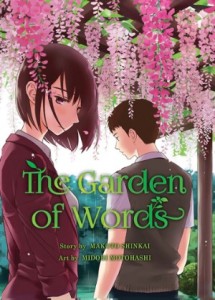
The Garden of Words

October 17, 2014 by Sean Gaffney

By Makoto Shinkai and Midori Motohashi. Released in Japan by Kodansha, serialized in the magazine Afternoon. Released in North America by Vertical Comics.

I don’t really watch a lot of anime, but I know enough by osmosis that I am aware that the words ‘Makoto Shinkai’ and ‘bittersweet’ go together extremely well. I also recall the manga version of Five Centimeters Per Second, which lived up to that description very well. Now Vertical is releasing The Garden of Words, another by the same author. It’s still pretty riddled with emotion and emotional turmoil, but the good news is that there is a more optimistic ending that makes you think things might actually work out for the couple on the cover, even if several people might be skeeved a little by the May-August romance going on within the book.

garden

Our hero is Takao, a young high school student who has dreams of being a shoemaker, but finds himself frustrated as he’s trying to do this self-taught, and still is not as good as he wants to be. He skips school whenever it’s raining and goes to a public gazebo to sketch people’s shoes. I like him. His frustration rings very true, and we can also see how he wants to try to help Yukari as well but is uncertain how to, so it just comes out as emotional turmoil. He also falls for her pretty fast, even though she’s clearly older than she is – he assumes that she is an office lady.

One of the more interesting things about this title is that it has some reverse bullying. Takao seems to get on fairly well with his fellow students. When we get the flashbacks that show us what led Yukino to her depressed current existence, though, we see that it was a case of the students bullying a young teacher. The girls in her class think she’s being too friendly with the boys, so begin to simply skip, and the rest of the class then joins in. The few remaining blame the teacher for the poorer instruction they receive as a result. And so Yukino quits, and we see in the scenes in her tiny apartment that she’s had tremendous trouble moving forward in life, to the point where she goes to the aforementioned gazebo just to drink.

But she and Takao have a strong bond, at first over poetry, and then because they seem to want to understand each other. I like that the poetry used was one of those quotes where you have to find the proper response, as it allows the whole thing to go full circle towards the end. I was a bit less happy with the way things did turn romantic – there’s nothing untoward here, but Takao does say he’s in love with Yukino, and the epilogue hints he’ll seek her out after he graduates from shoemaking school. The artist even shows off the discomfort of this by including a picture of a 20-year-old Yukino holding hands with an 8-year-old Takao in the extras. Teacher/student romance stories are far more popular in Japan than they are here, where anime fans still can’t say the words “Na-chan” without risking a fight.

Overall, however, this is exactly what you want from a Makoto Shinkai story, and the fact that it’s slightly happier and open ended also helps. And at one volume, it would also be a good present for someone who may have seen the film it’s based on.

Filed Under: REVIEWS

Manga the Week of 10/22

October 16, 2014 by Sean Gaffney, Michelle Smith, Ash Brown, Anna N and MJ 1 Comment

SEAN: Another week, another pile. Here we go.

I may not really enjoy Gantz, but it certainly sells in comic shops, and is popular enough that the author’s new title was just announced at NYCC. We’re still a few volumes from the end over here.

animal10

Animal Land, an underrated Kodansha title, has reached Vol. 10. I always mean to go back and check this out, but never do.

MICHELLE: I honestly had no idea this was still going.

SEAN: If you still haven’t gotten the first four Attack on Titan volumes, Kodansha has a nice box set of them for you.

No. 6 has hit Vol. 9, and there are many Manga Bookshelf peeps excited about that.

ASH: I’m looking forward to it! (I just hope the manga’s ending is handled better than the anime adaptation’s was.)

SEAN: Sankarea has also hit Volume 9, and has pretty much ceased to be a fanservice-filled romantic comedy entirely. At this point you wonder who will remain alive at the end.

In case manga was not enough Alice for you, Seven Seas has the light novel Alice in the Country of Diamonds: Bet on My Heart. Blood is the love interest du jour, I believe.

ANNA: I wonder if this series will ever run out of card suits and have to incorporate an additional organizational system drawn from other games like Jenga or Yatzee.

Arpeggio of Blue Steel impressed me more than I expected, and I am eager to see if the second volume can keep it up.

Thought you’d read all of Dance in the Vampire Bund, had you? Never! There are still the… Secret Chronicles. (makes scary woooo gestures with fingers)

Haganai 9 won’t get you many friends, but it should still provide a lot of laughs and some heart as well.

ngnl1

Seven Seas debuts the manga version of No Game, No Life. With the light novel out next year, this series is getting a lot of push. It looks pretty fanservice-heavy, but hey.

Vertical also has a new debut with Vol. 1 of Witchcraft Works. I reviewed it over here.

ASH: I’m rather curious about Witchcraft Works.

SEAN: Viz is releasing an 18-volume Black Bird Box Set, which… why? I thought we were done! (weeps)

MJ: NO… no… nooooooo…

MICHELLE: I know what I’m getting MJfor Christmas!

MJ: *stare of death*

MICHELLE: Dude. That’s harsh.

MJ: It was the mildest response I could come up with.

ANNA: Not a fan of Black Bird but hey, at least we have a series to point people to if they really enjoy wound licking.

SEAN: And Monster gets a 2nd omnibus Perfect Edition.

MICHELLE: I have fond memories of Monster

ANNA: I might buy these omnibus editions for myself as a holiday present!

SEAN: For Hayao Miyazaki fans, Princess Mononoke: The First Story is a must buy, being the original early 80s idea he had for the eventual movie to come.

And for alt-manga fans, you can’t go wrong with a new volume of Sunny.

ASH: That’s true!

MJ: Finally, something for me to get excited about this week!

MICHELLE: Same here! I was beginning to despair.

ANNA: Alt-manga isn’t my favorite thing, but Sunny is great.

SEAN: Lastly, there’s a new Vagabond, still trundling along even after 3 dozen books.

ASH: I’ve really been meaning to catch up with Vagabond; Inoue does some fantastic work.

ANNA: I love the 3 in 1 Vagabond editions.

SEAN: Is there a book here that’s right for you?

MICHELLE: Just one, apparently!

Filed Under: FEATURES, manga the week of

3 Things Thursday: NETCOMICS

October 16, 2014 by MJ 3 Comments

givetotheheartIt’s been over three years since Michelle and I published an Off the Shelf column entitled, “NETCOMICS Lives!” A year later, it seemed that our excitement was perhaps premature, as new chapter releases dwindled and the company’s social media accounts went dark. But this year, once again, we’ve seen signs of life! I’m a bit late realizing it, myself. When, just yesterday, the NETCOMICS Twitter account suddenly favorited two old tweets of mine from 2012, I headed over to the website, only to find that not only had NETCOMICS attended Anime Expo this year, but they were also releasing a new print series, Give to the Heart, the first volume of which was just released this week!

Give to the Heart is written by Wann, an artist I’ve had mixed experiences with (see 100% Perfect Girl), but her series So I Married an Anti-Fan was one of the charming new series Michelle and I got so excited about back in 2011, so I can’t help but feel optimistic. Most notably, as I mentioned, Give to the Heart is being released in print which I admit I far prefer over the company’s only other current method of distribution—its chapter-by-chapter, short-term rentals.

letdaiI still deeply regret not picking up all my favorite NETCOMICS series in print when they were available. In fact, one of my tweets that NETCOMICS recently favorited was this from February 9th, 2012: “Random wish–I read all 15 volumes of Let Dai digitally at @NETCOMICS… kinda wish I owned the complete print run. Volumes very $ now, tho.” Honestly, this is still true, perhaps even more now than it was in 2012. The longer I’m a fan, the more careful I am about keeping my personal print collection relevant and manageable, but it is series like Let Dai—epic fantasies (romantic or otherwise) with memorable characters and lovely artwork—that I most long to keep around.

Not only that, it’s exactly the kind of series I’d be pleased to share with my teen students, as it’s both the strengths and flaws of a series like this that make it something I’d have enjoyed most when I was a teen. If I enjoy it as an adult despite its excessively violent and melodramatic nature, I’d have loved it for exactly those things when I was twelve or thirteen. For this reason, I’ll likely pick up the print volumes of Give to the Heart as they become available, just in case it might become a source of later regret.

So what am I getting at here? What are my 3 things? Okay, here we go:

3 NETCOMICS series I wish I owned in print:

82_7_11. Do Whatever You Want | Yeri Na Oh, English-language publishing has been so cruel to Yeri Na. While I’m happy to have been able to read this series in its entirety on NETCOMICS’ site (a fate much kinder than that of Drama Queen’s ill-fated license for Peter Panda), a short-term rental just really can’t do this series justice. Like Let Dai, it’s a series that deserves a long shelf life, being re-read and shared and discussed in squeeful hushed tones between teens (or adults who still remember being teens). This is a terrific title that ends up being both deeper and larger in scope than it might initially appear. I own the first three published volumes, and they do sit happily on my shelf. I would dearly love to be able to add the remaining four. Pipe dreams… pipe dreams. Note: This same, unfinished fate also applies to Roureville.

fullhouse42. Full House | Sooyeon Won – From the same gloriously over-the-top mind that brought us Let Dai, Full House was rescued from its original doomed publication by the defunct Central Park Media, and thankfully brought to us in its entirety to us via NETCOMICS’ digital platform. Unfortunately it remains in that format only. From my review of the second volume: “Though this series is, frankly, stunningly predictable, to leave it at that would be a grave oversimplification. Manhwa-ga Sooyeon Won has an extraordinary talent for turning romantic cliché into storytelling gold … Her secret to this is brazen excess, which in this case applies to the series’ endless stream of classic screwball comedy banter—precisely the thing that makes the story so much fun in the first place.” We wants it, precious… ON OUR SHELVES. *weep*

small-minded23. Small-Minded Schoolgirls | Toma – This three-volume series is the only one on this list that has never enjoyed a print run, and while I certainly understand the (apparent) difficulty in marketing comics for adult women, this truly is a shame. This unsentimental comic was one of my favorites in 2009, and remained so through the end of its run on NETCOMICS. Its idiosyncratic art style and fantastic female characters belong on my shelf next to Moyoco Anno, Natsume Ono, and Fumi Yoshinaga. What a wonderful collection that would be! Out of all the titles on this list, Small-Minded Schoolgirls is also the one I’d recommend most fervently to new readers. Its length makes it a low-cost, low-committment option at twenty cents a chapter (you can read the entire thing for under $3). It’s really a crime *not* to read it!

Of course, while I can avoid blame for not owning these non-existent volumes in print, will I ever recover from my lack of foresight in failing to buy Let Dai? Probably not. How about you? What NETCOMICS series do you wish you owned in print?

Filed Under: 3 Things Thursday

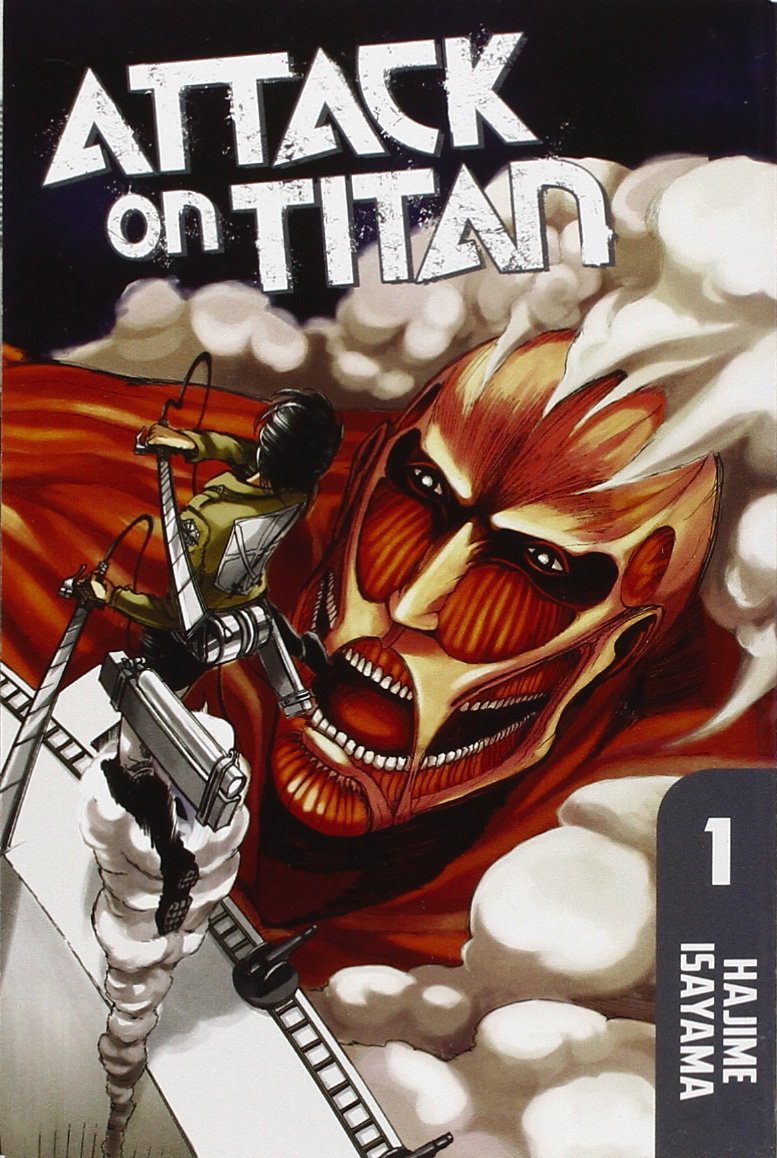
Attack on Titan Boosts US Manga Market

October 16, 2014 by Katherine Dacey

Sales of Attack on Titan have helped reinvigorate manga publishing in the US.

Over at Publisher’s Weekly, Deb Aoki files a lengthy report on the state of manga publishing. The good news: Attack on Titan has attracted thousands of new readers to manga, just as Naruto did ten years ago. As a result, manga publishers across the industry are reporting stronger sales for 2014 and licensing more titles for 2015.

Does Crunchyroll’s practice of “simulpublishing” harm print sales of series such as Ajin and Attack on Titan? Alexander Hoffman investigates.

Nike Taiwan will be launching a shoe line inspired by Takehiko Inoue’s Slam Dunk.

Dark Horse announced a smattering of new titles for 2015, including the final volume of Oh! My Goddess. (That would be number 47, in case you’ve lost track.)

The Japan Times explores the growth of digital manga magazines, from NHN PlayArt’s Comico to Shueisha’s Shonen Jump+.

Reviews: Butt-kicking heroines unite! Megan R. posts a lengthy appreciation of Sailor Moon, while Ash Brown reviews Revolutionary Girl Utena: The Adolescence of Utena.

Theron Martin on vol. 19 of Battle Angel Alita: Last Order (Anime News Network)
Jenny Ertel on vols. 1-4 of Blue Morning (No Flying No Tights)
Lesley Aeschliman on vol. 2 of Dengeki Daisy (Lesley’s Musings on Anime & Manga)
Seth Hahne on vols. 1-4 of From the New World (Good Ok Bad)
Seth Hahne on In Clothes Called Fat (Good Ok Bad)
Matthew Warner on vol. 8 of Is This a Zombie? (The Fandom Post)
Ken H. on vol. 1 of Kimagure Orange Road (Sequential Ink)
Leroy Douresseaux on vol. 8 of Magi: The Labyrinth of Magic (Comic Book Bin)
Helen on vols. 1-3 of Paradise Kiss (Narrative Investigations)

Filed Under: MANGABLOG

Revolutionary Girl Utena: The Adolescence of Utena

October 15, 2014 by Ash Brown

Revolutionary Girl Utena: The Adolescence of UtenaCreator: Chiho Saito
U.S. publisher: Viz Media
ISBN: 9781591165002
Released: November 2004
Original release: 1999

Revolutionary Girl Utena is one of my absolute favorite anime series. Despite that fact, I’ve never read any of the Revolutionary Girl Utena manga until now. I have no idea why that is. I love manga, and I love Revolutionary Girl Utena, so it would seem obvious that I should want read the Revolutionary Girl Utena manga. Maybe I was simply afraid that I would be disappointed by it. Turns out–at least with Revolutionary Girl Utena: The Adolescence of Utena–I probably shouldn’t have worried. The Adolescence of Utena manga by Chiho Saito is an alternate version of the animated film Adolescence of Utena which in turn is a retelling of sorts of the Revolutionary Girl Utena anime series. Saito’s The Adolescence of Utena was originally released in Japan in 1999, the same year as the film. In English it was first serialized in Animerica Extra, a shoujo-leaning monthly manga magazine published by Viz Media between 1998 and 2004, before the manga was collected and released as a single volume in 2004.

Utena Tenjou is a new student at the prestigious Ohtori Academy, known for its elegance, traditions, and ceremony. What she didn’t realize was that her ex-boyfriend Touga Kiryuu is also enrolled at the school and is president of the student council, no less. Two years ago he left her and, in response, Utena decided to take control of her life and become her own prince instead of waiting around for Touga or some other man to fill that role. But upon her arrival at Ohtori, Utena is quickly swept up in a mysterious series of duels between the members of the student council that will determine the fates of those who fight as well as the fate of a young woman named Anthy Himemiya, the Rose Bride. The winner of the duels earns the right to do whatever he or she desires with the Rose Bride, gaining the power to change and remake the world however is seen fit. All of those involved, even Utena herself, have tragic pasts and dark secrets, but Utena is the only one who is able to look beyond all of those and see Anthy as more than an object to be won.

I have always found it difficult to summarize Revolutionary Girl Utena or to adequately explain just how meaningful the series is to me. Revolutionary Girl Utena has a strange but powerful narrative with many, many layers to it. The same is true of The Adolescence of Utena manga; it just seems impossible for me to truly do the work justice. Although certainly more direct and straightforward than its film counterpart, the manga is still incredibly surreal and rife with symbolism. Almost nothing is exactly what it initially seems and almost everything is open to multiple interpretations and analyses. The imagery itself is very dreamlike–architecture that defies the laws of physics, floating castles, flurries of rose petals, gardens that shouldn’t be able to exist, and so on–but Saito captures it all beautifully. There is an ethereal quality to her artwork that suits The Adolescence of Utena remarkably well, whether the manga is meant to be a dream, purgatory, a metaphor, or something else entirely. Both the story and the art of The Adolescence of Utena are intensely psychological, deeply emotional, and highly sexually charged.

The Adolescence of Utena is in many ways a distillation of Revolutionary Girl Utena, crystallizing many of the original series’ themes into a single volume. I was actually rather impressed by how much Saito was able to retain and how complex the tale remained even in a condensed form. The manga will probably be appreciated most by those who are at least familiar with Revolutionary Girl Utena, but it also carries some significance and effectiveness as a separate work in its own right. The relationship between Utena and Anthy is absolutely key to the story as the manga explores love of different types–romantic, illicit, familial, sexual, and many others–as well the multitude of intersections between those types of love, both good and bad. And just as important as love is to The Adolescence of Utena, so are the feelings and emotions of despair and desperation as each of the characters, all of whom are broken or damaged, struggle in their own way to try to reclaim their lives and who they are. Much like the original Revolutionary Girl Utena, I found The Adolescence of Utena to be an exceptionally compelling work.

Filed Under: REVIEWS Tagged With: Chiho Saito, manga, Revolutionary Girl Utena, viz media, Year of Yuri

One Piece Fever

October 15, 2014 by Katherine Dacey

OnePiece_163b_61The One Piece Podcast interviewed Japanese fans about their relationship with Eiichiro Oda’s long-running series. The result: a lively documentary about one of the world’s most popular comic book franchises.

Over at Manga Therapy, Tony Yao reflects on the important role that editors play in shaping your favorite manga series.

MJ sings the praises of Yumi Tamura’s Basara.

TCJ’s Joe McCullough kicks off his This Week In Comics column with a brief appreciation of Manga Pachinko 777, a magazine dedicated to Japan’s favorite gambling machine.

Wondering what you might find in the current issue of Ribon? Heart of Manga offers a brief list of ongoing series.

Justin Stroman files a lengthy report on his experiences at NYCC 2014.

Ed Chavez shows off the spiffy new Vertical Comics logo, and explains why Vertical, Inc. decided to create a separate imprint for its extensive manga catalog.

You, too, can be the proud owner of a super-sized Pikachu, Doraemon, or Totoro bed for about $370.

LINE Corp. just announced that it will be teaming up with Kodansha and Shogakukan to offer manga in English and Chinese via their LINE Manga app. Although details are scarce, this appears to be a global initiative; no word on potential regional restrictions.

News from Japan: Yukito Kishiro will pen the final installment of his long-running Gunnm/Battle Angel Alita series in Evening magazine. The first chapter hits Japanese newsstands on October 28th.

Reviews: Make room for an another exhibit in the Manga Hall of Shame: Alice Vernon nominates Btooom! for Worst Manga of 2014.

Leroy Douresseaux on vol. 5 of Deadman Wonderland (Comic Book Bin)
Megan R. on vols. 1-2 of Gyo (Manga Test Drive)
Mad Manga on In Clothes Called Fat (Cartoon Geek Corner)
Megan R. on Kitaro (Manga Test Drive)
Al Sparrow on vol. 1 of Kokoro Connect (Comics Spectrum)
Helen on vol. 3 of My Little Monster (Narrative Investigations)
Danica Davidson on vol. 1 of My Love Story!! (Otaku USA)
Tony Yao on vol. 1 of My Love Story!! (Manga Therapy)
Alexander Hoffman on Pink (Sequential State)
Mad Manga on vol. 1 of Sweet Rein (Cartoon Geek Corner)
Sean Gaffney on vol. 1 of Witchcraft Works (A Case Suitable for Treatment)

Filed Under: MANGABLOG

Witchcraft Works, Vol. 1

October 15, 2014 by Sean Gaffney

By Ryu Mizunagi. Released in Japan by Kodansha, serialization ongoing in the magazine Good! Afternoon. Released in North America by Vertical Comics.

Sometimes when a company has a reputation for left-field, odd or intellectual manga titles, it can be a bit of a shock to see a license that goes against the grain. Such is the case with Witchcraft Works, which is not exactly a lowest common denominator title per se, but it definitely feels odd at Vertical, being the sort of thing I would have expected to see more with one of the more mainstream companies. Vertical it is, though, and the production is as always first rate. The content is pretty good as well, with the proviso that this feels very much like a first volume that hasn’t quite gotten a running start yet.

wcw1

The best thing that Witchcraft Works has going for it are its two leads. The heroine, Ayaka, is the school princess, revered and good at everything she does. And, as we discover, she’s also a witch, there to protect our unwitting hero, Honoka. As a witch, she is also good at everything she does, being adept at fire magic to the point where she may literally be a fire elemental of some sort. Throughout this first volume, she doesn’t crack a smile or even vary her expressions, really – she is completely stoic. It works quite well for what she’s supposed to be. As for Honoka, given that his function here is mainly to be shocked at events spiraling around him and ask “what’s going on?” a lot, he does pretty well, and you identify with his frustration at being unable to do anything.

As for the villains and supporting cast, I will admit I was less impressed. The ‘moe’ aspect of the manga, since it can’t come out in its stone-faced heroine, tends to be shunted here. Thus, our first villain is a catgirl who uses bunnies to attack, her villain team that arrives later also looks like a collection of traits rather than people (though we’ve barely met them yet), and Ayaka’s waitress friend is there to have giant breasts and fall down a lot. It feels as if the author was told “there isn’t enough here that would remind people of Comic Alive, please add some fanservice pronto.” I hope that as the series goes on these villains will be fleshed out a bit more.

There is a healthy dose of humor, and I like that the story doesn’t take itself too seriously. I may have disliked the fanservice waitress, but her appallingness is lampshaded, and Honoka’s general bafflement can get so intense that footnotes are needed to remind readers that he’s an idiot. With a title like this, where catgirls are throwing around evil bunnies and our heroine decided to get intel by typing everyone to a stake and torturing them, a sense of humor is essential to not have it tip over into self-parody, and this strikes just the right note.

I wasn’t blown awway by this first volume, but it’s solid, and with an anime airing last year should definitely attract some readers, particularly those who like stoic female leads who don’t take any guff. We’ll see how it develops.

Filed Under: REVIEWS

Morning Manga Spotlight: Basara

October 14, 2014 by MJ 2 Comments

basara-dreams-smI’ve recently offered up my personal manga/manhwa library (completely with photos & titles on Facebook) as a resource for my teen students who might wish to begin reading manga, or to dig into older/rarer series that they may never have heard of. This is my second attempt at such a thing, but now that I actually have a couple of students who already read manga, I’m feeling more hopeful about spreading the love for Japanese and Korean comics. And to help things along, I thought I’d try spotlighting some of these series that may be new to young fans. I intended this as a series of Facebook posts, since that’s where I most commonly interact with my students via social media, but I thought I’d also duplicate it here, particularly for newer and/or younger manga readers, who may not be familiar with titles we’ve all talked about in the past.

To that end, my first spotlight will shine on Yumi Tamura’s BASARA, a 27-volume shoujo manga that ran in Japan from 1990-1998. Friends in the industry will know that there is pretty much nothing I love more than late 1980s – early 1990s shoujo, and Basara is a particularly precious gem from this period. Basara is an epic fantasy set in a post-apocalyptic world, in which Japan has been divided into several regions, each ruled by a king from the same cruel and corrupt royal clan. The story revolves around Sarasa, a 15-year-old girl from the poorest of these regions, whose twin brother, Tatara, is prophesied to be the “child of destiny” who can free their people from tyranny. When Sarasa’s village is destroyed and her brother murdered by the Red King, Sarasa takes on the identity of “Tatara” in order to keep the prophecy alive and seek revenge on the Red King. The series chronicles her journey through her ravaged country toward her final battle with the Red King, but more importantly, it chronicles her journey as a young woman in a world where she’s valued primarily for her identity as a man.

While I was initially dismayed by what I perceived as an unfortunate focus on romance in this series, I eventually came to view it not only as a decidedly feminist tale, but also an anarchist narrative that was more compelling than I ever expected. Here, I’ll let my articles here on Manga Bookshelf do the talking. (Yes, there are spoilers. But for a story like this, the plot itself is less the point than how it plays out. Decide for yourself how you feel about that.)

Personalizing Feminism in Basara

More than this, though (or perhaps *because* of this), Basara is engaging, beautiful, and incredibly moving as an epic fantasy. If you doubt at all the emotional power of this series, I should mention that I’m tearing up just *skimming* that article I wrote over a year ago. For more reading (and even more spoilers), here is the 10,000-world roundtable I participated in during last year’s Yumi Tamura Manga Moveable Feast.

Or for something a little more fannish: try this essay on why Basara’s Blue King demonstrates what JK Rowling could have (and *should have*) done with Draco Malfoy,

Even if you don’t want to read the spoilers, go look at some of the beautiful artwork. It is undeniably drawn in an older shoujo style, but I’ll take this over current art trends any day. I mean, seriously. THE EMOTIONS.

If you like epic fantasy with a fantastic female protagonist, Basara is for you. But, honestly, I think it’s something everyone should read. I’m totally serious. BASARA IS THE BEST. Your life will be made richer by it, on multiple levels.

This has been today’s Manga Spotlight! Enjoy!

Filed Under: Morning Manga Spotlight, UNSHELVED

Tezuka Takes Center Stage

October 14, 2014 by Katherine Dacey

If you like Osamu Tezuka and Ludwig van Beethoven — and really, who doesn’t like both? — you’ll be thrilled to hear that Tezuka’s Ludwig B. is being adapted for the stage. Now if only someone would license the manga…

The seventh volume of Mobile Suit Gundam: The Origin tops this week’s New York Times Manga Bestseller list, while the first volume of Attack on Titan drops to third place.

Contest alerts! Yen Press is giving away a copy of Satsuki Yoshino’s Barakamon, while VIZ Media is offering autographed copies of Takeshi Obata’s Death Note and All You Need Is Kill.

The Manga Bookshelf gang’s weekly recommendations run the gamut from Ajin to Whispered Words.

What would manga hair look like on a real person? Brian Ashcraft investigates.

Last Gasp Books, publisher of The Strange Tale of Panorama Island, is running a Kickstarter campaign to help fund its fall publication schedule. While there are no manga in the works, backers can snag some original artwork by Little Fluffy Gigolo Pelu creator Junko Mizuno.

Japanese fans give (mostly) positive marks to Disney, which has been airing an Americanized version of the Doraemon anime.

Speaking of famous cats, the Japanese American National Museum has organized an exhibit commemorating the fortieth anniversary of Hello! Kitty. The show, which runs through April 26, 2015, examines the character’s history and impact on global pop culture.

News from Japan: Soul Eater Not! will finish its run in Monthly Shounen Gangan in November.

Reviews: Anna N. and Michelle Smith dedicate the latest Bookshelf Briefs to Honey Blood, My Love Story!! and other recent shojo releases.

Sarah on vol. 13 of Attack on Titan (Nagareboshi Reviews)
Rebecca Silverman on vol. 1 of Happy Marriage?! (Anime News Network)
Erica Friedman on vol. 2 of Hourai Girls (Okazu)
Sarah on vol. 1 of Kurosagi Corpse Delivery Service (Nagareboshi Reviews)

Filed Under: MANGABLOG

Kodansha, CLAMP and NYCC Links

October 13, 2014 by Katherine Dacey

Fairy Tail: Blue Mistral will be published by Kodansha Comics USA.

Fairy Tail: Blue Mistral will be published by Kodansha Comics USA.

On Sunday, Kodansha revealed that it would be publishing CLAMP’s Tsubasa: WoRLD CHRoNiCLE and Hiro Mashima’s Fairy Tail: Blue Mistral. Also in the queue for 2015 are Inuyashiki by Hiroya Oya (Gantz) and L♥DK by Ayu Watanabe (Kimi ga Suki).

Publisher’s Weekly is reporting that Vertical, Inc. has created a separate imprint for its growing manga catalog. Vertical Comics will release “about 20 new manga titles” over the next twelve months, with a long-term goal of publishing “30 to 40 manga and anime-oriented titles a year.” The Vertical, Inc. name will be reserved for fantasy novels, cookbooks, thrillers, etc.

Justin Stroman roamed the Javits Center with a microphone and a question: why do you buy manga?

Sean Gaffney shares his impressions of Day Four of NYCC.

ICv2 reports that attendance at NYCC 2014 topped 150,000 people, surpassing San Diego Comic-Con’s previous record of 130,000.

Reviews: Ash Brown posts brief reviews of Attack on Titan: Before the Fall, My Love Story!!, and A New Season of Young Leaves.

Matthew Warner on vol. 12 of 07-Ghost (The Fandom Post)
Matthew Warner on vol. 7 of Happy Marriage?! (The Fandom Post)
Kate O’Neil on vol. 12 of Loveless (The Fandom Post)
Angela Sylvia on vol. 21 of Nura: Rise of the Yokai Clan (The Fandom Post)
Lesley Aeschliman on vol. 24 of Pokemon Adventures (Lesley’s Musings on Anime & Manga)
Lesley Aeschliman on vol. 1 of Puella Magi Madoka Magica (Lesley’s Musings on Anime & Manga)
Lori Henderson on vol. 1 of Sona-G: Heaven Is Not Needed (Manga Xanadu)
Leroy Douresseaux on vol. 24 of Toriko (Comic Book Bin)
Leroy Douresseaux on vol. 19 of Vampire Knight (Comic Book Bin)

Filed Under: MANGABLOG

Bookshelf Briefs 9/13/14

October 13, 2014 by Michelle Smith and Anna N Leave a Comment

This week, Anna & Michelle look at recent releases from Viz Media & Kodansha Comics.

dawn13Dawn of the Arcana, Vol. 13 | By Rei Toma | Viz Media – Dawn of the Arcana comes to an end with this thirteenth volume, and though I could still argue that some plot elements are a bit rushed, that seems a conscious decision to allow more room for characters’ emotional responses to events, and so I must ultimately approve. Case in point: after Loki’s surprise usurpation of Senan, ample time is devoted to Nakaba’s overwhelming sorrow and grief, and it’s very well done. Then, a single panel references her off-camera remarriage to Caesar and years seemingly pass. And then we bring it back ’round to Loki and his backstory for an affecting conclusion. In fact, it seems that Nakaba’s relationship with her former attendant, and their love for each other despite all that transpired, is actually more important than her romance with Caesar here at the end, and I kind of love that. I really enjoyed this series, and hope we see more from Rei Toma in the future! – Michelle Smith

honeyblood1Honey Blood, Vol. 1 | By Miko Mitsuki | Viz Media – When a series of attacks in her neighborhood is rumored to be the work of a vampire, Hinata Sorazono is dubious. That is, until her new next-door neighbor, Junya Tokinaga (author of vampire romance novels), piques her interest. Could he be a vampire? In a flash, they are in love and angsting about whether to seal their relationship with a kiss that will bind them in a contract wherein Junya can only feed on Hinata’s blood and will therefore finally be able to die when she passes away. While there’s nothing outright objectionable about Honey Blood, I found it difficult to connect with the story. It felt like the author was going for some epic romance, but the characters are so flat that it just wound up generic. Interestingly, in the bonus material Mitsuki-sensei admits that the series was not popular when serialized, so it concludes in the next volume. – Michelle Smith

kamisama16Kamisama Kiss, Vol. 16 | By Julietta Suzuki | Viz Media – Nanami continues to dwell within Tomoe’s past, trying to make contact with the fallen kami responsible for the curse affecting Tomoe in the present. In reality, there’s not a great deal of plot here—Akura-Oh, Tomoe’s erstwhile companion in mayhem, has decided to kidnap Yukiji on the way to her wedding. Nanami, trying to protect the woman Tomoe loved, takes her place, and then ends up rescued by Tomoe, who wants her to stay by his side. I am pretty sure we’re going to a “Nanami was the one he loved all along” place, but I don’t even mind if my prediction comes true because it’s worth it just to see a lovestruck Tomoe say the words, “I’ve been desperately in love with you.” Even if it doesn’t translate to the present, just seeing these two be open about their feelings is truly gratifying. – Michelle Smith

mylovestory2My Love Story!!, Vol. 2 | By Kazune Kawahara and Aruko | Viz Media – You might think that a super sweet love story involving pure-hearted characters being nice to each other and never getting bent out of shape would be boring, but that is not the least bit true about My Love Story!!. Nothing can get Takeo and Yamato down, be it her friends initially making fun of them until Takeo proves his coolness by saving them from a burning building, or the Judo tournament that takes up Takeo’s free time, or birthday plans gone awry when Takeo decides that he has to be at his best friend’s side during a difficult time. I basically smiled throughout the volume like an utter goofball. Two particular things I love are the depiction of Takeo and Sunakawa’s friendship and the subtle way Takeo’s good deeds are overlooked because of his appearance, while Sunakawa gets credit instead merely for being handsome. See, it’s cute and it has depth! – Michelle Smith

sayiloveyou3Say I Love You, Vol. 3 by Kanae Hazuki | Kodansha Comics – Hazuki continues to develop the growing relationship between Mei and Yamato while fitting in plenty of time for her supporting cast. Aiko continues to struggle with seeing Yamato acting so developed to Mei. She’s unhappy about her own relationships and the rumors that are spreading about her. Yamato acknowledges her feelings but lets her know that a relationship with him isn’t ever going to be a possibility. Mei and Aiko also talk, and Mei’s usual forthright manner. There’s a cute chapter showing what happens the first time Yamato takes Mei to his house after school, where Mei meets Yamato’s very jealous and slightly maladjusted younger sister. There are the inevitable struggles with Valeintine’s day too, but at this point I’m so invested in the characters I don’t even mind the standard shoujo plot devices. Looking forward to the next volume! – Anna N

phantomjeanne4Phantom Thief Jeanne, Vol. 4 | By Arina Tanemura | Viz Media – I’m enjoying being able to experience this series all over again in a new edition and new translation. Here Maron is shocked when she learns about the true motivations of her angelic sidekick Finn, and she even manages to take a trip into the past to visit her past self, Joan of Arc. Maron’s resilience in the face of overwhelming odds is endearing and while she might be full of courage when it comes to fighting the Dark Lord, she still needs to get her personal life together and actually admit to Chiaki how she feels about him. The balance between a cosmic struggle between good and evil and the pain of high school romance has seldom been done better than this series. Even though this is an early work by Tanemura, her signature style is well in place. Highly recommended. – Anna N

Filed Under: Bookshelf Briefs

Pick of the Week: Light & Rich

October 13, 2014 by Michelle Smith, Ash Brown, Anna N, Sean Gaffney and MJ Leave a Comment

potwMICHELLE: There are a few things I’ll be checking out this week, and while Say I Love You. and Blue Morning are certainly good enough to earn my pick, I must say that I am most looking forward to volume eight of Magi: The Labyrinth of Magic, a compelling shounen adventure with some well-developed characters.
ASH: This is a good week with all sorts of manga releases that I’m interested in reading, but the manga I’m most curious about is Ajin. I’ve heard good things about the series, and dark seinen manga dealing with immortals and immortality sounds like it should be right up my alley.

ANNA: I just finished Say I Love You Volume 3 in preparation for the 4th volume coming out this week, so that is my pick! This series delves into some more realistic details about teen sexuality than many shoujo series. The characters also have much more frank discussions about the issues they are grappling with than I tend to expect. It is romantic, but much more grounded in reality than most of the shoujo that gets released over here.

SEAN: I’ll go with the 2nd omnibus of Whispered Words. It really is one of the best yuri stories to come out of Japan in the last few years, and manages to be in Comic Alive and yet not have a ton of fanservice. I greatly look forward to delving into Sumika and Ushio’s angst-ridden destiny some more.

MJ: Since many of this week’s releases have already been named, I’ll give my vote to the fifth volume of Shoko Hidaka’s Blue Morning. It’s been a long time since I had the opportunity to enjoy a plotty, multi-volume BL series like this, and it’s a real pleasure. Though aristocratic intrigue isn’t perhaps my romance genre of choice, Blue Morning is just idiosyncratic enough to charm me. This is perhaps my favorite of SuBLime’s licenses so far. Count me in for volume five!

What looks good to you this week?

Filed Under: PICK OF THE WEEK

My Week in Manga: October 6-October 12, 2014

October 13, 2014 by Ash Brown

My News and Reviews

Last week Experiments in Manga saw the introduction of a new feature–Adaptation Adventures. Basically, the feature is intended to explore and compare different versions of the same story, which I think should be an interesting approach. I specifically had things in mind like the Parasyte anime adaptation that recently began airing  (readers of Experiments in Manga have expressed interest in some sort of Parasyte comparison in the past), but I quickly realized that the feature provides nearly endless options. For the first Adaptation Adventures column, I took a look at Udon Entertainment’s Manga Classics, a line of manga-style graphic novel adaptations of classic literature. I was pleasantly surprised by the Manga Classics editions of Pride & Prejudice and Les Misérables and look forward to seeing future releases. I also posted an in-depth manga review last week of Yaya Sakuragi’s Bond of Dreams, Bond of Love, Volume 4, the last volume in the series. Sakuragi was my introduction to boys’ love manga and I’m always happy to see more of her work available in English. Bond of Dreams, Bond of Love isn’t my favorite Sakuragi manga, but I did enjoy its goofiness.

Elsewhere online, I was extremely happy to see that the one and only Manga Critic (Katherine Dacey) has come out of “retirement” and joined forces with Brigid Alverson at MangaBlog. Kate was one of my major inspirations for starting Experiments in Manga, so I’m very happy to see her return and look forward to reading her commentary. This also means that MangaBlog will be updated more regularly again, which will be great. In other news: Sean Gaffney at A Case Suitable for Treatment has a roundup of Seven Seas recent license announcements. Over at Comics Forum, the most recent Manga Studies column has been posted–Takeuchi Osamu and Manga Expression pt. 1: Tezuka Osamu as Manga Locus by Nicholas Theisen. Also, October’s issue of Sparkler Monthly is now available. It includes the launch of the third and final volume of Tokyo Demons as well as some additional bonus stories for the series. (Since I love Tokyo Demons, I’m particularly excited for and dreading the beginning of the end.)

The New York Comic Con took place over the weekend, and there was plenty of excitement to come out of that. Sean was there this year and has written up some notes on the panels he was able to attend. Vertical is spinning off Vertical Comics as a separate imprint to focus on manga and related material while Vertical continues to release prose and nonfiction. Vertical also licensed more Attack on Titan light novels, which will probably do pretty well. Viz Media also had a few new licenses to announce, as did Kodansha Comics. In addition to several other licenses, Yen Press has rescued Kaoru Mori’s Emma for a deluxe hardcover omnibus release! I only discovered Emma after CMX’s edition went out of print (and became extremely expensive), so I’m thrilled that I’ll finally be able to own the series in such a lovely format. (If you’re curious about Emma, I recommend checking out the archives for the Emma Manga Moveable Feast.)

Quick Takes

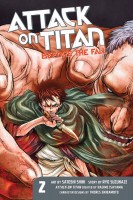
Attack on Titan: Before the Fall, Volume 2Attack on Titan: Before the Fall, Volume 2 written by Ryo Suzukaze and illustrated by Satoshi Shiki. I have largely been enjoying Attack on Titan‘s prequel manga Before the Fall, but I think I like it even more now that I have read the first Before the Fall novel that was recently released by Vertical. (My review of that volume can be found here.) Other than both being prequels to Attack on Titan, the stories of the novel and the manga aren’t directly related, but small references are made to the novel’s plot and characters in the manga. Which makes a fair amount of sense since the Before the Fall manga series is based on the second and third Attack on Titan light novels written by Suzukaze. In the second volume of the Before the Fall manga, Kuklo and Sharle have made their escape–Kuklo from the dungeons and Sharle from her overbearing father–but they are now faced with surviving among the common people. They actually make a pretty good life for themselves at first, but then Kuklo becomes obsessed with wanting to see a Titan for himself which, as anyone who is familiar with Attack on Titan will know, is an absolutely terrible idea that probably won’t end well for anyone involved.

My Love Story!!, Volume 2My Love Story!!, Volume 2 written by Kazune Kawahara and illustrated by Aruko. I absolutely adored the first volume of My Love Story!!, so much so that I was actually a little afraid to read the second volume since my expectations had been set so high. However, I am very pleased to report that I also loved My Love Story!!, Volume 2. The entire series just makes me so extremely happy to read. Takeo and Yamato’s love is incredibly pure and sweet and the two of them are utterly endearing and charming together. Misunderstandings do happen on occasion, but forgiveness is quick in coming and no harm is done. My Love Story!! has the potential to be sickeningly sweet, but the romance and characters are handled with such humor and lightheartedness that, at least for me, the manga hasn’t reached that point. There isn’t much nuance or subtlety to the characters–Takeo is a manly many with a sensitive heart, Yamato is adorable and earnest, Suna is cool and aloof–but I like them all so much that I don’t mind. My Love Story!! is ridiculous and over-the-top and I love it. I’m still not sure how the story will be able to be sustained for an entire series now that the basic conceit has been so well-established, but I look forward to finding out.

A New Season of Young LeavesA New Season of Young Leaves written by Venio Tachibana and illustrated by Akeno Kitahata. Ever since reading the two-volume boys’ love manga series Seven Days (which I loved) I have made a point to seek out more of Tachibana’s work available in English. And so I was very excited when A New Season of Young Leaves was licensed. I’ll admit, at first I was actually a little disappointed with A New Season for Young Leaves. I simply didn’t understand the relationship and odd power dynamics between the super popular Mariya and the socially awkward Nachi. But then about halfway through the volume, during an extensive flashback that explores the evolution of their strange friendship, the manga finally clicked for me. I found it to be incredibly compelling and I immediately wanted to read it again, which I take as a very good sign. I didn’t realize it when I initially began reading A New Season for Young Leaves, but it’s actually the first manga in a series that is at least three volumes long. While there were definitely a few plot lines introduced that were left unresolved, for the most part A New Season of Young Leaves does tell a complete story. But I really do hope more of the series is licensed; I am very curious to see how things continue to develop between Mariya and Nachi and the rest of their classmates.

Filed Under: FEATURES, My Week in Manga Tagged With: Akeno Kitahata, Aruko, attack on titan, Kazune Kawahara, manga, My Love Story, Ryo Suzukaze, Satoshi Shiki, Venio Tachibana

  • « Go to Previous Page
  • Page 1
  • Page 2
  • Page 3
  • Page 4
  • Page 5
  • Go to Next Page »
 | Log in
Copyright © 2010 Manga Bookshelf | Powered by WordPress & the Genesis Framework