• Skip to primary navigation
  • Skip to main content
  • Skip to primary sidebar
  • Home
  • About Us
    • Privacy Policy
    • Comment Policy
    • Disclosures & Disclaimers
  • Resources
    • Links, Essays & Articles
    • Fandomology!
    • CLAMP Directory
    • BlogRoll
  • Features & Columns
    • 3 Things Thursday
    • Adventures in the Key of Shoujo
    • Bit & Blips (game reviews)
    • BL BOOKRACK
    • Bookshelf Briefs
    • Bringing the Drama
    • Comic Conversion
    • Fanservice Friday
    • Going Digital
    • It Came From the Sinosphere
    • License This!
    • Magazine no Mori
    • My Week in Manga
    • OFF THE SHELF
    • Not By Manga Alone
    • PICK OF THE WEEK
    • Subtitles & Sensibility
    • Weekly Shonen Jump Recaps
  • Manga Moveable Feast
    • MMF Full Archive
    • Yun Kouga
    • CLAMP
    • Shojo Beat
    • Osamu Tezuka
    • Sailor Moon
    • Fruits Basket
    • Takehiko Inoue
    • Wild Adapter
    • One Piece
    • After School Nightmare
    • Karakuri Odette
    • Paradise Kiss
    • The Color Trilogy
    • To Terra…
    • Sexy Voice & Robo
  • Browse by Author
    • Sean Gaffney
    • Anna Neatrour
    • Michelle Smith
    • Katherine Dacey
    • MJ
    • Brigid Alverson
    • Travis Anderson
    • Phillip Anthony
    • Derek Bown
    • Jaci Dahlvang
    • Angela Eastman
    • Erica Friedman
    • Sara K.
    • Megan Purdy
    • Emily Snodgrass
    • Nancy Thistlethwaite
    • Eva Volin
    • David Welsh
  • MB Blogs
    • A Case Suitable For Treatment
    • Experiments in Manga
    • MangaBlog
    • The Manga Critic
    • Manga Report
    • Soliloquy in Blue
    • Manga Curmudgeon (archive)

Manga Bookshelf

Discussion, Resources, Roundtables, & Reviews

Archives for May 2013

License This! 7 Seeds by Tamura Yumi

May 24, 2013 by Travis Anderson 4 Comments

Well, since everyone’s talking about Tamura Yumi and I just recently finished reading the newest volume of 7 Seeds, I think I will talk today about how some US company really, really, REALLY needs to license this awesome manga!

7seeds 22I’m sure many of you have read Basara, so you know Tamura Yumi can write amazing long-form post-apocalyptic adventure series. The cool thing about 7 Seeds is that it is also a long-form post-apocalyptic adventure series, but at the same time is completely different from Basara. Basara is set sometime long after humanity has recovered from their apocalypse and has regressed to a sort of feudal society. The actual apocalypse and aftermath don’t play any role in the story and to be honest, it could be set in a fantasy feudal Japan and not really feel any different.

7 Seeds, on the other hand, tells the story of five groups of young people who were cryogenically frozen in a government plan to assure humanity’s survival after Earth’s collision with a giant meteor. It’s a survival story and the apocalypse and the affect it had on Japan is constantly felt. There’s also lots of intrigue as we learn more about the 7 Seeds Project and what happened to everyone else on Earth after the meteor hit.

The manga starts off with Natsu’s POV, as she wakes up in an unfamiliar world with a bunch of strangers. No one told her or the other people in her group that they were chosen to be part of this project. The only person who knows anything is their guide, Botan. Later the POV switches to Hana, a girl on a different team, who also had no knowledge of the project, but is far more prepared than anyone else, having had a lot of wilderness training from her father. Occasionally the POV switches to other characters (like when we meet Aramaki, the sole survivor of his group, who thawed out fifteen years earlier than Hana and Natsu’s groups, in the icy wilderness of Hokkaido, or when Hana finds the journal of Mark, a guy who lived in a doomed shelter directly after the meteor hit, or when we meet the team whose members trained their entire life in order to be sent to the future as humanity’s great hope but who ended up being emotionally and mentally scarred by the experience), but for the most part it’s shared between Hana and Natsu.

This series has so many angles of appeal. Do you like adventure? Do you like post-apocalyptic stories? Do you like large casts with lots of great female characters? Do you like found/chosen family? Do you like intrigue and mystery? There is romance, too, as these are (for the most part) teenagers with lots of emotions and hormones and all that jazz. But romance plays even less of a role than it does in Basara, so if that was your main interest in a story then this probably wouldn’t be the story for you (but then again, it might, since there are loads of people to ship and at least one pairing that’s set up as the “main romance”). (I do love shoujo romance, but I’m also always really happy to find good shoujo series that aren’t primarily romance, because while there’s more of them in Japan than available in English, even in Japan it’s still a minority compared to romance-focused manga.)

One thing that really hit me in reading the most recent volume is that the theme of 7 Seeds seems to be “don’t look back.” No one knows how long it’s been since the meteor hit. Even the guides, who were prepared for this, know only that they were set to thaw when the computers sensed that the world was once again able to sustain human life. The flora and fauna and even the landscape of Japan, everything is alien. But the lesson seems to be that it’s humans who are the intruders, and in order to survive, they have to adapt to this new world, rather than clinging to the past. This is really driven home every time they encounter one of the abandoned shelters where those few survivors who weren’t part of the 7 Seeds project lived after the meteor hit.

I know some people don’t like her art and feel it’s dated (personally I think it’s unique and helps it stand out from the crowd), but she’s such a great storyteller that even if it had the worst art ever, I would still recommend this series to everyone because it’s that great. I don’t want it to end, so when it seemed like the groups were getting closer to finally all coming together (which will surely be the beginning of the end) in this most recent volume, I found myself cheering when they were separated even further as that meant the series wasn’t as close to the end as I’d feared. (There’s still so much to discover! So much I want to know!)

The longer this series goes on without being licensed (the most recent volume was #24 and it’s been running for over ten years now), the more I worry it never will be, since publishers are always more hesitant about picking up a long series (especially when it’s not shounen), but I really, really hope that someone will take a chance on it. As much as I loved Basara, I love this many times more and I want more people to be able to enjoy it!

Filed Under: License This! Tagged With: Post-Apocalyptic Sci-Fi, shoujo, Yumi Tamura

Fanservice Friday: Draco Malfoy & the Blue King

May 24, 2013 by MJ 18 Comments

(Warning: This article contains major spoilers for Yumi Tamura’s Basara and J.K. Rowling’s Harry Potter series.)


Confession time: Some of you may have gleaned this from our fanfiction roundtable a couple of years ago, but I’ll admit it plainly now. I was a fan of Draco Malfoy—not so much the Draco Malfoy that J.K. Rowling actually ended up writing, but the Draco Malfoy I thought she was writing, all the way up until the final book in the series.

It was all incredibly clear, you see. This spoiled, fair-haired, delicate flower whose life of privilege had turned him into a bigoted, arrogant bully was the polar opposite of hero Harry—slick on the outside and twisted within, smart and talented, but taught to lie and cheat and cry to daddy whenever anything went wrong. He was Harry’s negative image. When, early on in volume five, the highly revered (but generally reticent) Sorting Hat chose to sing a song to the Hogwarts student body, warning them that the four houses of Hogwarts must unite or crumble from within, that meant that somehow the brave Gryffindors and ambitious Slytherins must learn to work together, and who better to serve as the catalyst for that but Draco Malfoy?

Obsessed with Harry from the beginning and eternally offended by Harry’s refusal to take his hand, it seemed obvious that Draco Malfoy was the key to heeding the Hat’s warning. And when, in the sixth book, Draco came face-to-face with the real terror of the Dark Lord—reduced to crying in a haunted bathroom over his horrifying plight—finally humanized in his darkest moments—Rowling’s plan seemed to be firmly underway. (I once wrote that Harry Potter and the Half-Blood Prince was my favorite Harry/Draco fanfic of 2005, and I wasn’t really joking.) As a result, not only would Hogwarts and the entire wizarding world be saved, but both Draco and Harry would have learned to be better people—people who could tolerate and even embrace their differences and use them to their best advantage.

Except that wasn’t Rowling’s plan. At all. Because apparently what the Hat really meant was “the four houses except Slytherin,” so in the brave students’ moment of glory, the Slytherins were sent to the dungeons and Draco Malfoy slunk off in a cowardly, shameful fashion with his cowardly, shameful parents to live a cowardly, shameful life.

I was devastated, honestly. I mean, I’d managed to weather the senseless death of a favorite character, the cruel murder of an owl, and some of the worst romantic dialogue ever written, but I just couldn’t believe that Rowling had squandered a character she seemed to have put so much work into. And was the Hat just singing for its health? WTF, J.K. Rowling? My Draco, he was gone.

Then, I met Asagi.

(Read right-to-left.)

basara-bluegod

It’s important to note that Asagi is actually talking about himself in this panel. Though known to the public (and even to the so-called Blue King himself) as the leader of the Blue King’s guard, it’s Asagi—first introduced in volume four of Yumi Tamura’s epic shoujo fantasy, Basara—who is actually the Blue King, pulling all the strings from behind the scenes. He’s proud of himself and his cunning, and extraordinarily arrogant, but when, after the false Blue King’s fall, he joins up with rebel leader Tatara (with the intention to ruin both Tatara and their mutual enemy, the Red King) the cracks in his shiny, shiny armor begin to show.

basara-cackle2Thanks to his proximity to the story’s heroine, Sarasa, and her love interest, Shuri, during the Blue King’s horrifying “race,” along with a little inside knowledge (the Red King is his younger brother, after all), Asagi is the first person in the story to become aware that Sarasa and Shuri are, in fact, Tatara and the Red King—sworn enemies in love with each other—so his initial plans revolve around trying to control the circumstances under which they will discover this (and be discovered) in order to ensure maximum damage to both sides.

In the meantime, he connives and wheedles. He plots to create conflicts within Tatara’s camp. He sexually harasses Sarasa by skulking around her bedroom and stealing a kiss from her when she’s lost her eyesight. He’s a hateful menace in every way. He even cackles with glee like a freaking supervillain.

No, seriously. Check it out. —>

There’s no romanticizing Asagi. He’s a vicious brat whose lifelong jealousy of his hotshot little brother has consumed him to the point that, not only is he intent on being hurtful to others, he’s simultaneously hurting himself by letting his own issues render him a pawn in the game of someone who doesn’t even really care about him all that much. He’s acting on the White King’s orders, but to his own peril, as she’s really only using him to achieve her own revenge.

Any of this sounding familiar?

It was just a few days ago, while working on our upcoming Basara roundtable, that I realized… Asagi is the Draco Malfoy I thought J.K. Rowling was writing. And wow am I glad to see him at long last.

I said there’s no romanticizing Asagi, and I meant it. He’s not a romantic figure at all. Unlike Ageha, whose dignity and good faith in the face of great suffering frame him as a truly heroic and romantic supporting character, Asagi is small and petty and difficult to care about. But, like most of us, it’s Asagi’s weakness that is ultimately his undoing, and fortunately it’s undoing that Asagi needs most.

I said in the Basara roundtable that Asagi’s whole character could be essentially boiled down to a single desire: “to have someone—anyone—just one person love him best.” I do think that’s true, but it’s probably oversimplified. Yes, Asagi wants someone to love him, but perhaps more specifically, he wants someone to believe that he’s worthwhile. For all his arrogance, Asagi’s greatest weakness is his own self-esteem, which is so low and so twisted up by years of outside manipulation that when Sarasa does something really wacky like trust him with something important, it throws him completely for a loop.

basara-trust1

Sarasa, of course, has no idea what she’s done, but the results speak for themselves.

basara-trust2

That’s how you write a hero—in this case, Sarasa—and how you write a Draco Malfoy (or, in this case, Asagi). Let the hero take a freaking chance on him, in genuine good faith, and give him the thing he most needs in order to begin to believe in himself.

Asagi muses above on the fact that the fake Blue King (the “Serpent King”) had trusted him and wonders why this feels different. The difference of course, is that what he had with the Serpent King wasn’t trust at all. It was dependence, for sure, and perhaps some sense of loyalty, but the Serpent King didn’t so much trust him as need him, and that’s not the same thing. Like love, trust is something given freely and in good faith, and counting on someone because they’re bound to serve and protect you isn’t actually the same thing.

As the story goes on, Sarasa proves that her trust also comes with attentive care and affection. And I kinda love the fact that, here, she pretty much acknowledges straight out that he’s a delicate flower.

(Click images to enlarge. Read right-to-left.)

basara-delicateflower1
basara-delicateflower2

Asagi is nothing if not a master of self-deception, and he spends most of the series after he joins up with Tatara explaining carefully to anyone connected to the White King that he is definitely not starting to believe in Tatara or care about her or her cause. Meanwhile, he’s pretty definitely falling in love with her (or something that looks a hell of a lot like love) and learning what it’s like to actually have someone to protect whom he can trust to protect him in return.

(Click images to enlarge. Read right-to-left.)

basara-asagi1
basara-asagi2

It’s starting to sound a lot like I ‘ship Asagi with Sarasa (Tatara), isn’t it? And I’d be lying if I said it had never crossed my mind. After all, I ‘shipped Draco with Harry all those years, and that’s where I’ve been going with this entire post, haven’t I? The truth is, though, seeing where Asagi and Tatara’s relationship goes in Basara actually makes me think that I’d rather have seen Harry and Draco become real friends more than anything else. Because even if I occasionally harbored thoughts of Sarasa throwing over Shuri (who, let’s face it, isn’t all that much better a catch, at least not early on, and if she’s not going to fall for Ageha… well, there’s no helping her) for Asagi, and certainly that’s what Asagi would like to have happen, I think what Asagi needs more than anything is a friend—someone who won’t fall out of love with him or become complicated in any way—just a friend who can teach him what that even means. And Sarasa is so beautifully, perfectly that, I think it’s ultimately best for both of them.

The following is one of my favorite scenes in the entire series. It’s emotionally riveting, intense, and one of the best examples of why Tamura-sensei’s realization of this character is so much better than anything J.K. Rowling’s ever done. So much so, that I’m blown away every time I read it as though I’ve never seen it before in my life.

(Click images to enlarge. Read right-to-left.)

basara-butter
basara-butter2
basara-butter3

The emotional impact of that scene is only topped by this one, in which Tamura shows us Sarasa’s face and only the back of Asagi’s head for the entire exchange. And that back of the head says everything. It’s brilliantly drawn and precisely in tune with both their characters. Obviously there’s a lot more going on in an epic series like Basara besides a whole slew of intimacy porn between the heroine and one supporting character, but if you know me, you know that’s my fanservice.

(Click images to enlarge. Read right-to-left.)

basara-incharge
basara-incharge2

I could go on and on. I would go on and on, but the truth is that I so hope that Viz will eventually be able to give this series a digital release, and I don’t want to give everything away (the scene leading up to the last few pages I shared here is one of the most intense and emotionally resonant of the series—and with this series, that’s saying a lot). Suffice it to say that with a character like Asagi, written by someone as thoughtful and brilliant as Yumi Tamura, things are going to be complicated all the way through the end.

Some part of me still wishes that J.K. Rowling had followed through on her promises for Draco. Another realizes that she never could have written him as well as did Yumi Tamura.


All images © Yumi Tamura/Shogakukan, Inc. New and adapted artwork and text © Viz Media. This article was written for the Yumi Tamura Manga Moveable Feast. Check out Tokyo Jupiter for more!

Filed Under: Fanservice Friday Tagged With: basara, Manga Moveable Feast, MMF, Yumi Tamura

Manga the Week of 5/29

May 23, 2013 by Sean Gaffney, Michelle Smith and MJ 2 Comments

mardock7SEAN: The rest of the world is getting Yen next week, so feel free to add their books here. The rest of the pile is fairly muted, though as always, not without interest.

Air Gear is one of those Shonen Magazine series that just runs and runs, with its combination of roller blading, conspiracy, and pretty girls. If you missed it first time around, or miss Tenjo Tenge, Kodansha has an omnibus of the first three volumes.

MICHELLE: Air Gear is just never going to be something I’m interested in, alas.

MJ: Alas, that goes for me as well.

ANNA: I actually read and enjoyed the first few volumes of Air Gear but not enough to want to read the whole thing. Also, I started to get creeped out as the series progressed.

SEAN: Fairy Tail‘s speedup is not quite as hectic as One Piece or Naruto‘s were, but it’s still coming out at a decent clip. Here’s Vol. 26, where the whole S-class exam thing continues to go straight to hell.

MICHELLE: I have fallen so far behind with Fairy Tail that catching up is daunting.

SEAN: As for Mardock Scramble 7, I’m pretty sure that’s the final volume. Which is good, as I really have run out of things to say about it. I’d try “best prostitute cyborg manga ever”, but given this is Japan, I suspect there’s 10-12 others I’m forgetting.

shonan9MJ: I really do like Mardock Scramble, and though I don’t have confidence that I can remember all the “prostitute cyborg manga,” I suspect it would be my favorite. So I’ll take the risk!

SEAN: The big release for me this week is also a final volume, and given the apparently tepid sales, may be our last glimpse of Onizuka here in North America. But GTO: 14 Days in Shonan has been a hell of a ride, and the 9th volume wraps things up.

MICHELLE: Yet another one I like but have fallen behind on. Stupid life, getting in the way of my manga reading!

MJ: This is gonna be a spoiler for Pick of the Week, but I LOVE THIS SERIES. I’m very sorry to see it end, but I’m sure it’ll be fantastic.

SEAN: And on the ‘things I forgot’ list, Yen also has the 2nd and final volume of Welcome to the Erotic Bookstore out digitally. Admittedly, I forgot about it as it’s only listed on Yen and Hachette websites. But then, the same was true of Vol. 1, which seemed unavailable till it was. In any case, cute slice-of-life sex shop antics!

This is, Erotic Bookstore aside, a fairly manly week of manga. What manga makes you feel like a MAN?

Filed Under: FEATURES & REVIEWS, manga the week of

Weekly Shonen Jump Recap: May 20, 2013

May 22, 2013 by Derek Bown 1 Comment

May 20 2013 TitleIt’s actually been a while since the last time we had just a regular issue of Weekly Shonen Jump. As far as I can remember the past few weeks have included a few monthly series here and there. So I almost don’t know what to do with myself, finding that I’m back to basics this week. It’s also the first week where I find myself unsure what to think of certain chapters that I usually really like. I’ll try to do my best, but I can’t make any promises about the coherence of my thoughts, considering the current change in my work schedule.

One-Punch Man Ch. 017
Well then, if One-Punch Man is anything, it’s most certainly experimental. This was basically thirty two page spreads, thirty pages of a magazine, devoted to the most pure representation of what a fight in shounen manga should be like. No talking, just pure action, punching, kicking, laser…ing… It’s a cinematic approach that most creators don’t take because their page count is limited. But being a monthly series One-Punch Man manages to pull this off. Were I still writing my Combat Commentary column this would be a definite candidate for analysis. Still, it does run the risk of readers just skimming over it, which I recommend against, because you can’t get the full impact unless you take the time to examine each page. Protip: Don’t read it on an iphone, or any phone. Read it on a tablet or a computer. You’ll get the full effect that way.

One-Punch Man

One Piece Ch. 709
I think most everyone was at least suspecting that B block would come out the way it did. I know I for one didn’t definitively call it, but it it was one of the possibilities I thought would happen. Though, I was impressed by Elizabello’s punch. I know we were told it was powerful, but somehow just having a really big punch that could only be used once an hour didn’t seem that impressive. And yet, here we are, with him taking out all the heavy hitters of the round except one. Though it did prove the main flaw of his attack—that if someone was prepared for it and knew what was coming, or could otherwise block it, the attack loses some of its effectiveness. Now it remains to see if we get a backstory for the island, or if we move on to the next set of fights next chapter.

One Piece

Naruto Ch. 630
Will someone please shut Obito up? He’s been saying the same thing for the past three months. It’s like Kishimoto doesn’t think we have the mental faculty to understand what Obito is saying unless it’s constantly repeated over and over. Then again, and I can’t speak for the rest of you, but I’m still reading this series, so I dunno if Kishimoto would be that far off in his estimation of my intelligence.

Though, it was good to finally get a response to the repetitive rhetoric Obito has been sprouting. Especially after he went completely coo-coo bananas with these past few chapters.

The rest of the chapter was inoffensive. And I’ll even go so far as to say that I quite enjoyed Minato’s appearance at the end. Even though I knew he was coming. Though why is Naruto not surprised that his dead father suddenly appeared? Is this series going to treat death the way Dragon Ball Z did?

It was also nice to see Sakura actually contribute. Remember her? She was the female lead at one point, before she was abandoned way at the beginning of this interminably long arc. I know more chapters means more money and all that. But there’s something to be said for quitting while being ahead. Instead Naruto is going to be remembered as a good series that went quite bad for a while, became tolerable, and then became absolutely awful at the end.

World Trigger Ch. 014
Seeing as how my time has become a lot more precious to me, I can’t say I have much to say about this week’s chapter. If nothing else the fight was interesting enough. But I can’t help but wonder why we’re supposed to believe a government agency would give sniper rifles to two kids not even eighteen yet. I know it’s a trope to have kids fighting the monsters in manga and anime. But in series like Evangelion we’re given a reason why it has to be kids. It’s not exactly a good reason, but it’s a reason. World Trigger expects us to just accept that a government agency is having teenagers fight with deadly weaponry for no other reason than that’s how it’s done in manga. I’m sorry, but I refuse to accept that. Give me a good reason. Are adults incapable of producing Trion? Can they not use the triggers? I need a reason. Any reason. Even a stupid reason would be marginally better than expecting me to just sit back and accept that a bunch of kids are the most effective fighting force around.

Bleach Ch. 537
While this chapter did retcon Masaki’s death, it at least makes sense in the context of what the flashback has established. We needed to understand how she could die against an easy opponent like Grand Fisher, considering she had her own powers that could take on hollow hybrids. And if we consider that she was sensitive enough to know the kid Ichigo was going to save was a hollow, then we could perhaps assume she had some kind of power. Still, it’s clear that the purpose of it all was to make Ywatch the ultimate bad guy. And yes, in that case it’s rather clumsy. But at least in the context of the flashback it holds together. Motivations of the author aside.

Cross Manage Ch. 033
This week’s chapter was a bit weaker than the last two, but mostly just because there was a lot less focus on the action. The character interactions, and general character moments, were really strong. Ryu also just happened to give me my favorite moment of the entire issue. I have high hopes that Cross Manage will continue to do well, and increase in the rankings so we can continue to see what Kaito can do.

Cross Manage

Nisekoi Ch. 074
I’ve found that the biggest problem I have with Nisekoi is that after Chitoge fell in love with Rakku she lost what made her unique from the other girls. She’s no longer the one that doesn’t like him, she’s just like the rest of them. And as strong as the rest are, Chitoge doesn’t have much else to back up her personality. In the long run she’s just less interesting than the other girls. I think it would have served the overall manga much better to put the inevitable moment where she falls for Rakku for much later, because the overall dynamics just don’t work as they are. She’s still enjoyable enough, and this chapter was a lot of fun, but I’ve found that I tend to enjoy her moments less. Which goes to show when I compare this chapter to recent ones. And that’s a big shame considering she’s the main romantic interest. If we don’t like her over the other girls, as well handled as the romance is, it just won’t be that satisfying when she and Rakku get together. And since that’s the whole point of the story it’s a big weakness that needs addressing.

Nisekoi

Toriko Ch. 233
This wasn’t the best Toriko chapter ever. The biggest weakness is of course how much time was spent on flashbacks, and the fact that the big reveal last chapter, that Toriko was beaten, is irrelevant. It was just meant to be a shocking moment, and now we move on to the real fight. It’s weak, transparent writing, and as much as I love this series I have to call it on this one. Emotional moments don’t work if they’re obviously being written to be emotional. Still, we can’t expect every chapter to be a winner, so I’ll give it a few more before I start really laying into it. I think Toriko deserves the benefit of the doubt.

Dragon Ball Z Ch. 015
Chi Chi may be one of the least liked characters of this series, but I really can’t help but feel sorry for her. Not only is her child kidnapped, but her husband has been murdered by the monster that almost murdered him before she and Goku got married. I’m amazed she isn’t traumatized by the events of the series. And of course, we get the beginning of Goku actually being a pretty terrible husband and father. Never mind that he’s leaving his wife and child behind to train, I know, I know, it’s to save the earth and all, but later on he does this exact same thing for no good reason. Still, this chapter focuses more on just blanket exposition and reminding us that Goku still has made any progression yet. But, it’s a good chapter, enough variety to make it more entertaining than some of the past few chapters have been.


And there you have it. I apologize again for this column being late, hopefully things at work slow down so I can actually get this taken care of in a timely manner. Anyone have any suggestions for blogging and working a fulltime job? Leave them in the comments, I need all the help I can get.

If you want to hear more, check out the Manga^3 Podcast Archives. Or go directly to last week’s episode, Episode 047 – May 13, 2013 – Gender Roles in Manga | Wandering Son. PS: We had Ed Sizemore on as a guest last week, he’s a lot smarter than us so last week’s episode is actually really good.

Filed Under: FEATURES & REVIEWS, WSJA Recaps Tagged With: bleach, Cross Manage, Dragon Ball Z, naruto, nisekoi, One Piece, one punch man, toriko, world trigger

It Came from the Sinosphere: Khóohái Lúsînliông

May 21, 2013 by Sara K. 2 Comments

PUPPETS!

Ever since I started this column, I’ve hoped to eventually feature a Taiwanese puppet show. Well, the time has come.

The Story

This series is a spinoff of a Taiwanese puppet saga known in English as The Scholar Swordsman. It stars one of the main characters of “The Scholar Swordsman,” called Khóohái Lúsînliông.

Khóohái Lúsînliông is being punished.

Khóohái Lúsînliông is being punished.

Khóohái Lúsînliông is a Tartar princess who has become a travelling sword fighter. She prefers drinking alcohol and kicking butt to acting like a princess. Various characters have trouble whether to treat Khóohái Lúsînliông as a friend or enemy.

She is in love with a poet called Sú Gânbûn. However, there’s a fake Sú Gânbûn running around! Where’s the real Sú Gânbûn? At one point, a ‘Sú Gânbûn’ gets rescued by a mysterious horse-rider called Tiònghuakióng. Is Tiònghuakióng the real Sú Gânbûn? Is Tiònghuakióng actually

Tiònghuakióng is caught in a spider web!

Tiònghuakióng is caught in a spider web!

Khóohái Lúsînliông in disguise? And why is there a fake Sú Gânbûn?

Anyway, the plot keeps going on an on like this. Every episode ends with a cliffhanger, usually either along the lines of “character X and Y are about to fight, who will win?” or “What is the true identity and motive of Character Z?”

I’ll be honest, and admit that I had trouble following the plot. This is not necessarily the drama’s fault. I must point out that

1) This is in Taiwanese, and my Taiwanese comprehension skills suck.
2) I am not terribly familiar with The Scholar Swordsman, so I seem to be missing out on some background.

About Taiwanese Puppets

Glove puppetry has been extremely popular for as long as Chinese speakers have lived in Taiwan. Live puppetry used to be the most popular way to entertain masses of people.

There are actually many kinds of traditional puppetry in Taiwan, and I’m not qualified to describe them, but they can be broadly divided into the “northern school” and the “southern school.” The “northern school” tended to focus on tales of magic, adventure, good vs. evil, and heroism, whereas the “southern school” focused on tales about family, love, and ordinary people. Guess which school Khóohái Lúsînliông is descended from.

Back in 19th century Taiwan, the “southern school” was considered higher-brow than the “northern school” – scholars could admit to enjoying the southern school, not so much the northern school.

Then something called “television” appeared in Taiwan.

Is that television coming to Taiwan? No, it's just Khóohái Lúsînliông going somewhere.

Is that television coming to Taiwan? No, it’s just Khóohái Lúsînliông going somewhere.

Did the puppeteers say “Oh no, television is going to take away all of our audience, we must stop it!!!!”?

Nope. They said “What a great way to reach more people.”

And that’s how the “Golden Light” puppetry style was born.

“Golden Light” first appeared around the 1950s, and is a style which has been adapted to work well both live and on the small screen, with a heavy focus on exciting special effects to dazzle viewers.

And it worked.

Throughout the 1960s, not only were many of the most popular Taiwanese TV shows puppet dramas, many of the top selling music albums were soundtracks from puppet dramas. Live puppet shows also did well.

When I talk to middle-aged Taiwanese people, if I mention puppet shows, their eyes will light up with nostalgia. 40-year-old men will become 10-year-old boys. It’s like talking about popular old Saturday-morning cartoons with Americans.

However, puppet dramas have gradually fallen out of the mainstream, and are now considered something primarily for fans. While puppet dramas used to be broadcast over the air, now they are almost only present on cable (that said, there is an ENTIRE CABLE CHANNEL dedicated just to puppet dramas). When I ask people why puppet dramas aren’t as popular as they used to be, I am told that there is too much media from Hollywood, Japan, Hong Kong, etc., crowding out the puppet dramas.

A puppet is buried in sand.

The sand represents Hollywood/Anime/Hong Kong Cinema/K-Dramas, and the puppet represents, well, Taiwanese puppetry.

Even so, there is a very active puppet fandom in Taiwan. They have conventions. The puppets themselves can become collectors’ items which demand high prices. It is not unusual to see a 7-11 advertisement featuring puppets.

Many traditional events, such as temple festivals, often feature live puppet performances. I remembering seeing one just two blocks away from my apartment. However, while some people look on curiously for a minute or two, I have never seen anybody enraptured by a live puppet performance. It seems to be there as a ritual, not as a form of entertainment.

About this Drama

The Scholar Swordsman is the magnum opus of one of Taiwan’s most celebrated “Golden Light” puppeteers, Toshio Huang, who belongs to the third generation of a noted puppeteering family. The saga has been produced multiple times for TV, and has also been performed many times live. This specific spinoff seems to be a collaboration between Toshio Huang and his son, Huang Liwang.

The themesong, of course is “Khóohái Lúsînliông.” The song had originally been popularized by The Scholar Swordsman, and become a standard of Taiwanese music. I had actually been familiar with the song before I found out that it came from a puppet drama. The Youtube video above features the song.

The Puppetry

One of the things that’s frustrating about writing this post is that stills taken from the show *completely miss the point*.

Though the puppets can move their eyes and mouths, the expressions on their face generally don’t change very much. Therefore, much of the expressive power of the puppets come from how they move. You really do have to see them in action to see just how skilled the puppeteers are in conveying personality, mood, feeling, etc., just by how the puppets move. Still images of the puppets look almost lifeless, whereas the puppets in motion feel like living people.

The show integrates both “real footage” and “puppet footage.” For example, sometimes they use shots of real deserts, forests, etc … and sometimes they have miniature puppet forests, deserts, etc.

It's a puppet waterfall.

It’s a puppet waterfall.

And I never imagined that puppet fighting could be so exciting to watch. The fights are really well done – detailed, easy to follow the flow of the action, variety, etc. And there are a lot of things you can do with puppets which cannot be done (ethically) with live performers. Cutting off their heads, for example. Also setting them on fire.

The fact that they are puppets, in a way, makes it all more magical. It’s very hard to explain. However, I also feel that special effects in live performances feel more special than special effects in Hollywood blockbusters, for that matter, I think special effects in silent cinema feel more special than special effects in Hollywood blockbusters. The fact that the technology is cruder ironically seems to make it more wonderful. The same effect it at work in this puppet drama, at least for me.

Influences

Obviously, this show is heavily influenced by wuxia, in fact, it *is* wuxia. But it’s not just based on wuxia.

A witch with a broomstick who looks like she came from Western fantasy (specifically the kind of witch you might see in Halloween festivities).

Puppets. Seriously.

American culture does not take puppets seriously. Anything involving puppets is assumed to be cute and/or funny. I bet you can count on one hand every work of American puppetry which is neither a comedy nor for kids.

I’m an American too, and so it’s also my reflex not to take puppets seriously, even though I have been an (amateur) puppeteer myself. So while watching this show, there were time when I thought, “Oh, the puppets are travelling through the desert, how cute” or “Prostitute puppets, ha ha ha” (yes, some of the characters in this story are prostitutes).

However, I know that Taiwanese culture does not have this reflex. They take puppets as seriously as they take popular cinema, particularly the older generations. Puppet dramas can be for kids and/or comedic, but they aren’t necessarily so.

Puppetry is considered “masculine,” so much so that a Taiwanese girl/woman who took great interest in puppetry might be considered a tomboy. In the United States, a boy/man who took great interest in puppetry might be considered a sissy. (Sadly, in both Taiwanese and American culture, “masculine” things are taken more seriously than “feminine” things).

Encountering things like Taiwanese puppetry drive home the point that, yes, I am culturally American.

Availability in English

Well, Khóohái Lúsînliông is not available in English.

There is a movie, Legend of the Sacred Stone, which is available on DVD with English subtitles. Weirdly, the movie is in Mandarin – most puppet dramas are in Taiwanese (they also sometimes are performed in Cantonese).

Taiwanese puppetry has also been adapted into the Cartoon Network show Wulin Warriors, which of course is available in English, but I’ve read that the Cartoon Network version is inferior to the original.

A pretty woman (puppet) with lots of pink flowers.

She works in a brothel.

Conclusion

Many Taiwanese people take a “the glass is half empty” view of puppetry because they know it’s not as wildly popular as it was a few decades ago.

I take a “the glass is half full” view because, even today, puppetry is way more popular in Taiwan than it ever has been in the United States.

What I take away from this drama is not the story, which, while somewhat entertaining, did not make much an impression on me. What I take away from it is the sheer creativity which goes into golden light glove puppetry as a medium. It feels new and fresh to me, and the special effects probably inspired a greater sense of wonder in me than the special effects of all the Hollywood movies I’ve seen in the last seven years combined.

Next Time: What the **** Are You Doing, Wei Xiaobao? The Duke of Mount Deer (novel).


One time, Sara K. was assigned the task of making bird puppets. She thought it would be really boring if they were perched, so she wanted to make it look like they were flying. It wasn’t enough for the wings to be outstretched – she wanted the wings to move as if they were flying. She found it was amazingly difficult to get information about how birds move in flight, and ended up reading a book Bird Flight about the science of how birds fly because she couldn’t find any other source. Who would have thought that taking a theatre class would lead to doing detailed research in physics and ornithology?

Filed Under: It Came From the Sinosphere Tagged With: puppets, taiwan

Manga at TCAF

May 21, 2013 by Brigid Alverson

The Manga Bookshelf team discusses their Pick of the Week.

Lissa Pattillo files her con report on TCAF:

The event had two manga guests – Taiyo Matsumoto and Gengoroh Tagame. I didn’t have much personal interest in Taiyo Matsumoto’s work, but I was thrilled that Tagame Gengoroh – a pioneer in the bara genre – was being flown in to help promote his new book, The Passion of Gengoroh Tagame. I attended his panel and signings and enjoyed what a friendly and out-going individual he was, and how much fun he seemed to have talking about his work.

On the floor, it was exciting to see Chromatic Press‘s booth set-up with lots of goodies promoting their current and upcoming projects. Plus the staff are all completely charming and hard-working individuals who I have nothing less than well wishes for! I was sad that both rem and Jen Lee Quick – who work with the new publisher, and happen to be two artists whose work I adore – were unable to attend the event despite initial plans. Maybe next year?

And Scott Green takes a look at a new book I first saw in the wild at TCAF: Suehiro Maruo’s The Strange Tale of Panorama Island, which was announced four years ago and is finally being published by Last Gasp.

With the Yumi Tamura Manga Moveable Feast in the offing, Anna N. rounds up her reviews of Tamura’s work, Chicago and Basara.

Reviews: Ash Brown looks back on a week in manga at Experiments in Manga.

Sakura Eries on vol. 12 of Dengeki Daisy (The Fandom Post)
Lori Henderson on King’s Moon: The Life of Akechi Mitsuhide (Manga Xanadu)
Erin on vols. 4-6 of Otomen (Gagging on Sexism)
Erica Friedman on vol. 10 of Pure Yuri Anthology Hirari (Okazu)

Filed Under: MANGABLOG

Cross Manage, Vol. 1

May 21, 2013 by Sean Gaffney

By Kaito. Released in Japan by Shueisha, serialization ongoing in the magazine Weekly Shonen Jump. Released in North America by Viz Media.

Note: this is only available digitally right now.

As I have mentioned before, sports manga and North American have a very iffy relationship, with none of the contenders really hitting the heights of Naruto or One Piece sales. That said, there’s a lot of sports manga out there, and I’ll give credit to Viz (and let’s be honest, it’s pretty much just Viz, unless I count Sasameke, WHICH I DON’T) for continuing to experiment with them. Especially as such series are HUGE in Japan, and tend to run and run. Slam Dunk was 31 volumes, Eyeshield 21 was 37. Kuroko’s Basketball is 20+, and continues to succeed despite terrorist threats (though it’s sadly not licensed here, possibly as Slam Dunk is still ongoing.) And of course we’ve had Cross Game on the Sunday side of the fence.

CrossManage1

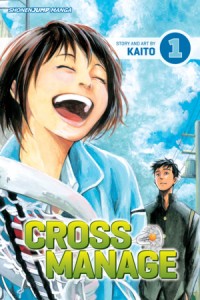
And now we have Cross Manage, one of Viz’s ‘we’ll try a new weekly series and see if it dies in 2 volumes’ attempts they’ve had recently, and easily the most successful, given it actually seems to have survived the most recent round of cancellations in Japan. I particularly like the cover, which has Toyoguchi’s beaming face (and oh boy, does it beam – sometimes her face gets so happy it’s almost surreal) right in the foreground and Sakurai’s passive gaze in the background. Because this is about a female lacrosse team, and Sakurai is signed up/blackmailed into being their manager.

There’s a lot to love here. Toyoguchi is just great, being a perky, naive girl who looks like she could burst into a Disney song at any moment, but is also fueled by pure determination and smiles just as widely when threatening to tell everyone our hero accidentally groped her. She’s so relentlessly upbeat and caring that when Hayami shows up and attempts to guilt-trip Toyoguchi into letting Sakurai return to the soccer team (and her arms), not only does Toyoguchi not get it, but the other girl finds herself automatically trying to comfort and reassure her. That needs to be weaponized somehow.

Then there’s the team itself, which is made up of…. drum roll please… girls with all sorts of body types! Yes, the other main girl we get to know is the tall butch tomboy, but we also see pudgy girls, and tiny girls, and girls that sort of look like Sumiyoshi in Excel Saga. And they’re some of the best players. I like the fact that the team is not going to be used simply as an excuse to see a lot of hot girls changing constantly (imagine if the Cage of Eden artist drew this manga… *shudder*) and hope we get to know everyone better. And, of course, we have a classic Bad News Bears team – they’re newbies, with some ra2w skills, but mostly horrible, and they get curbstomped in their first match.

As for Sakurai, our hero, the goal of the first volume is to get him to rediscover the passion he lost to a knee injury, and mission accomplished. He’s a fairly subdued and diligent young man, which contrasts nicely with Toyoguchi’s perkiness and the hotheads and airheads that are also on the team. I think he’ll be an excellent manager, provided the soccer girl doesn’t pry him away. Not that she has any chance… she has ‘unsuccessful rival girl’ written all over her.

I’m pumped to see more of this series – its mood is pretty infectious, and it makes me want to learn more about lacrosse. Roll on Vol. 2!

Filed Under: REVIEWS

Yumi Tamura Manga Moveable Feast

May 20, 2013 by Anna N

I am very excited about the Yumi Tamura Manga Moveable Feast happening this week! Basara is one of my favorite manga, and I would love to see more work by Tamura translated into English. I’m planning on getting back on my Basara reread campaign that I let lapse previously, but I thought I would do a mini-roundup of some of my previous posts that covered some of her works.

Chicago – complete with cello technique critique!
Basara 1 and 2
Basara 3 and 4
Basara 5 and 6
Basara 7 and 8
Basara 9 and 10
Basara 11 and 12

I feel like I’m going to spend a portion of this week vainly wishing that someone would license Tamura’s 7 Seeds for English publication, but I will also put my slightly mournful feelings aside and dive back into Basara, which is always a rewarding reading experience.

Filed Under: UNSHELVED Tagged With: basara

News, reviews, and recommendations

May 20, 2013 by Brigid Alverson

Over at MTV Geek I took a look at the past week’s new manga and other happenings, and I wrote a short review of Mario, the one-shot gangster manga by Naruto creator Masashi Kishimoto that ran in last week’s Shonen Jump.

The Manga Bookshelf team takes an advance look at this week’s new manga.

A A prime

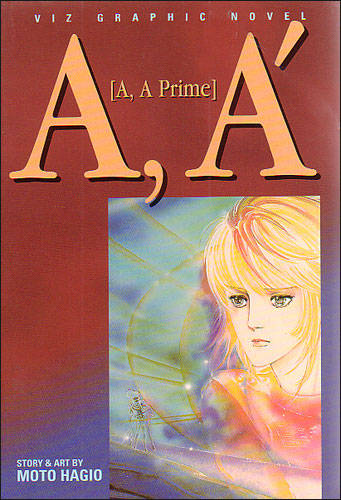
Guest blogger Shaenon Garrity writes about Moto Hagio’s A,A’ for this week’s House of 1000 Manga column at ANN.

Erica Friedman has the latest yuri update in this week’s edition of Yuri Network News at Okazu.

At Manga Therapy, Tony Yao explains why he is thankful for fujoshi.

Lori Henderson discusses the digital-only title Japan Sinks in her latest Manga Dome podcast at Manga Xanadu, and she brings in some related books as well.

Lissa Pattillo catches up with last month’s announcement from PictureBox of two new manga: Seiichi Hayashi’s Gold Pollen and Other Stories and Yuichi Yokoyama’s World Map Room.

MJ is thrilled at the news that manga-ka Kayuza Minekura is back at work on Wild Adapter after a three-year hiatus due to health reasond.

After many delays, the English edition of Suehiro Maru’s The Strange Tale of Panorama Island is now available from Last Gasp. It’s true—I saw a copy on Ryan Sands’ table at TCAF. And so did Deb Aoki, who had the presence of mind to take pictures.

Viz’s yaoi imprint SuBLime has launched a new series, Blue Morning, “an intriguing new series about aristocratic drama and the intricate relationship between the loyal butler of a noble family and a young heir he is duty-bound to look after.”

News from Japan: Galaxy Express 999 manga-ka Leiji Matsumoto has revealed nine pages of Osamu Tezuka’s unpublished work, drafts for Metropolis and other manga. The pages will go on display at Tokyo’s Museum of Contemporary Art this summer. Kami Minai’s “bishojo x violence” manga Needless is coming to an end. Black Bird creator Kanoko Sakurakoji has a new series in the works.

Reviews

Mark Thomas on vols. 13 and 14 of Arata: The Legend (The Fandom Post)
Johanna Draper Carlson on vol. 19 of Bakuman (Comics Worth Reading)
Mark Thomas on vol. 17 of Battle Angel Alita: The Last Order (The Fandom Post)
Leroy Douresseaux on vol. 4 of Bond of Dreams, Bond of Love (I Reads You)
AstroNerdBoy on vol. 7 of A Certain Scientific Railgun (AstroNerdBoy’s Anime and Manga Blog)
Erica Friedman on Cirque Arachne (Okazu)
Lesley Aeschliman on vol. 6 of Fullmetal Alchemist (Blogcritics)
Jocelyne Allen on Kami no Kodomo (Brain Vs. Book)
Anna N. on vols. 1-6 of Kare First Love (Manga Report)
Sakura Eries on vol. 17 of La Corda d’Oro (The Fandom Post)
Connie C. on Lone Wolf and Cub, Gunslinger Girl, and Golgo 13 (Comics Should Be Good)
Johanna Draper Carlson on vol. 3 of Missions of Love (Comics Worth Reading)
Leroy Douresseaux on vol. 61 of Naruto (The Comic Book Bin)
Sean Gaffney on vols. 7-9 of Neon Genesis Evangelion (A Case Suitable for Treatment)
Sweetpea on Nobody Can Hear Me But You (Organization Anti-Social Geniuses)
Helen on vol. 1 of Off*Beat (Narrative Investigations)
Leroy Douresseaux on vol. 15 of Otomen (The Comic Book Bin)
Leroy Douresseaux on vol. 10 of Psyren (The Comic Book Bin)
L.B. Bryant on vol. 1 of Rurouni Kenshin: Restoration (ICv2)
Johanna Draper Carlson on vol. 4 of Strobe Edge (Comics Worth Reading)

Filed Under: MANGABLOG

Pick of the Week: Sunny & Other Stories

May 20, 2013 by MJ, Anna N, Michelle Smith and Sean Gaffney 1 Comment

potw5-20MJ: With the slew of Yen Press titles on Sean’s list this week, along with new volumes of series like Limit and Sailor Moon, it’d normally be pretty tough for me to choose a single pick. Fortunately Viz comes to the rescue with a title I absolutely can’t refuse, and that would be Sunny, the latest from mangaka Taiyo Matsumoto, author of Tekkonkinkreet and Blue Spring. This is one of my most-anticipated manga of the year so far, and a no-brainer as my Pick of the Week. I really can’t wait to read it.

ANNA: I’ll have to go with Sunny as well. I’m most excited about reading that.

MICHELLE: I’m going to award my pick to the low-key sci-fi charmer, Saturn Apartments, which comes to a close this week in its seventh volume. I’m somewhat behind on this tale of future window-washers and how their occupation affords them glimpses of the different strata of society, but I’m really looking forward to seeing how it turns out in the end.

SEAN: I’ll go with Sailor Moon once again. Of all the manga, these last two volumes are the ones I’m least familiar and comfortable with, and I seem to recall liking them less than the rest last time around. I look forward to finding new things to love about them in this new edition, as well as another visit with my favorite Sailor Senshi—which is to say, all of them.

What looks good to you this week?

Filed Under: PICK OF THE WEEK Tagged With: sailor moon, saturn apartments, sunny

Wild Adapter returns!

May 19, 2013 by MJ 7 Comments

wardDreams do come true, my friends—at least for fans of Kazuya Minekura’s Wild Adapter, which has been on hiatus since 2009 due to its creator’s health problems and rumored conflicts with the series’ original publisher, Tokuma Shoten.
It’s no secret that we’re big fans here at Manga Bookshelf, and we’ve been following the news of this series’ possible resurrection since its move to Ichijisha in 2011. Back in August of last year, it was announced that new chapters would begin appearing sometime this spring, and ANN has now reported that the relaunch has begun!

Fans on Twitter have questioned whether the series still has a large enough fanbase to successfully continue, and all we can say here is… DAMN, we hope so.

For more on why we feel that way, check out our Wild Adapter MMF archive, and these posts in particular:

  • Introduction to Wild Adapter
  • BL Bookrack: Wild Adapter Roundtable (with special guest David Welsh)
  • 3 Things Thursday: Wild Adapter
  • Fanservice Friday: The Human Touch
  • Let’s Get Visual: Wild Adapter

What say you, readers? Any Wild Adapter fans still out there? Stand up and be counted!

Filed Under: UNSHELVED Tagged With: kazuya minekura, wild adapter

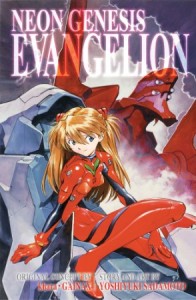
Neon Genesis Evangelion Omnibus, Vols. 7-9

May 19, 2013 by Sean Gaffney

By Yoshiyuki Sadamoto and GAINAX. Released in Japan by Kadokawa Shoten, serialized in the magazine Shonen Ace. Released in North America by Viz Media.

Well, the party’s over. As if it weren’t obvious from the events at the end of the previous omnibus, the light and fluffy ‘everyone is slightly more tolerable’ manga antics end here, as these three volumes are a brutal kick in the teeth reminding us over and over again that humanity is desperately fighting to survive… and that most of the people in charge actually have a different agenda OTHER than fighting to survive. And, just as we finally add our last major cast member, we also get the first of our major cast deaths. There will be more.

evangelion3

The Evangelion fandom doesn’t use “I mustn’t run away” as a meme for no good reason. This volume sees Shinji in a constant cycle of attempting to flee from his destiny and the responsibilities being thrown at him, and constantly being drawn back as he’s unable to just let everyone else get annihilated. Of course, that doesn’t necessarily mean that he gets to accomplish anything here – he returns, but is basically “sat in the corner” by his father, who punishes him by having him watch everyone get annihilated without his help ANYWAY. The manga is less emotive than the anime, with characters at times seeming to underreact to horrible crises, but that’s unsurprising – the pace of the manga is such that there is a state of constant danger, and I imagine after a while the senses just get numbed.

There’s a lot of backstory here. Kaji’s is designed to make him both more likeable and more vulnerable. For all that we like to pretend that we wouldn’t crack under the threat of death, the reality is that we probably would. And so much of Kaji’s life has revolved around finding out the real reason that things happened the way they did – an attempt to expose what led to his own actions. Shinji at one point notes that Misato still loves him, and indeed he’s clearly in love with her, but these are two people, like the rest of the cast, who are unable to grasp at the happiness that could be theirs. As for the other flashback, Fuyutsuki seems to be the perfect “follower”, and Gendo seems even worse than we’d originally suspected. As for Yui, I suspect that she’s being idolized in the memories of both Fuyutsuki and Shinji when we see her, but I agree that it’s easy to see Gendo could have genuinely loved her.

And then there’s Asuka and Rei. I’ve said before that I find manga Asuka far more likeable, and the counter argument to that is that she’s involved in the manga plotline so much less than in the anime, so doesn’t get the time to be irritating. Asuka’s backstory is also shown to us, which is bad news for her, as backstory in this manga is always followed by trauma. Asuka’s attempts to take out the Angel are interrupted by it raping her – yes, yes, mentally, but given that she screams “don’t come inside me” at one point, I think the distinction is fairly irrelevant here. It’s the most horrific we’ve ever seen the Angel attacks, and she comes away from it basically comatose. Rei, meanwhile, is struggling with a distance growing between her and Gendo as she and Shinji grow closer. Ritsuko seems to realize that Rei is growing more human and less doll-like, something that nearly drives her to murder. This, naturally, leads up to the cliffhanger for this omnibus, showing Rei’s “last stand”.

As for Kaworu, it’s interesting that he arrives right as Kaji departs, given his presence as “the mole”. He’s shipped with Shinji a bit harder than in the anime, with Shinji’s “have some sense of personal space” going unheeded. And the scene with the kitten shows a somewhat unbreakable wall between his own value system and that of the First Child. Nevertheless, you can even see Kaworu getting caught up in the struggle against the Angels, and wonder if he’s oing to be a double/triple/quadruple agent the way Kaji was.

The plot may be going places I don’t want it to go, but the writing is still top notch, with a complete inability to put the book down. The news that the manga will end with Chapter 95 in June means that this is likely to be 5 omnibuses (14 volumes) long, and thus this volume begins the second half of the story. It’ll be hard to make things even more tense after this, but I’m sure we’ll find a way.

Filed Under: REVIEWS

Random Musings: Toronto Comic Arts Festival 2013

May 17, 2013 by Ash Brown

© Taiyo Matsumoto

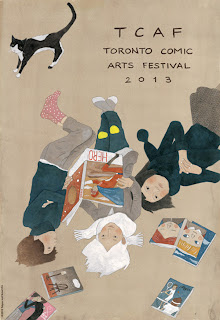
I first learned about the Toronto Comic Arts Festival (TCAF) in 2011 when Usamaru Furuya and Natsume Ono were invited to the event as featured guests. (As a side note: translations of their diary manga from the trip are included in the 2013 TCAF program guide.) It took me two years to finally work up the courage to attend TCAF myself and get my passport in order. 2013 marked TCAF’s tenth anniversary. This year’s festival featured over four hundred creators from nineteen different countries, including mangaka Taiyo Matsumoto and Gengoroh Tagame. While there were festival events throughout May, TCAF 2013’s main exhibition took place on Saturday, May 11th and Sunday, May 12th.

In order to keep the cost of the trip as low as possible, I crossed over the border into Canada from Michigan early Saturday morning along with my good friend Traci (who contributed a guest post here at Experiments in Manga not too long ago.) I arrived in Toronto in time to see The World of Taiyo Matsumoto, an exhibition at The Japan Foundation featuring original artwork by Matsumoto (creator of Blue Spring, Tekkon Kinkreet, GoGo Monster, and the recently released Sunny.) Matsumoto himself was in attendance for a special interview and artist’s talk. The turnout was huge—standing-room only and some people even had to be turned away. Matsumoto admitted that he never expected so many people to turn out to see him and that he was greatly honored. The event and exhibit, which focused on Matsumoto’s artwork, were marvelous. I certainly learned quite a bit: Matsumoto and Santa Inoue (creator of Tokyo Tribes) are cousins and they regularly talk about manga and help each other out; Tekkon Kinkreet was originally intended to be six volumes long, but ended after three since it wasn’t popular enough to continue (although Matsumoto said that he is satisfied with its conclusion and has no desire to revisit the story); in the beginning, Matsumoto was actually reluctant and even resentful working on Ping Pong, which became his breakout manga; and while Matsumoto has always been an innovative artist, more recent developments in printing technology have allowed him to experiment with different drawing materials and techniques, moving even further away from the use of screentone.

© Maurice Vellekoop

From The Japan Foundation, I headed over to the spotlight on Gengoroh Tagame, a highly influential gay manga artist. Joining Tagame were Anne Ishii, Chip Kidd, and Graham Kolbeins to celebrate Tagame and his work and to discuss the recent release of The Passion of Gengoroh Tagame, which they all had a hand in bringing into being. The panelists were all very enthusiastic and had a great senses of humor. Because of this, the spotlight was engaging and entertaining in addition to being informative. Apparently, there was a rumor that Tagame did not want his work translated into English. He assured us all that this was not true. In fact, he was surprised that it took until now for a collection of his manga to be released in English. It is possible that the rumor may have had a chilling effect on the licensing of Tagame’s materials. Like so many other people (myself included), he is very excited about the publication of The Passion of Gengoroh Tagame. He is also unbelievably happy that others share enjoyment in his fantasies. Tagame is unusual in that very few gay manga artists in Japan are able to make their living on their artwork alone, most hold at least a second job. The panel ended with a very interesting conversation about gay manga and bara (manga typically geared towards gay men) and boys’ love and yaoi (manga typically geared towards women.) It’s difficult to generalize about the genres and the distinction between them isn’t always as clear as some people claim or would like; there can be considerable grey area, crossover, and overlap between the two. For a time, yaoi served as an outlet for gay manga before bara became more publicly acceptable and gay manga magazines were established. Tagame actually started out by submitting his work to yaoi magazines when he was eighteen and he continues to have a large number of female fans. In line for his signing after the talk were people of all (adult) ages, genders, and sexualities, which was wonderful to see.

After having my copy of The Passion of Gengoroh Tagame signed, Traci and I met up together again. We made our way down to The Beguiling Books & Art which is an astounding, award-winning comics store. If you find yourself in Toronto, I highly recommend stopping by The Beguiling. It has new comics, old comics, out-of-print comics, mainstream comics, alternative comics, independent comics, domestic comics, international comics (including the largest selection of manga that I’ve ever seen in one place), and more, more, more. And since the shop was across the street from Koreatown, Traci and I took the opportunity to chow down on some delicious Korean food before heading over to Church on Church to catch the tail end of the TCAF Queer Mixer. Unfortunately, we missed the reception and artist talks, but we still were able to see the exhibit Legends: The Gay Erotic Art of Maurice Vellekoop and Gengoroh Tagame which was well worth the trek across town. (Honestly, I was more interested in the art than I was in the mixer itself, anyways.) On a more personal note, I have never had the opportunity to walk around a queer neighborhood before. It was an awesome and somewhat surreal experience for me; it made me very happy just to be in the Church Wellesley Village area.

On Sunday, I attended the Comics Editing International panel which brought together four comics editors from different countries and backgrounds: Thomas Ragon from Dargaud (the oldest comics publisher in France), James Lucas Jones from Oni Press, Mark Siegel from First Second Books, and Hideki Egami from IKKI/Shogakukan. The group talked about the similarities and differences between their work as editors and the comics markets in their countries. The panel was fascinating. I love IKKI manga, and so was very excited to hear editor-in-chief Egami speak. IKKI is different from most magazines in Japan; it appeals to mangaka who want more control over their work and artistic vision as well as those who want to escape the factory-like system associated with so many of the other magazines. Egami mentioned that the manga industry in general is in decline in Japan, and so publishers are beginning to look outside of the country more and more where once they were almost exclusively focused on the domestic market. IKKI has even started to experiment by publishing left-to-right comics with horizontal text, hoping that they will be more easily adapted, translated, and distributed in other countries. I also attended Sunday’s Queer Comics panel which featured Zan Christensen (who is utterly delightful), Erika Moen, Justin Hall, Chip Kidd, and Gilbert Hernandez and Jaime Hernandez. They talked about queer comics specifically and the representation of queer characters in comics in general, with a particular emphasis on non-binary and fluid sexualities and genders, which I personally appreciated. It was a great group and a great discussion.

My very small, TCAF haul

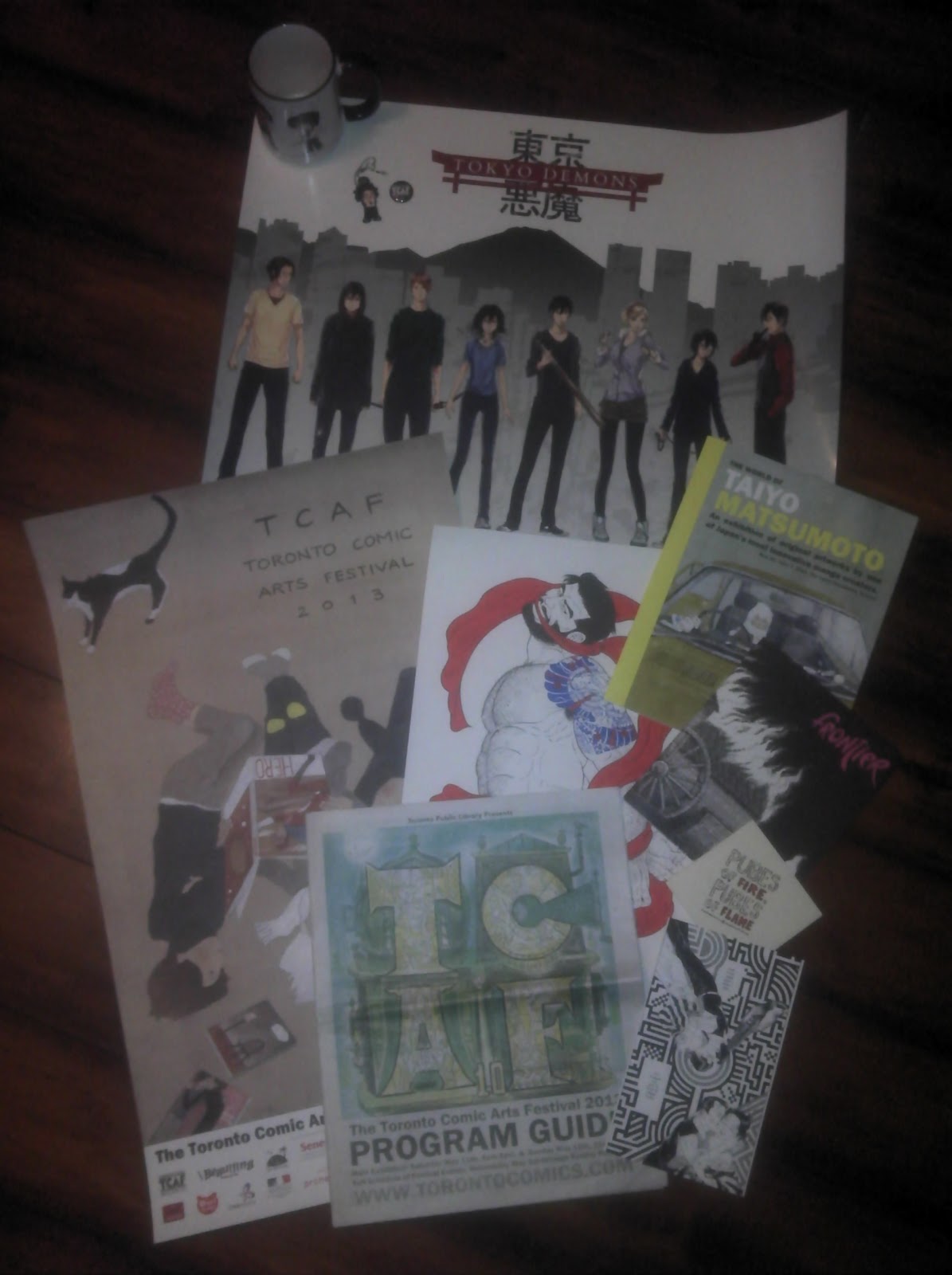
For the most part, I intentionally flew under the radar while at TCAF. I saw several of my fellow manga lovers around (Deb Aoki, Brigid Alverson, and Jocelyne Allen, just to name a few) and I know that there were even more of us there, too, but I tend to keep to myself and didn’t seek anyone out. I did, however, wander around the exhibitors’ area for a bit. Because I promised that I would, I made a point to introduce myself to the wonderful ladies of Chromatic Press and Tokyo Demons, which is one of my more recent obsessions. (I had been invited to the Chromatic Manga Mixer on Friday night, but I sadly wasn’t in town yet.) I also chatted with Alex Woolfson about  Artifice and The Young Protectors and stopped by Jess Fink‘s table long enough to awkwardly profess my love for her work. Ryan Sand’s new publishing effort Youth in Decline made it’s official debut at TCAF, so I picked up a copy of the first issue of Frontier to show my support. One of the best things about TCAF, other than the chance to see so many fantastic artists who I already follow all in one place (and there were a lot of them there), was the opportunity to discover creators who I wasn’t previously aware of. This is how I ended up bringing home Andrew Fulton‘s minicomic Pubes of Fire, Pubes of Flame which continues to greatly amuse me.

I really do not do well in unstructured, social settings; simply attending TCAF was a huge deal for me and a tremendous personal achievement. I largely consider my first TCAF experience to be a success. I am very happy to report that Traci and I both had a phenomenal time. After only a few hours of being there, I was already making plans for a return visit for next year’s show. Seriously, TCAF is amazing. There was so much going on that I had to make some extremely tough decisions about which programs to attend over others. I saw a ton of incredible work from incredible creators from all over the world and I still feel like there was more that I didn’t get to see. So next year, I’ll be showing up no later than the Friday before the main exhibition and preferably earlier. I’ll be scheduling more time to spend exploring every nook and cranny of the exhibitors’ area. I’ll also be carrying around some snacks with me during the festival; I was so busy and engaged by the programming and exhibits that I actually forgot to eat for most of the day. Next year, I hope to have the guts to actually introduce myself to everyone and maybe even socialize a bit more, too. (Please do not be offended if I didn’t say hello to you this year!) As long as there’s a TCAF, you can expect me to be there.

Filed Under: UNSHELVED Tagged With: comics, Gengoroh Tagame, manga, Taiyo Matsumoto, TCAF

Kare First Love Vols 1-6

May 17, 2013 by Anna N

Kare First Love Volumes 1-3 by Kaho Miyasaka

I was excited to see the first volume of Kare First Love pop up on Viz Digital. I thought this would be a good excuse for me to reread the series. I checked out most of Kare First Love from a library a long time ago, and since then I’ve been slowly acquiring my own copies. Kare First Love was a shoujo manga released before the Shojo Beat imprint came into being. In terms of content, it would skew a bit older than some of the titles in the Shojo Beat line, although Miyasaka doesn’t straddle the josei/shoujo line the way I feel Ai Yazawa sometimes does.

Kare First Love sticks fairly close to standard shoujo plots, but it executes them in an engaging and sometimes slightly more realistic way. Kare First Love also piles on the drama. While there are humorous moments, there’s much more angst as the protagonists navigate their budding relationship. Karin Karino is a shy girl who hides behind her glasses and doesn’t stick up for herself at school. She’s thinking slightly snarky thoughts to herself as she endures her morning bus ride when she’s approached by Kiriya, a handsome student from a nearby boys’ school who is interested in the photography book that she’s reading. A mishap on the bus leaves Karin thinking Kiriya is a pervert, and she slaps him and leaves her book behind. Like many shoujo heroines Karin’s outward actions contract with her inner thoughts, as she meekly gives in when her frenemy Yuka demands her class notes while thinking of what she’d actually like to say in response. All the mean girl shenanigans are deflated a little bit by Nanri, a girl in Karin’s class with a worldly and cynical air about her. Nanri holds herself apart from the rest of the class, but she points out to Karin that she does have the ability to stop being taken advantage of if she would only speak up.

As much as Karin would like to go back to her simple anonymous life Kiriya will not go away. He shows up at her school to return her photography book, and they immediately start bickering. Yuko decides that she’s going to use Kiriya’s odd interest in Karin to pursue him and his group of hot friends. Karin finds herself maneuvered into a series of awkward group dates, and it becomes apparent that instead of being obnoxious, Kiriya is almost saintly for a 16-year-old boy. He goes out of his way to look after Karin, maneuvering her through awkward social situations. Karin can’t believe that Kiriya is actually interested in her, but around him she actually says what’s on her mind without her customary filter of shyness.

As Karin and Kiriya start to spend more time with each other, she learns that he’s estranged from his family and supports himself by working a series of part-time jobs. His main ambition is to be a photographer. There are plenty of misunderstandings and incidents where Karin is swept off her feet while Kiriya says things like “Let me take care of you…or I’ll do something horrible like kiss you again.” Kiriya encourages Karin to rediscover her love for music, which is something that she dropped due to the extreme pressure her parents placed on her studying for school.

One of the things that sets Kare First Love apart from other shoujo manga is the way Miyasaka details the trials and tribulations associated with Karin and Kirya developing the physical aspect of their relationship. The manga goes into more detail than is typical, with Nanri sometimes functioning as a peer counselor for the Japanese equivalent for Planned Parenthood because she keeps handing Karin condoms to ensure that when she does have sex, it will be safe sex. Karin is as scared and timid as you would expect a socially isolated girl to be, and Kiriya is about as patient as one would expect a 16 year old boy to be, which is not very patient. One difficult element of the characterization that Miyasaka manages to pull off is that for several volumes Kiriya is basically pressuring Karin to have sex, but he doesn’t seem like a jerk. He might attempt more physical intimacy in their relationship, but he always backs down when Karin appears uncomfortable.

Teenage romance is always both intense and complicated, and in short order the couple have to deal with Kiriya’s tragic past (the most important accessory of any shoujo hero), Karin’s overbearing parents, Yuka’s bullying, interfering photographers, and Kiriya’s attractive older sister-in-law. In addition to these outside complications, Kiriya and Karin’s relationship turns stormy due to their own lack of communication and misunderstandings with each other. The dynamic of the main relationship in Kare First Love reminded me a bit of Fuyumi Soryo’s Mars, but with much less psychological torture.

Miyasaka’s art is attractive, but most fluid and natural when she’s drawing teenagers. Karin’s father often looks a tad on the robotic side, but that could also be a function of his less than great personality. Karin is believable as a stunning shoujo heroine when she takes off her glasses, and Kiriya’s larger frame and shaggy blond hair contrasts with her more conservative look. Miyasaka does a good job alternating between the outward action and Karin’s thoughts, making all the scenes of breaking up and making up dramatic enough to satisfy any shoujo fan.

I’m very happy that Viz is making their backlist available on digital platforms, and I hope this series finds a new group of fans!

Filed Under: REVIEWS Tagged With: kare first love, shoujo, viz media

Manga the Week of 5/22

May 16, 2013 by Sean Gaffney, MJ, Michelle Smith and Anna N 3 Comments

SEAN: As I try to wean this list away from just what Midtown Comics says and try to take in more alternate sources (mostly Amazon), I find myself sometimes missing books I should have mentioned. Last week was Dance in the Vampire Bund, this week it’s X, which apparently showed up today and I didn’t have on the MtWo list. So, X 3-in-1 5, which presumably has Vols. 13-15. And a picnic? Came out this week.

MJ: I’ve been really enjoying the X 3-in-1 releases. I didn’t enjoy this series much the first time I read it through, but the larger trim size is giving me a fresh appreciation for the artwork, which has really transformed my experience with the series. I’d recommend this new version to anyone who enjoys dramatic shoujo in all its glory.

SEAN: Meanwhile, in stuff coming out NEXT week, Kodansha has a trio of releases. I continue to buy and be entertained by Cage of Eden, even as it hits double digits. Honestly, its faults are the faults of almost have the titles that run in Shonen Magazine – the plot rambles on like a season of Lost without giving much info, and its female characters are all large-breasted nymphs for the males (and reader) to ogle. But – it’s fun snack food manga.

There’s also Ghost in the Shell: Stand Alone Complex 4, which, I would imagine, stands alone. Robert Cormier’s Ghost in the Shell, coming soon.

sailormoon11

And Sailor Moon is in the home stretch, as Vol. 11 brings us the start of the final arc, Stars. Chibi Chibi is on the cover, and if you’re wondering who the hell she is, well, read on and find out!

MICHELLE: I continue to be sad that the Starlights never got a cover of their own.

SEAN: Seven Seas has a new debut in The Sacred Blacksmith, another title I vaguely recall was adapted into an anime a while back, and is no doubt based on a light novel, as that’s how Seven Seas rolls these days. It seems to feature a female swordswoman, which is a good start, and is fantasy-ish? And I hear this is another one where the anime takes great liberties with the heroine – not for the better. Let’s see if it impresses me like Zero’s Familiar did.

ANNA: This seems potentially interesting to me, but I think I’m going to wait until a few people I know read it.

MJ: I’ve become so skittish about Seven Seas. I’m with Anna on this one.

SEAN: Alice in the Country of Joker: Circus and Liar’s Game was one of the most psychological yet, and also took us closer to Alice finding out about her sister than ever before, so I really want to read Vol. 2.

ANNA: I did enjoy the first volume of this series and I plan on reading volume 2 as well. The first volume was not quite as good as Hearts, but not as bad as Clover, so I’m interested to see where this goes.

SEAN: Vertical has Vol. 5 of Limit, which features – shock and horror – a male on the cover. No doubt this is the volume where everything starts to turn around and go great. Aheh.

ANNA: I am feeling guilty that I am three volumes behind with this series! I plan to catch up though. It is always such a nice change of pace, if a Lord of the Flies type scenario featuring stranded schoolgirls could be described as “nice.”

MJ: I’ve been looking forward to this volume quite a bit!

sunny1

SEAN: Viz has a debut from the author of Tekkonkinkreet, Taiyo Matsumoto. It’s called Sunny, and is the manga to give your indie comics friends who hate manga to say “No, see? See?”

ANNA: I also feel guilt that I haven’t read anything by Taiyo Matsumoto. But this is on my to-read list, so hopefully my feelings of guilt will abate when I read it.

MJ: I’ve drooled over artwork I’ve seen from Blue Spring, and I’ve longed to read it ever since I read Kate’s article on the subject, so I’m thrilled to have an opportunity to experience some new Matsumoto along with everyone else.

SEAN: They also have the final volume of Saturn Apartments, one of the quieter Ikki series, but one that had a lot of fans who appreciated just those qualities. Every Ikki series that comes out here is worth it, IMO. Yes, even Bokurano, though I won’t read that.

MICHELLE: I’m looking forward to catching up on/concluding this one.

SEAN: And there is a GIANT PILE OF YEN, which I am getting in a week early, as my shop sometimes does. They will arrive just in time for me to go to Anime North. But it’s OK, as I can bring all my new manga up to Canada! And take it through customs! Hey, wait, found the flaw in my plan.

MICHELLE: Once again, you have made me snerk.

ANNA: I don’t know why, but there isn’t much that Yen puts out that’s on my radar. I need to catch up with A Bride’s Story and want to read Thermae Romae, but that’s about it. Perhaps my problem is that I’ve already read most of their graphic novel adaptations in prose form.

MJ: I’m deeply in love with several current Yen series, so a GIANT PILE OF YEN is always good news for me!

MICHELLE: Lately they’ve released several new action-ish series that I’ve found to be enjoyable, too. I look forward to volume three of Blood Lad, for example.

SEAN: Because the two bestsellers of last year were High School of the Dead and Alice in the Country of Hearts, the most obvious license ever would combine elements of the two in some way. This we have Are You Alice?, which seems to be about characters playing Wonderland ‘roles’ (like the other Alice), and murderous violence. I’m hoping this is more ‘psychological thriller’ and not ‘Saw’ with moe kids.

The 19th volume of Black God is out, and I believe that it is the final volume. It’s a manwha, so I will tag the others here.

MJ: I’ve been collecting this series all along, and I have a marathon planned now that the final volume is out. Look for more on this coming up!

SEAN: Blood Lad has proven to be my big surprise hit of 2013, so I’m really looking forward to the 3rd omnibus, whose cover is also very purple.

MJ: Oh, Blood Lad, how I adore you. I kinda can’t believe I’m saying that, but it’s obviously true.

SEAN: And speaking of survival horror, we have the 2nd volume of BTOOOM!. The first didn’t grab me hard, but I didn’t dislike it, so I will give it a second volume.

MJ: I had moderate fun with the first volume, so I’m looking forward to seeing where it goes.

I’ve spent 3 volumes watching The Disappearance of Nagato Yuki-chan sort of play around with being cute and moe, knowing that Vol. 4 would hit and be FAR more interesting. This is Vol. 4. It’s FAR more interesting.

And the second volume of Durarara!! Saika arc should be interesting as well, and feature a lot of slashing.

Amano_KingdomHeartsFinalMix_V1

One of Yen’s stealth announcements was the rescue/relicensing of the Kingdom Hearts books, with two volumes titled Final Mix coming out this month. I never read the Tokyopop ones the first time around, but I really should check them out, if only for Donald and Goofy.

MJ: This will be my first experience with the series, too, but I’m ready to check it out.

SEAN: Omamori Himari has hit ten whole volumes, which makes it a shame I know next to nothing about it except it has ‘cat demon samurai girls’. (What, no vampires?)

Soul Eater 14 has one of the most minimal manga covers I’ve seen in a while. Love it. As for the plot, hope you’re enjoying Baba Yaga’s Castle, we’re still there.

Thermae Romae has its 2nd omnibus come out, which will no doubt continue to look gorgeous. I’m hoping the storyline can keep it up as well – things were getting dangerous when we left off for our bathing hero.

MJ: I’m certainly interested in seeing where the story goes. It’s difficult for me to imagine how it’s going to hold up over the long term, but it’s lovely to look at, and that’ll take me quite a ways.

SEAN: Lastly, Umineko: When They Cry (the ‘they’ in this case being Seagulls, not Cicadas) starts its second arc, which is where things really begin to get very, very meta, if I recall correctly. Plus you have to love that insane grin on the cover.

Anything that you’d risk exposing to Canadian Customs?

Filed Under: FEATURES, manga the week of

  • « Go to Previous Page
  • Page 1
  • Page 2
  • Page 3
  • Page 4
  • Go to Next Page »
 | Log in
Copyright © 2010 Manga Bookshelf | Powered by WordPress & the Genesis Framework