• Skip to primary navigation
  • Skip to main content
  • Skip to primary sidebar
  • Home
  • About Us
    • Privacy Policy
    • Comment Policy
    • Disclosures & Disclaimers
  • Resources
    • Links, Essays & Articles
    • Fandomology!
    • CLAMP Directory
    • BlogRoll
  • Features & Columns
    • 3 Things Thursday
    • Adventures in the Key of Shoujo
    • Bit & Blips (game reviews)
    • BL BOOKRACK
    • Bookshelf Briefs
    • Bringing the Drama
    • Comic Conversion
    • Fanservice Friday
    • Going Digital
    • It Came From the Sinosphere
    • License This!
    • Magazine no Mori
    • My Week in Manga
    • OFF THE SHELF
    • Not By Manga Alone
    • PICK OF THE WEEK
    • Subtitles & Sensibility
    • Weekly Shonen Jump Recaps
  • Manga Moveable Feast
    • MMF Full Archive
    • Yun Kouga
    • CLAMP
    • Shojo Beat
    • Osamu Tezuka
    • Sailor Moon
    • Fruits Basket
    • Takehiko Inoue
    • Wild Adapter
    • One Piece
    • After School Nightmare
    • Karakuri Odette
    • Paradise Kiss
    • The Color Trilogy
    • To Terra…
    • Sexy Voice & Robo
  • Browse by Author
    • Sean Gaffney
    • Anna Neatrour
    • Michelle Smith
    • Katherine Dacey
    • MJ
    • Brigid Alverson
    • Travis Anderson
    • Phillip Anthony
    • Derek Bown
    • Jaci Dahlvang
    • Angela Eastman
    • Erica Friedman
    • Sara K.
    • Megan Purdy
    • Emily Snodgrass
    • Nancy Thistlethwaite
    • Eva Volin
    • David Welsh
  • MB Blogs
    • A Case Suitable For Treatment
    • Experiments in Manga
    • MangaBlog
    • The Manga Critic
    • Manga Report
    • Soliloquy in Blue
    • Manga Curmudgeon (archive)

Manga Bookshelf

Discussion, Resources, Roundtables, & Reviews

Archives for August 2011

Off the Shelf: Three from Kodansha Comics

August 31, 2011 by MJ and Michelle Smith 8 Comments

MJ: Well, howdy, stranger.

MICHELLE: Howdy. This place looks like a ghost town. Check out that well-timed tumbleweed.

MJ: Do you think we can bring it back to life?

MICHELLE: I reckon we can. Especially if we can rustle up some of them ladies of ill repute.

MJ: Oh, good idea! I’ll see what I can come up with on that front. In the meantime, you wanna tell us what you’ve been reading?

MICHELLE: I guess it’ll pass the time.

A whole bunch of new series from Kodansha have debuted this month, so I checked out a couple of those. The first was Animal Land by Makoto Raiku, whose Zatch Bell! was previously released by VIZ. I wasn’t sure if I’d like this and, even after having read it, I’m still not quite sure what to make of it.

Monoko the tanuki lost her parents to wildcats three months ago and is very lonely. One day, when she’s trying to catch a fish in the river, she spots a floating basket with a baby inside and is instantly smitten. She is determined to be a mother to the baby, and braves many dangers to provide milk for him and, with the help of the other tanuki, brings him back to life when he seems on the verge of death.

It soon becomes apparent that this is one unusual baby, since he’s not only able to understand tanuki speech, but can actually converse with all animals. This skill manifests most poignantly in regards to Kurokagi, a scarred, black wildcat who’s been hanging around. The tanuki all fear him, but Kurokagi has actually appointed himself their protector after a tragic incident in which he caused the death of an infant animal. It’s fairly bizarre watching this baby, who doesn’t even crawl all that well, holding a reasonably adult conversation with a giant wildcat, I must say.

So, yes, there are some nice moments here. And I like Kurokagi. But there are also some things I don’t like. The art, for one, is often unattractive. I don’t like how the tanuki are drawn at all, for example. For another, this is clearly a story for young kids, with a zany sense of humor that relies heavily on poop jokes. Seriously, characters will just randomly start pooping for no reason. It’s ironic, really, since I bet the poop is there to appeal to ten-year-old boys—I imagine Japanese manga editors calling for “More poop!”—but here in the US, its prevalence results in the book receiving a teen rating.

I’ll probably check out a second volume, but this may end up being a series that’s just not for me.

MJ: You know, even as a kid, I was pretty much immune to the charm of poop jokes. I just don’t get the appeal.

MICHELLE: I think appreciation of poop jokes resides on the Y chromosome.

So, what have you been reading this week?

MJ: Well, I decided to make it a Kodansha week too, and the results surprised me greatly. First, I read the debut volume of Mardock Scramble, which is the manga adaptation of Tow Ubukata’s novel trilogy of the same name that was released as a single volume early this year on Viz’s Haikasoru prose imprint. I hadn’t read the novel, and didn’t have high expectations for the manga adaptation, but actually I enjoyed it quite a bit.

Young Rune Balot thinks she’d be better off dead. “Rescued” from a life of abuse and prostitution by a guy named Shell, it’s only after Shell tries to kill her that Rune makes a (subconscious) choice to stay alive. She’s rescued from near-death by a techie detective, who gives her a new body and a shape-changing cyborg mouse to protect her, in the hopes that she’ll agree to testify against Shell in court.

There’s a whole bunch of stuff about Shell, who apparently kills girls and then loses his memory afterwards, and another mysterious man who’s coming after Balot, but even with so much plot and intrigue going on, the real story is in Balot, about whom we still know little, whose second chance at life could turn her into a completely different person–probably awesome, possibly terrifying. She’s the thing that really draws the reader in. Though the super-cute, badass mouse doesn’t hurt either.

Novel adaptations are hit-and-miss with me.Too often, I think they try to rush the story, or try too hard to be visually thrilling (especially in terms of fanservice) when really they just need to practice good storytelling. But I’m on the edge of my seat with this one. There’s still a lot to be revealed, and mangaka Yoshitoki Oima has left us with quite a bit of mystery (and a pretty big cliffhanger) at the end of the series’ first volume, but I’ve been given enough to be pretty well hooked.

I’m tempted to pick up the novel now, though I’d hate to risk compromising my enjoyment of the manga when I really am enjoying it so much.

MICHELLE: Wow, that sounds truly awesome. I was also somewhat wary that the prostitution backstory would mean fanservice would ensue, so I am happy to hear that’s not the case. And my inner twelve-year-old is *really* keen on that mouse!

MJ: Michelle, you would love the mouse. Truly.

Now, my second Kodansha adventure this week had a bit of the opposite effect on me, and since I know we both tried out this one, I’m anxious to hear whether your experience was similar. Care to start with a little summary?

MICHELLE: I will give it a whirl.

Until the Full Moon is a two-volume series by Sanami Matoh (Fake) that was originally published in the US by Broccoli Books. I actually owned that edition for several years and gave it away unread, but now I am finally giving it another chance.

Vampire cousins David and Marlo were extremely close growing up, but Marlo has been keeping his distance the past ten years or so while his family lived in America. Now they’re back, and have come to David’s doctor father to discuss a bizarre condition Marlo has recently developed. He’s half-werewolf, and has begun to transform into a woman on the full moon! His parents angst in over-the-top fashion until David’s father suggests that the only possible solution is that David and Marlo must get married. The date is set for a full moon a year in the future.

Various obstacles insinuate themselves between the couple, be it a family friend who mistakenly believes his sister is in love with David, or an ex-girlfriend of Marlo’s who is jealous when she realizes that David is the one to whom Marlo was referring when he confessed he loved someone else. Everything is very campy, with lots of silliness and epic kisses upon floral backgrounds. The interior artwork is possessed of retro charm and that vintage Matoh look, but the cover art is distressingly generic-looking: I found myself very distracted by my inability to tell who some of these characters were even supposed to be. They look like they’re from some other series entirely!

MJ: Yes, I never would have picked it up from the cover art, but as soon as I saw the old-school look of the inner artwork, I was determined that I would love it. On top of that, the outrageous, gender-switching werewolf premise convinced me that this would be exactly the kind of cracktastic “classic” shoujo in which I most delight. Unfortunately, I was pretty disappointed in the silly reality.

The premise is, indeed, cracktastic, but the story itself reads more like a bad teen-penned novel than brilliantly mad shoujo. The volume’s main conflicts all read as completely contrived, with no real tension or meaning of any kind. I mentioned in Monday’s Pick of the Week that I would be content simply looking at this manga, and I’m wondering if I should have left it at that after all.

MICHELLE: While I was reading it, I kept comparing it to what I’d heard about the inventive kookiness of Demon Sacred which, from all accounts, was the very epitome of “brilliantly mad shoujo.” Alas, you’ve hit the nail on the head in describing this as “contrived.” David and Marlo also keep up the standard horny!seme and reluctant!uke roles, no matter what gender Marlo happens to be at the moment. The one element of the story I do appreciate is how David makes it clear that his feelings are for Marlo the person, not Marlo the specific gender.

MJ: The comparison with Demon Sacred is very apt, and sadly brings Until the Full Moon‘s shortcomings into clear view. Demon Sacred used its super-fantasy world as a tool for enhancing the real emotions of its characters. Here, the vampire/oddly transforming werewolf stuff feels superfluous to everything, like a badly re-themed board game.

What’s particularly sad to me, is that I actually sort of like David and Marlo as a couple, even with the clichéd BL roles, and might have been quite interested in just watching the two of them deal with their own issues. But the author relies so much on the external characters to threaten their happy existence, there’s never really any time spent on the two of them as a couple.

MICHELLE: You’re absolutely right. We just know they love each other ‘cos they say it all the time, but we don’t actually know why or see any of the moments between them that led to the development of these feelings. It’s extremely shallow.

And, yes, dead horse, but can we go back to the cover for a minute? Because seriously…. who are these people? Is David the blond on the couch with the ponytail? I don’t recognize ANY of these other characters. Not one. I am truly baffled.

MJ: I can only assume it’s going for a more contemporary style in an attempt to bring in newer readers? It’s a shame, really, since the vintage artwork is the book’s best quality by far.

MICHELLE: I assume that as well, but I am at a loss as to who the female characters in particular are even supposed to be. Maybe they’ll turn up in volume two, but it’s very puzzling and, as you will note, distracted me a good deal. :)

MJ: Yeah, it’s kinda like they took characters from Pandora Hearts (or something along those lines) and randomly stuck them on the cover.

MICHELLE: Heh. Yeah. So, anyway, do you think you’ll read volume two? I probably will, since that’s also the final volume.

MJ: Yes, I probably will. Though this disappointed me, it didn’t actively offend me, and I’ll nearly always give something a few volumes to find itself. Surely I can make my way through one more.

MICHELLE: I think that’s a great note to end on. “Until the Full Moon… not actively offensive!”

MJ: Works for me! See you next week!

Filed Under: OFF THE SHELF Tagged With: animal land, mardock scramble, until the full moon

Manga the Week of 9/7

August 31, 2011 by Sean Gaffney

It’s the first week of the month, and you know what that means. Far, far too much manga. What’s worse, Diamond is finally catching up with Kodansha. (Midtown, not so much). I mentioned most of the titles coming in last week (Bloody Monday, Cage of Eden, Phoenix Wright), but one I did not is the re-release of Gon, the adorable (and fearsome) baby dinosaur manga that is actually getting its third re-release. Kodansha is apparently trying to pitch it for a movie, and I think it could be a big hit with the right company. Naturally, being about the antics of a baby dino, it ran in Kodansha’s magazine for adult salarymen, Weekly Morning.

There is also Dark Horse, which is now releasing the 39th volume of Oh My Goddess. I should note that Dark Horse is worried about how old fans will think the manga is given the high volume number, and so ongoing volumes will also remain Volume 39, in tribute to Jack Benny.

The rest is aaaaaaaaall Viz. From Weekly Shonen Jump: Bleach 36, Death Note omnibus 5, Naruto 7-8-9 omnibus, regular Naruto 52, One Piece 58, and Toriko 6. There’s also Ultimo from Jump Square. All featuring Friendship, Perseverance, and Victory. There’s also Kekkaishi 7-8-9 omnibus as well, which is from Shonen Sunday, so is legally obligated not to have friendship, perseverance, or victory. Sad, really.

On the shoujo end, we have cute Hakusensha mangas! Library Wars 6, La Corda D’Oro 14 (another in Viz’s ‘see, it’s not cancelled, just on a ‘no one buys this at all’ schedule!’ titles), and Oresama Teacher 4. Slightly less cutely, we get Grand Guignol Orchestra 3. We have cute Shueisha manga! It’s another volume of tug-at-your-heartstrings Kimi ni Todoke. We have sexy Shogakukan manga! There’s ‘Who am I to argue with its sales?’ Black Bird 10, as well as techno-thriller shoujo romance Dengeki Daisy 6. And we have one final volume, as not-really-shoujo smutty comedy Butterflies, Flowers ends with Vol. 8. I’m betting on a wedding.

All this and a Pokemon Black and White! Are you prepared for this much manga?

Filed Under: FEATURES

Buffy the Vampire Slayer Season Eight, Vol. 7

August 31, 2011 by Michelle Smith

By Brad Meltzer, et al. | Published by Dark Horse

When I write a review, I do my best to articulate what I liked and didn’t like as clearly as possible. When one is a passionate fan of something, however—as I undoubtedly and unabashedly am of Buffy the Vampire Slayer—such clarity becomes more difficult to achieve. I will do my best to explain my aversion to the “Twilight” arc contained in this volume, but what it really boils down to is that I just don’t like it.

Spoilers abound. Beware.

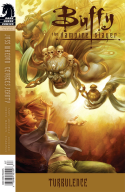
The volume actually starts off pretty well, with a Joss-penned one-shot called “Turbulence” (issue #31) that finally gets rid of those irksome colorful goddesses for good and contains an amazing scene between Buffy and Xander wherein she reacts to seeing him kissing Dawn by confessing that she has begun to see him in a romantic light. He is appropriately incredulous:

Xander: Yoooou… have feelings. At me.
Buffy: Would that be good?
Xander: That would be great. If it was a bunch of years ago and you actually meant it.

He also points out that, even if her feelings were genuine, once she saw him and Dawn together she should’ve realized that the decent thing to do would be to keep quiet. Honestly, I’m a little bothered by how immature and selfish Buffy is here, but her desperate loneliness coupled by Xander’s rejection might play a part in her actions a few issues later. Xander, on the other hand, comes off as entirely in character; I think he is probably the best thing about the Season Eight comics, actually.

Really, the first 2.5 issues of the “Twilight” arc are pretty good, too. Buffy and Xander explore the extent of her newfound superpowers. Dawn is concerned, pointing out that “you don’t get power for free,” and she is proven correct when Willow’s search for the missing Faith, Giles, and Andrew leads to the discovery of a bunch of dead Slayers. It turns out that 206 Slayers have died since the start of the conflict, and Buffy has inherited all of their powers. She’s understandably pretty freaked out by this. “If I’m sucking their power… it makes me a vampire.”

Meanwhile, the missing trio are being held at Twilight headquarters, where Giles recognizes the enemy’s voice and many hints are dropped concerning what’s going on and Giles’s knowledge of it. “Every Watcher wonders if his Slayer might be the girl… and you’ve had more reason than any.”

The high point of the arc is when Buffy interrupts this conversation to attack Twilight, at which points he unmasks himself. Angel. Buffy’s anger is initially white-hot. “You killed my girls! Two hundred and six girls!” and “Why did you put us through this fucking hell for the past year?!” Angel rationalizes his actions as a way to keep the body count lower than if governments had gotten involved. If he posed as the masked villain and talked of “master plans,” he would distract others who might’ve wanted to take action. Simultaneously, he would focus Buffy and help her superpowers develop.

And here’s where things start to break down for me. What it boils down to is this: by activating all the Potentials, Buffy upset the balance of the Universe. But also, there’s this prophecy (referred to as merely a myth by Giles when he’s accused of not sharing his awareness of the possibility) that a Slayer and Vampire will be used to usher in a new reality of superbeings. Or something. It’s all very vague. When this new reality is established, the old one (and humanity with it) will be discarded. This is what the whole season has been building toward, and it’s just such a disappointment. Ugh.

What I really hate about this idea is that it basically retcons Buffy’s personal attraction to vampires and makes it something that the Universe’s grand plan was engineering. How much of what is happening is free will, and how much is the Universe controlling their actions? Does Angel really believe all this stuff? Or is he essentially possessed? Did Buffy really want to jump his bones so desperately (which she does, in fact, proceed to do) because she’s in a lonely and vulnerable place, or did the Universe make it easy for her to put aside her fury and make with the sexy times?

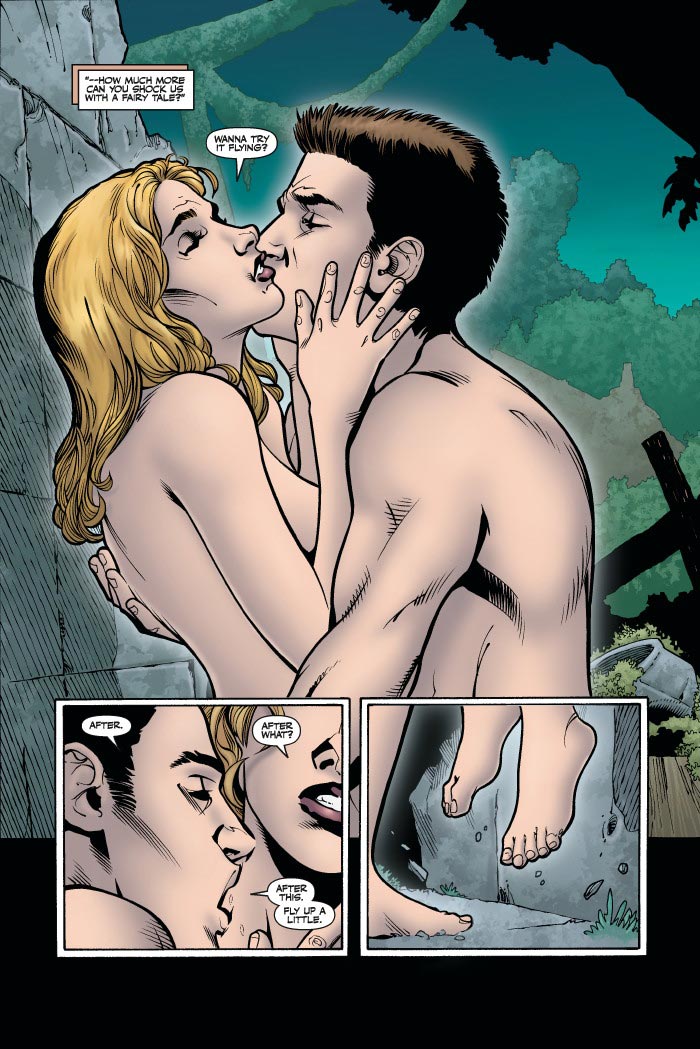
I also hate how their sexual encounter is treated, with a peanut gallery making jokes about it and many silly panels where they zoom across the sky, bodies entwined, while the world erupts in seaquakes and cyclones. It just looks stupid, but more than that, I think it was done to shock the reader. Is this juxtaposition (NSFW) of imagery and text coincidence? I think not, especially after the whole Buffy/Satsu thing.

The final issue of the arc offers some redemption, with Buffy gradually regaining her focus after sexual bliss and being dissatisfied with the pleasure paradise to which she and Angel have ascended. He is ready to believe in it (and, again, is this really his personal opinion?) and dwell there together forever but she doesn’t trust it and, more than that, can’t be happy in a nirvana while her friends are fighting for their lives. Her exact words are “Fuck evolution,” and, after a brief sad smile to acknowledge what might have been, she and Angel return to help her family fight off the hordes of demons who have invaded “the lower plane.” Willow is suitably pissed at Angel—“What you got coming you better hope never comes”—and then Spike arrives, seemingly with the intent of knocking a bunch of sense into everyone. Yay, Spike!

So, anyway, I just don’t like this arc. I don’t think it was thought through very well, and I don’t like the implications it retroactively conveys upon the events of the series. While I’m airing grievances, I shall also point out that Meltzer gets a basic fact wrong—Faith did not become a Slayer upon Buffy’s death—that no one on the editorial staff was knowledgable (or attentive) enough to spot. Too, Georges Jeanty’s renderings of Faith continue to be extremely ugly. The only way to enjoy her scenes is to just try really hard to imagine Eliza Dushku in her place.

The volume is rounded out by “Willow: Goddesses and Monsters,” another Joss-penned one-shot set before the beginning of Season Eight. In it, Willow takes some sort of magical journey that she originally skipped over in her accelerated path to power. There’s really not a lot going on here, and a lot of the dialogue is supposed to be funny but isn’t, but it’s noteworthy because it’s the first time we’ve glimpsed Tara in the comics.

One more volume to go, and it includes Spike! I never did read the final two issues, so though I am spoiled on one pivotal event, much of it will be new to me. I hope I don’t hate it.

Filed Under: REVIEWS Tagged With: Buffy the Vampire Slayer, Dark Horse

Cardcaptor Sakura Omnibus Volume 2

August 31, 2011 by Anna N

Cardcaptor Sakura Omnibus Volume 2 by Clamp

I finished this volume and I immediately felt frustrated that the third Cardcaptor Sakura omnibus from Dark Horse doesn’t seem to be scheduled to be released anytime soon. I’m feeling a little frustrated with some of the more modern Clamp series – they just seem to either go on for far to many volumes (Tsubasa) or lean towards the insipid (Kobato). But since I’ve only read a couple scattered volumes of Cardcaptor Sakura I am happy to enjoy it from the beginning in all of its pink magical girl glory.

The opening storyline of this omnibus shows Sakura struggling to master the Clow card “The Maze.” She’s aided by her enigmatic Mizuki, who has an alarmingly direct way of dealing with her students being trapped in a maze that automatically adjusts itself to create more confusion. Syaoran is immediately suspicious of Mizuki, but it turns out that she used to know Sakura’s older brother. The question of Mizuki being helpful or having some other agenda runs through much of this omnibus, because she seems determined to remain mysterious. Sakura doesn’t really care because Mizuki makes her feel “floaty inside,” but Syaoran is constantly trying to figure out what Mizuki is up to. Other episodes include a scary class trip and a class play put on by selecting roles without considering gender, with the result that Sakura ends up playing the Prince and Syaoran the Princess. Crossdressing Syaoran is pretty hilarious in the way his dialog is portrayed at being flatly shouted and peppered with exclamation points.

While magical girl activities are the general focus of the book, there’s also a nice summer vacation episode when Sakura and her father go on vacation and she befriends the old man next door who turns out to be her estranged great-grandfather. Having the card battles interrupted by occasional school event or family interaction helps keep Cardcaptor Sakura from feeling too quest-focused. The end of this omnibus is a giant battle as Sakura has to prove herself worthy of the cards she’s collected. One thing I was surprised about was that by the end of this omnibus Sakura has collected all of the Clow cards, so in six volumes the first stage of her quest is complete. I somehow thought the card collecting aspect of the manga went on for much longer, but as you might expect when Sakura masters one challenge she is set up to face new tests in the next volume.

As always from Dark Horse, this omnibus features plenty of color pages and nice paper quality. It might take them forever to release these volumes but they are a treat for Clamp fans. Now, when is volume 3 coming out?

Filed Under: UNSHELVED

The Favorites Alphabet: A

August 31, 2011 by David Welsh

Welcome to the first installment of the Favorites Alphabet, where the Manga Bookshelf battle robot glances through our respective libraries to pick a favorite manga title from each letter of the alphabet, whenever possible. We’re trying to stick with books that have been licensed and published in English, but we recognize that the alphabet is long, so we’re keeping a little wiggle room in reserve.

“A” is for…

After School Nightmare | By Setona Mizushiro | Go!Comi — Gender-bending is not unusual in manga, but actual exploration of gender is, and that’s just one of several refreshing aspects of this unfortunately out-of-print manga. It’s also a story about teenagers that uses school-mandated shared nightmares as a way of forcing students to display and face their own worst fears right in front of each other. Is it creepy? Yes. It also serves as a pretty accurate metaphor for my own thankfully-distant teenage hell, and I expect I’m not alone there. Though the series’ dream setting places it soundly in the realm of the surreal, that doesn’t make it any less resonant. After all, where do our own fears feel more real than in our fevered dreams? For more about this series from smarter writers than I, look to Jason Thompson  and (of course) David Welsh. – MJ

Antique Bakery | By Fumi Yoshinaga | Digital Manga Publishing — Ostensibly a slice-of-life tale about four men working together in a bakery, Antique Bakery offers more dramatic surprises than one might expect. Early on, charismatic gay pastry chef Ono and cluelessly lovable Chikage emerge as favorites, but as we learn more about the bakery’s proprietor, Tachibana, the more fascinating he becomes. An ordeal suffered in his past has profoundly informed the man he is in the present, and when readers realize the truth of what’s been going on all along, Yoshinaga’s mastery suddenly becomes even more apparent. Yes, there are lighthearted moments in this series. Yes, there is a fun cast of characters who grow and change from working together. But most of all, there is Tachibana’s unforgettable story. – Michelle Smith


Apocalypse Meow | By Motofumi Kobayashi | ADV Manga — Apocalypse Meow does for the Vietnam War what Maus does for World War II, using animal surrogates to re-enact period conflict. In this case, rabbits stand in for American soldiers, and cats stand in for the Vietnamese, while the Chinese (pandas) and Russians (bears) observe from the sidelines. Author Motofumi Kobayashi is clearly a military enthusiast: every volume is studded with sidebars describing combat tactics and weaponry, as well as lovingly drawn maps of troop movement. Yet Kobayashi doesn’t lose sight of the human cost of war; watching a trio of bunnies caught in a brutal fire fight makes the horror of combat fresh and unsettling, especially for readers who have been desensitized to the conflict through years of watching movies and documentaries about Vietnam. The series is long out of print, but enterprising (and patient) readers can find inexpensive copies on eBay. – Katherine Dacey


Aria (and its prequel Aqua) | By Kozue Amano | ADV Manga/Tokyopop — A cynical person might say that what Aria really shows is that slice-of-life, look at the scenery manga with no moe schoolgirls in it will die a financial death here in North America.  But what we saw of this series just made me love it all the more.  For a science-fiction utopia fantasy world, Aria is so relaxed and sedate.  It’s not afraid to devote 30 pages to simply walking to a store in the rain, or visiting a friend.  And as the series goes on, the cast of characters that form the core group grow and change, some more startlingly than others.  It’s a classic example of the sort of series you read and feel a smile on your face and a warmth in your heart.  It ran for a total of 14 volumes between both series in Japan, of which 8 saw publication here (both of Aqua and 6 of Aria’s 12).  Sadly, if you want more, I suspect you’ll have to learn Japanese.  It’s now failed to sell with two different North American publishers, and its Japanese company, Mag Garden, is the *only* major manga publisher with no digital initiative – even Square Enix is striking out on its own, separate from JManga.  It’s a shame, as I’d love everyone to see the end of this. – Sean Gaffney


Astral Project | By Garon Tsuchiya and Syuji Takeya | CMX — Being able to describe this series as “a slice-of-life supernatural mystery” makes me enormously pleased, even though it isn’t by any means comprehensive. A young man’s sister has committed suicide, and he tries to make sense of her death. Along the way, he learns to project his spirit out of his body and encounters other astral travelers who change his perspective on life. Beyond his emotional trauma, we also learn of a decidedly odd government conspiracy that gives Tsuchiya a platform for all kinds of extremely pointed satire aimed at contemporary culture. Astral Project is really, really odd, though it’s ultimately very involving and likeable. It’s further proof that Enterbrain’s Comic Beam publishes some of the most unusual, interesting comics Japan has to offer. It may be difficult to find copies of this four-volume series, as CMX didn’t exactly flood the market with copies the first time, but it’s worth the hunt. – David Welsh

What starts with “A” in your Favorites Alphabet?


Filed Under: FEATURES

Bloody Monday, Vol. 1

August 30, 2011 by Katherine Dacey

To judge from all the shonen manga I’ve read, the fate of the world rests in teenage boys’ hands: not only do they have the power to kill demons and thwart alien invasions, they’re also blessed with the kind of superior intelligence that makes them natural partners with law enforcement. Bloody Monday is a textbook example of the teen-genius genre: high school student Fujimaru Takagi dabbles in crime-solving, hacking into secure networks and decoding encrypted files on behalf of the Public Security Intelligence Agency. (Naturally, he works for the PSIA’s super-secret “Third-I” division, which is “comprised solely of elites.”) Fujimaru’s deductive skills are put to the ultimate test when his father is falsely implicated in a murder. To find the real killer, Fujimaru must uncover the connection between his father and the “Christmas Massacre,” a terrorist attack that left thousands of Russian civilians dead, their bodies covered in boils.

In the right hands, Bloody Monday might have been good, silly fun, 24 for the under-twenty-four crowd. The script, however, is pointed and obvious, explaining hacker culture and internet technology to an audience that has grown up on the world-wide web: are there any fifteen-year-olds who don’t grasp the basics of computer viruses? The characters, too, seem impossibly dim, thinking out loud, missing obvious connections, and reminding each other how they’re related, whether they’re fellow reporters for the school newspaper or siblings. Small wonder they don’t realize that their school has been infiltrated by an enemy agent.

The art is more skillful than the script, with polished character designs and detailed backgrounds. The adults actually look like adults, not teenagers with unfortunate laugh lines, while the scenes aboard the Transsiberian Railroad convey the harshness of the Russian landscape. Though artist Kouji Megumi nevers misses an opportunity to show us an attractive woman in her underwear — and really, what well-trained assassin doesn’t snuff a target or two while wearing only a matching bra-and-panty set? — the fanservice never overwhelms the plot. The action sequences, too, are well-staged, using swift cross-cuts and imaginative camera angles to heighten the suspense.

In the end, however, the slick visuals aren’t enough to compensate for the flat-footed storytelling. A plot as potentially interesting and complex as Bloody Monday‘s should challenge the reader to arrive the solution independently, not spoon-feed it; too often, the story seems to have been written in boldface, depriving the reader of an opportunity to guess the outcome of the story for herself.

BLOODY MONDAY, VOL. 1 • STORY BY RYOU RYUMON, ART BY KOUJI MEGUMI • KODANSHA COMICS USA • 200 pp. • RATING: TEEN (13+)

Filed Under: Manga, Manga Critic, REVIEWS Tagged With: Action/Adventure, Bloody Monday, yen press

Bloody Monday, Vol. 1

August 30, 2011 by Katherine Dacey 10 Comments

To judge from all the shonen manga I’ve read, the fate of the world rests in teenage boys’ hands: not only do they have the power to kill demons and thwart alien invasions, they’re also blessed with the kind of superior intelligence that makes them natural partners with law enforcement.

Bloody Monday is a textbook example of the teen-genius genre: high school student Fujimaru Takagi dabbles in crime-solving, hacking into secure networks and decoding encrypted files on behalf of the Public Security Intelligence Agency. (Naturally, he works for the PSIA’s super-secret “Third-I” division, which is “comprised solely of elites.”) Fujimaru’s deductive skills are put to the ultimate test when his father is falsely implicated in a murder. To find the real killer, Fujimaru must uncover the connection between his father and the “Christmas Massacre,” a terrorist attack that left thousands of Russian civilians dead, their bodies covered in boils.

In the right hands, Bloody Monday might have been good, silly fun, 24 for the under-twenty-four crowd. The script, however, is pointed and obvious, explaining hacker culture and internet technology to an audience that has grown up on the world-wide web: are there any fifteen-year-olds who don’t grasp the basics of computer viruses? The characters, too, seem impossibly dim, thinking out loud, missing obvious connections, and reminding each other how they’re related, whether they’re fellow reporters for the school newspaper or siblings. Small wonder they don’t realize that their school has been infiltrated by an enemy agent.

The art is more skillful than the script, with polished character designs and detailed backgrounds. The adults actually look like adults, not teenagers with unfortunate laugh lines, while the scenes aboard the Transsiberian Railroad convey the harshness of the Russian landscape. Though artist Kouji Megumi nevers misses an opportunity to show us an attractive woman in her underwear — and really, what well-trained assassin doesn’t snuff a target or two while wearing only a matching bra-and-panty set? — the fanservice never overwhelms the plot. The action sequences, too, are well-staged, using swift cross-cuts and imaginative camera angles to heighten the suspense.

In the end, however, the slick visuals aren’t enough to compensate for the flat-footed storytelling. A plot as potentially interesting and complex as Bloody Monday‘s should challenge the reader to arrive the solution independently, not spoon-feed it; too often, the story seems to have been written in boldface, depriving the reader of an opportunity to guess the outcome of the story for herself.

BLOODY MONDAY, VOL. 1 • STORY BY RYOU RYUMON, ART BY KOUJI MEGUMI • KODANSHA COMICS USA • 200 pp. • RATING: TEEN (13+)

Filed Under: Manga Critic Tagged With: Bloody Monday, kodansha, Shonen

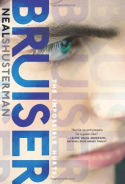
Bruiser by Neal Shusterman

August 30, 2011 by Michelle Smith

From the back cover:
Tennyson:
Don’t get me started on the Bruiser. He was voted “Most Likely to Get the Death Penalty” by the entire school. He’s the kid no one knows, no one talks to, and everyone hears disturbing rumors about. So why is my sister, Brontë, dating him? One of these days she’s going to take in the wrong stray dog, and it’s not going to end well.

Brontë:
My brother has no right to talk about Brewster that way—no right to threaten him. There’s a reason why Brewster can’t have friends—why he can’t care about too many people. Because when he cares about you, things start to happen. Impossible things that can’t be explained. I know, because they’re happening to me.

Review:
Let me just state upfront that any parents pretentious enough to name their children Tennyson and Brontë need a damn good whacking.

Moving on, Bruiser (from the author of Unwind) is the story of a social outcast named Brewster Rawlins who is perceived as a creepy delinquent by his classmates but is actually harboring a secret that compels him to keep his distance: if he cares about someone, he will absorb their pain, both mental and physical. Alternating between the perspectives of four characters (broody poetry fan Brewster, twins Tennyson and Brontë Sternberger, and Brewster’s daredevil little brother), the novel depicts how Brewster’s gift/curse affects his relationships with others and how, ultimately, being healed of all one’s ills is not necessarily a good thing.

Initially, Tennyson is opposed to his sister dating Brewster and sets out to warn the guy off, but once he catches a glimpse of Brewster’s terribly scarred back, he begins to suspect something awful is going on at the boy’s home. Concern and conscience win out, and he and Brewster begin to become friends, which is when Tennyson first notices that the scabs on his knuckles (a lacrosse injury) have miraculously disappeared in Brew’s presence. It takes a while for the specifics of his ability to come to light, and an interminable time for Tennyson and Brontë to realize that Brew’s ability to take away pain also extends to their feelings.

At first, I thought they did realize that Brew could quell mental anguish, and that that was part of the reason they convinced/manipulated their on-the-verge-of-divorce parents into taking temporary custody of Brew and his brother, Cody, after their guardian, Uncle Hoyt, passes away. Selfish to use Brew in this way, yes, but believably so for desperate teens. Eventually, though, it seems they really did not know, which is why Brontë kept pushing and pushing for Brew to make new friends, never considering that, for him, more people to care about means more potential injury. Uncle Hoyt was an abusive drunken bastard, true, but his ability to hang on to his own anger (instead of passing it off to Brew) and his insistence that Brew keep his distance from the world are seen in a new light by the novel’s end. (And speaking of the end, reports of its cheesiness are not exaggerated. The last few lines made me go “Pfft.”)

Even with the mystery of Brewster’s powers, Bruiser lacks the high-impact concept of Unwind. Instead of an epic dystopia where the whole country is going in a bizarre direction, Tennyson and Brontë’s world is defined by their home life, where they can tell that something very wrong is happening between their parents. Brew’s presence in their home acts as a balm for a while, but eventually they want to own their own pain because it seems so wrong to feel content while their family crumbles. The novel may not be as dramatic as Unwind, but is possessed of its own subtle themes and messages. I’ll definitely be reading more Shusterman in the future.

Filed Under: Books, YA Tagged With: Neal Shusterman

Upcoming 8/31/2011

August 30, 2011 by David Welsh

Hey, look up there! It’s the cover to my Pick of the Week! Haven’t seen one of those in a while, have we? Perhaps it bodes well for this week’s ComicList!

A week can’t be all bad when it features a new two-volume collection of Kaoru Tada’s quirky, funny Itazura na Kiss (Digital Manga), can it? Kotoko tries to hang on to the gains she’s made in her relationship with Naoki, and I think we can all guess how well that’s going to go for the poor dear.

Kodansha releases the 10th volume of Koji Kumeta’s sharp, satirical Sayonara, Zetsubou-Sensei, promising lots of field trips and ultimately dispiriting life lessons!

And Viz rolls out a few Signature titles. The one I’m most eager to read is the fourth volume of Q Hayashida’s gritty yet strangely charming horror series, Dorohedoro. That book has really grown on me since its debut.

Sci-fi, romance, satire, and horror… a nice mix, in the end! What looks good to you?


Filed Under: DAILY CHATTER, Link Blogging

Tenjo Tenge, Vol. 2

August 30, 2011 by Sean Gaffney

By Oh!Great. Released in Japan by Shueisha, serialized in the magazine Ultra Jump. Released in North America by Viz.

We left off last time in the middle of a big melee at a bowling alley, and that’s where we stay for about half of this omnibus volume (it was Vol. 3-4 in Japan), as our ongoing villains begin to show their badassery, and our heroes realize that they really aren’t strong enough right now to do much about it. Not even Maya.

In terms of plot, there is some stuff thrown to us. Aya’s supernatural powers become more clear in these chapters, and it’s noted that her sister does NOT have the same ability – despite apparently being able to turn into a little kid. Of course, with great power comes great responsibility, and Aya’s still a moody teenager – she knows there’s no one to blame regarding Soichiro falling for her sister, but gets jealous anyway, and luckily there’s a handy demon blade to bring out her darker emotions. We don’t get to see what happens with her here, but I imagine it won’t be pleasant.

Then there’s her sister Maya, who gets expelled from school as a consequence of ‘defying’ the executive council at the bowling alley. In the present-day, she’s seemingly trying to do what’s best for the club, despite having ‘I am doomed’ written across her forehead. We do start to get a look at her past towards the end, though, featuring a Maya who has all the bravado of Soichiro – and like Soichiro, gets her ass handed to her. Multiple times. We also meet her brother in the flashback, whose death plays such a huge role in the mentalities of the cast.

To be honest, after 2 omnibus volumes of Tenjo Tenge, the character I probably like and respect most is Chiaki, Bob’s girlfriend, who’s also the only non-combatant. Trapped in the bowling alley with the rest of the fighters, and at one point literally shoved into a locker to protect her, she nevertheless manages to talk Bob down when he’s given an offer by the head bad guy to join them so he can achieve his true potential. What’s more, her confrontation with Maya, and subsequent discussion with Bunshichi shows her trying to come to terms with the aftermath of her rape, and trying to help Bob by understanding exactly how it is things at the school got to this point. I know she’s merely a minor character, but she’s handled quite well.

All this chatter about plot and characterization is deceptive, of course. For all the demon powers, the tragic pasts, and the philosophy of why mankind fights, this is still just a lot of people hitting each other hard, occasionally contrasted with the nudity and fanservice. The appearance of depth does not equal actual depth, and so while Tenjo Tenge is an addictive page-turner, it’s still like eating cake rather than eating steak, no matter how many manly fights are in it.

Oh yes, and Masataka’s comic relief persona gets very old very fast.

Filed Under: REVIEWS

Ekiben Hitoritabi, Vol. 1

August 29, 2011 by Michelle Smith

By Jun Hayase | Published by Futabasha | Available in English at JManga

Even if JManga didn’t offer anything else to interest me, I think I would still love them forever for introducing me to Ekiben Hitoritabi. (The ekiben in the title refers to the boxed meals sold at train stations throughout Japan, while hitoritabi means “a trip undertaken alone.”)

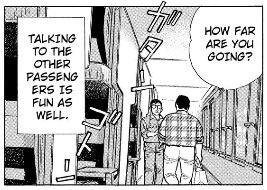
Ekiben Hitoritabi is a slice-of-life story about an ordinary 35-year-old train enthusiast named Daisuke Nakahara whose wife gives him a ticket to Kyushu by special express sleeper train for their tenth anniversary. Once he gets to Kyushu, Daisuke begins making his way north by taking a variety of local and little-used rail lines. He’s accompanied throughout most of the first volume by a journalist named Nana, whom he educates on railroad history and exposes to the wide variety of tasty ekiben to be found at the stations they visit. When they’re not rhapsodizing over the contents of these ekiben, they’re admiring the scenery or the trains themselves.

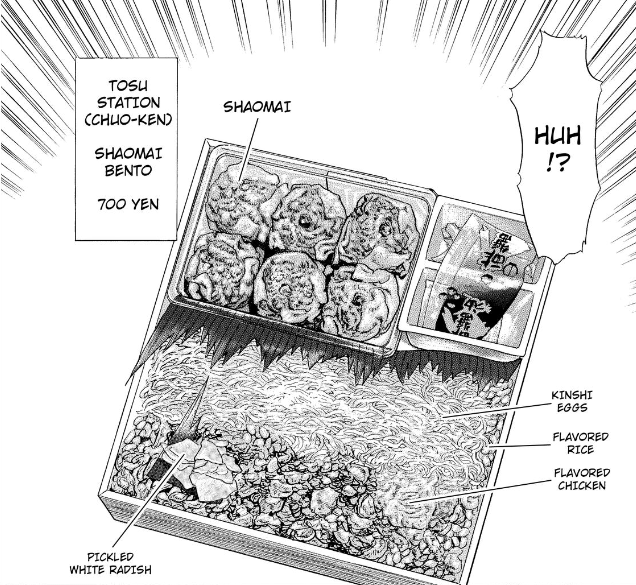
I don’t think this is a manga for everyone. The biggest source of tension, for example, is worrying whether Daisuke and Nana are going to miss their train when it’s taking longer than expected to procure ekiben. Daisuke likes everything he tastes—and, indeed, his love of ekiben has inspired him to open a bento shop of his own in Tokyo—and is in perpetually good spirits. There’s always a page turn before the contents of the bento are revealed, so that each always appears on the upper right-hand side, with each component identified. Someone is bound to make a remark about the taste permeating his/her mouth, too.

But it’s just so charming. (One learns a lot about Japanese geography, too.) Daisuke is content with his life and with taking his leisurely time, and he makes it look so awesome that I am frankly envious. Now I want to travel Japan by local rail and sample a bunch of ekiben! I must admit, though, that I’d be reluctant to try some of them. And the one that looked the best to me was the only one Daisuke had anything even slightly negative to say about. Here it is, the Shaomai Bento:

(Click to enlarge.)

Shaomai is the Kyushu term for shumai, and after noticing that many of the ekiben contain kinshi eggs, I had to look them up and I WANT SOME ON RICE RIGHT NOW. That, of course, is the danger with Ekiben Hitoritabi: reading it while hungry is sheer torture.

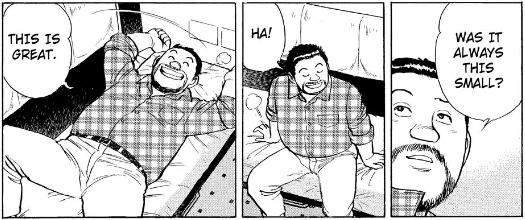
What’s not torture is the translation, which is better than I expected. I did get the sense that the work was spread between several people, however, because treatment of sound effects was inconsistent and some errors (like “bento’s” instead of “bentos”) cropped up only intermittently. I never had any issues with comprehension, though, and JManga welcomes feedback, so I did leave them a few notes about the minor problems I noticed. Splitting a word between two lines seemed to be an issue, for example:

On the whole, however, I am utterly delighted that I got to read Ekiben Hitoritabi. I doubt it would’ve sold too well in print format, so if digital is the only way I can get it, then I am just grateful to have the chance. Grateful and yet impatient, because I am going to need volume two pretty soon. And some kinshi eggs.

Ekiben Hitoritabi is up to volume thirteen in Japan and is still ongoing.

Filed Under: REVIEWS Tagged With: Futabasha, JManga

Pick of the Week: Lotsa Kodansha

August 29, 2011 by Sean Gaffney, David Welsh, Katherine Dacey, Michelle Smith and MJ 4 Comments

Take a look at the Manga Bookshelf bloggers’ picks from this week’s new releases!


SEAN: There’s any number of interesting titles due out this week (hurricane permitting), but the one that most catches my eye is Bloody Monday. First off, it’s from the brother/sister writing team responsible, under various pen names, for Drops of God, Getbackers, Kindaichi Case Files, Remote and Psycho Busters. Secondly, it’s an intense psychological techno-thriller with terrorists, computer viruses, and a lot of difficulty knowing who to trust. It might definitely appeal to the Death Note crowd who liked the manga’s tense back-and-forth plotting – or heck, even Die Hard fans, though there’s no obvious John McClane figure here. It’s also spawned 2 sequels, the last of which is still running in Japan.

DAVID: After the last few weeks of relative scarcity, it’s nice to see a diverse list, even if it isn’t a particularly bountiful one. For me, the highlight is the 13th volume of Hiroki Endo’s Eden: It’s an Endless World! This paranoid, post-apocalyptic drama almost always has something intriguing to offer, even when Endo strays too long in pet subplots that don’t seem entirely specific to the world he’s been building. I’m glad that Dark Horse continues to release this series, however slowly, though I always have to go back and refresh my memory of what happened during the last couple of volumes, because I’m an old man, and some of my brain cells go into retirement over an 18-month period. Of course, a new volume of The Kurosagi Corpse Delivery Service would make me even happier.

KATE: I normally loathe manga based on video games, but I was pleasantly surprised by Hiro Mashima’s Monster Hunter Orage: it’s funny, fast-paced, and smartly illustrated. Mashima does a fine job of adapting the source material, translating game play into an actual narrative and not just a series of monster-fighting set-pieces. Oh, and Mashima creates two awesome female leads, both of whom are smart, sensible, and handy with weapons. (Not surprisingly, they find the strong but dumb-as-toast hero a source of amusement and frustration.) No, it won’t change your life, or challenge your conceptions about what shonen manga is, but it’s a perfect read for a subway commute or a rainy afternoon.

MICHELLE: I agree with Kate’s assessment of Monster Hunger Orage 100%, but rather than simply say “ditto” I will cast my vote for Warning! Whispers of Love, a new one-volume title from Digital Manga Publishing. I admit that I am judging this one almost solely on its unconventional cover, but that strategy worked well for me with I Give to You, so why not employ it a second time? The blurb over at DMP’s site suggests that the hijinks might get a little too zany for my tastes—one of the boys seems to have an ear-swabbing fetish—but I’m willing to give it a shot, at least.

MJ: I’m going to stray from the usual Midtown list this week and pick out a title that became available at Boston’s Comicopia last week, Kodansha Comics’ re-release of Until the Full Moon from mangaka Sanami Matoh. Having completely missed the original English release from Broccoli Books, I admit I’m quite eager to give it a whirl, if for no other reason than my undying love affair with its brand of old-school shoujo artwork. I would be content with simply looking at this manga, but I’m hoping to find it enjoyable to read as well. Absolutely my must-read comic for the week.


Readers, what looks good to you this week?

Filed Under: PICK OF THE WEEK

Bookshelf Briefs 8/29/11

August 29, 2011 by Katherine Dacey, David Welsh, MJ and Michelle Smith 4 Comments

This week, Kate, David, MJ, & Michelle look at recent releases from Kodansha Comics, Viz Media, and Vertical, Inc.


Animal Land, Vol. 1 | By Makoto Raiku | Kodansha Comics – This odd little fable focuses on Monoko, a tanuki who discovers a human baby at the edge of a river. Monoko, herself an orphan, immediately identifies with Tarozo’s plight, and vows to raise him herself — a vow complicated by many factors, including an abundance of dangerous predators lurking just outside the tanukis’ village. Whether you’ll like Animal Land depends on how you feel about the tanukis, as they look like theme-park mascots with grotesquely oversized ears and china-doll faces. (I suppose we should be thankful that Makoto Raiku didn’t follow convention in super-sizing other parts of the tanukis’ anatomy, but still.) The tanukis’ behavior is just as outsized as their ears, steadily alternating between pratfalls and teary, anguished conversation, leaving little room for character development or new patterns of interaction. Younger readers won’t mind, but adults may find the tanukis’ odd appearance and frantic antics tiresome. – Katherine Dacey

Bokurano: Ours, Vol. 4 | By Mohiro Kitoh | Published by VIZ Media – Mangaka Mohiro Kitoh is beginning to tweak the established formula of Bokurano: Ours in some innovative ways. The presence of a pair of military observers (Seki and Tanaka) is making a big difference, for example, as they introduce more organization to what’s going on, resulting in some gatherings where the children interact with one another prior to someone being called for pilot duty. Too, it appears that two of the kids don’t actually have a binding contract to participate, which interjects an interesting complication to the story. (The kids assume this includes the lone fourth grader in their midst, but I somehow doubt she’ll be off the hook.) Lastly, the stakes are especially high for one of this volume’s pilots, who hopes to save a sick friend’s life with an organ donation, resulting in a cliffhanger that sent me to the SigIkki website for the resolution. Good stuff! – Michelle Smith

Oresama Teacher, Vol. 4 | By Izumi Tsubaki | Published by VIZ Media – I feel like I’m always unexpectedly learning something when I read Oresama Teacher. First, there was the informative sequence on how to foil attempts to tie you up, and now we learn techniques for dodging and deflecting blows as Mafuyu (in her mail guise, Natsuo) trains Hayasaka in the finer points of fighting so he’ll be prepared to square off against the members of a rival club who’re out to ambush the members of the Public Morals Club. Mafuyu is worried about how straightforward Hayasaka will fare in a fight, but comes to trust him and even realizes that, though gullible Hayasaka completely believes in and reveres two of her adopted personas, he also cares for her true self enough to put himself in jeopardy. With all the action and comedy, this isn’t really a romance manga, but I still think I may detect some feelings beginning to bloom… – Michelle Smith

Sayonara, Zetsubou-Sensei, Vol. 10 | By Koji Kumeta | Kodansha Comics – There’s a lot to like about Sayonara, Zetsubou-Sensei, from its crisp, confident artwork to its broad, equally confident characterization. But what’s really most impressive about this series is its ability to remain funny, volume after volume, while its format (and universe) remains unchanged. Nobody wearies of a gag manga faster than I do, but ten volumes in, I’m still laughing at Sayonara, Zetsubou-Sensei. Furthermore, volume ten is one of the series’ strongest so far. Jokes related to its then-new anime adaptation continue from the previous volume, enhancing (but not overwhelming) chapters revolving around subjects such as three-way standoffs, protecting “unnature,” entitlement, and “May sickness,” and even the volume’s most Japanese-specific jokes appear to translate effortlessly in the hands of new adapter Joshua Weeks. Still recommended. – MJ

Velveteen & Mandala | By Jiro Matsumoto | Vertical– If you read some of the cruder entries in Top Shelf’s AX anthology and found yourself saying, “I wish this was longer,” then Velveteen and Mandala is the book for you. Matsumoto pits dim, bickering schoolgirls against a horde of bemused zombies, throwing gobs of gross-out humor and precocious sexuality into the mix. Imagine a better-drawn Tokyo Zombie with female protagonists, and you’ll have the general idea. There’s certainly an audience for this sort of thing, but it’s equally certain that I’m not a member of that subset of comic fandom. To be honest, Velveteen and Mandala, with its indifferent plotting and feeble, familiar attempts at transgression tested my patience far more often than it rewarded it. Aside from some stylistic flourishes, there’s nothing here that you probably haven’t seen before, and it’s up to you whether you’re really eager to see it again. – David Welsh

Filed Under: Bookshelf Briefs Tagged With: animal land, bokurano: ours, oresama teacher, sayonara zetsubou-sensei, velveteen & mandala

Dorohedoro, Vol. 4

August 29, 2011 by Sean Gaffney

By Q Hayashida. Released in Japan by Shogakukan, serialization ongoing in the magazine Ikki. Released in North America by Viz.

It’s really amazing how much I still enjoy every page of this series, considering that there’s so little forward progression in it. Those who get frustrated by a lack of plot are going to get very annoyed very fast reading this volume, which contains a baseball game featuring our heroes, two of the villains, and various zombies… apparently because Hayashida felt like it, who knows? But the game is still a lot of fun.

That’s not to say there’s absolutely nothing happening here – there’s a ton going on. It’s just not immediately plot-oriented. Caiman has figured out by now that Nikaido is actually a sorcerer, and though conflicted, he’s trying not to let that destroy their friendship. Fujita discovers that he can get revenge on Caiman and Nikaido, who killed his partner (remember that opening scene in Vol. 1?) and goes out to do his best, along with tag-along Ebisu. Fujita’s on the cover this time, so seeing him get more to do makes sense, even though he still tends to be a bit of a sad sack who is there for bad things to happen to. Which makes him a good partner for Ebisu, come to think of it, as that’s what she’ there for as well.

Speaking of Ebisu, we continue to discover little bits about her past before getting attacked by Caiman. Turns out her magic is connected to lizard people, so she too could be the one who created Caiman… except that doesn’t appear to be the case. Her magic appears to be quite dangerous, taking over Noi and transforming her into a rampaging lizard woman as well, forcing Shin to take measures against her. Then they have to go find En’s partner in order to save her, in what might be the shippiest scene in the manga to date. Fans of Shin/Noi (of which I am one) will be delighted.

We also get some development of Risu, the guy walking around wearing Caiman’s face. But the big development here is Shin, whose backstory is given here. As one might expect, it is rather tragic and filled with blood and gore, but it does serve to underscore how determined Shin can get whenever he’s after something. It’s getting harder and harder to see who the good and bad guys are in this series… there’s just a bunch of guys doing mostly bad things.

It’s not a perfect volume by any means. The baseball game was fun, but does meander a lot. And the way that they got Noi to be attacked by Ebisu’s smoke, with an assistant coming along, tripping, and dumping it all over her, is the worst of sitcom cliches. Still, Caiman’s off to the Sorcerer’s World by himself now, no doubt because a man’s gotta do what a man’s gotta do. I look forward to seeing what happens. Dorohedoro is a series that requires a lot of patience, but I feel that if you hang in there there’s a lot of reward to it.

Filed Under: REVIEWS

Otomen Volume 11

August 28, 2011 by Anna N

Otomen Volume 11 by Aya Kanno

I’d collected a fair amount of Otomen when I stopped feeling the need to keep preordering it. I like it, but the episodic nature of the book means that most of the volumes revolve around the same conflict – will Asuka’s secret talents for feminine pursuits like knitting and baking be revealed and destroy his facade of manliness? The 11th volume is pretty much the same, but it wasn’t very hard for me to pick up on what was going on after skipping several volumes and Otomen is consistently funny.

Asuka is on a class trip/feudal Japan reenactment when he and his friends find themselves stranded in the wilderness. Asuka’s enigmatic and tomboyish girlfriend Ryo promptly starts foraging, while Asuka decides to lift everybody’s spirits by constructing lovely origami flowers. Ryo gets stranded in the woods and ends up cheerfully and capably rescuing Tonomine, who comments to Asuka “She may be a girl…but she’s a true samurai.” Other episodes in this volume includes Asuka attending secret baking lessons for men and a showdown at school over Valentine’s chocolate between Asuka and “Pheromone Prince” Suzaku Oji, the school nurse. Kanno’s sense of humor really comes through in her character designs, as Oji is drawn with flowing hair and a ruffled shirt worn under his white labcoat. He makes pronouncements like “come to me, my kittens,” and all the teenage girls swoon.

Asuka’s better nature begins to make inroads against the strict gender roles enforced by his school, but things are about to take a turn for the worse when his mother comes back from overseas. My major complaint with this volume was that there wasn’t enough focus on Ryo and mangaka Juta Tachibana. A bonus story of “Love Chick” the manga Juta wrote based on Asuka and Ryo with their genders swapped was included in the back of the volume. This was fun to see, since Kanno drew it in a deliberately more simple and insipid style.

Review copy provided by the publisher

Filed Under: UNSHELVED

  • Page 1
  • Page 2
  • Page 3
  • Interim pages omitted …
  • Page 7
  • Go to Next Page »
 | Log in
Copyright © 2010 Manga Bookshelf | Powered by WordPress & the Genesis Framework