• Skip to primary navigation
  • Skip to main content
  • Skip to primary sidebar
  • Home
  • About Us
    • Privacy Policy
    • Comment Policy
    • Disclosures & Disclaimers
  • Resources
    • Links, Essays & Articles
    • Fandomology!
    • CLAMP Directory
    • BlogRoll
  • Features & Columns
    • 3 Things Thursday
    • Adventures in the Key of Shoujo
    • Bit & Blips (game reviews)
    • BL BOOKRACK
    • Bookshelf Briefs
    • Bringing the Drama
    • Comic Conversion
    • Fanservice Friday
    • Going Digital
    • It Came From the Sinosphere
    • License This!
    • Magazine no Mori
    • My Week in Manga
    • OFF THE SHELF
    • Not By Manga Alone
    • PICK OF THE WEEK
    • Subtitles & Sensibility
    • Weekly Shonen Jump Recaps
  • Manga Moveable Feast
    • MMF Full Archive
    • Yun Kouga
    • CLAMP
    • Shojo Beat
    • Osamu Tezuka
    • Sailor Moon
    • Fruits Basket
    • Takehiko Inoue
    • Wild Adapter
    • One Piece
    • After School Nightmare
    • Karakuri Odette
    • Paradise Kiss
    • The Color Trilogy
    • To Terra…
    • Sexy Voice & Robo
  • Browse by Author
    • Sean Gaffney
    • Anna Neatrour
    • Michelle Smith
    • Katherine Dacey
    • MJ
    • Brigid Alverson
    • Travis Anderson
    • Phillip Anthony
    • Derek Bown
    • Jaci Dahlvang
    • Angela Eastman
    • Erica Friedman
    • Sara K.
    • Megan Purdy
    • Emily Snodgrass
    • Nancy Thistlethwaite
    • Eva Volin
    • David Welsh
  • MB Blogs
    • A Case Suitable For Treatment
    • Experiments in Manga
    • MangaBlog
    • The Manga Critic
    • Manga Report
    • Soliloquy in Blue
    • Manga Curmudgeon (archive)

Manga Bookshelf

Discussion, Resources, Roundtables, & Reviews

VIZ

Tidbits: Now We Are Six

April 22, 2012 by Michelle Smith

Originally, this post was supposed to go up several months ago, when the sixth volumes of these series were newly released, but time conspired against me. And so, belatedly, I present reviews of volumes five and six of Kamisama Kiss and Oresama Teacher. Also included is perennial favorite Skip Beat!, which is on a similar trajectory, just twenty volumes ahead.

Kamisama Kiss, Vols. 5-6
It’s hard to believe now that I ever had my doubts about Kamisama Kiss, because I’m enjoying it more and more with each volume.

Volume five finds Nanami determined to correct public opinion that her shrine is a creepy, dangerous ruin, especially since her shinshi, Tomoe, works so hard to maintain it. And so, she decides to hold a festival, spending two weeks preparing for a special performance while soliciting amusingly misguided advice from her supernatural acquaintances. It’s a success in the end. In volume six, Nanami is called upon to compete against another human girl for a spot at a prestigious kami conference.

In these two volumes, mangaka Julietta Suzuki nicely balances the expansion of the supernatural world (including the introduction of several new characters) and Nanami’s abilities with further development in her relationship with Tomoe. It seems to me that Tomoe is finding himself somewhat in awe of his kami these days—particularly when purification powers on par with his first master’s manifest themselves—and also more prone to emotions like fondness and jealousy. One of the best things about their relationship is how he is able to encourage and reassure her before the festival without being condescending about it. “I acknowledged you as my master,” he says. “Don’t be afraid. Prove yourself to everyone… like you did to me.”

I think the main appeal for me is that Kamisama Kiss is shaping up to be the story of Nanami’s growth. She may be in love with Tomoe, but winning his affections is not her sole ambition, or even her focus. Instead, she wants to develop as a kami and become someone that her parishioners can depend upon and respect. Because progress has come slowly, watching her actually achieve some truly remarkable things in these volumes actually leaves me a little verklempt. This has become less a story about a human girl thrust into the wacky world of yokai and more about someone embracing their destiny and striving to reach their full potential. I eagerly look forward to the next volume.
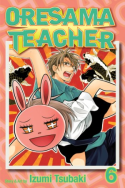
Oresama Teacher, Vols. 5-6
I was worried there for a minute. It seemed to me that volume five was showing signs of Tsubaki-sensei running out of ideas, what with a chapter about Takaomi and Mafuyu helping a wealthy girl find love with her self-denying servant, a chapter about the school’s bancho being stalked by a flower fairy, and a chapter about the Student Council’s resident ninja gathering intel on the Public Morals Club.

Although it’s not the neatest bow—I still don’t fully grasp why the Student Council is so opposed to Takaomi’s plans to attract more non-delinquent students to Midorigaoka, but at least I have an inkling now—Tsubaki does manage to tie things together by the end of volume six. Okay, not the flower fairy bit, but the significance of Takaomi going out of his way to help Marika (the rich girl) ties in with the backstory of why he’s become a teacher and why he’s made a bet with the school’s director. It brings new depth to his character and even relates to some things he said back in volume one.

I also really enjoyed the chapter in which the members of the Public Morals Club—now including Shinobu the ninja, who has decided to obtain information on his enemies from within their midst—explore the school, finding oodles of empty classrooms and realizing that it was once a thriving place with high-caliber students. Also significant is that, when Mafuyu is frustrated by Takaomi refusal to reveal his true motivations, she complains that all she’d wanted was to be a regular high school girl, but then got forcibly recruited to his agenda. Hayasaka overhears and, thinking he has kept Mafuyu from the life she’d wished for, avoids her. Mafuyu attempts to hang out with some girls, but in the end realizes she prefers being with Hayasaka. It’s really sweet.

This description might make it sound as if the series has suddenly gone in a plot-heavy direction, but that’s not really the case. There’s definitely something happening, but there are still plenty of amusing moments. My favorite is when Hayasaka and Super Bun are reunited and we get a panel of her carrying him in her arms while he thinks, “You’re so dreamy!”

Skip Beat!, Vols. 25-26
It’s a rare series that still genuinely delights me this far into its run, but Skip Beat! consistently manages to do so. I think the key here is that Nakamura has developed a cast of characters whose personality quirks enable her to take the plot in unexpected directions.

For example, volume 25 is all about the aftermath of Valentine’s Day. Sho has learned that Kyoko gave chocolates to Reino, and so shows up on the set of Dark Moon with an ostentatious bouquet in hand. He’s not out to win Kyoko’s love—so her explanation of the true nature of the chocolates (hatred) makes no difference—he just wants all her thoughts to be focused on him once more, and he temporarily ensures this by stealing her first kiss. Kyoko freaks out, according to plan, and is briefly talked down by Ren, but when she gives Ren his own special valentine, he can’t resist driving thoughts of Sho out of her head by administering a smooch of his own. This one’s on the cheek and he plays it off as a foreigner’s expression of gratitude, but it definitely leaves a trace in her heart.

Backing away from all of this progress, Nakamura eases us into the next arc by having Kyoko and Kanae return to the Love-Me Section, where they are joined by new member Chiori Amamiya, a former child actress whom Kyoko recently inspired to regain her love for acting. Each girl receives a personalized assignment from Lory, and Kyoko’s involves picking up Cain Heel, a dangerous-looking guy who is the president’s guest. Turns out, this is Ren going undercover and Kyoko’s new assignment is to stay by his side as his doting and scantily clad goth sister, Setsuka. And they have to live together in a hotel room. Ordinarily, a twist like this would be completely out of left field, but because this is Lory and because this is Skip Beat! I can just roll with it and eagerly anticipate the complications that will ensue.

If you’ve never read Skip Beat! before, now is a great time to start, as an omnibus edition of the first three volumes has recently been released!

Review copies provided by the publisher.

Filed Under: REVIEWS Tagged With: shojo beat, VIZ

Manga Artifacts: Love Song

April 19, 2012 by Katherine Dacey 13 Comments

Back in the 1990s, Matt Thorn labored hard to make Keiko Nishi a household name among American manga readers, translating six of her stories for VIZ. Two appeared in Four Shojo Stories alongside work by Moto Hagio and Shio Sato, and four appeared in a stand-alone volume called Love Song.

VIZ made a conscious effort to present Nishi’s work not just as comics, but as literature. Love Song boasted fancy endpapers — the kind you might find in the Everyman’s edition of Middlemarch — and a back cover blurb that defined shojo manga as “a literary genre of Japanese comics in which the relationships between characters are as meticulously crafted as the story’s action.” Lest the reader interpreted that statement to mean, “Here be romance comics,” the editor optimistically declared that shojo manga was “created by women for everyone!”

Though Nishi didn’t catch on with Western readers, it’s easy to see why Thorn championed her work: she’s a terrific, versatile storyteller, equally capable of writing light-hearted fantasies and character studies of deeply damaged people. Of the four stories that appear in Love Song, two are standouts: “Jewels of the Seaside,” a black comedy about three sisters who compete for the same man’s affection, with disastrous results, and “The Skin of Her Heart,” a sci-fi tale about a young woman torn between what she wants and what her mother wants for her. The other two stories — “Love Song” and “The Signal Goes Blink, Blink” — are also strong, if more conventional. “Love Song” focuses on an angry young woman who dominates her saintly boyfriend, while “The Signal Goes Blink, Blink” explores how fame transforms the life of a bullied teen.

Common to all four stories is a palpable sense of longing. The characters desperately seek human connection, but face genuine obstacles to their happiness. Yoshio Yamada, hero of “Signal,” is a perfect example: he’s the kind of small, quiet person whose shyness makes him a natural target for other kids’ scorn. (Even his own family detests him for his weakness.) When his newly discovered healing abilities land him television appearances, he worries what will happen if his powers fail him — not because he fears the stigma of being discredited, but because he fears being alone. “I’m afraid that if I lose this power, I’ll just go back to being a nobody again,” he tells his agent. “Are those people going to play with me? Will they come to school with me?”

The female protagonists of “Love Song” and “Skin of Her Heart” are also dissatisfied, though neither can fully articulate what they want. Saki, the heroine of “Love Song,” is perplexed by the intensity of her anger; though she readily admits that she was scarred by her first romantic experience, that alone cannot explain the cruel delight she takes in manipulating her current boyfriend. Lin-Lin, protagonist of “Skin,” also has difficulty pinpointing the source of her frustration, rejecting a suitor who could solve all of her financial and family problems. Only in the final pages of the story does she realize that moving to another space colony might change her life in ways that would help her “learn to open my heart to someone.”

Even the “Seaside” sisters are prisoners of their own desires. All three fancy their cousin Daniel, a handsome, polite young man, but each secretly worries that she compares unfavorably with her siblings. Their desperation is played for macabre laughs — poison factors into the narrative — but each sister’s pain and fear of rejection is very real; the punchline of the story is simultaneously amusing and horrifying, as we realize the true cost of their insecurities.

Nishi’s artwork is the perfect vehicle for such nuanced character studies, at times precise, elegant, and naturalistic, and at times loose and sketchy, with the white of the page playing an important role in underscoring the emotional distance between her characters. Her minimalist approach won’t be to every shojo fan’s liking, but she demonstrates that it’s perfectly possible to convey the interior lives of her characters without resorting to the kind of visual shorthands — flowers, sweatdrops, nosebleeds — that have been overused in contemporary shojo manga.

Readers wishing to track down a copy of Love Song should know that the title is officially out of print. (You won’t find it listed anywhere on the VIZ website.) Unlike Four Shojo Stories or A, A’, however, Love Song is still relatively easy to obtain through online retailers like Amazon, Barnes and Noble, and eBay. Highly recommended.

Manga Artifacts is a monthly feature exploring older, out-of-print manga published in the 1980s and 1990s. For a fuller description of the series’ purpose, see the inaugural column.

LOVE SONG • BY KEIKO NISHI • VIZ • 208 pp. • NO RATING

Filed Under: Manga Critic Tagged With: Keiko Nishi, matt thorn, shojo, VIZ

Manga Artifacts: Love Song

April 19, 2012 by Katherine Dacey

Back in the 1990s, Rachel Thorn labored hard to make Keiko Nishi a household name among American manga readers, translating six of her stories for VIZ. Two appeared in Four Shojo Stories alongside work by Moto Hagio and Shio Sato, and four appeared in a stand-alone volume called Love Song.

VIZ made a conscious effort to present Nishi’s work not just as comics, but as literature. Love Song boasted fancy endpapers — the kind you might find in the Everyman’s edition of Middlemarch — and a back cover blurb that defined shojo manga as “a literary genre of Japanese comics in which the relationships between characters are as meticulously crafted as the story’s action.” Lest the reader interpreted that statement to mean, “Here be romance comics,” the editor optimistically declared that shojo manga was “created by women for everyone!”

Though Nishi didn’t catch on with Western readers, it’s easy to see why Thorn championed her work: she’s a terrific, versatile storyteller, equally capable of writing light-hearted fantasies and character studies of deeply damaged people. Of the four stories that appear in Love Song, two are standouts: “Jewels of the Seaside,” a black comedy about three sisters who compete for the same man’s affection, with disastrous results, and “The Skin of Her Heart,” a sci-fi tale about a young woman torn between what she wants and what her mother wants for her. The other two stories — “Love Song” and “The Signal Goes Blink, Blink” — are also strong, if more conventional. “Love Song” focuses on an angry young woman who dominates her saintly boyfriend, while “The Signal Goes Blink, Blink” explores how fame transforms the life of a bullied teen.

Common to all four stories is a palpable sense of longing. The characters desperately seek human connection, but face genuine obstacles to their happiness. Yoshio Yamada, hero of “Signal,” is a perfect example: he’s the kind of small, quiet person whose shyness makes him a natural target for other kids’ scorn. (Even his own family detests him for his weakness.) When his newly discovered healing abilities land him television appearances, he worries what will happen if his powers fail him — not because he fears the stigma of being discredited, but because he fears being alone. “I’m afraid that if I lose this power, I’ll just go back to being a nobody again,” he tells his agent. “Are those people going to play with me? Will they come to school with me?”

The female protagonists of “Love Song” and “Skin of Her Heart” are also dissatisfied, though neither can fully articulate what they want. Saki, the heroine of “Love Song,” is perplexed by the intensity of her anger; though she readily admits that she was scarred by her first romantic experience, that alone cannot explain the cruel delight she takes in manipulating her current boyfriend. Lin-Lin, protagonist of “Skin,” also has difficulty pinpointing the source of her frustration, rejecting a suitor who could solve all of her financial and family problems. Only in the final pages of the story does she realize that moving to another space colony might change her life in ways that would help her “learn to open my heart to someone.”

Even the “Seaside” sisters are prisoners of their own desires. All three fancy their cousin Daniel, a handsome, polite young man, but each secretly worries that she compares unfavorably with her siblings. Their desperation is played for macabre laughs — poison factors into the narrative — but each sister’s pain and fear of rejection is very real; the punchline of the story is simultaneously amusing and horrifying, as we realize the true cost of their insecurities.

Nishi’s artwork is the perfect vehicle for such nuanced character studies, at times precise, elegant, and naturalistic, and at times loose and sketchy, with the white of the page playing an important role in underscoring the emotional distance between her characters. Her minimalist approach won’t be to every shojo fan’s liking, but she demonstrates that it’s perfectly possible to convey the interior lives of her characters without resorting to the kind of visual shorthands — flowers, sweatdrops, nosebleeds — that have been overused in contemporary shojo manga.

Readers wishing to track down a copy of Love Song should know that the title is officially out of print. (You won’t find it listed anywhere on the VIZ website.) Unlike Four Shojo Stories or A, A’, however, Love Song is still relatively easy to obtain through online retailers like Amazon, Barnes and Noble, and eBay. Highly recommended.

Manga Artifacts is a monthly feature exploring older, out-of-print manga published in the 1980s and 1990s. For a fuller description of the series’ purpose, see the inaugural column.

LOVE SONG • BY KEIKO NISHI • VIZ • 208 pp. • NO RATING

Filed Under: Manga, Manga Critic, REVIEWS Tagged With: Keiko Nishi, Rachel Thorn, shojo, VIZ

The Earl & The Fairy, Vol. 1

April 6, 2012 by Katherine Dacey 1 Comment

Meet Lydia Carlton: she’s a so-called “fairy doctor,” a healer who acts as an intermediary between the spirit and human worlds. The rapid advance of technology in Victorian England has made Lydia’s job obsolete; most people no longer seek magical remedies for their ailments, and view Lydia as a relic of a less enlightened time, someone who steadfastly clings to the belief that she can see and talk to these mischievous folk. Lydia knows better: not only are fairies real, but they continue to wreak havoc with humans, even in an age of railroads, telegraphs, and steam-powered ships.

Lydia’s predicament would make a swell basis for a manga, but her abilities are more a plot contrivance than a central element of the drama — at least in volume one of The Earl & The Fairy. The initial chapters focus on Lydia’s fraught relationship with Edgar Ashenbert, a dashing young man who claims to be descended from the Blue Knight, a legendary warrior. Edgar enlists kidnaps Lydia because he needs someone to help him find the Blue Knight’s sword, the location of which is inscribed on a coin that can only be read by a fairy doctor.

If you’ve read more than five or six shojo manga — or, for that matter, five or six Harlequin romances — you can guess what sort of chap Edgar is: he’s handsome, possessive, and smug, with a tender side that the heroine’s beauty and decency helps reveal. Lydia is a similarly predictable character: she’s feisty and conflicted, simultaneously drawn to and repelled by her captor. Lydia also happens to be one of the duller knives in the Shojo Beat drawer, placing her trust in anyone who approaches her; she’s kidnapped not once but twice in the very first chapter of the story.

For a grumpy old lady like me, stale, silly lead characters would usually be a deal-breaker. The lively supporting cast and lovely artwork, however, drew me into the story, even when Edgar and Lydia’s conversations inspired eyeball rolling and hair pulling. (In later chapters, Edgar narrates his tortured personal history in comic detail — it’s courtship by information dump.)

The best character in The Earl & The Fairy — so far, at least — is Nico, a magical being who assumes the form of a fussy talking cat. On one level, Nico is a standard animal sidekick, providing much-needed comic relief: in one running joke, for example, he bristles with indignation every time he’s served a bowl of milk. (He prefers wine.) On another level, however, Nico is a reader stand-in, giving voice to our frustration with Lydia’s naivete; in essence, it’s like watching a horror movie in which one of the characters says, “Don’t open that door, dude, the killer’s in there.” You don’t say.

Ermine and Raven, a sister-brother duo in Edgar’s employ, also add depth to the cast. Their backstory is pure manga: both were enslaved by a wicked “prince” working out of the sewers of an unnamed American city. After Edgar rescued them, Ermine and Raven became his most devoted servants, waiting on him hand and foot, defending him against enemies, and wooing Lydia on his behalf. To be sure, henchmen/servants are a standard manga type, but Ermine and Raven have enough idiosyncrasies to make them interesting; Ermine, in particular, is an unusual figure, a melancholy cross-dresser who seems caught between the male and female worlds.

The Earl & The Fairy‘s other saving grace is the artwork. The character designs are crisply executed; though none of the characters are especially distinguished looking, artist Ayuko draws elegant, well-proportioned figures that are pleasing to the eye. The settings are rendered with even greater care, capturing the technology and landscapes of mid-nineteenth century England in convincing detail. (Well, minus the ships: when viewed from a distance, they appear to be eighteenth-century sailing vessels, while their interiors suggest a Cunard ocean liner.) Ayuko pays similar attention to lighting; in several nocturnal scenes, she does a fine job of suggesting the meager, irregular quality of candlelight, using delicate crosshatching to mark the boundary between light and shadow.

If the parts of Earl are greater than the whole, it’s still an entertaining series. I don’t know if moody landscapes and talking cats are enough to justify my investment in all four volumes, but I’m certainly willing to read another before declaring this nice-looking romance a dud.

THE EARL & THE FAIRY, VOL. 1 • STORY AND ART BY AYUKO, ORIGINAL CONCEPT BY MIZUE TANI • VIZ MEDIA • 186 pp. • RATING: TEEN (13+)

Filed Under: Manga Critic Tagged With: Romance/Romantic Comedy, shojo, shojo beat, VIZ

The Earl & The Fairy, Vol. 1

April 6, 2012 by Katherine Dacey

Meet Lydia Carlton: she’s a so-called “fairy doctor,” a healer who acts as an intermediary between the spirit and human worlds. The rapid advance of technology in Victorian England has made Lydia’s job obsolete; most people no longer seek magical remedies for their ailments, and view Lydia as a relic of a less enlightened time, someone who steadfastly clings to the belief that she can see and talk to these mischievous folk. Lydia knows better: not only are fairies real, but they continue to wreak havoc with humans, even in an age of railroads, telegraphs, and steam-powered ships.

Lydia’s predicament would make a swell basis for a manga, but her abilities are more a plot contrivance than a central element of the drama — at least in volume one of The Earl & The Fairy. The initial chapters focus on Lydia’s fraught relationship with Edgar Ashenbert, a dashing young man who claims to be descended from the Blue Knight, a legendary warrior. Edgar enlists kidnaps Lydia because he needs someone to help him find the Blue Knight’s sword, the location of which is inscribed on a coin that can only be read by a fairy doctor.

If you’ve read more than five or six shojo manga — or, for that matter, five or six Harlequin romances — you can guess what sort of chap Edgar is: he’s handsome, possessive, and smug, with a tender side that the heroine’s beauty and decency helps reveal. Lydia is a similarly predictable character: she’s feisty and conflicted, simultaneously drawn to and repelled by her captor. Lydia also happens to be one of the duller knives in the Shojo Beat drawer, placing her trust in anyone who approaches her; she’s kidnapped not once but twice in the very first chapter of the story.

For a grumpy old lady like me, stale, silly lead characters would usually be a deal-breaker. The lively supporting cast and lovely artwork, however, drew me into the story, even when Edgar and Lydia’s conversations inspired eyeball rolling and hair pulling. (In later chapters, Edgar narrates his tortured personal history in comic detail — it’s courtship by information dump.)

The best character in The Earl & The Fairy — so far, at least — is Nico, a magical being who assumes the form of a fussy talking cat. On one level, Nico is a standard animal sidekick, providing much-needed comic relief: in one running joke, for example, he bristles with indignation every time he’s served a bowl of milk. (He prefers wine.) On another level, however, Nico is a reader stand-in, giving voice to our frustration with Lydia’s naivete; in essence, it’s like watching a horror movie in which one of the characters says, “Don’t open that door, dude, the killer’s in there.” You don’t say.

Ermine and Raven, a sister-brother duo in Edgar’s employ, also add depth to the cast. Their backstory is pure manga: both were enslaved by a wicked “prince” working out of the sewers of an unnamed American city. After Edgar rescued them, Ermine and Raven became his most devoted servants, waiting on him hand and foot, defending him against enemies, and wooing Lydia on his behalf. To be sure, henchmen/servants are a standard manga type, but Ermine and Raven have enough idiosyncrasies to make them interesting; Ermine, in particular, is an unusual figure, a melancholy cross-dresser who seems caught between the male and female worlds.

The Earl & The Fairy‘s other saving grace is the artwork. The character designs are crisply executed; though none of the characters are especially distinguished looking, artist Ayuko draws elegant, well-proportioned figures that are pleasing to the eye. The settings are rendered with even greater care, capturing the technology and landscapes of mid-nineteenth century England in convincing detail. (Well, minus the ships: when viewed from a distance, they appear to be eighteenth-century sailing vessels, while their interiors suggest a Cunard ocean liner.) Ayuko pays similar attention to lighting; in several nocturnal scenes, she does a fine job of suggesting the meager, irregular quality of candlelight, using delicate crosshatching to mark the boundary between light and shadow.

If the parts of Earl are greater than the whole, it’s still an entertaining series. I don’t know if moody landscapes and talking cats are enough to justify my investment in all four volumes, but I’m certainly willing to read another before declaring this nice-looking romance a dud.

THE EARL & THE FAIRY, VOL. 1 • STORY AND ART BY AYUKO, ORIGINAL CONCEPT BY MIZUE TANI • VIZ MEDIA • 186 pp. • RATING: TEEN (13+)

Filed Under: Manga, Manga Critic, REVIEWS Tagged With: Romance/Romantic Comedy, shojo, shojo beat, VIZ

Going Digital: March 2012

March 25, 2012 by MJ and Sean Gaffney 6 Comments

Welcome to the latest Going Digital, Manga Bookshelf’s monthly feature focusing on manga available for digital viewing or download. Each month, the Manga Bookshelf bloggers review a selection of comics we’ve read on our computers, phones, or tablet devices, to give readers a taste of what’s out there, old and new, and how well it works in digital form.

This month, MJchecks in on the iPad manga scene, while Sean takes a look a a recent JManga release for your web browser. Device, OS, and browser information is included with each review as appropriate, to let you know exactly how we accessed what we read.


iOS

Manga on the iPad: 18 month check-in

It’s been a year and a half since New York Comic Con 2010, where Yen Press announced the launch of their new iPad app. Viz followed soon after, and quickly rose to the head of the class thanks to their quickly growing catalogue and significantly lower pricing. Fast forward to NYCC 2011, where Kodansha USA finally joined the game, followed by Digital Manga Publishing a few months later.

For me, the success (or failure) of any manga app can be boiled down to three basic components: functionality, selection, and price. So now, 18 months after manga first began trickling onto the iPad, how are publishers faring on these three key issues?

Functionality

All four of the major manga apps began with strong functionality right out of the gate. Their (very similar) layouts are all fairly intuitive, with easy access to each publisher’s catalogue as well as the user’s own library of purchased manga. Each app offers high-quality images, and the ability to read in single or double page-view, as well as the ability to zoom in on (and out from) any single panel with ease. Of these apps, only Kodansha Comics’ displayed any functionality issues at launch time, with its progressive images that stall readability from page to page. Unfortunately, this issue appears to remain unresolved at the time of this writing, making Kodansha Comics’ app the least visually attractive of the manga apps to-date.

It’s worth noting here, too, that while both Viz and DMP both have browser-based stores as well, so far only Viz’s app allows for cross-platform purchases, while eManga customers must buy again to read their purchased volumes on the iPad.

Selection

Viz far outshines its mainstream competitors in this category, with over fifty titles available to-date (and more being added all the time), including super-popular titles like Naruto and One Piece, as well as more eclectic fare like House of Five Leaves and Saturn Apartments. Though I’m still hoping to see some of Viz’s out-of-print shoujo licenses show up here one day (e.g. Please Save My Earth, Banana Fish, Basara) there’s no denying that Viz is blowing everyone else away when it comes to selection on this platform. Recent additions like Hikaru no Go suggest that Viz indeed views its various digital platforms as a means for introducing long-running, completed series to new readers, and I certainly hope to see that continue.

DMP started out with a very strong catalogue, particularly for fans of its Juné and Digital Manga Guild imprints, but new additions have stalled since their recent issues with Apple censors, and it’s difficult to know at this point what the future of their app might be. BL fans can still pick up over fifty different titles (several with multiple volumes) at the time of this writing, ranging from newer releases like An Even More Beautiful Lie, Seven Days, and Blue Sheep Reverie, to older titles like Maiden Rose and Il Gatto Sul G. Though many more DMP/DMG titles are currently available to iPad readers by way of Amazon’s Kindle app (which has had its rocky moments, too), issues like image quality and reading direction make this option less than ideal.

While Yen Press’ catalogue is relatively small (25 titles as of this writing), it does have the advantage of being the only real source for Korean manhwa among these publishers to-date. Manga Bookshelf favorites like Time and Again and 13th Boy are both being released by Yen Press on this platform, and I certainly hope this will be a continuing trend. Though Yen’s manhwa licensing seems to have come to a halt over the past year or so, it would be a real treat to see series like Forest of Gray City or Very! Very! Sweet make a reappearance on the iPad so that they can be discovered by new readers. OEL series are another highlight of Yen’s app, including critical successes like Nightschool and Soulless: The Manga. Yen’s manga selection is less impressive, with titles Yotsuba&! and The Melancholy of Haruhi Suzumiya standing as its heaviest hitters.

Bringing up the rear in this category again is Kodansha Comics, whose catalogue has still not expanded beyond the four series it launched with (Arisa, Fairy Tail, Sayonara, Zetsubou-Sensei, and Until the Full Moon) even after six months.

Price

Here, again, Viz leads the pack, with prices starting at $4.99 a volume for Shonen Jump and Shojo Beat series, $5.99 for IKKI and Signature series, and between $6.99-$8.99 for oversized or omnibus releases. Though I still think that $5 a volume is too high to encourage real bulk purchases, it remains the best price out there for manga on the iPad. Kodansha Comics’ volumes sell for $4.99 apiece as well, though it’s worth mentioning that they ran a $2.99 special for Fairy Tail when the app first launched—a price I absolutely would pay for bulk purchases of a series I had interest in reading.

Both Yen Press and DMP lag in this category, with single volumes going for $6.99-$8.99 apiece—sometimes significantly more than print prices online—and $12.99 for larger volumes. Though BL readers, in particular, are accustomed to paying more for their habit, thrifty shoppers who are willing to put up with the downsides of the Kindle app can pretty much always get the same books for less by going that route—and have their purchase available on their other compatible devices as well, including their computers. I will admit that though I was fairly depressed not to be able to purchase Keiko Kinoshita’s You & Tonight through DMP’s far superior iPad app, it’s awfully nice to have it available on both my iPad and my laptop via Amazon’s Kindle app.

Bottom Line

Viz is the clear winner on the iPad overall, performing well in all three categories of functionality, selection, and price. DMP’s app is promising, and should they manage to resolve their issues with Apple and find a way to better serve cross-platform customers, they could become a digital powerhouse for BL fans, despite a significantly less attractive price point. Yen Press’s app lags in both selection and price, though it does hold a particular allure for manhwa fans. (Will we ever see NETCOMICS in the iPad app game?) And though Kodansha Comics does well when it comes to pricing, its dinky selection and less-than-optimum readability diminish its worth significantly.

What do you suppose this year’s New York Comic Con will bring? – MJ


Web Browser

Anesthesiologist Hana Vol. 2 | By Nakao Hakua and Kappei Matsumoto | Futabasha, Manga Action | JManga.com | Windows XP, Firefox 11.0
Volume Two of this medical series continues to pummel our heroine with exhausting daily living. I’d say crises, but she’s an anesthesiologist, so to a certain degree this is what she does. She has professors teaching a class putting her on the spot to embarrass her, the hospital changing to more of a trauma unit center (meaning longer hours), and most of all a new doctor in the unit, Hiura, who is a complete and utter jerk to her He’s constantly yelling at her and forcing her to step up her game, and is rude to her other colleagues… especially Dr. Kobayakawa, the troubled young doctor Hana hit it off with last volume. Of course, those familiar with this type of manga will know immediately that he is the sort of person that doesn’t suffer fools gladly. He dislikes Kobayakawa for his fear and wasted potential, and is so hard on Hana because of her increasing skills and pluck – he teaches by rudeness, basically.

He also, in yelling at Hana, basically notes that her breasts are big, something this manga never really allows us to forget. There’s no gratuitous shower scene here, but instead we get a new trauma doctor, Kenshi, who simply walks up, marvels at her breasts, and starts to fondle them. My jaw dropped briefly, and I am once again reminded of the huge sexual harassment gulf between here and Japan, in that Hana didn’t slug him. Yes, this is supposed to take place in the mid-90s rather than the time it was written, but sheesh. This doctor later gets a nice moment where he tries to teach Hana a basic truth – patients die, and that doctors simply have to accept this and try to save the next one just as hard – but he can’t read her as well as Hiura, so it doesn’t really take. In any case, if his schtick of groping Hana becomes his running gag, I can’t say I’ll be too fond of him.

There’s a lot of medical stuff going on here, and like the first volume if the reader doesn’t want to wade through some jargon they may be in trouble..That said, it’s not too difficult, and the basic premise remains the same – a doctor’s life is very hard, and every day is a struggle to wonder if it’s worth it. Especially given that these are anesthesiologists, so they don’t have the ‘these are my life-saving hands!’ aspect that, say, heart surgeons would. Hana, like the heroine of Nao Go Straight, can be too empathic at times – something contrasted with the new trauma doctors introduced towards the end. The best chapters were the two-parters, one dealing with the patient who loses his life, as I’d mentioned, and the other with how anesthesiologists have immense trouble with morbidly obese people. Hiura wants to harness Hana’s passion, and avoid having her become like Kobayakawa. Can he do it? To be continued! -Sean Gaffney


Disclosure: MJ is currently under contract with Digital Manga Publishing’s Digital Manga Guild, as necessitated for her ongoing report Inside the DMG. Any compensation earned by MJin her role as an editor with the DMG will be donated to the Comic Book Legal Defense Fund.

Filed Under: FEATURES, Going Digital Tagged With: DMP, iPad, JManga, Kodansha Comics, VIZ, yen press

Psyren, Vols. 1-2

March 7, 2012 by Michelle Smith

By Toshiaki Iwashiro | Published by VIZ Media

Ageha Yoshina is a first-year highschool student who channels his passion for fighting into helping people (for a fee). When classmate Sakurako Amamiya goes missing, he can’t just ignore it, particularly since she seems to know something about Psyren, a mysterious organization that recently issued Ageha a phone card when he answered a ringing public phone. The quest to find Sakurako leads Ageha to Psyren itself, which is not so much an organization as a place—a dangerous dimension where a chosen few (known as Psyren Drifters) brave the harsh landscape and murderous denizens to reach a particular gate, at which point they return home to be called again in the future, using the interval to learn more about Psyren and hone the psionic skills that Psyren’s atmosphere has infected them with.

I wasn’t sure what to think of Psyren at first. It starts slowly, and neither Ageha nor Sakurako are particularly distinct characters (Ageha because he’s so like every other shounen hero and Sakurako because Iwashiro-sensei is admittedly not aiming for any kind of consistency in her characterization). Once Hiryu—a formerly wimpy elementary school classmate who is now simultaneously hulking and thoughtful—arrives, however, things begin to improve. He provides a foil against which Ageha can be compared, which makes their psionic training sessions (in which Hiryu excels with concentrated effort and Ageha fails time and time again until he unleashes a powerful, uncontrolled burst) pretty fun.

It also helps that the concept of Psyren has elements that remind me of other series: the giant insectoid creatures and dire depiction of Japan’s future remind me of 7SEEDS, the cyborgish enemies remind me of BLAME!, and the contract by which unwitting participants are forced to risk their lives for some vaguely explained purpose reminds me of Bokurano: Ours. It remains to be seen whether Psyren will truly turn out to be as great as these other series, but it does have a dark edge—hinting that one’s performance in the game can somehow impact Earth’s future—that I appreciate.

To be sure, Psyren is not perfect. As mentioned, the main problem is Sakurako. She, quite literally, seems to change personality from panel to panel. At first, I thought that maybe this was happening because she’d used her psionic abilities so much that it had affected her mind, but after Iwashiro’s confession—“I was very careful when portraying [heroine of previous series]’s personality, but I’ve tempered that tendency, allowing for more of a kaleidoscopic view of Sakurako”—that doesn’t seem to be the case. Too, I feel like we’re supposed to find Matsuri-sensei, the concert pianist/biker chick who has beaten the Psyren game, cool and awesome, but she just makes me yawn.

Ultimately, Psyren is better than I thought it would be. It’s also, at sixteen volumes, not a sprawling epic that would require a huge commitment. At the moment, at least, I plan to continue for the long haul.

Psyren is published in English by VIZ Media. The third volume came out this week. The series is complete in Japan with sixteen volumes.

Review copies provided by the publisher.

Filed Under: REVIEWS Tagged With: VIZ

Going Digital: February 2012

February 19, 2012 by Michelle Smith, Sean Gaffney and MJ 4 Comments

Welcome to the latest Going Digital, Manga Bookshelf’s monthly feature focusing on manga available for digital viewing or download. Each month, the Manga Bookshelf bloggers review a selection of comics we’ve read on our computers, phones, or tablet devices, to give readers a taste of what’s out there, old and new, and how well it works in digital form.

This month, we’ll take a look at VIZ Media’s new manga for the NOOK Color, as well as a couple of titles from JManga. Device, OS, and browser information is included with each review as appropriate, to let you know exactly how we accessed what we read.


E-Readers

VIZ Manga on the NOOK Color

In last September’s Going Digital column, I wrote about my experience reading manga on a Kindle. The review included such sentiments as “Wow, this looks like crap,” and ended with this pithy observation:

I guess paying $6 for a Kindle edition of a book I didn’t like very much is better than paying $13 for same, but my advice to those considering reading manga on their Kindle is simple: “Don’t.”

So, when I was presented with the opportunity to check out the titles VIZ has made available for NOOK devices, I was quite eager to see how the experience would differ. As it turns out, the NOOK vastly outperforms the Kindle in all areas but one, and that one is not a deal-breaker.

The loaner model NOOK Color I received came pre-loaded with a few VIZ titles, so I can’t comment on the ease of buying and downloading manga from the Barnes and Noble site, but it looks pretty straightforward to me. There’s a WiFi connection on the device, so you can shop directly from the reader, as well. Books are accessible in the Library, which displays a nice gallery of color covers instead of a plain text list of titles. Simply tap the cover of your book of choice to open, and you’re good to go.

The first offering I perused was volume 31 of Bleach, and when I saw its cover come up full-screen, so crisp and beautiful, I am pretty sure I uttered a “wow” aloud. The inner pages are just as sharp, with clean, white backgrounds and legible text. Navigation is easy—gently tap the right side of the screen for the next page (granted, this is a little counter-intuitive when reading manga, as normally you’d be turning to the left) and the left side for the previous page. Tap the middle and a menu pops up, where one can scroll amongst all the pages in the volume and manage bookmarks, which one sets by pressing the “+” icon in the top right of the screen, creating a little digital “dog-ear” effect on the page.

At this point, I still hadn’t figured out how to zoom—I’m definitely a late adopter where technology is concerned, so there was a bit of a learning curve with touch-screen navigation—so I thought I’d check out some shoujo, which is known for its teensy asides and author-talk sections with small text. I found examples of both on a page of Absolute Boyfriend, and personally found the text legible, but once I discovered the “reverse-pinch method” of zooming in, it was a definite improvement. The screen is larger than the Kindle, so a single page looks pretty good as is. The NOOK’s got an auto-rotate function, which means that the display will shift to landscape mode if you turn the device on its side. This is helpful when you want to enjoy the scope of a two-page layout from an artistic standpoint, but not really practical for reading that way, unless you want to stay zoomed in all the time.

There are only two complaints I have about the NOOK, and one is exceedingly minor. In most respects, the sensitivity of the touch screen is a good thing, but as I held the device, I somehow kept placing my thumb in such a way that caused the system to repeatedly alert me to my lack of new notifications, which was annoying. The second issue is more significant, and that is that the NOOK is pretty heavy. According to Barnes and Noble, the NOOK Color weighs 15.8 ounces, but mine (with protective cover) clocked in at 20.8 ounces, which is equal to three print volumes of manga. Obviously, this is not extremely heavy, and even the fact that the latest Kindle supposedly weighs less than six ounces could not ever induce me to recommend it over the NOOK Color where reading manga is concerned. – Michelle Smith


Web Browser

Morita-san Wa Mukuchi Vol. 1 | By Tae Sano | Takeshobo, Manga Life Momo | JManga.com | Windows XP, Firefox 10.0

Readers of print manga in North America will be very familiar with the type of manga we get with Morita-san. It’s what’s termed a ‘4-koma’ style manga. Basically the equivalent to American comic strips such as Peanuts or Beetle Bailey, They’re 4 panels, mostly vertical, with quick punchlines and gag humor. Yes, there are the occasional serious 4-koma series, but they are definitely the exception. We;ve seen the high school band series K-On!, the high school eccentrics of Azumanga Daioh, and even spin-offs of popular titles like Haruhi Suzumiya and Shugo Chara.

This series has a lot of the same types of ingredients. With the exception of a token male or two to get one-liners, the cast is almost entirely cute and female. It takes place in a typical high school. There’s no real plot to speak of – we follow our heroine and her friends through the school year, being amused at their comedy antics. However, despite all of this, I found Morita-san to be quite a fun and pleasant experience. It has a very good hook. The heroine, the titular Morita, doesn’t speak. Note that she *can* speak – she just never gets a good opportunity. Either she thinks too long about what to say and everyone moves on, or she gets flustered, or the timing is wrong… as such, she spends the volume as a sort of ‘silent support’.

Her friends, and this is another reason I found this fun, don’t really bring this up or hold it against Morita at all. It’s just a quirk, like her best friend Miki’s being boy-crazy, or Hana’s being shy. They treat her like a good friend, and don’t even mention the silence – they always ask her opinion on things and the like. And Morita herself is a likeable heroine, being nice and sweet without getting overly sappy. (Her parents help here – her mother vacillates wildly between sweet adoring wife and jealous harridan, and it’s noted Morita got her reticence from her upbringing.) There’s even some mild yuri tease here, involving the cool Student Council President who everyone loves, as well as an unnamed girl who keeps trying to stalk… um, strike up a conversation with Morita only to misread whatever situation is going on. If you’re going to read 4-koma, it should be as fun and likeable as this. -Sean Gaffney

Hyakusho Kizoku, Vol. 1 By Hiromu Arakawa | Shinshokan, Wings | JManga.com | Mac OS 10.7.3, Chrome 17.0.963.56

As most Manga Bookshelf readers will already know, I’m a huge fan of Hiromu Arakawa’s epic shounen series Fullmetal Alchemist. In fact, the series even made my personal top ten. I consider Arakawa to be a truly exceptional storyteller, so when I heard that JManga was offering something new from her, I immediately ran over to read it. I was not disappointed in the least.

From the pages of the eccentric shoujo magazine Wings, Hyakusho Kizoku is a series of humor-tinged manga essays detailing life on a Hokkaido dairy farm. Though, on the surface, Hyakusho Kizoku may seem to share little in common with a fantasy epic like Fullmetal Alchemist, fans of FMA will quickly recognize Arakawa’s easy sense of humor, as well as her ability to create compelling, recognizable characters with just a few deft strokes.

The series is openly autobiographical, filled with anecdotes from Arakawa’s childhood and teen years that cover everything from her father’s habit of visiting the cow shed in winter wearing only his underpants, to a bit of light authorial ranting on topics like pesticides, government demands, and why Hokkaido would be better off as an independent country. And though her humor is a highlight, it’s not the only way in which Arakawa shows off her strengths. One particularly haunting lesson about the fate of a sick, newborn calf had me tearing up as I read—a feat achieved mainly through just a few poignant strokes of Arakawa’s pen, as she drew her own mournful, childish face and that of the unsuspecting calf.

If I sound like a hopeless fangirl, well, perhaps I am. But it’s a devotion well-earned by any author who can entertain equally well with action-packed fantasy and facts about cow dung. And fortunately, JManga does their part as well, offering up a clean, readable adaptation that lets the series’ conversational style shine.

While Hyakusho Kizoku may not be every FMA fan’s cup of tea, it certainly is mine. Highly recommended. – MJ

Filed Under: Going Digital Tagged With: Hyakusho Kizoku, Morita-san Wa Mukuchi, Nook, VIZ

Combat Commentary: One Piece Vol. 3, Ch. 18-20 – Luffy vs. Buggy

January 31, 2012 by Derek Bown 2 Comments

And we save the best for last. Not necessarily the best fight, but most certainly the best series. One Piece is interesting when compared to the others of Jump‘s Big Three. As opposed to starting strong and losing steam as the years passed, One Piece did the exact opposite. It has become a war cry for One Piece fans trying to get new readers into the series, “Just make it past the first nine volumes, make it to the Arlong Arc and you’ll be hooked.” With oddly cartoonish art and stories that fans generally rank among the series’ worst, the early chapters of One Piece belie the powerhouse of a manga it would later become.

But surely there must have been something that drew readers in? After all, every manga fan knows that One Piece is easily the world’s number one manga (at least sales-wise). So what let it survive beyond its infancy? Well, if you’ve been reading this column for the past two weeks, chances are you have an inkling of my answer to this question.

Also, since this column is still new, I’m always testing new ideas for formats. Let me know what you think of this version.

What Happened?
After defeating the tyrannical Axe-hand Morgan, Luffy and Zoro find themselves drifting on the ocean with no food and no way to navigate. Luffy tries to catch a bird to eat, but ends up on an island occupied by the dread pirate Buggy the Clown. Luffy runs into Nami, who initially turns him over to Buggy in order to get to his treasure map, but then saves him at the last second. Luffy beats Mohji the beast trainer, and Zoro beats Cabaji the acrobat, leaving Luffy and Buggy ready for the final battle.

(click on images to enlarge)

What Happens?
Buggy’s devil fruit powers give Luffy a hard time at first, but before long he is able to take advantage of Buggy’s weaknesses. Buggy tells Luffy about the time he was an apprentice on a pirate ship with Luffy’s idol, Red Haired Shanks. After Shanks inadvertently ruin’s Buggy’s plan to sell a valuable devil fruit, Shanks then saves Buggy’s life, but earns his eternal ire. With some help from Nami, Luffy is able to defeat Buggy easily, sending him flying with most of his body parts missing.

What does it mean?
Compared to the straightforward action scenes in Bleach and Naruto, One Piece can often rub fans of those series the wrong way with how it portrays action. The early fights, especially the first three in the series (Alvida, Ax-Hand Morgan, and Buggy) come across as just ways to show off how cool the main character is.

Buggy stands out among the early fights, because he is the only antagonist Luffy faces (before Logue Town) that has devil fruit powers. While later on in the series every villain worth his (or her) salt has devil fruit powers, this early in the game it was a big deal. None of the other characters had powers like Luffy. What makes this fight stand out so much is how creatively these powers are put to use. Luffy always finds ways to make his strange power combat-worthy, but to see another character doing the same thing makes this fight stand out in a sea of sword-swinging and punching fights.

This is what makes Buggy’s status as a “joke villain” so strange. While he is portrayed as a serious threat, the ease with which Luffy deals with him (after some minor set backs) doesn’t quite match up. It feels as if Buggy could have either been taken seriously or written off as a complete joke, and seeing him as a little of both is jarring to say the least—still fun, but a little too much in the middle to make for easy classification.

Though Luffy is still portrayed as an invincible protagonist, Oda manages to throw in some tension by giving Luffy a weakness that Buggy can exploit. Luffy’s hat, given to him by Red Hair Shanks, is the only part of him that can be effectively damaged, and Buggy takes advantage of this.

But Buggy is not the only person who can take advantage of others’ weaknesses. As he learns to his suffering. Luffy takes advantage of Buggy still feeling the pain of his separate body parts. And with only two eyes, Buggy cannot both hunt down Nami (who is getting away with his treasure) and protect his lower half.

After this point, the seriousness of the fight dissipates, and Buggy goes from being a threat to being the the fight’s buttmonkey. While the transition is a little jarring, it helps that Oda does not switch back and forth. When Buggy is threatening, he is threatening, but once his weakness is discovered, Luffy takes full advantage of it, and Buggy becomes a joke. So in its own way, the shift from serious to gag goes as smoothly as it possibly could have.

This fight ranks as one of the best in the East Blue arc, solely because it stands out as the first real threat Luffy faces, as well as only one of two villains that have devil fruit powers. Compared to Kuro and Don Krieg, Buggy is one of the more memorable One Piece villains. The shift from serious threat to comedic foil may be jarring for some, but it’s One Piece in a nutshell. No matter how dangerous the situation, there’s always a good laugh to be had.

Filed Under: Combat Commentary, FEATURES Tagged With: Combat Commentary, One Piece, VIZ

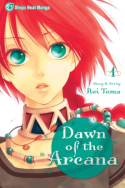
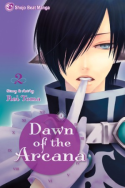
Dawn of the Arcana, Vols. 1-2

January 29, 2012 by Michelle Smith

By Rei Toma | Published by VIZ Media

In premise, Dawn of Arcana sounds like fairly generic shoujo fantasy. Princess Nakaba of Senan is married to Prince Caesar of Belquat in an arrangement ostensibly meant to ensure peace between their warring kingdoms, but which nobody expects to do so for long. Nakaba is resigned to her fate, but not without backbone, while Caesar is arrogant and entitled and makes remarks like, “Make no mistake. You are my property.” It’s pretty obvious they will fall for each other soon.

Accompanying Nakaba is her demi-human attendant, Loki, who belongs to an enslaved race possessed of heightened strength and senses. He’s been by Nakaba’s side ever since the village in which she lived was attacked by Belquat soldiers—evidently, her mother (also a princess) eloped with a member of a race possessed of precognitive powers, which Belquat was attempting to wipe out and of which Nakaba is now the only survivor—and so she feels much love and gratitude for him.

The first volume mainly focuses on Nakaba’s attempts to fit in around the enemy castle. In Senan and Belquat, only royalty have black hair, so the fact that hers is red has always prompted sneers, curiosity, and contempt, so the reaction would be the same no matter where she resided. Gradually, she gets to know Caesar a little better, and we see that his main problems are youth and actually buying into the “it’s your right” lectures that his mother has been subjecting him to since childhood. Here’s a great sample exchange between them:

Caesar: (After planting a smooch on Nakaba.) I’m a prince, and this is my kingdom. If I want something, I take it.

Nakaba: You may be a prince, but there are some things you’ll never have. Allow me to be the first.

Nakaba actually trusts him to keep his word when he promises to help Loki get out of trouble at one point, and expresses faith in his abilities to succeed in the very endeavors which his mother discouraged him from even trying. In return, he somewhat awkwardly tries to make her happy by bestowing lavish gifts upon her, and learns that a simple thing like caring for a wounded bird does the job better than fancy dresses. It’s certainly nothing new for a surly hero to be thus tamed by a spunky heroine, but I like the development all the same.

And speaking of development, volume two is a lot more interesting than the first. While someone plots to poison Caesar—and attempts to frame Nakaba for the deed—tension is brewing between Nakaba’s husband and her attendant. Loki intervenes to save Caesar from the would-be assassin, but admits that this is only to earn his trust. “I do want him dead… Have you forgotten? They are the enemy.” For too long, Loki’s people have been kept down, and he is now plotting rebellion. “You must not let him into your heart,” he warns, knowing that Caesar must eventually be his target, but though Nakaba attempts to comply, out of loyalty to Loki, she’s ultimately unable to do so.

Despite the fact that Nakaba falling for Caesar is predictable, I still like them together—how she improves him, and how he manages to make her feel safe yet simultaneously guilty—and I really like that she’s torn between these two guys, but not exactly in a romantic sense. Even while her feelings for Caesar are growing, she’s aware of the possibility that she’ll end up betraying him for Loki’s sake. Personally, I’m betting on Caesar becoming aware of the atrocities committed by his father and joining Loki’s cause—there have been some hints in this direction already—but the angst will be fun in the meantime.

Ultimately, this is a solidly good series. It’s not great yet, but it’s also far from bad.

Dawn of the Arcana is published in English by VIZ Media. Volume one is out now and volume two will officially be released on February 7, 2012. The series is ongoing in Japan, where the ninth volume has just come out.

Review copies provided by the publisher.

Filed Under: REVIEWS Tagged With: shojo beat, VIZ

The Art of The Secret World of Arrietty

January 26, 2012 by Katherine Dacey 2 Comments

Among the many books I read and loved as a child, few left as indelible an impression as Mary Norton’s The Borrowers (1952). The book featured the Clocks, a family of mouse-sized people who lived, unseen, in the floorboards and walls of an old English house, stealing small objects and transforming them into furniture, cookware, and decorations. Norton’s rapturous descriptions of the Borrowers’ home so enchanted me that I still view thimbles and buttons not as human tools, but as tea-cozies and dinner plates for tiny folk.

The Borrowers made a similarly powerful impression on legendary animator Hayao Miyazaki, who saw in the Clocks’ resourceful gathering a metaphor for the way ordinary people were living through “chaotic, unsure times.” In 2007, he teamed up with Keiko Niwa to adapt Norton’s story into a screenplay. He then hired Hiromasa Yonebayashi to direct the film version, The Borrower Arrietty, which took nearly three years to complete. (N.B. For the North American release, the film has been re-titled The Secret World of Arrietty.)

Through concept sketches, movie stills, and interviews with Yonebayashi, The Art of The Secret World of Arrietty walks readers through the three-year process of making the movie. We see numerous sketches of Arrietty — sometimes as fierce warrior figure, other times as a round, soft-faced girl — as well as Miyazaki’s first sketches of the Clocks’ tiny home. In every chapter, these rough sketches are juxtaposed with finished images, allowing the reader to appreciate the important role that art directors Noboru Yoshida and Yoji Takeshige played in translating Miyazaki’s ideas into animated sequences. No where is this more evident than in their rendering of the Borrowers’ habitat: the rich color saturation, palpable textures, and intricate patterns make the Borrowers’ world seem utterly real.

Readers should note that the book covers the entire movie, revealing several important plot points. The book also reproduces the complete script — again, something that spoiler-phobes should consider in timing their purchase of The Art of The Secret World of Arrietty. (The film arrives in North American theaters on February 17.) For anyone who’s been impatient to see the film since it was first announced in 2009, or who read and loved Mary Norton’s novel, however, the lush, lovely images in Arrietty are the perfect “trailer” for this much-anticipated film. Recommended.

Review copy provided by VIZ Media LLC. The Art of The Secret World of Arrietty will be released on February 7, 2012.

THE ART OF THE SECRET WORLD OF ARRIETTY • BY HIROMASA YONEBAYASHI • VIZ MEDIA • 200 pp.

Filed Under: Manga Critic Tagged With: anime, Hayao Miyazaki, Secret World of Arrietty, Studio Ghibli, The Borrowers, VIZ

The Art of The Secret World of Arrietty

January 26, 2012 by Katherine Dacey

Among the many books I read as a child, few left as indelible an impression as Mary Norton’s The Borrowers (1952). The book featured the Clocks, a family of mouse-sized people who lived unseen in the floorboards and walls of an old English house, stealing small objects and transforming them into furniture, cookware, and decorations. Norton’s rapturous descriptions of the Borrowers’ home so enchanted me that I still view thimbles and buttons not as human tools, but as tea-cozies and dinner plates for tiny folk.

The Borrowers made a similarly powerful impression on legendary animator Hayao Miyazaki, who saw in the Clocks’ resourceful gathering a metaphor for the way ordinary people were living through “chaotic, unsure times.” In 2007, he teamed up with Keiko Niwa to adapt Norton’s story into a screenplay. He then hired Hiromasa Yonebayashi to direct the film version, The Borrower Arrietty, which took nearly three years to complete. (N.B. For the North American release, the film has been re-titled The Secret World of Arrietty.)

Through concept sketches, movie stills, and interviews with Yonebayashi, The Art of The Secret World of Arrietty walks readers through the three-year process of making the movie. We see numerous sketches of Arrietty — sometimes as fierce warrior figure, other times as a round, soft-faced girl — as well as Miyazaki’s first sketches of the Clocks’ tiny home. In every chapter, these rough sketches are juxtaposed with finished images, allowing the reader to appreciate the important role that art directors Noboru Yoshida and Yoji Takeshige played in translating Miyazaki’s ideas into animated sequences. No where is this more evident than in their rendering of the Borrowers’ habitat: the rich color saturation, palpable textures, and intricate patterns make the Borrowers’ world seem utterly real.

Readers should note that the book covers the entire movie, revealing several important plot points. The book also reproduces the complete script — again, something that spoiler-phobes should consider in timing their purchase of The Art of The Secret World of Arrietty. (The film arrives in North American theaters on February 17.) For anyone who’s been impatient to see the film since it was first announced in 2009, or who read and loved Mary Norton’s novel, however, the lush, lovely images in Arrietty are the perfect “trailer” for this much-anticipated film. Recommended.

Review copy provided by VIZ Media LLC. The Art of The Secret World of Arrietty will be released on February 7, 2012.

THE ART OF THE SECRET WORLD OF ARRIETTY • BY HIROMASA YONEBAYASHI • VIZ MEDIA • 200 pp.

Filed Under: Books, Manga Critic, REVIEWS Tagged With: anime, Hayao Miyazaki, Secret World of Arrietty, Studio Ghibli, The Borrowers, VIZ

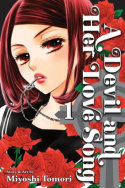
A Devil and Her Love Song, Vol. 1

January 24, 2012 by Michelle Smith

By Miyoshi Tomori | Published by VIZ Media

The back cover blurb of A Devil and Her Love Song contains the following lines: “Meet Maria Kawai—she’s gorgeous and whip-smart, a girl who seems to have it all. But when she unleashes her sharp tongue, it’s no wonder some consider her to be the very devil!”

And in my mind, this built up the expectation for a comedy, but that’s not what A Devil and Her Love Song is at all. It’s much more serious and sad than I had anticipated, but if I had done my research beforehand and realized that it originally ran in Margaret, I shouldn’t have been surprised.

Beautiful Maria Kawai has been expelled from her prestigious Catholic school, St. Katria’s, and must now enroll in a new school. She carries a lot of mental baggage from her experiences at St. Katria’s, most notably the fact that someone she regarded as her best friend told her “You taint everyone around you.” And, as if to lend credence to these words, Maria stirs up hostilities amongst her classmates almost immediately. The problem is that she’s so perceptive, and so blunt in her delivery, that she points out personality attributes that her classmates would rather not acknowledge, like the fact that they’ve been gossiping about her prior to her arrival, or that one boy is pushing himself to be liked by all even though he is not naturally a people person. Over the first week of school, matters escalate to the point where Maria is shoved down a flight of stairs and a truly odious teacher is telling her she’s “rotten to the core.”

And yet, there are certain lessons from her St. Katria’s days that serve Maria well in tough moments, like “those who believe will be saved,” which provides her encouragement to get through bullying encounters with a group of Mean Girls in her class. But she’s not taking solace from a religious implication of these words; instead, she seems to feel that if she believes in people’s good intentions, has faith that one day they will accept her, that this will actually come to pass. And so, even though she knows the girls have it in for her, she puts herself in the path of their harassment in the hopes that one day, she’ll win them over. As I said, it’s really rather sad and makes her far more sympathetic than I ever expected a sharp-tongued heroine to be.

I regret to admit I made another snap judgment of the series based on the chapter one title page, which depicts Maria and a couple of boys, one a cheerful blond and the other a surly-looking brunette. I assumed these would be her stereotypical shoujo love interests, but though both boys are definitely interested in her, they are far more complicated individuals than I had assumed they would be. The brunette, Shin, is grumpy, rebellious, and not really friendly with the rest of the class, but has a kind heart. It unsettles him that Maria can so clearly see through him, and he’s terrified of what would happen if she could discern what he’s feeling about her, but he still comes through with her when no one else will. There’s one especially nice scene where she’s so happy and scared by his kindness that she can’t even find the words to explain, so she sings instead.

On the other hand, you have Yusuke, who is trying so hard to be everyone’s friend that he’s actually no one’s real friend at all. His philosophy is the “lovely spin,” which is a survival mechanism he tries to impart upon Maria with little success. Turn everything into something palatable and nice, even if you’re being untrue to yourself, is the basic gist. It’s probably good for her to master this subterfuge, to avoid further confrontations and to effect the personal change she seeks, but why is he doing it? Just as he helps her master the art of diplomacy, one wonders whether she will help him drop the charade.

I mean no slight to shoujo comedies when I say that A Devil and Her Love Song is much better, richer and more deep, than I anticipated. To say that I am looking forward to reading the rest of this story would be a gross understatement.

A Devil and Her Love Song is published in English by VIZ Media. The first volume will officially be released on February 7, 2012. The series is complete in Japan with thirteen volumes.

Review copy provided by the publisher.

Filed Under: REVIEWS Tagged With: shojo beat, VIZ

Combat Commentary: Naruto Vol. 2, Ch. 12–15

January 17, 2012 by Derek Bown 5 Comments

Fight scenes are practically synonymous with manga and anime. Few people can think of anime without thinking of two over-muscled men throwing energy beams and punches at each other while screaming for minutes on end.

These people are wrong, and most likely stopped paying attention to anime and manga back when Dragonball Z first came out in the west. Not only is there obviously much more to manga than fighting, but even shounen manga, the posterboys for fighting series, go beyond two muscled mastodons beating the crap out of each other.

Fight scenes in manga can range from straightforward, brutal beatings to calculated strategic encounters between two opponents. The purpose of this column is to explore the many flavors of fight scenes found in shounen manga, as well as some shoujo and seinen manga.

For many manga fans, Naruto was one of the first series they ever read. And while the series’ value is hotly debated among the various camps of manga fans, it cannot be denied that in its early run, Naruto was very different from the typical shounen battle manga. Fights were developed and executed in a much more cerebral way, making them far more interesting to read.

(click images to enlarge)

The most indicative of this style is in volume two, chapters twelve to fifteen—the first fight against Zabuza. The fight begins with Zabuza being set up as a serious threat, both through his actions and the words of others. He is shown as being on par with (and momentarily superior to) Kakashi, who until this point has been the strongest ninja in the series. With Kakashi (a ninja who has already bested Naruto and his team) incapacitated, the protagonists find themselves facing an opponent they cannot best physically.

So they do what they did not do when fighting Kakashi; they use teamwork and tactics. The climax of the fight involves Naruto using a complex strategy involving turning into a throwing star to get get behind Zabuza and free Kakashi.

Some might say that Naruto and Sasuke failed, as Zabuza was taken down by Kakashi in the end. And they would be correct, if not for the fact that the purpose of the fight was not to defeat Zabuza, but instead to free Kakashi so that he could defeat Zabuza. With this goal accomplished, the fight was a success for Naruto and Sasuke. And since two twelve year olds taking out an adult is ludicrous, this is essentially one of the only ways to have resolved the fight while remaining believable, or as believable as any shounen manga ever gets. Masaki Kishimoto understood his characters’ limitations, and set up a battle in which they could be victorious while still remaining true to those limitations.

The fight focuses on intelligence over brute force, and if one thinks of fight scenes as a mystery plot in which the mystery to be solved is how the opponent can be defeated, then it becomes easier to determine what makes a good fight scene. No one would ever consider a mystery story where the protagonist stumbles upon the answer rather than working it out for themselves to be a good example of the genre.

Likewise, sudden powerups only work to a fight’s detriment. What sets Naruto apart in the early chapters is that most of the fight scenes progress like the fight against Zabuza did, with focus being given to fighting tactics rather than power levels. The way opponents are defeated involves intelligent solutions more often than not, which makes the fights more intellectually stimulating than their cousins.

Derek Bown writes anime and manga reviews at Burning Lizard Studios. If you have any fight scenes from manga you want him to look at, mention them in the comments. 

Filed Under: Combat Commentary, FEATURES Tagged With: Combat Commentary, manga, naruto, Shonen, Shonen Jump, VIZ

A Devil and Her Love Song, Vol. 1

January 15, 2012 by Katherine Dacey 12 Comments

Maria Kawai, heroine of A Devil and Her Love Song, is a cool customer. Not only is she beautiful, talented, and smart, she’s also tough — so tough, in fact, that she was expelled from a hoity-toity Catholic school for beating up a teacher. Her blunt demeanor further cements her bad-girl impression; within minutes of enrolling at a new high school, she antagonizes all the girls in her class with a few sharp observations about their behavior. Only two boys — Yusuke, a cheerful, popular student who avoids conflict at all costs, and Shin, a moody outsider — try defending Maria from her peers’ nasty comments and pranks.

So far, so good: Maria is spiky and complicated, a truth-teller who lacks the ability to censor herself, even though she’s aware of the potential consequences of speaking her mind. Throughout volume one, there are some wonderful comic moments as Maria struggles to put a “lovely spin” — Yusuke’s term — on her acid comments. Alas, Maria’s sideways head-tilt and doe-eyed gaze look more sinister than cute; not since Kazuo Umezu’s Scary Book has a manga-ka made a doll-like character look so thoroughly menacing, even when superimposed atop a backdrop of flowers and sparkles.

Having created such a vivid character, however, Miyoshi Tomori isn’t sure where to go with the story. In several scenes, Maria does things that contradict what we know about her: would someone as perceptive as Maria willingly attend a party hosted by the class mean girls, especially after they’d harassed her on a daily basis? And why would someone as outspoken as Maria refrain from pointing out her teacher’s judgmental behavior — especially when it’s plainly obvious to both the characters in the story and the reader? These kind of abrupt reversals might make sense if we knew more about Maria’s past, but at this stage in the story, they feel more like authorial floundering than a conscious revelation of character.

From time to time, however, Tomori convincingly hints at Maria’s softer side. Midway through volume one, for example, Maria makes tentative overtures towards Tomoya “Nippachi” Kohsaka, a fellow bullying victim. (“Nippachi” means “twenty-eight,” and is a mean-spirited reference to Tomoya’s poor academic performance.) That scene is both sad and real; anyone who’s ever seen two ostracized kids turn their classmates’ scorn on one another will immediately appreciate the dynamic between Maria and Nippachi. Maria’s exchanges with Shin, too, reveal a different side of her personality; though the pair frequently engage in the kind of rapid, antagonistic banter that’s de rigeur for romantic comedies, their quieter conversations suggest a grudging mutual respect.

Maria’s interactions with Nippachi and Shin fill me with hope that A Devil and Her Love Song will find its footing in later chapters. If Tomori can find a way to reveal Maria’s fundamental decency without compromising her heroine’s tart, outspoken personality, A Devil and Her Love Song will be a welcome addition to the Shojo Beat catalog, an all-too-rare example of a story in which the heroine isn’t the least bit concerned with being nice or popular. If Tomori can’t, Devil runs the risk of devolving into a YA Taming of the Shrew, with Shin (or, perhaps, Yosuke) playing Petruchio to Maria’s Katherina.

Review copy provided by VIZ Media, LLC. Volume one will be released February 7, 2011.

A DEVIL AND HER LOVE SONG, VOL. 1 • BY MIYOSHI TOMORI • VIZ MEDIA • 200 pp. • RATING: TEEN (13+)

Filed Under: Manga Critic Tagged With: shojo, shojo beat, VIZ

  • « Go to Previous Page
  • Page 1
  • Interim pages omitted …
  • Page 4
  • Page 5
  • Page 6
  • Page 7
  • Page 8
  • Interim pages omitted …
  • Page 26
  • Go to Next Page »
 | Log in
Copyright © 2010 Manga Bookshelf | Powered by WordPress & the Genesis Framework