• Skip to primary navigation
  • Skip to main content
  • Skip to primary sidebar
  • Home
  • About Us
    • Privacy Policy
    • Comment Policy
    • Disclosures & Disclaimers
  • Resources
    • Links, Essays & Articles
    • Fandomology!
    • CLAMP Directory
    • BlogRoll
  • Features & Columns
    • 3 Things Thursday
    • Adventures in the Key of Shoujo
    • Bit & Blips (game reviews)
    • BL BOOKRACK
    • Bookshelf Briefs
    • Bringing the Drama
    • Comic Conversion
    • Fanservice Friday
    • Going Digital
    • It Came From the Sinosphere
    • License This!
    • Magazine no Mori
    • My Week in Manga
    • OFF THE SHELF
    • Not By Manga Alone
    • PICK OF THE WEEK
    • Subtitles & Sensibility
    • Weekly Shonen Jump Recaps
  • Manga Moveable Feast
    • MMF Full Archive
    • Yun Kouga
    • CLAMP
    • Shojo Beat
    • Osamu Tezuka
    • Sailor Moon
    • Fruits Basket
    • Takehiko Inoue
    • Wild Adapter
    • One Piece
    • After School Nightmare
    • Karakuri Odette
    • Paradise Kiss
    • The Color Trilogy
    • To Terra…
    • Sexy Voice & Robo
  • Browse by Author
    • Sean Gaffney
    • Anna Neatrour
    • Michelle Smith
    • Katherine Dacey
    • MJ
    • Brigid Alverson
    • Travis Anderson
    • Phillip Anthony
    • Derek Bown
    • Jaci Dahlvang
    • Angela Eastman
    • Erica Friedman
    • Sara K.
    • Megan Purdy
    • Emily Snodgrass
    • Nancy Thistlethwaite
    • Eva Volin
    • David Welsh
  • MB Blogs
    • A Case Suitable For Treatment
    • Experiments in Manga
    • MangaBlog
    • The Manga Critic
    • Manga Report
    • Soliloquy in Blue
    • Manga Curmudgeon (archive)

Manga Bookshelf

Discussion, Resources, Roundtables, & Reviews

VIZ Signature

An Introduction to the VIZ Signature Imprint

April 22, 2012 by Katherine Dacey

If TOKYOPOP was the company that first embraced the teen market, licensing Sailor Moon and bringing manga to big chain stores, then VIZ was the company that first wooed adult readers, using distinctive packaging and punchy trade names to help older manga fans distinguish stories about boy ninjas from stories about disillusioned samurai. VIZ wasn’t the only company courting older fans, of course; Dark Horse has been synonymous with manly-man manga for most of its licensing history, while TOKYOPOP made several unsuccessful forays into ladies’ comics. VIZ, however, has done more than any major American publisher to create a market for titles like Oishinbo and 20th Century Boys, seinen works that appeal equally to male and female readers in their twenties, thirties, and beyond.

One of VIZ’s first branding experiments was its short-lived Spectrum Editions line (1990-91). VIZ published three seinen titles in a prestige format with vinyl dust jackets, high-quality paper, and a large trim size. Those titles — Natsuo Sekikawa and Jiro Taniguchi’s Hotel Harbour View, Yukinobu Hoshino’s Saber Tiger, and Yu Kinutani’s Shion: Blade of the Minstrel — didn’t make much of a splash in the market, but they anticipated some of the design choices that VIZ would make with its Editor’s Choice and Signature imprints a decade later.

Another important precedent for the VIZ Signature line was PULP: The Manga Magazine. First launched in 1997, VIZ billed its monthly anthology as “manga for grownups,” and featured edgier stories than its companion magazines Animerica and Manga Vizion. Titles such as Banana Fish, Bakune Young, Dance Til Tomorrow, Even a Monkey Can Draw Manga, Short Cuts, Strain, and Uzumaki debuted in PULP before they were collected into graphic novels that bore the magazine’s name.

After struggling to find an audience, PULP was canceled in 2002. The significance of PULP wasn’t lost on its editors, however; when the magazine ceased production, they issued the following statement, summarizing their achievement:

PULP was the first English-language magazine to run the kind of manga that make comics a mass medium for ordinary adults in Japan, from dynamic action narratives to avant-garde ventures, when it debuted in December 1997… PULP offered readers a Japanese comics contrast to both the superhero genre that typifies American comics and the stereotypical “anime-esque” manga often offered to U.S. readers.

After VIZ phased out the magazine, several PULP titles — Dance Til Tomorrow, No. 5 — found a home at the newly created Editor’s Choice imprint. Like PULP, the Editor’s Choice line was designed to appeal to older readers, featuring titles such as Maison Ikkoku, Nausicaa of the Valley of the Wind, Phoenix, and Saikano. The Editor’s Choice imprint had something else in common with PULP: it was short-lived. By 2006, VIZ had rebranded the catalog with the VIZ Signature name, using it to help adult readers distinguish Naoki Urasawa’s Monster from Naruto.

In its six years of existence, the VIZ Signature line has been steadily diversifying to serve a wider audience. Speaking to Publisher’s Weekly in 2009, VIZ Managing Editor Leyla Ayker explained that one of the goals of the line was “to create a balance between the more ‘literary’ works that would appeal to readers of Western graphic novels like Fun Home or Asterios Polyp and the more ‘action’ works that would appeal to readers of American superhero comics and genre fiction.” To that end, VIZ has been licensing a mixture of highbrow titles — All My Darling Daughters, Oishinbo A La Carte, Pluto: Urasawa x Tezuka — and pulp fiction for mature readers — Black Lagoon, Biomega, Dogs: Bullets and Carnage.

The Signature line was never tied to a print magazine, but in 2009, VIZ launched an ambitious collaboration with the Japanese anthology IKKI: select IKKI titles would be serialized online, allowing North American readers to read free monthly updates of series such as I’ll Give It My All… Tomorrow and Saturn Apartments. VIZ would then publish those series as part of its Signature line, with a special logo to distinguish the IKKI titles from other Signature manga. For a year and a half, the site flourished, offering readers a mixture of new comics and feature articles: an interview with Q Hayashida (Dorohedoro), a comic drawn by one of the VIZ designers. By the end of 2011, however, regular updates to the site had ceased, prompting speculation about the future of the project.

Whatever the future of SigIKKI, the project epitomizes what the VIZ Signature line does best: publishing high-quality manga that appeal to a wide spectrum of adult readers As Leyla Aker explained to Publisher’s Weekly:

The reason why IKKI and Signature are such a good fit is because their objectives are the same: to publish series that offer a diverse range of content but that are all marked by creative excellence. Another factor is that both lines are gender-neutral, so to speak; their content is aimed at both adult men and women, which is fairly unusual for manga.

And that, in a nutshell, is the VIZ Signature imprint: 43 titles that run the gamut from kitchen-sink drama (All My Darling Daughtes, Gente: The People of Ristorante Paradiso) to horror stories (Cat-Eyed Boy, Uzumaki), sword-and-sandal epics (Vagabond), science fiction (Bokurano: Ours, Saturn Apartments), thrillers (Black Lagoon, Monster), romances (Ristorante Paradiso), mysteries (not simple, Sexy Voice and Robo), and fantasies (Dorohedoro, GoGo Monster).

N.B. VIZ began designing a new Signature website which remains unfinished as of 4/22/12. In the comments below, reader Eric Rupe notes that VIZ doesn’t seem to have made much progress on the site; links redirect the reader to an empty product page at viz.com.

* * * * *

The goal of this month’s Manga Movable Feast is to create a place where grown-ups can discuss their favorite — or least favorite — VIZ Signature manga. Anyone can contribute: all you need to do is send me a link to an essay, podcast, or review about a VIZ Signature title, and I’ll feature it in one of my daily round-ups. (Email or Twitter are the best way to submit links; Twitter submissions should be directed to @manga_critic.) Note that the feast runs from today (Sunday, April 22nd) through Saturday (April 28th). For more information, please visit the VIZ Signature MMF archive.

Filed Under: Manga, Manga Critic Tagged With: Manga Movable Feast, Seinen, SigIKKI, VIZ, VIZ Signature

MMF: An Introduction to the VIZ Signature Imprint

April 22, 2012 by Katherine Dacey 15 Comments

If TOKYOPOP was the company that first embraced the teen market, licensing Sailor Moon and bringing manga to big chain stores, then VIZ was the company that first wooed adult readers, using distinctive packaging and punchy trade names to help older manga fans distinguish stories about boy ninjas from stories about disillusioned samurai. VIZ wasn’t the only company courting older fans, of course; Dark Horse has been synonymous with manly-man manga for most of its licensing history, while TOKYOPOP made several unsuccessful forays into ladies’ comics. VIZ, however, has done more than any major American publisher to create a market for titles like Oishinbo and 20th Century Boys, seinen works that appeal equally to male and female readers in their twenties, thirties, and beyond.

One of VIZ’s first branding experiments was its short-lived Spectrum Editions line (1990-91). VIZ published three seinen titles in a prestige format with vinyl dust jackets, high-quality paper, and a large trim size. Those titles — Natsuo Sekikawa and Jiro Taniguchi’s Hotel Harbour View, Yukinobu Hoshino’s Saber Tiger, and Yu Kinutani’s Shion: Blade of the Minstrel — didn’t make much of a splash in the market, but they anticipated some of the design choices that VIZ would make with its Editor’s Choice and Signature imprints a decade later.

Another important precedent for the VIZ Signature line was PULP: The Manga Magazine. First launched in 1997, VIZ billed its monthly anthology as “manga for grownups,” and featured edgier stories than its companion magazines Animerica and Manga Vizion. Titles such as Banana Fish, Bakune Young, Dance Til Tomorrow, Even a Monkey Can Draw Manga, Short Cuts, Strain, and Uzumaki debuted in PULP before they were collected into graphic novels that bore the magazine’s name.

After struggling to find an audience, PULP was canceled in 2002. The significance of PULP wasn’t lost on its editors, however; when the magazine ceased production, they issued the following statement, summarizing their achievement:

PULP was the first English-language magazine to run the kind of manga that make comics a mass medium for ordinary adults in Japan, from dynamic action narratives to avant-garde ventures, when it debuted in December 1997… PULP offered readers a Japanese comics contrast to both the superhero genre that typifies American comics and the stereotypical “anime-esque” manga often offered to U.S. readers.

After VIZ phased out the magazine, several PULP titles — Dance Til Tomorrow, No. 5 — found a home at the newly created Editor’s Choice imprint. Like PULP, the Editor’s Choice line was designed to appeal to older readers, featuring titles such as Maison Ikkoku, Nausicaa of the Valley of the Wind, Phoenix, and Saikano. The Editor’s Choice imprint had something else in common with PULP: it was short-lived. By 2006, VIZ had rebranded the catalog with the VIZ Signature name, using it to help adult readers distinguish Naoki Urasawa’s Monster from Naruto.

In its six years of existence, the VIZ Signature line has been steadily diversifying to serve a wider audience. Speaking to Publisher’s Weekly in 2009, VIZ Managing Editor Leyla Ayker explained that one of the goals of the line was “to create a balance between the more ‘literary’ works that would appeal to readers of Western graphic novels like Fun Home or Asterios Polyp and the more ‘action’ works that would appeal to readers of American superhero comics and genre fiction.” To that end, VIZ has been licensing a mixture of highbrow titles — All My Darling Daughters, Oishinbo A La Carte, Pluto: Urasawa x Tezuka — and pulp fiction for mature readers — Black Lagoon, Biomega, Dogs: Bullets and Carnage.

The Signature line was never tied to a print magazine, but in 2009, VIZ launched an ambitious collaboration with the Japanese anthology IKKI: select IKKI titles would be serialized online, allowing North American readers to read free monthly updates of series such as I’ll Give It My All… Tomorrow and Saturn Apartments. VIZ would then publish those series as part of its Signature line, with a special logo to distinguish the IKKI titles from other Signature manga. For a year and a half, the site flourished, offering readers a mixture of new comics and feature articles: an interview with Q Hayashida (Dorohedoro), a comic drawn by one of the VIZ designers. By the end of 2011, however, regular updates to the site had ceased, prompting speculation about the future of the project.

Whatever the future of SigIKKI, the project epitomizes what the VIZ Signature line does best: publishing high-quality manga that appeal to a wide spectrum of adult readers As Leyla Aker explained to Publisher’s Weekly:

The reason why IKKI and Signature are such a good fit is because their objectives are the same: to publish series that offer a diverse range of content but that are all marked by creative excellence. Another factor is that both lines are gender-neutral, so to speak; their content is aimed at both adult men and women, which is fairly unusual for manga.

And that, in a nutshell, is the VIZ Signature imprint: 43 titles that run the gamut from kitchen-sink drama (All My Darling Daughtes, Gente: The People of Ristorante Paradiso) to horror stories (Cat-Eyed Boy, Uzumaki), sword-and-sandal epics (Vagabond), science fiction (Bokurano: Ours, Saturn Apartments), thrillers (Black Lagoon, Monster), romances (Ristorante Paradiso), mysteries (not simple, Sexy Voice and Robo), and fantasies (Dorohedoro, GoGo Monster).

N.B. VIZ began designing a new Signature website which remains unfinished as of 4/22/12. In the comments below, reader Eric Rupe notes that VIZ doesn’t seem to have made much progress on the site; links redirect the reader to an empty product page at viz.com.

* * * * *

The goal of this month’s Manga Movable Feast is to create a place where grown-ups can discuss their favorite — or least favorite — VIZ Signature manga. Anyone can contribute: all you need to do is send me a link to an essay, podcast, or review about a VIZ Signature title, and I’ll feature it in one of my daily round-ups. (Email or Twitter are the best way to submit links; Twitter submissions should be directed to @manga_critic.) Note that the feast runs from today (Sunday, April 22nd) through Saturday (April 28th). For more information, please visit the VIZ Signature MMF archive.

Filed Under: Manga Critic Tagged With: Manga Movable Feast, Seinen, SigIKKI, VIZ, VIZ Signature

Let’s Get Visual: The Jibblies

December 3, 2011 by Michelle Smith

MICHELLE: So, in our last installment of Let’s Get Visual we celebrated the pretty, so it seems only fitting that this time we devote our attentions to images that make us shudder with a feeling I like to call “the jibblies.” Just like beauty, creepy is a subjective thing, so we’ve each chosen a variety of images that get our personal hackles rising.

MJ, you want to go first this time?

MJ: Sure!

So, as I was perusing my manga collection for things that creep me out, it became increasingly clear to me that I’m very simple when it comes to what scares me. All it takes to really get to me is a single disturbing image–especially one that distorts something human into something sinister. I’m apparently not scared of monsters so much as I am of monsters in human clothing.

My first example comes from Setona Mizushiro’s After School Nightmare. In this series, a group of teenagers is regularly drawn into a shared dreamworld in which they each appear as physical manifestations of their own worst fears. Some of these are visually more disturbing than others. The series’ main character, Ichijo, for instance, most fears his own confusion about gender, so his skirt-wearing dream self is really horrifying only to him. Some of the other students, however, wear their fears in a much more visually distorted manner. This short spread features two of those students.

After School Nightmare, Vol. 1 (Go! Comi)

First, you’ll see a student who appears only as an arm and hand, twisting itself around Ichijo. Second, a girl appears with giant cavities replacing her face and chest. While the second of these has the most stunning, immediate affect on my psyche, the first creeps up on me as I try to move away from the page. Both images stick with me long after I’ve put the book down, and this seems to be the real key to scaring the bejeezus out of me. If I can’t get the image out of my mind, it easily haunts me for days. That’s the power of a single, shocking image.

MICHELLE: My first thought upon hearing of your aversion to “a single disturbing image” is that you shouldn’t read Junji Ito’s Uzumaki, followed by the thought that you should read it.

My reaction to the image above differs from yours, though, in that while these images certainly provoke in me an “ew” reaction, they aren’t the type that haunt me. I definitely think that the slinky arm creature is the more creepy in the image you displayed. For me, it’s because the gaping images of emptiness are immediately recognizable as symbols for what that character is feeling, but what on earth is causing that other student to appear like a grasping, creeping arm?! I feel like their circumstances in life might ultimately be the more disturbing! (This comes from someone who’s read only one volume of After School Nightmare, so I don’t know if this turns out to be the case.)

MJ: I think part of what makes the gaping holes in the second student so horrifying for me, is that (for whatever reason) I’m strongly affected by a lack of face. I have the same reaction to images of people with blank faces. It creeps the hell out of me when I can’t assess a person’s feelings/personality from their expression. It feels very threatening to me.

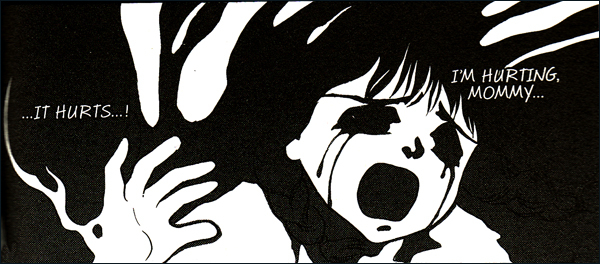
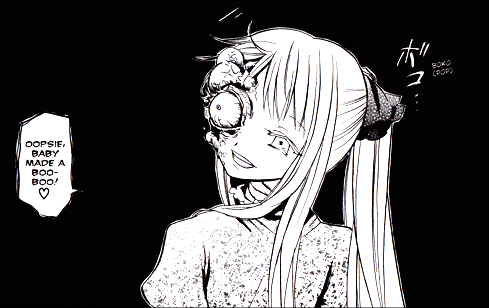
Perhaps it’s further evidence of how much a face means to me, actually, that both of my follow-up images are pretty much face-only. First, from CLAMP’s Tokyo Babylon, we have the face of a dead child who pleads with her mother to avenge her, and secondly, from Jun Mochizuki’s Pandora Hearts, the face of a girl that reveals itself to be a monster underneath.

Tokyo Babylon, Vol. 4 (TOKYOPOP)

Pandora Hearts, Vol. 1 (Yen Press)

I actually find both of these to be creepier than the images from After School Nightmare, though they are much simpler. Something they have in common is that they are presented against a stark, black background, giving the distorted expressions full focus. After that, though, they are nearly opposites of each other. The face of the girl in Tokyo Babylon is all too real, distorted by the power of raw emotion, while the character in Pandora Hearts is revealed to have no emotion at all, or at least none that matched what was on her false human face. Yet in the end, which is more monstrous?

MICHELLE: It’s interesting how much the things that creep us out reveal about us, isn’t it? I’d wager you get the same threatening feeling from the girl who is revealed to be a monster underneath as you do the girl with no face at all. People pretending to be what they’re not, hiding their real selves, etc. That’s definitely something all of us have experienced at one time or another.

Getting back to actual attempts at visual analysis, those deep black backgrounds really do focus the reader’s eye on what the mangaka wants them to see. It’s as if they’re saying, “I don’t want you to be distracted by anything else.”

MJ: Your analysis of me is spot-on, that’s for sure!

And yes, I think the black backgrounds achieve exactly that, while also evoking our natural fear of the dark, or what we can’t see. It’s a powerful tool for both showing us something and not showing us something, if that makes sense.

MICHELLE: It definitely does.

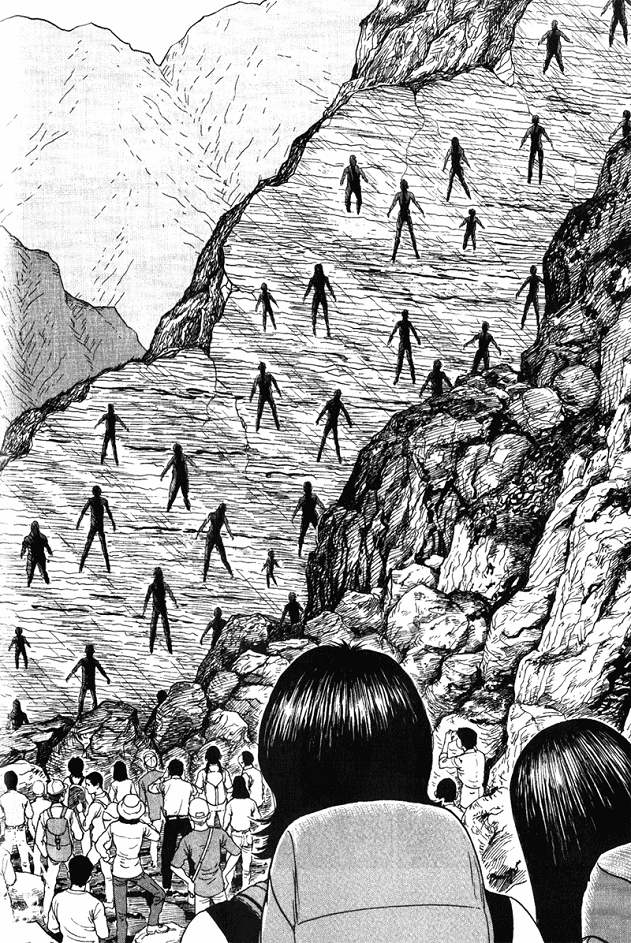
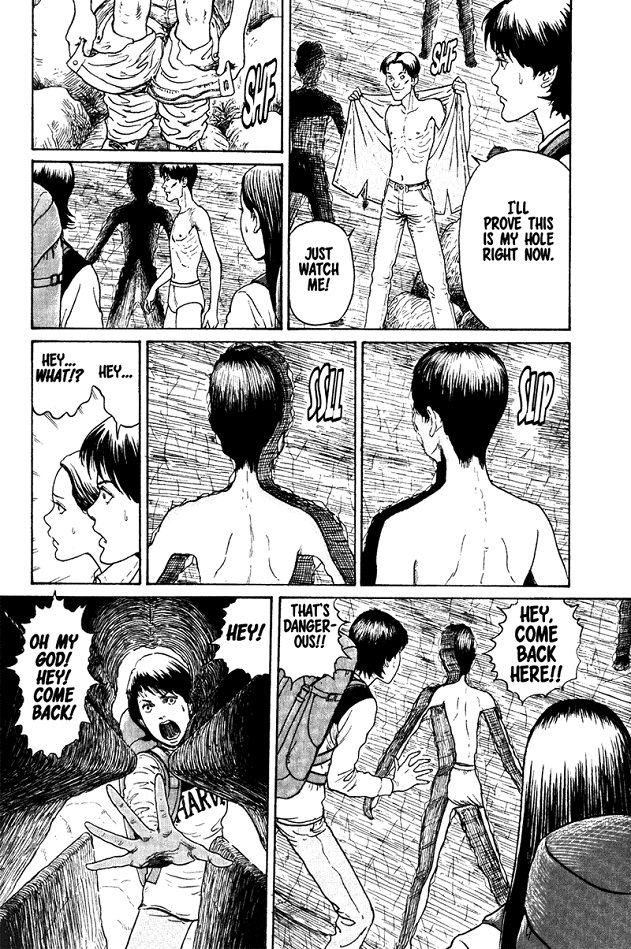
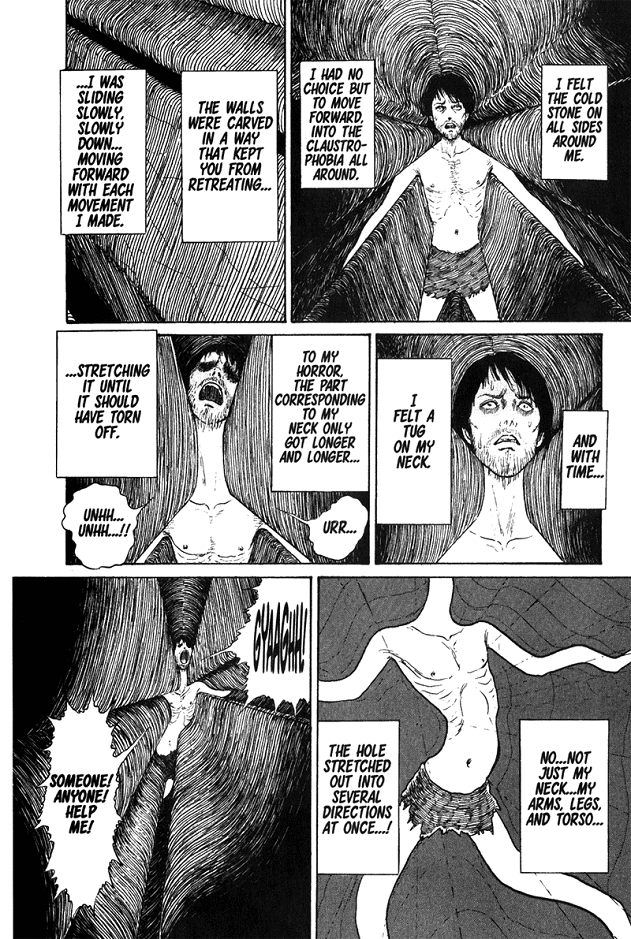
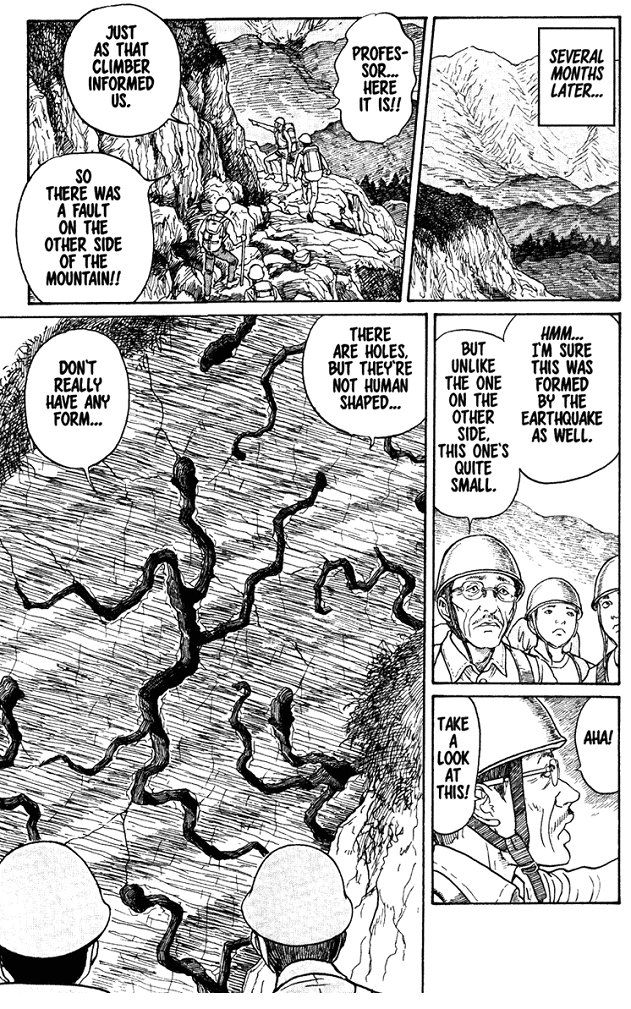
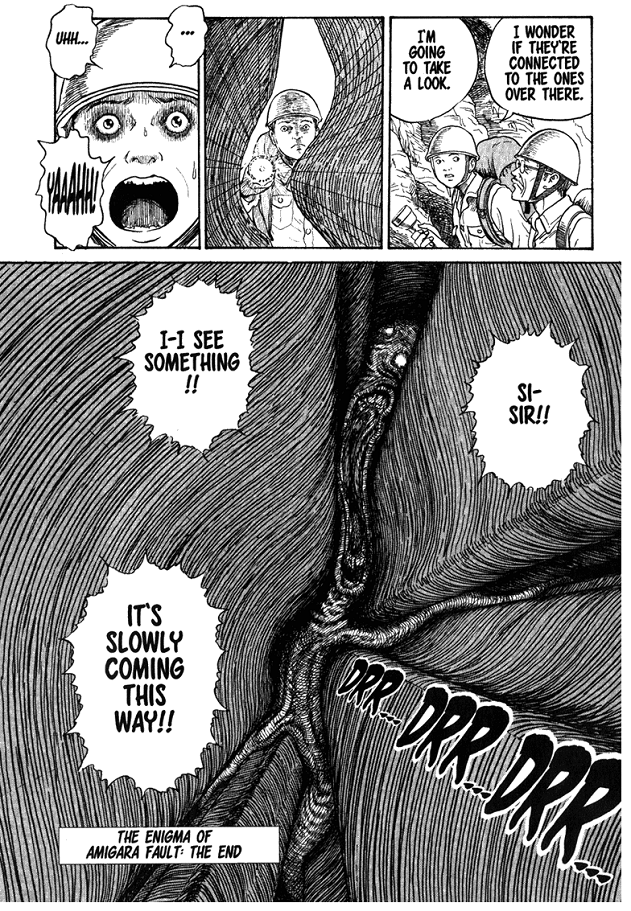
Now I’m reflecting on what the images I’ve chosen say about me. There’s hardly a face among them, for one thing, because I am less creeped out by shocking images than I am by imagining an experience, specifically an experience during which one is forced to endure something horrible for a really, really long period of time with no means of escape. Ugh, just thinking about the short story my images come from—”The Enigma of Amigara Fault” by Junji Ito—has given me the jibblies while typing this paragraph!

Gyo, Volume 2, “The Enigma of Amigara Fault” (VIZ Media)

Page 178

Page 185

Page 198

Page 203

Page 204

I’ve chosen this particular sequence of images from this short story because they illustrate the entire plot without me needing to introduce it beforehand. By now you probably don’t need me to explain that when the TV news reports on a mountainside full of people-shaped holes revealed by a recent earthquake, people flock to the site and can’t be dissuaded from climbing into their personal holes, where long, icky agony awaits them. At first the site seems innocent enough, if a bit strange, but soon people are walking into holes, having nightmares about what happens to you in a hole, and eventually discovering the exit and…. Holy crap, it’s terrifying. This is the kind of thing that will haunt me for ages.

I’m honestly trying to analyze Ito’s artistic techniques dispassionately here, but I find that the disturbing power of the images is so great that it is affecting my ability to reason even now!

MJ: Hmmm, I’m wondering if what it’s saying is that while I’m terrified of people betraying me, you’re terrified of your environment betraying you. Or something like that.

In any case, these panels are undeniably creepy. Even if they creep me out in a less personal way, I can certainly see what’s giving you the jibblies! Interestingly, we again see the human form distorted, though in this case it’s happening sort of *to* the character we’re relating to rather than in front of him. (Maybe I’m afraid of the people I trust being compromised, and you’re afraid of yourself being compromised?)

This has a Twilight Zone feel to me, where some unexplained supernatural phenomenon is turning the lives of ordinary people into a nightmare. The artist does a great job of evoking the real terror of what’s happening, too. The texture of the stone walls around the man gives the images a three-dimensional look that makes it feel more real than a lot of what we see in manga. It’s the only thing that has that kind of thick texture, too, so it really stands out.

MICHELLE: More like I’m terrified of taking a step that can’t be undone and ending up in eternal torment because of it!

And yes, now that I’ve regained my senses, I agree that it’s the realistic three-dimensional detail that really makes it so disturbing. The details of the setting itself establish it firmly in the here and now, and then we’re shown that within the here and now exists something completely alien and unexplainable! Regarding the texture of the stone walls… it’s that bit of dialogue about how they’re carved to prevent backtracking that really gets to me. It’s mute, immobile stone, and it’s going to be your tormentor for the next several months, slowly inflicting more gruesome horrors upon you than something living could ever do. Uh-oh… jibblies.

MJ: There, there!

MICHELLE: Thanks. I also really love the bottom left panel on page 185, when you see the outside world from inside the tunnel. Interestingly, this is an angle from which the guy who just entered the hole could never have seen the characters. He’s got his back turned to this world, and is resolutely leaving it behind. And, too, I love the “less is more” approach here. We don’t see the distorted figure actually emerge from the mountain and thrash around terrorizing people. One glimpse is enough to confirm what has happened. It’s almost kind of elegant in its structure.

MJ: Yeah, I agree, the threat of what is about to happen is actually scarier by itself than it might be if we actually saw it happen. Or at least it’s creepier that way.

MICHELLE: Well, I fear this column has actually been more about us than the art, but it’s been the art that made us feel that way, and that’s something, isn’t it?

MJ: It is!

MICHELLE: So, that’s it for us this month. What gives you the jibblies?

Filed Under: FEATURES, Let's Get Visual Tagged With: Junji Ito, VIZ, VIZ Signature

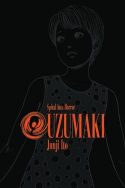
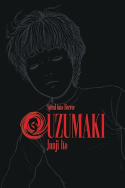
Uzumaki, Vols. 1-3

October 25, 2011 by Michelle Smith

By Junji Ito | Published by VIZ Media

As with Ito’s two-volume work, Gyo, the best word to describe Uzumaki—despite a back cover blurb promising “terror in the tradition of The Ring”—is “weird.”

High school student Kirie Goshima lives in Kurôzu-Cho, a small coastal town nestled between the sea and a line of hills. She narrates each chapter in an effort to share the strange things that happened there. It all begins when, on the way to meet her boyfriend Shuichi Saito at the train station, she spots his father crouching in an alley, staring intently at a snail. Shuichi confirms that his dad has indeed been acting odd lately, and suggests that the entire town is “contaminated with spirals.”

Mr. Saito’s fixation with spirals grows to the point where he dies in an attempt to achieve a spiral shape, which drives his wife insane with spiral phobia. She too eventually passes away, leaving Shuichi alone to become a recluse who is able to resist the spiral menace while being more perceptive to it than most. Other episodic incidents fill out the first two volumes, including unfortunate events involving Kirie’s classmates (boys who turn into snails, a bizarre rivalry over spiralling hair, etc.), her father’s decision to use clay from the local pond in his ceramics, a mosquito epidemic that leads to icky goings-on at a hospital, and an abandoned lighthouse that suddenly begins producing a mesmerizing glow. Things come to a head in volume three when six successive hurricanes are drawn to Kurôzu-Cho, leaving it in ruins. Rescue workers and volunteers flock to the area, but find themselves unable to leave. Dun dun dun!

Creepy occurrences mandate creepy visuals, but I wouldn’t say that anything depicted herein is actually scary. Oh, there are loads of indelible images that made me go “ew” or “gross,” but was I frightened by them? No. The real horrors of Uzumaki are more subtle: the suggestions that there are ancient and mysterious forces against which humans are utterly powerless and that the spiral’s victims will live in eternal torment. Many tales of horror involve bloodthirsty monsters, but a menace that forces you to live and endure something horrific is much more capable of giving me the jibblies. It’s the ideas behind Uzumaki, therefore, and not the surfeit of disturbing images, that evoke dread.

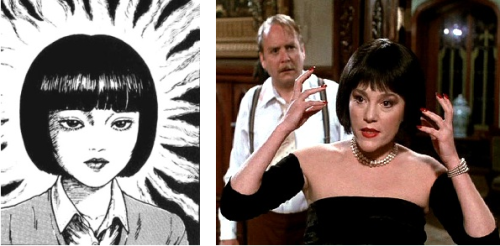
Uzumaki has a much larger cast than Gyo, which prompted me to notice that Ito actually draws some really cute and realistic-looking female characters. Kirie is a prime example, but her classmates and TV reporter Chie Maruyama also fit the bill. I was pretty distracted by Ito’s rendering of a girl named Azami, though, because she reminded me so much of Madeline Kahn as Mrs. White in Clue. Observe:

Flames... FLAMES on the side of my face!

Uzumaki definitely delivers an unforgettable story with memorable art, but I would’ve liked to get to know the characters more. Kirie is a reasonably accessible lead and is smart, strong, and kind, but I felt at times that she was too strong. If anything gross is going on in town, Kirie is the one who’s going to discover it, and though she reacts in the moment, there wasn’t much emphasis on the cumulative effect of having witnessed all this madness. She keeps going and being shocked by things right until the very end, but a more normal person would’ve broken down long before. And why weren’t more people fleeing, I wonder? True, once the storms hit, nobody could leave, but for a while there plenty of crazy stuff is happening and folks are just sticking around.

I also would’ve liked to spend more time with Shuichi. He’s a pretty interesting guy, who wants to get out of town from the very start but remains because of Kirie. He seems to have inherited equal parts fascination with and fear of the spiral from his parents, which keeps him alive if not entirely sane, and is able to function at times when others are mesmerized, allowing him to come to Kirie’s aid on several occasions. Through these actions we see how much he cares for her, but I actually had no idea they were supposed to be a couple until he was specifically referred to as her boyfriend a couple of chapters in. Okay, yes, this isn’t a romance manga and I shouldn’t expect a lot of focus on their relationship, but even just a little bit of physical affection would’ve gone a long way.

Uzumaki is grim, gruesome, and a whole host of synonyms besides. This isn’t jump-out-of-your-skin horror, but a psychological tale with a decidedly grisly bent. I’m not sure I’d universally recommend it—I think I know several people who definitely shouldn’t read it, actually—but if it sounds intriguing to you, give it a whirl.

Uzumaki was published in English by VIZ Media. It is complete in three volumes.

For more entries in this month’s horror-themed MMF, check out the archive at Manga Xanadu.

Filed Under: REVIEWS Tagged With: Junji Ito, VIZ, VIZ Signature

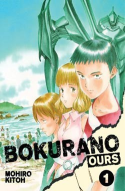
Bokurano: Ours 1-2 by Mohiro Kitoh: B

November 22, 2010 by Michelle Smith

Fifteen kids—most of them, except for one boy’s kid sister, in 7th grade—are taking part in a summer program called “Seaside Friendship and Nature School.” Chafing at the instruction to go out and observe nature, the kids decide to explore a nearby cave, where they inexplicably discover a computer lab and a strange guy who calls himself Kokopelli.

Kokopelli tells the kids he’s working on a game in which the “chosen heroes” will pilot a giant robot as it faces off against alien invaders, and offers them the chance to play. Of course, they’re all interested and when he asks them to seal their contract before explaining the rules, they comply. It’s only when Kokopelli’s subsequent demonstration claims the life of a fighter pilot that they begin to grasp that the battle—and the damage it causes—is real.

Over the course of these first two volumes, the kids begin to learn exactly what they’re in for. After the disappearance of Kokopelli, “assistance” is provided by (possibly untrustworthy) Koyemshi, a floating creature almost cute enough to be a plushie if not for his menacing set of pointed teeth. He doles out information sparingly, and it’s not until two of their comrades have died that the kids learn the truth: the giant robot will fight to defend humanity from the invaders, but derives the power to do so from the life force of its pilot.

Obviously, the kids want to quit, but Koyemshi points out that they signed a contract and warns that if they should refuse to fight, Earth will be destroyed within 48 hours. The same fate awaits if they should lose a battle. As he puts it, “Win, save the planet and die… or lose and die when your planet is destroyed. Those are your options.” Believing that they really are helping to save the world, the kids soldier on.

At this point, the feel of the story reminds me a lot of another VIZ Signature title, Ikigami. For those unfamiliar with the story, Ikigami envisions a Japan in which the government attempts to encourage its citizens to lead a more productive life by instilling in them the fear of death. Anyone could receive a death notice (an ikigami) at any time informing them that they have 24 hours left to live, and the series follows each recipient in turn as they deal with the news.

Bokurano is structured similarly, focusing on each pilot as he or she “gets the call.” There are merits and flaws to this approach: obviously, the current pilot receives a lot of attention, and it’s interesting to see how each approaches the responsibility differently. One boy cares nothing for human casualties while another carefully takes the battle out into the harbor to minimize damage. One girl uses her final hours to sew morale-boosting uniforms for the group. Unfortunately, this also means that at any given time there are about a dozen characters relegated to the background, waiting for their turn to contribute to the story.

Because of lack of time spent with individual characters, it’s hard to care about them much, despite their awful predicament. I might realize I like someone based on how he handles his turn as pilot, but I know the opportunity to see things from his perspective will be brief. The most compelling aspect of the story to me is the notion of where these invaders came from in the first place, and what the human population as a whole thinks about giant monsters in their midst.

During Kokopelli’s demonstration, as he occupies the sole chair in a circle of many, he admits that he’s as much a pawn as the kids are and that he isn’t from our planet. It would appear, then, that he is the final pilot from a previous incarnation of this “game” who was sent to Earth to find a new set of players. Is this “invasion” real? Why are there precisely fifteen enemies and no more? This may not be a game for the young pilots or the humans threatened by these monsters, but is it a game for someone, somewhere?

Dark, grim, and mysterious, Bokurano is probably not for everyone, but I’ll definitely be reading more.

Bokurano: Ours is published in English by VIZ. The series is complete in Japan with eleven volumes.

This review was originally published at Comics Should Be Good.

Review copy for volume two provided by the publisher.

Filed Under: Manga, Sci-Fi, Seinen Tagged With: VIZ, VIZ Signature

Gyo 1-2 by Junji Ito: B+

October 26, 2010 by Michelle Smith

Walking fish aren’t the usual sort of monsters one associates with Halloween, but their invasion makes for creepy reading nonetheless!

Tadashi and his high-maintenance girlfriend, Kaori, are vacationing in Okinawa when Kaori begins complaining of putrid smells. Soon after, a chase ensues between Tadashi and a barely glimpsed, fast-moving creature, culminating with the discovery that said critter is actually a fish with four spindly mechanical legs. This is just the tip of the fishberg, though, as Okinawa is soon overrun by walking fish, which quickly spread to mainland Japan and eventually the rest of the world.

Despite the attempts of the back cover to induce me to regard the series as “horrifying,” the primary adjective I’d use to describe it is “weird.” The scenes of walking fish—and sharks, squids, and whales—swarming down city streets are alarming but fun in a disaster movie kind of way. For most of the first volume, I actually smiled as I read. Things get more serious in the second volume, with revelations about what the creepy legs will do once they run out of fish bodies to use as fuel, but the weird only gets weirder—there’s a critter circus, for example—and the series never loses its page-turning momentum.

While I’d primarily classify Gyo as something fun that’s not too deep, it does offer some commentary on scientific ethics, particularly in the person of Tadashi’s uncle, who immediately begins trying to create a walking machine of his own. Some will be put off by the lack of a finite ending, but I find it interesting. If this were a disaster movie, we’d probably be given the opportunity to cheer on our battered heroes as they figure out the creatures’ vulnerability and blow them all to smithereens, but Gyo stops short of that point. Will mankind prevail? Will the world be overrun? We’ll never know.

Two short stories are included in volume two. “The Sad Tale of the Principal Post” is short and random, but I liked “The Enigma of Amigara Fault” a lot. In it, an earthquake has revealed a rock formation riddled with human-shaped holes that go farther back into the rock than researchers are able to measure. People have flocked to the site after seeing it on TV, somehow drawn to holes that seem to have been tailor-made for them. A young man named Owaki tries to keep his new female friend, Yoshida, from entering her hole, and suffers some vivid (and way more horrifying than the fish-monsters!) nightmares about what could happen to a person who enters. The final page suggests he was right.

In the end, I wouldn’t classify Gyo as amazing, but it—and “The Enigma of Amigara Fault”—are certainly entertaining and memorable. I may have to check out more from Junji Ito, like the spooky spiral menace of Uzumaki!

Gyo is published in English by VIZ and is complete in two volumes.

Filed Under: Books Tagged With: Junji Ito, VIZ, VIZ Signature

Afterschool Charisma 1 by Kumiko Suekane: B-

July 16, 2010 by Michelle Smith

Sigmund Freud. Florence Nightingale. Napoleon Bonaparte. These are not merely the names of eminent historical figures. They are also the names of students at a certain high school. These children are the fruit of leading-edge genetic engineering technology. In other words… they are clones.

It’s the year 2XXX A.D. and St. Kleio Academy is home to many students, all clones of famous historical figures. All, that is, except for Shiro Kamiya, son of a professor at the school and the only regular kid in attendance.

The students are expected to not only live up to the “monumental legacies of [their] originals,” but to strive to surpass their achievements. While some students are seemingly content with this arrangement, others strive to be their own person. Marie Curie, for example, lacks passion for scientific study and instead wants to be a pianist. When the school’s first graduate, a clone of John F. Kennedy, is assassinated while dutifully following in his original’s footsteps and campaigning for president, the astute Sigmund Freud does some digging and confirms the existence of a group whose agenda is to kill all of the clones.

Like me, you might find this concept very intriguing. Like me, then, you’ll likely be disappointed to discover that the tone of this volume is quite erratic. After some ominous hinting that Marie Curie—who the students believe has been allowed to transfer to music school—has been scrapped (“Another do-over,” according to Shiro’s dad), the story abruptly veers into fanservice territory, with Shiro and Freud shoved into the girls’ changing room by their friends. So, now we’ve gone from “Ooh, creepy!” to “Ooh, boobies!”

As the story progresses, it wanders seemingly without direction. There are still some hints about the anti-clone organization sprinkled throughout, but the focus becomes more on a sort of cult operating within the school whose members carry around plush toys in the likeness of Dolly, the famous cloned sheep. Also, because Mozart disdained Marie Curie’s musical ambitions, Shiro decides he needs to get fit so he can challenge him to a fencing match after which Mozart seemingly hangs himself to teach Shiro what it’s like to be a clone. Or something. It’s very odd.

In the end, I’m still interested enough in the story to read the next volume. I have suspicions about Shiro’s origins, for one thing, and the fact that the anti-clone folks have their faces hidden can only be significant. There’s a lot of potential here—I just hope the various elements coalesce into something more purposeful.

This review was originally published at Comics Should Be Good.

Afterschool Charisma is published in English by VIZ and serialized on their SigIKKI website. One volume’s available in print so far while in Japan the fourth volume has just been released.

Filed Under: Manga, Sci-Fi, Seinen Tagged With: VIZ, VIZ Signature

Saturn Apartments 1 by Hisae Iwaoka: B+

July 9, 2010 by Michelle Smith

In this low-key, dystopic sci-fi story, a boy named Mitsu takes up his missing father’s occupation as a window washer in the hopes that it will yield answers about his disappearance, or maybe just life in general.

Humanity has vacated Earth. They were not, however, willing to move too far away from their former home, now declared a vast nature preserve, and have instead taken up residence in a gigantic ring around the planet. Within the ring, a very stratified society exists, with public facilities located on the relatively airy middle levels, spacious homes for the wealthy in the upper levels, and dark and cramped living conditions for everyone else in “the basement.” Saturn Apartments is essentially a slice-of-life story that follows Mitsu as he begins his new job (washing the ring’s external windows) and interacts with residents from the various levels of society. Most of the guild’s work is either assigned by the government or commissioned by the very rich, so when his first job is cleaning windows on the lower level, it’s rare.

This job has been requested by a young couple who are about to get married—the groom-to-be is Sohta, a very bright young man who obtained an advanced degree with the hopes of finding a job in the middle levels. Only after Sohta graduated was he told that, even if he goes to grad school, he’s still not going to be employable because he’s from the basement. He ends up settling for a job as a technician in a power plant instead. Many of the following stories also serve to illustrate the plight of the basement-dwellers while offering in contrast the excesses of the rich, including one eccentric fellow who keeps a near-extinct sea creature in his home and another who tinkers with robots all day long and has the crew back to redo his windows over and over without offering any explanation as to what they’ve done wrong.

Meanwhile, Mitsu seeks to learn more about the accident that apparently claimed the life of his father, Akitoshi. Five years ago, Akitoshi’s rope was cut and he plunged toward Earth. Mitsu had always suspected that his father cut the rope intentionally, but when he’s sent to work at the same spot, he notices some damage to the ring’s hull that could’ve been responsible for severing the rope, along with many handprints that suggest his father fought to stay alive. Later, he meets his Akitoshi’s former partner, Tamachi, and begins to hear about a side of his father that he never knew.

As I wrote in my introduction, the world of Saturn Apartments is what I would call a low-key dystopia. Those who dwell in the basement aren’t too happy with their lot, but they seem resigned to the fact that they can’t do anything about it. The only one who really has any spunk is Jin, the experienced window washer with whom Mitsu is partnered, but his frustration at rich folks manifests as bursts of ill temper that pass quickly. Iwaoka’s art excels at depicting the oppressive feeling of life in the basement—narrow alleyways and towering buildings reinforce the notion of insurmountable obstacles and one can almost feel the weight of all the rooms above Mitsu’s pressing down on him.

Mitsu himself is perhaps the weakest link here because he is so much an observer. We do learn that his mother died when he was very young and that, after his father’s death, some kindly neighbors attempted to care for him but he always kept a respectful distance from them. Now that he’s finished school and is working, he is determined to pay his own way and seeks to find meaning in the work that he’s doing. Too, he believes that following in his father’s footsteps and working hard will enable him to learn something. What that is, exactly, he doesn’t know, but perservering feels important.

I certainly find Mitsu’s quest interesting and will keep reading about him and his world, but it’s as if he’s keeping a respectful distance from the reader, too, which makes it difficult to become more than simply curious how things will turn out.

This review was originally published at Comics Should Be Good.

Saturn Apartments is published in English by VIZ. One volume has been released so far, though two chapters of volume two are available on the SigIKKI website. The series is still ongoing in Japan; five volumes are currently available there.

Filed Under: Manga Tagged With: VIZ, VIZ Signature

Solanin

June 26, 2010 by Katherine Dacey

The characters in Solanin are suffering from what I call a “pre-life crisis”—that moment in your twenties when you realize that it’s time to join the world of adult responsibility, but you aren’t quite ready to abandon dreams of indie-rock stardom, literary genius, or artistic greatness. From a dramatic standpoint, the pre-life crisis doesn’t make the best material for a novel, graphic or otherwise, as twenty-something angst can seem trivial when compared with the vicissitudes of middle and old age. Yet Asano Inio almost pulls it off on the strength of his appealing characters and astute observations.

Solanin focuses on a quartet of twenty-somethings, each struggling to shed their collegiate persona and forge adult identities. To be sure, these characters are familiar types, working dead-end jobs, remaining in relationships out of habit, and clinging to unrealistic dreams. Yet Inio never dismisses or romanticizes their pseudo-bohemian aspirations, instead viewing these angstful young adults with a parental mixture of frankness and affection.

Early in the book, for example, a young woman (Meiko) introduces her boyfriend (Naruo) to her mother while trying to conceal the fact they live together. Inio might have milked the scene for its dramatic potential, staging a confrontation between Meiko and her mother. Yet he opts for something quieter and, frankly, truer to life: Meiko’s mother calls her daughter’s bluff, then offers the couple practical advice and encouragement. Instead of being pleased, however, Meiko is dumbfounded and embarrassed, leaving Naruo to stumble alone through an awkward conversation with her mother. What makes this scene work is Inio’s even-handedness; though we feel sympathy for Meiko — she’s genuinely afraid of upsetting her parents — we also realize that she’s disappointed that her decision to move in with Naruo hasn’t caused a scandal, a symptom of her not-quite-adult-relationship with her mother.

Solanin flounders, however, when Inio injects some drama into the proceedings. His big plot twist wouldn’t seem out of place in a deliciously overripe soap opera like NANA, but it feels too contrived for a low-key, slice-of-life story like Solanin; more frustrating still, Inio telegraphs what’s going to happen more than a chapter before that Big, Life-Changing Event, blunting its emotional impact. The book never quite regains its footing, culminating in a concert scene that’s as hokey as anything in The Commitments. Granted, that scene is beautifully executed, using wordless panels to convey the blood, sweat, and tears needed to pull off a live performance, but it feels too pat to be a satisfactory resolution to what is, in essence, a detailed character study.

I also felt ambivalent about the artwork. On the one hand, Inio draws his characters in a refreshingly soft and realistic fashion; as David Welsh noted in his 2008 review, Inio captures the transitional nature of their age through small but important visual cues: gangly limbs, baby fat still evident in their cheeks and tummies, soul patches and other “unpersuasive” attempts to grow beards and mustaches. Inio nails their body language, too, evoking his characters’ emotional and physical awkwardness as they try to forge connections. In this scene, for example, Inio’s characters can barely look one another in the eye, even though it’s evident from their conversation that each has a deep personal investment in music that s/he wants to share with the other:

solanin_interior

On the other hand, the backgrounds sometimes look like poorly retouched clip art. Such shortcuts are common in manga, but when done poorly (as they are in a few sequences in Solanin), the resulting images look more like dioramas or collages than organic compositions. In several key scenes, the characters appear to be pasted into the picture frame, floating above their surroundings instead of actually inhabiting them, spoiling the mood and pulling me out of the moment.

Artistic and narrative shortcuts aside, I’d still recommend Solanin. Inio’s book is funny, rueful, and honest, filled with beautifully observed moments and conversations that ring true, even if it occasionally succumbs to Brat Pack cliche.

SOLANIN • BY INIO ASANO • VIZ MEDIA • 432 pp • RATING: OLDER TEEN (16+)

This is a revised version of a review that appeared at PopCultureShock on 11/19/2008.

Filed Under: Manga, Manga Critic, REVIEWS Tagged With: Drama, Inio Asano, Musical Manga, VIZ, VIZ Signature

Ristorante Paradiso by Natsume Ono: B+

June 5, 2010 by Michelle Smith

Twenty-one-year-old Nicoletta arrives in Rome with the intention of confronting her absentee mother, Olga, and revealing the fact of her existence to Olga’s husband, Lorenzo, who had believed his wife to be childless. Instead, she becomes entranced by her mother’s world and ultimately finds a place in it.

Olga and Lorenzo run a restaurant, and though the food is excellent, many of the patrons come just to see the waiters, a staff of mostly older men who all wear glasses (whether necessary or not) to indulge Olga’s whim. At first Nicoletta is perplexed by the multitude of women swooning over these men until she begins to notice the particular charms of Claudio, the head waiter. Claudio is graceful, sexy, and very kind, though he’s still hung up on his ex-wife and continues to wear his wedding ring. Although Nicoletta originally wrangles a job as a kitchen apprentice in order to be near him, she proves to be genuinely good at cooking. She becomes part of the restaurant’s family, and her relationship with Olga improves as a result.

Ristorante Paradiso is a completely different kind of story than not simple, the other Natsume Ono title currently available in English. It’s happy, for one thing, with a cozy, slice-of-life storytelling style and the kind of predictable yet comforting conclusion that would be perfectly at home in an Italian holiday kind of chick flick. Things between Nicoletta and Olga work out too easily, but most of the focus is on the guys anyway, so I’m not as annoyed as I otherwise would be.

Let’s talk about those guys for a minute. Sexy Claudio is definitely the star among them, but grumpy yet kind Luciano is another standout, as is Gigi, Lorenzo’s eccentric half-brother who seems to have a completely unspoken thing for the boss’s wife. Nicoletta is continually upstaged by these men—and by Olga, whose zeal for life makes her a sympathetic character despite the mistakes she made in the past—and it’s no wonder that Gente, the prequel/sequel series due from VIZ in July, focuses on them and not her. Nicoletta starts out as a directionless twenty-something in search of her place in the world, but we just don’t get to know her well enough to find her journey truly compelling. That said, I did appreciate her confidence in certain situations and she has a terrific final line.

It might just be an illusion, but Natsume Ono’s art looks a little more traditional here than in not simple. There’s no way you’d mistake her work for anyone else’s, but the characters seem more normally proportioned and she really does a great job in conveying Claudio’s gentle demeanor and appeal whenever he appears. While the “show don’t tell” rule gets broken on several occasions, there are still a few examples of good nonverbal communication, too. My one artistic complaint is that I wish we could have seen more of the food! Then we might have had something like the Antique Bakery of Italian cuisine. The subtle inclusion of a hilariously oversized ravioli made by Olga is some compensation, however.

In the end, Ristorante Paradiso is definitely worth reading. The plot won’t knock your socks off, but the experience will likely put a smile on your face nonetheless.

Review copy provided by the publisher. Review originally published at Manga Recon.

Filed Under: REVIEWS Tagged With: Natsume Ono, VIZ, VIZ Signature

All My Darling Daughters by Fumi Yoshinaga: A

January 28, 2010 by Michelle Smith

allmydarling“A mother is an imperfect woman.”

So thinks Yukiko Kisaragi, the central hub around which the collection of stories in All My Darling Daughters revolves. As the story begins, Yukiko’s mother, Mari, has just undergone a successful cancer operation and decides that, from now on, she’s going to live her life the way she wants. To Yukiko’s dismay, this involves getting remarried to an aspiring actor and much younger man, Ken Ohashi, whom she met at a host club. At first, Yukiko is convinced it’s a con, and maintains a guarded demeanor around Ohashi, but once he proves his love for Mari really is genuine, she breaks down. “She’s always belonged entirely to me,” she sobs.

From there, stories focus on those Yukiko knows. The second chapter is about a strange student named Maiko who forces herself on Izumi, a lecturer friend of Ohashi’s; the third features Sayako, a pretty friend of Yukiko who has decided to investigate arranged marriage; the fourth is about middle school friends of Yukiko and how their career plans went awry; and the final chapter focuses on Yukiko’s grandmother and her relationship with Mari. Meanwhile, we catch glimpses of how Yukiko’s life is evolving through a series of revelations about what has occurred “off-camera.”

At first I had a hard time understanding how some of these stories related to each other. Sayako’s story, for example, is incredibly touching and sad, but her mother does not play much of a role. The story of the forceful student seemed entirely out of place. But then the common thread hit me: this book is not just about mothers and daughters. It’s about the relationship between any caregiver and a child, and how something that might seem inconsequential to one could affect the other for the rest of their lives.

Sayako is crippled in love because her well-meaning grandfather told her, “You mustn’t discriminate among people.” Maiko has a warped view of relationships because someone indoctrinated her with a servile disposition—even though Izumi repeatedly says, “Who told you that?” it’s a perception she is unable and even unwilling to shake. Yukiko’s middle school friend is unable to fulfill her lofty goal of being a trailblazer for women in the workplace because an abusive father forces her to leave home early and quit school. Even Mari’s not immune, since her mother’s denigrating comments (made with good intentions, we later learn) about her appearance gave her a lifetime complex about her looks.

By the end of the volume, it’s apparent that Yukiko really is living a charmed life. Mari may be an imperfect mother, but she’s honest about her foibles and the two share an incredible relationship. Yukiko even achieves a sense of peace about her new step-dad, realizing “this strange boy is necessary for my mom.” Yukiko’s husband, Jun, is sweet yet equally imperfect, and a casual remark near the end of the volume reveals they’ve made headway in conquering a problem of equality in their marriage. Career-wise, Yukiko is the most successful of her group of middle school friends, prompting former chum Saeki to think, “At least one of us fulfilled her modest dreams.” And who is it whose fierce yet loving care enabled Yukiko’s life to turn out so well? I’ll give you one guess.

In addition to all of this thoughtful, integrated writing, Yoshinaga also employs her distinctive artistic style in the service of the story. True, the bulk of the panels contain talking heads in white space, but sometimes these headshots are exactly what one needs to get the point across. The most effective example of this occurs in the third chapter, when a two-page spread of close-ups is used to convey how Sayako and a prospective husband, Mr. Fuwa, have instantly achieved a content companionship. And if you don’t get sniffly when this technique is used again in the final two pages, you might just be a robot.

Review originally published at Manga Recon. Review copy provided by the publisher.

Filed Under: REVIEWS Tagged With: fumi yoshinaga, VIZ, VIZ Signature

20th Century Boys, Vols. 1-6

January 9, 2010 by Katherine Dacey

Do you remember those first, glorious seasons of Heroes and Lost? Both shows promised to reinvigorate the sci-fi thriller with complex, flawed characters and plots that moved freely between past, present, and future. By the middle of their second seasons, however, it was clear that neither shows’ writers knew how to successfully resolve the conflicts and mysteries introduced in the first, as the writers resorted to cheap tricks — the out-of-left-field personality reversal, the all-too-convenient coincidence, and the arbitrary let’s-kill-off-a-character plot twist — to keep the myriad plot lines afloat, alienating thousands of viewers in the process. Heroes and Lost seemed proof that even the scariest doomsday scenario would fall flat if saddled with too many subplots and secondary characters.

Reading Naoki Urasawa’s 20th Century Boys, however, convinced me that it is possible to tell a twisty, layered story about ordinary people saving the world from annihilation without succumbing to cliche or unduly testing the audience’s patience. The key to Urasawa’s success? A strong script with vivid characters and a clear sense of purpose, reassuring the reader that all the plot strands are just that: strands, not loose threads.

In 20th Century Boys, humanity’s future rests in the hands of an unpromising lot. There’s Kenji, a college dropout who runs a convenience store; Maruo, a cheerful, plump soul who owns a shop down the street from Kenji; Yoshitune, a shy, bespectacled office man; Otcho, a scruffy renegade who’s been living off the grid in Thailand; and Yukiji, a K-9 officer who can’t control her drug-sniffing dog. All five were childhood friends, members of a secret club that wrote The Book of Prophecy, an elaborate doomsday scenario involving superheroes and giant robots. Now in their thirties, the gang has disbanded — that is, until their pal Donkey, a high-school science teacher, leaps to his death off a building.

Or did he? As Kenji begins pushing for answers, he discovers that Donkey was investigating a mysterious cult, known only as The Friends, that had appropriated the club’s “official” symbol. The more Kenji probes, the more parallels he discovers between The Friends’ clandestine activities and the Book of Prophecy, parallels that suggest the cult is headed by one of Kenji’s old schoolmates. Terrified that The Friends will attempt to recreate the story’s climatic battle, Kenji tracks down his clubmates one by one, assembling a small army to oppose the cult.

20thcentury4From the very first pages of volume one, Urasawa demonstrates an uncommon ability to move back and forth in time, juxtaposing scenes from Kenji’s past with brief glimpses of the future. The success of these scenes is attributable, in part, to Urasawa’s superb draftsmanship, as he does a fine job of aging his characters from their long-limbed, baby-faced, ten-year-old selves into thirty-somethings weighed down by adult responsibilities.
The integrity of Urasawa’s characterizations also contribute to the success of these temporal leaps; his characters’ adult behavior jives with what we know about them from childhood flashbacks. Otcho, for example, was the club’s most worldly member, the kid who introduced his pals to rock-n-roll and gave them the lowdown on Woodstock; it’s not surprising to see him reincarnated as a long-haired thug-for-hire who despises authority. Ditto for Yanbo and Mabo, twins who terrorized Kenji and friends back in the day. When Yanbo and Mabo resurface in volume five, Urasawa gives them a more pleasing appearance and demeanor than we might have expected, luring us into a false sense that they’ve outgrown their bullying ways. Urasawa then slaps us on the wrist for not trusting our original assessment of the twins, uncorking a fiendish plot twist that’s in keeping with what we already knew about them.

Urasawa uses these flashbacks and flash-forwards to build a dense network of connections among his characters, gradually revealing how and why Kenji’s childhood fantasies are providing the blueprint for a real-life apocalyptic scenario. Heroes and Lost attempted to do the same thing, but neither show succeeded in convincing us that those connections were lying just below the surface waiting for us to discover them; those connections had an arbitrary, bolt-from-the-blue quality. With 20th Century Boys, however, Urasawa makes us feel that we might have unearthed these links without any editorial guidance, as even the most surprising developments still make sense within the story’s elaborate framework.

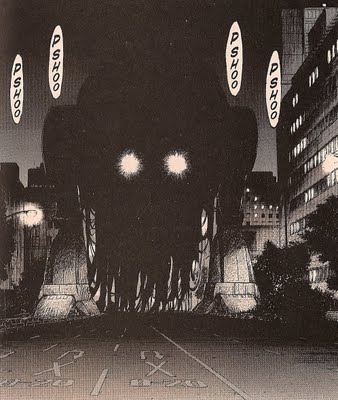
What gives the story its sense of urgency is Urasawa’s ability to create and sustain a strong sense of fear and anticipation. Six volumes into 20th Century Boys, we’ve had a few tantalizing glimpses of the robot that menaces Tokyo on the eve of the millennium, but we still don’t know what it looks like or what it can do. Urasawa has only shown us the enemy in silhouette:

20thcentury_robot

It’s a point I’ve raised in other reviews: an unseen menace is much scarier than one that’s routinely trotted out of the shadows to spook us. Consider the difference between Jaws and its sequels. In the original, Steven Spielberg hinted at the shark’s presence, showing us a dorsal fin or a dark outline moving rapidly beneath the water’s surface, but withholding the “money” shot (“tooth” shot, perhaps?) until the third reel. The few times that we see Jaws attack are genuinely scary because they finally put us face-to-face with those terrible teeth and dead eyes, confirming just how deadly the shark really is. In the sequels, however, the shark is featured prominently; we see it dine on boaters and swimmers in lurid detail. We may marvel at the stupidity of the shark’s victims, or feel disgusted by the gallons of fake blood, but we never feel scared, as we know what we’re up against from the very first scenes.

Urasawa takes a page from Spielberg’s book, showing us just enough of the robot’s form to engage our imagination. The robot’s silhouette hints at its size and strength; if anything, it looks like an enormous man-o-war lumbering through Tokyo. But what stays with us are those fierce, penetrating headlights, so evocative of a prison searchlight or a pair of eyes. As David Ford observes at Are You a Serious Comic Book Reader?, we feel a palpable sense of despair when we see the robot: how can Kenji hope to escape its all-seeing gaze? (By the way, I highly encourage you to read Ford’s essay, though spoiler-phobes should stay away until they’ve finished volume five.)

With more than ten volumes left in 20th Century Boys, I have no idea how Urasawa plans to tie all of the stories’ threads together. I’m confident, however, that he’ll do so with the skill of a master weaver, seamlessly incorporating all of the relationships, plot twists, and motives into an intricate, beautiful tapestry.

Review copies provided by VIZ Media, LLC. Volume seven will be released on February 10, 2010.

20TH CENTURY BOYS, VOLS. 1-6 • BY NAOKI URASAWA • VIZ • RATING: OLDER TEEN (16+)

Filed Under: Manga, Manga Critic, REVIEWS Tagged With: Naoki Urasawa, Sci-Fi, Thriller, VIZ, VIZ Signature

not simple by Natsume Ono: A

December 25, 2009 by Michelle Smith

notsimpleFrom the back cover:
A story within a story,
A book within a book,
A tale about the search for family,
For an emotional home.

Ian, a young man with a fractured family history, travels from Australia to England to America in the hope of realizing his dreams and reuniting with his beloved sister. His story unfolds backwards through the framing narrative of Jim, a reporter driven to capture Ian’s experiences in a novel: not simple.

Review:
I normally reserve my comments about a comic’s art for somewhere near the end of my review, but since the fact that Natsume Ono’s style deviates from the manga norm is glaringly obvious, I thought I’d address it first. Her art is spare and kind of squiggly, true, and yet it’s absolutely perfect, adding to rather than detracting from the narrative. I honestly cannot imagine this heartbreaking story being illustrated in any other way; to pair it with pretty art would be too wrong for words, so don’t let the lack of same be a deterrent.

If you, like me, have ever thought, “Why don’t more stories have sad endings?” then not simple is the manga for you. That’s not even a spoiler, really, since the structure of the story reveals the fate of Ian, the hapless protagonist, practically immediately. The book begins with a conversation between Jim, a writer, and Ian, in which Jim announces, “You’re going to be my next novel.” From there, a prologue depicts the end of Ian’s story, in which he is a drifter looking to keep a rendezvous with a woman he met years earlier, before shifting back in time to chronologically cover his life from childhood until the moment he leaves for the meeting.

The hardships and misfortunes of Ian’s existence are beyond many, and just when you think it couldn’t get worse, it does. Growing up in Australia as the child of a drunken mother and absentee father, he’s extremely close to his sister, Kylie. When Kylie is sent to prison for robbery—her means for funding a new life with Ian by her side—he’s left alone at home, and after his parents divorce, ends up living in London with his mother. Upon her release, Kylie finds him there and they have the briefest of brief reunions before she sends him back to Melbourne to be with his dad and promises that they’ll meet again once he achieves his dream.

Years pass. Ian has always loved running, and his dream is to break a certain runner’s record. He and Jim originally met when Jim was assigned to interview him, and they reconnect when Ian’s peculiarly jubilant response to placing fourth in a race attracts the notice of Jim’s editor. Ian, having achieved his goal, now feels free to seek out his sister. His search is long and disappointing, hindered by a series of terribly unlucky near-misses and a set of relatives that don’t care much about Kylie or Ian, let alone helping them achieve a reunion.

If this sounds like just about the most depressing story around, that isn’t far off the mark. And yet, it never strays into implausible territory. Ian is a likable guy—a strangely pure and innocent person who is, simultaneously, somewhat of an enigma—but the stresses of his life begin to take their toll and the final time he shows up at Jim’s place, after an absence of two years, the change is palpable. For years, he’s been matter-of-fact about the horrible things that have happened to him, but finally is so worn down that he’s become haggard and yearns only for the warm personal relationships that have been denied him. Jim’s an interesting observer, as well, ignoring his own family about as strenuously as Ian searches for his. If there’s anything I could complain about with not simple, it’s that we don’t learn more about Jim’s particular circumstances.

Depressing or not, not simple is masterfully told and completely unforgettable. If I had to sum it up in one word it would be this: haunting.

Review copy provided by the publisher.

Filed Under: REVIEWS Tagged With: Natsume Ono, VIZ, VIZ Signature

Oishinbo A la Carte: Vegetables

December 14, 2009 by Katherine Dacey

I mean no disrespect to Tetsu Kariya or Akira Hanasaki when I say that the Vegetables volume of Oishinbo A la Carte irresistibly reminded me of 1970s television. Back in the day when there were only three networks, hour-long dramas doggedly followed the same formula: they dramatized a problem — say, drinking and driving, or falling in with a bad crowd — then resolved it with a little action and a lot of talking, culminating in a freeze-frame shot of the entire cast laughing at corny situational humor. Oishinbo follows this template to a tee, using hot-button issues such as bullying and pollution to preach the healing power of vegetables. The stories are as hokey and predictable as an episode of CHiPs or Little House on the Prairie, but entertaining in their sincerity.

Take “The Joy of a New Potato,” for example. The story begins with big-shot executive Misaki Hacho treating the Ultimate Menu team to an expensive meal. Shortly afterwards, Yamaoka discovers that Misaki has fallen on hard times, selling his business interests and trading his lavish home for a two-room flat. Kurita and Yamaoka invite Misaki’s family on a country outing, teaching his children how to harvest and cook potatoes. Though the denouement of the story is predictable and a little credulity-straining — Misaki’s son declares the potato outing “a hundred times better” than the extravagant birthday party that dad threw him the previous year — the message is heartfelt: doing things with your children is more important than doing things for them. Other stories in this vein include “The Bean Sprout Kid,” in which Yamaoka defends a quiet, frail boy from his classmates; “Good Eggplant, Bad Eggplant,” in which Tomio’s son overcomes his lifelong hatred of aubergines; “The Story of Vegetables, Now and Then,” in which a wealthy industrialist learns an important lesson about pesticides; “The Breath of Spring,” in which a cook woos her estranged lover with an asparagus dish; and “The Taste of Chicken, The Taste of Carrots,” in which a grandmother’s homemade chicken soup inspires a picky eater to add veggies to her diet.

No volume of Oishinbo would be complete with at least one epic food battle, and Vegetables opens with a doozy: a three-part contest revolving around cabbage and turnips. For most of the showdown, Yuzan appears to have the upper hand, preparing simple dishes that emphasize the unique flavors of the star ingredients. Yamaoka’s fortunes change, however, when Arakawa’s mother comes to the city for a visit, bringing wild grape juice and walnuts with her. The bold flavors of the grapes and walnuts inspire Yamaoka to take a page from his father’s book, trading elaborate preparations for straightforward ones that enhance the “muddiness” of the turnip.

As I noted in my review of the first volume, the structure of the A la Carte edition of Oishinbo is both its strength and weakness. On the one hand, organizing each volume around a particular kind of food makes for a fun, educational introduction to Japanese cuisine; a better title for the US edition would be Oishinbo: Beyond Pocky and California Rolls, given the sheer diversity of the food described in each volume. On the other hand, the series’ thematic organization robs the series of its continuity; we never have a chance to see Kurita and Yamaoka’s relationship evolve from co-workers to spouses, as we’re constantly seeing them at different stages of their courtship, nor do we have any sense of how the Ultimate Menu vs. Supreme Menu contest is unfolding.

Still, it’s difficult to deny Oishinbo‘s appeal. Imagine Iron Chef crossed with Mostly Martha, and you have some idea of why this sincere, somewhat hokey, series is as addictive as gyoza: it reminds us that food is an essential ingredient in all human relations, the glue that binds friends, families, and lovers in times of joy and crisis alike. The best of the A la Carte series.

Review copy provided by VIZ Media, LLC.

OISHINBO A LA CARTE: VEGETABLES • STORY BY TETSU KARIYA, ART BY AKIRA HANASAKI • VIZ • 266 pp. • RATING: TEEN

Filed Under: Manga, Manga Critic, REVIEWS Tagged With: Cooking and Food, VIZ, VIZ Signature

Detroit Metal City, Vol. 1

May 28, 2009 by Katherine Dacey

Detroit Metal City is a rude, raunchy comedy that’s both a satire of death metal culture and a loving portrait of the folks who labor in its trenches. When we first meet the series’ hero, twenty-three-year-old Soichi Negishi, he’s wearing a fright wig, kabuki makeup, fangs, and a pair of knee-high platform boots that look like they were swiped from Paul Stanley’s closet. Soichi is the lead singer and guitarist for Detroit Metal City (DMC), an “evil core death metal band with a huge following.” Onstage, Soichi adopts the persona of Krauser II, Lord of Hell, spitting lyrics about rape, torture, and mutilation; offstage, however, Soichi is a sweetly metrosexual young man who loves Swedish pop music, Audrey Tatou movies, and shopping for stylish clothing in the Daikanyama district. How, exactly, Soichi ended up singing in DMC is something of a mystery; by his own admission, he left his parents’ farm hoping to start a “hip indie pop band.” Five years later, however, Soichi is living in Tokyo and performing in DMC while doing his utmost to conceal that fact. Try as he might, however, he can’t quite limit his loud, violent persona to the stage, as Krauser has an unfortunate tendency to manifest himself whenever Soichi is depressed, angry, intoxicated, or feeling rejected by Yuri, a pretty young magazine editor who shares Soichi’s passion for perky tunes.

The tension between Soichi’s two musical personae turns out to be a brilliant framing device for the story, allowing manga-ka Kiminori Wakasugi to have his cake and eat it, too. As Krauser II, Soichi can sing the kind of crudely misogynistic lyrics that might otherwise offend because we, the readers, know that DMC epitomizes everything Soichi disdains in real life — in effect, Soichi is our surrogate, expressing indignation for us so that we might laugh freely at the risque jokes. At the same time, however, DMC gives Soichi an outlet for expressing the darker side of his personality—for de-wussifying him, if you will—and acknowledging his deep disappointment that no one appreciates his gentle, sensitive side.

Nowhere is the tension between the Swedish pop star and the Japanese metal god more evident than in chapter twelve. While hanging out in a trendy boutique with Yuri, Soichi lands an opportunity to play a small, intimate gig in the store. Soichi jumps at the chance, performing a saccharine tune called “Sweet Lover”:

When I wake up in the morning
You’re there making cheese tarts.
Sweet baby, that’s what you are.
My sweet, sweet lover
Let’s go
Let’s dress up and go to town.
With cheese tarts in one hand,
You’re romping around.
Cut through the crowds
Let’s go to that store we love.
To buy those matching rings
I promised you.
Sweet sweet sweet sweet lover…

The song’s god-awful lyrics, however, meet with indifference, prompting the boutique owner to eject Soichi from the store. Dazed and wounded, Soichi goes on a drinking binge, his embarrassment slowly curdling into rage. He then dons his DMC outfit and performs “Bad, Bad Lover,” a darkly humorous re-working of his much-reviled love song:

When I wake up in the morning
You’re there frying your parents up!
Let’s go
Kill everyone dressed up in town.
With chainsaw in one hand
You’re slashing around.
Slaughter the crowds
Let’s go to that store we love.
To get those matching weapons
I promised you.

As one might imagine, there are only so many scenarios in which Soichi can transform into Krauser (and vice versa). Mid-way through volume one, I worried that the joke was beginning to wear thin, as Soichi once again found himself trying to explain to Yuri why, exactly, he’d suddenly started acting like a loud, foul-mouthed boor. Thankfully, Wakasugi finds some odd and marvelous ways to spin the story—none of which I’ll spoil for you—including a contest between DMC and an Ozzy Osbourne-esque rocker, and a visit to Soichi’s hometown, where his cheerful, clueless parents grow mushrooms and raise livestock.

All of these scenes are rendered in a crude yet energetic style; if I had to hazard a guess, I’d say Wakusagi didn’t do very well in life drawing, as his bow-legged figures sit awkwardly in the picture plane. Yet the very clumsiness of the art works perfectly with the story’s over-the-top premise, capturing both the intensity of DMC’s performances and the sheer stupidity of their on-stage antics. Were the art any slicker, many of Detroit Metal City’s most outrageous moments just wouldn’t work, as their verisimilitude would elicit a “That couldn’t happen in real life!” response from the reader.

Fans worried that Viz would sanitize Detroit Metal City for English-speaking audiences can breathe a sigh of relief. The script abounds in f-bombs, anatomical slang, and crude sexual humor, suggesting that Viz made every effort to preserve the tone and content of the original script. Translator Anne Ichii deserves special mention, as she did a terrific job of making the song lyrics funny in English, a task akin to translating “Big Bottom” or “Stonehenge” into, say, Czech or Chinese. (Just how does one say “mud flaps” in Czech?) The production team merits praise as well, both for their snazzy cover design and for their inclusion of 2009’s coolest extra: temporary DMC tattoos.

If you find South Park offensive, it’s a safe bet that Detroit Metal City won’t be your cup of tea. But if you can look past the swear words and lewd behavior, you’ll find a surprisingly funny, touching story about a musician on a quest to discover his true voice — crank up Portrait of the Artist as a Young Man to eleven, and you have a pretty good idea how this crude, goofy story reads. Highly recommended.

Review copy provided by VIZ Media, LLC.

DETROIT METAL CITY, VOL. 1 • BY KIMINORI WAKASUGI • VIZ • 200 pp.  RATING: MATURE (18+)

Filed Under: Manga, Manga Critic, REVIEWS Tagged With: Comedy, Heavy Metal, Musical Manga, VIZ, VIZ Signature

  • « Go to Previous Page
  • Page 1
  • Page 2
  • Page 3
  • Page 4
  • Go to Next Page »
 | Log in
Copyright © 2010 Manga Bookshelf | Powered by WordPress & the Genesis Framework