• Skip to primary navigation
  • Skip to main content
  • Skip to primary sidebar
  • Home
  • About Us
    • Privacy Policy
    • Comment Policy
    • Disclosures & Disclaimers
  • Resources
    • Links, Essays & Articles
    • Fandomology!
    • CLAMP Directory
    • BlogRoll
  • Features & Columns
    • 3 Things Thursday
    • Adventures in the Key of Shoujo
    • Bit & Blips (game reviews)
    • BL BOOKRACK
    • Bookshelf Briefs
    • Bringing the Drama
    • Comic Conversion
    • Fanservice Friday
    • Going Digital
    • It Came From the Sinosphere
    • License This!
    • Magazine no Mori
    • My Week in Manga
    • OFF THE SHELF
    • Not By Manga Alone
    • PICK OF THE WEEK
    • Subtitles & Sensibility
    • Weekly Shonen Jump Recaps
  • Manga Moveable Feast
    • MMF Full Archive
    • Yun Kouga
    • CLAMP
    • Shojo Beat
    • Osamu Tezuka
    • Sailor Moon
    • Fruits Basket
    • Takehiko Inoue
    • Wild Adapter
    • One Piece
    • After School Nightmare
    • Karakuri Odette
    • Paradise Kiss
    • The Color Trilogy
    • To Terra…
    • Sexy Voice & Robo
  • Browse by Author
    • Sean Gaffney
    • Anna Neatrour
    • Michelle Smith
    • Katherine Dacey
    • MJ
    • Brigid Alverson
    • Travis Anderson
    • Phillip Anthony
    • Derek Bown
    • Jaci Dahlvang
    • Angela Eastman
    • Erica Friedman
    • Sara K.
    • Megan Purdy
    • Emily Snodgrass
    • Nancy Thistlethwaite
    • Eva Volin
    • David Welsh
  • MB Blogs
    • A Case Suitable For Treatment
    • Experiments in Manga
    • MangaBlog
    • The Manga Critic
    • Manga Report
    • Soliloquy in Blue
    • Manga Curmudgeon (archive)

Manga Bookshelf

Discussion, Resources, Roundtables, & Reviews

vertical

The Best Manga of 2011: The Manga Critic’s Picks

December 31, 2011 by Katherine Dacey 27 Comments

The usual gambit for introducing a year-end list is to remark on the abundance of good titles, acknowledge the difficulty in choosing just ten (or five, or three), and comment on the overall state of the industry. And while I certainly debated what to include on my list, I’ll be honest: 2011 yielded fewer contenders for Best Manga than any other year I’ve covered. The dearth of new titles was attributable to publishers’ financial prudence; companies released fewer books, licensed fewer series, and focused on repackaging older content for budget-conscious consumers. And though I selfishly wish that more new material had been released this year, I think manga publishers have done an excellent job of responding to their biggest challenges: a sluggish economy, digital piracy, and Borders’ bankruptcy.

So what titles made my 2011 list? My top ten are below, along with my list of favorite continuing series, favorite finales, and favorite guilty pleasures.

10. BREATHE DEEPLY (Yamaaki Doton; One Peace Books)

Part sci-fi thriller, part coming-of-age story, this engrossing drama examines the relationship between two young men: Sei, who grew up in a world of privilege, and Oishi, a boy from the wrong side of the tracks. Both Sei and Oishi fall in love with Yuko, a sickly girl whose incurable illness inspires her suitors to become medical researchers. In less capable hands, Breathe Deeply might have been a mawkish paean to the purity of young love, but the husband-and-wife team of Yamaaki Doton have a keen ear for dialogue; the interactions between Yuko and her two suitors are tinged with an authentic mixture of adolescent anxiety, sexual longing, and braggadocio. Clean, expressive artwork and well-rounded characters help sell the story, especially in its final pages. One of 2011’s best surprises.

9. THE SECRET NOTES OF LADY KANOKO (Ririko Tsujita; Tokyopop)

Kanoko, the sardonic heroine of The Secret Notes of Lady Kanoko, is a student of human behavior, gleefully filling her notebooks with detailed observations about her classmates. Though Kanoko would like nothing more than to remain on the sidelines, she frequently becomes embroiled in her peers’ problems; they value her independent perspective, as Kanoko isn’t the least bit interested in dating, running for student council, or currying favor with the alpha clique. Kanoko’s sharp tongue and cool demeanor might make her the mean-girl villain in another shojo manga, but Ririko Tsujita embraces her heroine’s prickly, opinionated nature and makes it fundamental to Kanoko’s appeal. It’s a pity TOKYOPOP didn’t survive long enough to finish this three-volume series, as it’s one of the best shojo titles in recent memory.

8. WANDERING SON (Takako Shimura; Fantagraphics)

In her thoughtful review of volume one, Michelle Smith praised Takako Shimura’s deft use of perspective: “The main thing I kept thinking about while reading Wandering Son… is how things that seem insignificant to one person can be secretly, intensely significant to someone else.” Shimura’s ability to dramatize each character’s unique point of view is one of the reasons Wandering Son never feels preachy, even though the topic suggests an Afterschool Special; we are always exquisitely aware of the subtle but important changes in the way each character views herself, as well as her fears and hopes.

7. PRINCESS KNIGHT (Osamu Tezuka; Vertical, Inc.)

What Osamu Tezuka’s New Treasure Island (1946) was to shonen, his Princess Knight (1953-56) was to shojo: both were long-form adventure stories with cinematic flair. Neither could be said to be the “first” shonen or shojo manga, but both had a profound influence on the artists who came of age in the 1940s and 1950s, offering a new storytelling model for them to emulate. Viewed through a contemporary lens, Princess Knight hasn’t aged quite as well as New Treasure Island, as it’s saddled with some woefully antiquated notions of gender. At the same time, however, it’s easy to see why this story appealed to several generations of Japanese girls: Sapphire gets to eat her cake and have it too, having swashbuckling adventures *and* winning the hand of Prince Charming. –Reviewed at Manga Bookshelf on 11/21/11 and The Manga Critic on 12/19/10

6. TANK TANKURO: GAJO SAKAMOTO, MANGA’S PRE-WAR MASTER, 1934-35 (Gajo Sakamoto; Press Pop)

Almost twenty years before Osamu Tezuka’s Astro Boy took flight in the pages of Shonen Kobunsha magazine, Gajo Sakamoto’s Tank Tankuro enchanted Japanese youngsters with his monster-fighting exploits and cool gadgets. Though the series’ propaganda intent is impossible for contemporary readers to ignore — Tank fights the Chinese, who are portrayed in less-than-flattering terms — Presspop’s new anthology demonstrates that Sakamoto’s artistry has aged more gracefully than his storylines. Sakamoto’s work is packaged in a handsome, hardcover edition that includes thoughtful extras: a contextual essay by translator Sunsuke Nakazawa, an interview with Sakamoto’s son, and an article by Sakamoto himself, discussing the character’s origin.

5. STARGAZING DOG (Takashi Murakami; NBM/Comics Lit)

Consider yourself warned: Stargazing Dog is a five-hanky affair. The two interconnecting vignettes that comprise this slim volume explore the bond between Happie, a shiba inu, and Daddy, his owner. When Daddy loses his job, his home, and his family, he and Happie hit the road in search of a new life. Though the outcome of Happie and Daddy’s journey is never in doubt — we learn their fate in the opening pages of the book — Murakami draws the reader into their story with an honest and unsparing look at the human-dog compact that may remind cinephiles of Vittorio de Sica’s Umberto D. —Reviewed at The Manga Critic on 12/23/11

4. ONWARDS TOWARD OUR NOBLE DEATHS (Shigeru Mizuki; Drawn & Quarterly)

In this blistering indictment of Japanese militarism, Shigeru Mizuki draws on his own experiences during World War II to tell the story of a platoon stationed in Papua New Guinea. The soldiers face a terrible choice: fight a hopeless battle, or face execution for treason. Like many war stories, Onwards Toward Our Noble Deaths documents the tremendous human sacrifice of modern armed conflict: gruesome injuries, senseless deaths, devastated landscapes. What lends Mizuki’s narrative its special potency is his depiction of the senior officers; their perverse dedication to their mission turns them into tyrants, more concerned with saving face than saving their own soldiers’ skins. Essential reading for anyone interested in World War II.

3. THE DROPS OF GOD (Tadashi Agi and Shu Okimoto; Vertical, Inc.)

As Oishinbo handily demonstrated, a skilled writer can fold a considerable amount of educational detail into a story without reducing it to a textbook. The Drops of God follows a similar template, imparting highly specialized information about wine with the same natural ease that Law & Order illustrates the inner workings of a crime investigation. At the same time, however, Drops is a delicious soap opera, filled with domineering fathers, mustache-twirling villains, evil beauties, eccentric oenophiles, and down-on-their-luck restauranteurs. Even if the reader isn’t the least bit interested in wine, he’ll find the drama as irresistible as an episode of Dynasty. –Reviewed at The Manga Critic on 12/16/11

2. A ZOO IN WINTER (Jiro Taniguchi; Fanfare/Ponent Mon)

Drawing on his own experiences, Jiro Taniguchi spins an engaging tale about a young man who abandons a promising career in textile design for the opportunity to become a manga artist. Though the basic plot invites comparison with Bakuman, Taniguchi does more than just document important milestones in Hamaguchi’s career: he shows us how Hamaguchi’s emotional maturation informs every aspect of his artistry — something that’s missing from many other portrait-of-an-artist-as-a-young-man sagas, which place much greater emphasis on the pleasure of professional recognition than on the satisfaction of mastering one’s craft. Lovely, moody artwork and an appealing cast of supporting characters complete this very satisfying package.  —Reviewed at The Manga Critic on 5/28/11

1. A BRIDE’S STORY (Kaoru Mori; Yen Press)

A Bride’s Story, which takes place on the banks of the Caspian Sea, explores the relationship between Amir Halgal, a nineteen-year-old nomad, and Karluk Eihon, the eldest son of sheep herders. Though their marriage is one of political expedience, Amir is determined to be a good wife, doing her utmost to learn her new family’s customs, befriend the members of their extended clan, and earn her new husband’s respect. Kaoru Mori is as interested in observing Amir’s everyday life as she is in documenting the growing conflict between the Halgal and Eihon clans, yet A Bride’s Story is never dull, thanks to Mori’s smart, engaging dialogue; as she demonstrated in Emma and Shirley, Mori can make even the simplest moments revealing, whether her characters are preparing a manor house for the master’s return or skinning a freshly killed deer. By allowing her story to unfold in such a naturalistic fashion, A Bride’s Story manages to be both intimate and expansive, offering readers a window into life along the Silk Road. –Reviewed at The Manga Critic on 5/24/11

HONORABLE MENTIONS

As in previous years, I had difficulty limiting myself to just ten titles, so I compiled a list of manga that didn’t quite make my best-of list, but were thoroughly enjoyable:

  • OTHER AWESOME DEBUTS: The Book of Human Insects (Vertical, Inc.), Tesoro (VIZ)
  • BEST CONTINUING SERIES: 20th Century Boys (VIZ), Bunny Drop (Yen Press), Chi’s Sweet Home (Vertical, Inc.), Cross Game (VIZ), Ooku: The Inner Chambers (VIZ), Twin Spica (Vertical, Inc.)
  • BEST NEW GUILTY PLEASURE: Blue Exorcist (VIZ), Oresama Teacher (VIZ)
  • BEST REPRINT EDITION: Magic Knight Rayearth (Dark Horse), Pretty Guardian Sailor Moon (Kodansha Comics)
  • BEST MANGA I THOUGHT I’D HATE: Cage of Eden (Kodansha Comics)
  • BEST FINALE: Black Jack, Vol. 17 (Vertical, Inc.)

So now I turn the floor over to you, readers: what were your favorite new manga of 2011?

Filed Under: Manga Critic Tagged With: Drawn & Quarterly, Fanfare/Ponent Mon, fantagraphics, Gajo Sakamoto, Jiro Taniguchi, Kaoru Mori, NBM/Comics Lit, One Peace Books, Osamu Tezuka, PressPop, Shigeru, Tokyopop, vertical, yen press

The Drops of God, Vols. 1-2

December 16, 2011 by Katherine Dacey 7 Comments

Reading The Drops of God is like drinking a good table wine: the flavor may not be as complex as a finely aged varietal, but it goes down easily, leaving a pleasant aftertaste of melodrama, intrigue, and romance.

Like Oishinbo, the manga it most closely resembles, The Drops of God revolves around a slightly preposterous contest between a father and son. Kanazaki Yutaka, a revered wine critic, dies unexpectedly, leaving behind a will that’s a much a gauntlet as it is a set of instructions for his son: Shizuku will inherit Yutaka’s wine collection, but only if Shizuku can identify the thirteen different wines mentioned in his father’s will.

To complete his task, Shizuku must overcome several serious handicaps, not the least of which is his own lack of experience buying and drinking wine. (At the start of the series, Shizuku is a junior sales executive at a beer distributor, proudly eschewing wine for ale.) Adding special urgency to his quest is a rival, Tomine Issei, a handsome young wine critic who was adopted by Shizuku’s father. If Issei successfully names the “Twelve Apostles” and the “Drops of God” before Shizuku, Issei will inherit the entire collection….

Read More

Filed Under: Manga Critic Tagged With: Seinen, The Drops of God, vertical, wine

The Drops of God, Vols. 1-2

December 16, 2011 by Katherine Dacey

Reading The Drops of God is like drinking a good table wine: the flavor may not be as complex as a finely aged varietal, but it goes down easily, leaving a pleasant aftertaste of melodrama, intrigue, and romance.

Like Oishinbo, the manga it most closely resembles, The Drops of God revolves around a slightly preposterous contest between a father and son. Kanazaki Yutaka, a revered wine critic, dies unexpectedly, leaving behind a will that’s a much a gauntlet as it is a set of instructions for his son: Shizuku will inherit Yutaka’s wine collection, but only if Shizuku can identify the thirteen different wines mentioned in his father’s will.

To complete his task, Shizuku must overcome several serious handicaps, not the least of which is his own lack of experience buying and drinking wine. (At the start of the series, Shizuku is a junior sales executive at a beer distributor, proudly eschewing wine for ale.) Adding special urgency to his quest is a rival, Tomine Issei, a handsome young wine critic who was adopted by Shizuku’s father. If Issei successfully names the “Twelve Apostles” and the “Drops of God” before Shizuku, Issei will inherit the entire collection.

No manga cliche goes unturned in the opening chapters. The brash Shizuku has never so much as drunk a glass of wine, but resolves to do his best to defeat Issei. Shizuku’s ability to win that contest is never really in doubt, however: from the very first pages of the story, Shizuku demonstrates a discerning palate, wowing oenophiles and greenhorns alike with his ability to recognize great wines. In his first showdown with Issei, for example, Shizuku correctly identifies the age, varietal, and origin of a wine even though his only exposure to that particular grape came from eating a handful of them as a child. (Top that, Robert Parker!)

Also disappointing is the portrayal of Shizuku’s partner-in-wine-tasting, Miyabi Shinohara, an aspiring sommelier. Though other characters praise Miyabi for her book knowledge of wine, she rarely has an opportunity to shine in her role as the expert on viniculture; Miyabi’s primary function is to recite each wine’s provenance in detail, allowing Shizuku the more entertaining role of waxing poetic about the wine’s flavor. Throughout volumes one and two, Shizuku frequently upstages Miyabi, even when Miyabi’s professional experience ought to afford her greater insight into an appropriate wine-food pairing, or lead her towards an inexpensive but sophisticated French import.

Yet for all the creaky plot mechanics and broad-brush characterizations, The Drops of God proves surprisingly fun, thanks to the author’s imaginative attempts to describe the flavor of particular wines. Early in volume one, for example, one character likens a a 2001 Chateau Mont-Perac to Freddie Mercury’s singing—an odd but inspired choice, as Mercury’s voice is one of the most distinctive rock-n-roll sounds of the last forty years, a piercing, operatic instrument that’s immediately recognizable, even to the untrained ear. The fact that the artist’s rendering of Mercury looks nothing like him is beside the point; the comparison alone is enough to instill in the reader a sense of how visceral and distinctive the Mont-Perac’s flavor is.

The other thing that prevents The Drops of God from sinking under the weight of hackneyed story elements are the supporting characters. Tadashi Agi (actually a pseudonym for the brother-sister writing team of Shin and Yuko Kibayashi) populates the story with mustache-twirling villains, oddball oenophiles, and opinionated co-workers, each of whom leaves a vivid impression. One of the most appealing is Chosuke Honma, a member of the Wine Division at Taiyo Beer. Though drawn in bold strokes, Chosuke seems like a real person — a wine enthusiast who firmly believes that Italy, not France, produces the world’s best wines, and who frequently bursts into song. (His tune of choice: “O sole mio,” of course!) Chosuke’s passion, temper, and obsession with Italian culture — not to mention his receding hairline — make him a great foil for the ridiculously perfect Shizuku, whose movie-star looks, charming personality, and superior ability to identify great wines make him more a fantasy figure than a real character.

Artistically, The Drops of God is a feast for the eyes. Shu Okimoto’s characters are beautifully rendered, making the numerous scenes of characters discussing wine something to savor, rather than something to be endured. Okimoto also does a terrific job of translating terroir into imagery, transporting the reader from Japan to Europe with crisp, evocative drawings of French vineyards; the reader can practically smell the soil and the ripening fruit. Most importantly, Okimoto finds creative ways to suggest the complexity of a good wine, using vivid imagery —  a field of sunflowers, a masquerade party — to suggest how the “nose” of a wine sparks strong associations with events, places, and people.

Long-time manga readers won’t be surprised to learn that The Drops of God is an entertaining way to learn about wine; as titles such as Oishinbo and Not Love But Delicious Foods Make Me So Happy! demonstrate, a skilled writer can fold a considerable amount of educational detail into a story without reducing it to a textbook. Manga newbies or readers looking for a good introduction to wine terminology will find Drops a revelation, however, as it imparts highly specialized information with the same natural ease that Law & Order illustrates the inner workings of a crime investigation, while at the same time functioning as a fun soap opera; even if the reader isn’t the least bit interested in wine, Shizuku’s quest for the “Drops of God” is an irresistible hook. Highly recommended.

THE DROPS OF GOD, VOLS. 1-2 • WRITTEN BY TADASHI AGI, ILLUSTRATED BY SHU OKIMOTO • VERTICAL, INC.

Filed Under: Manga, Manga Critic, REVIEWS Tagged With: Seinen, The Drops of God, vertical, wine

No Longer Human, Vol. 1

November 24, 2011 by Katherine Dacey 4 Comments

First published in 1948, Osamu Dazai’s No Longer Human became one of the most widely read books in post-war Japan. The story, modeled on Dazai’s own life, chronicles a dissolute young man’s profound estrangement from his family and peers. The protagonist’s life follows a trajectory similar to Dazai’s: convinced that his life is an empty charade, Yozo drops out of school; joins the Communist Party; enters into a suicide pact with a virtual stranger; and woos lonely women, using them for shelter, emotional comfort, and financial support after his father, a prominent politician, disowns him.

The novel is divided into three sections, or “notebooks,” each corresponding to a period in the protagonist’s life. In the first, Yozo describes his childhood: his uneasy relationship with his father, his clownish behavior at school, and his abuse at the hands of a female servant. In the second and third sections, Yozo documents his troubled adulthood, as he abandons school for a life of drinking and illicit relationships, bouncing from one woman to the next with little regard for the harm he causes them — or himself. Framing Yozo’s story is a second narrative delivered by an unnamed author who has found three photographs of Yozo: as a child of ten, “a small boy surrounded by a great many women”; as a college student, handsome but “strangely unpleasant”; and as man in his later twenties, his hair “streaked with gray,” and his face “devoid of expression.”*

Given the novel’s enduring popularity, it’s no surprise that several manga artists have adapted Dazai’s text as a graphic novel. Their approaches have ranged from reverential — the East Press edition (2007) hews closely to the original novel — to provocative — Yasunori Ninose’s version (2010) uses tentacle-porn imagery to represent the character’s extreme emotional distress. Usamaru Furuya’s 2009 adaptation falls somewhere in between, taking liberties with the setting and structure of Dazai’s work, while preserving the original tone and events of the novel.

As these myriad approaches suggest, one of the biggest challenges of translating No Longer Human into a pictorial form is its interiority: though eventful, Yozo’s story is as much about his state of mind as his behavior. Early in the novel, for example, Yozo describes his inability to understand how other people feel and think. “I have not the remotest clue what the nature or extent of my neighbor’s woes can be,” he tells the reader. “It is almost impossible for me to converse with other people.” In a desperate attempt to camouflage his bewilderment, Yozo constructs a jovial mask, winning approval from his family members and classmates with impish behavior and remarks. “I kept my melancholy and my agitation hidden, careful lest any trace should be left exposed,” he explains. “I feigned an innocent optimism; I gradually perfected myself in the role of the farcical eccentric.”

Furuya makes a game effort to find visual analogues for Yozo’s interior states. Whenever Yozo feels emotionally disoriented, for example, Furuya obscures the other characters’ expressions, rendering their faces as blurs. Furuya extends this symbolic approach to Yozo’s social paralysis as well. “I was congenitally unable to refuse anything offered to me by another person, no matter how little it might suit my tastes,” Yozo confesses. “In other words, I hadn’t the strength even to choose between two alternatives.” In these passages, Furuya draws Yozo as a marionette, violently manipulated by an unseen puppeteer; as a drowning victim, disappearing under the water’s surface; and as a man engulfed in flames, so consumed by his fear of disappointing others that he surrenders his own agency.

Though Furuya follows the basic outline of Dazai’s novel, he makes two significant changes to the text. First, he moves the story from pre-war Japan to the present day, replacing the unnamed narrator with a character named Usamaru Furuya, a manga artist who discovers Yozo’s pictures on the internet. Second, Furuya streamlines the script, all but eliminating the first notebook; instead, he depicts Yozo’s childhood through a few brief, suggestive flashbacks.

The first decision makes good sense. By moving the setting from Taisho-era Japan to the present, Furuya sheds the novel’s period trappings in favor of a milieu that readers can intuitively appreciate — a world of blogs, cell-phones, high-rise apartment buildings, and other technologies that promote social isolation.

Less successful is Furuya’s decision to focus on Yozo’s adult life to the exclusion of his childhood. In the original novel, ten-year-old Yozo crosses paths with another outsider, a young boy who immediately detects the effort and strain behind Yozo’s clowning.  Fearful that Takeichi will expose his deceit to the other students, Yozo dons “the gentle beguiling smile of the false Christian,” befriending the odd, unlikeable Takeichi in an effort to buy his silence. The episode is among the most potent and revealing in the book, an early example of Yozo’s ability to manipulate others, and a rare example of him acknowledging his own agency — something he never does in the manga.

Furuya also trims another brief but important scene from the early pages of No Longer Human, in which Yozo implies that he was molested by his wealthy family’s servants. “Already by that time I had been taught a lamentable thing by the maids and menservants; I was being corrupted,” Yozo declares. “I now think that that to perpetrate such a thing on a small child is the ugliest, vilest, cruelest crime a human being can commit.” Yozo’s indifference to others’ suffering, inability to experience romantic love, and passive-aggressive behavior, suggest a pathology rooted in this formative experience. Perhaps Furuya found this passage too neatly Freudian for his purposes, but in choosing to omit it, he makes Yozo seem like just another cad who beds and discards women, rather than a wounded soul incapable of sexual intimacy.

Yet for all its shortcomings — the omissions, the obvious symbolism — Furuya’s adaptation still captures the raw power of Dazai’s original novel. In its best passages, Furuya makes us feel as dazed and lonely as Yozo himself; we appreciate how helpless he feels, though we can see how seductive — and dangerous — he can be. Furuya also manages to document the full extent of Yozo’s debauchery without eroticizing it; we are keenly aware of the emotional distance between Yozo and his sexual conquests, making these scenes feel joyless and awkward, rather than titillating in their explicitness.

In short, Furuya has found a way to transform Dazai’s sharp critique of pre-war Japanese society into a more universal text, one that raises the question, What does it mean to be human right now?

* All quotations taken from Donald Keene’s translation (New York: Penguin Books, 1958).

Review copy provided by Vertical, Inc.

NO LONGER HUMAN, VOL. 1 • NOVEL BY OSAMU DAZAI, ADAPTATION BY USAMARU FURUYA • VERTICAL, INC. • RATING: OLDER TEEN (16+)

Filed Under: Manga Critic Tagged With: Osamu Dazai, Seinen, Usamaru Furuya, vertical

Velveteen & Mandala

August 15, 2011 by Katherine Dacey

Jiro Matsumoto’s Velveteen & Mandala, a phantasmagoria of zombie-slaying, nudity, and poop, seems calibrated to shock readers into nervous laughter, though it’s never entirely clear if Matsumoto has a greater point to make. Like many of the shorts in the AX anthology, Velveteen & Mandala lacks any overarching sense of narrative direction or social commentary. The volume consists of fourteen loosely connected vignettes starring Velveteen, a ditzy blonde, and Mandala, her frenemy. Both are living on the outskirts of Tokyo, though the time is left to the reader’s imagination; all we know is that a war has ravaged the city, reducing it to a weedy sprawl of corpses, tanks, and abandoned buildings. In some of the stories, the two wield pistols and patrol their territory, shooting anything in sight; in others, they forage for food; and in others, their girlish horseplay shades in sadism or sexual violence.

The first three chapters are relatively innocuous, documenting the minutiae of the girls’ day-to-day existence. Velveteen lives in an amnesiac fog, snapping to consciousness only when she devises a new technique for torturing Mandala. Mandala, too, delights in annoying her friend, adopting verbal mannerisms that drive Velveteen to violent distraction. Neither seems particularly bright; their dialogue and destructive behavior make them seem like a pair of mean-spirited ko-gals.

The series takes a turn for the ugly in “The Super,” a brief story introducing a nameless, pantsless man to whom Velveteen administers a sharp crack on the head. (She wants to keys to his secret stash of weapons. And taxidermy animals. Yes, we’re in Underground Comix territory, folks.) From there on, Matsumoto begins playing up the scatological angle; we’re treated to numerous scenes of Velveteen defecating and vomiting, as well as images of her exposing herself.

The nadir is a gang rape scene in which Velveteen narrowly escapes her captors thanks to an explosive bout of indigestion. I’m guessing — perhaps wrongly — that Matsumoto intended this episode as a particularly nasty joke, designed to an elicit an appreciative “Dude! That’s so gross!” from readers. But as a feminist, it’s impossible not to find this passage yet another tiresome example of a male artist using sexual violence to titillate and shock the reader. (The loving way in which he draws a semi-naked Velveteen only confirms the pornographic impression.) Making things worse is that Matsumoto doesn’t just suggest that Velveteen is dirty, he literally covers her and her would-be assailants in her own filth. Nothing about the character or the story suggests that Matsumoto is trying to make a greater point about sexual violence, or level the playing between victim and attacker, or make the reader uncomfortably aware of his arousal at the scene; if anything, the cruelly unflattering way in which Matsumoto portrays Velveteen suggests a deep contempt for teenage girls.

Perhaps the most frustrating thing about Velveteen & Mandala is that Matsumoto is a genuinely good artist. His linework is superb, reminiscent of Taiyo Matsumoto and Daisuke Igurashi; it’s scratchy and energetic, well-suited to depicting the urban wasteland in which the story unfolds. His characters’ faces are superbly animated, too; few artists can draw malicious glee or surprise with such precision, even if that skill is put in service of drawing a thoroughly repellent cast.

Yet for all the obvious artistry behind Velveteen & Mandala, it’s a stretch to call this book a Hobbesian meditation on survival. Matsumoto’s dialogue is too stylized to register as genuine communication, while his fixation on the most bodily aspects of existence comes off as coprophilia, not meaningful commentary on the human condition. A more thoughtful artist might have found a way to put an intelligent or funny spin on the schoolgirls-slay-zombies premise, but in Matsumoto’s hands, the underlying message seems to be that teenage girls are just as nasty and despicable as the rest of us, as evidenced by the fact that they poop and puke, too.

Review copy provided by Vertical, Inc. Velveteen & Mandala will be released on August 30, 2011.

VELVETEEN & MANDALA • BY JIRO MATSUMOTO • VERTICAL, INC. • 344 pp. • RATING: MATURE (18+)

Filed Under: Manga, Manga Critic, REVIEWS Tagged With: Jiro Matsumoto, vertical

Velveteen & Mandala

August 15, 2011 by Katherine Dacey 14 Comments

Let’s just call this spade a spade: Jiro Matsumoto’s Velveteen & Mandala is a phantasmagoria of zombie-slaying, nudity, and poop. Though Velveteen seems calibrated to shock readers into nervous laughter, it’s never clear if Matsumoto has a greater point to make, as the manga lacks any overarching sense of narrative direction or social commentary.

The volume consists of fourteen loosely connected vignettes starring Velveteen, a ditzy blonde, and Mandala, her frenemy. Both are living on the outskirts of Tokyo, though the time is left to the reader’s imagination; all we know is that a war has ravaged the city, reducing it to a weedy sprawl of corpses, tanks, and abandoned buildings. In some of the stories, the two wield pistols and patrol their territory, shooting anything in sight; in others, they forage for food; and in others, their girlish horseplay shades in sadism or sexual violence.

The first three chapters are innocuous, documenting the minutiae of the girls’ day-to-day existence. Velveteen lives in an amnesiac fog, snapping to consciousness only when she devises a new technique for torturing Mandala. Mandala, too, delights in annoying her friend, adopting verbal mannerisms that drive Velveteen to violent distraction. Neither seems particularly bright; their dialogue and destructive behavior make them seem like a pair of mean-spirited ko-gals.

The series takes a turn for the ugly in “The Super,” a brief story introducing a nameless, pantsless man to whom Velveteen administers a sharp crack on the head. From there on, Matsumoto begins playing up the scatological angle. In subsequent chapters, we’re treated to numerous scenes of Velveteen defecating and vomiting, as well as images of her exposing herself.

The nadir is a gang rape scene in which Velveteen narrowly escapes her captors thanks to an explosive bout of indigestion. I’m guessing — perhaps wrongly — that Matsumoto intended this episode as a particularly nasty joke, designed to an elicit an appreciative “Dude! That’s so gross!” from readers. But as a feminist, it’s impossible not to find this passage yet another tiresome example of a male artist using sexual violence to titillate and shock the reader.

Making things worse is that Matsumoto doesn’t just suggest that Velveteen is dirty, he literally covers her and her would-be assailants in her own filth. Nothing about the character or the story suggests that Matsumoto is trying to make a greater point about sexual violence, level the playing field between victim and attacker, or make the reader uncomfortably aware of his arousal at the scene. If anything, the cruelly unflattering way in which Matsumoto portrays Velveteen suggests a deep contempt for teenage girls.

Perhaps the most frustrating thing about Velveteen & Mandala is that Matsumoto is a genuinely good artist. His linework is superb, reminiscent of Taiyo Matsumoto and Daisuke Igurashi; it’s scratchy and energetic, well-suited to depicting the urban wasteland in which the story unfolds. His characters’ faces are superbly animated, too; few artists can draw malicious glee or surprise with such precision, even if that skill is put in service of drawing a thoroughly repellent cast.

Yet for all the obvious artistry behind Velveteen & Mandala, it’s a stretch to call this book a Hobbesian meditation on survival. Matsumoto’s dialogue is too stylized to register as genuine communication, while his fixation on the most bodily aspects of existence comes off as coprophilia, not meaningful commentary on the human condition. A more thoughtful artist might have found a way to put an intelligent or funny spin on the schoolgirls-slay-zombies premise, but in Matsumoto’s hands, the underlying message seems to be that teenage girls are just as nasty and despicable as the rest of us, as evidenced by the fact that they poop and puke, too.

Review copy provided by Vertical, Inc. Velveteen & Mandala will be released on August 30, 2011.

VELVETEEN & MANDALA • BY JIRO MATSUMOTO • VERTICAL, INC. • 344 pp. • RATING: MATURE (18+)

Filed Under: Manga Critic Tagged With: Jiro Matsumoto, vertical

Now You’re One of Us

August 3, 2011 by Katherine Dacey Leave a Comment

Noriko, the young heroine of Asa Nonami’s Now You’re One of Us, initially thinks she’s hit the marriage jackpot. Not only are her in-laws wealthy and well regarded by their neighbors, they’re also quick to embrace her as a member of the family. Her husband Kazuhito is handsome and utterly devoted; her mother-in-law Kimie, generous and uncritical; and her sister-in-law Ayano, solicitous to everyone in the household, including Kazuhito’s oddly child-like brother Takehami. Even the Shito matriarch, ninety-eight-year-old Ei, welcomes Noriko to the clan by declaring her the family’s “treasure” and “future.”

Shortly after Noriko arrives at the Shitos’ Tokyo home, a strange, slightly disheveled neighbor approaches her while she works in the garden. Though Kimie is quick to dismiss him as a troubled tenant who’s fallen on hard times, Noriko can’t shake the feeling that the neighbor was about to divulge something damning — a feeling intensified by his mysterious death in a fire several days later. The Shitos’ oddly muted, impersonal response to his death further arouses Noriko’s suspicion, as do the family’s clandestine midnight meetings. Though the Shitos offer reasonable, measured responses to Noriko’s inquiries, she begins wondering if the Shitos run an illicit business… or worse.

Thanks to a fluid translation by Michael and Mitsuko Valek, Asa Nonami’s simple, unfussy prose draws the reader into Noriko’s insular world, showing us how a simple girl from a working class family is lured into the Shitos’ web. In this passage, for example, Nonami reveals Kazuhito to be a deft manipulator, appealing to Noriko’s vanity by suggesting that Ei’s endorsement carries special significance:

“Great Granny’s been watching people for ninety-eight years — she can see through them at a glance, so lots of people in the neighborhood come to ask her for advice.” He explained how delighted he was that Great Granny had taken a liking to her; it showed that he hadn’t been blinded by attraction. He felt like the luckiest man in the world for having found someone of whom his family approved.

Unfortunately, Nonami is never content to let a passage like this one stand alone; she feels compelled to explain how Kazuhito’s words swayed Noriko by telling us exactly what Noriko is thinking at the moment he gives this speech. The obviousness of Noriko’s interior monologues is especially frustrating; Nonami does a competent job of revealing her characters’ motivations and feelings through their actions without resorting to such editorial interventions.

The other drawback to Nonami’s storytelling is that she begins telegraphing the ending just a few chapters into the book. Savvier readers will quickly figure out what the Shitos’ secret is — and it’s a doozy — though they probably won’t mind wading through another hundred pages to have their ickiest suspicions confirmed, especially since Nonami manages a few surprises in the final pages.

The bottom line: Now You’re One of Us is an entertaining, atmospheric potboiler that’s probably best read in the privacy of one’s own home.

This review originally appeared at PopCultureShock on 2/8/08.

NOW YOU’RE ONE OF US • BY ASA NONAMI, TRANSLATED BY MICHAEL AND MITSUKO VALEK • VERTICAL, INC. • 240 pp.

Filed Under: Manga Critic Tagged With: Mystery/Suspense, Novel, vertical

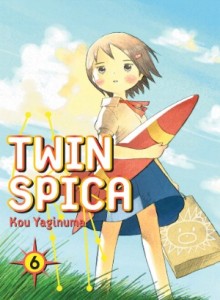
Twin Spica, Vols. 5-6

March 30, 2011 by Katherine Dacey 14 Comments

If you spend any time surfing the mangasphere, you don’t need me to tell you that Twin Spica is about a group of teenagers who are training to become Japan’s first astronauts. You probably know — or have heard from other readers — that it’s poignant. And you may have heard pundits declare it one of the best new series of 2010. (It made my best-of list.) Rather than re-hash plot points or tell you how awesome it is, therefore, I thought I’d share what I like best about Twin Spica: every volume makes me want to look up at the sky.

I’m not talking about the simple act of looking through a telescope or watching clouds drift in the wind — I’m talking about the way the act of looking at the sky makes me feel. Reflecting back on my childhood, that act elicited very specific emotions: the sky represented the future, a large canvas on which I could project my most cherished dreams of traveling to distant places, having adventures, and doing things that, from a six or eight-year-old’s perspective, seemed important. Kou Yaginuma clearly remembers that feeling from his own childhood, because his characters are at their most optimistic and thoughtful when they’re looking up at the sky and thinking about their own experiences.

There’s a lovely moment in volume six, for example, when Fuchuya’s grandfather tells six-year-old Asumi to cherish the memory of gazing up at the sky, as the sky will look different to her as she reaches adulthood. He explains:

You might as well spend your time looking up, at the sky. Me, I’ve spent decades staring up the sky in this town. I only thought the sky was very high when I was your age. When you’re old, it doesn’t seem quite that way. The sky you see as a kid is a lifelong treasure. I mean it. Value what you can see now, and only now.

Reading this passage reminds me of “Feldeinsamkeit” (“In Summerfields”), a beautiful piece of juvenilia from Charles Ives’ 114 Songs. The lyrics, taken from German poet Hermann Allmers, describe the experience of lying in a meadow on a summer’s afternoon and watching the sky. The sight of drifting clouds induces melancholy in his poem’s narrator, who — in typical nineteenth-century fashion — sees the clouds’ gentle, unfettered progress across the sky as a symbol of release from earthly burdens:

I’m resting quietly in tall green grass,
and cast my eyes far upwards;
around me crickets chirp unceasing,
the sky’s blue magically encloses me.

The beautiful white clouds float past
through the deep blue, like lovely silent dreams.
It is as if I had been long dead,
and flew in bliss with them through unending space.

Ives’ setting, by his own standards, is rather tame; there’s a running accompaniment figure that suggests fast-moving clouds, and a fleeting moment of bitonality, but it falls squarely within the nineteenth-century Stimmungslied tradition with its rounded binary form and gentle chromaticism. The song has an undeniably haunting quality, however. Its rapid modulation to harmonically distant key signatures and achingly sad melodic line suggest that the singer isn’t simply describing the act of watching clouds, as the lyrics alone might imply, but remembering what she was thinking and feeling as she did so.

That may sound like a minor distinction, but memory — or, more accurately, the act of remembering — is an important motif in the 114 Songs. “At the River,” for example, initially sounds like a straightforward rendition of “Shall We Gather At the River,” only to deviate from the melody as the singer “forgets” the proper tune, while “Memories” re-enacts a child’s enthusiasm at attending a concert. “In Summerfields” is less self-consciously modernist than either of these songs, but all three rely heavily on the illusion that the performer is reliving one of her own memories.

And that’s exactly the quality I find so compelling about Twin Spica: it’s a manga about living with vivid memories — some haunting, some happy — about reconciling past and present, about recognizing the value in both joy and pain, about negotiating the transition from youthful innocence to adulthood. In that scene with Fuchuya’s grandfather, we’re given a powerful reminder of just how much symbolic importance the sky holds for all of us, even if it doesn’t fill us with the same sense of wonder that it did when we were small.

Review copies provided by Vertical, Inc.

TWIN SPICA, VOLS. 5-6 • BY KOU YAGINUMA • VERTICAL, INC. • RATING: TEEN (13+)

Filed Under: Manga Critic Tagged With: Seinen, vertical

Twin Spica, Vols. 5-6

March 30, 2011 by Katherine Dacey

If you spend any time surfing the mangasphere, you don’t need me to tell you that Twin Spica is about a group of teenagers who are training to become Japan’s first astronauts. You probably know — or have heard from other readers — that it’s poignant. And you may have heard pundits declare it one of the best new series of 2010. (It made my best-of list.) Rather than re-hash plot points or tell you how awesome it is, therefore, I thought I’d share what I like best about Twin Spica: every volume makes me want to look up at the sky.

I’m not talking about the simple act of looking through a telescope or watching clouds drift in the wind — I’m talking about the way the act of looking at the sky makes me feel. Reflecting back on my childhood, that act elicited very specific emotions: the sky represented the future, a large canvas on which I could project my most cherished dreams of traveling to distant places, having adventures, and doing things that, from a six or eight-year-old’s perspective, seemed important. Kou Yaginuma clearly remembers that feeling from his own childhood, because his characters are at their most optimistic and thoughtful when they’re looking up at the sky and thinking about their own experiences.

There’s a lovely moment in volume six, for example, when Fuchuya’s grandfather tells six-year-old Asumi to cherish the memory of gazing up at the sky, as the sky will look different to her as she reaches adulthood. He explains:

You might as well spend your time looking up, at the sky. Me, I’ve spent decades staring up the sky in this town. I only thought the sky was very high when I was your age. When you’re old, it doesn’t seem quite that way. The sky you see as a kid is a lifelong treasure. I mean it. Value what you can see now, and only now.

Reading this passage reminds me of “Feldeinsamkeit” (“In Summerfields”), a beautiful piece of juvenilia from Charles Ives’ 114 Songs. The lyrics, taken from German poet Hermann Allmers, describe the experience of lying in a meadow on a summer’s afternoon and watching the sky. The sight of drifting clouds induces melancholy in his poem’s narrator, who — in typical nineteenth-century fashion — sees the clouds’ gentle, unfettered progress across the sky as a symbol of release from earthly burdens:

I’m resting quietly in tall green grass,
and cast my eyes far upwards;
around me crickets chirp unceasing,
the sky’s blue magically encloses me.

The beautiful white clouds float past
through the deep blue, like lovely silent dreams.
It is as if I had been long dead,
and flew in bliss with them through unending space.

Ives’ setting, by his own standards, is rather tame; there’s a running accompaniment figure that suggests fast-moving clouds, and a fleeting moment of bitonality, but it falls squarely within the nineteenth-century Stimmungslied tradition with its rounded binary form and gentle chromaticism. The song has an undeniably haunting quality, however. Its rapid modulation to harmonically distant key signatures and achingly sad melodic line suggest that the singer isn’t simply describing the act of watching clouds, as the lyrics alone might imply, but remembering what she was thinking and feeling as she did so.

That may sound like a minor distinction, but memory — or, more accurately, the act of remembering — is an important motif in the 114 Songs. “At the River,” for example, initially sounds like a straightforward rendition of “Shall We Gather At the River,” only to deviate from the melody as the singer “forgets” the proper tune, while “Memories” re-enacts a child’s enthusiasm at attending a concert. “In Summerfields” is less self-consciously modernist than either of these songs, but all three rely heavily on the illusion that the performer is reliving one of her own memories.

And that’s exactly the quality I find so compelling about Twin Spica: it’s a manga about living with vivid memories — some haunting, some happy — about reconciling past and present, about recognizing the value in both joy and pain, about negotiating the transition from youthful innocence to adulthood. In that scene with Fuchuya’s grandfather, we’re given a powerful reminder of just how much symbolic importance the sky holds for all of us, even if it doesn’t fill us with the same sense of wonder that it did when we were small.

Review copies provided by Vertical, Inc.

TWIN SPICA, VOLS. 5-6 • BY KOU YAGINUMA • VERTICAL, INC. • RATING: TEEN (13+)

Filed Under: Manga, Manga Critic, REVIEWS Tagged With: Seinen, vertical

3 Things Thursday: Vertical x Kodansha

February 24, 2011 by MJ 18 Comments

So, any of you following manga industry news have undoubtedly already heard about Kodansha’s new investment in Vertical, Inc., a story that broke last night, but has apparently been in the works for quite some time.

As a big fan of Vertical’s non-Kodansha licenses (Twin Spica, 7 Billion Needles, most of the company’s Tezuka releases) I was grateful to hear that the news would not impact their ability to continue with those licenses. Still, this seems like an appropriate time to reflect on some of the Vertical x Kodansha goodness we’ve already seen, either in print or in the works. Though my understanding is that some of these negotiations took place directly between Vertical and the series’ authors (or their representatives), the fact remains, we have both publishers to thank for their existence in print.

3 series brought to us by Vertical and Kodansha:

1. Chi’s Sweet Home | Konami Kanata – I’ve been a big fan of this sweet (and sometimes bittersweet) tale of human/cat cohabitation since Vertical’s release of its first volume, and those feelings have only grown warmer over time. Though the series is certainly appropriate for children, the advantage of it having been published in a magazine for adults definitely gives it an edge for a reader like me. Both genuinely funny and occasionally dark, there’s a lot more to Chi than meets the eye. And when what meets the eye is as cute as this… well, there’s really no way it can go wrong. Volume 5 is available now!

2. Princess Knight | Osamu Tezuka – Though this license was likely brought forth via Tezuka Productions, we have Kodansha to thank for all of its incarnations in print so far, from Shojo Club, to Nakayoshi, to the bilingual version that up until now (or soon, at least) was the series’ only English-language edition.

In the words of David Welsh, ” It sounds really delightful. It’s only three volumes long. It’s Tezuka. More Tezuka is always better.”

Agreed on all points.

3. The Drops of God | Tadashi Agi – Another one of David’s recently-fulfilled license requests, this manga has me hooked already simply by being about wine. Though I expect it might be hard on my pocketbook (all the wines in the series are real, and can be sought out and purchased by those willing to spend the dough), I honestly can’t wait to dig in.

Deb Aoki has been pushing for some time for this series to be licensed. “The Drops of God tries to capture the romance, the drama, the history, and the sensual joy of drinking wine, the fascinating people who make, sell and collect wine, and the diverse places where wine is grown, bottled and enjoyed all over the world.” Read more at About.com.


An honorable mention must go to Peepo Choo, which I featured in this column just a few weeks ago!

So, readers, what are your thoughts on what we might see now from Vertical and Kodansha?

Filed Under: 3 Things Thursday Tagged With: kodansha, vertical

7 Short Series Worth Adding to Your Manga Bookshelf

February 23, 2011 by Katherine Dacey 37 Comments

I like getting lost in a long, twisty story as much as the next person, but I often lose interest in a manga around the five- or ten-volume mark. As a service to other people afflicted with Manga ADHD, therefore, I’ve compiled a list of seven shorter series that enjoy pride of place on my shelves.

There were a few ground rules that guided my list-making. First, the series needed to be complete in five volumes or fewer. Second, every volume of the series needed to be readily available through a major retailer like Amazon. Third, the list needed to be diverse, covering a range of genres and demographics. Had I expanded the list to include out-of-print favorites — Antique Bakery, Apocalypse Meow, Club 9, Domu: A Child’s Dream, The Name of the Flower, Planetes — it would have been an unwieldy beast, and one sure to disappoint: why recommend a book that’s selling for $100 on eBay?

So without further ado… here are seven short series worth adding to your manga bookshelf.

A DISTANT NEIGHBORHOOD

JIRO TANIGUCHI • FANFARE/PONENT MON • 2 VOLUMES

A Distant Neighborhood is a wry, wistful take on a tried-and-true premise: a salaryman is transported back in time to his high school days, and must decide whether to act on his knowledge of the past or let events unfold as they did before. We’ve seen this story many times at the multiplex — Back to the Future, Peggy Sue Got Married — but Taniguchi doesn’t play the set-up for laughs; rather, he uses Hiroshi’s predicament to underscore the challenges of family life and the awkwardness of adolescence. (Hiroshi is the same chronological age as his parents, giving him special insight into the vicissitudes of marriage, as well as the confidence to cope with teenage tribulations.) Easily one of the most emotional, most intimate stories Taniguchi’s ever told. (A Distant Neighborhood was one of my picks for Best Manga of 2009; click here for the full list.)

ICHIGENME… THE FIRST CLASS IS CIVIL LAW

FUMI YOSHINAGA • DMP • 2 VOLUMES

One of the things that distinguishes Fumi Yoshinaga’s work from that of other yaoi artists is her love of dialogue. In works like Antique Bakery and Solfege, she reminds us that conversation can be an aphrodisiac, especially when two people are analyzing a favorite book or confessing a mutually-shared passion for art, cooking, or manga. True to form, the sexiest scenes in Ichigenme: The First Class Is Civil Law are conversations between law professors and their students. We feel the erotic charge of more experienced scholars engaging their proteges in intense debates over legal procedure and philosophy, even when the topics themselves are rather dry. Not that Yoshinaga skimps on the smut: there’s plenty of bedroom action as the carefree Tohdou helps his uptight, closeted classmate Tamiya explore his sexuality, but the series’ best moments are fully clothed. An entertaining manga that gets better with each reading. (Reviewed at PopCultureShock on 3/14/08.)

ODE TO KIRIHITO

OSAMU TEZUKA • VERTICAL, INC. • 2 VOLUMES

While investigating an outbreak of a mysterious disease, an earnest young doctor contracts it himself, becoming a hideous dog-man who craves raw meat. Kirihito’s search for the cause — and the cure — is the backbone of this globe-trotting adventure, but Kirihito’s quest to reclaim his humanity is its heart and soul; his travels bring him into contact with hustlers, racists, and superstitious villagers, each of whom greets him with a mixture of suspicion and fear. As its dog-man premise suggests, Ode to Kirihito is Tezuka at his bat-shit craziest: in one storyline, for example, Kirihito befriends a nymphomaniac circus performer who transforms herself into human tempura. But for all its over-the-top characters and plot developments (see “nympho human tempura,” above), Ode to Kirihito is one of Tezuka’s most moving stories, a thoughtful meditation on the the fluid boundaries between man and animal, sanity and insanity, good and evil. (Reviewed at The Manga Critic on 4/7/10.)

THE SECRET NOTES OF LADY KANOKO

RIRIKO TSUJITA • TOKYOPOP • 3 VOLUMES

Kanoko, the sardonic heroine of The Secret Notes of Lady Kanoko, is a student of human behavior, gleefully filling her notebooks with detailed observations about her classmates. Though Kanoko would like nothing more than to remain on the sidelines, she frequently becomes embroiled in her peers’ problems; they value her independent perspective, as Kanoko isn’t the least bit interested in dating, running for student council, or currying favor with the alpha clique. Kanoko’s sharp tongue and cool demeanor might make her the mean-girl villain in another shojo manga, but Ririko Tsujita embraces her heroine’s prickly, opinionated nature and makes it fundamental to Kanoko’s appeal. The perfect antidote to shojo stories about timid good girls and boy-crazy spazzes. UPDATE 4/16/11: TOKYOPOP announced that it would be shutting down its US publishing operations on May 31, 2011. Unfortunately, that means that Lady Kanoko will likely remain incomplete at two volumes. The stories are largely self-contained, so it is still possible to enjoy Lady Kanoko without reading the last volume.

7 BILLION NEEDLES

NOBUAKI TADANO • VERTICAL, INC. • 4 VOLUMES

Nobuaki Tadano gives Hal Clement’s Needle a manga makeover, moving the action from a remote island in the South Seas to Japan, and replacing Clement’s wholesome, Hardy Boy protagonist with a sullen teenage girl who’s none too pleased to discover that an alien bounty hunter has taken control of her body. The decision to make Hikaru a troubled loner with a difficult past is a stroke of genius; her social isolation proves almost as formidable an obstacle for her to overcome as the monster that she and Horizon (as the bounty hunter is known) are pursuing. Her personal struggles also add a level of raw, emotional authenticity to the story — something that was largely absent from the fascinating, though clinically detached, original. Oh, and the monster? It’s a doozy. (7 Billion Needles was one of my picks for Best Teen-Friendly Comic of 2010; see Good Comics for Kids for the full list. Volumes one and two were reviewed at The Manga Critic on 11/21/10; volume three was reviewed on 2/17/11. The fourth and final volume will arrive in stores on April 26, 2011.)

TO TERRA

KEIKO TAKEMIYA • VERTICAL, INC. • 3 VOLUMES

If Richard Wagner wrote space operas, he might have composed something like Keiko Takemiya’s To Terra, an inter-generational drama about a race of telepathic mutants who’ve been exiled from their home world. Under the leadership of the charismatic Jomy Marcus Shin, the Mu embark on a grueling voyage back to Terra to be reunited with their human creators. Their principle foe: an evil supercomputer named Mother. Takemiya’s richly detailed artwork makes To Terra an almost cinematic experience, suggestive of 2001: A Space Odyssey and Star Wars. But don’t be fooled by those blinking computers and blazing starships: To Terra is an unabashedly Romantic saga about two ubermensch locked in a struggle of cosmic proportions. No doubt Richard would approve. (To Terra was one of my picks for Best Manga of 2007; read the full list at PopCultureShock. For more information on To Terra‘s history, click here.)

TOTO! THE WONDERFUL ADVENTURE

YUKO OSADA • DEL REY • 5 VOLUMES

Shonen series often run to 10, 20, or 40 volumes, but Toto! The Wonderful Adventure proves that good stories come in shorter packages, too. Yuko Osada brazenly steals ideas from dozens of other sources — Castle in the Sky, One Piece, Last Exile, The Wizard of Oz — to produce a boisterous, fast-paced story about a tyro explorer who crosses paths with sky pirates, military warlords, and a high-kicking senjutsu expert named Dorothy. Though the jokes are hit-or-miss, Toto! boasts crisp artwork, strong female characters, and an infectious sense of bonhomie among the series’ protagonists; Kakashi and his traveling companions are impossible to dislike. (Reviewed at The Manga Critic on 9/16/10.)

HONORABLE MENTIONS

CAT-EYED BOY (Kazuo Umezu • VIZ • 2 volumes): Readers looking for an introduction to Kazuo Umezu’s work could do a lot worse than this two-volume collection of stories about a strange little boy who’s half-human, half-demon. Umezu gives free reign to his imagination, conjuring some of the most bizarre monsters in the J-horror canon. The results aren’t always as shocking as they might be, but Cat-Eyed Boy is by turns funny, scary, and sad. (Reviewed at The Manga Critic on 10/3/10.)

LADY SNOWBLOOD (Kazuo Koike and Kazuo Kimimura • Dark Horse • 4 volumes): Now that everyone’s forgotten Kill Bill, the epic mess “inspired” by Kazuo Koike’s Lady Snowblood, it’s possible to read this series for what it is: a deliciously trashy story about a beautiful assassin who manipulates, cajoles, seduces, and stabs her way through Meiji-era Japan. Expect copious nudity, buckets of blood, and fight scenes so outrageous they have to be seen to be believed.

ONE POUND GOSPEL (Rumiko Takahashi • VIZ • 4 volumes): In this charming sports comedy, a struggling boxer is torn between his love for food and his love for a pretty young nun who wants him to lay down his fork, lose some weight, and win a few matches. The series is a little episodic (Takahashi published new chapters sporadically), but the dialogue and slapstick humor have a characteristically Takahashian zing.

For additional suggestions, see:

  • 5 Underrated Shojo Manga, which includes Setona Mizushiro’s X-Day;
  • My 10 Favorite CMX Titles, which includes such short series as Astral Project, Chikyu Misaki, Kiichi and the Magic Books, The Name of the Flower, and Presents. Note that many of these series are out of print and may be hard to find through retailers like Amazon;
  • My 10 Favorite Spooky Manga, which includes such short series as Dororo, Gyo, Mail, and School Zone.

Filed Under: Manga Critic Tagged With: Dark Horse, del rey, DMP, fumi yoshinaga, Historical Drama, Horror/Supernatural, Kazuo Koike, Kazuo Umezu, Keiko Takemiya, Osamu Tezuka, Romance/Romantic Comedy, Rumiko Takahashi, Sci-Fi, Seinen, shojo, Shonen, Tokyopop, vertical, VIZ, Yaoi

Chi’s Sweet Home 4 by Konami Kanata: B+

December 28, 2010 by Michelle Smith

From the back cover:
Welcome to the neighborhood, Chi and family! Now in her new residence, Chi will be introduced to many friends of the furry and feathery kind. With so many fresh smells to investigate, endless adventures await. So settle in, because here pets will never be chased… unless they are chasing each other.

Review:
Chi’s Sweet Home is one of those series that goes to the top of the to-read pile whenever a new volume is released. It’s always a true pleasure to read, with colorful cuteness guaranteed on every page.

This volume focuses mostly on the Yamada family’s move to a new, pet-friendly apartment complex and Chi’s reactions to her new environment. I love that so much time is devoted to her acclimation, and how familiar smells gradually embolden her enough to rub herself all over all the new stuff and proclaim it to be hers, too. She also meets a few animals at the new place, though more of her interactions so far have been with a gregarious (but well-trained) dog named David than with snooty long-haired kitty, Alice.

As usual, mangaka Konami Kanata perfectly captures several moments that ought to be familiar to cat owners: the pitiful mewling and pawing at a door that separates the kitty from its people, the inability to fathom what a scratching post is for, and the perils of claw trimming. In fact, I think this last was actually understated; I’ve had cats practically all my life and I still feel unqualified to attempt this task!

It’s not all cuteness, though. Chi’s Sweet Home has occasionally had some bittersweet moments—early volumes contrasted Chi’s cozy new home to her fading memories of her mother and siblings—and this volume is no exception. It’s sad to see how much confusion human-induced change causes to poor Chi and how baffled she is by her friend Blackie’s abrupt departure. I don’t know whether to hope and/or expect that a reunion will be forthcoming or to admire this slightly darker streak in the story.

We’re getting close to being caught up with the series in Japan. The fifth volume is due in February and then, after being spoiled on a bimonthly release schedule, we will suddenly be called upon to wait much longer for our Chi fix. I guess we could always turn to Crunchyroll for solace.

Review copy provided by the publisher.

Filed Under: REVIEWS Tagged With: vertical

Ayako

December 17, 2010 by Katherine Dacey

Ayako is an odd beast. Structurally, it resembles a Russian realist novel, using a once-powerful family of landowners to embody the political and economic upheaval caused by America’s seven-year occupation of Japan (1945-52). Temperamentally, however, Ayako feels more like a John Frankenheimer movie, with subplots involving a Communist organizer, an assassin who stashes orders in his empty eye socket, and a witness whose family condemns her to lifelong imprisonment in an underground cell. Though Tezuka makes a game effort to reconcile his literary and cinematic influences, the results are uneven: Ayako is powerful, disturbing, and, at times, flat-out ludicrous, yet it lacks the winking self-awareness of MW or the profound humanism of Ode to Kirihito, instead offering an engrossing but not entirely persuasive portrait of a family torn apart by the emergence of a new social order in post-war Japan.

Ayako revolves around the Tenge clan. The patriarch, Sakuemon, is a glutton and a bully, indulging his voracious appetites for food and sex while aggressively policing his family’s behavior. His sons aren’t much better: Ichiro, the eldest, is a manipulative coward who barters his wife for Sakuemon’s loyalty; Jiro, the middle son, is a disgraced war veteran who’s been coerced into spying for the US military; and Shiro, the youngest, is a fierce truth-teller who is slowly corrupted by his family’s secrets.

Two events threaten the Tenge’s equilibrium. The first — a murder — condemns the youngest family member to a dungeon, lest Ayako reveal a key piece of evidence linking a clan member to a murdered political dissident. Though the Tenge women are appalled by the plan, they’re powerless to help; the rest of the family views Ayako as a threat, as she’s both Sakuemon’s daughter and Ichiro, Jiro, and Shiro’s half-sister. The second — a decree from the government — forces the Tenge clan to redistribute their land among tenant farmers. Despite Ichiro’s vigorous protests, the government arrives on the property, intent on razing the structure that has kept Ayako out of public view for more than a decade.

Though the characters’ behavior is more extreme than anything found in Tolstoy or Sholokhov — unless I missed the incest in The Don Flows Home to the Sea — the spirit of Russian realism informs Ayako. Tezuka had already been to the Russian realist well before, loosely adapting Fyodor Dostoevsky’s Crime and Punishment in 1953. He wasn’t alone in taking inspiration from Russian literature; other Japanese artists — most notably Akira Kurosawa — adapted Dostoevsky and Maxim Gorky’s work, too, transplanting the settings from Russia to Japan. (Kurosawa’s Red Beard, borrows liberally from Dosteoveksy’s 1861 novel Humiliated and Insulted; The Idiot and The Lower Depths follow the original source material more faithfully.) It’s not hard to imagine what made these Russian authors so attractive to Japanese artists of the 1950s, 1960s, and 1970s: the realists’ work was both grand and intimate, using sympathetic characters to dramatize the toll — physical, economic, and psychological — of social unrest and change.

Of course, the realist approach has a potential pitfall: characters can feel contrived, lacking an identity outside the cause they represent. Ichiro and Jiro, the eldest brothers in Ayako, both have obvious symbolic intent: Ichiro represents the last vestiges of feudal Japan, a landlord in danger of losing his fields, his farmers, and his source of power, while Jiro embodies the complicated relationship between the Japanese and their American overlords, caught between the Japanese desire to restore normalcy and the American desire to refashion Japanese society in its own image. For all their symbolic baggage, Ichiro and Jiro still register as fundamentally human: they’re flawed, inconsistent, and corrupted by what little power they have, yet both are strongly driven to pursue what they believe to be in their best interests.

Ayako, however, is more a receptacle for other characters’ anger and lust than a true individual. She’s an innocent victim who endures over a decade of isolation, emotional neglect, and sexual abuse at Shiro’s hands, emerging from her ordeal with no real beliefs or desires of her own. Her lack of individuality makes her the most transparently symbolic member of the Tenge clan; it’s not much of a stretch to interpret her character as a representation of occupied Japan. That symbolism is underscored by one of the book’s most arresting sequences. In it, we see Ayako writhe and shed her skin like a molting insect, casting aside her girl’s body for a woman’s. The images are stark: Ayako is rendered in white lines on a jet-black background, and her ecstatic expression suggests an erotic awakening — a metaphorical re-enactment of lost innocence during a period of confinement and darkness.

The symbolic intent of Tezuka’s characters is more apparent in Ayako than in some of Tezuka’s other mature works, I think, because Ayako is more  self-consciously literary than MW or Ode to Kirihito. The absence of humor or cartoonishly evil characters — two staples of MW and Kirihito — cuts both ways. On the one hand, Ayako is sobering and adult; we can appreciate the gravity of the characters’ actions because Tezuka doesn’t punctuate serious moments with low comedy; there’s no reprieve from our discomfort with the characters’ behavior, no mustache-twirling villains on whom to pin our disgust. On the other hand, Tezuka has a natural instinct for blending high and low, using pulp genres as vehicles for exploring big questions about human nature. The heightened reality of the stories is fundamental to their success; Tezuka uses his character’s extreme behavior and dramatic physical transformations to tear away masks, to lay bare real hypocrisy, selfishness, and cowardice. That pulpy spirit asserts itself from time to time in Ayako (see “spy who stashes orders in his eye socket,” above), but there isn’t quite enough of it; the thriller elements feel tacked on, rather than fundamental to elucidating Tezuka’s central themes.

Yet Ayako is compelling, in spite of its flaws. It’s a fierce, angry work, at once intensely critical of American efforts to re-engineer Japanese society, and intensely critical of the old Japanese social order, portraying the Tenges as feudal overlords out of step with the modern world. It isn’t Tezuka’s best work, but it’s one of his most ambitious, a sincere and emotionally wrenching attempt to show the lingering effects of World War II on the Japanese psyche. Recommended.

Review copy provided by Vertical, Inc.

AYAKO • BY OSAMU TEZUKA • VERTICAL, INC. • 704 pp. • RATING: OLDER TEEN (16+)

Filed Under: Manga, Manga Critic, REVIEWS Tagged With: Classic, Osamu Tezuka, Seinen, vertical

Ayako

December 17, 2010 by Katherine Dacey 12 Comments

Ayako is an odd beast. Structurally, it resembles a Russian realist novel, using a once-powerful family of landowners to embody the political and economic upheaval caused by America’s seven-year occupation of Japan (1945-52). Temperamentally, however, Ayako feels more like a John Frankenheimer movie, with subplots involving a Communist organizer, an assassin who stashes orders in his empty eye socket, and a witness whose family condemns her to lifelong imprisonment in an underground cell. Though Tezuka makes a game effort to reconcile his literary and cinematic influences, the results are uneven: Ayako is powerful, disturbing, and, at times, flat-out ludicrous, yet it lacks the winking self-awareness of MW or the profound humanism of Ode to Kirihito, instead offering an engrossing but not entirely persuasive portrait of a family torn apart by the emergence of a new social order in post-war Japan.

Ayako revolves around the Tenge clan. The patriarch, Sakuemon, is a glutton and a bully, indulging his voracious appetites for food and sex while aggressively policing his family’s behavior. His sons aren’t much better: Ichiro, the eldest, is a manipulative coward who barters his wife for Sakuemon’s loyalty; Jiro, the middle son, is a disgraced war veteran who’s been coerced into spying for the US military; and Shiro, the youngest, is a fierce truth-teller who is slowly corrupted by his family’s secrets.

Two events threaten the Tenge’s equilibrium. The first — a murder — condemns the youngest family member to a dungeon, lest Ayako reveal a key piece of evidence linking a clan member to a murdered political dissident. Though the Tenge women are appalled by the plan, they’re powerless to help; the rest of the family views Ayako as a threat, as she’s both Sakuemon’s daughter and Ichiro, Jiro, and Shiro’s half-sister. The second — a decree from the government — forces the Tenge clan to redistribute their land among tenant farmers. Despite Ichiro’s vigorous protests, the government arrives on the property, intent on razing the structure that has kept Ayako out of public view for more than a decade.

Though the characters’ behavior is more extreme than anything found in Tolstoy or Sholokhov — unless I missed the incest in The Don Flows Home to the Sea — the spirit of Russian realism informs Ayako. Tezuka had already been to the Russian realist well before, loosely adapting Fyodor Dostoevsky’s Crime and Punishment in 1953. He wasn’t alone in taking inspiration from Russian literature; other Japanese artists — most notably Akira Kurosawa — adapted Dostoevsky and Maxim Gorky’s work, too, transplanting the settings from Russia to Japan. (Kurosawa’s Red Beard, borrows liberally from Dosteoveksy’s 1861 novel Humiliated and Insulted; The Idiot and The Lower Depths follow the original source material more faithfully.) It’s not hard to imagine what made these Russian authors so attractive to Japanese artists of the 1950s, 1960s, and 1970s: the realists’ work was both grand and intimate, using sympathetic characters to dramatize the toll — physical, economic, and psychological — of social unrest and change.

Of course, the realist approach has a potential pitfall: characters can feel contrived, lacking an identity outside the cause they represent. Ichiro and Jiro, the eldest brothers in Ayako, both have obvious symbolic intent: Ichiro represents the last vestiges of feudal Japan, a landlord in danger of losing his fields, his farmers, and his source of power, while Jiro embodies the complicated relationship between the Japanese and their American overlords, caught between the Japanese desire to restore normalcy and the American desire to refashion Japanese society in its own image. For all their symbolic baggage, Ichiro and Jiro still register as fundamentally human: they’re flawed, inconsistent, and corrupted by what little power they have, yet both are strongly driven to pursue what they believe to be in their best interests.

Ayako, however, is more a receptacle for other characters’ anger and lust than a true individual. She’s an innocent victim who endures over a decade of isolation, emotional neglect, and sexual abuse at Shiro’s hands, emerging from her ordeal with no real beliefs or desires of her own. Her lack of individuality makes her the most transparently symbolic member of the Tenge clan; it’s not much of a stretch to interpret her character as a representation of occupied Japan. That symbolism is underscored by one of the book’s most arresting sequences. In it, we see Ayako writhe and shed her skin like a molting insect, casting aside her girl’s body for a woman’s. The images are stark: Ayako is rendered in white lines on a jet-black background, and her ecstatic expression suggests an erotic awakening — a metaphorical re-enactment of lost innocence during a period of confinement and darkness.

The symbolic intent of Tezuka’s characters is more apparent in Ayako than in some of Tezuka’s other mature works, I think, because Ayako is more  self-consciously literary than MW or Ode to Kirihito. The absence of humor or cartoonishly evil characters — two staples of MW and Kirihito — cuts both ways. On the one hand, Ayako is sobering and adult; we can appreciate the gravity of the characters’ actions because Tezuka doesn’t punctuate serious moments with low comedy; there’s no reprieve from our discomfort with the characters’ behavior, no mustache-twirling villains on whom to pin our disgust. On the other hand, Tezuka has a natural instinct for blending high and low, using pulp genres as vehicles for exploring big questions about human nature. The heightened reality of the stories is fundamental to their success; Tezuka uses his character’s extreme behavior and dramatic physical transformations to tear away masks, to lay bare real hypocrisy, selfishness, and cowardice. That pulpy spirit asserts itself from time to time in Ayako (see “spy who stashes orders in his eye socket,” above), but there isn’t quite enough of it; the thriller elements feel tacked on, rather than fundamental to elucidating Tezuka’s central themes.

Yet Ayako is compelling, in spite of its flaws. It’s a fierce, angry work, at once intensely critical of American efforts to re-engineer Japanese society, and intensely critical of the old Japanese social order, portraying the Tenges as feudal overlords out of step with the modern world. It isn’t Tezuka’s best work, but it’s one of his most ambitious, a sincere and emotionally wrenching attempt to show the lingering effects of World War II on the Japanese psyche. Recommended.

Review copy provided by Vertical, Inc.

AYAKO • BY OSAMU TEZUKA • VERTICAL, INC. • 704 pp. • RATING: OLDER TEEN (16+)

Filed Under: Manga Critic Tagged With: Classic, Osamu Tezuka, Seinen, vertical

Black Jack, Vols. 1-2

December 15, 2010 by Katherine Dacey

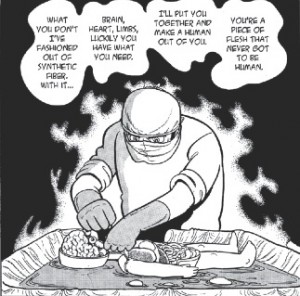
Black Jack practices a different kind of medicine than the earnest physicians on Grey’s Anatomy or ER, taking cases that push the boundary between science and science fiction. In the first two volumes of Black Jack alone, the good doctor tests his surgical mettle by:

  • Performing a brain transplant
  • Separating conjoined twins
  • Operating on a killer whale
  • Operating blind
  • Operating on a man who’s been hit by a bullet train
  • Operating on twelve patients at once… without being sued for medical malpractice.

Osamu Tezuka’s own medical training is evident in the detailed drawings of muscle tissue, livers, hearts, and brains. Yet these images are beautifully integrated into his broad, cartoonish vocabulary, making the surgical scenes pulse with life. These procedures get an additional jolt of energy from the way Tezuka stages them; he brings the same theatricality to the operating room that John Woo does to shoot-outs and hostage crises, with crazy camera angles and unexpected complications that demand split-second decision-making from the hero.

At the same time, however, a more adult sensibility tempers the bravado displays of surgical acumen. Black Jack’s medical interventions cure his patients but seldom yield happy endings. In “The Face Sore,” for example, a man seeks treatment for a condition that contorts his face into a grotesque mask of boils. Jack eventually restores the man’s appearance, only to realize that the organism causing the deformation had a symbiotic relationship with its host; once removed, the host proves even more hideous than his initial appearance suggested. “The Painting Is Dead!” offers a similarly bitter twist, as Jack prolongs a dying artist’s life by transplanting his brain into a healthy man’s body. The artist longs to paint one final work — hence the request for a transplant — but finds himself incapable of realizing his vision until radiation sickness begins corrupting his new body just as it did his old one. Jack may profess to be indifferent to both patients’ suffering, insisting he’s only in it for the money, but that bluster conceals a painful truth: Jack knows all too well that he can’t heal the heart or mind.

The only thing that dampened my enthusiasm for Black Jack was the outdated sexual politics. In “Confluence,” for example, a beautiful young medical student is diagnosed with uterine cancer. Tezuka diagrams her reproductive tract, explaining each organ’s function and describing what will happen to this luckless gal if they’re removed:

As you know, the uterus and ovaries secrete crucial hormones that define a woman’s sex. To have them removed is to quit being a woman. You won’t be able to bear children, of course, and you’ll become unfeminine.

Too bad Tezuka never practiced gynecology; he might have gotten an earful (and a black eye or two) from some of his “unfeminine” patients.

I also found the dynamic between Jack and his sidekick Pinoko, a short, slightly deformed child-woman, similarly troubling. Though Pinoko has the will and libido of an adult, she behaves like a toddler, pouting, wetting herself, running away, and lisping in a babyish voice. She’s mean-spirited and possessive, behaving like a jealous lover whenever Jack mentions other women, even those who are clearly seeking his medical services. These scenes are played for laughs, but have a creepy undercurrent; it’s hard to know if Pinoko is supposed to be a caricature of a housewife or just a vaguely incestuous flourish in an already over-the-top story. Thankfully, these Pygmalion-and-Galatea moments are few and far between, making it easy to bypass them altogether. Don’t skip the story in which Jack first creates Pinoko from a teratoid cystoma, however; it’s actually quite moving, and at odds with the grotesque domestic comedy that follows.

If you’ve never read anything by Tezuka, Black Jack is a great place to begin exploring his work. Tezuka is at his most efficient in this series, distilling novel-length dramas into gripping twenty-page stories. Though Tezuka is often criticized for being too “cartoonish,” his flare for caricature is essential to Black Jack; Tezuka conveys volumes about a character’s past or temperament in a few broad strokes: a low-slung jaw, a furrowed brow, a big belly. That visual economy helps him achieve the right balance between medical shop-talk and kitchen-sink drama without getting bogged down in expository dialogue. The result is a taut, entertaining collection of stories that offer the same mixture of pathos and medical mystery as a typical episode of House, minus the snark and commercials. Highly recommended.

This is a synthesis of two reviews that originally appeared at PopCultureShock on 10/26/2008 and 11/4/08. I’ve also reviewed volumes five and eleven here at The Manga Critic.

BLACK JACK, VOLS. 1-2 • BY OSAMU TEZUKA • VERTICAL, INC.

Filed Under: Manga, Manga Critic, REVIEWS Tagged With: Classic, Medical, Osamu Tezuka, vertical

  • « Go to Previous Page
  • Page 1
  • Interim pages omitted …
  • Page 3
  • Page 4
  • Page 5
  • Page 6
  • Page 7
  • Go to Next Page »
 | Log in
Copyright © 2010 Manga Bookshelf | Powered by WordPress & the Genesis Framework