• Skip to primary navigation
  • Skip to main content
  • Skip to primary sidebar
  • Home
  • About Us
    • Privacy Policy
    • Comment Policy
    • Disclosures & Disclaimers
  • Resources
    • Links, Essays & Articles
    • Fandomology!
    • CLAMP Directory
    • BlogRoll
  • Features & Columns
    • 3 Things Thursday
    • Adventures in the Key of Shoujo
    • Bit & Blips (game reviews)
    • BL BOOKRACK
    • Bookshelf Briefs
    • Bringing the Drama
    • Comic Conversion
    • Fanservice Friday
    • Going Digital
    • It Came From the Sinosphere
    • License This!
    • Magazine no Mori
    • My Week in Manga
    • OFF THE SHELF
    • Not By Manga Alone
    • PICK OF THE WEEK
    • Subtitles & Sensibility
    • Weekly Shonen Jump Recaps
  • Manga Moveable Feast
    • MMF Full Archive
    • Yun Kouga
    • CLAMP
    • Shojo Beat
    • Osamu Tezuka
    • Sailor Moon
    • Fruits Basket
    • Takehiko Inoue
    • Wild Adapter
    • One Piece
    • After School Nightmare
    • Karakuri Odette
    • Paradise Kiss
    • The Color Trilogy
    • To Terra…
    • Sexy Voice & Robo
  • Browse by Author
    • Sean Gaffney
    • Anna Neatrour
    • Michelle Smith
    • Katherine Dacey
    • MJ
    • Brigid Alverson
    • Travis Anderson
    • Phillip Anthony
    • Derek Bown
    • Jaci Dahlvang
    • Angela Eastman
    • Erica Friedman
    • Sara K.
    • Megan Purdy
    • Emily Snodgrass
    • Nancy Thistlethwaite
    • Eva Volin
    • David Welsh
  • MB Blogs
    • A Case Suitable For Treatment
    • Experiments in Manga
    • MangaBlog
    • The Manga Critic
    • Manga Report
    • Soliloquy in Blue
    • Manga Curmudgeon (archive)

Manga Bookshelf

Discussion, Resources, Roundtables, & Reviews

Reviews

Adachi and Shimamura, Vol. 9

May 26, 2022 by Sean Gaffney

By Hitoma Iruma and Non. Released in Japan by Dengeki Bunko. Released in North America by Seven Seas. Translated by Molly Lee.

The self-improvement of Shimamura continues in this volume, following up from the last one. We see Shimamura reflecting on her past self and her tendency to deliberately forget about everyone around her, o the point where it’s an active choice. But now she has Adachi in her life and as her girlfriend. The trouble is, as Adachi points out to her here, she’s very hard to read. Shimamura tends to have one mode, which is “whatever”, and when you are a stressed and insecure young lesbian like Adachi, that just makes you think that the relationship is entirely one-sided. And credit to Shimamura, she really tries hard here, even using the word love to show Adachi how serious she is. Admittedly their relationship has not really progressed beyond holding hands, but given the two participants and their emotional ages that’s not only unsurprising but likely a good thing. I hope future books will show us Adachi’s self-improvement as well. As for Yashiro… she is perpetually the same.

After Shimamura tells a curious Yashiro about her junior high years of rebellion (which consisted of skipping class and not much else), we get the meat of the first half of the book, which is telling us a bit about Hino and Nagafuji’s childhood. This comes up because Hino’s father, who is not the best at communicating, tells her she isn’t important to the family legacy. Hino, who is thirteen in this flashback, does not really take this well (though, as is fairly typical with this author’s works, a lot of the emotional turmoil is left for the reader to fill in themselves) and decides to run away from home. After getting permission. And also taking her maid. And Nagafuji. The second half of the book is Christmas, and shows us an adorable date between our lead couple, Adachi breaking out the Chinese-style dress again, and Christmas dinner at the Shimamuras with a surprise guest, which may carry over into the next book.

This is the final volume with illustrations by Non, who I believe had been ill, and the illustrations are mostly ones used from other promotional materials – there are no interior ones. Which is a shame, but also allows us to see the pasts of most of the main cast without having to see them attempted as “3 years younger”. The Hino and Nagafuji stuff was good, though Hino’s narration works far better (and is far longer) than Nagafuji’s. It’s also implied that her parents have a marriage of convenience and that her mother and head maid are childhood friends with benefits. It’s heavily implied this is what Hino could have with Nagafuji too, though the idea of Nagafuji as a maid is horrifying. The other interesting part of the book is the relationship between the two moms. Mrs. Adachi reads very much like her daughter only cynical and bitter, and Shimamura likewise has her daughter’s “well, whatever” mood only extroverted to the nth degree. It’s kind of fun.

This wasn’t terrific, but is at least solid, even if it read a bit like a short story collection at times. The best parts were Shimamura’s forwardness. We’ll see if she can keep that up.

Filed Under: adachi and shimamura, REVIEWS

Two by Caroline B. Cooney

May 25, 2022 by Michelle Smith

cooney1The Face on the Milk Carton
The Face on the Milk Carton was first published in 1990, but though I actually was a young adult at the time, I was unaware of its existence. The basic plot is that lactose-intolerant Janie Johnson rebels one day at lunch and has some milk, only to see her own face on the carton alongside the name “Jennie Spring” and a 1-800 number for missing children. She begins to remember things about her past, but is racked by indecision because her parents are so lovely. Could they possibly be capable of such a thing? And what does it say about her that she was lured away willingly with the promise of an ice cream sundae?

It’s interesting to compare the way this book is written to how it would be today; a modern version would probably be in the first person, for example, and would not contain fifteen-year-olds who believe that “dumbbell” is an age-appropriate insult. Possibly it would involve genuine peril. In comparison, Face comes across as a bit chaste, though there are allusions to how far Janie and her boyfriend have gone in their making out. Perhaps “mild” would be a better word for it.

There are some things I liked and didn’t like about the book. As if there were no other way to solve Janie’s dilemma, we get an extremely contrived solution in which she a) puts an account of her abduction down on paper and b) slips it into an envelope onto which she has previously typed her actual return address and c) decides to address it to her birth family though she intends to take it home and put it in the attic and d) promptly loses it and must assume that a good Samaritan will affix a stamp and send it for her. Eyeroll. I did like that Janie’s boyfriend showed his true (and shitty) colors by getting all huffy that her inconvenient kidnapping trauma was cutting into the attention/action he was getting. Alas, though her “drop dead!” reaction was satisfying, she was soon feeling bad about it. Eyeroll again.

Still, despite my complaints, I did think it was a pretty enjoyable (and quick!) read, and I’m interested to see what happens next.

cooney2Whatever Happened to Janie?
While the first book in this series had some suspense to it, Whatever Happened to Janie? is 100% family drama. Because the family that raised her, the Johnsons, has no legal claim to her, Janie is returned to the Spring family after an absence of almost twelve years. The book is primarily about her struggles to adjust to different parents, four siblings, and a life less affluent and cultured than the one she left behind.
Janie feels intensely loyal to the Johnsons, and thus doesn’t try as hard as she might to get along with the Springs. Indeed, she is frequently hurtful to them on purpose. We do get the points of view of her two older siblings, which I appreciated, as they show that the Springs are truly a very nice family that simply had unrealistic expectations about what would happen when Janie came home. Surprise! She’s still as much of a brat as she was when she was three.

There were some subtle moments I enjoyed when she did start to think of the Springs are her real family, but just as she makes real progress, she decides she’s going back to the Johnsons. The Springs consent to this, and everyone plans to continue visiting and corresponding, but it still strikes me as a weird arrangement. Is she going to live the rest of her life as Janie Johnson, then? Will she get her name changed legally? What kind of documentation did the Johnsons provide to enroll her in school in the first place, come to think of it?

Anyway, I’m thinking about it too much.

After this, I did plan to continue on to the next installment in the series, The Voice on the Radio. I checked it out from the library more than once, but just could not summon any enthusiasm for a book about Janie’s shitty attention-seeking boyfriend, Reeve, getting a job at his college radio station and blabbing all of the painful details about Janie’s experience to his listeners.

Filed Under: Books, REVIEWS, Suspense, YA Tagged With: Caroline B. Cooney

Suppose a Kid from the Last Dungeon Boonies Moved to a Starter Town, Vol. 9

May 25, 2022 by Sean Gaffney

By Toshio Satou and Nao Watanuki. Released in Japan as “Tatoeba Last Dungeon Mae no Mura no Shonen ga Joban no Machi de Kurasu Youna Monogatari” by GA Bunko. Released in North America by Yen On. Translated by Andrew Cunningham.

Last time I mentioned that the series had an actual plot in among all the comedy, and we still see some of that here as well. But its never going to get in the way of the comedy itself, and honestly is likely never going to be the main part of the book unless the series finally comes to an end. As for the actual plot of this book… why, it’s a school festival with a maid cafe, of course. Honestly, I feel that a lot of these books can be summed up by the author flicking through TV channels, landing on some random anime, going “A ha, that’s it!” and moving back to the computer. The fact that the book even tries to justify it only makes it funnier. Add to this a master thief who has reckoned without our dumbass heroes and a king who can’t convince anyone he’s been kidnapped, and there’s no worries on the laugh front.

So yes, a maid cafe. Well, theoretically a maid/butler cafe, but the butler uniforms are stolen for no real reason other than to stick Lloyd and Allan in maid outfits. The idea is mostly Riho’s, thinking she can get some cash for once (which is true, but don’t expect it to stick). The king, meanwhile, wants to put out a huge statue that supposedly grants good fortune to couples who stand next to it. There’s just one problem: the statue’s creator really really does not want it to be shown off, and will happily steal the whole thing to prevent that happening. Oh yes, and there’s a master thief around, though whether he is connected to the missing statue is neither here nor there. What this all amounts to is a lot of school festival schtick and a lot of Lloyd going on not-dates with his two most aggressive girls.

In the two volumes before this, we saw Lloyd get actual character development that stuck, as he has started to realize, if not that he is stronger than everyone else in the world, art least that he IS strong. What’s more, he’s finally showing off that strength in front of people who are NOT the main cast, which means that credit for saving the day, for once, does not go to Allan. Who, frankly, has enough to deal with, given his wife ends up returning and working for the military. Lloyd, meanwhile, is starting to think about his future, not realizing that everyone else already has it planned out for him: military PR, military intelligence, military security, or hell, just marry into royalty. (Marie’s not in the book much at all, but still tends to be top girl by default whenever she’s around, and at least the King now knows who she’s crushing on.)

This is deeply sill, but in a good way, and I look forward to the plot of the next book, which will no doubt be inspired by a refrigerator magnet the author saw the other day.

Filed Under: REVIEWS, suppose a kid from the last dungeon boonies moved to a starter town

Baccano!: 1935-B Dr. Feelgreed

May 24, 2022 by Sean Gaffney

By Ryohgo Narita and Katsumi Enami. Released in Japan by Dengeki Bunko. Released in North America by Yen On. Translated by Taylor Engel.

One of the main themes in Baccano!, and indeed in most of Narita’s work, is that everyone is connected to everyone else, and the connections can be closer than we think. The 1935 arc seems to be this writ large, as we get a lot of reunions of various characters and other characters thinking “wait, they know each other?”. Even the new connections are things I would not have expected. Melvi may have hired Claire to be his bodyguard, but it’s clear there’s no love lost between the two. After meeting Chane’s father last volume, Claire ends up meeting her mother in this book, though I’m not sure that meeting will go quite as well, given Renee is broken and also evil. Mostly, though, these two books take one of the most minor villains from the earliest parts of the series, gives him a backstory and real character development, and then pairs him off with the closest the series has to an innocent sweetie pie. The connections are startling, but they work.

If you thought we were going to get a lot of casino shenanigans in this book, I’m sorry to say we’re still in the ‘set up the dominoes’ part. Melvi is making his presence known everywhere, and no one likes him, including the reader. (Then again, Baccano! fans do love the bad guys…) He’s clearly not got the Runorata Family’s agenda in mind so much as his own, and his own agenda definitely involves making Firo miserable. Meanwhile, in the doctor’s clinic (which is staffed by, among others, Fermet, who I would not trust to give me a sugar pill), the other half of the cast gathers together. This includes Nader, who is still trying to deal with being dragged back into chaos; Roy, who has cleaned up after the events of Book 4; and Isaac and Miria, dressed up as doctors and nurses, because they can. Add Ladd and Graham, Victor’s boys, and so many Lamia we can’t even be bothered to name them, and you have the usual ruckus.

I’ve talked about this before, and it’s even more annoying that it’s happening again; Ennis deserves more than to just be a damsel to make Firo do things. She’s not even *in* this book and she gets kidnapped; it’s really irritating given how much ass she’s kicked in the past. Chane wasn’t in this volume either, so there is a bit of a macho streak to it, to be honest. We do get to see Claire be Claire again, after a long break where he’s barely appeared. That said, he works best in small doses. As does Renee, though I fear we may get more of her than I’d like. Just because she has Felix the Cat drawn on her artificial eye does not make her more likeable, especially when she keeps talking about Huey giving her one of their daughters, presumably for science. Oh yes, worst of all, you can’t just tease the Dormentaire ship and not have Lucrezia turn up! That’s just mean!

In any case, I suspect the next 1935 book will have the chaos actually begin. That said… we have one more detour to make, to the last of the “written for the DVD releases” stories expanded into a novel. It dares to ask the question: can we really add even more to that freaking train journey than we already have?

Filed Under: baccano!, REVIEWS

No Game No Life, Vol. 11

May 23, 2022 by Sean Gaffney

By Yuu Kamiya. Released in Japan by MF Bunko J. Released in North America by Yen On. Translated by Richard Tobin.

The general rule of thumb when reading a volume of No Game No Life is to ignore anything that is not directly related to the plot or character development. and yes, this means you are ignoring about 85% of each book. This volume in particular is filled with pointless fanservice, cringey cliches, and more situations and art that remind you why this series got Amazon banned (though, again, this new volume is still there). When you get past all that, you’re essentially left with two things. First of all, the fact that [ ] actually lose for the first time in the series… and they’re not too sure how it happened yet. The result, though, is near catastrophic, though I guess it’s very good news if you’re Chlammy. The second thing is that Sora and Shiro, adopted siblings, are forced to confront their feelings for each other for real… and Shiro especially is almost broken by them. This is a rare reminder that she’s still eleven years old. And while there’s a reset at the end, I think both of them have moved forward a bit.

We open with Sora, Shiro, Steph, Jibril and Emir-Eins waking up to find they’re now trapped in a death game, to Sora’s horror. He hates the very idea of death games, and knows that the only reason that he and the others would ever have agreed to it is if [ ] had lost. Their host is Foeniculum a fairy who is streaming all of this on the fairy version of YouTube. The five of them are in a room where there’s an exit door… but only those who say they’re a couple can go through it. Needless to say, everyone is horrified at this… especially as there’s five of them, so someone will lose. Also, four of them are women. You can buy a key to get out… but the price is exorbitant, and depends entirely on getting donations from viewers. As a result… Sora and company need to be interesting enough to make money!

A lot of this, especially in the first half, is pure stupidity, with the usual antics. Sora has low self-esteem, Steph whines, Jibril and Emir-Eins fight, etc. Things change once the fairy viewers force Sora to tell Shiro that he finds her attractive… something Shiro, theoretically, has been waiting eleven books to hear. But theory and practice are two different things, and it turns out Sora seeing her sexually terrifies her… and indeed Sora, after being released from the fairy geas, is appalled he said it as well. The incest subtext has always been uncomfortable in this series, and it’s shoved in our faces here, but the outcome in the end is good; Shiro doesn’t really need Sora as a lover or a boyfriend, she just needs Sora there next to her all the time. As for [ ] losing, we’re still not sure how it happened either, but it’s setting up for a big battle against the elves next time.

I didn’t mention Steph, but her role is the same as always: be degraded and humiliated 95% of the book, then remind the cast she’s the emotional heart of the story, and far more sensible than any of them. NGNL fans will definitely have a ball with this. Hope we don’t wait so long for the 12th book.

Filed Under: no game no life, REVIEWS

86 –Eighty-Six–, Vol. 10: Fragmental Neoteny

May 22, 2022 by Sean Gaffney

By Asato Asato and Shirabii. Released in Japan by Dengeki Bunko. Released in North America by Yen On. Translated by Roman Lempert.

First of all: yes, it’s a short story collection. And, for the most part, it’s entirely about Shin, so if you’re looking for the others, well, you’ll only get them as we get closer to the end of the book. These stories are meant to fill in a bit of the gap between Shin being sent off t war and where we joined his story in the first volume. Now, I know what you’re thinking. “Isn’t this just an excuse to write a bunch of grimdark stuff where people are nice to Shin and then die horribly?” And hey, that’s just rude. There are also people that are mean and nasty to Shin who die horribly. That said, I was pleased that not EVERY story in this volume ended with the entire cast dead except for Shin… but most of them do. That said, it’s an excellent look into Shin’s mind, and into how he got to be the person he is today, even though everything but the final story and a few interludes takes place just after the events of the first volume.

The stories show us a freshly recruited Shin, already going far too hard into everything he can, being worried after by his commanding officer Alice; Shin being used as a scapegoat to attract the hatred of the rest of the unit so that it doesn’t spread to others; Shin getting the help of the mechanics to save a scavenger he found that seems to have a mind of its own; Shin discussing the nature of the afterlife with his comrades, as well as coming up with the handle of Undertaker; The Spearhead Squadron’s daily life just before they got Lena as their handler; and Shin, Raiden, Theo, Kurena and Anju marching off to their deaths, only to find that there is still life worth living out there, however dangerous and difficult.

I’ve left out two stories which are the best of this group. The story of Fido, told in several parts, is deeply heartwarming and tearjerking at the same time, and also gives us a much closer look at shin’s family before everything went to hell. Fido’s backstory is a revelation that will put a smile on most people’s faces, I think. The other interesting story is the final one, which appears to be a shared dream between Annette and Shin showing us what life would have been like if they really had managed to find unmanned units to fight the war for the Republic, and Shin and the others could have a normal life. It’s deeply bittersweet, and requires remembering what everyone looks like to get the most out of it (the main cast appears, but dream Shin doesn’t know who they re, so we only see their description), but it also shows us a Shin who regrets a lot of things but is ready to move forward. It’s a Shin prepared for the end of the series, which the author assures us is coming soon.

to sum up: this is how you do a short story volume. We get a lot more about Shin here, some backstory that wouldn’t really fit elsewhere, and yes, a lot of dead people. Come on, it’s still 86.

Filed Under: eighty-six, REVIEWS

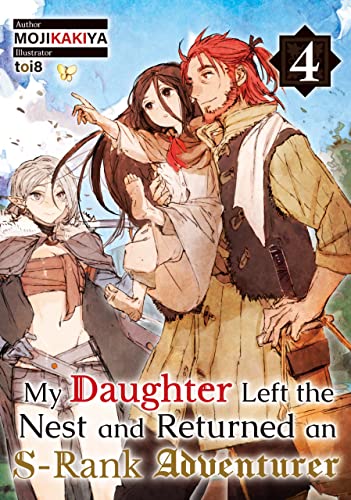
My Daughter Left the Nest and Returned an S-Rank Adventurer, Vol. 4

May 21, 2022 by Sean Gaffney

By MOJIKAKIYA and toi8. Released in Japan as “Boukensha ni Naritai to Miyako ni Deteitta Musume ga S-Rank ni Natteta” by Earth Star Novels. Released in North America digitally by J-Novel Club. Translated by Roy Nukia.

Easily the best in the series to date, despite the fact that we’re now at the second round of “I have gotten everything planned out to see my dad again but something comes along to screw it up at the last minute”. Angeline is still a big-time Daddy’s Girl, but she’s put into a situation where that’s mostly irrelevant, and when it is relevant she actually manages to use it as a force for good. Belgrieve is finally forced to admit to himself that he may actually be as good at fighting as Angeline says he is, after going toe-to-toe with a top-ranked adventurer and … not winning, but lasting far longer than a 40-year-old with one leg should really be lasting. And the overall plot is finally coming into focus, giving us more ongoing bad guys, as well as an idea of what they’re going to do. Which I suspect is “kill Belgrieve and then watch Angeline destroy the world”. Best to stop that.

Angeline and company are ready to take Charlotte and Byaku back to her hometown. Unfortunately, the nobles have finally gotten around to noticing her, and have called her to the capital to come get an award… which means she’ll get back too late to make the trip before winter sets in. She is… unhappy. Meanwhile, Belgrieve has settled in with his new mini-family back in Turnera, but some of them are leaving as well, mostly as they have the adventure lust in their blood. It’s also reminding him of his past, which we get brief glimpses of here, and we see how even as a younger man he was cautious and careful. As for Angeline, when she arrives at the capital she not only finds a pile of nobles but also a mysterious guy in a dungeon… who may be more connected to her than she thinks.

This is not really a big fighting volume. Belgrieve gets into a couple of spars, but that’s not the same thing. As for Angeline, as I noted above, the best part of the book is the fight she doesn’t get into, especially as it’s supposed to be used as the excuse for a coup. It’s actually the second time she avoids this, the first being in the middle of her awards ceremony, where a noble attempts to taunt her into fighting and she responds by pointing out exactly what battling monsters and demons should be for, and it’s not “to show off my strength against some noble jackasses”. That said, they aren’t all bad here, and I really liked the young spunky noble girl, who I hope we see again. Plus Angeline gets her reward at the end – her dad came to see her rather than the other way around, and he’ll be there all winter.

Despite once again keeping its two leads separated most of the book, this time it did it in exactly the right way. This is a solid fantasy series.

Filed Under: my daughter left the nest, REVIEWS

The Apothecary Diaries, Vol. 5

May 20, 2022 by Sean Gaffney

y Natsu Hyuuga and Touko Shino. Released in Japan as “Kusuriya no Hitorigoto” by Hero Bunko. Released in North America by J-Novel Club. Translated by Kevin Steinbach.

For the most part, this is something of a transitional volume of The Apothecary Diaries, at least until the end. While Maomao is no longer at the palace, she’s still very much involved in everyday life, and now she has a little boy to look after (who proves to be quite an artist). There are several interlinking plots, one of which is likely to stick around – there’s a potential famine on the way, which was figured out by the fact that there are more grasshoppers than locusts around, something I absolutely did not know, so kudos there. Maomao even finds time to attend the theater, where we see a magic act that looks pretty impressive, but which is fairly easily explained by a combination of tricks and drugging the audience. The second half of the book, though, is more interesting, as Maomao is taken by Jinshi to a banquet in the western part of the country, and all hell breaks loose, both figuratively and literally.

Let’s leave Maomao and Jinshi for later and talk about the other parts of this book. I really enjoyed seeing Maomao back in her hometown and fitting in very well… she even takes on an apprentice, who has a very good memory, something required in an apothecary. The apprentice will no doubt be necessary soon, as there’s no way Maomao stays here long. Indeed, the second half of the book is a big field trip, first where she goes to the quack doctor’s hometown and meets his family (who she refuses to name, continuing this book’s longest running gag). I must admit Maomao challenging a bunch of assholes to a drinking contest may be the best part of the book, especially when she worries she’ll lose not by getting too drunk but by having to pee. I also really liked her relationship with Lishu, who is a trembling bird of a woman who turns out to be bullied at home and at the palace. That said, maybe she’s found a guy… which is more than can be said for Maomao.

The final scene should technically be romantic, but is instead deeply uncomfortable to me. I have never seen someone so blatantly determined not to fall in love as Maomao is in this series. The Emperor is pushing Jinshi to get married, and things are not going well, mostly as Jinshi only wants Maomao. For once there isn’t really a class or status problem here – *if* Maomao were to admit to her birth parentage, which she really really does not want to do. She desperately wants Jinshi to marry anyone else mostly to try to get rid of the undeniable tension between them. The final scene features Jinshi, in a bit of a rage at Maomao’s attempts to brush him off, literally almost choke her to death, and it’s horrifying. As is Maomao’s response to this, which amounts to “gotta do this, I guess”. It’s a good thing that this series is a large number of volumes, as if Jinshi and Maomao got together now as they both are, bad things would happen.

This remains one of the best light novel series out there, an absolutely riveting read. If you’re reading it for the romance, though, I’m so sorry. Also, I forgot to mention the lion. There is a lion.

Filed Under: apothecary diaries, REVIEWS

Sakamoto Days, Vol. 1

May 19, 2022 by Katherine Dacey

The opening pages of Sakamoto Days unfold with ruthless efficiency: in just a handful of panels, author Yuto Suzuki shows us how twenty-two-year-old Taro Sakamoto, once Japan’s most “feared and revered” hit man, became Mr. Sakamoto, twenty-seven-year-old husband, father, and shopkeeper. Though Sakamoto seems content being the neighborhood jack-of-all-trades, his former associates view him as a potential threat, dispatching renown assassin Shin the Clairvoyant to kill him. Shin appears to have the upper hand in this contest—he’s younger, fitter, and, as his name suggests, telepathic—but Sakamoto quickly subdues Shin with a bag of cough drops and a well-timed kick, leaving Shin gasping for breath—and, oddly, eager to join forces with his old rival.

This initial encounter highlights Suzuki’s strengths and weaknesses as a storyteller. In the plus column is Suzuki’s ability to stage a great sight gag, as evidenced by Sakamoto’s MacGuyver-esque ability to transform ordinary objects into powerful weapons. Suzuki also makes the most of Sakamoto’s sangfroid; no matter how chaotic the scene or ridiculous his opponent, Sakamoto never betrays a hint of emotion, making him an excellent foil for the chatty Shin. In the minus column is Suzuki’s fixation with Sakamoto’s weight. Other characters routinely comment on how “out of shape” Sakamoto is, and express surprise at his speed and agility—Shin, for example, initially dismisses Sakamoto as a threat because “he’s gone all tubby now.” One or two comments in this vein are enough to subvert the idea that a skilled assassin needs to be fit to be lethal, but this “joke” is repeated almost every time Sakamoto mixes it up with a new bad guy. 

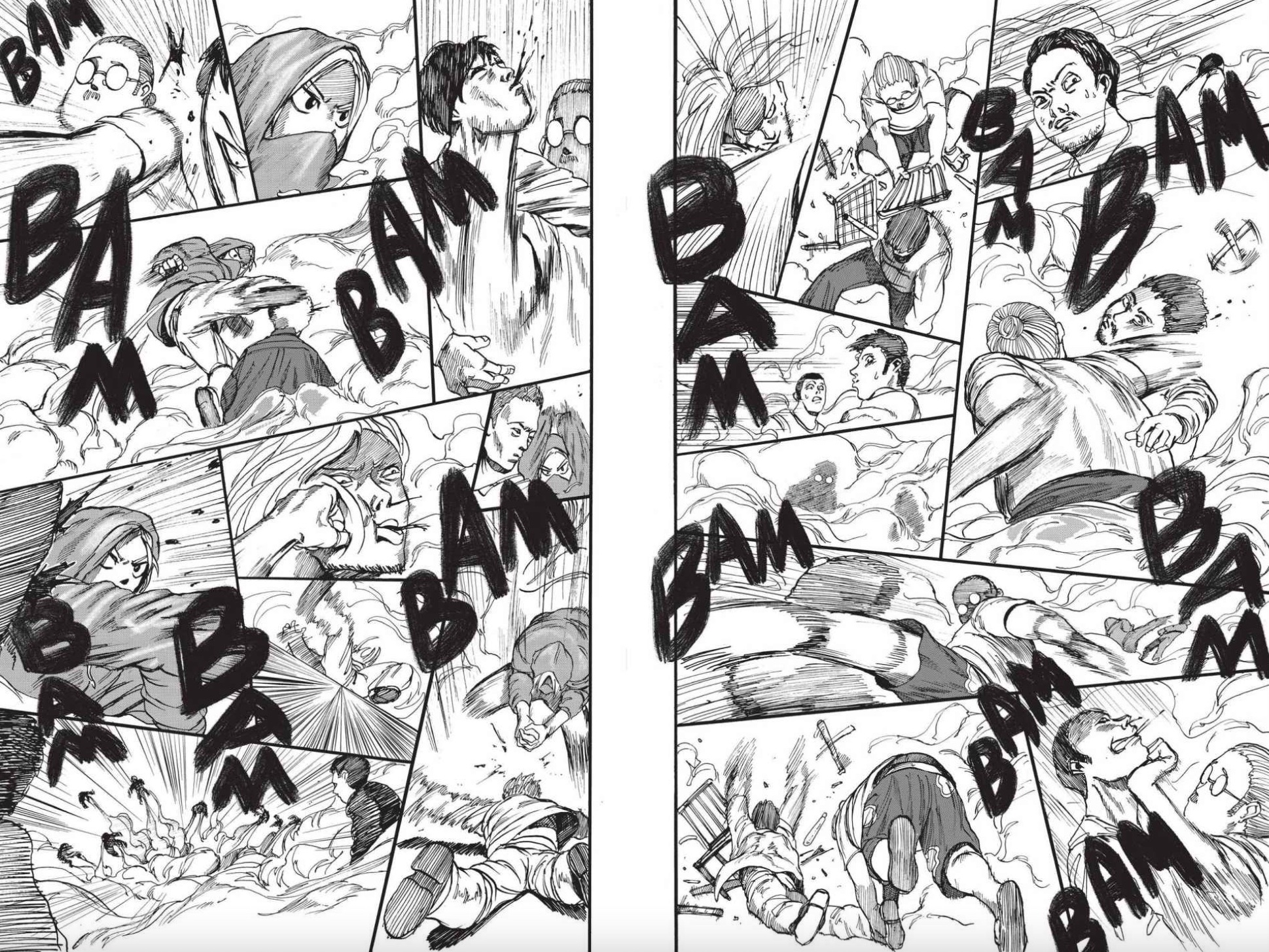
Art-wise, Suzuki’s style is pleasingly organic, relying more on linework than screentone to create depth and volume. Suzuki compliments this approach with an imaginative use of perspective and panel shape that suggests the controlled frenzy of Sakamoto’s attacks. In chapter three, for example, Shin and Sakamoto attempt to rescue Officer Nakase, a newly-minted cop who’s been kidnapped by a motorcycle gang. Sakamoto uses a smoke bomb to surprise his opponents, then unleashes a series of kicks, body slams, and upper cuts to overwhelm the gang members:


Suzuki presents the fight in a kaleidoscopic fashion, using panels of varying shapes and sizes to show how Sakamoto takes advantage of the smoke screen to dispatch his enemies, using the poor visibility to bob and weave his way to victory. The density of the images allows Suzuki to compress the action into just a few pages, creating a reading experience that puts the viewer in the middle of the action, watching the fight unfold in something approximating real time—a welcome antidote the bloated, multi-chapter fights scenes characteristic of so many Shonen Jump titles.

If some of the later chapters aren’t as tightly executed as the first, Sakamoto Days nonetheless achieves a good balance between character development and karate-chopping, affording us enough insight into Shin and Sakamoto’s personalities to make their Laurel and Hardy dynamic amusing. Recommended.

SAKAMOTO DAYS, VOL. 1 • ART AND STORY BY YUTO SUZUKI • TRANSLATED BY CAMILLA NIEH • LETTERING BY EVE GRANDT AND SNIR AHARON • VIZ MEDIA • RATED TEEN PLUS (VIOLENCE AND GORE) • 196 pp.

Filed Under: Manga, REVIEWS Tagged With: Comedy, Shonen Jump, VIZ

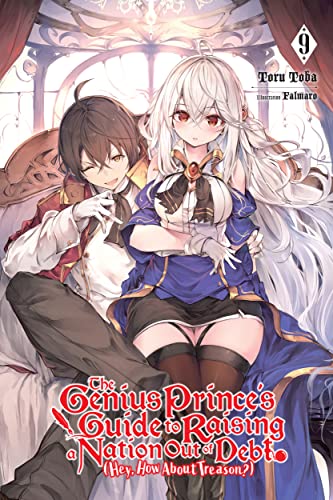
The Genius Prince’s Guide to Raising a Nation Out of Debt (Hey, How About Treason?), Vol. 9

May 19, 2022 by Sean Gaffney

By Toru Taba and Falmaro. Released in Japan as “Tensai Ouji no Akaji Kokka Saisei Jutsu ~Sou da, Baikoku Shiyou~” by GA Bunko. Released in North America by Yen On. Translated by Jessica Lange.

As we’ve now gone through about nine volumes of this series, it’s good to remember that the initial premise was that Wein was trying various ways to abdicate his responsibilities, and failing for the most part because a) he’s too good at his job, and b) he won’t do it if it means the people of Natra suffer. For the last few books, that’s mostly been forgotten, to the point where the title almost seems archaic. But this book reminds us that yes, Wein really does not want to be running his country, and he is still trying to take steps to avoid being the ruler. Fortunately for Wein, he has an adorable little sister with even more charisma than he has who sucks up knowledge like a sponge. The most interesting scenes in the book are when he asks Falanya is he really is “good” to the Flahm, and if so, how? Getting her to stop hero-worshipping him is a good first step.

Wein and Ninym are on their way to Ulbeth, a nation divided into four regions: Muldu, Altie, Roynock, and Facrita. In theory they all are distinct areas with their own distinct rulers but united as an alliance. In practice, they all hate each other. Wein has been invited by Muldu’s representative, Agata, a Holy Elite who wants Wein’s help to undermine the other nations. Of course, Wein is not about to do this out of the goodness of its heart, but (as with most books in the series) complications suddenly turn up. Who’s going to win this mini-throne war? Can everything be solved by simply marrying as many couples as possible? And, most importantly, if something happens to Ninym, has Wein matured enough as a person not to simply kill every single person in the nation?

Slavery, as a concept, is so prevalent in light novels that it has become one of the worst cliches, and Genius Prince has been no exception. The Flahm have been presented in the story to date as an oppressed and hated group, and even in Natra, which supports them to an extent, Wein and Ninym have to merely be content to be ruler and aide and nothing more. The backstory of the Flahm has been teased in previous books, but here we get (secondhand) most of the story. I’ll be honest, it’s handled a bit better than other stories of its ilk, but still makes me a bit uncomfortable. On the up side, spoiling the previous paragraph a bit, we’re now seeing Wein be big enough to have someone kidnap Ninym and NOT destroy them completely. Alas, poor Ninym for once is the damsel in distress – her pulling a Wein and bewailing it at the end is hilarious.

I have a sneaking suspicion this series will end with Falanya on the throne and Wein and Ninym running off somewhere together, but we’re not there yet. Till then, this is a solid volume.

Filed Under: genius prince's guide to raising a nation out of debt, REVIEWS

An Archdemon’s Dilemma: How to Love Your Elf Bride, Vol. 13

May 18, 2022 by Sean Gaffney

By Fuminori Teshima and COMTA. Released in Japan as “Maou no Ore ga Dorei Elf wo Yome ni Shitanda ga, Dou Medereba Ii?” by HJ Bunko. Released in North America by J-Novel Club. Translated by Hikoki.

This is a long book. I’m not sure if it’s the longest in the series, but it has to be pretty close. Which is good, as the whole book is basically one giant battle scene, and length gives me more things to attempt to talk about other than “mmm, fight good”. It helps that we see pretty much the entire cast here, heroes, villains, and the morally grey area in between that is the majority of the group. Shere Khan finally gets a chance to try to be the Big Bad, but in the end he still manages to be upstaged by Bifrons. You know it’s bad when the villain is looking back at the one good deed they did once. We also finally – finally – get the explanation for Zagan’s past, and who his parents are. That said, in the end we learn the real reason for all of this, the reason Zagan fought back so harshly – and it’s hilarious.

Things are not in a good place at the start of the book. Nephteros is possessed AND dying, the worst combination. Richard is in a coma, Stella is in a coma, and it’s gotten to the point where they even have to abandon the castle, or at least hide it in an alternate dimension. Gremory is missing and possibly dead, and there is also the slight problem of all the resurrected heroes who are on Shere Khan’s side. To fight back they’re going to need absolutely everyone… though possibly not Chastille, who they are trying to prevent finding out about Nephteros in case it triggers her crybabay side. (They really should know better). Can they save Nephteros? Can they save Aristella? Can they deal with all these people coming back from the dead with close connections to the entire cast? And will they be able to celebrate another birthday?

There are a large number of cool scenes, as you’d expect from a book like this. Everyone gets a chance to do awesome things, either by being powerful (Foll, Kimaris) or by being “the heart” (Nephy, Chastille). If there’s a downside to the book, it’s that Shere Khan, by his very nature, can’t really do much once Zagan reaches him except die. The entire book is about trying to stop Zagan getting to him, and once he does, the book is basically over. The biggest surprise, though, may be Bifrons. He was so busy being evil and sneering that I forgot that he was also a sorcerer trying to do something that no other sorcerer had ever done, and if that means he ends up being the man who saves the day and makes everything better, trust me, that’s just a side effect. Good for you, Bifrons. Now please stay dead.

This very much has a feeling of “this is the final book in the series”, but there’s more on the way. We’ll see what it can do next – isn’t Alshiera still dying? In any case, fans of the series should be very satisfied with this one.

Filed Under: archdemon's dilemma, REVIEWS

Accomplishments of the Duke’s Daughter, Vol. 5

May 17, 2022 by Sean Gaffney

By Reia and Haduki Futaba. Released in Japan as “Koushaku Reijou no Tashinami” by Kadokawa Books. Released in North America by Seven Seas. Translated by Andria Cheng.

Now, I know what you’re thinking, isn’t this series eight volumes in total? And yes, it definitely is. That said, this fifth book is the final one of the main series, resolving most of the plot points and wrapping up the love affair between Iris and Dean. Gonna be honest, it feels a bit rushed. This is very odd, as this comes from a webnovel, so by definition should not have to worry about “the book isn’t selling so well, wrap it up next volume” woes. That said, it still feels rushed. Leticia’s subplot is not exactly out of nowhere, but I wish we had another book to develop it more. Alfred’s fate is handled as dramatically as possible, and certainly devastates Iris, but the reader is just sighing and going “uh huh”, and I’m pretty sure the author knows this, so the impact is lessened. It’s a decent book, it just is not quite as good as previous ones.

Tasmeria is going to war, which means Iris has to return to her domain to prepare. Good thing, too, as her port is one of the first to be attacked… by a completely different country. Is this related to the proposal she got last volume? There’s also the problem of Alfred also having to go to war, as when you’re the recent victor of a throne war you don’t sit back in the palace and let others fight for you. Unfortunately, this turns tragic when Iris hears the news that he was killed by an archer’s arrow. Devastated, she loses herself in grief for a bit before managing to pull herself together in time for the rest of the war to wrap up smoothly… thanks in great part to her mother’s secret identity as the most feared warrior in the land. (Secret to Iris, at least.) That said… is Alfred/Dean really dead?

The best scenes in the book are probably a) the ones with Iris’ mother Merellis, who is sort of what happened if the “ohohohohohoho!” ojou could also kick your ass and stab you, and b) the subplot with Edward and Yuri. By this final volume Iris’ past life in Japan is not even mentioned once, and the villainess part has long been thrown out the window. It briefly comes back here, though, as Iris and Yuri have a final confrontation and Iris states bluntly that the fact that Yuri is afraid to trust anyone is what led to her downfall. If Yuri had confided in any of her love interests, particularly Edward, things may have been different. Edward and Yuri’s story also impacts Leticia, who is essentially taking over the entire country this book, and for the most part doing it regally and stoically – though the cracks do show on occasion. I wish we’d seen more of her.

I also wish we’d seen more of Marellis’ past, but that’s being taken care of, as the next volume will tell us her story. Till then, this is the end of Iris’ story, and she’s happy, but I’d give the book only a ‘satisfactory’ as a grade.

Filed Under: accomplishments of the duke's daughter, REVIEWS

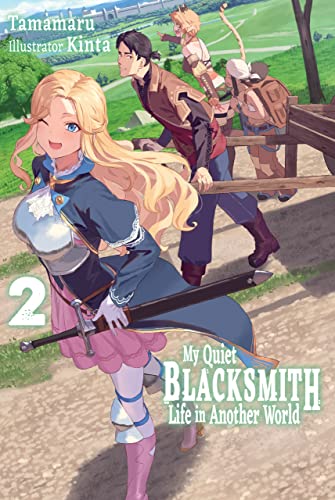
My Quiet Blacksmith Life in Another World, Vol. 2

May 16, 2022 by Sean Gaffney

By Tamamaru and Kinta. Released in Japan as “Kajiya de Hajimeru Isekai Slow Life” by Kadokawa Books. Released in North America by J-Novel Club. Translated by Linda Liu.

One thing that I’m not sure I say often enough here is that you don’t need a reason to like something. There are, of course, numerous reasons to NOT like something, but sometimes, let’s face it, you just vibe despite yourself. My Quiet Blacksmith Life in Another World is, on paper, something that hits a lot of the wrong buttons. Our hero has mad cheat skills. He constantly puts himself down at every opportunity, while everyone around insists he’s the best. He’s not just a blacksmith but a brilliant swordsman (which he will not admit). Last book he accumulated three women who like him, two of whom go so far as to move in with him. In this new book he meets a noble daughter (who moves in with him) and a cute elf. The women, or at least the ones who move in, are clearly in love with him, something he refuses to acknowledge. Oh, and it’s super long. This should be dire. Instead, it’s a great example of slow life.

There are two main plots in this volume. In the first, we find out why Eizo’s friend the gate guard suddenly vanished one day – he’s actually the third son of a noble family, and there’s a dispute over who takes over after the count and his eldest son die in mysterious circumstances. The 2nd son is from a mistress, so Marius is in line to take over, but second son does not like that at all. As part of all this, Diana, the daughter in the family, is sent to live with Eizo and company in hiding. That said, you know Eizo’s gonna get drawn into the throne war as well. After this, an elf named Lidy arrives with a broken mithril sword, which she asks Eizo to repair. This will be tricky, as the sword is also magical, so it can’t be reforged using normal means. Fortunately, it turns out that our hero has the ability to make magical swords too. Phew. Bullet dodged.

As with the first book, get ready for a lot of detailed description of forging swords, which, if removed from the book’s page count, would make this a normal sized light novel. That said, the forging is also what makes the slow life part happen, as for once this is a slow life book that really is slow life, rather than “I am trying to have a slow life but keep getting caught in life-threatening schemes”. And, let’s face it, looked at from the perspective of the women in the home watching Eizo smith, it’s seeing a handsome, kind, and sexy man show off his strong muscles and exquisite attention to detail. They are getting a full meal of eye candy every day. I will admit to being amused at the extra addition to the household, an wonder if this can be the light novel equivalent of the 100 Girlfriends Who Really, Really, Really, Really, REALLY Love You. Well, probably not, Eizo will never try anything. The others might, though.

So yeah, does most things wrong, still quite good. Give it a shot.

Filed Under: my quiet blacksmith life in another world, REVIEWS

Sabikui Bisco, Vol. 2

May 15, 2022 by Sean Gaffney

By Shinji Cobkubo and K Akagishi. Released in Japan by Dengeki Bunko. Released in North America by Yen On. Translated by Jake Humphrey.

Last time I had asked myself how the first volume, which was excellent but felt very much complete in one volume, would become a long-running series. The answer, at least judging from this second volume, is to do more of the same. More mushrooms, more relationships that end up in betrayal and then reverse betrayal, more of Bisco and Milo being as gay as possible, and more love interests who could also function as family who are there to reassure the macho Dengeki Bunko reader that it doesn’t have to be TOO gay if they don’t want. Fortunately for all concerned, there’s one other thing which is the same as last volume: it’s just as good. This is a rollicking action piece, with lots of violence, some death, and a lot of fun dialogue. Plus it gets a move on faster than the first volume. Of course, there’s also the problem that Bisco and Milo accidentally release the man who will become the book’s main villain, but let’s face it, he was gonna get out of there soon anyway.

Now that Bisco is both a wanted criminal and very famous, he not only has to watch out as he and Mlo travel the land, but he also has to deal with a score of two-bit hoodlums pretending to be him in order to shake down others. While dealing with one of these idiots, they end up headed towards the Six Towers of Izumo, where they hope to find an answer to Bisco’s immortality. What they do end up finding is the old man who they rescued from the earlier two-bit hoods has literally cut out Bisco’s stomach, because liver and lights turns out to be a lot more religious and magical in this particular city. Teaming up with Raskeni, a grim but determined doctor, as well as her apprentice, teenage Amli, they try to figure out how to stop Kelshinka, get Bisco’s stomach back, and also perhaps stop the entire city from turning into a tower of death and destruction.

The best part of the book is probably Amli, who is a bundle of sunshine and joy, but who also has a bit of a tragic core that comes out more and more as we get further into the book. She also fills the role that Pawoo played in the first book, which is to say she gets a massive crush on Bisco, though she’s not sure if she wants him as a big brother or as a romantic partner. That said, she has a ways to go to get to the level of Milo, whose love for Bisco, and vice versa, is becoming a literal religious experience. If you told me that this author read Reborn, Gintama, Kuroko’s Basketball, and no other Jump manga, I would not be the least bit surprised. Oh yes, and there are an awful lot of fights, mostly involving mushrooms, and an awful lot of death and gore, also mostly involving mushrooms. It can get very dark. But fear not, it’s Shonen Jump. Sort of.

If you wanted exactly what the first book did, only more of it, great news. This series does not disappoint.

Filed Under: REVIEWS, sabikui bisco

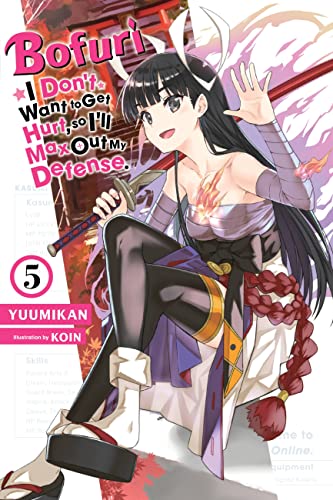
Bofuri: I Don’t Want to Get Hurt, So I’ll Max Out My Defense, Vol. 5

May 14, 2022 by Sean Gaffney

By Yuumikan and KOIN. Released in Japan as “Itai no wa Iya nano de Bōgyoryoku ni Kyokufuri Shitai to Omoimasu” by Kadokawa Books. Released in North America by Yen On. Translated by Andrew Cunningham.

This is the fist volume to take place post-anime (while a 2nd season was immediately announced, there has been no word about it ever since), and as such I imagine it has a few folks reading the series for the first time to try to see what happens next. That said… does Bofuri have an ongoing plot? We’re still entirely inside the game, with the most important real-life event in this volume being Kaede getting the flu. The plot of the books is basically “watch everyone slowly move to new levels and see what they do”. This volume has a weather-based level, with lots of clouds, lightning, and the like. If there is an ongoing plot that might affect future volumes, it’s Sally’s. She’s always taken the lead in gaming with Maple,. and has now found a game that Maple is not only intuitively better at but a LOT better at. Sally doesn’t want to play like Maple does… but she wants to be cool for Maple.

While this is not a “short story” volume per se, the book feels more scattered than usual, mostly as we’re having various groups team up with each other. Having faced off against Mii and Pain’s groups in the last event, there’s no similar guild war this time around. So Maple can team up with Mii for one day, getting to see more of her “real” self when she’s not putting up a front. She can also team up with Pain, who discovers, as he knew, that Maple can be a terrifying monstrosity, but also (as he didn’t know) that she can also be amazingly dense in equal measure. However, she *is* learning slowly how to game the “normal” way as well, and how to use new skills to bet suit her playset. Which is good, as the GMs are not making things any easier for her.

For those who go to Bofuri for the humor, there are definitely fun examples. Kasumi, the straight man samurai of the group for the most part, turns out to have a weakness for antiques, and on this level that mostly consists of getting quests by buying things at shops, she ends up spending FAR too much money. As for Maple, her defense – or more accurately her lack of everything other than defense – means that she’;s advancing far slower than anyone else in Maple Tree, and when she recovers from her flu she finds they all fought a boss without her. They’re pretty sure she can solo it, so she goes to do so… only to accidentally fight the LAST boss. Which she does of course beat, but it’s easily the most difficult fight we’ve seen her have since the first book, and it’s fun watching her throw everything at the enemy and seeing it not work.

Bofuri is fun and relaxing, and while it may not appeal to fans of the anime’s quicker comedic style, it’s a good read in and of itself. And good luck trying to show off for your girlfriend, Sally. At least there’s still Frederica if you can’t keep up.

Filed Under: bofuri, REVIEWS

  • « Go to Previous Page
  • Page 1
  • Interim pages omitted …
  • Page 79
  • Page 80
  • Page 81
  • Page 82
  • Page 83
  • Interim pages omitted …
  • Page 346
  • Go to Next Page »
 | Log in
Copyright © 2010 Manga Bookshelf | Powered by WordPress & the Genesis Framework