• Skip to primary navigation
  • Skip to main content
  • Skip to primary sidebar
  • Home
  • About Us
    • Privacy Policy
    • Comment Policy
    • Disclosures & Disclaimers
  • Resources
    • Links, Essays & Articles
    • Fandomology!
    • CLAMP Directory
    • BlogRoll
  • Features & Columns
    • 3 Things Thursday
    • Adventures in the Key of Shoujo
    • Bit & Blips (game reviews)
    • BL BOOKRACK
    • Bookshelf Briefs
    • Bringing the Drama
    • Comic Conversion
    • Fanservice Friday
    • Going Digital
    • It Came From the Sinosphere
    • License This!
    • Magazine no Mori
    • My Week in Manga
    • OFF THE SHELF
    • Not By Manga Alone
    • PICK OF THE WEEK
    • Subtitles & Sensibility
    • Weekly Shonen Jump Recaps
  • Manga Moveable Feast
    • MMF Full Archive
    • Yun Kouga
    • CLAMP
    • Shojo Beat
    • Osamu Tezuka
    • Sailor Moon
    • Fruits Basket
    • Takehiko Inoue
    • Wild Adapter
    • One Piece
    • After School Nightmare
    • Karakuri Odette
    • Paradise Kiss
    • The Color Trilogy
    • To Terra…
    • Sexy Voice & Robo
  • Browse by Author
    • Sean Gaffney
    • Anna Neatrour
    • Michelle Smith
    • Katherine Dacey
    • MJ
    • Brigid Alverson
    • Travis Anderson
    • Phillip Anthony
    • Derek Bown
    • Jaci Dahlvang
    • Angela Eastman
    • Erica Friedman
    • Sara K.
    • Megan Purdy
    • Emily Snodgrass
    • Nancy Thistlethwaite
    • Eva Volin
    • David Welsh
  • MB Blogs
    • A Case Suitable For Treatment
    • Experiments in Manga
    • MangaBlog
    • The Manga Critic
    • Manga Report
    • Soliloquy in Blue
    • Manga Curmudgeon (archive)

Manga Bookshelf

Discussion, Resources, Roundtables, & Reviews

Reviews

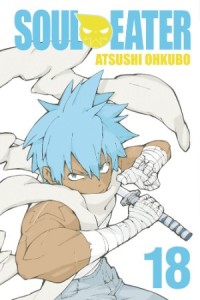
Soul Eater, Vol. 18

February 19, 2014 by Sean Gaffney

By Atsushi Ohkubo. Released in Japan by Square Enix, serialization ongoing in the magazine Shonen Gangan. Released in North America by Yen Press.

Soul Eater is an ensemble cast, but as with most ensemble casts, some characters are more lead than others, and so Soul Eater really stars Maka and Soul. Throughout the series we’ve seen the growing closeness between the two, and the confidence that they now have. Which is why the chapters on Envy and Sloth that they both go through are so traumatic. It’s such a shame that Maka, deep down, really has these issues with her. Of course, Maka is all of us, and you can never quite get rid of that core of self-loathing, no matter how much confidence you have. Luckily, Maka has Soul to snap her out of it.
soul18

As for everyone else, the Lust chapter actually plays out a lot faster than everyone thought, once the basic ‘what if they all changed sexes’ gag is done. Naturally, the more repressed a person is, the longer it takes to change back, which gives us an excuse to watch Tsubaki and Liz be humiliated. Gluttony, Wrath and Pride are excuses for character-based humor, as Black*Star and Patti pig out and we have to deal with the return of the most annoying sword in the world, which even Liz can’t wield in order to save Kid. (There’s some amusing 4th wall breaking here, as it’s noted that Black*Star screaming at Excalibur is buried in the gutter of the book.)

Speaking of 4th wall breaking, the art itself undergoes a change in the Sloth chapter, fitting in with what Maka and Soul are going through. This is probably the most disturbing part of the book, as Giriko shows up and threatens to rape Maka using extremely crude language, which (being in an existential crisis) she just sits there and takes. Luckily, Soul is there to come to her rescue, and she’s able to supposedly kill Giriko, though this may prove trickier than they expected. “People don’t explode when you kill them!” Is this meant to be another commentary on shonen tropes?

And then there’s Kid. We’ve had his obsessive-compulsive disorder used for humor for so long that it’s a bit jarring to see it be so serious now. And, truth be told, it’s a great way to get Kid to turn to the side of evil – point out that the best way everything can truly be symmetrical forever is to make everything become nothing, the empty symmetry of nonexistence. It’s chilling. Luckily, we have the one man whose ego is so big that facing off against something like this is nothing, and the cliffhanger sets us up for the big fight between Kid and Black*Star. The first time they fought, Kid wiped the floor with him, but I suspect things will go differently this time.

Soul Eater is slowly makes its way towards a big confrontation, but the journey is also fun, and this continues to be one of the best shonen titles out there.

Filed Under: REVIEWS

Dawn of the Arcana Vols 11 and 12

February 19, 2014 by Anna N

Dawn of the Arcana Vol 11 by Rei Toma

Dawn of the Arcana is a series that I think is best experienced in mini bursts of 2 or 3 volumes, simply due to the deliberate pace of the storytelling in the manga, as well as the fact that it sometimes takes a half volume or so for my brain to kick in with my memories about what happened in the previous volume due to all the relationships developing and the shifting nature of the geopolitical situations happening in Toma’s world. Usually I’m far too impatient to let the volumes pile up like this though!

After 10 volumes, the new status quo for red haired socially outcast with alarming powers of precognition Princess Nakaba and formerly arrogant but really a nice guy who has a social conscience inspired by the power of love Prince Caesar is to be separated. Nakaba has returned to Senan, determined to do some ruling in her own right, and Caesar is back in his home country of Belquat, dealing with his evil family. This volume shows the emotional impact of Nakaba’s power, the Arcana of Time, as she is determined to save the outcast child of a village that is in the direct path of an avalanche. This becomes a story that further explores the position of the humanoid animal hybrid race called ajin, as Lala the child with bunny ears is actually the product of a human/ajin encounter, leading to her abandonment. Lala has one human friend, and Nakaba’s ever present ajin protector Loki is there to save the day as always.

Loki always seems to have a new revelation every few volumes, either about his emotions or background, and a secret is revealed in this volume that shows that he and Nakaba have even more in common than I previously thought. While there’s the more conventional romantic storyline with Caesar and Nakaba, I actually find Nakaba’s relationship with Loki much more interesting, as they trade off protector duties in unexpected ways. Nakaba decides to take power in her home country, and her choices are largely driven by wanting to prevent Loki from going too far for her.

Dawn of the Arcana Vol 12 by Rei Toma

Everything keeps zipping along, as now that Nakaba and Caesar are in power in their respective countries, they have a chance to finally see each other again, when Caesar is ordered to invade Senan. Nakaba’s been looking in on Caesar and remarks that he’s going to start a revolution, so she’s “Here to lend a hand.” Nakaba’s power also provides Toma with a great way of providing more backstory about her characters. Nakaba looks back at Caesar’s father when he was young, even though Loki warns her that it might be difficult for her to see because she’s “too kind”. Nakaba sees King Guran’s first meeting with his unconventional first queen, the commoner Sara. The unhappy ending of this romance provides a reason for why King Guran might have ended up so twisted and bitter, but it doesn’t prevent a confrontation that is sure to cause even more fallout to happen in the volumes ahead.

One of the things that I really like about the art in this series is that it is so clear and easy to read. Toma might not have the most intricate backgrounds or innovative approach to paneling, but I’m never left puzzled about action scenes or finding that I have to go back and reread a page to make sure I understand the sequencing. The wordless exchanges between Nakaba and Caesar and the sidelong glances between Loki and Caesar do more to express the tensions between the characters than several pages of dialog. Overall, these were two very solid volumes in a fantasy series that is always surprising me with unexpected depths. I’m looking forward to the next few volumes to see what will become of Nakaba, Caesar, and Loki (well, really mostly Loki).

Filed Under: REVIEWS Tagged With: dawn of the arcana, shojo beat, shoujo, viz media

Blue

February 14, 2014 by Ash Brown

BlueCreator: Kiriko Nananan
U.S. publisher: Fanfare/Ponent Mon
ISBN: 9788493340971
Released: 2006
Original release: 1997

I first discovered Kiriko Nananan’s work while reading Secret Comics Japan: Underground Comics Now. Two of her short manga–“Heartless Bitch” and “Painful Love”–were included in the volume. I was quite taken by the pieces and so was determined to find more of Nananan’s manga in English. Sadly, very little has been translated. Another of her short manga, “Kisses,” was collected in Sake Jock: Comics from Today’s Japanese Underground, an early English anthology of alternative Japanese manga. Nananan debuted in the avant-garde manga magazine Garo in 1993, which is one of the reasons her work is found in these “underground” collections. She is particularly well-known for her short manga; Blue is her only long-form manga to have been released in English. Originally published in Japan in 1997, Fanfare/Ponent Mon published the English edition of the manga in 2006 after releasing a Spanish-language edition in 2004. Blue has also been translated into French and German. The manga was also popular enough to receive a live-action film adaptation directed by Hiroshi Ando in 2002.

“The sky that stretches out above the dark sea. The school uniforms and our desperate awkwardness. If those adornments of our youth held any color it would have been deep blue.” Thus begins Kiriko Nananan’s Blue. Kayako Kirishima, a senior at the Hijiri all-girls high school, is fascinated by her classmate Masami Endō, the young woman who sits directly in front of her. Endō was suspended from school the previous year. Because of that and her general attitude, many of the students at Hijiri find her difficult to approach. But Kirishima eventually musters up the courage to finally talk to Endō. Her fascination becomes friendship and eventually love. But their relationship isn’t an easy one. Uncertainty, worry for the future, and past regrets all have an impact on Kirishima and Endō and how they relate to each other and to the rest of their friends. Love can be a wonderful thing, but it can also be painful. As high school draws to an end, they must face the inevitable changes in their lives either together or alone.

Nananan’s artwork in Blue is very simple, almost minimalistic, and yet it is also incredibly arresting. There is very little shading employed. In fact, the use of negative and white space is just as important to the manga’s composition as the deep black of Nananan’s ink work. It has a distancing and cooling effect. The fragility of Kirishima and Endō’s relationship is reflected in the fragility of Nananan’s lines. At times the pages are nearly empty, giving a sense of loss and contemplativeness, as if the feelings of the two young women are in danger of disappearing altogether. Body language is especially important in Blue. Hands in particular are a recurring motif and are very expressive–they reach out to grasp someone or to push them away, they hide a face in shame or frustration. Nananan shows intimacy of varying degrees in Blue through the characters’ actions and touch. It can be extremely sensual, but it can also be very chaste.

Blue has a reflective, poetic, and lyrical quality to it. The manga is a fairly simple and straightforward story of first love which is both sweet and sad. However, Nananan is adept at capturing the realistic complexities of love and all of the feelings associated with it–the jealousy and heartache as well as the happiness and joy. Kirishima is constantly thinking about Endō. Even when she isn’t immediately present on the page Endō is the focal point of the manga and always on Kirishima’s mind. The two of them obviously care deeply about each other and so it is particularly unfortunate that they seem unable to be completely open and honest with each other or with themselves. They are both young and don’t always make the best or most mature decisions. Blue is told from Kirishima’s perspective as she looks back from some point in the future to her high school days with understandable sentimentality. Although the manga is frequently melancholic and intensely emotional, it never comes across as melodramatic. Blue is a beautiful and striking work; I would love to see more of Nananan’s manga translated.

Filed Under: REVIEWS Tagged With: Fanfare/Ponent Mon, Kiriko Nananan, manga, Year of Yuri

Wandering Son, Vol. 6

February 12, 2014 by Ash Brown

Wandering Son, Volume 6Creator: Takako Shimura
U.S. publisher: Fantagraphics Books
ISBN: 9781606997079
Released: January 2014
Original release: 2007

Wandering Son is currently the only manga by Takako Shimura to have been released in print in English. Although I would love to see more of her work translated and published, I am particularly grateful that it is Wandering Son that has been licensed for print release. (Fantagraphics’ large format hardcover edition is simply lovely, too.) Wandering Son is a beautiful series that explores the young protagonists’ search for personal identity and addresses issues of gender and sexuality in a very sincere, sensitive, and accessible way. Wandering Son often hits incredibly close to home for me which is one of the reasons that I personally hold the series so dear. I’m not sure how popular the series is in general, but it has been well-received by critics both inside and outside of Japan. The sixth volume of Wandering Son was initially published in Japan in 2007. Fantagraphics’ English-language edition of Wandering Son, Volume 6 was released in 2014.

As the school’s cultural festival approaches, the students are hard at work preparing for their classes’ projects. Chiba and Shuichi are trying to put the final touches on their script for a gender-swapped version of Romeo and Juliet despite some of their classmates’ well-intentioned interference. To Chiba and Shuichi the play is much more than a simple seventh-grade class production. It’s also a very personal expression of their desires: Chiba wants to see Shuichi in the role of Juliet and Shuichi wants to be seen as a girl. In some ways their version of Romeo and Juliet is a reflection of Shuichi and Takatsuki as the two of them are faced with challenging society’s established gender roles and expectations. Shuichi and Takatsuki’s bonding over the play is a source of immense frustration for Chiba. She’s in love with Shuichi, and Shuichi has feelings for Takatsuki, but Takatsuki isn’t interested in pursuing those feelings. The result is that there’s quite a bit of drama both on and off the stage.

For my part, I’m glad to see Shuichi and Takatsuki becoming close again after their relationship was disrupted by Shuichi’s confession of love. Thankfully, they were able to work through that and are once again able to lean and rely on each other as friends. This is particularly important for the two of them since they share so much in common. The additional support is something that Shuichi especially needs. At the beginning of Wandering Son, Shuichi was a very meek and hesitant person. However, as the series has progressed, Shuichi has grown, becoming much more assertive and confident and is now able to begin to express in words needs and desires. In a very touching scene with Takatsuki, Shuichi sums it up quite nicely, “It’s my wish. You as a boy…me as a girl…a happy ending for everybody.” It’s really the first time that Shuichi has been able to be so clear and forthright about the their situation. Happily, it’s not the last time that it happens, but it is a very formative and noteworthy moment.

One of the things that Shimura captures remarkably well in Wandering Son is the natural development of the characters and their relationships with one another. Wandering Son is a story about growing up and determining not only who you are as an individual but who you are in relation to other people; how people see themselves in addition to how others see them. Life itself could be said to be a performance. It’s particularly interesting then that in Wandering Son, Volume 6 so many parallels are made between Shuichi and Takatsuki’s real life and the very deliberately crafted Romeo and Juliet production. Through it they are able to reveal a part of themselves for everyone to see. It may not be a particularly subtle narrative technique on Shimura’s part, but it is a very effective one. The play echos their experiences, emphasizing specific aspects of their lives and relationships not only for the characters, but for the readers as well. Wandering Son continues to be an absolutely wonderful series. As always, I am very much looking forward to the next volume.

Filed Under: REVIEWS Tagged With: Fantagraphics Books, manga, Takako Shimura, Wandering Son

Oh, Tama!

February 9, 2014 by Ash Brown

Oh, Tama!Author: Mieko Kanai
Translator: Tomoko Aoyama and Paul McCarthy
U.S. publisher: Kurodahan Press
ISBN: 9784902075670
Released: January 2014
Original release: 1987
Awards: Women’s Literature Prize

Oh, Tama! is the third volume of Mieko Kanai’s work to be translated into English. The first was The Word Book, a collection of her short stories from the 1970s, while the second was a short novel called Indian Summer. Both Oh, Tama! and Indian Summer are a part of Kanai’s Mejiro Series–a group of novels tied together more by location and characters than by an overarching plot (though some events do cross over from one novel to another.) Indian Summer is actually the third volume in that series while Oh, Tama!, even though it was translated later, is the second. Oh, Tama! was originally serialized between 1986 and 1987 before being collected and released as a single volume which went on to win Kanai the Women’s Literature Prize in 1988. The English-language translation by Tomoko Aoyama and Paul McCarthy, released by Kurodahan Press in 2014, is based on the 1999 Japanese edition of the novel. I was very pleased to receive a copy of Oh, Tama! through LibraryThing’s Early Reviewers program.

Tsuneko is pregnant. No one except for her and maybe her half-brother Alexandre (if he really is her half-brother) is entirely sure who the father is. Natsuyuki was one of the candidates, but for various reasons instead of being given the role of “father” he has had the responsibility of caring for Tama–Tusnkeo’s pet cat, also pregnant–thrust upon him by Alexandre. It’s a rather strange turn of events, especially when Tusneko leaves the country and Tama becomes one of the only remaining links to her left in Tokyo. The other potential fathers-to-be are trying to find or at least contact Tsuneko, which eventually leads them to Natsuyuki and Tama. In yet another bizarre twist of fate, one of them, Fuyuhiko, actually turns out to be Natsuyuki’s very own long-lost half-brother, making for a rather odd meeting.

There’s actually not much of a driving plot to Oh, Tama!. Instead, Kanai focuses on the mundane lives of the characters. Even the novel’s setting is unremarkable–almost the entire story takes place within the confines of Natsuyuki’s small apartment. Tama provides a focal point from which Kanai explores the interpersonal relationships between Natsuyuki, his friends, family members, and neighbors. The characters in Oh, Tama! aren’t particularly exceptional people although they’re all slightly quirky, eccentric, and offbeat. Their relationships also follow that same pattern of being just a little peculiar and unusual. I actually quite like Natsuyuki and the others and find their interactions, though fairly low-key, to be delightfully amusing as well as realistic. According to one of Kanai’s afterwords, the characters in Oh, Tama! are actually based on real people, so perhaps it shouldn’t be too surprising that their relationships, in all of their strangeness, should also feel so natural.

The translators’ introduction to Oh, Tama! describes the novel as “a treasure chest of rich and varied parody, allusion and intertextuality.” Since I haven’t actually read many of the works being alluded to, many of the references (even when pointed out) were a little lost on me. However, I could appreciate what Kanai was doing. Personally, what appealed to me most about Oh, Tama! were the characters themselves. Natsuyuki is a fairly laid back sort of guy, but this tendency (mostly because complaining or actually trying to change things would take too much effort) puts him into some odd situations. Alexandre, who seems to delight in messing with people, is often more concerned about Tama and the kittens than any of the people around him. I found their slightly antagonistic friendship and their interactions with Fuyuhiko and the others to be highly entertaining. I greatly enjoyed Oh, Tama! and its quirky, understated humor. So much so that I plan on reading the next novel in the Mejiro series, Indian Summer, in the very near future.

Thank you Kurodahan Press for providing a copy of Oh, Tama! for review.

Filed Under: REVIEWS Tagged With: Kurodahan Press, Mejiro Series, Mieko Kanai, Novels, Women's Literature Prize

Vinland Saga, Vol. 2

February 7, 2014 by Ash Brown

Vinland Saga, Omnibus 2Creator: Makoto Yukimura
U.S. publisher: Kodansha
ISBN: 9781612624211
Released: January 2014
Original release: 2006-2007
Awards: Japan Media Arts Award, Kodansha Manga Award

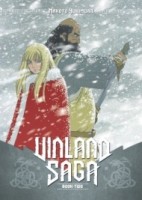
The second Vinland Saga omnibus, released by Kodansha in 2014, collects the third and fourth volumes of Makoto Yukimura’s historical manga series originally published in Japan in 2006 and 2007 respectively. Vinland Saga first began serialization in 2005 and has since earned Yukimura several honors, including a Japan Media Arts Award in 2009 and a Kodansha Manga Award in 2012. Vinland Saga was a series that I had been hoping would be licensed in English for years and so I was understandably thrilled when Kodansha picked the series up. Kodansha’s edition of Vinland Saga is quite nice–hardcover omnibuses which include color pages and have a larger trim size than the publisher’s previous releases. Vinland Saga is Kodansha’s first deluxe manga; personally, I think it’s a series which deserves the special treatment. I was not at all disappointed with the first omnibus of Vinland Saga and so was eagerly awaiting the release of the second.

In the early part of the eleventh century, England was under frequent attack by Vikings. In 1013, after years of fighting, England’s King Ethelred has been driven into exile in France while King Sweyn of Denmark proceeds with his invasion of the country. The Danes aren’t entirely united though, and many of the king’s forces are more like mercenaries or bands of pirates than they are loyal followers. Some groups, such as those led by Thorkell the Tall, have actually aligned themselves with the English in the conflict. Others, such as Askeladd’s band of warriors, fight under King Sweyn simply because he currently has the more advantageous position and the chance of reward is therefore much greater. But there is some infighting among Askeladd’s ranks as well. The only reason that Thorfinn, a skilled young fighter, follows him is for the chance to seek revenge against Askeladd for the death of his father. In the meantime, Thorfinn serves both as one of Askeladd’s most valuable and most expendable assets.

I enjoyed the first omnibus of Vinland Saga a great deal, but I think that I probably enjoyed the second one even more. Yukimura has struck an ideal balance between exciting action sequences and combat and the more personal and emotional character development of the fighters who are involved. Vinland Saga is both epic and intimate in its scope. War is occurring between nations, but it is the characters’ individual struggles that make the story so visceral and compelling. Many of the warriors in Vinland Saga are bloodthirsty, seeking glory and taking pleasure from battle itself rather than from any sort of perceived noble cause. But there are exceptions. Thorfinn despises this fighting for fighting’s sake. However, while his search for revenge may arguably be more righteous, that doesn’t necessarily mean that he’s in the right. Askeladd, too, has some very legitimate justifications for fighting. But while his skills as a warrior and strategist are commendable, many of his actions are deplorable.

The depth of characterization in Vinland Saga is impressive. In this omnibus, Askeladd in particular is shown to be a much more complicated figure than he may have first appeared. Vinland Saga, Omnibus 2 delves into part of his backstory, which only begins to reveal his motivations and who he really is as a person. Yukimura’s attention to detail in Vinland Saga extends beyond the characters themselves. The amount of research he has conducted allows him to portray the time period realistically, taking into consideration major historical events but also incorporating religious issues and matters of the day-to-day lives of royalty, mercenaries, and common folk. The artwork, too, can be incredibly detailed. The landscapes and environments are beautifully rendered and each character, even the multitudes of unnamed combatants, have distinctive designs. Vinland Saga really is an excellent series. I’m enjoying it immensely and am extremely happy that it’s finally available in English.

Filed Under: REVIEWS Tagged With: Japan Media Arts Award, kodansha, Kodansha Comics, Kodansha Manga Award, Makoto Yukimura, manga, Vinland Saga

Hayate the Combat Butler, Vol. 23

February 6, 2014 by Sean Gaffney

By Kenjiro Hata. Released in Japan as “Hayate no Gotoku!” by Shogakukan, serialization ongoing in the magazine Shonen Sunday. Released in North America by Viz.

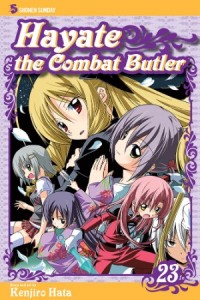
This volume wasn’t really supposed to be read on its own – it came out in Japan at the same time as Vol. 24, as it’s one big epic storyline resolution. But here in North America, where Hayate’s sales sort of suck, we get this volume now and Vol. 24 in late summer. That said, it’s not like this is incoherent without the other volume, it just leaves us with another nasty cliffhanger. More to the point, everything is finally tying together as the universe sets out to make Hayate’s life miserable, and he helps it along as best he can.

hayate23

Not that Hayate is the only one suffering – we get the aftermath of Hina’s confession, as her heart is shattered into little pieces but she still manages to say the right things to Hayate. There are many characters in this series who are at their best when they’re absolutely miserable, and Hina’s is one of the bigger examples. That said, I suspect she’s not simply going to sit back at the hotel for the rest of this arc and let Athena steal the show…

Nor is Nagi, though she doesn’t really appear much in this volume. Hayate’s self-worth is tied directly to the fact that Nagi ‘saved’ him from his old life, and therefore when Mikado (who is really being a horrible old bastard here) forces him to choose between Nagi’s happiness (as losing all her wealth will destroy her) and Athena’s (as she may very well die if Hayate doesn’t intervene), it’s snot surprising that he freezes up and goes into a bit of a blue funk. It’s not so much a Lady or the Tiger choice as it is two kinds of tiger.

And then there’s Athena (who has a comedy relief servant, Makina, who is appropriately a bit of a dark Hayate to Athena’s Dark Nagi). There’s a bit of possession by evil going on, so her desire to get the King’s Jewel at all costs it wrapped up in that. Her feelings for Hayate seem to be genuine, though, and it’s telling that the evil inside her is allowed to take over when she realizes that Nagi is the one who saved him and the most important woman in his life right now. This leads to summoning giant demonic spirits to kill Hayate once and for all. Thank goodness for Isumi…

…who arrives just in time to lose her first battle in the entire series (as possessed-Athena points out to her, “You’ve never had to face someone stronger than you, have you?), so our heroes have to run away for a bit. Isumi also gets to be infodump girl, informing Hayate that even if they destroy the stone, the shock of the thing that’s currently possessing her being destroyed may kill Athena. He really does have no good options here. Well, except this is a shonen manga, so he can go back and plead with her to listen to reason some more. I suspect that’s what we’ll see next.

At the time this came out, a lot of folks were wondering if this might be the conclusion, and if Hayate would actually end up with Athena. No fear (it’s up to Vol. 39 in Japan now), but this is still an excellent buildup to something big. Can Hayate win despite his amazing powers of self-hatred?

Filed Under: REVIEWS

Book Girl and the Scribe Who Faced God, Part 2

February 4, 2014 by Sean Gaffney

By Mizuki Nomura. Released in Japan by Enterbrain. Released in North America by Yen Press.

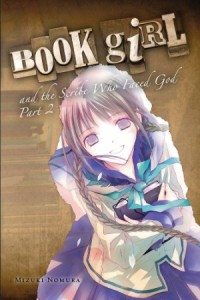
And so we finally get to the book that wraps everything up, and it’s appropriate that it also dips back into the previous seven books so much. Everything here has been interconnecting far more than we expected at the time, and, as Chie herself noted, people did not get magically healed after the tragic events that happened to them. Still, most everyone seems to be working things out to a certain degree as they graduate. Even Konoha, who has finally come to terms with the fact that once he removes writing from all of the triggers it presents to him, he actually loves doing it.

bookgirl8

Konoha has been a very frustrating character to read through this series, and can be that way here as well, at least for the first half. His relationship0 with Nanase is sweet and innocent and pure poison to absolutely everyone involved, even if Ryuto’s attempts to break them up through threats and violence are even more dumb. I actually feel bad for Nanase – not only does she lose out on Konoha in the end, but she also ended up being the least developed character, really. The tragedy in her focused book happened to her best friend, leaving her to be the prime example of the pure tsundere shonen heroine that pines away even as she knows deep in her heart that something is wrong. I hope one of the side-story sequels in Japan features her and gives her more depth.

Ryuto and Tohko tie together, of course, and while I still think he makes every wrong decision imaginable in this series, I can now sympathize with Ryuto’s intentions and see why he tries to torture himself so much. He and Chie still make a weirdly twisted couple, and her actions towards the end were not surprising but still managed to pack a punch. As for Maki, she finally gets what she wants out of life. Her painting of Tohko included. She’s an excellent positive example of how to beat overwhelming odds through sheer determination, and probably still my most favorite character in the series.

Finally, Tohko and Konoha, and the backstory with Tohko’s parents. This is where most of the plot twists come in, some of them mere lines after the last. I have not read Andre Gide’s Strait Is the Gate, the book that features so heavily, but it ties into Tohko’s life heavily. Tohko in the end is simply an incredibly nice girl who wants to see people happy and doing what they do best. She also knows that Konoha needs to write, and his rejection of her basically hits all if her emotional trauma buttons. I’m still not sure I like the idea of them as a romantic couple – I think they’d be excellent best friends and a writer/editor team. But they’re the best part of this book, and I liked that it was Konoha who got the big dramatic speech tying the tragedy into the book this time around.

Book Girl has been a roller coaster of teen trauma, and really didn’t have *too* much supernatural content – Tohko’s nature really isn’t examined all that much. It’s the perfect novel series for someone who wants a book for teenagers but wants to avoid all the cliches that plague most Japanese light noels that are translated into English. Character you care about, twisty plots, and an overwhelming love of books. I want to read it all over again. Luckily, I don’t eat books, so I can do so fairly easily. (Tohko must hate e-readers.)

Filed Under: REVIEWS

Harlequin Manga: The Tycoon’s Pregnant Mistress and Her Sheikh Boss

February 3, 2014 by Anna N

The Tycoon’s Pregnant Mistress by Maya Banks and Nanao Hidaka

tycoon

The Tycoon’s Pregnant Mistress manages to hit some sort of Harlequin manga trifecta, because the pregnant mistress in question gets cast off, kidnapped, and develops amnesia in the first 30 pages! The woman with the eventful life is Marley, and her boss is a slightly dimwitted Greek tycoon named Chrysander. Marley finds out that she’s pregnant and attempts to have a meaningful talk about their relationship with Chrysander, only to be shut down and promptly kicked out when Chrysander discovers top secret business documents in Marley’s handbag only minutes after his extremely suspicious secretary pays him a visit at their home. While he might be successful in business, Chrysander has very little insight into human nature, as he kicks Marley out onto the street, where she is immediately scooped up by kidnappers, appearing four months later in an advanced stage of pregnancy!

Chrysander is very suspicious of his pregnant former mistress who has amnesia, but he is determined to Do the Right Thing and decides that he’s going to take care of her and her child. Marley attempts to get her memories back, all the while being slightly bewildered by the continued presence of Chrysander’s skanky secretary and his distant nature. The art for this title is about average for a Harlequin manga, it is attractive despite some slightly odd proportions, and while it doesn’t have the lush 80s retro vibe that I tend to love the most in these manga adaptations, everyone’s hair is glossy and there is a profusion of brooding greek tycoons.

Her Sheikh Boss by Carol Culver and Earithen

hsb

The story for this manga is fairly predictable, but I really enjoyed the art for this title, which had a loose sophisticated style that reminded me a bit of Walkin’ Butterfly. Claudia is a highly efficient secretary working in the United States for Samir, the prince of a country in the Middle East. She’s indispensible for his business, and he decides to take her along when he goes home to his country. Samir tends to view Claudia as an efficient piece of furniture, and when Claudia goes on her trip she is profoundly dismayed to find out that her boss his traveling back to his family in order to get engaged!

Claudia has developed a secret crush on her boss, and she struggles with her feelings as his family regards her with suspicion. As Claudia visits Samir’s country he begins to see her as a woman for the first time, as she throws herself into new experiences with enthusiasm. His fiancee seems very unenthusiastic, perhaps due to the handsome male servant that follows her about wherever she goes. The art captures Claudia’s transformations and shifts in moods easily and there’s plenty of billowing hair and the occasional camel. While the illustrations aren’t necessarily very detailed, there’s more variation with the paneling and I found myself just as entertained by the art as the story. The complications that keep Samir and Claudia are resolved nicely, and overall I found myself pleasantly entertained.

Filed Under: REVIEWS Tagged With: digital manga publishing, emanga.com, harlequin manga

Umineko: When They Cry, Vol. 5

February 1, 2014 by Sean Gaffney

Story by Ryukishi07; Art by Kei Natsumi. Released in Japan in two and 1/2 separate volumes as “Umineko no Naku Koro ni: Banquet of the Golden Witch” by Square Enix, serialized in the magazine Gangan Joker. Released in North America by Yen Press.

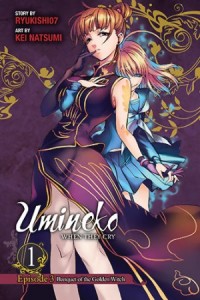
In Umineko fandom, there are two manga arcs that are considered to be the absolute best at adapting the source and adding actual expressions and action, and Banquet is the first of these (the other is End, if you’re curious). The artist from the first arc is back, but this one gives her far more to sink her teeth into, with Beatrice seemingly getting replaced as people actually bother to… solve the epitaph this time around! Meanwhile, given the first arc was Natsuhi-heavy and the 2nd focused on Rosa, the cover of the 3rd arc should not surprise you…

umineko5

Yes, that’s Eva biting her pinky on the cover… and yes, that’s also Eva behind her grinning insanely. Sort of. We get flashbacks at the start of the book to Eva as a teenager, dealing with being the smartest of the siblings but having a father who’s an abusive misogynist and a brother who realizes this is basically the only way he can ever have power over her. The flashbacks blend together with the present, as Eva arrives in 1986 for the Conference, and we see teenage-Eva stay behind, acting as sort of a ‘inner voice’ for Eva, driving her forward and giving her help/admonishment.

The First Twilight takes out all the servants (plus Kinzo), leaving us with the parents for a far more extended period than we’ve seen before. Which, if nothing else, reminds us once again how toxic this family is, even as they’re trying to hide from a killer. Speaking of that Twilight, we also meet a few new people, Ronove and Virgilia. Ronove seems like your typical ‘demon butler’ sort, there to give small hints, dole out tea, and be a bit too gay for battler’s liking. (It is worth noticing that Genji’s last name is Ronoue.) As for Virgilia, we see at the start that she was Beatrice back when the Beatrice we know was a young girl, and has been hiding inside Kumasawa until she emerges to chastise her former student. There’s a lot of double identities here, which is quite important as the series goes on.

Speaking of the Beatrice we know, there’s a lot of interesting things going on with her. She’s still really cruel and nasty, to the point where the omnibus ends with Battler slapping her after she laughs at the antics down on Rokkenjima. At the same time, she’s far less aloof and more likeable here, and I’d go so far as to say she’s even cute. This is also the first time I’ve really been able to buy the flirting that she and Battler do. We also get some backstory on her supposed history on the island; we see her as a young girl at the start, and later on a teenage Rosa runs into Beatrice imprisoned in Kuwadorian, Kinzo’s secret mansion on the other side of the island he created because he’s just like that. Sadly, Rosa leads her off the edge of a cliff (by accident, I note, she’s not an abusive mother just yet) and she dies. And Beatrice notes in read that she’s definitely dead down there. Curiouser and curiouser…

This arc has been described as “Umineko for Dummies”, as the fans apparently told Ryukishi07 that he made the first 2 arcs too hard to figure out what was really going on (except, well, “it was magic”, which they were reluctant to say). Ergo, this one really is a lot more anvilicious with its hints to Battler/the reader, describing the idea of Schrodinger’s Box as a way to avoid answering the “magic vs. human culprit” question in the first place, the use of ‘imaginary friends’ and identity theft, and Beatrice as a shared title. This culminates in Eva managing to solve the epitaph (though Rosa was close behind, give her credit), and finding the gold, which really does exist. As a result, she inherits the title of Beatrice… or rather, her teenage self does. And when her teenage self realizes she is unwilling to share the gold with anyone else, well, the murders take an even more grotesque turn. One might even go so far as to say that this game as been hijacked…

So again, if you’re looking for human culprits here, the obvious question is “Can I trust what I’m reading? And who can I not trust?” By the end of this first omnibus, you should have a pretty good idea. This is another good (and huge) adaptation of a fun and increasingly convoluted story. Will we get to sympathize with Beatrice even more next time? If so, which Beatrice will it be?

Also, Yen, you tried, and I appreciate the reluctance to use the fan version everyone knows already, but “Karub Kamy Crokatch” is no “Sucker Merry Barrels”. Love Natsuhi’s reaction, though.

Filed Under: REVIEWS

Kafka on the Shore

January 31, 2014 by Ash Brown

Kafka on the ShoreAuthor: Haruki Murakami
Translator: Philip Gabriel
U.S. publisher: Alfred A. Knopf
ISBN: 9781400079278
Released: January 2006
Original release: 2002
Awards: World Fantasy Award

Haruki Murakami is an international best-selling author and one of the most recognizable Japanese novelists currently writing worldwide. Therefore, I find it somewhat surprising that I actually haven’t read much of his work. Before picking up Kafka on the Shore I had only read two of his books–1Q84 and Underground: The Tokyo Gas Attack and the Japanese Psyche–in addition to a small selection of essays and interviews. 1Q84 was my introduction to Murakami; it was both an incredibly frustrating and invigorating experience. I loved parts of the novel but strongly disliked others. 1Q84 probably wasn’t the best place to start reading Murakami, and so I’ve been meaning to give another one of his novels a try. I settled on Kafka on the Shore, originally published in Japan in 2002, for several reasons. It’s one of Murakami’s best-known works. Philip Gabriel’s 2005 English translation won the World Fantasy Award. The novel’s young protagonist basically runs away to a library. But mostly, I wanted to read Kafka on the Shore for the sake of one character, Oshima, with whom I happen to share quite a bit in common.

Fifteen-year-old Kafka Tamura, though that’s not his real name, has just run away from home. He leaves behind his father in Tokyo just as his mother and sister left the two of them behind more than a decade ago. Kafka’s plan is simple–travel to a faraway town and make a place for himself in a library. That’s how he finds himself in Takamatsu, over four hundred miles away from the home, father, and life that he wants to escape. There he seeks out the privately owned Komura Memorial Library where meets Oshima, an assistant at the library who takes Kafka under his wing. Meanwhile, strange events are unfolding around Kafka and the people in his life. Back in Tokyo, a man by the name of Nakata with the ability to talk to cats finds himself pulled into Kafka’s story. Though the two have never met they share a strange connection with each other that neither of them are entirely aware of or expected.

The chapters in Kafka on the Shore alternate between Kafka and Nakata’s individual journeys. Kafka’s chapters are written in first-person present, giving them a very intimate and immediate perspective, while Nakata’s are written in third-person past, creating more distance. At first the two stories seem to be completely unrelated, but as Kafka on the Shore develops the tales steadily draw towards one another and connect  in shocking ways. Kafka and Nakata’s paths never directly cross but they do influence each other and those of the people around them. Ideas, concepts, and turns of phrase, not to mention actions and their consequences, echo throughout the novel, tying seemingly disparate events together into a cohesive whole. There is a lot of loneliness in Kafka on the Shore. The characters are searching and reaching out for these sorts of connections and relationships, both consciously and subconsciously. They are individuals yearning to find what is missing from themselves and from their lives, often disregarding time and reality in the process.

Much as with 1Q84, there were parts of Kafka on the Shore that I adored and other parts that I found immensely frustrating. In general, I preferred the earlier novel over its later developments. For me, Kafka on the Shore worked best when it was more firmly grounded in reality with hints of the unexplainable, mysterious, and strange rather than the other way around. As the novel progresses it becomes more confusing and dreamlike. That in and of itself isn’t problematic, but towards the end of Kafka on the Shore Murakami begins introducing bizarre elements seemingly out of nowhere that do very little to develop the plot or the characters. Readers looking for closure from Kafka on the Shore may be disappointed as there are plenty of threads left unresolved by the time the novel reaches its conclusion. Despite my frustrations with Kafka on the Shore I am glad that I read the novel. I appreciated the importance giving to books and the influence of music; I found the characters intriguing; and although the story goes a little off the rails, I liked Kafka’s peculiar journey of discovery and coming of age.

Filed Under: REVIEWS Tagged With: Haruki Murakami, Novels, World Fantasy Award

Fushigi Yugi Genbu Kaiden, Vol 12

January 31, 2014 by Anna N


Fushigi Yugi Genbu Kaiden, Vol 12 by Yuu Watase

I’m sure it sounds odd, but I was actually a bit nervous about picking up the final volume of this series that I’ve been enjoying so much, simply because I’ve been a bit frightened of the ending. I knew that plenty of deaths would be occurring. This is no big secret, since the heroine Takiko has been dying of tuberculosis throughout the series, and the presence of a couple ghostly Genbu Celestial Warriors in the first Fushigi Yuugi series gave enough hints towards inevitable tragedy that a certain air of melancholy has hung over this manga, giving it an additional theme that has offset all the fantasy adventure I’d expect from a Yuu Watase series.

When I put this volume down, I realized I was wrong to be nervous, because the ending was the best one possible given the set of circumstances the characters found themselves in. The final confrontation with the Qu-Dong army has arrived, and even though Takiko has married the Uruki, now Emperor of Bei-Jia, all the efforts of her Celestial Warriors aren’t going to fend off the eternal winter that is going to threaten all the people of Bei-Jia. The Celestial Warriors fight gallantly, but Takiko is determined to see her destiny as a priestess fulfilled, even if she ends up being consumed by the god that she summons. There are plenty of quiet moments between the characters mixed in with the battles, and each Celestial Warrior gets a bit of a sendoff. Tomite teases Takiko one last time. Hatsui is courageous in battle. Inami deflects volleys of arrows with her hair, arranged in a giant web. Naname undergoes an unexpected and meaningful last transformation.

Throughout everything that happens in this final volume, the connection between Takiko and Uruki remains strong and supportive. As a heroine, Takiko’s quiet and unwavering determination really sets her apart, and I thought that this series exhibited more maturity in storytelling than the first Fushigi Yugi series. This is one of my favorite Yuu Watase series, and that’s saying a lot since I’ve read and enjoyed most of her manga. I’ve read all the volumes of this series as soon as I’ve been able to get my hands on them, and the only thing that has marred the reading experience is the long wait between volumes! I really want to set aside some time and read the whole series again in a shorter span of time, to see what I think about it without having to wait months and years between volumes. Overall though, I don’t hesitate to recommend Fushigi Yugi Genbu Kaiden to anyone who enjoys fantasy and adventure shoujo.

Filed Under: REVIEWS Tagged With: fushigi yugi genbu kaiden, shojo beat, Yuu Watase

Higurashi: When They Cry, Vol. 24

January 30, 2014 by Sean Gaffney

Story by Ryukishi07; Art by Karin Suzuragi. Released in Japan as “Higurashi no Naku Koro ni: Matsuribayashi-hen” by Square Enix, serialized in the magazine Gangan Joker. Released in North America by Yen Press.

When we last saw Rika, she had just recovered her memories of previous lives… or so we thought. As it turns out, the cliffhanger wasn’t that she was missing a bunch of memories, but just missing one specific world: the last one, the Massacre arc. Realistically this makes absolutely no sense, but dramatically it’s necessary, so that “this” Rika can have Hanyuu explain things all over again to her (which also shows us the strength of Hanyuu’s resolve), and also so that Rika can have the appropriate surprised and amazed reactions when things actually start going her way.

higurashi24

For once the adults get the cover image, as we see Akasaka, Tomitake, Irie and Ooishi walking in a determined fashion. And most of the first half of this volume revolves around their own concerns. Akasaka can finally release the guilt from past lives of forgetting about Rika by showing up in the nick of time (Rika even lampshades this, torn between sobbing in happiness and being angry), Tomitake is forced to realize that yes, he may be in love with a psychologically disturbed woman who will be killing him later on, Irie finds that just because Rika’s the Queen Carrier does not mean that everything can’t go wrong if she dies, and Ooishi deals with the very real and adult concern that if this turns out to be a lot of fuss over nothing, he’ll lose his entire retirement pension and be ruined. Oh yes, not to mention his reaction to finding the Sonozakis are not, in fact, behind everything.

Takano also gets some POV here, and it’s as horrifying as it is revelatory. What starts out as being honest anguish about her feelings for Tomitake (this is likely the first time she’s ever fallen in love, so she simply has no idea what to make of it) turns into a PTSD-laced loathing that ends with her flashing back to the orphanage – again – and realizing that if she’s screwed up her Grandfather’s Research because of this “kill everyone” plan, than it would be better for everyone if she’d died back there. Still, by the end of this volume, she’s back in the driver’s seat, and Tomitake is captured.

Ryukishi07 includes a lot of shonen GAR (look it up on Urban Dictionary) in this volume, which does not *quite* go over the top. Partly it’s because much of it is subverted by the bad guys ruining everyone’s amazing moments – only Akasaka succeeds in being too cool for the room. Tomitake’s daring and dramatic escape… ends with him captured. Shion’s noble self-sacrifice to let the others get away… ends with her being hostage bait. Just as with the Massacre Arc we kept almost getting a happy ending only to see it vanish, here we almost have things end in tragedy a lot. Luckily, Akasaka is the exception to this rule, as he gets to swoop in with the dramatic rescue, which is so filled with cliche that Rika decides to doodle on the ground rather than watch any of it.

(By the way, Yen translators, nice job with Akasaka as the speeding bullet and Tomitake being more powerful than a locomotive. Too bad Shion can’t jump all that high.)

Speaking of the Sonozaki twins, they get the cover art that wasn’t used here (it’s on the inside front), and a lot of the focus towards the end is on them. Shion arrives in the story late and upset that she was kept out of the loop, but that’s sort of been her role throughout almost all of these worlds, with only Massacre being the exception. I was surprised that she outright stated to Mion that she wanted to be the “big sister” again to protect her – I’ll assume this is sotto voce, though who knows, maybe Mion actually told them everything about the permanent switch at some point – and amused at her noting to Keiichi that she can’t teach him to use a Kalashnikov in time to stop the bad guys. (It’s not that hard – she’s likely bluffing.) For KeiMii fans, by the way, Shion outright tells Keiichi Mion is in love with him, and his reaction is less “wait, what?” and more “why are you bringing this up now?” Keiichi, Mion and Rena really need to have a long talk after this is all over.

And so at the end of this volume, Rika is rescued, and things are looking up for everyone except Tomitake, who’s been captured by the bad guys. Next volume is the final one (of the main series, that is… please license Dice-Killing, Yen) and so we will at last see what we’ve been waiting for so long: a happy ending. In any case, this penultimate volume is filled with humor and heart, and fans will love it.

Filed Under: REVIEWS

Attack on Titan, Vol 1

January 28, 2014 by Anna N


Attack on Titan Vol 1 by Hajime Isayama

At this point, given the ubiquity of Attack on Titan on manga best seller lists, reviewing it is a bit like reviewing the air, but I decided to finally get around to reading this series when Mangablog alerted me to the crazy deal for the kindle edition of the first volume that was running recently. Sometimes I have no trouble reading manga on my Kindle Paperwhite, but I had more difficulty figuring out what was going on with the art with the reduced size, and quickly switched over to reading this manga on my iPad instead.

I’ve been reading a bunch of post-apocalyptic fiction recently, just because there are so many YA dystopian novels out there, and I’m also in the middle of reading Justin Cronin’s The Twelve. Attack on Titan is an interesting twist on the dystopian genre as many years into the future humanity has retreated into walled cities in order to protect themselves from the Titian, giant zombie-like humanoid creatures who enjoy eating human flesh. Eren is in many ways a fairly typical brash and opinionated shonen hero, whose close companion is a quieter and seemingly more pragmatic girl named Mikasa. Eren is worried about the complacency his town seems to be developing, as Titans haven’t attacked it for a long time.

Sure enough, a devastating attack on the town follows, as a Titan bigger than anyone has seen before easily breaches the wall, causing panic and confusion in the town where few humans are equipped to deal with a direct attack. Years later, Eren and Mikasa are ready to take their work assignments in the town, and they have to choose the safer duty of directly protecting the townspeople or joining up with the riskier survey corps. Eren wants to avenge his family, and Mikasa is quietly determined to follow him in order to protect him.

By far the weakest element of Attack on Titan is the art. The characters are drawn stiffly and not in proportion. For much of the time Eren and his comrades are yelling at each other, with facial expressions that don’t have very much variation. At the same time, the more detailed renderings of the Titans are plenty creepy, with their musculature visible on their bodies due to lack of skin, wide jaws, and shark-like rows of teeth. In contrast to the art, the worldbuilding in Attack on Titan is excellent, and it is clear that Isayama has spent plenty of time plotting out the events in his future history, thinking through the weapon systems and defenses the humans have constructed, and setting up the relationships between the characters in an interesting way. The first volume ended on a cliffhanger that was both shocking and weirdly refreshing from a manga plotting perspective, making me wonder a bit if Attack on Titan is going to be serving up a bit of metacommentary about manga plot cliches. Even though the art was fairly awkward, I was still able to follow along with the action sequences, and the Titans were genuinely unsettling, with their grimacing silence and habits of eating people in one gulp. I’m a little leery of taking on such a long series, but I can certainly see why Attack on Titan is so popular.

Filed Under: REVIEWS Tagged With: attack on titan, kodansha

No Longer Human, Vol. 3

January 25, 2014 by Ash Brown

No Longer Human, Volume 3Creator: Usamaru Furuya
Original story: Osamu Dazai

U.S. publisher: Vertical
ISBN: 9781935654377
Released: February 2012
Original release: 2011

Osamu Dazai’s semi-autobiographical novel No Longer Human, originally published in Japan in 1948, has had a least three manga adaptations. Of those, only one is currently available in English–a three-volume series by Usamaru Furuya. I have been interested in Furuya’s work ever since I read Lychee Light Club, and so I was very happy when Vertical licensed his No Longer Human manga series. No Longer Human, Volume 3 was first published in Japan in 2011 while the English-language edition was released in 2012. The original novel was a fairly dark work. While Furuya has taken some liberties with his version of the story–using himself as a framing character and updating the setting to contemporary Japan, among other changes–the No Longer Human manga is also quite dark. Furuya argues in the afterword that his ending is somewhat more uplifting than Dazai’s, but it is still severe. Vertical describes the third volume as “the devastating finale” which is incredibly apt.

Disowned by his family and the survivor of a double suicide, Yozo Oba’s life was falling apart. Getting by on his good looks, he lived for a time as a kept man until he ran away from that situation, too. But then he met and fell in love with Yoshino, a young woman working at the cigarette shop that he frequented. Yoshino and Yozo elope and have now been married for a year. For the first time in his life Yozo is genuinely happy. He has a wonderful trusting wife who loves and accepts him for who he is, the only person with whom he can be completely open and honest. He’s gainfully employed, his manga for children is popular and selling well and with the extra income from his side job drawing erotic illustrations, he and Yoshino are able to live quite comfortably. Yozo still carries some guilt over his past, something that his supposed friend Horiki never lets him forget, but he’s now starting to look forward to his future. And then it all comes crashing down. Yozo’s perfect fantasy life is destroyed and he is destroyed along with it.

Having previously read Dazai’s orignal novel (several times, actually), I was all too aware the direction that Furuya’s No Longer Human was heading. Actually, from the beginning of the manga series alone it is known that Yozo’s story is not a happy one. But knowing what’s in store does not necessarily make it any easier to witness it happen. There is nothing that the reader can do but to watch the events unfold. Yozo is doomed from the very start. Something happens to this young man, seemingly loved by all, to cause his life to completely shatter. He should be in the prime of his youth but becomes so broken that most assume him to be more than twice his age. The third volume of Furuya’s No Longer Human outlines his final and ultimate downfall, the one from which he is never to recover. It’s made even more tragic because he has finally experienced true happiness and contentment only to have it torn from his grasp.

Throughout the No Longer Human manga the tremendous disconnect between how Yozo views himself and how others perceive him has been shown. It’s one of the driving forces behind the story. Up until the very end people insist that Yozo is a good person, but to him it has all been an act. He holds a pessimistic view of the world and recoils from humanity. What many people would consider to be a source of hope and salvation only guarantees Yozo’s undoing. Eventually he becomes a drug addict which only amplifies his fears and anxieties and further damages his precarious state of mind. His increasingly twisted and tormented psyche is reflected quite clearly in Furuya’s artwork. No Longer Human is an unrelenting and even terrifying tale. Even at his worst I can still see a little bit of myself in Yozo. It’s perhaps because of this that I find the series to be so effectively gut-wrenching. Furuya’s adaptation of Dazai’s novel is excellent, bringing his own interpretation to the story while staying true to the dark heart of the original.

Filed Under: REVIEWS Tagged With: manga, no longer human, Osamu Dazai, Usamaru Furuya, vertical

  • « Go to Previous Page
  • Page 1
  • Interim pages omitted …
  • Page 258
  • Page 259
  • Page 260
  • Page 261
  • Page 262
  • Interim pages omitted …
  • Page 346
  • Go to Next Page »
 | Log in
Copyright © 2010 Manga Bookshelf | Powered by WordPress & the Genesis Framework