• Skip to primary navigation
  • Skip to main content
  • Skip to primary sidebar
  • Home
  • About Us
    • Privacy Policy
    • Comment Policy
    • Disclosures & Disclaimers
  • Resources
    • Links, Essays & Articles
    • Fandomology!
    • CLAMP Directory
    • BlogRoll
  • Features & Columns
    • 3 Things Thursday
    • Adventures in the Key of Shoujo
    • Bit & Blips (game reviews)
    • BL BOOKRACK
    • Bookshelf Briefs
    • Bringing the Drama
    • Comic Conversion
    • Fanservice Friday
    • Going Digital
    • It Came From the Sinosphere
    • License This!
    • Magazine no Mori
    • My Week in Manga
    • OFF THE SHELF
    • Not By Manga Alone
    • PICK OF THE WEEK
    • Subtitles & Sensibility
    • Weekly Shonen Jump Recaps
  • Manga Moveable Feast
    • MMF Full Archive
    • Yun Kouga
    • CLAMP
    • Shojo Beat
    • Osamu Tezuka
    • Sailor Moon
    • Fruits Basket
    • Takehiko Inoue
    • Wild Adapter
    • One Piece
    • After School Nightmare
    • Karakuri Odette
    • Paradise Kiss
    • The Color Trilogy
    • To Terra…
    • Sexy Voice & Robo
  • Browse by Author
    • Sean Gaffney
    • Anna Neatrour
    • Michelle Smith
    • Katherine Dacey
    • MJ
    • Brigid Alverson
    • Travis Anderson
    • Phillip Anthony
    • Derek Bown
    • Jaci Dahlvang
    • Angela Eastman
    • Erica Friedman
    • Sara K.
    • Megan Purdy
    • Emily Snodgrass
    • Nancy Thistlethwaite
    • Eva Volin
    • David Welsh
  • MB Blogs
    • A Case Suitable For Treatment
    • Experiments in Manga
    • MangaBlog
    • The Manga Critic
    • Manga Report
    • Soliloquy in Blue
    • Manga Curmudgeon (archive)

Manga Bookshelf

Discussion, Resources, Roundtables, & Reviews

Reviews

Goodbye, Overtime! This Reincarnated Villainess Is Living for Her New Big Brother, Vol. 3

February 26, 2025 by Sean Gaffney

By Chidori Hama and Wan Hachipisu. Released in Japan as “Akuyaku Reijō, Brocon ni Job Change Shimasu” by Kadokawa Beans Bunko. Released in North America by J-Novel Heart. Translated by Rymane Tsouria.

One of the things that you see a lot in villainess books, and especially this one, is having your cake and eating it, too. Our protagonist is a villainess trying to avoid her doom, and turns out to now be smart, sweet, and beloved? That’s all very well and good, but you still need an ACTUAL arrogant girl in the book, preferably with drill curls. The brother and sister are wonderful nobles who are working hard to recover their family’s reputation and work for the sake of their people? Sure, but better show some stupid, evil nobles as well, because stupid, evil nobles are what this genre does. Ekaterina may be changing her fate, but the world itself still inspires bad actors to be around, and it’s implied that the nobles that flitter around the royal family are even worse. Fortunately, neither she not her brother have to worry about that, as they’re far too busy making everyone stare with their G-rated brocon/siscon shenanigans.

School’s out, after final exams show Ekaterina coming in… third! (It’s fine, the prince and the “heroine” are first and second, so this works for her not-so-secret agenda.) Now she and her brother are returning to their ancestral home for the first time in a long time… and for her, the first time since she got her memories from Japan/became a massive Alexei otaku. Back home she finds some servants who don’t like her, but that’s balanced out by the people who have been hired back after the death of her grandmother, who turn out to be fantastic. This will culminate in a ball where Ekaterina will make her debut as the head of house. Unfortunately, there are also a lot of scheming nobles who want to get their hands on Alexei’s power and fortune. Luckily, those scheming nobles are complete idiots.

I know I keep bringing up the incest, but it really is impossible to avoid – it’s the premise. And yet I still applaud the author for somehow managing to make it so these two are disgustingly in love with each other, and also that he is impossibly handsome (something she notices all the time) and that she is voluptuous and beautiful (something every male around her notices all the time), and yet it STILL is as sexless as you could possibly want. These two adore each other yet absolutely are not down to fuck, and that’s terrific. It’s terrific mostly because their shameless pawing and flirting, when contrasted with, say, the drill curled noble throwing a tantrum, is so sickeningly sweet it’s hilarious. They’ve somehow weaponized incest subtext, and are using it to kill off their enemies. Amazing.

I’m not sure where the series is going next, except that, as implied by the ending section, Ekaterina will be getting a horse soon. But as long as it continues to have these two lovey-dovey siblings be not remotely sexual, I’ll stick around for it.

Filed Under: goodbye overtime, REVIEWS

The Otome Heroine’s Fight for Survival, Vol. 4

February 25, 2025 by Sean Gaffney

By Harunori Biyori and Hitaki Yuu. Released in Japan as “Otome Game no Heroine de Saikyō Survival” by TO Books. Released in North America by J-Novel Club. Translated by Camilla L.

After spending the last four books ignoring the otome game aspect of this world for the most part and being devoted to showing pages of stat upgrades and lots of monster fighting, we will finally be getting around to the actual game in the next volume, with academy hijinks and everything. That said, some aspects of the game still shine through, and one of them is that, though she doesn’t really notice it herself, everyone and their brother is falling head over heels for Alia. Random passersby on the street gawk at her. Royal knights all vow to protect her. Elena thinks they’re soulmates. And Karla… well, we’ll talk about Karla later. Alia’s got that heroine energy for sure. Heck, at the climax of this book she’s forced to get rid of having ash in her hair and let her peach flag fly. The trouble is, Alia does NOT think of herself as the heroine of an otome game, so all of this, with the exception of protecting Elena, is irrelevant to her.

Alis is finally, somewhat reluctantly, joining the Rainbow Blade, mostly as that’s the only way she’ll be able to help Elena, who is going to a very difficult dungeon, along with her brother, her brother’s fiancee candidates, an annoying uncle, and various retainers, in order to gain the fantastic “any wish” reward the dungeon can offer. After officially leveling up, and dodging a murder attempt, Alia and the rest of the adventuring party arrive and head through a secret door that allows you to skip seventy floors of the dungeon – which still leaves us with the most dangerous floors. Can Alia keep Elena and the rest of the royal family safe without getting murdered by dangerous ogres, terrifying minotaurs, and the scariest being of all, Karla?

As with the last book she appeared in, Karla is absolutely one of the best reasons to read this, as she is legitimately mentally disturbed in a way very few anime villains really manage to pull off. “Yandere” is a word I hate because it gets abused, but there’s no denying that Karla’s death wish revolves around her obsession with Alia, and her desire to level up – even if it means murdering piles of people, which she does here – is solely so that she can achieve her wish of fighting Alia in the ruins of the entire kingdom until Alia kills her. It is a grand guignol death wish, and I have no doubt it will be the series finale – hopefully NOT in the ruins of the capital. As for Clara, the other villainess in this story… meh. Even her name is easy to mistype when I mean Karla. I get that she’s sort of trapped, but she needs to get more interesting. (Arguably Elena does as well, but at least she manages to solve the worst of her problems by the end of this book.)

With a big YMMV reminder over the series, which always reminds us how young these girls really are, this remains a strangely compelling narrative. I’m hoping spending time at the academy with petty nobles and classwork might mean a few less stat screens, though.

Filed Under: otome heroine's fight for survival, REVIEWS

Duchess in the Attic, Vol. 3

February 24, 2025 by Sean Gaffney

By Mori and Huyuko Aoi. Released in Japan as “Yane Urabeya no Kōshaku Fujin” by Kadokawa Books. Released in North America by J-Novel Heart. Translated by piyo.

(This review discusses a plot twist near the end of the book, but I will wait till paragraph three to do so.)

This is a very odd series, in that it’s technically meant to be a thriller of sorts, where we see Opal struggle against events that are conspiring against her. But she’s never seriously in danger, and knows it. And we, the reader, are fine with that. We’re not reading this series to see Opal being threatened by goons, we’re reading this to see Opal being smug, and boy howdy do we get that here. We also get another attic, and this time she stays in it for an extended period. I sometimes wonder if the author thinks of Opal in the attic, and then writes a plot to get her into it, rather than the other way around. As for the book itself, well, it’s taking the events of Books 1 and 2 and telling the reader we should have been paying far closer attention to them.

After the events of the last volume, which ended with someone trying to break up Opal and Claude, she heads off to their new lands without him. There she finds an old-fashioned, Satan-hating land maintainer, a butler who screams “I am evil”, and a footman that she immediately dislikes on sight. Fortunately, she does have her loyal maid Nadja. Unfortunately, while on her way to inspect mines, which requires her staying at a ludicrously opulent mansion that looms over a poor neighborhood, she finds herself kidnapped, locked in an attic, and held for ransom, along with Nadja. At least she gets things to read from that footman she dislikes. As for why she’s been kidnapped, well, the anti-royal faction have decided to have their revolution, and she makes a great hostage. Supposedly. If their revolution were going well.

So, one mystery I love is The Murder of Roger Ackroyd, by Agatha Christie. It’s not loved by everyone, however, and gets into “is it OK to withhold vital information when you are a first-person narrator?”. This book does the same thing, with Julian, the footman. I already knew he was going to be more than just one of the three bad guys. For one thing, he’s on the cover, pictured happily next to Claude and Opal. For another, he gets a big interior illustration the moment he first appears. That said, I assumed that he would be, y’know, an old friend of Claude’s who’s being a spy. Which, admittedly, is 100% true. But he’s also someone we’ve been hearing about since the very, very start of the series, always present by his absence, and Opal’s immediate dislike of him should have been a bigger clue. No one fights quite like a brother and sister, after all. This also makes the climax of the book, which should be tense and anxious, hilarious, as the two cannot stop sniping at each other. It’s glorious.

The first book had a definite ending, and then it continued. This third book also has a definite ending, and yet there is more. I’m looking forward to it a great deal, though.

Filed Under: duchess in the attic, REVIEWS

Babel: The Bewitching Princess in the Birdcage

February 23, 2025 by Sean Gaffney

By Kuji Furumiya and Haruyuki Morisawa. Released in Japan as “Babel III: Torikago Yori Izuru Youki” by Dengeki Bunko. Released in North America by Yen On. Translated by Amelia Imogen.

So, first of all, I want to note that I *loved* this volume. It’s not only my favorite volume of Babel so far, but it may actually be my favorite book by Furumiya I’ve read so far. That said… boy, this is absolutely exhausting to read. As always with this author, it’s a brick – the digital version comes in at 463 pages – and much of it, especially in the back half, is a series of “is this going to end badly with Shizuku dead?” mini-cliffhangers. More to the point, while the start of the volume does indeed continue the themes of the previous one, showing Shizuku trying to explain how teaching language can be a good way to solve the current crisis – it rapidly derails into Shizuku doing what she does best, which is speaking to those in power and smacking them down. With Lars that mostly just led to a lot of arguments. With Princess Ortea, it leads to revolution.

We pick up from the cliffhanger of the previous book: Shizuku is being kidnapped and brought to another country by the evil mage Niké, with Erik’s life being threatened till she gives in. (As a result, Erik is almost entirely absent from this volume.) When she gets there, she discovers that mages have been conducting cruel experiments on children to solve the language issue, and Shizuku is there to try to solve it with her own solution, education. The one she has to impress is the cruel and capricious Princess Ortea, who has been running much of the nation behind the scenes and has a tendency to have people who displease her executed. As the book goes on, Shizuku becomes Ortea’s aide, and gradually comes to realize that there’s a lot more going on here than an evil princess and her worried brother the King. Is the answer overthrowing the monarchy? Yup.

For the most part, I adored this, though I could do without the curse above Shizuku’s womb that’s even more agonizing because she’s a virgin. The only thing more annoying than having superpowers that only work because someone is a virgin is having suffering that is even worse because someone is a virgin. That said, the best part of the book is talking about how you cannot erase your past actions, even if they’re atrocities (especially if they are), but you can try to atone for them and move forward, especially if you care more about the country than about power. Honestly, I kind of wonder if the final book will end with Lars and Ortea marrying, as while they get on even worse than Lars and Shizuku, I could see it working – they’re very similar. As for the lack of Erik, fear not, we do get a romance of sorts, as evil mage Niké turns out to not be all that evil really, and also gradually falling in love with Shizuku, despite her bad habit of getting kidnapped and shot at and stabbed and having painful womb curses put on her. Shizuku needs a break, let’s be honest. Anyway, needless to say he gets nowhere, but he does get in a kiss before she leaves, which is the one thing in the book that reads like a cliched anime moment.

The next book is the final one in the series. After Book 1, I was fairly sure that she would not be returning to Japan, but now I’m not so sure. Will Shizuku have to give up and settle down here? And can she solve the Babel crisis before she returns? A terrific series.

Filed Under: babel, REVIEWS

Bofuri: I Don’t Want to Get Hurt, So I’ll Max Out My Defense, Vol. 15

February 21, 2025 by Sean Gaffney

By Yuumikan and KOIN. Released in Japan as “Itai no wa Iya nano de Bōgyoryoku ni Kyokufuri Shitai to Omoimasu” by Kadokawa Books. Released in North America by Yen On. Translated by Andrew Cunningham.

Generally speaking, when a series has a volume that consists of nothing but battle scenes, I tend to groan and whine a lot. Battle scenes are hard to review beyond “yup, they sure did hit each other hard”. Strangely, though, I don’t really mind the ones that happen in Bofuri. Part of it is Bofuri’s a game, as opposed to endless “fantasy world that just happens to have game stats”, so I really don’t need to be concerned when a character I like dies. But the other reason is that I trust this author’s style. It’s fast-paced – the action really does not stop for a minute in this volume. And it’s short, so that I don’t need to worry about this taking 600 pages like some OTHER action driven series. Congratulations, Maple, you’re better than Bell at this. As for who the winner is… well, the event does end, but any aftermath will need to wait for Book 16.

This is the climax of the event, and there’s a lot going on. Maple shows off some death from above with mysterious acid rain. The group try out various strategies, but given the enemy has the Best Snipers Ever, as well as Naruto and Hinata… pardon me, Velvet and Hinata, Maple is in danger from this. So the best thing to do is to literally shove her in a box till she’s needed. The twins are separated, but each of them manages a suicide attack that devastates the enemy forces. Marx gets to briefly be cool before dying. Kasumi gets to briefly be cool before dying. Kanade gets to briefly be cool before dying. OK, maybe I was right to worry about writing this review.

And then there’s Maple and Sally. As I write this, the webnovel version of Bofuri came to a close two days ago, and the light novel will wrap up with the 20th volume next month. We’re a ways away from that ending, but I think I can be fairly confident how it’s going to wrap up. Maple and Sally have been the focus of the series fro0m the start, and as the books go on that’s become even more apparent – this is not a series that is just “what crazy shit will Maple come up with next?” This book is all about showing us just how utterly, utterly broken Sally is, how she’s just as terrifying as Maple if not more so, and that it’s even more impressive because while Maple’s play style mostly runs on her instincts, Sally’s is calculated to the last microsecond, allowing her to do the impossible while fooling people into thinking she can go BEYOND the impossible. Also, she is 100% gay for Maple.

The next volume should give an after-event recap of this arc, but more importantly, I think it will begin the climax that will take up the last quarter of the series. Can Maple and Sally get to the 10th Strata without finally being killed off? And can they continue to make everyone stare at them with their jaw dropped?

Filed Under: bofuri, REVIEWS

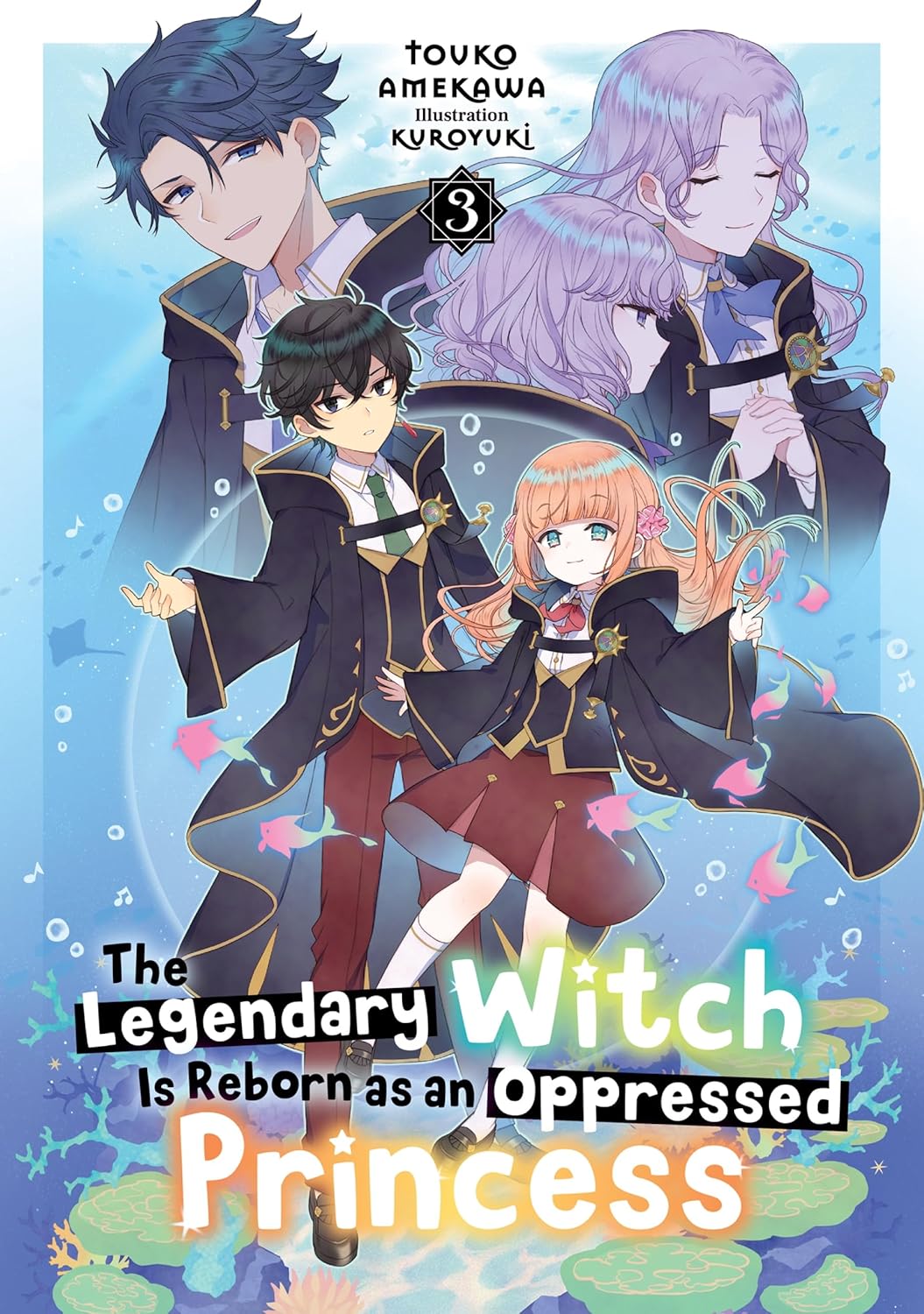
The Legendary Witch Is Reborn As an Oppressed Princess, Vol. 3

February 20, 2025 by Sean Gaffney

By Touko Amekawa and Kuroyuki. Released in Japan as “Shiitagerareta Tsuihou Oujo wa, Tenseishita Densetsu no Majo deshita: Mukae ni Koraretemo Komarumasu. Juuboku to no Ohirune wo Jamashinaide Kudasai” by Overlap Novels f. Released in North America by J-Novel Heart. Translated by Jeremy Browning.

I always enjoy mysteries with multiple twists, even if I figure out some of them. This series has been very good about giving us those twists, which is good, as despite the final scene this series is a lot less action packed than the author’s other book, 7th Time Loop. Claudia is ten now, and even more than the other two books she mostly acts like a ten-year-old… well, OK, a 6-year-old. Claudia likes to weaponize being an adorable child, and I think she overdoes it a bit. She’s a magical powerhouse, but that is, again, used mostly subtly till the very end. Mostly, Claudia enjoys being doted upon as a new girl at the academy, does quiet investigations, and tries to get Noah to meet his half-brother, which Noah, frankly, has no desire to do. And honestly, given events in this book, I can’t blame him. Claudia and Noah may be codependent, but they’re also what’s best for each other.

Claudia and Noah have entered an academy for nobles to learn magic, mostly as there’s another curse going on there. Ships have been disappearing, and since this school is under the sea, and exactly where the ships vanish, it’s a good guess that’s where the cause is. As it turns out, this school was created by Adelheid, 500 years ago, to promote equality. Which it, well, isn’t really pulling off. We meet a gorgeous 18-year-old who is the belle of the school, beloved by all. We also meet her 11-year-old sister, whose lack of control over her magic terrified everyone, and who now mostly holes up in her room. They both sing, and the thought is that it’s a song that’s the cause of the missing ships. Also, how does Sieghart, Noah’s brother, figure into this? And are all these curse cases tying together?

It’s hard to talk about the climax of the book without spoiling it, and I already discussed Claudia’s childishness, but it’s interesting to see that she still appears to be pushing Noah to try to understand the greater world around him, presumably so that one day, when she is gone, he can go on to greater things. This is despite the fact that, multiple times a day, he tells her how devoted to her he is and that leaving her side even for a moment makes him upset. The adult Adelheid wants to push Noah away, but the child Claudia, I think, wants him to be there and dote on her – or have her dote on him. It ties in nicely to the story of this volume, which features a curse set off by people desperately reaching out to family because, in the end, they’re not as mature and put together as they might actually pretend. Even the villain of this book is also pretending to be mature and in control but, well, isn’t.

Claudia looks grown up on the cover of the 4th book, but I don’t think we’ll jump that many years. In any case, this remains a fun and intriguing mystery with age-up and age-down shenanigans galore.

Filed Under: legendary witch is reborn as an oppressed princess, REVIEWS

I’ll Become a Villainess Who Goes Down in History: It Seems Turning into a High-Born Baddie Makes the Prince All the More Lovestruck, Vol. 1

February 19, 2025 by Sean Gaffney

By Izumi Okido and Jyun Hayase. Released in Japan as “Rekishi ni Nokoru Akujo ni Naru zo: Akuyaku Reijō ni Naru hodo Ōji no Dekiai wa Kasoku suru yō desu!” by B’s-LOG Bunko. Released in North America by Yen On. Translated by Sarah Moon.

This is the 2nd book that’s been licensed from the imprint B’s-LOG Bunko, the first being The Princess of Convenient Plot Devices, also from Yen On, and with a very similar vibe. Taking a look at the Japanese publisher’s page, the imprint is rife with villainesses, disgraced nobles, and young women striking out on their own by opening shops, etc. For all that we complain about isekai harems and villainess books being the only thing that gets picked up these days, there’s certainly ten times more of it in Japanese. We’ve had so many villainess books, in fact, that here we actually get someone who seems to be basing her idea of the archetype from light novels rather than otome games. A typical “villainess” is a shallow, vain bully who exists to get banished and/or killed, to the joy of the reader, right? Why would anyone want to be that?

A Japanese woman gets hit by a truck, and wakes up as a 7-year-old, Alicia Williams, the villainess of the game … actually, I don’t think the title of the game is mentioned by Alicia. She’s delighted, though. She has always loved villainesses, who need to be strong, powerful and caustic so that she could be a perfect match against the pure young heroine. Alicia therefore does a 180 from the spoiled, selfish girl Alicia was before, and asks for sword lessons. She’s told to do 100 situps and 50 pushups first… and does so. Then she goes and reads 100 books a day in the family library. Oh dear. It’s not clear if this is just due to being reincarnated, but it seems Alicia is a Divergent, someone with super special abilities whose presence can change the world. And so the King decides that she’s going to help the actual heroine, Liz, who is, frankly, a bit too idealistic. Can Alicia do that, even though it might mean being hated? She can’t wait.

The author says they wanted to contrast the idealism of Liz’s heroine with Alicia’s pragmatism, and honestly, has stacked the decks against Liz. To its credit, Liz isn’t an idiot like some other Villainess books, and I suspect she’s not going to turn evil anytime soon. That said, the way everyone is taken with Alicia immediately as a child, then all fall for Liz and start to turn against Alicia later on, shows she’s using some sort of heroine power, though it’s unclear what. The most interesting thing here is that Alicia is five years younger than everyone, including Liz. This allows her to become super special in order to catch up, as she isn’t being told “that’s impossible” by anyone till after she does it. That said, be warned: there’s a lot of people falling in love with Alicia when she’s only 7-13 years old (there’s a 6 year timespan in this book), and the book ends with everyone looking forward to her being 15, which is legal in Villainesslandia. Sigh.

This got an anime, which I haven’t seen but which seems to have been “good except the animation quality”. It made me want to read more, creepy love interest obsession aside. That’s almost a given for shoujo these days. Recommended for genre fans.

Filed Under: i'll become a villainess who goes down in history, REVIEWS

Love & Magic Academy: Who Cares about the Heroine and Villainess? I Want to Be the Strongest in this Otome Game World, Vol. 1

February 18, 2025 by Sean Gaffney

By Toyozo Okamura and Parum. Released in Japan as “Renai Mahou Gakuin: Heroine mo Akuyaku Reijou mo Kankeinai. Ore wa Otome Game Sekai de Saikyou wo Mezasu” by GC Novels. Released in North America by Cross Infinite World. Translated by Jordan Taylor.

For obvious reasons, I write these reviews as if people are coming across these reviews individually rather than sequentially. That said, if you are reading these day by day… boy, there’s been a lot of overpowered protagonists, right? I mean, yes, Sean, it’s a light novel, but even more so than usual. Arius in particular, in this book written around 2021-22 or so, feels like a Fanfiction.net story from 2009 or so. You know, the ones that have “Dark/Grey/Independent Harry” in the summary. I will not lie, this book is filled with tedious scenes of Arius marching through dungeons, or criticizing others for marching through dungeons wrong, and generally being the best thing since sliced bread. That said, I did find things here to like. Most of them have to do with the parts of this book that are not a dungeon crawl, as it’s another otome game reincarnation story.

A nameless college researcher dies from overwork and finds himself as a baby – with his full memories from Japan – and realizes he’s in the otome game Love & Magic Academy. His childhood friend was obsessed with it and forced him to play it, so he knows how it’s supposed to go. He also knows that the makers of the game wanted to make an RPG, but it failed, so they laid over the otome game setup but kept the RPG undertones, meaning this world is filled with terrifying monsters (who are polite enough to stay in dungeons). Arius, as he grows up, decides to become a strong adventurer and fight amazing battles. That said, he does also need to do the whole “I am the son of a marquis and have to attend the noble magic academy” thing. But he’s not following the plot.

So I did promise I’d talk about what’s interesting. The interesting thing, for me, was that this is a rare case where no one is particularly trying to stick to the plot. Arius isn’t. The “heroine”, Milia, at first feels she has to, but eventually Arius convinces her that these are not characters but people. And there is not, so far, any “guiding force” that is forcing the events of the game to happen regardless of how everyone acts. It’s honestly refreshing, a huge “free will, boys!” moment that suffuses the book. I also appreciated how, for all his cool “I’m not interested in romance” bullshit, Arius actually does get to be a teenage boy near the end of the book, as he clearly realizes he likes noble “villainess” Sophia, but she’s engaged to the prince, so welp. (It’s also heavily hinted, but never stated, that Milia is the “childhood friend” he had in Japan.) More of Arius being uncool, please.

I’m not sure there’s enough here to make people want to read it unless their ability to tolerate OP bullshit is high (he’s speaking full sentences to his parents at six months old). But if you gotta catch all the otome game books, this won’t make you angry. Decent-ish.

Filed Under: love & magic academy, REVIEWS

Loner Life in Another World, Vol. 11

February 17, 2025 by Sean Gaffney

By Shoji Goji and Saku Enomaru. Released in Japan as “Hitoribocchi no Isekai Kouryaku” by Overlap Bunko. Released in North America by Airship. Translated by Andrew Schubauer.

This series continues to be a masterclass in doing things that I find questionable and them making them heartwarming anyway. Class Rep talks here about Haruka using “Eye Mastery”, which is basically a brainwashing skill that lets him read someone’s mind and then alter their memories. He uses it here on some nuns that were about to be raped by the Church soldiers, as this world, as we are constantly reminded, is awful. I wasn’t happy with hearing that he’d been using it on the girls for a long time now, keeping them content and selfish, fighting over clothes and equipment and being goofy. He wanted them to be unaffected by this crapsack world. Sadly for him, they’ve all now leveled up enough so that it doesn’t affect them anymore, and thus they go to battle knowing full well what the Church’s soldiers have been doing. And they kill them. A lot of them. This is war, and our heroines are no longer going to be kept out of it. Innocent no more.

Our cast are headed off to the theocracy, there to take on the Church who are responsible for so much of the evil in this world. (We meet the Pope here, and he’s cartoonishly evil.) Sister Girl, who is (natch) a princess, will be leading the charge, backed up by Princess Girl, MeriMeri, the 20 girls of Haruka’s group, and Armored Rep as backup in case anything goes wrong. Meanwhile, Haruka and Dancer Girl are headed off to the capital itself, to deliver letters to various cities letting them know that The revolution is coming, and it’s time to break off and join it. They’re also there to kick ass, murder a metric fuckton of goons and assassins, and along the way, pick up a rabbit girl (on the cover), who is searching for her sister, kidnapped by the Church. Her sister is a wolf girl, by the way. Haruka is over the moon, but also a bit disturbed that these two are such an obvious chuuni stereotype.

I deliberately avoided using any names except for Haruka there, because that’s how he thinks. It’s underlined in this volume, where the girls once again yell at him for not using their names, getting their backgrounds wrong, and forgetting the name of their own school. Haruka’s subtext has rapidly become text. (Class Rep mentions the deaths of Haruka’s parents and sister here, though we get no details.) The running gag in the book is that Rabbit Girl and Wolf Girl, who are desperate to thank him for saving them and want to ask if there’s anything they can do for him (sorry, kids, you’re too young for Haruka to feel comfortable with), always have food stuffed in their mouths by him to shut them up, because the idea of hearing himself praised for doing what is essentially a giant pile of murders bothers him more than he can say. (And, just to bring the book back around to its core again, yes, a lot of the time when he’s shoving food in their mouths it’s meant to be phallic.)

Again, this book is for hardcore fans only, but if you are one, it’s always rewarding. And completely filthy, of course. I assume next volume we’ll get a new Dungeon Emperor, and I’m sure she’ll end up being gorgeous. This series is what it is.

Filed Under: loner life in another world, REVIEWS

Mercedes and the Waning Moon: The Dungeoneering Feats of a Discarded Vampire Aristocrat, Vol. 1

February 17, 2025 by Sean Gaffney

By Fire head and KeG. Released in Japan as “Kaketa Tsuki no Mercedes: Kyūketsuki no Kizoku ni Tensei Shita kedo Suteraresō nanode Dungeon wo Seiha suru” by TO Books. Released in North America by J-Novel Club. Translated by Maddy Willette.

Let’s face it. At its heart, this is a story about a girl who starts off ludicrously OP and just gets even more so. She’s of the stoic variety, but otherwise she fits the stereotype perfectly. She defeats monsters who “swear eternal loyalty” to her, though of course the word slave is not used. If you dislike this sort of book, then this is absolutely not a book that is going to change your mind. I kinda liked it, though. It has a gimmick that took me a while to figure out, which I’ll get to below. It has a few people other than our somewhat sociopathic heroine who have actual heart and soul, though honestly this is not a world for nice people to be nice in. And honestly, I just kinda got on with Mercedes. It’s the sort of power fantasy I don’t mind reading.

Our heroine is Mercedes, a young vampire who has (yes, I’m sorry) memories of her past life in Japan. (Yes, she invents chocolate. Sorry.) She’s the daughter of a concubine, and she and her mother live in a run-down decaying mansion, abandoned by her father. So she decides to become an adventurer. She trains hard to make herself strong, though because she never sees anyone other than her mother and maid, she has no idea how strong she is compared to others. And then she heads off to take on a dungeon and do quests. Which… turns out pretty easy, actually. She even tames an ogre and a dangerous wolf to act as her companions. Could she actually be really strong? Nah. But she’ll soon find out, as her older half-brother is holding a party where he plans to beat up the rest of his family to prove he’s best.

At first I wondered if this series was a satire, as Mercedes continually points out the cliches and weird things about her world. It’s medieval in tone, but has some 21st century amenities. It combines a tourist’s idea of Germany with Japanese writing. It is, in fact, exactly like you’d expect an isekai written by a writer who’s just taking a standard RPG setting and doesn’t care much to be. But, as it turns out, there may be more to it than that, as when she conquers the dungeon (which features a slew of cliches, including her confronting her also sociopathic past self) she learns that this world was created in the past, and records of its past then excised. I hope we come back to this. As for the rest of the book, I liked Mercedes’ interaction with Margaret, which is possibly the only point in the book she shows that she’s not simply exactly the same as her father. Just… mostly the same.

That plotline will play out in the second volume, I assume. Provided you don’t mind everything about its genre, this is quite enjoyable.

Filed Under: mercedes and the waning moon, REVIEWS

Trillion Game, Vol. 1

February 16, 2025 by Katherine Dacey

By all rights, Trillion Game should be a blast. Creators Riichiro Inagaki and Ryoichi Ikegami have more than a dozen hit series to their names—including Eyeshield 21, Dr. Stone, Sanctuary, and Crying Freeman—and a flair for writing shamelessly entertaining stories that burst at the seams with crazed villains, over-the-top plot twists, and jaw-dropping action scenes. Trillion Game, however, is just plain bad, saddled with a premise so dumb I’m almost embarrassed to type it: a young man sets out to be the first Japanese entrepreneur to make a trillion dollars without an actual plan for achieving that goal.

A dumb premise isn’t automatically a deal-killer; executed with panache, a silly idea can still work if the reader feels invested in the main character’s success. Trillion Game, however, has both a dumb premise and an awful lead who is less a person than a teenage male fantasy, a ruthless entrepreneur who weaponizes his charm and good looks to get what he wants. Haru lies, bluffs, and cheats, manifesting new talents—say, bantering in Mandarin or scaling skyscrapers—whenever the plot demands, prompting other characters to gush about his charisma and business acumen. His only redeeming quality is his unwavering loyalty to friend and business partner Gaku, a helmet-haired nerd with computer skills. Even that relationship is fraught, however, as Haru repeatedly puts Gaku into situations that test the limits of his abilities.

The other issue plaguing Trillion Game is its sincerity: we’re supposed to admire Haru’s audacious, go-for-broke style, even when his behavior seems more sociopathic than strategic. No matter what he does, Haru always gets the best of his opponents, especially when they appear to be more logical, experienced, or perceptive than he is. That dynamic is most evident in his interactions with the beautiful, inscrutable Kirika Kokuryū, a.k.a. “Kirihime,” a twenty-six-year-old wunderkind who helps her father run the all-powerful Dragon Bank. Any time she gets the upper hand in her dealings with Haru and Gaku, the authors undercut Kirihime’s authority by dreaming up new ways to humiliate her while suggesting she’s turned on by Haru’s cutthroat tactics.

The only bright spot is Ikegami’s artwork. As he did in series like Samurai Crusader and The Wounded Man, Ikegami populates the story with attractive leads while rendering the supporting players as caricatures, making it easy to keep track of the sprawling cast. The layouts, too, are easy to scan: they’re dynamic and detailed, capturing the density and opulence of Tokyo’s financial district with the same degree of realism as the spartan office that Haru and Gaku rent.

No amount of stylish artwork, though, can disguise the fact that Trillion Game feels like an macho artifact of the 1980s, a Wall Street for the Young Jump reader. I have no doubt that there are folks who will love this series, but I found it impossible to get swept up in Haru’s embrace of greed and deceit, especially when he approvingly cites broligarchs like Mark Zuckerberg and Jeff Bezos as an inspiration. Not recommended.

TRILLION GAME, VOL. 1 • STORY BY RIICHIRO INAGAKI • ART BY RYOICHI IKEGAMI • TRANSLATED BY STEPHEN PAUL • TOUCH-UP & LETTERING BY JOANNA ESTEP • VIZ MEDIA • RATED M FOR MATURE (NUDITY, SEXUAL REFERENCES) • 208 pp.

Filed Under: Manga, Manga Critic, REVIEWS Tagged With: Riichiro Inagaki, Ryoichi Ikegami, Seinen, VIZ, VIZ Signature

Lycoris Recoil: Ordinary Days

February 15, 2025 by Sean Gaffney

By Asaura, imigimuru, and Spider Lily. Released in Japan by Dengeki Bunko. Released in North America by Yen On. Translated by Kiki Piatkowska.

Lycoris Recoil ended up being the big hit of Fall 2022, and evidence of that hit is starting to trickle over here to manga and light novels. The manga began a few months ago, and a manga anthology was just licensed last week. And we also have this spinoff, a Dengeki Bunko short story collection featuring some of the stories that the creator was not able to fit into the 13-episode anime. It feels like a regular old short story collection. I’ve talked before about how these seem to either be front-loaded (best stories come first) or back-loaded (best stories go last). This one turns out to be middle-loaded – the three stories in the center of the book are pretty damn good, but the first main story is incredibly irritating, and the last story is monumentally bleak and awful. Fortunately, we have the main cast. Well, we have Chisato and Takina. As with the anime, the other three “main” cast are mostly here to be support, though Mika gets some nice scenes. But it’s about our girls.

The wraparound story in this volume is about a reporter who wants to do a feature on the LycoReco cafe. He’s sensibly told “no”, but hangs out at the cafe anyway, as it’s a great place to come up with ideas. The main stories: 1) a recently retired man comes to the cafe but seems depressed, and Takina is showing him a lot of attention. Chisato thinks that this might be… love! 2) Chisato and Takina infiltrate a hideout pushing drugs, featuring a very big foreign man who hates the weak coffee Japan has; 3) Takina’s extreme way of thinking has led to increasingly spartan lunches when it’s her turn to cook, and the cast try to figure out a way to tell her “vary the menu” without upsetting her; 4) Takina wakes up to find that Japan is overrun by zombies, and she and Chisato have to battle their way out of the cafe and find help; and 5) a middle schooler who’s been enjoying the cafe turns out to have a terrible home life, and terrible school life, and has decided to murder everyone who is bullying her. Will she ask for help before it’s too late?

So, I know Japan is different, but I’m pretty sure the North American audience who wanted to read 50 pages of “is Takina in love with a 55-year-old dude?” is precisely zero. It’s meant to be in the genre of “Chisato inspires people”, but did less than nothing for me. As for the last story, after a while I started to skim, because it’s so unrelenting grim that I was not having fun – the reverse, it drags the entire end of the book down. I also note that the author should not have had one bad guy say that he wanted a really good cup of coffee and then not pay it off later with Chisato getting him one, that was a missed moment there. The best story by far is the zombie one, and it’s no surprise that it’s the one that focuses most on the relationship between Chisato and Takina, and where along the yuri spectrum it lies. Takina’s headspace is fascinating.

So a mixed bag, which this was always going to be, but not a total loss. For fans of the anime.

Filed Under: lycoris recoil, REVIEWS

The Hero and the Sage, Reincarnated and Engaged, Vol. 3

February 15, 2025 by Sean Gaffney

By Washiro Fujiki and Heiro. Released in Japan as “Eiyū to Kenja no Tensei Kon: Katsute no Kōtekishu to Konyaku Shite Saikyō Fūfu ni Narimashita” by HJ Bunko. Released in North America by J-Novel Club. Translated by Joey Antonio.

I regret to tell you that this series has become difficult to write about. Oh, it’s still good. I quite enjoyed this volume, and will read more. It’s sometimes funny, the OP-ness isn’t ludicrous (unless it’s because it’s funny), and the characters are all interesting and not annoying (except that one guy, and he’s now comedy relief). But aside from one plot point, which I’m saving for later in the review so it’s not just 500 words of me whining, there’s nothing here to jabber on about. I suppose I can talk about how this is an overpowered protagonist fantasy that is not meant to really have the reader identify with it. Raid is not just “potato with a +infinity sword”, and Eluria is his co-star rather than just love interest. The climax of the book is not “oh my God, how will our two heroes possibly defeat this thing that is beyond their abilities”, it is “wow, a monster so powerful that they don’t have to be told to hold back and can go all out”.

It’s time to prepare for exams! …well, for everyone except our lead couple, who are going to take the time to investigate the ruins of Raid’s old country. Everyone ends up at the water resort city of Palmare, where Raid and Eluria put their friends, rival, and rival’s maid and butler through some awful torture… pardon me, I meant excellent training. They then meet up with two sorcerers – note the different magic terminology – from the nearby country of Legnare. They are also powerhouses, and consist of Totori (young-looking girl who’s actually over 100, has cat ears) and Savad (her husband, seemingly normal but we’ll find out that’s not true). The four of them, plus Alma (who admits in text she’s a fifth wheel, and she’s right) are off to investigate Raid’s old country… and there they find it’s not as abandoned as previously thought.

The interesting bits in this book (an d again, I enjoyed the book, it’s just the first 2/3 are froth I can’t analyze) are right near the end. Last time I theorized that we might be seeing a child from the future plot going on, and that turns out to… sort of be true, but not remotely in the way I thought it would be. The cliffhanger ending, which I will try not to spoil is also another good example of this series taking a seemingly silly, comedy character (see Millis, for example) and then showing off their depth (as in Millis), or showing off that it’s all a front. As for the love comedy part of the series, aside from the running gag of the flirting, I did like how, at one point where Eluria appears to be having a genuine crisis, Raid steps in immediately and diffuses it in ten seconds. In any other series, these two already having had all their character development before the plot begins might be tedious. Here I think it’s the point.

So: good stuff, cute couple. They like to fight. Their relationship even progresses here. The next book should develop the future/past/present time travel stuff a bit more, but I think it will end up being cute flirting 60% of the time.

Filed Under: hero and the sage reincarnated and engaged, REVIEWS

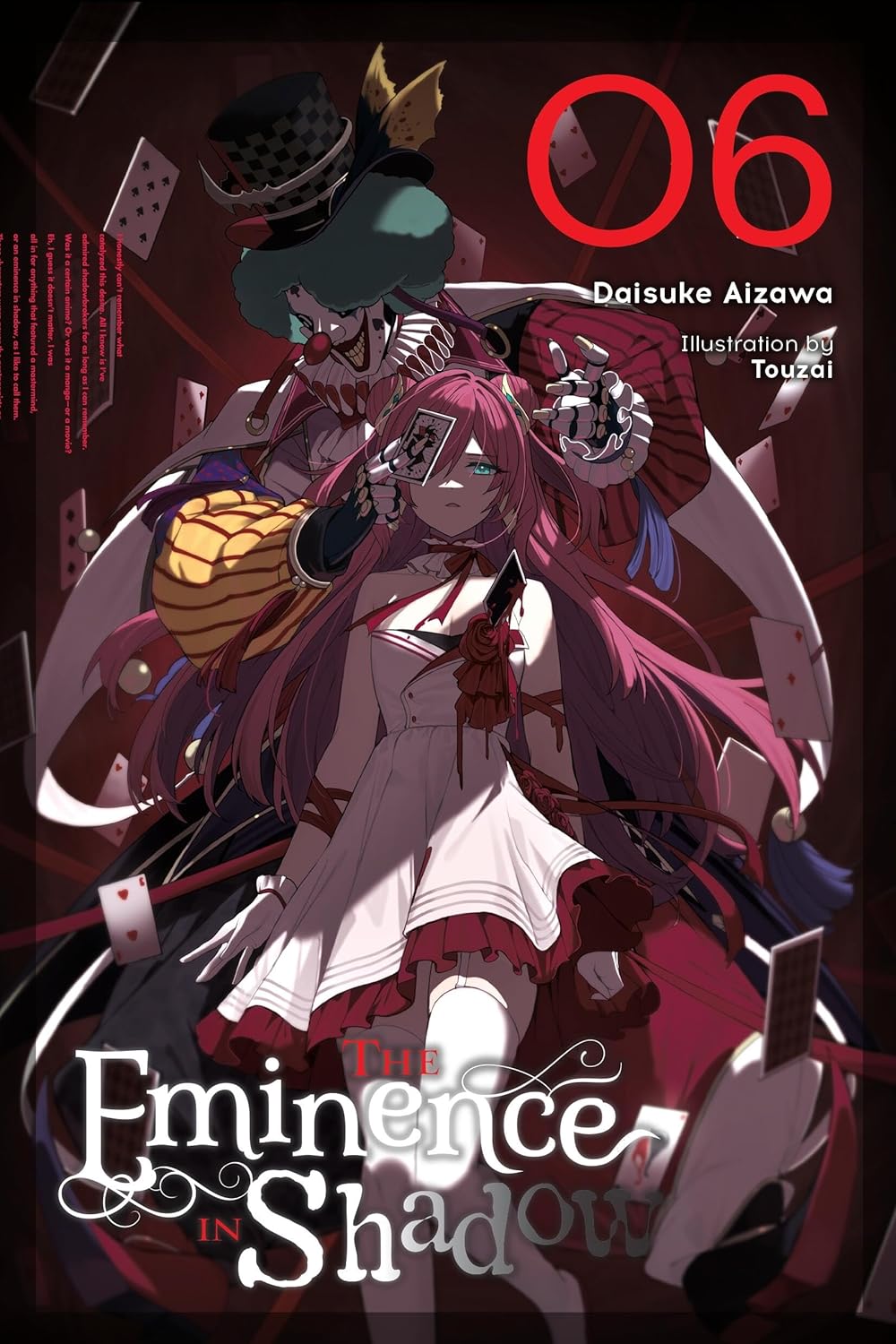
The Eminence in Shadow, Vol. 6

February 13, 2025 by Sean Gaffney

By Daisuke Aizawa and Touzai. Released in Japan as “Kage no Jitsuryokusha ni Naritakute!” by Enterbrain. Released in North America by Yen On. Translated by Nathaniel Hiroshi Thrasher.

I think I am finally, mostly, beginning to give in and accept the series’ vibe, and the fact that it’s written as a ridiculously overblown piece of… satire is wrong, but so is parody and comedy, to be honest. I’ll roll with it. Also, I’m sure those terrible, terrible name puns (and there are a LOT more in this book, like four times more) are just as bad if not worse in Japanese, so I will forgive the translator… just. That said, we are running into a really big issue with this series, which is that it is very dependent on remembering things from previous books, but it only comes out once in a blue moon. I reviewed the first volume in 2020, and here it is 2025, and we’re only on Book 6. Worse, Book 6 came out in Japan in 2023, and there’s no new book on the horizon. So yeah, apologies, little girl from apparently Vol. 1 who was meant to be tragic. I had forgotten about you. As had Cid, I think.

After the events of the last book, evil noble Eliza is manipulating things to make sure she’s found innocent, and is also planning to quietly do away with the star witness (who we find out here is named Kanade, and oh my god, more on her later). Christina Hope is trying to prevent this, but her family is actively hindering her, and all she can do is take Kanade and that annoying background extra Cid, who seems to have found definitive evidence, to one of her villas to hide from assassins. Meanwhile, the latest Mysterious Evil Group of Evil are indeed planning to kill Kanade (and Christina, and Cid, and possibly Alexia if they could get away with it), but all of a sudden they’re getting killed off one by one by a man covered in blood, dressed as a clown, and calling himself Jack the Ripper. Who could this mysterious assassin be? Who?

I won’t deny that this volume was helped by having slightly less Cid than usual. Also, Kanade is hilarious, and I hope we see more of her. If Cid is a chuuni who has ended up in a dream world that runs along his desires, then Kanade is that sidekick girl in a shonen manga who keeps trying to be cute and sexy but ends up looking stupid all the time instead. She and Cid are wonderful together, and I’m, glad she doesn’t die. Also, finally, we get Akane back into the storyline, though she’s a bit stunned to find she’s suddenly one of the weaker characters. Naturally, she ends up in Shadow Garden… as does a victim from the first volume, who has Cid literally cut the monster out of her. This scene is, honestly, as heartwarming as this series will ever get, and I hope she and Akane bond.

So yeah. This was good, especially Christina’s character arc. I will try not to take it too seriously. I will also be waiting a while for the next volume, though.

Filed Under: eminence in shadow, REVIEWS

Let’s Get to Villainessin’: Stratagems of a Former Commoner, Vol. 2

February 12, 2025 by Sean Gaffney

By Hiironoame and Misumi. Released in Japan as “Sa, Akuyaku Reijou no Oshigoto wo Hajimemashou: Moto Shomin no Watashi ga Idomu Zunousen” by PASH! Bunko. Released in North America by Cross Infinite World. Translated by Dawson Chen.

I have a dog, and I love my dog. Occasionally, though, I want my dog to stay out in the yard for a bit. And my dog, he does not want to stay out in the yard. And so he throws himself at the back door. Over. And Over. And Over Again. He will do this for up to three hours or so, knowing that eventually I will get annoyed enough to let him back in. As I was reading this volume, and watching Mio hurling herself at “villainessin'” time and time again, I was reminded of my dog, as it takes real stubbornness to do. Yes, I am aware that her sister’s life hangs in the balance, but frankly, I appreciate Mio doing this, as everyone else in the book is taking things extremely seriously, and at least Mio being the most obvious tsundere ever leads to the book’s moments of hilarity. That she’s so bad at being bad is the point.

Mio has been doing… well, not great, but at least she’s so far managed to avoid falling flat on her face. The same can’t be said for her two “minions” who got humiliated last volume, and Mio’s new mission is to rehabilitate them and bring them back in the fold. She’ll have to do this while also negotiating the school’s sports festival, which (in the game) she played a minor part in. Unfortunately, Mio’s actions so far are starting to have knock-on effects elsewhere in the world, and her attempts to prove to herself that she can, in fact, affect things so they’re not quite like the game’s plot may end up getting her in a ton of trouble. Trouble that she can only get out of by – finally – genuinely being cruel.

I mentioned Mio being the one comedic part of this book, and that’s because when I try to imagine the rest of the cast watching her, I can feel their frustration and helplessness. They know she’s a good, kind person. They know she’s acting this way on purpose. And they know she’s determined to drag her own reputation in the mud. But they don’t know why, and it’s maddening. They don’t have the Shizuku piece of the puzzle. (The names, by the way, are just as bad as before, and this volume we have a Miyu pretending to be a Miu to confuse Mio. It’s so bad that I think even the translator/editor get Shizuki and Shizuku mixed up once or twice) Fortunately, Nonoka is straight from the Maria Campbell school, and her faith in Mio (and, it’s hinted, slight crush on Mio) remains steadfast. The end of this volume also brings a fake engagement into the mix, so the third volume would be very interesting…

…if it existed. I think even the webnovel version of the story ends with this volume. Which is a shame, as I kind of wanted to see Mio continue to throw herself against my back door.

Filed Under: let's get to villainessin', REVIEWS

  • « Go to Previous Page
  • Page 1
  • Interim pages omitted …
  • Page 21
  • Page 22
  • Page 23
  • Page 24
  • Page 25
  • Interim pages omitted …
  • Page 346
  • Go to Next Page »
 | Log in
Copyright © 2010 Manga Bookshelf | Powered by WordPress & the Genesis Framework